Search Results: "ag"

18 August 2020

Lisandro Dami n Nicanor P rez Meyer: Stepping down as Qt 6 maintainers

After quite some time maintaining Qt in Debian both Dmitry Shachnev and I decided to not maintain Qt 6 when it's published (expected in December 2020, see https://wiki.qt.io/Qt_6.0_Release). We will do our best to keep the Qt 5 codebase up and running.

We **love** Qt, but it's a huge codebase and requires time and build power, both things that we are currently lacking, so we decided it's time for us to step down and pass the torch. And a new major version seems the right point to do that.

We will be happy to review and/or sponsor other people's work or even occasionally do uploads, but we can't promise to do it regularly.

Some things we think potential Qt 6 maintainers should be familiar with are, of course, C++ packaging (specially symbols files) and CMake, as Qt 6 will be built with it.

We also encourage prospective maintainers to remove the source's -everywhere-src suffixes and just keep the base names as source package names: qtbase6, qtdeclarative6, etc.

It has been an interesting ride all these years, we really hope you enjoyed using Qt.

Thanks for everything,

Dmitry and Lisandro.Note 20200818 12:12 ARST: I was asked if the move has anything to do with code quality or licensing. The answer is a huge no, Qt is a **great** project which we love. As stated before it's mostly about lack of free time to properly maintain it.


17 August 2020

Ian Jackson: Doctrinal obstructiveness in Free Software

Any software system has underlying design principles, and any software project has process rules. But I seem to be seeing more often, a pathological pattern where abstract and shakily-grounded broad principles, and even contrived and sophistic objections, are used to block sensible changes. Today I will go through an example in detail, before ending with a plea: PostgreSQL query planner, WITH [MATERIALIZED] optimisation fence Background history PostgreSQL has a sophisticated query planner which usually gets the right answer. For good reasons, the pgsql project has resisted providing lots of knobs to control query planning. But there are a few ways to influence the query planner, for when the programmer knows more than the planner. One of these is the use of a WITH common table expression. In pgsql versions prior to 12, the planner would first make a plan for the WITH clause; and then, it would make a plan for the second half, counting the WITH clause's likely output as a given. So WITH acts as an "optimisation fence". This was documented in the manual - not entirely clearly, but a careful reading of the docs reveals this behaviour:
The WITH query will generally be evaluated as written, without suppression of rows that the parent query might discard afterwards.
Users (authors of applications which use PostgreSQL) have been using this technique for a long time. New behaviour in PostgreSQL 12 In PostgreSQL 12 upstream were able to make the query planner more sophisticated. In particular, it is now often capable of looking "into" the WITH common table expression. Much of the time this will make things better and faster. But if WITH was being used for its side-effect as an optimisation fence, this change will break things: queries that ran very quickly in earlier versions might now run very slowly. Helpfully, pgsql 12 still has a way to specify an optimisation fence: specifying WITH ... AS MATERIALIZED in the query. So far so good. Upgrade path for existing users of WITH fence But what about the upgrade path for existing users of the WITH fence behaviour? Such users will have to update their queries to add AS MATERIALIZED. This is a small change. Having to update a query like this is part of routine software maintenance and not in itself very objectionable. However, this change cannnot be made in advance because pgsql versions prior to 12 will reject the new syntax. So the users are in a bit of a bind. The old query syntax can be unuseably slow with the new database and the new syntax is rejected by the old database. Upgrading both the database and the application, in lockstep, is a flag day upgrade, which every good sysadmin will want to avoid. A solution to this problem Colin Watson proposed a very simple solution: make the earlier PostgreSQL versions accept the new MATERIALIZED syntax. This is correct since the new syntax specifies precisely the actual behaviour of the old databases. It has no deleterious effect on any users of older pgsql versions. It makes it possible to add the new syntax to the application, before doing the database upgrade, decoupling the two upgrades. Colin Watson even provided an implementation of this proposal. The solution is rejected by upstream Unfortunately upstream did not accept this idea. You can read the whole thread yourself if you like. But in summary, the objections were (italic indicates literal quotes): I find these extremely unconvincing, even taken together. Many of them are very unattractive things to hear one's upstream saying. At best they are knee-jerk and inflexible application of very general principles. The authors of these objections seem to have lost sight of the fact that these principles have a purpose. When these kind of software principles work against their purposes, they should be revised, or exceptions made. At worst, it looks like a collective effort to find reasons - any reasons, no matter how bad - not to make this change. The OFFSET 0 trick One of the responses in the thread mentions OFFSET 0. As part of writing the queries in the Xen Project CI system, and preparing for our system upgrade, I had carefully read the relevant pgsql documentation. This OFFSET 0 trick was new to me. But, now that I know the answer, it is easy to provide the right search terms and find, for example, this answer on stackmumble. Apparently adding a no-op OFFSET 0 to the subquery defeats the pgsql 12 query planner's ability to see into the subquery.
I think OFFSET 0 is the better approach since it's more obviously a hack showing that something weird is going on, and it's unlikely we'll ever change the optimiser behaviour around OFFSET 0 ... wheras hopefully CTEs will become inlineable at some point CTEs became inlineable by default in PostgreSQL 12.
So in fact there is a syntax for an optimisation fence that is accepted by both earlier and later PostgreSQL versions. It's even recommended by pgsql devs. It's just not documented, and is described by pgsql developers as a "hack". Astonishingly, the fact that it is a "hack" is given as a reason to use it! Well, I have therefore deployed this "hack". No doubt it will stay in our codebase indefinitely. Please don't be like that! I could come up with a lot more examples of other projects that have exhibited similar arrogance. It is becoming a plague! But every example is contentious, and I don't really feel I need to annoy a dozen separate Free Software communities. So I won't make a laundry list of obstructiveness. If you are an upstream software developer, or a distributor of software to users (eg, a distro maintainer), you have a lot of practical power. In theory it is Free Software so your users could just change it themselves. But for a user or downstream, carrying a patch is often an unsustainable amount of work and risk. Most of us have patches we would love to be running, but which we haven't even written because simply running a nonstandard build is too difficult, no matter how technically excellent our delta. As an upstream, it is very easy to get into a mindset of defending your code's existing behaviour, and to turn your project's guidelines into inflexible rules. Constant exposure to users who make silly mistakes, and rudely ask for absurd changes, can lead to core project members feeling embattled. But there is no need for an upstream to feel embattled! You have the vast majority of the power over the software, and over your project communication fora. Use that power consciously, for good. I can't say that arrogance will hurt you in the short term. Users of software with obstructive upstreams do not have many good immediate options. But we do have longer-term choices: we can choose which software to use, and we can choose whether to try to help improve the software we use. After reading Colin's experience, I am less likely to try to help improve the experience of other PostgreSQL users by contributing upstream. It doesn't seem like there would be any point. Indeed, instead of helping the PostgreSQL community I am now using them as an example of bad practice. I'm only half sorry about that.

comment count unavailable comments

Norbert Preining: KDE Apps 20.08 now available for Debian

KDE Apps bundle 20.08 has been released recently, and some of the packages are already updated in Debian/unstable. I have updated also all my packages to 20.08 and they are now available for x86_64, i586, and hopefully aarch64 (some issues remaining here still). With the new release 20.08 I have also switched to versioned app repositories, so you need to update the apt sources directive. The new one is
deb https://download.opensuse.org/repositories/home:/npreining:/debian-kde:/apps2008/Debian_Unstable/ ./
and similar for Testing. Packages from the other repo that depend on apps, that is in particular Digikam, are currently rebuild and will be coinstallable soon. Just to make sure, here is the full set of repositories I use on my computers:
deb https://download.opensuse.org/repositories/home:/npreining:/debian-kde:/other-deps/Debian_Unstable/ ./
deb https://download.opensuse.org/repositories/home:/npreining:/debian-kde:/frameworks/Debian_Unstable/ ./
deb https://download.opensuse.org/repositories/home:/npreining:/debian-kde:/plasma519/Debian_Unstable/ ./
deb https://download.opensuse.org/repositories/home:/npreining:/debian-kde:/apps2008/Debian_Unstable/ ./
deb https://download.opensuse.org/repositories/home:/npreining:/debian-kde:/other/Debian_Unstable/ ./
Enjoy.

Arnaud Rebillout: Modify Vim syntax files for your taste

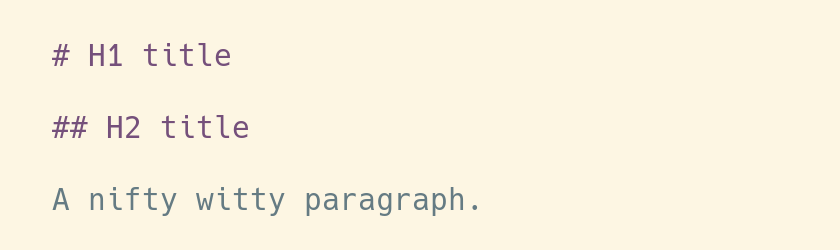
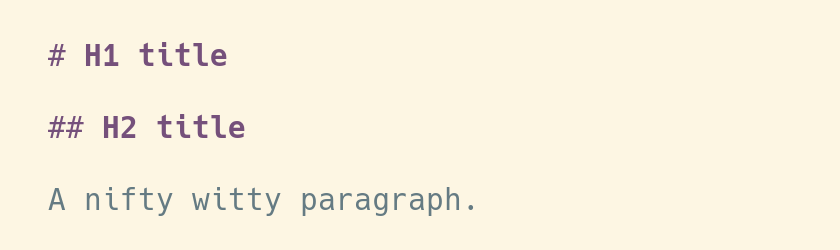
In this short how-to, we'll see how to make small modifications to a Vim syntax file, in order to change how a particular file format is highlighted. We'll go for a simple use-case: modify the Markdown syntax file, so that H1 and H2 headings (titles and subtitles, if you prefer) are displayed in bold. Of course, this won't be exactly as easy as expected, but no worries, we'll succeed in the end. The calling Let's start with a screenshot: how Vim displays Markdown files for me, someone who use the GNOME terminal with the Solarized light theme. Vim - Markdown file with original highlighting I'm mostly happy with that, except for one or two little details. I'd like to have the titles displayed in bold, for example, so that they're easier to spot when I skim through a Markdown file. It seems like a simple thing to ask, so I hope there can be a simple solution. The first steps Let's learn the basics. In Vim world, the rules to highlight files formats are defined in the directory /usr/share/vim/vim82/syntax (I bet you'll have to adjust this path depending on the version of Vim that is installed on your system). And so, for the Markdown file format, the rules are defined in the file /usr/share/vim/vim82/syntax/markdown.vim. The first thing we could do is to have a look at this file, try to make sense of it, and maybe start to make some modifications. But wait a moment. You should know that modifying a system file is not a great idea. First because your changes will be lost as soon as an update kicks in and the package manager replaces this file by a new version. Second, because you will quickly forget what files you modified, and what were your modifications, and if you do that too much, you might experience what is called "maintenance headache" in the long run. So instead, maybe you DO NOT modify this file, and instead you copy it in your personal Vim folder, more precisely in ~/.vim/syntax. Create this directory if it does not exist:
mkdir -p ~/.vim/syntax
cp /usr/share/vim/vim82/syntax/markdown.vim ~/.vim/syntax
The file in your personal folder takes precedence over the system file of the same name in /usr/share/vim/vim82/syntax/, it is a replacement for the existing syntax files. And so from now on, Vim uses the file ~/.vim/syntax/markdown.vim, and this is where we can make our modifications. (And by the way, this is explained in the Vim faq-24.12) And so, it's already nice to know all of that, but wait, there's even better. There's is another location of interest, and it is ~/.vim/after/syntax. You can drop syntax files in this directory, and these files are treated as additions to the existing syntax. So if you only want to make slight modifications, that's the way to go. (And by the way, this is explained in the Vim faq-24.11) So let's forget about a syntax replacement in ~/.vim/syntax/markdown.vim, and instead let's go for some syntax additions in ~/.vim/after/syntax/markdown.vim.
mkdir -p ~/.vim/after/syntax
touch ~/.vim/after/syntax/markdown.vim
Now, let's answer the initial question: how do we modify the highlighting rules for Markdown files, so that the titles are displayed in bold? First, we have to understand where are the rules that define the highlighting for titles. Here there are, from the file /usr/share/vim/vim82/syntax/markdown.vim:
hi def link markdownH1 htmlH1
hi def link markdownH2 htmlH2
hi def link markdownH3 htmlH3
...
You should know that H1 means Heading 1, and so on, and so we want to make H1 and H2 bold. What we can see here is that the headings in the Markdown files are highlighted like the headings in HTML files, and this is obviously defined in the file /usr/share/vim/vim82/syntax/html.vim. So let's have a look into this file:
hi def link htmlH1 Title
hi def link htmlH2 htmlH1
hi def link htmlH3 htmlH2
...
Let's keep digging a bit. Where is Title defined? For those using the default color scheme like me, this is defined straight in the Vim source code, in the file src/highlight.c.
CENT("Title term=bold ctermfg=DarkMagenta",
     "Title term=bold ctermfg=DarkMagenta gui=bold guifg=Magenta"),
And for those using custom color schemes, it might be defined in a file under /usr/share/vim/vim82/colors/. Alright, so how do we override that? We can just define this kind of rules in our syntax additions file at ~/.vim/after/syntax/markdown.vim:
hi link markdownH1 markdownHxBold
hi link markdownH2 markdownHxBold
hi markdownHxBold  term=bold ctermfg=DarkMagenta gui=bold guifg=Magenta cterm=bold
As you can see, the only addition we made, compared to what's defined in src/highlight.c, is cterm=bold. And that's already enough to achieve the initial goal, make the titles (ie. H1 and H2) bold. The result can be seen in the following screenshot: Vim - Markdown file with modified highlighting The rabbit hole So we could stop right here, and life would be easy and good. However, with this solution there's still something that is not perfect. We use the color DarkMagenta as defined in the default color scheme. What I didn't mention however, is that this is applicable for a light background. If you have a dark background though, dark magenta won't be easy to read. Actually, if you look a bit more into src/highlight.c, you will see that the default color scheme comes in two variants, one for a light background, and one for a dark background. And so the definition for Title for a dark background is as follow:
CENT("Title term=bold ctermfg=LightMagenta",
     "Title term=bold ctermfg=LightMagenta gui=bold guifg=Magenta"),
Hmmm, so how do we do that in our syntax file? How can we support both light and dark background, so that the color is right in both cases? After a bit of research, and after looking at other syntax files, it seems that the solution is to check for the value of the background option, and so our syntax file becomes:
hi link markdownH1 markdownHxBold
hi link markdownH2 markdownHxBold
if &background == "light"
  hi markdownHxBold term=bold ctermfg=DarkMagenta gui=bold guifg=Magenta cterm=bold
else
  hi markdownHxBold term=bold ctermfg=LightMagenta gui=bold guifg=Magenta cterm=bold
endif
In case you wonder, in Vim script you prefix Vim options with &, and so you get the value of the background option by writing &background. You can learn this kind of things in the Vim scripting cheatsheet. And so, it's easy enough, except for one thing: it doesn't work. The headings always show up in DarkMagenta, even for a dark background. This is why I called this paragraph "the rabbit hole", by the way. So... Well after trying a few things, I noticed that in order to make it work, I would have to reload the syntax files with :syntax on. At this point, the most likely explanation is that the background option is not set yet when the syntax files are loaded at startup, hence it needs to be reloaded manually afterward. And after muuuuuuch research, I found out that it's actually possible to set a hook for when an option is modified. Meaning, it's possible to execute a function when the background option is modified. Quite cool actually. And so, there it goes in my ~/.vimrc:
" Reload syntax when the background changes 
autocmd OptionSet background if exists("g:syntax_on")   syntax on   endif
For humans, this line reads as:
  1. when the background option is modified -- autocmd OptionSet background
  2. check if the syntax is on -- if exists("g:syntax_on")
  3. if that's the case, reload it -- syntax on
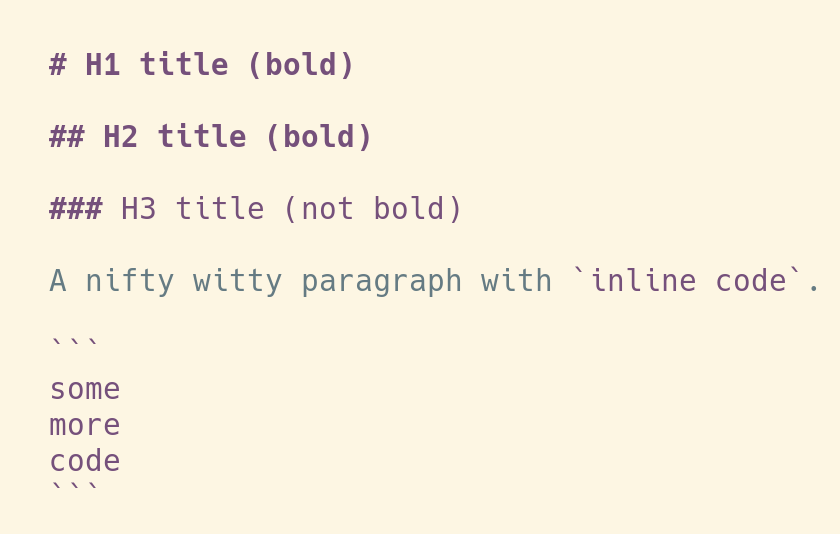
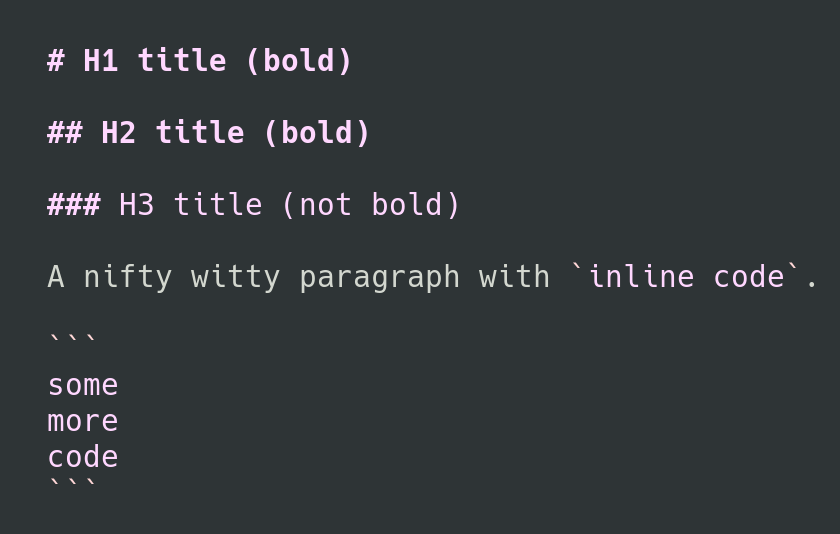
With that in place, my Markdown syntax overrides work for both dark and light background. Champagne! The happy end To finish, let me share my actual additions to the markdown.vim syntax. It makes H1 and H2 bold, along with their delimiters, and it also colors the inline code and the code blocks.
" H1 and H2 headings -> bold
hi link markdownH1 markdownHxBold
hi link markdownH2 markdownHxBold
" Heading delimiters (eg '#') and rules (eg '----', '====') -> bold
hi link markdownHeadingDelimiter markdownHxBold
hi link markdownRule markdownHxBold
" Code blocks and inline code -> highlighted
hi link markdownCode htmlH1
" The following test requires this addition to your vimrc:
" autocmd OptionSet background if exists("g:syntax_on")   syntax on   endif
if &background == "light"
  hi markdownHxBold term=bold ctermfg=DarkMagenta gui=bold guifg=Magenta cterm=bold
else
  hi markdownHxBold term=bold ctermfg=LightMagenta gui=bold guifg=Magenta cterm=bold
endif
And here's how it looks like with a light background: Vim - Markdown file with final highlighting (light) And a dark background: Vim - Markdown file with final highlighting (dark) That's all, that's very little changes compared to the highlighting from the original syntax file, and now that we understand how it's supposed to be done, it's not much effort to achieve it. It's just that finding the workaround to make it work for both light and dark background took forever, and leaves the usual, unanswered question: bug or feature?

16 August 2020

Enrico Zini: Historical links

Saint Guinefort was a dog who lived in France in the 13th century, worshipped through history as a saint until less than a century ago. The recurrence is soon, on the 22th of August. Many think middle ages were about superstition, and generally a bad period. Black Death, COVID, and Why We Keep Telling the Myth of a Renaissance Golden Age and Bad Middle Ages tells a different, fascinating story. Another fascinating middle age story is that of Christine de Pizan, author of The Book of the City of Ladies. This is a very good lecture about her (in Italian): Come pensava una donna nel Medioevo? 2 - Christine de Pizan. You can read some of her books at the Memory of the World library. If you understand Italian, Alessandro Barbero gives fascinating lectures. You can find them index in a timeline, or in a map. Still from around the middle ages, we get playing cards: see Playing Cards Around the World and Through the Ages. If you want to go have a look in person, and you overshoot with your time machine, here's a convenient route planner for antique Roman roads. View all historical links that I have shared.

Bits from Debian: Debian turns 27!

Today is Debian's 27th anniversary. We recently wrote about some ideas to celebrate the DebianDay, you can join the party or organise something yourselves :-) Today is also an opportunity for you to start or resume your contributions to Debian. For example, you can scratch your creative itch and suggest a wallpaper to be part of the artwork for the next release, have a look at the DebConf20 schedule and register to participate online (August 23rd to 29th, 2020), or put a Debian live image in a DVD or USB and give it to some person near you, who still didn't discover Debian. Our favorite operating system is the result of all the work we do together. Thanks to everybody who has contributed in these 27 years, and happy birthday Debian!

Andrej Shadura: Useful FFmpeg commands for video editing

As a response to Antonio Terceiro s blog post, I m publishing some FFmpeg commands I ve been using recently. Embedding subtitles Sometimes you have a video with subtitles in multiple languages and you don t want to clutter the directory with a lot of similarly-named files or maybe you want to be able to easily transfer the video and subtitles at once. In this case, it may be useful to embed to subtitles directly into the video container file.
ffmpeg -i video.mp4 -i video.eng.srt -map 0:v -map 0:a -c copy -map 1 \
        -c:s:0 mov_text -metadata:s:s:0 language="eng" video-out.mp4
This commands recodes the subtitle file into a format appropriate for the MP4 container and embeds it with a metadata element telling the video player what language it is in. You can add multiple subtitles at once, or you can also transcode the audio to AAC while doing so (I found that a lot of Android devices can t play Ogg Vorbis streams):
ffmpeg -i video.mp4 -i video.deu.srt -i video.eng.srt -map 0:v -map 0:a \
        -c:v copy -c:a aac -map 1 -c:s:0 mov_text -metadata:s:s:0 language="deu" \
                           -map 2 -c:s:1 mov_text -metadata:s:s:1 language="eng" video-out.mp4
Hard subtitles Sometimes you need to play the video with subtitles on devices not supporting them. In that case, it may be useful to hardcode the subtitles directly into the video stream:
ffmpeg -i video.mp4 -vf subtitles=video.eng.srt video-out.mp4
Unfortunately, if you also want to apply more transformations to the video, it starts getting tricky, the -vf option is no longer enough:
ffmpeg -i video.mp4 -i overlay.jpg -filter:a "volume=10" \
        -filter_complex '[0:v][1:v]overlay[outv];[outv]subtitles=video.eng.srt' \
                        video-out.mp4
This command adds an overlay to the video stream (in my case I overlaid a full frame over the original video offering some explanations), increases the volume ten times and adds hard subtitles. P.S. You can see the practical application of the above in this video with a head of one of the electoral commissions in Belarus forcing the members of the staff to manipulate the voting results. I transcribed the video in both Russian and English and encoded the English subtitles into the video.

Gunnar Wolf: DebConf20 talk recorded

Following Antonio Terceiro s post on tips for using ffmpeg for editing video, I will also share a bit of my experience producing my video for my session in DebConf20. I recorded my talk today. As Terceiro mentioned, even though I m used to speaking in front of my webcam (i.e. for my classes and some smaller conferences I ve worked on during the COVID lockdown), it does feel a bit weird to present a live talk to nobody :- OK, one step back. Why are we doing this? Because our hardworking friends of the DebConf20 video team recommended so. In order to minimize connecitvity issues from the variety of speakers throughout the world, we were requested to pre-record the exposition part of our talks, send them to the video team (deadline: today 2020-08-16, in case you still owe yours!), and make sure to be present at the end of the talk for the Q&A session. Of course, for a 45 minute talk, I prepared a 30 minute presentation, saving time for said Q&A session. Anyway, I used the excellent OBS studiolive video mixing/editing program (of course, Debian packages are available. This allowed me to set up several predefined views (combinations and layouts of the presentation, webcam, and maybe some other sources) and professionally and elegantly switch between them on the fly. I am still a newbie with OBS, but I surely see it becoming a part of my day to day streaming. Of course, my setup still was obvious (me looking right every now and then to see or control OBS, as I work on a dual-monitor setup ) Anyway, the experience was very good, much smoother and faster than what I usually have to do when editing video. But just as I was finishing thanking the (future) audience and closing the recording I had to tell the camera, oh, fuck! The button labeled Start Recording Had not been pressed. So, did I just lose 30 minutes of my life, plus a half-decent delivered talk? No, fortunately not. I had previously been playing with OBS, and configured some things. The button I did press was Start Streaming . So, my talk (swearing included, of course) was dutifully streamed over to my YouTube channel. It seems up to five people got a sneak preview as to what will my DebConf participation be (of course, I ve de-listed the video). I pulled it with the always-handy youtube-dl, edited out my curses using kdenlive, and pushed it to the DebConf video server. Oh, make sure you follow the advice for recording presentations. It has all the relevant advice, the settings you should use, and much more welcome information if you are new to this. So Next week, DebConf20! Be there or be square!

15 August 2020

Antonio Terceiro: Useful ffmpeg commands for editing video

For DebConf20, we are recommending that speakers pre-record the presentation part of their talks, and will have live Q&A. We had a smaller online MiniDebConf a couple of months ago, where for instance I had connectivity issues during my talk, so even though it feels too artificial, I guess pre-recording can decrease by a lot the likelihood of a given talk going bad. Paul Gevers and I submitted a short 20 min talk giving an update on autopkgtest, ci.debian.net and friends. We will provide the latest updates on autopkgtest, autodep8, debci, ci.debian.net, and its integration with the Debian testing migration software, britney. We agreed on a split of the content, each one recorded their part, and I offered to join them together. The logical chaining of the topics is such that we can't just concatenate the recordings, so we need to interlace our parts. So I set out to do a full video editing work. I have done this before, although in a simpler way, for one of the MiniDebconfs we held in Curitiba. In that case, it was just cutting the noise at the beginning and the end of the recording, and adding beginning and finish screens with sponsors logos etc. The first issue I noticed was that both our recordings had a decent amount of audio noise. To extract the audio track from the videos, I resorted to How can I extract audio from video with ffmpeg? on Stack Overflow:
ffmpeg -i input-video.avi -vn -acodec copy output-audio.aac
I then edited the audio with Audacity. I passed a noise reduction filter a couple of times, then a compressor filter to amplify my recording on mine, as Paul's already had a good volume. And those are my more advanced audio editing skills, which I acquired doing my own podcast. I now realized I could have just muted the audio tracks from the original clip and align the noise-free audio with it, but I ended up creating new video files with the clean audio. Another member of the Stack Overflow family came to the rescue, in How to merge audio and video file in ffmpeg. To replace the audio stream, we can do something like this:
ffmpeg -i video.mp4 -i audio.wav -c:v copy -c:a aac -map 0:v:0 -map 1:a:0 output.mp4
Paul's recording had a 4:3 aspect ratio, while the requested format is 16:9. This late in the game, there was zero chance I would request him to redo the recording. So I decided to add those black bars on the side to make it the right aspect when showing full screen. And yet again the quickest answer I could find came from the Stack Overflow empire: ffmpeg: pillarbox 4:3 to 16:9:
ffmpeg -i "input43.mkv" -vf "scale=640x480,setsar=1,pad=854:480:107:0" [etc..]
The final editing was done with pitivi, which is what I have used before. I'm a very basic user, but I could do what I needed. It was basically splitting the clips at the right places, inserting the slides as images and aligning them with the video, and making most our video appear small in the corner when presenting the slides. P.S.: all the command lines presented here are examples, basically copied from the linked Q&As, and have to be adapted to your actual input and output formats.

Jelmer Vernooij: Debian Janitor: 8,200 landed changes landed so far

The Debian Janitor is an automated system that commits fixes for (minor) issues in Debian packages that can be fixed by software. It gradually started proposing merges in early December. The first set of changes sent out ran lintian-brush on sid packages maintained in Git. This post is part of a series about the progress of the Janitor. The bot has been submitting merge requests for about seven months now. The rollout has happened gradually across the Debian archive, and the bot is now enabled for all packages maintained on Salsa, GitLab, GitHub and Launchpad. There are currently over 1,000 open merge requests, and close to 3,400 merge requests have been merged so far. Direct pushes are enabled for a number of large Debian teams, with about 5,000 direct pushes to date. That covers about 11,000 lintian tags of varying severities (about 75 different varieties) fixed across Debian. Janitor pushes over time Janitor merges over time

For more information about the Janitor's lintian-fixes efforts, see the landing page

14 August 2020

Russell Coker: Jitsi on Debian

I ve just setup an instance of the Jitsi video-conference software for my local LUG. Here is an overview of how to set it up on Debian. Firstly create a new virtual machine to run it. Jitsi is complex and has lots of inter-dependencies. It s packages want to help you by dragging in other packages and configuring them. This is great if you have a blank slate to start with, but if you already have one component installed and running then it can break things. It wants to configure the Prosody Jabber server and a web server and my first attempt at an install failed when it tried to reconfigure the running instances of Prosody and Apache. Here s the upstream install docs [1]. They cover everything fairly well, but I ll document the configuration I wanted (basic public server with password required to create a meeting). Basic Installation The first thing to do is to get a short DNS name like j.example.com. People will type that every time they connect and will thank you for making it short. Using Certbot for certificates is best. It seems that you need them for j.example.com and auth.j.example.com.
apt install curl certbot
/usr/bin/letsencrypt certonly --standalone -d j.example.com,auth.j.example.com -m you@example.com
curl https://download.jitsi.org/jitsi-key.gpg.key   gpg --dearmor > /etc/apt/jitsi-keyring.gpg
echo "deb [signed-by=/etc/apt/jitsi-keyring.gpg] https://download.jitsi.org stable/" > /etc/apt/sources.list.d/jitsi-stable.list
apt-get update
apt-get -y install jitsi-meet
When apt installs jitsi-meet and it s dependencies you get asked many questions for configuring things. Most of it works well. If you get the nginx certificate wrong or don t have the full chain then phone clients will abort connections for no apparent reason, it seems that you need to edit /etc/nginx/sites-enabled/j.example.com.conf to use the following ssl configuration:
ssl_certificate /etc/letsencrypt/live/j.example.com/fullchain.pem;
ssl_certificate_key /etc/letsencrypt/live/j.example.com/privkey.pem;
Then you have to edit /etc/prosody/conf.d/j.example.com.cfg.lua to use the following ssl configuration:
key = "/etc/letsencrypt/live/j.example.com/privkey.pem";
certificate = "/etc/letsencrypt/live/j.example.com/fullchain.pem";
It seems that you need to have an /etc/hosts entry with the public IP address of your server and the names j.example.com j auth.j.example.com . Jitsi also appears to use the names speakerstats.j.example.com conferenceduration.j.example.com lobby.j.example.com conference.j.example.com conference.j.example.com internal.auth.j.example.com but they aren t required for a basic setup, I guess you could add them to /etc/hosts to avoid the possibility of strange errors due to it not finding an internal host name. There are optional features of Jitsi which require some of these names, but so far I ve only used the basic functionality. Access Control This section describes how to restrict conference creation to authenticated users. The secure-domain document [2] shows how to restrict access, but I ll summarise the basics. Edit /etc/prosody/conf.avail/j.example.com.cfg.lua and use the following line in the main VirtualHost section:
        authentication = "internal_hashed"
Then add the following section:
VirtualHost "guest.j.example.com"
        authentication = "anonymous"
        c2s_require_encryption = false
        modules_enabled =  
            "turncredentials";
         
Edit /etc/jitsi/meet/j.example.com-config.js and add the following line:
        anonymousdomain: 'guest.j.example.com',
Edit /etc/jitsi/jicofo/sip-communicator.properties and add the following line:
org.jitsi.jicofo.auth.URL=XMPP:j.example.com
Then run commands like the following to create new users who can create rooms:
prosodyctl register admin j.example.com
Then restart most things (Prosody at least, maybe parts of Jitsi too), I rebooted the VM. Now only the accounts you created on the Prosody server will be able to create new meetings. You should be able to add, delete, and change passwords for users via prosodyctl while it s running once you have set this up. Conclusion Once I gave up on the idea of running Jitsi on the same server as anything else it wasn t particularly difficult to set up. Some bits were a little fiddly and hopefully this post will be a useful resource for people who have trouble understanding the documentation. Generally it s not difficult to install if it is the only thing running on a VM.

Markus Koschany: My Free Software Activities in July 2020

Welcome to gambaru.de. Here is my monthly report (+ the first week in August) that covers what I have been doing for Debian. If you re interested in Java, Games and LTS topics, this might be interesting for you. Debian Games
Debian Java Misc Debian LTS This was my 53. month as a paid contributor and I have been paid to work 15 hours on Debian LTS, a project started by Rapha l Hertzog. In that time I did the following: ELTS Extended Long Term Support (ELTS) is a project led by Freexian to further extend the lifetime of Debian releases. It is not an official Debian project but all Debian users benefit from it without cost. The current ELTS release is Debian 8 Jessie . This was my 26. month and I have been paid to work 13,25 hours on ELTS. Thanks for reading and see you next time.

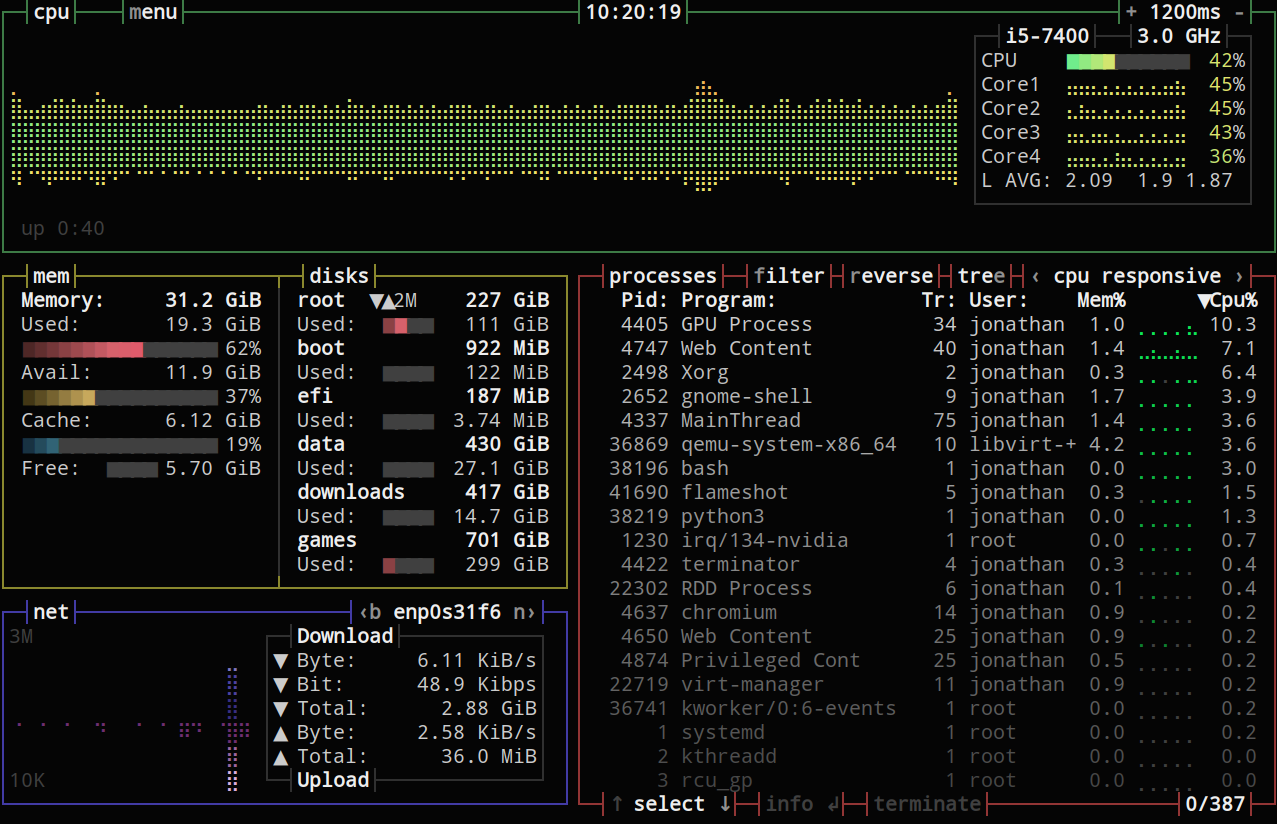
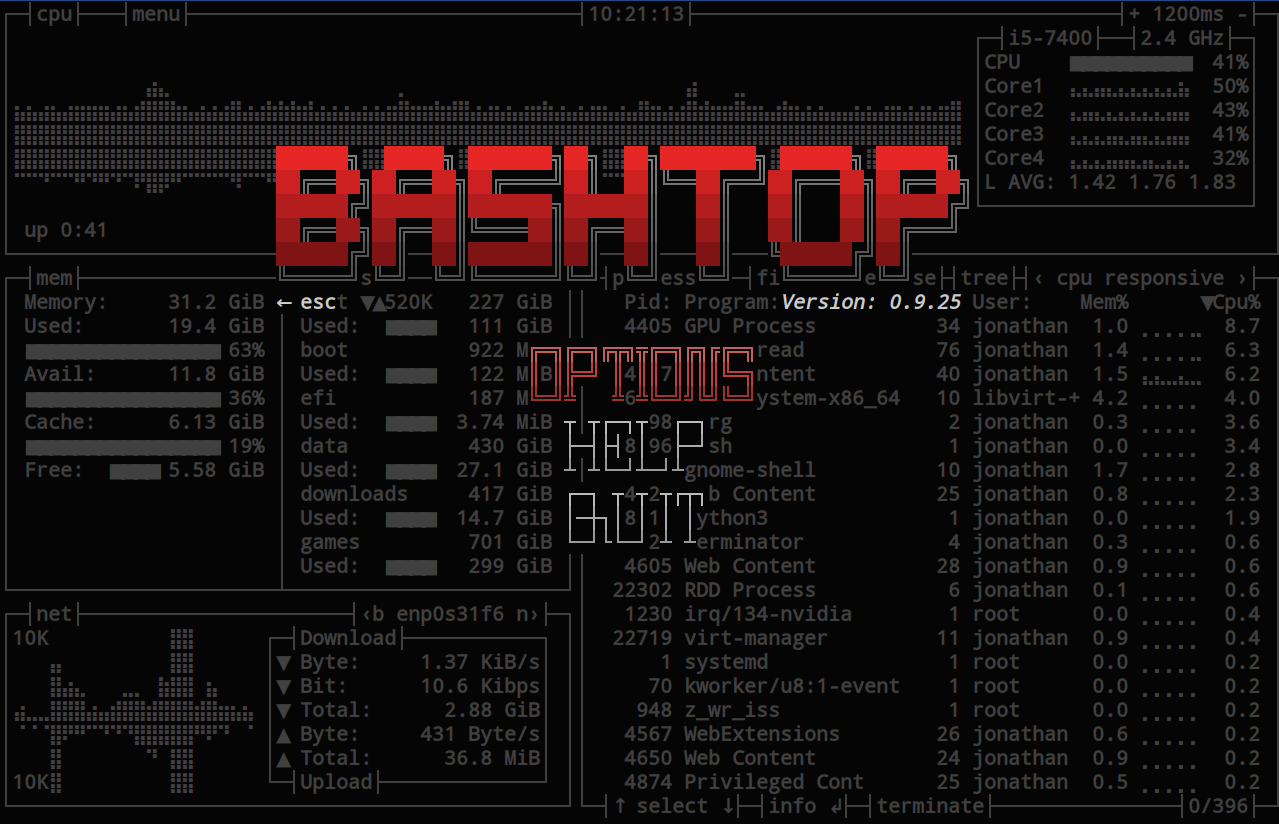
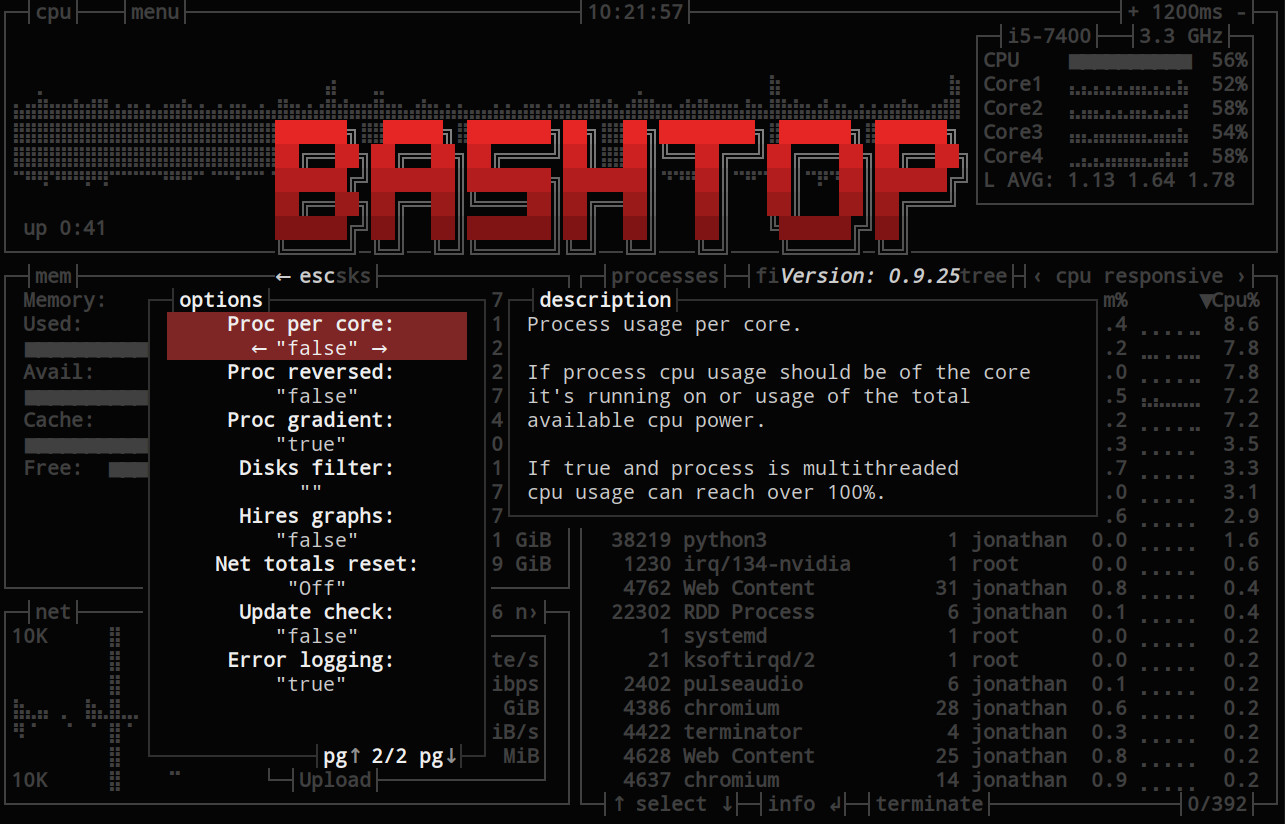
Jonathan Carter: bashtop, now in buster-backports

Recently, I discovered bashtop, yet another fancy top-like utility that s mostly written in bash (it uses some python3-psutil and shells out to other common system utilities). I like its use of high-colour graphics and despite being written in bash, it s not as resource heavy as I would have expected and also quite snappy (even on a raspberry pi). While writing this post, I also discovered that the author of bashtop ported it to Python and that the python version is called bpytop (hmm, doesn t quite have the same ring to it), which is even faster and less resource intensive than the bash version (although I haven t tried that yet, I guess I will soon ). I set out to package it, but someone beat me to it, but since I m also on the backports team these days, I went ahead and backported it for buster. So if you have backports enabled, you can now install it using apt install bashtop -t buster-backports . Dylan A ssi, who packaged bashtop in Debian, has already filed an ITP for bpytop, so we ll soon have yet another top-like tool in our collection :-)

Jonathan Dowland: Generic Haskell

When I did the work described earlier in template haskell, I also explored generic programming in Haskell to solve a particular problem. StrIoT is a program generator: it outputs source code, which may depend upon other modules, which need to be imported via declarations at the top of the source code files. The data structure that StrIoT manipulates contains information about what modules are loaded to resolve the names that have been used in the input code, so we can walk that structure to automatically derive an import list. The generic programming tools I used for this are from Scrap Your Boilerplate (SYB), a module written to complement a paper of the same name. In this code snippet, everything and mkQ are from SYB:
extractNames :: Data a => a -> [Name]
extractNames = everything (++) (\a -> mkQ [] f a)
     where f = (:[])
The input must be any type which implements typeclass Data, as must all its members (and their members etc.): This holds for the Template Haskell Exp types. The output is a normal list of Names. The utility function has a more specific type Name -> [Name]. This is all that's needed to walk over the heterogeneous data structures and do something specific (f) when we encounter a Name. Post-processing the Names to get a list of modules is simple
 nub . catMaybes . map nameModule . concatMap extractNames
Unfortunately, there's a weird GHC behaviour relating to the module names for some Prelude functions that makes the above less useful in practice. For example, the Prelude function words :: String -> [String] can normally be used without an explicit import (since it's a Prelude function). However, once round-tripped through a Name, it becomes GHC.OldList.words. Attempting to import GHC.OldList fails in some contexts, because it's a hidden module or package. I've been meaning to investigate further and, if necessary, file a GHC bug about this. For this reason I've scrapped all the above and gone with a different plan. We go back to requiring the user to specify their required import list explicitly. We then walk over the Exp data type prior to code generation and decanonicalize all the Names. I also use generic programming/SYB to do this:
unQualifyNames :: Exp -> Exp
unQualifyNames = everywhere (\a -> mkT f a)
     where f :: Name -> Name
           f n = if n == '(.)
            then mkName "."
            else (mkName . last . splitOn "." . pprint) n
I've had to special-case composition (.) since that code-point is also used as the delimiter between package, module and function. Otherwise this looks very similar to the earlier function, except using everywhere and mkT (make transformation) instead of everything and mkQ (make query).

Keith Packard: picolibc-news

Picolibc Updates I thought work on picolibc would slow down at some point, but I keep finding more things that need work. I spent a few weeks working in libm and then discovered some important memory allocation bugs in the last week that needed attention too. Cleaning up the Picolibc Math Library Picolibc uses the same math library sources as newlib, which includes code from a range of sources: The original SunPro math code had been split into two levels at some point:
  1. IEEE-754 functions. These offer pure IEEE-754 semantics, including return values and exceptions. They do not set the POSIX errno value. These are all prefixed with __ieee754_ and can be called directly by applications if desired.
  2. POSIX functions. These can offer POSIX semantics, including setting errno and returning expected values when errno is set.
New Code Sponsored by ARM Szabolcs Nagy and Wilco Dijkstra's work in the last few years has been to improve the performance of some of the core math functions, which is much appreciated. They've adopted a more modern coding style (C99) and written faster code at the expense of a larger memory foot print. One interesting choice was to use double computations for the float implementations of various functions. This makes these functions shorter and more accurate than versions done using float throughout. However, for machines which don't have HW double, this pulls in soft double code which adds considerable size to the resulting binary and slows down the computations, especially if the platform does support HW float. The new code also takes advantage of HW fused-multiply-add instructions. Those offer more precision than a sequence of primitive instructions, and so the new code can be much shorter as a result. The method used to detect whether the target machine supported fma operations was slightly broken on 32-bit ARM platforms, where those with 'float' fma acceleration but without 'double' fma acceleration would use the shorter code sequence, but with an emulated fma operation that used the less-precise sequence of operations, leading to significant reductions in the quality of the resulting math functions. I fixed the double fma detection and then also added float fma detection along with implementations of float and double fma for ARM and RISC-V. Now both of those platforms get fma-enhanced math functions where available. Errno Adventures I'd submitted patches to newlib a while ago that aliased the regular math library names to the __ieee754_ functions when the library was configured to not set errno, which is pretty common for embedded environments where a shared errno is a pain anyways. Note the use of the word can in remark about the old POSIX wrapper functions. That's because all of these functions are run-time switchable between _IEEE_ and _POSIX_ mode using the _LIB_VERSION global symbol. When left in the usual _IEEE_ mode, none of this extra code was ever executed, so these wrapper functions never did anything beyond what the underlying __ieee754_ functions did. The new code by Nagy and Dijkstra changed how functions are structured to eliminate the underlying IEEE-754 api. These new functions use tail calls to various __math_ error reporting functions. Those can be configured at library build time to set errno or not, centralizing those decisions in a few functions. The result of this combination of source material is that in the default configuration, some library functions (those written by Nagy and Dijkstra) would set errno and others (the old SunPro code) would not. To disable all errno references, the library would need to be compiled with a set of options, -D_IEEE_LIBM to disable errno in the SunPro code and -DWANT_ERRNO=0 to disable errno in the new code. To enable errno everywhere, you'd set -D_POSIX_MODE to make the default value for _LIB_VERSION be _POSIX_ instead of _IEEE_. To clean all of this up, I removed the run-time _LIB_VERSION variable and made that compile-time. In combination with the earlier work to alias the __ieee754_ functions to the regular POSIX names when _IEEE_LIBM was defined this means that the old SunPro POSIX functions now only get used when _IEEE_LIBM is not defined, and in that case the _LIB_VERSION tests always force use of the errno setting code. In addition, I made the value of WANT_ERRNO depend on whether _IEEE_LIBM was defined, so now a single definition (-D_IEEE_LIBM) causes all of the errno handling from libm to be removed, independent of which code is in use. As part of this work, I added a range of errno tests for the math functions to find places where the wrong errno value was being used. Exceptions As an alternative to errno, C also provides for IEEE-754 exceptions through the fenv functions. These have some significant advantages, including having independent bits for each exception type and having them accumulate instead of sharing errno with a huge range of other C library functions. Plus, they're generally implemented in hardware, so you get exceptions for both library functions and primitive operations. Well, you should get exceptions everywhere, except that the GCC soft float libraries don't support them at all. So, errno can still be useful if you need to know what happened in your library functions when using soft floats. Newlib has recently seen a spate of fenv support being added for various architectures, so I decided that it would be a good idea to add some tests. I added tests for both primitive operations, and then tests for library functions to check both exceptions and errno values. Oddly, this uncovered a range of minor mistakes in various math functions. Lots of these were mistakes in the SunPro POSIX wrapper functions where they modified the return values from the __ieee754_ implementations. Simply removing those value modifications fixed many of those errors. Fixing Memory Allocator bugs Picolibc inherits malloc code from newlib which offers two separate implementations, one big and fast, the other small and slow(er). Selecting between them is done while building the library, and as Picolibc is expected to be used on smaller systems, the small and slow one is the default. Contributed by someone from ARM back in 2012/2013, nano-mallocr reminds me of the old V7 memory allocator. A linked list, sorted in address order, holds discontiguous chunks of available memory. Allocation is done by searching for a large enough chunk in the list. The first one large enough is selected, and if it is large enough, a chunk is split off and left on the free list while the remainder is handed to the application. When the list doesn't have any chunk large enough, sbrk is called to get more memory. Free operations involve walking the list and inserting the chunk in the right location, merging the freed memory with any immediately adjacent chunks to reduce fragmentation. The size of each chunk is stored just before the first byte of memory used by the application, where it remains while the memory is in use and while on the free list. The free list is formed by pointers stored in the active area of the chunk, so the only overhead for chunks in use is the size field. Something Something Padding To deal with the vagaries of alignment, the original nano-mallocr code would allow for there to be 'padding' between the size field and the active memory area. The amount of padding could vary, depending on the alignment required for a particular chunk (in the case of memalign, that padding can be quite large). If present, nano-mallocr would store the padding value in the location immediately before the active area and distinguish that from a regular size field by a negative sign. The whole padding thing seems mysterious to me -- why would it ever be needed when the allocator could simply create chunks that were aligned to the required value and a multiple of that value in size. The only use I could think of was for memalign; adding this padding field would allow for less over-allocation to find a suitable chunk. I didn't feel like this one (infrequent) use case was worth the extra complexity; it certainly caused me difficulty in reading the code. A Few Bugs In reviewing the code, I found a couple of easy-to-fix bugs. Time For Testing Once I had uncovered a few bugs in this code, I decided that it would be good to write a few tests to exercise the API. With the tests running on four architectures in nearly 60 variants, it seemed like I'd be able to uncover at least a few more failures: These new tests did find bugs. But not where I expected them. Which is why I'm so fond of testing. GCC Optimizations One of my tests was to call calloc and make sure it returned a chunk of memory that appeared to work or failed with a reasonable value. To my surprise, on aarch64, that test never finished. It worked elsewhere, but on that architecture it hung in the middle of calloc itself. Which looked like this:
void * nano_calloc(malloc_size_t n, malloc_size_t elem)
 
    ptrdiff_t bytes;
    void * mem;
    if (__builtin_mul_overflow (n, elem, &bytes))
     
    RERRNO = ENOMEM;
    return NULL;
     
    mem = nano_malloc(bytes);
    if (mem != NULL) memset(mem, 0, bytes);
    return mem;
 
Note the naming here -- nano_mallocr uses nano_ prefixes in the code, but then uses #defines to change their names to those expected in the ABI. (No, I don't understand why either). However, GCC sees the real names and has some idea of what these functions are supposed to do. In particular, the pattern:
foo = malloc(n);
if (foo) memset(foo, '\0', n);
is converted into a shorter and semantically equivalent:
foo = calloc(n, 1);
Alas, GCC doesn't take into account that this optimization is occurring inside of the implementation of calloc. Another sequence of code looked like this:
chunk->size = foo
nano_free((char *) chunk + CHUNK_OFFSET);
Well, GCC knows that the content of memory passed to free cannot affect the operation of the application, and so it converted this into:
nano_free((char *) chunk + CHUNK_OFFSET);
Remember that nano_mallocr stores the size of the chunk just before the active memory. In this case, nano_mallocr was splitting a large chunk into two pieces, setting the size of the left-over part and placing that on the free list. Failing to set that size value left whatever was there before for the size and usually resulted in the free list becoming quite corrupted. Both of these problems can be corrected by compiling the code with a couple of GCC command-line switches (-fno-builtin-malloc and -fno-builtin-free). Reworking Malloc Having spent this much time reading through the nano_mallocr code, I decided to just go through it and make it easier for me to read today, hoping that other people (which includes 'future me') will also find it a bit easier to follow. I picked a couple of things to focus on:
  1. All newly allocated memory should be cleared. This reduces information disclosure between whatever code freed the memory and whatever code is about to use the memory. Plus, it reduces the effect of un-initialized allocations as they now consistently get zeroed memory. Yes, this masks bugs. Yes, this goes slower. This change is dedicated to Kees Cook, but please blame me for it not him.
  2. Get rid of the 'Padding' notion. Every time I read this code it made my brain hurt. I doubt I'll get any smarter in the future.
  3. Realloc could use some love, improving its efficiency in common cases to reduce memory usage.
  4. Reworking linked list walking. nano_mallocr uses a singly-linked free list and open-codes all list walking. Normally, I'd switch to a library implementation to avoid introducing my own bugs, but in this fairly simple case, I think it's a reasonable compromise to open-code the list operations using some patterns I learned while working at MIT from Bob Scheifler.
  5. Discover necessary values, like padding and the limits of the memory space, from the environment rather than having them hard-coded.
Padding To get rid of 'Padding' in malloc, I needed to make sure that every chunk was aligned and sized correctly. Remember that there is a header on every allocated chunk which is stored before the active memory which contains the size of the chunk. On 32-bit machines, that size is 4 bytes. If the machine requires allocations to be aligned on 8-byte boundaries (as might be the case for 'double' values), we're now going to force the alignment of the header to 8-bytes, wasting four bytes between the size field and the active memory. Well, the existing nano_mallocr code also wastes those four bytes to store the 'padding' value. Using a consistent alignment for chunk starting addresses and chunk sizes has made the code a lot simpler and easier to reason about while not using extra memory for normal allocation. Except for memalign, which I'll cover in the next section. realloc The original nano_realloc function was as simple as possible:
mem = nano_malloc(new_size);
if (mem)  
    memcpy(mem, old, MIN(old_size, new_size));
    nano_free(old);
 
return mem;
However, this really performs badly when the application is growing a buffer while accumulating data. A couple of simple optimizations occurred to me:
  1. If there's a free chunk just after the original location, it could be merged to the existing block and avoid copying the data.
  2. If the original chunk is at the end of the heap, call sbrk() to increase the size of the chunk.
The second one seems like the more important case; in a small system, the buffer will probably land at the end of the heap at some point, at which point growing it to the size of available memory becomes quite efficient. When shrinking the buffer, instead of allocating new space and copying, if there's enough space being freed for a new chunk, create one and add it to the free list. List Walking Walking singly-linked lists seem like one of the first things we see when learning pointer manipulation in C:
for (element = head; element; element = element->next)
    do stuff ...
However, this becomes pretty complicated when 'do stuff' includes removing something from the list:
prev = NULL;
for (element = head; element; element = element->next)
    ...
    if (found)
        break;
    ...
    prev = element
if (prev != NULL)
    prev->next = element->next;
else
    head = element->next;
An extra variable, and a test to figure out how to re-link the list. Bob showed me a simpler way, which I'm sure many people are familiar with:
for (ptr = &head; (element = *ptr); ptr = &(element->next))
    ...
    if (found)
        break;
*ptr = element->next;
Insertion is similar, as you would expect:
for (ptr = &head; (element = *ptr); ptr = &(element->next))
    if (found)
        break;
new_element->next = element;
*ptr = new_element;
In terms of memory operations, it's the same -- each 'next' pointer is fetched exactly once and the list is re-linked by performing a single store. In terms of reading the code, once you've seen this pattern, getting rid of the extra variable and the conditionals around the list update makes it shorter and less prone to errors. In the nano_mallocr code, instead of using 'prev = NULL', it actually used 'prev = free_list', and the test for updating the head was 'prev == element', which really caught me unawares. System Parameters Any malloc implementation needs to know a couple of things about the system it's running on:
  1. Address space. The maximum range of possible addresses sets the limit on how large a block of memory might be allocated, and hence the size of the 'size' field. Fortunately, we've got the 'size_t' type for this, so we can just use that.
  2. Alignment requirements. These derive from the alignment requirements of the basic machine types, including pointers, integers and floating point numbers which are formed from a combination of machine requirements (some systems will fault if attempting to use memory with the wrong alignment) along with a compromise between memory usage and memory system performance.
I decided to let the system tell me the alignment necessary using a special type declaration and the 'offsetof' operation:
typedef struct  
    char c;
    union  
    void *p;
    double d;
    long long ll;
    size_t s;
      u;
  align_t;
#define MALLOC_ALIGN        (offsetof(align_t, u))
Because C requires struct fields to be stored in order of declaration, the 'u' field would have to be after the 'c' field, and would have to be assigned an offset equal to the largest alignment necessary for any of its members. Testing on a range of machines yields the following alignment requirements:
Architecture Alignment
x86_64 8
RISC-V 8
aarch64 8
arm 8
x86 4
So, I guess I could have just used a constant value of '8' and not worried about it, but using the compiler-provided value means that running picolibc on older architectures might save a bit of memory at no real cost in the code. Now, the header containing the 'size' field can be aligned to this value, and all allocated blocks can be allocated in units of this value. memalign memalign, valloc and pvalloc all allocate memory with restrictions on the alignment of the base address and length. You'd think these would be simple -- allocate a large chunk, align within that chunk and return the address. However, they also all require that the address can be successfully passed to free. Which means that the allocator needs to do some tricks to make it all work. Essentially, you allocate 'lots' of memory and then arrange that any bytes at the head and tail of the allocation can be returned to the free list. The tail part is easy; if it's large enough to form a free chunk (which must contain the size and a 'next' pointer for the free list), it can be split off. Otherwise, it just sits at the end of the allocation being wasted space. The head part is a bit tricky when it's not large enough to form a free chunk. That's where the 'padding' business came in handy; that can be as small as a 'size_t' value, which (on 32-bit systems) is only four bytes. Now that we're giving up trying to reason about 'padding', any extra block at the start must be big enough to hold a free block, which includes the size and a next pointer. On 32-bit systems, that's just 8 bytes which (for most of our targets) is the same as the alignment value we're using. On 32-bit systems that can use 4-byte alignment, and on 64-bit systems, it's possible that the alignment required by the application for memalign and the alignment of a chunk returned by malloc might be off by too small an amount to create a free chunk. So, we just allocate a lot of extra space; enough so that we can create a block of size 'toosmall + align' at the start and create a free chunk of memory out of that. This works, and at least returns all of the unused memory back for other allocations. Sending Patches Back to Newlib I've sent the floating point fixes upstream to newlib where they've already landed on master. I've sent most of the malloc fixes, but I'm not sure they really care about seeing nano_mallocr refactored. If they do, I'll spend the time necessary to get the changes ported back to the newlib internal APIs and merged upstream.

John Goerzen: In Which COVID-19 Misinformation Leads To A Bunch of Graphs Made With Rust

A funny and by funny, I mean sad thing has happened. Recently the Kansas Department of Health and Environment (KDHE) has been analyzing data from the patchwork implementation of mask requirements in Kansas. They came to a conclusion that shouldn t be surprising to anyone: masks help. They published a chart showing this. A right-wing propaganda publication got ahold of this, and claimed the numbers were doctored because there were two-different Y-axes. I set about to analyze the data myself from public sources, and produced graphs of various kinds using a single Y-axis and supporting the idea that the graphs were not, in fact, doctored. Here s one graph that s showing that:
In order to do that, I had imported COVID-19 data from various public sources. Many states in the US are large enough to have significant variation in COVID-19 conditions, and many of the source people look at don t show county-level data over time. I wanted to do that. Eventually, I wrote covid19db, which ingests data from a number of public sources and generates a SQLite database file. Using Github Actions, this file is automatically updated every morning and available for download. Or, you can download the code and generate a database yourself locally. Then, I wrote covid19ks, which generates various pretty graphs covering the data. These graphs, incidentally, turn out to highlight just how poorly the United States is doing compared to the rest of the industrialized world. I hope that these resources, and especially covid19db, might be useful to others that would like to analyze the data. The code isn t the prettiest since it was done in a hurry, but I think that functionally this is useful.

Reproducible Builds (diffoscope): diffoscope 156 released

The diffoscope maintainers are pleased to announce the release of diffoscope version 156. This version includes the following changes:
[ Chris Lamb ]
* Update PPU tests for compatibility with Free Pascal versions 3.2.0 or
  greater. (Closes: #968124)
* Emit a debug-level logging message when our ppudump(1) version does not
  match file header.
* Add and use an assert_diff helper that loads and compares a fixture output
  to avoid a bunch of test boilerplate.
[ Frazer Clews ]
* Apply some pylint suggestions to the codebase.
You find out more by visiting the project homepage.

13 August 2020

Sven Hoexter: An Average IT Org

Supply chain attacks are a known issue, and also lately there was a discussion around the relevance of reproducible builds. Looking in comparison at an average IT org doing something with the internet, I believe the pressing problem is neither supply chain attacks nor a lack of reproducible builds. The real problem is the amount of prefabricated binaries supplied by someone else, created in an unknown build environment with unknown tools, the average IT org requires to do anything. The Mess the World Runs on By chance I had an opportunity to look at what some other people I know use, and here is the list I could compile by scratching just at the surface: Of course there are also all the script language repos - Python, Ruby, Node/Typescript - around as well. Looking at myself, who's working in a different IT org but with a similar focus, I have the following lingering around on my for work laptop and retrieved it as a binary from a 3rd party: Yes some of that is even non-free and might contain spyw^telemetry. Takeway I By guessing based on Pareto Principle probably 80% of the software mentioned above is also open source software. But, and here we leave Pareto behind, close to none is build by the average IT org from source. Why should the average IT org care about advanced issues like supply chain attacks on source code and mitigations, when it already gets into very hot water the day DockerHub closes down, HashiCorp moves from open core to full proprietary or Elastic decides to no longer offer free binary builds? The reality out there seems to be that infrastructure of "modern" IT orgs is managed similar to the Windows 95 installation of my childhood. You just grab running binaries from somewhere and run them. The main difference seems to be that you no longer have the inconvenience of downloading a .xls from geocities you've to rename to .rar and that it's legal. Takeway II In the end the binary supply is like a drug for the user, and somehow the Debian project is also just another dealer / middle man in this setup. There are probably a lot of open questions to think about in that context. Are we the better dealer because we care about signed sources we retrieve from upstream and because we engage in reproducible build projects? Are our own means of distributing binaries any better than a binary download from github via https with a manual checksum verification, or the Debian repo at download.docker.com? Is the approach of the BSD/Gentoo ports, where you have to compile at least some software from source, the better one? Do I really want to know how some of the software is actually build? Or some more candid ones like is gnutls a good choice for the https support in apt and how solid is the gnupg code base? Update: Regarding apt there seems to be some movement.

Norbert Preining: Switching from KDE/Plasma to Gnome3 for one week

This guy is doing a great work, providing patches to improve kwin, and then tried Gnome3 for a week, 7 days. His verdict:
overall, after one week of using this, I can say it s f**king HORRIBLE!!! well, it s not as bad as I thought but yeah, it was overall a pretty unpleasant experience
I definitely have seen improvements, but the desktop is still not in shape. I mean, it s still not as usable as KDE is .
Honestly, I can t agree more. I have tried Gnome3 for over a year, again and again, and it feels like a block of concrete put onto the feet of dissidents by Italian mafia bosses. It drowns and kills you. Here are the links: Start, Day 1, Day 2, Day 3, Day 4, Day 5, Day 6, Day 7. Thanks a lot for these blog posts, incredibly informative and convincing!

Erich Schubert: Publisher MDPI lies to prospective authors

The publisher MDPI is a spammer and lies. If you upload a paper draft to arXiv, MDPI will send spam to the authors to solicit submission. Within minutes of an upload I received the following email (sent by MDPI staff, not some overly eager new editor):
We read your recent manuscript "[...]" on
arXiv, and sincerely invite you to submit it to our journal Future
Internet, if it has not been published or submitted elsewhere.
Future Internet (ISSN 1999-5903, indexed by Scopus, Ei compendex,
*ESCI*-Web of Science) is a journal on Internet technologies and the
information society. It maintains a rigorous and fast peer review system
with a median publication time of 35 days from submission to online
publication, and 3 days from acceptance to publication. The journal
scope is shown here:
https://www.mdpi.com/journal/futureinternet/about.
Editorial Board: https://www.mdpi.com/journal/futureinternet/editors.
Since Future Internet is an open access journal there is a publication
fee. Your paper will be published, with a 20% discount (amounting to 200
CHF), and provided that it is accepted after our standard peer-review
procedure. 
First of all, the email begins with a lie. Because this paper clearly states that it is submitted elsewhere. Also, it fits other journals much better, and if they had read even just the abstract, they would have known. This is predatory behavior by MDPI. Clearly, it is just about getting as many submissions as possible. The journal charges 1000 CHF (next year, 1400 CHF) to publish the papers. Its about the money. Also, there have been reports that MDPI ignores the reviews, and always publishes even when reviewers recommended rejection The reviewer requests I have received from MDPI came with unreasonable deadlines, which will not allow for a thorough peer review. Hence I asked to not ever be emailed by them again. I must assume that many other qualified reviewers do the same. MDPI boasts in their 2019 annual report a median time to first decision of 19 days in my discipline the typical time window to ask for reviews is at least a month (for shorter conference papers, not full journal articles), because professors tend to have lots of other duties, hence they need more flexibility. Above paper has been submitted in March, and is now under review for 4 months already. This is an annoying long time window, and I would appreciate if this were less, but it shows how extremely short the MDPI time frame is. They also claim 269.1k submissions and 106.2k published papers, so the acceptance rate is around 40% on average, and assuming that there are some journals with higher standards there then some must have acceptance rates much higher than this. I d assume that many reputable journals have 40% desk-rejection rate for papers that are not even on-topic The average cost to authors is given as 1144 CHF (after discounts, 25% waived feeds etc.), so they, so we are talking about 120 million CHF of revenue from authors. Is that what you want academic publishing to be? I am not happy with some of the established publishers such as Elsevier that also overcharge universities heavily. I do think we need to change academic publishing, and arXiv is a big improvement here. But I do not respect publishers such as MDPI that lie and send spam.

Next.

Previous.