Search Results: "xam"

3 July 2024

Samuel Henrique: Announcing wcurl: a curl wrapper to download files

tl;dr Whenever you need to download files through the terminal and don't feel like using wget:
wcurl example.com/filename.txt
Manpage:
https://manpages.debian.org/unstable/curl/wcurl.1.en.html

Availability (comes installed with the curl package):
  • Debian unstable - Since 2024-07-02
  • Debian testing - Since 2024-07-18
  • Debian 12/bookworm backports - Expected by the end of August 2024.
  • Debian 12/bookworm - Depends on whether Debian's release team will approve it, it could be available in the next point release.
  • Debian derivatives - Rolling releases will get it by the time it's on Debian testing (e.g.: Kali Linux). Stable derivatives only in their next major release.
If you don't want to wait for the package update to arrive, you can always copy the script and place it in your /usr/bin, the code is here:
https://github.com/Debian/wcurl/blob/main/wcurl
https://salsa.debian.org/debian/wcurl/-/blob/main/wcurl?ref_type=heads

Smoother CLI experience Starting with curl version 8.8.0-2, the Debian's curl package now ships a wcurl executable. wcurl is the solution for those who just need to download files without having to remember curl's parameters for things like automatically naming the files. Some people, myself included, would fall back to using wget whenever there was a need to download a file. Sometimes even installing wget just for that usecase. After all, it's easier to remember "apt install wget" rather than "curl -L -O -C - ...". wcurl consists of a simple shell script that provides sane defaults for the curl invocation, for when the use case is to just download files. By default, wcurl will:
  • Encode whitespaces in URLs;
  • Download multiple URLs in parallel if the installed curl's version is >= 7.66.0;
  • Follow redirects;
  • Automatically choose a filename as output;
  • Avoid overwriting files if the installed curl's version is >= 7.83.0 (--no-clobber);
  • Perform retries;
  • Set the downloaded file timestamp to the value provided by the server, if available;
  • Default to the protocol used as https if the URL doesn't contain any;
  • Disable curl's URL globbing parser so and [] characters in URLs are not treated specially.
Example to download a single file:
wcurl example.com/filename.txt
If you ever need to set a custom flag, you can make use of the --curl-options wcurl option, anything set there will be passed to the curl invocation. Just beware that if you need to set any custom flags, it's likely you will be better served by calling curl directly. The --curl-options option is there to allow for some flexibility in unforeseen circumstances.

The need for wcurl I've always felt a bit ashamed of not remembering curl's parameters for downloading a file and automatically naming it, having resorted to wget most of the times this was needed (even installing wget when it wasn't there, just for this). I've spoken to a few other experienced people I know and confirmed what could be obvious to others: a lot of people struggle with this. Recently, the curl project released the results of 2024's curl survey, which also showed this is as a much needed feature, just look at some of the answers:

Q: Which curl command line option do you think needs improvement and how?
-O, I really want wget like functionality where I don't have to specify the name
Downloading a file (like wget) could be improved - with automatic naming of the file
downloading files - wget is much cleaner
I wish the default behaviour when GETting a binary was to drop it on disk. That's the only reason 'wget foo.tgz" is still ingrained in my muscle memory .
Maybe have a way to download without specifying something in -o (the only reason i used wget still)
--remote-time should be default
--remote-name-all could really use a short flag

Q: If you miss support for something, tell us what!
"Write the data to the file named in the URL (or in redirects if I'm feeling daring), and timestamp the file to the last-modified-date". This is the main reason I'm still using wget.
I can finally feel less bad about falling back to wget due to not remembering the parameters I want.

Idealization vs. reality I don't believe curl will ever change its default behavior in such a way that would accommodate this need, as that would have a side-effect of breaking things which expect the current behavior (the blast radius is literally the solar system). This means a new executable needs to be shipped side-by-side with curl, an opportunity to start fresh and work with a more focused use case (to download files). Ideally, this new executable would be maintained by the curl project, make use of libcurl under-the-hood, and be available everywhere. Nobody wants to worry if their systems have the tool or not, it should always be there. Given I'm just a Debian Developer, with not as much free time as I wish, I've decided to write a simple shell script wrapper calling the curl CLI under-the-hood. wcurl will come installed with the curl package from now on, and I will check with the release team about shipping it on the current Debian stable as well. Shipping wcurl in other distros will be up to them (Debian-derivatives should pick it up automatically, though). We've tried to make it easy for anyone to ship this by using the curl license, keeping the script POSIX-compliant, and shipping a manpage. Maybe if there's enough interest across distributions, someone might sign up for implementing this in upstream curl and increase its reach. I would be happy with the curl project reusing the wcurl name when that happens. It's unlikely that wcurl would be shipped by curl upstream as it is, assuming they would prefer a solution that uses libcurl direclty (more similar to curl the CLI, to maintain). In the worst case, wcurl becomes a Debian-specific tool that only a few people are aware of, in the best case, it becomes the new go-to CLI tool for simply downloading files. I would be happy if at least someone other than me finds it useful.

Naming is hard When I started working on it, I was calling the new executable "curld" (stands for "curl download"), but then when discussing this in one of our weekly calls in the Debian Bras lia community, it was mentioned that this could be confused for a daemon. We then settled for the name "wcurl", suggested by Carlos Henrique Lima Melara <charles>. It doesn't really stand for anything, but it's very easy to remember. You know... "it's that wget alternative for when you want to use curl instead" :)

Feedback I'm hosting the code on Github and Debian's GitLab instance, feel free to open an issue to provide feedback.
https://salsa.debian.org/debian/wcurl
https://github.com/Debian/wcurl We also have a Matrix room for the Debian curl maintainers:
https://matrix.to/#/#debian-curl-maintainers:matrix.org

Acknowledgments The idea for wcurl came a few days before the curl-up conference 2024. I've been thinking a lot about developer productivity in the terminal lately, different tools and better defaults. Before curl-up, I was also thinking about packaging improvements for the curl package. I don't remember what exactly happened, but I likely had to download something and felt a bit ashamed of maintaining curl and not remembering the parameters to download files the way I wanted. I first discussed this idea in the conference, where I asked the participants about it and there were no concerns raised, and some people said I should give it a go. Participating in curl-up was a really great experience and I'm thankful for the interactions I've had there. On the Debian side, I've got reviews of the code and manpage by Sergio Durigan Junior <sergiodj>, Guilherme Puida Moreira <puida> and Carlos Henrique Lima Melara <charles>. Sergio ended up rewriting the tool to be POSIX-compliant (my version was written in bash), so he takes all the credit for the portability.

Changes since publication

2024-07-18
  • Update date of availability for Debian testing and expected date for bookworm backports.
  • Mention charles as the person who suggested "wcurl" as a name.
  • Update wcurl's -o/--opts options, it's now just --curl-options.
  • Remove mention of language spoken in the Matrix room, we are using English now.
  • Update list of features of wcurl.

2 July 2024

Dima Kogan: vnlog.slurp() with non-numerical data

For a while now I'd see an annoying problem when trying to analyze data. I would be trying to import into numpy an innocuous-looking data file like this:
#  image   x y z temperature
image1.png 1 2 5 34
image2.png 3 4 1 35
As usual, I would be using vnlog.slurp() (a thin wrapper around numpy.loadtxt()) to read this in, but that doesn't work: the image filenames aren't parseable as numerical values. Up until now I would work around this by using the suprocess module to fork off a vnl-filter -p !image and then slurp that, but it's a pain and slow and has other issues. I just solved this conclusively using the numpy structured dtypes. I can now do this:
dtype = np.dtype([ ('image',       'U16'),
                   ('x y z',       int, (3,)),
                   ('temperature', float), ])
arr = vnlog.slurp("data.vnl", dtype=dtype)
This will read the image filename, the xyz points and the temperature into different sub-arrays, with different types each. Accessing the result looks like this:
print(arr['image'])
---> array(['image1.png', 'image2.png'], dtype='<U16')
print(arr['x y z'])
---> array([[1, 2, 5],
            [3, 4, 1]])
print(arr['temperature'])
---> array([34., 35.])
Notes: We still do not support records with any null values (-). This could probably be handled with the converters kwarg of numpy.loadtxt(), but that sounds slow. I'll look at that later. This is available today in vnlog 1.38.

Bits from Debian: Bits from the DPL

Dear Debian community, Statement on Daniel Pocock The Debian project has successfully taken action to secure its trademarks and interests worldwide, as detailed in our press statement. I would like to personally thank everyone in the community who was involved in this process. I would have loved for you all to have spent your volunteer time on more fruitful things. Debian Boot team might need help I think I've identified the issue that finally motivated me to contact our teams: for a long time, I have had the impression that Debian is driven by several "one-person teams" (to varying extents of individual influence and susceptibility to burnout). As DPL, I see it as my task to find ways to address this issue and provide support. I received private responses from Debian Boot team members, which motivated me to kindly invite volunteers to some prominent and highly visible fields of work that you might find personally challenging. I recommend subscribing to the Debian Boot mailing list to see where you might be able to provide assistance. /usrmerge Helmut Grohne confirmed that the last remaining packages shipping aliased files inside the package set relevant to debootstrap were uploaded. Thanks a lot for Helmut and all contributors that helped to implement DEP17. Contacting more teams I'd like to repeat that I've registered a BoF for DebConf24 in Busan with the following description: This BoF is an attempt to gather as much as possible teams inside Debian to exchange experiences, discuss workflows inside teams, share their ways to attract newcomers etc. Each participant team should prepare a short description of their work and what team roles ( openings ) they have for new contributors. Even for delegated teams (membership is less fluid), it would be good to present the team, explain what it takes to be a team member, and what steps people usually go to end up being invited to participate. Some other teams can easily absorb contributions from salsa MRs, and at some point people get commit access. Anyway, the point is that we work on the idea that the pathway to become a team member becomes more clear from an outsider point-of-view. I'm lagging a bit behind my team contacting schedule and will not manage to contact every team before DebConf. As a (short) summary, I can draw some positive conclusions about my efforts to reach out to teams. I was able to identify some issues that were new to me and which I am now working on. Examples include limitations in Salsa and Salsa CI. I consider both essential parts of our infrastructure and will support both teams in enhancing their services. Some teams confirmed that they are basically using some common infrastructure (Salsa team space, mailing lists, IRC channels) but that the individual members of the team work on their own problems without sharing any common work. I have also not read about convincing strategies to attract newcomers to the team, as we have established, for instance, in the Debian Med team. DebConf attendance The amount of money needed to fly people to South Korea was higher than usual, so the DebConf bursary team had to make some difficult decisions about who could be reimbursed for travel expenses. I extended the budget for diversity and newcomers, which enabled us to invite some additional contributors. We hope that those who were not able to come this year can make it next year to Brest or to MiniDebConf Cambridge or Toulouse tag2upload On June 12, Sean Whitton requested comments on the debian-vote list regarding a General Resolution (GR) about tag2upload. The discussion began with technical details but unfortunately, as often happens in long threads, it drifted into abrasive language, prompting the community team to address the behavior of an opponent of the GR supporters. After 560 emails covering technical details, including a detailed security review by Russ Allbery, Sean finally proposed the GR on June 27, 2024 (two weeks after requesting comments). Firstly, I would like to thank the drivers of this GR and acknowledge the technical work behind it, including the security review. I am positively convinced that Debian can benefit from modernizing its infrastructure, particularly through stronger integration of Git into packaging workflows. Sam Hartman provided some historical context [1], [2], [3], [4], noting that this discussion originally took place five years ago with no results from several similarly lengthy threads. My favorite summary of the entire thread was given by Gregor Herrmann, which reflects the same gut feeling I have and highlights a structural problem within Debian that hinders technical changes. Addressing this issue is definitely a matter for the Debian Project Leader, and I will try to address it during my term. At the time of writing these bits, a proposal from ftpmaster, which is being continuously discussed, might lead to a solution. I was also asked to extend the GR discussion periods which I will do in separate mail. Talk: Debian GNU/Linux for Scientific Research I was invited to have a talk in the Systems-Facing Track of University of British Columbia (who is sponsoring rack space for several Debian servers). I admit it felt a bit strange to me after working more than 20 years for establishing Debian in scientific environments to be invited to such a talk "because I'm DPL". Kind regards Andreas.

1 July 2024

Sahil Dhiman: Personal ASNs From India

Internet and it s working are interesting and complex. We need an IP address to connect to the Internet. A group of IP addresses with common routing policy is known as an Autonomous System (AS). Each AS has a globally unique Autonomous System Number (ASN) and is maintained by a single entity or individual(s). Your ISP would have an ASN. IP addresses/prefixes are advertised (announced) by an AS through Border Gateway Protocol (BGP) to its peers (ASes which it connects to) to steer traffic in its direction or back. Take for example Google DNS service at 8.8.8.8 owned and operated by AS15169 Google LLC. AS15169 through BGP announcements, lets all its peers know that traffic for whole of 8.8.8.0/24 (including 8.8.8.8) prefix should be sent to them. See the following screenshot response of mtr -zt 8.8.8.8 from my system. From my Internet Service Provider (ISP), AS133982 Excitel Broadband, traffic travels to AS15169 to reach 8.8.8.8 (dns.google) and returns via the same path. This Inter-AS traffic makes the Internet tick. mtr from Excitel to Google ASes comes in different sizes and purposes. Like AS749 DoD Network Information Center which holds more than 200 million+ IPv4 addresses for historical reasons or AS23860 Alliance Broadband Services which has 68 thousand+ IPv4 address for purpose of providing consumer Internet. Similarly, some individuals also run their personal ASN including a bunch of Indians. Most of these Indian ASNs are IPv6 (primary or only) networks run for hobby and educational purposes. I was interested in this data, so complied a list of active ones (visible in the global routing table) from BGP.Tools: Let me know if I m missing someone.

Guido G nther: Free Software Activities June 2024

A short status update of what happened on my side last month. Was able to test our Cellbroadcast bits, feedbackd became more flexible regarding LEDs, Phosh 0.40 is out, and some more. Phosh Phoc gmobile phosh-mobile-settings phosh-wallpapers emacs Debian ModemManager Feedbackd Livi Calls Chatty meta-phosh Libhandy If you want to support my work see donations.

Russ Allbery: Review: Snuff

Review: Snuff, by Terry Pratchett
Series: Discworld #39
Publisher: Harper
Copyright: October 2011
Printing: January 2013
ISBN: 0-06-221886-7
Format: Mass market
Pages: 470
Snuff is the 39th Discworld novel and the 8th (and last) Watch novel. This is not a good place to start reading. Sam Vines has been talked, cajoled, and coerced into taking a vacation. Since he is now the Duke of Ankh, he has a country estate that he's never visited. Lady Sybil is insistent on remedying this, as is Vetinari. Both of them may have ulterior motives. They may also be colluding. It does not take long for Vimes to realize that something is amiss in the countryside. It's not that the servants are uncomfortable with him talking to them, the senior servants are annoyed that he talks to the wrong servants, and the maids turn to face the wall at the sight of him. Those are just the strange customs of the aristocracy, for which he has little understanding and even less patience. There's something else going on. The nobility is wary, the town blacksmith is angry about something more than disliking the nobles, and the bartender doesn't want to get involved. Vimes smells something suspicious. When he's framed for a murder, the suspicions seem justified. It takes some time before the reader learns what the local nobility are squirming about, so I won't spoil it. What I will say is that Snuff is Pratchett hammering away at one of his favorite targets: prejudice, cruelty, and treating people like things. Vimes, with his uncompromising morality, is one of the first to realize the depth of the problem. It takes most of the rest longer to come around, even Sybil. It's both painful, and painfully accurate, to contemplate how often recognition of other people's worth only comes once they do something that you recognize as valuable. This is one of the better-plotted Discworld novels. Vimes starts out with nothing but suspicions and stubbornness, and manages to turn Snuff into a mystery novel through dogged persistence. The story is one continuous plot arc with the normal Pratchett color (Young Sam's obsession with types of poo, for example) but without extended digressions. It also has considerably better villains than most Pratchett novels: layers of foot soldiers and plotters, each of which have to be dealt with in a suitable way. Even the concluding action sequences worked for me, which is not always a given in Discworld. The problem, unfortunately, is that the writing is getting a bit wobbly. Pratchett died of early-onset Alzheimer's in 2015, four years after this book was first published, and this is the first novel where I can see some early effects. It mostly shows up in the dialogue: it's just a bit flabby and a bit repetitive, and the characters, particularly towards the end of the book, start repeating the name of the person they're talking to every other line. Once I saw it, I couldn't unsee it, and it was annoying enough to rob a bit of enjoyment from the end of the book. That aside, though, this was a solid Discworld novel. Vimes testing his moral certainty against the world and forcing it into a more ethical shape is always rewarding, and here he takes more risks, with better justification, than in most of the Watch novels. We also find out that Vimes has a legacy from the events of Thud!, which has interesting implications that I wish Pratchett had more time to explore. I think the best part of this book is how it models the process of social change through archetypes: the campaigner who knew the right choice early on, the person who formed their opinion the first time they saw injustice, the person who gets there through a more explicit moral code, the ones who have to be pushed by someone who was a bit faster, the ones who have to be convinced but then work to convince others, and of course the person who is willing to take on the unfair and far-too-heavy burden of being exceptional enough that they can be used as a tool to force other people to acknowledge them as a person. And, since this is Discworld, Vetinari is lurking in the scenery pulling strings, balancing threats, navigating politics, and giving Vimes just enough leeway to try to change the world without abusing his power. I love that the amount of leeway Vimes gets depends on how egregious the offense is, and Vetinari calibrates this quite carefully without ever saying so openly. Recommended, and as much as I don't want to see this series end, this is not a bad entry for the Watch novels to end on. Followed in publication order by Raising Steam. Rating: 8 out of 10

30 June 2024

Joachim Breitner: Do surprises get larger?

The setup Imagine you are living on a riverbank. Every now and then, the river swells and you have high water. The first few times this may come as a surprise, but soon you learn that such floods are a recurring occurrence at that river, and you make suitable preparation. Let s say you feel well-prepared against any flood that is no higher than the highest one observed so far. The more floods you have seen, the higher that mark is, and the better prepared you are. But of course, eventually a higher flood will occur that surprises you. Of course such new record floods are happening rarer and rarer as you have seen more of them. I was wondering though: By how much do the new records exceed the previous high mark? Does this excess decrease or increase over time? A priori both could be. When the high mark is already rather high, maybe new record floods will just barley pass that mark? Or maybe, simply because new records are so rare events, when they do occur, they can be surprisingly bad? This post is a leisurely mathematical investigating of this question, which of course isn t restricted to high waters; it could be anything that produces a measurement repeatedly and (mostly) independently weather events, sport results, dice rolls. The answer of course depends on the distribution of results: How likely is each possible results.

Dice are simple With dice rolls the answer is rather simple. Let our measurement be how often you can roll a die until it shows a 6. This simple game we can repeat many times, and keep track of our record. Let s say the record happens to be 7 rolls. If in the next run we roll the die 7 times, and it still does not show a 6, then we know that we have broken the record, and every further roll increases by how much we beat the old record. But note that how often we will now roll the die is completely independent of what happened before! So for this game the answer is: The excess with which the record is broken is always the same. Mathematically speaking this is because the distribution of rolls until the die shows a 6 is memoryless. Such distributions are rather special, its essentially just the example we gave (a geometric distribution), or its continuous analogue (the exponential distributions, for example the time until a radioactive particle decays).

Mathematical formulation With this out of the way, let us look at some other distributions, and for that, introduce some mathematical notations. Let X be a random variable with probability density function (x) and cumulative distribution function (x), and a be the previous record. We are interested in the behavior of Y(a) = X a X > x i.e. by how much X exceeds a under the condition that it did exceed a. How does Y change as a increases? In particular, how does the expected value of the excess e(a) = E(Y(a)) change?

Uniform distribution If X is uniformly distributed between, say, 0 and 1, then a new record will appear uniformly distributed between a and 1, and as that range gets smaller, the excess must get smaller as well. More precisely, e(a) = E(X a X > a) = E(X X > a) a = (1 a)/2 This not very interesting linear line is plotted in blue in this diagram:
The expected record surpass for the uniform distribution The expected record surpass for the uniform distribution
The orange line with the logarithmic scale on the right tries to convey how unlikely it is to surpass the record value a: it shows how many attempts we expect before the record is broken. This can be calculated by n(a) = 1/(1 (a)).

Normal distribution For the normal distribution (with median 0 and standard derivation 1, to keep things simple), we can look up the expected value of the one-sided truncated normal distribution and obtain e(a) = E(X X > a) a = (a)/(1 (a)) a Now is this growing or shrinking? We can plot this an have a quick look:
The expected record surpass for the normal distribution The expected record surpass for the normal distribution
Indeed it is, too, a decreasing function! (As a sanity check we can see that e(0) = (2/ ), which is the expected value of the half-normal distribution, as it should.)

Could it be any different? This settles my question: It seems that each new surprisingly high water will tend to be less surprising than the previously assuming high waters were uniformly or normally distributed, which is unlikely to be helpful. This does raise the question, though, if there are probability distributions for which e(a) is be increasing? I can try to construct one, and because it s a bit easier, I ll consider a discrete distribution on the positive natural numbers, and consider at g(0) = E(X) and g(1) = E(X 1 X > 1). What does it take for g(1) > g(0)? Using E(X) = p + (1 p)E(X X > 1) for p = P(X = 1) we find that in order to have g(1) > g(0), we need E(X) > 1/p. This is plausible because we get equality when E(X) = 1/p, as it precisely the case for the geometric distribution. And it is also plausible that it helps if p is large (so that the next first record is likely just 1) and if, nevertheless, E(X) is large (so that if we do get an outcome other than 1, it s much larger). Starting with the geometric distribution, where P(X > n X n) = pn = p (the probability of again not rolling a six) is constant, it seems that these pn is increasing, we get the desired behavior. So let p1 < p2 < pn < be an increasing sequence of probabilities, and define X so that P(X = n) = p1 pn 1 (1 pn) (imagine the die wears off and the more often you roll it, the less likely it shows a 6). Then for this variation of the game, every new record tends to exceed the previous more than previous records. As the p increase, we get a flatter long end in the probability distribution.

Gamma distribution To get a nice plot, I ll take the intuition from this and turn to continuous distributions. The Wikipedia page for the exponential distribution says it is a special case of the gamma distribution, which has an additional shape parameter , and it seems that it could influence the shape of the distribution to be and make the probability distribution have a longer end. Let s play around with = 2 and = 0.5, 1 and 1.5:
The expected record surpass for the gamma distribution The expected record surpass for the gamma distribution
  • For = 1 (dotted) this should just be the exponential distribution, and we see that e(a) is flat, as predicted earlier.
  • For larger (dashed) the graph does not look much different from the one for the normal distribution not a surprise, as for , the gamma distribution turns into the normal distribution.
  • For smaller (solid) we get the desired effect: e(a) is increasing. This means that new records tend to break records more impressively.
The orange line shows that this comes at a cost: for a given old record a, new records are harder to come by with smaller .

Conclusion As usual, it all depends on the distribution. Otherwise, not much, it s late.

21 June 2024

Dirk Eddelbuettel: nanotime 0.3.9 on CRAN: Bugfix

A quick bug fix release 0.3.9 for our nanotime package is now on CRAN, following up on the 0.3.8 release made this week. nanotime relies on the RcppCCTZ package (as well as the RcppDate package for additional C++ operations) and offers efficient high(er) resolution time parsing and formatting up to nanosecond resolution, using the bit64 package for the actual integer64 arithmetic. Initially implemented using the S3 system, it has benefitted greatly from a rigorous refactoring by Leonardo who not only rejigged nanotime internals in S4 but also added new S4 types for periods, intervals and durations. The 0.3.8 release added a accurate parameter for POSIXct conversions, and it turns out that this did not test as expected on arm64 so we disabled the test on that platform. The NEWS snippet below has the full details.

Changes in version 0.3.9 (2024-06-21)
  • Condition two tests to not run on arm64 (Dirk in #129 fixing #128)

Thanks to my CRANberries, there is a diffstat report for this release. More details and examples are at the nanotime page; code, issue tickets etc at the GitHub repository and all documentation is provided at the nanotime documentation site. If you like this or other open-source work I do, you can sponsor me at GitHub.

This post by Dirk Eddelbuettel originated on his Thinking inside the box blog. Please report excessive re-aggregation in third-party for-profit settings.

Bits from Debian: Looking for the artwork for Trixie the next Debian release

Each release of Debian has a shiny new theme, which is visible on the boot screen, the login screen and, most prominently, on the desktop wallpaper. Debian plans to release Trixie, the next release, next year. As ever, we need your help in creating its theme! You have the opportunity to design a theme that will inspire thousands of people while working in their Debian systems. For the most up to date details, please refer to the wiki. We would also like to take this opportunity to thank Juliette Taka Belin for doing the Emerald theme for bookworm. The deadlines for submissions is: 2024-09-19 The artwork is usually picked based on which themes look the most: If you'd like more information or details, please post to the Debian Desktop mailing list.

20 June 2024

C.J. Collier: Signed NVIDIA drivers on Google Cloud Dataproc 2.2

Hello folks, I ve been working this year on better integrating NVIDIA hardware with the Google Cloud Dataproc product (Hadoop on Google Cloud) running the default cluster node image. We have an open bug[1] in the initialization-actions repo regarding creation failures upon enabling secure boot. This is because with secure boot, kernel driver code has its signature verified before insmod places the symbols into kernel memory. The verification process involves reading trust root certificates from EFI variables, and validating that the signatures on the kernel driver either a) were made directly by one of the certificates in the boot sector or b) were made by certificates which chain up to one of them. This means that Dataproc disk images must have a certificate installed into them. My work on the internals will likely start producing images which have certificates from Google in them. In the meantime, however, our users are left without a mechanism to have both secure boot enabled and install out-of-tree kernel modules such as the NVIDIA GPU drivers. To that end, I ve got PR #83[2] open with the GoogleCloudDataproc/custom-images github repository. This PR introduces a new argument to the custom image creation script, trusted-cert , the argument of which is the path to a DER-encoded certificate to be included in the certificate database in the EFI variables of the disk s boot sector. I ve written up the instructions on creating a custom image with a trusted certificate here: https://github.com/cjac/custom-images/blob/secure-boot-custom-image/examples/secure-boot/README.md Here is a set of commands that can be used to create a Dataproc custom image with certificate installed to the EFI s db variable. You can run these commands from the root directory of a checkout such as this:

git clone https://github.com/cjac/custom-images.git --branch secure-boot-custom-image --single-branch
pushd custom-images
PROJECT_ID=your-project-here
PROJECT_NUMBER=your-project-nnnn-here
my_bucket=your-bucket-here
custom_image_zone=your-zone-here
gcloud projects add-iam-policy-binding $ PROJECT_ID  \
        --member=serviceAccount:$ PROJECT_NUMBER -compute@developer.gserviceaccount.com \
        --role=roles/secretmanager.secretAccessor
gcloud config set project $ PROJECT_ID 
gcloud auth login
eval $(bash examples/secure-boot/create-key-pair.sh)
metadata="public_secret_name=$ public_secret_name "
metadata="$ metadata ,private_secret_name=$ private_secret_name "
metadata="$ metadata ,secret_project=$ secret_project "
metadata="$ metadata ,secret_version=$ secret_version "
#dataproc_version=2.1-debian11
dataproc_version=2.2-debian12
#customization_script=examples/secure-boot/install-nvidia-driver-debian11.sh
customization_script=examples/secure-boot/install-nvidia-driver-debian12.sh
#image_name="nvidia-open-kernel-bullseye-$(date +%F)"
image_name="nvidia-open-kernel-bookworm-$(date +%F)"
disk_size_gb="50"
python generate_custom_image.py \
    --image-name $ image_name  \
    --dataproc-version $ dataproc_version  \
    --trusted-cert "tls/db.der" \
    --customization-script $ customization_script  \
    --metadata "$ metadata " \
    --zone "$ custom_image_zone " \
    --disk-size "$ disk_size_gb " \
    --no-smoke-test \
    --gcs-bucket "$ my_bucket "
popd
I d love to hear your feedback! [1] https://github.com/GoogleCloudDataproc/initialization-actions/issues/1058
[2] https://github.com/GoogleCloudDataproc/custom-images/pull/83

19 June 2024

Dirk Eddelbuettel: nanotime 0.3.8 on CRAN: More Maintenance

Leonardo and I are happy to annunce that a new version 0.3.8 of our nanotime package arrived on CRAN today. It is the first release in over 1 1/2 years. nanotime relies on the RcppCCTZ package (as well as the RcppDate package for additional C++ operations) and offers efficient high(er) resolution time parsing and formatting up to nanosecond resolution, using the bit64 package for the actual integer64 arithmetic. Initially implemented using the S3 system, it has benefitted greatly from a rigorous refactoring by Leonardo who not only rejigged nanotime internals in S4 but also added new S4 types for periods, intervals and durations. This release responds to a number of enhancements including a new paramter accurate for POSIXct to nanotime conversions, a vector date converter, a switch to double return value when durations objects are dividded as well as a small battery of CRAN requests for changes and updates. This started with a move away from the now non-API function SET_S4_OBJECT which has been replaced by use of Rf_asS4. We also no longer need a custom compiler flag on Windows (where for some reasons nobody understands or remembers, bitfields are not packed) to small enhancements of manual page formatting and last-but-not-least avoidance of some new UBSAN warnings. The NEWS snippet has the full details.

Changes in version 0.3.8 (2024-06-19)
  • Time format documentation now has a reference to RcppCCTZ
  • The package no longer sets a default C++ compilation standard of C++11 (Dirk initially in #114, and later switched to C++17)
  • New accurate parameter for conversion from POSIXct to nanotime (Davor Josipovic and Leonardo in #116 closing #115)
  • The as.Date() function is now vectorized and can take a TZ argument (Leonardo and Dirk in #119 closing #118)
  • Use of internal function SET_S4_OBJECT has been replaced by API function Rf_asS4 (Leonardo in #121 closing #120)
  • An nanoduration / nanoduration expression now returns a double (Leonardo in #122 closing #117)
  • Bitfield calculations no longer require an Windows-only compiler switch (Leonardo in #124)
  • A simple manual page format nag involving has been addressed (Dirk in #126 fixing #125)
  • An set of tests tickling an UBSAN issue via Rcpp code no longer run unless CI is set (Dirk in #127 fixing #123)

Thanks to my CRANberries, there is a diffstat report for this release. More details and examples are at the nanotime page; code, issue tickets etc at the GitHub repository and all documentation is provided at the nanotime documentation site. If you like this or other open-source work I do, you can sponsor me at GitHub.

This post by Dirk Eddelbuettel originated on his Thinking inside the box blog. Please report excessive re-aggregation in third-party for-profit settings.

12 June 2024

C.J. Collier: IPv6 Multicast support on libvirt guests using macvtap

#
# Debian / libvirt
#
# By default, qemu guests network interfaces are created with the
# trustGuestRxFilters attribute set to no.  This setting blocks
# neighbor solicitation and other ipv6 multicast traffic.  To enable
# neighbor solicitations, modify your interface definition in your
# guest definition XML.
# For example if you have a guest named bird0 with an interface
# definition that looks like this:
$ sudo virsh dumpxml bird0   grep -A7 "type='direct'"
    <interface type='direct' trustGuestRxFilters='no'>
      <mac address='52:54:00:AA:BB:CC'/>
      <source dev='ens2f0np0' mode='bridge'/>
      <target dev='macvtap3'/>
      <model type='virtio'/>
      <alias name='net4'/>
      <address type='pci' domain='0x0000' bus='0x09' slot='0x00' function='0x0'/>
    </interface>
# Then use 'virsh edit bird0' change the attribute in the <interface>
# element to have the value 'yes' instead:
    <interface type='direct' trustGuestRxFilters='yes'>
      <mac address='52:54:00:AA:BB:CC'/>
      <source dev='ens2f0np0' mode='bridge'/>
      <target dev='macvtap3'/>
      <model type='virtio'/>
      <alias name='net4'/>
      <address type='pci' domain='0x0000' bus='0x09' slot='0x00' function='0x0'/>
    </interface>
# If the trustGuestRxFilters attribute is missing, it defaults to no,
# so be sure that the attribute exists and that the attribute has a
# value of 'yes'

8 June 2024

Thorsten Alteholz: My Debian Activities in May 2024

FTP master This month I accepted 347 and rejected 49 packages. The overall number of packages that got accepted was 348.

Debian LTS This was my hundred-nineteenth month that I did some work for the Debian LTS initiative, started by Raphael Hertzog at Freexian. During my allocated time I uploaded or worked on: I also continued to work on tiff and last but not least did a week of FD and attended the monthly LTS/ELTS meeting. Unfortunately I used lots of time to debug an issue with nghttp2. Please see my odyssey below. Debian ELTS This month was the seventieth ELTS month. During my allocated time I uploaded: For some tests I installed the new nghttp2 package on my Stretch VM and started the daemon. Unfortunately I got an unexpected error from getaddrinfo() about ai_socktype not supported. The daemon was configured to listen on lo, the device was available, but the error remained. I was pretty sure that my patch was not the reason for this and indeed the unpatched version showed this error as well. I didn t want to release an untested package, so nghttp2 had to start at least! Therefore I built a minimal example to reproduce the issue. getaddrinfo() failed for hints.ai_socktype=SOCK_STREAM and a numerical IP address. Having no hints at all or localhost instead of 127.0.0.1 made the error disappear (as a remark: localhost resolves to 127.0.0.1, the ipv6 variant is ip6-localhost ). I could see that in nghttp2 as well. Configuring it with localhost let the error vanish but the daemon still exited due to other reasons. After some time of debugging, I added another network interface to my VM and configured it with a dummy IPv4 address. Voila, everything worked as expected. According to Wikipedia, IPv6 was ratified as standard in 2017 and Stretch was also released in 2017. No wonder that a IPv6-only-VM had problems back then and these problems survived to the present. I also continued to work on an update for tiff in Jessie and Stretch, did a week of FD and attended the LTS/ELTS meeting. Debian Printing This month I uploaded new upstream or bugfix versions of: This work is generously funded by Freexian! Debian Astro This month I uploaded a new upstream or bugfix version of: Debian IoT This month I uploaded new upstream or bugfix versions of: Debian Mobcom Due to more and more problems with time_t, I removed osmo-iuh and all dependencies from armel, armhf and i386, sorry. If there is really anybody using this software on 32-bit architectures don t hesitate to get in touch. It is official now, the GSoC student working on the Mobcom packages is Nathan Doris. He already finished the hardest part of the job and I could upload the latest version of libosmocore. I really enjoy working with him and look forward to a pleasant SoC :-). misc This month I uploaded new upstream or bugfix versions of: Did I already mention that I love lists with topics I can work on. I print out such lists and enjoy checking off one after the other. End of May Helmut told me that I am a bit lazy and gave me such a list with all my packages that have one or the other issue with /usr-move. Most of the uploads above are packages on that list and I could check off a lot :-).

Reproducible Builds: Reproducible Builds in May 2024

Welcome to the May 2024 report from the Reproducible Builds project! In these reports, we try to outline what we have been up to over the past month and highlight news items in software supply-chain security more broadly. As ever, if you are interested in contributing to the project, please visit our Contribute page on our website. Table of contents:
  1. A peek into build provenance for Homebrew
  2. Distribution news
  3. Mailing list news
  4. Miscellaneous news
  5. Two new academic papers
  6. diffoscope
  7. Website updates
  8. Upstream patches
  9. Reproducibility testing framework


A peek into build provenance for Homebrew Joe Sweeney and William Woodruff on the Trail of Bits blog wrote an extensive post about build provenance for Homebrew, the third-party package manager for MacOS. Their post details how each bottle (i.e. each release):
[ ] built by Homebrew will come with a cryptographically verifiable statement binding the bottle s content to the specific workflow and other build-time metadata that produced it. [ ] In effect, this injects greater transparency into the Homebrew build process, and diminishes the threat posed by a compromised or malicious insider by making it impossible to trick ordinary users into installing non-CI-built bottles.
The post also briefly touches on future work, including work on source provenance:
Homebrew s formulae already hash-pin their source artifacts, but we can go a step further and additionally assert that source artifacts are produced by the repository (or other signing identity) that s latent in their URL or otherwise embedded into the formula specification.

Distribution news In Debian this month, Johannes Schauer Marin Rodrigues (aka josch) noticed that the Debian binary package bash version 5.2.15-2+b3 was uploaded to the archive twice. Once to bookworm and once to sid but with differing content. This is problem for reproducible builds in Debian due its assumption that the package name, version and architecture triplet is unique. However, josch highlighted that
This example with bash is especially problematic since bash is Essential:yes, so there will now be a large portion of .buildinfo files where it is not possible to figure out with which of the two differing bash packages the sources were compiled.
In response to this, Holger Levsen performed an analysis of all .buildinfo files and found that this needs almost 1,500 binNMUs to fix the fallout from this bug. Elsewhere in Debian, Vagrant Cascadian posted about a Non-Maintainer Upload (NMU) sprint to take place during early June, and it was announced that there is now a #debian-snapshot IRC channel on OFTC to discuss the creation of a new source code archiving service to, perhaps, replace snapshot.debian.org. Lastly, 11 reviews of Debian packages were added, 15 were updated and 48 were removed this month adding to our extensive knowledge about identified issues. A number of issue types have been updated by Chris Lamb as well. [ ][ ]
Elsewhere in the world of distributions, deep within a larger announcement from Colin Percival about the release of version 14.1-BETA2, it was mentioned that the FreeBSD kernels are now built reproducibly.
In Fedora, however, the change proposal mentioned in our report for April 2024 was approved, so, per the ReproduciblePackageBuilds wiki page, the add-determinism tool is now running in new builds for Fedora 41 ( rawhide ). The add-determinism tool is a Rust program which, as its name suggests, adds determinism to files that are given as input by attempting to standardize metadata contained in binary or source files to ensure consistency and clamping to $SOURCE_DATE_EPOCH in all instances . This is essentially the Fedora version of Debian s strip-nondeterminism. However, strip-nondeterminism is written in Perl, and Fedora did not want to pull Perl in the buildroot for every package. The add-determinism tool eliminates many causes of non-determinism and work is ongoing to continue the scope of packages it can operate on.

Mailing list news On our mailing list this month, regular contributor kpcyrd wrote to the list with an update on their source code indexing project, whatsrc.org. The whatsrc.org project, which was launched last month in response to the XZ Utils backdoor, now contains and indexes almost 250,000 unique source code archives. In their post, kpcyrd gives an example of its intended purpose, noting that it shown that whilst there seems to be consensus about [the] source code for zsh 5.9 in various Linux distributions, it does not align with the contents of the zsh Git repository . Holger Levsen also posted to the list with a pre-announcement of sorts for the 2024 Reproducible Builds summit. In particular:
[Whilst] the dates and location are not fixed yet, however if you don help us with finding a suitable location soon, it is very likely that we ll meet again in Hamburg in the 2nd half of September 2024 [ ].
Lastly, Frederic-Emmanuel Picca wrote to the list asking for help understanding the non-reproducible status of the Debian silx package and received replies from both Vagrant Cascadian and Chris Lamb.

Miscellaneous news strip-nondeterminism is our tool to remove specific non-deterministic results from a completed build. This month strip-nondeterminism version 1.14.0-1 was uploaded to Debian unstable by Chris Lamb chiefly to incorporate a change from Alex Muntada to avoid a dependency on Sub::Override to perform monkey-patching and break circular dependencies related to debhelper [ ]. Elsewhere in our tooling, Jelle van der Waa modified reprotest because the pipes module will be removed in Python version 3.13 [ ].
It was also noticed that a new blog post by Daniel Stenberg detailing How to verify a Curl release mentions the SOURCE_DATE_EPOCH environment variable. This is because:
The [curl] release tools document also contains another key component: the exact time stamp at which the release was done using integer second resolution. In order to generate a correct tarball clone, you need to also generate the new version using the old version s timestamp. Because the modification date of all files in the produced tarball will be set to this timestamp.

Furthermore, Fay Stegerman filed a bug against the Signal messenger app for Android to report that their reproducible builds cannot, in fact, be reproduced. However, Fay is quick to note that she has:
found zero evidence of any kind of compromise. Some differences are yet unexplained but everything I found seems to be benign. I am disappointed that Reproducible Builds have been broken for months but I have zero reason to doubt Signal s security in any way.

Lastly, it was observed that there was a concise and diagrammatic overview of supply chain threats on the SLSA website.

Two new academic papers Two new scholarly papers were published this month. Firstly, Mathieu Acher, Beno t Combemale, Georges Aaron Randrianaina and Jean-Marc J z quel of University of Rennes on Embracing Deep Variability For Reproducibility & Replicability. The authors describe their approach as follows:
In this short [vision] paper we delve into the application of software engineering techniques, specifically variability management, to systematically identify and explicit points of variability that may give rise to reproducibility issues (e.g., language, libraries, compiler, virtual machine, OS, environment variables, etc.). The primary objectives are: i) gaining insights into the variability layers and their possible interactions, ii) capturing and documenting configurations for the sake of reproducibility, and iii) exploring diverse configurations to replicate, and hence validate and ensure the robustness of results. By adopting these methodologies, we aim to address the complexities associated with reproducibility and replicability in modern software systems and environments, facilitating a more comprehensive and nuanced perspective on these critical aspects.
(A PDF of this article is available.)
Secondly, Ludovic Court s, Timothy Sample, Simon Tournier and Stefano Zacchiroli have collaborated to publish a paper on Source Code Archiving to the Rescue of Reproducible Deployment. Their paper was motivated because:
The ability to verify research results and to experiment with methodologies are core tenets of science. As research results are increasingly the outcome of computational processes, software plays a central role. GNU Guix is a software deployment tool that supports reproducible software deployment, making it a foundation for computational research workflows. To achieve reproducibility, we must first ensure the source code of software packages Guix deploys remains available.
(A PDF of this article is also available.)

diffoscope diffoscope is our in-depth and content-aware diff utility that can locate and diagnose reproducibility issues. This month, Chris Lamb made a number of changes such as uploading versions 266, 267, 268 and 269 to Debian, making the following changes:
  • New features:
    • Use xz --list to supplement output when comparing .xz archives; essential when metadata differs. (#1069329)
    • Include xz --verbose --verbose (ie. double) output. (#1069329)
    • Strip the first line from the xz --list output. [ ]
    • Only include xz --list --verbose output if the xz has no other differences. [ ]
    • Actually append the xz --list after the container differences, as it simplifies a lot. [ ]
  • Testing improvements:
    • Allow Debian testing to fail right now. [ ]
    • Drop apktool from Build-Depends; we can still test APK functionality via autopkgtests. (#1071410)
    • Add a versioned dependency for at least version 5.4.5 for the xz tests as they fail under (at least) version 5.2.8. (#374)
    • Fix tests for 7zip 24.05. [ ][ ]
    • Fix all tests after additon of xz --list. [ ][ ]
  • Misc:
    • Update copyright years. [ ]
In addition, James Addison fixed an issue where the HTML output showed only the first difference in a file, while the text output shows all differences [ ][ ][ ], Sergei Trofimovich amended the 7zip version test for older 7z versions that include the string [64] [ ][ ] and Vagrant Cascadian relaxed the versioned dependency to allow version 5.4.1 for the xz tests [ ] and proposed updates to guix for versions 267, 268 and pushed version 269 to Guix. Furthermore, Eli Schwartz updated the diffoscope.org website in order to explain how to install diffoscope on Gentoo [ ].

Website updates There were a number of improvements made to our website this month, including Chris Lamb making the print CSS stylesheet nicer [ ]. Fay Stegerman made a number of updates to the page about the SOURCE_DATE_EPOCH environment variable [ ][ ][ ] and Holger Levsen added some of their presentations to the Resources page. Furthermore, IOhannes zm lnig stipulated support for SOURCE_DATE_EPOCH in clang version 16.0.0+ [ ], Jan Zerebecki expanded the Formal definition page and fixed a number of typos on the Buy-in page [ ] and Simon Josefsson fixed the link to Trisquel GNU/Linux on the Projects page [ ].

Upstream patches This month, we wrote a number of patches to fix specific reproducibility issues, including:

Reproducibility testing framework The Reproducible Builds project operates a comprehensive testing framework running primarily at tests.reproducible-builds.org in order to check packages and other artifacts for reproducibility. In May, a number of changes were made by Holger Levsen:
  • Debian-related changes:
    • Enable the rebuilder-snapshot API on osuosl4. [ ]
    • Schedule the i386 architecture a bit more often. [ ]
    • Adapt cleanup_nodes.sh to the new way of running our build services. [ ]
    • Add 8 more workers for the i386 architecture. [ ]
    • Update configuration now that the infom07 and infom08 nodes have been reinstalled as real i386 systems. [ ]
    • Make diffoscope timeouts more visible on the #debian-reproducible-changes IRC channel. [ ]
    • Mark the cbxi4a-armhf node as down. [ ][ ]
    • Only install the hdmi2usb-mode-switch package only on Debian bookworm and earlier [ ] and only install the haskell-platform package on Debian bullseye [ ].
  • Misc:
    • Install the ntpdate utility as we need it later. [ ]
    • Document the progress on the i386 architecture nodes at Infomaniak. [ ]
    • Drop an outdated and unnoticed notice. [ ]
    • Add live_setup_schroot to the list of so-called zombie jobs. [ ]
In addition, Mattia Rizzolo reinstalled the infom07 and infom08 nodes [ ] and Vagrant Cascadian marked the cbxi4a node as online [ ].

If you are interested in contributing to the Reproducible Builds project, please visit our Contribute page on our website. However, you can get in touch with us via:

7 June 2024

Freexian Collaborators: Debian Contributions: DebConf Bursaries, /usr-move, sbuild, and more! (by Stefano Rivera)

Contributing to Debian is part of Freexian s mission. This article covers the latest achievements of Freexian and their collaborators. All of this is made possible by organizations subscribing to our Long Term Support contracts and consulting services.

DebConf Bursary updates, by Utkarsh Gupta Utkarsh is the bursaries team lead for DebConf 24. Bursary requests are dispatched to a team of volunteers to review. The results are collated, adjusted and merged to produce priority lists of requests to fund. Utkarsh raised the team, coordinated the review, and issued bursaries to attendees.

/usr-move, by Helmut Grohne More and more, the /usr-move transition is being carried out by multiple contributors and many performed around a hundred of the requested uploads. Of these, Helmut contributed five patches and two uploads. As a result, there are less than 350 packages left to be converted, and all of the non-trivial cases have patches. We started with three times that number. Thanks to everyone involved for supporting this effort. For people interested in background information of this transition, Helmut gave a presentation at MiniDebConf Berlin 2024 (slides).

sbuild, by Helmut Grohne While unshare mode of sbuild has existed for quite a while, it is now getting significant use in Debian, and new problems are popping up. Helmut looked into an apparmor-related failure and provided a diagnosis. While relevant code would detect the chroot nature of a schroot backend and skip apparmor tests, the unshare environment would be just good enough to run and fail the test. As sbuild exposes fewer special kernel filesystems, the tests will be skipped again. Another problem popped up when gobject-introspection added a dependency on the host architecture Python interpreter in a cross build environment. sbuild would prefer installing (and failing) a host architecture Python to installing the qemu alternative. Attempts to fix this would result in systemd killing sbuild. ischroot as used by libc6.postinst would not classify the unshare environment as a chroot. Therefore libc6.postinst would run telinit which would kill the build process. This is a complex interaction problem that shall eventually be solved by providing triggers from libc6 to be implemented by affected init systems.

Salsa CI updates, by Santiago Ruano Rinc n Several issues arose about Salsa CI last month, and it is probably worth mentioning part of the challenges of defining its framework in YAML. With the upcoming end-of-support of Debian 10 buster as LTS, armel was removed from deb.debian.org, making the jobs that build images for buster/armel to fail. While the removal of buster/armel from the repositories is a natural change, it put some light on the flaws in the Salsa CI design regarding the support of the different Debian releases. Currently, the images are defined like these (from .images-debian.yml):
.all-supported-releases: &all-supported-releases
  - stretch
  - stretch-backports
  - buster
  - bullseye
  - bullseye-backports
  - bookworm
  - bookworm-backports
  - trixie
  - sid
  - experimental
And from them, different images are built according to the different jobs and how they are supported, for example:
images-prod-arm:
  stage: build
  extends: .build_template
  tags:
    - $SALSA_CI_ARM_RUNNER_TAG
  parallel:
    matrix:
      # Base image, all releases, all arches
      - IMAGE_NAME: base
        ARCH:
          - arm32v5
          - arm32v7
          - arm64v8
        RELEASE: *all-supported-releases
The removal of buster/armel could be easily reflected as:
images-prod-arm:
  stage: build
  extends: .build_template
  tags:
    - $SALSA_CI_ARM_RUNNER_TAG
  parallel:
    matrix:
      # Base image, fully supported releases, all arches
      - IMAGE_NAME: base
        ARCH:
          - arm32v5
          - arm32v7
          - arm64v8
        RELEASE:
          - stretch
          - buster
          - bullseye
          - bullseye-backports
          - bookworm
          - bookworm-backports
          - trixie
          - sid
          - experimental
      # buster only supports armhf and arm64
      - IMAGE_NAME: base
        ARCH:
          - arm32v7
          - arm64v8
        RELEASE: buster
Evidently, this increases duplication of the release support data, which is of course not optimal and it is error prone when changing the data about supported releases. A better approach would be to have two different YAML lists, such as:
# releases that have partial support. E.g.: buster is transitioning to
# Debian LTS, and buster armel is no longer found in deb.debian.org
.old-releases: &old-releases
  - stretch
  - buster

.currently-supported-releases: &currently-supported-releases
  - bullseye
  - bullseye-backports
  - bookworm
  - bookworm-backports
  - trixie
  - sid
  - experimental
and then a unified list:
.all-supported-releases: &all-supported-releases
  - *old-releases
  - *currently-supported-releases
that could be used in the matrix of the jobs that build all the images available in the pipeline container registry. However, due to limitations in GitLab, it is not possible to expand the variables or mapping values in a parallel:matrix context. At least not in an elegant fashion. This is the kind of issue that recently arose and that Santiago is currently working to solve, in the simplest possible way. Astute readers would notice that stretch is listed in the fully supported releases. And there is no problem with stretch, because it is built from archive.debian.org. Otto actually has tried to fix the broken image build job doing the same, but it is still incorrect, because the security repository is not (yet) available in archive.debian.org. Additionally, Santiago has also worked on other merge requests, such as:
  1. support branch/tags as target head in the test projects,
  2. build autopkgtest image on top of stable
  3. Add .yamllint and make it happy in the autopkgtest-lxc project
  4. enable FF_SCRIPT_SECTIONS to log multiline commands, among others.

Archiving DebConf Websites, by Stefano Rivera DebConf, the annual Debian conference, has its own new website every year. These are typically complex dynamic web applications (featuring registration, call for papers, scheduling, etc.) Once the conference is over, there is no need to keep maintaining these applications, so we archive the sites off as static HTML, and serve them from Debian s static CDN. Stefano archived the websites for the last two DebConfs. The schedule system behind DebConf 14 and 15 s websites was a derivative of Canonical s summit system. This was only used for a couple of years before migrating to wafer, the current system. Archiving summit content has been on the nice to have list for years, but nobody has ever tackled it. The machine that served the sites went away a couple of years ago. After much digging, a backup of the database was found, and Stefano got this code running on an ancient Python 2.7. Recently Stefano put this all together and hooked in an archive export to finally get this content preserved.

Python 3.x and pypy3 security bug triage, by Stefano Rivera Stefano Rivera triaged all the open security bugs against the Python 3.x and PyPy3 packages for Debian s stable and LTS releases. Several had been fixed but this wasn t recorded in the security tracker.

Linux livepatching support for Debian, by Santiago Ruano Rinc n In collaboration with Emmanuel Arias, Santiago filed ITP bug #1070494. As stated in the bug, more than an Intent to Package, it is an Intent to Design and Implement live patching support for the Linux kernel in Debian. For now, Emmanuel and Santiago have done exploratory work and they are working to understand the different possibilities to implement livepatching. One possible direction is to rely on kpatch, and the other is to package the modules using regular packaging tools. Also, it is needed to evaluate if it is possible to rely on distributing the modules via packages, or instead as a service, as it is done by some commercial distributions.

Miscellaneous contributions
  • Thorsten Alteholz uploaded cups-bjnp to improve packaging.
  • Colin Watson tracked down a baffling CI issue in openssh to unblock several merge requests, removed the user_readenv=1 option from its PAM configuration, and started on the first stage of his plan to split out GSS-API key exchange support to separate packages.
  • Colin did his usual routine work on the Python team, upgrading 26 packages to new upstream versions, and cherry-picking an upstream PR to fix a pytest 8 incompatibility in ipywidgets.
  • Colin NMUed a couple of packages to reduce the need for explicit overrides in Packages-arch-specific, and removed some other obsolete entries from there.
  • Emilio managed various library transitions, and helped finish a few of the remaining t64 transitions.
  • Helmut sent a patch for enabling piuparts to work as a regular user building on earlier work.
  • Helmut sent patches for 7 cross build failures, 6 other debian bugs and fixed an infrastructure problem in crossqa.debian.net.
  • Nicholas worked on a sponsored package upload, and discovered the blhc tool for diagnosing build hardening.
  • Stefano Rivera started and completed the re2 transition. The release team suggested moving to a virtual package scheme that includes the absl ABI (as re2 now depends on it). Adopted this.
  • Stefano continued to work on DebConf 24 planning.
  • Santiago continued to work on DebConf24 Content tasks as well as Debconf25 organisation.

5 June 2024

Alberto Garc a: More ways to install software in SteamOS: Distrobox and Nix

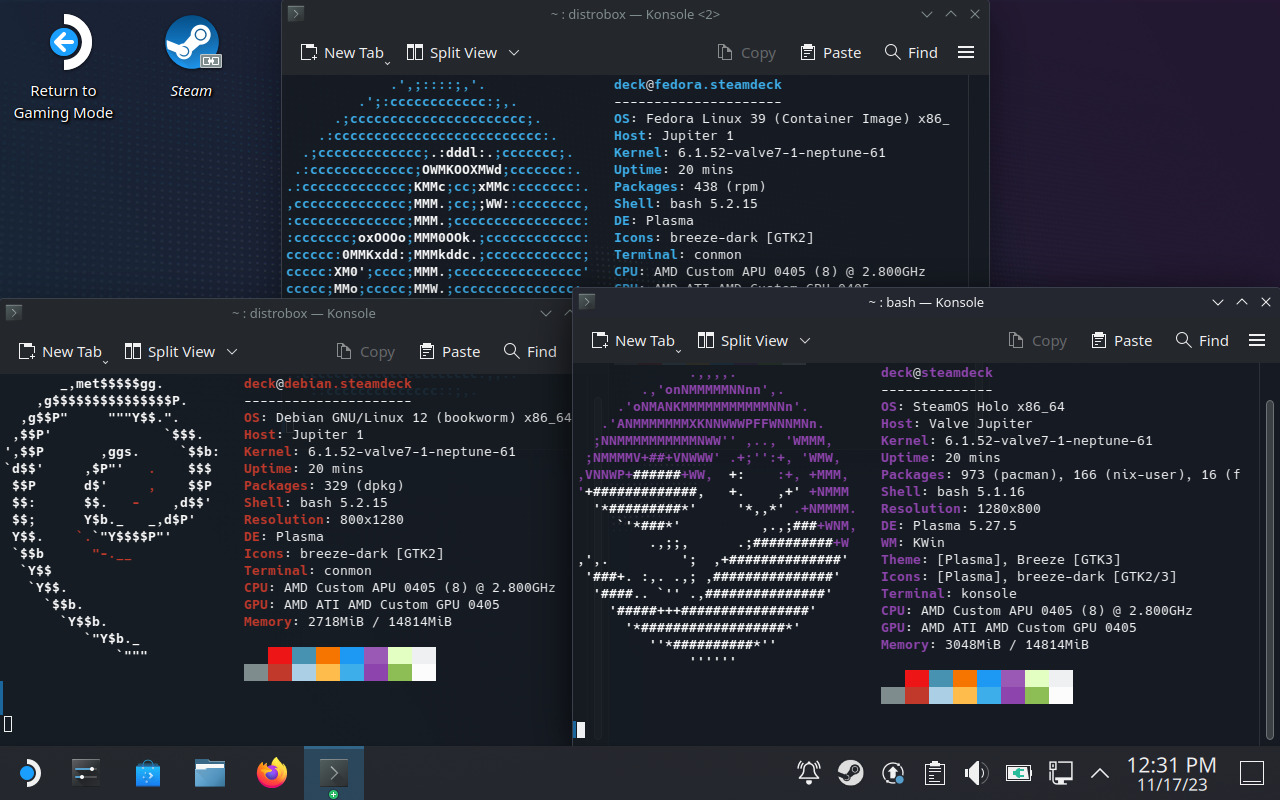
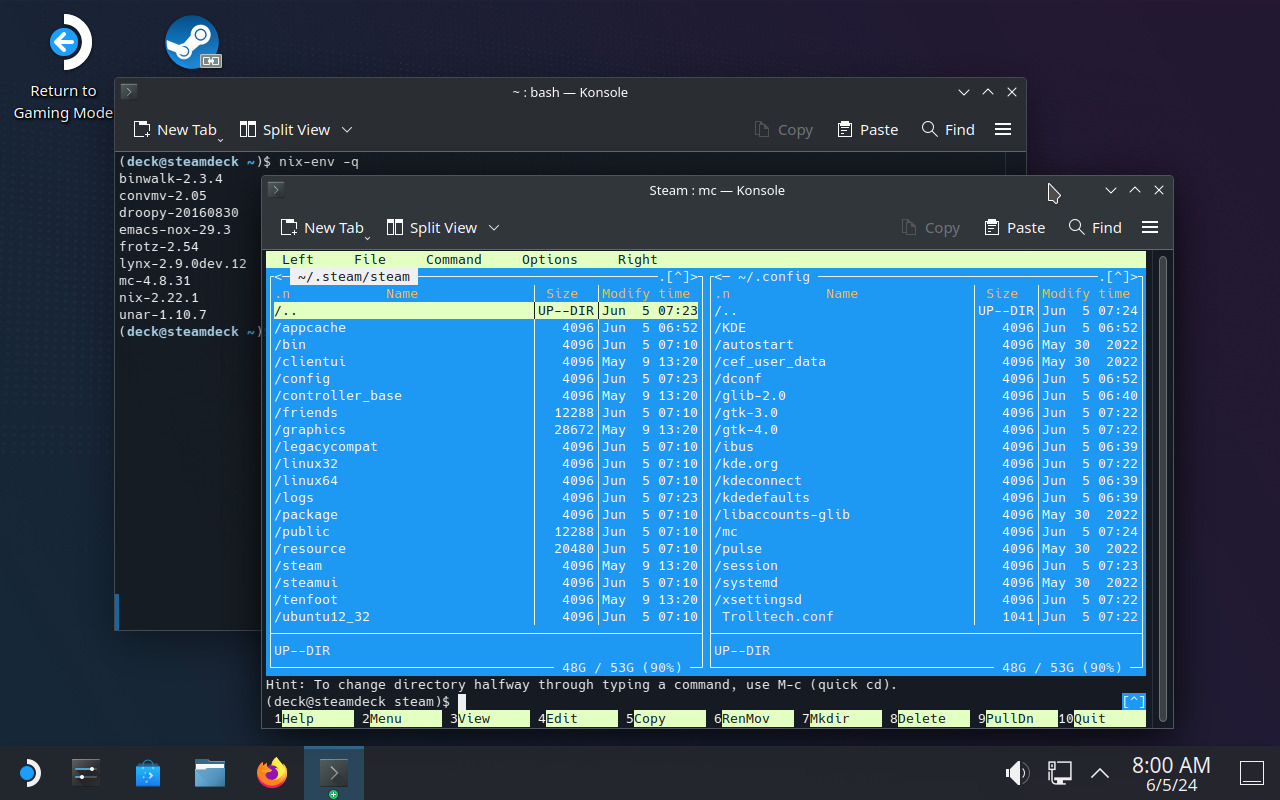
Introduction In my previous post I talked about how to use systemd-sysext to add software to the Steam Deck without modifying the root filesystem. In this post I will give a brief overview of two additional methods. Distrobox distrobox is a tool that uses containers to create a mutable environment on top of your OS. Distrobox running in SteamOS With distrobox you can open a terminal with your favorite Linux distro inside, with full access to the package manager and the ability to install additional software. Containers created by distrobox are integrated with the system so apps running inside have normal access to the user s home directory and the Wayland/X11 session. Since these containers are not stored in the root filesystem they can survive an OS update and continue to work fine. For this reason they are particularly suited to systems with an immutable root filesystem such as Silverblue, Endless OS or SteamOS. Starting from SteamOS 3.5 the system comes with distrobox (and podman) preinstalled and it can be used right out of the box without having to do any previous setup. For example, in order to create a Debian bookworm container simply open a terminal and run this:
$ distrobox create -i debian:bookworm debbox
Here debian:bookworm is the image that this container is created from (debian is the name and bookworm is the tag, see the list of supported tags here) and debbox is the name that is given to this new container. Once the container is created you can enter it:
$ distrobox enter debbox
Or from the Debian entry in the desktop menu -> Lost & Found. Once inside the container you can run your Debian commands normally:
$ sudo apt update
$ sudo apt install vim-gtk3
Nix Nix is a package manager for Linux and other Unix-like systems. It has the property that it can be installed alongside the official package manager of any distribution, allowing the user to add software without affecting the rest of the system. Nix running in SteamOS Nix installs everything under the /nix directory, and packages are made available to the user through a new entry in the PATH and a ~/.nix-profile symlink stored in the home directory. Nix is more things, including the basis of the NixOS operating system. Explaning Nix in more detail is beyond the scope of this blog post, but for SteamOS users these are perhaps its most interesting properties: The only thing that Nix needs from SteamOS is help to set up the /nix directory so its contents are not stored in the root filesystem. This is already happening starting from SteamOS 3.5 so you can install Nix right away in single-user mode:
$ sudo chown deck:deck /nix
$ wget https://nixos.org/nix/install
$ sh ./install --no-daemon
This installs Nix and adds a line to ~/.bash_profile to set up the necessary environment variables. After that you can log in again and start using it. Here s a very simple example (refer to the official documentation for more details):
# Install and run Midnight Commander
$ nix-env -iA nixpkgs.mc
$ mc
# List installed packages
$ nix-env -q
mc-4.8.31
nix-2.21.1
# Uninstall Midnight Commander
$ nix-env -e mc-4.8.31
What we have seen so far is how to install Nix in single-user mode, which is the simplest one and probably good enough for a single-user machine like the Steam Deck. The Nix project however recommends a multi-user installation, see here for the reasons. Unfortunately the official multi-user installer does not work out of the box on the Steam Deck yet, but if you want to go the multi-user way you can use the Determinate Systems installer: https://github.com/DeterminateSystems/nix-installer Conclusion Distrobox and Nix are useful tools and they give SteamOS users the ability to add additional software to the system without having to modify the base operating system. While for graphical applications the recommended way to install third-party software is still Flatpak, Distrobox and Nix give the user additional flexibility and are particularly useful for installing command-line utilities and other system tools.

4 June 2024

Dirk Eddelbuettel: ulid 0.4.0 on CRAN: Extended to Milliseconds

A new version of the ulid package is now on CRAN. The packages provides universally (unique) lexicographically (sortable) identifiers see the spec at GitHub for details on those which offer sorting which uuids lack. The R package provides access via the standard C++ library, had been put together by Bob Rudis and is now maintained by me. Mark Heckmann noticed that a ulid round trip of generating and unmarshalling swallowed subsecond informationm and posted on a well-known site I no longer go to. Duncan Murdoch was kind enough to open an issue to make me aware, and in it included the nice minimally complete verifiable example by Mark. It turns out that this issue was known, documented upstream in two issues and fixed in fork by the authors of those issues, Chris Bove. It replaces time_t as the value of record (constrained at the second resolution) with a proper std::chrono object which offers milliseconds (and much more, yay Modern C++). So I switched the two main files of library to his, and updated the wrapper code to interface from POSIXct to std::chrono object. And with that we are in business. The original example of five ulids create 100 millisecond part, then unmarshalled and here printed as a data.table as data.frame by default truncates to seconds:
> library(ulid)
> gen_ulid <- \(sleep) replicate(5,  Sys.sleep(sleep); generate() )
> u <- gen_ulid(.1)
> df <- unmarshal(u)
> data.table::data.table(df)
                        ts              rnd
                    <POSc>           <char>
1: 2024-05-30 16:38:28.588 CSQAJBPNX75R0G5A
2: 2024-05-30 16:38:28.688 XZX0TREDHD6PC1YR
3: 2024-05-30 16:38:28.789 0YK9GKZVTED27QMK
4: 2024-05-30 16:38:28.890 SC3M3G6KGPH7S50S
5: 2024-05-30 16:38:28.990 TSKCBWJ3TEKCPBY0
>
We updated the documentation accordingly, and added some new tests as well. The NEWS entry for this release follows.

Changes in version 0.4.0 (2024-06-03)
  • Switch two functions to fork by Chris Bove using std::chrono instead of time_t for consistent millisecond resolution (#3 fixing #2)
  • Updated documentation showing consistent millisecond functionality
  • Added unit tests for millisecond functionality

Courtesy of my CRANberries, there is also a diffstat report for this release. If you like this or other open-source work I do, you can sponsor me at GitHub.

This post by Dirk Eddelbuettel originated on his Thinking inside the box blog. Please report excessive re-aggregation in third-party for-profit settings.

29 May 2024

Antoine Beaupr : Playing with fonts again

I am getting increasingly frustrated by Fira Mono's lack of italic support so I am looking at alternative fonts again.

Commit Mono This time I seem to be settling on either Commit Mono or Space Mono. For now I'm using Commit Mono because it's a little more compressed than Fira and does have a italic version. I don't like how Space Mono's parenthesis (()) is "squarish", it feels visually ambiguous with the square brackets ([]), a big no-no for my primary use case (code). So here I am using a new font, again. It required changing a bunch of configuration files in my home directory (which is in a private repository, sorry) and Emacs configuration (thankfully that's public!). One gotcha is I realized I didn't actually have a global font configuration in Emacs, as some Faces define their own font family, which overrides the frame defaults. This is what it looks like, before:
A dark terminal showing the test sheet in Fira Mono Fira Mono
After:
A dark terminal showing the test sheet in Fira Mono Commit Mono
(Notice how those screenshots are not sharp? I'm surprised too. The originals look sharp on my display, I suspect this is something to do with the Wayland transition. I've tried with both grim and flameshot, for what its worth.) They are pretty similar! Commit Mono feels a bit more vertically compressed maybe too much so, actually -- the line height feels too low. But it's heavily customizable so that's something that's relatively easy to fix, if it's really a problem. Its weight is also a little heavier and wider than Fira which I find a little distracting right now, but maybe I'll get used to it. All characters seem properly distinguishable, although, if I'd really want to nitpick I'd say the and are too different, with the latter (REGISTERED SIGN) being way too small, basically unreadable here. Since I see this sign approximately never, it probably doesn't matter at all. I like how the ampersand (&) is more traditional, although I'll miss the exotic one Fira produced... I like how the back quotes ( , GRAVE ACCENT) drop down low, nicely aligned with the apostrophe. As I mentioned before, I like how the bar on the "f" aligns with the other top of letters, something in Fira mono that really annoys me now that I've noticed it (it's not aligned!).

A UTF-8 test file Here's the test sheet I've made up to test various characters. I could have sworn I had a good one like this lying around somewhere but couldn't find it so here it is, I guess.
US keyboard coverage:
abcdefghijklmnopqrstuvwxyz 1234567890-=[]\;',./
ABCDEFGHIJKLMNOPQRSTUVWXYZ~!@#$%^&*()_+ :"<>?
latin1 coverage:  
EURO SIGN, TRADE MARK SIGN:  
ambiguity test:
e coC0ODQ iI71lL! 
b6G&0B83  []() /\. 
zs$S52Z%   '" 
all characters in a sentence, uppercase:
the quick fox jumps over the lazy dog
THE QUICK FOX JUMPS OVER THE LAZY DOG
same, in french:
Portez ce vieux whisky au juge blond qui fume.
d s no l, o  un z phyr ha  me v t de gla ons w rmiens, je d ne
d exquis r tis de b uf au kir,   l a  d ge m r, &c tera.
D S NO L, O  UN Z PHYR HA  ME V T DE GLA ONS W RMIENS, JE D NE
D EXQUIS R TIS DE B UF AU KIR,   L A  D GE M R, &C TERA.
Ligatures test:
-<< -< -<- <-- <--- <<- <- -> ->> --> ---> ->- >- >>-
=<< =< =<= <== <=== <<= <= => =>> ==> ===> =>= >= >>=
<-> <--> <---> <----> <=> <==> <===> <====> :: ::: __
<~~ </ </> /> ~~> == != /= ~= <> === !== !=== =/= =!=
<: := *= *+ <* <*> *> <  < >  > <. <.> .> +* =* =: :>
(* *) /* */ [   ]     ++ +++ \/ /\  - -  <!-- <!---
Box drawing alignment tests:


Dashes alignment test:
HYPHEN-MINUS, MINUS SIGN, EN, EM DASH, HORIZONTAL BAR, LOW LINE
--------------------------------------------------


__________________________________________________
Update: here is another such sample sheet, it's pretty good and has support for more languages while being still relatively small. So there you have it, got completely nerd swiped by typography again. Now I can go back to writing a too-long proposal again. Sources and inspiration for the above:
  • the unicode(1) command, to lookup individual characters to disambiguate, for example, - (U+002D HYPHEN-MINUS, the minus sign next to zero on US keyboards) and (U+2212 MINUS SIGN, a math symbol)
  • searchable list of characters and their names - roughly equivalent to the unicode(1) command, but in one page, amazingly the /usr/share/unicode database doesn't have any one file like this
  • bits/UTF-8-Unicode-Test-Documents - full list of UTF-8 characters
  • UTF-8 encoded plain text file - nice examples of edge cases, curly quotes example and box drawing alignment test which, incidentally, showed me I needed specific faces customisation in Emacs to get the Markdown code areas to display properly, also the idea of comparing various dashes
  • sample sentences in many languages - unused, "Sentences that contain all letters commonly used in a language"
  • UTF-8 sampler - unused, similar

Other fonts In my previous blog post about fonts, I had a list of alternative fonts, but it seems people are not digging through this, so I figured I would redo the list here to preempt "but have you tried Jetbrains mono" kind of comments. My requirements are:
  • no ligatures: yes, in the previous post, I wanted ligatures but I have changed my mind. after testing this, I find them distracting, confusing, and they often break the monospace nature of the display
  • monospace: this is to display code
  • italics: often used when writing Markdown, where I do make use of italics... Emacs falls back to underlining text when lacking italics which is hard to read
  • free-ish, ultimately should be packaged in Debian
Here is the list of alternatives I have considered in the past and why I'm not using them:
  • agave: recommended by tarzeau, not sure I like the lowercase a, a bit too exotic, packaged as fonts-agave
  • Cascadia code: optional ligatures, multilingual, not liking the alignment, ambiguous parenthesis (look too much like square brackets), new default for Windows Terminal and Visual Studio, packaged as fonts-cascadia-code
  • Fira Code: ligatures, was using Fira Mono from which it is derived, lacking italics except for forks, interestingly, Fira Code succeeds the alignment test but Fira Mono fails to show the X signs properly! packaged as fonts-firacode
  • Hack: no ligatures, very similar to Fira, italics, good alternative, fails the X test in box alignment, packaged as fonts-hack
  • Hermit: no ligatures, smaller, alignment issues in box drawing and dashes, packaged as fonts-hermit somehow part of cool-retro-term
  • IBM Plex: irritating website, replaces Helvetica as the IBM corporate font, no ligatures by default, italics, proportional alternatives, serifs and sans, multiple languages, partial failure in box alignment test (X signs), fancy curly braces contrast perhaps too much with the rest of the font, packaged in Debian as fonts-ibm-plex
  • Inconsolata: no ligatures, maybe italics? more compressed than others, feels a little out of balance because of that, packaged in Debian as fonts-inconsolata
  • Intel One Mono: nice legibility, no ligatures, alignment issues in box drawing, not packaged in Debian
  • Iosevka: optional ligatures, italics, multilingual, good legibility, has a proportional option, serifs and sans, line height issue in box drawing, fails dash test, not in Debian
  • Jetbrains Mono: (mandatory?) ligatures, good coverage, originally rumored to be not DFSG-free (Debian Free Software Guidelines) but ultimately packaged in Debian as fonts-jetbrains-mono
  • Monoid: optional ligatures, feels much "thinner" than Jetbrains, not liking alignment or spacing on that one, ambiguous 2Z, problems rendering box drawing, packaged as fonts-monoid
  • Mononoki: no ligatures, looks good, good alternative, suggested by the Debian fonts team as part of fonts-recommended, problems rendering box drawing, em dash bigger than en dash, packaged as fonts-mononoki
  • Source Code Pro: italics, looks good, but dash metrics look whacky, not in Debian
  • spleen: bitmap font, old school, spacing issue in box drawing test, packaged as fonts-spleen
  • sudo: personal project, no ligatures, zero originally not dotted, relied on metrics for legibility, spacing issue in box drawing, not in Debian
So, if I get tired of Commit Mono, I might probably try, in order:
  1. Hack
  2. Jetbrains Mono
  3. IBM Plex Mono
Iosevka, Monoki and Intel One Mono are also good options, but have alignment problems. Iosevka is particularly disappointing as the EM DASH metrics are just completely wrong (much too wide). This was tested using the Programming fonts site which has all the above fonts, which cannot be said of Font Squirrel or Google Fonts, amazingly. Other such tools:

27 May 2024

Thomas Koch: Minimal overhead VMs with Nix and MicroVM

Posted on March 17, 2024
Joachim Breitner wrote about a Convenient sandboxed development environment and thus reminded me to blog about MicroVM. I ve toyed around with it a little but not yet seriously used it as I m currently not coding. MicroVM is a nix based project to configure and run minimal VMs. It can mount and thus reuse the hosts nix store inside the VM and thus has a very small disk footprint. I use MicroVM on a debian system using the nix package manager. The MicroVM author uses the project to host production services. Otherwise I consider it also a nice way to learn about NixOS after having started with the nix package manager and before making the big step to NixOS as my main system. The guests root filesystem is a tmpdir, so one must explicitly define folders that should be mounted from the host and thus be persistent across VM reboots. I defined the VM as a nix flake since this is how I started from the MicroVM projects example:
 
  description = "Haskell dev MicroVM";
  inputs.impermanence.url = "github:nix-community/impermanence";
  inputs.microvm.url = "github:astro/microvm.nix";
  inputs.microvm.inputs.nixpkgs.follows = "nixpkgs";
  outputs =   self, impermanence, microvm, nixpkgs  :
    let
      persistencePath = "/persistent";
      system = "x86_64-linux";
      user = "thk";
      vmname = "haskell";
      nixosConfiguration = nixpkgs.lib.nixosSystem  
          inherit system;
          modules = [
            microvm.nixosModules.microvm
            impermanence.nixosModules.impermanence
            ( pkgs, ...  :  
            environment.persistence.$ persistencePath  =  
                hideMounts = true;
                users.$ user  =  
                  directories = [
                    "git" ".stack"
                  ];
                 ;
               ;
              environment.sessionVariables =  
                TERM = "screen-256color";
               ;
              environment.systemPackages = with pkgs; [
                ghc
                git
                (haskell-language-server.override   supportedGhcVersions = [ "94" ];  )
                htop
                stack
                tmux
                tree
                vcsh
                zsh
              ];
              fileSystems.$ persistencePath .neededForBoot = nixpkgs.lib.mkForce true;
              microvm =  
                forwardPorts = [
                    from = "host"; host.port = 2222; guest.port = 22;  
                    from = "guest"; host.port = 5432; guest.port = 5432;   # postgresql
                ];
                hypervisor = "qemu";
                interfaces = [
                    type = "user"; id = "usernet"; mac = "00:00:00:00:00:02";  
                ];
                mem = 4096;
                shares = [  
                  # use "virtiofs" for MicroVMs that are started by systemd
                  proto = "9p";
                  tag = "ro-store";
                  # a host's /nix/store will be picked up so that no
                  # squashfs/erofs will be built for it.
                  source = "/nix/store";
                  mountPoint = "/nix/.ro-store";
                   
                  proto = "virtiofs";
                  tag = "persistent";
                  source = "~/.local/share/microvm/vms/$ vmname /persistent";
                  mountPoint = persistencePath;
                  socket = "/run/user/1000/microvm-$ vmname -persistent";
                 
                ];
                socket = "/run/user/1000/microvm-control.socket";
                vcpu = 3;
                volumes = [];
                writableStoreOverlay = "/nix/.rwstore";
               ;
              networking.hostName = vmname;
              nix.enable = true;
              nix.nixPath = ["nixpkgs=$ builtins.storePath <nixpkgs> "];
              nix.settings =  
                extra-experimental-features = ["nix-command" "flakes"];
                trusted-users = [user];
               ;
              security.sudo =  
                enable = true;
                wheelNeedsPassword = false;
               ;
              services.getty.autologinUser = user;
              services.openssh =  
                enable = true;
               ;
              system.stateVersion = "24.11";
              systemd.services.loadnixdb =  
                description = "import hosts nix database";
                path = [pkgs.nix];
                wantedBy = ["multi-user.target"];
                requires = ["nix-daemon.service"];
                script = "cat $ persistencePath /nix-store-db-dump nix-store --load-db";
               ;
              time.timeZone = nixpkgs.lib.mkDefault "Europe/Berlin";
              users.users.$ user  =  
                extraGroups = [ "wheel" "video" ];
                group = "user";
                isNormalUser = true;
                openssh.authorizedKeys.keys = [
                  "ssh-rsa REDACTED"
                ];
                password = "";
               ;
              users.users.root.password = "";
              users.groups.user =  ;
             )
          ];
         ;
    in  
      packages.$ system .default = nixosConfiguration.config.microvm.declaredRunner;
     ;
 
I start the microVM with a templated systemd user service:
[Unit]
Description=MicroVM for Haskell development
Requires=microvm-virtiofsd-persistent@.service
After=microvm-virtiofsd-persistent@.service
AssertFileNotEmpty=%h/.local/share/microvm/vms/%i/flake/flake.nix
[Service]
Type=forking
ExecStartPre=/usr/bin/sh -c "[ /nix/var/nix/db/db.sqlite -ot %h/.local/share/microvm/nix-store-db-dump ]   nix-store --dump-db >%h/.local/share/microvm/nix-store-db-dump"
ExecStartPre=ln -f -t %h/.local/share/microvm/vms/%i/persistent/ %h/.local/share/microvm/nix-store-db-dump
ExecStartPre=-%h/.local/state/nix/profile/bin/tmux new -s microvm -d
ExecStart=%h/.local/state/nix/profile/bin/tmux new-window -t microvm: -n "%i" "exec %h/.local/state/nix/profile/bin/nix run --impure %h/.local/share/microvm/vms/%i/flake"
The above service definition creates a dump of the hosts nix store db so that it can be imported in the guest. This is necessary so that the guest can actually use what is available in /nix/store. There is an effort for an overlayed nix store that would be preferable to this hack. Finally the microvm is started inside a tmux session named microvm . This way I can use the VM with SSH or through the console and also access the qemu console. And for completeness the virtiofsd service:
[Unit]
Description=serve host persistent folder for dev VM
AssertPathIsDirectory=%h/.local/share/microvm/vms/%i/persistent
[Service]
ExecStart=%h/.local/state/nix/profile/bin/virtiofsd \
 --socket-path=$ XDG_RUNTIME_DIR /microvm-%i-persistent \
 --shared-dir=%h/.local/share/microvm/vms/%i/persistent \
 --gid-map :995:%G:1: \
 --uid-map :1000:%U:1:

Next.

Previous.