Search Results: "tb"

14 May 2024

Freexian Collaborators: Monthly report about Debian Long Term Support, April 2024 (by Roberto C. S nchez)


Like each month, have a look at the work funded by Freexian s Debian LTS offering.

Debian LTS contributors In April, 19 contributors have been paid to work on Debian LTS, their reports are available:
  • Abhijith PA did 0.5h (out of 0.0h assigned and 14.0h from previous period), thus carrying over 13.5h to the next month.
  • Adrian Bunk did 35.75h (out of 17.25h assigned and 40.5h from previous period), thus carrying over 22.0h to the next month.
  • Bastien Roucari s did 25.0h (out of 25.0h assigned).
  • Ben Hutchings did 24.0h (out of 9.0h assigned and 15.0h from previous period).
  • Chris Lamb did 18.0h (out of 18.0h assigned).
  • Daniel Leidert did 10.0h (out of 10.0h assigned).
  • Emilio Pozuelo Monfort did 46.0h (out of 12.0h assigned and 34.0h from previous period).
  • Guilhem Moulin did 14.75h (out of 20.0h assigned), thus carrying over 5.25h to the next month.
  • Lee Garrett did 51.25h (out of 0.0h assigned and 60.0h from previous period), thus carrying over 8.75h to the next month.
  • Markus Koschany did 40.0h (out of 40.0h assigned).
  • Ola Lundqvist did 22.5h (out of 19.5h assigned and 4.5h from previous period), thus carrying over 1.5h to the next month.
  • Roberto C. S nchez did 11.0h (out of 9.25h assigned and 2.75h from previous period), thus carrying over 1.0h to the next month.
  • Santiago Ruano Rinc n did 20.0h (out of 20.0h assigned).
  • Sean Whitton did 9.5h (out of 4.5h assigned and 5.5h from previous period), thus carrying over 0.5h to the next month.
  • Stefano Rivera did 1.5h (out of 0.0h assigned and 10.0h from previous period), thus carrying over 8.5h to the next month.
  • Sylvain Beucler did 12.5h (out of 22.75h assigned and 35.0h from previous period), thus carrying over 45.25h to the next month.
  • Thorsten Alteholz did 14.0h (out of 14.0h assigned).
  • Tobias Frost did 10.0h (out of 12.0h assigned), thus carrying over 2.0h to the next month.
  • Utkarsh Gupta did 3.25h (out of 28.5h assigned and 29.25h from previous period), thus carrying over 54.5h to the next month.

Evolution of the situation In April, we have released 28 DLAs. During the month of April, there was one particularly notable security update made in LTS. Guilhem Moulin prepared DLA-3782-1 for util-linux (part of the set of base packages and containing a number of important system utilities) in order to address a possible information disclosure vulnerability. Additionally, several contributors prepared updates for oldstable (bullseye), stable (bookworm), and unstable (sid), including:
  • ruby-rack: prepared for oldstable, stable, and unstable by Adrian Bunk
  • wpa: prepared for oldstable, stable, and unstable by Bastien Roucari s
  • zookeeper: prepared for stable by Bastien Roucari s
  • libjson-smart: prepared for unstable by Bastien Roucari s
  • ansible: prepared for stable and unstable, including autopkgtest fixes to increase future supportability, by Lee Garrett
  • wordpress: prepared for oldstable and stable by Markus Koschany
  • emacs and org-mode: prepared for oldstable and stable by Sean Whitton
  • qtbase-opensource-src: prepared for oldstable and stable by Thorsten Alteholz
  • libjwt: prepared for oldstable by Thorsten Alteholz
  • libmicrohttpd: prepared for oldstable by Thorsten Alteholz
These fixes were in addition to corresponding updates in LTS. Another item to highlight in this month s report is an update to the distro-info-data database by Stefano Rivera. This update ensures that Debian buster systems have the latest available information concerning the end-of-life dates and other related information for all releases of Debian and Ubuntu. As announced on the debian-lts-announce mailing list, it is worth to point out that we are getting close to the end of support of Debian 10 as LTS. After June 30th, no new security updates will be made available on security.debian.org. However, Freexian and its team of paid Debian contributors will continue to maintain Debian 10 going forward for the customers of the Extended LTS offer. If you still have Debian 10 servers to keep secure, it s time to subscribe!

Thanks to our sponsors Sponsors that joined recently are in bold.

12 May 2024

Daniel Lange: htop and PCP have a new home at Hack Club

After the unfortunate and somewhat surprising shutdown of the Open Collective Foundation (OCF), htop and Performance Co-Pilot (PCP) have migrated to Hack Club. Initially founded to improve STEM education, support high school computer science clubs and firmly founded in the hacker culture, Hack Club have created a US IRS approved 501(c)(3) charity that provides what Open Collective did/does1 and more at a flat 7% fee of the project income. Nathan Scott organized these moves with Paul Spitler. Many thanks! We considered other options for the projects, e.g. Gentoo has moved to Software in the Public Interest (SPI) and I know SPI quite well as they were created initially to host Debian. But PCP moved from SPI to OCF in 2021. Open Collective has a European branch that seems independent of the dissolved US foundation. But all-in-all Hack Club seemed the best fit. You can find the new fiscal sponsorship and donation landing pages at:
htophttps://hcb.hackclub.com/htop/https://hcb.hackclub.com/donations/start/htop
PCPhttps://hcb.hackclub.com/pcp/https://hcb.hackclub.com/donations/start/pcp

  1. Open Collective as in the fancy "manage your project donations and reimbursements" website still continues to run but the foundation of the same name that provided the actual fiscal sponsorship (i.e. managing the funds) got dissolved. It's ... complicated.

Freexian Collaborators: Debian Contributions: Salsa CI updates, OpenSSH option review, and more! (by Utkarsh Gupta)

Contributing to Debian is part of Freexian s mission. This article covers the latest achievements of Freexian and their collaborators. All of this is made possible by organizations subscribing to our Long Term Support contracts and consulting services. P.S. We ve completed over a year of writing these blogs. If you have any suggestions on how to make them better or what you d like us to cover, or any other opinions/reviews you might have, et al, please let us know by dropping an email to us. We d be happy to hear your thoughts. :)

Salsa CI updates & GSoC candidacy, by Santiago Ruano Rincon In the context of Google Summer of Code (GSoC), Santiago continued the mentoring work, following the applications of three of the candidates. This work started in March, but Aquila Macedo, Ahmed Siam and Piyush Raj continued in April to propose and review MRs. For example, Update CI pipeline to utilize specific blhc image per release and Remove references to buster-backports by Aquila, or the reviews the candidates made to Document the structure of the different components of the pipeline (see below). Unfortunately, the Salsa CI project didn t get any slot from the GSoC program in the end. Along with the Salsa CI related work, Santiago improved the documentation of Salsa CI, to make it easier for newcomers (as the GSoC candidates) or people willing to fork the project to understand its internals. Documentation is an aspect where a lot of improvements can be made.

OpenSSH option review, by Colin Watson In light of last month s xz-utils backdoor, Colin did an extensive review of some of the choices in Debian s OpenSSH packaging. Some work on this has already been done (removing uses of libsystemd and reducing tcp-wrappers linkage); the next step is likely to be to start work on the plan to split out GSS-API key exchange again.

Miscellaneous contributions
  • Utkarsh Gupta started to put together and kickstart the bursary team ahead of DebConf 24, to be held in Busan, South Korea.
  • Utkarsh Gupta reviewed some MRs and docs for the bursary team for the DC24 website.
  • Helmut Grohne sent patches for 19 cross build failures and submitted a gcc patch removing LIMITS_H_TEST upstream.
  • Helmut sent 8 bug reports with 3 patches related to the /usr-move.
  • Helmut diagnosed why /dev/stdout is not accessible in sbuild --mode=unshare.
  • Helmut diagnosed the time64-induced glibc FTBFS.
  • Helmut sent patches for fixing initramfs triggers on firmware removal.
  • Thorsten Alteholz uploaded foo2zjs and fixed two bugs, one related to /usr-merge. Likewise the upload of cups-filters (from the 1.x branch) fixed three bugs. In order to fix an RC bug in cpdb-backends-cups, which was updated to the 2.x branch, the new package libcupsfilters has been introduced. Last but not least an upload of hplip fixed one RC bug and an upload of gutenprint fixed two of them. All of these RC bugs were more or less related to the time_t transition.
  • Santiago continued to work in the DebConf organization tasks, including some for the DebConf 24 Content Team, and looking to build a local community for DebConf 25.
  • Stefano Rivera made a couple of uploads of dh-python to Debian, and a few other general package update uploads.
  • Stefano did some winding up of DebConf 23 finances, including closing bursary claims and recording the amounts spent on travel bursaries.
  • Stefano opened DebConf 24 registration, which always requires some last-minute work on the website.
  • Colin released man-db 2.12.1.
  • Colin fixed a regression in groff s PDF output.
  • In the Python team, Colin fixed build/autopkgtest failures in seven packages, and updated ten packages to new upstream versions.

10 May 2024

Reproducible Builds: Reproducible Builds in April 2024

Welcome to the April 2024 report from the Reproducible Builds project! In our reports, we attempt to outline what we have been up to over the past month, as well as mentioning some of the important things happening more generally in software supply-chain security. As ever, if you are interested in contributing to the project, please visit our Contribute page on our website. Table of contents:
  1. New backseat-signed tool to validate distributions source inputs
  2. NixOS is not reproducible
  3. Certificate vulnerabilities in F-Droid s fdroidserver
  4. Website updates
  5. Reproducible Builds and Insights from an Independent Verifier for Arch Linux
  6. libntlm now releasing minimal source-only tarballs
  7. Distribution work
  8. Mailing list news
  9. diffoscope
  10. Upstream patches
  11. reprotest
  12. Reproducibility testing framework

New backseat-signed tool to validate distributions source inputs kpcyrd announced a new tool called backseat-signed, after:
I figured out a somewhat straight-forward way to check if a given git archive output is cryptographically claimed to be the source input of a given binary package in either Arch Linux or Debian (or both).
Elaborating more in their announcement post, kpcyrd writes:
I believe this to be the reproducible source tarball thing some people have been asking about. As explained in the README, I believe reproducing autotools-generated tarballs isn t worth everybody s time and instead a distribution that claims to build from source should operate on VCS snapshots instead of tarballs with 25k lines of pre-generated shell-script.
Indeed, many distributions packages already build from VCS snapshots, and this trend is likely to accelerate in response to the xz incident. The announcement led to a lengthy discussion on our mailing list, as well as shorter followup thread from kpcyrd about bootstrapping Autotools projects.

NixOS is not reproducible Morten Linderud posted an post on his blog this month, provocatively titled, NixOS is not reproducible . Although quickly admitting that his title is indeed clickbait , Morten goes on to clarify the precise guarantees and promises that NixOS provides its users. Later in the most, Morten mentions that he was motivated to write the post because:
I have heavily invested my free-time on this topic since 2017, and met some of the accomplishments we have had with Doesn t NixOS solve this? for just as long and I thought it would be of peoples interest to clarify[.]

Certificate vulnerabilities in F-Droid s fdroidserver In early April, Fay Stegerman announced a certificate pinning bypass vulnerability and Proof of Concept (PoC) in the F-Droid fdroidserver tools for managing builds, indexes, updates, and deployments for F-Droid repositories to the oss-security mailing list.
We observed that embedding a v1 (JAR) signature file in an APK with minSdk >= 24 will be ignored by Android/apksigner, which only checks v2/v3 in that case. However, since fdroidserver checks v1 first, regardless of minSdk, and does not verify the signature, it will accept a fake certificate and see an incorrect certificate fingerprint. [ ] We also realised that the above mentioned discrepancy between apksigner and androguard (which fdroidserver uses to extract the v2/v3 certificates) can be abused here as well. [ ]
Later on in the month, Fay followed up with a second post detailing a third vulnerability and a script that could be used to scan for potentially affected .apk files and mentioned that, whilst upstream had acknowledged the vulnerability, they had not yet applied any ameliorating fixes.

Website updates There were a number of improvements made to our website this month, including Chris Lamb updating the archive page to recommend -X and unzipping with TZ=UTC [ ] and adding Maven, Gradle, JDK and Groovy examples to the SOURCE_DATE_EPOCH page [ ]. In addition Jan Zerebecki added a new /contribute/opensuse/ page [ ] and Sertonix fixed the automatic RSS feed detection [ ][ ].

Reproducible Builds and Insights from an Independent Verifier for Arch Linux Joshua Drexel, Esther H nggi and Iy n M ndez Veiga of the School of Computer Science and Information Technology, Hochschule Luzern (HSLU) in Switzerland published a paper this month entitled Reproducible Builds and Insights from an Independent Verifier for Arch Linux. The paper establishes the context as follows:
Supply chain attacks have emerged as a prominent cybersecurity threat in recent years. Reproducible and bootstrappable builds have the potential to reduce such attacks significantly. In combination with independent, exhaustive and periodic source code audits, these measures can effectively eradicate compromises in the building process. In this paper we introduce both concepts, we analyze the achievements over the last ten years and explain the remaining challenges.
What is more, the paper aims to:
contribute to the reproducible builds effort by setting up a rebuilder and verifier instance to test the reproducibility of Arch Linux packages. Using the results from this instance, we uncover an unnoticed and security-relevant packaging issue affecting 16 packages related to Certbot [ ].
A PDF of the paper is available.

libntlm now releasing minimal source-only tarballs Simon Josefsson wrote on his blog this month that, going forward, the libntlm project will now be releasing what they call minimal source-only tarballs :
The XZUtils incident illustrate that tarballs with files that are not included in the git archive offer an opportunity to disguise malicious backdoors. [The] risk of hiding malware is not the only motivation to publish signed minimal source-only tarballs. With pre-generated content in tarballs, there is a risk that GNU/Linux distributions [ship] generated files coming from the tarball into the binary *.deb or *.rpm package file. Typically the person packaging the upstream project never realized that some installed artifacts was not re-built[.]
Simon s post goes into further details how this was achieved, and describes some potential caveats and counters some expected responses as well. A shorter version can be found in the announcement for the 1.8 release of libntlm.

Distribution work In Debian this month, Helmut Grohne filed a bug suggesting the removal of dh-buildinfo, a tool to generate and distribute .buildinfo-like files within binary packages. Note that this is distinct from the .buildinfo generation performed by dpkg-genbuildinfo. By contrast, the entirely optional dh-buildinfo generated a debian/buildinfo file that would be shipped within binary packages as /usr/share/doc/package/buildinfo_$arch.gz. Adrian Bunk recently asked about including source hashes in Debian s .buildinfo files, which prompted Guillem Jover to refresh some old patches to dpkg to make this possible, which revealed some quirks Vagrant Cascadian discovered when testing. In addition, 21 reviews of Debian packages were added, 22 were updated and 16 were removed this month adding to our knowledge about identified issues. A number issue types have been added, such as new random_temporary_filenames_embedded_by_mesonpy and timestamps_added_by_librime toolchain issues. In openSUSE, it was announced that their Factory distribution enabled bit-by-bit reproducible builds for almost all parts of the package. Previously, more parts needed to be ignored when comparing package files, but now only the signature needs to be deleted. In addition, Bernhard M. Wiedemann published theunreproduciblepackage as a proper .rpm package which it allows to better test tools intended to debug reproducibility. Furthermore, it was announced that Bernhard s work on a 100% reproducible openSUSE-based distribution will be funded by NLnet. He also posted another monthly report for his reproducibility work in openSUSE. In GNU Guix, Janneke Nieuwenhuizen submitted a patch set for creating a reproducible source tarball for Guix. That is to say, ensuring that make dist is reproducible when run from Git. [ ] Lastly, in Fedora, a new wiki page was created to propose a change to the distribution. Titled Changes/ReproduciblePackageBuilds , the page summarises itself as a proposal whereby A post-build cleanup is integrated into the RPM build process so that common causes of build irreproducibility in packages are removed, making most of Fedora packages reproducible.

Mailing list news On our mailing list this month:
  • Continuing a thread started in March 2024 about the Arch Linux minimal container now being 100% reproducible, John Gilmore followed up with a post about the practical and philosophical distinctions of local vs. remote storage of the various artifacts needed to build packages.
  • Chris Lamb asked the list which conferences readers are attending these days: After peak Covid and other industry-wide changes, conferences are no longer the must attend events they previously were especially in the area of software supply-chain security. In rough, practical terms, it seems harder to justify conference travel today than it did in mid-2019. The thread generated a number of responses which would be of interest to anyone planning travel in Q3 and Q4 of 2024.
  • James Addison wrote to the list about a quirk in Git related to its core.autocrlf functionality, thus helpfully passing on a slightly off-topic and perhaps not of direct relevance to anyone on the list today note that might still be the kind of issue that is useful to be aware of if-and-when puzzling over unexpected git content / checksum issues (situations that I do expect people on this list encounter from time-to-time) .

diffoscope diffoscope is our in-depth and content-aware diff utility that can locate and diagnose reproducibility issues. This month, Chris Lamb made a number of changes such as uploading versions 263, 264 and 265 to Debian and made the following additional changes:
  • Don t crash on invalid .zip files, even if we encounter their badness halfway through the file and not at the time of their initial opening. [ ]
  • Prevent odt2txt tests from always being skipped due to an (impossibly) new version requirement. [ ]
  • Avoid parens-in-parens in test skipping messages. [ ]
  • Ensure that tests with >=-style version constraints actually print the tool name. [ ]
In addition, Fay Stegerman fixed a crash when there are (invalid) duplicate entries in .zip which was originally reported in Debian bug #1068705). [ ] Fay also added a user-visible note to a diff when there are duplicate entries in ZIP files [ ]. Lastly, Vagrant Cascadian added an external tool pointer for the zipdetails tool under GNU Guix [ ] and proposed updates to diffoscope in Guix as well [ ] which were merged as [264] [265], fixed a regression in test coverage and increased verbosity of the test suite[ ].

Upstream patches The Reproducible Builds project detects, dissects and attempts to fix as many currently-unreproducible packages as possible. We endeavour to send all of our patches upstream where appropriate. This month, we wrote a large number of such patches, including:

reprotest reprotest is our tool for building the same source code twice in different environments and then checking the binaries produced by each build for any differences. This month, reprotest version 0.7.27 was uploaded to Debian unstable) by Vagrant Cascadian who made the following additional changes:
  • Enable specific number of CPUs using --vary=num_cpus.cpus=X. [ ]
  • Consistently use 398 days for time variation, rather than choosing randomly each time. [ ]
  • Disable builds of arch:any packages. [ ]
  • Update the description for the build_path.path option in README.rst. [ ]
  • Update escape sequences for compatibility with Python 3.12. (#1068853). [ ]
  • Remove the generic upstream signing-key [ ] and update the packages signing key with the currently active team members [ ].
  • Update the packaging Standards-Version to 4.7.0. [ ]
In addition, Holger Levsen fixed some spelling errors detected by the spellintian tool [ ] and Vagrant Cascadian updated reprotest in GNU Guix to 0.7.27.

Reproducibility testing framework The Reproducible Builds project operates a comprehensive testing framework running primarily at tests.reproducible-builds.org in order to check packages and other artifacts for reproducibility. In April, an enormous number of changes were made by Holger Levsen:
  • Debian-related changes:
    • Adjust for changed internal IP addresses at Codethink. [ ]
    • Automatically cleanup failed diffoscope user services if there are too many failures. [ ][ ]
    • Configure two new nodes at infomanik.cloud. [ ][ ]
    • Schedule Debian experimental even less. [ ][ ]
  • Breakage detection:
    • Exclude currently building packages from breakage detection. [ ]
    • Be more noisy if diffoscope crashes. [ ]
    • Health check: provide clickable URLs in jenkins job log for failed pkg builds due to diffoscope crashes. [ ]
    • Limit graph to about the last 100 days of breakages only. [ ]
    • Fix all found files with bad permissions. [ ]
    • Prepare dealing with diffoscope timeouts. [ ]
    • Detect more cases of failure to debootstrap base system. [ ]
    • Include timestamps of failed job runs. [ ]
  • Documentation updates:
    • Document how to access arm64 nodes at Codethink. [ ]
    • Document how to use infomaniak.cloud. [ ]
    • Drop notes about long stalled LeMaker HiKey960 boards sponsored by HPE and hosted at ETH. [ ]
    • Mention osuosl4 and osuosl5 and explain their usage. [ ]
    • Mention that some packages are built differently. [ ][ ]
    • Improve language in a comment. [ ]
    • Add more notes how to query resource usage from infomaniak.cloud. [ ]
  • Node maintenance:
    • Add ionos4 and ionos14 to THANKS. [ ][ ][ ][ ][ ]
    • Deprecate Squid on ionos1 and ionos10. [ ]
    • Drop obsolete script to powercycle arm64 architecture nodes. [ ]
    • Update system_health_check for new proxy nodes. [ ]
  • Misc changes:
    • Make the update_jdn.sh script more robust. [ ][ ]
    • Update my SSH public key. [ ]
In addition, Mattia Rizzolo added some new host details. [ ]

If you are interested in contributing to the Reproducible Builds project, please visit our Contribute page on our website. However, you can get in touch with us via:

9 May 2024

Vincent Sanders: Bee to the blossom, moth to the flame; Each to his passion; what's in a name?

I like the sentiment of Helen Hunt Jackson in that quote and it generally applies double for computer system names. However I like to think when I named the first NetSurf VM host server phoenix fourteen years ago I captured the nature of its continuous cycle of replacement.
Image of the fourth phoenix server
We have been very fortunate to receive a donated server to replace the previous every few years and the very generous folks at Collabora continue to provide hosting for it.Recently I replaced the server for the third time. We once again were given a replacement by Huw Jones in the form of a SuperServer 6017R-TDAF system with dual Intel Xeon Ivy Bridge E5-2680v2 processors. There were even rack rails!

The project bought some NVMe drives and an adaptor cards and I attempted to arrange to swap out the server in January.

The old phoenixiii server being replaced
Here we come to the slight disadvantage of an informal arrangement where access to the system depends upon a busy third party. Unfortunately it took until May to arrange access (I must thank Vivek again for coming in on a Saturday to do this)

In the intervening time, once I realised access was going to become increasingly difficult, I decided to obtain as good a system as I could manage to reduce requirements for future access.

I turned to eBay and acquired a slightly more modern SuperServer with dual Intel Xeon Haswell E5-2680v3 processors which required purchase of 64G of new memory (Haswell is a DDR4 platform).

I had wanted to use Broadwell processors but this exceeded my budget and would only be a 10% performance uplift (The chassis, motherboard and memory cost 180 and another 50 for processors was just too much, maybe next time)

graph of cpu mark improvements in the phoenix servers over time
While making the decision on the processor selection I made a quick chart of previous processing capabilities (based on a passmark comparison) of phoenix servers and was startled to discover I needed a logarithmic vertical axis. Multi core performance of processors has improved at a startling rate in the last decade.

When the original replacement was donated I checked where the performance was limited and noticed it was mainly in disc access which is what prompted the upgrade to NVMe (2 gigabytes a second peek read throughput) which moved the bottleneck to the processors where, even with the upgrades, it remains.

I do not really know if there is a conclusion here beyond noting NetSurf is very fortunate as a project to have some generous benefactors both for donating hardware and hosting for which I know all the developers are grateful.

Now I just need to go and migrate a huge bunch of virtual machines and associated sysadmin to make use of these generous donations.

Thorsten Alteholz: My Debian Activities in April 2024

FTP master This month I accepted 386 and rejected 39 packages. The overall number of packages that got accepted was 386.

I also added lots of +moreinfo tags to some RM bugs. Is it that hard to check the reverse dependencies on your own? Debian LTS This was my hundred-eighteenth month that I did some work for the Debian LTS initiative, started by Raphael Hertzog at Freexian. During my allocated time I uploaded:

8 May 2024

Bastian Venthur: New python-debianbts in experimental

Last month, I asked for help migrating python-debianbts to zeep, a SOAP library that would replace the now unmaintained pysimplesoap. The main blocker was the lack of a proper WSDL file provided by Debian s BTS software, debbugs. Peter De Wachter pointed out other issues with debbugs SOAP implementation and provided a patch that solves the whole issue by removing the dependency on an external SOAP library altogether by implementing the required bits of the SOAP protocol directly in python-debianbts. The new version is completely backwards compatible, and the test suites of python-debianbts and reportbug are still passing. Apparently, while working on this patch, Peter also uncovered an issue with the type hints defined in Python s xml.etree module, for which he also provided a patch. Really great work! I ve uploaded the new version to Debian/experimental for now to get some exposure and feedback, before uploading it to unstable. Peter, thank you very much for your support, I really appreciate it!

6 May 2024

Thomas Lange: Removing tens of thousands of web pages

In January I've removed tens of thousands of web pages on www.debian.org. Have you noticed it? In the past From 1997 onwards, we had web pages for security announcements. We had to manually prepare a .data and a .wml file which then generated a web page for each security announcement (DSA or DLA). We have listed the 6 most recent messages in a short list that was created from these files. Most of the work that went into the Debian web pages was creating these files. Our search engine often listed the pages with security announcements instead of a more relevant web page for a particular topic. Preparation At DebConf Kosovo (2022) I started with a proof of concept and wrote a script, that generates this list without using the .data/.wml files in the Git repository, but instead reading the primary sources of security information[1]. This new list now includes links to the security tracker and the email of the announcement. Following web pages and scripts were also using these .data and .wml files: Before I could remove all the security web pages, I had to adjust the scripts, that create the above information. When I looked at the OVAL files and the apache logs of our web server, I saw that more than 99% of the web traffic was generated by these XML files (134TB of 135TB total in two weeks). They were not compressed and were around 50MB in size. With the help of Carsten Sch nert we managed to modify the python scripts that generate this OVAL file without using the .data/.wml files and now we only provide bzip2 compressed XML files[2]. The RSS feeds are created by the new Perl script which reads the DSA/DLA list the security tracker and determines the URL of the email of all entries. This script also generates the list of the most recent DSA/DLA entries. Currently we show the last 350 entries which covers more than the last year and includes links to the announcement email and the security tracker. The huge list of crossreferences is not needed any more, since the mapping of CVE to DSA is already included in the DSA list[3] of the security tracker. The amount of translations of the DSA/DLA was very different. French translations were almost all done, but all other languages did translations for a couple of months or years only. E.g. in 2022, Italian had 2 translations, Russian 15, Danish 212, French and English each 279. But from 2023 on only French translations were made. By generating the list of DSA/DLA we lost the ability to translate these web pages, but since these announcements are made of simple, identical sentences it is easy to use an automatic translation service if needed. Now the translation statistics of all web pages are more accurate. Instead of 12200 pages that need to be translated (including all these old DSA/DLA) there are now only 2500 pages to translate[4]. Languages that had a lot of old translations of DSA/DLA lost some percentage but languages that are doing translations of newer web pages won in the statistics of how many pages are translated. Examples: Before
German (de)   3501  28.5%
Italian (it)  1005   8.2%
Danish (da)   6336  51.7%
After
German (de)   1486  59.0%
Italian (it)   909  36.1%
Danish (da)    982  39.0%
Cleanup of all the security web pages Finally in January, I could remove all web pages of the security announcements in one git commit[5]. Using several git rm -rf commands this commit removed 54335 files, including around 9650 DSA/DLA data files, 44189 wml files, nearly 500 Makefiles. Outcome No more manual work is needed for the security team and we now have direct links from a DSA-NNN/DLA-NNN to the email in our mailing list archive. This was not possible before. The search results became more accurate. But we still host a lot of other old content on the Debian web pages which may be removed in the future. [1] https://www.debian.org/security/#infos [2] https://www.debian.org/security/oval/ [3] https://salsa.debian.org/security-tracker-team/security-tracker/-/raw/master/data/DSA/list [4] https://www.debian.org/devel/website/stats [5] https://salsa.debian.org/webmaster-team/webwml/-/commit/2aa73ff15bfc4eb2afd85c

1 May 2024

Bits from Debian: Infomaniak Platinum Sponsor of DebConf24

infomaniaklogo We are pleased to announce that Infomaniak has committed to sponsor DebConf24 as a Platinum Sponsor. Infomaniak is an independent cloud service provider recognised throughout Europe for its commitment to privacy, the local economy and the environment. Recording growth of 18% in 2023, the company is developing a suite of online collaborative tools and cloud hosting, streaming, marketing and events solutions. Infomaniak uses exclusively renewable energy, builds its own data centers and develops its solutions in Switzerland at the heart of Europe, without relocating. The company powers the website of the Belgian radio and TV service (RTBF) and provides streaming for more than 3,000 TV and radio stations in Europe. With this commitment as Platinum Sponsor, Infomaniak is contributing to the Debian annual Developers' conference, directly supporting the progress of Debian and Free Software. Infomaniak contributes to strengthen the community that collaborates on Debian projects from all around the world throughout all of the year. Thank you very much, Infomaniak, for your support of DebConf24! Become a sponsor too! DebConf24 will take place from 28th July to 4th August 2024 in Busan, South Korea, and will be preceded by DebCamp, from 21st to 27th July 2024. DebConf24 is accepting sponsors! Interested companies and organizations should contact the DebConf team through sponsors@debconf.org, or viisit the DebConf24 website at https://debconf24.debconf.org/sponsors/become-a-sponsor/.

Russ Allbery: Review: To Each This World

Review: To Each This World, by Julie E. Czerneda
Publisher: DAW
Copyright: November 2022
ISBN: 0-7564-1543-8
Format: Kindle
Pages: 676
To Each This World is a standalone science fiction novel. Henry m'Yama t'Nowak is the Arbiter of New Earth. This is somewhat akin to a president, but only in very specific ways. Henry's job is to deal with the Kmet. New Earth was settled by a slower-than-light colony ship from old Earth, our Earth. It is, so far as they know, the last of humanity in the universe. Origin Earth fell silent hundreds of years previous, before the colonists even landed. New Earth is now a carefully and thoughtfully managed world where humans survived, thrived, and at one point sent out six slower-than-light colony ships of its own. All were feared lost after a rushed launch due to a solar storm. As this story opens, a probe from one of those ships arrives. This is cause for rejoicing, but there are two small problems. The first is that the culture of New Earth has changed drastically since the days when they launched the Halcyon colony ships. New Earth is now part of the Duality, a new alliance with aliens painstakingly negotiated after their portal appeared in orbit. The Kmet were peaceful, eager to form an alliance and offer new technology, although they struggled with concepts such as individuality and insisted on interacting only with the Arbiter. Their technological gifts and the apparent loss of the Halcyon colony ships refocused New Earth on safety and caution. This unexpected message is a somewhat tricky political problem, a reminder of the path not taken. The other small problem is that the reaction of the Kmet to this message is... dramatic. This book has several problems, but the most serious is that it is simply too long. If you have read any other Czerneda novels, you know that she tends towards sprawling world-building, but usually there are enough twists and turns in the plot to keep the story moving while the protagonists slowly puzzle out the scientific mysteries. To Each This World is not sufficiently twisty for 676 pages. I think you could have cut half the novel without losing any major plot points. The interesting parts of this book, to me, were figuring out what's going on with the Kmet, some of the political tensions within the New Earth government, and understanding what Henry and Pilot Killian's story had to do with the apparently-unrelated but intriguing interludes following Beth Seeker in a strange place called Doublet. All that stuff is in here, but it's alongside a whole lot of Henry wrestling with lifeboat ethics in situations where he thinks he needs to lie to and manipulate people for their own good. We also get several extended tours of societies that, while vaguely interesting in a science fiction world-building way, have essentially nothing to do with the plot. We also get a whole lot of Henry's eagerly helpful AI polymorph Flip. I wanted to like this character, and I occasionally managed, but I felt like there was a constant mismatch between, in hindsight, how Czerneda meant for me to see Flip and what I thought she was signaling while I was reading. I wanted Flip to either be a fascinatingly weird companion or to be directly relevant to the plot, but instead there were hundreds of pages of unnerving creepiness mixed with obsequiousness and emotional neediness, all of which I think I read more into than Czerneda had intended. The overall experience was more exhausting than fun. The core of the plot is solid, and if you like SF novels built around world-building and scientific mysteries, there's a lot here to enjoy. I think Czerneda's Species Imperative series (starting with Survival) is a better execution of some of the same ideas, but I liked that series a lot and was willing to read another take on it. Czerneda is one of the SF writers who takes biology seriously and is willing to write very alien aliens, and that leads to a few satisfying twists. Also, Beth Seeker is a great character (I wish we'd seen more of her), and Killian, while a bit generic, is a serviceable protagonist when Czerneda needs someone to go poke things with a stick. Henry... I'm not sure what I think of Henry, and your enjoyment of this book may depend on how much you click with him. Henry is a diplomat and an extrovert. His greatest joy and talent is talking to people, navigating political situations, and negotiating. Science fiction is full of protagonists who should be this character, but they rarely are this character, probably because a lot of writers are introverts. I think Czerneda deserves real credit for making her charismatic politician sufficiently accurate that his thought processes occasionally felt alien. For me, Henry was easiest to appreciate when Killian was the viewpoint protagonist and I could look at him through someone else's eyes, but Henry's viewpoint mostly worked as well. There's a lot of competence porn enjoyment in watching him do his thing. The problem for me is that I thought several of his actions were unforgivably unethical, but no one in the book who matters seems to agree. I can see why he reached those unethical decisions, but they were profound violations of consent. He directly lies to people because he thinks telling the truth would be too risky and not get them to do what he wants them to do, and Czerneda sets up the story to imply that he might be right. This is not necessarily a bad choice in a novel, but the author has to do some work to bring me along, and Czerneda didn't do enough of that work. I kept wanting there to be some twist or sting or complication that forced Henry to come to terms with what he was doing, but it never happens. He has to pick between two moral principles that I consider rather finely balanced, if not tilted in the opposite direction that he does, and he treats one principle as inviolable and the other as mostly unimportant. The plans he makes on that basis work fine, and those on the other side of that decision are never heard from again. It left a bad taste in my mouth, particularly given how much of the book is built around Henry making tough, tricky decisions under pressure. I don't know about this book. I have a lot of mixed feelings. Parts of it I quite enjoyed. Parts of it I mostly enjoyed but wish were much less dragged out. Parts of it frustrated or bored me. It's one of those books where the more I thought about it after reading it, the more the parts I disliked annoyed me. If you like Czerneda's style of world-building and biology, and if you have more tolerance for Henry's decisions than I did, you may well like this, but read Species Imperative first. I should probably also warn that there is a lot of magical technology in this book that blatantly violates some core principles of physics. I have a high tolerance for that sort of thing, but if you don't, you're going to be grumbling. Rating: 6 out of 10

30 April 2024

Russell Coker: Links April 2024

Ron Garret wrote an insightful refutation to 2nd amendment arguments [1]. Interesting article from the UK about British Gas losing a civil suit about bill collecting techniques that are harassment [2]. This should be a criminal offence investigated by the police and prosecuted by the CPS. David Brin wrote a new version of his essay about dealing with blackmail in the US political system [3]. Cory Doctorow gave an insightful lecture about Enshittification for the Transmediale festival in Berlin [4]. This link has video and a transcript, I read the transcript. The Cut has an insightful article by a journalist who gave $50k in cash to a scammer and compares the scam to techniques used to extort false confessions [5]. Truth Dig has an informative article about how Nick Bostrom is racist and how his advocacy of eugenics influences Effective Altruism and a lot of Silicon Valley [6]. Bruce Scneier and Nathan Sanders wrote an insightful article about the problems with a frontier slogan for AI development [7]. Brian Krebs wrote an informative article about the links between Chinese APT companies and the Chinese government [8].

28 April 2024

Russell Coker: USB PSUs

I just bought a new USB PSU from AliExpress [1]. I got this to reduce the clutter in my bedroom, I charge my laptop, PineTime, and a few phones at the same time and a single PSU with lots of ports makes it easier. Also I bought a couple of really short USB-C cables as it s been proven by both real life tests and mathematical modelling that shorter cables get tangled less. This power supply is based on Gallium Nitride (GaN) [2] technology which makes it efficient and cool. One thing I only learned about after that purchase is the new USB PPS standard (see the USB Wikipedia page for details [3]). The PPS (Programmable Power Supply) standard allows (quoting Wikipedia) allowing a voltage range of 3.3 to 21 V in 20 mV steps, and a current specified in 50 mA steps, to facilitate constant-voltage and constant-current charging . What this means in practice (when phones support it which for me will probably be 2029 or something) is that the phone could receive power exactly matching the voltage needed for the battery and not have any voltage conversion inside the phone. Phones are designed to stop charging at a certain temperature, this probably doesn t concern people in places like Northern Europe but in Australia it can be an issue. Removing the heat dissipation from inefficiencies in voltage change circuitry means the phone will be cooler when charging and can charge at a higher rate. There is a Certified USB Fast Charger logo for chargers which do this, but it seems that at the moment they just include PPS in the feature list. So I highly recommend that GaN and PPS be on your feature list for your next USB PSU, but failing that the 240W PSU I bought for $36 was a good deal.

Russell Coker: Galaxy Note 9 Droidian

Droidian Support for Note 9 Droidian only supported the version of this phone with the Exynos chipset. The GSM Arena specs page for the Note 9 shows that it s the SM-N960F part number [1]. In Australia all Note 9 phones should have the Exynos but it doesn t hurt to ask for the part number before buying. The status of the Note9 in Droidian went from fully supported to totally unsupported in the time I was working on this blog post. Such a rapid change is disappointing, it would be good if they at least kept the old data online. It would also be good if they didn t require a hash character in the URL for each phone which breaks the archive.org mirroring. Installing Droidian Firstly Power+VolumeDown will reboot in some situations where Power button on its own won t. The Note 9 hardware keys are: The Droidian install document for the Galaxy Note 9 9 now deleted is a bit confusing and unclear. Here is the install process that worked for me.
  1. The doc says to start by installing Android 10 (Q) stock firmware , but apparently a version of Android 10 that s already on the phone will do for that.
  2. Download the rescue.img file and the Droidian s image files from the Droidian page and extract the Droidian s image zip.
  3. Connect your phone to your workstation by USB, preferably USB 3 because it will take a few minutes to transfer the image at USB 2 speed. Install the Debian package adb on the workstation.
  4. To Unlock the bootloader you can apparently use a PC and the Samsung software but the unlock option in the Android settings gives the same result without proprietary software, here s how to do it:
    1. Connect the phone to Wifi. Then in settings go to Software update , then click on Download and install . Refuse to install if it offers you a new version (the unlock menu item will never appear unless you do this, so you can t unlock without Internet access).
    2. In settings go to About phone , then Software information , then tap on Build number repeatedly until Developer mode is enabled.
    3. In settings go to the new menu Developer options then turn on the OEM unlocking option, this does a factory reset of the phone.
  5. To flash the recovery.img you apparently use Odin on Windows. I used the heimdall-flash package on Debian. On your Linux workstation run the commands:
    adb reboot download
    heimdall flash --RECOVERY recovery.img
    Then press VOLUME-UP+BIXBY+POWER as soon as it reboots to get into the recovery image. If you don t do it soon enough it will do a default Android boot which will wipe the recovery.img you installed and also do a factory reset which will disable Developer mode and you will need to go back to step 4.
  6. If the above step works correctly you will have a RECOVERY menu where the main menu has options Reboot system now , Apply update , Factory reset , and Advanced in a large font. If you failed to install recovery.img then you would get a similar menu but with a tiny font which is the Samsung recovery image which won t work so reboot and try again.
  7. When at the main recovery menu select Advanced and then Enter fastboot . Note that this doesn t run a different program or do anything obviously different, just gives a menu that s OK we want it at this menu.
  8. Run ./flash_all.sh on your workstation.
  9. Then it should boot Droidian! This may take a bit of time.
First Tests Battery The battery and its charge and discharge rates are very important to me, it s what made the PinePhonePro and Librem5 unusable as daily driver phones. After running for about 100 minutes of which about 40 minutes were playing with various settings the phone was at 89% battery. The output of upower -d isn t very accurate as it reported power use ranging from 0W to 25W! But this does suggest that the phone might last for 400 minutes of real use that s not CPU intensive, such as reading email, document editing, and web browsing. I don t think that 6.5 hours of doing such things non-stop without access to a power supply or portable battery is something I m ever going to do. Samsung when advertising the phone claimed 17 hours of video playback which I don t think I m ever going to get or want. After running for 11 hours it was at 58% battery. Then after just over 21 hours of running it had 13% battery. Generally I don t trust the upower output much but the fact that it ran for over 21 hours shows that its battery life is much better than the PinePhonePro and the Librem5. During that 21 hours I ve had a ssh session open with the client set to send ssh keep-alive messages every minute. So it had to remain active. There is an option to suspend on Droidian but they recommend you don t use it. There is no need for the caffeine mode that you have on Mobian. For comparison my previous tests suggested that when doing nothing a PinePhonePro might last for 30 hours on battery while the Liberem5 might only list 10 hours [2]. This test with Droidian was done with the phone within my reach for much of that time and subject to my desire to fiddle with new technology so it wasn t just sleeping all the time. When charging from the USB port on my PC it went from 13% to 27% charge in half an hour and then after just over an hour it claimed to be at 33%. It ended up taking just over 7 hours to fully charge from empty that s not great but not too bad for a PC USB port. This is the same USB port that my Librem5 couldn t charge from. Also the discharge:charge ratio of 21:7 is better than I could get from the PinePhonePro with Caffeine mode enabled. rndis0 The rndis0 interface used for IP over USB doesn t work. Droidian bug #36 [3]. Other Hardware The phone I bought for testing is the model with 6G of RAM and 128G of storage, has a minor screen crack and significant screen burn-in. It s a good test system for $109. The screen burn-in is very obvious when running the default Android setup but when running the default Droidian GNOME setup set to the Dark theme (which is a significant power saving with an AMOLED screen) I can t see it at all. Buying a cheap phone with screen burn-in is something I recommend. The stylus doesn t work, this isn t listed on the Droidian web page. I m not sure if I tested the stylus when the phone was running Android, I think I did. D State Processes I get a kernel panic early in the startup for unknown reasons and some D state kernel threads which may or may not be related to that. Droidian bug #37 [4]. Second Phone The Phone I ordered a second Note9 on ebay, it had been advertised at $240 for a month and the seller accepted my offer of $200. With postage that s $215 for a Note9 in decent condition with 8G of RAM and 512G of storage. But Droidian dropped support for the Note9 before I got to install it. At the moment I m not sure what I ll do with this, maybe I ll keep it on Android. I also bought four phone cases for $16. I got spares because of the high price of postage relative to the case cost and the fact that they may be difficult to get in a few years. The Tests For the next phone my plan was to do more tests on Android before upgrading it to Debian. Here are the ones I can think of now, please suggest any others I should do. Droidian and Security When I tell technical people about Droidian a common reaction is great you can get a cheap powerful phone and have better security than Android . This is wrong in several ways. Firstly Android has quite decent security. Android runs most things in containers and uses SE Linux. Droidian has the Debian approach for most software (IE it all runs under the same UID without any special protections) and the developers have no plans to use SE Linux. I ve previously blogged about options for Sandboxing for Debian phone use, my blog post is NOT a solution to the problem but an analysis of the different potential ways of going about solving it [5]. The next issue is that Droidian has no way to update the kernel and the installation instructions often advise downgrading Android (running a less secure kernel) before the installation. The Android Generic Kernel Image project [6] addresses this by allowing a separation between drivers supplied by the hardware vendor and the kernel image supplied by Google. This also permits running the hardware vendor s drivers with a GKI kernel released by Google after the hardware vendor dropped security support. But this only applies to Android 11 and later, so Android 10 devices (like the Note 9 image for Droidian) miss out on this.

Russell Coker: Kitty and Mpv

6 months ago I switched to Kitty for terminal emulation [1]. So far there s only been one thing that I couldn t effectively do with Kitty that I did with Konsole in the past, that is watching a music video in 1/4 of the screen while using the rest for terminals. I could setup multiple Kitty windows taking up the rest of the screen but I wanted to keep using a single Kitty with multiple terminals and just have mpv go over one of them. Kitty supports it s own graphical interface so mpv vo=kitty works but took 6* the CPU power in my tests which isn t good for a laptop. For X11 there s a ontop option for mpv that does what you expect, but that doesn t work on Wayland. Not working is mostly Wayland s fault as there is a long tail of less commonly used graphical operations that work in X11 but aren t yet implemented in Wayland. I have filed a Debian bug report about this, the mpv man page should note that it s only going to work on X11 on Linux. I have discovered a solution to that, in the KDE settings there s a Window Rules section, I created an entry for Window class exactly matching mpv and then added a rule Keep above other windows and set it for force and yes . After that I can just resize mpv to occlude just one terminal and keep using the rest. Also one noteworthy thing with this is that it makes mpv go on top of the KDE taskbar, which can be a feature.

26 April 2024

Russell Coker: Humane AI Pin

I wrote a blog post The Shape of Computers [1] exploring ideas of how computers might evolve and how we can use them. One of the devices I mentioned was the Humane AI Pin, which has just been the recipient of one of the biggest roast reviews I ve ever seen [2], good work Marques Brownlee! As an aside I was once given a product to review which didn t work nearly as well as I think it should have worked so I sent an email to the developers saying sorry this product failed to work well so I can t say anything good about it and didn t publish a review. One of the first things that caught my attention in the review is the note that the AI Pin doesn t connect to your phone. I think that everything should connect to everything else as a usability feature. For security we don t want so much connecting and it s quite reasonable to turn off various connections at appropriate times for security, the Librem5 is an example of how this can be done with hardware switches to disable Wifi etc. But to just not have connectivity is bad. The next noteworthy thing is the external battery which also acts as a magnetic attachment from inside your shirt. So I guess it s using wireless charging through your shirt. A magnetically attached external battery would be a great feature for a phone, you could quickly swap a discharged battery for a fresh one and keep using it. When I tried to make the PinePhonePro my daily driver [3] I gave up and charging was one of the main reasons. One thing I learned from my experiment with the PinePhonePro is that the ratio of charge time to discharge time is sometimes more important than battery life and being able to quickly swap batteries without rebooting is a way of solving that. The reviewer of the AI Pin complains later in the video about battery life which seems to be partly due to wireless charging from the detachable battery and partly due to being physically small. It seems the phablet form factor is the smallest viable personal computer at this time. The review glosses over what could be the regarded as the 2 worst issues of the device. It does everything via the cloud (where the cloud means a computer owned by someone I probably shouldn t trust ) and it records everything. Strange that it s not getting the hate the Google Glass got. The user interface based on laser projection of menus on the palm of your hand is an interesting concept. I d rather have a Bluetooth attached tablet or something for operations that can t be conveniently done with voice. The reviewer harshly criticises the laser projection interface later in the video, maybe technology isn t yet adequate to implement this properly. The first criticism of the device in the review part of the video is of the time taken to answer questions, especially when Internet connectivity is poor. His question who designed the Washington Monument took 8 seconds to start answering it in his demonstration. I asked the Alpaca LLM the same question running on 4 cores of a E5-2696 and it took 10 seconds to start answering and then printed the words at about speaking speed. So if we had a free software based AI device for this purpose it shouldn t be difficult to get local LLM computation with less delay than the Humane device by simply providing more compute power than 4 cores of a E5-2696v3. How does a 32 core 1.05GHz Mali G72 from 2017 (as used in the Galaxy Note 9) compare to 4 cores of a 2.3GHz Intel CPU from 2015? Passmark says that Intel CPU can do 48GFlop with all 18 cores so 4 cores can presumably do about 10GFlop which seems less than the claimed 20-32GFlop of the Mali G72. It seems that with the right software even older Android phones could give adequate performance for a local LLM. The Alpaca model I m testing with takes 4.2G of RAM to run which is usable in a Note 9 with 8G of RAM or a Pixel 8 Pro with 12G. A Pixel 8 Pro could have 4.2G of RAM reserved for a LLM and still have as much RAM for other purposes as my main laptop as of a few months ago. I consider the speed of Alpaca on my workstation to be acceptable but not great. If we can get FOSS phones running a LLM at that speed then I think it would be great for a first version we can always rely on newer and faster hardware becoming available. Marques notes that the cause of some of the problems is likely due to a desire to make it a separate powerful product in the future and that if they gave it phone connectivity in the start they would have to remove that later on. I think that the real problem is that the profit motive is incompatible with good design. They want to have a product that s stand-alone and justifies the purchase price plus subscription and that means not making it a phone accessory . While I think that the best thing for the user is to allow it to talk to a phone, a PC, a car, and anything else the user wants. He compares it to the Apple Vision Pro which has the same issue of trying to be a stand-alone computer but not being properly capable of it. One of the benefits that Marques cites for the AI Pin is the ability to capture voice notes. Dictaphones have been around for over 100 years and very few people have bought them, not even in the 80s when they became cheap. While almost everyone can occasionally benefit from being able to make a note of an idea when it s not convenient to write it down there are few people who need it enough to carry a separate device, not even if that device is tiny. But a phone as a general purpose computing device with microphone can easily be adapted to such things. One possibility would be to program a phone to start a voice note when the volume up and down buttons are pressed at the same time or when some other condition is met. Another possibility is to have a phone have a hotkey function that varies by what you are doing, EG if bushwalking have the hotkey be to take a photo or if on a flight have it be taking a voice note. On the Mobile Apps page on the Debian wiki I created a section for categories of apps that I think we need [4]. In that section I added the following list:
  1. Voice input for dictation
  2. Voice assistant like Google/Apple
  3. Voice output
  4. Full operation for visually impaired people
One thing I really like about the AI Pin is that it has the potential to become a really good computing and personal assistant device for visually impaired people funded by people with full vision who want to legally control a computer while driving etc. I have some concerns about the potential uses of the AI Pin while driving (as Marques stated an aim to do), but if it replaces the use of regular phones while driving it will make things less bad. Marques concludes his video by warning against buying a product based on the promise of what it can be in future. I bought the Librem5 on exactly that promise, the difference is that I have the source and the ability to help make the promise come true. My aim is to spend thousands of dollars on test hardware and thousands of hours of development time to help make FOSS phones a product that most people can use at low price with little effort. Another interesting review of the pin is by Mrwhostheboss [5], one of his examples is of asking the pin for advice about a chair but without him knowing the pin selected a different chair in the room. He compares this to using Google s apps on a phone and seeing which item the app has selected. He also said that he doesn t want to make an order based on speech he wants to review a page of information about it. I suspect that the design of the pin had too much input from people accustomed to asking a corporate travel office to find them a flight and not enough from people who look through the details of the results of flight booking services trying to save an extra $20. Some people might say if you need to save $20 on a flight then a $24/month subscription computing service isn t for you , I reject that argument. I can afford lots of computing services because I try to get the best deal on every moderately expensive thing I pay for. Another point that Mrwhostheboss makes is regarding secret SMS, you probably wouldn t want to speak a SMS you are sending to your SO while waiting for a train. He makes it clear that changing between phone and pin while sharing resources (IE not having a separate phone number and separate data store) is a desired feature. The most insightful point Mrwhostheboss made was when he suggested that if the pin had come out before the smartphone then things might have all gone differently, but now anything that s developed has to be based around the expectations of phone use. This is something we need to keep in mind when developing FOSS software, there s lots of different ways that things could be done but we need to meet the expectations of users if we want our software to be used by many people. I previously wrote a blog post titled Considering Convergence [6] about the possible ways of using a phone as a laptop. While I still believe what I wrote there I m now considering the possibility of ease of movement of work in progress as a way of addressing some of the same issues. I ve written a blog post about Convergence vs Transferrence [7].

Russell Coker: Convergence vs Transference

I previously wrote a blog post titled Considering Convergence [1] about the possible ways of using a phone as a laptop. While I still believe what I wrote there I m now considering the possibility of ease of movement of work in progress as a way of addressing some of the same issues. Currently the expected use is that if you have web pages open on Chrome on Android it s possible to instruct Chrome on the desktop to open the same page if both instances of Chrome are signed in to the same GMail account. It s also possible to view the Chrome history with CTRL-H, select tabs from other devices and load things that were loaded on other devices some time ago. This is very minimal support for moving work between devices and I think we can do better. Firstly for web browsing the Chrome functionality is barely adequate. It requires having a heavyweight login process on all browsers that includes sharing stored passwords etc which isn t desirable. There are many cases where moving work is desired without sharing such things, one example is using a personal device to research something for work. Also the Chrome method of sending web pages is slow and unreliable and the viewing history method gets all closed tabs when the common case is get the currently open tabs from one browser window without wanting the dozens of web pages that turned out not to be interesting and were closed. This could be done with browser plugins to allow functionality similar to KDE Connect for sending tabs and also the option of emailing a list of URLs or a JSON file that could be processed by a browser plugin on the receiving end. I can send email between my home and work addresses faster than the Chrome share to another device function can send a URL. For documents we need a way of transferring files. One possibility is to go the Chromebook route and have it all stored on the web. This means that you rely on a web based document editing system and the FOSS versions are difficult to manage. Using Google Docs or Sharepoint for everything is not something I consider an acceptable option. Also for laptop use being able to run without Internet access is a good thing. There are a range of distributed filesystems that have been used for various purposes. I don t think any of them cater to the use case of having a phone/laptop and a desktop PC (or maybe multiple PCs) using the same files. For a technical user it would be an option to have a script that connects to a peer system (IE another computer with the same accounts and access control decisions) and rsync a directory of working files and the shell history, and then opens a shell with the HISTFILE variable, current directory, and optionally some user environment variables set to match. But this wouldn t be the most convenient thing even for technical users. For programs that are integrated into the desktop environment it s possible for them to be restarted on login if they were active when the user logged out. The session tracking for that has about 1/4 the functionality needed for requesting a list of open files from the application, closing the application, transferring the files, and opening it somewhere else. I think that this would be a good feature to add to the XDG setup. The model of having programs and data attached to one computer or one network server that terminals of some sort connect to worked well when computers were big and expensive. But computers continue to get smaller and cheaper so we need to think of a document based use of computers to allow things to be easily transferred as convenient. With convenience being important so the hacks of rsync scripts that can work for technical users won t work for most people.

25 April 2024

Jonathan McDowell: Sorting out backup internet #3: failover

With local recursive DNS and a 5G modem in place the next thing was to work on some sort of automatic failover when the primary FTTP connection failed. My wife works from home too and I sometimes travel so I wanted to make sure things didn t require me to be around to kick them into switch the link in use. First, let s talk about what I didn t do. One choice to try and ensure as seamless a failover as possible would be to get a VM somewhere out there. I d then run Wireguard tunnels over both the FTTP + 5G links to the VM, and run some sort of routing protocol (RIP, OSPF?) over the links. Set preferences such that the FTTP is preferred, NAT v4 to the VM IP, and choose somewhere that gave me a v6 range I could just use directly. This has the advantage that I m actively checking link quality to the outside work, rather than just to the next hop. It also means, if the failover detection is fast enough, that existing sessions stay up rather than needing re-established. The downsides are increased complexity, adding another point of potential failure (the VM + provider), the impact on connection quality (even with a decent endpoint it s an extra hop and latency), and finally the increased cost involved. I can cope with having to reconnect my SSH sessions in the event of a failure, and I d rather be sure I can make full use of the FTTP connection, so I didn t go this route. I chose to rely on local link failure detection to provide the signal for failover, and a set of policy routing on top of that to make things a bit more seamless. Local link failure turns out to be fairly easy. My FTTP is a PPPoE configuration, so in /etc/ppp/peers/aquiss I have:
lcp-echo-interval 1
lcp-echo-failure 5
lcp-echo-adaptive
Which gives me a failover of ~ 5s if the link goes down. I m operating the 5G modem in bridge rather than router mode, which means I get the actual IP from the 5G network via DHCP. The DHCP lease the modem hands out is under a minute, and in the event of a network failure it only hands out a 192.168.254.x IP to talk to its web interface. As the 5G modem is the last resort path I choose not to do anything special with this, but the information is at least there if I need it. To allow both interfaces to be up and the FTTP to be preferred I m simply using route metrics. For the PPP configuration that s:
defaultroute-metric 100
and for the 5G modem I have:
iface sfp.31 inet dhcp
    metric 1000
    vlan-raw-device sfp
There s a wrinkle in that pppd will not replace an existing default route, so I ve created /etc/ppp/ip-up.d/default-route to ensure it s added:
#!/bin/bash
[ "$PPP_IFACE" = "pppoe-wan" ]   exit 0
# Ensure we add a default route; pppd will not do so if we have
# a lower pref route out the 5G modem
ip route add default dev pppoe-wan metric 100   true
Additionally, in /etc/dhcp/dhclient.conf I ve disabled asking for any server details (DNS, NTP, etc) - I have internal setups for the servers I want, and don t want to be trying to select things over the 5G link by default. However, what I do want is to be able to access the 5G modem web interface and explicitly route some traffic out that link (e.g. so I can add it to my smokeping tests). For that I need some source based routing. First step, add a 5g table to /etc/iproute2/rt_tables:
16  5g
Then I ended up with the following in /etc/dhcp/dhclient-exit-hooks.d/modem-interface-route, which is more complex than I d like but seems to do what I want:
#!/bin/sh
case "$reason" in
    BOUND RENEW REBIND REBOOT)
        # Check if we've actually changed IP address
        if [ -z "$old_ip_address" ]  
           [ "$old_ip_address" != "$new_ip_address" ]  
           [ "$reason" = "BOUND" ]   [ "$reason" = "REBOOT" ]; then
            if [ ! -z "$old_ip_address" ]; then
                ip rule del from $old_ip_address lookup 5g
            fi
            ip rule add from $new_ip_address lookup 5g
            ip route add default dev sfp.31 table 5g   true
            ip route add 192.168.254.1 dev sfp.31 2>/dev/null   true
        fi
    ;;
    EXPIRE)
        if [ ! -z "$old_ip_address" ]; then
            ip rule del from $old_ip_address lookup 5g
        fi
    ;;
    *)
    ;;
esac
What does all that aim to do? We want to ensure traffic directed to the 5G WAN address goes out the 5G modem, so I can SSH into it even when the main link is up. So we add a rule directing traffic from that IP to hit the 5g routing table, and a default route in that table which uses the 5G link. There s no configuration for the FTTP connection in that table, so if the 5G link is down the traffic gets dropped, which is what we want. We also configure 192.168.254.1 to go out the link to the modem, as that s where the web interface lives. I also have a curl callout (curl --interface sfp.31 to ensure it goes out the 5G link) after the routes are configured to set dynamic DNS with Mythic Beasts, which helps with knowing where to connect back to. I seem to see IP address changes on the 5G link every couple of days at least. Additionally, I have an entry in the interfaces configuration carving out the top set of the netblock my smokeping server is in:
    up ip rule add from 192.0.2.224/27 lookup 5g
My smokeping /etc/smokeping/config.d/Probes file then looks like:
*** Probes ***
+ FPing
binary = /usr/bin/fping
++ FPingNormal
++ FPing5G
sourceaddress = 192.0.2.225
+ FPing6
binary = /usr/bin/fping
which allows me to use probe = FPing5G for targets to test them over the 5G link. That mostly covers the functionality I want for a backup link. There s one piece that isn t quite solved, however, IPv6, which can wait for another post.

Lukas M rdian: Creating a Netplan enabled system through Debian-Installer

With the work that has been done in the debian-installer/netcfg merge-proposal !9 it is possible to install a standard Debian system, using the normal Debian-Installer (d-i) mini.iso images, that will come pre-installed with Netplan and all network configuration structured in /etc/netplan/. In this write-up, I d like to run you through a list of commands for experiencing the Netplan enabled installation process first-hand. For now, we ll be using a custom ISO image, while waiting for the above-mentioned merge-proposal to be landed. Furthermore, as the Debian archive is going through major transitions builds of the unstable branch of d-i don t currently work. So I implemented a small backport, producing updated netcfg and netcfg-static for Bookworm, which can be used as localudebs/ during the d-i build. Let s start with preparing a working directory and installing the software dependencies for our virtualized Debian system:
$ mkdir d-i_bookworm && cd d-i_bookworm
$ apt install ovmf qemu-utils qemu-system-x86
Now let s download the custom mini.iso, linux kernel image and initrd.gz containing the Netplan enablement changes, as mentioned above.
$ wget https://people.ubuntu.com/~slyon/d-i/bookworm/mini.iso
$ wget https://people.ubuntu.com/~slyon/d-i/bookworm/linux
$ wget https://people.ubuntu.com/~slyon/d-i/bookworm/initrd.gz
Next we ll prepare a VM, by copying the EFI firmware files, preparing some persistent EFIVARs file, to boot from FS0:\EFI\debian\grubx64.efi, and create a virtual disk for our machine:
$ cp /usr/share/OVMF/OVMF_CODE_4M.fd .
$ cp /usr/share/OVMF/OVMF_VARS_4M.fd .
$ qemu-img create -f qcow2 ./data.qcow2 5G
Finally, let s launch the installer using a custom preseed.cfg file, that will automatically install Netplan for us in the target system. A minimal preseed file could look like this:
# Install minimal Netplan generator binary
d-i preseed/late_command string in-target apt-get -y install netplan-generator
For this demo, we re installing the full netplan.io package (incl. Python CLI), as the netplan-generator package was not yet split out as an independent binary in the Bookworm cycle. You can choose the preseed file from a set of different variants to test the different configurations: We re using the custom linux kernel and initrd.gz here to be able to pass the preseed URL as a parameter to the kernel s cmdline directly. Launching this VM should bring up the normal debian-installer in its netboot/gtk form:
$ export U=https://people.ubuntu.com/~slyon/d-i/bookworm/netplan-preseed+networkd.cfg
$ qemu-system-x86_64 \
	-M q35 -enable-kvm -cpu host -smp 4 -m 2G \
	-drive if=pflash,format=raw,unit=0,file=OVMF_CODE_4M.fd,readonly=on \
	-drive if=pflash,format=raw,unit=1,file=OVMF_VARS_4M.fd,readonly=off \
	-device qemu-xhci -device usb-kbd -device usb-mouse \
	-vga none -device virtio-gpu-pci \
	-net nic,model=virtio -net user \
	-kernel ./linux -initrd ./initrd.gz -append "url=$U" \
	-hda ./data.qcow2 -cdrom ./mini.iso;
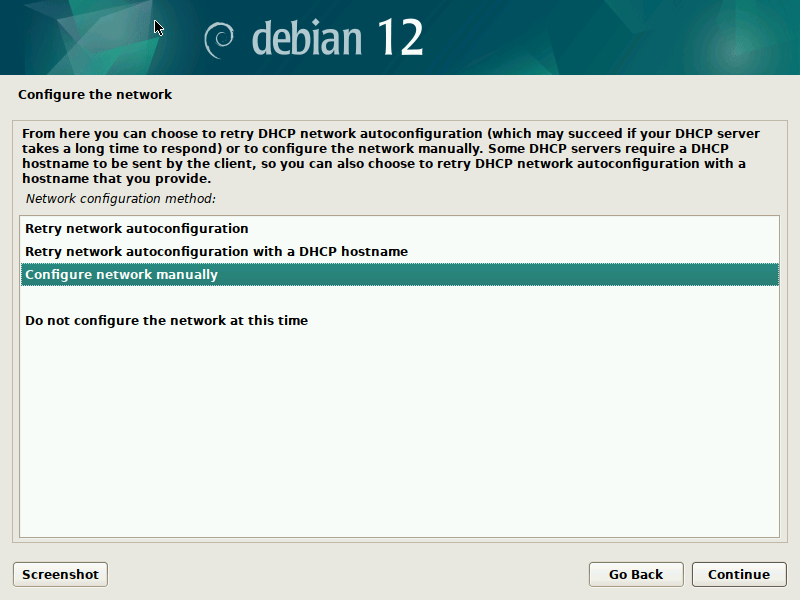
Now you can click through the normal Debian-Installer process, using mostly default settings. Optionally, you could play around with the networking settings, to see how those get translated to /etc/netplan/ in the target system.
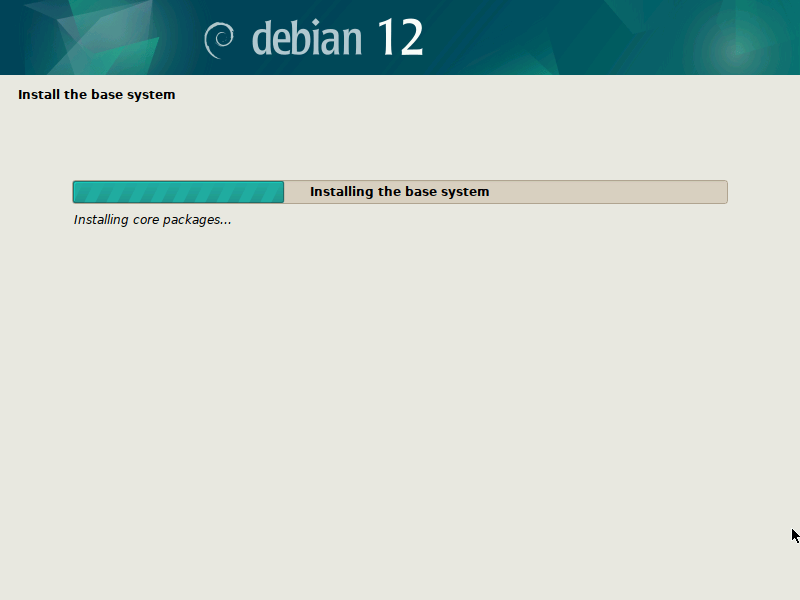
After you confirmed your partitioning changes, the base system gets installed. I suggest not to select any additional components, like desktop environments, to speed up the process.
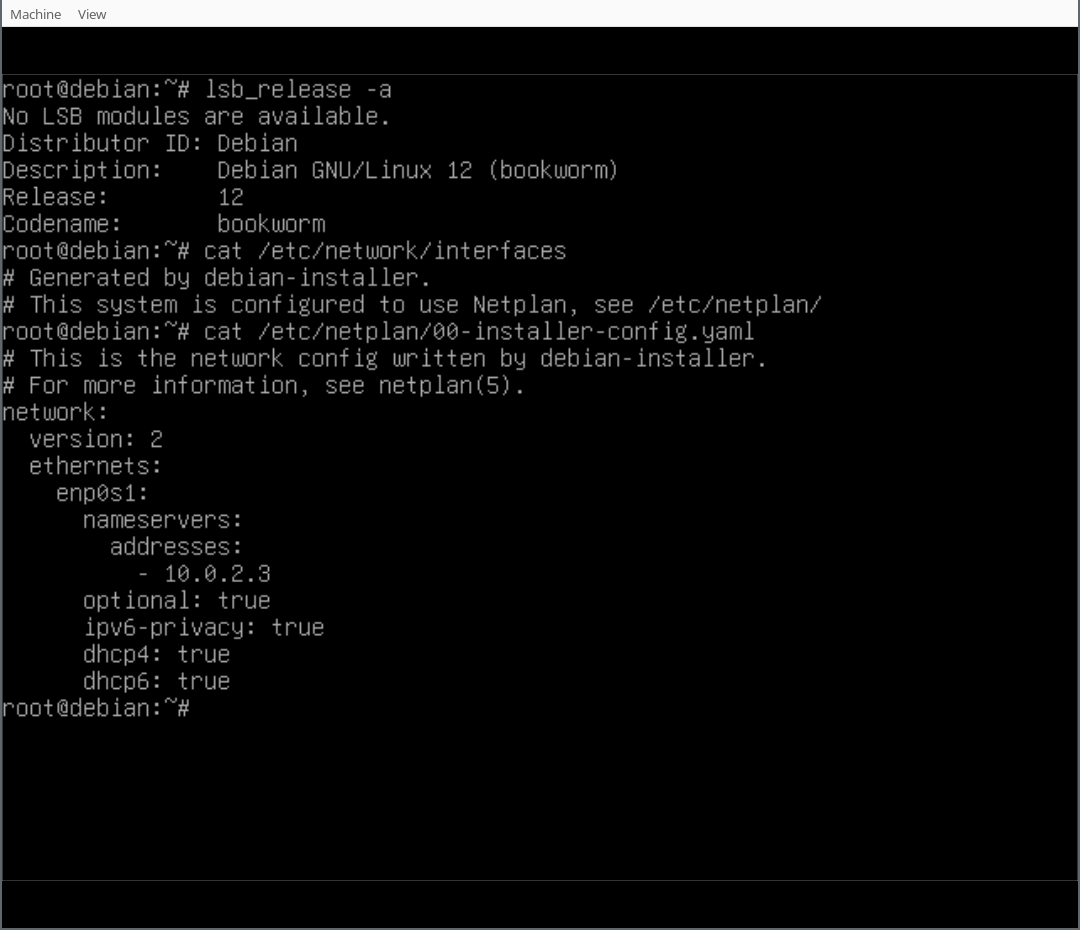
During the final step of the installation (finish-install.d/55netcfg-copy-config) d-i will detect that Netplan was installed in the target system (due to the preseed file provided) and opt to write its network configuration to /etc/netplan/ instead of /etc/network/interfaces or /etc/NetworkManager/system-connections/.
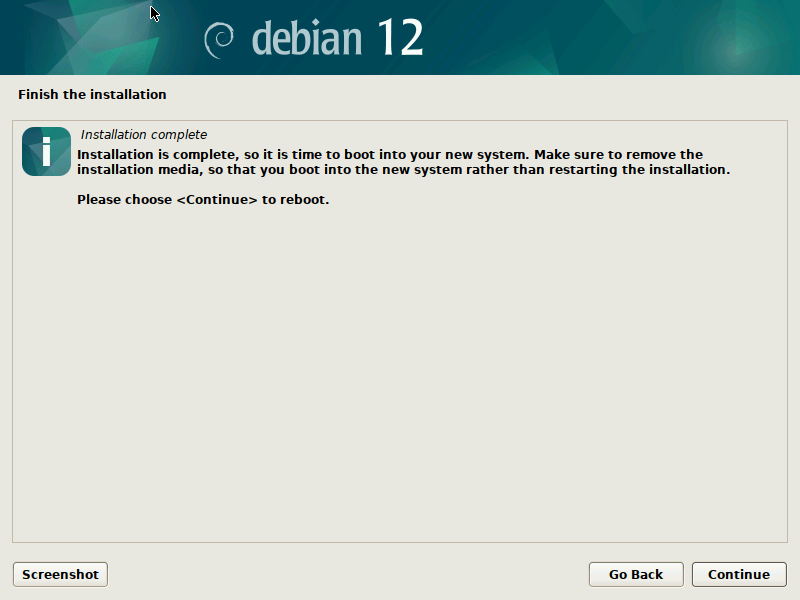
Done! After the installation finished, you can reboot into your virgin Debian Bookworm system. To do that, quit the current Qemu process, by pressing Ctrl+C and make sure to copy over the EFIVARS.fd file that was written by grub during the installation, so Qemu can find the new system. Then reboot into the new system, not using the mini.iso image any more:
$ cp ./OVMF_VARS_4M.fd ./EFIVARS.fd
$ qemu-system-x86_64 \
        -M q35 -enable-kvm -cpu host -smp 4 -m 2G \
        -drive if=pflash,format=raw,unit=0,file=OVMF_CODE_4M.fd,readonly=on \
        -drive if=pflash,format=raw,unit=1,file=EFIVARS.fd,readonly=off \
        -device qemu-xhci -device usb-kbd -device usb-mouse \
        -vga none -device virtio-gpu-pci \
        -net nic,model=virtio -net user \
        -drive file=./data.qcow2,if=none,format=qcow2,id=disk0 \
        -device virtio-blk-pci,drive=disk0,bootindex=1
        -serial mon:stdio
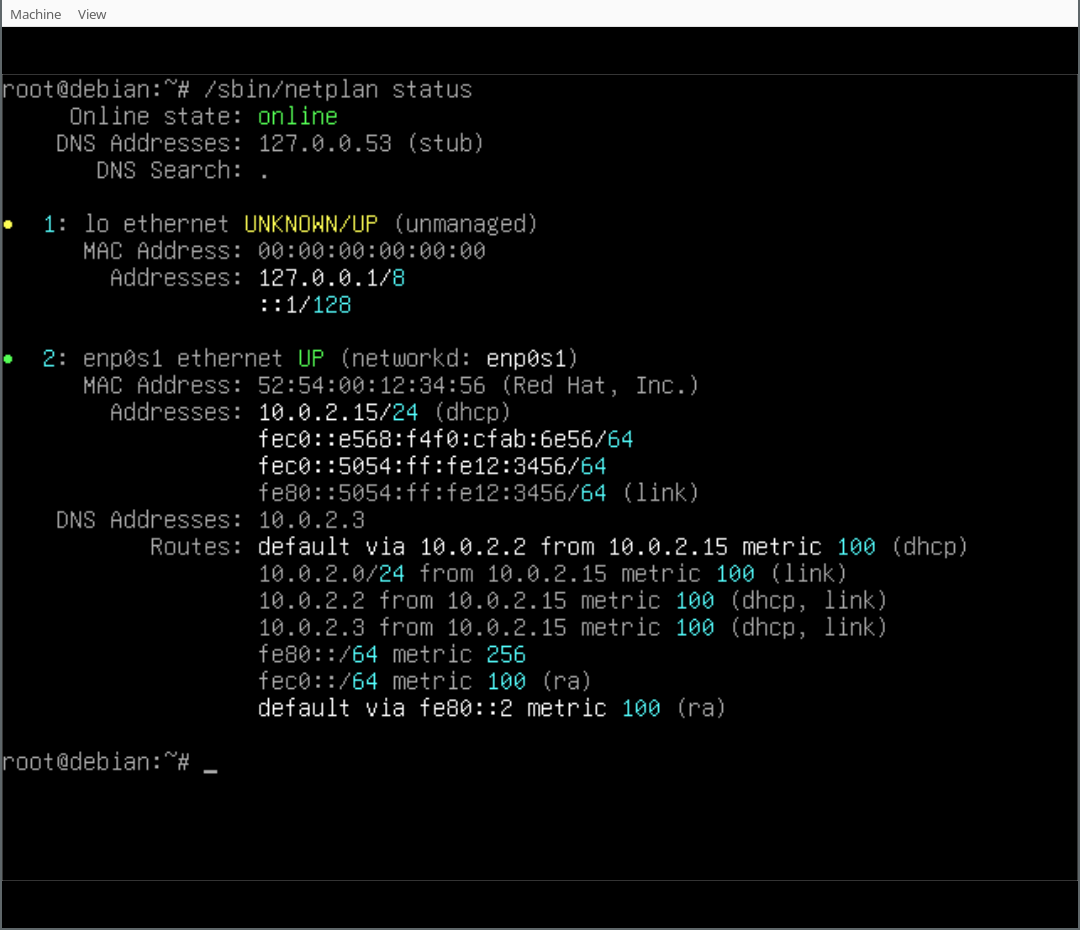
Finally, you can play around with your Netplan enabled Debian system! As you will find, /etc/network/interfaces exists but is empty, it could still be used (optionally/additionally). Netplan was configured in /etc/netplan/ according to the settings given during the d-i installation process.
In our case, we also installed the Netplan CLI, so we can play around with some of its features, like netplan status:
Thank you for following along the Netplan enabled Debian installation process and happy hacking! If you want to learn more, join the discussion at Salsa:installer-team/netcfg and find us at GitHub:netplan.

Russ Allbery: Review: Nation

Review: Nation, by Terry Pratchett
Publisher: Harper
Copyright: 2008
Printing: 2009
ISBN: 0-06-143303-9
Format: Trade paperback
Pages: 369
Nation is a stand-alone young adult fantasy novel. It was published in the gap between Discworld novels Making Money and Unseen Academicals. Nation starts with a plague. The Russian influenza has ravaged Britain, including the royal family. The next in line to the throne is off on a remote island and must be retrieved and crowned as soon as possible, or an obscure provision in Magna Carta will cause no end of trouble. The Cutty Wren is sent on this mission, carrying the Gentlemen of Last Resort. Then comes the tsunami. In the midst of fire raining from the sky and a wave like no one has ever seen, Captain Roberts tied himself to the wheel of the Sweet Judy and steered it as best he could, straight into an island. The sole survivor of the shipwreck: one Ermintrude Fanshaw, daughter of the governor of some British island possessions. Oh, and a parrot. Mau was on the Boys' Island when the tsunami came, going through his rite of passage into manhood. He was to return to the Nation the next morning and receive his tattoos and his adult soul. He survived in a canoe. No one else in the Nation did. Terry Pratchett considered Nation to be his best book. It is not his best book, at least in my opinion; it's firmly below the top tier of Discworld novels, let alone Night Watch. It is, however, an interesting and enjoyable book that tackles gods and religion with a sledgehammer rather than a knife. It's also very, very dark and utterly depressing at the start, despite a few glimmers of Pratchett's humor. Mau is the main protagonist at first, and the book opens with everyone he cares about dying. This is the place where I thought Pratchett diverged the most from his Discworld style: in Discworld, I think most of that would have been off-screen, but here we follow Mau through the realization, the devastation, the disassociation, the burials at sea, the thoughts of suicide, and the complete upheaval of everything he thought he was or was about to become. I found the start of this book difficult to get through. The immediate transition into potentially tragic misunderstandings between Mau and Daphne (as Ermintrude names herself once there is no one to tell her not to) didn't help. As I got farther into the book, though, I warmed to it. The best parts early on are Daphne's baffled but scientific attempts to understand Mau's culture and her place in it. More survivors arrive, and they start to assemble a community, anchored in large part by Mau's stubborn determination to do what's right even though he's lost all of his moorings. That community eventually re-establishes contact with the rest of the world and the opening plot about the British monarchy, but not before Daphne has been changed profoundly by being part of it. I think Pratchett worked hard at keeping Mau's culture at the center of the story. It's notable that the community that reforms over the course of the book essentially follows the patterns of Mau's lost Nation and incorporates Daphne into it, rather than (as is so often the case) the other way around. The plot itself is fiercely anti-colonial in a way that mostly worked. Still, though, it's a quasi-Pacific-island culture written by a white British man, and I had some qualms. Pratchett quite rightfully makes it clear in the afterward that this is an alternate world and Mau's culture is not a real Pacific island culture. However, that also means that its starkly gender-essentialist nature was a free choice, rather than one based on some specific culture, and I found that choice somewhat off-putting. The religious rituals are all gendered, the dwelling places are gendered, and one's entire life course in Mau's world seems based on binary classification as a man or a woman. Based on Pratchett's other books, I assume this was more an unfortunate default than a deliberate choice, but it's still a choice he could have avoided. The end of this book wrestles directly with the relative worth of Mau's culture versus that of the British. I liked most of this, but the twists that Pratchett adds to avoid the colonialist results we saw in our world stumble partly into the trap of making Mau's culture valuable by British standards. (I'm being a bit vague here to avoid spoilers.) I think it is very hard to base this book on a different set of priorities and still bring the largely UK, US, and western European audience along, so I don't blame Pratchett for failing to do it, but I'm a bit sad that the world still revolved around a British axis. This felt quite similar to Discworld to me in its overall sensibilities, but with the roles of moral philosophy and humor reversed. Discworld novels usually start with some larger-than-life characters and an absurd plot, and then the moral philosophy sneaks up behind you when you're not looking and hits you over the head. Nation starts with the moral philosophy: Mau wrestles with his gods and the problem of evil in a way that reminded me of Job, except with a far different pantheon and rather less tolerance for divine excuses on the part of the protagonist. It's the humor, instead, that sneaks up on you and makes you laugh when the plot is a bit too much. But the mix arrives at much the same place: the absurd hand-in-hand with the profound, and all seen from an angle that makes it a bit easier to understand. I'm not sure I would recommend Nation as a good place to start with Pratchett. I felt like I benefited from having read a lot of Discworld to build up my willingness to trust where Pratchett was going. But it has the quality of writing of late Discworld without the (arguable) need to read 25 books to understand all of the backstory. Regardless, recommended, and you'll never hear Twinkle Twinkle Little Star in quite the same way again. Rating: 8 out of 10

24 April 2024

Russell Coker: Source Code With Emoji

The XKCD comic Code Quality [1] inspired me to test out emoji in source. I really should have done this years ago when that XKCD was first published. The following code compiles in gcc and runs in the way that anyone who wants to write such code would want it to run. The hover text in the XKCD comic is correct. You could have a style guide for such programming, store error messages in the doctor and nurse emoji for example.
#include <stdio.h>
int main()
 
  int   = 1,   = 2;
  printf(" =%d,  =%d\n",  ,  );
  return 0;
 
To get this to display correctly in Debian you need to install the fonts-noto-color-emoji package (used by the KDE emoji picker that runs when you press Windows-. among other things) and restart programs that use emoji. The Konsole terminal emulator will probably need it s profile settings changed to work with this if you ran Konsole before installing fonts-noto-color-emoji. The Kitty terminal emulator works if you restart it after installing fonts-noto-color-emoji. This web page gives a list of HTML codes for emoji [2]. If I start writing real code with emoji variable names then I ll have to update my source to HTML conversion script (which handles <>" and repeated spaces) to convert emoji. I spent a couple of hours on this and I think it s worth it. I have filed several Debian bug reports about improvements needed to issues related to emoji.

Next.

Previous.