Search Results: "stone"

26 May 2011

Tanguy Ortolo: PGP signatures with trust and verification level

Identity checks and trust Saint Peter's key, detail from a stone statue The OpenPGP web of trust is composed of keys linked to each other by two things: With these two pieces of information, GnuPG is able to determine whether or not the key of someone you never met can trusted to belong to its alleged owner. Signatures Signing a key is usually a binary action: either you sign it or you do not sign it. Thus your signature on a key will give other people a rough identity check information and no trust information at all. In fact, the OpenPGP standard does allow to publish precise identity check and trust information on signatures, but unfortunately this is now enabled with GnuPG by default. These features are called certification level and trust signatures.Certification level To indicate how careful you verified someone's identity, run GnuPG with the option --ask-cert-level, or add ask-cert-level to your configuration file .gnupg/gpg.conf. When you make a signature with this option, GnuPG will ask you how carefully you verified the key owner's identity. According to the manpage gpg(1), the available levels are: Trust level You can also indicate how much you trust someone, sign his key with the command tsign instead of sign. GnuPG will then ask you three questions:
  1. how far you trust him to verify other people's keys: marginally or fully (I personally only fully trust people that were trained or challenged by myself or by people I trust even more)
  2. how far you allow him to make trust signatures on your behalf: usually answer 1; answering 3 would allow him to issue trust signature with level 2, thus allowing other people to issue trust signatures on your behalf (this features exists to implement pyramidal certification systems, but can be interesting for signing your own keys when you have several);
  3. if you wish to restrict this signature to a domain: I have no idea of what this means so I give none.
Conclusion Although certification level and trust signatures are not very widely used, thanks to GnuPG's default settings, it allows to publish more information about your signatures, adding value to the web of trust at no cost, which I believe is a good think. Thus I think it is worth doing it. If you want to use these features with the caff wrapper, remember that it has its own GnuPG configuration .caff/gnupghome/gpg.conf. In addition it does not implement trust signatures natively: to use them, you have to abort the automatic signing, which gives you a GnuPG prompt, where you are then able to tsign, then exit to return to caff that will consider your trust signatures. Credits

16 May 2011

Rudy Godoy: GSoC 2011: Compute Clusters Integration for Debian Development and Building

Hi, been offline for a while and now after my mid-term exams I m glad to tell that I ll be working on this year s GSoC project called: Compute Clusters Integration for Debian Development and Building . The main idea for this project is to give Debian developers and downstream developers a set of tools for helping them to leverage the power of a cloud-based infrastructure for their development duties. This is specially targeted to porters, multi-arch and cross-development, So I ll ask such teams for feedback on the subject over the next days. People at Eucalyptus has been very helpful and willing to cooperate with us to make this project a success. We expect to get them involved on the packaging and probably as Debian contributors, if not developers, also. Next week is the official coding phase start, but I ve been talking and working together with my mentor Steffen and the Eucalyptus people already. We ll be starting working on the qemu ARM images, reusing and resuming the job did by Dominique Belhachemi in the past GSoC. Of course I welcome as much feedback as you might find useful. I plan to post a project update every two weeks.

11 May 2011

Vincent Bernat: New website with Hyde

My previous website was generated (dynamically) with mod_autoindex, a module from Apache targeted at rendering an index page for the files contained in a directory. Pretty basic (but themable). Here is a new revamped web site using Hyde, a static web generator written in Python.

Static or dynamic ? It has been a long time since almost everybody is creating dynamic websites. Most often, they are powered by some blog engine written in PHP like DotClear or WordPress. Infrequently, they are crafted with bare hands using one s preferred language. Nowadays, hosting a dynamic website is pretty easy. There are a lot of cheap virtual servers solution that allow you to get a root access. However, dynamic websites have some drawbacks:
  • Security need to be monitored tightly, especially security upgrades; some platforms are more often vulnerable than others.
  • Dynamic websites may have some problem to handle increased load.
With a static website, security problems are easier: there are far less components to monitor and most of them (for example, the web server) are pretty solid and well audited. A site powered by nginx can handle several thousands of new connections per second without any special tuning. Getting this kind of performance with a dynamic website is far more difficult. Scaling is also easier. Just add more webservers and copy the content. No database, no synchronisation mechanism needed. Hosting can even be done on simple platforms like Amazon S3, even if there is now more appropriate platforms for this like Amazon CloudFront. Moreover, even a static website can receive comments using a system like Disqus which leverages the use of Javascript to add comment system to any static page.

Hyde Hyde is a static website generator written in Python. There exists a lot of those beasts. On StackOverflow, a question about this got some interesting answers. You will also find a fairly complete list on this blog. If you like Ruby, I assume that nanoc and Webgen are good candidates. Let s go back to Hyde. It was rewritten recently and the documentation is a bit incomplete. You will need to read the source code or look at examples (like the shipped one or this site) to understand how things are handled. Everything is handled by a plugin system. I hope it will not become a mess in one year (I play a large part in this). Hyde takes your files, apply a lot of filters on them and generate the final website. It uses Jinja as a template system, Markdown for markup syntax, Less to write CSS in a more efficient way (and to minify them), UglifyJS to minify Javascript, etc. It is also possible to add metadata to files (title, author, creation date, etc.). But since everything comes as a plugin, you can use any technology you like. In the end, you can tune all knobs but you need to do most of the work (HTML, CSS, Javascript), as well. Conveniently, there is a small web server that rebuild modified files on the fly. This comes handy but this is a common feature with this kind of generator.

New website Here is a new website crafted with Hyde. It is translated both in French and in English. This is done with the help of a small plugin plugin. I am quite happy about the result. Technically, there is one minified CSS file, one minified Javascript file and the dependencies (like jQuery) are loaded with the help of yepnope.js which will become part of Modernizr. I don t want to support Internet Explorer 6, but I plan to support Firefox 3, Internet Explorer 7 and recent versions of Chrome and Safari. For the design, I have always been undecided. I am pretty impressed by some raw website but also by some others more elaborate. Since I am not a talented graphic designer, I have tried to keep things plain and simple. If you are interested, sources are available on GitHub !

5 May 2011

Jeff Licquia: FHS Refresh

I ve been busy tonight spamming mailing lists and otherwise getting the word out: the LSB workgroup is preparing to update the FHS. This update has been a long time in coming; FHS 2.3 (the current version) was released back in 2004. Since then, a lot has happened, and it s starting to look like the FHS is holding things back due to the lack of updates. For the longest time, the FHS was cared for by its original editors: Dan Quinlan, Rusty Russell, and Chris Yeoh. We should all be grateful that they created a useful and well-written standard one that has been resilient enough to remain useful for six years without changes. Even though it s time to move on, we should not forget that we are building on a strong foundation they laid for us. So, you may be asking: how can I help? Glad you asked! We re tentatively shooting for a goal of releasing FHS 3.0 before July, though that s not written in stone. But we don t want to wait much longer than we ve already had to.

30 March 2011

Benjamin Drung: Hardware review I

This month I built two systems with identical hardware component (except for the case). Here s the list of components: Cases often don t meet my high requirements. Many cases are sharp-edged, bad designed (inside and outside), use cheep plastic, and/or vibrate, because the hard drives confer their vibration to the case. The Sugo SG02-F case is not perfect, but I will recommend it. The Silentium T11 case has no shard edges, but I won t recommend it. Too much plastic and optical not appealing. You probably have to replace the boxed CPU heat sink and use a better power supply if you want a silent system. How well do these components work with Ubuntu 10.10 (and probably other recent GNU/Linux distributions)? Perfectly. Everything that I tested worked: Flattr this

28 March 2011

Raphaël Hertzog: People behind Debian: Bdale Garbee, chair of the technical committee

Bdale is a long-time Free Software believer, he has been contributing even before Debian existed in the prehistoric era of free software. :-) Anyone who went to a big Free Software conference has seen one of his colorful t-shirts. Or maybe you have heard the story where he got his beard shaved by Linus Torvalds to raise funds to protect the Tasmanian Devil. More seriously Bdale has played and continue to play a number of important roles in the Debian community. He also represents one of the biggest corporate sponsors (both for DebConf and for the servers that Debian owns): Hewlett Packard. My questions are in bold, the rest is by Bdale. Who are you? I made my first personal contribution of source code to what we now call Free Software in 1979. I started with HP in 1986 and for nearly a decade have served the company as Chief Technologist for Open Source & Linux. I am president of Software in the Public Interest, which is the umbrella organization providing legal and financial existence for Debian in the USA. I also represent users, developers, and Debian interests on a number of boards including at the Linux Foundation and the Freedombox Foundation. I m happily married with two children. Many people in Debian have met some or all of my family. They all joined me for Debconf in Edinburgh, and my daughter Elizabeth also attended in Caceres and New York. I joined Debian in 1994. I ve been responsible for a number of packages essential to our base system continuously since that time. But I ve also contributed to the project in many other ways over the years. I ran the first server that was fully dedicated to Debian. Ideas of mine influenced the development of project infrastructure, from the early design of our mirror network to structuring the archive around a package pool . I started or made significant early contributions to 5 ports of Debian to non-i386 architectures. I served as Debian Project Leader (DPL) in 2002-2003, was acting Secretary for a while, and have served on the Technical Committee for a number of years. Over the years, I ve also had some interesting hobbies. I helped design, build, and program pieces of various amateur radio satellites. I enjoy making physical things, and have many tools for working in wood and metals. My son and I are very active in the world of high power model rockets. And with my partner (and fellow Debian developer!) Keith Packard I m now running a small business making and selling open hardware and open source avionics for hobby rockets. You can read more about that at http://altusmetrum.org. You re the chair of the Debian technical committee. Can you quickly explain the role of this committee? I think many people assume the Technical Committee has a larger role in Debian than it really does. Section 6 of Debian s constitution defines the official role of the Technical Committee. Most importantly, the committee exists as a last resort place to resolve technical conflicts between Debian developers that they are unable to resolve by themselves. Most of the power in Debian is left in the hands of individual developers, who are usually able to collaborate with each other to make good technical decisions. So the Technical Committee s resolution process has only rarely been needed, which I think is a very good thing. From my point of view, the technical committee is not working. In many cases, the committee does not take any (timely) decision and just waits until the underlying situation has evolved to a point where the intervention of the committee is no longer needed. Do you agree with this and how can you explain it? I think it s very important for all of us to remember that everyone working on Debian does so voluntarily, and people who volunteer their time generally deserve a measure of respect and appreciation for their efforts. No issue is brought to the Technical Committee unless resolving it is expected to be really difficult, or at least contentious. And often, the issues brought to the committee have been as much or more about personality than technology. That makes some of them really hard to solve. So I do not agree that the technical committee is not working. It seems to me that the decisions that bog down and take a long time are the ones where arguments start out or become emotional instead of technical. In this context, if committee members can help lead public and private discussions in a way that causes a situation to evolve to the point where a decision is no longer needed, that may be healthier for the project in the long term than a quick vote that satisfies some contributors at the expense of others. The last important change that was made to try to revive the committee was the addition of two new members (Don Armstrong and Russ Allbery). Is there anything else that could be tried? The biggest improvement I could personally wish for is something people sending issues to the committee can help with. As the ultimate technical decision making body for a project whose output is mostly software, the more a request can be put in terms of a decision about source code, the easier it will be for us to make a decision. That won t always be possible, but when we re forced to try and dream up alternatives and then figure out whether anyone would actually be willing to write the code to implement those alternatives, the process takes a lot longer than choosing between competing patch sets or deciding whether a patch should be included. Besides your role in the technical committee, you have held the role of mediator/facilitator/advisor on numerous occasions. Because you re an old wise bearded guy who travels a lot and knows many Debian contributors I would like to thank you for all this work that few people notice. Are there been times where this has been a real burden for you? Thank you for mentioning this. I ve put a lot of my heart into Debian over the years, largely because it s a project and a community that continues to amaze and inspire me. I feel fortunate to have been able to meet and work on Debian with so many outstanding people from around the world. Many are now my friends, with all the silly and serious things being a friend implies. I ve been asked for and have given advice many times. I ve helped celebrate birthdays, marriages, new jobs, and the arrival of children. Sadly, I have also found myself having to try and find the right words to mark the loss of some of these friends The only time any of this feels like a burden is when there s some important problem that many people care about, that I m working behind the scenes to help fix, but can t really talk about publicly without causing more harm than good. It s distressing to have people think you don t care or aren t helping, when really you re doing everything you possibly can just not in a publicly visible way. Of course I understand that this is an impossible situation. If you can t see what s happening, there s no way to know if something is happening or not. That s why I advocate doing as much as possible in Debian, and SPI, and everywhere else I contribute in as open a way as possible. You have been Debian Project Leader and you promoted the vision of Debian as the Universal Operating System. What does universal mean for you? The biggest thing to me at the time was the idea that Debian could be anything. Those who chose to work on Debian would ultimately determine what Debian became. I also wanted to make sure we thought about as broad a set of potential users and collaborators as possible. But this vision provided a framework for pursuing a whole range of worthwhile increases in Debian s scope of utility, some of which I articulated in my DPL platforms, some others put forward. Internationalization, porting to more supported architectures, our inclusive and evolving approaches to accepting new developers and new packages, and so forth. I think this vision has served us well, and it pleases me that it has stayed a part of our collective thinking for so long. We re again in Debian s electoral period, what do you think of the work done by the current DPL? I m very happy with what I ve observed of Stefano s activities during his first year as DPL. He has an obvious enthusiasm for Debian, communicates well both in one to one interactions and in front of a crowd, and I think represents Debian very well. It is interesting that he s running unopposed for re-election this year. I choose to interpret that as evidence he s doing a good job, the project is running well, and nobody feels the need to try and take the job away From him. I m glad he s willing to continue in this role for another year. What s the most important thing that Debian should achieve in the wheezy timeframe? I don t yet have a very crisp personal wish-list for wheezy. But I would certainly like to see multiarch support finally completed! I m also very interested to see what comes from the CUT work. You have been an early supporter of multiarch , a project to allow easy installation of foreign architecture packages. It s on good track for Wheezy. Do you think it s an important milestone? My original motivation for requesting multiarch support was to enable support for 32-bit x86 binaries on ia64 Itanium systems, in the time leading up to the sarge release. I ended up creating the ia32-libs package, which I m not proud of. The emergence of 64-bit extensions to x86 (the amd64 architecture) made this a much broader issue. Today, I run a 64 bit kernel and a 32 bit user space on my notebook. There are problems with just moving entirely to 64 bit but I would like to be able to run some applications that work with large data sets in full 64 bit mode!
Thank you to Bdale Garbee for the time spent answering my questions. I hope you enjoyed reading his answers as I did. Subscribe to my newsletter to get my monthly summary of the Debian/Ubuntu news and to not miss further interviews. You can also follow along on Identi.ca, Twitter and Facebook.

4 comments Liked this article? Click here. My blog is Flattr-enabled.

23 March 2011

Jaldhar Vyas: Happy Birthday William Shatner...

...and me. I turned 40 today and on such a momentous occasion I should pause
to take stock of my life. Executive summary: it's not bad at all. Last week I completed 13 years of marriage to Jyoti who loves me and always
looks out for my best interest even during the times when I do not. I have two lovely children who are kind, intelligent, Dharmic, and (mostly :-)
well behaved. Of course I can't forget all my dear friends and family who gave me their
blessings and good wishes today and indeed every day. My health is better now than it was in my twenties. Since last year I've been
exercising on the treadmill regularly and taken a lot of junk out of my diet.
I've lost about two stones and while I won't be joining the Debian marathon
runners just yet, I can at least jog briskly without collapsing in a puddle of
sweat, heart palpitations and shame. Mentally, I've been taking college level courses in Maths in an effort to
relearn the things I didn't pay proper attention to the first time I was in
college. I completed National Novel Writing Month for the first time with a
60,000 word philosophical science fiction blockbuster that other people might
actually consider readable once I finish revising it. And I am still training
for the day when I shall be granted the spot on Jeopardy which is rightfully
mine. Financially, the last few years have not been good for many people but we are
holding our heads above water and even slowly moving forwards. This is the
year Consolidated Braincells Inc. my little corporate empire will take off I
hope. As I begin preparing for Chaitra Navaratri I feel it will be extra special
this year because all these good things that are happening to me are solely
due to Her grace and krpa. Last thing I wanted to mention is that a present I gave myself today was to
make a donation to the Red Cross to help the victims of the tsunami in Japan.
If you have had good fortune in your life and have not already done so won't
you consider doing the same? (or to any of the other reputable charities
engaged in disaster relief.) Our shastras say that dana is the best insurance
against accidental sins and the guarantor of good luck.

18 March 2011

Adnan Hodzic: Debian CUT, a new rolling release?

This post is also available on/was written for OMG! Ubuntu

It looks like 2011 started well for Debian. The project won awards in two out of seven categories at the Linux New Media Awards 2011 ( Best Open Source Server Distribution and Outstanding Contribution to Open Source/Linux/Free Software ). Just recently Internet.com declared Debian the most influential distribution ever, stating that ~63% of all distributions now being developed come ultimately from Debian. However, my intention for this article is not solely to praise Debian for its recent awards, but rather to focus on a new project, Debian CUT. Don t be surprised if you haven t heard about CUT; it seems most Debian community hasn t either. Then again, maybe it s because it is only labelled as unofficial/development so far.
A bit of history One of the greatest criticisms of Debian is that its release cycles are too long. Debian stable release is seen as often as Ubuntu s LTS release. As a server solution this doesn t present a problem at all, it can even seen as a pro. However, for desktop use and for your average Joe who needs to have the latest software and is unable to get it, this may well present a problem. Of course he can always turn to backports to get what he needs but by the time you have finished reading this very sentence, Joe has already moved to Ubuntu. For those who are completely unaware how things work within Debian, let me try to shed some light. Debian has 3 main branches: Unstable , is a branch used mainly by developers, where the latest changes to the software they are working on are made. Usually, after approximately 10 days this software is pushed to testing , branch which is going to become next Debian stable release. For comparison, in the process of a new Ubuntu release at one point in this process, changes from testing/unstable are frozen where Ubuntu fixes bugs until they are ready to release new Ubuntu release. Debian s testing branch is said by some to be more stable then most of the stable distributions out there. Last but not least is stable branch, which follows the (in)famous mantra it s released when it s ready , although last two releases have been released in a more timely manner. Okay, so what is Debian CUT? The idea stretches back more then 2 years, to Joey Hess proposing the idea of Constantly Usable Testing . For users/developers who can t wait ~2 years to see new Debian release, they usually turn to Debian testing branch. To clarify, testing images are released weekly, but most of us in Debian don t recommend you jump to testing by installing it from weekly image, but rather by upgrading from stable. To make the situation even worse, these builds frequently don t work due to all the changes that have been pushed from unstable. But this is where Constantly Usable Testing idea comes in, where the installer is always installable and you re already using what s going to be next stable release. You wouldn t have to worry about whether the next update is going to break your system, but would get regular security updates, while the big updates would come in shape of new testing snapshot versions. Frequency of release of these snapshots is ought to be on monthly basis, so you can plan on seeing the next release on April 6th (exactly one month after the current release, provided of course if there are no showstopper bugs). To sum it all up, you wouldn t have to wait ~2 years before new Stable release shows up, nor (in case you have already switched to testing) would you have to worry whether your next update will break your system. You would get your updates in form of timely (ie: monthly) snapshots until it s time for major milestone which would turn out to be new Debian release. Even though this might be long term goal, in these early stages no one can guarantees this. Rolling release? The simplest way to explain this concept is that there are two types of Linux distributions: one with milestone version numbers and other where new updates keep coming through their rolling release cycles. Some of the rolling distributions are Gentoo and Arch Linux, while on the other side you have RedHat and Suse. Novell announced that OpenSuse is moving to rolling release with project codename Tumbleweed. It s also worth mentioning that Debian already has its rolling counters and perfect examples are: LMDE and aptosid. It is a way to continuously develop software, a way that best fits Debian as a platform where software is continuously developed. Especially because most of its greatest values could get lost with the release of that big stable version . Perfect case of that could be the almost drop of Chromium in Squeeze. Another great example could be Android, which is criticised most for its versioning. Companies are refusing to release new Android versions to their current phones, because they want you to buy new phone with latest Android version, even though your current one is perfectly capable of running latest Android. Personally, I m sure the future will reveal that rolling releases are the future, towards which all Linux platforms should be heading. Perhaps the definition of rolling releases I gave earlier is why I believe this project has such bright future ahead of it. Debian would be somewhat of a hybrid of this definition, it would be rolling release until it s time to mark a big milestone with a version number, and before you know it, we re rolling again. Unofficial Debian Monthly Testing Snapshot Release (version 2011.03 final) Michael Gilbert took on a big responsibility, trying experimentally to prove the feasibility of such a project. He has released a first wheezy snapshot installer (versioned 2011.03) as a test for the development community to try out and evaluate. Please read official announcement along with download links. While you can use this snapshot to have constantly working installer, after it is installed you could move to testing altogether if you wish. Conclusion As I have already mentioned, this project is still in the development/experimental stage, which makes all of this its very conception. Also, apart from rumors of Ubuntu becoming rolling release, if Ubuntu is to get its rolling release this how it s going to get it Smile If you d like to find out more about Debian CUT, I suggest you read Raphael Hertzog s article A constantly usable testing distribution for Debian , and watch the video of Joey Hess CUT BoF on DebConf10 in NYC. Of course, if you d like to get involved into this project, please use the project s mailing list. If you have any comments, please do share, as I d be happy to answer any of your questions.

20 February 2011

Evgeni Golov: Desktop in a shell

People are using computers, everywhere, really! ;)
As you might guess correctly, so do I.Basically, I am using three computers: my laptop (ThinkPad X201s, awesome machine, but pabs told me not to post any more adverts for ThinkPads on Planet Debian *g*), my smartphone (Motorola Milestone, yes, that counts as a computer) and random_pc (for random as in my girlfriends or some other trusted (!!!) friends computer).
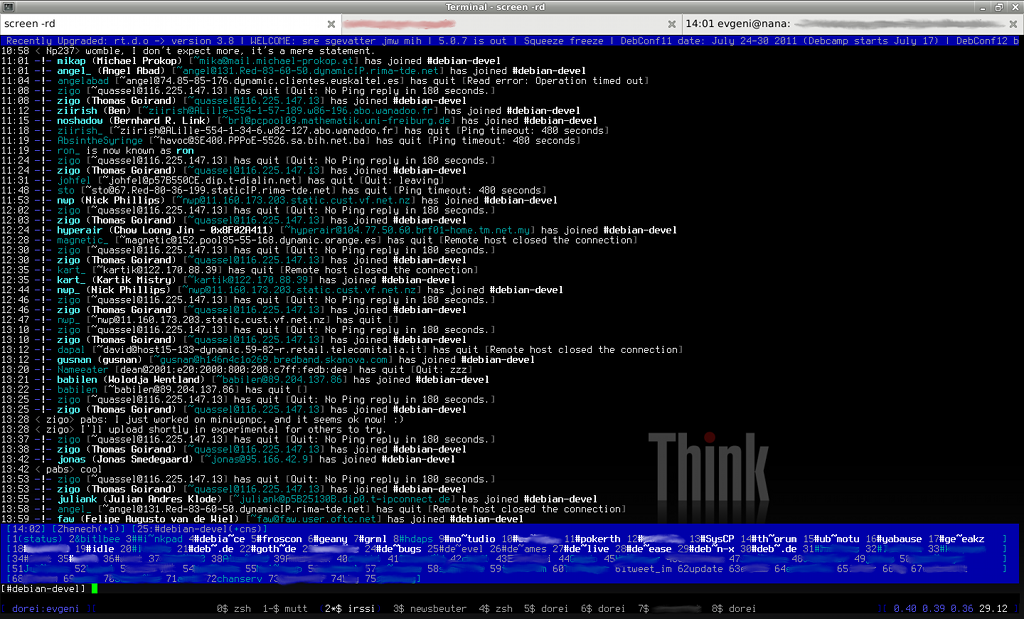
My laptop is running Debian GNU/Linux unstable with Xfce4.6, my smartphone is running Android 2.2.1 Froyo, my girlfriend has Ubuntu with GNOME, a friend runs Debian unstable with GNOME, another one Arch Linux with KDE4 and so on. And on all these machines I want be able to work, which means I have to read mail and rss, chat via IRC, JabberXMPP and ICQ, have a look at my to-do list, ssh into different machines, write some code, tweet and dent etc.In the following series of posts I will describe how I can handle about 90% of my work on every (trusted) computer out there, using ssh, screen, mutt, irssi, BitlBee, newsbeuter etc.As I am describing the setup as a Desktop in a shell , let s start with a login- and desktop/window-manager: ssh+screen.sshObviously, you need a machine to ssh into it, where the Desktop will live on. For me, that s my home router/fileserver/vm-server dorei, running Debian GNU/Linux LennySqueeze with OpenSSH as a kind of login manager ;)Yes, my user is allowed to login with a password instead of a public key. And well, that s all for the login-manager, no extra configuration needed.screenAfter logging in, I start my window-manager with screen -rd, -r for reattach a running screen session, -d for detach it if it is already attached somewhere else. Or I can start a new session by just typing screen. Inside the screen I have multiple windows (one can create new ones with ^A c) with all the needed software running. I can switch windows by pressing ^A N, N being the number of the window, ^A n for the next window, ^A p for the previous one or ^A ^a for the last one. Or I can get a window-list with ^A w. If needed, I can rename windows with ^A A, followed by the new name. That should be enough for almost everyone. Let s just add a window-list to the bottom (as you might have seen on GNOME, Xfce, KDE and even Windows ;) by adding the following to the ~/.screenrc:
caption always " "                    # clear line before hardstatus
hardstatus alwayslastline "% = kb [ % B %H:$USER % b ][ %=% w %?%-Lw%?% b (% W %n*%f %t%?(%u)%?% b )% w %?%+Lw%?%?%= % b ][% B  %l % B % W %d.%0m % b ]"
You get the current host- and username, the machine load and the date for free ;)Even if it is possible, I do not have any autostart like stuff in my .screenrc as the machine is running stable and I start the screen and the apps inside maybe once a year after a reboot.screenrcMy .screenrc looks like this:
# detach on hangup
  autodetach on
# don't display the copyright page
  startup_message off
# set scrollback to 2000 lines, default 100
  defscrollback 2000
# set silencewait to 15 seconds, default 30
  silencewait 15
# new shells should be started as login-shells
  shell -$SHELL
# make a fancy statusline
  caption always " "                    # clear line before hardstatus
  hardstatus alwayslastline "% = kb [ % B %H:$USER % b ][ %=% w %?%-Lw%?% b (% W %n*%f %t%?(%u)%?% b )% w %?%+Lw%?%?%= % b ][% B  %l % B % W %d.%0m % b ]"
# make higlighting bold, black on blue background
  sorendition +b bk
# some fixes, no I do not know where they come from :)
  termcap  xterm hs@:cs=\E[%i%d;%dr:im=\E[4h:ei=\E[4l
  terminfo xterm hs@:cs=\E[%i%p1%d;%p2%dr:im=\E[4h:ei=\E[4l
  termcapinfo  xterm Z0=\E[?3h:Z1=\E[?3l:is=\E[r\E[m\E[2J\E[H\E[?7h\E[?1;4;6l
  termcapinfo xterm* OL=100
  termcapinfo xterm 'VR=\E[?5h:VN=\E[?5l'
  termcapinfo xterm 'k1=\E[11~:k2=\E[12~:k3=\E[13~:k4=\E[14~'
  termcapinfo xterm 'kh=\EOH:kI=\E[2~:kD=\E[3~:kH=\EOF:kP=\E[5~:kN=\E[6~'
  termcapinfo xterm 'hs:ts=\E]2;:fs=\007:ds=\E]2;screen\007'
  termcapinfo xterm 'vi=\E[?25l:ve=\E[34h\E[?25h:vs=\E[34l'
  termcapinfo xterm 'XC=K%,%\E(B,[\304,\\\\\326,]\334, \344, \366, \374,~\337'
  termcapinfo xterm* be
  termcapinfo xterm xterms xs ti@:te=\E[2J
  termcapinfo wy75-42 xo:hs@
  termcapinfo wy* CS=\E[?1h:CE=\E[?1l:vi=\E[?25l:ve=\E[?25h:VR=\E[?5h:VN=\E[?5l:cb=\E[1K:CD=\E[1J
  termcapinfo  hp700 'Z0=\E[?3h:Z1=\E[?3l:hs:ts=\E[62"p\E[0$~\E[2$~\E[1$ :fs=\E[0 \E[61"p:ds=\E[62"p\E[1$~\E[61"p:ic@'
  termcap  vt100* ms:AL=\E[%dL:DL=\E[%dM:UP=\E[%dA:DO=\E[%dB:LE=\E[%dD:RI=\E[%dC
  terminfo vt100* ms:AL=\E[%p1%dL:DL=\E[%p1%dM:UP=\E[%p1%dA:DO=\E[%p1%dB:LE=\E[%p1%dD:RI=\E[%p1%dC
  termcapinfo linux C8
# some bindings
  bind k
  bind ^k
  bind .
  bind ^\
  bind \\
  bind ^h
  bind h
  bind 'w' windowlist -b
  bind 'W' windows
  bind 'K' kill
  bind 'I' login on
  bind 'O' login off
  bind ' ' history
  bind = resize =
  bind + resize +3
  bind - resize -3
# Mutt demands this
# http://wiki.mutt.org/?MuttFaq/Appearance
 defbce on
 term screen-bce
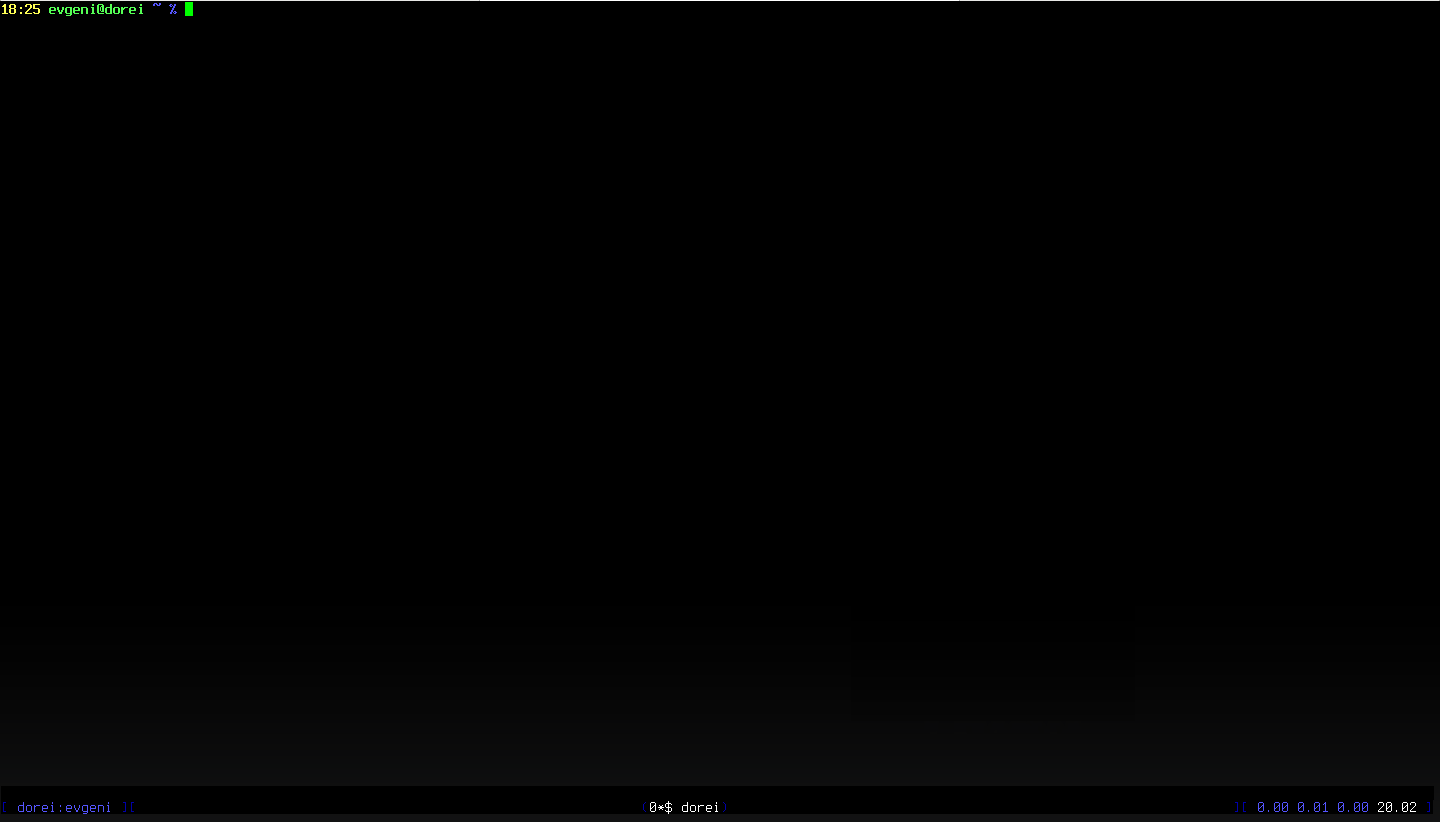
That s all for my screen setup. The obvious, boring screenshot follows:See you next time, when I will present my mutt setup here.

17 February 2011

Raphaël Hertzog: People behind Debian: Maximilian Attems, member of the kernel team

Maximilian, along with the other members of the Debian kernel team, has the overwhelming job of maintaining the Linux kernel in Debian. It s one of the largest package and certainly one where dealing with bug reports is really difficult as most of them are hardware-specific, and thus difficult to reproduce. He s very enthusiastic and energetic, and does not fear criticizing when something doesn t please him. You ll see. My questions are in bold, the rest is by Maximilian. Who are you? My name is Maximilian Attems. I am a theoretical physicist in my last year of PhD at the Technical University of Vienna. My main research area is the early phase of a Quark-Gluon Plasma as produced in heavy ion collisions at the LHC at CERN. I am developing simulations that take weeks on the Vienna Scientific Cluster (in the TOP 500 list). The rest of the lab is much less fancy and boils down to straight intel boxes without any binary blobs or external drivers (although lately we add radeon graphics for decent free 3D). Mathematica and Maple are the rare exceptions to the many dev tools of Debian (LaTeX, editors, git, IDE s, Open MPI, ..) found at the institute, as those are unfortunately yet unmatched in Free Software for symbolic computations. The lab mostly runs a combination of Debian stable (testing starting from freeze) for desktops and oldstable/stable for servers. Debian is in use for more than 10 years. So people in the institute know some ups and downs of the project. Newcomers like my room neighbors are always surprised how functional a free Debian Desktop is. :) What s your biggest achievement within Debian? Building lots and lots of kernels together with an growing uptake of the officially released linux images. I joined the Debian kernel team shortly after Herbert Xu departed. I had been upstream Maintainer of the linux-2.6 janitor project for almost a year brewing hundreds of small cleanups with quilt in a tree named kjt for early linux-2.6. In Debian we had lots of fun in sorting out the troubles that the long 2.5 freeze had imposed: Meaning we were sitting on a huge diverging monolithic semi-good patchset. It was great fun to prepare 2.6.8 for Sarge with a huge team enthusiastic in shipping something real close to mainline (You have to imagine that back then you had no stable or longterm release nor any useful free tools like git. This involved passing patches around, hand editing them and seeing what the result does.) From the Sarge install reports a common pattern emerged that the current Debian early userspace was causing lots of boot failures. This motivated me to develop an alternative using the new upstream initramfs features. So I got involved in early userspace. Thanks to large and active development team initramfs-tools got a nice ecosystem. It still tries to be as generic and flexible as possible and thus gains many nice features. Also H. Peter Anvin (hpa) gave me the official co-maintenance of klibc. klibc saw uptake and good patches from Google in the last 2 years. I am proud that the early userspace is working out fairly well these days, meaning you can shuffle discs around and see your box boot. Later on we focused on 2.6.18 for Etch, which turned out to a be good release and picked up by several other distributions. Only very much later we would see such a sync again. With 2.6.26 for Lenny we got somehow unlucky as we just missed the new longterm release by one release. We also pushed for another update very late (during freeze) in the release cycle, which turned out to semi-work as too much things depend on linux-2.6. For Squeeze 2.6.32 got picked thanks to discussions at Portland Linux Plumbers and it turned out to be a good release picked up by many distributions and external patchsets. The long-term support is going very well. Greg KH is doing a great job in collecting various needed fixes for it. Somehow we had hoped that the Squeeze freeze would start sooner and that the freeze duration would be shorter, since we were ready for a release starting from the actual freeze on. The only real big bastard on the cool 2.6.32 sync is Red Hat. Red Hat Enterprise 6.0 is shipping the linux-2.6 2.6.32 in obfuscated form. They released their linux-2.6 as one big tarball clashing with the spirit of the GPL. One can only mildly guess from the changelog which patches get applied. This is in sharp contrast to any previous Red Hat release and has not yet generated the sharp and snide comments in press it deserves. Red Hat should really step back and not make such stupid management moves. Next to them even the semi-maintained Oracle Unbreakable 2.6.32 branch looks better: It is git fetchable. What are your plans and those of the kernel team for Debian Wheezy? Since 2.6.32 many of the used patches landed upstream or are on the way (speakup, Kbuild Debian specific targets, ..). The proper vfs based unionfs is something we d be looking forward. We haven t yet picked the next upstream release we will base Wheezy on, so currently we can happily jump to the most recent ones. There are plans for better interaction with Debian Installer thanks to generating our udebs properly in linux-2.6 source itself. Also we are looking forward to using git as tool of maintenance. We d hope that this will also allow for even better cross distribution collaboration. Concerning early userspace I plan to release an initramfs-tools with more generic userspace for the default case and finally also a klibc only for embedded or tuning cases. What do you like most in Debian? For one thing I do like the 2 year release cycle. It is not too long to have completely outdated software and on the other hand it gives enough time to really see huge progress from release to release. Also at my institute the software is is recent enough without too much admin overhead. For servers the three years support are a bit short, but on the manageable side. I do enjoy a lot the testing distribution. For my personal use it is very stable and thus I mainly run testing on my desktop and work boxes. (Occasionally mixing in things from sid for unbreaking transition or newer security fixes). Debian is independent and not a commercial entity. I think this is its main force and even more important these days. I enjoy using the Debian platform a lot at work thus in return this motivates me to contribute to Debian itself. I also like the fact that we strive for technical correctness. Is there some recurrent problem that hinders the progress of Debian? The New Maintainer process is a strange way to discourage people to contribute to Debian. It is particularly bureaucratic and a huge waste of time both for the applicant and his manager. It should be completely thrown overboard. One needs a more scalable approach for trust and credibility that also enhances the technical knowledge for coding and packaging of the applicant. NM is currently set in stone as any outside critics is automatically rejected. Young and energetic people are crucial for Debian and the long-term viability of the project, this is the reason why I d consider the New Maintainer process as Debian s biggest problem. Note from Rapha l Hertzog: I must say I do not share this point of view on the New Maintainer process, I have witnessed lots of improvements lately thanks to the addition of the Debian Maintainer status, and to the fact that a good history of contribution can easily subsume the annoying Tasks & Skills questionnaire. Another thing I miss is professional graphics input both for the desktop theme and the website. I know that effort has been done there lately and it is good to see movement there, but the end result is still lacking. Another trouble of Debian is its marketing capabilities. It should learn to better sell itself. It is the distribution users want to run and use not the rebranded copies of itself with lock-in sugar . Debian is about choice and it offers plenty of it: it is a great default Desktop. Linus Torvalds doesn t find Debian (and/or Ubuntu) a good platform to hack on the kernel. Do you know why and what can we do about this? The Fedora linux-2.6 receives contributions from several Red Hat employed upstream sub-Maintainers. Thus it typically carries huge patches which are not yet upstream. As a consequence eventual userland troubles get revealed quite quickly and are often seen there first. The cutting edge nature of Fedora rawhide is appealing for many developers. The usual Debian package division of library development files and the library itself is traditionally an entry barrier for dev on Debian. Debian got pretty easily usable these days, although we could and should again improve a lot more in this sector. Personally I think that Linus hasn t tried Debian for years. I have the feeling that the implication of the Debian Kernel team in LKML has been on the rise. Is that true and how do you explain this? Ben Hutchings is the Nr.1 contributor for 2.6.33. He also is top listed as author of patches on stable 2.6.32. Debian is not listed as organization as many send their linux-2.6 patches from their corporate or personal email address and thus it won t be attributed to Debian. There is currently no means to see how many patches get forwarded for the stable tree, but I certainly forwarded more then fifty patches. I was very happy when Greg KH personally thanked me in the 2.6.32.12 release. In the Squeeze kernel, the firmwares have been stripped and moved into separate packages in the non-free section. What should a user do to ensure his system keeps working? There is a debconf warning on linux-2.6 installation. It is quite clear that the free linux-2.6 can t depend on the firmware of the non-free archive (also there is no strict dependency there technically). On the terminal you d also see warnings by update-initramfs on the initramfs generation for drivers included in the initramfs. The debconf warning lists the filename(s) of the missing firmware(s). One can then apt-cache search for the firmware package name and install it via the non-free repository. The check runs against the current loaded modules. The match is not 100% accurate for special cases as the one where the device might be handled well by this driver without firmware, but is accurate enough to warrant the warning. The set of virtualization technologies that the official Debian kernel supports seems to change regularly. Which of the currently available options would you recommend to users who want to build on something that will last? KVM has been a smooth ride from day zero. It almost got included instantly upstream. The uptake it has is great as it sees both dev from Intel and AMD. Together with libvirt it s management is easy. Also the performance of virtio is very good. The linux containers are the thing we are looking forward for enhanced chroots in the Wheezy schedule. They are also manageable by libvirt. Xen being the bad outside boy has an incredible shrinking patchset, thus is fair to expect to see it for Wheezy and beyond. For many it may come a bit late, but for old hardware without relevant CPU it is there. Many tend to overstate the importance of the virtualization tech. I d be much more looking forward to the better Desktop support in newer linux-2.6. The Desktop is important for linux and something that is in heavy use. The much better graphics support of the radeon and nouveau drivers: The performance optimizations thanks to dcache scalability work and the neat automatic task-grouping for the CPU scheduler are very promising features for the usability of the linux desktop. Another nice to have feature is the online defrag of ext4 and its faster mkfs. Even cooler would be better scalability in ext4 (This side seems to have seen not enough effort lately). Is there someone in Debian that you admire for their contributions? Hans Peter Anvin and Ted Tso are a huge source of deep linux-2.6 knowledge and personal wisdom. I do enjoy all sorts of interactions with them. Christoph Hellwig with Matthew Wilcox and also William Irwin for setting up the Debian kernel Team. Several Debian leaders including the previous and the current one for their engagement, which very often happens behind the scene. The Debian Gnome Team work is great, also the interactions have always been always easy and a pleasure. Martin Michlmayr and previously Thiemo Seufer do an incredible job in porting Debian on funny and interesting ARM and MIPS boxes. Debian has a lot of upcoming potential on this area. I m looking forward to other young enthusiastic people in that area. Colin Watson is bridging Debian and Ubuntu, which is an immense task. Michael Prokop bases on Debian an excellent recovery boot CD: http://www.grml.org. I d be happy if any Debian Developer would work as carefully coding and working.
Thank you to Maximilian for the time spent answering my questions. I hope you enjoyed reading his answers as I did. Subscribe to my newsletter to get my monthly summary of the Debian/Ubuntu news and to not miss further interviews. You can also follow along on Identi.ca, Twitter and Facebook.

One comment Liked this article? Click here. My blog is Flattr-enabled.

12 February 2011

Wouter Verhelst: Ten years of Debian

My first ever Linux installation was done in the late nineties 1998 or thereabouts but was a RedHat 4.5 installation rather than a Debian one. The reason for that was fairly simple: the Infomagick sixpack CD set that I'd bought contained RedHat, Debian, and Slackware, but the RedHat installation was the only one that could be installed directly from CD the other two required me to write floppies and boot from those to start the installation, and I wasn't very fond of that idea. It was only a few years and a few broken RedHat upgrades later that I saw the light and considered trying out this Debian thing that some of my classmates were talking about. The fact that I'd just bought my own computer (rather than having to compete for time with my siblings on my parents' computer) was a good reason to do a fresh Linux installation. I'd been planning to install Linux From Scratch, but as what was still known as the LFS HOWTO told me you'd need a working Linux installation to do that, I considered my options. Since I'd developed a strong dislike of RedHat, I wasn't interested in doing another RedHat anymore. So, I downloaded the most recent version of Debian at the time (Potato Test Cycle III), wrote it to a CD, and installed. I've probably still got the CD lying around somewhere. A few months later, I found these "Linux Gazette" packages in the archive, with the latest packaged issue being 47, but the latest upstream version being much higher. Trying to figure out what was going on, I mailed the maintainer, Adrian Bridgett, who encouraged me to take over maintenance. Thus began my life of actively contributing to Open Source software. In November 2000, I applied to become a Debian Developer. In January 2001, Martin Michlmayr was assigned to be my AM. And in early February 2001, now just over ten years ago, I'd become a Debian Developer. Yes, that was fast, and no, I probably wasn't really ready yet, at the time. Originally, I only cared much about these Linux Gazette packages. But, as time went on, I started looking around, too. A friend passed me an old Macintosh Centris 610. As I tried to install Debian on it, I found that it didn't actually run very well. This turned out to be due to it having a broken 68LC040 processor, so I bought me another m68k-based mac, one with a full 68040 processor (a Centris 650). Thus I became involved in the m68k port and buildd maintenance. As these old machines came with 80MB or 250MB SCSI hard disks of which I had none laying around, and a then-recent Debian installation had minimum requirements of about 200MB, I was in need of network storage to be able to do anything useful with the mac. NFS didn't work as expected; the RTC implementation on m68k mac hardware was reverse engineered and didn't work too well at the time, which meant that the clock would run slower if the machine was under load, and that in turn would mean that make would get confused about timestamps, since they would suddenly appear to originate from the future (in NFS, it's the server that assigns time stamps, not the client). There was a simple solution, however; Pavel Macheck had written this neat 'Network Block Device', which would let the client do its own filesystem on network storage. Only it wasn't packaged; but then, that was easy to fix. Thus I started maintaining the single piece of software that I've worked the most on, to date. A few years later, Pavel lost interest in maintaining NBD, and handed over upstream maintenance to me and maintenance of the kernel side to Paul Clements. Thus began my life in upstream work. And while I originally joined Debian with the intent of using it as a learning experience and stepping stone on my way to more "important" free software, I found that it wasn't as satisfying as was my work for Debian. Over the years, there's been this duality where I've felt like I was doing too much and not enough at the same time. Too much, because the things I was doing would eat up much of my spare time, leaving little time left for other hobbies. Not enough, because I witnessed other people doing much more for Debian than I did, and I wanted to make a difference. As the years passed by, many things have changed. Not only in Debian, but also besides it. I became an independent contractor, focusing mostly on supporting people in using Debian (although I support them with other distributions, too). The importance of a port went from 'something which these weird porter people are doing, and that we should probably help them with if it doesn't work, but is their problem really' to 'something that I really really really have to make sure works for my packages', and back for the port that I cared about most. After several years of trying, I finally managed to explain to my parents what this Debian thing is, why it matters, and what my role in the whole thing is. We did a few releases, some taking longer than I would've liked. People joined the project, and left again. Some of my friends died. My fame in the project rose, even though I wasn't aware of it initially; and thus I was rather surprised when someone asked me whether I was "the Wouter Verhelst" at a key signing party. Recently, I've started looking back, and considered the things which Debian has meant to me. Ten years ago, I was 22, still in college, and had way too much spare time on my hands. I'd recently gotten my first Internet installation, and all these online communities were very new to me. Yes, that was all probably rather late. Debian has changed my life in many ways; it has allowed me to meet various kinds of people, both online and in meatspace. I've been to Helsinki, Edinburgh, Mar del Plata, C ceres, and New York City, places that I might otherwise not have visited. Each of these trips was an incredible experience that I have fond memories of; and while the most fond ones originate from Helsinki, I cherish the memories of each of these trips as some of the best trips I've ever done. Working on Debian has forced me to learn about the inner workings of a Linux-based system, which is knowledge that has helped me tremendously professionally, too. And finally, working on Debian has given me a unique perspective on this whole FOSS community, which has helped shape my ethics and my view of the world. While I believe that I would've subscribed to most of that ideology at any rate, I'm not sure that the details of my beliefs and understanding would've been exactly the same. And while I don't agree on every position that the project subscribes to as a whole, I do believe that the philosophies that lie at the core of this project contain just the right mix of pragmatism and ideology that makes it possible for our project to thrive in a changing world of not only a growing group of people who subscribe unconditionally to the free software ideals, but also business people who care mostly about money. Over the years, somehow I moved from "one of the recent batch of new Debian Developers" to "someone who's been with the project longer than most". It still feels weird to see people shut up because you've built up a reputation in some area, and you give your gut opinion on some subject without researching it too much. I try not to let that happen too often. Today, ten years and just over a week ago, my life as a Debian Developer started, and it would change the way I looked at the world, the things I would do in my spare time, and the people I would meet. I wouldn't have it any other way. Thanks, Debian, for what's been a blast; may the next ten years be as inspiring to me and everyone as the past ten!

31 January 2011

Stefano Zacchiroli: who the bloody hell cares about Debian

A down-under talk on the role of Debian, A.D. 2011 I'm back from LCA 2011, which I've attended to share some thoughts about the role that Debian plays in the Free Software ecosystem, 18 years after its inception (yes, we are that old^Welder). The talk title---Who the bloody hell cares about Debian? [1]---was meant to be rather provocative. The idea was indeed to challenge the meme that, in the era of distributions that release every 6 months, a distribution with a release cycle of circa 2 years (like Debian, considering the past 5 years) is not a project that deserves your attention anymore. Is it really the case? In the talk I (obviously) claim it is not, using two main arguments. The first argument is based on the observation that Debian offers a set of pretty rare, if not unique, features among mainstream FOSS distributions. Those features consist of a mix of technical and "political" aspects: (1) a focus on package quality, with no distinction among first and second class packages; (2) a strong culture of software freedom, which refuses to offer non-free software (or firmware) by default to users and distribution developers (as parts of the infrastructure used to make Debian); (3) independence from commercial interests, with no single company or entity that could claim to babysit Debian; and (4) a decision making model based on a weighted sum of do-ocracy and democracy, which implies that by doing (rather than talking) everyone has a chance to have an impact on Debian. Considering all that and looking at the most popular FOSS distributions, one can easily identify Debian as one of the few remaining players who both care about Free Software and can be trusted in making choices not driven by profit. Mind you, I've nothing against companies in general and I'm very well aware that many FOSS companies carry a good deal of the burden of developing and promoting Free Software. Nonetheless, in days in which it is striking how quickly FOSS-friendly companies can become very much FOSS-unfriendly, I can't help putting my trust and efforts into community-driven projects, better if with no attached company label whatsoever. Furthermore, having distributions like Debian around can encourage other company-backed distributions to demand more and more independence and clarifications about the relationships between the community and the backing company. The second argument about the relevance of Debian is more pragmatic and rather straightforward: Debian is the root of a huge tree of derived-distribution (AKA "derivatives"), more than 120 according to popular distribution indexing sites. Each Debian derivative focuses its attention on, and directs its people power to, customizing Debian for a specific target and build entierly upon Debian work for all parts that do not need customization. That possibility is one key advantage of Free Software, after all. A well-known derivative example is Ubuntu, which is probably the most popular Debian derivative, enjoying a user base way larger than that of Debian itself. Ubuntu is heavily customized with respect to Debian and still had only about (at the time of Natty) 25% of packages which either differed from their Debian counterparts or that did not exist in Debian at all. Other Debian derivatives tend to be way less customized than that. Either way, if you are running a Debian derivative, chances are that you heavily depend on Debian and on its well-being. (Yes, it is so also if you didn't know about that, sorry.) Let's now fast-forward to the end of the talk, skipping my usual comments on how to keep the whole tree of Debian derivatives sustainable and beneficial for Free Software as a whole (i.e. by reducing as much as possible the viscosity of patch flow along the derivatives tree). Feedback People's reaction to such a provocative talk has been positive and we have enjoyed a fairly long Q&A session discussing the topics mentioned above as well as other Debian-related topics. A (commented) summary of the obtained feedback is reported below. Judging from the recurrent questions and suggestions I've received doing Debian talks in the past 8 months, I dare to say that LCA feedback is fairly representative of the feelings of many Debian users. Slides of the talk are available, while a video will eventually be posted at http://linuxconfau.blip.tv.
[1] Kudos to Francois Marier for suggesting the title. If the title doesn't ring a bell for you (it didn't for me in the beginning), you might want to check out the story of this ad. Update: minor rephrasing in the 4th paragraph

28 January 2011

Amaya Rodrigo: Indignez Vous!

If There is any sort of food for thought worth reading, this is it.
INDIGNEZ-VOUS! GET ANGRY! CRY OUT by St phane Hessel


St phane Hessel, author of Indignez-vous!
After 93 years, it is almost the final act. The end for me is not very far off any more. But it still leaves me a chance to be able to remind others of what acted as the basis of my political engagement. It was the years of resistance to the Nazi occupation -- and the program of social rights worked out 66 years ago by the National Council of the Resistance!

It is to Jean Moulin [murdered founder of the Council] that we owe, as part of this Council, the uniting of all elements of occupied France -- the movements, the parties, the labor unions -- to proclaim their membership in Fighting France, and we owe this to the only leader that it acknowledged, General de Gaulle. From London, where I had joined de Gaulle in March 1941, I learned that this Council had completed a program and adopted it on March 15th, 1944, that offered for liberated France a group of principles and values on which would rest the modern democracy of our country.

These principles and these values, we need today more than ever. It is up to us to see to it, all together, that our society becomes a society of which we are proud, not this society of immigrants without papers -- expulsions, suspicion regarding the immigrants. Not this society where they call into question social security and national retirement and health plans. Not this society where mass media are in the hands of the rich. These are things that we would have refused to give in to if we had been the true heirs of the National Council of the Resistance.


From 1945, after a dreadful drama [WWII], it was an ambitious
resurrection of society to which the remaining contingent of the Council
of the Resistance devoted itself. Let us remember them while creating
national health and pensions plans such as the Resistance wished, as its
program stipulated, "a full plan of French national health and social
security, aimed at assuring all citizens the means of existence whenever
they are unable to obtain them by a job; a retirement allowing the old
workers to finish their days with dignity."

The sources of energy, electricity, and gas, mines, the big banks, were
nationalized. Now this was as the program recommended: "... the return
to the nation of big monopolized means of production, fruits of common
labor, sources of energy, wealth from the mines, from insurance
companies and from big banks; the institution of a true economic and
social democracy involving the ousting of the big economic and financial
fiefdoms from the direction of the economy."

General interest must dominate over special interest. The just man
believes that wealth created in the realm of labor should dominate over
the power of money.

The Resistance proposed, "a rational organization of the economy
assuring the subordination of special interests to general interest, and
the emancipation of 'slaves' of the professional dictatorship that was
instituted just as in the fascist states," which had used the interim
[for two years after the war] government of the Republic as an agent.

A true democracy needs an independent press, and the Resistance
acknowledged it, demanded it, by defending "the freedom of the press,
its honor, and its independence from the State, the power of money and
foreign influence." This is what relieved restrictions on the press from
1944 on. And press freedom is definitely what is in danger today.

The Resistance called for a "real possibility for all French children to
benefit from the most advanced education," without discrimination.
Reforms offered in 2008 go contrary to this plan. Young teachers, whose
actions I support, went so far as refusing to apply them, and they saw
their salaries cut by way of punishment. They were indignant,
"disobeyed," judging these reforms too far from the ideal of the
democratic school, too much in the service of a society of commerce and
not developing the inventive and critical mind enough. 2

All the foundations of the social conquests of the Resistance are
threatened today.

The motive of the Resistance: indignation (Indignez-vous!)

Some dare to say to us that the State cannot afford the expenses of
these measures for citizens any more. But how can there be today a lack
of money to support and extend these conquests while the production of
wealth has been considerably augmented since the Liberation period when
Europe was in ruins? On the contrary, the problem is the power of money,
so much opposed by the Resistance, and of the big, boldfaced, selfish
man, with his own servants in the highest spheres of the State.

Banks, since privatized again, have proved to be concerned foremost for
their dividends and for the very high salaries of their leaders, not the
general interest. The disparity between the poorest and the richest has
never been so great, and amassing money, competition, so encouraged.

The basic motive of the Resistance was indignation!

We, the veterans of the resistance movements and combat forces of Free
France, we call on the young generation to live by, to transmit, the
legacy of the Resistance and its ideals. We say to them: Take our place,
"Indignez-vous!" [Get angry! or Cry out!].

The political, economic, intellectual leaders, and the whole society do
not have to give in, nor allow oppression by an actual international
dictatorship of the financial markets, which threatens peace and
democracy.

I wish for you all, each of you, to have your own motive for
indignation. It is precious. When something outrages you as I was
outraged by Nazism, then people become militant, strong, and engaged.
They join this current of history, and the great current of history must
continue thanks to each individual. And this current goes towards more
justice, more freedom, but not this unbridled freedom of the fox in the
henhouse. The rights contained in the UN Universal Declaration of Human
Rights of 1948 are just that, universal.

If you meet somebody who does not benefit from it, feel sorry for them
but help them to win their rights.

Two visions of history

When I try to understand what caused fascism, what made it so we were
overcome by Hitler and the Vichy [French government that collaborated
with Hitler], I tell myself that the propertied, with their selfishness,
were terrifically afraid of Bolshevik revolution. They were allowed to
lead with their fear.

But if, today as then, an active minority stands up, it will be enough;
we shall be the leavening that makes the bread rise. Certainly, the
experience of a very old person like me, born in 1917, is different from
the experience of the today's young persons. I often ask professors for
the opportunity to interact with their students, and I say to them: You
don't have the same obvious reasons to engage you. For us, to resist was
not to accept German occupation, defeat. It was comparatively simple.
Simple as what followed, decolonization. Then the war in Algeria.

It was necessary that Algeria become independent, it was obvious. As for
Stalin, we all applauded the victory of the Red Army against the Nazis
in 1943. But already we had known about the big Stalinist trials of
1935, and even if it was necessary to keep an ear open towards communism
to compensate against American capitalism, the necessity to oppose this
unbearable form of totalitarianism had established itself as an
obviousness. My long life presented a succession of reasons to outrage
me.

These reasons were born less from an emotion than a deliberate
commitment. As a young student at normal school [teachers college] I was
very influenced by Sartre, a fellow student. His "Nausea" [a novel],
"The Wall," [play], and "The Being and Nothingness" [essay] were very
important in the training of my thought. Sartre taught us, "You are
responsible as individuals." It was a libertarian message. The
responsibility of a person can not be assigned by a power or an
authority. On the contrary, it is necessary to get involved in the name
of one's responsibility as a human being.

When I entered the French Ecole Normale Superieure, Ulm Street, in Paris
in 1939, I entered it as a fervent adherent of the philosopher Hegel,
and I adhered to the thought of Maurice Merleau-Ponty. His teaching
explored concrete experience, that of the body and of its relations with
the senses, one big singular sense faced with a plurality of senses. But
my natural optimism, which wants all that is desirable to be possible,
carried me rather towards Hegel. Hegelism interprets the long history of
humanity as having a meaning: It is the freedom of man progressing step
by step. History is made of successive shocks, and the taking into
account of challenges. The history of societies thus advances; and in
the end, man having attained his full freedom, we have the democratic
state in its ideal form.

There is certainly another understanding of history. It says progress is
made by "freedom" of competition, striving for "always more"; it can be
as if living in a devastating hurricane. That's what it represented to a
friend of my father, the man who shared with him an effort to translate
into German "The Search for Time Lost" [novel] by Marcel Proust.

That was the German philosopher Walter Benjamin. He had drawn a
pessimistic view from a painting by the Swiss painter Paul Klee,
"Angelus Novus," where the face of the angel opens arms as if to contain
and push back a tempest, which he identifies with progress. For
Benjamin, who would commit suicide in September 1940 to escape Nazism,
the sense of history is the overpowering progression of disaster upon
disaster.

Indifference: the worst of attitudes

It is true the reasons to be indignant can seem today less clearly
related or the world too complex. Who's doing the ordering, who decides?
It is not always easy to differentiate between all the currents that
govern us. We are not any more dealing with a small elite whose joint
activities can be clearly seen. It is a vast world, of which we have a
feeling of interdependence.

We live in an interconnectivity as never before. But in this world there
still are intolerable things. To see them, it is well and necessary to
look, to search. I say to the young people, Search little, and that is
what you are going to find. The worst of attitudes is indifference, to
say "I can do nothing there, I'll just manage to get by." By including
yourself in that, you lose one of the essential elements that makes the
human being: the faculty of indignation and the commitment that is a
consequence of it.

They [young people] can already identify two big new challenges:

1. The huge gap which exists between the very poor and the very rich and
that does not cease increasing. It is an innovation of the 20th and 21st
centuries. The very poor in the today's world earn barely two dollars a
day. The new generation cannot let this gap become even greater. The
official reports alone should provoke a commitment.

2. Human rights and state of the planet: I had the chance after the
Liberation to join in the writing of the Universal Declaration of Human
Rights, adopted by the United Nations organization, on December 10th,
1948, in Paris at the palace of Chaillot. It was as principal private
secretary of Henry Laugier, the adjunct general-secretary of the UN, and
as and secretary of the Commission on Human Rights that I with others
was led to participate in the writing of this statement. I wouldn't know
how to forget the role in its elaboration of Ren Cassin, who was
national commissioner of justice and education in the government of Free
France in London in 1941 and won the Nobel peace prize in 1968, nor that
of Pierre Mend s-France in the Economic and Social Council, to whom the
text drafts we worked out were submitted before being considered by the
Third Committee (Social, Humanitarian and Cultural) of the General
Assembly. It was ratified by the 54 member states in session of the
United Nations, and I certified it as secretary.

It is to Ren Cassin that we owe the term "universal rights" instead of
"international rights" as offered by our American and British friends.
This [universal versus international] was key because, at the end of the
Second World War, what was at stake was to becomeereignty," which a
nation can emphasize while it devotes itself to crimes against humanity
on its own soil. Such was the case of Hitler, who felt himself supreme
and authorized to carry out a genocide. This universal statement owed
much to universal revulsion towards Nazism, fascism, and totalitarianism
-- and owes a lot, in our minds, to the spirit of the Resistance.

I had a feeling that it was necessary to move quickly so as not to be
dupes of the hypocrisy that there was in the UN membership, some whom
claimed these values already won but had no intention at all to promote
them faithfully -- claimed that we were trying to impose values on them.

I can not resist the desire to quote Article 15 of the Universal
Declaration of Human Rights (1948): "Everyone has the right to a
nationality." Article 22 says, "Everyone, as a member of society, has
the right to social security and is entitled to realization, through
national effort and international cooperation and in accordance with the
organization and resources of each State, of the economic, social and
cultural rights indispensable for his dignity and the free development
of his personality." And if this statement has a declarative scope, and
not statutory, the Declaration nevertheless has played a powerful role
since 1948. It saw colonized people take it up in their fight for
independence; it sowed minds in a battle for freedom.

I note with pleasure that in the course of last decades there has been
an increase in nongovernmental organizations (NGOs) and social movements
such as ATTAC (Association for the Taxation of Financial Transactions);

also FIDH (International Federation for Human Rights) and Amnesty
International, which are active and competitive. It is obvious that to
be effective today it is necessary to act in a network, to use all
modern means of communication.

To the young people, I say: Look around you, you will find topics that
justify your indignation facts about treatment of immigrants, of
"illegal" immigrants, of the Roma [aka Gypsies]. You will find concrete
situations that lead you to strong citizen action. Search and you shall
find!

My indignation regarding Palestine outrages by Israel [Indignez-vous!]

Today, my main indignation concerns Palestine, the Gaza Strip, and the
West Bank of Jordan. This conflict is outrageous. It is absolutely
essential to read the report by Richard Goldstone, of September 2009, on
Gaza, in which this South African, Jewish judge, who claims even to be a
Zionist, accuses the Israeli army of having committed "acts comparable
to war crimes and perhaps, in certain circumstances, crimes against
humanity" during its "Operation Cast Lead," which lasted three weeks.

I went back to Gaza in 2009 myself, when I was able to enter with my
wife thanks to our diplomatic passports, to study first-hand what this
report said. People who accompanied us were not authorized to enter the
Gaza Strip. There and in the West Bank of Jordan. We also visited the
Palestinian refugee camps set up from 1948 by the United Nations agency
UNRWA, where more than three million Palestinians expelled off their
lands by Israel wait even yet for a more and more problematical return.

As for Gaza, it is a roofless prison for one and a half million
Palestinians. A prison where people get organized just to survive.
Despite material destruction such as that of the Red Crescent hospital
by Operation Cast Lead, it is the behavior of the Gazans, their
patriotism, their love of the sea and beaches, their constant
preoccupation for the welfare of their children, who are innumerable and
cheerful, that haunt our memory. We were impressed by how ingeniously
they face up to all the scarcities that are imposed on them. We saw them
making bricks, for lack of cement, to rebuild the thousands of houses
destroyed by tanks. They confirmed to us that there had been 1400 deaths
including women, children, and oldsters in the Palestinian camp
during this Operation Cast Lead led by the Israeli army, compared to
only 50 injured men on the Israeli side. I share conclusions of the
South African judge. That Jews can, themselves, perpetrate war crimes is
unbearable. Alas, history does not give enough examples of people who
draw lessons from their own history. [The author, St phane Hessel, had
a Jewish father.]

Terrorism, or exasperation?

I know that Hamas [party of Palestine freedom fighters], which had won
the last legislative elections, could not help it that rockets were
launched on Israeli cities in response to the situation of isolation and
blockade in which Gazans exist. I think, naturally, that terrorism is
unacceptable; but it is necessary to acknowledge (from experience in
France) that when people are occupied by forces immensely superior to
their own, popular reaction cannot be altogether bloodless.

Does it serve Hamas to send rockets onto the town of Sd rot [Israeli
town across the border from Gaza]?

The answer is no. This does not serve their purpose, but they can
explain this gesture by the exasperation of Gazans. In the notion of
exasperation, it is necessary to understand violence as the regrettable
conclusion of situations not acceptable to those who are subjected them.

Thus, they can tell themselves, terrorism is a form of exasperation. And
that this "terrorism" is a misnomer. One should not have to resort to
this exasperation, but it is necessary to have hope. Exasperation is a
denial of hope. It is comprehensible, I would say almost natural, but it
still is not acceptable. Because it does not allow one to acquire
results that hope can possibly, eventually produce.

Nonviolence: the way we must learn to follow

I am persuaded that the future belongs to nonviolence, to reconciliation
of different cultures. It is by this way that humanity will have to
enter its next stage. But on this I agree with Sartre: We cannot excuse
the terrorists who throw bombs, but we can understand them. Sartre wrote
in 1947: "I recognize that violence in whatever form it may manifest
itself is a setback. But it is an inevitable setback because we are in a
world of violence. And if it is true that recourse to violence risks
perpetuating it, it is also true it is the sure means to make it stop."

To that I would add that nonviolence is a surer means of making violence
stop. One can not condone the terrorism, using Sartre or in the name of
this principle, during the war of Algeria, nor during the Munich Games
of 1972 the murder attempt made against Israeli athletes. Terrorism is
not productive, and Sartre himself would end up wondering at the end of
his life about the sense of violence and doubt its reason for being.

However, to proclaim "violence is not effective" is more important than
to know whether one must condemn or not those who devote themselves to
it. Terrorism is not effective. In the notion of effectiveness, a
bloodless hope is needed. If there is a violent hope, it is in the poem
of William Apollinaire "that hope is violent," and not in policy.

Sartre, in March 1980, within three weeks of his death, declared: "It is
necessary to try to explain why the world of today, which is horrible,
is only an instant in a long historical development, that hope always
has been one of the dominant forces in revolutions and insurrections,
and how I still feel hope as my conception of the future." [Note 5]

It is necessary to understand that violence turns its back on hope. It
is necessary to prefer to it hope, hope over violence. Nonviolence is
the way that we must learn to follow. So must the oppressors.
10

It is necessary to arrive at negotiations to remove oppression; it is
what will allow you to have no more terrorist violence. That's why you
should not let too much hate pile up.

The message of Mandela and Martin Luther King finds all its pertinence
in the world that overcame the confrontation of ideologies [e.g.,
Nazism] and conquered totalitarianism [e.g.,Hitler]. It is also a
message of hope in the capacity of modern societies to overcome
conflicts by a mutual understanding and a vigilant patience. To reach
that point is necessarily based on rights, against es, such as the
military intervention in Iraq.

We had this economic crisis, but we still did not initiate a new policy
of development. Also, the summit of Copenhagen against climatic warming
did not bring about a true policy for the preservation of the planet.

We are on a threshold between the terror of the first decade and the
possibilities of following decades. But it is necessary to hope, it is
always necessary to hope. The previous decade, that of 1990s, had been a
time of great progress. The United Nations had enough wisdom to call
conferences such as those of Rio on environment, in 1992, and that of
Beijing on women, in 1995. In September 2000, on the initiative of the
general secretary of United Nations, Kofi Annan, the 191 member
countries adopted a statement on the "eight objectives of the millennium
for development," by which they notably promised to reduce poverty in
the world by half before 2015.

My big regret is that neither Obama nor the European Union has yet
committed themselves to what should be the provision for a useful forum
bearing on the fundamental values.

Conclusion

How to conclude this call to be indignant? By saying still what, on the
occasion of the sixtieth anniversary of the program of the National
Council of the Resistance, we said on March 8th, 2004 -- we veterans of
the resistance movements and combat forces of Free France (1940-1945) --
that certainly "Nazism was conquered, thanks to the sacrifice of our
brothers and sisters of the Resistance and United Nations against
fascist barbarism. But this threat did not completely disappear, and our
anger against injustice is ever intact." [Note 6] Also, let us always be
called in "a truly peaceful insurrection against means of mass
communication that offer as a vista for our youth only the consumption
of mass trivia, contempt of the weakest and the culture, a generalized
amnesia, and the hard competition of all against all."

To those who will make the 21st century, we say with our affection:

TO CREATE IS TO RESIST; TO RESIST IS TO CREATE.

7 January 2011

Simon Josefsson: On Password Hashing and RFC 6070

The RFC Editor has announced a new document, RFC 6070, with test vectors for PKCS5 PBKDF2. The document grow out of my implementation of SCRAM for GNU SASL. During interop testing, more than one other implementation turned out to have mistakes in the PBKDF2 implementation. It didn t help that there weren t any stable test vectors for PBKDF2, so that we could do black-box testing of our PBKDF2 implementations against well-known and stable test vectors. Debugging this was time consuming. The document addresses this problem. So what is PBKDF2?

Briefly, the PBKDF2 is the state of the art way to convert a password string into a cryptographic binary key. There are many ways to design such an algorithm. To understand why PBKDF2 is designed the way it is we need some basic understanding. The typical attack you would be concerned with is if someone compromises your authentication servers and steals the credential database. This is what happened with the recent Gawker attack, where passwords were apparently stored in clear text. The first security improvement compared to storing passwords in clear text is to only store a hashed or encrypted form of the password. Hashing is preferable over encryption in this context, because with encryption it is possible to go back to the unencrypted form (if you know the key) whereas with a hash it is computationally infeasible to do so. The downside of hashing is that it is impossible to be compatible with all kind of authentication systems: the hash of the password in the database needs to be computed using the same algorithm as the system will be using. Unfortunately there are many different schemes out there to do password hashing, including the old Unix crypt(3) algorithm and the Windows LM-hash. You normally never know in advance what kind of systems your hashed credential database needs to work for, so you have to pick some set of algorithms and hope for the best. The next security improvements are iterations and salting. Iterations means to run the hash function not once, but hundreds or even thousands of times, on the input data (e.g., password). The extra time is hardly noticeable for the user, but for an attacker who is testing an entire dictionary of common passwords against your hash, making the work cost thousand times higher quickly makes the attack vector computationally infeasible. Salting means to include something other than the password in the input to the hash function, typically a random string. Without salting, a pre-computed rainbow table would provide a dictionary attack against all hashed password databases (one rainbow table per hashing algorithm). By using a sufficiently long and random salt, a rainbow table for one system is not applicable to another system. Since generating a rainbow table is time consuming, this adds another barrier to the attacker. PBKDF2 combines these three concepts hashing, iteration and salting into one construct, and it is designed flexible enough so that it can work on any pseudo-random function. In practice, I ve only ever seen HMAC-SHA1 be used. Some final words on the publication behind RFC 6070: Out of my earlier publications, this was the document that (by a large margin) spent the least time in the IETF process. You see various milestones of the document in the RFC 6070 datatracker history page. The time in the publication process was from 2010-08-09 to 2011-01-06. One month was in the AUTH48 state, of which the initial 20 days were waiting for me to respond. Thank you to my sponsoring AD, Sean Turner, for making this possible!

29 December 2010

Evgeni Golov: because people asked: my irssi advanced windowlist setup

As XTaran and uschebit asked yesterday at the 27C3 about my nice windowlist in irssi, here is what I use: adv_windowlist.pl. Download it, put it into you ~/.irssi/scripts and load it with /script load adv_windowlist. Now you have a list with all those window names in them, but it s still a bit ugly ;)First of all, get rid of the default Act list of irssi: /statusbar window remove actNow let s customize awl a bit:Done! Your irssi should look like this now:

23 December 2010

Matt Zimmerman: Rejoining Debian

A couple of months ago, Debian project membership voted, after extensive discussion, to implement a fundamental change in the Debian community: to welcome as members people who make a valuable contribution to the project, even if they are contributing something other than source code. This was a tremendous milestone for Debian, and one which made me feel proud to have been a part of the project. Historically, only developers had been eligible for membership, including voting and other formal privileges. Although other kinds of contributions were welcome, this disparity gave the impression that they were less valued than code contributions. It seemed to me at the time that Debian s mission was to package all of the free software in the world, and if one s efforts didn t go directly to improving packages, they just weren t as important. I don t remember when I first installed Debian, but I made my first contributions to the project in 1999, and officially joined as a developer in 2000. After several fun and rewarding years of packaging and development, I started a very demanding day job, and spent more and more of my energy into that, and less and less coding for Debian as a volunteer. However, my job with Canonical involved working with Debian, and that was a primary reason why it was interesting to me. It was an opportunity to introduce a whole new population of people to the things I loved about Debian. The reality, of course, was more complicated. Following the launch in 2004, Ubuntu grew quickly in popularity and scope, diverged from Debian in significant ways, and relations between Debian and Ubuntu became strained. Canonical grew quickly as well, and the combination of a growing community, a growing company and growing user adoption was a challenge for everyone concerned. As a Canonical manager and a Debian developer, I felt the strain as much as anyone. Meanwhile, and I felt more and more alienated from Debian. Debian developers who had been friendly in the past became suspicious of Ubuntu and me and I quickly became an outsider. My code contributions to Debian continued to decline, and I was no longer maintaining any packages. In Debian at the time, that meant that I didn t exist. I saw it as an important part of my job to work with my counterparts in Debian, in a coordinating role, but found this increasingly impractical. In 2007, I received an inquiry from the Debian Account Manager, who had noticed I wasn t actively involved in packaging, and wished to disable my account for security reasons if I wasn t using it. Although I wanted to remain active in the Debian community, I had to agree that it wasn t good security practice for me to hold onto my developer privileges. I relinquished my upload rights, with the option to come back if I resumed my development work, and officially became a nobody: I lost the right to vote, my email address and mailing list subscriptions, and all other official ties with Debian, except for the record of my GPG key in a special emeritus keyring for informational purposes. Last month, Enrico Zini announced instructions for contributors to apply for membership under the new guidelines, which recognize many kinds of contributions, not only code. Today, after a three year hiatus, I am proud to be the first Debian member to be accepted through this new process. I expect to continue to submit the occasional patch, but my primary interest is in healing the rift which still exists between Debian and Ubuntu by contributing in a more personal way. Please feel free to contact me if you d like to work together on this. You can reach me as mdz at either debian.org or ubuntu.com, or on IRC. I would like to thank Stefano Zacchiroli, for proposing the General Resolution which enabled Debian to make this transition, and for all of his other work as Debian Project Leader to help Debian grow and improve. I also appreciate Enrico Zini, Jonathan McDowell and Martin Zobel-Helas for expediently processing me and working through the technical changes needed to implement the resolution correctly. It s good to be back.

19 December 2010

Andrew Pollock: [life] Why Sarah's 30th birthday is a Big Deal

We had a small celebration with friends at our local Italian restaurant, Mario's Italiano today, to mark Sarah's 30th birthday. The reason this milestone is a big deal is because, to put it simply, two of her direct ancestors didn't make it to it. The undetermined genetic connective tissue disorder that Sarah has, claimed the lives of her father and paternal aunt when they were both in their twenties, suddenly and two weeks apart from each other. The case made the journal of the American College of Chest Physicians at the time. We're just very fortunate that with advances in medical diagnostic and surgical technology, Sarah was able to be diagnosed and have her aortic aneurysm repaired before it dissected. So there's the heart thing. That's a big deal. Then there's all the other crap that she's had to go through in only thirty years of life. She's had to endure more tragedies and medical challenges than some people have to go through in a lifetime. The fact that she's still such a happy, positive person is a testament to just what an amazing person she is, and it is an honour to be able to call her my wife. So happy birthday Sarah, here's to the next thirty years being a whole lot less eventful than the first thirty, and the last three in particular. Sarah and Zoe

17 December 2010

Daniel Stone: new x.org multitouch patchset posted

So, I've been working on multitouch on and off the past few months (which have included a solid ten weeks of holiday), but have finally posted the third patch series, which I think should be pretty close to final, to the list today.

Touch events look kind of similar to standard Xi 2.1 events (DeviceMotionNotify and friends), but the implementation of grabbing and event delivery is quite different from the traditional X model that we all know and love.

Firstly, touch grabs are not strictly grabs as with other input events. When a synchronous pointer or keyboard grab activates, it 'freezes' the device, stopping delivery of all further events until the grabbing client has decided what to do. The client can either pass on the event to the next client (replay), opt to continue receiving all events with the device freezing again after each event (synchronous mode), or continue receiving all events with the device unfrozen (asynchronous). While this is happening, the grabbing client is the only one receiving events, hence the name.

Touch grabs break both of these assumptions. Firstly, the device never freezes: delivery of all events (pointer, keyboard, touch, whatever) continues at full tilt, and a touch grab never affects pointer or keyboard events, with the possible future exception of pointer events that are emulated from touch events. Secondly, all clients with grabs, as well as the client with the first selection we find<super>0</super>, receive the events. An 'owner' flag is set (or unset) to indicate to the client that it does, or does not, own the touch stream in question.

The owner principle is important: the theory is that all touch streams must be considered as a whole (i.e. from init, through all the motion events, to the touch stream ending), and cannot be separated into component parts. So a client which does not own a touch stream can do gesture recognition or whathaveyou in the background, but must not act upon it until it becomes the owner. We added an extra request, XIAllowTouchEvents, to control ownership: clients can either reject ownership, passing it on to the next in line, or assert their ownership and permanently remove all other clients from the delivery list.

So it's somewhat different, but (hopefully) not without reason. The motivation behind this was to keep latency as low as humanly possible, since people seem to demand lower latencies from direct touch-based devices. Sticking to the traditional grab model would have meant a flurry of round trips between all the clients in the stack and the server, as well as maintaining huge buffers in the server for every touch event, which each client would have to transfer in turn.

This model is a compromise between my original design and Ubuntu's suggested design; both of us had far more simple designs, but oriented towards different usecases. The original Ubuntu usecase was for a global gesture recognition system, which apps would only opt out of in rare cases. My primary usecase was exactly the reverse: apps doing their own gesture recognition, with a very small, if any, global system. Hopefully it's actually the best of both worlds, rather than the worst possible intersection: I guess we'll find out. :)

At the moment, it's all largely theoretical, but some of the Nokia Qt guys are working on a port and have provided really helpful feedback, and hopefully the GTK+ multitouch branch, which was written against a much earlier and, er, speculative, version of the spec, gets updated too.

Finally, some thanks: to both Nokia and my excellent employer Collabora for sponsoring my part of this work; to Chase Douglas from Canonical for his contributions and for not just giving us the finger and vanishing when we rejected the X Gesture Extension, but hanging around and working through it; and to Peter Hutterer, for spec work and review. There were also numerous others involved earlier (including, but not limited to, Henrik Rydberg working on mtdev and others) who deserve credit, so sorry if I forgot anyone.

If you want to get it and play around with it, the patches/repositories are all laid out in my initial mail linked to earlier, as well as the follow-up mail noting the evdev repository location. The spec has more details, and will hopefully be cleaned up to be a lot less clunkily-written.

[0]: The delivery order is unchanged. For grabs, we start at the root window and proceed down the window stack to the innermost child window, activating grabs in that order. For events selected for with XISelectEvents, we start at the innermost child window, work our way up towards the root window, and stop as soon as we find one.

29 November 2010

Vincent Sanders: Mobile Telecommunication Luddite

Actually I can not really be called a Luddite because I am not really against telecommunication progress nor do I fear it will negatively effect my employment...but the title sounded good? ;-)
Anyhow, I have a strange relationship with mobile phones. My ability to have a functioning device has historically limited their usefulness to me.

Because of my low usage and odd attitude for a techie I have always used PAYG for my personal phone. Work may have provided me with a device with a contract for being on-call etc. but in general its been PAYG all the way. My first phone was a Nokia 1610 back in the late nineties, second user after my employer at the time contract upgraded and had a load of "leftovers". I paid 50quid for it and bought a ten quid SIM and ten pounds credit.

My phones
The standing joke among my friends for the next decade has been that whatever provider I moved to they would go out of business within the year. I went through about eight providers in ten years. And for the first six the same tenner credit went with me! Each time the PAYG provider folded etc. I would be moved on to someone new with a tenners credit and a new SIM and number.

After Easy Mobile closed they did not have an option of a new provider with credit and the "recommended" provider was very poor, so this time I shopped around and went with Tesco mobile but remembered to take my number, which did at least stop my colleagues making fun of me for another move.

During this period my phones were no better than my providers. I bought a Nokia 1100 and used other peoples leftovers. Culminating in Daniel Silverstone taking pity on me and giving me his Sony Ericsson K800 at the end of his contract, despite acquiring an ADP1 and a G1 (both have which have dropped dead) this is the phone I have been using for three years now.

Due to my dreadful relationship I did not get the most from the technology and felt like I was missing out. Over the last few years to try and address this I have set myself a target of having a phone physically with me, turned on and in credit at all times. This I have finally managed for a whole six month stretch and as a reward I have bought myself a nice Android based smartphone on contract with T-Mobile.

I have done all the administrative things to port the number so no-one will need to alter their address books :-)

After only a few days of usage I have already discovered why the combination of smart phone and decent contract are so appealing. The freedom to just call and text and use the internet wherever you are without stopping to worry if you have enough credit is a wonderful thing. And decent hardware with the guarantee that if it breaks all I have to do is go into the store and they give me a new one.

I went for the HTC Wildfire instead of the Desire on cost grounds (100 pounds up front instead of 290) which seems perfectly reasonable hardware performance wise. My one and only niggle is T-mobile have nobbled the media player so it only plays some mp3s and not oggs or flacs. No real challenge, just a bit disappointing that vendurs seem to think they need to fiddle.


26 November 2010

Dirk Eddelbuettel: RcppArmadillo 0.2.10

Conrad Sanderson released version 1.0.0 of Armadillo, his templated C++ library for linear algebra, earlier this week. So congratulations to Conrad on reaching 1.0.0! I folded his version 1.0.0 into a new release 0.2.10 of RcppArmadillo, our Rcpp-based integration into R. Other small changes comprises a small fix to the build process, and additional output in the summary() function for the fastLm function. The short NEWS file extract follows, also containing Conrad's entry for 1.0.0:
0.2.10  2010-11-25
    o   Upgraded to Armadillo 1.0.0 "Antipodean Antileech"
         * After 2 1/2 years of collaborative development, we are proud to
           release the 1.0 milestone version. 
         * Many thanks are extended to all contributors and bug reporters.
    o   R/RcppArmadillo.package.skeleton.R: Updated to no longer rely on GNU
        make for builds of packages using RcppArmadillo
 
    o   summary() for fastLm() objects now returns r.squared and adj.r.squared
And courtesy of CRANberries, here is the diff to the previous release 0.2.9:
 ChangeLog                                                   17 ++++++++
 DESCRIPTION                                                 25 +++++------
 R/RcppArmadillo.package.skeleton.R                           4 -
 R/fastLm.R                                                  21 +++++++++
 inst/NEWS                                                   13 ++++++
 inst/doc/RcppArmadillo-unitTests.pdf                     binary
 inst/doc/unitTests-results/RcppArmadillo-unitTests.html      6 +-
 inst/doc/unitTests-results/RcppArmadillo-unitTests.txt      34 ++++++++--------
 inst/include/armadillo_bits/arma_version.hpp                15 +++++--
 inst/skeleton/Makevars                                       2 
 src/Makevars                                                 2 
 src/Makevars.win                                             2 
 12 files changed, 97 insertions(+), 44 deletions(-)
More information is on the RcppArmadillo page. Questions, comments etc should go to the rcpp-devel mailing list off the R-Forge page.

Next.

Previous.