Search Results: "rul"

26 June 2022

Russ Allbery: Review: Feet of Clay

Review: Feet of Clay, by Terry Pratchett
Series: Discworld #19
Publisher: Harper
Copyright: October 1996
Printing: February 2014
ISBN: 0-06-227551-8
Format: Mass market
Pages: 392
Feet of Clay is the 19th Discworld novel, the third Watch novel, and probably not the best place to start. You could read only Guards! Guards! and Men at Arms before this one, though, if you wanted. This story opens with a golem selling another golem to a factory owner, obviously not caring about the price. This is followed by two murders: an elderly priest, and the curator of a dwarven bread museum. (Dwarf bread is a much-feared weapon of war.) Meanwhile, assassins are still trying to kill Watch Commander Vimes, who has an appointment to get a coat of arms. A dwarf named Cheery Littlebottom is joining the Watch. And Lord Vetinari, the ruler of Ankh-Morpork, has been poisoned. There's a lot going on in this book, and while it's all in some sense related, it's more interwoven than part of a single story. The result felt to me like a day-in-the-life episode of a cop show: a lot of character development, a few largely separate plot lines so that the characters have something to do, and the development of a few long-running themes that are neither started nor concluded in this book. We check in on all the individual Watch members we've met to date, add new ones, and at the end of the book everyone is roughly back to where they were when the book started. This is, to be clear, not a bad thing for a book to do. It relies on the reader already caring about the characters and being invested in the long arc of the series, but both of those are true of me, so it worked. Cheery is a good addition, giving Pratchett an opportunity to explore gender nonconformity with a twist (all dwarfs are expected to act the same way regardless of gender, which doesn't work for Cheery) and, even better, giving Angua more scenes. Angua is among my favorite Watch characters, although I wish she'd gotten more of a resolution for her relationship anxiety in this book. The primary plot is about golems, which on Discworld are used in factories because they work nonstop, have no other needs, and do whatever they're told. Nearly everyone in Ankh-Morpork considers them machinery. If you've read any Discworld books before, you will find it unsurprising that Pratchett calls that belief into question, but the ways he gets there, and the links between the golem plot and the other plot threads, have a few good twists and turns. Reading this, I was reminded vividly of Orwell's discussion of Charles Dickens:
It seems that in every attack Dickens makes upon society he is always pointing to a change of spirit rather than a change of structure. It is hopeless to try and pin him down to any definite remedy, still more to any political doctrine. His approach is always along the moral plane, and his attitude is sufficiently summed up in that remark about Strong's school being as different from Creakle's "as good is from evil." Two things can be very much alike and yet abysmally different. Heaven and Hell are in the same place. Useless to change institutions without a "change of heart" that, essentially, is what he is always saying. If that were all, he might be no more than a cheer-up writer, a reactionary humbug. A "change of heart" is in fact the alibi of people who do not wish to endanger the status quo. But Dickens is not a humbug, except in minor matters, and the strongest single impression one carries away from his books is that of a hatred of tyranny.
and later:
His radicalism is of the vaguest kind, and yet one always knows that it is there. That is the difference between being a moralist and a politician. He has no constructive suggestions, not even a clear grasp of the nature of the society he is attacking, only an emotional perception that something is wrong, all he can finally say is, "Behave decently," which, as I suggested earlier, is not necessarily so shallow as it sounds. Most revolutionaries are potential Tories, because they imagine that everything can be put right by altering the shape of society; once that change is effected, as it sometimes is, they see no need for any other. Dickens has not this kind of mental coarseness. The vagueness of his discontent is the mark of its permanence. What he is out against is not this or that institution, but, as Chesterton put it, "an expression on the human face."
I think Pratchett is, in that sense, a Dickensian writer, and it shows all through Discworld. He does write political crises (there is one in this book), but the crises are moral or personal, not ideological or structural. The Watch novels are often concerned with systems of government, but focus primarily on the popular appeal of kings, the skill of the Patrician, and the greed of those who would maneuver for power. Pratchett does not write (at least so far) about the proper role of government, the impact of Vetinari's policies (or even what those policies may be), or political theory in any deep sense. What he does write about, at great length, is morality, fairness, and a deeply generous humanism, all of which are central to the golem plot. Vimes is a great protagonist for this type of story. He's grumpy, cynical, stubborn, and prejudiced, and we learn in this book that he's a descendant of the Discworld version of Oliver Cromwell. He can be reflexively self-centered, and he has no clear idea how to use his newfound resources. But he behaves decently towards people, in both big and small things, for reasons that the reader feels he could never adequately explain, but which are rooted in empathy and an instinctual sense of fairness. It's fun to watch him grumble his way through the plot while making snide comments about mysteries and detectives. I do have to complain a bit about one of those mysteries, though. I would have enjoyed the plot around Vetinari's poisoning more if Pratchett hadn't mercilessly teased readers who know a bit about French history. An allusion or two would have been fun, but he kept dropping references while having Vimes ignore them, and I found the overall effect both frustrating and irritating. That and a few other bits, like Angua's uncommunicative angst, fell flat for me. Thankfully, several other excellent scenes made up for them, such as Nobby's high society party and everything about the College of Heralds. Also, Vimes's impish PDA (smartphone without the phone, for those younger than I am) remains absurdly good commentary on the annoyances of portable digital devices despite an original publication date of 1996. Feet of Clay is less focused than the previous Watch novels and more of a series book than most Discworld novels. You're reading about characters introduced in previous books with problems that will continue into subsequent books. The plot and the mysteries are there to drive the story but seem relatively incidental to the characterization. This isn't a complaint; at this point in the series, I'm in it for the long haul, and I liked the variation. As usual, Pratchett is stronger for me when he's not overly focused on parody. His own characters are as good as the material he's been parodying, and I'm happy to see them get a book that's not overshadowed by another material. If you've read this far in the series, or even in just the Watch novels, recommended. Followed by Hogfather in publication order and, thematically, by Jingo. Rating: 8 out of 10

21 June 2022

Steve Kemp: Writing a simple TCL interpreter in golang

Recently I was reading Antirez's piece TCL the Misunderstood again, which is a nice defense of the utility and value of the TCL language. TCL is one of those scripting languages which used to be used a hell of a lot in the past, for scripting routers, creating GUIs, and more. These days it quietly lives on, but doesn't get much love. That said it's a remarkably simple language to learn, and experiment with. Using TCL always reminds me of FORTH, in the sense that the syntax consists of "words" with "arguments", and everything is a string (well, not really, but almost. Some things are lists too of course). A simple overview of TCL would probably begin by saying that everything is a command, and that the syntax is very free. There are just a couple of clever rules which are applied consistently to give you a remarkably flexible environment. To get started we'll set a string value to a variable:
  set name "Steve Kemp"
  => "Steve Kemp"
Now you can output that variable:
  puts "Hello, my name is $name"
  => "Hello, my name is Steve Kemp"
OK, it looks a little verbose due to the use of set, and puts is less pleasant than print or echo, but it works. It is readable. Next up? Interpolation. We saw how $name expanded to "Steve Kemp" within the string. That's true more generally, so we can do this:
 set print pu
 set me    ts
 $print$me "Hello, World"
 => "Hello, World"
There "$print" and "$me" expanded to "pu" and "ts" respectively. Resulting in:
 puts "Hello, World"
That expansion happened before the input was executed, and works as you'd expect. There's another form of expansion too, which involves the [ and ] characters. Anything within the square-brackets is replaced with the contents of evaluating that body. So we can do this:
 puts "1 + 1 = [expr 1 + 1]"
 => "1 + 1 = 2"
Perhaps enough detail there, except to say that we can use and to enclose things that are NOT expanded, or executed, at parse time. This facility lets us evaluate those blocks later, so you can write a while-loop like so:
 set cur 1
 set max 10
 while   expr $cur <= $max    
       puts "Loop $cur of $max"
       incr cur
  
Anyway that's enough detail. Much like writing a FORTH interpreter the key to implementing something like this is to provide the bare minimum of primitives, then write the rest of the language in itself. You can get a usable scripting language with only a small number of the primitives, and then evolve the rest yourself. Antirez also did this, he put together a small TCL interpreter in C named picol: Other people have done similar things, recently I saw this writeup which follows the same approach: So of course I had to do the same thing, in golang: My code runs the original code from Antirez with only minor changes, and was a fair bit of fun to put together. Because the syntax is so fluid there's no complicated parsing involved, and the core interpreter was written in only a few hours then improved step by step. Of course to make a language more useful you need I/O, beyond just writing to the console - and being able to run the list-operations would make it much more useful to TCL users, but that said I had fun writing it, it seems to work, and once again I added fuzz-testers to the lexer and parser to satisfy myself it was at least somewhat robust. Feedback welcome, but even in quiet isolation it's fun to look back at these "legacy" languages and recognize their simplicity lead to a lot of flexibility.

20 June 2022

Petter Reinholdtsen: My free software activity of late (2022)

I guess it is time to bring some light on the various free software and open culture activities and projects I have worked on or been involved in the last year and a half. First, lets mention the book releases I managed to publish. The Cory Doctorow book "Hvordan knuse overv kningskapitalismen" argue that it is not the magic machine learning of the big technology companies that causes the surveillance capitalism to thrive, it is the lack of trust busting to enforce existing anti-monopoly laws. I also published a family of dictionaries for machinists, one sorted on the English words, one sorted on the Norwegian and the last sorted on the North S mi words. A bit on the back burner but not forgotten is the Debian Administrators Handbook, where a new edition is being worked on. I have not spent as much time as I want to help bring it to completion, but hope I will get more spare time to look at it before the end of the year. With my Debian had I have spent time on several projects, both updating existing packages, helping to bring in new packages and working with upstream projects to try to get them ready to go into Debian. The list is rather long, and I will only mention my own isenkram, openmotor, vlc bittorrent plugin, xprintidle, norwegian letter style for latex, bs1770gain, and recordmydesktop. In addition to these I have sponsored several packages into Debian, like audmes. The last year I have looked at several infrastructure projects for collecting meter data and video surveillance recordings. This include several ONVIF related tools like onvifviewer and zoneminder as well as rtl-433, wmbusmeters and rtl-wmbus. In parallel with this I have looked at fabrication related free software solutions like pycam and LinuxCNC. The latter recently gained improved translation support using po4a and weblate, which was a harder nut to crack that I had anticipated when I started. Several hours have been spent translating free software to Norwegian Bokm l on the Weblate hosted service. Do not have a complete list, but you will find my contributions in at least gnucash, minetest and po4a. I also spent quite some time on the Norwegian archiving specification Noark 5, and its companion project Nikita implementing the API specification for Noark 5. Recently I have been looking into free software tools to do company accounting here in Norway., which present an interesting mix between law, rules, regulations, format specifications and API interfaces. I guess I should also mention the Norwegian community driven government interfacing projects Mimes Br nn and Fiksgatami, which have ended up in a kind of limbo while the future of the projects is being worked out. These are just a few of the projects I have been involved it, and would like to give more visibility. I'll stop here to avoid delaying this post. As usual, if you use Bitcoin and want to show your support of my activities, please send Bitcoin donations to my address 15oWEoG9dUPovwmUL9KWAnYRtNJEkP1u1b.

Jamie McClelland: A very liberal spam assassin rule

I just sent myself a test message via Powerbase (a hosted CiviCRM project for community organizers) and it didn t arrive. Wait, nope, there it is in my junk folder with a spam score of 6!
X-Spam-Status: Yes, score=6.093 tagged_above=-999 required=5
	tests=[BAYES_00=-1.9, DKIM_SIGNED=0.1, DKIM_VALID=-0.1,
	DKIM_VALID_AU=-0.1, DKIM_VALID_EF=-0.1, DMARC_MISSING=0.1,
	HTML_MESSAGE=0.001, KAM_WEBINAR=3.5, KAM_WEBINAR2=3.5,
	NO_DNS_FOR_FROM=0.001, SPF_HELO_NONE=0.001, ST_KGM_DEALS_SUB_11=1.1,
	T_SCC_BODY_TEXT_LINE=-0.01] autolearn=no autolearn_force=no
What just happened? A careful look at the scores suggest that the KAM_WEBINAR and KAM_WEBINAR2 rules killed me. I ve never heard of them (this email came through a system I m not administering). So, I did some searching and found a page with the rules:
# SEMINARS AND WORKSHOPS SPAM
header   __KAM_WEBINAR1 From =~ /education career manage learning webinar project efolder/i
header   __KAM_WEBINAR2 Subject =~ /last chance increase productivity workplace morale payroll dept trauma.training case.study issues follow.up service.desk vip.(lunch breakfast) manage.your private.business professional.checklist customers.safer great.timesaver prep.course crash.course hunger.to.learn (keys tips).(to for).smarter/i
header   __KAM_WEBINAR3 Subject =~ /webinar strateg seminar owners.meeting webcast our.\d.new sales.video/i
body     __KAM_WEBINAR4 /executive.education contactid register now \d+.minute webinar management.position supervising.skills discover.tips register.early take.control marketing.capabilit drive.more.sales leveraging.cloud solution.provider have.a.handle plan.to.divest being.informed upcoming.webinar spearfishing.email increase.revenue industry.podcast \d+.in.depth.tips early.bird.offer pmp.certified lunch.briefing/i

meta     KAM_WEBINAR (__KAM_WEBINAR1 + __KAM_WEBINAR2 + __KAM_WEBINAR3 + __KAM_WEBINAR4 >= 3)
describe KAM_WEBINAR Spam for webinars
score    KAM_WEBINAR 3.5

meta     KAM_WEBINAR2 (__KAM_WEBINAR1 + __KAM_WEBINAR2 + __KAM_WEBINAR3 + __KAM_WEBINAR4 >= 4)
describe KAM_WEBINAR2 Spam for webinars
score    KAM_WEBINAR2 3.5
For those of you who don t care to parse those regular expressions, here s a summary: Hm. I m glad I can now fix our email, but this doesn t work so well for people with a name that includes project that like to organize webinars for which you have to register.

16 June 2022

Dima Kogan: Ricoh GR IIIx 802.11 reverse engineering

I just got a fancy new camera: Ricoh GR IIIx. It's pretty great, and I strongly recommend it to anyone that wants a truly pocketable camera with fantastic image quality and full manual controls. One annoyance is the connectivity. It does have both Bluetooth and 802.11, but the only official method of using them is some dinky closed phone app. This is silly. I just did some reverse-engineering, and I now have a functional shell script to download the last few images via 802.11. This is more convenient than plugging in a wire or pulling out the memory card. Fortunately, Ricoh didn't bend over backwards to make the reversing difficult, so to figure it out I didn't even need to download the phone app, and sniff the traffic. When you turn on the 802.11 on the camera, it says stuff about essid and password, so clearly the camera runs its own access point. Not ideal, but it's good-enough. I connected, and ran nmap to find hosts and open ports: only port 80 on 192.168.0.1 is open. Pointing curl at it yields some error, so I need to figure out the valid endpoints. I downloaded the firmware binary, and tried to figure out what's in it:
dima@shorty:/tmp$ binwalk fwdc243b.bin
DECIMAL       HEXADECIMAL     DESCRIPTION
--------------------------------------------------------------------------------
3036150       0x2E53F6        Cisco IOS microcode, for "8"
3164652       0x3049EC        Certificate in DER format (x509 v3), header length: 4, sequence length: 5412
5472143       0x537F8F        Copyright string: "Copyright ("
6128763       0x5D847B        PARity archive data - file number 90
10711634      0xA37252        gzip compressed data, maximum compression, from Unix, last modified: 2022-02-15 05:47:23
13959724      0xD5022C        MySQL ISAM compressed data file Version 11
24829873      0x17ADFB1       MySQL MISAM compressed data file Version 4
24917663      0x17C369F       MySQL MISAM compressed data file Version 4
24918526      0x17C39FE       MySQL MISAM compressed data file Version 4
24921612      0x17C460C       MySQL MISAM compressed data file Version 4
24948153      0x17CADB9       MySQL MISAM compressed data file Version 4
25221672      0x180DA28       MySQL MISAM compressed data file Version 4
25784158      0x1896F5E       Cisco IOS microcode, for "\"
26173589      0x18F6095       MySQL MISAM compressed data file Version 4
28297588      0x1AFC974       MySQL ISAM compressed data file Version 6
28988307      0x1BA5393       MySQL ISAM compressed data file Version 3
28990184      0x1BA5AE8       MySQL MISAM index file Version 3
29118867      0x1BC5193       MySQL MISAM index file Version 3
29449193      0x1C15BE9       JPEG image data, JFIF standard 1.01
29522133      0x1C278D5       JPEG image data, JFIF standard 1.08
29522412      0x1C279EC       Copyright string: "Copyright ("
29632931      0x1C429A3       JPEG image data, JFIF standard 1.01
29724094      0x1C58DBE       JPEG image data, JFIF standard 1.01
The gzip chunk looks like what I want:
dima@shorty:/tmp$ tail -c+10711635 fwdc243b.bin> /tmp/tst.gz
dima@shorty:/tmp$ < /tmp/tst.gz gunzip   file -
/dev/stdin: ASCII cpio archive (SVR4 with no CRC)
dima@shorty:/tmp$ < /tmp/tst.gz gunzip > tst.cpio
OK, we have some .cpio thing. It's plain-text. I grep around it in, looking for GET and POST and such, and I see various URI-looking things at /v1/..... Grepping for that I see
dima@shorty:/tmp$ strings tst.cpio   grep /v1/
GET /v1/debug/revisions
GET /v1/ping
GET /v1/photos
GET /v1/props
PUT /v1/params/device
PUT /v1/params/lens
PUT /v1/params/camera
GET /v1/liveview
GET /v1/transfers
POST /v1/device/finish
POST /v1/device/wlan/finish
POST /v1/lens/focus
POST /v1/camera/shoot
POST /v1/camera/shoot/compose
POST /v1/camera/shoot/cancel
GET /v1/photos/ / 
GET /v1/photos/ / /info
PUT /v1/photos/ / /transfer
/v1/photos/<string>/<string>
/v1/photos/<string>/<string>/info
/v1/photos/<string>/<string>/transfer
/v1/device/finish
/v1/device/wlan/finish
/v1/lens/focus
/v1/camera/shoot
/v1/camera/shoot/compose
/v1/camera/shoot/cancel
/v1/changes
/v1/changes message received.
/v1/changes issue event.
/v1/changes new websocket connection.
/v1/changes websocket connection closed. reason( )
/v1/transfers, transferState( ), afterIndex( ), limit( )
Jackpot. I pointed curl at most of these, and they do interesting things. Generally they all spit out JSON. /v1/liveview sends out a sequence of JPEG images. The thing I care about is /v1/photos/DIRECTORY/FILE and /v1/photos/DIRECTORY/FILE/info. The result is a script I just wrote to connect to the camera, download N images, and connect back to the original access point: https://github.com/dkogan/ricoh-download Kinda crude, but works for now. I'll improve it with time. After I did this I found an old thread from 2015 where somebody was using an apparently-compatible camera, and wrote a fancier tool: https://www.pentaxforums.com/forums/184-pentax-k-s1-k-s2/295501-k-s2-wifi-laptop-2.html

3 June 2022

Reproducible Builds (diffoscope): diffoscope 215 released

The diffoscope maintainers are pleased to announce the release of diffoscope version 215. This version includes the following changes:
[ Chris Lamb ]
* Bug fixes:
  - Also catch IndexError (in addition to ValueError) when parsing .pyc
    files. (Closes: #1012258)
  - Strip "sticky" etc. from "x.deb: sticky Debian binary package [ ]".
    Thanks to David Pr vot for the report. (Closes: #1011635)
  - Correctly package diffoscope's scripts/ directory, fixing the extraction
    of vmlinuz kernel images. (Closes: reproducible-builds/diffoscope#305)
  - Correct the logic for supporting different versions of argcomplete in
    debian/rules.
* New features:
  - Support both PyPDF 1.x and 2.x.
* Codebase improvements:
  - Don't call re.compile and then call .sub on the result; just call
    re.sub directly.
  - Clarify the logic around the difference between --usage and --help.
* Testsuite improvements:
  - Integrate test coverage with GitLab's concept of artifacts.
  - Re-enable Gnumeric tests as its now available again.
  - Test --help and --usage, and additionally test that --help includes
    the programmatically-generated file format list as well.
[ Holger Levsen ]
* Bump Standards Version field in debian/control to 4.6.1.
You find out more by visiting the project homepage.

1 June 2022

Russ Allbery: Review: The Seeress of Kell

Review: The Seeress of Kell, by David Eddings
Series: The Malloreon #5
Publisher: Del Rey
Copyright: May 1991
Printing: May 1992
ISBN: 0-345-37759-1
Format: Mass market
Pages: 374
The Seeress of Kell is the conclusion of the five-book Malloreon series and a direct sequel to Sorceress of Darshiva. You do not want to begin the series here (or, to be honest, at all). We have finally finished the relaxed tour of Mallorea, the second continent of Eddings's remarkably small two-continent world. The heroes have gathered all of their required companions and are headed for Kell, where the seeress Cyradis awaits. From there, they and the new Child of Dark must find their way to the Place Which Is No More for the final confrontation. By "find," I mean please remain seated with your hands, arms, feet, and legs inside the vehicle. The protagonists have about as much to do with the conclusion of this series as the passengers of a roller coaster have control over its steering. I am laughing at my younger self, who quite enjoyed this series (although as I recall found it a bit repetitive) and compared it favorably to the earlier Belgariad series. My memory kept telling me that the conclusion of the series was lots of fun. Reader, it was not. It was hilariously bad. Both of Eddings's first two series, but particularly this one, take place in a fantasy world full of true prophecy. The conceit of the Malloreon in particular (this is a minor spoiler for the early books, but not one that I think interferes with enjoyment) is that there are two competing prophecies that agree on most events but are in conflict over a critical outcome. True prophecy creates an agency problem: why have protagonists if everything they do is fixed in prophecy? The normal way to avoid that is to make the prophecy sufficiently confusing and the mechanism by which it comes true sufficiently subtle that everyone has to act as if there is no prophecy, thus reducing the role of the prophecy to foreshadowing and a game the author plays with the reader. What makes the Malloreon interesting (and I mean this sincerely) is that Eddings instead leans into the idea of a prophecy as an active agent leading the protagonists around by the nose. As a meta-story commentary on fantasy stories, this can be quite entertaining, and it helps that the prophecy appears as a likable character of sorts in the book. The trap that Eddings had mostly avoided before now is that this structure can make the choices of the protagonists entirely pointless. In The Seeress of Kell, he dives head-first into the trap and then pulls it shut behind him. The worst part is Ce'Nedra, who once again spends an entire book either carping at Garion in ways that are supposed to be endearing (but aren't) or being actively useless. The low point is when she is manipulated into betraying the heroes, costing them a significant advantage. We're then told that, rather than being a horrific disaster, this is her important and vital role in the story, and indeed the whole reason why she was in the story at all. The heroes were too far ahead of the villains and were in danger of causing the prophecy to fail. At that point, one might reasonably ask why one is bothering reading a novel instead of a summary of the invented history that Eddings is going to tell whether his characters cooperate or not. The whole middle section of the book is like this: nothing any of the characters do matters because everything is explicitly destined. That includes an extended series of interludes following the other main characters from the Belgariad, who are racing to catch up with the main party but who will turn out to have no role of significance whatsoever. I wouldn't mind this as much if the prophecy were more active in the story, given that it's the actual protagonist. But it mostly disappears. Instead, the characters blunder around doing whatever seems like a good idea at the time, while Cyradis acts like a bizarre sort of referee with a Calvinball rule set and every random action turns out to be the fulfillment of prophecy in the most ham-handed possible way. Zandramas, meanwhile, is trying to break the prophecy, which would have been a moderately interesting story hook if anyone (Eddings included) thought she were potentially capable of doing so. Since no one truly believes there's any peril, this turns into a series of pointless battles the reader has no reason to care about. All of this sets up what has been advertised since the start of the series as a decision between good and evil. Now, at the least minute, Eddings (through various character mouthpieces) tries to claim that the decision is not actually between good and evil, but is somehow beyond morality. No one believes this, including the narrator and the reader, making all of the philosophizing a tedious exercise in page-turning. To pull off a contention like that, the author has to lay some sort of foundation to allow the reader to see the supposed villain in multiple lights. Eddings does none of that, instead emphasizing how evil she is at every opportunity. On top of that, this supposed free choice on which the entire universe rests and for which all of history was pointed depends on someone with astonishing conflicts of interest. While the book is going on about how carefully the prophecy is ensuring that everyone is in the right place at the right time so that no side has an advantage, one side is accruing an absurdly powerful advantage. And the characters don't even seem to realize it! The less said about the climax, the better. Unsurprisingly, it was completely predictable. Also, while I am complaining, I could never get past how this entire series starts off with and revolves around an incredibly traumatic and ongoing event that has no impact whatsoever on the person to whom the trauma happens. Other people are intermittently upset or sad, but not only is that person not harmed, they act, at the end of this book, as if the entire series had never happened. There is one bright spot in this book, and ironically it's the one plot element that Eddings didn't make blatantly obvious in advance and therefore I don't want to spoil it. All I'll say is that one of the companions the heroes pick up along the way turns out to be my favorite character of the series, plays a significant role in the interpersonal dynamics between the heroes, and steals every scene that she's in by being more sensible than any of the other characters in the story. Her story, and backstory, is emotional and moving and is the best part of this book. Otherwise, not only is the plot a mess and the story structure a failure, but this is also Eddings at his most sexist and socially conservative. There is an extended epilogue after the plot resolution that serves primarily as a showcase of stereotypes: baffled men having their habits and preferences rewritten by their wives, cast-iron gender roles inside marriage, cringeworthy jokes, and of course loads and loads of children because that obviously should be everyone's happily ever after. All of this happens to the characters rather than being planned or actively desired, continuing the theme of prophecy and lack of agency, although of course they're all happy about it (shown mostly via grumbling). One could write an entire academic paper on the tension between this series and the concept of consent. There were bits of the Malloreon that I enjoyed, but they were generally in spite of the plot rather than because of it. I do like several of Eddings's characters, and in places I liked the lack of urgency and the sense of safety. But I think endings still have to deliver some twist or punch or, at the very least, some clear need for the protagonists to take an action other than stand in the right room at the right time. Eddings probably tried to supply that (I can make a few guesses about where), but it failed miserably for me, making this the worst book of the series. Unless like me you're revisiting this out of curiosity for your teenage reading habits (and even then, consider not), avoid. Rating: 3 out of 10

31 May 2022

Russ Allbery: Review: Maskerade

Review: Maskerade, by Terry Pratchett
Series: Discworld #18
Publisher: Harper
Copyright: 1995
Printing: February 2014
ISBN: 0-06-227552-6
Format: Mass market
Pages: 360
Maskerade is the 18th book of the Discworld series, but you probably could start here. You'd miss the introduction of Granny Weatherwax and Nanny Ogg, which might be a bit confusing, but I suspect you could pick it up as you went if you wanted. This is a sequel of sorts to Lords and Ladies, but not in a very immediate sense. Granny is getting distracted and less interested in day-to-day witching in Lancre. This is not good; Granny is incredibly powerful, and bored and distracted witches can go to dark places. Nanny is concerned. Granny needs something to do, and their coven needs a third. It's not been the same since they lost their maiden member. Nanny's solution to this problem is two-pronged. First, they'd had their eye on a local girl named Agnes, who had magic but who wasn't interested in being a witch. Perhaps it was time to recruit her anyway, even though she'd left Lancre for Ankh-Morpork. And second, Granny needs something to light a fire under her, something that will get her outraged and ready to engage with the world. Something like a cookbook of aphrodisiac recipes attributed to the Witch of Lancre. Agnes, meanwhile, is auditioning for the opera. She's a sensible person, cursed her whole life by having a wonderful personality, but a part of her deep inside wants to be called Perdita X. Dream and have a dramatic life. Having a wonderful personality can be very frustrating, but no one in Lancre took either that desire or her name seriously. Perhaps the opera is somewhere where she can find the life she's looking for, along with another opportunity to try on the Perdita name. One thing she can do is sing; that's where all of her magic went. The Ankh-Morpork opera is indeed dramatic. It's also losing an astounding amount of money for its new owner, who foolishly thought owning an opera would be a good retirement project after running a cheese business. And it's haunted by a ghost, a very tangible ghost who has started killing people. I think this is my favorite Discworld novel to date (although with a caveat about the ending that I'll get to in a moment). It's certainly the one that had me laughing out loud the most. Agnes (including her Perdita personality aspect) shot to the top of my list of favorite Discworld characters, in part because I found her sensible personality so utterly relatable. She is fascinated by drama, she wants to be in the middle of it and let her inner Perdita goth character revel in it, and yet she cannot help being practical and unflappable even when surrounded by people who use far too many exclamation points. It's one thing to want drama in the abstract; it's quite another to be heedlessly dramatic in the moment, when there's an obviously reasonable thing to do instead. Pratchett writes this wonderfully. The other half of the story follows Granny and Nanny, who are unstoppable forces of nature and a wonderful team. They have the sort of long-standing, unshakable adult friendship between very unlike people that's full of banter and minor irritations layered on top of a deep mutual understanding and respect. Once they decide to start investigating this supposed opera ghost, they divvy up the investigative work with hardly a word exchanged. Planning isn't necessary; they both know each other's strengths. We've gotten a lot of Granny's skills in previous books. Maskerade gives Nanny a chance to show off her skills, and it's a delight. She effortlessly becomes the sort of friendly grandmother who blends in so well that no one questions why she's there, and thus manages to be in the middle of every important event. Granny watches and thinks and theorizes; Nanny simply gets into the middle of everything and talks to everyone until people tell her what she wants to know. There's no real doubt that the two of them are going to get to the bottom of anything they want to get to the bottom of, but watching how they get there is a delight. I love how Pratchett handles that sort of magical power from a world-building perspective. Ankh-Morpork is the Big City, the center of political power in most of the Discworld books, and Granny and Nanny are from the boondocks. By convention, that means they should either be awed or confused by the city, or gain power in the city by transforming it in some way to match their area of power. This isn't how Pratchett writes witches at all. Their magic is in understanding people, and the people in Ankh-Morpork are just as much people as the people in Lancre. The differences of the city may warrant an occasional grumpy aside, but the witches are fully as capable of navigating the city as they are their home town. Maskerade is, of course, a parody of opera and musicals, with Phantom of the Opera playing the central role in much the same way that Macbeth did in Wyrd Sisters. Agnes ends up doing the singing for a beautiful, thin actress named Christine, who can't sing at all despite being an opera star, uses a truly astonishing excess of exclamation points, and strategically faints at the first sign of danger. (And, despite all of this, is still likable in that way that it's impossible to be really upset at a puppy.) She is the special chosen focus of the ghost, whose murderous taunting is a direct parody of the Phantom. That was a sufficiently obvious reference that even I picked up on it, despite being familiar with Phantom of the Opera only via the soundtrack. Apart from that, though, the references were lost on me, since I'm neither a musical nor an opera fan. That didn't hurt my enjoyment of the book in the slightest; in fact, I suspect it's part of why it's in my top tier of Discworld books. One of my complaints about Discworld to date is that Pratchett often overdoes the parody to the extent that it gets in the way of his own (excellent) characters and story. Maybe it's better to read Discworld novels where one doesn't recognize the material being parodied and thus doesn't keep getting distracted by references. It's probably worth mentioning that Agnes is a large woman and there are several jokes about her weight in Maskerade. I think they're the good sort of jokes, about how absurd human bodies can be, not the mean sort? Pratchett never implies her weight is any sort of moral failing or something she should change; quite the contrary, Nanny considers it a sign of solid Lancre genes. But there is some fat discrimination in the opera itself, since one of the things Pratchett is commenting on is the switch from full-bodied female opera singers to thin actresses matching an idealized beauty standard. Christine is the latter, but she can't sing, and the solution is for Agnes to sing for her from behind, something that was also done in real opera. I'm not a good judge of how well this plot line was handled; be aware, going in, if this may bother you. What did bother me was the ending, and more generally the degree to which Granny and Nanny felt comfortable making decisions about Agnes's life without consulting her or appearing to care what she thought of their conclusions. Pratchett seemed to be on their side, emphasizing how well they know people. But Agnes left Lancre and avoided the witches for a reason, and that reason is not honored in much the same way that Lancre refused to honor her desire to go by Perdita. This doesn't seem to be malicious, and Agnes herself is a little uncertain about her choice of identity, but it still rubbed me the wrong way. I felt like Agnes got steamrolled by both the other characters and by Pratchett, and it's the one thing about this book that I didn't like. Hopefully future Discworld books about these characters revisit Agnes's agency. Overall, though, this was great, and a huge improvement over Interesting Times. I'm excited for the next witches book. Followed in publication order by Feet of Clay, and later by Carpe Jugulum in the thematic sense. Rating: 8 out of 10

29 May 2022

Russ Allbery: Review: Kleptopia

Review: Kleptopia, by Tom Burgis
Publisher: Harper
Copyright: 2020
Printing: September 2021
ISBN: 0-06-323613-3
Format: Kindle
Pages: 340
Kleptopia is a nonfiction chronicle of international financial corruption and money laundering told via a focus on the former Soviet republic of Kazakhstan. The primary characters are a British banker named Nigel Wilkins (at the start of the story, the head of compliance in the London office of the Swiss bank BSI), a group of businessmen from Kyrgyzstan and Uzbekistan called the Trio, and a Kazakh oligarch and later political dissident named Mukhtar Ablyazov, although the story spreads beyond them. It is partly a detailed example of what money laundering looks like in practice: where the money comes from, who has it, what they want to do with it, who they hire to move it, and what countries welcome it. But it is more broadly about the use of politics for financial plunder, and what stories we tell about the results. The title of this book feels a bit like clickbait, and I was worried it would be mostly opinion and policy discussion. It is the exact opposite. Tom Burgis is an investigations correspondent at the Financial Times, and this is a detailed piece of investigative journalism (backed by a hundred pages of notes and detailed attributions). Burgis has a clear viewpoint and expresses it when it seems relevant, but the vast majority of this book is the sort of specific account of people, dates, times, and events that one would expect from a full-length investigative magazine piece, except maintained at book length. Even aside from the subject matter, I love that writing like this exists. It's often best in magazines, newspapers, and on-line articles for timeliness, since book publishing is slow, but some subjects require the length of a book. Burgis is the sort of reporter who travels the world to meet with sources in person, and who, before publication, presents his conclusions to everyone mentioned for their rebuttals (many of which are summarized or quoted in detail in the notes so that the reader can draw their own credibility conclusions). Whether or not one agrees with his specific conclusions or emphasis, we need more of this sort of journalism in the world. I knew essentially nothing about Kazakhstan or its politics before reading this book. I also had not appreciated the degree to which exploitation of natural resources is the original source of the money for international money laundering. In both Kazakhstan and Africa (a secondary setting for this book), people get rich largely because of things dug or pumped out of the ground. That money, predictably, does not go to the people doing the hard work of digging and pumping, who work in appalling conditions and are put down with violence if they try to force change. (In one chapter, Burgis tells the harrowing and nightmarish story of Roza Tuletayeva, a striker at the oil field in Zhanaozen.) It's gathered up by the already rich and politically connected, who gained control of former state facilities during the post-Soviet collapse and then maintained their power with violence and corruption. And once they have money, they try to convert it into holdings in European banks, London real estate, and western corporations. The primary thing I will remember from this book is the degree to which oligarchs rely on being able to move between two systems. They make their money in unstable or authoritarian countries with high degrees of political corruption and violence, and are adept at navigating that world (although sometimes it turns on them; more on that in a moment). But they don't want to leave their money in that world. Someone else could betray them, undermine them, or gain the ear of the local dictator. They rely instead on western countries with strong property rights, stable financial institutions, and vast legal systems devoted to protecting the wealth of people who are already rich. In essence, they play both rule sets against each other: make money through techniques that would be illegal in London, and then move their money to London so that the British government and legal system will protect it against others who are trying to do the same. What they get out of this is obvious. What London gets out of it is another theme of this book: it's a way for a lot of people to share the wealth without doing any of the crimes. Money laundering is a very lossy activity. Lots of money falls out of the cart along the way, where it is happily scooped up by bankers, lawyers, accountants, public relations consultants, and the rest of the vast machinery of theoretically legitimate business. Everyone wins, except the people the money is being stolen from in the first place. (And the planet; Burgis doesn't talk much about the environment, but I found the image of one-way extraction of irreplaceable natural resources haunting and disturbing.) Donald Trump does make an appearance here, although not as significant of one as I was expecting given the prominent appearance of Trump crony Felix Sater. Trump is part of the machinery that allows oligarch money to become legally-protected business investment, but it's also clear from Burgis's telling that he is (at least among the money flows Burgis is focused on) a second-tier player with delusions of grandeur. He's more notable for his political acumen and ability to craft media stories than his money-laundering skills. The story-telling is a third theme of this book. The electorate of the societies into which oligarchs try to move their money aren't fond of crime, mob activity, political corruption, or authoritarian exploitation of workers. If public opinion turns sufficiently strongly against specific oligarchs, the normally friendly mechanisms of law and business regulation may have to take action. The primary defense of laundered money is hiding its origins sufficiently that it's too hard to investigate or explain to a jury, but there are limits to how completely the money can hide given that oligarchs still want to spend it. They need to tell a story about how they are modernizing businessmen, aghast at the lingering poor conditions of their home countries but working earnestly to slowly improve them. And they need to defend those stories against people who might try to draw a clearer link between them and criminal activity. The competing stories between dissident oligarch Mukhtar Ablyazov and the Kazakh government led by Nursultan Nazarbayev are a centerpiece of this book. Ablyazov is in some sense a hero of the story, someone who attempted to expose the corruption of Nazerbayev's government and was jailed by Nazerbayev for corruption in retaliation. But Burgis makes clear the tricky fact that Ablyazov likely is guilty of at least some (and possibly a lot) of the money laundering of which he was accused. It's a great illustration of the perils of simple good or bad labels when trying to understand this world from the outside. All of these men are playing similar games, and all of them are trying to tell stories where they are heroes and their opponents are corrupt thieves. And yet, there is not a moral equivalency. Ablyazov is not a good person, but what Nazerbayev attempted to do to his family is appalling, far worse than anything Ablyazov did, and the stories about Ablyazov that have prevailed to date in British courts are not an attempt to reach the truth. The major complaint that I have about Kleptopia is that this is a highly complex story with a large number of characters, but Burgis doesn't tell it in chronological order. He jumps forward and backward in time to introduce new angles of the story, and I'm not sure that was the right structural choice. Maybe a more linear story would have been even more confusing, but I got lost in the chronology at several points. Be prepared to put in some work as a reader in keeping the timeline straight. I also have to warn that this is not in any way a hopeful book. Burgis introduces Nigel Wilkins and his quixotic quest to expose the money laundering activities of European banks early in the book. In a novel that would set up a happy ending in which Wilkins brings down the edifice, or at least substantial portions of it. We do not live in a novel, sadly. Kleptopia is not purely depressing, but by and large the bad guys win. This is not a history of corruption that we've exposed and overcome. It's a chronicle of a problem that is getting worse, and that the US and British governments are failing to address. Burgis's publishers successfully defended a libel suit in British courts brought by the Eurasian Natural Resources Corporation, the primary corporate entity of the Trio who are the primary villains of this book. I obviously haven't done my own independent research, but after reading this book, including the thorough notes, this looks to me like the type of libel suit that should serve as an advertisement for its target. I can't say I enjoyed reading this, particularly at the end when the arc becomes clear. Understanding how little governments and institutions care about stopping money laundering is not a pleasant experience. But it's an important book, well and vividly told (except for the chronology), and grounded in solid investigative journalism. Recommended; I'm glad I read it. Rating: 7 out of 10

22 May 2022

Russ Allbery: Review: On a Sunbeam

Review: On a Sunbeam, by Tillie Walden
Publisher: Tillie Walden
Copyright: 2016-2017
Format: Online graphic novel
Pages: 544
On a Sunbeam is a web comic that was published in installments between Fall 2016 and Spring 2017, and then later published in dead tree form. I read the on-line version, which is still available for free from its web site. It was nominated for an Eisner Award and won a ton of other awards, including the Los Angeles Times Book Prize. Mia is a new high school graduate who has taken a job with a construction crew that repairs old buildings (that are floating in space, but I'll get to that in a moment). Alma, Elliot, and Charlotte have been together for a long time; Jules is closer to Mia's age and has been with them for a year. This is not the sort of job one commutes to: they live together on a spaceship that travels to the job sites, share meals together, and are more of an extended family than a group of coworkers. It's all a bit intimidating for Mia, but Jules provides a very enthusiastic welcome and some orientation. The story of Mia's new job is interleaved with Mia's school experience from five years earlier. As a new frosh at a boarding school, Mia is obsessed with Lux, a school sport that involves building and piloting ships through a maze to capture orbs. Sent to the principal's office on the first day of school for sneaking into the Lux tower when she's supposed to be at assembly, she meets Grace, a shy girl with sparkly shoes and an unheard-of single room. Mia (a bit like Jules in the present timeline) overcomes Grace's reticence by being persistently outgoing and determinedly friendly, while trying to get on the Lux team and dealing with the typical school problems of bullies and in-groups. On a Sunbeam is science fiction in the sense that it seems to take place in space and school kids build flying ships. It is not science fiction in the sense of caring about technological extrapolation or making any scientific sense whatsoever. The buildings that Mia and the crew repair appear to be hanging in empty space, but there's gravity. No one wears any protective clothing or air masks. The spaceships look (and move) like giant tropical fish. If you need realism in your science fiction graphical novels, it's probably best not to think of this as science fiction at all, or even science fantasy despite the later appearance of some apparently magical or divine elements. That may sound surrealistic or dream-like, but On a Sunbeam isn't that either. It's a story about human relationships, found family, and diversity of personalities, all of which are realistically portrayed. The characters find their world coherent, consistent, and predictable, even if it sometimes makes no sense to the reader. On a Sunbeam is simply set in its own universe, with internal logic but without explanation or revealed rules. I kind of liked this approach? It takes some getting used to, but it's an excuse for some dramatic and beautiful backgrounds, and it's oddly freeing to have unremarked train tracks in outer space. There's no way that an explanation would have worked; if one were offered, my brain would have tried to nitpick it to the detriment of the story. There's something delightful about a setting that follows imaginary physical laws this unapologetically and without showing the author's work. I was, sadly, not as much of a fan of the art, although I am certain this will be a matter of taste. Walden mixes simple story-telling panels with sweeping vistas, free-floating domes, and strange, wild asteroids, but she uses a very limited color palette. Most panels are only a few steps away from monochrome, and the colors are chosen more for mood or orientation in the story (Mia's school days are all blue, the Staircase is orange) than for any consistent realism. There is often a lot of detail in the panels, but I found it hard to appreciate because the coloring confused my eye. I'm old enough to have been a comics reader during the revolution in digital coloring and improved printing, and I loved the subsequent dramatic improvement in vivid colors and shading. I know the coloring style here is an intentional artistic choice, but to me it felt like a throwback to the days of muddy printing on cheap paper. I have a similar complaint about the lettering: On a Sunbeam is either hand-lettered or closely simulates hand lettering, and I often found the dialogue hard to read due to inconsistent intra- and interword spacing or ambiguous letters. Here too I'm sure this was an artistic choice, but as a reader I'd much prefer a readable comics font over hand lettering. The detail in the penciling is more to my liking. I had occasional trouble telling some of the characters apart, but they're clearly drawn and emotionally expressive. The scenery is wildly imaginative and often gorgeous, which increased my frustration with the coloring. I would love to see what some of these panels would have looked like after realistic coloring with a full palette. (It's worth noting again that I read the on-line version. It's possible that the art was touched up for the print version and would have been more to my liking.) But enough about the art. The draw of On a Sunbeam for me is the story. It's not very dramatic or event-filled at first, starting as two stories of burgeoning friendships with a fairly young main character. (They are closely linked, but it's not obvious how until well into the story.) But it's the sort of story that I started reading, thought was mildly interesting, and then kept reading just one more chapter until I had somehow read the whole thing. There are some interesting twists towards the end, but it's otherwise not a very dramatic or surprising story. What it is instead is open-hearted, quiet, charming, and deeper than it looks. The characters are wildly different and can be abrasive, but they invest time and effort into understanding each other and adjusting for each other's preferences. Personal loss drives a lot of the plot, but the characters are also allowed to mature and be happy without resolving every bad thing that happened to them. These characters felt like people I would like and would want to get to know (even if Jules would be overwhelming). I enjoyed watching their lives. This reminded me a bit of a Becky Chambers novel, although it's less invested in being science fiction and sticks strictly to humans. There's a similar feeling that the relationships are the point of the story, and that nearly everyone is trying hard to be good, with differing backgrounds and differing conceptions of good. All of the characters are female or non-binary, which is left as entirely unexplained as the rest of the setting. It's that sort of book. I wouldn't say this is one of the best things I've ever read, but I found it delightful and charming, and it certainly sucked me in and kept me reading until the end. One also cannot argue with the price, although if I hadn't already read it, I would be tempted to buy a paper copy to support the author. This will not be to everyone's taste, and stay far away if you are looking for realistic science fiction, but recommended if you are in the mood for an understated queer character story full of good-hearted people. Rating: 7 out of 10

18 May 2022

Reproducible Builds: Supporter spotlight: Jan Nieuwenhuizen on Bootstrappable Builds, GNU Mes and GNU Guix

The Reproducible Builds project relies on several projects, supporters and sponsors for financial support, but they are also valued as ambassadors who spread the word about our project and the work that we do. This is the fourth instalment in a series featuring the projects, companies and individuals who support the Reproducible Builds project. We started this series by featuring the Civil Infrastructure Platform project and followed this up with a post about the Ford Foundation as well as a recent ones about ARDC and the Google Open Source Security Team (GOSST). Today, however, we will be talking with Jan Nieuwenhuizen about Bootstrappable Builds, GNU Mes and GNU Guix.
Chris Lamb: Hi Jan, thanks for taking the time to talk with us today. First, could you briefly tell me about yourself? Jan: Thanks for the chat; it s been a while! Well, I ve always been trying to find something new and interesting that is just asking to be created but is mostly being overlooked. That s how I came to work on GNU Guix and create GNU Mes to address the bootstrapping problem that we have in free software. It s also why I have been working on releasing Dezyne, a programming language and set of tools to specify and formally verify concurrent software systems as free software. Briefly summarised, compilers are often written in the language they are compiling. This creates a chicken-and-egg problem which leads users and distributors to rely on opaque, pre-built binaries of those compilers that they use to build newer versions of the compiler. To gain trust in our computing platforms, we need to be able to tell how each part was produced from source, and opaque binaries are a threat to user security and user freedom since they are not auditable. The goal of bootstrappability (and the bootstrappable.org project in particular) is to minimise the amount of these bootstrap binaries. Anyway, after studying Physics at Eindhoven University of Technology (TU/e), I worked for digicash.com, a startup trying to create a digital and anonymous payment system sadly, however, a traditional account-based system won. Separate to this, as there was no software (either free or proprietary) to automatically create beautiful music notation, together with Han-Wen Nienhuys, I created GNU LilyPond. Ten years ago, I took the initiative to co-found a democratic school in Eindhoven based on the principles of sociocracy. And last Christmas I finally went vegan, after being mostly vegetarian for about 20 years!
Chris: For those who have not heard of it before, what is GNU Guix? What are the key differences between Guix and other Linux distributions? Jan: GNU Guix is both a package manager and a full-fledged GNU/Linux distribution. In both forms, it provides state-of-the-art package management features such as transactional upgrades and package roll-backs, hermetical-sealed build environments, unprivileged package management as well as per-user profiles. One obvious difference is that Guix forgoes the usual Filesystem Hierarchy Standard (ie. /usr, /lib, etc.), but there are other significant differences too, such as Guix being scriptable using Guile/Scheme, as well as Guix s dedication and focus on free software.

Chris: How does GNU Guix relate to GNU Mes? Or, rather, what problem is Mes attempting to solve? Jan: GNU Mes was created to address the security concerns that arise from bootstrapping an operating system such as Guix. Even if this process entirely involves free software (i.e. the source code is, at least, available), this commonly uses large and unauditable binary blobs. Mes is a Scheme interpreter written in a simple subset of C and a C compiler written in Scheme, and it comes with a small, bootstrappable C library. Twice, the Mes bootstrap has halved the size of opaque binaries that were needed to bootstrap GNU Guix. These reductions were achieved by first replacing GNU Binutils, GNU GCC and the GNU C Library with Mes, and then replacing Unix utilities such as awk, bash, coreutils, grep sed, etc., by Gash and Gash-Utils. The final goal of Mes is to help create a full-source bootstrap for any interested UNIX-like operating system.
Chris: What is the current status of Mes? Jan: Mes supports all that is needed from R5RS and GNU Guile to run MesCC with Nyacc, the C parser written for Guile, for 32-bit x86 and ARM. The next step for Mes would be more compatible with Guile, e.g., have guile-module support and support running Gash and Gash Utils. In working to create a full-source bootstrap, I have disregarded the kernel and Guix build system for now, but otherwise, all packages should be built from source, and obviously, no binary blobs should go in. We still need a Guile binary to execute some scripts, and it will take at least another one to two years to remove that binary. I m using the 80/20 approach, cutting corners initially to get something working and useful early. Another metric would be how many architectures we have. We are quite a way with ARM, tinycc now works, but there are still problems with GCC and Glibc. RISC-V is coming, too, which could be another metric. Someone has looked into picking up NixOS this summer. How many distros do anything about reproducibility or bootstrappability? The bootstrappability community is so small that we don t need metrics, sadly. The number of bytes of binary seed is a nice metric, but running the whole thing on a full-fledged Linux system is tough to put into a metric. Also, it is worth noting that I m developing on a modern Intel machine (ie. a platform with a management engine), that s another key component that doesn t have metrics.

Chris: From your perspective as a Mes/Guix user and developer, what does reproducibility mean to you? Are there any related projects? Jan: From my perspective, I m more into the problem of bootstrapping, and reproducibility is a prerequisite for bootstrappability. Reproducibility clearly takes a lot of effort to achieve, however. It s relatively easy to install some Linux distribution and be happy, but if you look at communities that really care about security, they are investing in reproducibility and other ways of improving the security of their supply chain. Projects I believe are complementary to Guix and Mes include NixOS, Debian and on the hardware side the RISC-V platform shares many of our core principles and goals.
Chris: Well, what are these principles and goals? Jan: Reproducibility and bootstrappability often feel like the next step in the frontier of free software. If you have all the sources and you can t reproduce a binary, that just doesn t feel right anymore. We should start to desire (and demand) transparent, elegant and auditable software stacks. To a certain extent, that s always been a low-level intent since the beginning of free software, but something clearly got lost along the way. On the other hand, if you look at the NPM or Rust ecosystems, we see a world where people directly install binaries. As they are not as supportive of copyleft as the rest of the free software community, you can see that movement and people in our area are doing more as a response to that so that what we have continues to remain free, and to prevent us from falling asleep and waking up in a couple of years and see, for example, Rust in the Linux kernel and (more importantly) we require big binary blobs to use our systems. It s an excellent time to advance right now, so we should get a foothold in and ensure we don t lose any more.
Chris: What would be your ultimate reproducibility goal? And what would the key steps or milestones be to reach that? Jan: The ultimate goal would be to have a system built with open hardware, with all software on it fully bootstrapped from its source. This bootstrap path should be easy to replicate and straightforward to inspect and audit. All fully reproducible, of course! In essence, we would have solved the supply chain security problem. Our biggest challenge is ignorance. There is much unawareness about the importance of what we are doing. As it is rather technical and doesn t really affect everyday computer use, that is not surprising. This unawareness can be a great force driving us in the opposite direction. Think of Rust being allowed in the Linux kernel, or Python being required to build a recent GNU C library (glibc). Also, the fact that companies like Google/Apple still want to play us vs them , not willing to to support GPL software. Not ready yet to truly support user freedom. Take the infamous log4j bug everyone is using open source these days, but nobody wants to take responsibility and help develop or nurture the community. Not ecosystem , as that s how it s being approached right now: live and let live/die: see what happens without taking any responsibility. We are growing and we are strong and we can do a lot but if we have to work against those powers, it can become problematic. So, let s spread our great message and get more people involved!

Chris: What has been your biggest win? Jan: From a technical point of view, the full-source bootstrap has have been our biggest win. A talk by Carl Dong at the 2019 Breaking Bitcoin conference stated that connecting Jeremiah Orian s Stage0 project to Mes would be the holy grail of bootstrapping, and we recently managed to achieve just that: in other words, starting from hex0, 357-byte binary, we can now build the entire Guix system. This past year we have not made significant visible progress, however, as our funding was unfortunately not there. The Stage0 project has advanced in RISC-V. A month ago, though, I secured NLnet funding for another year, and thanks to NLnet, Ekaitz Zarraga and Timothy Sample will work on GNU Mes and the Guix bootstrap as well. Separate to this, the bootstrappable community has grown a lot from two people it was six years ago: there are now currently over 100 people in the #bootstrappable IRC channel, for example. The enlarged community is possibly an even more important win going forward.
Chris: How realistic is a 100% bootstrappable toolchain? And from someone who has been working in this area for a while, is solving Trusting Trust) actually feasible in reality? Jan: Two answers: Yes and no, it really depends on your definition. One great thing is that the whole Stage0 project can also run on the Knight virtual machine, a hardware platform that was designed, I think, in the 1970s. I believe we can and must do better than we are doing today, and that there s a lot of value in it. The core issue is not the trust; we can probably all trust each other. On the other hand, we don t want to trust each other or even ourselves. I am not, personally, going to inspect my RISC-V laptop, and other people create the hardware and do probably not want to inspect the software. The answer comes back to being conscientious and doing what is right. Inserting GCC as a binary blob is not right. I think we can do better, and that s what I d like to do. The security angle is interesting, but I don t like the paranoid part of that; I like the beauty of what we are creating together and stepwise improving on that.
Chris: Thanks for taking the time to talk to us today. If someone wanted to get in touch or learn more about GNU Guix or Mes, where might someone go? Jan: Sure! First, check out: I m also on Twitter (@janneke_gnu) and on octodon.social (@janneke@octodon.social).
Chris: Thanks for taking the time to talk to us today. Jan: No problem. :)


For more information about the Reproducible Builds project, please see our website at reproducible-builds.org. If you are interested in ensuring the ongoing security of the software that underpins our civilisation and wish to sponsor the Reproducible Builds project, please reach out to the project by emailing contact@reproducible-builds.org.

15 May 2022

Dirk Eddelbuettel: RcppArmadillo 0.11.1.1.0 on CRAN: Updates

armadillo image Armadillo is a powerful and expressive C++ template library for linear algebra and scientific computing. It aims towards a good balance between speed and ease of use, has syntax deliberately close to Matlab and is useful for algorithm development directly in C++, or quick conversion of research code into production environments. RcppArmadillo integrates this library with the R environment and language and is widely used by (currently) 978 other packages on CRAN, downloaded over 24 million times (per the partial logs from the cloud mirrors of CRAN), and the CSDA paper (preprint / vignette) by Conrad and myself has been cited 469 times according to Google Scholar. This release brings a first new upstream fix in the new release series 11.*. In particular, treatment of ill-conditioned matrices is further strengthened. We once again tested this very rigorously via three different RC releases each of which got a full reverse-dependencies run (for which results are always logged here). A minor issue with old g++ compilers was found once 11.1.0 was tagged to this upstream release is now 11.1.1. Also fixed is an OpenMP setup issue where Justin Silverman noticed that we did not propagate the -fopenmp setting correctly. The full set of changes (since the last CRAN release 0.11.0.0.0) follows.

Changes in RcppArmadillo version 0.11.1.1.0 (2022-05-15)
  • Upgraded to Armadillo release 11.1.1 (Angry Kitchen Appliance)
    • added inv_opts::no_ugly option to inv() and inv_sympd() to disallow inverses of poorly conditioned matrices
    • more efficient handling of rank-deficient matrices via inv_opts::allow_approx option in inv() and inv_sympd()
    • better detection of rank deficient matrices by solve()
    • faster handling of symmetric and diagonal matrices by cond()
  • The configure script again propagates the'found' case again, thanks to Justin Silverman for the heads-up and suggested fix (Dirk and Justin in #376 and #377 fixing #375).

Changes in RcppArmadillo version 0.11.0.1.0 (2022-04-14)
  • Upgraded to Armadillo release 11.0.1 (Creme Brulee)
    • fix miscompilation of inv() and inv_sympd() functions when using inv_opts::allow_approx and inv_opts::tiny options

Courtesy of my CRANberries, there is a diffstat report relative to previous release. More detailed information is on the RcppArmadillo page. Questions, comments etc should go to the rcpp-devel mailing list off the R-Forge page. If you like this or other open-source work I do, you can sponsor me at GitHub.

This post by Dirk Eddelbuettel originated on his Thinking inside the box blog. Please report excessive re-aggregation in third-party for-profit settings.

13 May 2022

Arturo Borrero Gonz lez: Toolforge GridEngine Debian 10 Buster migration

Toolforge logo, a circle with an anvil in the middle This post was originally published in the Wikimedia Tech blog, authored by Arturo Borrero Gonzalez. In accordance with our operating system upgrade policy, we should migrate our servers to Debian Buster. As discussed in the previous post, one of the most important and successful services provided by the Wikimedia Cloud Services team at the Wikimedia Foundation is Toolforge. Toolforge is a platform that allows users and developers to run and use a variety of applications with the ultimate goal of helping the Wikimedia mission from the technical side. As you may know already, all Wikimedia Foundation servers are powered by Debian, and this includes Toolforge and Cloud VPS. The Debian Project mostly follows a two year cadence for releases, and Toolforge has been using Debian Stretch for some years now, which nowadays is considered old-old-stable . In accordance with our operating system upgrade policy, we should migrate our servers to Debian Buster. Toolforge s two different backend engines, Kubernetes and Grid Engine, are impacted by this upgrade policy. Grid Engine is notably tied to the underlying Debian release, and the execution environment offered to tools running in the grid is limited to what the Debian archive contains for a given release. This is unlike in Kubernetes, where tool developers can leverage container images and decouple the runtime environment selection from the base operating system. Since the Toolforge grid original conception, we have been doing the same operation over and over again: We ve done this type of migration several times before. The last few ones were Ubuntu Precise to Ubuntu Trusty and Ubuntu Trusty to Debian Stretch. But this time around we had some special angles to consider.
So, you are upgrading the Debian release
  • You are migrating to Debian 11 Bullseye, no?
  • No, we re migrating to Debian 10 Buster
  • Wait, but Debian 11 Bullseye exists!
  • Yes, we know! Let me explain
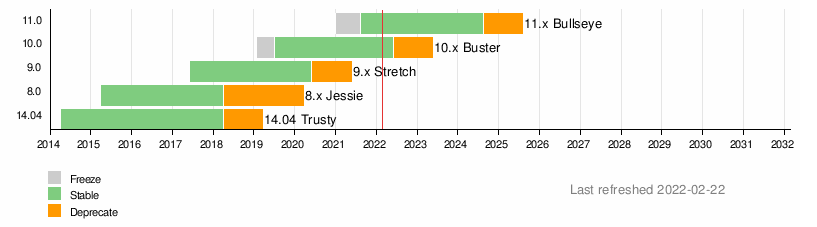
We re migrating the grid from Debian 9 Stretch to Debian 10 Buster, but perhaps we should be migrating from Debian 9 Stretch to Debian 11 Bullseye directly. This is a legitimate concern, and we discussed it in September 2021. A timeline showing Debian versions since 2014 Back then, our reasoning was that skipping to Debian 11 Bullseye would be more difficult for our users, especially because greater jump in version numbers for the underlying runtimes. Additionally, all the migration work started before Debian 11 Bullseye was released. Our original intention was for the migration to be completed before the release. For a couple of reasons the project was delayed, and when it was time to restart the project we decided to continue with the original idea. We had some work done to get Debian 10 Buster working correctly with the grid, and supporting Debian 11 Bullseye would require an additional effort. We didn t even check if Grid Engine could be installed in the latest Debian release. For the grid, in general, the engineering effort to do a N+1 upgrade is lower than doing a N+2 upgrade. If we had tried a N+2 upgrade directly, things would have been much slower and difficult for us, and for our users. In that sense, our conclusion was to not skip Debian 10 Buster.

We no longer want to run Grid Engine In a previous blog post we shared information about our desired future for Grid Engine in Toolforge. Our intention is to discontinue our usage of this technology.

No grid? What about my tools? Toolforge logo, a circle with an anvil in the middle Traditionally there have been two main workflows or use cases that were supported in the grid, but not in our Kubernetes backend:
  • Running jobs, long-running bots and other scheduled tasks.
  • Mixing runtime environments (for example, a nodejs app that runs some python code).
The good news is that work to handle the continuity of such use cases has already started. This takes the form of two main efforts:
  • The Toolforge buildpacks project to support arbitrary runtime environments.
  • The Toolforge Jobs Framework to support jobs, scheduled tasks, etc.
In particular, the Toolforge Jobs Framework has been available for a while in an open beta phase. We did some initial design and implementation, then deployed it in Toolforge for some users to try it and report bugs, report missing features, etc. These are complex, and feature-rich projects, and they deserve a dedicated blog post. More information on each will be shared in the future. For now, it is worth noting that both initiatives have some degree of development already. The conclusion Knowing all the moving parts, we were faced with a few hard questions when deciding how to approach the Debian 9 Stretch deprecation:
  • Should we not upgrade the grid, and focus on Kubernetes instead? Let Debian 9 Stretch be the last supported version on the grid?
  • What is the impact of these decisions on the technical community? What is best for our users?
The choices we made are already known in the community. A couple of weeks ago we announced the Debian 9 Stretch Grid Engine deprecation. In parallel to this migration, we decided to promote the new Toolforge Jobs Framework, even if it s still in beta phase. This new option should help users to future-proof their tool, and reduce maintenance effort. An early migration to Kubernetes now will avoid any more future grid problems. We truly hope that Debian 10 Buster is the last version we have for the grid, but as they say, hope is not a good strategy when it comes to engineering. What we will do is to work really hard in bringing Toolforge to the service level we want, and that means to keep developing and enabling more Kubernetes-based functionalities. Stay tuned for more upcoming blog posts with additional information about Toolforge. This post was originally published in the Wikimedia Tech blog, authored by Arturo Borrero Gonzalez.

10 May 2022

Russell Coker: Elon and Free Speech

Elon Musk has made the news for spending billions to buy a share of Twitter for the alleged purpose of providing free speech. The problem with this claim is that having any company controlling a large portion of the world s communication is inherently bad for free speech. The same applies for Facebook, but that s not a hot news item at the moment. If Elon wanted to provide free speech he would want to have decentralised messaging systems so that someone who breaks rules on one platform could find another with different rules. Among other things free speech ideally permits people to debate issues with residents of another country on issues related to different laws. If advocates for the Russian government get kicked off Twitter as part of the American sanctions against Russia then American citizens can t debate the issue with Russian citizens via Twitter. Mastodon is one example of a federated competitor to Twitter [1]. With a federated messaging system each host could make independent decisions about interpretation of sanctions. Someone who used a Mastodon instance based in the US could get a second account in another country if they wanted to communicate with people in countries that are sanctioned by the US. The problem with Mastodon at the moment is lack of use. It s got a good set of features and support for different platforms, there are apps for Android and iPhone as well as lots of other software using the API. But if the people you want to communicate with aren t on it then it s less useful. Elon could solve that problem by creating a Tesla Mastodon server and give a free account to everyone who buys a new Tesla, which is the sort of thing that a lot of Tesla buyers would like. It s quite likely that other companies selling prestige products would follow that example. Everyone has seen evidence of people sharing photos on social media with someone else s expensive car, a Mastodon account on ferrari.com or mercedes.com would be proof of buying the cars in question. The number of people who buy expensive cars new is a very small portion of the world population, but it s a group of people who are more influential than average and others would join Mastodon servers to follow them. The next thing that Elon could do to kill Twitter would be to have all his companies (which have something more than a dozen verified Twitter accounts) use Mastodon accounts for their primary PR releases and then send the same content to Twitter with a 48 hour delay. That would force journalists and people who want to discuss those companies on social media to follow the Mastodon accounts. Again this wouldn t be a significant number of people, but they would be influential people. Getting journalists to use a communications system increases it s importance. The question is whether Elon is lacking the vision necessary to plan a Mastodon deployment or whether he just wants to allow horrible people to run wild on Twitter. The Verge has an interesting article from 2019 about Gab using Mastodon [2]. The fact that over the last 2.5 years I didn t even hear of Gab using Mastodon suggests that the fears of some people significantly exceeded the problem. I m sure that some Gab users managed to harass some Mastodon users, but generally they were apparently banned quickly. As an aside the Mastodon server I use doesn t appear to ban Gab, a search for Gab on it gave me a user posting about being pureblood at the top of the list. Gab claims to have 4 million accounts and has an estimated 100,000 active users. If 5.5% of Tesla owners became active users on a hypothetical Tesla server that would be the largest Mastodon server. Elon could demonstrate his commitment to free speech by refusing to ban Gab in any way. The Wikipedia page about Gab [3] has a long list of horrible people and activities associated with it. Is that the free speech to associate with Tesla? Polestar makes some nice electric cars that appear quite luxurious [4] and doesn t get negative PR from the behaviour of it s owner, that s something Elon might want to consider. Is this really about bragging rights? Buying a controlling interest in a company that has a partial monopoly on Internet communication is something to boast about. Could users of commercial social media be considered serfs who serve their billionaire overlord?

9 May 2022

Robert McQueen: Evolving a strategy for 2022 and beyond

As a board, we have been working on several initiatives to make the Foundation a better asset for the GNOME Project. We re working on a number of threads in parallel, so I wanted to explain the big picture a bit more to try and connect together things like the new ED search and the bylaw changes. We re all here to see free and open source software succeed and thrive, so that people can be be truly empowered with agency over their technology, rather than being passive consumers. We want to bring GNOME to as many people as possible so that they have computing devices that they can inspect, trust, share and learn from. In previous years we ve tried to boost the relevance of GNOME (or technologies such as GTK) or solicit donations from businesses and individuals with existing engagement in FOSS ideology and technology. The problem with this approach is that we re mostly addressing people and organisations who are already supporting or contributing FOSS in some way. To truly scale our impact, we need to look to the outside world, build better awareness of GNOME outside of our current user base, and find opportunities to secure funding to invest back into the GNOME project. The Foundation supports the GNOME project with infrastructure, arranging conferences, sponsoring hackfests and travel, design work, legal support, managing sponsorships, advisory board, being the fiscal sponsor of GNOME, GTK, Flathub and we will keep doing all of these things. What we re talking about here are additional ways for the Foundation to support the GNOME project we want to go beyond these activities, and invest into GNOME to grow its adoption amongst people who need it. This has a cost, and that means in parallel with these initiatives, we need to find partners to fund this work. Neil has previously talked about themes such as education, advocacy, privacy, but we ve not previously translated these into clear specific initiatives that we would establish in addition to the Foundation s existing work. This is all a work in progress and we welcome any feedback from the community about refining these ideas, but here are the current strategic initiatives the board is working on. We ve been thinking about growing our community by encouraging and retaining diverse contributors, and addressing evolving computing needs which aren t currently well served on the desktop. Initiative 1. Welcoming newcomers. The community is already spending a lot of time welcoming newcomers and teaching them the best practices. Those activities are as time consuming as they are important, but currently a handful of individuals are running initiatives such as GSoC, Outreachy and outreach to Universities. These activities help bring diverse individuals and perspectives into the community, and helps them develop skills and experience of collaborating to create Open Source projects. We want to make those efforts more sustainable by finding sponsors for these activities. With funding, we can hire people to dedicate their time to operating these programs, including paid mentors and creating materials to support newcomers in future, such as developer documentation, examples and tutorials. This is the initiative that needs to be refined the most before we can turn it into something real. Initiative 2: Diverse and sustainable Linux app ecosystem. I spoke at the Linux App Summit about the work that GNOME and Endless has been supporting in Flathub, but this is an example of something which has a great overlap between commercial, technical and mission-based advantages. The key goal here is to improve the financial sustainability of participating in our community, which in turn has an impact on the diversity of who we can expect to afford to enter and remain in our community. We believe the existence of this is critically important for individual developers and contributors to unlock earning potential from our ecosystem, through donations or app sales. In turn, a healthy app ecosystem also improves the usefulness of the Linux desktop as a whole for potential users. We believe that we can build a case for commercial vendors in the space to join an advisory board alongside with GNOME, KDE, etc to input into the governance and contribute to the costs of growing Flathub. Initiative 3: Local-first applications for the GNOME desktop. This is what Thib has been starting to discuss on Discourse, in this thread. There are many different threats to free access to computing and information in today s world. The GNOME desktop and apps need to give users convenient and reliable access to technology which works similarly to the tools they already use everyday, but keeps them and their data safe from surveillance, censorship, filtering or just being completely cut off from the Internet. We believe that we can seek both philanthropic and grant funding for this work. It will make GNOME a more appealing and comprehensive offering for the many people who want to protect their privacy. The idea is that these initiatives all sit on the boundary between the GNOME community and the outside world. If the Foundation can grow and deliver these kinds of projects, we are reaching to new people, new contributors and new funding. These contributions and investments back into GNOME represent a true win-win for the newcomers and our existing community. (Originally posted to GNOME Discourse, please feel free to join the discussion there.)
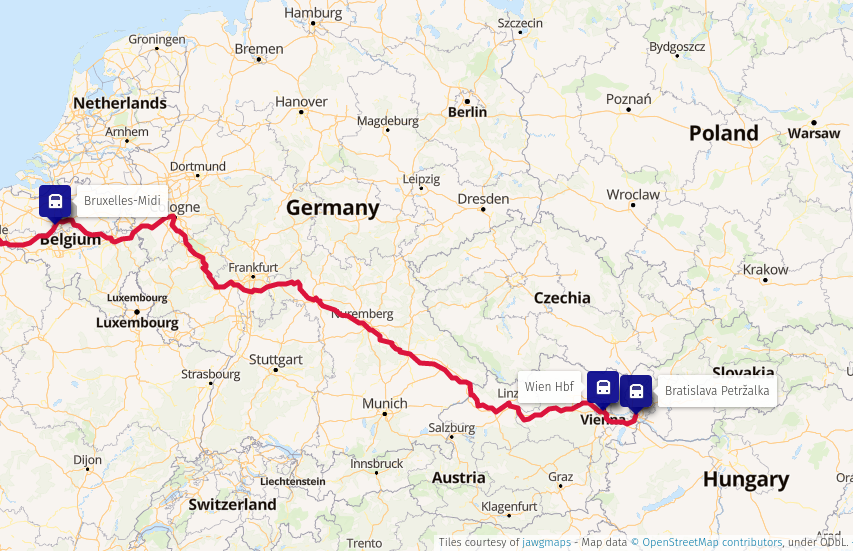
Russ Allbery: rra-c-util 10.2

rra-c-util is my collection of utility functions, mostly but not entirely for C, that I use with my various software releases. There are two major changes in this release. The first is Autoconf support for PCRE2, the new version of the Perl-Compatible Regular Expression library (PCRE1 is now deprecated), which was the motivation for a new release. The second is a huge update to the Perl formatting rules due to lots of work by Julien LIE for INN. This release also tags deallocation functions, similar to the change mentioned for C TAP Harness 4.8, for all the utility libraries provided by rra-c-util, and fixes an issue with the systemd support. You can get the latest version from the rra-c-util distribution page.

29 April 2022

Russ Allbery: Review: Interesting Times

Review: Interesting Times, by Terry Pratchett
Series: Discworld #17
Publisher: Harper
Copyright: 1994
Printing: February 2014
ISBN: 0-06-227629-8
Format: Mass market
Pages: 399
Interesting Times is the seventeenth Discworld novel and certainly not the place to start. At the least, you will probably want to read The Colour of Magic and The Light Fantastic before this book, since it's a sequel to those (although Rincewind has had some intervening adventures). Lord Vetinari has received a message from the Counterweight Continent, the first in ten years, cryptically demanding the Great Wizzard be sent immediately. The Agatean Empire is one of the most powerful states on the Disc. Thankfully for everyone else, it normally suits its rulers to believe that the lands outside their walls are inhabited only by ghosts. No one is inclined to try to change their minds or otherwise draw their attention. Accordingly, the Great Wizard must be sent, a task that Vetinari efficiently delegates to the Archchancellor. There is only the small matter of determining who the Great Wizzard is, and why it was spelled with two z's. Discworld readers with a better memory than I will recall Rincewind's hat. Why the Counterweight Continent would demanding a wizard notorious for his near-total inability to perform magic is a puzzle for other people. Rincewind is promptly located by a magical computer, and nearly as promptly transported across the Disc, swapping him for an unnecessarily exciting object of roughly equivalent mass and hurling him into an unexpected rescue of Cohen the Barbarian. Rincewind predictably reacts by running away, although not fast or far enough to keep him from being entangled in a glorious popular uprising. Or, well, something that has aspirations of being glorious, and popular, and an uprising. I hate to say this, because Pratchett is an ethically thoughtful writer to whom I am willing to give the benefit of many doubts, but this book was kind of racist. The Agatean Empire is modeled after China, and the Rincewind books tend to be the broadest and most obvious parodies, so that was already a recipe for some trouble. Some of the social parody is not too objectionable, albeit not my thing. I find ethnic stereotypes and making fun of funny-sounding names in other languages (like a city named Hunghung) to be in poor taste, but Pratchett makes fun of everyone's names and cultures rather equally. (Also, I admit that some of the water buffalo jokes, despite the stereotypes, were pretty good.) If it had stopped there, it would have prompted some eye-rolling but not much comment. Unfortunately, a significant portion of the plot depends on the idea that the population of the Agatean Empire has been so brainwashed into obedience that they have a hard time even imagining resistance, and even their revolutionaries are so polite that the best they can manage for slogans are things like "Timely Demise to All Enemies!" What they need are a bunch of outsiders, such as Rincewind or Cohen and his gang. More details would be spoilers, but there are several deliberate uses of Ankh-Morpork as a revolutionary inspiration and a great deal of narrative hand-wringing over how awful it is to so completely convince people they are slaves that you don't need chains. There is a depressingly tedious tendency of western writers, even otherwise thoughtful and well-meaning ones like Pratchett, to adopt a simplistic ranking of political systems on a crude measure of freedom. That analysis immediately encounters the problem that lots of people who live within systems that rate poorly on this one-dimensional scale seem inadequately upset about circumstances that are "obviously" horrific oppression. This should raise questions about the validity of the assumptions, but those assumptions are so unquestionable that the writer instead decides the people who are insufficiently upset about their lack of freedom must be defective. The more racist writers attribute that defectiveness to racial characteristics. The less racist writers, like Pratchett, attribute that defectiveness to brainwashing and systemic evil, which is not quite as bad as overt racism but still rests on a foundation of smug cultural superiority. Krister Stendahl, a bishop of the Church of Sweden, coined three famous rules for understanding other religions:
  1. When you are trying to understand another religion, you should ask the adherents of that religion and not its enemies.
  2. Don't compare your best to their worst.
  3. Leave room for "holy envy."
This is excellent advice that should also be applied to politics. Most systems exist for some reason. The differences from your preferred system are easy to see, particularly those that strike you as horrible. But often there are countervailing advantages that are less obvious, and those are more psychologically difficult to understand and objectively analyze. You might find they have something that you wish your system had, which causes discomfort if you're convinced you have the best political system in the world, or are making yourself feel better about the abuses of your local politics by assuring yourself that at least you're better than those people. I was particularly irritated to see this sort of simplistic stereotyping in Discworld given that Ankh-Morpork, the setting of most of the Discworld novels, is an authoritarian dictatorship. Vetinari quite capably maintains his hold on power, and yet this is not taken as a sign that the city's inhabitants have been brainwashed into considering themselves slaves. Instead, he's shown as adept at maintaining the stability of a precarious system with a lot of competing forces and a high potential for destructive chaos. Vetinari is an awful person, but he may be better than anyone who would replace him. Hmm. This sort of complexity is permitted in the "local" city, but as soon as we end up in an analog of China, the rulers are evil, the system lacks any justification, and the peasants only don't revolt because they've been trained to believe they can't. Gah. I was muttering about this all the way through Interesting Times, which is a shame because, outside of the ham-handed political plot, it has some great Pratchett moments. Rincewind's approach to any and all danger is a running (sorry) gag that keeps working, and Cohen and his gang of absurdly competent decrepit barbarians are both funnier here than they have been in any previous book and the rare highly-positive portrayal of old people in fantasy adventures who are not wizards or crones. Pretty Butterfly is a great character who deserved to be in a better plot. And I loved the trouble that Rincewind had with the Agatean tonal language, which is an excuse for Pratchett to write dialog full of frustrated non-sequiturs when Rincewind mispronounces a word. I do have to grumble about the Luggage, though. From a world-building perspective its subplot makes sense, but the Luggage was always the best character in the Rincewind stories, and the way it lost all of its specialness here was oddly sad and depressing. Pratchett also failed to convince me of the drastic retcon of The Colour of Magic and The Light Fantastic that he does here (and which I can't talk about in detail due to spoilers), in part because it's entangled in the orientalism of the plot. I'm not sure Pratchett could write a bad book, and I still enjoyed reading Interesting Times, but I don't think he gave the politics his normal care, attention, and thoughtful humanism. I hope later books in this part of the Disc add more nuance, and are less confident and judgmental. I can't really recommend this one, even though it has some merits. Also, just for the record, "may you live in interesting times" is not a Chinese curse. It's an English saying that likely was attributed to China to make it sound exotic, which is the sort of landmine that good-natured parody of other people's cultures needs to be wary of. Followed in publication order by Maskerade, and in Rincewind's personal timeline by The Last Continent. Rating: 6 out of 10

27 April 2022

Russell Coker: PIN for Login

Windows 10 added a new PIN login method, which is an optional login method instead of an Internet based password through Microsoft or a Domain password through Active Directory. Here is a web page explaining some of the technology (don t watch the YouTube video) [1]. There are three issues here, whether a PIN is any good in concept, whether the specifics of how it works are any good, and whether we can copy any useful ideas for Linux. Is a PIN Any Good? A PIN in concept is a shorter password. I think that less secure methods of screen unlocking (fingerprint, face unlock, and a PIN) can be reasonably used in less hostile environments. For example if you go to the bathroom or to get a drink in a relatively secure environment like a typical home or office you don t need to enter a long password afterwards. Having a short password that works for short time periods of screen locking and a long password for longer times could be a viable option. It could also be an option to allow short passwords when the device is in a certain area (determined by GPS or Wifi connection). Android devices have in the past had options to disable passwords when at home. Is the Windows 10 PIN Any Good? The Windows 10 PIN is based on TPM security which can provide real benefits, but this is more of a failure of Windows local passwords in not using the TPM than a benefit for the PIN. When you login to a Windows 10 system you will be given a choice of PIN or the configured password (local password or AD password). As a general rule providing a user a choice of ways to login is bad for security as an attacker can use whichever option is least secure. The configuration options for Windows 10 allow either group policy in AD or the registry to determine whether PIN login is allowed but doesn t have any control over when the PIN can be used which seems like a major limitation to me. The claim that the PIN is more secure than a password would only make sense if it was a viable option to disable the local password or AD domain password and only use the PIN. That s unreasonably difficult for home users and usually impossible for people on machines with corporate management. Ideas For Linux I think it would be good to have separate options for short term and long term screen locks. This could be implemented by having a screen locking program use two different PAM configurations for unlocking after short term and long term lock periods. Having local passwords based on the TPM might be useful. But if you have the root filesystem encrypted via the TPM using systemd-cryptoenroll it probably doesn t gain you a lot. One benefit of the TPM is limiting the number of incorrect attempts at guessing the password in hardware, the default is allowing 32 wrong attempts and then one every 10 minutes. Trying to do that in software would allow 32 guesses and then a hardware reset which could average at something like 32 guesses per minute instead of 32 guesses per 320 minutes. Maybe something like fail2ban could help with this (a similar algorithm but for password authentication guesses instead of network access). Having a local login method to use when there is no Internet access and network authentication can t work could be useful. But if the local login method is easier then an attacker could disrupt Internet access to force a less secure login method. Is there a good federated authentication system for Linux? Something to provide comparable functionality to AD but with distributed operation as a possibility?

22 April 2022

Andrej Shadura: To England by train (part 1)

This post was written in August 2021. Just as I was going to publish it, I received an email from BB stating that due to a railway strike in Germany my night train would be cancelled. Since the rest of the trip has already been booked well in advance, I had to take a plane to Charleroi and a bus to Brussels to catch my Eurostar. Ultimately, I ended up publishing it in April 2022, just as I m about to leave for a fully train-powered trip to the UK once again. Before the pandemic started, I planned to use the last months of my then-expiring UK visa and go to England by train. I ve completed two train long journeys by that time already, to Brussels and to Belarus and Ukraine, but this would be something quite different, as I wanted to have multiple stops on my way, use night trains where it made sense, and to go through the Channel Tunnel. The Channel Tunnel fascinated me since my childhood; I first read about it in the Soviet Science and Life magazine ( ) when I was seven. I ve never had the chance to use it though, since to board any train going though it I d first need to get to France, Belgium or the Netherlands, making it significantly more expensive than the cheap 30 Ryanair flights to Stansted. As the coronavirus spread across the world, all of my travel plans along with plans for a sabbatical had to be cancelled. During 2020, I only managed to go on two weekend trips to Prague and Budapest, followed by a two-weeks holiday on Crete (we returned just a couple of weeks before the infection numbers rose and lockdowns started). I do realise that a lot of people couldn t even have this much because the situation in their countries was much worse we were lucky to have had at least some travel. Fast forward to August 2021, I m fully vaccinated, I once again have a UK visa for five years, and the UK finally recognises the EU vaccination passports yay! I can finally go to Devon to see my mother and sister again. By train, of course. Compared to my original plan, this journey will be different: about the same or even more expensive than I originally planned, but shorter and with fewer stops on the way. My original plan would be to take multiple trains from Bratislava to France or Belgium and complete this segment of the trip in about three days, enjoying my stay in a couple of cities on the way. Instead, I m taking a direct NightJet from Vienna to Brussels, not stopping anywhere on the way.
Map: train route from Bratislava to BrusselsTrain route from Bratislava to Brussels
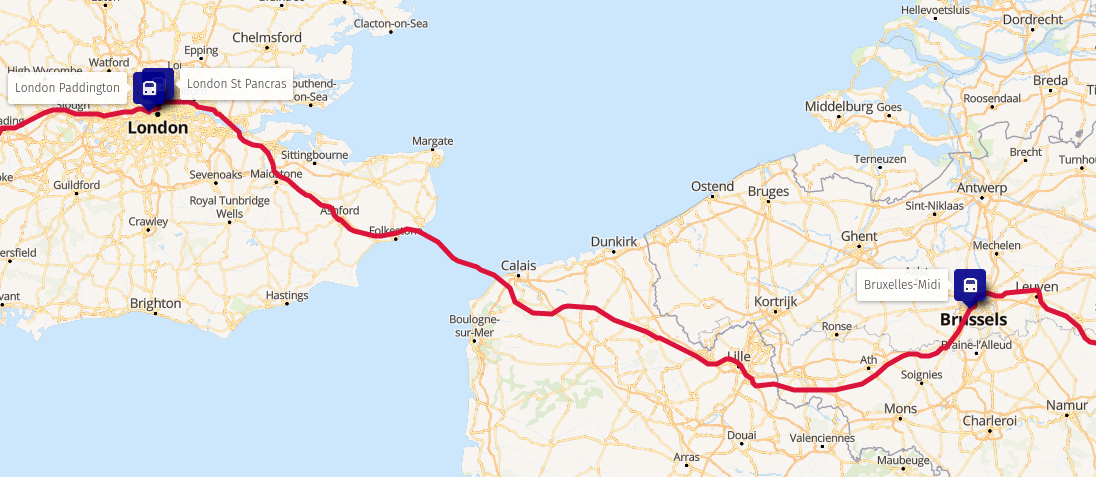
Since I was booking my trip just two weeks ahead, the price of the ticket is not that I hoped for, but much higher: 109 for the ticket itself and 60 for the berth (advance bookings could be about twice as cheap). Next, to London! Eurostar is still on a very much reduced schedule, running one train only from Amsterdam through Brussels and Lille to London each day. This means, of course, higher ticket prices (I paid about 100 for the ticket) and longer waiting time in Brussels my sleeper arrives about 10 am, but the Eurostar train is scheduled to depart at 3 pm.
Map: train route from Brussels to LondonTrain route from Brussels to London
The train makes a stop in Lille, which I initially suspected to be risky as at the time when I booked my tickets, as at the time France was on the amber plus list for the UK, requiring a quarantine upon arrival. However, Eurostar announced that they will assign travellers from Lille to a different carriage to avoid other passengers having to go to quarantine, but recently France was taken off the amber plus list. The train fare system in the UK is something I don t quite understand, as sometimes split tickets are cheaper, sometimes they re expensive, sometimes prices for the same service at different times can be vastly different, off-peak tickets don t say what exactly off-peak means (very few people in the UK are asked were able to tell me when exactly off-peak hours are). Curiously, transfers between train stations using London Underground services can be included into railway tickets, but some last mile connection like Exeter to Honiton cannot (but this used to be possible). Both GWR.com and TrainLine refused to sell me a single ticket from London to Honiton through Exeter, insisting I split the ticket at Exeter St Davids or take the slower South Western train to Honiton via Salisbury and Yeovil. I ended up buying a 57 ticket from Paddington to Exeter St Davids with the first segment being the London Underground from St Pancras, and a separate 7.70 ticket to Honiton.
Map: arrival at St Pancras, the underground, departure from PaddingtonChange of trains in London
Map: arrival at Exeter St Davids, change to a South Western train, arrival at HonitonChange of trains in Exeter
Date Station Arrival Departure Train
12.8 Bratislava-Petr alka 18:15 REX 7756
Wien Hbf 19:15 19:53 NJ 50490
13.8 Bruxelles-Midi 9:55 15:06 EST 9145
London St Pancras 16:03 16:34 TfL
London Paddington 16:49 17:04 GWR 59231
Exeter St Davids 19:19 19:25 SWR 52706
Honiton 19:54
Unfortunately, due to the price of the tickets, I m taking a 15 Ryanair flight back Update after the journey Since I flew to Charleroi instead of comfortably sleeping in a night train, I had to put up with inconveniences of airports, including cumbersome connections to the nearby cities. The only reasonable way of getting from Charleroi to Brussels is an overcrowded bus which takes almost an hour to arrive. I used to take this bus when I tried to save money on my way to FOSDEM, and I must admit it s not something I missed. Boarding the Eurostar train went fine, my vaccination passport and Covid test wasn t really checked, just glanced at. The waiting room was a bit of a disappointment, with bars closed and vending machines broken. Since it was underground, I couldn t even see the trains until the very last moment when we were finally allowed on the platform. The train itself, while comfortable, disappointed me with the bistro carriage: standing only, instant coffee, poor selection of food and drinks. I m glad I bought some food at Carrefour at the Midi station! When I arrived in Exeter, I soon found out why the system refused to sell me a through ticket: 6 minutes is not enough to change trains at Exeter St Davids! Or, it might have been if I took the right footbridge but I took the one which led into a very talkative (and slow!) lift. I ended up running to the train just as it closed the doors and departed, leaving me tin Exeter for an hour until. I used this chance and walked to Exeter Central, and had a pint in a conveniently located pub around the corner. P.S. The maps in this and other posts were created using uMap; the map data come from OpenStreetMap. The train route visualisation was generated with help of the Raildar.fr OSRM instance.

19 April 2022

Steve McIntyre: Firmware - what are we going to do about it?

TL;DR: firmware support in Debian sucks, and we need to change this. See the "My preference, and rationale" Section below. In my opinion, the way we deal with (non-free) firmware in Debian is a mess, and this is hurting many of our users daily. For a long time we've been pretending that supporting and including (non-free) firmware on Debian systems is not necessary. We don't want to have to provide (non-free) firmware to our users, and in an ideal world we wouldn't need to. However, it's very clearly no longer a sensible path when trying to support lots of common current hardware. Background - why has (non-free) firmware become an issue? Firmware is the low-level software that's designed to make hardware devices work. Firmware is tightly coupled to the hardware, exposing its features, providing higher-level functionality and interfaces for other software to use. For a variety of reasons, it's typically not Free Software. For Debian's purposes, we typically separate firmware from software by considering where the code executes (does it run on a separate processor? Is it visible to the host OS?) but it can be difficult to define a single reliable dividing line here. Consider the Intel/AMD CPU microcode packages, or the U-Boot firmware packages as examples. In times past, all necessary firmware would normally be included directly in devices / expansion cards by their vendors. Over time, however, it has become more and more attractive (and therefore more common) for device manufacturers to not include complete firmware on all devices. Instead, some devices just embed a very simple set of firmware that allows for upload of a more complete firmware "blob" into memory. Device drivers are then expected to provide that blob during device initialisation. There are a couple of key drivers for this change: Due to these reasons, more and more devices in a typical computer now need firmware to be uploaded at runtime for them to function correctly. This has grown: At the beginning of this timeline, a typical Debian user would be able to use almost all of their computer's hardware without needing any firmware blobs. It might have been inconvenient to not be able to use the WiFi, but most laptops had wired ethernet anyway. The WiFi could always be enabled and configured after installation. Today, a user with a new laptop from most vendors will struggle to use it at all with our firmware-free Debian installation media. Modern laptops normally don't come with wired ethernet now. There won't be any usable graphics on the laptop's screen. A visually-impaired user won't get any audio prompts. These experiences are not acceptable, by any measure. There are new computers still available for purchase today which don't need firmware to be uploaded, but they are growing less and less common. Current state of firmware in Debian For clarity: obviously not all devices need extra firmware uploading like this. There are many devices that depend on firmware for operation, but we never have to think about them in normal circumstances. The code is not likely to be Free Software, but it's not something that we in Debian must spend our time on as we're not distributing that code ourselves. Our problems come when our user needs extra firmware to make their computer work, and they need/expect us to provide it. We have a small set of Free firmware binaries included in Debian main, and these are included on our installation and live media. This is great - we all love Free Software and this works. However, there are many more firmware binaries that are not Free. If we are legally able to redistribute those binaries, we package them up and include them in the non-free section of the archive. As Free Software developers, we don't like providing or supporting non-free software for our users, but we acknowledge that it's sometimes a necessary thing for them. This tension is acknowledged in the Debian Free Software Guidelines. This tension extends to our installation and live media. As non-free is officially not considered part of Debian, our official media cannot include anything from non-free. This has been a deliberate policy for many years. Instead, we have for some time been building a limited parallel set of "unofficial non-free" images which include non-free firmware. These non-free images are produced by the same software that we use for the official images, and by the same team. There are a number of issues here that make developers and users unhappy:
  1. Building, testing and publishing two sets of images takes more effort.
  2. We don't really want to be providing non-free images at all, from a philosophy point of view. So we mainly promote and advertise the preferred official free images. That can be a cause of confusion for users. We do link to the non-free images in various places, but they're not so easy to find.
  3. Using non-free installation media will cause more installations to use non-free software by default. That's not a great story for us, and we may end up with more of our users using non-free software and believing that it's all part of Debian.
  4. A number of users and developers complain that we're wasting their time by publishing official images that are just not useful for a lot (a majority?) of users.
We should do better than this. Options The status quo is a mess, and I believe we can and should do things differently. I see several possible options that the images team can choose from here. However, several of these options could undermine the principles of Debian. We don't want to make fundamental changes like that without the clear backing of the wider project. That's why I'm writing this...
  1. Keep the existing setup. It's horrible, but maybe it's the best we can do? (I hope not!)
  2. We could just stop providing the non-free unofficial images altogether. That's not really a promising route to follow - we'd be making it even harder for users to install our software. While ideologically pure, it's not going to advance the cause of Free Software.
  3. We could stop pretending that the non-free images are unofficial, and maybe move them alongside the normal free images so they're published together. This would make them easier to find for people that need them, but is likely to cause users to question why we still make any images without firmware if they're otherwise identical.
  4. The images team technically could simply include non-free into the official images, and add firmware packages to the input lists for those images. However, that would still leave us with problem 3 from above (non-free generally enabled on most installations).
  5. We could split out the non-free firmware packages into a new non-free-firmware component in the archive, and allow a specific exception only to allow inclusion of those packages on our official media. We would then generate only one set of official media, including those non-free firmware packages. (We've already seen various suggestions in recent years to split up the non-free component of the archive like this, for example into non-free-firmware, non-free-doc, non-free-drivers, etc. Disagreement (bike-shedding?) about the split caused us to not make any progress on this. I believe this project should be picked up and completed. We don't have to make a perfect solution here immediately, just something that works well enough for our needs today. We can always tweak and improve the setup incrementally if that's needed.)
These are the most likely possible options, in my opinion. If you have a better suggestion, please let us know! I'd like to take this set of options to a GR, and do it soon. I want to get a clear decision from the wider Debian project as to how to organise firmware and installation images. If we do end up changing how we do things, I want a clear mandate from the project to do that. My preference, and rationale Mainly, I want to see how the project as a whole feels here - this is a big issue that we're overdue solving. What would I choose to do? My personal preference would be to go with option 5: split the non-free firmware into a special new component and include that on official media. Does that make me a sellout? I don't think so. I've been passionately supporting and developing Free Software for more than half my life. My philosophy here has not changed. However, this is a complex and nuanced situation. I firmly believe that sharing software freedom with our users comes with a responsibility to also make our software useful. If users can't easily install and use Debian, that helps nobody. By splitting things out here, we would enable users to install and use Debian on their hardware, without promoting/pushing higher-level non-free software in general. I think that's a reasonable compromise. This is simply a change to recognise that hardware requirements have moved on over the years. Further work If we do go with the changes in option 5, there are other things we could do here for better control of and information about non-free firmware:
  1. Along with adding non-free firmware onto media, when the installer (or live image) runs, we should make it clear exactly which firmware packages have been used/installed to support detected hardware. We could link to docs about each, and maybe also to projects working on Free re-implementations.
  2. Add an option at boot to explicitly disable the use of the non-free firmware packages, so that users can choose to avoid them.
Acknowledgements Thanks to people who reviewed earlier versions of this document and/or made suggestions for improvement, in particular:

Next.

Previous.