Search Results: "nion"

1 August 2016

Bits from Debian: Debian and Tor Services available as Onion Services

We, the Debian project and the Tor project are enabling Tor onion services for several of our sites. These sites can now be reached without leaving the Tor network, providing a new option for securely connecting to resources provided by Debian and Tor. The freedom to use open source software may be compromised when access to that software is monitored, logged, limited, prevented, or prohibited. As a community, we acknowledge that users should not feel that their every action is trackable or observable by others. Consequently, we are pleased to announce that we have started making several of the various web services provided by both Debian and Tor available via onion services. While onion services can be used to conceal the network location of the machine providing the service, this is not the goal here. Instead, we employ onion services because they provide end-to-end integrity and confidentiality, and they authenticate the onion service end point. For instance, when users connect to the onion service running at http://sejnfjrq6szgca7v.onion/, using a Tor-enabled browser such as the TorBrowser, they can be certain that their connection to the Debian website cannot be read or modified by third parties, and that the website that they are visiting is indeed the Debian website. In a sense, this is similar to what using HTTPS provides. However, crucially, onion services do not rely on third-party certification authorities (CAs). Instead, the onion service name cryptographically authenticates its cryptographic key. In addition to the Tor and Debian websites, the Debian FTP and the Debian Security archives are available from .onion addresses, enabling Debian users to update their systems using only Tor connections. With the apt-transport-tor package installed, the following entries can replace the normal debian mirror entries in the apt configuration file (/etc/apt/sources.list):
  deb  tor+http://vwakviie2ienjx6t.onion/debian          jessie            main
  deb  tor+http://vwakviie2ienjx6t.onion/debian          jessie-updates    main
  deb  tor+http://sgvtcaew4bxjd7ln.onion/debian-security jessie/updates    main
Likewise, Tor's Debian package repository is available from an onion service :
  deb tor+http://sdscoq7snqtznauu.onion/torproject.org   jessie    main
Where appropriate, we provide services redundantly from several backend machines using OnionBalance. The Debian OnionBalance package is available from the Debian backports repository. Lists of several other new onion services offered by Debian and Tor are available from https://onion.debian.org and https://onion.torproject.org respectively. We expect to expand these lists in the near future to cover even more of Debian's and Tor's services.

30 July 2016

Sean Whitton: internetcomments

This doesn t appear to cover the other kind of comment-moderation problem: that where overmoderation and attachment to poster identity leads to an environment of stifling conventionalism. Photography communities in particular (e.g. flickr, instagram, 500px) are vulnerable to turning into circlejerks where no-one is willing to say what they mean for fear of appearing the negative nancy (no pun intended) and where high post-count contributors poorly-supported opinions become elevated above said views merits. In such communities the typical discussion is at the level of tepid platitude: good exposure! , nice depth of field! , or cool HDR! . On the other end of the scale there s the imageboard style of community where anonymity is the norm, feedback is uncompromisingly harsh, and uselessly opaque criticism appears such on its face; unsuited to the overly sensitive but hideously valuable to the advancing novice. Ordinary web forums, with tools oriented towards a punitive he said the n-word! delete his account and everything he s posted! persona non grata, in damnatio memoriae! school of moderation, strongly tend to the former.
ksandstr on LWN

29 July 2016

Debian Sysadmin Team: Peter Palfrader: Onion Services

Abstract I just set up a lot of Onion Services for many of Debian's static websites. You can find the entire list of services on onion.debian.org. More might come in the future. Read more about this on either Bits or on the Tor Blog. -- Peter Palfrader

28 July 2016

Norbert Preining: TUG 2016 Day 3 Stories and Histories

The last day of TUG 2016, or at least the last day of talks, brought four one-hour talks from special guests, and several others, where many talks told us personal stories and various histories.
tug2016-biglow A great finish of a great conference. Jennifer Claudio The case for justified text Due to a strange timezone bug in my calendar program, I completely overslept a morning meeting and breakfast, as well as the first talk, so unfortunately I don t have anything to report about this surely intersting talk comparing justification in various word processors and TeX. Leyla Akhmadeeva, Rinat Gizatullin, Boris Veytsman Are justification and hyphenation good or bad for the reader? Still half dizzy and without coffee, I couldn t really follow this talk, and only woke up till the end when there was a lot of interesting discussion about speed reading and its non-existence (because it is simply skimming over text), and improvements on reading comprehension. Charles Bigelow Looking for legibility Another special guest, Charles Bigelow, presented a huge pool of research and work into readability, and how attitude and usage of fonts change over time. A very involving and well laid out talk, full of interesting background images and personal opinions and thoughts. Charles also touched onto topics of readability on modern devices like e-readers and mobiles. He compared the recent developments in font design for mobile devices with their work on Lucida 20+ years ago, and concluded that both arrived at the same solutions. A very educating and amusing talk packed full with information on readability. I surely will revisit the recording in a study session. David Walden Some notes on the history of digital typography David touches on many topics of the history of digital typography which he has experienced himself over the years: First the development of newspaper production and printing, then the evolvement of editors from simple text editors over word processors to full-fledged DTP programs. Finally he touches on various algorithmic problems that appear in the publishing business. Tim Inkster The beginning of my career Tim, our fanatastic guide through his print shop the Procupine s Quill on the second excursion day, talked about his private ups and downs in the printing business, all filled with an infinite flow of funny stories and surprising anecdotes. Without slides and anything but his voice and his stories, he kept us hanging on his lips without a break. I recommend watching the recording of his talk because one cannot convey the funny comments and great stories he shared with us in this simple blog. Joe Clark Type and tiles on the TTC Joe unveils the history of rise and fall of the underground types and
tiles in Toronto. It is surprising to me that a small metro network as in Toronto can have such a long history of changes of design, layout, presentation. Some of the photos completely stymed me how can anyone put up signs like that? I was thinking. To quote Joe (hopefully I remember correctly):
You see what happens without adult supervision.
Abdelouahad Bayar Towards an operational (La)TeX package supporting optical scaling of dynamic mathematical symbols A technical talk about a trial in providing optical scaling of mathematical symbols. As far as I understand it tries to improve on the TeX way of doing extensible math symbols by glueing things together. It seems to be highly involved and technically interesting project, but I couldn t completely grasp the aim of it. Michael Cohen, Blanca Mancilla, John Plaice Zebrackets: A score of years and delimiters John introduced us to Zebrackets, stripped parentheses and brackets, to help us keep track of pairing of those beasts. But as we know, Zebras are very elusive animals, and so we saw lots of stripped brackets around. The idea of better markup of matching parentheses is definitely worth developing. Charles Bigelow Probably approximately not quite correct: Revise, repeat The second talk of Charles, this time on the history of the Lucida fonts, from the early beginnings drawn on graph paper to recent developments using FontLab producing OpenType fonts. A truly unique crash course through the development of one of the very big families of fonts, and one of the first outside Computer Modern that had also support for proper math typesetting in TeX.
Aggressively legible!
One of the key phrases that popped up again and again was aggressively legible, mostly in negative connotations as far to fat symbols or far to big Arabic letters. But for me this font family is still close to my heart. I purchased it back than from Y&Y for my PhD thesis, and since then have upgraded to the TUG version including the OpenType fonts, and I use them for most of my presentation. Maybe I like the aggressive legibility! Chuck slided in lots of nice comments about Kris Holmes, the development practice in their cooperation, stories of business contacts, and many more, making this talk a very lively and amusing, and at the same time very educating talk.
This concluded the TUG conference talks, and we thanked Pavneet for his excellent organization. But since we still have up to two days of excursions, many people dispersed quickly, just to meet again for a optional Type and Tile Tour 3-5 subway stops with discussion of typesetting This guided tour through the underground of Toronto, guided by Joe Clark who spoke in the morning about this topic, was attended by far too many participants. I think there were around 25 when we left. I thought that this will not work out properly, and so decided to leave the group and wander around alone. The last program point for today was dinner with a blues music concert in the near by Jazz Bistro:
jazz-bistro Excellent life music in a bit schick/sophisticated atmosphere was a good finish for this excellent day. With Herb from MacTeX and his wife we killed two bottles of red wine, before slowly tingling back to the hotel. A great finishing day of talks.

26 July 2016

Rhonda D'Vine: Debian LGBTIQA+

I have a long overdue blog entry about what happened in recent times. People that follow my tweets did catch some things. Most noteworthy there was the Trans*Inter*Congress in Munich at the start of May. It was an absolute blast. I met so many nice and great people, talked and experienced so many great things there that I'm still having a great motivational push from it every time I think back. It was also the time when I realized that I in fact do have body dysphoria even though I thought I'm fine with my body in general: Being tall is a huge issue for me. Realizing that I have a huge issue (yes, pun intended) with my length was quite relieving, even though it doesn't make it go away. It's something that makes passing and transitioning for me harder. I'm well aware that there are tall women, and that there are dedicated shops for lengthy women, but that's not the only thing that I have trouble with. What bothers me most is what people read into tall people: that they are always someone they can lean on for comfort, that tall people are always considered to be self confident and standing up for themselves (another pun, I know ... my bad). And while I'm fine with people coming to me for leaning on to, I rarely get the chance to do so myself. And people don't even consider it. When I was there in Munich, talking with another great (... pun?) trans woman who was as tall as me I finally had the possibility to just rest my head on her shoulder and finally feel the comfort I need just as much as everyone else out there, too. Probably that's also the reason why I'm so touchy and do go Free Hugging as often as possible. But being tall also means that you are usually only the big spoon when cuddling up. Having a small mental breakdown because of realizing that didn't change the feeling directly but definitely helped with looking for what I could change to fix that for myself. Then, at the end of may, the movie FtWTF - female to what the fuck came to cinema. It's a documentary about six people who got assigned female at birth. And it's absolutely charming, and has great food for thoughts in it. If you ever get the chance to watch it you definitely should. And then came debconf16 in Capetown. The flight to there was canceled and we had to get rebooked. The first offer was to go through Dubai, and gladly a colleague did point out to the person behind the desk that that wouldn't be safe for myself and thus out of scope. In the end we managed to get to Capetown quite nice, and even though it was winter when the sun was shining it was quite nice. Besides the cold nights that is. Or being stuck on the way up to table mountain because a colleague had cramps in his lags and we had to call mountain rescue. Gladly the night was clear, and when the mountain rescue finally got us to top and it was night already we had one of the nicest views from up there most people probably never will experience. And then ... I got invited to a trans meetup in Capetown. I was both excited and nervous about it, what to expect there. But it was simply great. The group there was simply outstandingly great. The host gave update information on progress on clinical support within south Africa, from what I took with me is that there is only one clinic there for SRS which manages only two people a year which is simply ... yuck. Guess you can guess how many years (yes, decades) the waiting line is ... I was blown away though by the diversity of the group, on so many levels, most notably on the age spectrum. It was a charm to meet you all there! If you ever stop by in Capetown and you are part of the LGBTIQ community, make sure you get in contact with the Triangle Project. But, about the real reason to write this entry: I was approached at Debconf by at least two people who asked me what I thought about creating an LGBTIQA+ group within Debian, and if I'd like to push for that. Actually I think it would be a good idea to have some sort of exchange between people on the queer spectrum (and I hope I don't offend anyone with just saying queer for LGBTIQA+ people). Given that I'm quite outspoken people approach me every now and then so I'm aware that there is a fair amount of people that would fall into that category. On the other hand some of them wouldn't want to have it publicly known because it shouldn't matter and isn't really the business of others. So I'm uncertain. If we follow that path I guess something that is closed or at least offers the possibility to have a closed communication would be needed to not out someone by just joining in the discussion. It's was easier with Debian Women where it was (somewhat) clear that male participants are allies supporting the cause and not considered being women themselves, but often enough (mostly cis hetero male) people are afraid to join a dedicated LGBTIQA+ group because they have the fear of having their identity judged. These things should be considered before creating such a place so that people can feel comfortable when joining and know what to expect beforehand. For the time being I created #debian-diversity on irc.debian.org to discuss how to move forward. Please bear in mind that even the channel name is up for discussion. Acronyms might not be the way to go in my opinion, just read back up the discussion that lead to the Diversity Statement of Debian where the original approach was to start listing groups for inclusiveness but it was quickly clear that it can get outdated too easily. I am willing to be part of that effort, but right now I have some personal things to deal which eat up a fair amount of my time. My kid starts school in September (yes, it's that long already, time flies ...). And it looks like I'll have to move a second time in the near future: I'll have to leave my current flat by the end of the year and the Que[e]rbau I'm moving into won't be ready by that time to host me yet ... F*ck. :(

/personal permanent link Comments: 1 Flattr this

24 July 2016

Russ Allbery: Review: The Run of His Life

Review: The Run of His Life, by Jeffrey Toobin
Publisher: Random House
Copyright: 1996, 1997
Printing: 2015
ISBN: 0-307-82916-2
Format: Kindle
Pages: 498
The O.J. Simpson trial needs little introduction to anyone who lived through it in the United States, but a brief summary for those who didn't. O.J. Simpson is a Hall of Fame football player and one of the best running backs to ever play the game. He's also black, which is very relevant much of what later happened. After he retired from professional play, he became a television football commentator and a spokesperson for various companies (particularly Hertz, a car rental business). In 1994, he was arrested for the murder of two people: his ex-wife, Nicole Brown Simpson, and Ron Goldman (a friend of Nicole's). The arrest happened after a bizarre low-speed police chase across Los Angeles in a white Bronco that was broadcast live on network television. The media turned the resulting criminal trial into a reality TV show, with live cable television broadcasts of all of the court proceedings. After nearly a full year of trial (with the jury sequestered for nine months more on that later), a mostly black jury returned a verdict of not guilty after a mere four hours of deliberation. Following the criminal trial, in an extremely unusual legal proceeding, Simpson was found civilly liable for Ron Goldman's death in a lawsuit brought by his family. Bizarre events surrounding the case continued long afterwards. A book titled If I Did It (with "if" in very tiny letters on the cover) was published, ghost-written but allegedly with Simpson's input and cooperation, and was widely considered a confession. Another legal judgment let the Goldman family get all the profits from that book's publication. In an unrelated (but also bizarre) incident in Las Vegas, Simpson was later arrested for kidnapping and armed robbery and is currently in prison until at least 2017. It is almost impossible to have lived through the O.J. Simpson trial in the United States and not have formed some opinion on it. I was in college and without a TV set at the time, and even I watched some of the live trial coverage. Reactions to the trial were extremely racially polarized, as you might have guessed. A lot of black people believed at the time that Simpson was innocent (probably fewer now, given subsequent events). A lot of white people thought he was obviously guilty and was let off by a black jury for racial reasons. My personal opinion, prior to reading this book, was a common "third way" among white liberals: Simpson almost certainly committed the murders, but the racist Los Angeles police department decided to frame him for a crime that he did commit by trying to make the evidence stronger. That's a legitimate reason in the US justice system for finding someone innocent: the state has an obligation to follow correct procedure and treat the defendant fairly in order to get a conviction. I have a strong bias towards trusting juries; frequently, it seems that the media second-guesses the outcome of a case that makes perfect sense as soon as you see all the information the jury had (or didn't have). Toobin's book changed my mind. Perhaps because I wasn't watching all of the coverage, I was greatly underestimating the level of incompetence and bad decision-making by everyone involved: the prosecution, the defense, the police, the jury, and the judge. This court case was a disaster from start to finish; no one involved comes away looking good. Simpson was clearly guilty given the evidence presented, but the case was so badly mishandled that it gave the jury room to reach the wrong verdict. (It's telling that, in the far better managed subsequent civil case, the jury had no trouble reaching a guilty verdict.) The Run of His Life is a very detailed examination of the entire Simpson case, from the night of the murder through the end of the trial and (in an epilogue) the civil case. Toobin was himself involved in the media firestorm, breaking some early news of the defense's decision to focus on race in The New Yorker and then involved throughout the trial as a legal analyst, and he makes it clear when he becomes part of the story. But despite that, this book felt objective to me. There are tons of direct quotes, lots of clear description of the evidence, underlying interviews with many of the people involved to source statements in the book, and a comprehensive approach to the facts. I think Toobin is a bit baffled by the black reaction to the case, and that felt like a gap in the comprehensiveness and the one place where he might be accused of falling back on stereotypes and easy judgments. But other than hole, Toobin applies his criticism even-handedly and devastatingly to all parties. I won't go into all the details of how Toobin changed my mind. It was a cumulative effect across the whole book, and if you're curious, I do recommend reading it. A lot was the detailed discussion of the forensic evidence, which was undermined for the jury at trial but looks very solid outside the hothouse of the case. But there is one critical piece that I would hope would be handled differently today, twenty years later, than it was by the prosecutors in that case: Simpson's history of domestic violence against Nicole. With what we now know about patterns of domestic abuse, the escalation to murder looks entirely unsurprising. And that history of domestic abuse was exceedingly well-documented: multiple external witnesses, police reports, and one actual prior conviction for spousal abuse (for which Simpson did "community service" that was basically a joke). The prosecution did a very poor job of establishing this history and the jury discounted it. That was a huge mistake by both parties. I'll mention one other critical collection of facts that Toobin explains well and that contradicted my previous impression of the case: the relationship between Simpson and the police. Today, in the era of Black Lives Matter, the routine abuse of black Americans by the police is more widely known. At the time of the murders, it was less recognized among white Americans, although black Americans certainly knew about it. But even in 1994, the Los Angeles police department was notorious as one of the most corrupt and racist big-city police departments in the United States. This is the police department that beat Rodney King. Mark Fuhrman, one of the police officers involved in the case (although not that significantly, despite his role at the trial), was clearly racist and had no business being a police officer. It was therefore entirely believable that these people would have decided to frame a black man for a murder he actually committed. What Toobin argues, quite persuasively and with quite a lot of evidence, is that this analysis may make sense given the racial tensions in Los Angeles but ignores another critical characteristic of Los Angeles politics, namely a deference to celebrity. Prior to this trial, O.J. Simpson largely followed the path of many black athletes who become broadly popular in white America: underplaying race and focusing on his personal celebrity and connections. (Toobin records a quote from Simpson earlier in his life that perfectly captures this approach: "I'm not black, I'm O.J.") Simpson spent more time with white businessmen than the black inhabitants of central Los Angeles. And, more to the point, the police treated him as a celebrity, not as a black man. Toobin takes some time to chronicle the remarkable history of deference and familiarity that the police showed Simpson. He regularly invited police officers to his house for parties. The police had a long history of largely ignoring or downplaying his abuse of his wife, including not arresting him in situations that clearly seemed to call for that, showing a remarkable amount of deference to his side of the story, not pursuing clear violations of the court judgment after his one conviction for spousal abuse, and never showing much inclination to believe or protect Nicole. Even on the night of the murder, they started following a standard playbook for giving a celebrity advance warning of investigations that might involve them before the news media found out about them. It seems clear, given the evidence that Toobin collected, that the racist Los Angeles police didn't focus that animus at Simpson, a wealthy celebrity living in Brentwood. He wasn't a black man in their eyes; he was a rich Hall of Fame football player and a friend. This obviously raises the question of how the jury could return an innocent verdict. Toobin provides plenty of material to analyze that question from multiple angles in his detailed account of the case, but I can tell you my conclusion: Judge Lance Ito did a horrifically incompetent job of managing the case. He let the lawyers wander all over the case, interacted bizarrely with the media coverage (and was part of letting the media turn it into a daytime drama), was not crisp or clear about his standards of evidence and admissibility, and, perhaps worst of all, let the case meander on at incredible length. With a fully sequestered jury allowed only brief conjugal visits and no media contact (not even bookstore shopping!). Quite a lot of anger was focused on the jury after the acquittal, and I do think they reached the wrong conclusion and had all the information they would have needed to reach the correct one. But Toobin touches on something that I think would be very hard to comprehend without having lived through it. The jury and alternate pool essentially lived in prison for nine months, with guards and very strict rules about contact with the outside world, in a country where compensation for jury duty is almost nonexistent. There were a lot of other factors behind their decision, including racial tensions and the sheer pressure from judging a celebrity case about which everyone has an opinion, but I think it's nearly impossible to underestimate the psychological tension and stress from being locked up with random other people under armed guard for three quarters of a year. It's hard for jury members to do an exhaustive and careful deliberation in a typical trial that takes a week and doesn't involve sequestration. People want to get back to their lives and families. I can only imagine the state I would be in after nine months of this, or how poor psychological shape I would be in to make a careful and considered decision. Similarly, for those who condemned the jury for profiting via books and media appearances after the trial, the current compensation for jurors is $15 per day (not hour). I believe at the time it was around $5 per day. There are a few employers who will pay full salary for the entire jury service, but only a few; many cap the length at a few weeks, and some employers treat all jury duty as unpaid leave. The only legal requirement for employers in the United States is that employees that serve on a jury have their job held for them to return to, but compensation is pathetic, not tied to minimum wage, and employers do not have to supplement it. I'm much less inclined to blame the jurors than the system that badly mistreated them. As you can probably tell from the length of this review, I found The Run of His Life fascinating. If I had followed the whole saga more closely at the time, this may have been old material, but I think my vague impressions and patchwork of assumptions were more typical than not among people who were around for the trial but didn't invest a lot of effort into following it. If you are like me, and you have any interest in the case or the details of how the US criminal justice system works, this is a fascinating case study, and Toobin does a great job with it. Recommended. Rating: 8 out of 10

10 July 2016

Simon D saulniers: [GSOC] Week 5&6 Report

During week 5 and 6, I have been to the debian conference 2016. It was really interesting meeting with a lot of people all so involved in Debian.

Key signing party Each year, this is a really important tradition: people gather together and exchange GPG public key fingerprint and sign each other s keys. This contributes greatly to the growth of the web of trust.
I did exchange public key fingerprint with others. It was the first opportunity become more connected in the PGP web of trust. I think this is something that needs to make its way to the less technical people so that everyone can benefit from the network privacy features. There is support for some mail clients like Thunderbird, but I think there is still work to do there and mostly there is work to do about the opinion or point of view people have about encryption ; people don t care enough and they don t really know what encryption can do for them (digital signature, trust and privacy).

Ring now part of Debian During the first week at debcamp, Alexandre Viau, an employee at Savoir-Faire Linux and a also a Debian developer (DD for short), has packaged Ring for Debian. Users can now install Ring like so:
$ sudo apt-get install ring
This is an important moment as more people are now going to easily try Ring and potentially contribute to it.

Presentating Ring Alexandre Viau and I have been thinking about presenting Ring at debconf 2016. We finally did it.

7 July 2016

Lior Kaplan: Anonymous CVE requests

A year ago I ve blogged about people requesting CVE without letting upstream know. On the other hand, per requests from Debian, I m working on improving PHP upstream CVE request process. For the last few release this means I ask the security list members which issues they think should have CVE and ask for them in parallel to the release being made (usually in the space between the release being tagged publicly and is actually announced). In the last week, I ve encountered a case where a few CVE were assigned to old PHP issues without any public notice. The fixes for these issues have been published a year ago (August 2015). And I find out about these assignment through warning published by the distributions (mostly Debian, which I m close to). Sometimes things fall between the chairs, and it s perfectly OK to ask for CVE to make sure security issues do get attention even if time has passed. But after the issues (and fixes) are public, I don t see a reason to do so without making the request itself public as well. And even if the request wasn t public, at least notify upstream so this info can be added to the right places. Most of these bug were found out when I started to add sequential number into the CVE search after getting an a notice from Debian for two of the issues. And while working on processing these issues for PHP, I also notice they weren t updated for libGD where appropriate (including recent issues). Beyond keeping the eco-system up to date, another aspect of publicity is getting opinions from other parties. For example, in the case of CVE-2015-8879, RedHat doesn t agree with the classification of the bug as security. To give an example of a way things should happen is the request of CVE for PHP 5.5.34 in April, in which the Gentoo security team asked for assignment without upstream knowledge, Debian representative CCs upstream (Thanks!) and also asks CVE for issues covered by Ubuntu, to which the Ubuntu guy then adds some details. I hope this blog post will reach the anonymous people behind these CVE requests, and also the people assigning them. Without transparency and keeping things in synchronization, the idea of having a centralized location for security warning is not going to accomplish its goals.
Filed under: Debian GNU/Linux, PHP

3 July 2016

Russ Allbery: Review: Coming Home

Review: Coming Home, by Jack McDevitt
Series: Alex Benedict #7
Publisher: Ace
Copyright: November 2014
Printing: November 2015
ISBN: 0-425-26088-7
Format: Mass market
Pages: 356
Coming Home is a direct sequel to Firebird, the first time McDevitt has done that in this series. You therefore don't want to start here, although the nature of the sequel doesn't require that you remember Firebird in that much detail. The mystery of the disappearing starships was understood in Firebird but not resolved. The title advertises that as a major theme in this book, but it progresses very slowly. There's more media bickering and various factional attempts to draw Alex (and, to a lesser extent, Chase) into the controversies. McDevitt does a good job writing popular media, the strange position of public intellectual and talk-show favorite, and the way this filters into popular arguments. But with Alex trying to take a nuanced and unsure position and with a lot of talk but little action, it's not the most compelling reading. Coming Home holds to form in balancing a mystery and a second plot. Since the starship problem is understood, it can't be the central mystery of the book. That role is taken by the discovery of communication device from the very early days of space flight, which takes Alex and Chase to Earth for the first time in this series (at least that I can recall). This time, the search is for a legendary trove of historical artifacts that was moved from a space flight museum in Florida when the ocean rose to cover the state. From there, its location was lost in the middle of a general economic collapse called the Time of Troubles that destroyed most of Earth's governmental systems (and, apparently rather more importantly to McDevitt, the space program). Anyone who has gotten this far in the series will know the standard problem with McDevitt's futures: they're indistinguishable from the 1960s except that they have flying cars. There is a tiny break from that tradition here, since climate change has clearly happened to Earth, covering Florida with the ocean and shifting the major cities north. But the sense of deep history that McDevitt is trying for in this series doesn't work: I just don't believe as much time has gone by as the story claims. He does offer an explanation for why technology has been stagnant for apparently millennia, but it's just a contention that science ran out of more things to discover due to authorial fiat and is now just a matter of engineering and step-wise refinement. (I think the science behind the disappearing starships happening in this very same book undermines that contention considerably.) Even if one can put that aside, Earth is, well, boring. This is partly an intriguing stylistic choice by McDevitt: Earth is intended to be just one more world. It might have a longer history than many other human-occupied worlds, but history is so long everywhere that this only matters to a few people like Alex and Chase. The choice makes sense, but it doesn't make a good story. And there are other things that I flatly didn't believe, such as the supposed isolation of Earth from the communication network of Alex's home world of Rimway for... no apparent reason other than that different communication networks don't talk to each other except via, essentially, letters. Even if one is willing to ignore the mysterious failure of forward progress in technology, this makes no social or engineering sense given the capabilities already shown in the series. I found the main mystery at best mildly interesting. McDevitt does a good job showing the research and investigation process, with all its tedium and dead ends, but I wasn't as invested in the search as he wanted me to be. The endless space boosterism started getting on my nerves, as it so often does in science fiction of a certain type, and I had a much harder time swallowing McDevitt's Earth than his fictional Rimway. I will give him credit for a surprisingly affecting conclusion of the main mystery, but the missing starship subplot putters to an undistinguished end. I think this series is running out of steam. It's become increasingly formulaic, and the characters, like McDevitt's future technology, have stopped developing. I was hoping the reunion foreshadowed since Firebird would shake things up, but at least in this book it doesn't. Maybe it will in subsequent books, but I'm starting to question whether I really want to keep reading. Rating: 5 out of 10

30 June 2016

Chris Lamb: Free software activities in June 2016

Here is my monthly update covering a large part of what I have been doing in the free software world (previously):
Debian My work in the Reproducible Builds project was covered in our weekly reports. (#58, #59 & #60)
Debian LTS

This month I have been paid to work 18 hours on Debian Long Term Support (LTS). In that time I did the following:
  • "Frontdesk" duties, triaging CVEs, etc.
  • Extended the lts-cve-triage.py script to ignore packages that are not subject to Long Term Support.

  • Issued DLA 512-1 for mantis fixing an XSS vulnerability.
  • Issued DLA 513-1 for nspr correcting a buffer overflow in a sprintf utility.
  • Issued DLA 515-1 for libav patching a memory corruption issue.
  • Issued DLA 524-1 for squidguard fixing a reflected cross-site scripting vulnerability.
  • Issued DLA 525-1 for gimp correcting a use-after-free vulnerability in the channel and layer properties parsing process.

Uploads
  • redis (2:3.2.1-1) New upstream bugfix release, plus subsequent upload to the backports repository.
  • python-django (1.10~beta1-1) New upstream experimental release.
  • libfiu (0.94-5) Misc packaging updates.


RC bugs

I also filed 170 FTBFS bugs against a7xpg, acepack, android-platform-dalvik, android-platform-frameworks-base, android-platform-system-extras, android-platform-tools-base, apache-directory-api, aplpy, appstream-generator, arc-gui-clients, assertj-core, astroml, bamf, breathe, buildbot, cached-property, calf, celery-haystack, charmtimetracker, clapack, cmake, commons-javaflow, dataquay, dbi, django-celery, django-celery-transactions, django-classy-tags, django-compat, django-countries, django-floppyforms, django-hijack, django-localflavor, django-markupfield, django-model-utils, django-nose, django-pipeline, django-polymorphic, django-recurrence, django-sekizai, django-sitetree, django-stronghold, django-taggit, dune-functions, elementtidy, epic4-help, fcopulae, fextremes, fnonlinear, foreign, fort77, fregression, gap-alnuth, gcin, gdb-avr, ggcov, git-repair, glance, gnome-twitch, gnustep-gui, golang-github-audriusbutkevicius-go-nat-pmp, golang-github-gosimple-slug, gprbuild, grafana, grantlee5, graphite-api, guacamole-server, ido, jless, jodreports, jreen, kdeedu-data, kdewebdev, kwalify, libarray-refelem-perl, libdbusmenu, libdebian-package-html-perl, libdevice-modem-perl, libindicator, liblrdf, libmail-milter-perl, libopenraw, libvisca, linuxdcpp, lme4, marble, mgcv, mini-buildd, mu-cade, mvtnorm, nose, octave-epstk, onioncircuits, opencolorio, parsec47, phantomjs, php-guzzlehttp-ringphp, pjproject, pokerth, prayer, pyevolve, pyinfra, python-asdf, python-ceilometermiddleware, python-django-bootstrap-form, python-django-compressor, python-django-contact-form, python-django-debug-toolbar, python-django-extensions, python-django-feincms, python-django-formtools, python-django-jsonfield, python-django-mptt, python-django-openstack-auth, python-django-pyscss, python-django-registration, python-django-tagging, python-django-treebeard, python-geopandas, python-hdf5storage, python-hypothesis, python-jingo, python-libarchive-c, python-mhash, python-oauth2client, python-proliantutils, python-pytc, python-restless, python-tidylib, python-websockets, pyvows, qct, qgo, qmidinet, quodlibet, r-cran-gss, r-cran-runit, r-cran-sn, r-cran-stabledist, r-cran-xml, rgl, rglpk, rkt, rodbc, ruby-devise-two-factor, ruby-json-schema, ruby-puppet-syntax, ruby-rspec-puppet, ruby-state-machine, ruby-xmlparser, ryu, sbd, scanlogd, signond, slpvm, sogo, sphinx-argparse, squirrel3, sugar-jukebox-activity, sugar-log-activity, systemd, tiles, tkrplot, twill, ucommon, urca, v4l-utils, view3dscene, xqilla, youtube-dl & zope.interface.

FTP Team

As a Debian FTP assistant I ACCEPTed 186 packages: akonadi4, alljoyn-core-1509, alljoyn-core-1604, alljoyn-gateway-1504, alljoyn-services-1504, alljoyn-services-1509, alljoyn-thin-client-1504, alljoyn-thin-client-1509, alljoyn-thin-client-1604, apertium-arg, apertium-arg-cat, apertium-eo-fr, apertium-es-it, apertium-eu-en, apertium-hbs, apertium-hin, apertium-isl, apertium-kaz, apertium-spa, apertium-spa-arg, apertium-tat, apertium-urd, arc-theme, argus-clients, ariba, beast-mcmc, binwalk, bottleneck, colorfultabs, dh-runit, django-modeltranslation, dq, dublin-traceroute, duktape, edk2, emacs-pdf-tools, eris, erlang-p1-oauth2, erlang-p1-sqlite3, erlang-p1-xmlrpc, faba-icon-theme, firefox-branding-iceweasel, golang-1.6, golang-defaults, golang-github-aelsabbahy-gonetstat, golang-github-howeyc-gopass, golang-github-oleiade-reflections, golang-websocket, google-android-m2repository-installer, googler, goto-chg-el, gr-radar, growl-for-linux, guvcview, haskell-open-browser, ipe, labplot, libalt-alien-ffi-system-perl, libanyevent-fcgi-perl, libcds-savot-java, libclass-ehierarchy-perl, libconfig-properties-perl, libffi-checklib-perl, libffi-platypus-perl, libhtml-element-library-perl, liblwp-authen-oauth2-perl, libmediawiki-dumpfile-perl, libmessage-passing-zeromq-perl, libmoosex-types-portnumber-perl, libmpack, libnet-ip-xs-perl, libperl-osnames-perl, libpodofo, libprogress-any-perl, libqtpas, librdkafka, libreoffice, libretro-beetle-pce-fast, libretro-beetle-psx, libretro-beetle-vb, libretro-beetle-wswan, libretro-bsnes-mercury, libretro-mupen64plus, libservicelog, libtemplate-plugin-datetime-perl, libtext-metaphone-perl, libtins, libzmq-ffi-perl, licensecheck, link-grammar, linux, linux-signed, lua-busted, magics++, mkalias, moka-icon-theme, neutron-vpnaas, newlisp, node-absolute-path, node-ejs, node-errs, node-has-flag, node-lodash-compat, node-strip-ansi, numba, numix-icon-theme, nvidia-graphics-drivers, nvidia-graphics-drivers-legacy-304xx, nvidia-graphics-drivers-legacy-340xx, obs-studio, opencv, pacapt, pgbackrest, postgis, powermock, primer3, profile-sync-daemon, pyeapi, pypandoc, pyssim, python-cutadapt, python-cymruwhois, python-fisx, python-formencode, python-hkdf, python-model-mommy, python-nanomsg, python-offtrac, python-social-auth, python-twiggy, python-vagrant, python-watcherclient, python-xkcd, pywps, r-bioc-deseq2, r-bioc-dnacopy, r-bioc-ensembldb, r-bioc-geneplotter, r-cran-adegenet, r-cran-adephylo, r-cran-distory, r-cran-fields, r-cran-future, r-cran-globals, r-cran-htmlwidgets, r-cran-listenv, r-cran-mlbench, r-cran-mlmrev, r-cran-pheatmap, r-cran-pscbs, r-cran-r.cache, refind, relatorio, reprotest, ring, ros-ros-comm, ruby-acts-as-tree, ruby-chronic-duration, ruby-flot-rails, ruby-numerizer, ruby-u2f, selenium-firefoxdriver, simgrid, skiboot, smtpping, snap-confine, snapd, sniffles, sollya, spin, subuser, superlu, swauth, swift-plugin-s3, syncthing, systemd-bootchart, tdiary-theme, texttable, tidy-html5, toxiproxy, twinkle, vmtk, wait-for-it, watcher, wcslib & xapian-core.

25 June 2016

Dimitri John Ledkov: Post-Brexit - The What Now?

Out of 46,500,001 electorate 17,410,742 voted to leave, which is a mere 37.4% or just over a third. [source]. On my books this is not a clear expression of the UK wishes.

The reaction that the results have caused are devastating. The Scottish First Minister has announced plans for 2nd Scottish Independence referendum [source]. Londoners are filing petitions calling for Independent London [source, source]. The Prime Minister announced his resignation [source]. Things are not stable.

I do not believe that super majority of the electorate are in favor of leaving the EU. I don't even believe that those who voted to leave have considered the break up of the UK as the inevitable outcome of the leave vote. There are numerous videos on the internet about that, impossible to quantify or reliably cite, but for example this [source]

So What Now?

P R O T E S T

I urge everyone to start protesting the outcome of the mistake that happened last Thursday. 4th of July is a good symbolic date to show your discontent with the UK governemnt and a tiny minority who are about to cause the country to fall apart with no other benefits. Please stand up and make yourself heard.
  • General Strikes 4th & 5th of July
There are 64,100,000 people living in the UK according to the World Bank, maybe the government should fear and listen to the unheard third. The current "majority" parliament was only elected by 24% of electorate.

It is time for people to actually take control, we can fix our parliament, we can stop austerity, we can prevent the break up of the UK, and we can stay in the EU. Over to you.

ps. How to elect next PM?

Electing next PM will be done within the Conservative Party, and that's kind of a bummer, given that the desperate state the country currently is in. It is not that hard to predict that Boris Johnson is a front-runner. If you wish to elect a different PM, I urge you to splash out 25 quid and register to be a member of the Conservative Party just for one year =) this way you will get a chance to directly elect the new Leader of the Conservative Party and thus the new Prime Minister. You can backdoor the Conservative election here.

22 June 2016

Andrew Cater: Why share / why collaborate? - Some useful sources outside Debian.

"We will encourage you to develop the three great virtues of a programmer: laziness, impatience, and hubris."
[Larry Wall, Programming Perl, O'Reilly Assoc. (and expanded at http://c2.com/cgi/wiki?LazinessImpatienceHubris) ]

Because "A mind is a terrible thing to waste"
[The above copyright Young and Rubicam, advertisers, for UNC Fund, 1960s]

"Why I Must Write GNUI consider that the Golden Rule requires that if I like a program I must share it with other people who like it. Software sellers want to divide the users and conquer them, making each user agree not to share with others. I refuse to break solidarity with other users in this way. I cannot in good conscience sign a nondisclosure agreement or a software license agreement. ... "
[rms, GNU Manifesto copyright 1985-2014 Free Software Foundation Inc. https://www.gnu.org/gnu/manifesto.html]

"La p dagogie, l information, la culture et le d bat d opinion sont le seul fait des utilisateurs, des webmestres ind pendants et des initiatives universitaires et associatives."
Education, information, culture and debate can only come from users, independent webmasters, academic or associative organizations.
[le minir zo http://www.uzine.net/article60.html]

We value:
  1. Contributors and facilitators over editors and authors
  2. Collaboration over indiviualised production
  3. Here and now production over sometime soon production
  4. Meaningful credit for all contributors over single author attribution
https://github.com/greyscalepress/manifestos - from whom much of the above quotations were abstracted - Manifestos for the Internet Age
Grayscale Press ISBN-13:978-2-940561-02-5]

[Note] Github repository is marked with licence of CC-Zero but explicitly states that licences of the individual pieces of writing should be respected

So - collaboration matters. Not repeating needless make-work that someone else has already done matters. Giving due credit: sharing: doing and "do-ocracy" matters above all

Perversely, Acknowledging prior work and prior copyright correctly is the beginning and end of the law. Only by doing this conscientiously and sharing in giving due credit can any of us truly participate.

It seems clear to me at least that contributing openly and freely, allowing others to make use of your expertise, opinions, prior experience can anyone progress in good conscience.

Accordingly, I recommend to my work colleagues and those I advise that they only consider FLOSS licences, that they do not make use of code snippets or random, unlicensed code culled form Github and that they contribute


21 June 2016

Hideki Yamane: Debian developers reference update (3.4.18)

Thanks to our lovely translators, Debian developers reference has now added Russian and Italian version. Hope people who use those languages can look into Debian development more deeply.

And also added fancy CSS for pages, hope you like it...

We have looong queue in BTS, so please help us to make it better with patch (or just article), not just post your opinion. I cannot squash those since I'm not good at English... ;-), so please give your hands.

And maybe it'd be better to use date for versioning, IMHO (not 3.4.18 but 20160621).

15 June 2016

Enrico Zini: On discomfort and new groups

I recenyly wrote:
When you get involved in a new community, such as Debian, find out early where, if that happens, you can find support, understanding, and help to make it stop.
Last night I asked a group of friends what do they do if they start feeling uncomfortable when they are alone in a group of people they don't know. Here are the replies: I think a lot of these point are good food for thought about barriers of entry, and about safety nets that a group has or might want to have.

12 June 2016

Mario Lang: A Raspberry Pi Zero in a Handy Tech Active Star 40 Braille Display

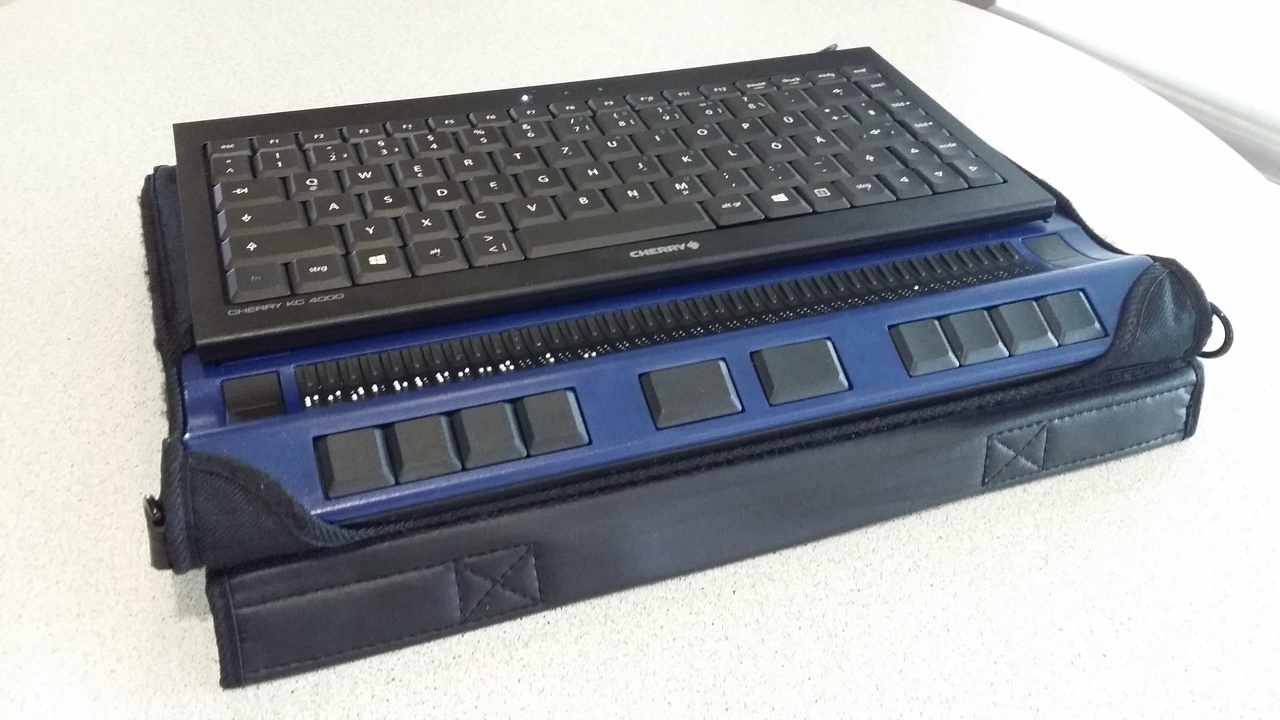
TL;DR: I put a $5 Raspberry Pi Zero, a Bluetooth USB dongle, and the required adapter cable into my new Handy Tech Active Star 40 braille display. An internal USB port provides the power. This has transformed my braille display into an ARM-based, monitorless, Linux laptop that has a keyboard and a braille display. It can be charged/powered via USB so it can also be run from a power bank or a solar charger, thus potentially being able to run for days, rather than just hours, without needing a standard wall-jack. [picture: a Raspberry Pi Zero embedded within an Active Star 40] [picture: a braille display with a keyboard on top and a Raspberry Pi Zero inside]
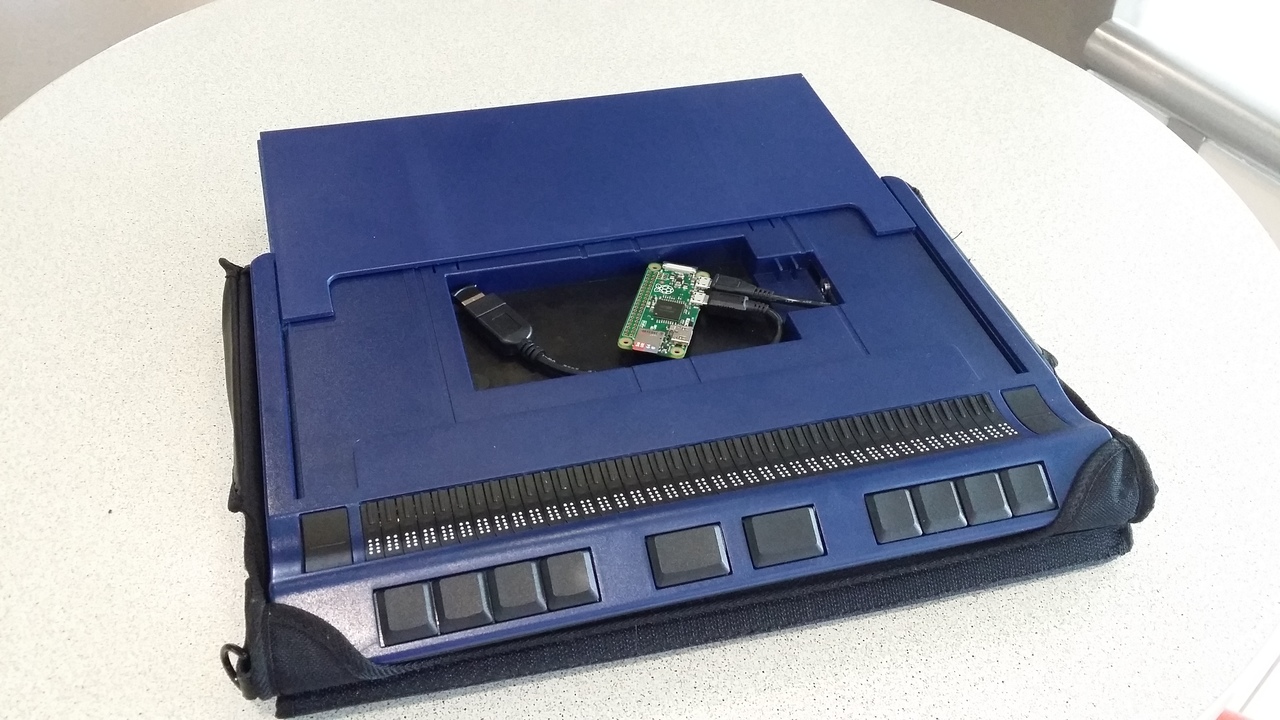
Some Background on Braille Display Form Factors Braille displays come in various sizes. There are models tailored for desktop use (with 60 cells or more), models tailored for portable use with a laptop (usually with 40 cells), and, nowadays, there are even models tailored for on-the-go use with a smartphone or similar (with something like 14 or 18 cells). Back in the old days, braille displays were rather massive. A 40-cell braille display was typically about the size of a 13" laptop. In modern times, manufacturers have managed to reduce the size of the internals such that a 40-cell display can be placed in front of a laptop or keyboard instead of placing the laptop on top of the braille display. While this is a nice achievement, I personally haven't found it to be very convenient because you now have to place two physically separate devices on your lap. It's OK if you have a real desk, but, at least in my opinion, if you try to use your laptop as its name suggests, it's actually inconvenient to use a small form factor, 40-cell display. For this reason, I've been waiting for a long-promised new model in the Handy Tech Star series. In 2002, they released the Handy Tech Braille Star 40, which is a 40-cell braille display with enough space to put a laptop directly on top of it. To accommodate larger laptop models, they even built in a little platform at the back that can be pulled out to effectively enlarge the top surface. Handy Tech has now released a new model, the Active Star 40, that has essentially the same layout but modernized internals. [picture: a plain Active Star 40] You can still pull out the little platform to increase the space that can be used to put something on top. [picture: an Active Star 40 with extended platform and a laptop on top] But, most conveniently, they've designed in an empty compartment, roughly the size of a modern smartphone, beneath the platform. The original idea was to actually put a smartphone inside, but this has turned out (at least to me) to not be very feasible. Fortunately, they thought about the need for electricity and added a Micro USB cable terminating within the newly created, empty compartment. My first idea was to put a conventional Raspberry Pi inside. When I received the braille display, however, we immediately noticed that a standard-sized rpi is roughly 3mm too high to fit into the empty compartment. Fortunately, though, a co-worker noticed that the Raspberry Pi Zero was available for order. The Raspberry Pi Zero is a lot thinner, and fits perfectly inside (actually, I think there's enough space for two, or even three, of them). So we ordered one, along with some accessories like a 64GB SDHC card, a Bluetooth dongle, and a Micro USB adapter cable. The hardware arrived a few days later, and was immediately bootstrapped with the assistance of very helpful friends. It works like a charm!
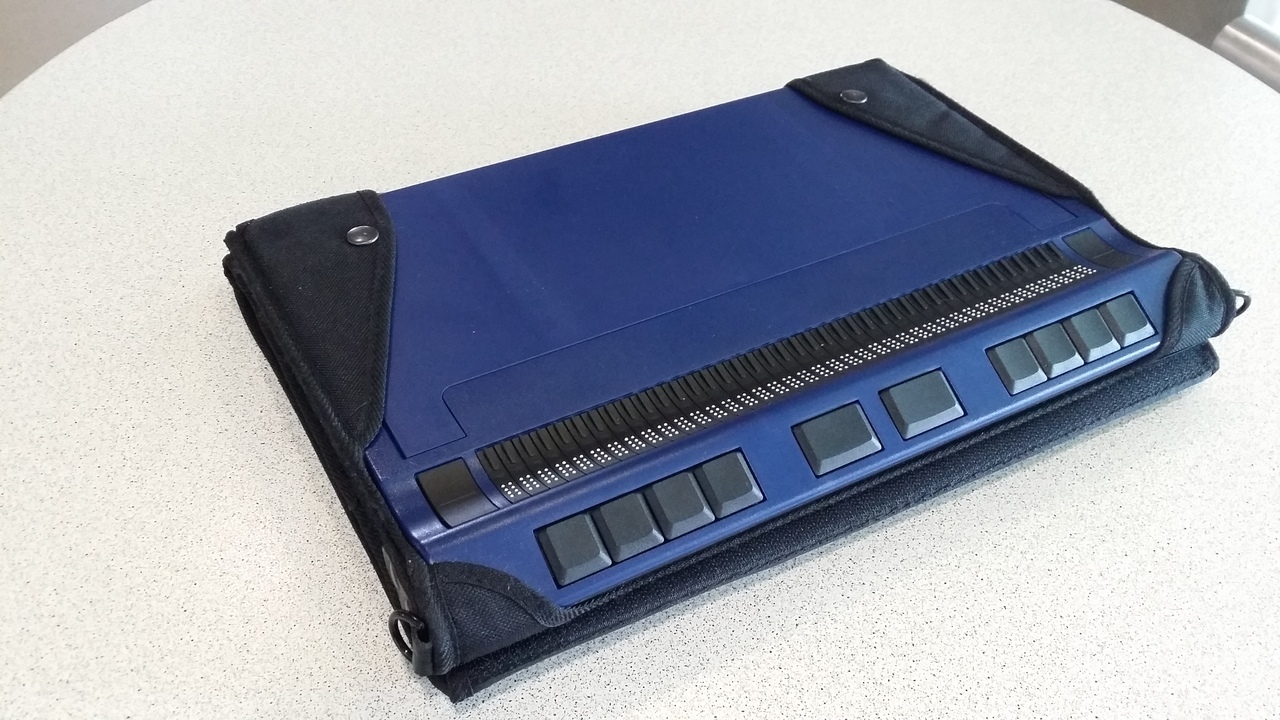

Technical Details The backside of the Handy Tech Active Star 40 features two USB host ports that can be used to connect devices such as a keyboard. A small form-factor, USB keyboard with a magnetic clip-on is included. When a USB keyboard is connected, and when the display is used via Bluetooth, the braille display firmware additionally offers the Bluetooth HID profile, and key press/release events received via the USB port are passed through to it. I use the Bluetooth dongle for all my communication needs. Most importantly, BRLTTY is used as a console screen reader. It talks to the braille display via Bluetooth (more precisely, via an RFCOMM channel). The keyboard connects through to Linux via the Bluetooth HID profile. Now, all that is left is network connectivity. To keep the energy consumption as low as possible, I decided to go for Bluetooth PAN. It appears that the tethering mode of my mobile phone works (albeit with a quirk), so I can actually access the internet as long as I have cell phone reception. Additionally, I configured a Bluetooth PAN access point on my desktop machines at home and at work, so I can easily (and somewhat more reliably) get IP connectivity for the rpi when I'm near one of these machines. I plan to configure a classic Raspberry Pi as a mobile Bluetooth access point. It would essentially function as a Bluetooth to ethernet adapter, and should allow me to have network connectivity in places where I don't want to use my phone.
BlueZ 5 and PAN It was a bit challenging to figure out how to actually configure Bluetooth PAN with BlueZ 5. I found the bt-pan python script (see below) to be the only way so far to configure PAN without a GUI. It handles both ends of a PAN network, configuring a server and a client. Once instructed to do so (via D-Bus) in client mode, BlueZ will create a new network device - bnep0 - once a connection to a server has been established. Typically, DHCP is used to assign IP addresses for these interfaces. In server mode, BlueZ needs to know the name of a bridge device to which it can add a slave device for each incoming client connection. Configuring an address for the bridge device, as well as running a DHCP server + IP Masquerading on the bridge, is usually all you need to do.
A Bluetooth PAN Access Point with Systemd I'm using systemd-networkd to configure the bridge device. /etc/systemd/network/pan.netdev:
[NetDev]
Name=pan
Kind=bridge
ForwardDelaySec=0
/etc/systemd/network/pan.network:
[Match]
Name=pan
[Network]
Address=0.0.0.0/24
DHCPServer=yes
IPMasquerade=yes
Now, BlueZ needs to be told to configure a NAP profile. To my surprise, there seems to be no way to do this with stock BlueZ 5.36 utilities. Please correct me if I'm wrong. Luckily, I found a very nice blog post, as well as an accommodating Python script that performs the required D-Bus calls. For convenience, I use a Systemd service to invoke the script and to ensure that its dependencies are met. /etc/systemd/system/pan.service:
[Unit]
Description=Bluetooth Personal Area Network
After=bluetooth.service systemd-networkd.service
Requires=systemd-networkd.service
PartOf=bluetooth.service
[Service]
Type=notify
ExecStart=/usr/local/sbin/pan
[Install]
WantedBy=bluetooth.target
/usr/local/sbin/pan:
#!/bin/sh
# Ugly hack to work around #787480
iptables -F
iptables -t nat -F
iptables -t mangle -F
iptables -t nat -A POSTROUTING -o eth0 -j MASQUERADE
exec /usr/local/sbin/bt-pan --systemd --debug server pan
This last file wouldn't be necessary if IPMasquerade= were supported in Debian right now (see #787480). After the obligatory systemctl daemon-reload and systemctl restart systemd-networkd, you can start your Bluetooth Personal Area Network with systemctl start pan.
Bluetooth PAN Client with Systemd Configuring the client is also quite easy to do with Systemd. /etc/systemd/network/pan-client.network:
[Match]
Name=bnep*
[Network]
DHCP=yes
/etc/systemd/system/pan@.service:
[Unit]
Description=Bluetooth Personal Area Network client
[Service]
Type=notify
ExecStart=/usr/local/sbin/bt-pan --debug --systemd client %I --wait
Now, after the usual configuration reloading, you should be able to connect to a specific Bluetooth access point with:
systemctl start pan@00:11:22:33:44:55
Pairing via the Command Line Of course, the server and client-side service configuration require a pre-existing pairing between the server and each of its clients. On the server, start bluetoothctl and issue the following commands:
power on
agent on
default-agent
scan on
scan off
pair XX:XX:XX:XX:XX:XX
trust XX:XX:XX:XX:XX:XX
Once you've set scan mode to on, wait a few seconds until you see the device you're looking for scroll by. Note its device address, and use it for the pair and (optional) trust commands. On the client, the sequence is essentially the same except that you don't need to issue the trust command. The server needs to trust a client in order to accept NAP profile connections from it without waiting for manual confirmation by the user. I'm actually not sure if this is the optimal sequence of commands. It might be enough to just pair the client with the server and issue the trust command on the server, but I haven't tried this yet.
Enabling Use of the Bluetooth HID Profile Essentially the same as above also needs to be done in order to use the Bluetooth HID profile of the Active Star 40 on Linux. However, instead of agent on, you need to issue the command agent KeyboardOnly. This explicitly tells bluetoothctl that you're specifically looking for a HID profile.
Configuring Bluetooth via the Command Line Feels Vague While I'm very happy that I actually managed to set all of this up, I must admit that the command-line interface to BlueZ feels a bit incomplete and confusing. I initially thought that agents were only for PIN code entry. Now that I've discovered that "agent KeyboardOnly" is used to enable the HID profile, I'm not sure anymore. I'm surprised that I needed to grab a script from a random git repository in order to be able to set up PAN. I remember, with earlier version of BlueZ, that there was a tool called pand that you could use to do all of this from the command-line. I don't seem to see anything like that for BlueZ 5 anymore. Maybe I'm missing something obvious?
Performance The data rate is roughly 120kB/s, which I consider acceptable for such a low power solution. The 1GHz ARM CPU actually feels sufficiently fast for a console/text-mode person like me. I'll rarely be using much more than ssh and emacs on it anyway.
Console fonts and screen dimensions The default dimensions of the framebuffer on the Raspberry Pi Zero are a bit unexpectedly strange. fbset reports that the screen dimension is 656x416 pixels (of course, no monitor connected). With a typical console font of 8x16, I got 82 columns and 26 lines. With a 40 cell braille display, the 82 columns are very inconvenient. Additionally, as a braille user, I would like to be able to view Unicode braille characters in addition to the normal charset on the console. Fortunately, Linux supports 512 glyphs, while most console fonts do only provide 256. console-setup can load and combine two 256-glyph fonts at once. So I added the following to /etc/default/console-setup to make the text console a lot more friendly to braille users:
SCREEN_WIDTH=80
SCREEN_HEIGHT=25
FONT="Lat15-Terminus16.psf.gz brl-16x8.psf"

Note

You need console-braille installed for brl-16x8.psf to be available.

Further Projects There's a 3.5mm audio jack inside the braille display as well. Unfortunately, there are no converters from Mini-HDMI to 3.5mm audio that I know of. It would be very nice to be able to use the sound card that is already built into the Raspberry Pi Zero, but, unfortunately, this doesn't seem possible at the moment. Alternatively, I'm looking at using a Micro USB OTG hub and an additional USB audio adapter to get sound from the Raspberry Pi Zero to the braille display's speakers. Unfortunately, the two USB audio adapters I've tried so far have run hot for some unknown reason. So I have to find some other chipset to see if the problem goes away. A little nuisance, currently, is that you need to manually power off the Raspberry, wait a few seconds, and then power down the braille display. Turning the braille display off cuts power delivery via the internal USB port. If this is accidentally done too soon then the Raspberry Pi Zero is shut down ungracefully (which is probably not the best way to do it). We're looking into connecting a small, buffering battery to the GPIO pins of the rpi, and into notifying the rpi when external power has dropped. A graceful, software-initiated shutdown can then be performed. You can think of it as being like a mini UPS for Micro USB.
The image If you are a happy owner of a Handy Tech Active Star 40 and would like to do something similar, I am happy to share my current (Raspbian Stretch based) image. In fact, if there is enough interest by other blind users, we might even consider putting a kit together that makes it as easy as possible for you to get started. Let me know if this could be of interest to you.
Thanks Thanks to Dave Mielke for reviewing the text of this posting. Thanks to Simon Kainz for making the photos for this article. And I owe a big thank you to my co-workers at Graz University of Technology who have helped me a lot to bootstrap really quickly into the rpi world.
P.S. My first tweet about this topic is just five days ago, and apart from the soundcard not working yet, I feel like the project is already almost complete! By the way, I am editing the final version of this blog posting from my newly created monitorless ARM-based Linux laptop via an ssh connection to my home machine.

3 June 2016

Reproducible builds folks: Reprotest repository exists and installs

Author: ceridwen I had family obligations for most of the past week, so I haven't had a chance to do more than get started on reprotest. The repository now contains a version of reprotest that can be installed with pip/setuptools (run python setup.py install in the repository directory or pip reprotest/ from its parent directory) or with debhelper (run debuild -b -uc -us in the repository, then install the resulting .deb). I've tested this works by installing into a virtualenv and onto my own system, but if anyone else wants to verify this, that would be great. At the moment, reprotest doesn't do anything, mind. I ended up importing significant amounts of code from autopkgtest into reprotest. While I may change my opinion as I read the code further, my first analysis is that much of the code responsible for processing command line arguments and config files (in lib/ and runner/) and building and communicating with the environments/virtual servers (in runner/, tools/, and virt-subproc/) can be adapted for reprotest. Once I have the chance to begin implementing functionality, I intend to discuss this in more detail.

19 May 2016

Antoine Beaupr : My free software activities, May 2016

Debian Long Term Support (LTS) This is my 6th month working on Debian LTS, started by Raphael Hertzog at Freexian. This is my largest month so far, for which I had requested 20 hours of work.

Xen work I spent the largest amount of time working on the Xen packages. We had to re-roll the patches because it turned out we originally just imported the package from Ubuntu as-is. This was a mistake because that package forked off the Debian packaging a while ago and included regressions in the packaging itself, not just security fixes. So I went ahead and rerolled the whole patchset and tested it on Koumbit's test server. Brian May then completed the uploaded, which included about 40 new patches, mostly from Ubuntu.

Frontdesk duties Next up was the frontdesk duties I had taken this week. This was mostly uneventful, although I had forgotten how to do some of the work and thus ended up doing extensive work on the contributor's documentation. This is especially important since new contributors joined the team! I also did a lot of Debian documentation work in my non-sponsored work below. The triage work involved chasing around missing DLAs, triaging away OpenJDK-6 (for which, let me remind you, security support has ended in LTS), raised the question of Mediawiki maintenance.

Other LTS work I also did a bunch of smaller stuff. Of importance, I can note that I uploaded two advisories that were pending from April: NSS and phpMyAdmin. I also reviewed the patches for the ICU update, since I built the one for squeeze (but didn't have time to upload before squeeze hit end-of-life). I have tried to contribute to the NTP security support but that was way too confusing to me, and I have left it to the package maintainer which seemed to be on top of things, even if things mean complete chaos and confusion in the world of NTP. I somehow thought that situation had improved with the recent investments in ntpsec and ntimed, but unfortunately Debian has not switched to the ntpsec codebase, so it seems that the NTP efforts have diverged in three different projects instead of closing into a single, better codebase.

Future LTS work This is likely to be my last month of work on LTS until September. I will try to contribute a few hours in June, but July and August will be very busy for me outside of Debian, so it's unlikely that I contribute much to the project during the summer. My backlog included those packages which might be of interest to other LTS contributors:
  • libxml2: no upstream fix, but needs fixing!
  • tiff ,3 : same mess
  • libgd2: maintainer contacted
  • samba regression: mailed bug #821811 to try to revive the effort
  • policykit-1: to be investigated
  • p7zip: same

Other free software work

Debian documentation I wrote an detailed short guide to Debian package development, something I felt was missing from the existing corpus, which seems to be too focus in covering all alternatives. My guide is opinionated: I believe there is a right and wrong way of doing things, or at least, there are best practices, especially when just patching packages. I ended up retroactively publishing that as a blog post - now I can simply tag an item with blog and it shows up in the blog. (Of course, because of a mis-configuration on my side, I have suffered from long delays publishing to Debian planet, so all the posts dates are off in the Planet RSS feed. This will hopefully be resolved around the time this post is published, but this allowed me to get more familiar with the Planet Venus software, as detailed in that other article.) Apart from the guide, I have also done extensive research to collate information that allowed me to create workflow graphs of the various Debian repositories, which I have published in the Debian Release section of the Debian wiki. Here is the graph: It helps me understand how packages flow between different suites and who uploads what where. This emerged after I realized I didn't really understand how "proposed updates" worked. Since we are looking at implementing a similar process for the security queue, I figured it was useful to show what changes would happen, graphically. I have also published a graph that describes the relations between different software that make up the Debian archive. The idea behind this is also to provide an overview of what happens when you upload a package in the Debian archive, but it is more aimed at Debian developers trying to figure out why things are not working as expected. The graphs were done with Graphviz, which allowed me to link to various components in the graph easily, which is neat. I also prefered Graphviz over Dia or other tools because it is easier to version and I don't have to bother (too much) about the layout and tweaking the looks. The downside is, of course, that when Graphviz makes the wrong decision, it's actually pretty hard to make it do the right thing, but there are various workarounds that I have found that made the graphs look pretty good. The source is of course available in git but I feel all this documentation (including the guide) should go in a more official document somewhere. I couldn't quite figure out where. Advice on this would be of course welcome.

Ikiwiki I have made yet another plugin for Ikiwiki, called irker, which enables wikis to send notifications to IRC channels, thanks to the simple irker bot. I had trouble with Irker in the past, since it was not quite reliable: it would disappear from channels and not return when we'd send it a notification. Unfortunately, the alternative, the KGB bot is much heavier: each repository needs a server-side, centralized configuration to operate properly. Irker's design is simpler and more adapted to a simple plugin like this. Let's hope it will work reliably enough for my needs. I have also suggested improvements to the footnotes styles, since they looked like hell in my Debian guide. It turns out this was an issue with the multimarkdown plugin that doesn't use proper semantic markup to identify footnotes. The proper fix is to enable footnotes in the default Discount plugin, which will require another, separate patch. Finally, I have done some improvements (I hope!) on the layout of this theme. I made the top header much lighter and transparent to work around an issue where followed anchors would be hidden under the top header. I have also removed the top menu made out of the sidebar plugin because it was cluttering the display too much. Those links are all on the frontpage anyways and I suspect people were not using them so much. The code is, as before, available in this git repository although you may want to start from the new ikistrap theme that is based on Bootstrap 4 and that may eventually be merged in ikiwiki directly.

DNS diagnostics Through this interesting overview of various *ping tools, I got found out about the dnsdiag tool which currently allows users to do DNS traces, tampering detection and ping over DNS. In the hope of packaging it into Debian, I have requested clarifications regarding a modification to the DNSpython library the tool uses. But I went even further and boldly opened a discussion about replacing DNSstuff, the venerable DNS diagnostic tools that is now commercial. It is somewhat surprising that there is no software that has even been publicly released that does those sanity checks for DNS, given how old DNS is. Incidentally, I have also requested smtpping to be packaged in Debian as well but httping is already packaged.

Link checking In the process of writing this article, I suddenly remembered that I constantly make mistakes in the various links I post on my site. So I started looking at a link checker, another tool that should be well established but that, surprisingly, is not quite there yet. I have found this neat software written in Python called LinkChecker. Unfortunately, it is basically broken in Debian, so I had to do a non-maintainer upload to fix that old bug. I managed to force myself to not take over maintainership of this orphaned package but I may end up doing just that if no one steps up the next time I find issues in the package. One of the problems I had checking links in my blog is that I constantly refer to sites that are hostile to bots, like the Debian bugtracker and MoinMoin wikis. So I published a patch that adds a --no-robots flag to be able to crawl those sites effectively. I know there is the W3C tool but it's written in Perl, and there's probably zero chance for me to convince those guys to bypass robots exclusion rules, so I am sticking to Linkchecker.

Other Debian packaging work At my request, Drush has finally been removed from Debian. Hopefully someone else will pick up that work, but since it basically needs to be redone from scratch, there was no sense in keeping it in the next release of Debian. Similarly, Semanticscuttle was removed from Debian as well. I have uploaded new versions of tuptime, sopel and smokeping. I have also file a Request For Help for Smokeping. I am happy to report there was a quick response and people will be stepping up to help with the maintenance of that venerable monitoring software.

Background radiation Finally, here's the generic background noise of me running around like a chicken with his head cut off: Finally, I should mention that I will be less active in the coming months, as I will be heading outside as the summer finally came! I somewhat feel uncomfortable documenting publicly my summer here, as I am more protective of my privacy than I was before on this blog. But we'll see how it goes, maybe you'll hear non-technical articles here again soon!

12 May 2016

Antoine Beaupr : Notmuch, offlineimap and Sieve setup

I've been using Notmuch since about 2011, switching away from Mutt to deal with the monstrous amount of emails I was, and still am dealing with on the computer. I have contributed a few patches and configs on the Notmuch mailing list, but basically, I have given up on merging patches, and instead have a custom config in Emacs that extend it the way I want. In the last 5 years, Notmuch has progressed significantly, so I haven't found the need to patch it or make sweeping changes.

The huge INBOX of death The one thing that is problematic with my use of Notmuch is that I end up with a ridiculously large INBOX folder. Before the cleanup I did this morning, I had over 10k emails in there, out of about 200k emails overall. Since I mostly work from my laptop these days, the Notmuch tags are only on the laptop, and not propagated to the server. This makes accessing the mail spool directly, from webmail or simply through a local client (say Mutt) on the server, really inconvenient, because it has to load a very large spool of mail, which is very slow in Mutt. Even worse, a bunch of mail that was archived in Notmuch shows up in the spool because it's just removed tags in Notmuch: the mails are still in the inbox, even though they are marked as read. So I was hoping that Notmuch would help me deal with the giant inbox of death problem, but in fact, when I don't use Notmuch, it actually makes the problem worse. Today, I did a bunch of improvements to my setup to fix that. The first thing I did was to kill procmail, which I was surprised to discover has been dead for over a decade. I switched over to Sieve for filtering, having already switched to Dovecot a while back on the server. I tried to use the procmail2sieve.pl conversion tool but it didn't work very well, so I basically rewrote the whole file. Since I was mostly using Notmuch for filtering, there wasn't much left to convert.

Sieve filtering But this is where things got interesting: Sieve is so simpler to use and more intuitive that I started doing more interesting stuff in bridging the filtering system (Sieve) with the tagging system (Notmuch). Basically, I use Sieve to split large chunks of emails off my main inbox, to try to remove as much spam, bulk email, notifications and mailing lists as possible from the larger flow of emails. Then Notmuch comes in and does some fine-tuning, assigning tags to specific mailing lists or topics, and being generally the awesome search engine that I use on a daily basis.

Dovecot and Postfix configs For all of this to work, I had to tweak my mail servers to talk sieve. First, I enabled sieve in Dovecot:
--- a/dovecot/conf.d/15-lda.conf
+++ b/dovecot/conf.d/15-lda.conf
@@ -44,5 +44,5 @@
 protocol lda  
   # Space separated list of plugins to load (default is global mail_plugins).
-  #mail_plugins = $mail_plugins
+  mail_plugins = $mail_plugins sieve
  
Then I had to switch from procmail to dovecot for local delivery, that was easy, in Postfix's perennial main.cf:
#mailbox_command = /usr/bin/procmail -a "$EXTENSION"
mailbox_command = /usr/lib/dovecot/dovecot-lda -a "$RECIPIENT"
Note that dovecot takes the full recipient as an argument, not just the extension. That's normal. It's clever, it knows that kind of stuff. One last tweak I did was to enable automatic mailbox creation and subscription, so that the automatic extension filtering (below) can create mailboxes on the fly:
--- a/dovecot/conf.d/15-lda.conf
+++ b/dovecot/conf.d/15-lda.conf
@@ -37,10 +37,10 @@
 #lda_original_recipient_header =
 # Should saving a mail to a nonexistent mailbox automatically create it?
-#lda_mailbox_autocreate = no
+lda_mailbox_autocreate = yes
 # Should automatically created mailboxes be also automatically subscribed?
-#lda_mailbox_autosubscribe = no
+lda_mailbox_autosubscribe = yes
 protocol lda  
   # Space separated list of plugins to load (default is global mail_plugins).

Sieve rules Then I had to create a Sieve ruleset. That thing lives in ~/.dovecot.sieve, since I'm running Dovecot. Your provider may accept an arbitrary ruleset like this, or you may need to go through a web interface, or who knows. I'm assuming you're running Dovecot and have a shell from now on. The first part of the file is simply to enable a bunch of extensions, as needed:
# Sieve Filters
# http://wiki.dovecot.org/Pigeonhole/Sieve/Examples
# https://tools.ietf.org/html/rfc5228
require "fileinto";
require "envelope";
require "variables";
require "subaddress";
require "regex";
require "vacation";
require "vnd.dovecot.debug";
Some of those are not used yet, for example I haven't tested the vacation module yet, but I have good hopes that I can use it as a way to announce a special "urgent" mailbox while I'm traveling. The rationale is to have a distinct mailbox for urgent messages that is announced in the autoreply, that hopefully won't be parsable by bots.

Spam filtering Then I filter spam using this fairly standard expression:
########################################################################
# spam 
# possible improvement, server-side:
# http://wiki.dovecot.org/Pigeonhole/Sieve/Examples#Filtering_using_the_spamtest_and_virustest_extensions
if header :contains "X-Spam-Flag" "YES"  
  fileinto "junk";
  stop;
  elsif header :contains "X-Spam-Level" "***"  
  fileinto "greyspam";
  stop;
 
This puts stuff into the junk or greyspam folder, based on the severity. I am very aggressive with spam: stuff often ends up in the greyspam folder, which I need to check from time to time, but it beats having too much spam in my inbox.

Mailing lists Mailing lists are generally put into a lists folder, with some mailing lists getting their own folder:
########################################################################
# lists
# converted from procmail
if header :contains "subject" "FreshPorts"  
    fileinto "freshports";
  elsif header :contains "List-Id" "alternc.org"  
    fileinto "alternc";
  elsif header :contains "List-Id" "koumbit.org"  
    fileinto "koumbit";
  elsif header :contains ["to", "cc"] ["lists.debian.org",
                                       "anarcat@debian.org"]  
    fileinto "debian";
# Debian BTS
  elsif exists "X-Debian-PR-Message"  
    fileinto "debian";
# default lists fallback
  elsif exists "List-Id"  
    fileinto "lists";
 
The idea here is that I can safely subscribe to lists without polluting my mailbox by default. Further processing is done in Notmuch.

Extension matching I also use the magic +extension tag on emails. If you send email to, say, foo+extension@example.com then the emails end up in the foo folder. This is done with the help of the following recipe:
########################################################################
# wildcard +extension
# http://wiki.dovecot.org/Pigeonhole/Sieve/Examples#Plus_Addressed_mail_filtering
if envelope :matches :detail "to" "*"  
  # Save name in $ name  in all lowercase except for the first letter.
  # Joe, joe, jOe thus all become 'Joe'.
  set :lower "name" "$ 1 ";
  fileinto "$ name ";
  #debug_log "filed into mailbox $ name  because of extension";
  stop;
 
This is actually very effective: any time I register to a service, I try as much as possible to add a +extension that describe the service. Of course, spammers and marketers (it's the same really) are free to drop the extension and I suspect a lot of them do, but it helps with honest providers and this actually sorts a lot of stuff out of my inbox into topically-defined folders. It is also a security issue: someone could flood my filesystem with tons of mail folders, which would cripple the IMAP server and eat all the inodes, 4 times faster than just sending emails. But I guess I'll cross that bridge when I get there: anyone can flood my address and I have other mechanisms to deal with this. The trick is to then assign tags to all folders so that they appear in the Notmuch-emacs welcome view:
echo tagging folders
for folder in $(ls -ad $HOME/Maildir/$ PREFIX */   egrep -v "Maildir/$ PREFIX (feeds.* Sent.* INBOX/ INBOX/Sent)\$"); do
    tag=$(echo $folder   sed 's#/$##;s#^.*/##')
    notmuch tag +$tag -inbox tag:inbox and not tag:$tag and folder:$ PREFIX $tag
done
This is part of my notmuch-tag script that includes a lot more fine-tuned filtering, detailed below.

Automated reports filtering Another thing I get a lot of is machine-generated "spam". Well, it's not commercial spam, but it's a bunch of Nagios, cron jobs, and god knows what software thinks it's important to send me emails every day. I get a lot less of those these days since I'm off work at Koumbit, but still, those can be useful for others as well:
if anyof (exists "X-Cron-Env",
          header :contains ["subject"] ["security run output",
                                        "monthly run output",
                                        "daily run output",
                                        "weekly run output",
                                        "Debian Package Updates",
                                        "Debian package update",
                                        "daily mail stats",
                                        "Anacron job",
                                        "nagios",
                                        "changes report",
                                        "run output",
                                        "[Systraq]",
                                        "Undelivered mail",
                                        "Postfix SMTP server: errors from",
                                        "backupninja",
                                        "DenyHosts report",
                                        "Debian security status",
                                        "apt-listchanges"
                                        ],
           header :contains "Auto-Submitted" "auto-generated",
           envelope :contains "from" ["nagios@",
                                      "logcheck@"])
     
    fileinto "rapports";
 
# imported from procmail
elsif header :comparator "i;octet" :contains "Subject" "Cron"  
  if header :regex :comparator "i;octet"  "From" ".*root@"  
        fileinto "rapports";
   
 
elsif header :comparator "i;octet" :contains "To" "root@"  
  if header :regex :comparator "i;octet"  "Subject" "\\*\\*\\* SECURITY"  
        fileinto "rapports";
   
 
elsif header :contains "Precedence" "bulk"  
    fileinto "bulk";
 

Refiltering emails Of course, after all this I still had thousands of emails in my inbox, because the sieve filters apply only on new emails. The beauty of Sieve support in Dovecot is that there is a neat sieve-filter command that can reprocess an existing mailbox. That was a lifesaver. To run a specific sieve filter on a mailbox, I simply run:
sieve-filter .dovecot.sieve INBOX 2>&1   less
Well, this doesn't do anything. To really execute the filters, you need the -e flags, and to write to the INBOX for real, you need the -w flag as well, so the real run looks something more like this:
sieve-filter -e -W -v .dovecot.sieve INBOX > refilter.log 2>&1
The funky output redirects are necessary because this outputs a lot of crap. Also note that, unfortunately, the fake run output differs from the real run and is actually more verbose, which makes it really less useful than it could be.

Archival I also usually archive my mails every year, rotating my mailbox into an Archive.YYYY directory. For example, now all mails from 2015 are archived in a Archive.2015 directory. I used to do this with Mutt tagging and it was a little slow and error-prone. Now, i simply have this Sieve script:
require ["variables","date","fileinto","mailbox", "relational"];
# Extract date info
if currentdate :matches "year" "*"   set "year" "$ 1 ";  
if date :value "lt" :originalzone "date" "year" "$ year "  
  if date :matches "received" "year" "*"  
    # Archive Dovecot mailing list items by year and month.
    # Create folder when it does not exist.
    fileinto :create "Archive.$ 1 ";
   
 
I went from 15613 to 1040 emails in my real inbox with this process (including refiltering with the default filters as well).

Notmuch configuration My Notmuch configuration is a in three parts: I have small settings in ~/.notmuch-config. The gist of it is:
[new]
tags=unread;inbox;
ignore=
#[maildir]
# synchronize_flags=true
# tentative patch that was refused upstream
# http://mid.gmane.org/1310874973-28437-1-git-send-email-anarcat@koumbit.org
#reckless_trash=true
[search]
exclude_tags=deleted;spam;
I omitted the fairly trivial [user] section for privacy reasons and [database] for declutter. Then I have a notmuch-tag script symlinked into ~/Maildir/.notmuch/hooks/post-new. It does way too much stuff to describe in details here, but here are a few snippets:
if hostname   grep angela > /dev/null; then
    PREFIX=Anarcat/
else
    PREFIX=.
fi
This sets a variable that makes the script work on my laptop (angela), where mailboxes are in Maildir/Anarcat/foo or the server, where mailboxes are in Maildir/.foo. I also have special rules to tag my RSS feeds, which are generated by feed2imap, which is documented shortly below:
echo tagging feeds
( cd $HOME/Maildir/ && for feed in $ PREFIX feeds.*; do
    name=$(echo $feed   sed "s#$ PREFIX feeds\\.##")
    notmuch tag +feeds +$name -inbox folder:$feed and not tag:feeds
done )
Another example that would be useful is how to tag mailing lists, for example, this removes the inbox tag and adds the notmuch tags to emails from the notmuch mailing list.
notmuch tag +lists +notmuch      -inbox tag:inbox and "to:notmuch@notmuchmail.org"
Finally, I have a bunch of special keybindings in ~/.emacs.d/notmuch-config.el:
;; autocompletion
(eval-after-load "notmuch-address"
  '(progn
     (notmuch-address-message-insinuate)))
; use fortune for signature, config is in custom
(add-hook 'message-setup-hook 'fortune-to-signature)
; don't remember what that is
(add-hook 'notmuch-show-hook 'visual-line-mode)
;;;;;;;;;;;;;;;;;;;;;;;;;;;;;;;;;;;;;;;;;;;;;;;;;;;;;;;;;;;;;;;;;;;;;;;;
;;; keymappings
;;;;;;;;;;;;;;;;;;;;;;;;;;;;;;;;;;;;;;;;;;;;;;;;;;;;;;;;;;;;;;;;;;;;;;;;
(define-key notmuch-show-mode-map "S"
  (lambda ()
    "mark message as spam and advance"
    (interactive)
    (notmuch-show-tag '("+spam" "-unread"))
    (notmuch-show-next-open-message-or-pop)))
(define-key notmuch-search-mode-map "S"
  (lambda (&optional beg end)
    "mark message as spam and advance"
    (interactive (notmuch-search-interactive-region))
    (notmuch-search-tag (list "+spam" "-unread") beg end)
    (anarcat/notmuch-search-next-message)))
(define-key notmuch-show-mode-map "H"
  (lambda ()
    "mark message as spam and advance"
    (interactive)
    (notmuch-show-tag '("-spam"))
    (notmuch-show-next-open-message-or-pop)))
(define-key notmuch-search-mode-map "H"
  (lambda (&optional beg end)
    "mark message as spam and advance"
    (interactive (notmuch-search-interactive-region))
    (notmuch-search-tag (list "-spam") beg end)
    (anarcat/notmuch-search-next-message)))
(define-key notmuch-search-mode-map "l" 
  (lambda (&optional beg end)
    "undelete and advance"
    (interactive (notmuch-search-interactive-region))
    (notmuch-search-tag (list "-unread") beg end)
    (anarcat/notmuch-search-next-message)))
(define-key notmuch-search-mode-map "u"
  (lambda (&optional beg end)
    "undelete and advance"
    (interactive (notmuch-search-interactive-region))
    (notmuch-search-tag (list "-deleted") beg end)
    (anarcat/notmuch-search-next-message)))
(define-key notmuch-search-mode-map "d"
  (lambda (&optional beg end)
    "delete and advance"
    (interactive (notmuch-search-interactive-region))
    (notmuch-search-tag (list "+deleted" "-unread") beg end)
    (anarcat/notmuch-search-next-message)))
(define-key notmuch-show-mode-map "d"
  (lambda ()
    "delete current message and advance"
    (interactive)
    (notmuch-show-tag '("+deleted" "-unread"))
    (notmuch-show-next-open-message-or-pop)))
;; https://notmuchmail.org/emacstips/#index17h2
(define-key notmuch-show-mode-map "b"
  (lambda (&optional address)
    "Bounce the current message."
    (interactive "sBounce To: ")
    (notmuch-show-view-raw-message)
    (message-resend address)
    (kill-buffer)))
;;;;;;;;;;;;;;;;;;;;;;;;;;;;;;;;;;;;;;;;;;;;;;;;;;;;;;;;;;;;;;;;;;;;;;;;
;;; my custom notmuch functions
;;;;;;;;;;;;;;;;;;;;;;;;;;;;;;;;;;;;;;;;;;;;;;;;;;;;;;;;;;;;;;;;;;;;;;;;
(defun anarcat/notmuch-search-next-thread ()
  "Skip to next message from region or point
This is necessary because notmuch-search-next-thread just starts
from point, whereas it seems to me more logical to start from the
end of the region."
  ;; move line before the end of region if there is one
  (unless (= beg end)
    (goto-char (- end 1)))
  (notmuch-search-next-thread))
;; Linking to notmuch messages from org-mode
;; https://notmuchmail.org/emacstips/#index23h2
(require 'org-notmuch nil t)
(message "anarcat's custom notmuch config loaded")
This is way too long: in my opinion, a bunch of that stuff should be factored in upstream, but some features have been hard to get in. For example, Notmuch is really hesitant in marking emails as deleted. The community is also very strict about having unit tests for everything, which makes writing new patches a significant challenge for a newcomer, which will often need to be familiar with both Elisp and C. So for now I just have those configs that I carry around. Emails marked as deleted or spam are processed with the following script named notmuch-purge which I symlink to ~/Maildir/.notmuch/hooks/pre-new:
#!/bin/sh
if hostname   grep angela > /dev/null; then
    PREFIX=Anarcat/
else
    PREFIX=.
fi
echo moving tagged spam to the junk folder
notmuch search --output=files tag:spam \
        and not folder:$ PREFIX junk \
        and not folder:$ PREFIX greyspam \
        and not folder:Koumbit/INBOX \
        and not path:Koumbit/** \
      while read file; do
          mv "$file" "$HOME/Maildir/$ PREFIX junk/cur"
      done
echo unconditionnally deleting deleted mails
notmuch search --output=files tag:deleted   xargs -r rm
Oh, and there's also customization for Notmuch:
;; -*- mode: emacs-lisp; auto-recompile: t; -*-
(custom-set-variables
 ;; from https://anarc.at/sigs.fortune
 '(fortune-file "/home/anarcat/.mutt/sigs.fortune")
 '(message-send-hook (quote (notmuch-message-mark-replied)))
 '(notmuch-address-command "notmuch-address")
 '(notmuch-always-prompt-for-sender t)
 '(notmuch-crypto-process-mime t)
 '(notmuch-fcc-dirs
   (quote
    ((".*@koumbit.org" . "Koumbit/INBOX.Sent")
     (".*" . "Anarcat/Sent"))))
 '(notmuch-hello-tag-list-make-query "tag:unread")
 '(notmuch-message-headers (quote ("Subject" "To" "Cc" "Bcc" "Date" "Reply-To")))
 '(notmuch-saved-searches
   (quote
    ((:name "inbox" :query "tag:inbox and not tag:koumbit and not tag:rt")
     (:name "unread inbox" :query "tag:inbox and tag:unread")
     (:name "unread" :query "tag:unred")
     (:name "freshports" :query "tag:freshports and tag:unread")
     (:name "rapports" :query "tag:rapports and tag:unread")
     (:name "sent" :query "tag:sent")
     (:name "drafts" :query "tag:draft"))))
 '(notmuch-search-line-faces
   (quote
    (("deleted" :foreground "red")
     ("unread" :weight bold)
     ("flagged" :foreground "blue"))))/
 '(notmuch-search-oldest-first nil)
 '(notmuch-show-all-multipart/alternative-parts nil)
 '(notmuch-show-all-tags-list t)
 '(notmuch-show-insert-text/plain-hook
   (quote
    (notmuch-wash-convert-inline-patch-to-part notmuch-wash-tidy-citations notmuch-wash-elide-blank-lines notmuch-wash-excerpt-citations)))
 )
I think that covers it.

Offlineimap So of course the above works well on the server directly, but how do run Notmuch on a remote machine that doesn't have access to the mail spool directly? This is where OfflineIMAP comes in. It allows me to incrementally synchronize a local Maildir folder hierarchy with a a remote IMAP server. I am assuming you already have an IMAP server configured, since you already configured Sieve above. Note that other synchronization tools exist. The other popular one is isync but I had trouble migrating to it (see courriels for details) so for now I am sticking with OfflineIMAP. The configuration is fairly simple:
[general]
accounts = Anarcat
ui = Blinkenlights
maxsyncaccounts = 3
[Account Anarcat]
localrepository = LocalAnarcat
remoterepository = RemoteAnarcat
# refresh all mailboxes every 10 minutes
autorefresh = 10
# run notmuch after refresh
postsynchook = notmuch new
# sync only mailboxes that changed
quick = -1
## possible optimisation: ignore mails older than a year
#maxage = 365
# local mailbox location
[Repository LocalAnarcat]
type = Maildir
localfolders = ~/Maildir/Anarcat/
# remote IMAP server
[Repository RemoteAnarcat]
type = IMAP
remoteuser = anarcat
remotehost = anarc.at
ssl = yes
# without this, the cert is not verified (!)
sslcacertfile = /etc/ssl/certs/DST_Root_CA_X3.pem
# do not sync archives
folderfilter = lambda foldername: not re.search('(Sent\.20[01][0-9]\..*)', foldername) and not re.search('(Archive.*)', foldername)
# and only subscribed folders
subscribedonly = yes
# don't reconnect all the time
holdconnectionopen = yes
# get mails from INBOX immediately, doesn't trigger postsynchook
idlefolders = ['INBOX']
Critical parts are:
  • postsynchook: obviously, we want to run notmuch after fetching mail
  • idlefolders: receives emails immediately without waiting for the longer autorefresh delay, which means that most mailboxes don't see new emails until 10 minutes in the worst case. unfortunately, doesn't run the postsynchook so I need to hit G in Emacs to see new mail
  • quick=-1, subscribedonly, holdconnectionopen: makes most runs much, much faster as it skips unchanged or unsubscribed folders and keeps the connection to the server
The other settings should be self-explanatory.

RSS feeds I gave up on RSS readers, or more precisely, I merged RSS feeds and email. The first time I heard of this, it sounded like a horrible idea, because it means yet more emails! But with proper filtering, it's actually a really nice way to process emails, since it leverages the distributed nature of email. For this I use a fairly standard feed2imap, although I do not deliver to an IMAP server, but straight to a local Maildir. The configuration looks like this:
---
include-images: true
target-refix: &target "maildir:///home/anarcat/Maildir/.feeds."
feeds:
- name: Planet Debian
  url: http://planet.debian.org/rss20.xml
  target: [ *target, 'debian-planet' ]
I have obviously more feeds, the above is just and example. This will deliver the feeds as emails in one mailbox per feed, in ~/Maildir/.feeds.debian-planet, in the above example.

Troubleshooting You will fail at writing the sieve filters correctly, and mail will (hopefully?) fall through to your regular mailbox. Syslog will tell you things fail, as expected, and details are in your .dovecot.sieve.log file in your home directory. I also enabled debugging on the Sieve module
--- a/dovecot/conf.d/90-sieve.conf
+++ b/dovecot/conf.d/90-sieve.conf
@@ -51,6 +51,7 @@ plugin  
        # deprecated imapflags extension in addition to all extensions were already
   # enabled by default.
   #sieve_extensions = +notify +imapflags
+  sieve_extensions = +vnd.dovecot.debug
   # Which Sieve language extensions are ONLY available in global scripts. This
   # can be used to restrict the use of certain Sieve extensions to administrator
This allowed me to use debug_log function in the rulesets to output stuff directly to the logfile.

Further improvements Of course, this is all done on the commandline, but that is somewhat expected if you are already running Notmuch. Of course, it would be much easier to edit those filters through a GUI. Roundcube has a nice Sieve plugin, and Thunderbird also has such a plugin as well. Since Sieve is a standard, there's a bunch of clients available. All those need you to setup some sort of thing on the server, which I didn't bother doing yet. And of course, a key improvement would be to have Notmuch synchronize its state better with the mailboxes directly, instead of having the notmuch-purge hack above. Dovecot and Maildir formats support up to 26 flags, and there were discussions about using those flags to synchronize with notmuch tags so that multiple notmuch clients can see the same tags on different machines transparently. This, however, won't make Notmuch work on my phone or webmail or any other more generic client: for that, Sieve rules are still very useful. I still don't have webmail setup at all: so to read email, I need an actual client, which is currently my phone, which means I need to have Wifi access to read email. "Internet Caf s" or "this guy's computer" won't work as well, although I can always use ssh to login straight to the server and read mails with Mutt. I am also considering using X509 client certificates to authenticate to the mail server without a passphrase. This involves configuring Postfix, which seems simple enough. Dovecot's configuration seems a little more involved and less well documented. It seems that both [OfflimeIMAP][] and K-9 mail support client-side certs. OfflineIMAP prompts me for the password so it doesn't get leaked anywhere. I am a little concerned about building yet another CA, but I guess it would not be so hard... The server side of things needs more documenting, particularly the spam filters. This is currently spread around this wiki, mostly in configuration.

Security considerations The whole purpose of this was to make it easier to read my mail on other devices. This introduces a new vulnerability: someone may steal that device or compromise it to read my mail, impersonate me on different services and even get a shell on the remote server. Thanks to the two-factor authentication I setup on the server, I feel a little more confident that just getting the passphrase to the mail account isn't sufficient anymore in leveraging shell access. It also allows me to login with ssh on the server without trusting the machine too much, although that only goes so far... Of course, sudo is then out of the question and I must assume that everything I see is also seen by the attacker, which can also inject keystrokes and do all sorts of nasty things. Since I also connected my email account on my phone, someone could steal the phone and start impersonating me. The mitigation here is that there is a PIN for the screen lock, and the phone is encrypted. Encryption isn't so great when the passphrase is a PIN, but I'm working on having a better key that is required on reboot, and the phone shuts down after 5 failed attempts. This is documented in my phone setup. Client-side X509 certificates further mitigates those kind of compromises, as the X509 certificate won't give shell access. Basically, if the phone is lost, all hell breaks loose: I need to change the email password (or revoke the certificate), as I assume the account is about to be compromised. I do not trust Android security to give me protection indefinitely. In fact, one could argue that the phone is already compromised and putting the password there already enabled a possible state-sponsored attacker to hijack my email address. This is why I have an OpenPGP key on my laptop to authenticate myself for critical operations like code signatures. The risk of identity theft from the state is, after all, a tautology: the state is the primary owner of identities, some could say by definition. So if a state-sponsored attacker would like to masquerade as me, they could simply issue a passport under my name and join a OpenPGP key signing party, and we'd have other problems to deal with, namely, proper infiltration counter-measures and counter-snitching.

10 May 2016

Lars Wirzenius: Qvarn Platform announcement

In March we started a new company, to develop and support the software whose development I led at my previous job. The software is Qvarn, and it's fully free software, licensed under AGPL3+. The company is QvarnLabs (no website yet). Our plan is to earn a living from this, and our hope is to provide software that is actually useful for helping various organisations handle data securely. The first press release about Qvarn was sent out today. We're still setting up the company and getting operational, but a little publicity never hurts. (Even if it is more marketing-speak and self-promotion than I would normally put on my blog.) So this is what I do for a living now.

The development of the open source Qvarn Platform was led by QvarnLabs CEO Kaius H ggblom (left) and CTO Lars Wirzenius. Helsinki, Finland 10.05.2016 With Privacy by Design, integrated Gluu access management and comprehensive support for regulatory data compliance, Qvarn is set to become the Europe-wide platform of choice for managing workforce identities and providing associated value-added services. Construction industry federations in Sweden, Finland and the Baltic States have been using the Qvarn Platform (http://www.qvarn.org) since October 2015 to securely manage the professional digital identities of close to one million construction workers. Developed on behalf of these same federations, Qvarn is now free and open source software; making it a compelling solution for any organization that needs to manage a secure register of workers data. "There is something universal and fundamental at the core of the Qvarn platform. And that s trust," said Qvarn evangelist Kaius H ggblom. "We decided to make it free, open source and include Gluu access management because we wanted all those using Qvarn or contributing to its continued development to have the freedom to work with the platform in whatever way is best for them." Qvarn has been designed to meet the requirements of the European Union s new General Data Protection Regulation (GDPR), enabling organizations that use the platform to ensure their compliance with the new law. Qvarn has also incorporated the principles of Privacy by Design to minimize the disclosure of non-essential personal information and to give people more control over their data. "Today, Qvarn is used by the construction industry as a way to manage the data of employees, many of whom frequently move across borders. In this way the platform helps to combat the grey economy in the building sector, thereby improving quality and safety, while simultaneously protecting the professional identity data of almost a million individuals," said H ggblom. "Qvarn is so flexible and secure that we envision it becoming the preferred platform for the provision of any value-added services with an identity management component, eventually even supporting monetary transactions." Qvarn is a cloud based solution supported to run on both Amazon Web Services (AWS) and OpenStack. In partnership with Gluu, the platform delivers an out-of-the-box solution that uses open and standard protocols to provide powerful yet flexible identity and access management, including mechanisms for appropriate authentication and authorization. "Qvarn's identity management and governance capabilities perfectly compliment the Gluu Server's access management features," said Founder and CEO of Gluu, Michael Schwartz. "Free open source software (FOSS) is essential to the future of identity and access management. And the FOSS development methodology provides the transparency that is needed to foster the strong sense of community upon which a vibrant ecosystem thrives." Qvarn s development team continues to be led by recognized open source developer and platform architect Lars Wirzenius. He has been developing free and open source software for 30 years and is a renowned expert in the Linux environment, with a particular focus on the Debian distribution. Lars works at all levels of software development from writing code to designing system architecture. About the Qvarn Platform: The Qvarn Platform is free and open source software for managing workforce identities. Qvarn is integrated with the Gluu Server s access management features out of the box, using open and standard protocols to provide the platform with a single common digital identity and mechanisms for appropriate authentication and authorization. A cloud based solution, Qvarn is supported to run on both Amazon Web Services (AWS) and OpenStack. Privacy by Design is central to the architecture of Qvarn and the platform has been third party audited to a security level of HIGH. http://www.qvarn.org For more information, please contact:
Andrew Flowers
andrew.flowers@ellisnichol.com
+358 40 161 5668

Next.

Previous.