Matthew Garrett: Twitter's new encrypted DMs aren't better than the old ones
 (Edit: Twitter could improve this significantly with very few changes - I wrote about that here. It's unclear why they'd launch without doing that, since it entirely defeats the point of using HSMs)
When Twitter[1] launched encrypted DMs a couple
of years ago, it was the worst kind of end-to-end
encrypted - technically e2ee, but in a way that made it relatively easy for Twitter to inject new encryption keys and get everyone's messages anyway. It was also lacking a whole bunch of features such as "sending pictures", so the entire thing was largely a waste of time. But a couple of days ago, Elon announced the arrival of "XChat", a new encrypted message platform
built on Rust with (Bitcoin style) encryption, whole new architecture. Maybe this time they've got it right?
tl;dr - no. Use Signal. Twitter can probably obtain your private keys, and admit that they can MITM you and have full access to your metadata.
The new approach is pretty similar to the old one in that it's based on pretty straightforward and well tested cryptographic primitives, but merely using good cryptography doesn't mean you end up with a good solution. This time they've pivoted away from using the underlying cryptographic primitives directly and into higher level abstractions, which is probably a good thing. They're using Libsodium's boxes for message encryption, which is, well, fine? It doesn't offer forward secrecy (if someone's private key is leaked then all existing messages can be decrypted) so it's a long way from the state of the art for a messaging client (Signal's had forward secrecy for over a decade!), but it's not inherently broken or anything. It is, however, written in C, not Rust[2].
That's about the extent of the good news. Twitter's old implementation involved clients generating keypairs and pushing the public key to Twitter. Each client (a physical device or a browser instance) had its own private key, and messages were simply encrypted to every public key associated with an account. This meant that new devices couldn't decrypt old messages, and also meant there was a maximum number of supported devices and terrible scaling issues and it was pretty bad. The new approach generates a keypair and then stores the private key using the Juicebox protocol. Other devices can then retrieve the private key.
Doesn't this mean Twitter has the private key? Well, no. There's a PIN involved, and the PIN is used to generate an encryption key. The stored copy of the private key is encrypted with that key, so if you don't know the PIN you can't decrypt the key. So we brute force the PIN, right? Juicebox actually protects against that - before the backend will hand over the encrypted key, you have to prove knowledge of the PIN to it (this is done in a clever way that doesn't directly reveal the PIN to the backend). If you ask for the key too many times while providing the wrong PIN, access is locked down.
But this is true only if the Juicebox backend is trustworthy. If the backend is controlled by someone untrustworthy[3] then they're going to be able to obtain the encrypted key material (even if it's in an HSM, they can simply watch what comes out of the HSM when the user authenticates if there's no validation of the HSM's keys). And now all they need is the PIN. Turning the PIN into an encryption key is done using the Argon2id key derivation function, using 32 iterations and a memory cost of 16MB (the Juicebox white paper says 16KB, but (a) that's laughably small and (b) the code says 16 * 1024 in an argument that takes kilobytes), which makes it computationally and moderately memory expensive to generate the encryption key used to decrypt the private key. How expensive? Well, on my (not very fast) laptop, that takes less than 0.2 seconds. How many attempts to I need to crack the PIN? Twitter's chosen to fix that to 4 digits, so a maximum of 10,000. You aren't going to need many machines running in parallel to bring this down to a very small amount of time, at which point private keys can, to a first approximation, be extracted at will.
Juicebox attempts to defend against this by supporting sharding your key over multiple backends, and only requiring a subset of those to recover the original.
On the plus side, Juicebox is written in Rust, so Elon's not 100% wrong. Just mostly wrong.
But ok, at least you've got viable end-to-end encryption even if someone can put in some (not all that much, really) effort to obtain your private key and render it all pointless? Actually no, since you're still relying on the Twitter server to give you the public key of the other party and there's no out of band mechanism to do that or verify the authenticity of that public key at present. Twitter can simply give you a public key where they control the private key, decrypt the message, and then reencrypt it with the intended recipient's key and pass it on. The support page makes it clear that this is a known shortcoming and that it'll be fixed at some point, but they said that about the original encrypted DM support and it never was, so that's probably dependent on whether Elon gets distracted by something else again. And the server knows who and when you're messaging even if they haven't bothered to break your private key, so there's a lot of metadata leakage.
Signal doesn't have these shortcomings. Use Signal.
[1] I'll respect their name change once Elon respects his daughter
[2] There are implementations written in Rust, but Twitter's using the C one with these JNI bindings
[3] Or someone nominally trustworthy but who's been compelled to act against your interests - even if Elon were absolutely committed to protecting all his users, his overarching goals for Twitter require him to have legal presence in multiple jurisdictions that are not necessarily above placing employees in physical danger if there's a perception that they could obtain someone's encryption keys


 June that is.




 Debian 13 "Trixie"

 In this post, I demonstrate the optimal workflow for creating new Debian packages in 2025, preserving the upstream git history. The motivation for this is to lower the barrier for sharing improvements to and from upstream, and to improve software provenance and supply-chain security by making it easy to inspect every change at any level using standard git tooling.
Key elements of this workflow include:
 In this post, I demonstrate the optimal workflow for creating new Debian packages in 2025, preserving the upstream git history. The motivation for this is to lower the barrier for sharing improvements to and from upstream, and to improve software provenance and supply-chain security by making it easy to inspect every change at any level using standard git tooling.
Key elements of this workflow include:
 After cartridge pleating, the next fabric manipulation technique I
wanted to try was smocking, of the honeycombing variety, on a shirt.
My current go-to pattern for shirts is the
 In my stash I had a cut of purple-blue hopefully cotton [#cotton] I had
bought for a cheap price and used for my first attempt at an
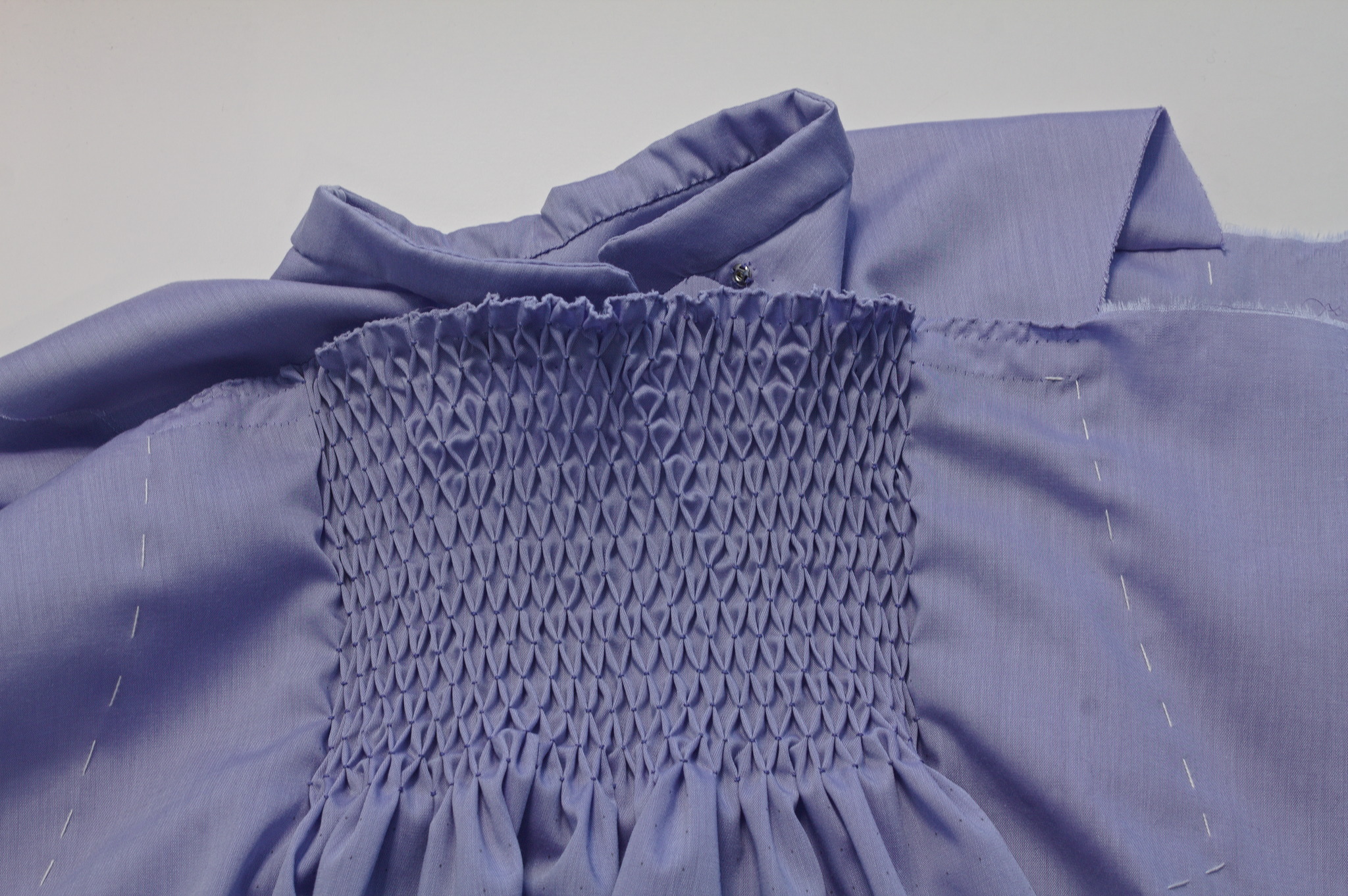 Of course I wanted some honeycombing on the front, but I was afraid that
the slit in the middle of it would interfere with the honeycombing and
gape, so I decided to have the shirt open in an horizontal line at the
yoke.
I added instructions
 I also used a row of honeycombing on the back and two on the upper part
of the sleeves, instead of the gathering, and of course some rows to
gather the cuffs.
The honeycombing on the back was a bit too far away from the edge, so
it s a bit of an odd combination of honeycombing and pleating that I
don t hate, but don t love either. It s on the back, so I don t mind. On
the sleeves I ve done the honeycombing closer to the edge and I ve
decided to sew the sleeve as if it was a cartridge pleated sleeve, and
that worked better.
Because circumstances are still making access to my sewing machine
more of a hassle than I d want it to be, this was completely sewn by
hand, and at a bit more than a month I have to admit that near the end
it felt like it had been taken forever. I m not sure whether it was the
actual sewing being slow, some interruptions that happened when I had
little time to work on it, or the fact that I ve just gone through a
time when my brain kept throwing new projects at me, and I kept thinking
of how to make those. Thanks brain.
Even when on a hurry to finish it, however, it was still enjoyable
sewing, and I think I ll want to do more honeycombing in the future.
 Anyway, it s done! And it s going straight into my daily garment
rotation, because the weather is getting hot, and that means it s
definitely shirt time.
 For a while, the strongSwan Debian package had an autopktest.
The initial version was proposed by Christian Ehrhardt in 2016
(presumably especially for downstream use in Ubuntu) and updated in
2019, but since then not much at least in Debian.
With the metapackage dependencies update in 6.0.0-1 I had to
tune a bit the tests dependencies so they wouldn't totally fail,
and I noticed the amd64 tests were failing since basically the
beginning (the other architectures would pass, but because the
tests wouldn't actually run at all since they rely on the
 A popular topic of public conversation in 2025 is balance. How do we balance budgets, how do we balance entities, and how do we balance perspectives? How do we balance the right of free expression with our ability to effectively convey a message?Here s another popular topic of conversation AI. What is it? What does it do?I m going to give you some resources, as someone who first learned the inner workings of AI about ten years ago.I ll start with the presentation I gave in middle school. Our objective was to give a presentation on a topic of our choice, and we would be graded on our ability to give a presentation. Instead of talking about specific things or events, I talked about the broader idea of fully establishing an artificial form of intelligence.This is the video I used as a basis for that presentation:

 Like each month, have a look at the work funded by