Search Results: "joey"

9 November 2009

Joey Hess: king kong vs godzilla from a mouse's perspective

In Ubuntu Server Edition 9.10: No hardware required, Matt Zimmerman announces that from now on, "every release of Ubuntu Server Edition is simultaneously available on EC2". Amazon's EC2 documentation says: "the ability to create and publish kernels and ramdisks is restricted to Amazon EC2 and selected vendors". Canonical appears to be one of those vendors. Their newest EC2 AMI's contain modules from an Ubuntu build of linux-xen (2.6.27-23). Eric Hammond, who has been for a while making both Ubuntu and Debian images for EC2 says
Historically on EC2, neither Debian nor Ubuntu have had completely Debian and Ubuntu stacks from the kernel up. Instead, we've had to make do with patching the runtime on top of older kernels (2.6.16, 2.6.18, 2.6.21) built for other distros (Fedora Core). Amazingly, we've managed to hold this together and keep it running well for a couple years on EC2.
He goes on to describe current problems with eg, Debian's new udev version and the available EC2 kernels. Furthermore, anticipating today's news:
When the point comes where I am not publishing the base Ubuntu server AMIs, it will not make sense for me to publish new Debian AMIs either.
Those wanting to run Debian on EC2 will be stuck with duct-taping together Debian with the available kernels. Maybe I'm wrong. Maybe Ubuntu is actually working with Debian's kernel team, and will be letting them use Canonical's access to publish AKI's of official Debian kernels. Or maybe Ubuntu is working with Debian's kernel team to include identical linux-xen kernel in Debian, so the Ubuntu AKI's could be used. But appearances are that this is another case where Ubuntu has managed to take a situation that was less than ideal for all concerned, and turn it into an advantage for Ubuntu, while at the same time being a unfixable loss for Debian. My mouse's perspective is that a) we maybe only have so many losses left in us (altho we did get thru that whole dinosaur thing ok!) and b) King Kong is still oddly dependent on his mammilian heritage to be up there with his head in the cloud, tearing at Godzilla and stamping on us.

6 November 2009

Joey Hess: nethack

The large cat sniffs the planter. Your houscat snarls! Your housecat hits.
   -- --........                   Tools
    *.( -.. ...                    l - A blessed +1 laptop named gnu
  % /.. ..' 'f**                   Armor
  .....+...f..**                   j - blue jeans
  # @.. ..                        t - t-shirt
  ----------                       s - socks of warmth +2
When an afternoon on the sun room begins to look like this, I swear off nethack for a few more months.

1 November 2009

Steve Kemp: Do I look like your travel agent?

This entry is primarily composed of "random".
Palm Pre
Several people have persuaded me that I need to change my phone. I've elected to purchase a Palm Pre. Rooting them, and installing Debian is trivial, though I think its missing an openssh client - so I can read my mail in mutt via the device. (I've seen mentions of the "scary black window" as a terminal; it isn't obvious how well that works.) I went shopping yesterday to purchase one, but because my mobile phone contract doesn't end for another 9 days I'd have to pay an extra fee. Instead I'm going to wait 9 days and get it for free.
Getting Bigger
Having randomly remembered the idea that people shrink over the course of a day due to gravity affecting the spine I decided to test this. For a few days in a row I measured my height before going to bed, and then again in the morning. It certainly appears to be true, average difference in height is about 9mm for me.
SEO - Is it hard?
I was involved with the setup of a new site last weekend. Today it is top-5 when searched for by two pretty broad keywords in google. This does not seem unusual for me - though I appreciate there is a difference between "site being popular/succeeding" and "site being findable". (I remember once attending an interview for a hotel portal site. The interview wasn't that interesting, but I remember they perked up a lot when I said "Search google for Steve Kemp - I come top".)
ObFilm: Mortal Kombat

28 October 2009

Joey Hess: couchdb

Couchdb came onto my radar since distributed stuff is interesting to me these days. But most of what was being written about it put me off, since it seemed to be very web-oriented, with javascript and html and stuff stored in the database, served right out of it to web browsers in an AJAXy mess. Also, it's a database. I decided a long, long time ago not to mess with traditional databases. (They're great, they're just not great for me. Said the guy leaving after 5 years in the coal mines.) Then I saw Damien Katz's talk about how he gave up everything to go off and create couchdb. Was very inspirational. Seemed it must be worth another look, with that story behind it. Now I'm reading the draft O'Rielly book, like some things, as expected don't like others[1], and am not sure what to think overall (plus still have half the book to get through yet), but it has spurred some early thoughts: ... vs DVCS Couchdb is very unlike a distributed VCS, and yet it's moved from traditional database country much closer to VCS land. It's document oriented, not normalized; the data stored in it has significant structure, but is also in a sense freeform. It doesn't necessarily preserve all history, but it does support multiple branches, merging, and conflict resolution. Oddly, the thing I dislike most about it is possibly its biggest strength compared to a VCS, and that is that code is stored in the database alongside the data. That means that changes to the data can trigger processing, so it is mapped, reduced, views are updated, etc, on demand. This is done using code that is included in the database, and so is always available, and runs in an environment couchdb provides -- so replicating the database automatically deploys it. Compare with a VCS, where anything that is triggered by changes to the data is tacked onto the side in hooks, has to be manually set up, and so is poorly integrated overall. Basically, what I've been doing with ikiwiki is adding some smarts about handling a particular kind of data, on top of the VCS. But this is done via a few narrow hooks; cloning the VCS repository does not get you a wiki set up and ready to go. There are good reasons why cloning a VCS repository does not clone the hooks associated with it. The idea of doing so seems insane; how could you trust those hooks? How could they work when cloned to another environment? And so that's Never Been Done[2]. But with couchdb's example, this is looking to me like a blind spot, that has probably stunted the range of things VCSs are used for. If you feel, like I do, that it's great we have these amazing distributed VCSs, with so many advanced capabilities, but a shame that they're only used by software developers, then that is an exciting thought.
[1] Javascript? Mixed all in a database with data it runs on? Imperative code that's supposed to be side-effect free? (I assume the Haskell guys have already been all over that.) Code stored without real version control? Still having a hard time with this. :) [2] I hope someone will give a counterexample of a VCS that does so in the comments?

13 October 2009

Steve Kemp: There's no such thing as a wrong war

Once upon a time I wrote a blog compiler, a simple tool that would read in a bunch of text files and output a blog. This blog would contain little hierarchies for tags, historical archives, etc. It would also have a number of RSS feeds too. Every now and again somebody will compare it to ikiwiki and I'll ignore that comparison entirely, because the two tools do different things in completely different fashions. But I was interested to see Joey talk about performance tweaks recently as I have a blog which has about 900 pages, and which takes just over 2 minutes to build from start to finish. (Not this one!) I've been pondering performance for a while as I know my current approach is not suited to high speed. Currently the compiler reads in every entry and builds a giant data structure in memory which is walked in different fashions to generate and output pages. The speed issue comes about because storing the data structure entirely in memory is insane, and because sometimes a single entry will be read from disk multiple times. I've made some changes over the past few evenings such that a single blog entry will be read no more than once from disk (and perhaps zero times if Memcached is in use :) but that doesn't solve the problem of the memory usage. So last night I made a quick hack - using my introduction to SQLite as inspiration I wrote a minimal reimplementation of chronicle which does things differently: This is a significantly faster approach than the previous one - with a "make steve" job taking only 18 seconds, down from just over 2 minutes 5 seconds. ("make steve" uses rsync to pull in comments on entries, rebuilds the blog, then uses rsync to push the generated output into its live location.) ObFilm: If...

8 October 2009

Joey Hess: ikiwiki dependency types

Like make(1), ikiwiki knows about dependencies between the files that it is building, and will rebuild a file if its dependencies change. I've always known that it was possible to greatly reduce the amount of work ikiwiki does, if it gets smarter handling of different types of dependencies. It would be as if make knew that changes to comments inside header files did not change the resulting binary, and avoided rebuilding it for such a change -- but did rebuild the doxygen documentation. Except that, in ikiwiki, this can be done sanely, since it figures out the dependencies by examing the wiki's files, not by using a Makefile. Also, there were some nasty bugs with certian complex dependencies not being handled right. Fixing one of them, the transitive dependency problem, would require ikiwiki doing significantly more work. So fixing all this has been on my todo list for a while. Though when I mentioned "transitive dependencies" at the ikiwiki BOF @ DebConf, eyes glazed over. :) And I expect I've lost most of my readers already here too.. Which is a pity, because I've just gotten to the fun stuff. So, a few (how many?!) days ago I started my current insane hackfest, and began adding dependency types into ikiwiki. The first special type was a presence dependency -- a dependency that only cares if a page is created, or deleted, but does not care about changes to the page. Next type was a links dependency -- a dependency that only cares if the page changes what pages it links to. That was great, except it often didn't work. For features like gathering "posts/*" together into a blog, or displaying a tag cloud of "tags/*", ikiwiki uses a PageSpec. This is a small, domain specific language, that can specify a set of pages with lots of control. For example, "(index or backlink(index)) and created_after(oldpage)". The problem is that when using a PageSpec like the one above in a presence dependency, it doesn't only matter if pages are added/removed. Certian changes to "oldpage" or "index" can also change what it matches. So now, I had this PageSpec DSL, that I needed to somehow analyise to find these influences. While thankfully not turing-complete, parsing it to extract the influences would still be annoying. Except: Operator overloading to the rescue! The solution was this perl:
package IkiWiki::FailReason;
use overload (
        '""'    => sub   $_[0][0]  ,
        '0+'    => sub   0  ,
        '!'     => sub   bless $_[0], 'IkiWiki::SuccessReason' ,
        '&'     => sub   $_[0]->merge_influences($_[1]); $_[0]  ,
        ' '     => sub   $_[1]->merge_influences($_[0]); $_[1]  ,
        fallback => 1,
);
package IkiWiki::SuccessReason;
use overload (
        '""'    => sub   $_[0][0]  ,
        '0+'    => sub   1  ,
        '!'     => sub   bless $_[0], 'IkiWiki::FailReason' ,
        '&'     => sub   $_[1]->merge_influences($_[0]); $_[1]  ,
        ' '     => sub   $_[0]->merge_influences($_[1]); $_[0]  ,
        fallback => 1,
);
Ikiwiki already dealt with pagespecs by translating them to perl (which is then compiled (yes, perl can), and happily memoized). A pagespec is translated to something like this:
(match_glob("index")   match_backlink("index")) & match_created_after("oldpage")
The match_* functions return IkiWiki::SuccessReason or IkiWiki::FailReason objects. These objects are special in a lot of ways; they act like boolean values most of the time, but if viewed as a string, you get a user-understandable message saying why the pagespec didn't match. And when ANDed or ORed together, they build up a list of influences, that can be accessed at the end to get all the influences for the whole pagespec. (Why am I using what's supposed to be bitwise operations & and , rather than "and" and "or"? Because perl doesn't seem to consider the latter to be operators. Odd.) Anyway, this stuff should be available in an ikiwiki release just as soon as I've finished making it smoking fast.

1 October 2009

John Goerzen: MoinMoin as a Personal Wiki, Zen To Done, And A Bit of Ikiwiki

Since I last evaluated and complained about wikis last year, I ve been using moinmoin for two sites: a public one and a personal one. The personal site has notes on various projects, and my task lists. I ve been starting out with the Zen To Done (ebook, PDF, paper) idea. It sounds great, by the way; a nice improvement on the better-known GTD. My To Do Page Anyhow, in MoinMoin, I have a ToDos page. At the top are links to pages with different tasks: personal, work, yard, etc. Below that, are the three big rocks (as ZTD calls them) for the day: three main goals for the day. I edit that section every day. The Calendar And below that, I use MoinMoin s excellent MonthCalendar macro. I have three calendars in a row: this month, next month, and last month. Each day on the calendar is a link to a wiki page; for instance, ToDos/Calendar/2009-10-01. The day has a red background if the wiki page exists, and white otherwise. So when I need to do something on or by a specific day, I click on the link, click my TaskTemplate, and create a simple wiki page. When I complete all the tasks for that day, I delete that day s wiki page (and can note what I did as the log message if I like). Very slick. The Task Lists My task pages are similar. They look like this:
= Personal =
<<NewPage(TaskTemplate,Create new task,@SELF)>> <<Navigation(children,1)>>
<<BR>>
So, my personal task page has a heading, then it has an input form with a text box and a button that says Create new task. Type something in and that becomes the name for a wiki page, and takes you do the editor to describe it. Below the button is a list of all the sub-pages under the Personal page, which represent the tasks. When a task is done, I delete the page and off the list it goes. I can move items from one list to another by renaming the page. It works very, very nicely. Collecting Part of both ZTD and GTD is that it must be very easy to get your thoughts down. The idea is that if you have to think, I ve got to remember this, then you ll be stressed and worried about the things you might be forgetting. I have a Collecting page, like the Personal or Work pages, that new items appear on when I m not editing my wiki. They get there by email. MoinMoin has a nice email system. I ve set up a secret email address. Mail sent there goes directly into MoinMoin. It does some checks on it, then looks at a combination of the From and Subject lines to decide what to do with it. If I name an existing page, it will append my message the the end. If it s a new page, it ll create it. I have it set up so that it takes the subject line as a page name to create/append to under ToDos/Collecting/$subject (by putting that as the name on the To line). So, on my computers, I have a newtodo script that invokes mail(1), asks for a subject, and optionally lets me supply a body. Quick and painless. Also, I ve added the address to my mobile phone s address book. That way I don t have to carry around pen and paper. Need to get down some thought ? No problem. Hit send email, pull the last address sent to, give it a subject and maybe a body. Very slick. Wiki Software As a way of updating my posts from last year: I ve been very happy with MoinMoin overall. It has some oddities, and the biggest one that concerns me is its attachment support. It doesn t let you specify a maximum upload size, and doesn t very well let you restrict attachment work to only certain people. But the biggest problem is that it doesn t track history on attachments. If a vandal deletes the attachment on a page, it s GONE. They expect to have that fixed in 2.0, coming out in approximately November, 2010. I also looked at Ikiwiki carefully over the past few days. Several things impressed me. First, everything can be in git. This makes for a very nice offline mode, better than Moin s offline sync. The comment module is nicer than anything in Moin, and the tagging system is as well. Ikiwiki truly could make a nice blog, and Moin just couldn t. It also puts backlinks at the bottom of each page automatically, a nice feature. And it s by Joey Hess, who writes very solid software. There are also some drawbacks. Chief on that list is that ikiwiki has no built-in history of a page feature. Click History and it expects to take you to gitweb or ViewVC or some such tool. That means that reverting a page requires either git access or cut and pasting. That s fine for me, but throwing newbies to gitweb suddenly might not be the most easy. Since ikiwiki is a (very smart) wiki compiler, its permission system is a lot less powerful than Moin s, and notably can t control read access to pages at all. If you need to do that, you d have to do it at the webserver level. It does have a calendar, but not one that works like Moin s does, though I could probably write one easily enough based on what s there. A few other minor nits: the email receiving feature is not as versatile as Moin s, you can t subscribe to get email notifications on certain pages (RSS feeds only, which would have to be manually tweaked later), and you can t easily modify the links at the top of each page or create personal bookmarks. Ikiwiki looks like an excellent tool, but just not quite the right fit for my needs right at the moment. I ve also started to look at DokuWiki a bit. I was initially scared off by all the plugins I d have to use, but it does look like a nice software. I also re-visited MediaWiki, and once again concluded that it is way too complicated for its own good. There are something like a dozen calendar plugins for it, some of which even are thought to work. The one that looked like the one I d use had a 7-step (2-page) installation process that involved manually running SQL commands and cutting and pasting some obscure HTML code with macros in it. No thanks.

30 September 2009

Joey Hess: fractal directory structures

I was thinking about how I often end up in a directory path where the names of one or more components repeat. It seemed there should be a name for when this happens.
/home/joey/src/ikiwiki/doc/ikiwiki/
/home/joey/src/pdmenu/src/
/home/joey/src/joeywiki/joey/
/lib/modules/2.6.26-2-686/kernel/lib/
/proc/1/task/1/
Then I realized there was a name already: Fractal. While directory structures are supposedly hierarchical, different levels in the hierarchy are self-similar, and so sometimes the same name is duplicated, with a subtly, or vastly different meaning, at different levels in the same directory path. I had wondered if we were doing something wrong, that this happens so often. It is occasionally confusing. But aside from using a deep, nominally hierarchical directory structure, and displaying a slice through it (as if talking about electron orbitals in a rock orbiting sol), I don't think we're doing anything wrong. Here is a oneliner that will find all such directories inside a specified start directory. You will probably find some amusing ones you've never noticed.
perl -MFile::Find -le 'find(sub   if (-d $_)   my %bits; foreach $bit (split "/", $File::Find::name)   if (++$bits lc($bit)  > 1)   print $File::Find::name; return         , shift   ".")'

27 September 2009

Joey Hess: additions and subtractions

Hauled this stove into the yurt today, across a creek that was flooded yesterday. Putting a stove in a space changes/refocuses it so much.

15 September 2009

Joey Hess: Debian Installer USB partitioning

The Debian Installer has a USB boot image that is supposed to be written raw to the USB stick. Problem is that means the image has a fixed size, 256 MB, and all the other gigabytes on your typical USB stick are unusable after writing this image to it. It's a bit of a cheat for me to blog about this, since I'm slighly responsible for the thing that I'm working around. But still. The real problem is not the fixed size of the image, but that it is written to the USB stick as a "super floppy", without any partition table. If there were a partition table, you could make a second partition in the rest of the space of the USB stick, and use it to store files, etc. So, let's set that up. It's not really hard:
  1. Use your favorite partition tool to partition the USB stick. Make a 256 MB DOS partition, that will be used to hold the installer, and set it bootable. Make a second, or more partitions for your own use.
  2. Unplug and replug the USB stick so the device files show up, and write the installer image to the first partition (/dev/sda1 in this example). zcat boot.img >/dev/sda1
  3. Make the USB stick bootable by installing the mbr package, and running install-mbr /dev/sda
  4. Copy a Debian ISO image to the USB stick somewhere. You can put it on the first partition, as ususal, or if you prefer, can put it on one of the later, larger partitions. That's useful if you want to use a larger ISO than the netinst. The installer should find it anywhere.

14 September 2009

Joey Hess: perfect day


Wonderful day on Roan Mountain, kiteing, blueberries.. Only could have been improved by The Ridgewood Barbeque being open, and my cellphone camera handling exposure more consistently for the above panoramas.

13 September 2009

Joey Hess: debhelper talk

In Spain this summer, I gave a talk about new features in debhelper. It seemed to help a lot of people get started. So if you were not at DebConf, this is your chance to learn about dh, overrides, addons, and mimimal rules files. (low quality higher quality) The audio gets much better half-way through, and slides become visible. (We all also wake up a bit midway through -- it had been a late night!) The full slides are here.

Joey Hess: d-i code swarm

In May, Frans and I worked on making a code swarm video that covers most of the history of commits to debian-installer. Then at DebConf, Christian bravely gave a short presentation of the video, with witty commentary. Here I've combined the two, so we have Christian's commentary, with video that allows reading the names of the committers. Click image to play. (Also on vimeo).

8 September 2009

Holger Levsen: upstream debian dir

Convinced. "mostly because of _hyste/orical_ tool limitations."

Emphasis mine.

7 September 2009

Joey Hess: look who's packaging

So, Debian is still trying to decide if it likes upstream developers including debian directories in their source. Unlike the rpm world, where including a spec file in the tarball is expected, there has historically been some dislike about this being done on the deb side, mostly because of tool limitations. In the meantime, an interesting thing is happening in the wider world. Developing "apps" for mobile phones is appealing to lots of developers. And in an inversion of the linux distro status quo, part of making such an "app" is packaging it. Typically, for linux-based phones, into a .deb package, or something very close to it. Since N900 apps can fairly easily be ported to/from desktop linux, I won't be suprised if debian directories start popping up in lots more upstream sources. Like it or not.

Gunnar Wolf: Google having gender issues related to old-agers?

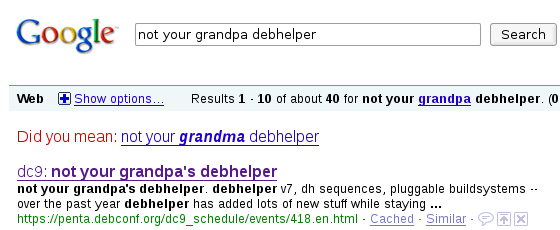
I am updating an old package's packaging style to take advantage of the new DebHelper 7 goodities. So far, I have been quite successful, but I hit a problem And before bugging on IRC, I decided to check with Joey Hess' presentation at DebConf9, Not your grandpa's debhelper. Of course, not remembering the URL, it was the most natural thing to ask Google: Did you mean... Not your grandma's Debhelper  WTF! Of course, putting this thingy aside, the right answer was the first hit. However, what is the first hit for the Grandma version? Quite dangerous: A post in Ubuntuforums for which the Google excrept reads: this tool can obviously eat your cat, poison your grandma, create an earthquake or do any other unexpected harm, so I don't provide any warranty whatsoever. I sincerely prefer joeyh's version.
6 September 2009

Joey Hess: camping

Spent last night halfway up Holston Mountain in what I call Bear Meadow, since I saw a bear the first time I was there. tent under trees I haven't been backpacking or otherwise rough camping in years. Random tech note: Last time I backpacked, a GPS was fairly new tech and IIRC rather big and bulky in its own device. This time, GPS and camera ability were a given; even my flashlight was just another program to run; and when I used it I had to turn off the network to stay away from it all.

2 June 2009

Christian Perrier: On localization

An old friend is ranting about localization. I first considered not really reaction to Joey's post, mostly because he has very true points...and particularly when he has about the same reaction than mine about a recent post in ou mailing lists. So, I will stick to react to one part of Joey's post...the one I consider really inaccurate. "everyone uses the software in English anyway" Really, Joey, really, that's completely untrue. Of course, I do live in a country that very well known (or at least that has the reputation) for being deeply ignorant in English language. But, really....*all* computers I see around me, both in my personal life *and in my professionnal life* are nearly completely localized. It's probably now well know that I spend most of my professionnal time....providing desktop systems (or managing the people who provide them) to users in ONERA, "the French Aerospace Lab". That means about 2000 users in a scientific environment where the use of English is much more developed than the average environment. Most of these users speak a fairly decent English and are perfectly able to understand that language in some way. About 80% of these systems are Windows-based and 20% are Linux-based. Probably more than 95% of them are localized in French. Even on Windows systems, we mostly integrate free software. And for *each* of them, the most important feature we need, besides software being free, is it to be localized in French. I bet our friends from Extremadura can say the same. The success of Linux-based free systems there also happened because the software is available in Spanish. And, of course, there are tons of similar stories and counter-examples (M nchen, Bhutan, Venezuela, etc.). So, really, please don't spread out that idea. Oh, yes, geeks *do* use their software in English (and, even here, I need to be convinced if I remember well what I saw at conferences in Germany or Spain, for instance). And, yes, it's very well widespread among geeks that using software in English is "better" or "easier". Which I indeed always fight and will fight until I die..:-). We certainly agree that these l10n needs put a high load on development and sometimes slow it down. and, for sure, we sometimes need to make a balance and I really thank you for giving me the credit to try doing that balance. Anyway, all this (including your rant) had to be said and it's interesting to have that small discussion (I just should not start writing down a blog entry at 23:00...:-)) See you soon, hopefully, Joey !

Joey Hess: on localization and progress

In this post I will say some things about localization that I've never felt it was politic to say before. (It still isn't, but what the hey.) But I first want to mention that one of the reasons Christian Perrier is awesome is because he manages to steer projects in ways that avoid (most of) the problems below, and because he has managed to scale rather impressively far. But not far enough that these things haven't gotten under my skin. So, I hate localization. Hate, hate, hate. I wish it would die. I wish everyone spoke the same language. I hate that we have to be politically correct about it, to the point that even if everyone does speak English (hello, Denmark?), we still have to worry about localization into their native language. I especially hate that, after we waste time and resources doing that, everyone uses the software in English anyway (hello, most of Europe). I hate that the typical best effort localization of software is typically so incomplete that it's not actually usable by people who really do need the translation. Either because "best effort" == 80% translated, which is sometimes worse than 0%, or because the documentation doesn't get translated too. And that even with what we consider a complete translation, there are still all sorts of English bits that nobody would ever consider translating. Such as the names of commands, of command-line switches, of markup keywords and configuration files. I hate that translating software and documentation always involves bolting an enormous, nasty build system onto its side, and that the bulk of translations always greatly outweighs the size of the code. I hate that these systems constantly produce deltas that I have to avoid cluttering my commits with. I hate the expectation that every programmer somehow become an expert in internationalization, rather than letting them devote their time to something they're good at. But none of that is what really bothers me about localization. What really, really bothers me is that I often see the need to localize code inhibiting that code becoming better. Just two examples: (PS, I also hate that we have to keep "l10n" and "i18n" straight, and that the words are so unwieldly in this f5g modern English that we represent them based on their length.)

29 May 2009

Joey Hess: on wave

While I've only skimmed the available protocol draft and whitepapers, I do have a couple thoughts about wave. Firstly, I can imagine something like this supplanting not just email and instant messaging, but also web forums, blog comments, mailing lists, wikis, bug tracking systems, twitter, and probably various other forms of communication. (But not, apparently, version control systems.) While one might have an attachment to a few of those things, I think most of us would be glad to see most of them collectively die (especially twitter and web forums of course) and be replaced by a data-driven standard, with multiple clients, rather than their general ad-hoc, server-side generated nastiness. (The Project Xanadu guys would be probably be proud.) Secondly, while Google are making all the right noises about open protocols, multiple providers, etc, and probably only plan to lock in about five nines percent of users to wave.google.com before competing implementations arrive, wave is not a fully distributed system. Spec says:
The operational transform used for concurrency control in wave is [currently] based on mutation of a shared object owned by a central master. The wave server where the wave is created (IE that has the first operation) is considered the authoritative source of operations for that wave.
If the master server goes away, it sounds like a wave will become frozen and uneditable. There seems to be no way to change the master server after a wave is created, without ending up with an entirely different wave. (Update: The demo, around minute 70, seems to show a private modification to a wave being made on another server -- so I may be missing a piece of the puzzle.)
The concurrency control protocol will be distributed at some point in the future
How many centralized systems have been successfully converted into distributed systems? In a similar vein, after reading this whitepaper, I'm left unsure about whether it will be possible to respond to (edit) a wave while offline. Maybe, as clients can cache changes, but how well will conflict resolution work? It seems it would have to be done in the client, and there are some disturbing references here to clients throwing their local state away if they get out of sync with the server.

Next.

Previous.


