Search Results: "jan"

31 October 2017

Chris Lamb: Free software activities in October 2017

Here is my monthly update covering what I have been doing in the free software world in October 2017 (previous month):
Reproducible builds

Whilst anyone can inspect the source code of free software for malicious flaws, most software is distributed pre-compiled to end users. The motivation behind the Reproducible Builds effort is to allow verification that no flaws have been introduced either maliciously or accidentally during this compilation process by promising identical results are always generated from a given source, thus allowing multiple third-parties to come to a consensus on whether a build was compromised. I have generously been awarded a grant from the Core Infrastructure Initiative to fund my work in this area. This month I:


I also made the following changes to our tooling:
diffoscope

diffoscope is our in-depth and content-aware diff utility that can locate and diagnose reproducibility issues.

  • Improve names in output of "internal" binwalk members. (#877525).
  • Don't crash on malformed md5sums files. (#877473).
  • Omit misleading "any of" prefix when only complaining about a single module on import. [...]
  • Adjust tests as ps2ascii now varies its output on timezone. [...]

strip-nondeterminism

strip-nondeterminism is our tool to remove specific non-deterministic results from a completed build.

  • Clojure considers .class file to be stale if it shares the same timestamp of the .clj. We thus adjust the timestamps of the .clj to always be younger. (#877418).
  • Print a message in --verbose mode if no canonical time was specified. [...]

buildinfo.debian.net

buildinfo.debian.net is my experiment into how to process, store and distribute .buildinfo files after the Debian archive software has processed them.

  • Always show SHA-256 checksums, regardless of the browser viewport size. [...]
  • Add an API endpoint to fetch specific .buildinfo files for a certain package/version/architecture. [...]


Debian My activities as the current Debian Project Leader are covered in my "Bits from the DPL" email to the debian-devel-announce mailing list.
Patches contributed
  • devscripts: Please print the actual arguments debuild makes to Lintian. (#880124)
  • hw-detect: Drop reference to floppy disks; it's almost 2018. (#880122)
  • debci:
    • Use deb.debian.org over http.debian.net. (#879654)
    • Document how to use an alternative mirror. (#879655)

Debian LTS

This month I have been paid to work 18 hours on Debian Long Term Support (LTS). In that time I did the following:
  • "Frontdesk" duties, triaging CVEs, etc.
  • Followed up on a large number of upstream "pings" that have been left dormant.
  • Issued DLA 1121-1 to fix an out-of-bounds read vulnerability in curl where a malicious FTP server could abuse this to prevent clients from interacting with it.
  • Issued DLA 1123-1 for the "Go" programming language where an attacker could generate a MIME request such that the server ran out of file descriptors.
  • Issued DLA 1126-1 for the libxfont font selection and rasterisation library, correcting two vulnerabilities, both involving the library being tricked into reading invalid/random memory.
  • Issued DLA 1134-1 for sdl-image1.2, an image loading library. A maliciously-crafted .xcf file could cause a stack-based buffer overflow resulting in potential code execution.

Uploads
  • python-django:
    • 2.0~beta1-1 New upstream 2.x release.
    • 1.11.6-1 New upstream bugfix release.
  • gunicorn (19.6.0-10+deb9u1) Prepared a release for stable to avoid a runtime dependency on a compiler. (#877722)
  • redis:
    • 4:4.0.2-3:
      • Drop the Debian-specific /etc/redis/redis-server.pre-up.d (etc.) hooks and remove them if unchanged.
      • Include systemd redis-server@.service and redis-sentinel@.service template files to easily run multiple Redis instances. (#877702)
      • Patch redis.conf and sentinel.conf with quilt instead of maintaining our own versions under debian/.
    • 4:4.0.2-4:
      • Add input validity checking to cluster config slot numbers to fix CVE-2017-15047. (#878076)
      • Drop debian/bin/generate-parts now we aren't calling it.
      • Correct Bash-ism in NEWS file.
    • 4:4.0.2-5: Replace the existing patch for CVE-2017-15047 with an upstream-blessed version that covers another case.
  • redisearch (0.21.3-5) Initial release.
  • docbook2man (2.0.0-40) Correct spelling mistakes in binaries and other misc packaging tidying.
  • python-redis (2.10.6-1) New upstream release.
  • bfs (1.1.3-1) New upstream release.

FTP Team

As a Debian FTP assistant I ACCEPTed 103 packages: amcheck, argagg, binutils, blockui, bro-pkg, chkservice, citus, django-axes, docker-containerd, doctest, dtkwidget, duktape, feed2exec, fontforge, fonttools, gcc-8, gcc-8-cross, generator-scripting-language, gitgraph.js, haskell-uri-encode, hoel, iniparser, its, jquery-areyousure, kodi, libcatmandu-mods-perl, libcatmandu-template-perl, libcatmandu-xml-perl, libcatmandu-xsd-perl, libcode-tidyall-plugin-sortlines-naturally-perl, libgdamm5.0, libinfinity, libmods-record-perl, libreoffice-dictionaries, libset-intervaltree-perl, libsodium, linux, linux-grsec, ltsp-manager, lxqt-themes, mailman3-core, measurement-kit, mini-buildd, musescore, node-babel, node-babel-eslint, node-babel-loader, node-babel-plugin-add-module-exports, node-babel-plugin-transform-define, node-gulp-newer, node-regenerate-unicode-properties, node-regexpu-core, node-regjsparser, node-unicode-data, node-unicode-loose-match, openjdk-9, orafce, pgaudit, pgsql-ogr-fdw, pk4, postgresql-mysql-fdw, powa-archivist, python-azure-devtools, python-colormap, python-darkslide, python-dotenv, python-karborclient, python-logfury, python-lupa, python-marshmallow, python-murano-pkg-check, python-octaviaclient, python-pathspec, python-pgpy, python-pydub, python-randomize, python-sabyenc, python-searchlightclient, python-stestr, python-subunit2sql, python-twitter, python-utils, python-wsgilog, r-cran-bindr, r-cran-desc, r-cran-hms, r-cran-readstata13, r-cran-rprojroot, r-cran-wikidatar, r-cran-wikipedir, r-cran-wikitaxa, repmgr, requests-file, resteasy3.0, sdl-kitchensink, stardicter, systemd-el, thunderbird, tomcat8.0, uwsgi-plugin-luajit, uwsgi-plugin-mongo, uwsgi-plugin-php & uwsgi-plugin-v8. I additionally filed 3 RC bugs against packages that had incomplete debian/copyright files against: fonttools, generator-scripting-language & libsodium.
27 October 2017

Russ Allbery: Review: The Black Gryphon

Review: The Black Gryphon, by Mercedes Lackey & Larry Dixon
Series: Mage Wars #1
Publisher: DAW
Copyright: 1994
Printing: January 1995
ISBN: 0-88677-643-0
Format: Mass market
Pages: 460
The Mage Wars series (or the Gryphon series, which isn't its official title but which is in all of the titles) is part of the sprawling Valdemar mega-series, but it's a prequel to all of the other stories. It's also slightly challenging if you're reading in publication order, since it was published simultaneously with the Mage Storms series. If you're following publication order, in theory you should interleave the two series, but I hate doing that. I'm therefore reading it after Mage Winds and before Mage Storms. We'll see whether that was a good idea when I get to the next series. You could, if you really wanted to, read this series before any other Valdemar book. As a prequel from the deep past of Valdemar's world, it doesn't depend on the other series, and you'll get a rediscovery of lost knowledge feel from later books. The downside is that it's a rather boring introduction, and that order would spoil a lot of the revelatory flow of the other series (particularly Elspeth's adventures in the Mage Winds books). I'm now getting into the Valdemar books that I've only read once. I've been putting off continuing my Valdemar re-read because this series was next and I remember being rather bored with it the first time I read it. But I'm re-reading for the world-building and background as much as for the characters, and this is a huge chunk of world background that fills in the bones underneath Winds of Fate and its sequels. Here's why Dhorisha is a crater, here's why the Pelagiris forests are such a mess, here's where Ma'ar starts, here's the origin of both the gryphons and K'Leshya, and here, finally, we get to see the legendary Urtho on the page. The problem with writing novels set in the epic backstory of your universe is that it's hard to live up to the drama that readers have invented for themselves. A lot of The Black Gryphon is background to events Valdemar readers already know will happen, creating a corresponding lack of surprise. I reached the end of the book and said "yup, that's pretty much what everyone said had happened." Lackey and Dixon do try to do some interesting things here, one of which being the backgrounding of the war. The Black Gryphon starts in the middle of a long-running conflict between Urtho and Ma'ar and doesn't follow the generals or the battles. The protagonists, instead, are a kestra'chern (a type of psychiatrist and spiritual healer who also uses sex, with the expected conflicts of people who incorrectly think of them as prostitutes) and the eventual leader of the gryphons (Skandranon, who is referenced in later books and who provides the title). We get some combat scenes from Skandranon and later another gryphon, but a lot of the book is Amberdrake fighting the effects of the war instead of the details of the war itself. There's a deep and moving story in that idea, and in some of the attached love stories that play out in the army camps. There's also a great story somewhere around Urtho: a brilliant but detached mage who is way out of his depth trying to run an army but smart enough to gather good people around him. He's also a creator of new life, including the gryphons. The Black Gryphon tries to talk about Urtho's paternalism, the weird emotional currents of his relationship with his creations, and the places Urtho keeps things from others for, supposedly, their own good. If this book had looked a bit deeper at the support structure for an army that's trying to be humane, or at the ways in which Urtho strays far too close to being an abusive tyrant through inaction despite having the best of intentions at every step, I think it could have said something significant. Unfortunately, that's not this book. This book is full of relentlessly black and white morality (the flaw of much of the Valdemar series) that bleaches away interesting shades of grey. Urtho is good and wise by authorial fiat, and Ma'ar is the same utterly irredeemable force of evil that he is in other books. The story skitters over Urtho's odd tyrannies, making them all better with the pure power of friendship and good intentions. There just isn't much emotional depth, and while I don't expect that of Lackey in general, this story really needed that depth to work. What we get instead is repetition, as Lackey and Dixon hit the same emotional notes with Amberdrake repeatedly. This is one of those books that makes me wonder if Lackey was trying to write too many novels in a short time than was good for their individual quality. (Collaborations often mean that the lesser-known name is doing all the work, but Dixon is Lackey's husband and the tone of the book is sufficiently Lackey that I don't think that happened here.) It felt padded by Amberdrake turning over the same emotional rocks repeatedly, to largely the same effect. This is, in short, not Lackey's finest effort, although it does have its moments. As always, Lackey is at her best when writing psychological healing narratives. Zhaneel's story is a bit too easy, but the dynamic between Amberdrake and Winterhart is the best part of the book. And The Black Gryphon does tell the reader exactly what led up to the Cataclysm and why. There are no major surprises, but there are some small ones, and it's a nice payoff for the lore-obsessed (like me). This is missable unless you want the full world-building behind Valdemar's past, and it's not the best writing. But if you're heavily invested in the Valdemar universe, it's at least readable and provides an important bit of the history. Followed by The White Gryphon. Rating: 5 out of 10

17 October 2017

Antoine Beaupr : A comparison of cryptographic keycards

An earlier article showed that private key storage is an important problem to solve in any cryptographic system and established keycards as a good way to store private key material offline. But which keycard should we use? This article examines the form factor, openness, and performance of four keycards to try to help readers choose the one that will fit their needs. I have personally been using a YubiKey NEO, since a 2015 announcement on GitHub promoting two-factor authentication. I was also able to hook up my SSH authentication key into the YubiKey's 2048 bit RSA slot. It seemed natural to move the other subkeys onto the keycard, provided that performance was sufficient. The mail client that I use, (Notmuch), blocks when decrypting messages, which could be a serious problems on large email threads from encrypted mailing lists. So I built a test harness and got access to some more keycards: I bought a FST-01 from its creator, Yutaka Niibe, at the last DebConf and Nitrokey donated a Nitrokey Pro. I also bought a YubiKey 4 when I got the NEO. There are of course other keycards out there, but those are the ones I could get my hands on. You'll notice none of those keycards have a physical keypad to enter passwords, so they are all vulnerable to keyloggers that could extract the key's PIN. Keep in mind, however, that even with the PIN, an attacker could only ask the keycard to decrypt or sign material but not extract the key that is protected by the card's firmware.

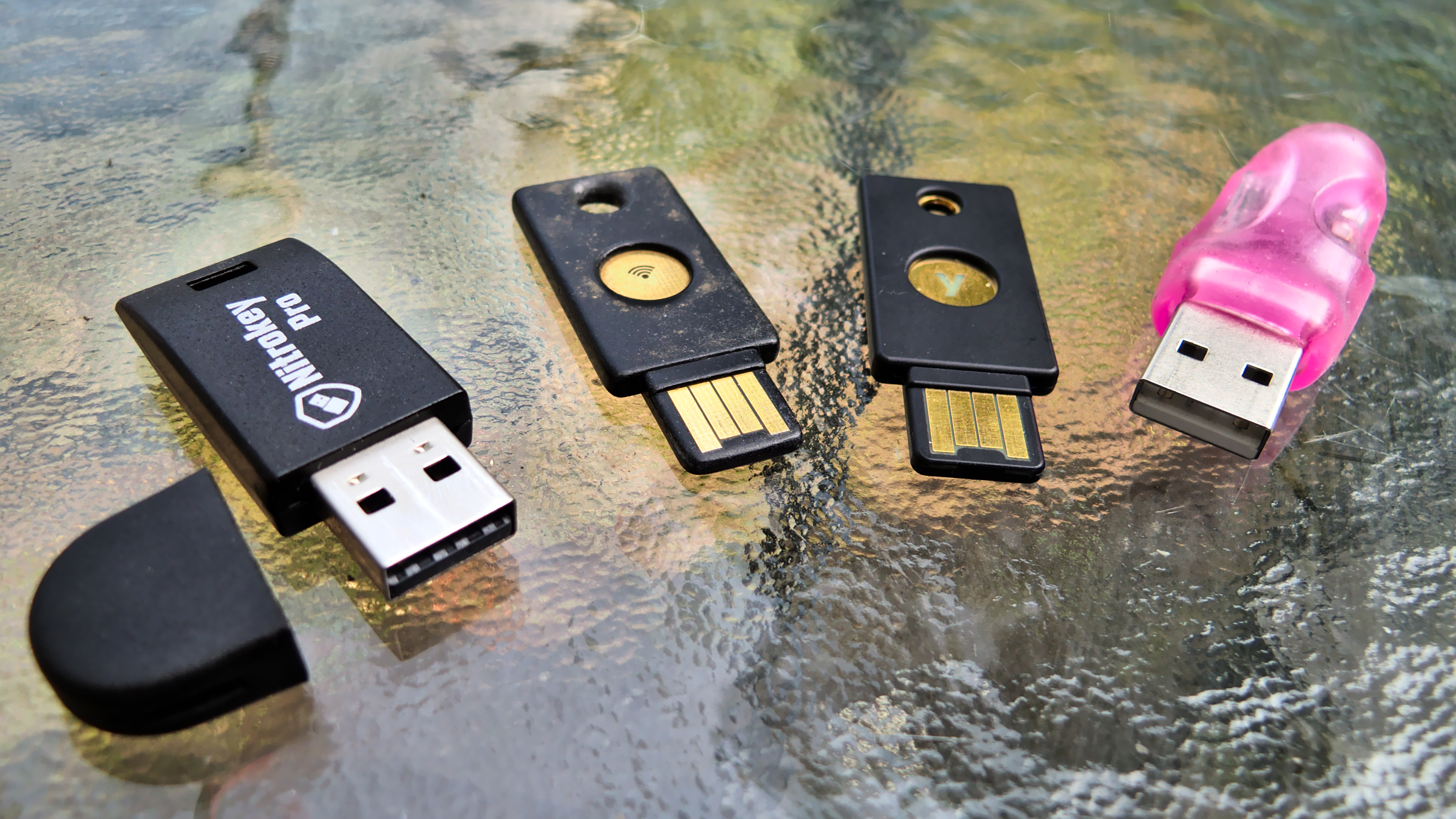
Form factor The Nitrokey Pro, YubiKey NEO (worn out), YubiKey 4, and FST-01 The four keycards have similar form factors: they all connect to a standard USB port, although both YubiKey keycards have a capacitive button by which the user triggers two-factor authentication and the YubiKey 4 can also require a button press to confirm private key use. The YubiKeys feel sturdier than the other two. The NEO has withstood two years of punishment in my pockets along with the rest of my "real" keyring and there is only minimal wear on the keycard in the picture. It's also thinner so it fits well on the keyring. The FST-01 stands out from the other two with its minimal design. Out of the box, the FST-01 comes without a case, so the circuitry is exposed. This is deliberate: one of its goals is to be as transparent as possible, both in terms of software and hardware design and you definitely get that feeling at the physical level. Unfortunately, that does mean it feels more brittle than other models: I wouldn't carry it in my pocket all the time, although there is a case that may protect the key a little better, but it does not provide an easy way to hook it into a keyring. In the group picture above, the FST-01 is the pink plastic thing, which is a rubbery casing I received along with the device when I got it. Notice how the USB connectors of the YubiKeys differ from the other two: while the FST-01 and the Nitrokey have standard USB connectors, the YubiKey has only a "half-connector", which is what makes it thinner than the other two. The "Nano" form factor takes this even further and almost disappears in the USB port. Unfortunately, this arrangement means the YubiKey NEO often comes loose and falls out of the USB port, especially when connected to a laptop. On my workstation, however, it usually stays put even with my whole keyring hanging off of it. I suspect this adds more strain to the host's USB port but that's a tradeoff I've lived with without any noticeable wear so far. Finally, the NEO has this peculiar feature of supporting NFC for certain operations, as LWN previously covered, but I haven't used that feature yet. The Nitrokey Pro looks like a normal USB key, in contrast with the other two devices. It does feel a little brittle when compared with the YubiKey, although only time will tell how much of a beating it can take. It has a small ring in the case so it is possible to carry it directly on your keyring, but I would be worried the cap would come off eventually. Nitrokey devices are also two times thicker than the Yubico models which makes them less convenient to carry around on keyrings.

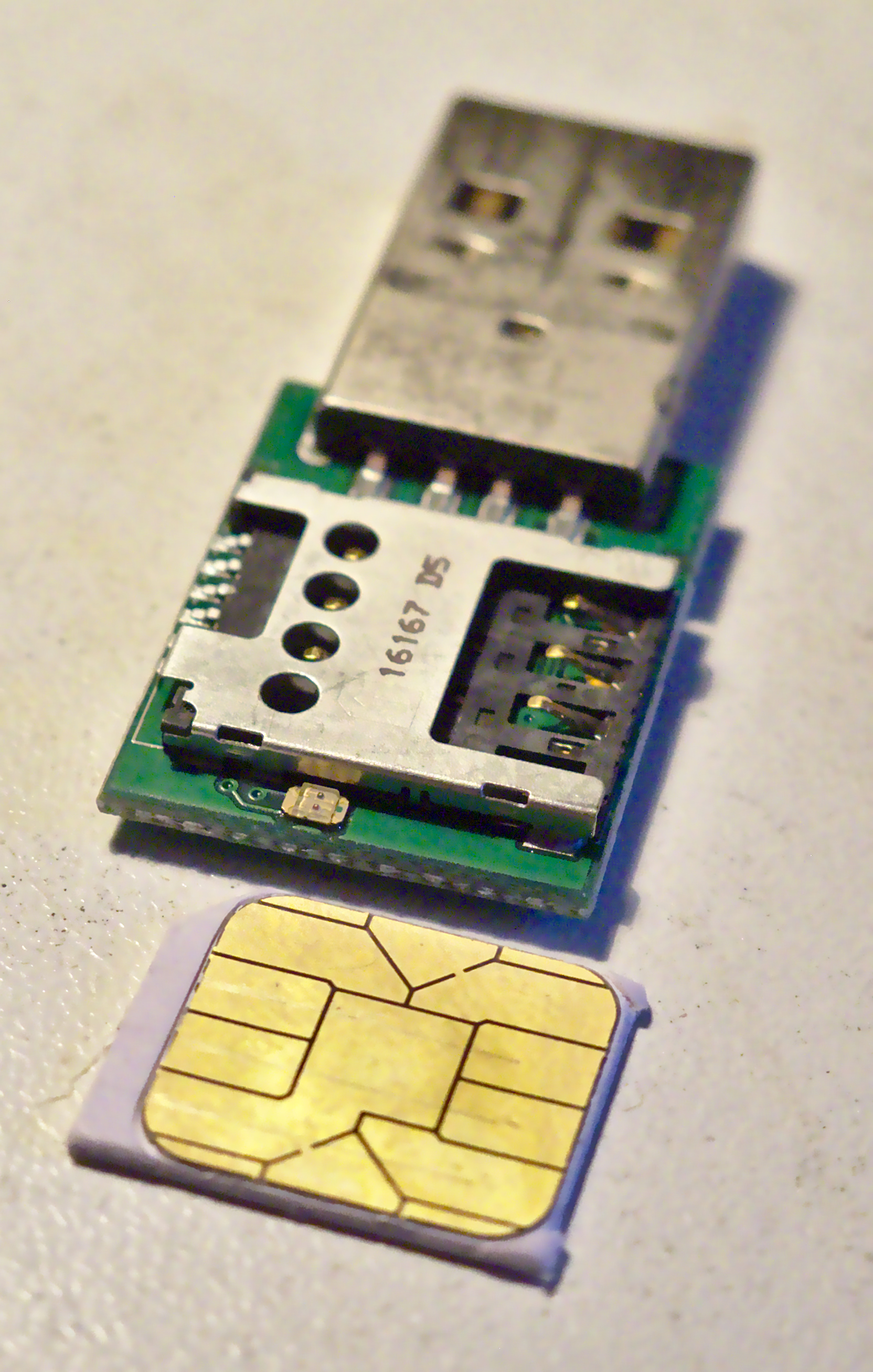
Open and closed designs The FST-01 is as open as hardware comes, down to the PCB design available as KiCad files in this Git repository. The software running on the card is the Gnuk firmware that implements the OpenPGP card protocol, but you can also get it with firmware implementing a true random number generator (TRNG) called NeuG (pronounced "noisy"); the device is programmable through a standard Serial Wire Debug (SWD) port. The Nitrokey Start model also runs the Gnuk firmware. However, the Nitrokey website announces only ECC and RSA 2048-bit support for the Start, while the FST-01 also supports RSA-4096. Nitrokey's founder Jan Suhr, in a private email, explained that this is because "Gnuk doesn't support RSA-3072 or larger at a reasonable speed". Its devices (the Pro, Start, and HSM models) use a similar chip to the FST-01: the STM32F103 microcontroller. Nitrokey Pro with STM32F103TBU6 MCU Nitrokey also publishes its hardware designs, on GitHub, which shows the Pro is basically a fork of the FST-01, according to the ChangeLog. I opened the case to confirm it was using the STM MCU, something I should warn you against; I broke one of the pins holding it together when opening it so now it's even more fragile. But at least, I was able to confirm it was built using the STM32F103TBU6 MCU, like the FST-01. Nitrokey back side But this is where the comparison ends: on the back side, we find a SIM card reader that holds the OpenPGP card that, in turn, holds the private key material and does the cryptographic operations. So, in effect, the Nitrokey Pro is really a evolution of the original OpenPGP card readers. Nitrokey confirmed the OpenPGP card featured in the Pro is the same as the one shipped by the Free Software Foundation Europe (FSFE): the BasicCard built by ZeitControl. Those cards, however, are covered by NDAs and the firmware is only partially open source. This makes the Nitrokey Pro less open than the FST-01, but that's an inevitable tradeoff when choosing a design based on the OpenPGP cards, which Suhr described to me as "pretty proprietary". There are other keycards out there, however, for example the SLJ52GDL150-150k smartcard suggested by Debian developer Yves-Alexis Perez, which he prefers as it is certified by French and German authorities. In that blog post, he also said he was experimenting with the GPL-licensed OpenPGP applet implemented by the French ANSSI. But the YubiKey devices are even further away in the closed-design direction. Both the hardware designs and firmware are proprietary. The YubiKey NEO, for example, cannot be upgraded at all, even though it is based on an open firmware. According to Yubico's FAQ, this is due to "best security practices": "There is a 'no upgrade' policy for our devices since nothing, including malware, can write to the firmware." I find this decision questionable in a context where security updates are often more important than trying to design a bulletproof design, which may simply be impossible. And the YubiKey NEO did suffer from critical security issue that allowed attackers to bypass the PIN protection on the card, which raises the question of the actual protection of the private key material on those cards. According to Niibe, "some OpenPGP cards store the private key unencrypted. It is a common attitude for many smartcard implementations", which was confirmed by Suhr: "the private key is protected by hardware mechanisms which prevent its extraction and misuse". He is referring to the use of tamper resistance. After that security issue, there was no other option for YubiKey NEO users than to get a new keycard (for free, thankfully) from Yubico, which also meant discarding the private key material on the key. For OpenPGP keys, this may mean having to bootstrap the web of trust from scratch if the keycard was responsible for the main certification key. But at least the NEO is running free software based on the OpenPGP card applet and the source is still available on GitHub. The YubiKey 4, on the other hand, is now closed source, which was controversial when the new model was announced last year. It led the main Linux Foundation system administrator, Konstantin Ryabitsev, to withdraw his endorsement of Yubico products. In response, Yubico argued that this approach was essential to the security of its devices, which are now based on "a secure chip, which has built-in countermeasures to mitigate a long list of attacks". In particular, it claims that:
A commercial-grade AVR or ARM controller is unfit to be used in a security product. In most cases, these controllers are easy to attack, from breaking in via a debug/JTAG/TAP port to probing memory contents. Various forms of fault injection and side-channel analysis are possible, sometimes allowing for a complete key recovery in a shockingly short period of time.
While I understand those concerns, they eventually come down to the trust you have in an organization. Not only do we have to trust Yubico, but also hardware manufacturers and designs they have chosen. Every step in the hidden supply chain is then trusted to make correct technical decisions and not introduce any backdoors. History, unfortunately, is not on Yubico's side: Snowden revealed the example of RSA security accepting what renowned cryptographer Bruce Schneier described as a "bribe" from the NSA to weaken its ECC implementation, by using the presumably backdoored Dual_EC_DRBG algorithm. What makes Yubico or its suppliers so different from RSA Security? Remember that RSA Security used to be an adamant opponent to the degradation of encryption standards, campaigning against the Clipper chip in the first crypto wars. Even if we trust the Yubico supply chain, how can we trust a closed design using what basically amounts to security through obscurity? Publicly auditable designs are an important tradition in cryptography, and that principle shouldn't stop when software is frozen into silicon. In fact, a critical vulnerability called ROCA disclosed recently affects closed "smartcards" like the YubiKey 4 and allows full private key recovery from the public key if the key was generated on a vulnerable keycard. When speaking with Ars Technica, the researchers outlined the importance of open designs and questioned the reliability of certification:
Our work highlights the dangers of keeping the design secret and the implementation closed-source, even if both are thoroughly analyzed and certified by experts. The lack of public information causes a delay in the discovery of flaws (and hinders the process of checking for them), thereby increasing the number of already deployed and affected devices at the time of detection.
This issue with open hardware designs seems to be recurring topic of conversation on the Gnuk mailing list. For example, there was a discussion in September 2017 regarding possible hardware vulnerabilities in the STM MCU that would allow extraction of encrypted key material from the key. Niibe referred to a talk presented at the WOOT 17 workshop, where Johannes Obermaier and Stefan Tatschner, from the Fraunhofer Institute, demonstrated attacks against the STMF0 family MCUs. It is still unclear if those attacks also apply to the older STMF1 design used in the FST-01, however. Furthermore, extracted private key material is still protected by user passphrase, but the Gnuk uses a weak key derivation function, so brute-forcing attacks may be possible. Fortunately, there is work in progress to make GnuPG hash the passphrase before sending it to the keycard, which should make such attacks harder if not completely pointless. When asked about the Yubico claims in a private email, Niibe did recognize that "it is true that there are more weak points in general purpose implementations than special implementations". During the last DebConf in Montreal, Niibe explained:
If you don't trust me, you should not buy from me. Source code availability is only a single factor: someone can maliciously replace the firmware to enable advanced attacks.
Niibe recommends to "build the firmware yourself", also saying the design of the FST-01 uses normal hardware that "everyone can replicate". Those advantages are hard to deny for a cryptographic system: using more generic components makes it harder for hostile parties to mount targeted attacks. A counter-argument here is that it can be difficult for a regular user to audit such designs, let alone physically build the device from scratch but, in a mailing list discussion, Debian developer Ian Jackson explained that:
You don't need to be able to validate it personally. The thing spooks most hate is discovery. Backdooring supposedly-free hardware is harder (more costly) because it comes with greater risk of discovery. To put it concretely: if they backdoor all of them, someone (not necessarily you) might notice. (Backdooring only yours involves messing with the shipping arrangements and so on, and supposes that you specifically are of interest.)
Since that, as far as we know, the STM microcontrollers are not backdoored, I would tend to favor those devices instead of proprietary ones, as such a backdoor would be more easily detectable than in a closed design. Even though physical attacks may be possible against those microcontrollers, in the end, if an attacker has physical access to a keycard, I consider the key compromised, even if it has the best chip on the market. In our email exchange, Niibe argued that "when a token is lost, it is better to revoke keys, even if the token is considered secure enough". So like any other device, physical compromise of tokens may mean compromise of the key and should trigger key-revocation procedures.

Algorithms and performance To establish reliable performance results, I wrote a benchmark program naively called crypto-bench that could produce comparable results between the different keys. The program takes each algorithm/keycard combination and runs 1000 decryptions of a 16-byte file (one AES-128 block) using GnuPG, after priming it to get the password cached. I assume the overhead of GnuPG calls to be negligible, as it should be the same across all tokens, so comparisons are possible. AES encryption is constant across all tests as it is always performed on the host and fast enough to be irrelevant in the tests. I used the following:
  • Intel(R) Core(TM) i3-6100U CPU @ 2.30GHz running Debian 9 ("stretch"/stable amd64), using GnuPG 2.1.18-6 (from the stable Debian package)
  • Nitrokey Pro 0.8 (latest firmware)
  • FST-01, running Gnuk version 1.2.5 (latest firmware)
  • YubiKey NEO OpenPGP applet 1.0.10 (not upgradable)
  • YubiKey 4 4.2.6 (not upgradable)
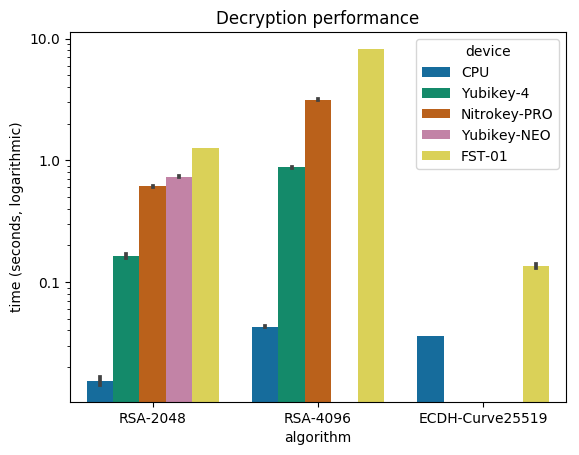
I ran crypto-bench for each keycard, which resulted in the following:
Algorithm Device Mean time (s)
ECDH-Curve25519 CPU 0.036
FST-01 0.135
RSA-2048 CPU 0.016
YubiKey-4 0.162
Nitrokey-Pro 0.610
YubiKey-NEO 0.736
FST-01 1.265
RSA-4096 CPU 0.043
YubiKey-4 0.875
Nitrokey-Pro 3.150
FST-01 8.218
Decryption graph There we see the performance of the four keycards I tested, compared with the same operations done without a keycard: the "CPU" device. That provides the baseline time of GnuPG decrypting the file. The first obvious observation is that using a keycard is slower: in the best scenario (FST-01 + ECC) we see a four-fold slowdown, but in the worst case (also FST-01, but RSA-4096), we see a catastrophic 200-fold slowdown. When I presented the results on the Gnuk mailing list, GnuPG developer Werner Koch confirmed those "numbers are as expected":
With a crypto chip RSA is much faster. By design the Gnuk can't be as fast - it is just a simple MCU. However, using Curve25519 Gnuk is really fast.
And yes, the FST-01 is really fast at doing ECC, but it's also the only keycard that handles ECC in my tests; the Nitrokey Start and Nitrokey HSM should support it as well, but I haven't been able to test those devices. Also note that the YubiKey NEO doesn't support RSA-4096 at all, so we can only compare RSA-2048 across keycards. We should note, however, that ECC is slower than RSA on the CPU, which suggests the Gnuk ECC implementation used by the FST-01 is exceptionally fast. In discussions about improving the performance of the FST-01, Niibe estimated the user tolerance threshold to be "2 seconds decryption time". In a new design using the STM32L432 microcontroller, Aurelien Jarno was able to bring the numbers for RSA-2048 decryption from 1.27s down to 0.65s, and for RSA-4096, from 8.22s down to 3.87s seconds. RSA-4096 is still beyond the two-second threshold, but at least it brings the FST-01 close to the YubiKey NEO and Nitrokey Pro performance levels. We should also underline the superior performance of the YubiKey 4: whatever that thing is doing, it's doing it faster than anyone else. It does RSA-4096 faster than the FST-01 does RSA-2048, and almost as fast as the Nitrokey Pro does RSA-2048. We should also note that the Nitrokey Pro also fails to cross the two-second threshold for RSA-4096 decryption. For me, the FST-01's stellar performance with ECC outshines the other devices. Maybe it says more about the efficiency of the algorithm than the FST-01 or Gnuk's design, but it's definitely an interesting avenue for people who want to deploy those modern algorithms. So, in terms of performance, it is clear that both the YubiKey 4 and the FST-01 take the prize in their own areas (RSA and ECC, respectively).

Conclusion In the above presentation, I have evaluated four cryptographic keycards for use with various OpenPGP operations. What the results show is that the only efficient way of storing a 4096-bit encryption key on a keycard would be to use the YubiKey 4. Unfortunately, I do not feel we should put our trust in such closed designs so I would argue you should either stick with 2048-bit encryption subkeys or keep the keys on disk. Considering that losing such a key would be catastrophic, this might be a good approach anyway. You should also consider switching to ECC encryption: even though it may not be supported everywhere, GnuPG supports having multiple encryption subkeys on a keyring: if one algorithm is unsupported (e.g. GnuPG 1.4 doesn't support ECC), it will fall back to a supported algorithm (e.g. RSA). Do not forget your previously encrypted material doesn't magically re-encrypt itself using your new encryption subkey, however. For authentication and signing keys, speed is not such an issue, so I would warmly recommend either the Nitrokey Pro or Start, or the FST-01, depending on whether you want to start experimenting with ECC algorithms. Availability also seems to be an issue for the FST-01. While you can generally get the device when you meet Niibe in person for a few bucks (I bought mine for around \$30 Canadian), the Seeed online shop says the device is out of stock at the time of this writing, even though Jonathan McDowell said that may be inaccurate in a debian-project discussion. Nevertheless, this issue may make the Nitrokey devices more attractive. When deciding on using the Pro or Start, Suhr offered the following advice:
In practice smart card security has been proven to work well (at least if you use a decent smart card). Therefore the Nitrokey Pro should be used for high security cases. If you don't trust the smart card or if Nitrokey Start is just sufficient for you, you can choose that one. This is why we offer both models.
So far, I have created a signing subkey and moved that and my authentication key to the YubiKey NEO, because it's a device I physically trust to keep itself together in my pockets and I was already using it. It has served me well so far, especially with its extra features like U2F and HOTP support, which I use frequently. Those features are also available on the Nitrokey Pro, so that may be an alternative if I lose the YubiKey. I will probably move my main certification key to the FST-01 and a LUKS-encrypted USB disk, to keep that certification key offline but backed up on two different devices. As for the encryption key, I'll wait for keycard performance to improve, or simply switch my whole keyring to ECC and use the FST-01 or Nitrokey Start for that purpose.
[The author would like to thank Nitrokey for providing hardware for testing.] This article first appeared in the Linux Weekly News.

2 October 2017

Antoine Beaupr : My free software activities, September 2017

Debian Long Term Support (LTS) This is my monthly Debian LTS report. I mostly worked on the git, git-annex and ruby packages this month but didn't have time to completely use my allocated hours because I started too late in the month.

Ruby I was hoping someone would pick up the Ruby work I submitted in August, but it seems no one wanted to touch that mess, understandably. Since then, new issues came up, and not only did I have to work on the rubygems and ruby1.9 package, but now the ruby1.8 package also had to get security updates. Yes: it's bad enough that the rubygems code is duplicated in one other package, but wheezy had the misfortune of having two Ruby versions supported. The Ruby 1.9 also failed to build from source because of test suite issues, which I haven't found a clean and easy fix for, so I ended up making test suite failures non-fatal in 1.9, which they were already in 1.8. I did keep a close eye on changes in the test suite output to make sure tests introduced in the security fixes would pass and that I wouldn't introduce new regressions as well. So I published the following advisories:
  • ruby 1.8: DLA-1113-1, fixing CVE-2017-0898 and CVE-2017-10784. 1.8 doesn't seem affected by CVE-2017-14033 as the provided test does not fail (but it does fail in 1.9.1). test suite was, before patch:
    2199 tests, 1672513 assertions, 18 failures, 51 errors
    
    and after patch:
    2200 tests, 1672514 assertions, 18 failures, 51 errors
    
  • rubygems: uploaded the package prepared in August as is in DLA-1112-1, fixing CVE-2017-0899, CVE-2017-0900, CVE-2017-0901. here the test suite passed normally.
  • ruby 1.9: here I used the used 2.2.8 release tarball to generate a patch that would cover all issues and published DLA-1114-1 that fixes the CVEs of the two packages above. the test suite was, before patches:
    10179 tests, 2232711 assertions, 26 failures, 23 errors, 51 skips
    
    and after patches:
    1.9 after patches (B): 10184 tests, 2232771 assertions, 26 failures, 23 errors, 53 skips
    

Git I also quickly issued an advisory (DLA-1120-1) for CVE-2017-14867, an odd issue affecting git in wheezy. The backport was tricky because it wouldn't apply cleanly and the git package had a custom patching system which made it tricky to work on.

Git-annex I did a quick stint on git-annex as well: I was able to reproduce the issue and confirm an approach to fixing the issue in wheezy, although I didn't have time to complete the work before the end of the month.

Other free software work

New project: feed2exec I should probably make a separate blog post about this, but ironically, I don't want to spend too much time writing those reports, so this will be quick. I wrote a new program, called feed2exec. It's basically a combination of feed2imap, rss2email and feed2tweet: it allows you to fetch RSS feeds and send them in a mailbox, but what's special about it, compared to the other programs above, is that it is more generic: you can basically make it do whatever you want on new feed items. I have, for example, replaced my feed2tweet instance with it, using this simple configuration:
[anarcat]
url = https://anarc.at/blog/index.rss
output = feed2exec.plugins.exec
args = tweet "%(title)0.70s %(link)0.70s"
The sample configuration file also has examples to talk with Mastodon, Pump.io and, why not, a torrent server to download torrent files available over RSS feeds. A trivial configuration can also make it work as a crude podcast client. My main motivation to work on this was that it was difficult to extend feed2imap to do what I needed (which was to talk to transmission to download torrent files) and rss2email didn't support my workflow (which is delivering to feed-specific mail folders). Because both projects also seemed abandoned, it seemed like a good idea at the time to start a new one, although the rss2email community has now restarted the project and may produce interesting results. As an experiment, I tracked my time working on this project. It turns out it took about 45 hours to write that software. Considering feed2exec is about 1400 SLOC, that's 30 lines of code per hour. I don't know if that's slow or fast, but it's an interesting metric for future projects. It sure seems slow to me, but we need to keep in mind those 30 lines of code don't include documentation and repeated head banging on the keyboard. For example, I found two issues with the upstream feedparser package which I use to parse feeds which also seems unmaintained, unfortunately. Feed2exec is beta software at this point, but it's working well enough for me and the design is much simpler than the other programs of the kind. The main issue people can expect from it at this point is formatting issues or parse errors on exotic feeds, and noisy error messages on network errors, all of which should be fairly easy to fix in the test suite. I hope it will be useful for the community and, as usual, I welcome contributions, help and suggestions on how to improve the software.

More Python templates As part of the work on feed2exec, I did cleanup a few things in the ecdysis project, mostly to hook tests up in the CI, improve on the advancedConfig logger and cleanup more stuff. While I was there, it turns out that I built a pretty decent basic CI configuration for Python on GitLab. Whereas the previous templates only had a non-working Django example, you should now be able to chose a Python template when you configure CI on GitLab 10 and above, which should hook you up with normal Python setup procedures like setup.py install and setup.py test.

Selfspy I mentioned working on a monitoring tool in my last post, because it was a feature from Workrave missing in SafeEyes. It turns out there is already such a tool called selfspy. I did an extensive review of the software to make sure it wouldn't leak out confidential information out before using it, and it looks, well... kind of okay. It crashed on me at least once so far, which is too bad because then it loses track of the precious activity. I have used it at least once to figure out what the heck I worked on during the day, so it's pretty useful. I particularly used it to backtrack my work on feed2exec as I didn't originally track my time on the project. Unfortunately, selfspy seems unmaintained. I have proposed a maintenance team and hopefully the project maintainer will respond and at least share access so we don't end up in a situation like linkchecker. I also sent a bunch of pull requests to fix some issues like being secure by default and fixing the build. Apart from the crash, the main issue I have found with the software is that it doesn't detect idle time which means certain apps are disproportionatly represented in statistics. There are also some weaknesses in the crypto that should be adressed for people that encrypt their database. Next step is to package selfspy in Debian which should hopefully be simple enough...

Restic documentation security As part of a documentation patch on the Restic backup software, I have improved on my previous Perl script to snoop on process commandline arguments. A common flaw in shell scripts and cron jobs is to pass secret material in the environment (usually safe) but often through commandline arguments (definitely not safe). The challenge, in this peculiar case, was the env binary, but the last time I encountered such an issue was with the Drush commandline tool, which was passing database credentials in clear to the mysql binary. Using my Perl sniffer, I could get to 60 checks per second (or 60Hz). After reimplementing it in Python, this number went up to 160Hz, which still wasn't enough to catch the elusive env command, which is much faster at hiding arguments than MySQL, in large part because it simply does an execve() once the environment is setup. Eventually, I just went crazy and rewrote the whole thing in C which was able to get 700-900Hz and did catch the env command about 10-20% of the time. I could probably have rewritten this by simply walking /proc myself (since this is what all those libraries do in the end) to get better result, but then my point was made. I was able to prove to the restic author the security issues that warranted the warning. It's too bad I need to repeat this again and again, but then my tools are getting better at proving that issue... I suspect it's not the last time I have to deal with this issue and I am happy to think that I can come up with an even more efficient proof of concept tool the next time around.

Ansible 101 After working on documentation last month, I ended up writing my first Ansible playbook this month, converting my tasksel list to a working Ansible configuration. This was a useful exercise: it allow me to find a bunch of packages which have been removed from Debian and provides much better usability than tasksel. For example, it provides a --diff argument that shows which packages are missing from a given setup. I am still unsure about Ansible. Manifests do seem really verbose and I still can't get used to the YAML DSL. I could probably have done the same thing with Puppet and just run puppet apply on the resulting config. But I must admit my bias towards Python is showing here: I can't help but think Puppet is going to be way less accessible with its rewrite in Clojure and C (!)... But then again, I really like Puppet's approach of having generic types like package or service rather than Ansible's clunky apt/yum/dnf/package/win_package types...

Pat and Ham radio After responding (too late) to a request for volunteers to help in Puerto Rico, I realized that my amateur radio skills were somewhat lacking in the "packet" (data transmission in ham jargon) domain, as I wasn't used to operate a Winlink node. Such a node can receive and transmit actual emails over the airwaves, for free, without direct access to the internet, which is very useful in disaster relief efforts. Through summary research, I stumbled upon the new and very promising Pat project which provides one of the first user-friendly Linux-compatible Winlink programs. I provided improvements on the documentation and some questions regarding compatibility issues which are still pending. But my pet issue is the establishment of pat as a normal internet citizen by using standard protocols for receiving and sending email. Not sure how that can be implemented, but we'll see. I am also hoping to upload an official Debian package and hopefully write more about this soon. Stay tuned!

Random stuff I ended up fixing my Kodi issue by starting it as a standalone systemd service, instead of gdm3, which is now completely disabled on the media box. I simply used the following /etc/systemd/service/kodi.service file:
[Unit]
Description=Kodi Media Center
After=systemd-user-sessions.service network.target sound.target
[Service]
User=xbmc
Group=video
Type=simple
TTYPath=/dev/tty7
StandardInput=tty
ExecStart=/usr/bin/xinit /usr/bin/dbus-launch --exit-with-session /usr/bin/kodi-standalone -- :1 -nolisten tcp vt7
Restart=on-abort
RestartSec=5
[Install]
WantedBy=multi-user.target
The downside of this is that it needs Xorg to run as root, whereas modern Xorg can now run rootless. Not sure how to fix this or where... But if I put needs_root_rights=no in Xwrapper.config, I get the following error in .local/share/xorg/Xorg.1.log:
[  2502.533] (EE) modeset(0): drmSetMaster failed: Permission denied
After fooling around with iPython, I ended up trying the xonsh shell, which is supposed to provide a bash-compatible Python shell environment. Unfortunately, I found it pretty unusable as a shell: it works fine to do Python stuff, but then all my environment and legacy bash configuration files were basically ignored so I couldn't get working quickly. This is too bad because the project looked very promising... Finally, one of my TLS hosts using a Let's Encrypt certificate wasn't renewing properly, and I figured out why. It turns out the ProxyPass command was passing everything to the backend, including the /.well-known requests, which obviously broke ACME verification. The solution was simple enough, disable the proxy for that directory:
ProxyPass /.well-known/ !

30 September 2017

Chris Lamb: Free software activities in September 2017

Here is my monthly update covering what I have been doing in the free software world in September 2017 (previous month):
Reproducible builds

Whilst anyone can inspect the source code of free software for malicious flaws, most software is distributed pre-compiled to end users. The motivation behind the Reproducible Builds effort is to allow verification that no flaws have been introduced either maliciously or accidentally during this compilation process by promising identical results are always generated from a given source, thus allowing multiple third-parties to come to a consensus on whether a build was compromised. I have generously been awarded a grant from the Core Infrastructure Initiative to fund my work in this area. This month I:
  • Published a short blog post about how to determine which packages on your system are reproducible. [...]
  • Submitted a pull request for Numpy to make the generated config.py files reproducible. [...]
  • Provided a patch to GTK upstream to ensure the immodules.cache files are reproducible. [...]
  • Within Debian:
    • Updated isdebianreproducibleyet.com, moving it to HTTPS, adding cachebusting as well as keeping the number up-to-date.
    • Submitted the following patches to fix reproducibility-related toolchain issues:
      • gdk-pixbuf: Make the output of gdk-pixbuf-query-loaders reproducible. (#875704)
      • texlive-bin: Make PDF IDs reproducible. (#874102)
    • Submitted a patch to fix a reproducibility issue in doit.
  • Categorised a large number of packages and issues in the Reproducible Builds "notes" repository.
  • Chaired our monthly IRC meeting. [...]
  • Worked on publishing our weekly reports. (#123, #124, #125, #126 & #127)


I also made the following changes to our tooling:
reproducible-check

reproducible-check is our script to determine which packages actually installed on your system are reproducible or not.

  • Handle multi-architecture systems correctly. (#875887)
  • Use the "restricted" data file to mask transient issues. (#875861)
  • Expire the cache file after one day and base the local cache filename on the remote name. [...] [...]
I also blogged about this utility. [...]
diffoscope

diffoscope is our in-depth and content-aware diff utility that can locate and diagnose reproducibility issues.

  • Filed an issue attempting to identify the causes behind an increased number of timeouts visible in our CI infrastructure, including running a number of benchmarks of recent versions. (#875324)
  • New features:
    • Add "binwalking" support to analyse concatenated CPIO archives such as initramfs images. (#820631).
    • Print a message if we are reading data from standard input. [...]
  • Bug fixes:
    • Loosen matching of file(1)'s output to ensure we correctly also match TTF files under file version 5.32. [...]
    • Correct references to path_apparent_size in comparators.utils.file and self.buf in diffoscope.diff. [...] [...]
  • Testing:
    • Make failing some critical flake8 tests result in a failed build. [...]
    • Check we identify all CPIO fixtures. [...]
  • Misc:
    • No need for try-assert-except block in setup.py. [...]
    • Compare types with identity not equality. [...] [...]
    • Use logging.py's lazy argument interpolation. [...]
    • Remove unused imports. [...]
    • Numerous PEP8, flake8, whitespace, other cosmetic tidy-ups.

strip-nondeterminism

strip-nondeterminism is our tool to remove specific non-deterministic results from a completed build.

  • Log which handler processed a file. (#876140). [...]

disorderfs

disorderfs is our FUSE-based filesystem that deliberately introduces non-determinism into directory system calls in order to flush out reproducibility issues.


Debian My activities as the current Debian Project Leader are covered in my monthly "Bits from the DPL" email to the debian-devel-announce mailing list.
Lintian I made a large number of changes to Lintian, the static analysis tool for Debian packages. It reports on various errors, omissions and general quality-assurance issues to maintainers: I also blogged specifically about the Lintian 2.5.54 release.

Patches contributed
  • debconf: Please add a context manager to debconf.py. (#877096)
  • nm.debian.org: Add pronouns to ALL_STATUS_DESC. (#875128)
  • user-setup: Please drop set_special_users hack added for "the convenience of heavy testers". (#875909)
  • postgresql-common: Please update README.Debian for PostgreSQL 10. (#876438)
  • django-sitetree: Should not mask test failures. (#877321)
  • charmtimetracker:
    • Missing binary dependency on libqt5sql5-sqlite. (#873918)
    • Please drop "Cross-Platform" from package description. (#873917)
I also submitted 5 patches for packages with incorrect calls to find(1) in debian/rules against hamster-applet, libkml, pyferret, python-gssapi & roundcube.

Debian LTS

This month I have been paid to work 15 hours on Debian Long Term Support (LTS). In that time I did the following:
  • "Frontdesk" duties, triaging CVEs, etc.
  • Documented an example usage of autopkgtests to test security changes.
  • Issued DLA 1084-1 and DLA 1085-1 for libidn and libidn2-0 to fix an integer overflow vulnerabilities in Punycode handling.
  • Issued DLA 1091-1 for unrar-free to prevent a directory traversal vulnerability from a specially-crafted .rar archive. This update introduces an regression test.
  • Issued DLA 1092-1 for libarchive to prevent malicious .xar archives causing a denial of service via a heap-based buffer over-read.
  • Issued DLA 1096-1 for wordpress-shibboleth, correcting an cross-site scripting vulnerability in the Shibboleth identity provider module.

Uploads
  • python-django:
    • 1.11.5-1 New upstream security release. (#874415)
    • 1.11.5-2 Apply upstream patch to fix QuerySet.defer() with "super" and "subclass" fields. (#876816)
    • 2.0~alpha1-2 New upstream alpha release of Django 2.0, dropping support for Python 2.x.
  • redis:
    • 4.0.2-1 New upstream release.
    • 4.0.2-2 Update 0004-redis-check-rdb autopkgtest test to ensure that the redis.rdb file exists before testing against it.
    • 4.0.2-2~bpo9+1 Upload to stretch-backports.
  • aptfs (0.11.0-1) New upstream release, moving away from using /var/lib/apt/lists internals. Thanks to Julian Andres Klode for a helpful bug report. (#874765)
  • lintian (2.5.53, 2.5.54) New upstream releases. (Documented in more detail above.)
  • bfs (1.1.2-1) New upstream release.
  • docbook-to-man (1:2.0.0-39) Tighten autopkgtests and enable testing via travis.debian.net.
  • python-daiquiri (1.3.0-1) New upstream release.

I also made the following non-maintainer uploads (NMUs):

Debian bugs filed
  • clipit: Please choose a sensible startup default in "live" mode. (#875903)
  • git-buildpackage: Please add a --reset option to gbp pull. (#875852)
  • bluez: Please default Device "friendly name" to hostname without domain. (#874094)
  • bugs.debian.org: Please explicitly link to packages,tracker .debian.org. (#876746)
  • Requests for packaging:
    • selfspy log everything you do on the computer. (#873955)
    • shoogle use the Google API from the shell. (#873916)

FTP Team

As a Debian FTP assistant I ACCEPTed 86 packages: bgw-replstatus, build-essential, caja-admin, caja-rename, calamares, cdiff, cockpit, colorized-logs, comptext, comptty, copyq, django-allauth, django-paintstore, django-q, django-test-without-migrations, docker-runc, emacs-db, emacs-uuid, esxml, fast5, flake8-docstrings, gcc-6-doc, gcc-7-doc, gcc-8, golang-github-go-logfmt-logfmt, golang-github-google-go-cmp, golang-github-nightlyone-lockfile, golang-github-oklog-ulid, golang-pault-go-macchanger, h2o, inhomog, ip4r, ldc, libayatana-appindicator, libbson-perl, libencoding-fixlatin-perl, libfile-monitor-lite-perl, libhtml-restrict-perl, libmojo-rabbitmq-client-perl, libmoosex-types-laxnum-perl, libparse-mime-perl, libplack-test-agent-perl, libpod-projectdocs-perl, libregexp-pattern-license-perl, libstring-trim-perl, libtext-simpletable-autowidth-perl, libvirt, linux, mac-fdisk, myspell-sq, node-coveralls, node-module-deps, nov-el, owncloud-client, pantomime-clojure, pg-dirtyread, pgfincore, pgpool2, pgsql-asn1oid, phpliteadmin, powerlevel9k, pyjokes, python-evdev, python-oslo.db, python-pygal, python-wsaccel, python3.7, r-cran-bindrcpp, r-cran-dotcall64, r-cran-glue, r-cran-gtable, r-cran-pkgconfig, r-cran-rlang, r-cran-spatstat.utils, resolvconf-admin, retro-gtk, ring-ssl-clojure, robot-detection, rpy2-2.8, ruby-hocon, sass-stylesheets-compass, selinux-dbus, selinux-python, statsmodels, webkit2-sharp & weston. I additionally filed 4 RC bugs against packages that had incomplete debian/copyright files against: comptext, comptext, ldc & python-oslo.concurrency.

Iain R. Learmonth: Breaking RSS Change in Hugo

My website and blog are managed by the static site generator Hugo. I ve found this to be a stable and flexible system, but at the last upgrade a breaking change has occurred that broken the syndication of my blog on various planets. At first I thought perhaps with my increased posting rate the planets were truncating my posts but this was not the case. The problem was in Hugo pull request #3129 where for some reason they have changed the RSS feed to contain only a lead instead of the full article. I ve seen other content management systems offer a similar option but at least they point out that it s truncated and offer a read more link. Here it just looks like I m publishing truncated unfinished really short posts. If you take a look at the post above, you ll see that the change is in an embedded template and it took a little reading the docs to work out how to revert the change. The steps are actually not that difficult, but it s still annoying that the change occurred. In a Hugo site, you will have a layouts directory that will contain your overrides from your theme. Create a new file in the path layouts/_default/rss.xml (you may need to create the _default directory) with the following content:
<rss version="2.0" xmlns:atom="http://www.w3.org/2005/Atom">
  <channel>
    <title>  if eq  .Title  .Site.Title   .Site.Title   else   with .Title  .  on   end   .Site.Title   end  </title>
    <link>  .Permalink  </link>
    <description>Recent content   if ne  .Title  .Site.Title   with .Title  in  .    end   end  on   .Site.Title  </description>
    <generator>Hugo -- gohugo.io</generator>  with .Site.LanguageCode  
    <language> . </language> end  with .Site.Author.email  
    <managingEditor> .  with $.Site.Author.name   ( . ) end </managingEditor> end  with .Site.Author.email  
    <webMaster> .  with $.Site.Author.name   ( . ) end </webMaster> end  with .Site.Copyright  
    <copyright> . </copyright> end  if not .Date.IsZero  
    <lastBuildDate>  .Date.Format "Mon, 02 Jan 2006 15:04:05 -0700"   safeHTML  </lastBuildDate>  end  
      with .OutputFormats.Get "RSS"  
          printf "<atom:link href=%q rel=\"self\" type=%q />" .Permalink .MediaType   safeHTML  
      end  
      range .Data.Pages  
    <item>
      <title>  .Title  </title>
      <link>  .Permalink  </link>
      <pubDate>  .Date.Format "Mon, 02 Jan 2006 15:04:05 -0700"   safeHTML  </pubDate>
        with .Site.Author.email  <author> .  with $.Site.Author.name   ( . ) end </author> end 
      <guid>  .Permalink  </guid>
      <description>  .Content   html  </description>
    </item>
      end  
  </channel>
</rss>
If you like my new Hugo theme, please let me know and I ll bump tidying it up and publishing it further up my todo list.

29 September 2017

Dirk Eddelbuettel: Rcpp 0.12.13: Updated vignettes, and more

The thirteenth release in the 0.12.* series of Rcpp landed on CRAN this morning, following a little delay because Uwe Ligges was traveling and whatnot. We had announced its availability to the mailing list late last week. As usual, a rather substantial amount of testing effort went into this release so you should not expect any surprise. This release follows the 0.12.0 release from July 2016, the 0.12.1 release in September 2016, the 0.12.2 release in November 2016, the 0.12.3 release in January 2017, the 0.12.4 release in March 2016, the 0.12.5 release in May 2016, the 0.12.6 release in July 2016, the 0.12.7 release in September 2016, the 0.12.8 release in November 2016, the 0.12.9 release in January 2017, the 0.12.10.release in March 2017, the 0.12.11.release in May 2017, and the 0.12.12 release in July 2017 making it the seventeeth release at the steady and predictable bi-montly release frequency. Rcpp has become the most popular way of enhancing GNU R with C or C++ code. As of today, 1069 packages (and hence 73 more since the last release) on CRAN depend on Rcpp for making analytical code go faster and further, along with another 91 in BioConductor. This releases contains a large-ish update to the documentation as all vignettes (apart from the unit test one, which is a one-off) now use Markdown and the (still pretty new) pinp package by James and myself. There is also a new vignette corresponding to the PeerJ preprint James and I produced as an updated and current Introduction to Rcpp replacing the older JSS piece (which is still included as a vignette too). A few other things got fixed: Dan is working on const iterators you would expect with modern C++, Lei Yu spotted error in Modules, and more. See below for details.

Changes in Rcpp version 0.12.13 (2017-09-24)
  • Changes in Rcpp API:
    • New const iterators functions cbegin() and cend() have been added to several vector and matrix classes (Dan Dillon and James Balamuta in #748) starting to address #741).
  • Changes in Rcpp Modules:
    • Misplacement of one parenthesis in macro LOAD_RCPP_MODULE was corrected (Lei Yu in #737)
  • Changes in Rcpp Documentation:
    • Rewrote the macOS sections to depend on official documentation due to large changes in the macOS toolchain. (James Balamuta in #742 addressing issue #682).
    • Added a new vignette Rcpp-introduction based on new PeerJ preprint, renamed existing introduction to Rcpp-jss-2011 .
    • Transitioned all vignettes to the 'pinp' RMarkdown template (James Balamuta and Dirk Eddelbuettel in #755 addressing issue #604).
    • Added an entry on running 'compileAttributes()' twice to the Rcpp-FAQ (##745).

Thanks to CRANberries, you can also look at a diff to the previous release. As always, even fuller details are on the Rcpp Changelog page and the Rcpp page which also leads to the downloads page, the browseable doxygen docs and zip files of doxygen output for the standard formats. A local directory has source and documentation too. Questions, comments etc should go to the rcpp-devel mailing list off the R-Forge page.

This post by Dirk Eddelbuettel originated on his Thinking inside the box blog. Please report excessive re-aggregation in third-party for-profit settings.

18 September 2017

Carl Chenet: The Github threat

Many voices arise now and then against risks linked to the Github use by Free Software projects. Yet the infatuation for the collaborative forge of the Octocat Californian start-ups doesn t seem to fade away.

These recent years, Github and its services take an important role in software engineering as they are seen as easy to use, efficient for a daily workload with interesting functions in enterprise collaborative workflow or amid a Free Software project. What are the arguments against using its services and are they valid? We will list them first, then we ll examine their validity.

1. Critical points

1.1 Centralization

The Github application belongs to a single entity, Github Inc, a US company which manage it alone. So, a unique company under US legislation manages the access to most of Free Software application code sources, which may be a problem with groups using it when a code source is no longer available, for political or technical reason.

The Octocat, the Github mascot

This centralization leads to another trouble: as it obtained critical mass, it becomes more and more difficult not having a Github account. People who don t use Github, by choice or not, are becoming a silent minority. It is now fashionable to use Github, and not doing so is seen as out of date . The same phenomenon is a classic, and even the norm, for proprietary social networks (Facebook, Twitter, Instagram).

1.2 A Proprietary Software

When you interact with Github, you are using a proprietary software, with no access to its source code and which may not work the way you think it is. It is a problem at different levels. First, ideologically, but foremost in practice. In the Github case, we send them code we can control outside of their interface. We also send them personal information (profile, Github interactions). And mostly, Github forces any project which goes through the US platform to use a crucial proprietary tools: its bug tracking system.

Windows, the epitome of proprietary software, even if others took the same path

1.3 The Uniformization

Working with Github interface seems easy and intuitive to most. Lots of companies now use it as a source repository, and many developers leaving a company find the same Github working environment in the next one. This pervasive presence of Github in free software development environment is a part of the uniformization of said developers working space.

Uniforms always bring Army in my mind, here the Clone army

2 Critical points cross-examination

2.1 Regarding the centralization

2.1.1 Service availability rate

As said above, nowadays, Github is the main repository of Free Software source code. As such it is a favorite target for cyberattacks. DDOS hit it in March and August 2015. On December 15, 2015, an outage led to the inaccessibility of 5% of the repositories. The same occurred on November 15. And these are only the incident reported by Github itself. One can imagine that the mean outage rate of the platform is underestimated.

2.1.2 Chain reaction could block Free Software development

Today many dependency maintenance tools, as npm for javascript, Bundler for Ruby or even pip for Python can access an application source code directly from Github. Free Software projects getting more and more linked and codependents, if one component is down, all the developing process stop.

One of the best examples is the npmgate. Any company could legally demand that Github take down some source code from its repository, which could create a chain reaction and blocking the development of many Free Software projects, as suffered the Node.js community from the decisions of Npm, Inc, the company managing npm.

2.2 A historical precedent: SourceForge

Github didn t appear out of the blue. In his time, its predecessor, SourceForge, was also extremely popular.

Heavily centralized, based on strong interaction with the community, SourceForge is now seen as an aging SAAS (Software As A Service) and sees most of its customers fleeing to Github. Which creates lots of hurdles for those who stayed. The Gimp project suffered from spams and terrible advertising, which led to the departure of the VLC project, then from installers corrupted with adwares instead of the official Gimp installer for Windows. And finally, the Project Gimp s SourceForge account was hacked by SourceForge team itself!

These are very recent examples of what can do a commercial entity when it is under its stakeholders pressure. It is vital to really understand what it means to trust them with data and exchange centralization, where it could have tremendous repercussion on the day-to-day life and the habits of the Free Software and open source community.

2.3. Regarding proprietary software

2.3.1 One community, several opinions on proprietary software

Mostly based on ideology, this point deals with the definition every member of the community gives to Free Software and open source. Mostly about one thing: is it viral or not? Or GPL vs MIT/BSD.

Those on the side of the viral Free Software will have trouble to use a proprietary software as this last one shouldn t even exist. It must be assimilated, to quote Star Trek, as it is a connected black box, endangering privacy, corrupting for profit our uses and restrain our freedom to use as we re pleased what we own, etc.

Those on the side of complete freedom have no qualms using proprietary software as their very existence is a consequence of freedom without restriction. They even agree that code they developed may be a part of proprietary software, which is quite a common occurrence. This part of the Free Software community has no qualm using Github, which is well within their ideology parameters. Just take a look at the Janson amphitheater during Fosdem and check how many Apple laptops running on macOS are around.

FreeBSD, the main BSD project under the BSD license

2.3.2 Data loss and data restrictions linked to proprietary software use

Even without ideological consideration, and just focusing on Github infrastructure, the bug tracking system is a major problem by itself.

Bug report builds the memory of Free Software projects. It is the entrance point for new contributors, the place to find bug reporting, requests for new functions, etc. The project history can t be limited only to the code. It s very common to find bug reports when you copy and paste an error message in a search engine. Not their historical importance is precious for the project itself, but also for its present and future users.

Github gives the ability to extract bug reports through its API. What would happen if Github is down or if the platform doesn t support this feature anymore? In my opinion, not that many projects ever thought of this outcome. How could they move all the data generated by Github into a new bug tracking system? One old example now is Astrid, a TODO list bought by Yahoo a few years ago. Very popular, it grew fast until it was closed overnight, with only a few weeks for its users to extract their data. It was only a to-do list. The same situation with Github would be tremendously difficult to manage for several projects if they even have the ability to deal with it. Code would still be available and could still live somewhere else, but the project memory would be lost. A project like Debian has today more than 800,000 bug reports, which are a data treasure trove about problems solved, function requests and where the development stand on each. The developers of the Cpython project have anticipated the problem and decided not to use Github bug tracking systems.

Issues, the Github proprietary bug tracking system

Another thing we could lose if Github suddenly disappear: all the work currently done regarding the push requests (aka PRs). This Github function gives the ability to clone one project s Github repository, to modify it to fit your needs, then to offer your own modification to the original repository. The original repository s owner will then review said modification, and if he or she agrees with them will fuse them into the original repository. As such, it s one of the main advantages of Github, since it can be done easily through its graphic interface.

However reviewing all the PRs may be quite long, and most of the successful projects have several ongoing PRs. And this PRs and/or the proprietary bug tracking system are commonly used as a platform for comment and discussion between developers.

Code itself is not lost if Github is down (except one specific situation as seen below), but the peer review works materialized in the PRs and the bug tracking system is lost. Let s remember than the PR mechanism let you clone and modify projects and then generate PRs directly from its proprietary web interface without downloading a single code line on your computer. In this particular case, if Github is down, all the code and the work in progress is lost. Some also use Github as a bookmark place. They follow their favorite projects activity through the Watch function. This technological watch style of data collection would also be lost if Github is down.

Debian, one of the main Free Software projects with at least a thousand official contributors

2.4 Uniformization

The Free Software community is walking a thigh rope between normalization needed for an easier interoperability between its products and an attraction for novelty led by a strong need for differentiation from what is already there.

Github popularized the use of Git, a great tool now used through various sectors far away from its original programming field. Step by step, Git is now so prominent it s almost impossible to even think to another source control manager, even if awesome alternate solutions, unfortunately not as popular, exist as Mercurial.

A new Free Software project is now a Git repository on Github with README.md added as a quick description. All the other solutions are ostracized? How? None or very few potential contributors would notice said projects. It seems very difficult now to encourage potential contributors into learning a new source control manager AND a new forge for every project they want to contribute. Which was a basic requirement a few years ago. It s quite sad because Github, offering an original experience to its users, cut them out of a whole possibility realm. Maybe Github is one of the best web versioning control systems. But being the main one doesn t let room for a new competitor to grow. And it let Github initiate development newcomers into a narrow function set, totally unrelated to the strength of the Git tool itself.

3. Centralization, uniformization, proprietary software What s next? Laziness?

Fight against centralization is a main part of the Free Software ideology as centralization strengthens the power of those who manage it and who through it control those who are managed by it. Uniformization allergies born against main software companies and their wishes to impose a closed commercial software world was for a long time the main fuel for innovation thirst and intelligent alternative development. As we said above, part of the Free Software community was built as a reaction to proprietary software and their threat. The other part, without hoping for their disappearance, still chose a development model opposite to proprietary software, at least in the beginning, as now there s more and more bridges between the two.

The Github effect is a morbid one because of its consequences: at least centralization, uniformization, proprietary software usage as their bug tracking system. But some years ago the Dear Github buzz showed one more side effect, one I ve never thought about: laziness. For those who don t know what it is about, this letter is a complaint from several spokespersons from several Free Software projects which demand to Github team to finally implement, after years of polite asking, new functions. Since when Free Software project facing a roadblock request for clemency and don t build themselves the path they need? When Torvalds was involved in the Bitkeeper problem and the Linux kernel development team couldn t use anymore their revision control software, he developed Git. The mere fact of not being able to use one tool or functions lacking is the main motivation to seek alternative solutions and, as such, of the Free Software movement. Every Free Software community member able to code should have this reflex. You don t like what Github offers? Switch to Gitlab. You don t like it Gitlab? Improve it or make your own solution.

The Gitlab logo

Let s be crystal clear. I ve never said that every Free Software developers blocked should code his or her own alternative. We all have our own priorities, and some of us even like their beauty sleep, including me. But, to see that this open letter to Github has 1340 names attached to it, among them some spokespersons for major Free Software project showed me that need, willpower and strength to code a replacement are here. Maybe said replacement will be born from this letter, it would be the best outcome of this buzz.

In the end, Github usage is just another example of Internet usage massification. As Internet users are bound to go to massively centralized social network as Facebook or Twitter, developers are following the same path with Github. Even if a large fraction of developers realize the threat linked this centralized and proprietary organization, the whole community is following this centralization and uniformization trend. Github service is useful, free or with a reasonable price (depending on the functions you need) easy to use and up most of the time. Why would we try something else? Maybe because others are using us while we are savoring the convenience? The Free Software community seems to be quite sleepy to me.

The lion enjoying the hearth warm

About Me Carl Chenet, Free Software Indie Hacker, founder of the French-speaking Hacker News-like Journal du hacker. Follow me on social networks Translated from French by St phanie Chaptal. Original article written in 2015.

10 September 2017

Sylvain Beucler: dot-zed archive file format

TL,DR: I reverse-engineered the .zed encrypted archive format.
Following a clean-room design, I'm providing a description that can be implemented by a third-party.
Interested? :) (reference version at: https://www.beuc.net/zed/) .zed archive file format Introduction Archives with the .zed extension are conceptually similar to an encrypted .zip file. In addition to a specific format, .zed files support multiple users: files are encrypted using the archive master key, which itself is encrypted for each user and/or authentication method (password, RSA key through certificate or PKCS#11 token). Metadata such as filenames is partially encrypted. .zed archives are used as stand-alone or attached to e-mails with the help of a MS Outlook plugin. A variant, which is not covered here, can encrypt/decrypt MS Windows folders on the fly like ecryptfs. In the spirit of academic and independent research this document provides a description of the file format and encryption algorithms for this encrypted file archive. See the conventions section for conventions and acronyms used in this document. Structure overview The .zed file format is composed of several layers. Or as a diagram:
+----------------------------------------------------------------------------------------------------+
  .zed archive (MS-CBF)                                                                               
                                                                                                      
   stream #1                         stream #2                       stream #3...                     
  +------------------------------+  +---------------------------+  +---------------------------+      
    metadata (MS-OLEPS)               encryption (AES)               encryption (AES)                 
                                      512-bytes chunks               512-bytes chunks                 
    +--------------------------+                                                                      
      obfuscation (static key)        +-----------------------+      +-----------------------+        
      +----------------------+       -  compression (zlib)     -    -  compression (zlib)     -       
       _ctlfile (TLV)                                                                            ...  
      +----------------------+          +---------------+              +---------------+               
    +--------------------------+          file contents                  file contents                
                                                                                                      
    +--------------------------+     -  +---------------+      -    -  +---------------+      -       
      _catalog (TLV)                                                                                  
    +--------------------------+      +-----------------------+      +-----------------------+        
  +------------------------------+  +---------------------------+  +---------------------------+      
+----------------------------------------------------------------------------------------------------+
Encryption schemes Several AES key sizes are supported, such as 128 and 256 bits. The Cipher Block Chaining (CBC) block cipher mode of operation is used to decrypt multiple AES 16-byte blocks, which means an initialisation vector (IV) is stored in clear along with the ciphertext. All filenames and file contents are encrypted using the same encryption mode, key and IV (e.g. if you remove and re-add a file in the archive, the resulting stream will be identical). No cleartext padding is used during encryption; instead, several end-of-stream handlers are available, so the ciphertext has exactly the size of the cleartext (e.g. the size of the compressed file). The following variants were identified in the 'encryption_mode' field. STREAM This is the end-of-stream handler for: This end-of-stream handler is apparently specific to the .zed format, and applied when the cleartext's does not end on a 16-byte boundary ; in this case special processing is performed on the last partial 16-byte block. The encryption and decryption phases are identical: let's assume the last partial block of cleartext (for encryption) or ciphertext (for decryption) was appended after all the complete 16-byte blocks of ciphertext: In either case, if the full ciphertext is less then one AES block (< 16 bytes), then the IV is used instead of the second-to-last block. CTS CTS or CipherText Stealing is the end-of-stream handler for: It matches the CBC-CS3 variant as described in Recommendation for Block Cipher Modes of Operation: Three Variants of Ciphertext Stealing for CBC Mode. Empty cleartext Since empty filenames or metadata are invalid, and since all files are compressed (resulting in a minimum 8-byte zlib cleartext), no empty cleartext was encrypted in the archive. metadata stream It is named 05356861616161716149656b7a6565636e576a33317a7868304e63 (hexadecimal), i.e. the character with code 5 followed by '5haaaaqaIekzeecnWj31zxh0Nc' (ASCII). The format used is OLE Property Set (MS-OLEPS). It introduces 2 property names "_ctlfile" (index 3) and "_catalog" (index 4), and 2 instances of said properties each containing an application-specific VT_BLOB (type 0x0041). _ctlfile: obfuscated global properties and access list This subpart is stored under index 3 ("_ctlfile") of the MS-OLEPS metadata. It consists of: The ciphertext is encrypted with AES-CBC "STREAM" mode using 128-bit static key 37F13CF81C780AF26B6A52654F794AEF (hexadecimal) and the prepended IV so as to obfuscate the access list. The ciphertext is continuous and not split in chunks (unlike files), even when it is larger than 512 bytes. The decrypted text contain properties in a TLV format as described in _ctlfile TLV: Archives may include "mandatory" users that cannot be removed. They are typically used to add an enterprise wide recovery RSA key to all archives. Extreme care must be taken to protect these key, as it can decrypt all past archives generated from within that company. _catalog: file list This subpart is stored under index 4 ("_catalog") of the MS-OLEPS metadata. It contains a series of 'fileprops' TLV structures, one for each file or directory. The file hierarchy can be reconstructed by checking the 'parent_id' field of each file entry. If 'parent_id' is 0 then the file is located at the top-level of the hierarchy, otherwise it's located under the directory with the matching 'file_id'. TLV format This format is a series of fields : Value semantics depend on its Type. It may contain an uint32be integer, a UTF-16LE string, a character sequence, or an inner TLV structure. Unless otherwise noted, TLV structures appear once. Some fields are optional and may not be present at all (e.g. 'archive_createdwith'). Some fields are unique within a structure (e.g. 'files_iv'), other may be repeated within a structure to form a list (e.g. 'fileprops' and 'passworduser'). The following top-level types that have been identified, and detailed in the next sections: Some additional unidentified types may be present. _ctlfile TLV _catalog TLV Decrypting the archive AES key rsauser The user accessing the archive will be authenticated by comparing his/her X509 certificate with the one stored in the 'certificate' field using DER format. The 'files_key_ciphertext' field is then decrypted using the PKCS#1 v1.5 encryption mechanism, with the private key that matches the user certificate. passworduser An intermediary user key, a user IV and an integrity checksum will be derived from the user password, using the deprecated PKCS#12 method as described at rfc7292 appendix B. Note: this is not PKCS#5 (nor PBKDF1/PBKDF2), this is an incompatible method from PKCS#12 that notably does not use HMAC. The 'pkcs12_hashfunc' field defines the underlying hash function. The following values have been identified: PBA - Password-based authentication The user accessing the archive will be authenticated by deriving an 8-byte sequence from his/her password. The parameters for the derivation function are: The derivation is checked against 'pba_checksum'. PBE - Password-based encryption Once the user is identified, 2 new values are derived from the password with different parameters to produce the IV and the key decryption key, with the same hash function: The parameters specific to user key are: The user key needs to be truncated to a length of 'encryption_strength', as specified in bytes in the archive properties. The parameters specific to user IV are: Once the key decryption key and the IV are derived, 'files_key_ciphertext' is decrypted using AES CBC, with PKCS#7 padding. Identifying file streams The name of the MS-CFB stream is derived by shuffling the bytes from the 'file_id' field and then encoding the result as hexadecimal. The reordering is:
Initial  offset: 0 1 2 3 4 5 6 7 8 9 10 11 12 13 14 15
Shuffled offset: 3 2 1 0 5 4 7 6 8 9 10 11 12 13 14 15
The 16th byte is usually a NUL byte, hence the stream identifier is a 30-character-long string. Decrypting files The compressed stream is split in chunks of 512 bytes, each of them encrypted separately using AES CBS and the global archive encryption scheme. Decryption uses the global AES key (retrieved using the user credentials), and the global IV (retrieved from the deobfuscated archive metadata). The IV for each chunk is computed by: Each chunk is an independent stream and the decryption process involves end-of-stream handling even if this is not the end of the actual file. This is particularly important for the CTS handler. Note: this is not to be confused with CTR block cipher mode of operation with operates differently and requires a nonce. Decompressing files Compressed streams are zlib stream with default compression options and can be decompressed following the zlib format. Test cases Excluded for brevity, cf. https://www.beuc.net/zed/#test-cases. Conventions and references Feedback Feel free to send comments at beuc@beuc.net. If you have .zed files that you think are not covered by this document, please send them as well (replace sensitive files with other ones). The author's GPG key can be found at 8FF1CB6E8D89059F. Copyright (C) 2017 Sylvain Beucler Copying and distribution of this file, with or without modification, are permitted in any medium without royalty provided the copyright notice and this notice are preserved. This file is offered as-is, without any warranty.

31 August 2017

Chris Lamb: Free software activities in August 2017

Here is my monthly update covering what I have been doing in the free software world in August 2017 (previous month):
Reproducible builds

Whilst anyone can inspect the source code of free software for malicious flaws, most software is distributed pre-compiled to end users. The motivation behind the Reproducible Builds effort is to allow verification that no flaws have been introduced either maliciously or accidentally during this compilation process by promising identical results are always generated from a given source, thus allowing multiple third-parties to come to a consensus on whether a build was compromised. I have generously been awarded a grant from the Core Infrastructure Initiative to fund my work in this area. This month I:
  • Presented a status update at Debconf17 in Montr al, Canada alongside Holger Levsen, Maria Glukhova, Steven Chamberlain, Vagrant Cascadian, Valerie Young and Ximin Luo.
  • I worked on the following issues upstream:
    • glib2.0: Please make the output of gio-querymodules reproducible. (...)
    • gcab: Please make the output reproducible. (...)
    • gtk+2.0: Please make the immodules.cache files reproducible. (...)
    • desktop-file-utils: Please make the output reproducible. (...)
  • Within Debian:
  • Categorised a large number of packages and issues in the Reproducible Builds "notes" repository.
  • Worked on publishing our weekly reports. (#118, #119, #120, #121 & #122)

I also made the following changes to our tooling:
diffoscope

diffoscope is our in-depth and content-aware diff utility that can locate and diagnose reproducibility issues.

  • Use name attribute over path to avoid leaking comparison full path in output. (commit)
  • Add missing skip_unless_module_exists import. (commit)
  • Tidy diffoscope.progress and the XML comparator (commit, commit)

disorderfs

disorderfs is our FUSE-based filesystem that deliberately introduces non-determinism into directory system calls in order to flush out reproducibility issues.

  • Add a simple autopkgtest smoke test. (commit)


Debian
Patches contributed
  • openssh: Quote the IP address in ssh-keygen -f suggestions. (#872643)
  • libgfshare:
    • SIGSEGV if /dev/urandom is not accessible. (#873047)
    • Add bindnow hardening. (#872740)
    • Support nodoc build profile. (#872739)
  • devscripts:
  • memcached: Add hardening to systemd .service file. (#871610)
  • googler: Tidy long and short package descriptions. (#872461)
  • gnome-split: Homepage points to domain-parked website. (#873037)

Uploads
  • python-django 1:1.11.4-1 New upstream release.
  • redis:
    • 4:4.0.1-3 Drop yet more non-deterministic tests.
    • 4:4.0.1-4 Tighten systemd/seccomp hardening.
    • 4:4.0.1-5 Drop even more tests with timing issues.
    • 4:4.0.1-6 Don't install completions to /usr/share/bash-completion/completions/debian/bash_completion/.
    • 4:4.0.1-7 Don't let sentinel integration tests fail the build as they use too many timers to be meaningful. (#872075)
  • python-gflags 1.5.1-3 If SOURCE_DATE_EPOCH is set, either use that as a source of current dates or the UTC-version of the file's modification time (#836004), don't call update-alternatives --remove in postrm. update debian/watch/Homepage & refresh/tidy the packaging.
  • bfs 1.1.1-1 New upstream release, tidy autopkgtest & patches, organising the latter with Pq-Topic.
  • python-daiquiri 1.2.2-1 New upstream release, tidy autopkgtests & update travis.yml from travis.debian.net.
  • aptfs 2:0.10-2 Add upstream signing key, refer to /usr/share/common-licenses/GPL-3 in debian/copyright & tidy autopkgtests.
  • adminer 4.3.1-2 Add a simple autopkgtest & don't install the Selenium-based tests in the binary package.
  • zoneminder (1.30.4+dfsg-2) Prevent build failures with GCC 7 (#853717) & correct example /etc/fstab entries in README.Debian (#858673).

Finally, I reviewed and sponsored uploads of astral, inflection, more-itertools, trollius-redis & wolfssl.

Debian LTS

This month I have been paid to work 18 hours on Debian Long Term Support (LTS). In that time I did the following:
  • "Frontdesk" duties, triaging CVEs, etc.
  • Issued DLA 1049-1 for libsndfile preventing a remote denial of service attack.
  • Issued DLA 1052-1 against subversion to correct an arbitrary code execution vulnerability.
  • Issued DLA 1054-1 for the libgxps XML Paper Specification library to prevent a remote denial of service attack.
  • Issued DLA 1056-1 for cvs to prevent a command injection vulnerability.
  • Issued DLA 1059-1 for the strongswan VPN software to close a denial of service attack.

Debian bugs filed
  • wget: Please hash the hostname in ~/.wget-hsts files. (#870813)
  • debian-policy: Clarify whether mailing lists in Maintainers/Uploaders may be moderated. (#871534)
  • git-buildpackage: "pq export" discards text within square brackets. (#872354)
  • qa.debian.org: Escape HTML in debcheck before outputting. (#872646)
  • pristine-tar: Enable multithreaded compression in pristine-xz. (#873229)
  • tryton-meta: Please combine tryton-modules-* into a single source package with multiple binaries. (#873042)
  • azure-cli:
  • fwupd-tests: Don't ship test files to generic /usr/share/installed-tests dir. (#872458)
  • libvorbis: Maintainer fields points to a moderated mailing list. (#871258)
  • rmlint-gui: Ship a rmlint-gui binary. (#872162)
  • template-glib: debian/copyright references online source without quotation. (#873619)

FTP Team

As a Debian FTP assistant I ACCEPTed 147 packages: abiword, adacgi, adasockets, ahven, animal-sniffer, astral, astroidmail, at-at-clojure, audacious, backdoor-factory, bdfproxy, binutils, blag-fortune, bluez-qt, cheshire-clojure, core-match-clojure, core-memoize-clojure, cypari2, data-priority-map-clojure, debian-edu, debian-multimedia, deepin-gettext-tools, dehydrated-hook-ddns-tsig, diceware, dtksettings, emacs-ivy, farbfeld, gcc-7-cross-ports, git-lfs, glewlwyd, gnome-recipes, gnome-shell-extension-tilix-dropdown, gnupg2, golang-github-aliyun-aliyun-oss-go-sdk, golang-github-approvals-go-approval-tests, golang-github-cheekybits-is, golang-github-chzyer-readline, golang-github-denverdino-aliyungo, golang-github-glendc-gopher-json, golang-github-gophercloud-gophercloud, golang-github-hashicorp-go-rootcerts, golang-github-matryer-try, golang-github-opentracing-contrib-go-stdlib, golang-github-opentracing-opentracing-go, golang-github-tdewolff-buffer, golang-github-tdewolff-minify, golang-github-tdewolff-parse, golang-github-tdewolff-strconv, golang-github-tdewolff-test, golang-gopkg-go-playground-validator.v8, gprbuild, gsl, gtts, hunspell-dz, hyperlink, importmagic, inflection, insighttoolkit4, isa-support, jaraco.itertools, java-classpath-clojure, java-jmx-clojure, jellyfish1, lazymap-clojure, libblockdev, libbytesize, libconfig-zomg-perl, libdazzle, libglvnd, libjs-emojify, libjwt, libmysofa, libundead, linux, lua-mode, math-combinatorics-clojure, math-numeric-tower-clojure, mediagoblin, medley-clojure, more-itertools, mozjs52, openssh-ssh1, org-mode, oysttyer, pcscada, pgsphere, poppler, puppetdb, py3status, pycryptodome, pysha3, python-cliapp, python-coloredlogs, python-consul, python-deprecation, python-django-celery-results, python-dropbox, python-fswrap, python-hbmqtt, python-intbitset, python-meshio, python-parameterized, python-pgpy, python-py-zipkin, python-pymeasure, python-thriftpy, python-tinyrpc, python-udatetime, python-wither, python-xapp, pythonqt, r-cran-bit, r-cran-bit64, r-cran-blob, r-cran-lmertest, r-cran-quantmod, r-cran-ttr, racket-mode, restorecond, rss-bridge, ruby-declarative, ruby-declarative-option, ruby-errbase, ruby-google-api-client, ruby-rash-alt, ruby-representable, ruby-test-xml, ruby-uber, sambamba, semodule-utils, shimdandy, sjacket-clojure, soapysdr, stencil-clojure, swath, template-glib, tools-analyzer-jvm-clojure, tools-namespace-clojure, uim, util-linux, vim-airline, vim-airline-themes, volume-key, wget2, xchat, xfce4-eyes-plugin & xorg-gtest. I additionally filed 6 RC bugs against packages that had incomplete debian/copyright files against: gnome-recipes, golang-1.9, libdazzle, poppler, python-py-zipkin & template-glib.

23 August 2017

Antoine Beaupr : The supposed decline of copyleft

At DebConf17, John Sullivan, the executive director of the FSF, gave a talk on the supposed decline of the use of copyleft licenses use free-software projects. In his presentation, Sullivan questioned the notion that permissive licenses, like the BSD or MIT licenses, are gaining ground at the expense of the traditionally dominant copyleft licenses from the FSF. While there does seem to be a rise in the use of permissive licenses, in general, there are several possible explanations for the phenomenon.

When the rumor mill starts Sullivan gave a recent example of the claim of the decline of copyleft in an article on Opensource.com by Jono Bacon from February 2017 that showed a histogram of license usage between 2010 and 2017 (seen below).
[Black Duck   histogram]
From that, Bacon elaborates possible reasons for the apparent decline of the GPL. The graphic used in the article was actually generated by Stephen O'Grady in a January article, The State Of Open Source Licensing, which said:
In Black Duck's sample, the most popular variant of the GPL version 2 is less than half as popular as it was (46% to 19%). Over the same span, the permissive MIT has gone from 8% share to 29%, while its permissive cousin the Apache License 2.0 jumped from 5% to 15%.
Sullivan, however, argued that the methodology used to create both articles was problematic. Neither contains original research: the graphs actually come from the Black Duck Software "KnowledgeBase" data, which was partly created from the old Ohloh web site now known as Open Hub. To show one problem with the data, Sullivan mentioned two free-software projects, GNU Bash and GNU Emacs, that had been showcased on the front page of Ohloh.net in 2012. On the site, Bash was (and still is) listed as GPLv2+, whereas it changed to GPLv3 in 2011. He also claimed that "Emacs was listed as licensed under GPLv3-only, which is a license Emacs has never had in its history", although I wasn't able to verify that information from the Internet archive. Basically, according to Sullivan, "the two projects featured on the front page of a site that was using [the Black Duck] data set were wrong". This, in turn, seriously brings into question the quality of the data:
I reported this problem and we'll continue to do that but when someone is not sharing the data set that they're using for other people to evaluate it and we see glimpses of it which are incorrect, that should give us a lot of hesitation about accepting any conclusion that comes out of it.
Reproducible observations are necessary to the establishment of solid theories in science. Sullivan didn't try to contact Black Duck to get access to the database, because he assumed (rightly, as it turned out) that he would need to "pay for the data under terms that forbid you to share that information with anybody else". So I wrote Black Duck myself to confirm this information. In an email interview, Patrick Carey from Black Duck confirmed its data set is proprietary. He believes, however, that through a "combination of human and automated techniques", Black Duck is "highly confident at the accuracy and completeness of the data in the KnowledgeBase". He did point out, however, that "the way we track the data may not necessarily be optimal for answering the question on license use trend" as "that would entail examination of new open source projects coming into existence each year and the licenses used by them". In other words, even according to Black Duck, its database may not be useful to establish the conclusions drawn by those articles. Carey did agree with those conclusions intuitively, however, saying that "there seems to be a shift toward Apache and MIT licenses in new projects, though I don't have data to back that up". He suggested that "an effective way to answer the trend question would be to analyze the new projects on GitHub over the last 5-10 years." Carey also suggested that "GitHub has become so dominant over the recent years that just looking at projects on GitHub would give you a reasonable sampling from which to draw conclusions".
[GitHub   graph]
Indeed, GitHub published a report in 2015 that also seems to confirm MIT's popularity (45%), surpassing copyleft licenses (24%). The data is, however, not without its own limitations. For example, in the above graph going back to the inception of GitHub in 2008, we see a rather abnormal spike in 2013, which seems to correlate with the launch of the choosealicense.com site, described by GitHub as "our first pass at making open source licensing on GitHub easier". In his talk, Sullivan was critical of the initial version of the site which he described as biased toward permissive licenses. Because the GitHub project creation page links to the site, Sullivan explained that the site's bias could have actually influenced GitHub users' license choices. Following a talk from Sullivan at FOSDEM 2016, GitHub addressed the problem later that year by rewording parts of the front page to be more accurate, but that any change in license choice obviously doesn't show in the report produced in 2015 and won't affect choices users have already made. Therefore, there can be reasonable doubts that GitHub's subset of software projects may not actually be that representative of the larger free-software community.

In search of solid evidence So it seems we are missing good, reproducible results to confirm or dispel these claims. Sullivan explained that it is a difficult problem, if only in the way you select which projects to analyze: the impact of a MIT-licensed personal wiki will obviously be vastly different from, say, a GPL-licensed C compiler or kernel. We may want to distinguish between active and inactive projects. Then there is the problem of code duplication, both across publication platforms (a project may be published on GitHub and SourceForge for example) but also across projects (code may be copy-pasted between projects). We should think about how to evaluate the license of a given project: different files in the same code base regularly have different licenses often none at all. This is why having a clear, documented and publicly available data set and methodology is critical. Without this, the assumptions made are not clear and it is unreasonable to draw certain conclusions from the results. It turns out that some researchers did that kind of open research in 2016 in a paper called "The Debsources Dataset: Two Decades of Free and Open Source Software" [PDF] by Matthieu Caneill, Daniel M. Germ n, and Stefano Zacchiroli. The Debsources data set is the complete Debian source code that covers a large history of the Debian project and therefore includes thousands of free-software projects of different origins. According to the paper:
The long history of Debian creates a perfect subject to evaluate how FOSS licenses use has evolved over time, and the popularity of licenses currently in use.
Sullivan argued that the Debsources data set is interesting because of its quality: every package in Debian has been reviewed by multiple humans, including the original packager, but also by the FTP masters to ensure that the distribution can legally redistribute the software. The existence of a package in Debian provides a minimal "proof of use": unmaintained packages get removed from Debian on a regular basis and the mere fact that a piece of software gets packaged in Debian means at least some users found it important enough to work on packaging it. Debian packagers make specific efforts to avoid code duplication between packages in order to ease security maintenance. The data set covers a period longer than Black Duck's or GitHub's, as it goes all the way back to the Hamm 2.0 release in 1998. The data and how to reproduce it are freely available under a CC BY-SA 4.0 license.
[Debsource   graph]
Sullivan presented the above graph from the research paper that showed the evolution of software license use in the Debian archive. Whereas previous graphs showed statistics in percentages, this one showed actual absolute numbers, where we can't actually distinguish a decline in copyleft licenses. To quote the paper again:
The top license is, once again, GPL-2.0+, followed by: Artistic-1.0/GPL dual-licensing (the licensing choice of Perl and most Perl libraries), GPL-3.0+, and Apache-2.0.
Indeed, looking at the graph, at most do we see a rise of the Apache and MIT licenses and no decline of the GPL per se, although its adoption does seem to slow down in recent years. We should also mention the possibility that Debian's data set has the opposite bias: toward GPL software. The Debian project is culturally quite different from the GitHub community and even the larger free-software ecosystem, naturally, which could explain the disparity in the results. We can only hope a similar analysis can be performed on the much larger Software Heritage data set eventually, which may give more representative results. The paper acknowledges this problem:
Debian is likely representative of enterprise use of FOSS as a base operating system, where stable, long-term and seldomly updated software products are desirable. Conversely Debian is unlikely representative of more dynamic FOSS environments (e.g., modern Web-development with micro libraries) where users, who are usually developers themselves, expect to receive library updates on a daily basis.
The Debsources research also shares methodology limitations with Black Duck: while Debian packages are reviewed before uploading and we can rely on the copyright information provided by Debian maintainers, the research also relies on automated tools (specifically FOSSology) to retrieve license information. Sullivan also warned against "ascribing reason to numbers": people may have different reasons for choosing a particular license. Developers may choose the MIT license because it has fewer words, for compatibility reasons, or simply because "their lawyers told them to". It may not imply an actual deliberate philosophical or ideological choice. Finally, he brought up the theory that the rise of non-copyleft licenses isn't necessarily at the detriment of the GPL. He explained that, even if there is an actual decline, it may not be much of a problem if there is an overall growth of free software to the detriment of proprietary software. He reminded the audience that non-copyleft licenses are still free software, according to the FSF and the Debian Free Software Guidelines, so their rise is still a positive outcome. Even if the GPL is a better tool to accomplish the goal of a free-software world, we can all acknowledge that the conversion of proprietary software to more permissive and certainly simpler licenses is definitely heading in the right direction.
[I would like to thank the DebConf organizers for providing meals for me during the conference.] Note: this article first appeared in the Linux Weekly News.

4 August 2017

Michal &#268;iha&#345;: Changes to Docker container for Weblate

I've made several changes to the Weblate Docker container which are worth mentioning today. First of all if you are still using nijel/weblate, you should switch to weblate/weblate. They both currently share same configuration, but it might happen that some future updates will go to the weblate owned container only. Now back to the container changes. Since beginning we were using Django built in server. That's fine for development purposes, but it really doesn't work that well in production as it can handle only one request at time. Therefore we've switched to more robust approach using nginx + uwsgi + supervisor. Thanks to this, the docker-compose no longer needs separate nginx server as everything is now sanely handled within the weblate container itself.

Filed under: Debian English Gammu phpMyAdmin SUSE Weblate

2 August 2017

Markus Koschany: My Free Software Activities in July 2017

Welcome to gambaru.de. Here is my monthly report that covers what I have been doing for Debian. If you re interested in Java, Games and LTS topics, this might be interesting for you. Debian Games Debian Java Debian LTS This was my seventeenth month as a paid contributor and I have been paid to work 23,5 hours on Debian LTS, a project started by Rapha l Hertzog. In that time I did the following: Non-maintainer upload Thanks for reading and see you next time.

31 July 2017

Chris Lamb: Free software activities in July 2017

Here is my monthly update covering what I have been doing in the free software world during July 2017 (previous month): I also blogged about my recent lintian hacking and installation-birthday package.
Reproducible builds

Whilst anyone can inspect the source code of free software for malicious flaws, most software is distributed pre-compiled to end users. The motivation behind the Reproducible Builds effort is to permit verification that no flaws have been introduced either maliciously or accidentally during this compilation process by promising identical results are always generated from a given source, thus allowing multiple third-parties to come to a consensus on whether a build was compromised. (I have generously been awarded a grant from the Core Infrastructure Initiative to fund my work in this area.) This month I:
  • Assisted Mattia with a draft of an extensive status update to the debian-devel-announce mailing list. There were interesting follow-up discussions on Hacker News and Reddit.
  • Submitted the following patches to fix reproducibility-related toolchain issues within Debian:
  • I also submitted 5 patches to fix specific reproducibility issues in autopep8, castle-game-engine, grep, libcdio & tinymux.
  • Categorised a large number of packages and issues in the Reproducible Builds "notes" repository.
  • Worked on publishing our weekly reports. (#114 #115, #116 & #117)

I also made the following changes to our tooling:
diffoscope

diffoscope is our in-depth and content-aware diff utility that can locate and diagnose reproducibility issues.

  • comparators.xml:
    • Fix EPUB "missing file" tests; they ship a META-INF/container.xml file. [ ]
    • Misc style fixups. [ ]
  • APK files can also be identified as "DOS/MBR boot sector". (#868486)
  • comparators.sqlite: Simplify file detection by rewriting manual recognizes call with a Sqlite3Database.RE_FILE_TYPE definition. [ ]
  • comparators.directory:
    • Revert the removal of a try-except. (#868534)
    • Tidy module. [ ]

strip-nondeterminism

strip-nondeterminism is our tool to remove specific non-deterministic results from a completed build.

  • Add missing File::Temp imports in the JAR and PNG handlers. This appears to have been exposed by lazily-loading handlers in #867982. (#868077)

buildinfo.debian.net

buildinfo.debian.net is my experiment into how to process, store and distribute .buildinfo files after the Debian archive software has processed them.

  • Avoid a race condition between check-and-creation of Buildinfo instances. [ ]


Debian My activities as the current Debian Project Leader are covered in my "Bits from the DPL emails to the debian-devel-announce mailing list.
Patches contributed
  • obs-studio: Remove annoying "click wrapper" on first startup. (#867756)
  • vim: Syntax highlighting for debian/copyright files. (#869965)
  • moin: Incorrect timezone offset applied due to "84600" typo. (#868463)
  • ssss: Add a simple autopkgtest. (#869645)
  • dch: Please bump $latest_bpo_dist to current stable release. (#867662)
  • python-kaitaistruct: Remove Markdown and homepage references from package long descriptions. (#869265)
  • album-data: Correct invalid Vcs-Git URI. (#869822)
  • pytest-sourceorder: Update Homepage field. (#869125)
I also made a very large number of contributions to the Lintian static analysis tool. To avoid duplication here, I have outlined them in a separate post.

Debian LTS

This month I have been paid to work 18 hours on Debian Long Term Support (LTS). In that time I did the following:
  • "Frontdesk" duties, triaging CVEs, etc.
  • Issued DLA 1014-1 for libclamunrar, a library to add unrar support to the Clam anti-virus software to fix an arbitrary code execution vulnerability.
  • Issued DLA 1015-1 for the libgcrypt11 crypto library to fix a "sliding windows" information leak.
  • Issued DLA 1016-1 for radare2 (a reverse-engineering framework) to prevent a remote denial-of-service attack.
  • Issued DLA 1017-1 to fix a heap-based buffer over-read in the mpg123 audio library.
  • Issued DLA 1018-1 for the sqlite3 database engine to prevent a vulnerability that could be exploited via a specially-crafted database file.
  • Issued DLA 1019-1 to patch a cross-site scripting (XSS) exploit in phpldapadmin, a web-based interface for administering LDAP servers.
  • Issued DLA 1024-1 to prevent an information leak in nginx via a specially-crafted HTTP range.
  • Issued DLA 1028-1 for apache2 to prevent the leakage of potentially confidential information via providing Authorization Digest headers.
  • Issued DLA 1033-1 for the memcached in-memory object caching server to prevent a remote denial-of-service attack.

Uploads
  • redis:
    • 4:4.0.0-1 Upload new major upstream release to unstable.
    • 4:4.0.0-2 Make /usr/bin/redis-server in the primary package a symlink to /usr/bin/redis-check-rdb in the redis-tools package to prevent duplicate debug symbols that result in a package file collision. (#868551)
    • 4:4.0.0-3 Add -latomic to LDFLAGS to avoid a FTBFS on the mips & mipsel architectures.
    • 4:4.0.1-1 New upstream version. Install 00-RELEASENOTES as the upstream changelog.
    • 4:4.0.1-2 Skip non-deterministic tests that rely on timing. (#857855)
  • python-django:
    • 1:1.11.3-1 New upstream bugfix release. Check DEB_BUILD_PROFILES consistently, not DEB_BUILD_OPTIONS.
  • bfs:
    • 1.0.2-2 & 1.0.2-3 Use help2man to generate a manpage.
    • 1.0.2-4 Set hardening=+all for bindnow, etc.
    • 1.0.2-5 & 1.0.2-6 Don't use upstream's release target as it overrides our CFLAGS & install RELEASES.md as the upstream changelog.
    • 1.1-1 New upstream release.
  • libfiu:
    • 0.95-4 Apply patch from Steve Langasek to fix autopkgtests. (#869709)
  • python-daiquiri:
    • 1.0.1-1 Initial upload. (ITP)
    • 1.1.0-1 New upstream release.
    • 1.1.0-2 Tidy package long description.
    • 1.2.1-1 New upstream release.

I also reviewed and sponsored the uploads of gtts-token 1.1.1-1 and nlopt 2.4.2+dfsg-3.

Debian bugs filed
  • ITP: python-daiquiri Python library to easily setup basic logging functionality. (#867322)
  • twittering-mode: Correct incorrect time formatting due to "84600" typo. (#868479)

24 July 2017

Jonathan Carter: Plans for DebCamp17

In a few days, I ll be attending DebCamp17 in Montr al, Canada. Here are a few things I plan to pay attention to:

21 July 2017

Michal &#268;iha&#345;: Making Weblate more secure and robust

Having publicly running web application always brings challenges in terms of security and in generally in handling untrusted data. Security wise Weblate has been always quite good (mostly thanks to using Django which comes with built in protection against many vulnerabilities), but there were always things to improve in input validation or possible information leaks. When Weblate has joined HackerOne (see our first month experience with it), I was hoping to get some security driven core review, but apparently most people there are focused on black box testing. I can certainly understand that - it's easier to conduct and you need much less knowledge of the tested website to perform this. One big area where reports against Weblate came in was authentication. Originally we were mostly fully relying on default authentication pipeline coming with Python Social Auth, but that showed some possible security implications and we ended up with having heavily customized authentication pipeline to avoid several risks. Some patches were submitted back, some issues reported, but still we've diverged quite a lot in this area. Second area where scanning was apparently performed, but almost none reports came, was input validation. Thanks to excellent XSS protection in Django nothing was really found. On the other side this has triggered several internal server errors on our side. At this point I was really happy to have Rollbar configured to track all errors happening in the production. Thanks to having all such errors properly recorded and grouped it was really easy to go through them and fix them in our codebase. Most of the related fixes have landed in Weblate 2.14 and 2.15, but obviously this is ongoing effort to make Weblate better with every release.

Filed under: Debian English SUSE Weblate

15 July 2017

Dirk Eddelbuettel: Rcpp 0.12.12: Rounding some corners

The twelveth update in the 0.12.* series of Rcpp landed on CRAN this morning, following two days of testing at CRAN preceded by five full reverse-depends checks we did (and which are always logged in this GitHub repo). The Debian package has been built and uploaded; Windows and macOS binaries should follow at CRAN as usual. This 0.12.12 release follows the 0.12.0 release from late July, the 0.12.1 release in September, the 0.12.2 release in November, the 0.12.3 release in January, the 0.12.4 release in March, the 0.12.5 release in May, the 0.12.6 release in July, the 0.12.7 release in September, the 0.12.8 release in November, the 0.12.9 release in January, the 0.12.10.release in March, and the 0.12.11.release in May making it the sixteenth release at the steady and predictable bi-montly release frequency. Rcpp has become the most popular way of enhancing GNU R with C or C++ code. As of today, 1097 packages (and hence 71 more since the last release in May) on CRAN depend on Rcpp for making analytical code go faster and further, along with another 91 in BioConductor. This releases contain a fairly large number of fairly small and focused pull requests most of which either correct some corner cases or improve other aspects. JJ tirelessly improved the package registration added in the previous release and following R 3.4.0. Kirill tidied up a number of small issues allowing us to run compilation in even more verbose modes---usually a good thing. Jeroen, Elias Pipping and Yo Gong all contributed as well, and we thank everybody for their contributions. All changes are listed below in some detail.

Changes in Rcpp version 0.12.12 (2017-07-13)
  • Changes in Rcpp API:
    • The tinyformat.h header now ends in a newline (#701).
    • Fixed rare protection error that occurred when fetching stack traces during the construction of an Rcpp exception (Kirill M ller in #706).
    • Compilation is now also possibly on Haiku-OS (Yo Gong in #708 addressing #707).
    • Dimension attributes are explicitly cast to int (Kirill M ller in #715).
    • Unused arguments are no longer declared (Kirill M ller in #716).
    • Visibility of exported functions is now supported via the R macro atttribute_visible (Jeroen Ooms in #720).
    • The no_init() constructor accepts R_xlen_t (Kirill M ller in #730).
    • Loop unrolling used R_xlen_t (Kirill M ller in #731).
    • Two unused-variables warnings are now avoided (Jeff Pollock in #732).
  • Changes in Rcpp Attributes:
    • Execute tools::package_native_routine_registration_skeleton within package rather than current working directory (JJ in #697).
    • The R portion no longer uses dir.exists to no require R 3.2.0 or newer (Elias Pipping in #698).
    • Fix native registration for exports with name attribute (JJ in #703 addressing #702).
    • Automatically register init functions for Rcpp Modules (JJ in #705 addressing #704).
    • Add Shield around parameters in Rcpp::interfaces (JJ in #713 addressing #712).
    • Replace dot (".") with underscore ("_") in package names when generating native routine registrations (JJ in #722 addressing #721).
    • Generate C++ native routines with underscore ("_") prefix to avoid exporting when standard exportPattern is used in NAMESPACE (JJ in #725 addressing #723).

Thanks to CRANberries, you can also look at a diff to the previous release. As always, even fuller details are on the Rcpp Changelog page and the Rcpp page which also leads to the downloads page, the browseable doxygen docs and zip files of doxygen output for the standard formats. A local directory has source and documentation too. Questions, comments etc should go to the rcpp-devel mailing list off the R-Forge page.

This post by Dirk Eddelbuettel originated on his Thinking inside the box blog. Please report excessive re-aggregation in third-party for-profit settings.

12 July 2017

Reproducible builds folks: Reproducible Builds: week 115 in Stretch cycle

Here's what happened in the Reproducible Builds effort between Sunday July 2 and Saturday July 8 2017: Reproducible work in other projects Ed Maste pointed to a thread on the LLVM developer mailing list about container iteration being the main source of non-determinism in LLVM, together with discussion on how to solve this. Ignoring build path issues, container iteration order was also the main issue with rustc, which was fixed by using a fixed-order hash map for certain compiler structures. (It was unclear from the thread whether LLVM's builds are truly path-independent or rather that they haven't done comparisons between builds run under different paths.) Bugs filed Patches submitted upstream: Reviews of unreproducible packages 52 package reviews have been added, 62 have been updated and 20 have been removed in this week, adding to our knowledge about identified issues. No issue types were updated or added this week. Weekly QA work During our reproducibility testing, FTBFS bugs have been detected and reported by: diffoscope development Development continued in git with contributions from: With these changes, we are able to generate a dynamically loaded HTML diff for GCC-6 that can be displayed in a normal web browser. For more details see this mailing list post. Misc. This week's edition was written by Ximin Luo, Bernhard M. Wiedemann and Chris Lamb & reviewed by a bunch of Reproducible Builds folks on IRC & the mailing lists.

Next.

Previous.