Search Results: "hug"

14 June 2017

Antoine Beaupr : Alioth moving toward pagure

Since 2003, the Debian project has been running a server called Alioth to host source code version control systems. The server will hit the end of life of the Debian LTS release (Wheezy) next year; that deadline raised some questions regarding the plans for the server over the coming years. Naturally, that led to a discussion regarding possible replacements. In response, the current Alioth maintainer, Alexander Wirt, announced a sprint to migrate to pagure, a free-software "Git-centered forge" written in Python for the Fedora project, which LWN covered last year. Alioth currently runs FusionForge, previously known as GForge, which is the free-software fork of the SourceForge code base when that service closed its source in 2001. Alioth hosts source code repositories, mainly Git and Subversion (SVN) and, like other "forge" sites, also offers forums, issue trackers, and mailing list services. While other alternatives are still being evaluated, a consensus has emerged on a migration plan from FusionForage to a more modern and minimal platform based on pagure.

Why not GitLab? While this may come as a surprise to some who would expect Debian to use the more popular GitLab project, the discussion and decision actually took place a while back. During a lengthy debate last year, Debian contributors discussed the relative merits of different code-hosting platforms, following the initiative of Debian Developer "Pirate" Praveen Arimbrathodiyil to package GitLab for Debian. At that time, Praveen also got a public GitLab instance running for Debian (gitlab.debian.net), which was sponsored by GitLab B.V. the commercial entity behind the GitLab project. The sponsorship was originally offered in 2015 by the GitLab CEO, presumably to counter a possible move to GitHub, as there was a discussion about creating a GitHub Organization for Debian at the time. The deployment of a Debian-specific GitLab instance then raised the question of the overlap with the already existing git.debian.org service, which is backed by Alioth's FusionForge deployment. It then seemed natural that the new GitLab instance would replace Alioth. But when Praveen directly proposed to move to GitLab, Wirt stepped in and explained that a migration plan was already in progress. The plan then was to migrate to a simpler gitolite-based setup, a decision that was apparently made in corridor discussions surrounding the Alioth Git replacement BoF held during Debconf 2015. The first objection raised by Wirt against GitLab was its "huge number of dependencies". Another issue Wirt identified was the "open core / enterprise model", preferring a "real open source system", an opinion which seems shared by other participants on the mailing list. Wirt backed his concerns with an hypothetical example:
Debian needs feature X but it is already in the enterprise version. We make a patch and, for commercial reasons, it never gets merged (they already sell it in the enterprise version). Which means we will have to fork the software and keep those patches forever. Been there done that. For me, that isn't acceptable.
This concern was further deepened when GitLab's Director of Strategic Partnerships, Eliran Mesika, explained the company's stewardship policy that explains how GitLab decides which features end up in the proprietary version. Praveen pointed out that:
[...] basically it boils down to features that they consider important for organizations with less than 100 developers may get accepted. I see that as a red flag for a big community like debian.
Since there are over 600 Debian Developers, the community seems to fall within the needs of "enterprise" users. The features the Debian community may need are, by definition, appropriate only to the "Enterprise Edition" (GitLab EE), the non-free version, and are therefore unlikely to end up in the "Community Edition" (GitLab CE), the free-software version. Interestingly, Mesika asked for clarification on which features were missing, explaining that GitLab is actually open to adding features to GitLab CE. The response from Debian Developer Holger Levsen was categorical: "It's not about a specific patch. Free GitLab and we can talk again." But beyond the practical and ethical concerns, some specific features Debian needs are currently only in GitLab EE. For example, debian.org systems use LDAP for authentication, which would obviously be useful in a GitLab deployment; GitLab CE supports basic LDAP authentication, but advanced features, like group or SSH-key synchronization, are only available in GitLab EE. Wirt also expressed concern about the Contributor License Agreement that GitLab B.V. requires contributors to sign when they send patches, which forces users to allow the release of their code under a non-free license. The debate then went on going through a exhaustive inventory of different free-software alternatives:
  • GitLab, a Ruby-based GitHub replacement, dual-licensed MIT/Commercial
  • Gogs, Go, MIT
  • Gitblit, Java, Apache-licensed
  • Kallithea, in Python, also supports Mercurial, GPLv3
  • and finally, pagure, also written Python, GPLv2
A feature comparison between each project was created in the Debian wiki as well. In the end, however, Praveen gave up on replacing Alioth with GitLab because of the controversy and moved on to support the pagure migration, which resolved the discussion in July 2016. More recently, Wirt admitted in an IRC conversation that "on the technical side I like GitLab a lot more than pagure" and that "as a user, GitLab is much nicer than pagure and it has those nice CI [continuous integration] features". However, as he explained in his blog "GitLab is Opencore, [and] that it is not entirely opensource. I don't think we should use software licensed under such a model for one of our core services" which leaves pagure as the only stable candidate. Other candidates were excluded on technical grounds, according to Wirt: Gogs "doesn't scale well" and a quick security check didn't yield satisfactory results; "Gitblit is Java" and Kallithea doesn't have support for accessing repositories over SSH (although there is a pending pull request to add the feature). In an email interview, Sid Sijbrandij, CEO of GitLab, did say that "we want to make sure that our open source edition can be used by open source projects". He gave examples of features liberated following requests by the community, such as branded login pages for the VLC project and GitLab Pages after popular demand. He stressed that "There are no artificial limits in our open source edition and some organizations use it with more than 20.000 users." So if the concern of the Debian community is that features may be missing from GitLab CE, there is definitely an opening from GitLab to add those features. If, however, the concern is purely ethical, it's hard to see how an agreement could be reached. As Sijbrandij put it:
On the mailinglist it seemed that some Debian maintainers do not agree with our open core business model and demand that there is no proprietary version. We respect that position but we don't think we can compete with the purely proprietary software like GitHub with this model.

Working toward a pagure migration The issue of Alioth maintenance came up again last month when Boyuan Yang asked what would happen to Alioth when support for Debian LTS (Wheezy) ends next year. Wirt brought up the pagure migration proposal and the community tried to make a plan for the migration. One of the issues raised was the question of the non-Git repositories hosted on Alioth, as pagure, like GitLab, only supports Git. Indeed, Ben Hutchings calculated that while 90% (\~19,000) of the repositories currently on Alioth are Git, there are 2,400 SVN repositories and a handful of Mercurial, Bazaar (bzr), Darcs, Arch, and even CVS repositories. As part of an informal survey, however, most packaging teams explained they either had already migrated away from SVN to Git or were in the process of doing so. The largest CVS user, the web site team, also explained it was progressively migrating to Git. Mattia Rizzolo then proposed that older repository services like SVN could continue running even if FusionForge goes down, as FusionForge is, after all, just a web interface to manage those back-end services. Repository creation would be disabled, but older repositories would stay operational until they migrate to Git. This would, effectively, mean the end of non-Git repository support for new projects in the Debian community, at least officially. Another issue is the creation of a Debian package for pagure. Ironically, while Praveen and other Debian maintainers have been working for 5 years to package GitLab for Debian, pagure isn't packaged yet. Antonio Terceiro, another Debian Developer, explained this isn't actually a large problem for debian.org services: "note that DSA [Debian System Administrator team] does not need/want the service software itself packaged, only its dependencies". Indeed, for Debian-specific code bases like ci.debian.net or tracker.debian.org, it may not make sense to have the overhead of maintaining Debian packages since those tools have limited use outside of the Debian project directly. While Debian derivatives and other distributions could reuse them, what usually happens is that other distributions roll their own software, like Ubuntu did with the Launchpad project. Still, Paul Wise, a member of the DSA team, reasoned that it was better, in the long term, to have Debian packages for debian.org services:
Personally I'm leaning towards the feeling that all configuration, code and dependencies for Debian services should be packaged and subjected to the usual Debian QA activities but I acknowledge that the current archive setup (testing migration plus backporting etc) doesn't necessarily make this easy.
Wise did say that "DSA doesn't have any hard rules/policy written down, just evaluation on a case-by-case basis" which probably means that pagure packaging will not be a blocker for deployment. The last pending issue is the question of the mailing lists hosted on Alioth, as pagure doesn't offer mailing list management (nor does GitLab). In fact, there are three different mailing list services for the Debian project: Wirt, with his "list-master hat" on, explained that the main mailing list service is "not really suited as a self-service" and expressed concern at the idea of migrating the large number mailing lists hosted on Alioth. Indeed, there are around 1,400 lists on Alioth while the main service has a set of 300 lists selected by the list masters. No solution for those mailing lists was found at the time of this writing. In the end, it seems like the Debian project has chosen pagure, the simpler, less featureful, but also less controversial, solution and will use the same hosting software as their fellow Linux distribution, Fedora. Wirt is also considering using FreeIPA for account management on top of pagure. The plan is to migrate away from FusionForge one bit at a time, and pagure is the solution for the first step: the Git repositories. Lists, other repositories, and additional features of FusionForge will be dealt with later on, but Wirt expects a plan to come out of the upcoming sprint. It will also be interesting to see how the interoperability promises of pagure will play out in the Debian world. Even though the federation features of pagure are still at the early stages, one can already clone issues and pull requests as Git repositories, which allows for a crude federation mechanism. In any case, given the long history and the wide variety of workflows in the Debian project, it is unlikely that a single tool will solve all problems. Alioth itself has significant overlap with other Debian services; not only does it handle mailing lists and forums, but it also has its own issue tracker that overlaps with the Debian bug tracking system (BTS). This is just the way things are in Debian: it is an old project with lots of moving part. As Jonathan Dowland put it: "The nature of the project is loosely-coupled, some redundancy, lots of legacy cruft, and sadly more than one way to do it." Hopefully, pagure will not become part of that "legacy redundant cruft". But at this point, the focus is on keeping the services running in a simpler, more maintainable way. The discussions between Debian and GitLab are still going on as we speak, but given how controversial the "open core" model used by GitLab is for the Debian community, pagure does seem like a more logical alternative.
Note: this article first appeared in the Linux Weekly News.

13 June 2017

Raphaël Hertzog: Freexian s report about Debian Long Term Support, May 2017

A Debian LTS logoLike each month, here comes a report about the work of paid contributors to Debian LTS. Individual reports In May, about 182 work hours have been dispatched among 11 paid contributors. Their reports are available: Evolution of the situation The number of sponsored hours did not change and we are thus still a little behind our objective. The security tracker currently lists 44 packages with a known CVE and the dla-needed.txt file 42. The number of open issues is close to last month. Thanks to our sponsors New sponsors are in bold (none this month unfortunately).

No comment Liked this article? Click here. My blog is Flattr-enabled.

9 June 2017

John Goerzen: Fixing the Problems with Docker Images

I recently wrote about the challenges in securing Docker container contents, and in particular with keeping up-to-date with security patches from all over the Internet. Today I want to fix that. Besides security, there is a second problem: the common way of running things in Docker pretends to provide a traditional POSIX API and environment, but really doesn t. This is a big deal. Before diving into that, I want to explain something: I have often heard it said the Docker provides single-process containers. This is unambiguously false in almost every case. Any time you have a shell script inside Docker that calls cp or even ls, you are running a second process. Web servers from Apache to whatever else use processes or threads of various types to service multiple connections at once. Many Docker containers are single-application, but a process is a core part of the POSIX API, and very little software would work if it was limited to a single process. So this is my little plea for more precise language. OK, soapbox mode off. Now then, in a traditional Linux environment, besides your application, there are other key components of the system. These are usually missing in Docker containers. So today, I will fix this also. In my docker-debian-base images, I have prepared a system that still has only 11MB RAM overhead, makes minimal changes on top of Debian, and yet provides a very complete environment and API. Here s what you get: The above goes into my minimal image. Additional images add layers on top of it, and here are some of the features they add: All of the above, including the optional features, has an 11MB overhead on start. Not bad for so much, right? From here, you can layer on top all your usual Dockery things. You can still run one application per container. But you can now make sure your disk doesn t fill up from logs, run your database vacuuming commands at will, have your blog download its RSS feeds every few minutes, etc all from within the container, as it should be. Furthermore, you don t have to reinvent the wheel, because Debian already ships with things to take care of a lot of this out of the box and now those tools will just work. There is some popular work done in this area already by phusion s baseimage-docker. However, I made my own for these reasons: Finally a word on the choice to use sysvinit. It would have been simpler to use systemd here, since it is the default in Debian these days. Unfortunately, systemd requires you to poke some holes in the Docker security model, as well as mount a cgroups filesystem from the host. I didn t consider this acceptable, and sysvinit ran without these workarounds, so I went with it. With all this, Docker becomes a viable replacement for KVM for various services on my internal networks. I ll be writing about that later.

7 June 2017

Alexander Wirt: New blog

After a long time I decided to move my blog again to something with git and markdown in the background. I decided to give hugo a chance on my uberspace account. Uberspace is a nice, geek driven hoster in germany from geeks for geeks. The blog itself is hosted on github, it pushes commits to a simple golang based webhook service based on adnanh/webhook.
6 June 2017

Russ Allbery: Review: Star Healer

Review: Star Healer, by James White
Series: Sector General #6
Publisher: Orb
Copyright: 1984
Printing: 2002
ISBN: 0-312-87770-6
Format: Trade paperback
Pages: 206
Star Healer is the sixth book of the Sector General series, and I think it may be the first novel in the series that was written as a novel instead of a fix-up of short stories. That makes it not a bad place to start in the series if one would rather not deal with fix-ups or barely-disguised short story collections. There isn't a huge amount of character development over the course of this series (at least to this point), so the main thing you would lose by starting here is some built-up reason for caring about the main character. This is the third book in the Alien Emergencies omnibus (the book referenced in the publication information here). Most of the previous stories have focused on Conway, a Senior Physician in the sprawling and wonderfully well-equipped multi-species hospital called Sector General and, in recent stories, the head physician in the hospital's ambulance ship. Becoming a Senior Physician at Sector General is quite the accomplishment, and a fine point to reach in the career of any doctor specializing in varied life forms, but there is another tier above: the Diagnosticians, who are the elite of Sector General. The difference is education tapes. Deep knowledge of even one specific type of life is a lot to ask of a doctor, as shown by the increasing specialization of human medicine. Sector General, which deals with wildly varying ailments of thousands of species including entirely unknown ones (if, admittedly, primarily trauma, at least in the stories shown), would be an impossible task. White realizes this and works around it with education tapes that temporarily embed in a doctor's head the experience of a doctor of another species entirely. This provides the native expertise missing, but it comes with the full personality of the doctor who recorded the tape, including preferences for food and romantic attachment that may be highly disorienting. Senior Physicians use a tape at a time, and then have it erased again when they don't need it. Diagnosticians juggle four or more tapes at the same time, and keep them for long periods or even permanently, allowing them to do ground-breaking original research. The opening of Star Healer is an offer from the intimidating Chief Psychologist of Sector General: he has a shot at Diagnostician. But it's a major decision that he should think over first, so the next step is to take a vacation of sorts on a quiet world with a small human scientific station. Oh, and there's a native medical problem, although not one with much urgency. Conway doesn't do a lot of resting, because of course he gets pulled into trying to understand the mystery of an alien species that is solitary to the point of deep and unbreakable social taboos against even standing close to other people. This is a nice cultural puzzle in line with the rest of the series, but it also leaves Conway with a new ally: an alien healer in a society in which being a doctor is difficult to the point of near hopelessness. It's not much of a spoiler to say that of course Conway decides to try for Diagnostician after his "vacation." The rest of the book is him juggling multiple cases with his new and often conflicting modes of thinking, and tackling problems that require a bit less in the way of puzzle-solving and a bit more in the way of hard trade-off decisions and quick surgical action. Senior Physicians may be able to concentrate on just one puzzle at a time; Diagnosticians have to juggle several. And they're larger, more long-term problems, focusing on how to improve a general problem for a whole species rather than just heal a specific injured alien. One interesting aspect of this series, which is very much on display here, is that Sector General most definitely does not have a Prime Directive. They are cautious about making contact with particularly primitive civilizations for fear that spacefarers would give them an inferiority complex, but sometimes they do anyway. And if they run into some biological system that offends their sensibilities, they try to fix it, not just observe it. White frequently shows species caught in what the characters call "biological traps," unable to develop farther because of some biological adaptation that gets in their way, and Sector General tries to fix those. It's an interesting ethical problem that I wish they'd think about a bit more. It's not clear they're wrong, and I think it's correct to take an expansive view of the mission to heal, but there's also a sense in which Sector General is modifying culture and biology to make aliens more like them. (The parallels between this and all the abusive paternalism that human cultures do around disability is a little too close to home to be comfortable, and now I kind of wish it hadn't occurred to me.) The gender roles, sadly, continue to be dire, although mostly ignorable because the one major female character is generally just shown as another doctor with little attention to sex. But apparently women (of every species!) cannot become Diagnosticians because they have an insurmountable biological aversion to sharing their minds with a learning tape from any doctor who doesn't find them physically attractive, which is just... sigh. It's sad that someone who could write an otherwise remarkably open-minded and pacifist series of stories, in sharp contrast with most of SF history, would still have that large of a blind spot. Apart from the times gender comes up, I liked this book more than the rest of the series, in part because I strongly prefer novels to short stories. There's more room to develop the story, and while characterization continues to not be White's strong point and that space mostly goes to more puzzles instead, he does provide an interesting set of interlocking puzzles. The problem posed by the aliens Conway meets on his "vacation" isn't fully resolved here (presumably that's for a future book), but he does solve several other significant problems and develops his own problem-solving style in more depth than in previous stories. Mildly recommended, particularly if you like this series in general. Followed by Code Blue - Emergency. Rating: 7 out of 10

5 June 2017

John Goerzen: Flying with my brothers

Picture one Sunday morning. Three guys are seemingly-randomly walking into a Mennonite church in rural Nebraska. One with long hair and well-maintained clothes from the 70s. Another dressed well enough to be preaching. And the third simply dressed to be comfortable, with short hair showing evidence of having worn a headset for a couple of hours that morning. This was the scene as we made a spur-of-the-moment visit to that church which resulted in quite some surprise all around, since my brother knew a number of people there. For instance:
Pastor: Peter! What are you doing here? Peter: [jokingly] Is that how you greet visitors here?
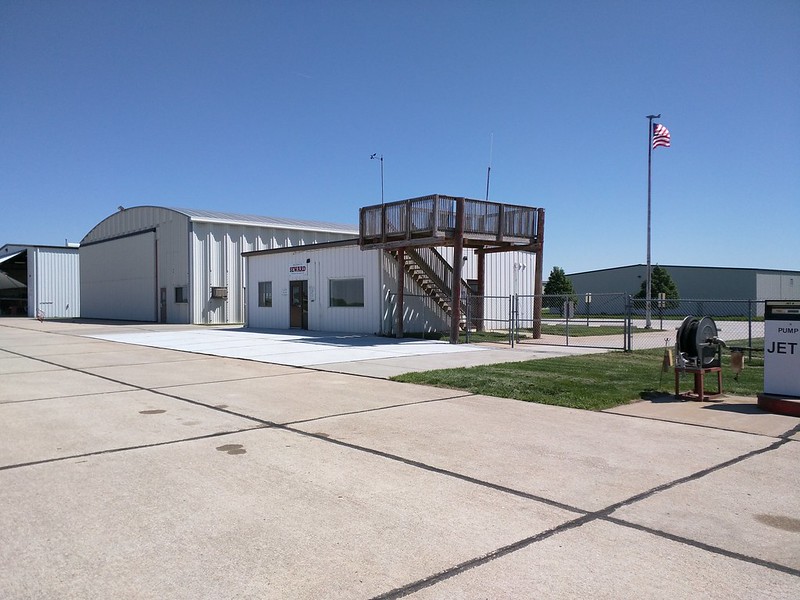
And then, of course, Peter would say, Well, we were flying home from South Dakota and figured we d stop in at Beatrice for fuel. And drop in on you. Followed by some surprise that we would stop at their little airport (which is quite a nice one). This all happened because it was windy. This is the fun adventure of aviation. Sometimes you plan to go to Texas, but the weather there is terrible, so you discover a 100-year-old landmark in Indiana instead. Or sometimes, like a couple of weeks ago, we planned to fly straight home but spent a few hours exploring rural Nebraska. The three of us flew to Sioux Falls, SD, in a little Cessna to visit my uncle and aunt up there. On our flight up, we stopped at the little airport in Seward, NE. It was complete with this unique elevated deck. In my imagination, this is used for people to drink beer while watching the planes land. IMG_20170512_113323 In South Dakota, we had a weekend full of card and board games, horseshoes, and Crokinole with my uncle and aunt, who are always fun to visit. We had many memories of visits up there as children and the pleasant enjoyment of the fact that we didn t need an 8-hour drive to get there. We flew back with a huge bag of large rhubarb from their garden (that too is something of a tradition!) It was a fun weekend to spend with my brothers first time we d been able to do this in a long while. And it marked the 11th state I ve flown into, and over 17,000 miles of flying.

3 June 2017

Norbert Preining: TeX Live 2017 released

TeX Live 2017 has been released! CTAN mirrors are busy updating. Get out bottles of good wine, and enjoy a good long download
Besides the huge amount of package updates due to the 2 month testing hiatus, I want to pick a few changes before copying the complete changelog entry: Additional TEXMF trees tlmgr got a new functionality to easily add and remove additional TEXMF trees to the search path. MikTeX had this features since long, and it was often requested. As it turned out, it is a rather trivial thing to achieve by some texmf.cnf lines. The rest is just front end in tlmgr. Here a few invocations (not very intelligent usage, though):
$ tlmgr conf auxtrees show
tlmgr: no auxiliary texmf trees defined.
$ tlmgr conf auxtrees add /projects/book-abc
$ tlmgr conf auxtrees
List of auxiliary texmf trees:
  /projects/book-abc
$ tlmgr conf auxtrees remove /projects/book-abc
$ tlmgr conf auxtrees show
tlmgr: no auxiliary texmf trees defined.
TeX Live Manager interactive shell tlmgr also got an interactive shell now, that can also be used for scripting. Available commands are all the usual command line actions, plus a few more (see documentation). Again, here a simple session:
$ tlmgr shell
protocol 1
tlmgr> load local
OK
tlmgr> load remote
tlmgr: package repositories
	main = /home/norbert/public_html/tlnet (verified)
	koma = http://www.komascript.de/repository/texlive/2017 (verified)
OK
tlmgr> update --list
tlmgr: package repositories
	main = /home/norbert/public_html/tlnet (verified)
	koma = http://www.komascript.de/repository/texlive/2017 (verified)
tlmgr: saving backups to /home/norbert/tl/2017/tlpkg/backups
tlmgr: no updates available
OK
tlmgr> byebye
$
User versus System mode for updmap and fmtutil I have reported on this during BachoTeX/TUG 2017, here are the slides, that the two central configuration programs updmap and fmtutil will change their operation mode slightly by disallowing invocations without mde specification. That is, one either needs to call updmap -sys (or updmap-sys, nothing changed here from previous years) or updmap -user (or updmap-user, new in TeX Live 2017). We hope by this and the accompanying web page of recommendations to help users not to shoot themselves to often by calling updmap without knowing the consequences. The upcoming proceedings of the BachoTeX will also comtain an article fully documenting both updmap and fmtutil including the most recent changes.
These were only a few changes where I had my fingers in the development. For the full list, read on below. Now get ready for partying, and also for the end of the peace, because daily package updates will restart in the next days. Enjoy Changes since TeX Live 2016 The following list of changes is directly from the TeX Live documentation.

29 May 2017

Enrico Zini: Egg-walking with qemu-nbd and kpartx

I wanted to retrieve a file from a VirtualBox VDI image for this blog post. I followed these instructions and ended up here:
Once having used nbd0, only rebooting the system makes it possible to mount another image ... a little bit unpractical.
What happened was this:
# modprobe nbd  # NOO! Don't *EVER* do that!
# qemu-nbd -c /dev/nbd0 file.vdi
# kpartx -d /dev/nbd0
# mount /dev/nbd0  EHI! Where's /dev/nbdpp1 ??
# qemu-nbd -d /dev/nbd0
# rmmod nbd
rmmod: ERROR: Module nbd is in use
# kpartx -d /dev/nbd0
read error, sector 0
llseek error
llseek error
llseek error
# rmmod nbd
rmmod: ERROR: Module nbd is in use
# WHAT THE 
It turns out it's really modprobe nbd max_part=16, otherwise max_part defaults to, uhm, zero? really? and kpartx cannot create device mappings because there are not enough (as in, not even a single one) partition devices available. At this point, however, kpartx did create some mappings connected to, uhm, probably Ancient Beings from beyond spacetime, and because of those the device is in use and cannot be removed, and unmapping doesn't work either because the Ancient Beings from beyond spacetime are keeping the device busy by feeding on it. I energized the pentacle and tried a desperate ritual of banishment:
# # Reconnect nbd0 to the vdi file to Restore the Balance
# qemu-nbd --verbose -c /dev/nbd0 file.vdi
# # This works now
# kpartx -vd /dev/nbd0
del devmap : nbd0p5
del devmap : nbd0p2
del devmap : nbd0p1
# # This too, the Ancient Beings lie asleep yet again
# modprobe nbd -r
At this point I managed to get my file, almost:
# modprobe nbd max_part=16
# qemu-nbd --verbose -c /dev/nbd0 file.vdi
NBD device /dev/nbd0 is now connected to file.vdi
# kpartx -va /dev/nbd0
add map nbd0p1 (254:12): 0 60260352 linear 43:0 2048
add map nbd0p2 (254:13): 0 2 linear 43:0 60264446
add map nbd0p5 (254:14): 0 2648064 linear 43:0 60264448
# mount /dev/nbd0p1 /mnt
mount: /dev/nbd0p1 is already mounted or /mnt busy
# # WHAT NOW?!
# lsblk
NAME                                       MAJ:MIN RM   SIZE RO TYPE  MOUNTPOINT
 
nbd0                                        43:0    0    30G  0 disk
 nbd0p1                                    43:1    0  28.8G  0 part
 nbd0p2                                    43:2    0     1K  0 part
 nbd0p5                                    43:5    0   1.3G  0 part
 nbd0p1                                   254:12   0  28.8G  0 part
 nbd0p2                                   254:13   0     1K  0 part
 nbd0p5                                   254:14   0   1.3G  0 part
# # WHAAAT?!!
# kpartx -vd /dev/nbd0
del devmap : nbd0p5
del devmap : nbd0p2
del devmap : nbd0p1
# lsblk
NAME                                       MAJ:MIN RM   SIZE RO TYPE  MOUNTPOINT
 
nbd0                                        43:0    0    30G  0 disk
 nbd0p1                                    43:1    0  28.8G  0 part
 nbd0p2                                    43:2    0     1K  0 part
 nbd0p5                                    43:5    0   1.3G  0 part
# mount /dev/nbd0p1 /mnt
# # I got my file, my preciouss file!
# umount /mnt
# kpartx -vd /dev/nbd0
# qemu-nbd -d /dev/nbd0
# rmmod nbd
# # sit in a corner hugging my precious file and sobbing quietly
As can be seen from the multiple exclamation marks, those Ancient Beings from beyond spacetime did manage to have a bite on my sanity after all.

27 May 2017

Russ Allbery: On time management

Last December, the Guardian published a long essay by Oliver Burkeman entitled "Why time management is ruining our lives". Those who follow my book reviews know I read a lot of time management books, so of course I couldn't resist this. And, possibly surprisingly, not to disagree with it. It's an excellent essay, and well worth your time. Burkeman starts by talking about Inbox Zero:
If all this fervour seems extreme Inbox Zero was just a set of technical instructions for handling email, after all this was because email had become far more than a technical problem. It functioned as a kind of infinite to-do list, to which anyone on the planet could add anything at will.
This is, as Burkeman develops in the essay, an important critique of time management techniques in general, not just Inbox Zero: perhaps you can become moderately more efficient, but what are you becoming more efficient at doing, and why does it matter? If there were a finite amount of things that you had to accomplish, with leisure the reward at the end of the fixed task list, doing those things more efficiently makes perfect sense. But this is not the case in most modern life. Instead, we live in a world governed by Parkinson's Law: "Work expands to fill the time available for its completion." Worse, we live in a world where the typical employer takes Parkinson's Law, not as a statement on the nature of ever-expanding to-do lists, but a challenge to compress the time made available for a task to try to force the work to happen faster. Burkeman goes farther into the politics, pointing out that a cui bono analysis of time management suggests that we're all being played by capitalist employers. I wholeheartedly agree, but that's worth a separate discussion; for those who want to explore that angle, David Graeber's Debt and John Kenneth Galbraith's The Affluent Society are worth your time. What I want to write about here is why I still read (and recommend) time management literature, and how my thinking on it has changed. I started in the same place that most people probably do: I had a bunch of work to juggle, I felt I was making insufficient forward progress on it, and I felt my day contained a lot of slack that could be put to better use. The alluring promise of time management is that these problems can be resolved with more organization and some focus techniques. And there is a huge surge of energy that comes with adopting a new system and watching it work, since the good ones build psychological payoff into the tracking mechanism. Starting a new time management system is fun! Finishing things is fun! I then ran into the same problem that I think most people do: after that initial surge of enthusiasm, I had lists, systems, techniques, data on where my time was going, and a far more organized intake process. But I didn't feel more comfortable with how I was spending my time, I didn't have more leisure time, and I didn't feel happier. Often the opposite: time management systems will often force you to notice all the things you want to do and how slow your progress is towards accomplishing any of them. This is my fundamental disagreement with Getting Things Done (GTD): David Allen firmly believes that the act of recording everything that is nagging at you to be done relieves the brain of draining background processing loops and frees you to be more productive. He argues for this quite persuasively; as you can see from my review, I liked his book a great deal, and used his system for some time. But, at least for me, this does not work. Instead, having a complete list of goals towards which I am making slow or no progress is profoundly discouraging and depressing. The process of maintaining and dwelling on that list while watching it constantly grow was awful, quite a bit worse psychologically than having no time management system at all. Mark Forster is the time management author who speaks the best to me, and one of the points he makes is that time management is the wrong framing. You're not going to somehow generate more time, and you're usually not managing minutes and seconds. A better framing is task management, or commitment management: the goal of the system is to manage what you mentally commit to accomplishing, usually by restricting that list to something far shorter than you would come up with otherwise. How, in other words, to limit your focus to a small enough set of goals that you can make meaningful progress instead of thrashing. That, for me, is now the merit and appeal of time (or task) management systems: how do I sort through all the incoming noise, distractions, requests, desires, and compelling ideas that life throws at me and figure out which of them are worth investing time in? I also benefit from structuring that process for my peculiar psychology, in which backlogs I have to look at regularly are actively dangerous for my mental well-being. Left unchecked, I can turn even the most enjoyable hobby into an obligation and then into a source of guilt for not meeting the (entirely artificial) terms of the obligation I created, without even intending to. And here I think it has a purpose, but it's not the purpose that the time management industry is selling. If you think of time management as a way to get more things done and get more out of each moment, you're going to be disappointed (and you're probably also being taken advantage of by the people who benefit from unsustainable effort without real, unstructured leisure time). I practice Inbox Zero, but the point wasn't to be more efficient at processing my email. The point was to avoid the (for me) psychologically damaging backlog of messages while acting on the knowledge that 99% of email should go immediately into the trash with no further action. Email is an endless incoming stream of potential obligations or requests for my time (even just to read a longer message) that I should normallly reject. I also take the time to notice patterns of email that I never care about and then shut off the source or write filters to delete that email for me. I can then reserve my email time for moments of human connection, directly relevant information, or very interesting projects, and spend the time on those messages without guilt (or at least much less guilt) about ignoring everything else. Prioritization is extremely difficult, particularly once you realize that true prioritization is not about first and later, but about soon or never. The point of prioritization is not to choose what to do first, it's to choose the 5% of things that you going to do at all, convince yourself to be mentally okay with never doing the other 95% (and not lying to yourself about how there will be some future point when you'll magically have more time), and vigorously defend your focus and effort for that 5%. And, hopefully, wholeheartedly enjoy working on those things, without guilt or nagging that there's something else you should be doing instead. I still fail at this all the time. But I'm better than I used to be. For me, that mental shift was by far the hardest part. But once you've made that shift, I do think the time management world has a lot of tools and techniques to help you make more informed choices about the 5%, and to help you overcome procrastination and loss of focus on your real goals. Those real goals should include true unstructured leisure and "because I want to" projects. And hopefully, if you're in a financial position to do it, include working less on what other people want you to do and more on the things that delight you. Or at least making a well-informed strategic choice (for the sake of money or some other concrete and constantly re-evaluated reason) to sacrifice your personal goals for some temporary external ones.

26 May 2017

Michael Prokop: The #newinstretch game: dbgsym packages in Debian/stretch

Debug packages include debug symbols and so far were usually named <package>-dbg in Debian. Those packages are essential if you ve to debug failing (especially: crashing) programs. Since December 2015 Debian has automatic dbgsym packages, being built by default. Those packages are available as <package>-dbgsym, so starting with Debian/stretch you should no longer look for -dbg packages but for -dbgsym instead. Currently there are 13.369 dbgsym packages available for the amd64 architecture of Debian/stretch, comparing this to the 2.250 packages which I counted being available for Debian/jessie this is really a huge improvement. (If you re interested in the details of dbgsym packages as a package maintainer take a look at the Automatic Debug Packages page in the Debian wiki.) The dbgsym packages are NOT provided by the usual Debian archive though (which is good thing, since those packages are quite disk space consuming, e.g. just the amd64 stretch mirror of debian-debug consumes 47GB). Instead there s a new archive called debian-debug. To get access to the dbgsym packages via the debian-debug suite on your Debian/stretch system include the following entry in your apt s sources.list configuration (replace deb.debian.org with whatever mirror you prefer):
deb http://deb.debian.org/debian-debug/ stretch-debug main
If you re not yet familiar with usage of such debug packages let me give you a short demo. Let s start with sending SIGILL (Illegal Instruction) to a running sha256sum process, causing it to generate a so called core dump file:
% sha256sum /dev/urandom &
[1] 1126
% kill -4 1126
% 
[1]+  Illegal instruction     (core dumped) sha256sum /dev/urandom
% ls
core
$ file core
core: ELF 64-bit LSB core file x86-64, version 1 (SYSV), SVR4-style, from 'sha256sum /dev/urandom', real uid: 1000, effective uid: 1000, real gid: 1000, effective gid: 1000, execfn: '/usr/bin/sha256sum', platform: 'x86_64'
Now we can run the GNU Debugger (gdb) on this core file, executing:
% gdb sha256sum core
[...]
Type "apropos word" to search for commands related to "word"...
Reading symbols from sha256sum...(no debugging symbols found)...done.
[New LWP 1126]
Core was generated by  sha256sum /dev/urandom'.
Program terminated with signal SIGILL, Illegal instruction.
#0  0x000055fe9aab63db in ?? ()
(gdb) bt
#0  0x000055fe9aab63db in ?? ()
#1  0x000055fe9aab8606 in ?? ()
#2  0x000055fe9aab4e5b in ?? ()
#3  0x000055fe9aab42ea in ?? ()
#4  0x00007faec30872b1 in __libc_start_main (main=0x55fe9aab3ae0, argc=2, argv=0x7ffc512951f8, init=<optimized out>, fini=<optimized out>, rtld_fini=<optimized out>, stack_end=0x7ffc512951e8) at ../csu/libc-start.c:291
#5  0x000055fe9aab4b5a in ?? ()
(gdb) 
As you can see by the several ?? question marks, the bt command (short for backtrace) doesn t provide useful information.
So let s install the according debug package, which is coreutils-dbgsym in this case (since the sha256sum binary which generated the core file is part of the coreutils package). Then let s rerun the same gdb steps:
% gdb sha256sum core
[...]
Type "apropos word" to search for commands related to "word"...
Reading symbols from sha256sum...Reading symbols from /usr/lib/debug/.build-id/a4/b946ef7c161f2d215518ca38d3f0300bcbdbb7.debug...done.
done.
[New LWP 1126]
Core was generated by  sha256sum /dev/urandom'.
Program terminated with signal SIGILL, Illegal instruction.
#0  0x000055fe9aab63db in sha256_process_block (buffer=buffer@entry=0x55fe9be95290, len=len@entry=32768, ctx=ctx@entry=0x7ffc51294eb0) at lib/sha256.c:526
526     lib/sha256.c: No such file or directory.
(gdb) bt
#0  0x000055fe9aab63db in sha256_process_block (buffer=buffer@entry=0x55fe9be95290, len=len@entry=32768, ctx=ctx@entry=0x7ffc51294eb0) at lib/sha256.c:526
#1  0x000055fe9aab8606 in sha256_stream (stream=0x55fe9be95060, resblock=0x7ffc51295080) at lib/sha256.c:230
#2  0x000055fe9aab4e5b in digest_file (filename=0x7ffc51295f3a "/dev/urandom", bin_result=0x7ffc51295080 "\001", missing=0x7ffc51295078, binary=<optimized out>) at src/md5sum.c:624
#3  0x000055fe9aab42ea in main (argc=<optimized out>, argv=<optimized out>) at src/md5sum.c:1036
As you can see it s reading the debug symbols from /usr/lib/debug/.build-id/a4/b946ef7c161f2d215518ca38d3f0300bcbdbb7.debug and this is what we were looking for.
gdb now also tells us that we don t have lib/sha256.c available. For even better debugging it s useful to have the according source code available. This is also just an apt-get source coreutils ; cd coreutils-8.26/ away:
~/coreutils-8.26 % gdb sha256sum ~/core
[...]
Type "apropos word" to search for commands related to "word"...
Reading symbols from sha256sum...Reading symbols from /usr/lib/debug/.build-id/a4/b946ef7c161f2d215518ca38d3f0300bcbdbb7.debug...done.
done.
[New LWP 1126]
Core was generated by  sha256sum /dev/urandom'.
Program terminated with signal SIGILL, Illegal instruction.
#0  0x000055fe9aab63db in sha256_process_block (buffer=buffer@entry=0x55fe9be95290, len=len@entry=32768, ctx=ctx@entry=0x7ffc51294eb0) at lib/sha256.c:526
526           R( h, a, b, c, d, e, f, g, K(25), M(25) );
(gdb) bt
#0  0x000055fe9aab63db in sha256_process_block (buffer=buffer@entry=0x55fe9be95290, len=len@entry=32768, ctx=ctx@entry=0x7ffc51294eb0) at lib/sha256.c:526
#1  0x000055fe9aab8606 in sha256_stream (stream=0x55fe9be95060, resblock=0x7ffc51295080) at lib/sha256.c:230
#2  0x000055fe9aab4e5b in digest_file (filename=0x7ffc51295f3a "/dev/urandom", bin_result=0x7ffc51295080 "\001", missing=0x7ffc51295078, binary=<optimized out>) at src/md5sum.c:624
#3  0x000055fe9aab42ea in main (argc=<optimized out>, argv=<optimized out>) at src/md5sum.c:1036
(gdb) 
Now we re ready for all the debugging magic. :) Thanks to everyone who was involved in getting us the automatic dbgsym package builds in Debian!

22 May 2017

Michal &#268;iha&#345;: HackerOne experience with Weblate

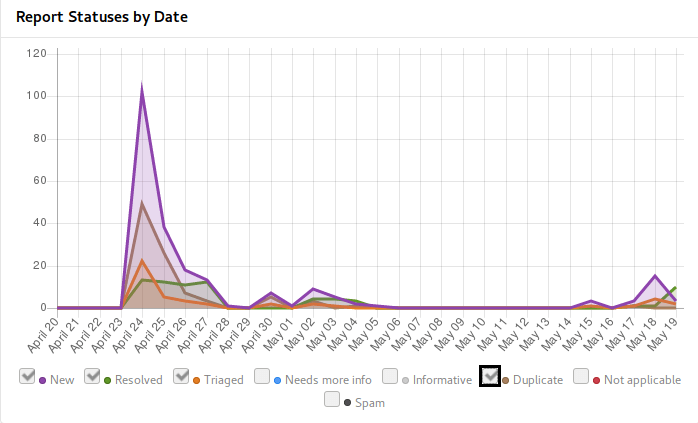
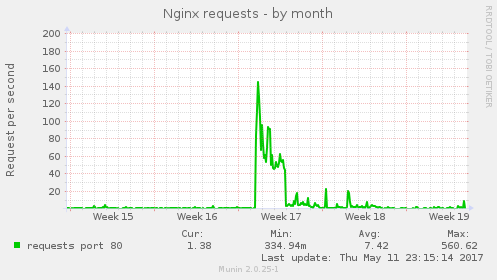
Weblate has started to use HackerOne Community Edition some time ago and I think it's good to share my experience with that. Do you have open source project and want to get more attention of security community? This post will answer how it looks from perspective of pretty small project. I've applied with Weblate to HackerOne Community Edition by end of March and it was approved early in April. Based on their recommendations I've started in invite only mode, but that really didn't bring much attention (exactly none reports), so I've decided to go public. I've asked for making the project public just after coming from two weeks vacation, while expecting the approval to take some time where I'll settle down things which have popped up during vacation. In the end that was approved within single day, so I was immediately under fire of incoming reports: Reports on HackerOne I was surprised that they didn't lie - you will really get huge amount of issues just after making your project public. Most of them were quite simple and repeating (as you can see from number of duplicates), but it really provided valuable input. Even more surprisingly there was second peak coming in when I've started to disclose resolved issues (once Weblate 2.14 has been released). Overall the issues could be divided to few groups: In the end it was really challenging week to be able to cope with the incoming reports, but I think I've managed it quite well. The HackerOne metrics states that there are 2 hours in average to respond on incoming incidents, what I think will not work in the long term :-). Anyway thanks to this, you can now enjoy Weblate 2.14 which more secure than any release before, if you have not yet upgraded, you might consider doing that now or look into our support offering for self hosted Weblate. The downside of this all was that the initial publishing on HackerOne made our website target of lot of automated tools and the web server was not really ready for that. I'm really sorry to all Hosted Weblate users who were affected by this. This has been also addressed now, but the infrastructure really should have been prepared before on this. To share how it looked like, here is number of requests to the nginx server: nxing requests I'm really glad I could make Weblate available on HackerOne as it will clearly improve it's security and security of hosted offering we have. I will certainly consider providing swag and/or bounties on further severe reports, but that won't be possible without enough funding for Weblate.
Filed under: Debian English SUSE Weblate

21 May 2017

Russ Allbery: Review: Sector General

Review: Sector General, by James White
Series: Sector General #5
Publisher: Orb
Copyright: 1983
Printing: 2002
ISBN: 0-312-87770-6
Format: Trade paperback
Pages: 187
Sector General is the fifth book (or, probably more accurately, collection) in the Sector General series. I blame the original publishers for the confusion. The publication information is for the Alien Emergencies omnibus, which includes the fourth through the sixth books in the series. Looking back on my previous reviews of this series (wow, it's been eight years since I read the last one?), I see I was reviewing them as novels rather than as short story collections. In retrospect, that was a mistake, since they're composed of clearly stand-alone stories with a very loose arc. I'm not going to go back and re-read the earlier collections to give them proper per-story reviews, but may as well do this properly here. Overall, this collection is more of the same, so if that's what you want, there won't be any negative surprises. It's another four engineer-with-a-wrench stories about biological and medical puzzles, with only a tiny bit of characterization and little hint to any personal life for any of the characters outside of the job. Some stories are forgettable, but White does create some memorable aliens. Sadly, the stories don't take us to the point of real communication, so those aliens stop at biological puzzles and guesswork. "Combined Operation" is probably the best, although "Accident" is the most philosophical and an interesting look at the founding principle of Sector General. "Accident": MacEwan and Grawlya-Ki are human and alien brought together by a tragic war, and forever linked by a rather bizarre war monument. (It's a very neat SF concept, although the implications and undiscussed consequences don't bear thinking about too deeply.) The result of that war was a general recognition that such things should not be allowed to happen again, and it brought about a new, deep commitment to inter-species tolerance and politeness. Which is, in a rather fascinating philosophical twist, exactly what MacEwan and Grawlya-Ki are fighting against: not the lack of aggression, which they completely agree with, but with the layers of politeness that result in every species treating all others as if they were eggshells. Their conviction is that this cannot create a lasting peace. This insight is one of the most profound bits I've read in the Sector General novels and supports quite a lot of philosophical debate. (Sadly, there isn't a lot of that in the story itself.) The backdrop against which it plays out is an accidental crash in a spaceport facility, creating a dangerous and potentially deadly environment for a variety of aliens. Given the collection in which this is included and the philosophical bent described above, you can probably guess where this goes, although I'll leave it unspoiled if you can't. It's an idea that could have been presented with more subtlety, but it's a really great piece of setting background that makes the whole series snap into focus. A much better story in context than its surface plot. (7) "Survivor": The hospital ship Rhabwar rescues a sole survivor from the wreck of an alien ship caused by incomplete safeguards on hyperdrive generators. The alien is very badly injured and unconscious and needs the full attention of Sector General, but on the way back, the empath Prilicla also begins suffering from empathic hypersensitivity. Conway, the protagonist of most of this series, devotes most of his attention to that problem, having delivered the rescued alien to competent surgical hands. But it will surprise no regular reader that the problems turn out to be linked (making it a bit improbable that it takes the doctors so long to figure that out). A very typical entry in the series. (6) "Investigation": Another very typical entry, although this time the crashed spaceship is on a planet. The scattered, unconscious bodies of the survivors, plus signs of starvation and recent amputation on all of them, convinces the military (well, police is probably more accurate) escort that this is may be a crime scene. The doctors are unconvinced, but cautious, and local sand storms and mobile vegetation add to the threat. I thought this alien design was a bit less interesting (and a lot creepier). (6) "Combined Operation": The best (and longest) story of this collection. Another crashed alien spacecraft, but this time it's huge, large enough (and, as they quickly realize, of a design) to indicate a space station rather than a ship, except that it's in the middle of nowhere and each segment contains a giant alien worm creature. Here, piecing together the biology and the nature of the vehicle is only the beginning; the conclusion points to an even larger problem, one that requires drawing on rather significant resources to solve. (On a deadline, of course, to add some drama.) This story requires the doctors to go unusually deep into the biology and extrapolated culture of the alien they're attempting to rescue, which made it more intellectually satisfying for me. (7) Followed by Star Healer. Rating: 6 out of 10

Adnan Hodzic: Automagically deploy & run containerized WordPress (PHP7 FPM, Nginx, MariaDB) using Ansible + Docker on AWS

In this blog post, I ve described what started as simple migration of WordPress blog to AWS, ended up as automation project consisting of publishing multiple Ansible roles deploying and running multiple Docker images. If you re not interested in reading about my entire journey, cognition gains and how this process came to be, please skim down to Birth of: containerized-wordpress-project (TL;DR) section. Migrating WordPress blog to AWS (EC2, Lightsail?) Since I ve been sold on Amazon s AWS idea of cloud computing services for couple of years now. I ve wanted, and been trying to migrate this (WordPress) blog to AWS, but somehow it never worked out. Moving it to EC2 instance, with its own ELB volumes, AMI, EIP, Security Group it just seemed as an overkill. When AWS Lightsail was first released, it seemed that was an answer to all my problems. But it wasn t, disregarding its bit restrictive/dumbed down versions of original features. Living in Amsterdam, my main problem with it was that it was only available in a single US region. Regardless, I thought it had everything I needed for WordPress site, and as a new service, it had great potential. Its regional limitations were also good in a sense that they made me realize one important thing. And that s once I migrate my blog to AWS, I want to be able to seamlessly move/migrate it across different EC2 s and different regions once they were available. If done properly, it meant I could even have it moved across different clouds (I m talking to you Google Cloud). P.S: AWS Lightsail is now available in couple of different regions across Europe. Rollout which was almost smoothless. Fundamental problem of every migration is migration

Phase 1: Don t reinvent the wheel? When you have a WordPress site that s not self hosted. You want everything to work, but yet you really don t want to spend any time managing infrastructure it s on. And as soon as I started looking what could fit this criteria, I found that there were pre-configured, running out of box WordPress EC2 images available on AWS Marketplace, great! But when I took a look, although everything was running out of box, I wasn t happy with software stack it was all built on. Namely Ubuntu 14.04 and Apache, and all of the services were started using custom scripts. Yuck. With this setup, when it was time to upgrade (and it s already that time) you wouldn t be thinking about upgrade. You d only be thinking about another migration. Phase 2: What if I built everything myself? Installing and configuring everything manually, and then writing huge HowTo which I would follow when I needed to re-create whole stack was not an option. Same case with was scripting whole process, as overhead of changes that had to be tracked was too way too big. Being a huge Ansible fan, automating this step was a natural next step. I even found an awesome Ansible role which seemed like it s going to do everything I need. Except, I realized I needed to update all software that s deployed with it, and customize it since configuration it was deployed on wasn t as generic. So I forked it and got to work. But soon enough, I was knee deep in making and fiddling with various system changes. Something I was trying to get away in this case, and most importantly something I was trying to avoid when it was time for next update. Phase 3: Marriage made in heaven: Ansible + Docker + AWS Idea to have everything Dockerized was around from very start. However, it never made a lot of sense until I put Ansible into same picture. And it was at this point where my final idea and requirements become crystal clear. Use Ansible to configure and setup host ready for Docker ecosystem. Ecosystem consisting of multiple separate containers for each required service (WordPress + Nginx + MariaDB). Link them all together as a single service using Docker Compose. Idea was backed by thought to spend minimum to no time (and effort) on manual configuration of anything on the server. Level of attachment to this server was so low that I didn t even want to SSH to it. If there was something wrong, I could just nuke the whole thing and deploy code on a new healthy rolled out server with everything working out of box. After it was clear what needed to be done, I got to work.

Birth of: containerized-wordpress-project (TL;DR)

After a lot of work, end result is project which allows you to automagically deploy & run containerized WordPress instance which consists of 3 separate containers running:

Once run, containerized-wordpress playbook will guide you through interactive setup of all 3 containers, after which it will run all Ansible roles created for this project. End result is that host you have never even SSH-ed to will be fully configured and running containerized WordPress instace out of box.

Most importantly, this whole process will be completed in <= 5 minutes and doesn t require any Docker or Ansible knowledge! containerized-wordpress demo Console output of running containerized-wordpress Ansible Playbook: Console output of running "containerized-wordpress" Ansible Playbook

Accessing WordPress instance created from containerized-wordpress Ansible Playbook:

Accessing WordPress instance created from "containerized-wordpress" Ansible Playbook Did I end up migrating to AWS in the end? You bet. Thanks to efforts made in containerized-wordpress-project, I m happy to report my whole WordPress migration to AWS was completed in matter of minutes and that this blog is now running on Docker and on AWS! I hope this same project will help you take a leap in your migration. Happy hacking!

20 May 2017

Ritesh Raj Sarraf: Patanjali Research Foundation

PSA: Research in the domain of Ayurveda

http://www.patanjaliresearchfoundation.com/patanjali/
I am so glad to see this initiative taken by the Patanjali group. This is a great stepping stone in the health and wellness domain. So far, Allopathy has been blunt in discarding alternate medicine practices, without much solid justification. The only, repetitive, response I've heard is "lack of research". This initiative definitely is a great step in that regard. Ayurveda (Ancient Hindu art of healing) has a huge potential to touch lives. For the Indian sub-continent, this has the potential of a blessing. The Prime Minister of India himself inaugurated the research centre.

Categories:

Keywords:

Like:

17 May 2017

Daniel Pocock: Hacking the food chain in Switzerland

A group has recently been formed on Meetup seeking to build a food computer in Zurich. The initial meeting is planned for 6:30pm on 20 June 2017 at ETH, (Zurich Centre/Zentrum, R mistrasse 101). The question of food security underlies many of the world's problems today. In wealthier nations, we are being called upon to trust a highly opaque supply chain and our choices are limited to those things that major supermarket chains are willing to stock. A huge transport and storage apparatus adds to the cost and CO2 emissions and detracts from the nutritional value of the produce that reaches our plates. In recent times, these problems have been highlighted by the horsemeat scandal, the Guacapocalypse and the British Hummus crisis. One interesting initiative to create transparency and encourage diversity in our diets is the Open Agriculture (OpenAg) Initiative from MIT, summarised in this TED video from Caleb Harper. The food produced is healthier and fresher than anything you might find in a supermarket and has no exposure to pesticides. An open source approach to food An interesting aspect of this project is the promise of an open source approach. The project provides hardware plans, a a video of the build process, source code and the promise of sharing climate recipes (scripts) to replicate the climates of different regions, helping ensure it is always the season for your favour fruit or vegetable. Do we need it? Some people have commented on the cost of equipment and electricity. Carsten Agger recently blogged about permaculture as a cleaner alternative. While there are many places where people can take that approach, there are also many overpopulated regions and cities where it is not feasible. Some countries, like Japan, have an enormous population and previously productive farmland contaminated by industry, such as the Fukushima region. Growing our own food also has the potential to reduce food waste, as individual families and communities can grow what they need. Whether it is essential or not, the food computer project also provides a powerful platform to educate people about food and climate issues and an exciting opportunity to take the free and open source philosophy into many more places in our local communities. The Zurich Meetup group has already received expressions of interest from a diverse group including professionals, researchers, students, hackers, sustainability activists and free software developers. Next steps People who want to form a group in their own region can look in the forum topic "Where are you building your Food Computer?" to find out if anybody has already expressed interest. Which patterns from the free software world can help more people build more food computers? I've already suggested using Debian's live-wrapper to distribute a runnable ISO image that can boot from a USB stick, can you suggest other solutions like this? Can you think of any free software events where you would like to see a talk or exhibit about this project? Please suggest them on the OpenAg forum. There are many interesting resources about the food crisis, an interesting starting point is watching the documentary Food, Inc. If you are in Switzerland, please consider attending the meeting on at 6:30pm on 20 June 2017 at ETH (Centre/Zentrum), Zurich. One final thing to contemplate: if you are not hacking your own food supply, who is?

16 May 2017

Rapha&#235;l Hertzog: Freexian s report about Debian Long Term Support, April 2017

A Debian LTS logoLike each month, here comes a report about the work of paid contributors to Debian LTS. Individual reports In April, about 190 work hours have been dispatched among 13 paid contributors. Their reports are available: Evolution of the situation The number of sponsored hours decreased slightly and we re now again a little behind our objective. The security tracker currently lists 54 packages with a known CVE and the dla-needed.txt file 37. The number of open issues is comparable to last month. Thanks to our sponsors New sponsors are in bold.

No comment Liked this article? Click here. My blog is Flattr-enabled.

14 May 2017

Steve Kemp: Some minor updates ..

The past few weeks have been randomly busy, nothing huge has happened, but several minor diversions. Coding

I made a new release of my console-based mail-client, with integrated Lua scripting, this is available for download over at https://lumail.org/ I've also given a talk (!!) on using a literate/markdown configuration for GNU Emacs. In brief I created two files:
~/.emacs/init.md
This contains both my configuration of GNU Emacs as well as documentation for the same. Neat.
~/.emacs/init.el
This parse the previous file, specifically looking for "code blocks" which are then extracted and evaluated.
This system is easy to maintain, and I'm quite happy with it :)
Fuzzing
Somebody nice took the time to report a couple of bugs against my simple bytecode-intepretting virtual-machine project - all found via fuzzing. I've done some fun fuzzing of my own in the past, so this was nice to see. I've now resolved those bugs, and updated the README.md file to include instructions on fuzzing it. (Which I started doing myself, after receiving the first of the reports )
Finally I have more personal news too: I had a pair of CT-scans carried out recently, and apparently here in sunny Finland (that's me being ironic, it was snowing in the first week of May) when you undergo a CT-scan you can pay to obtain your data on CD-ROM. I'm 100% definitely going to get a copy of my brain-scan data. I'll be able to view a 3d-rendered model of my own brain on my desktop. (Once upon a time I worked for a company that produced software, sold to doctors/surgeons, for creating 3d-rendered volumes from individual slices. I confirmed with the radiologist that handled my tests that they do indeed use the standard DICOM format. Small world.)

1 May 2017

Matthew Garrett: Intel's remote AMT vulnerablity

Intel just announced a vulnerability in their Active Management Technology stack. Here's what we know so far.
Background Intel chipsets for some years have included a Management Engine, a small microprocessor that runs independently of the main CPU and operating system. Various pieces of software run on the ME, ranging from code to handle media DRM to an implementation of a TPM. AMT is another piece of software running on the ME, albeit one that takes advantage of a wide range of ME features.
Active Management TechnologyAMT is intended to provide IT departments with a means to manage client systems. When AMT is enabled, any packets sent to the machine's wired network port on port 16992 or 16993 will be redirected to the ME and passed on to AMT - the OS never sees these packets. AMT provides a web UI that allows you to do things like reboot a machine, provide remote install media or even (if the OS is configured appropriately) get a remote console. Access to AMT requires a password - the implication of this vulnerability is that that password can be bypassed.
Remote managementAMT has two types of remote console: emulated serial and full graphical. The emulated serial console requires only that the operating system run a console on that serial port, while the graphical environment requires drivers on the OS side requires that the OS set a compatible video mode but is also otherwise OS-independent[2]. However, an attacker who enables emulated serial support may be able to use that to configure grub to enable serial console. Remote graphical console seems to be problematic under Linux but some people claim to have it working, so an attacker would be able to interact with your graphical console as if you were physically present. Yes, this is terrifying.
Remote mediaAMT supports providing an ISO remotely. In older versions of AMT (before 11.0) this was in the form of an emulated IDE controller. In 11.0 and later, this takes the form of an emulated USB device. The nice thing about the latter is that any image provided that way will probably be automounted if there's a logged in user, which probably means it's possible to use a malformed filesystem to get arbitrary code execution in the kernel. Fun!

The other part of the remote media is that systems will happily boot off it. An attacker can reboot a system into their own OS and examine drive contents at their leisure. This doesn't let them bypass disk encryption in a straightforward way[1], so you should probably enable that.
How bad is thisThat depends. Unless you've explicitly enabled AMT at any point, you're probably fine. The drivers that allow local users to provision the system would require administrative rights to install, so as long as you don't have them installed then the only local users who can do anything are the ones who are admins anyway. If you do have it enabled, though
How do I know if I have it enabled?Yeah this is way more annoying than it should be. First of all, does your system even support AMT? AMT requires a few things:

1) A supported CPU
2) A supported chipset
3) Supported network hardware
4) The ME firmware to contain the AMT firmware

Merely having a "vPRO" CPU and chipset isn't sufficient - your system vendor also needs to have licensed the AMT code. Under Linux, if lspci doesn't show a communication controller with "MEI" or "HECI" in the description, AMT isn't running and you're safe. If it does show an MEI controller, that still doesn't mean you're vulnerable - AMT may still not be provisioned. If you reboot you should see a brief firmware splash mentioning the ME. Hitting ctrl+p at this point should get you into a menu which should let you disable AMT.
How about over Wifi?Turning on AMT doesn't automatically turn it on for wifi. AMT will also only connect itself to networks it's been explicitly told about. Where things get more confusing is that once the OS is running, responsibility for wifi is switched from the ME to the OS and it forwards packets to AMT. I haven't been able to find good documentation on whether having AMT enabled for wifi results in the OS forwarding packets to AMT on all wifi networks or only ones that are explicitly configured.
What do we not know?We have zero information about the vulnerability, other than that it allows unauthenticated access to AMT. One big thing that's not clear at the moment is whether this affects all AMT setups, setups that are in Small Business Mode, or setups that are in Enterprise Mode. If the latter, the impact on individual end-users will be basically zero - Enterprise Mode involves a bunch of effort to configure and nobody's doing that for their home systems. If it affects all systems, or just systems in Small Business Mode, things are likely to be worse.
We now know that the vulnerability exists in all configurations.
What should I do?Make sure AMT is disabled. If it's your own computer, you should then have nothing else to worry about. If you're a Windows admin with untrusted users, you should also disable or uninstall LMS by following these instructions.
Does this mean every Intel system built since 2008 can be taken over by hackers?No. Most Intel systems don't ship with AMT. Most Intel systems with AMT don't have it turned on.
Does this allow persistent compromise of the system?Not in any novel way. An attacker could disable Secure Boot and install a backdoored bootloader, just as they could with physical access.
But isn't the ME a giant backdoor with arbitrary access to RAM?Yes, but there's no indication that this vulnerability allows execution of arbitrary code on the ME - it looks like it's just (ha ha) an authentication bypass for AMT.
Is this a big deal anyway?Yes. Fixing this requires a system firmware update in order to provide new ME firmware (including an updated copy of the AMT code). Many of the affected machines are no longer receiving firmware updates from their manufacturers, and so will probably never get a fix. Anyone who ever enables AMT on one of these devices will be vulnerable. That's ignoring the fact that firmware updates are rarely flagged as security critical (they don't generally come via Windows update), so even when updates are made available, users probably won't know about them or install them.
Avoiding this kind of thing in futureUsers ought to have full control over what's running on their systems, including the ME. If a vendor is no longer providing updates then it should at least be possible for a sufficiently desperate user to pay someone else to do a firmware build with the appropriate fixes. Leaving firmware updates at the whims of hardware manufacturers who will only support systems for a fraction of their useful lifespan is inevitably going to end badly.
How certain are you about any of this?Not hugely - the quality of public documentation on AMT isn't wonderful, and while I've spent some time playing with it (and related technologies) I'm not an expert. If anything above seems inaccurate, let me know and I'll fix it.

[1] Eh well. They could reboot into their own OS, modify your initramfs (because that's not signed even if you're using UEFI Secure Boot) such that it writes a copy of your disk passphrase to /boot before unlocking it, wait for you to type in your passphrase, reboot again and gain access. Sealing the encryption key to the TPM would avoid this.

[2] Updated after this comment - I thought I'd fixed this before publishing but left that claim in by accident.

(Updated to add the section on wifi)

(Updated to typo replace LSM with LMS)

(Updated to indicate that the vulnerability affects all configurations)

comment count unavailable comments

30 April 2017

Russ Allbery: Review: Periodic Tales

Review: Periodic Tales, by Hugh Aldersey-Williams
Publisher: HarperCollins
Copyright: February 2011
ISBN: 0-06-207881-X
Format: Kindle
Pages: 451
Perhaps my favorite chapter in Randall Munroe's What If? is his examination of what would happen if you assembled a periodic table from square blocks of each element. As with most What If? questions, the answer is "everyone in the vicinity dies," but it's all about the journey. The periodic table is full of so many elements that we rarely hear about but which have fascinating properties. It was partly in the memory of that chapter that I bought Periodic Tales on impulse after seeing a mention of it somewhere on the Internet (I now forget where). Hugh Aldersey-Williams is a journalist and author, but with a background in natural sciences. He also has a life-long hobby of collecting samples of the elements and attempting to complete his own private copy of the periodic table, albeit with considerably more precautions and sample containment than Munroe's thought experiment. Periodic Tales is inspired by that collection. It's a tour and cultural history of many of the elements, discussing their discovery, their role in commerce and industry, their appearance, and often some personal anecdotes. This is not exactly a chemistry book, although there's certainly some chemistry here, nor is it a history, although Aldersey-Williams usually includes some historical notes about each element he discusses. The best term might be an anthropology of the elements: a discussion of how they've influenced culture and an examination of the cultural assumptions and connections we've constructed around them. But primarily it's an idiosyncratic and personal tour of the things Aldersey-Williams found interesting about each one. Periodic Tales is not comprehensive. The completionist in me found that a bit disappointing, and there are a few elements that I think would have fit the overall thrust of the book but are missing. (Lithium and its connection to mental health and now computer batteries comes to mind.) It's also not organized in the obvious way, either horizontally or vertically along the periodic table. Instead, Aldersey-Williams has divided the elements he talks about into five major but fairly artificial divisions: power (primarily in the economic sense), fire (focused on burning and light), craft (the materials from which we make things), beauty, and earth. Obviously, these are fuzzy; silver appears in craft, but could easily be in power with gold. I'm not sure how defensible this division was. But it does, for good or for ill, break the reader's mind away from a purely chemical and analytical treatment and towards broader cultural associations. This cultural focus, along with Aldersey-Williams's clear and conversational style, are what pull this book firmly away from being a beautified recitation of facts that could be gleamed from Wikipedia. It also leads to some unexpected choices of focus. For example, the cultural touchstone he chooses for sodium is not salt (which is a broad enough topic for an entire book) but sodium street lights, the ubiquitous and color-distorting light of modern city nights, thus placing salt in the "fire" category of the book. Discussion of cobalt is focused on pigments: the brilliant colors of paint made possible by its many brightly-colored compounds. Arsenic is, of course, a poison, but it's also a source of green, widely used in wallpaper (and Aldersey-Williams discusses the connection with the controversial death of Napoleon). And the discussion of aluminum starts with a sculpture, and includes a fascinating discussion of "banalization" as we become used to use of a new metal, which the author continues when looking a titanium and its currently-occurring cultural transition between the simply new and modern and a well-established metal with its own unique cultural associations. One drawback of the somewhat scattered organization is that, while Periodic Tales provides fascinating glimmers of the history of chemistry and the search to isolate elements, those glimmers are disjointed and presented in no particular order. Recently-discovered metals are discussed alongside ancient ones, and the huge surge in elemental isolation in the 1800s is all jumbled together. Wikipedia has a very useful timeline that helps sort out one's sense of history, but there was a part of me left wanting a more structured presentation. I read books like this primarily for the fascinating trivia. Mercury: known in ancient times, but nearly useless, so used primarily for ritual and decoration (making the modern reader cringe). Relative abundancies of different elements, which often aren't at all what one might think. Rare earths (not actually that rare): isolated through careful, tedious work by Swedish mining chemists whom most people have never heard of, unlike the discoverers of many other elements. And the discovery of the noble gases, which is a fascinating bit of disruptive science made possible by new technology (the spectroscope), forcing a rethinking of the periodic table (which had no column for noble gases). I read a lot of this while on vacation and told interesting tidbits to my parents over breakfast or dinner. It's that sort of book. This is definitely in the popular science and popular writing category, for all the pluses and minuses that brings. It's not a detailed look at either chemistry or history. But it's very fun to read, it provides a lot of conversational material, and it takes a cultural approach that would not have previously occurred to me. Recommended if you like this sort of thing. Rating: 7 out of 10

29 April 2017

Russ Allbery: Review: Neverness

Review: Neverness, by David Zindell
Publisher: Bantam Spectra
Copyright: May 1988
Printing: July 1989
ISBN: 0-553-27903-3
Format: Mass market
Pages: 552
Mallory Ringess is a Pilot, one of the people who can guide a lightship through interstellar space from inside the dark cocoon and biotech interface that allows visualization of the mathematics of interstellar travel. At the start of the book, he's young, arrogant, impulsive, and has a deeply unhealthy relationship with Leopold Soli, the Lord Pilot and supposedly his uncle by marriage (although they share a remarkable physical resemblance). An encounter with his uncle in a bar provokes a rash promise, and Ringess finds himself promising to attempt to map the Solid State Entity in search of the Elder Eddas, a secret of life from the mythical Ieldra that might lead to mankind's immortality. The opening of Neverness is Ringess's initial voyage and brash search, in which he proves to be a capable mathematician who can navigate a region of space twisted and deformed by becoming part of a transcendent machine intelligence. The knowledge he comes away with, though, is scarcely more coherent than the hints Soli relates at the start of the story: the secret of mankind is somehow hidden in its deepest past. That, in turn, provokes a deeply bizarre trip into the ice surrounding his home city of Neverness to attempt to steal biological material from people who have recreated themselves as Neanderthals. Beyond that point, I would say that things get even weirder, but weird still implies some emotional connection with the story. I think a more accurate description is that the book gets more incoherently mystical, more hopelessly pretentious, and more depressingly enthralled by childish drama. It's the sort of thing that one writes if one is convinced that the Oedipal complex is the height of subtle characterization. I loathed this book. I started loathing this book partway through Ringess's trip through the Solid State Entity, when Zindell's prose reached for transcendent complexity, tripped over its own shoelaces, and fell headlong into overwrought babbling. I continued reading every page because there's a perverse pleasure in hate-reading a book one dislikes this intensely, and because I wanted to write a review on the firm foundation of having endured the entire experience. The paperback edition I have has a pull quote from Orson Scott Card on the cover, which includes the phrase "excellent hard science fiction." I'm not sure what book Card read, because if this is hard science fiction, Lord of the Rings is paranormal romance. Even putting aside the idea that one travels through interstellar space by proving mathematical theorems in artificially dilated time (I don't think Zindell really understands what a proof is or why you write one), there's the whole business with stopping time with one's mind, reading other people's minds, and remembering one's own DNA. The technology, such as it is, makes considerably less sense than Star Wars. The hard SF requirement to keep technology consistent with extrapolated science is nowhere to be found here. The back-cover quote from the St. Louis Post-Dispatch is a bit more on-target: "Reminiscent of Gene Wolfe's New Sun novels... really comes to life among the intrigues of Neverness." This is indeed reminiscent of Gene Wolfe, in that it wouldn't surprise me at all if Zindell fell in love with the sense of antiquity, strangeness, and hints of understood technology that Wolfe successfully creates and attempted to emulate Wolfe in his first novel. Sadly, Zindell isn't Wolfe. Almost no one is, which is why attempting to emulate the extremely difficult feat Wolfe pulls off in the Book of the New Sun in your first novel is not a good idea. The results aren't pretty. There is something to be said for resplendent descriptions, rich with detail and ornamental prose. That something is "please use sparingly and with an eye to the emotional swings of the novel." Wolfe does not try to write most of a novel that way, which is what makes those moments of description so effective. Wolfe is also much better at making his mysteries and allusions subtle and unobtrusive, rather than having the first-person protagonist beat the reader over the head with them for pages at a time. This is a case where showing is probably better than telling. Let me quote a bit of description from the start of the book:
She shimmers, my city, she shimmers. She is said to be the most beautiful of all the cities of the Civilized Worlds, more beautiful even than Parpallaix or the cathedral cities of Vesper. To the west, pushing into the green sea like a huge, jewel-studded sleeve of city, the fragile obsidian cloisters and hospices of the Farsider's Quarter gleamed like black glass mirrors. Straight ahead as we skated, I saw the frothy churn of the Sound and their whitecaps of breakers crashing against the cliffs of North Beach and above the entire city, veined with purple and glazed with snow and ice, Waaskel and Attakel rose up like vast pyramids against the sky. Beneath the half-ring of extinct volcanoes (Urkel, I should mention, is the southernmost peak, and though less magnificent than the others, it has a conical symmetry that some find pleasing) the towers and spires of the Academy scattered the dazzling false winter light so that the whole of the Old City sparkled.
That's less than half of that paragraph, and the entire book is written like that, even in the middle of conversations. Endless, constant words piled on words about absolutely everything, whether important or not, whether emotionally significant or not. And much of it isn't even description, but philosophical ponderings that are desperately trying to seem profound. Here's another bit:
Although I knew I had never seen her before, I felt as if I had known her all my life. I was instantly in love with her, not, of course, as one loves another human being, but as a wanderer might love a new ocean or a gorgeous snowy peak he has glimpsed for the first time. I was practically struck dumb by her calmness and her beauty, so I said the first stupid thing which came to mind. "Welcome to Neverness," I told her.
Now, I should be fair: some people like this kind of description, or at least have more tolerance for it than I do. But that brings me to the second problem: there isn't a single truly likable character in this entire novel. Ringess, the person telling us this whole story, is a spoiled man-child, the sort of deeply immature and insecure person who attempts to compensate through bluster, impetuousness, and refusing to ever admit that he made a mistake or needed to learn something. He spends a good portion of the book, particularly the deeply bizarre and off-putting sections with the fake Neanderthals, attempting to act out some sort of stereotyped toxic masculinity and wallowing in negative emotions. Soli is an arrogant, abusive asshole from start to finish. Katherine, Ringess's love interest, is a seer who has had her eyes removed to see the future (I cannot express how disturbing I found Zindell's descriptions of this), has bizarre and weirdly sexualized reactions to the future she never explains, and leaves off the ends of all of her sentences, which might be be the most pointlessly irritating dialogue quirk I've seen in a novel. And Ringess's mother is a man-hating feminist from a separatist culture who turns into a master manipulator (I'm starting to see why Card liked this book). I at least really wanted to like Bardo, Ringess's closest friend, who has a sort of crude loyalty and unwillingness to get pulled too deep into the philosophical quicksand lurking underneath everything in this novel. Alas, Zindell insists on constantly describing Bardo's odious eating, belching, and sexual habits every time he's on the page, thus reducing him to the disgusting buffoon who gets drunk a lot and has irritating verbal ticks. About the only person I could stand by the end of the book was Justine, who at least seems vaguely sensible (and who leaves the person who abuses her), but she's too much of a non-entity to carry sustained interest. (There is potential here for a deeply scathing and vicious retelling of this story from Justine's point of view, focusing on the ways she was belittled, abused, and ignored, but I think Zindell was entirely unaware of why that would be so effective.) Oh, and there's lots of gore and horrific injury and lovingly-described torture, because of course there is. And that brings me back to the second half of that St. Louis Post-Dispatch review quote: "... really comes to life among the intrigues of Neverness." I would love to know what was hiding behind the ellipses in this pull quote, because this half-sentence is not wrong. Insofar as Neverness has any real appeal, it's in the intrigues of the city of Neverness and in the political structure that rules it. What this quote omits is that these intrigues start around page 317, more than halfway through the novel. That's about the point where faux-Wolfe starts mixing with late-career Frank Herbert and we get poet-assassins, some revelations about the leader of the Pilot culture, and some more concrete explanations of what this mess of a book is about. Unfortunately, you have to read through the huge and essentially meaningless Neanderthal scenes to get there, scenes that have essentially nothing to do with the interesting content of this book. (Everything that motivates them turns out to be completely irrelevant to the plot and useless for the characters.) The last 40% of the book is almost passable, and characters I cared about might have even made it enjoyable. Still, a couple of remaining problems detract heavily, chief among them the lack of connection of the great revelation of the story to, well, anything in the story. We learn at the very start of the novel that the stars of the Vild are mysteriously exploding, and much of the novel is driven by uncovering an explanation and solution. The characters do find an explanation, but not through any investigation. Ringess is simply told what is happening, in a wad of exposition, as a reward for something else entirely. It's weirdly disconnected from and irrelevant to everything else in the story. (There are some faint connections to the odd technological rules that the Pilot society lives under, but Zindell doesn't even draw attention to those.) The political intrigue in Neverness is similar: it appears out of nowhere more than halfway through the book, with no dramatic foundation for the motives of the person who has been keeping most of the secrets. And the final climax of the political machinations involves a bunch of mystical nonsense masquerading as science, and more of the Neanderthal bullshit that ruins the first half of the book. This is a thoroughly bad book: poorly plotted, poorly written, clotted and pretentious in style, and full of sociopaths and emotionally stunted children. I read the whole thing because I'm immensely stubborn and make poor life choices, but I was saying the eight deadly words ("I don't care what happens to these people") by a hundred pages in. Don't emulate my bad decisions. (Somehow, this novel was shortlisted for the Arthur C. Clarke award in 1990. What on earth could they possibly have been thinking?) Neverness is a stand-alone novel, but the ending sets up a subsequent trilogy that I have no intention of reading. Followed by The Broken God. Rating: 2 out of 10

Next.

Previous.