Tributes:
(You can
Follow or Tweet about this blog on Twitter)
Over the last week, people have been saying a lot about the wonderful life of
Ian Murdock and his
contributions to Debian and the world of free software. According to one news site, a San Francisco police officer, Grace Gatpandan, has been doing the opposite,
starting a PR spin operation, leaking snippets of information about what may have happened during Ian's final 24 hours. Sadly, these things are now starting to be
regurgitated without proper scrutiny by the mainstream press (note the erroneous reference to SFGate with link to SFBay.ca, this is
British tabloid media at its best).
The report talks about somebody (no suggestion that it was even Ian) "trying to break into a residence". Let's translate that from the spin-doctor-speak back to English: it is the silly season, when many people have a couple of extra drinks and do silly things like losing their keys. "a residence", or just their own home perhaps? Maybe some AirBNB guest arriving late to the irritation of annoyed neighbours? Doesn't the choice of words make the motive sound so much more sinister? Nobody knows the full story and nobody knows if this was Ian, so snippets of information like this are inappropriate, especially when somebody is deceased.
Did they really mean to leave people with the impression that one of the greatest visionaries of the Linux world was also a cat burglar? That somebody who spent his life giving selflessly and generously for the benefit of the whole world (his legacy is far greater than Steve Jobs, as Debian comes with
no strings attached) spends the Christmas weekend taking things from other people's houses in the dark of the night? The report doesn't mention any evidence of a break-in or any charges for breaking-in.
If having a few drinks and losing your keys in December is such a sorry state to be in, many of us could potentially be framed in the same terms at some point in our lives. That is one of the reasons I feel so compelled to write this: somebody else could be going through exactly the same experience at the moment you are reading this. Any of us could end up facing an assault as unpleasant as the tweets imply at some point in the future. At least I can console myself that as a privileged white male, the risk to myself is much lower than for those with mental illness, the homeless,
transgender, Muslim or
black people but as the tweets suggest, it could be any of us.
The story reports that officers didn't actually come across Ian breaking in to anything, they encountered him at a nearby street corner. If he had weapons or drugs or he was known to police that would have almost certainly been emphasized. Is it right to rush in and deprive somebody of their liberties without first giving them an opportunity to identify themselves and possibly confirm if they had a reason to be there?
The report goes on, "he was belligerent", "he became violent", "banging his head"
all by himself. How often do you see intelligent and successful people like Ian Murdock spontaneously harming themselves in that way? Can you find anything like that in any of the
4,390 Ian Murdock videos on YouTube? How much more frequently do you see reports that somebody "banged their head", all by themselves of course, during some encounter with law enforcement? Do police never make mistakes like other human beings?
If any person was genuinely trying to spontaneously inflict a head injury on himself, as the police have suggested, why wouldn't the police leave them in the hospital or other suitable care? Do they really think that when people are displaying signs of self-harm, rounding them up and taking them to jail will be in their best interests?
Now, I'm not suggesting this started out with some sort of conspiracy. Police may have been at the end of a long shift (and it is a disgrace that
many US police are not paid for their overtime) or just had a rough experience with somebody far more sinister. On the other hand, there may have been a mistake, gaps in police training or an inappropriate use of a procedure that is not always justified, like a strip search, that causes profound suffering for many victims.
A select number of US police forces have been shamed around the world for a series of incidents of extreme violence in recent times, including the
death of Michael Brown in Ferguson,
shooting Walter Scott in the back,
death of Freddie Gray in Baltimore and the attempts of
Chicago's police to run an on-shore version of Guantanamo Bay. Beyond those highly violent incidents, the world has also seen the
abuse of Ahmed Mohamed, the Muslim schoolboy arrested for his interest in electronics and
in 2013, the suicide of Aaron Swartz which appears to be a direct consequence of the "Justice" department's obsession with him.
What have the police learned from all this bad publicity? Are they changing their methods, or just hiring more spin doctors? If that is their response, then doesn't it leave them with a cruel advantage over those people who were deceased?
Isn't it standard practice for some police to simply round up anybody who is a bit lost and write up a charge sheet for resisting arrest or assaulting an officer as insurance against questions about their own excessive use of force?
When British police executed Jean Charles de Menezes
on a crowded tube train and realized they had just done something incredibly outrageous, their PR office went to great lengths to try and protect their image, even
photoshopping images of Menezes to make him look more like some other suspect in a wanted poster. To this day, they continue to refer to Menezes as a victim of the terrorists, could they be any more arrogant? While nobody believes the police woke up that morning thinking "let's kill some random guy on the tube", it is clear they made a mistake and like many people (not just police), they immediately prioritized protecting their reputation over protecting the truth.
Nobody else knows exactly what Ian was doing and exactly what the police did to him. We may never know. However, any disparaging or irrelevant comments from the police should be viewed with some caution.
The horrors of incarceration
It would be hard for any of us to understand everything that an innocent person goes through when detained by the police. The recently released movie about
The Stanford Prison Experiment may be an interesting place to start, a German version produced in 2001,
Das Experiment, is also very highly respected.
The United States
has the largest prison population in the world and the second-highest per-capita incarceration rate. Many, including some on death row, are actually innocent, in the wrong place at the wrong time, without the funds to hire an attorney. The system, and the police and prison officers who operate it, treat these people as packages on a conveyor belt, without even the most basic human dignity. Whether their encounter lasts for just a few hours or decades, is it any surprise that something dies inside them when they discover this cruel side of American society?
Worldwide, there is an increasing trend to make incarceration as degrading as possible. People may be innocent until proven guilty, but this hasn't stopped police in the UK from locking up and
strip-searching over 4,500 children in a five year period, would these children go away feeling any different than if they had an encounter with
Jimmy Saville or
Rolf Harris? One can only wonder what they do to adults.
What all this boils down to is that people shouldn't really be incarcerated unless it is clear the danger they pose to society is greater than the danger they may face in a prison.
What can people do for Ian and for justice?
Now that these unfortunate smears have appeared, it would be great to try and fill the Internet with stories of the great things Ian has done for the world. Write whatever you feel about Ian's work and your own experience of Debian.
While the circumstances of the final tweets from his Twitter account are confusing, the tweets appear to be consistent with many other complaints about US law enforcement. Are there positive things that people can do in their community to help reduce the harm?
Sending books to prisoners (
the UK tried to ban this) can make a difference. Treat them like humans, even if the system doesn't.
Recording incidents of police activities can also make a huge difference, such as the video of
the shooting of Walter Scott or the
UK police making a brutal unprovoked attack on a newspaper vendor. Don't just walk past a situation and assume everything is under control. People making recordings may find themselves in danger, it is recommended to use software that automatically duplicates each recording, preferably to the cloud, so that if the police ask you to delete such evidence, you can let them watch you delete it and still have a copy.
Can anybody think of awards that Ian Murdock should be nominated for, either in free software, computing or engineering in general? Some, like the
prestigious Queen Elizabeth Prize for Engineering can't be awarded posthumously but others may be within reach. Come and share your ideas on the
debian-project mailing list, there are already
some here.
Best of all, Ian didn't just build software, he built an organization,
Debian. Debian's principles have helped to unite many people from otherwise different backgrounds and carry on those principles even when Ian is no longer among us. Find out more,
install it on your computer or even look for
ways to participate in the project.
 I designed clip cases for many of these systems giving me a higher storage density on my rack shelves and built a power supply to reduce the cabling complexity. These helped but I still ended up with a cluttered shelf full of SBC.
 Initially I started with the idea of housing the individual boards in a toast rack arrangement. This would mean that the enclosure would have to be at least 2U high to fit the boards all the existing cases would have to be discarded. This approach was dropped when the drawbacks of having no flexibility and only being able to fit the units that were selected at design time became apparent (connector cutouts and mounting hole placement.
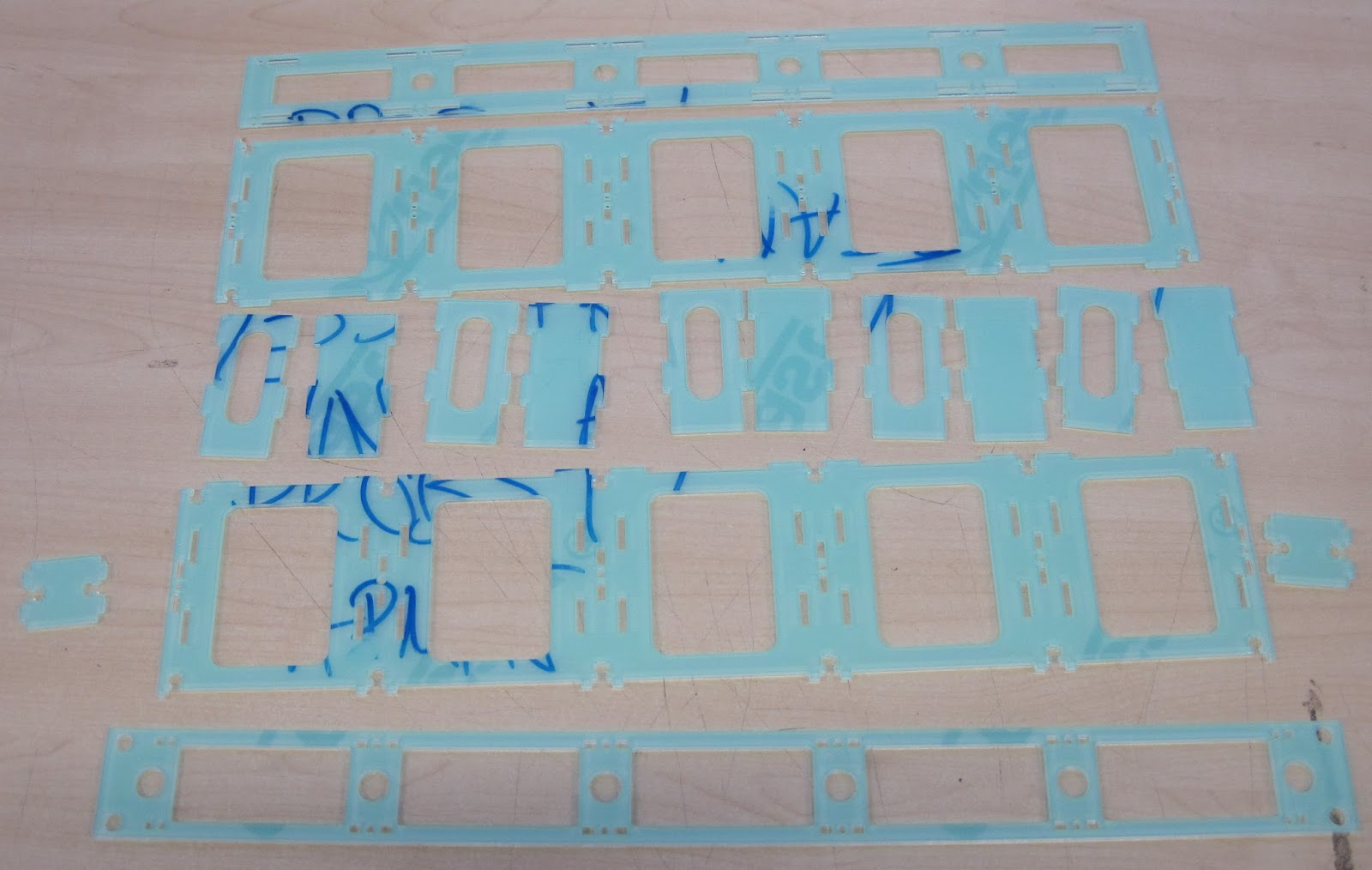
 The design was simply laser cut from sheet stock and fastened together with M3 nut and bolts. Once I corrected the initial design errors (I managed to get almost every important dimension wrong on the first attempt) the result was a success.
 The prototype is a variety of colours because makespace ran out of suitably sized clear acrylic stock but the colouring has no effect on the result other than aesthetical. The structure gives a great deal of rigidity and there is no sagging or warping, indeed testing on the prototype got to almost 50Kg loading without a failure (one end clamped and the other end loaded at 350mm distance)
 Overall this project was successful and I can now pack five SBC per U neatly. It does limit me to using systems cased in my "slimline" designs (68x30x97mm) which currently means the Raspberry Pi B+ style and the Orange Pi PC.

 Initially I started with the idea of housing the individual boards in a toast rack arrangement. This would mean that the enclosure would have to be at least 2U high to fit the boards all the existing cases would have to be discarded. This approach was dropped when the drawbacks of having no flexibility and only being able to fit the units that were selected at design time became apparent (connector cutouts and mounting hole placement.


 more than 50000 binary packages in sid main amd64
So in the last weeks every morning I looked at this graph and yesterday for the first time I finally saw it exceed 50k binary packages:

 And hopefully we'll reach 20k reproducible packages (in our current test framework) on testing/amd64 before that


 More than 10 years ago, I launched
 Over the past two months or so I have become
 Siri and I are on a journey through India and Nepal,
with the aim of learning about needs of Debian derivatives,
to improve Debian and encourage closer integration.
 Since moving to Japan, I got more and more interested in history, especially the recent history of the 20th century. The book I just finished, Ian Buruma (
 The comparison of Germany and Japan with respect to their recent history as laid out in Buruma s book throws a spotlight on various aspects of the psychology of German and Japanese population, while at the same time not falling into the easy trap of explaining everything with difference in the guilt culture. A book of great depth and broad insights everyone having even the slightest interest in these topics should read.

 Today I was wondering about converting a pdf made from scan of a book
into djvu, hopefully to reduce the size, without too much loss of
quality. My initial experiments with

 I don't often do retrospectives, but this year has been an
unusual one for me, as I moved to Finland almost six months ago.
The topic has come up in conversation a lot over the past few
months, so when people ask me what I think I can give some simple
answers without too much thought. Here's a brief summary.
There are some obvious changes:
 On some of my personal domains, such as this

 And yet another updated of
 Particularly noteworthy is the addition of support for intra-daily times in
 The arguments are quite easy to summarize: The meritocracy party proposes that One s contribution should only be evaluated based on the content and the quality , while the SJW party asserts that in case the submitter as from a minority group, in particular everyone outside the white straight group, the contribution has to be accepted with higher probability (or without discussion) to ensure equality.
(Added here for clarification: A SJW is someone who puts the agenda of anti-genderization and anti-biasization (nice word) above all other objectives, often by quoting scientific results on existing and not deniable bias)
Well, I am a scientist, and I can tell you just one thing: I simply don t give a shit for whether someone is white, black, red, green, red, straight, gay, a Rastafari or
 My personal verdict: 3 rotten eggs (because
 The variation in accuracy displayed is a result of experimentation with different dataset sizes and algorithm variations. More information and details can be found in the
