Search Results: "ean"

1 April 2025

Colin Watson: Free software activity in March 2025

Most of my Debian contributions this month were sponsored by Freexian. You can also support my work directly via Liberapay. OpenSSH Changes in dropbear 2025.87 broke OpenSSH s regression tests. I cherry-picked the fix. I reviewed and merged patches from Luca Boccassi to send and accept the COLORTERM and NO_COLOR environment variables. Python team Following up on last month, I fixed some more uscan errors: I upgraded these packages to new upstream versions: In bookworm-backports, I updated python-django to 3:4.2.19-1. Although Debian s upgrade to python-click 8.2.0 was reverted for the time being, I fixed a number of related problems anyway since we re going to have to deal with it eventually: dh-python dropped its dependency on python3-setuptools in 6.20250306, which was long overdue, but it had quite a bit of fallout; in most cases this was simply a question of adding build-dependencies on python3-setuptools, but in a few cases there was a missing build-dependency on python3-typing-extensions which had previously been pulled in as a dependency of python3-setuptools. I fixed these bugs resulting from this: We agreed to remove python-pytest-flake8. In support of this, I removed unnecessary build-dependencies from pytest-pylint, python-proton-core, python-pyzipper, python-tatsu, python-tatsu-lts, and python-tinycss, and filed #1101178 on eccodes-python and #1101179 on rpmlint. There was a dnspython autopkgtest regression on s390x. I independently tracked that down to a pylsqpack bug and came up with a reduced test case before realizing that Pranav P had already been working on it; we then worked together on it and I uploaded their patch to Debian. I fixed various other build/test failures: I enabled more tests in python-moto and contributed a supporting fix upstream. I sponsored Maximilian Engelhardt to reintroduce zope.sqlalchemy. I fixed various odds and ends of bugs: I contributed a small documentation improvement to pybuild-autopkgtest(1). Rust team I upgraded rust-asn1 to 0.20.0. Science team I finally gave in and joined the Debian Science Team this month, since it often has a lot of overlap with the Python team, and Freexian maintains several packages under it. I fixed a uscan error in hdf5-blosc (maintained by Freexian), and upgraded it to a new upstream version. I fixed python-vispy: missing dependency on numpy abi. Other bits and pieces I fixed debconf should automatically be noninteractive if input is /dev/null. I fixed a build failure with GCC 15 in yubihsm-shell (maintained by Freexian). Prompted by a CI failure in debusine, I submitted a large batch of spelling fixes and some improved static analysis to incus (#1777, #1778) and distrobuilder. After regaining access to the repository, I fixed telegnome: missing app icon in About dialogue and made a new 0.3.7 release.

Guido G nther: Free Software Activities March 2025

Another short status update of what happened on my side last month. Some more ModemManager bits landed, Phosh 0.46 is out, haptic feedback is now better tunable plus some more. See below for details (no April 1st joke in there, I promise): phosh phoc phosh-osk-stub phosh-mobile-settings phosh-tour pfs xdg-desktop-portal-gtk xdg-desktop-portal-phosh meta-phosh feedbackd feedbackd-device-themes gmobile livi Debian git-buildpackage feedbackd-device-themes wlroots ModemManager Tuba xdg-spec gnome-calls Reviews This is not code by me but reviews on other peoples code. The list is (as usual) slightly incomplete. Thanks for the contributions! Help Development If you want to support my work see donations. Comments? Join the Fediverse thread

Michael Ablassmeier: qmpbackup 0.46 - add image fleecing

I ve released qmpbackup 0.46 which now utilizes the image fleecing technique for backup. Usually, during backup, Qemu will use a so called copy-before-write filter so that data for new guest writes is sent to the backup target first, the guest write blocks until this operation is finished. If the backup target is flaky, or becomes unavailable during backup operation, this could lead to high I/O wait times or even complete VM lockups. To fix this, a so called fleecing image is introduced during backup being used as temporary cache for write operations by the guest. This image can be placed on the same storage as the virtual machine disks, so is independent from the backup target performance. The documentation on which steps are required to get this going, using the Qemu QMP protocol is, lets say.. lacking.. The following examples show the general functionality, but should be enhanced to use transactions where possible. All commands are in qmp-shell command format. Lets start with a full backup:
# create a new bitmap
block-dirty-bitmap-add node=disk1 name=bitmap persistent=true
# add the fleece image to the virtual machine (same size as original disk required)
blockdev-add driver=qcow2 node-name=fleecie file= "driver":"file","filename":"/tmp/fleece.qcow2" 
# add the backup target file to the virtual machine
blockdev-add driver=qcow2 node-name=backup-target-file file= "driver":"file","filename":"/tmp/backup.qcow2" 
# enable the copy-before-writer for the first disk attached, utilizing the fleece image
blockdev-add driver=copy-before-write node-name=cbw file=disk1 target=fleecie
# "blockdev-replace": make the copy-before-writer filter the major device (use "query-block" to get path parameter value, qdev node)
qom-set path=/machine/unattached/device[20] property=drive value=cbw
# add the snapshot-access filter backing the copy-before-writer
blockdev-add driver=snapshot-access file=cbw node-name=snapshot-backup-source
# create a full backup
blockdev-backup device=snapshot-backup-source target=backup-target-file sync=full job-id=test
[ wait until block job finishes]
# remove the snapshot access filter from the virtual machine
blockdev-del node-name=snapshot-backup-source
# switch back to the regular disk
qom-set path=/machine/unattached/device[20] property=drive value=node-disk1
# remove the copy-before-writer
blockdev-del node-name=cbw
# remove the backup-target-file
blockdev-del node-name=backup-target-file
# detach the fleecing image
blockdev-del node-name=fleecie
After this process, the temporary fleecing image can be deleted/recreated. Now lets go for a incremental backup:
# add the fleecing and backup target image, like before
blockdev-add driver=qcow2 node-name=fleecie file= "driver":"file","filename":"/tmp/fleece.qcow2" 
blockdev-add driver=qcow2 node-name=backup-target-file file= "driver":"file","filename":"/tmp/backup-incremental.qcow2" 
# add the copy-before-write filter, but utilize the bitmap created during full backup
blockdev-add driver=copy-before-write node-name=cbw file=disk1 target=fleecie bitmap= "node":"disk1","name":"bitmap" 
# switch device to the copy-before-write filter
qom-set path=/machine/unattached/device[20] property=drive value=cbw
# add the snapshot-access filter
blockdev-add driver=snapshot-access file=cbw node-name=snapshot-backup-source
# merge the bitmap created during full backup to the snapshot-access device so
# the backup operation can access it. (you better use an transaction here)
block-dirty-bitmap-add node=snapshot-backup-source name=bitmap
block-dirty-bitmap-merge node=snapshot-backup-source target=bitmap bitmaps=[ "node":"disk1","name":"bitmap" ]
# create incremental backup (you better use an transaction here)
blockdev-backup device=snapshot-backup-source target=backup-target-file job-id=test sync=incremental bitmap=bitmap
 [ wait until backup has finished ]
 [ cleanup like before ]
# clear the dirty bitmap (you better use an transaction here)
block-dirty-bitmap-clear node=disk1 name=bitmap
Or, use a simple reproducer by directly passing qmp commands via stdio:
#!/usr/bin/bash
qemu-img create -f raw disk 1M
qemu-img create -f raw fleece 1M
qemu-img create -f raw backup 1M
qemu-system-x86_64 -drive node-name=disk,file=disk,format=file -qmp stdio -nographic -nodefaults <<EOF
 "execute": "qmp_capabilities" 
 "execute": "block-dirty-bitmap-add", "arguments":  "node": "disk", "name": "bitmap" 
 "execute": "blockdev-add", "arguments":  "node-name": "fleece", "driver": "file", "filename": "fleece" 
 "execute": "blockdev-add", "arguments":  "node-name": "backup", "driver": "file", "filename": "backup" 
 "execute": "blockdev-add", "arguments":  "node-name": "cbw", "driver": "copy-before-write", "file": "disk", "target": "fleece", "bitmap":  "node": "disk", "name": "bitmap" 
 "execute": "query-block" 
 "execute": "qom-set", "arguments":  "path": "/machine/unattached/device[4]", "property": "drive", "value": "cbw" 
 "execute": "blockdev-add", "arguments":  "node-name": "snapshot", "driver": "snapshot-access", "file": "cbw" 
 "execute": "block-dirty-bitmap-add", "arguments":  "node": "snapshot", "name": "tbitmap" 
 "execute": "block-dirty-bitmap-merge", "arguments":  "node": "snapshot", "target": "tbitmap", "bitmaps": [ "node": "disk", "name": "bitmap" ] 
[..]
 "execute": "quit" 
EOF

31 March 2025

Dirk Eddelbuettel: Rblpapi 0.3.15 on CRAN: Several Refinements

bloomberg terminal Version 0.3.16 of the Rblpapi package arrived on CRAN today. Rblpapi provides a direct interface between R and the Bloomberg Terminal via the C++ API provided by Bloomberg (but note that a valid Bloomberg license and installation is required). This is the sixteenth release since the package first appeared on CRAN in 2016. It contains several enhancements. Two contributed PRs improve an error message, and extended connection options. We cleaned up a bit of internal code. And this release also makes the build conditional on having a valid build environment. This has been driven by the fact CRAN continues to builder under macOS 13 for x86_64, but Bloomberg no longer supplies a library and headers. And our repeated requests to be able to opt out of the build were, well, roundly ignored. So now the builds will succeed, but on unviable platforms such as that one we will only offer empty functions. But no more build ERRORS yelling at us for three configurations. The detailed list of changes follow below.

Changes in Rblpapi version 0.3.16 (2025-03-31)
  • A quota error message is now improved (Rodolphe Duge in #400)
  • Convert remaining throw into Rcpp::stop (Dirk in #402 fixing #401)
  • Add optional appIdentityKey argument to blpConnect (Kai Lin in #404)
  • Rework build as function of Blp library availability (Dirk and John in #406, #409, #410 fixing #407, #408)

Courtesy of my CRANberries, there is also a diffstat report for the this release. As always, more detailed information is at the Rblpapi repo or the Rblpapi page. Questions, comments etc should go to the issue tickets system at the GitHub repo.

This post by Dirk Eddelbuettel originated on his Thinking inside the box blog. If you like this or other open-source work I do, you can sponsor me at GitHub.

Johannes Schauer Marin Rodrigues: TIL: OpenPGP Web Key Directory

Today I was looking for a way on how to best publish my OpenPGP key on my webserver. Surely, somebody came up with some sort of standard way for where to place that key, right? Turns out, they did: https://datatracker.ietf.org/doc/draft-koch-openpgp-webkey-service/ The TLDR summary is, that my key can now be found here: https://mister-muffin.de/.well-known/openpgpkey/hu/8yxgr5jjfok88r9um56kb44x9h4dyj7f Or be downloadable by just running:
$ gpg --locate-key josch@mister-muffin.de
Where does the hash come from? It s the local part of my email (josch) hashed with sha1 and encoded in z-base32. That computation can be done by gpg:
$ gpg --with-wkd-hash -k josch@mister-muffin.de   grep mister-muffin.de
[...]
8yxgr5jjfok88r9um56kb44x9h4dyj7f@mister-muffin.de
I exported the key that I put there using the following command:
$ gpg --no-options --export --export-options export-minimal,export-clean \
    --export-filter keep-uid="uid = Johannes Schauer Marin Rodrigues <josch@mister-muffin.de>" \
    F83356BBE112B7462A41552F7D5D8C60CF4D3EB4
There is a handy validator for such setups that can be found here: https://www.webkeydirectory.com I had an interesting debugging experience when I tried to verify my setup in a fresh Debian chroot because I got this error message when I ran above command:
gpg: directory '/root/.gnupg' created
gpg: keybox '/root/.gnupg/pubring.kbx' created
gpg: /root/.gnupg/trustdb.gpg: trustdb created
gpg: error retrieving 'josch@mister-muffin.de' via WKD: General error
gpg: error reading key: General error
That s not very descriptive Turns out, that I was missing the ca-certificates package. After installing it, everything worked as expected:
$ gpg --locate-key josch@mister-muffin.de
gpg: key 7D5D8C60CF4D3EB4: public key "Johannes Schauer Marin Rodrigues <josch@mister-muffin.de>" imported
gpg: Total number processed: 1
gpg:               imported: 1
pub   rsa4096 2013-07-04 [SC]
      F83356BBE112B7462A41552F7D5D8C60CF4D3EB4
uid           [ unknown] Johannes Schauer Marin Rodrigues <josch@mister-muffin.de>
sub   rsa4096 2013-07-04 [E]
sub   rsa4096 2013-07-04 [S]
sub   rsa4096 2023-07-08 [S]

Simon Josefsson: On Binary Distribution Rebuilds

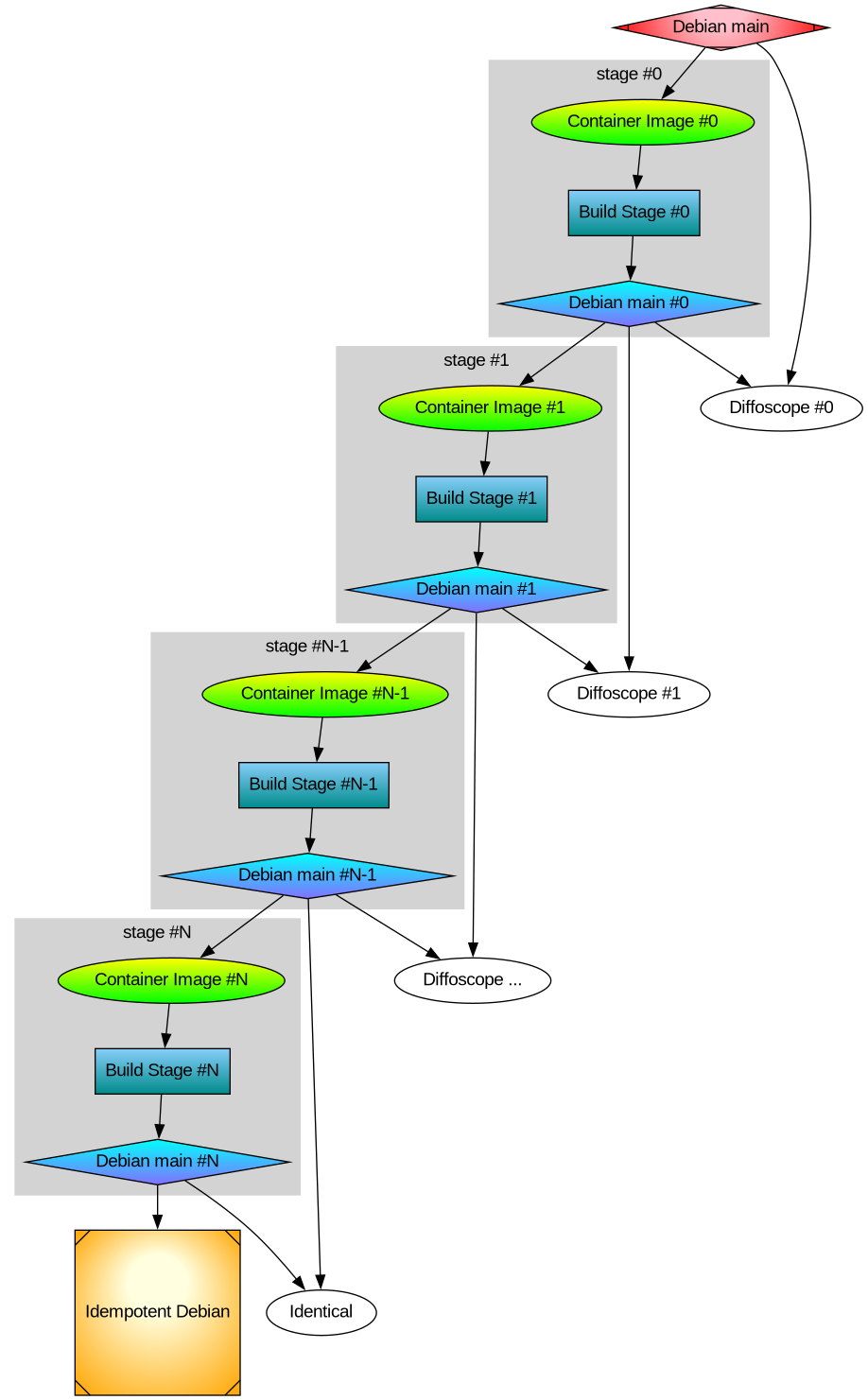
I rebuilt (the top-50 popcon) Debian and Ubuntu packages, on amd64 and arm64, and compared the results a couple of months ago. Since then the Reproduce.Debian.net effort has been launched. Unlike my small experiment, that effort is a full-scale rebuild with more architectures. Their goal is to reproduce what is published in the Debian archive. One differences between these two approaches are the build inputs: The Reproduce Debian effort use the same build inputs which were used to build the published packages. I m using the latest version of published packages for the rebuild. What does that difference imply? I believe reproduce.debian.net will be able to reproduce more of the packages in the archive. If you build a C program using one version of GCC you will get some binary output; and if you use a later GCC version you are likely to end up with a different binary output. This is a good thing: we want GCC to evolve and produce better output over time. However it means in order to reproduce the binaries we publish and use, we need to rebuild them using whatever build dependencies were used to prepare those binaries. The conclusion is that we need to use the old GCC to rebuild the program, and this appears to be the Reproduce.Debian.Net approach. It would be a huge success if the Reproduce.Debian.net effort were to reach 100% reproducibility, and this seems to be within reach. However I argue that we need go further than that. Being able to rebuild the packages reproducible using older binary packages only begs the question: can we rebuild those older packages? I fear attempting to do so ultimately leads to a need to rebuild 20+ year old packages, with a non-negligible amount of them being illegal to distribute or are unable to build anymore due to bit-rot. We won t solve the Trusting Trust concern if our rebuild effort assumes some initial binary blob that we can no longer build from source code. I ve made an illustration of the effort I m thinking of, to reach something that is stronger than reproducible rebuilds. I am calling this concept a Idempotent Rebuild, which is an old concept that I believe is the same as John Gilmore has described many years ago.
The illustration shows how the Debian main archive is used as input to rebuild another stage #0 archive. This stage #0 archive can be compared with diffoscope to the main archive, and all differences are things that would be nice to resolve. The packages in the stage #0 archive is used to prepare a new container image with build tools, and the stage #0 archive is used as input to rebuild another version of itself, called the stage #1 archive. The differences between stage #0 and stage #1 are also useful to analyse and resolve. This process can be repeated many times. I believe it would be a useful property if this process terminated at some point, where the stage #N archive was identical to the stage #N-1 archive. If this would happen, I label the output archive as an Idempotent Rebuild of the distribution. How big is N today? The simplest assumption is that it is infinity. Any build timestamp embedded into binary packages will change on every iteration. This will cause the process to never terminate. Fixing embedded timestamps is something that the Reproduce.Debian.Net effort will also run into, and will have to resolve. What other causes for differences could there be? It is easy to see that generally if some output is not deterministic, such as the sort order of assembler object code in binaries, then the output will be different. Trivial instances of this problem will be caught by the reproduce.debian.net effort as well. Could there be higher order chains that lead to infinite N? It is easy to imagine the existence of these, but I don t know how they would look like in practice. An ideal would be if we could get down to N=1. Is that technically possible? Compare building GCC, it performs an initial stage 0 build using the system compiler to produce a stage 1 intermediate, which is used to build itself again to stage 2. Stage 1 and 2 is compared, and on success (identical binaries), the compilation succeeds. Here N=2. But this is performed using some unknown system compiler that is normally different from the GCC version being built. When rebuilding a binary distribution, you start with the same source versions. So it seems N=1 could be possible. I m unhappy to not be able to report any further technical progress now. The next step in this effort is to publish the stage #0 build artifacts in a repository, so they can be used to build stage #1. I already showed that stage #0 was around ~30% reproducible compared to the official binaries, but I didn t save the artifacts in a reusable repository. Since the official binaries were not built using the latest versions, it is to be expected that the reproducibility number is low. But what happens at stage #1? The percentage should go up: we are now compare the rebuilds with an earlier rebuild, using the same build inputs. I m eager to see this materialize, and hope to eventually make progress on this. However to build stage #1 I believe I need to rebuild a much larger number packages in stage #0, it could be roughly similar to the build-essentials-depends package set. I believe the ultimate end goal of Idempotent Rebuilds is to be able to re-bootstrap a binary distribution like Debian from some other bootstrappable environment like Guix. In parallel to working on a achieving the 100% Idempotent Rebuild of Debian, we can setup a Guix environment that build Debian packages using Guix binaries. These builds ought to eventually converge to the same Debian binary packages, or there is something deeply problematic happening. This approach to re-bootstrap a binary distribution like Debian seems simpler than rebuilding all binaries going back to the beginning of time for that distribution. What do you think? PS. I fear that Debian main may have already went into a state where it is not able to rebuild itself at all anymore: the presence and assumption of non-free firmware and non-Debian signed binaries may have already corrupted the ability for Debian main to rebuild itself. To be able to complete the idempotent and bootstrapped rebuild of Debian, this needs to be worked out.

29 March 2025

Petter Reinholdtsen: Theora 1.2.0 released

Following the 1.2.0beta1 release two weeks ago, a final 1.2.0 release of theora was wrapped up today. This new release is tagged in the Xiph gitlab theora instance and you can fetch it from the Theora home page as soon as someone with access find time to update the web pages. In the mean time (automatically removed after 14 days) the release tarball is also available as a git build artifact from CI build of the release tag. The list of changes since The 1.2.0beta release from the CHANGES file in the tarball look like this:
libtheora 1.2.0 (2025 March 29)
  • Bumped minor SONAME versions as oc_comment_unpack() implementation changed.
  • Added example wrapper script encoder_example_ffmpeg (#1601 #2336).
  • Improve comment handling on platforms where malloc(0) return NULL (#2304).
  • Added pragma in example code to quiet clang op precedenca warnings.
  • Adjusted encoder_example help text.
  • Adjusted README, CHANGES, pkg-config and spec files to better reflect current release (#2331 #2328).
  • Corrected english typos in source and build system.
  • Switched http links to https in doc and comments where relevant. Did not touch RFC drafts.
As usual, if you use Bitcoin and want to show your support of my activities, please send Bitcoin donations to my address 15oWEoG9dUPovwmUL9KWAnYRtNJEkP1u1b.

28 March 2025

Ian Jackson: Rust is indeed woke

Rust, and resistance to it in some parts of the Linux community, has been in my feed recently. One undercurrent seems to be the notion that Rust is woke (and should therefore be rejected as part of culture wars). I m going to argue that Rust, the language, is woke. So the opponents are right, in that sense. Of course, as ever, dissing something for being woke is nasty and fascist-adjacent. Community The obvious way that Rust may seem woke is that it has the trappings, and many of the attitudes and outcomes, of a modern, nice, FLOSS community. Rust certainly does better than toxic environments like the Linux kernel, or Debian. This is reflected in a higher proportion of contributors from various kinds of minoritised groups. But Rust is not outstanding in this respect. It certainly has its problems. Many other projects do as well or better. And this is well-trodden ground. I have something more interesting to say: Technological values - particularly, compared to C/C++ Rust is woke technology that embodies a woke understanding of what it means to be a programming language. Ostensible values Let s start with Rust s strapline:
A language empowering everyone to build reliable and efficient software.
Surprisingly, this motto is not mere marketing puff. For Rustaceans, it is a key goal which strongly influences day-to-day decisions (big and small). Empowering everyone is a key aspect of this, which aligns with my own personal values. In the Rust community, we care about empowerment. We are trying to help liberate our users. And we want to empower everyone because everyone is entitled to technological autonomy. (For a programming language, empowering individuals means empowering their communities, of course.) This is all very airy-fairy, but it has concrete consequences: Attitude to the programmer s mistakes In Rust we consider it a key part of our job to help the programmer avoid mistakes; to limit the consequences of mistakes; and to guide programmers in useful directions. If you write a bug in your Rust program, Rust doesn t blame you. Rust asks how could the compiler have spotted that bug . This is in sharp contrast to C (and C++). C nowadays is an insanely hostile programming environment. A C compiler relentlessly scours your program for any place where you may have violated C s almost incomprehensible rules, so that it can compile your apparently-correct program into a buggy executable. And then the bug is considered your fault. These aren t just attitudes implicitly embodied in the software. They are concrete opinions expressed by compiler authors, and also by language proponents. In other words: Rust sees programmers writing bugs as a systemic problem, which must be addressed by improvements to the environment and the system. The toxic parts of the C and C++ community see bugs as moral failings by individual programmers. Sound familiar? The ideology of the hardcore programmer Programming has long suffered from the myth of the rockstar . Silicon Valley techbro culture loves this notion. In reality, though, modern information systems are far too complicated for a single person. Developing systems is a team sport. Nontechnical, and technical-adjacent, skills are vital: clear but friendly communication; obtaining and incorporating the insights of every member of your team; willingness to be challenged. Community building. Collaboration. Governance. The hardcore C community embraces the rockstar myth: they imagine that a few super-programmers (or super-reviewers) are able to spot bugs, just by being so brilliant. Of course this doesn t actually work at all, as we can see from the atrocious bugfest that is the Linux kernel. These rockstars want us to believe that there is a steep hierarchy in programmming; that they are at the top of this hierarchy; and that being nice isn t important. Sound familiar? Memory safety as a power struggle Much of the modern crisis of software reliability arises from memory-unsafe programming languages, mostly C and C++. Addressing this is a big job, requiring many changes. This threatens powerful interests; notably, corporations who want to keep shipping junk. (See also, conniptions over the EU Product Liability Directive.) The harms of this serious problem mostly fall on society at large, but the convenience of carrying on as before benefits existing powerful interests. Sound familiar? Memory safety via Rust as a power struggle Addressing this problem via Rust is a direct threat to the power of established C programmers such as gatekeepers in the Linux kernel. Supplanting C means they will have to learn new things, and jostle for status against better Rustaceans, or be replaced. More broadly, Rust shows that it is practical to write fast, reliable, software, and that this does not need (mythical) rockstars . So established C programmer experts are existing vested interests, whose power is undermined by (this approach to) tackling this serious problem. Sound familiar? Notes This is not a RIIR manifesto I m not saying we should rewrite all the world s C in Rust. We should not try to do that. Rust is often a good choice for new code, or when a rewrite or substantial overhaul is needed anyway. But we re going to need other techniques to deal with all of our existing C. CHERI is a very promising approach. Sandboxing, emulation and automatic translation are other possibilities. The problem is a big one and we need a toolkit, not a magic bullet. But as for Linux: it is a scandal that substantial new drivers and subsystems are still being written in C. We could have been using Rust for new code throughout Linux years ago, and avoided very many bugs. Those bugs are doing real harm. This is not OK. Disclosure I first learned C from K&R I in 1989. I spent the first three decades of my life as a working programmer writing lots and lots of C. I ve written C++ too. I used to consider myself an expert C programmer, but nowadays my C is a bit rusty and out of date. Why is my C rusty? Because I found Rust, and immediately liked and adopted it (despite its many faults). I like Rust because I care that the software I write actually works: I care that my code doesn t do harm in the world. On the meaning of woke The original meaning of woke is something much more specific, to do with racism. For the avoidance of doubt, I don t think Rust is particularly antiracist. I m using woke (like Rust s opponents are) in the much broader, and now much more prevalent, culture wars sense. Pithy conclusion If you re a senior developer who knows only C/C++, doesn t want their authority challenged, and doesn t want to have to learn how to write better software, you should hate Rust. Also you should be fired.
Edited 2025-03-28 17:10 UTC to fix minor problems and add a new note about the meaning of the word "woke".


comment count unavailable comments

John Goerzen: Why You Should (Still) Use Signal As Much As Possible

As I write this in March 2025, there is a lot of confusion about Signal messenger due to the recent news of people using Signal in government, and subsequent leaks. The short version is: there was no problem with Signal here. People were using it because they understood it to be secure, not the other way around. Both the government and the Electronic Frontier Foundation recommend people use Signal. This is an unusual alliance, and in the case of the government, was prompted because it understood other countries had a persistent attack against American telephone companies and SMS traffic. So let s dive in. I ll cover some basics of what security is, what happened in this situation, and why Signal is a good idea. This post isn t for programmers that work with cryptography every day. Rather, I hope it can make some of these concepts accessible to everyone else.

What makes communications secure? When most people are talking about secure communications, they mean some combination of these properties:
  1. Privacy - nobody except the intended recipient can decode a message.
  2. Authentication - guarantees that the person you are chatting with really is the intended recipient.
  3. Ephemerality - preventing a record of the communication from being stored. That is, making it more like a conversation around the table than a written email.
  4. Anonymity - keeping your set of contacts to yourself and even obfuscating the fact that communications are occurring.
If you think about it, most people care the most about the first two. In fact, authentication is a key part of privacy. There is an attack known as man in the middle in which somebody pretends to be the intended recipient. The interceptor reads the messages, and then passes them on to the real intended recipient. So we can t really have privacy without authentication. I ll have more to say about these later. For now, let s discuss attack scenarios.

What compromises security? There are a number of ways that security can be compromised. Let s think through some of them:

Communications infrastructure snooping Let s say you used no encryption at all, and connected to public WiFi in a coffee shop to send your message. Who all could potentially see it?
  • The owner of the coffee shop s WiFi
  • The coffee shop s Internet provider
  • The recipient s Internet provider
  • Any Internet providers along the network between the sender and the recipient
  • Any government or institution that can compel any of the above to hand over copies of the traffic
  • Any hackers that compromise any of the above systems
Back in the early days of the Internet, most traffic had no encryption. People were careful about putting their credit cards into webpages and emails because they knew it was easy to intercept them. We have been on a decades-long evolution towards more pervasive encryption, which is a good thing. Text messages (SMS) follow a similar path to the above scenario, and are unencrypted. We know that all of the above are ways people s texts can be compromised; for instance, governments can issue search warrants to obtain copies of texts, and China is believed to have a persistent hack into western telcos. SMS fails all four of our attributes of secure communication above (privacy, authentication, ephemerality, and anonymity). Also, think about what information is collected from SMS and by who. Texts you send could be retained in your phone, the recipient s phone, your phone company, their phone company, and so forth. They might also live in cloud backups of your devices. You only have control over your own phone s retention. So defenses against this involve things like:
  • Strong end-to-end encryption, so no intermediate party even the people that make the app can snoop on it.
  • Using strong authentication of your peers
  • Taking steps to prevent even app developers from being able to see your contact list or communication history
You may see some other apps saying they use strong encryption or use the Signal protocol. But while they may do that for some or all of your message content, they may still upload your contact list, history, location, etc. to a central location where it is still vulnerable to these kinds of attacks. When you think about anonymity, think about it like this: if you send a letter to a friend every week, every postal carrier that transports it even if they never open it or attempt to peak inside will be able to read the envelope and know that you communicate on a certain schedule with that friend. The same can be said of SMS, email, or most encrypted chat operators. Signal s design prevents it from retaining even this information, though nation-states or ISPs might still be able to notice patterns (every time you send something via Signal, your contact receives something from Signal a few milliseconds later). It is very difficult to provide perfect anonymity from well-funded adversaries, even if you can provide very good privacy.

Device compromise Let s say you use an app with strong end-to-end encryption. This takes away some of the easiest ways someone could get to your messages. But it doesn t take away all of them. What if somebody stole your phone? Perhaps the phone has a password, but if an attacker pulled out the storage unit, could they access your messages without a password? Or maybe they somehow trick or compel you into revealing your password. Now what? An even simpler attack doesn t require them to steal your device at all. All they need is a few minutes with it to steal your SIM card. Now they can receive any texts sent to your number - whether from your bank or your friend. Yikes, right? Signal stores your data in an encrypted form on your device. It can protect it in various ways. One of the most important protections is ephemerality - it can automatically delete your old texts. A text that is securely erased can never fall into the wrong hands if the device is compromised later. An actively-compromised phone, though, could still give up secrets. For instance, what if a malicious keyboard app sent every keypress to an adversary? Signal is only as secure as the phone it runs on but still, it protects against a wide variety of attacks.

Untrustworthy communication partner Perhaps you are sending sensitive information to a contact, but that person doesn t want to keep it in confidence. There is very little you can do about that technologically; with pretty much any tool out there, nothing stops them from taking a picture of your messages and handing the picture off.

Environmental compromise Perhaps your device is secure, but a hidden camera still captures what s on your screen. You can take some steps against things like this, of course.

Human error Sometimes humans make mistakes. For instance, the reason a reporter got copies of messages recently was because a participant in a group chat accidentally added him (presumably that participant meant to add someone else and just selected the wrong name). Phishing attacks can trick people into revealing passwords or other sensitive data. Humans are, quite often, the weakest link in the chain.

Protecting yourself So how can you protect yourself against these attacks? Let s consider:
  • Use a secure app like Signal that uses strong end-to-end encryption where even the provider can t access your messages
  • Keep your software and phone up-to-date
  • Be careful about phishing attacks and who you add to chat rooms
  • Be aware of your surroundings; don t send sensitive messages where people might be looking over your shoulder with their eyes or cameras
There are other methods besides Signal. For instance, you could install GnuPG (GPG) on a laptop that has no WiFi card or any other way to connect it to the Internet. You could always type your messages on that laptop, encrypt them, copy the encrypted text to a floppy disk (or USB device), take that USB drive to your Internet computer, and send the encrypted message by email or something. It would be exceptionally difficult to break the privacy of messages in that case (though anonymity would be mostly lost). Even if someone got the password to your secure laptop, it wouldn t do them any good unless they physically broke into your house or something. In some ways, it is probably safer than Signal. (For more on this, see my article How gapped is your air?) But, that approach is hard to use. Many people aren t familiar with GnuPG. You don t have the convenience of sending a quick text message from anywhere. Security that is hard to use most often simply isn t used. That is, you and your friends will probably just revert back to using insecure SMS instead of this GnuPG approach because SMS is so much easier. Signal strikes a unique balance of providing very good security while also being practical, easy, and useful. For most people, it is the most secure option available. Signal is also open source; you don t have to trust that it is as secure as it says, because you can inspect it for yourself. Also, while it s not federated, I previously addressed that.

Government use If you are a government, particularly one that is highly consequential to the world, you can imagine that you are a huge target. Other nations are likely spending billions of dollars to compromise your communications. Signal itself might be secure, but if some other government can add spyware to your phones, or conduct a successful phishing attack, you can still have your communications compromised. I have no direct knowledge, but I think it is generally understood that the US government maintains communications networks that are entirely separate from the Internet and can only be accessed from secure physical locations and secure rooms. These can be even more secure than the average person using Signal because they can protect against things like environmental compromise, human error, and so forth. The scandal in March of 2025 happened because government employees were using Signal rather than official government tools for sensitive information, had taken advantage of Signal s ephemerality (laws require records to be kept), and through apparent human error had directly shared this information with a reporter. Presumably a reporter would have lacked access to the restricted communications networks in the first place, so that wouldn t have been possible. This doesn t mean that Signal is bad. It just means that somebody that can spend billions of dollars on security can be more secure than you. Signal is still a great tool for people, and in many cases defeats even those that can spend lots of dollars trying to defeat it. And remember - to use those restricted networks, you have to go to specific rooms in specific buildings. They are still not as convenient as what you carry around in your pocket.

Conclusion Signal is practical security. Do you want phone companies reading your messages? How about Facebook or X? Have those companies demonstrated that they are completely trustworthy throughout their entire history? I say no. So, go install Signal. It s the best, most practical tool we have.
This post is also available on my website, where it may be periodically updated.

Freexian Collaborators: Monthly report about Debian Long Term Support, February 2025 (by Roberto C. S nchez)

Like each month, have a look at the work funded by Freexian s Debian LTS offering.

Debian LTS contributors In February, 18 contributors have been paid to work on Debian LTS, their reports are available:
  • Abhijith PA did 10.0h (out of 8.0h assigned and 6.0h from previous period), thus carrying over 4.0h to the next month.
  • Adrian Bunk did 12.0h (out of 0.0h assigned and 63.5h from previous period), thus carrying over 51.5h to the next month.
  • Andrej Shadura did 10.0h (out of 6.0h assigned and 4.0h from previous period).
  • Bastien Roucari s did 20.0h (out of 20.0h assigned).
  • Ben Hutchings did 12.0h (out of 8.0h assigned and 16.0h from previous period), thus carrying over 12.0h to the next month.
  • Chris Lamb did 18.0h (out of 18.0h assigned).
  • Daniel Leidert did 23.0h (out of 20.0h assigned and 6.0h from previous period), thus carrying over 3.0h to the next month.
  • Emilio Pozuelo Monfort did 53.0h (out of 53.0h assigned and 0.75h from previous period), thus carrying over 0.75h to the next month.
  • Guilhem Moulin did 11.0h (out of 3.25h assigned and 16.75h from previous period), thus carrying over 9.0h to the next month.
  • Jochen Sprickerhof did 27.0h (out of 30.0h assigned), thus carrying over 3.0h to the next month.
  • Lee Garrett did 11.75h (out of 9.5h assigned and 44.25h from previous period), thus carrying over 42.0h to the next month.
  • Markus Koschany did 40.0h (out of 40.0h assigned).
  • Roberto C. S nchez did 7.0h (out of 14.75h assigned and 9.25h from previous period), thus carrying over 17.0h to the next month.
  • Santiago Ruano Rinc n did 19.75h (out of 21.75h assigned and 3.25h from previous period), thus carrying over 5.25h to the next month.
  • Sean Whitton did 6.0h (out of 6.0h assigned).
  • Sylvain Beucler did 52.5h (out of 14.75h assigned and 39.0h from previous period), thus carrying over 1.25h to the next month.
  • Thorsten Alteholz did 11.0h (out of 11.0h assigned).
  • Tobias Frost did 17.0h (out of 17.0h assigned).

Evolution of the situation In February, we have released 38 DLAs.
  • Notable security updates:
    • pam-u2f, prepared by Patrick Winnertz, fixed an authentication bypass vulnerability
    • openjdk-17, prepared by Emilio Pozuelo Monfort, fixed an authorization bypass/information disclosure vulnerability
    • firefox-esr, prepared by Emilio Pozuelo Monfort, fixed several vulnerabilities
    • thunderbird, prepared by Emilio Pozuelo Monfort, fixed several vulnerabilities
    • postgresql-13, prepared by Christoph Berg, fixed an SQL injection vulnerability
    • freerdp2, prepared by Tobias Frost, fixed several vulnerabilities
    • openssh, prepared by Colin Watson, fixed a machine-in-the-middle vulnerability
LTS contributors Emilio Pozuelo Monfort and Santiago Ruano Rinc n coordinated the administrative aspects of LTS updates of postgresql-13 and pam-u2f, which were prepared by the respective maintainers, to whom we are most grateful. As has become the custom of the LTS team, work is under way on a number of package updates targeting Debian 12 (codename bookworm ) with fixes for a variety of vulnerabilities. In February, Guilhem Moulin prepared an upload of sssd, while several other updates are still in progress. Bastien Roucari s prepared an upload of krb5 for unstable as well. Given the importance of the Debian Security Tracker to the work of the LTS Team, we regularly contribute improvements to it. LTS contributor Emilio Pozuelo Monfort reviewed and merged a change to improve performance, and then dealt with unexpected issues that arose as a result. He also made improvements in the processing of CVEs which are not applicable to Debian. Looking to the future (the release of Debian 13, codename trixie , and beyond), LTS contributor Santiago Ruano Rinc n has initiated a conversation among the broader community involved in the development of Debian. The purpose of the discussion is to explore ways to improve the long term supportability of packages in Debian, specifically by focusing effort on ensuring that each Debian release contains the best supported upstream version of packages with a history of security issues.

Thanks to our sponsors Sponsors that joined recently are in bold.

26 March 2025

Dirk Eddelbuettel: RcppRedis 0.2.5 on CRAN: Fix Bashism in Configure, Maintenance

A new minor release 0.2.5 of our RcppRedis package arrived on CRAN today. RcppRedis is one of several packages connecting R to the fabulous Redis in-memory datastructure store (and much more). RcppRedis does not pretend to be feature complete, but it may do some things faster than the other interfaces, and also offers an optional coupling with MessagePack binary (de)serialization via RcppMsgPack. The package has been deployed in production as a risk / monitoring tool on a trading floor for several years. It also supports pub/sub dissemination of streaming market data as per this earlier example. Given the changes around Redis, it is worth stressing that the package works just as well with valkey and uses only hiredis which remains proper open source. This update is again somewhat mechanical as a few maintenance things bubbled up in since the last release in the summer of 2023. As with other packages, continuous integration was updated a few times as were URLs and badges, and we update the use of our RApiSerialize. And, just as we did today and yesterday with littler, RQuantLib and RDieHarder, this addresses a nag from CRAN about implicit bash dependency in configure.ac (which we fixed in January as for the other packages but are under deadline now). Last but not least the newly-added extension of forbidden symbols in static libraries revealed that yes indeed I had forgotten to set -DNDEBUG when building the embedded hiredis in fallback mode and I now also converted its four uses of sprintf to snprintf so we are clean there too. The detailed changes list follows.

Changes in version 0.2.5 (2025-03-26)
  • The continuous integration setup was updated several times
  • Badges and URLs in README.md have been updated
  • An updated interface from RApiSerialize is now used, and a versioned dependency on version 0.1.4 or later has been added
  • The DESCRIPTION file now uses Authors@R
  • Two possible bashisms have been converted in configure.ac
  • The (fallback if needed) build of libhiredis.a now sets -DNDEBUG, four uses of sprintf converted to snprintf

Courtesy of my CRANberries, there is also a diffstat report for this this release. More information is on the RcppRedis page and at the repository and its issue tracker.

This post by Dirk Eddelbuettel originated on his Thinking inside the box blog. If you like this or other open-source work I do, you can sponsor me at GitHub.

25 March 2025

Dirk Eddelbuettel: littler 0.3.21 on CRAN: Lots Moar Features!

max-heap image The twentysecond release of littler as a CRAN package landed on CRAN just now, following in the now nineteen year history (!!) as a (initially non-CRAN) package started by Jeff in 2006, and joined by me a few weeks later. littler is the first command-line interface for R as it predates Rscript. It allows for piping as well for shebang scripting via #!, uses command-line arguments more consistently and still starts faster. It also always loaded the methods package which Rscript only began to do in recent years. littler lives on Linux and Unix, has its difficulties on macOS due to some-braindeadedness there (who ever thought case-insensitive filesystems as a default were a good idea?) and simply does not exist on Windows (yet the build system could be extended see RInside for an existence proof, and volunteers are welcome!). See the FAQ vignette on how to add it to your PATH. A few examples are highlighted at the Github repo:, as well as in the examples vignette. This release, the first is almost exactly one year, brings enhancements to six scripts as well as three new ones. The new ones crup.r offers CRan UPloads from the command-line, deadliners.r lists CRAN package by CRAN deadline, and wb.r uploads to win-builder (replacing an older shell script of mine). Among the updated ones, kitten.r now creates more complete DESCRIPTION files in the packages it makes, and several scripts support additional options. A number of changes were made to packaging as well, some of which were contributed by Jon and Michael which is of course always greatly appreciated. The trigger for the release was, just like for RQuantLib earlier today, a CRAN nag on bashisms half of which actually false here it was in a comment only. Oh well. The full change description follows.

Changes in littler version 0.3.21 (2025-03-24)
  • Changes in examples scripts
    • Usage text for ciw.r is improved, new options were added (Dirk)
    • The noble release is supported by r2u.r (Dirk)
    • The installRub.r script has additional options (Dirk)
    • The ttlt.r script has a new load_package argument (Dirk)
    • A new script deadliners.r showing CRAN packages 'under deadline' has been added, and then refined (Dirk)
    • The kitten.r script can now use whoami and argument githubuser on the different *kitten helpers it calls (Dirk)
    • A new script wb.r can upload to win-builder (Dirk)
    • A new script crup.r can upload a CRAN submission (Dirk)
    • In rcc.r, the return from rcmdcheck is now explicitly printed (Dirk)
    • In r2u.r the dry-run option is passed to the build command (Dirk)
  • Changes in package
    • Regular updates to badges, continuous integration, DESCRIPTION and configure.ac (Dirk)
    • Errant osVersion return value are handled more robustly (Michael Chirico in #121)
    • The current run-time path is available via variable LITTLER_SCRIPT_PATH (Jon Clayden in #122)
    • The cleanup script remove macOS debug symbols (Jon Clayden in #123)

My CRANberries service provides a comparison to the previous release. Full details for the littler release are provided as usual at the ChangeLog page, and also on the package docs website. The code is available via the GitHub repo, from tarballs and now of course also from its CRAN page and via install.packages("littler"). Binary packages are available directly in Debian as well as (in a day or two) Ubuntu binaries at CRAN thanks to the tireless Michael Rutter. Comments and suggestions are welcome at the GitHub repo.

This post by Dirk Eddelbuettel originated on his Thinking inside the box blog. If you like this or other open-source work I do, you can sponsor me at GitHub.

24 March 2025

Jonathan McDowell: Who pays the cost of progress in software?

I am told, by friends who have spent time at Google, about the reason Google Reader finally disappeared. Apparently it had become a 20% Project for those who still cared about it internally, and there was some major change happening to one of it upstream dependencies that was either going to cause a significant amount of work rearchitecting Reader to cope, or create additional ongoing maintenance burden. It was no longer viable to support it as a side project, so it had to go. This was a consequence of an internal culture at Google where service owners are able to make changes that can break downstream users, and the downstream users are the ones who have to adapt. My experience at Meta goes the other way. If you own a service or other dependency and you want to make a change that will break things for the users, it s on you to do the migration, or at the very least provide significant assistance to those who own the code. You don t just get to drop your new release and expect others to clean up; doing that tends to lead to changes being reverted. The culture flows the other way; if you break it, you fix it (nothing is someone else s problem). There are pluses and minuses to both approaches. Users having to drive the changes to things they own stops them from blocking progress. Service/code owners having to drive the changes avoids the situation where a wildly used component drops a new release that causes a lot of high priority work for folk in order to adapt. I started thinking about this in the context of Debian a while back, and a few incidents since have resulted in my feeling that we re closer to the Google model than the Meta model. Anyone can upload a new version of their package to unstable, and that might end up breaking all the users of it. It s not quite as extreme as rolling out a new service, because it s unstable that gets affected (the clue is in the name, I really wish more people would realise that), but it can still result in release critical bugs for lots other Debian contributors. A good example of this are toolchain changes. Major updates to GCC and friends regularly result in FTBFS issues in lots of packages. Now in this instance the maintainer is usually diligent about a heads up before the default changes, but it s still a whole bunch of work for other maintainers to adapt (see the list of FTBFS bugs for GCC 15 for instance - these are important, but not serious yet). Worse is when a dependency changes and hasn t managed to catch everyone who might be affected, so by the time it s discovered it s release critical, because at least one package no longer builds in unstable. Commercial organisations try to avoid this with a decent CI/CD setup that either vendors all dependencies, or tracks changes to them and tries rebuilds before allowing things to land. This is one of the instances where a monorepo can really shine; if everything you need is in there, it s easier to track the interconnections between different components. Debian doesn t have a CI/CD system that runs for every upload, allowing us to track exact causes of regressions. Instead we have Lucas, who does a tremendous job of running archive wide rebuilds to make sure we can still build everything. Unfortunately that means I am often unfairly grumpy at him; my heart sinks when I see a bug come in with his name attached, because it often means one of my packages has a new RC bug where I m going to have to figure out what changed elsewhere to cause it. However he s just (very usefully) surfacing an issue someone else created, rather than actually being the cause of the problem. I don t know if I have a point to this post. I think it s probably that I wish folk in Free Software would try and be mindful of the incompatible changes they might introducing, and the toil they create for other volunteer developers, often not directly visible to the person making the change. The approach done by the Debian toolchain maintainers strikes me as a good balance; they do a bunch of work up front to try and flag all the places that might need to make changes, far enough in advance of the breaking change actually landing. However they don t then allow a tardy developer to block progress.

Simon Josefsson: Reproducible Software Releases

Around a year ago I discussed two concerns with software release archives (tarball artifacts) that could be improved to increase confidence in the supply-chain security of software releases. Repeating the goals for simplicity: While implementing these ideas for a small project was accomplished within weeks see my announcement of Libntlm version 1.8 adressing this in complex projects uncovered concerns with tools that had to be addressed, and things stalled for many months pending that work. I had the notion that these two goals were easy and shouldn t be hard to accomplish. I still believe that, but have had to realize that improving tooling to support these goals takes time. It seems clear that these concepts are not universally agreed on and implemented generally. I m now happy to recap some of the work that led to releases of libtasn1 v4.20.0, inetutils v2.6, libidn2 v2.3.8, libidn v1.43. These releases all achieve these goals. I am working on a bunch of more projects to support these ideas too. What have the obstacles so far been to make this happen? It may help others who are in the same process of addressing these concerns to have a high-level introduction to the issues I encountered. Source code for projects above are available and anyone can look at the solutions to learn how the problems are addressed. First let s look at the problems we need to solve to make git-archive style tarballs usable:

Version Handling To build usable binaries from a minimal tarballs, it need to know which version number it is. Traditionally this information was stored inside configure.ac in git. However I use gnulib s git-version-gen to infer the version number from the git tag or git commit instead. The git tag information is not available in a git-archive tarball. My solution to this was to make use of the export-subst feature of the .gitattributes file. I store the file .tarball-version-git in git containing the magic cookie like this:
$Format:%(describe)$
With this, git-archive will replace with a useful version identifier on export, see the libtasn1 patch to achieve this. To make use of this information, the git-version-gen script was enhanced to read this information, see the gnulib patch. This is invoked by ./configure to figure out which version number the package is for.

Translations We want translations to be included in the minimal source tarball for it to be buildable. Traditionally these files are retrieved by the maintainer from the Translation project when running ./bootstrap, however there are two problems with this. The first one is that there is no strong authentication or versioning information on this data, the tools just download and place whatever wget downloaded into your source tree (printf-style injection attack anyone?). We could improve this (e.g., publish GnuPG signed translations messages with clear versioning), however I did not work on that further. The reason is that I want to support offline builds of packages. Downloading random things from the Internet during builds does not work when building a Debian package, for example. The translation project could solve this by making a monthly tarball with their translations available, for distributors to pick up and provide as a separate package that could be used as a build dependency. However that is not how these tools and projects are designed. Instead I reverted back to storing translations in git, something that I did for most projects back when I was using CVS 20 years ago. Hooking this into ./bootstrap and gettext workflow can be tricky (ideas for improvement most welcome!), but I used a simple approach to store all directly downloaded po/*.po files directly as po/*.po.in and make the ./bootstrap tool move them in place, see the libidn2 commit followed by the actual make update-po commit with all the translations where one essential step is:
# Prime po/*.po from fall-back copy stored in git.
for poin in po/*.po.in; do
    po=$(echo $poin   sed 's/.in//')
    test -f $po   cp -v $poin $po
done
ls po/*.po   sed 's .*/ ; s \.po$ ' > po/LINGUAS

Fetching vendor files like gnulib Most build dependencies are in the shape of You need a C compiler . However some come in the shape of source-code files intended to be vendored , and gnulib is a huge repository of such files. The latter is a problem when building from a minimal git archive. It is possible to consider translation files as a class of vendor files, since they need to be copied verbatim into the project build directory for things to work. The same goes for *.m4 macros from the GNU Autoconf Archive. However I m not confident that the solution for all vendor files must be the same. For translation files and for Autoconf Archive macros, I have decided to put these files into git and merge them manually occasionally. For gnulib files, in some projects like OATH Toolkit I also store all gnulib files in git which effectively resolve this concern. (Incidentally, the reason for doing so was originally that running ./bootstrap took forever since there is five gnulib instances used, which is no longer the case since gnulib-tool was rewritten in Python.) For most projects, however, I rely on ./bootstrap to fetch a gnulib git clone when building. I like this model, however it doesn t work offline. One way to resolve this is to make the gnulib git repository available for offline use, and I ve made some effort to make this happen via a Gnulib Git Bundle and have explained how to implement this approach for Debian packaging. I don t think that is sufficient as a generic solution though, it is mostly applicable to building old releases that uses old gnulib files. It won t work when building from CI/CD pipelines, for example, where I have settled to use a crude way of fetching and unpacking a particular gnulib snapshot, see this Libntlm patch. This is much faster than working with git submodules and cloning gnulib during ./bootstrap. Essentially this is doing:
GNULIB_REVISION=$(. bootstrap.conf >&2; echo $GNULIB_REVISION)
wget -nv https://gitlab.com/libidn/gnulib-mirror/-/archive/$GNULIB_REVISION/gnulib-mirror-$GNULIB_REVISION.tar.gz
gzip -cd gnulib-mirror-$GNULIB_REVISION.tar.gz   tar xf -
rm -fv gnulib-mirror-$GNULIB_REVISION.tar.gz
export GNULIB_SRCDIR=$PWD/gnulib-mirror-$GNULIB_REVISION
./bootstrap --no-git
./configure
make

Test the git-archive tarball This goes without saying, but if you don t test that building from a git-archive style tarball works, you are likely to regress at some point. Use CI/CD techniques to continuously test that a minimal git-archive tarball leads to a usable build.

Mission Accomplished So that wasn t hard, was it? You should now be able to publish a minimal git-archive tarball and users should be able to build your project from it. I recommend naming these archives as PROJECT-vX.Y.Z-src.tar.gz replacing PROJECT with your project name and X.Y.Z with your version number. The archive should have only one sub-directory named PROJECT-vX.Y.Z/ containing all the source-code files. This differentiate it against traditional PROJECT-X.Y.Z.tar.gz tarballs in that it embeds the git tag (which typically starts with v) and contains a wildcard-friendly -src substring. Alas there is no consistency around this naming pattern, and GitLab, GitHub, Codeberg etc all seem to use their own slightly incompatible variant. Let s go on to see what is needed to achieve reproducible make dist source tarballs. This is the release artifact that most users use, and they often contain lots of generated files and vendor files. These files are included to make it easy to build for the user. What are the challenges to make these reproducible?

Build dependencies causing different generated content The first part is to realize that if you use tool X with version A to generate a file that goes into the tarball, version B of that tool may produce different outputs. This is a generic concern and it cannot be solved. We want our build tools to evolve and produce better outputs over time. What can be addressed is to avoid needless differences. For example, many tools store timestamps and versioning information in the generated files. This causes needless differences, which makes audits harder. I have worked on some of these, like Autoconf Archive timestamps but solving all of these examples will take a long time, and some upstream are reluctant to incorporate these changes. My approach meanwhile is to build things using similar environments, and compare the outputs for differences. I ve found that the various closely related forks of GNU/Linux distributions are useful for this. Trisquel 11 is based on Ubuntu 22.04, and building my projects using both and comparing the differences only give me the relevant differences to improve. This can be extended to compare AlmaLinux with RockyLinux (for both versions 8 and 9), Devuan 5 against Debian 12, PureOS 10 with Debian 11, and so on.

Timestamps Sometimes tools store timestamps in files in a way that is harder to fix. Two notable examples of this are *.po translation files and Texinfo manuals. For translation files, I have resolved this by making sure the files use a predictable POT-Creation-Date timestamp, and I set it to the modification timestamps of the NEWS file in the repository (which I set to the git commit of the latest commit elsewhere) like this:
dist-hook: po-CreationDate-to-mtime-NEWS
.PHONY: po-CreationDate-to-mtime-NEWS
po-CreationDate-to-mtime-NEWS: mtime-NEWS-to-git-HEAD
  $(AM_V_GEN)for p in $(distdir)/po/*.po $(distdir)/po/$(PACKAGE).pot; do \
    if test -f "$$p"; then \
      $(SED) -e 's,POT-Creation-Date: .*\\n",POT-Creation-Date: '"$$(env LC_ALL=C TZ=UTC0 stat --format=%y $(srcdir)/NEWS   cut -c1-16,31-)"'\\n",' < $$p > $$p.tmp && \
      if cmp $$p $$p.tmp > /dev/null; then \
        rm -f $$p.tmp; \
      else \
        mv $$p.tmp $$p; \
      fi \
    fi \
  done
Similarily, I set a predictable modification time of the texinfo source file like this:
dist-hook: mtime-NEWS-to-git-HEAD
.PHONY: mtime-NEWS-to-git-HEAD
mtime-NEWS-to-git-HEAD:
  $(AM_V_GEN)if test -e $(srcdir)/.git \
                && command -v git > /dev/null; then \
    touch -m -t "$$(git log -1 --format=%cd \
      --date=format-local:%Y%m%d%H%M.%S)" $(srcdir)/NEWS; \
  fi
However I ve realized that this needs to happen earlier and probably has to be run during ./configure time, because the doc/version.texi file is generated on first build before running make dist and for some reason the file is not rebuilt at release time. The Automake texinfo integration is a bit inflexible about providing hooks to extend the dependency tracking. The method to address these differences isn t really important, and they change over time depending on preferences. What is important is that the differences are eliminated.

ChangeLog Traditionally ChangeLog files were manually prepared, and still is for some projects. I maintain git2cl but recently I ve settled with gnulib s gitlog-to-changelog because doing so avoids another build dependency (although the output formatting is different and arguable worse for my git commit style). So the ChangeLog files are generated from git history. This means a shallow clone will not produce the same ChangeLog file depending on how deep it was cloned. For Libntlm I simply disabled use of generated ChangeLog because I wanted to support an even more extreme form of reproducibility: I wanted to be able to reproduce the full make dist source archives from a minimal git-archive source archive. However for other projects I ve settled with a middle ground. I realized that for git describe to produce reproducible outputs, the shallow clone needs to include the last release tag. So it felt acceptable to assume that the clone is not minimal, but instead has some but not all of the history. I settled with the following recipe to produce ChangeLog's covering all changes since the last release.
dist-hook: gen-ChangeLog
.PHONY: gen-ChangeLog
gen-ChangeLog:
  $(AM_V_GEN)if test -e $(srcdir)/.git; then			\
    LC_ALL=en_US.UTF-8 TZ=UTC0					\
    $(top_srcdir)/build-aux/gitlog-to-changelog			\
       --srcdir=$(srcdir) --					\
       v$(PREV_VERSION)~.. > $(distdir)/cl-t &&			\
         printf '\n\nSee the source repo for older entries\n'	\
         >> $(distdir)/cl-t &&					\
         rm -f $(distdir)/ChangeLog &&				\
         mv $(distdir)/cl-t $(distdir)/ChangeLog;  		\
  fi
I m undecided about the usefulness of generated ChangeLog files within make dist archives. Before we have stable and secure archival of git repositories widely implemented, I can see some utility of this in case we lose all copies of the upstream git repositories. I can sympathize with the concept of ChangeLog files died when we started to generate them from git logs: the files no longer serve any purpose, and we can ask people to go look at the git log instead of reading these generated non-source files.

Long-term reproducible trusted build environment Distributions comes and goes, and old releases of them goes out of support and often stops working. Which build environment should I chose to build the official release archives? To my knowledge only Guix offers a reliable way to re-create an older build environment (guix gime-machine) that have bootstrappable properties for additional confidence. However I had two difficult problems here. The first one was that I needed Guix container images that were usable in GitLab CI/CD Pipelines, and this side-tracked me for a while. The second one delayed my effort for many months, and I was inclined to give up. Libidn distribute a C# implementation. Some of the C# source code files included in the release tarball are generated. By what? You guess it, by a C# program, with the source code included in the distribution. This means nobody could reproduce the source tarball of Libidn without trusting someone elses C# compiler binaries, which were built from binaries of earlier releases, chaining back into something that nobody ever attempts to build any more and likely fail to build due to bit-rot. I had two basic choices, either remove the C# implementation from Libidn (which may be a good idea for other reasons, since the C and C# are unrelated implementations) or build the source tarball on some binary-only distribution like Trisquel. Neither felt appealing to me, but a late christmas gift of a reproducible Mono came to Guix that resolve this.

Embedded images in Texinfo manual For Libidn one section of the manual has an image illustrating some concepts. The PNG, PDF and EPS outputs were generated via fig2dev from a *.fig file (hello 1985!) that I had stored in git. Over time, I had also started to store the generated outputs because of build issues. At some point, it was possible to post-process the PDF outputs with grep to remove some timestamps, however with compression this is no longer possible and actually the grep command I used resulted in a 0-byte output file. So my embedded binaries in git was no longer reproducible. I first set out to fix this by post-processing things properly, however I then realized that the *.fig file is not really easy to work with in a modern world. I wanted to create an image from some text-file description of the image. Eventually, via the Guix manual on guix graph, I came to re-discover the graphviz language and tool called dot (hello 1993!). All well then? Oh no, the PDF output embeds timestamps. Binary editing of PDF s no longer work through simple grep, remember? I was back where I started, and after some (soul- and web-) searching I discovered that Ghostscript (hello 1988!) pdfmarks could be used to modify things here. Cooperating with automake s texinfo rules related to make dist proved once again a worthy challenge, and eventually I ended up with a Makefile.am snippet to build images that could be condensed into:
info_TEXINFOS = libidn.texi
libidn_TEXINFOS += libidn-components.png
imagesdir = $(infodir)
images_DATA = libidn-components.png
EXTRA_DIST += components.dot
DISTCLEANFILES = \
  libidn-components.eps libidn-components.png libidn-components.pdf
libidn-components.eps: $(srcdir)/components.dot
  $(AM_V_GEN)$(DOT) -Nfontsize=9 -Teps < $< > $@.tmp
  $(AM_V_at)! grep %%CreationDate $@.tmp
  $(AM_V_at)mv $@.tmp $@
libidn-components.pdf: $(srcdir)/components.dot
  $(AM_V_GEN)$(DOT) -Nfontsize=9 -Tpdf < $< > $@.tmp
# A simple sed on CreationDate is no longer possible due to compression.
# 'exiftool -CreateDate' is alternative to 'gs', but adds ~4kb to file.
# Ghostscript add <1kb.  Why can't 'dot' avoid setting CreationDate?
  $(AM_V_at)printf '[ /ModDate ()\n  /CreationDate ()\n  /DOCINFO pdfmark\n' > pdfmarks
  $(AM_V_at)$(GS) -q -dBATCH -dNOPAUSE -sDEVICE=pdfwrite -sOutputFile=$@.tmp2 $@.tmp pdfmarks
  $(AM_V_at)rm -f $@.tmp pdfmarks
  $(AM_V_at)mv $@.tmp2 $@
libidn-components.png: $(srcdir)/components.dot
  $(AM_V_GEN)$(DOT) -Nfontsize=9 -Tpng < $< > $@.tmp
  $(AM_V_at)mv $@.tmp $@
pdf-recursive: libidn-components.pdf
dvi-recursive: libidn-components.eps
ps-recursive: libidn-components.eps
info-recursive: $(top_srcdir)/.version libidn-components.png
Surely this can be improved, but I m not yet certain in what way is the best one forward. I like having a text representation as the source of the image. I m sad that the new image size is ~48kb compared to the old image size of ~1kb. I tried using exiftool -CreateDate as an alternative to GhostScript, but using it to remove the timestamp added ~4kb to the file size and naturally I was appalled by this ignorance of impending doom.

Test reproducibility of tarball Again, you need to continuously test the properties you desire. This means building your project twice using different environments and comparing the results. I ve settled with a small GitLab CI/CD pipeline job that perform bit-by-bit comparison of generated make dist archives. It also perform bit-by-bit comparison of generated git-archive artifacts. See the Libidn2 .gitlab-ci.yml 0-compare job which essentially is:
0-compare:
  image: alpine:latest
  stage: repro
  needs: [ B-AlmaLinux8, B-AlmaLinux9, B-RockyLinux8, B-RockyLinux9, B-Trisquel11, B-Ubuntu2204, B-PureOS10, B-Debian11, B-Devuan5, B-Debian12, B-gcc, B-clang, B-Guix, R-Guix, R-Debian12, R-Ubuntu2404, S-Trisquel10, S-Ubuntu2004 ]
  script:
  - cd out
  - sha256sum */*.tar.* */*/*.tar.*   sort   grep    -- -src.tar.
  - sha256sum */*.tar.* */*/*.tar.*   sort   grep -v -- -src.tar.
  - sha256sum */*.tar.* */*/*.tar.*   sort   uniq -c -w64   sort -rn
  - sha256sum */*.tar.* */*/*.tar.*   grep    -- -src.tar.   sort   uniq -c -w64   grep -v '^      1 '
  - sha256sum */*.tar.* */*/*.tar.*   grep -v -- -src.tar.   sort   uniq -c -w64   grep -v '^      1 '
# Confirm modern git-archive tarball reproducibility
  - cmp b-almalinux8/src/*.tar.gz b-almalinux9/src/*.tar.gz
  - cmp b-almalinux8/src/*.tar.gz b-rockylinux8/src/*.tar.gz
  - cmp b-almalinux8/src/*.tar.gz b-rockylinux9/src/*.tar.gz
  - cmp b-almalinux8/src/*.tar.gz b-debian12/src/*.tar.gz
  - cmp b-almalinux8/src/*.tar.gz b-devuan5/src/*.tar.gz
  - cmp b-almalinux8/src/*.tar.gz r-guix/src/*.tar.gz
  - cmp b-almalinux8/src/*.tar.gz r-debian12/src/*.tar.gz
  - cmp b-almalinux8/src/*.tar.gz r-ubuntu2404/src/*v2.*.tar.gz
# Confirm old git-archive (export-subst but long git describe) tarball reproducibility
  - cmp b-trisquel11/src/*.tar.gz b-ubuntu2204/src/*.tar.gz
# Confirm really old git-archive (no export-subst) tarball reproducibility
  - cmp b-debian11/src/*.tar.gz b-pureos10/src/*.tar.gz
# Confirm 'make dist' generated tarball reproducibility
  - cmp b-almalinux8/*.tar.gz b-rockylinux8/*.tar.gz
  - cmp b-almalinux9/*.tar.gz b-rockylinux9/*.tar.gz
  - cmp b-pureos10/*.tar.gz b-debian11/*.tar.gz
  - cmp b-devuan5/*.tar.gz b-debian12/*.tar.gz
  - cmp b-trisquel11/*.tar.gz b-ubuntu2204/*.tar.gz
  - cmp b-guix/*.tar.gz r-guix/*.tar.gz
# Confirm 'make dist' from git-archive tarball reproducibility
  - cmp s-trisquel10/*.tar.gz s-ubuntu2004/*.tar.gz
Notice that I discovered that git archive outputs differ over time too, which is natural but a bit of a nuisance. The output of the job is illuminating in the way that all SHA256 checksums of generated tarballs are included, for example the libidn2 v2.3.8 job log:
$ sha256sum */*.tar.* */*/*.tar.*   sort   grep -v -- -src.tar.
368488b6cc8697a0a937b9eb307a014396dd17d3feba3881e6911d549732a293  b-trisquel11/libidn2-2.3.8.tar.gz
368488b6cc8697a0a937b9eb307a014396dd17d3feba3881e6911d549732a293  b-ubuntu2204/libidn2-2.3.8.tar.gz
59db2d045fdc5639c98592d236403daa24d33d7c8db0986686b2a3056dfe0ded  b-debian11/libidn2-2.3.8.tar.gz
59db2d045fdc5639c98592d236403daa24d33d7c8db0986686b2a3056dfe0ded  b-pureos10/libidn2-2.3.8.tar.gz
5bd521d5ecd75f4b0ab0fc6d95d444944ef44a84cad859c9fb01363d3ce48bb8  s-trisquel10/libidn2-2.3.8.tar.gz
5bd521d5ecd75f4b0ab0fc6d95d444944ef44a84cad859c9fb01363d3ce48bb8  s-ubuntu2004/libidn2-2.3.8.tar.gz
7f1dcdea3772a34b7a9f22d6ae6361cdcbe5513e3b6485d40100b8565c9b961a  b-almalinux8/libidn2-2.3.8.tar.gz
7f1dcdea3772a34b7a9f22d6ae6361cdcbe5513e3b6485d40100b8565c9b961a  b-rockylinux8/libidn2-2.3.8.tar.gz
8031278157ce43b5813f36cf8dd6baf0d9a7f88324ced796765dcd5cd96ccc06  b-clang/libidn2-2.3.8.tar.gz
8031278157ce43b5813f36cf8dd6baf0d9a7f88324ced796765dcd5cd96ccc06  b-debian12/libidn2-2.3.8.tar.gz
8031278157ce43b5813f36cf8dd6baf0d9a7f88324ced796765dcd5cd96ccc06  b-devuan5/libidn2-2.3.8.tar.gz
8031278157ce43b5813f36cf8dd6baf0d9a7f88324ced796765dcd5cd96ccc06  b-gcc/libidn2-2.3.8.tar.gz
8031278157ce43b5813f36cf8dd6baf0d9a7f88324ced796765dcd5cd96ccc06  r-debian12/libidn2-2.3.8.tar.gz
acf5cbb295e0693e4394a56c71600421059f9c9bf45ccf8a7e305c995630b32b  r-ubuntu2404/libidn2-2.3.8.tar.gz
cbdb75c38100e9267670b916f41878b6dbc35f9c6cbe60d50f458b40df64fcf1  b-almalinux9/libidn2-2.3.8.tar.gz
cbdb75c38100e9267670b916f41878b6dbc35f9c6cbe60d50f458b40df64fcf1  b-rockylinux9/libidn2-2.3.8.tar.gz
f557911bf6171621e1f72ff35f5b1825bb35b52ed45325dcdee931e5d3c0787a  b-guix/libidn2-2.3.8.tar.gz
f557911bf6171621e1f72ff35f5b1825bb35b52ed45325dcdee931e5d3c0787a  r-guix/libidn2-2.3.8.tar.gz
I m sure I have forgotten or suppressed some challenges (sprinkling LANG=C TZ=UTC0 helps) related to these goals, but my hope is that this discussion of solutions will inspire you to implement these concepts for your software project too. Please share your thoughts and additional insights in a comment below. Enjoy Happy Hacking in the course of practicing this!

22 March 2025

Luke Faraone: I'm running for the OSI board... maybe

The Open Source Initiative has two classes of board seats: Affiliate seats, and Individual Member seats. In the upcoming election, each affiliate can nominate a candidate, and each affiliate can cast a vote for the Affiliate candidates, but there's only 1 Affiliate seat available. I initially expressed interest in being nominated as an Affiliate candidate via Debian. But since Bradley Kuhn is also running for an Affiliate seat with a similar platform to me, especially with regards to the OSAID, I decided to run as part of an aligned "ticket" as an Individual Member to avoid contention for the 1 Affiliate seat.Bradley and I discussed running on a similar ticket around 8/9pm Pacific, and I submitted my candidacy around 9pm PT on 17 February. I was dismayed when I received the following mail from Nick Vidal:
Dear Luke,

Thank you for your interest in the OSI Board of Directors election. Unfortunately, we are unable to accept your application as it was submitted after the official deadline of Monday Feb 17 at 11:59 pm UTC. To ensure a fair process, we must adhere to the deadline for all candidates.

We appreciate your enthusiasm and encourage you to stay engaged with OSI s mission. We hope you ll consider applying in the future or contributing in other meaningful ways.

Best regards,
OSI Election Teams
Nowhere on the "OSI s board of directors in 2025: details about the elections" page do they list a timezone for closure of nominations; they simply list Monday 17 February. The OSI's contact address is in California, so it seems arbitrary and capricious to retroactively define all of these processes as being governed by UTC.I was not able to participate in the "potential board director" info sessions accordingly, but people who attended heard that the importance of accommodating differing TZ's was discussed during the info session, and that OSI representatives mentioned they try to accommodate TZ's of everyone. This seems in sharp contrast with the above policy. I urge the OSI to reconsider this policy and allow me to stand for an Individual seat in the current cycle. Upd, N.B.: to people writing about this, I use they/them pronouns

Antoine Beaupr : Minor outage at Teksavvy business

This morning, internet was down at home. The last time I had such an issue was in February 2023, when my provider was Oricom. Now I'm with a business service at Teksavvy Internet (TSI), in which I pay 100$ per month for a 250/50 mbps business package, with a static IP address, on which I run, well, everything: email services, this website, etc.

Mitigation

Email The main problem when the service goes down like this for prolonged outages is email. Mail is pretty resilient to failures like this but after some delay (which varies according to the other end), mail starts to drop. I am actually not sure what the various settings are among different providers, but I would assume mail is typically kept for about 24h, so that's our mark. Last time, I setup VMs at Linode and Digital Ocean to deal better with this. I have actually kept those VMs running as DNS servers until now, so that part is already done. I had fantasized about Puppetizing the mail server configuration so that I could quickly spin up mail exchangers on those machines. But now I am realizing that my Puppet server is one of the service that's down, so this would not work, at least not unless the manifests can be applied without a Puppet server (say with puppet apply). Thankfully, my colleague groente did amazing work to refactor our Postfix configuration in Puppet at Tor, and that gave me the motivation to reproduce the setup in the lab. So I have finally Puppetized part of my mail setup at home. That used to be hand-crafted experimental stuff documented in a couple of pages in this wiki, but is now being deployed by Puppet. It's not complete yet: spam filtering (including DKIM checks and graylisting) are not implemented yet, but that's the next step, presumably to do during the next outage. The setup should be deployable with puppet apply, however, and I have refined that mechanism a little bit, with the run script. Heck, it's not even deployed yet. But the hard part / grunt work is done.

Other The outage was "short" enough (5 hours) that I didn't take time to deploy the other mitigations I had deployed in the previous incident. But I'm starting to seriously consider deploying a web (and caching) reverse proxy so that I endure such problems more gracefully.

Side note on proper servics Typically, I tend to think of a properly functioning service as having four things:
  1. backups
  2. documentation
  3. monitoring
  4. automation
  5. high availability
Yes, I miscounted. This is why you have high availability.

Backups Duh. If data is maliciously or accidentally destroyed, you need a copy somewhere. Preferably in a way that malicious joe can't get to. This is harder than you think.

Documentation I have an entire template for this. Essentially, it boils down to using https://diataxis.fr/ and this "audit" guide. For me, the most important parts are:
  • disaster recovery (includes backups, probably)
  • playbook
  • install/upgrade procedures (see automation)
You probably know this is hard, and this is why you're not doing it. Do it anyways, you'll think it sucks, but you'll be really grateful for whatever scraps you wrote when you're in trouble.

Monitoring If you don't have monitoring, you'll know it fails too late, and you won't know it recovers. Consider high availability, work hard to reduce noise, and don't have machine wake people up, that's literally torture and is against the Geneva convention. Consider predictive algorithm to prevent failures, like "add storage within 2 weeks before this disk fills up". This is harder than you think.

Automation Make it easy to redeploy the service elsewhere. Yes, I know you have backups. That is not enough: that typically restores data and while it can also include configuration, you're going to need to change things when you restore, which is what automation (or call it "configuration management" if you will) will do for you anyways. This also means you can do unit tests on your configuration, otherwise you're building legacy. This is probably as hard as you think.

High availability Make it not fail when one part goes down. Eliminate single points of failures. This is easier than you think, except for storage and DNS (which, I guess, means it's harder than you think too).

Assessment In the above 5 items, I check two:
  1. backups
  2. documentation
And barely: I'm not happy about the offsite backups, and my documentation is much better at work than at home (and even there, I have a 15 year backlog to catchup on). I barely have monitoring: Prometheus is scraping parts of the infra, but I don't have any sort of alerting -- by which I don't mean "electrocute myself when something goes wrong", I mean "there's a set of thresholds and conditions that define an outage and I can look at it". Automation is wildly incomplete. My home server is a random collection of old experiments and technologies, ranging from Apache with Perl and CGI scripts to Docker containers running Golang applications. Most of it is not Puppetized (but the ratio is growing). Puppet itself introduces a huge attack vector with kind of catastrophic lateral movement if the Puppet server gets compromised. And, fundamentally, I am not sure I can provide high availability in the lab. I'm just this one guy running my home network, and I'm growing older. I'm thinking more about winding things down than building things now, and that's just really sad, because I feel we're losing (well that escalated quickly).

Resolution In the end, I didn't need any mitigation and the problem fixed itself. I did do quite a bit of cleanup so that feels somewhat good, although I despaired quite a bit at the amount of technical debt I've accumulated in the lab.

Timeline Times are in UTC-4.
  • 6:52: IRC bouncer goes offline
  • 9:20: called TSI support, waited on the line 15 minutes then was told I'd get a call back
  • 9:54: outage apparently detected by TSI
  • 11:00: no response, tried calling back support again
  • 11:10: confirmed bonding router outage, no official ETA but "today", source of the 9:54 timestamp above
  • 12:08: TPA monitoring notices service restored
  • 12:34: call back from TSI; service restored, problem was with the "bonder" configuration on their end, which was "fighting between Montr al and Toronto"

Antoine Beaupr : Losing the war for the free internet

Warning: this is a long ramble I wrote after an outage of my home internet. You'll get your regular scheduled programming shortly. I didn't realize this until relatively recently, but we're at war. Fascists and capitalists are trying to take over the world, and it's bringing utter chaos. We're more numerous than them, of course: this is only a handful of people screwing everyone else over, but they've accumulated so much wealth and media control that it's getting really, really hard to move around. Everything is surveilled: people are carrying tracking and recording devices in their pockets at all time, or they drive around in surveillance machines. Payments are all turning digital. There's cameras everywhere, including in cars. Personal data leaks are so common people kind of assume their personal address, email address, and other personal information has already been leaked. The internet itself is collapsing: most people are using the network only as a channel to reach a "small" set of "hyperscalers": mind-boggingly large datacenters that don't really operate like the old internet. Once you reach the local endpoint, you're not on the internet anymore. Netflix, Google, Facebook (Instagram, Whatsapp, Messenger), Apple, Amazon, Microsoft (Outlook, Hotmail, etc), all those things are not really the internet anymore. Those companies operate over the "internet" (as in the TCP/IP network), but they are not an "interconnected network" as much as their own, gigantic silos so much bigger than everything else that they essentially dictate how the network operates, regardless of standards. You access it over "the web" (as in "HTTP") but the fabric is not made of interconnected links that cross sites: all those sites are trying really hard to keep you captive on their platforms. Besides, you think you're writing an email to the state department, for example, but you're really writing to Microsoft Outlook. That app your university or border agency tells you to install, the backend is not hosted by those institutions, it's on Amazon. Heck, even Netflix is on Amazon. Meanwhile I've been operating my own mail server first under my bed (yes, really) and then in a cupboard or the basement for almost three decades now. And what for? So I can tell people I can? Maybe! I guess the reason I'm doing this is the same reason people are suddenly asking me about the (dead) mesh again. People are worried and scared that the world has been taken over, and they're right: we have gotten seriously screwed. It's the same reason I keep doing radio, minimally know how to grow food, ride a bike, build a shed, paddle a canoe, archive and document things, talk with people, host an assembly. Because, when push comes to shove, there's no one else who's going to do it for you, at least not the way that benefits the people. The Internet is one of humanity's greatest accomplishments. Obviously, oligarchs and fascists are trying to destroy it. I just didn't expect the tech bros to be flipping to that side so easily. I thought we were friends, but I guess we are, after all, enemies. That said, that old internet is still around. It's getting harder to host your own stuff at home, but it's not impossible. Mail is tricky because of reputation, but it's also tricky in the cloud (don't get fooled!), so it's not that much easier (or cheaper) there. So there's things you can do, if you're into tech. Share your wifi with your neighbours. Build a LAN. Throw a wire over to your neighbour too, it works better than wireless. Use Tor. Run a relay, a snowflake, a webtunnel. Host a web server. Build a site with a static site generator and throw it in the wind. Download and share torrents, and why not a tracker. Run an IRC server (or Matrix, if you want to federate and lose high availability). At least use Signal, not Whatsapp or Messenger. And yes, why not, run a mail server, join a mesh. Don't write new software, there's plenty of that around already. (Just kidding, you can write code, cypherpunk.) You can do many of those things just by setting up a FreedomBox. That is, after all, the internet: people doing their own thing for their own people. Otherwise, it's just like sitting in front of the television and watching the ads. Opium of the people, like the good old time. Let a billion droplets build the biggest multitude of clouds that will storm over this world and rip apart this fascist conspiracy. Disobey. Revolt. Build. We are more than them.

21 March 2025

Jamie McClelland: AI's Actual Impact

Two years after OpenAI launched ChatGPT 3.5, humanity is not on the cusp of extinction and Elon Musk seems more responsible for job loss than any AI agent. However, ask any web administrator and you will learn that large language models are having a significant impact on the world wide web (or, for a less technical account, see Forbes articles on bots). At May First, a membership organization that has been supporting thousands of web site for over 20 years, we have never seen anything like this before.

Now what? So, no, unfortunately, your web site is not suddenly getting really popular. And, you are blessed with a whole new set of strategic decisions. Fortunately, May First has undergone a major infrastructure transition, resulting in centralized logging of all web sites and a fleet of web proxy servers that intercept all web traffic. Centralized logging means we can analyze traffic and identify bots more easily, and a web proxy fleet allows us to more easily implement rules across all web sites. However, even with all of our latest changes and hours upon hours of work to keep out the bots, our members are facing some hard decisions about maintaining an open web. One member of May First provides Google translations of their web site to every language available. But wow, that is now a disaster because instead of having every bot under the sun scrapping all 843 (a made up number) pieces of unique content on their site, the same bots are scraping 843 * (number of available languages) pieces of content on their site. Should they stop providing this translation service in order to ensure people can access their site in the site s primary language? Should web sites turn off their search features that include drop down options of categories to prevent bots from systematically refreshing the search page with every possible combination of search terms? Do we need to alter our calendar software to avoid providing endless links into the future (ok, that is an easy one)?

What s next? Something has to change.
  • Lock down web 2.0. Web 2.0 brought us wonderful dynamic web sites, which Drupal and WordPress and many other pieces of amazing software have supported for over a decade. This is the software that is getting bogged down by bots. Maybe we need to figure out a way to lock down the dynamic aspects of this software to logged in users and provide static content for everyone else?
  • Paywalls and accounts everywhere. There s always been an amazing non-financial reward to providing a web site with high quality movement oriented content for free. It populates the search engines, provides links to inspiring and useful content in moments of crises, and can galvanize movements. But these moments of triumph happen between long periods of hard labor that now seems to mostly feed capitalist AI scumbags. If we add a new set of expenses and labor to keep the sites running for this purpose, how sustainable is that? Will our treasure of free movement content have to move behind paywalls or logins? If we provide logins, will that keep the bots out or just create a small hurdle for them to automate the account creation process? What happens when we can t search for this kind of content via search engines?
  • Cutting deals. What if our movement content providers are forced to cut deals with the AI entrepreneurs to allow the paying scumbags to fund the content creation. Eww. Enough said.
  • Bot detection. Maybe we just need to get better at bot detection? This will surely be an arms race, but would have some good benefits. Bots have also been filling out our forms and populating our databases with spam, testing credit cards against our donation pages, conducting denial of service attacks and all kinds of other irritating acts of vandalism. If we were better at stopping bots automatically it would have a lot of benefits. But what impact would it have on our web sites and the experience of using them? What about good bots (RSS feed readers, payment processors, web hooks, uptime detectors)? Will we cut the legs off any developer trying to automate something?
I m not really sure where this is going, but it seems that the world wide web is about to head in a new direction.

20 March 2025

C.J. Collier: Installing a desktop environment on the HP Omen

dmidecode grep -A8 ^System Information tells me that the Manufacturer is HP and Product Name is OMEN Transcend Gaming Laptop 14-fb0xxx I m provisioning a new piece of hardware for my eng consultant and it s proving more difficult than I expected. I must admit guilt for some of this difficulty. Instead of installing using the debian installer on my keychain, I dd d the pv block device of the 16 inch 2023 version onto the partition set aside from it. I then rebooted into rescue mode and cleaned up the grub config, corrected the EFI boot partition s path in /etc/fstab, ran the grub installer from the rescue menu, and rebooted. On the initial boot of the system, X or Wayland or whatever is supposed to be talking to this vast array of GPU hardware in this device, it s unable to do more than create a black screen on vt1. It s easy enough to switch to vt2 and get a shell on the installed system. So I m doing that and investigating what s changed in Trixie. It seems like it s pretty significant. Did they just throw out Keith Packard s and Behdad Esfahbod s work on font rendering? I don t understand what s happening in this effort to abstract to a simpler interface. I ll probably end up reading more about it. In an effort to have Debian re-configure the system for Desktop use, I have uninstalled as many packages as I could find that were in the display and human interface category, or were firmware/drivers for devices not present in this Laptop s SoC. Some commands I used to clear these packages and re-install connamon follow:
 
dpkg -S /etc/X11
dpkg -S /usr/lib/firmware
apt-get purge $(dpkg -l   grep -i \
  -e gnome -e gtk -e x11-common -e xfonts- -e libvdpau -e dbus-user-session -e gpg-agent \
  -e bluez -e colord -e cups -e fonts -e drm -e xf86 -e mesa -e nouveau -e cinnamon \
  -e avahi -e gdk -e pixel -e desktop -e libreoffice -e x11 -e wayland -e xorg \
  -e firmware-nvidia-graphics -e firmware-amd-graphics -e firmware-mediatek -e firmware-realtek \
    awk ' print $2 ')
apt-get autoremove
apt-get purge $(dpkg -l   grep '^r'   awk ' print $2 ')
tasksel install cinnamon-desktop
 
And then I rebooted. When it came back up, I was greeted with a login prompt, and Trixie looks to be fully functional on this device, including the attached wifi radio, tethering to my android, and the thunderbolt-attached Marvell SFP+ enclosure. I m also installing libvirt and fetched the DVD iso material for Debian, Ubuntu and Rocky in case we have a need of building VMs during the development process. These are the platforms that I target at work with gcp Dataproc, so I m pretty good at performing maintenance operation on them at this point.

18 March 2025

Christian Kastner: 15th Anniversary of My First Debian Upload

Time flies! 15 years ago, on 2010-03-18, my first upload to the Debian archive was accepted. Debian had replaced Windows as my primary OS in 2005, but it was only when I saw that package zd1211-firmware had been orphaned that I thought of becoming a contributor. I owned a Zyxel G-202 USB WiFi fob that needed said firmware, and as is so often is with open-source software, I was going to scratch my own itch. Bart Martens thankfully helped me adopt the package, and sponsored my upload. I then joined Javier Fern ndez-Sanguino Pe a as a cron maintainer and upstream, and also worked within the Debian Python Applications, Debian Python Modules, and Debian Science Teams, where Jakub Wilk and Yaroslav Halchenko were kind enough to mentor me and eventually support my application to become a Debian Maintainer. Life intervened, and I was mostly inactive in Debian for the next two years. Upon my return in 2014, I had Vincent Cheng to thank for sponsoring most of my newer work, and for eventually supporting my application to become a Debian Developer. It was around that time that I also attended my first DebConf, in Portland, which remains one of my fondest memories. I had never been to an open-source software conference before, and DebConf14 really knocked it out of the park in so many ways. After another break, I returned in 2019 to work mostly on Python and machine learning libraries. In 2020, I finally completed a process that I had first started in 2012 but had never managed to finish before: converting cron from source format 1.0 (one big diff) to source format 3.0 (quilt) (a series of patches). This was a process where I converted 25 years worth of organic growth into a minimal series of logically grouped changes (more here). This was my white whale. In early 2023, shortly after the launch of ChatGPT which triggered an unprecedented AI boom, I started contributing to the Debian ROCm Team, where over the following year, I bootstrapped our CI at ci.rocm.debian.net. Debian's current tooling lack a way to express dependencies on specific hardware other than CPU ISA, nor does it have the means to run autopkgtests using such hardware. To get autopkgtests to make use of AMD GPUs in QEMU VMs and in containers, I had to fork autopkgtest, debci, and a few other components, as well as create a fair share of new tooling for ourselves. This worked out pretty well, and the CI has grown to support 17 different AMD GPU architectures. I will share more on this in upcoming posts. I have mentioned a few contributors by name, but I have countless others to thank for collaborations over the years. It has been a wonderful experience, and I look forward to many years more.

Next.

Previous.