Search Results: "az"

17 February 2023

Valhalla's Things: git status Side Effects

Posted on February 17, 2023
TIL, from a conversation with friends1, that git status can indeed have side effects, of some sort. By default, running git status causes a background refresh of the index to happen, which holds the write lock on the repository. In theory, if somebody is really unlucky, this could break some script / process that is also trying to work on the repo at the same time, especially on a huge repository where git status takes a significant time, rather than the usual fraction of a second2. There is a way to prevent this, by running git status --no-optional-locks (https://git-scm.com/docs/git#Documentation/git.txt---no-optional-locks) or by setting GIT_OPTIONAL_LOCKS to 0, as writing the updated index is just an optimization and git knows it can be avoided. I don t think there are many chances to actually stumble on this in the real life, but I m writing this down so that if I ever do I have an easy way to remember what happened and find the solution.

  1. I won t name name or provide details to protect the innocents (and the guilty), but thanks to all of the people involved in the conversations who helped find the answer.
  2. Related, but unrelated TIL: there is a place called Secondo (second), near Venice, but it s already a frazione (fraction / subdivision of municipality).

16 February 2023

Scarlett Gately Moore: KDE Snaps, Security updates, Debian Freeze

Icy morning Witch Wells AzIcy morning Witch Wells Az
Much like our trees, Debian is now in freeze stage for Bookworm. I am still working on packages locally until development opens up again. My main focus is getting mycroft packages updated to the new fork at https://github.com/orgs/OpenVoiceOS/repositories. On the KDE Snaps side of things: My PPA is not going well. There is a problem in Focal here qhelpgenerator-qt5 is a missing dependency, HOWEVER it is there as shown here: https://launchpad.net/ubuntu/focal/+package/qhelpgenerator-qt5 a fun circular dependency for qtbase. It also builds fine in a focal chroot. I have tried copying packages, source recipe builds, adding another PPA with successful builds, to no avail. My PPA does not seem to use its own packages, or universe for that matter. I have tried all of the dependency settings available and nothing changes. If any of you launchpad experts out there want to help me out, or point me in the right direction, it would be appreciated ! This PPA is mandatory for our core20 snaps moving forward, as they currently have no security updates, and I refuse to have my name on security riddled snaps. As for the kde-neon extension for core22, I have fixed most of the tests and Sergio is wrapping it up, thank you!!!! I am still looking for work!!! Please reach out if you, or anyone you know is looking for my skill set. Once again, I ask for you to please consider a donation. We managed to get the bills paid this month ( Big thank you! ) but, March is quickly approaching. The biggest thing is Phone/Internet so I can keep working on things and Job hunt. Thank you so much for your support! https://gofund.me/a9c36b87

15 February 2023

Lukas M rdian: Netplan v0.106 is now available

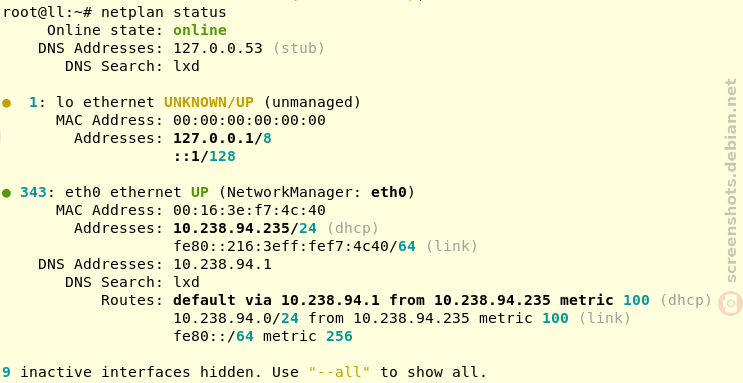
I m happy to announce that Netplan version 0.106 is now available on GitHub and is soon to be deployed into an Ubuntu/Debian/Fedora installation near you! Six months and 65 commits after the previous version, this release is brought to you by 4 free software contributors from around the globe. Highlights Highlights of this release include the new netplan status command, which queries your system for IP addresses, routes, DNS information, etc in addition to the Netplan backend renderer (NetworkManager/networkd) in use and the relevant Netplan YAML configuration ID. It displays all this in a nicely formatted way (or alternatively in machine readable YAML/JSON format).
Furthermore, we implemented a clean libnetplan API which can be used by external tools to parse Netplan configuration, migrated away from non-inclusive language (PR#303) and improved the overall Netplan documentation. Another change that should be noted, is that the match.macaddress stanza now only matches on PermanentMACAddress= on the systemd-networkd backend, as has been the case on the NetworkManager backend ever since (see PR#278 for background information on this slight change in behavior). Changelog Bug fixes:

13 February 2023

Jonathan Dowland: A visit to Prusa Labs

.
.

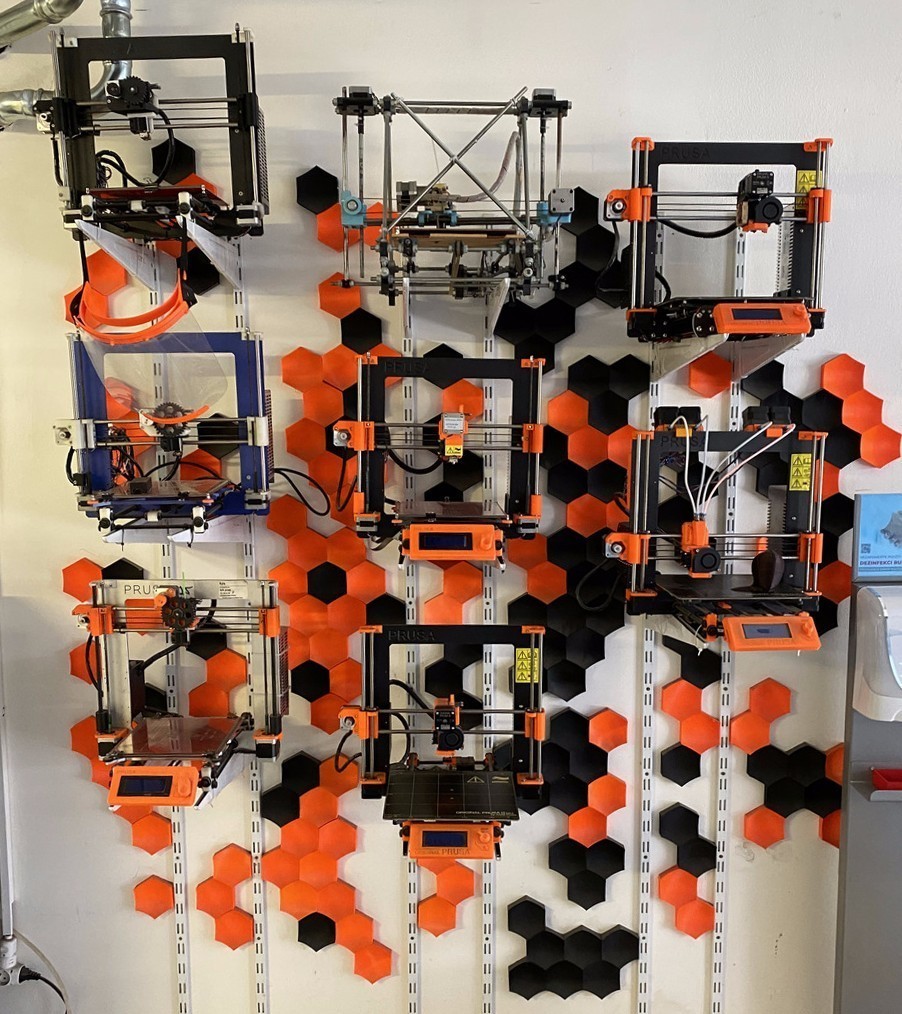
In September I was in Czechia for a Red Hat event. I ended up travelling via Prague, and had an unexpected extra day due to an airline strike causing my flight home to be cancelled. I took the opportunity to visit Prusa's offices/factory/Lab, and it was amazing! The Prusa team were all busy getting ready for the Prague Maker Faire that was happening the day afterwards.1 On arriving at the street which houses Prusa's Lab and Office buildings, the first thing that hit me was the smell. I find the melted-plastic smell of FDM printing (with PLA, at least) quite pleasant, and this was a super-condensed version of that, pumping out of their ground-floor windows. I started at the reception area on the ground floor. Outside reception there's a lovely sculpture representing the history of the development of the MK3S+.
The Reception The Reception
SLS Farm in the former Hack lab SLS Farm in the former Hack lab
History of the MK3S+ History of the MK3S+

At the reception you have a small waiting area with shelves of demonstration prints and some spools of Prusament. From here, our kind guide first took us to a region on the ground floor that used to be (prior to COVID times) the public maker/hack lab. The lab contained two modest farms of printers: one of their flagship FDM printer, the MK3S+, and another of their SLS resin printers. A close up of some example resin models is pictured above. The bicycle was tiny: about the size of a thumbnail.
A Historic display A Historic display
Bespoke QE equipment Bespoke QE equipment
The MK3S+ Farm The MK3S+ Farm

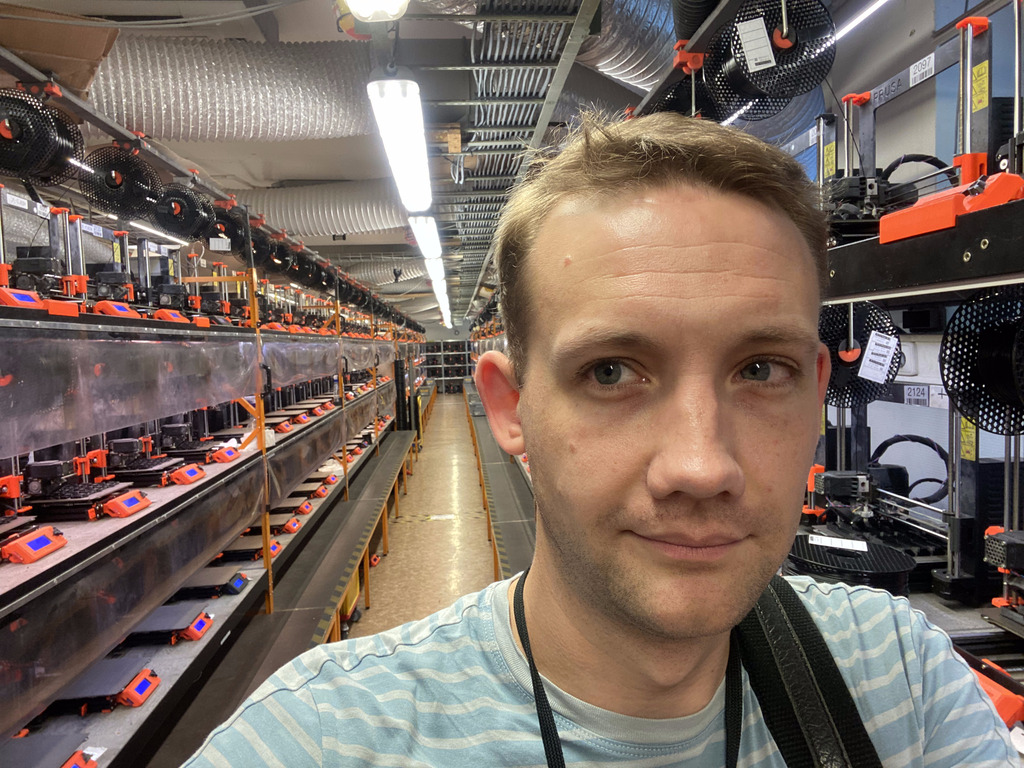
. Moi in the Farm
2KG orange PLA spools for the Farm 2KG orange PLA spools for the Farm
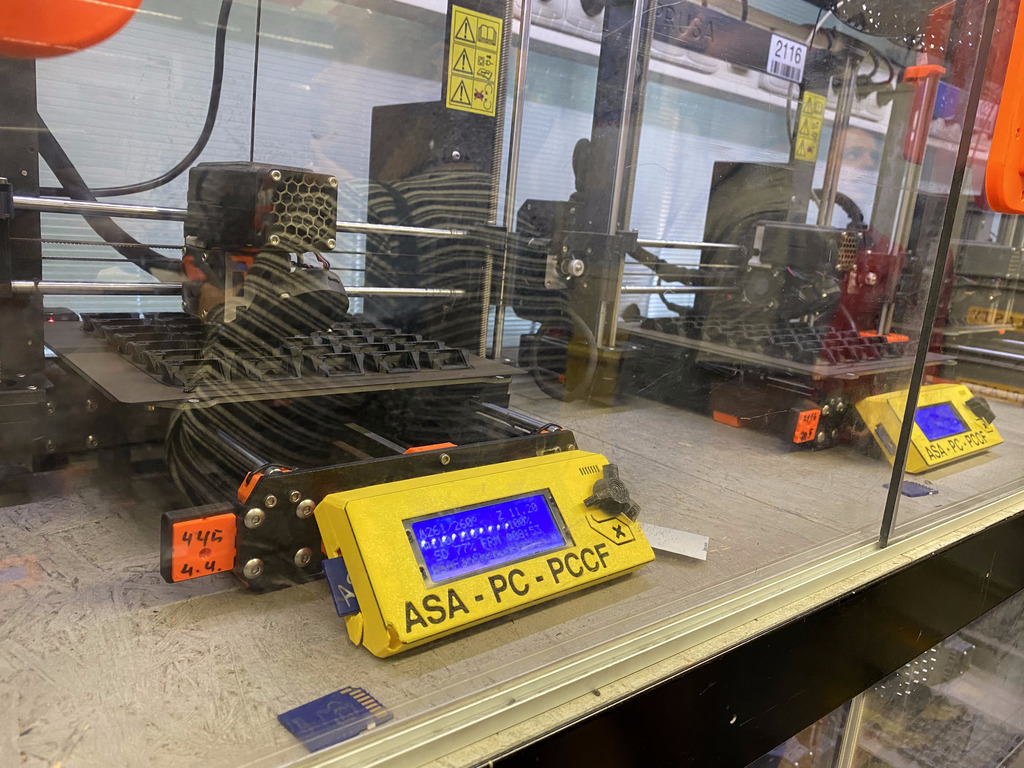
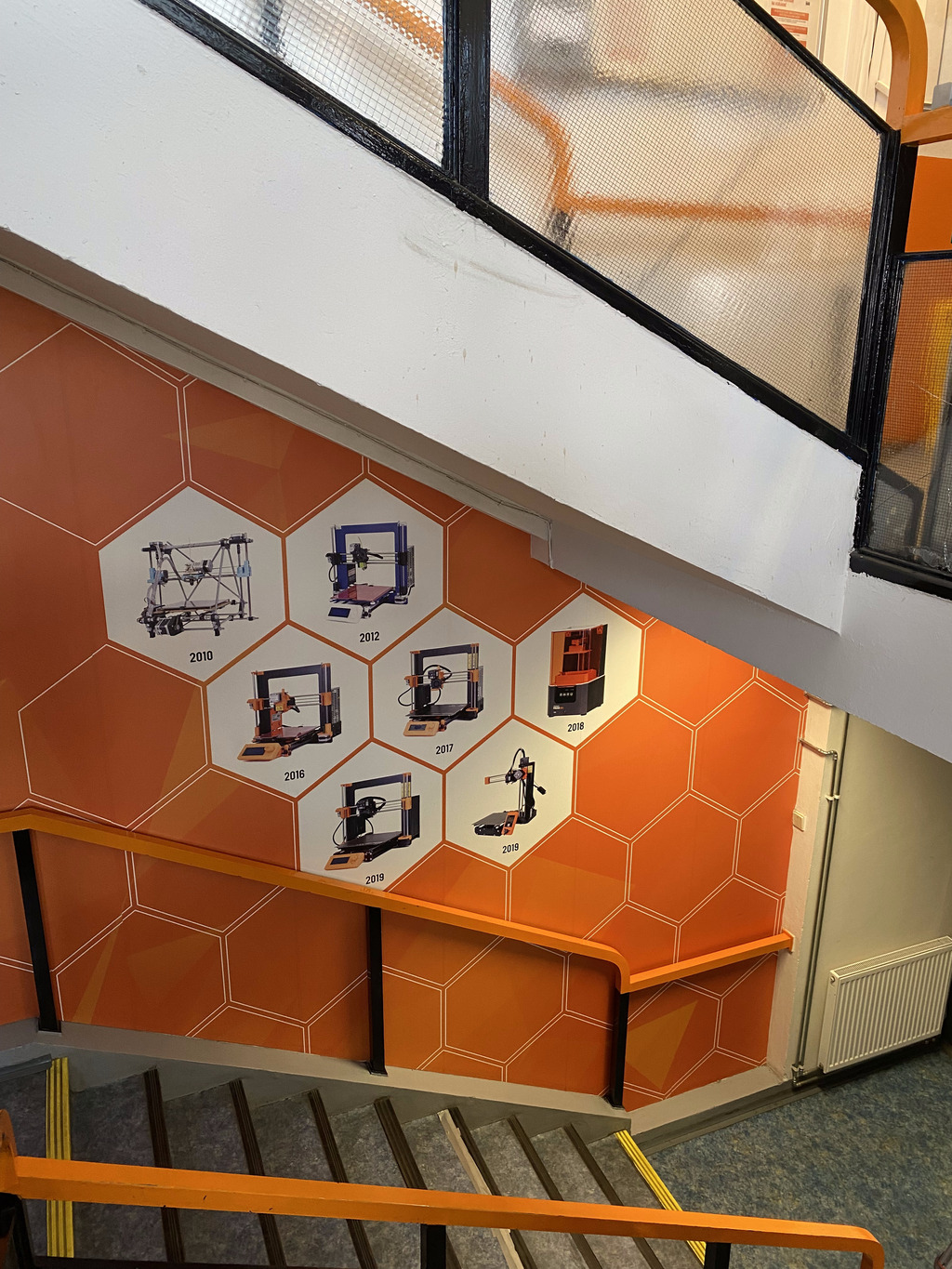
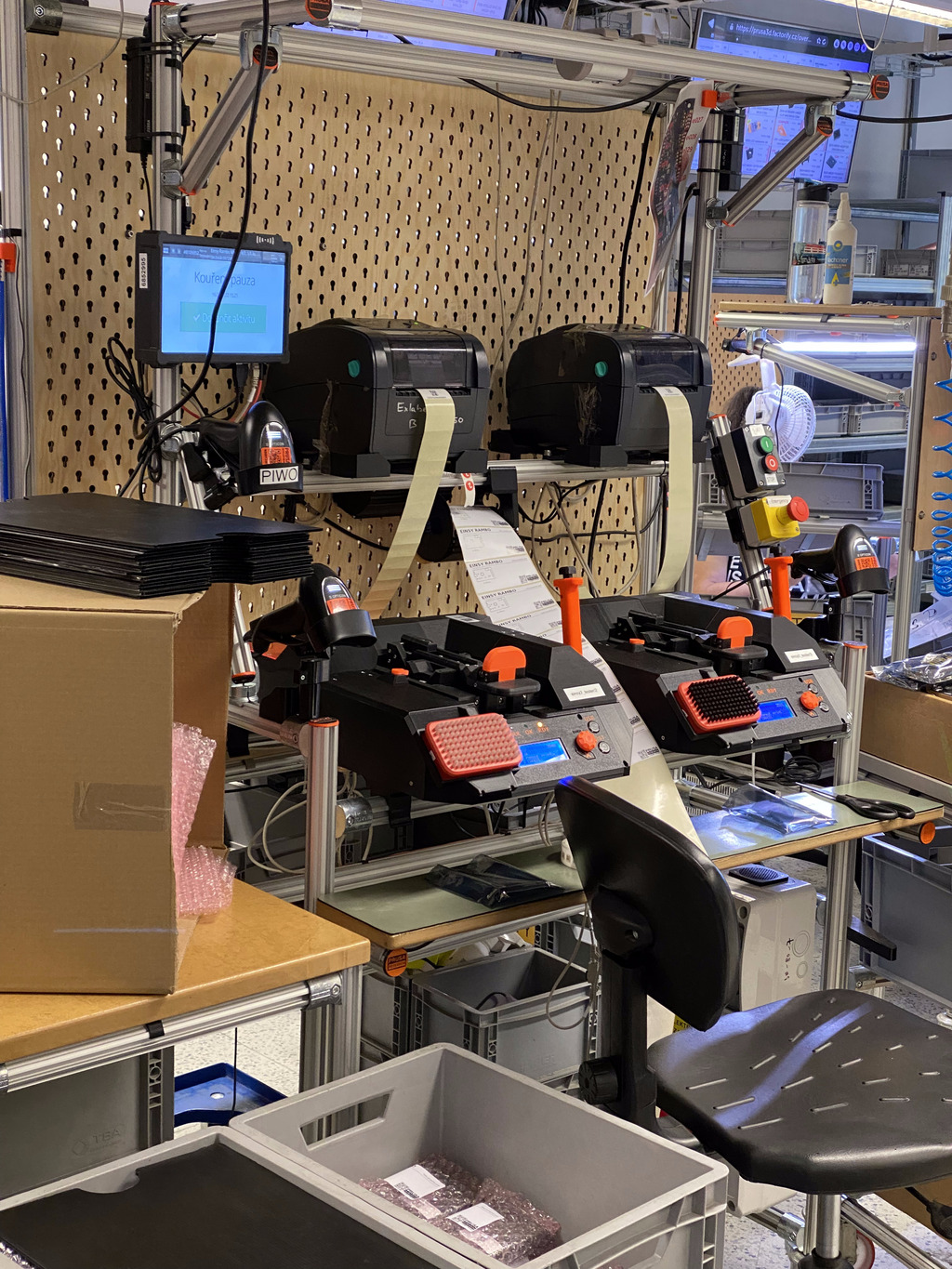
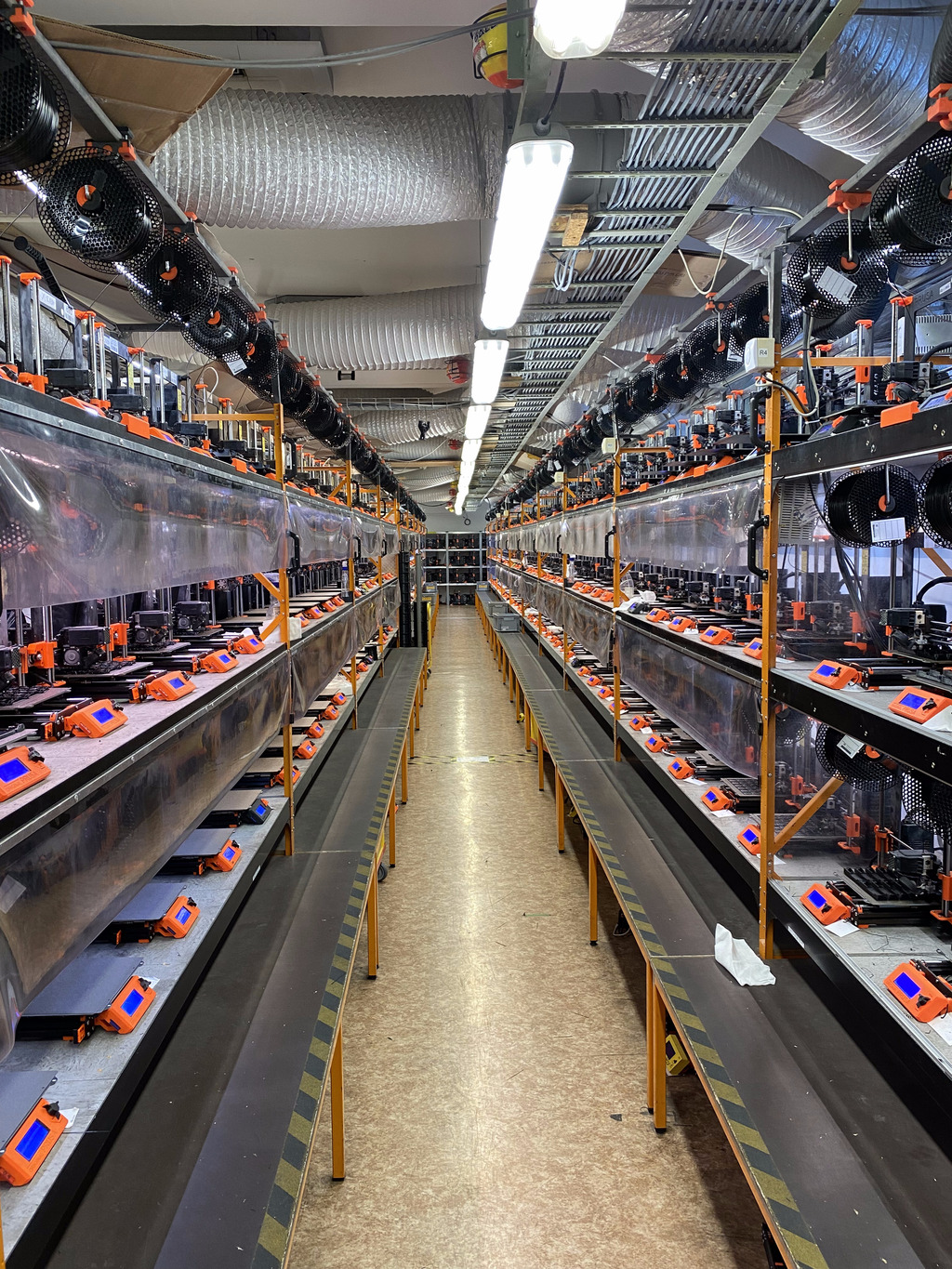
The rest of the ground floor area was full of heavy machinery and prototyping equipment. Onwards we went to the upstairs floors. Upstairs, past a nice graphic of Prusa's historic products, we visited the assembly and QE testing areas. They have a very organised system of parts buckets and some thorough QE processes, including some bespoke equipment that produces the "receipt" of tests and calibration that they provide for you in the box when you buy a 3D printer. After that, we visited the production Farm: a large room full of MK3S+ printers churning out parts for other printers. The noise was remarkable. The printers were running custom firmware to continually print the part they had been set for. Some of the printers were designated for printing with ASA: they were colour-coded (yellow controller surround) and within boxed regions to prevent the fumes causing problems. (picture at the top) Outside the room sat palettes of orange PETG plastic for the printer farm on 2KG spools (not a size they sell to the public just yet) The final part of the trip was outside, to the real farm: Prusa have a smallholding with Alpacas at the rear of their estate. Whilst we visited it, Josef Prusa himself turned up (in a snazzy looking custom colour Tesla) to feed the animals, say hello and pose for a picture. Overall, it was a fantastic visit. I'm very grateful to Air France for cancelling my flight home, and to Prusa Labs (in particular Luk ) for allowing me to come and say hello!

  1. I managed to squeeze that in too on my way to my rescheduled flight, although it was a rush visit and I don't have much to say or show from it. Suffice to say that it was lovely and bittersweet since the UK Maker Faire used to be hosted in my fair home city of Newcastle before they stopped.

Vincent Bernat: Building a SQL-like language to filter flows

Akvorado collects network flows using IPFIX or sFlow. It stores them in a ClickHouse database. A web console allows a user to query the data and plot some graphs. A nice aspect of this console is how we can filter flows with a SQL-like language:
Filter editor in Akvorado console
Often, web interfaces expose a query builder to build such filters. I think combining a SQL-like language with an editor supporting completion, syntax highlighting, and linting is a better approach.1 The language parser is built with pigeon (Go) from a parsing expression grammar or PEG. The editor component is CodeMirror (TypeScript).

Language parser PEG grammars are relatively recent2 and are an alternative to context-free grammars. They are easier to write and they can generate better error messages. Python switched from an LL(1)-based parser to a PEG-based parser in Python 3.9. pigeon generates a parser for Go. A grammar is a set of rules. Each rule is an identifier, with an optional user-friendly label for error messages, an expression, and an action in Go to be executed on match. You can find the complete grammar in parser.peg. Here is a simplified rule:
ConditionIPExpr "condition on IP"  
  column:("ExporterAddress"i   return "ExporterAddress", nil  
        / "SrcAddr"i   return "SrcAddr", nil  
        / "DstAddr"i   return "DstAddr", nil  ) _ 
  operator:("=" / "!=") _ 
  ip:IP  
    return fmt.Sprintf("%s %s IPv6StringToNum(%s)",
      toString(column), toString(operator), quote(ip)), nil
   
The rule identifier is ConditionIPExpr. It case-insensitively matches ExporterAddress, SrcAddr, or DstAddr. The action for each case returns the proper case for the column name. That s what is stored in the column variable. Then, it matches one of the possible operators. As there is no code block, it stores the matched string directly in the operator variable. Then, it tries to match the IP rule, which is defined elsewhere in the grammar. If it succeeds, it stores the result of the match in the ip variable and executes the final action. The action turns the column, operator, and IP into a proper expression for ClickHouse. For example, if we have ExporterAddress = 203.0.113.15, we get ExporterAddress = IPv6StringToNum('203.0.113.15'). The IP rule uses a rudimentary regular expression but checks if the matched address is correct in the action block, thanks to netip.ParseAddr():
IP "IP address"   [0-9A-Fa-f:.]+  
  ip, err := netip.ParseAddr(string(c.text))
  if err != nil  
    return "", errors.New("expecting an IP address")
   
  return ip.String(), nil
 
Our parser safely turns the filter into a WHERE clause accepted by ClickHouse:3
WHERE InIfBoundary = 'external' 
AND ExporterRegion = 'france' 
AND InIfConnectivity = 'transit' 
AND SrcAS = 15169 
AND DstAddr BETWEEN toIPv6('2a01:e0f:ffff::') 
                AND toIPv6('2a01:e0f:ffff:ffff:ffff:ffff:ffff:ffff')

Integration in CodeMirror CodeMirror is a versatile code editor that can be easily integrated into JavaScript projects. In Akvorado, the Vue.js component, InputFilter, uses CodeMirror as its foundation and leverages features such as syntax highlighting, linting, and completion. The source code for these capabilities can be found in the codemirror/lang-filter/ directory.

Syntax highlighting The PEG grammar for Go cannot be utilized directly4 and the requirements for parsers for editors are distinct: they should be error-tolerant and operate incrementally, as code is typically updated character by character. CodeMirror offers a solution through its own parser generator, Lezer. We don t need this additional parser to fully understand the filter language. Only the basic structure is needed: column names, comparison and logic operators, quoted and unquoted values. The grammar is therefore quite short and does not need to be updated often:
@top Filter  
  expression
 
expression  
 Not expression  
 "(" expression ")"  
 "(" expression ")" And expression  
 "(" expression ")" Or expression  
 comparisonExpression And expression  
 comparisonExpression Or expression  
 comparisonExpression
 
comparisonExpression  
 Column Operator Value
 
Value  
  String   Literal   ValueLParen ListOfValues ValueRParen
 
ListOfValues  
  ListOfValues ValueComma (String   Literal)  
  String   Literal
 
// [ ]
@tokens  
  // [ ]
  Column   std.asciiLetter (std.asciiLetter std.digit)*  
  Operator   $[a-zA-Z!=><]+  
  String  
    '"' (![\\\n"]   "\\" _)* '"'?  
    "'" (![\\\n']   "\\" _)* "'"?
   
  Literal   (std.digit   std.asciiLetter   $[.:/])+  
  // [ ]
 
The expression SrcAS = 12322 AND (DstAS = 1299 OR SrcAS = 29447) is parsed to:
Filter(Column, Operator, Value(Literal),
  And, Column, Operator, Value(Literal),
  Or, Column, Operator, Value(Literal))
The last step is to teach CodeMirror how to map each token to a highlighting tag:
export const FilterLanguage = LRLanguage.define( 
  parser: parser.configure( 
    props: [
      styleTags( 
        Column: t.propertyName,
        String: t.string,
        Literal: t.literal,
        LineComment: t.lineComment,
        BlockComment: t.blockComment,
        Or: t.logicOperator,
        And: t.logicOperator,
        Not: t.logicOperator,
        Operator: t.compareOperator,
        "( )": t.paren,
       ),
    ],
   ),
 );

Linting We offload linting to the original parser in Go. The /api/v0/console/filter/validate endpoint accepts a filter and returns a JSON structure with the errors that were found:
 
  "message": "at line 1, position 12: string literal not terminated",
  "errors": [ 
    "line":    1,
    "column":  12,
    "offset":  11,
    "message": "string literal not terminated",
   ]
 
The linter source for CodeMirror queries the API and turns each error into a diagnostic.

Completion The completion system takes a hybrid approach. It splits the work between the frontend and the backend to offer useful suggestions for completing filters. The frontend uses the parser built with Lezer to determine the context of the completion: do we complete a column name, an operator, or a value? It also extracts the column name if we are completing something else. It forwards the result to the backend through the /api/v0/console/filter/complete endpoint. Walking the syntax tree was not as easy as I thought, but unit tests helped a lot. The backend uses the parser generated by pigeon to complete a column name or a comparison operator. For values, the completions are either static or extracted from the ClickHouse database. A user can complete an AS number from an organization name thanks to the following snippet:
results := []struct  
  Label  string  ch:"label" 
  Detail string  ch:"detail" 
 
columnName := "DstAS"
sqlQuery := fmt.Sprintf( 
 SELECT concat('AS', toString(%s)) AS label, dictGet('asns', 'name', %s) AS detail
 FROM flows
 WHERE TimeReceived > date_sub(minute, 1, now())
 AND detail != ''
 AND positionCaseInsensitive(detail, $1) >= 1
 GROUP BY label, detail
 ORDER BY COUNT(*) DESC
 LIMIT 20
 , columnName, columnName)
if err := conn.Select(ctx, &results, sqlQuery, input.Prefix); err != nil  
  c.r.Err(err).Msg("unable to query database")
  break
 
for _, result := range results  
  completions = append(completions, filterCompletion 
    Label:  result.Label,
    Detail: result.Detail,
    Quoted: false,
   )
 
In my opinion, the completion system is a major factor in making the field editor an efficient way to select flows. While a query builder may have been more beginner-friendly, the completion system s ease of use and functionality make it more enjoyable to use once you become familiar.

  1. Moreover, building a query builder did not seem like a fun task for me.
  2. They were introduced in 2004 in Parsing Expression Grammars: A Recognition-Based Syntactic Foundation. LR parsers were introduced in 1965, LALR parsers in 1969, and LL parsers in the 1970s. Yacc, a popular parser generator, was written in 1975.
  3. The parser returns a string. It does not generate an intermediate AST. This makes it simpler and it currently fits our needs.
  4. It could be manually translated to JavaScript with PEG.js.

Valhalla's Things: Cernit Sets for the Royal Game of UR

Posted on February 13, 2023
Some months ago I stumbled on the video where Irving Finkel teaches Tom Scott how to play the Royal Game of Ur and my takeout was:
  1. Irving Finkel is Gandalf or something;
  2. the game sounded quite fun!;
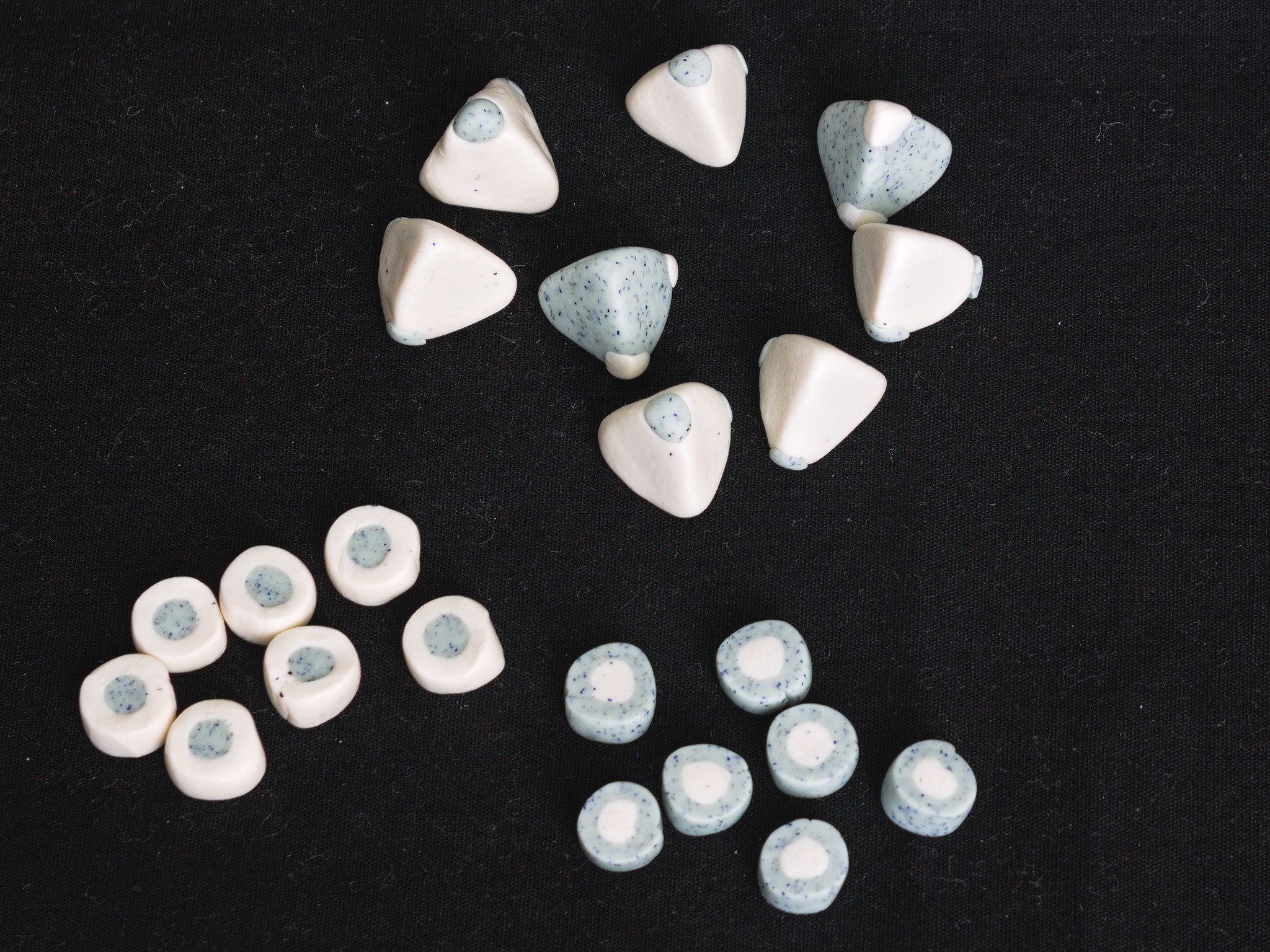
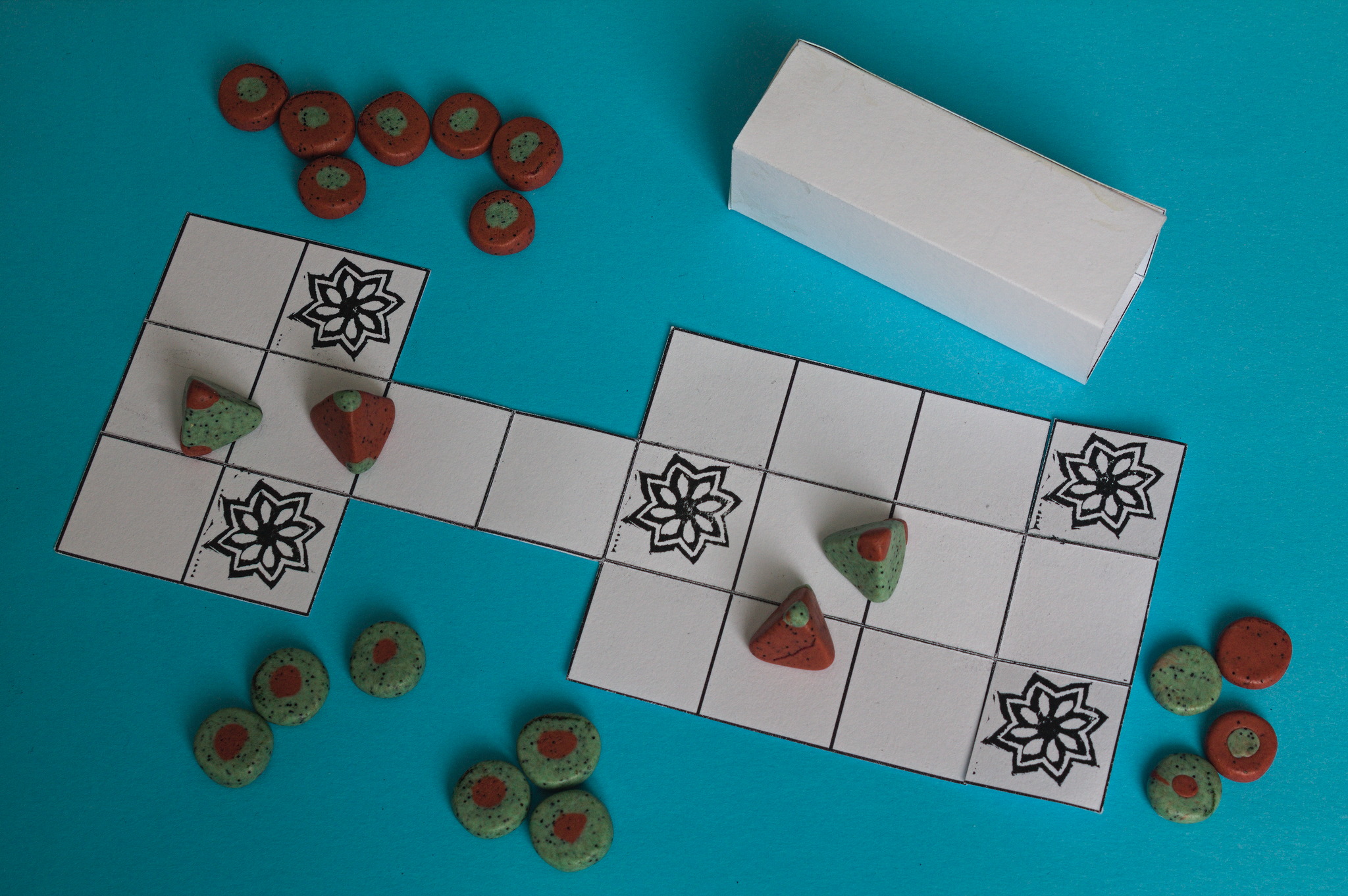
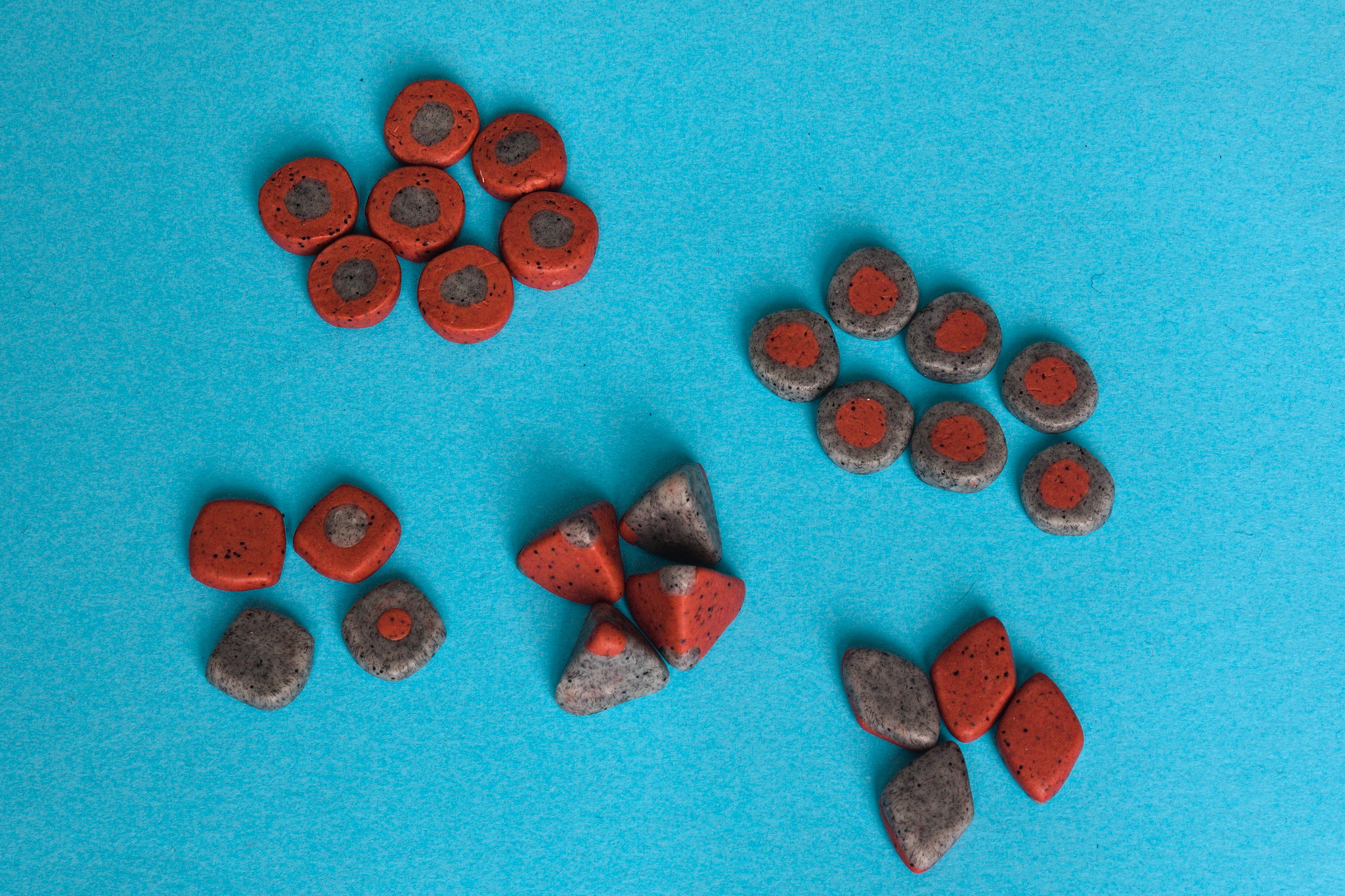
so I did the almost sensible thing, quickly drew a board with inkscape, printed it on 160 g/m paper and used my piecepack pieces to try a few games. two copies of a game board made of plain squares: a 3   4 squares area at the top, a 3   2 area at the bottom, connected by a 1   2 corridor in the middle. I say almost sensible, because rather than drawing the rosettes with inkscape I decided to carve a rubber stamp and use that to print them on the board (which is why the svgs on this page are missing them: if you print them you ll have to add the rosettes in some way). And if I had been a sensible person, that s where I would have stopped, since that s perfectly enough to play games and find out that it actually is quite a fun game, and one of our staples. As some of you probably know, I m not a sensible person. I also have quite a few blocks and half-blocks of cernit, and one day after I ve had used some, my hands were still moving and accidentally made some pyramidal dice, and a handful of tokens. Royal game of Ur pieces in marbled grey and white plastic: the tokens are small coins in one colour with a small circle of the other colour in the middle, the dice are tetrahedrons in one colour with two points marked in the other colour. And after baking and trying them I liked them, but they had not been planned in any way, and they were a bit too small for the board, so the next time I was using cernit I tried to make a new set. And while I was doing that I tried a new shape for the dice, as coins marked with a dot in the middle of one of the sides, because I don t really like tetrahedral dice. A set of red and green tokens, like the ones above, plus tetrahedron dice and four more coins with a dot of a different colour just on one side. Everything is on top of a board that folds up. And now, I realized this wasn t going to be my last set, and urgently felt the need for some container to keep them in and avoid missing pieces. (Yes, in the picture above one piece was already missing. While taking it I didn t realize it, and neither I did when picking up everything to put it away, getting the missing piece and storing it safely together with the rest of the set. It must have been hiding in plain sight nearby, but I will never know where.) Anyway, back to Inkscape, and to a board printed on scrap paper that I tried to fold up until I came up with a layout that folded up in a small drawer, and then I added a case to wrap around it to keep it closed. A white box, about 2.5 cm   2.5 cm   7.5 cm; a drawer is sliding out of one small end. The drawer from the box above, extracted to show it's made of a folded game of Ur board and contains a set with tokens and dice. I played around with the case until it was big enough to actually slide around the folded board, and this is the result, ready to be printed out on A4 paper, cut, folded and glued. (This takes most of the sheet, and I m not sure that the case would still fit around the board/drawer if printed with scaling, so if you want to print it on Letter paper I d recommend to move the pieces around.) two copies of the game board above, plus two cut / fold / glue boxes Now, the only problem left was that green isn t really my colour, and while I did like the stone effect of this set, I wasn t exactly pleased by the colour scheme. (why did I do it this way in the first place? probably because I was trying to use up old cernit blocks before opening new ones.) So, the only possible way out was to make yet another set, right? A set of red and grey tokens, tetrahedron dice, coins with one side marked with a dot that are square-ish rather than circular and four lozenge-shaped coins with each side of a different colour. I still used stone effect cernit, but this time in a red/grey scheme that knew I would have liked more, and while I was doing it I tried a few improvements on the randomization devices. The tetrahedral dice are still the same: they work, it s what they use in the replica sets, so I keep making them even if they re not my first choice. I ve changed the coins to make them almost square for two reasons, however: one is that the round one tended to roll away into inconvenient places when throwing them with emphasis, and the other one is to make it easier to recognise them from the tokens with no need to flip each one around before starting the game. The lozenges were a bit of a failure, instead. They work fine when thrown, but I don t think that there is a self-evident way to decide which side should be counted, and the only intuitive way I can think of (count the ones in the player s colour) would be unbalanced. Speaking of balance issues: of course the hand-modelled dice and coins aren t perfectly balanced but:
  • they don t feel obviously unbalanced;
  • both players use the same set, so any subtle unbalance isn t going to affect the chance of winning in an uneven way.
Maybe one day I will find a way to easily roll them a statistically significant number of times, collect data and analyze it to find out how imbalanced they are, but that s not going to happen with manual data collecting, and I m not really ready to go down the yak shaving filled road to automatize it. To wrap up: is it going to be the last set I make for the Royal Game of Ur? lol. Is it going to be the last cernit set I make this month? definitely yes, I now have one I m happy with, I m routinely playing with it and I m currently doing other crafts rather than cernit.

11 February 2023

Vincent Bernat: Hacking the Geberit Sigma 70 flush plate

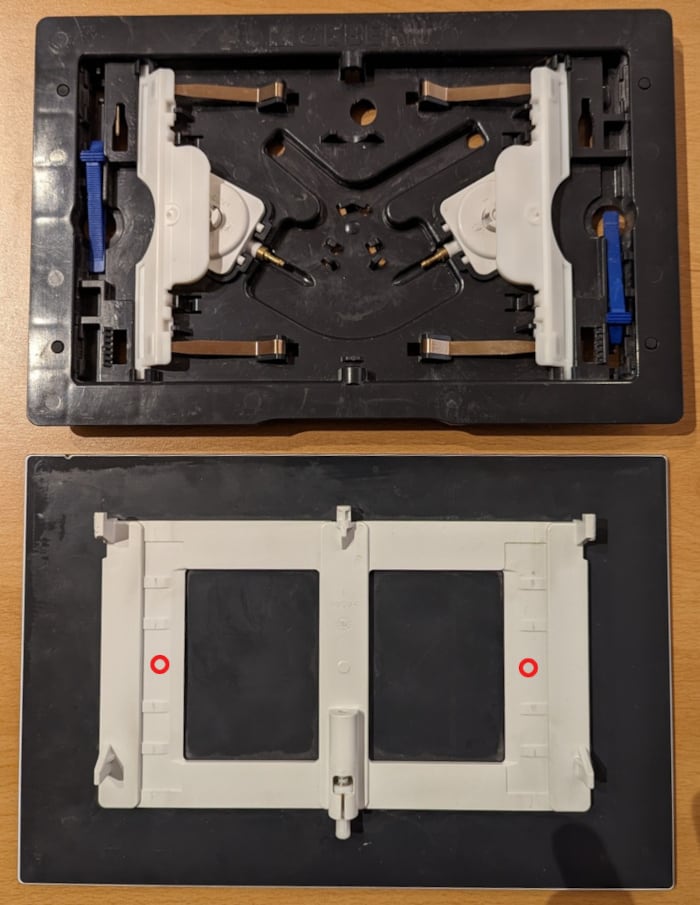
My toilet is equipped with a Geberit Sigma 70 flush plate. The sales pitch for this hydraulic-assisted device praises the ingenious mount that acts like a rocker switch. In practice, the flush is very capricious and has a very high failure rate. Avoid this type of mechanism! Prefer a fully mechanical version like the Geberit Sigma 20. After several plumbers, exchanges with Geberit s technical department, and the expensive replacement of the entire mechanism, I was still getting a failure rate of over 50% for the small flush. I finally managed to decrease this rate to 5% by applying two 8 mm silicone bumpers on the back of the plate. Their locations are indicated by red circles on the picture below:
Geberit Sigma 70 flush plate. Top: the mechanism that converts the mechanical press into a hydraulic impulse. Bottom: the back of the plate with the two places where to apply the bumpers.
Geberit Sigma 70 flush plate. Above: the mechanism installed on the wall. Below, the back of the glass plate. In red, the two places where to apply the silicone bumpers.
Expect to pay about 5 and as many minutes for this operation.

10 February 2023

Antoine Beaupr : Picking a USB-C dock and charger

Dear lazy web, help me pick the right hardware to make my shiny new laptop work better. I want a new USB-C dock and travel power supply.

Background I need advice on hardware, because my current setup in the office doesn't work so well. My new Framework laptop has four (4!) USB-C ports which is great, but it only has those ports (there's a combo jack, but I don't use it because it's noisy). So right now I have the following setup:
  • HDMI: monitor one
  • HDMI: monitor two
  • USB-A: Yubikey
  • USB-C: USB-C hub, which has:
    • RJ-45 network
    • USB-A keyboard
    • USB-A mouse
    • USB-A headset
... and I'm missing a USB-C port for power! So I get into this annoying situation where I need to actually unplug the USB-A Yubikey, unplug the USB-A expansion card, plug in the power for a while so it can charge, and then do that in reverse when I need the Yubikey again (which is: often). Another option I have is to unplug the headset, but I often need both the headset and the Yubikey at once. I also have a pair of earbuds that work in the combo jack, but, again, they are noticeably noisy. So this doesn't work. I'm thinking I should get a USB-C Dock of some sort. The Framework forum has a long list of supported docks in a "megathread", but I figured people here might have their own experience with docks and laptop/dock setups. So what should USB-C Dock should I get? Should I consider changing to a big monitor with a built-in USB-C dock and power? Ideally, i'd like to just walk in the office, put the laptop down and insert a single USB-C cable and be done with it. Does that even work with Wayland? I have read reports of Displaylink not working in Sway specifically... does that apply to any multi-monitor over a single USB-C cable setup? Oh, and what about travel options? Do you have a fancy small form factor USB-C power charger that you really like?

Current ideas Here are the devices I'm considering right now...

USB chargers The spec here is at least 65W USB-C with international plugs. I particularly like the TOFU, but I am not sure it will deliver... I found that weird little thing through this Twitter post from Benedict Reuschling, from this blog post, from 2.5 admins episode 127 (phew!). Update: I ordered a TOFU power station today (2023-02-20). I'm a little concerned about the power output (45W instead of 65W for the Framework charger), but I suspect it will not actually be a problem while traveling, since the laptop will keep its charge during the day and will charge at night... The device shipped 3 days later, with an estimated delivery time of 12 to 15 days, so expect this thing to take its sweet time landing on your desk.

USB Docks Specification:
  • must have 2 or more USB-A ports (3 is ideal, otherwise i need a new headset adapter)
  • at least one USB-C port, preferably more
  • works in Linux
  • 2 display support (or one big monitor?), ideally 2x4k for future-proofing, HDMI or Display-Port, ideally also with double USB-C/Thunderbolt for future-proofing
  • all on one USB-C wire would be nice
  • power delivery over the USB-C cable
  • not too big, preferably
Note that I move from 4 USB-A ports down to 2 or 3 because I can change the USB-A cable on my keyboard for USB-C. But that means I need a slot for a USB-C port on the dock of course. I also could live with one less USB-A cable if I find a combo jack adapter, but that would mean a noisy experience. Options found so far:
  • ThinkPad universal dock/40ay0090us): 300$USD, 65-100W, combo jack, 3x USB3.1, 2x USB2.0, 1x USB-C, 2x Display Port, 1x HDMI Port, 1x Gigabit Ethernet
  • Caldigit docks are apparently good, and the USB-C HDMI Dock seems like a good candidate (not on sale in there Canada shop), but leaves me wondering whether I want to keep my old analog monitors around and instead get proper monitors with USB-C inputs, and use something like Thunderbolt Element hub (230$USD). Update: I wrote Caldigit and they don't seem to have any Dock that would work for me, they suggest the TS3 plus which only has a single DP connector (!?). The USB-C HDMI dock is actually discontinued and they mentioned that they do have trouble with Linux in general.
  • I was also recommended OWC docks as well. update: their website is a mess, and live chat has confirmed they do not actually have any device that fits the requirement of two HDMI/DP outputs.
  • Anker also has docks (e.g. the Anker 568 USB-C Docking Station 11-in-1 looks nice, but holy moly 300$USD... Also, Anker docks are not all equal, I've heard reports of some of them being bad. Update: I reached out to Anker to clarify whether or not their docks will work on Linux and to advise on which dock to use, and their response is that they "do not recommend you use our items with Linux system". So I guess that settles it with Anker.
  • Cable Matters are promising, and their "USB-C Docking Station with Dual 4K HDMI and 80W Charging for Windows Computers might just actually work. It was out of stock on their website and Amazon but after reaching out to their support by email, they pointed out a product page that works in Canada.
Also: this post from Big Mess Of Wires has me worried that anything might work at all. It's where I had the Cable Matters reference however... Update: I ordered a this dock from Cable Matters from Amazon (reluctantly). It promises Linux support and checked all the boxes for me (4x USB-A, audio, network, 2xHDMI). It kind of works? I tested the USB-A ports, charging, networking, and the HDMI ports, all worked the first time. But! When I disconnect and reconnect the hub, the HDMI ports stop working. It s quite infuriating especially since there s very little diagnostics available. It s unclear how the devices show up on my computer, I can t even tell what device provides the HDMI connectors in lsbusb. I ve also seen the USB keyboard drop keypresses, which is also ... not fun. I suspect foul play inside Sway. And yeah, those things are costly! This one goes for 300$ a pop, not great. Update 2: Cable Matters support responded by simply giving me this hack that solved it at least for now. Just reverse the USB-C cable, and poof, everything works. Magic.

Your turn! So what's your desktop setup like? Do you have docks? a laptop? a desktop? did you build it yourself? Did you solder a USB-C port in the back of your neck and interface directly with the matrix and there's no spoon? Do you have a 4k monitor? Two? A 8k monitor that curves around your head in a fully immersive display? Do you work on a Occulus rift and only interface the world through 3d virtual reality, including terminal emulators? Thanks in advance!

9 February 2023

Sam Hartman: Building Carthage with Carthage

This is the second in a series of blog posts introducing Carthage, an Infrastructure as Code framework I ve been working on the last four years. In this post we ll talk about how we use Carthage to build the Carthage container images. We absolutely could have just used a Containerfile to do this; in fact I recently removed a hybrid solution that produced an artifact and then used a Containerfile to turn it into an OCI image. The biggest reason we don t use a Containerfile is that we want to be able to reuse the same infrastructure (installed software and configuration) across multiple environments. For example CarthageServerRole, a reusable Carthage component that install Carthage itself is used in several places:
  1. on raw hardware when we re using Carthage to drive a hypervisor
  2. As part of image building pipelines to build AMIs for Amazon Web Services
  3. Installed onto AWS instances built from the Debian AMI where we cannot use custom AMIs
  4. Installed onto KVM VMs
  5. As part of building the Carthage container images
So the biggest thing Carthage gives us is uniformity in how we set up infrastructure. We ve found a number of disadvantages of Containerfiles as well:
  1. Containerfiles mix the disadvantages of imperative and declarative formats. Like a declarative format they have no explicit control logic. It seems like that would be good for introspecting and reasoning about Containers. But all you get is the base image and a set of commands to build a container. For reasoning about common things like whether a container has a particular vulnerability or can be distributed under a particular license, that s not very useful. So we don t get much valuable introspection out of the declarative aspects, and all too often we see Containerfiles generated by Makefiles or other multi-level build-systems to get more logic or control flow.
  2. Containerfiles have limited facility for doing things outside the container. The disadvantage of this is that you end up installing all the software you need to build the container into the container itself (or having a multi-level build system). But for example if I want to use Ansible to configure a container, the easiest way to do that is to actually install Ansible into the container itself, even though Ansible has a large dependency chain most of which we won t need in the container. Yes, Ansible does have a number of connection methods including one for Buildah, but by the point you re using that, you re already using a multi-level build system and aren t really just using a Containerfile.
Okay, so since we re not going to just use a Containerfile, what do we do instead? We produce a CarthageLayout. A CarthageLayout is an object in the Carthage modeling language. The modeling language looks a lot like Python in fact it s even implemented using Python metaclasses and uses the Python parser. However, there are some key semantic differences and it may help to think of the modeling language as its own thing. Carthage layouts are typically contained in Carthage plugins. For example, the oci_images plugin is our focus today. Most of the work in that plugin is in layout.py, and the layout begins here:
class layout(CarthageLayout):
    add_provider(ConfigLayout)
    add_provider(carthage.ansible.ansible_log, str(_dir/"ansible.log"))
The add_provider calls are special, and we ll discuss them in a future post. For now, think of them as assignments in a more complex namespace than simple identifiers. But the heart of this layout is the CarthageImage class:
    class CarthageImage(PodmanImageModel, carthage_base.CarthageServerRole):
        base_image = injector_access('from_scratch_debian')
        oci_image_tag = 'localhost/carthage:latest'
        oci_image_command = ['/bin/systemd']
Most of the work of our image is done by inheritance. We inherit from the CarthageServerRole from the carthage_base plugin collection. A role is a reusable set of infrastructure that can be attached directly to a MachineModel. By inheriting from this role, we request the installation of the Carthage software. The role also supports copying in various dependencies; for example when Carthage is used to manage a cluster of machines, the layout corresponding to the cluster can automatically be copied to all nodes in the cluster. We do not need this feature to build the container image. The CarthageImage class sets its base image. Currently we are using our own base Debian image that we build with debootstrap and then import as a container image. In the fairly near future, we ll change that to:
        base_image =  debian:bookworm 
That will simply use the Debian image from Dockerhub. We are building our own base image for historical reasons and need to confirm that everything works before switching over. By setting oci_image_tag we specify where in the local images the resulting image will be stored. We also specify that this image boots systemd. We actually do want to do a bit of work on top of CarthageServerRole specific to the container image. To do that we use a Carthage feature called a Customization. There are various types of customization. For example MachineCustomization runs a set of tasks on a Machine that is booted and on the network. When building images, the most common type of customization is a FilesystemCustomization. For these, we have access to the filesystem, and we have some way of running a command in the context of the filesystem. We don t boot the filesystem as a machine unless we need to. (We might if the filesystem is a kvm VM or AWS instance for example). Carthage collects all the customizations in a role or image model. In the case of container image classes like PodmanImageModel, each customization is applied as an individual layer in the resulting container image. Roles and customizations are both reusable infrastructure. Roles typically contain customizations. Roles operate at the modeling layer; you might introspect a machine s model or an image s model to see what functionality (roles) it provides. In contrast, customizations operate at the implementation layer. They do specific things like move files around, apply Ansible roles or similar. Let s take a look at the customization applied for the Carthage container image (full code):

        class customize_for_oci(FilesystemCustomization):

            @setup_task("Remove Software")
            async def remove_software(self):
                await self.run_command("apt", "-y", "purge",
                                       "exim4-base",
                                       )

            @setup_task("Install service")
            async def install_service(self):
               # installs and activates a systemd unit
Then to pull it all together, we simply run the layout:
sudo PYTHONPATH=$(pwd) python3 ./bin/carthage-runner ./oci_images build
In the next post, we will dig more into how to make infrastructure reusable.

comment count unavailable comments

8 February 2023

Chris Lamb: Most anticipated films of 2023

Very few highly-anticipated movies appear in January and February, as the bigger releases are timed so they can be considered for the Golden Globes in January and the Oscars in late February or early March, so film fans have the advantage of a few weeks after the New Year to collect their thoughts on the year ahead. In other words, I'm not actually late in outlining below the films I'm most looking forward to in 2023...

Barbie No, seriously! If anyone can make a good film about a doll franchise, it's probably Greta Gerwig. Not only was Little Women (2019) more than admirable, the same could be definitely said for Lady Bird (2017). More importantly, I can't help feel she was the real 'Driver' behind Frances Ha (2012), one of the better modern takes on Claudia Weill's revelatory Girlfriends (1978). Still, whenever I remember that Barbie will be a film about a billion-dollar toy and media franchise with a nettlesome history, I recall I rubbished the "Facebook film" that turned into The Social Network (2010). Anyway, the trailer for Barbie is worth watching, if only because it seems like a parody of itself.

Blitz It's difficult to overstate just how important the aerial bombing of London during World War II is crucial to understanding the British psyche, despite it being a constructed phenomenon from the outset. Without wishing to underplay the deaths of over 40,000 civilian deaths, Angus Calder pointed out in the 1990s that the modern mythology surrounding the event "did not evolve spontaneously; it was a propaganda construct directed as much at [then neutral] American opinion as at British." It will therefore be interesting to see how British Grenadian Trinidadian director Steve McQueen addresses a topic so essential to the British self-conception. (Remember the controversy in right-wing circles about the sole Indian soldier in Christopher Nolan's Dunkirk (2017)?) McQueen is perhaps best known for his 12 Years a Slave (2013), but he recently directed a six-part film anthology for the BBC which addressed the realities of post-Empire immigration to Britain, and this leads me to suspect he sees the Blitz and its surrounding mythology with a more critical perspective. But any attempt to complicate the story of World War II will be vigorously opposed in a way that will make the recent hullabaloo surrounding The Crown seem tame. All this is to say that the discourse surrounding this release may be as interesting as the film itself.

Dune, Part II Coming out of the cinema after the first part of Denis Vileneve's adaptation of Dune (2021), I was struck by the conception that it was less of a fresh adaptation of the 1965 novel by Frank Herbert than an attempt to rehabilitate David Lynch's 1984 version and in a broader sense, it was also an attempt to reestablish the primacy of cinema over streaming TV and the myriad of other distractions in our lives. I must admit I'm not a huge fan of the original novel, finding within it a certain prurience regarding hereditary military regimes and writing about them with a certain sense of glee that belies a secret admiration for them... not to mention an eyebrow-raising allegory for the Middle East. Still, Dune, Part II is going to be a fantastic spectacle.

Ferrari It'll be curious to see how this differs substantially from the recent Ford v Ferrari (2019), but given that Michael Mann's Heat (1995) so effectively re-energised the gangster/heist genre, I'm more than willing to kick the tires of this about the founder of the eponymous car manufacturer. I'm in the minority for preferring Mann's Thief (1981) over Heat, in part because the former deals in more abstract themes, so I'd have perhaps prefered to look forward to a more conceptual film from Mann over a story about one specific guy.

How Do You Live There are a few directors one can look forward to watching almost without qualification, and Hayao Miyazaki (My Neighbor Totoro, Kiki's Delivery Service, Princess Mononoke Howl's Moving Castle, etc.) is one of them. And this is especially so given that The Wind Rises (2013) was meant to be the last collaboration between Miyazaki and Studio Ghibli. Let's hope he is able to come out of retirement in another ten years.

Indiana Jones and the Dial of Destiny Given I had a strong dislike of Indiana Jones and the Kingdom of the Crystal Skull (2008), I seriously doubt I will enjoy anything this film has to show me, but with 1981's Raiders of the Lost Ark remaining one of my most treasured films (read my brief homage), I still feel a strong sense of obligation towards the Indiana Jones name, despite it feeling like the copper is being pulled out of the walls of this franchise today.

Kafka I only know Polish filmmaker Agnieszka Holland through her Spoor (2017), an adaptation of Olga Tokarczuk's 2009 eco-crime novel Drive Your Plow Over the Bones of the Dead. I wasn't an unqualified fan of Spoor (nor the book on which it is based), but I am interested in Holland's take on the life of Czech author Franz Kafka, an author enmeshed with twentieth-century art and philosophy, especially that of central Europe. Holland has mentioned she intends to tell the story "as a kind of collage," and I can hope that it is an adventurous take on the over-furrowed biopic genre. Or perhaps Gregor Samsa will awake from uneasy dreams to find himself transformed in his bed into a huge verminous biopic.

The Killer It'll be interesting to see what path David Fincher is taking today, especially after his puzzling and strangely cold Mank (2020) portraying the writing process behind Orson Welles' Citizen Kane (1941). The Killer is said to be a straight-to-Netflix thriller based on the graphic novel about a hired assassin, which makes me think of Fincher's Zodiac (2007), and, of course, Se7en (1995). I'm not as entranced by Fincher as I used to be, but any film with Michael Fassbender and Tilda Swinton (with a score by Trent Reznor) is always going to get my attention.

Killers of the Flower Moon In Killers of the Flower Moon, Martin Scorsese directs an adaptation of a book about the FBI's investigation into a conspiracy to murder Osage tribe members in the early years of the twentieth century in order to deprive them of their oil-rich land. (The only thing more quintessentially American than apple pie is a conspiracy combined with a genocide.) Separate from learning more about this disquieting chapter of American history, I'd love to discover what attracted Scorsese to this particular story: he's one of the few top-level directors who have the ability to lucidly articulate their intentions and motivations.

Napoleon It often strikes me that, despite all of his achievements and fame, it's somehow still possible to claim that Ridley Scott is relatively underrated compared to other directors working at the top level today. Besides that, though, I'm especially interested in this film, not least of all because I just read Tolstoy's War and Peace (read my recent review) and am working my way through the mind-boggling 431-minute Soviet TV adaptation, but also because several auteur filmmakers (including Stanley Kubrick) have tried to make a Napoleon epic and failed.

Oppenheimer In a way, a biopic about the scientist responsible for the atomic bomb and the Manhattan Project seems almost perfect material for Christopher Nolan. He can certainly rely on stars to queue up to be in his movies (Robert Downey Jr., Matt Damon, Kenneth Branagh, etc.), but whilst I'm certain it will be entertaining on many fronts, I fear it will fall into the well-established Nolan mould of yet another single man struggling with obsession, deception and guilt who is trying in vain to balance order and chaos in the world.

The Way of the Wind Marked by philosophical and spiritual overtones, all of Terrence Malick's films are perfumed with themes of transcendence, nature and the inevitable conflict between instinct and reason. My particular favourite is his stunning Days of Heaven (1978), but The Thin Red Line (1998) and A Hidden Life (2019) also touched me ways difficult to relate, and are one of the few films about the Second World War that don't touch off my sensitivity about them (see my remarks about Blitz above). It is therefore somewhat Malickian that his next film will be a biblical drama about the life of Jesus. Given Malick's filmography, I suspect this will be far more subdued than William Wyler's 1959 Ben-Hur and significantly more equivocal in its conviction compared to Paolo Pasolini's ardently progressive The Gospel According to St. Matthew (1964). However, little beyond that can be guessed, and the film may not even appear until 2024 or even 2025.

Zone of Interest I was mesmerised by Jonathan Glazer's Under the Skin (2013), and there is much to admire in his borderline 'revisionist gangster' film Sexy Beast (2000), so I will definitely be on the lookout for this one. The only thing making me hesitate is that Zone of Interest is based on a book by Martin Amis about a romance set inside the Auschwitz concentration camp. I haven't read the book, but Amis has something of a history in his grappling with the history of the twentieth century, and he seems to do it in a way that never sits right with me. But if Paul Verhoeven's Starship Troopers (1997) proves anything at all, it's all in the adaption.

7 February 2023

Stephan Lachnit: Installing Debian on F2FS rootfs with deboostrap and systemd-boot

I recently got a new NVME drive. My plan was to create a fresh Debian install on an F2FS root partition with compression for maximum performance. As it turns out, this is not entirely trivil to accomplish. For one, the Debian installer does not support F2FS (here is my attempt to add it from 2021). And even if it did, grub does not support F2FS with the extra_attr flag that is required for compression support (at least as of grub 2.06). Luckily, we can install Debian anyway with all these these shiny new features when we go the manual road with debootstrap and using systemd-boot as bootloader. We can break down the process into several steps:
  1. Creating the partition table
  2. Creating and mounting the root partition
  3. Bootstrapping with debootstrap
  4. Chrooting into the system
  5. Configure the base system
  6. Define static file system information
  7. Installing the kernel and bootloader
  8. Finishing touches
Warning: Playing around with partitions can easily result in data if you mess up! Make sure to double check your commands and create a data backup if you don t feel confident about the process.

Creating the partition partble The first step is to create the GPT partition table on the new drive. There are several tools to do this, I recommend the ArchWiki page on this topic for details. For simplicity I just went with the GParted since it has an easy GUI, but feel free to use any other tool. The layout should look like this:
Type         Partition        Suggested size
 
EFI          /dev/nvme0n1p1           512MiB
Linux swap   /dev/nvme0n1p2             1GiB
Linux fs     /dev/nvme0n1p3        remainder
Notes:
  • The disk names are just an example and have to be adjusted for your system.
  • Don t set disk labels, they don t appear on the new install anyway and some UEFIs might not like it on your boot partition.
  • The size of the EFI partition can be smaller, in practive it s unlikely that you need more than 300 MiB. However some UEFIs might be buggy and if you ever want to install an additional kernel or something like memtest86+ you will be happy to have the extra space.
  • The swap partition can be omitted, it is not strictly needed. If you need more swap for some reason you can also add more using a swap file later (see ArchWiki page). If you know you want to use suspend-to-RAM, you want to increase the size to something more than the size of your memory.
  • If you used GParted, create the EFI partition as FAT32 and set the esp flag. For the root partition use ext4 or F2FS if available.

Creating and mounting the root partition To create the root partition, we need to install the f2fs-tools first:
sudo apt install f2fs-tools
Now we can create the file system with the correct flags:
mkfs.f2fs -O extra_attr,inode_checksum,sb_checksum,compression,encrypt /dev/nvme0n1p3
For details on the flags visit the ArchWiki page. Next, we need to mount the partition with the correct flags. First, create a working directory:
mkdir boostrap
cd boostrap
mkdir root
export DFS=$(pwd)/root
Then we can mount the partition:
sudo mount -o compress_algorithm=zstd:6,compress_chksum,atgc,gc_merge,lazytime /dev/nvme0n1p3 $DFS
Again, for details on the mount options visit the above mentioned ArchWiki page.

Bootstrapping with debootstrap First we need to install the debootstrap package:
sudo apt install debootstrap
Now we can do the bootstrapping:
debootstrap --arch=amd64 --components=main,contrib,non-free,non-free-firmware unstable $DFS http://deb.debian.org/debian
Notes:
  • --arch sets the CPU architecture (see Debian Wiki).
  • --components sets the archive components, if you don t want non-free pacakges you might want to remove some entries here.
  • unstable is the Debian release, you might want to change that to testing or bookworm.
  • $DFS points to the mounting point of the root partition.
  • http://deb.debian.org/debian is the Debian mirror, you might want to set that to http://ftp.de.debian.org/debian or similar if you have a fast mirror in you area.

Chrooting into the system Before we can chroot into the newly created system, we need to prepare and mount virtual kernel file systems. First create the directories:
sudo mkdir -p $DFS/dev $DFS/dev/pts $DFS/proc $DFS/sys $DFS/run $DFS/sys/firmware/efi/efivars $DFS/boot/efi
Then bind-mount the directories from your system to the mount point of the new system:
sudo mount -v -B /dev $DFS/dev
sudo mount -v -B /dev/pts $DFS/dev/pts
sudo mount -v -B /proc $DFS/proc
sudo mount -v -B /sys $DFS/sys
sudo mount -v -B /run $DFS/run
sudo mount -v -B /sys/firmware/efi/efivars $DFS/sys/firmware/efi/efivars
As a last step, we need to mount the EFI partition:
sudo mount -v -B /dev/nvme0n1p1 $DFS/boot/efi
Now we can chroot into new system:
sudo chroot $DFS /bin/bash

Configure the base system The first step in the chroot is setting the locales. We need this since we might leak the locales from our base system into the chroot and if this happens we get a lot of annoying warnings.
export LC_ALL=C.UTF-8 LANG=C.UTF-8
apt install locales console-setup
Set your locales:
dpkg-reconfigure locales
Set your keyboard layout:
dpkg-reconfigure keyboard-configuration
Set your timezone:
dpkg-reconfigure tzdata
Now you have a fully functional Debian chroot! However, it is not bootable yet, so let s fix that.

Define static file system information The first step is to make sure the system mounts all partitions on startup with the correct mount flags. This is done in /etc/fstab (see ArchWiki page). Open the file and change its content to:
# file system                               mount point   type   options                                                            dump   pass
# NVME efi partition
UUID=XXXX-XXXX                              /boot/efi     vfat   umask=0077                                                         0      0
# NVME swap
UUID=XXXXXXXX-XXXX-XXXX-XXXX-XXXXXXXXXXXX   none          swap   sw                                                                 0      0
# NVME main partition
UUID=XXXXXXXX-XXXX-XXXX-XXXX-XXXXXXXXXXXX   /             f2fs   compress_algorithm=zstd:6,compress_chksum,atgc,gc_merge,lazytime   0      1
You need to fill in the UUIDs for the partitions. You can use
ls -lAph /dev/disk/by-uuid/
to match the UUIDs to the more readable disk name under /dev.

Installing the kernel and bootloader First install the systemd-boot and efibootmgr packages:
apt install systemd-boot efibootmgr
Now we can install the bootloader:
bootctl install --path=/boot/efi
You can verify the procedure worked with
efibootmgr -v
The next step is to install the kernel, you can find a fitting image with:
apt search linux-image-*
In my case:
apt install linux-image-amd64
After the installation of the kernel, apt will add an entry for systemd-boot automatically. Neat! However, since we are in a chroot the current settings are not bootable. The first reason is the boot partition, which will likely be the one from your current system. To change that, navigate to /boot/efi/loader/entries, it should contain one config file. When you open this file, it should look something like this:
title      Debian GNU/Linux bookworm/sid
version    6.1.0-3-amd64
machine-id 2967cafb6420ce7a2b99030163e2ee6a
sort-key   debian
options    root=PARTUUID=f81d4fae-7dec-11d0-a765-00a0c91e6bf6 ro systemd.machine_id=2967cafb6420ce7a2b99030163e2ee6a
linux      /2967cafb6420ce7a2b99030163e2ee6a/6.1.0-3-amd64/linux
initrd     /2967cafb6420ce7a2b99030163e2ee6a/6.1.0-3-amd64/initrd.img-6.1.0-3-amd64
The PARTUUID needs to point to the partition equivalent to /dev/nvme0n1p3 on your system. You can use
ls -lAph /dev/disk/by-partuuid/
to match the PARTUUIDs to the more readable disk name under /dev. The second problem is the ro flag in options which tell the kernel to boot in read-only mode. The default is rw, so you can just remove the ro flag. Once this is fixed, the new system should be bootable. You can change the boot order with:
efibootmgr --bootorder
However, before we reboot we might add well add a user and install some basic software.

Finishing touches Add a user:
useradd -m -G sudo -s /usr/bin/bash -c 'Full Name' username
Debian provides a TUI to install Desktop Environment. To open it, run:
tasksel
Now you can finally reboot into your new system:
reboot

Resources for further reading https://ivanb.neocities.org/blogs/y2022/debootstrap
https://www.debian.org/releases/stable/amd64/apds03.en.html
https://www.addictivetips.com/ubuntu-linux-tips/set-up-systemd-boot-on-arch-linux/
https://p5r.uk/blog/2020/using-systemd-boot-on-debian-bullseye.html
https://www.linuxfromscratch.org/lfs/view/stable/chapter07/kernfs.html
Thanks for reading!

5 February 2023

C.J. Collier: IPv6 with CenturyLink Fiber

In case you want to know how to configure IPv6 using CenturyLink s 6rd tunneling service. There are four files to update with my script: There are a couple of environment variables in /etc/default/centurylink-6rd that you will want to set. Mine looks like this:
LAN_IFACE="ens18,ens21,ens22"
HEADER_FILE=/etc/radvd.conf.header
The script will configure radvd to advertise v6 routes to a /64 of clients on each of the interfaces delimited by a comma in LAN_IFACE. Current interface limit is 9. I can patch something to go up to 0xff, but I don t want to at this time. If you have some static configuration that you want to preserve, place them into the file pointed to by $ HEADER_FILE and it will be prepended to the generated /etc/radvd.conf file. The up script will remove the file and re-create it every time your ppp link comes up, so keep that in mind and don t manually modify the file and expect it to perist. You ve been warned :-) So here s the script. It s also linked above if you want to curl it.
#!/bin/bash
#
# Copyright 2023 Collier Technologies LLC
# https://wp.c9h.org/cj/?p=1844
#
# # These variables are for the use of the scripts run by run-parts
# PPP_IFACE="$1"
# PPP_TTY="$2"
# PPP_SPEED="$3"
# PPP_LOCAL="$4"
# PPP_REMOTE="$5"
# PPP_IPPARAM="$6"
$ PPP_IFACE:="ppp0" 
if [[ -z $ PPP_LOCAL  ]]; then
    PPP_LOCAL=$(curl -s https://icanhazip.com/)
fi
6rd_prefix="2602::/24"
#printf "%x%x:%x%x\n" $(echo $PPP_LOCAL   tr . ' ')
# This configuration option came from CenturyLink:
# https://www.centurylink.com/home/help/internet/modems-and-routers/advanced-setup/enable-ipv6.html
border_router=205.171.2.64
TUNIFACE=6rdif
first_ipv6_network=$(printf "2602:%02x:%02x%02x:%02x00::" $(echo $ PPP_LOCAL    tr . ' '))
ip tunnel del $ TUNIFACE  2>/dev/null
ip -l 5 -6 addr flush scope global dev $ IFACE 
ip tunnel add $ TUNIFACE  mode sit local $ PPP_LOCAL  remote $ border_router 
ip tunnel 6rd dev $ TUNIFACE  6rd-prefix "$ first_ipv6_network 0/64" 6rd-relay_prefix $ border_router /32
ip link set up dev $ TUNIFACE 
ip -6 route add default dev $ TUNIFACE 
ip addr add $ first_ipv6_network 1/64 dev $ TUNIFACE 
rm /etc/radvd.conf
i=1
DEFAULT_FILE="/etc/default/centurylink-6rd"
if [[ -f $ DEFAULT_FILE  ]]; then
    source $ DEFAULT_FILE 
    if [[ -f $ HEADER_FILE  ]]; then
	cp $ HEADER_FILE  /etc/radvd.conf
    fi
else
    LAN_IFACE="setThis"
fi
   
for IFACE in $( echo $ LAN_IFACE    tr , ' ' ) ; do
    ipv6_network=$(printf "2602:%02x:%02x%02x:%02x0$ i ::" $(echo $ PPP_LOCAL    tr . ' '))
    ip addr add $ ipv6_network 1/64 dev $ TUNIFACE 
    ip -6 route replace "$ ipv6_network /64" dev $ IFACE  metric 1
    echo "
interface $ IFACE   
   AdvSendAdvert on;
   MinRtrAdvInterval 3;
   MaxRtrAdvInterval 10;
   AdvLinkMTU 1280;
   prefix $ ipv6_network /64  
     AdvOnLink on;
     AdvAutonomous on;
     AdvRouterAddr on;
     AdvValidLifetime 86400;
     AdvPreferredLifetime 86400;
    ;
 ;
" >> /etc/radvd.conf
    let "i=i+1"
done
systemctl restart radvd

4 February 2023

Jonathan Dowland: The Horror Show!

the boy from the chemist is here to see you, Kerry Stuart, 1993
I was passing through London on Friday and I had time to get to The Horror Show! Exhibit at Somerset House, over by Victoria embankment. I learned about the exhibition from Gazelle Twin s website: she wrote music for the final part of the exhibit, with Maxine Peake delivering a monologue over the top. I loved it. It was almost like David Keenan s book England s Hidden Reverse had been made into an exhibition. It s divided into three themes: Monster, Ghost and Witch, although the themes are loose with lots of cross over and threads running throughout.
Thatcher (right) Thatcher (right)
Derek Jarman's Blue Derek Jarman's Blue
The show is littered with artefacts from culturally significant works from a recently-bygone age. There s a strong theme of hauntology. The artefacts that stuck out to me include some of Leigh Bowery s costumes; the spitting image doll of Thatcher; the cover of a Radio Times featuring the cult BBC drama Threads; Nigel Kneale s the stone tape VHS alongside more recent artefacts from Inside Number 9 and a MR James adaptation by Mark Gatiss (a clear thread of inspiration there); various bits relating to Derek Jarman including the complete Blue screening in a separate room; Mica Levi s eerie score to under the skin playing in the Witch section, and various artefacts and references to the underground music group Coil. Too much to mention! Having said that, the things which left the most lasting impression are the some of the stand-alone works of art: the charity box boy model staring fractured and refracted through a glass door (above); the glossy drip of blood running down a wall; the performance piece on a Betamax tape; the self portrait of a drowned man; the final piece, "The Neon Heiroglyph". Jonathan Jones at the Guardian liked it. The show runs until the 19th February and is worth a visit if you can.

28 January 2023

Scarlett Gately Moore: KDE Snaps, Debian uploads and much more in the works!

Witch Wells, AZ SnowWitch Wells, AZ Snow
It has been a very busy few weeks as we endured snowstorm after snowstorm! I have made some progress on the Mycroft in debian adventure! This will slow down as we enter freeze for bookworm and there is no way we will make it into bookworm as there are some significant issues to solve. On the KDE side of things: In the Snap arena, I have made my first significant contribution to snapcraft upstream! It has been a great learning experience as I convert my Ruby knowledge to Python. Formatting is something I need to get used to! https://github.com/snapcore/snapcraft/pull/4023 Snaps have been on hold due to the kde-neon extension not having core22 support and the above pull request fixes that. Meanwhile, I have been working on getting core20 apps ( 22.08.3 final KDE apps version for this base. ) rebuilt for security updates. As many of you know, I am seeking employment. I am a hard worker, that thrives on learning new things. I am a self starter, knowledge sponge, and eager to be an asset to < insert your company here > ! Meanwhile, as interview processes are much longer than I remember and the industry exploding in layoffs, I am coming up short on living expenses as my unemployment lingers on. Please consider donating to my gofundme. Thank you for your consideration. GoFundMe

Emmanuel Kasper: Table of correspondence between AWS / Azure / Red Hat OpenShift Container Platform / upstream projects

If you know the Amazon Web Services or Azure portfolio, and you are interested in OpenShift or the OKD OpenShift community distribution, this is a table of corresponding technologies. OpenShift is Red Hat s Kubernetes distribution: it is basically the upstream Kubernetes delivered with monitoring, logging, CI/CD, underlying OS, tested upgrade paths not found with a manual kubernetes.io kubeadm install. After passing the two corresponding certifications, my opinion on cloud operators is that it is very much a step back in the direction of proprietary software. You can rebuild their cloud stack with opensource components, but it is also a lot of integration work, similar to using the Linux from scratch distribution instead of something like Debian. A good middle point are the OpenShift and OKD Kubernetes distributions, who integrate the most common cloud components, but allow an installation on your own hardware or cloud provider of your choice.
AWS Azure OpenShift *OpenShift upstream project&
Cloud Trail Kubernetes API Server audit log Kubernetes
Cloud Watch Azure Monitor, Azure Log Analytics OpenShift Monitoring Prometheus, Kubernetes Metrics
AWS Artifact Compliance Operator OpenSCAP
AWS Trusted Advisor Azure Advisor Insights
AWS Marketplace Red Hat Market place Operator Hub
AWS Identity and Access Management (IAM) Azure Active Directory, Azure AD DS Red Hat SSO Keycloack
AWS Elastisc Beanstalk Azure App Services OpenShift Source2Image (S2I) Source2Image (S2I)
AWS S3 Azure Blob Storage** ODF Rados Gateway Rook RGW
AWS Elastic Block Storage Azure Disk Storage ODF Rados Block Device Rook RBD
AWS Elastic File System Azure Files ODF Ceph FS Rook CephFS
AWS ELB Classic Azure Load Balancer MetalLB Operator MetalLB
AWS ELB Application Load Balancer Azure Application Gateway OpenShift Router HAProxy
Amazon Simple Notification Service OpenShift Streams for Apache Kafka Apache Kafka
Amazon Guard Duty Microsoft Defender for Cloud API Server audit log review, ACS Runtime detection Stackrox
Amazon Inspector Microsoft Defender for Cloud Quay.io container scanner, ACS Vulnerability Assessment Clair, Stackrox
AWS Lambda Azure Serverless Openshift Serverless* Knative
AWS Key Management System Azure Key Vault could be done with Hashicorp Vault Vault
AWS WAF NGINX Ingress Controller Operator with ModSecurity NGINX ModSecurity
Amazon Elasticache Redis Enterprise Operator Redis, memcached as alternative
AWS Relational Database Service Azure SQL Crunchy Data Operator PostgreSQL
Azure Arc OpenShift ACM Open Cluster Management
AWS Scaling Group Azure Scale Set OpenShift Autoscaler OKD Autoscaler
* OpenShift Serverless requires the application to be packaged as a container, something AWS Lambda does not require. ** Azure Blob Storage covers the object storage use case of S3, but is itself not S3 compatible

26 January 2023

Louis-Philippe V ronneau: Montreal Subway Foot Traffic Data, 2022 edition

For the fourth year in a row, I've asked Soci t de Transport de Montr al, Montreal's transit agency, for the foot traffic data of Montreal's subway. By clicking on a subway station, you'll be redirected to a graph of the station's foot traffic. Licences

B lint R czey: How to speed up your next build 5-20x with Firebuild?

Firebuild logo
TL;DR: Just prefix your build command (or any command) with firebuild:
firebuild <build command>
OK, but how does it work? Firebuild intercepts all processes started by the command to cache their outputs. Next time when the command or any of its descendant commands is executed with the same parameters, inputs and environment, the outputs are replayed (the command is shortcut) from the cache instead of running the command again. This is similar to how ccache and other compiler-specific caches work, but firebuild can shortcut any deterministic command, not only a specific list of compilers. Since the inputs of each command is determined at run time firebuild does not need a maintained complete dependency graph in the source like Bazel. It can work with any build system that does not implement its own caching mechanism. Determinism of commands is detected at run-time by preloading libfirebuild.so and interposing standard library calls and syscalls. If the command and all its descendants inputs are available when the command starts and all outputs can be calculated from the inputs then the command can be shortcut, otherwise it will be executed again. The interception comes with a 5-10% overhead, but rebuilds can be 5-20 times, or even faster depending on the changes between the builds. Can I try it? It is already available in Debian Unstable and Testing, Ubuntu s development release and the latest stable version is back-ported to supported Ubuntu releases via a PPA. How can I analyze my builds with firebuild? Firebuild can generate an HTML report showing each command s contribution to the build time. Below are the before and after reports of json4s, a Scala project. The command call graphs (lower ones) show that java (scalac) took 99% of the original build. Since the scalac invocations are shortcut (cutting the second build s time to less than 2% of the first one) they don t even show up in the accelerated second build s call graph. What s left to be executed again in the second run are env, perl, make and a few simple commands. The upper graphs are the process trees, with expandable nodes (in blue) also showing which command invocations were shortcut (green). Clicking on a node shows details of the command and the reason if it was not shortcut. Could I accelerate my project more? Firebuild works best for builds with CPU-intensive processes and comes with defaults to not cache very quick commands, such as sh, grep, sed, etc., because caching those would take cache space and shortcutting them may not speed up the build that much. They can still be shortcut with their parent command. Firebuild s strength is that it can find shortcutting points in the process tree automatically, e.g. from sh -c 'bash -c "sh -c echo Hello World!"' bash would be shortcut, but none of the sh commands would be cached. In typical builds there are many such commands from the skip_cache list. Caching those commands with firebuild -o 'processes.skip_cache = []' can improve acceleration and make the reports smaller. Firebuild also supports several debug flags and -d proc helps finding reasons for not shortcutting some commands:
...
FIREBUILD: Command "/usr/bin/make" can't be short-cut due to: Executable set to be not shortcut,  ExecedProcess 1329.2, running, "make -f debian/rules build", fds=[ FileFD fd=0  FileOFD ...
FIREBUILD: Command "/usr/bin/sort" can't be short-cut due to: Process read from inherited fd ,  ExecedProcess 4161.1, running, "sort", fds=[ FileFD fd=0  FileOFD ...
FIREBUILD: Command "/usr/bin/find" can't be short-cut due to: fstatfs() family operating on fds is not supported,  ExecedProcess 1360.1, running, "find -mindepth 1 ...
...
make, ninja and other incremental build tool binaries are not shortcut because they compare the timestamp of files, but they are fast at least and every build step they perform can still be shortcut. Ideally the slower build steps that could not be shortcut can be re-implemented in ways that can be shortcut by avoiding tools performing unsupported operations. I hope those tools help speeding up your build with very little effort, but if not and you find something to fix or improve in firebuild itself, please report it or just leave a feedback! Happy speeding, but not on public roads!

18 January 2023

Jonathan Dowland: Belfast (David Holmes Remix)

This morning s record to start the day is David Holmes s remix of Belfast , by Orbital: the latest cover mount record with Electronic Sound magazine. This, and several other new remixes are available on the recent compilation 30 Something which, despite being yet another comp, I ve found quite compelling.
picture of a vinyl record
An unusual decision by ES: they ve split the remix across both sides, but kept the RPM at 45. I haven t ran the numbers to figure out if they could have fit it on one side at 33, but even if they could perhaps it would be too compromised. Quite a trade-off with splitting the track! Orbital are embarking on a new UK tour soon and play Newcastle in March. They ve got a new album out in February.

Russ Allbery: Review: Forward

Review: Forward, edited by Blake Crouch
Publisher: Amazon Original Stories
Copyright: September 2019
ISBN: 1-5420-9206-X
ISBN: 1-5420-4363-8
ISBN: 1-5420-9357-0
ISBN: 1-5420-0434-9
ISBN: 1-5420-4363-8
ISBN: 1-5420-4425-1
Format: Kindle
Pages: 300
This is another Amazon collection of short fiction, this time mostly at novelette length. (The longer ones might creep into novella.) As before, each one is available separately for purchase or Amazon Prime "borrowing," with separate ISBNs. The sidebar cover is for the first in the sequence. (At some point I need to update my page templates so that I can add multiple covers.) N.K. Jemisin's "Emergency Skin" won the 2020 Hugo Award for Best Novelette, so I wanted to read and review it, but it would be too short for a standalone review. I therefore decided to read the whole collection and review it as an anthology. This was a mistake. Learn from my mistake. The overall theme of the collection is technological advance, rapid change, and the ethical and social question of whether we should slow technology because of social risk. Some of the stories stick to that theme more closely than others. Jemisin's story mostly ignores it, which was probably the right decision. "Ark" by Veronica Roth: A planet-killing asteroid has been on its inexorable way towards Earth for decades. Most of the planet has been evacuated. A small group has stayed behind, cataloging samples and filling two remaining ships with as much biodiversity as they can find with the intent to leave at the last minute. Against that backdrop, two of that team bond over orchids. If you were going "wait, what?" about the successful evacuation of Earth, yeah, me too. No hint is offered as to how this was accomplished. Also, the entirety of humanity abandoned mutual hostility and national borders to cooperate in the face of the incoming disaster, which is, uh, bizarrely optimistic for an otherwise gloomy story. I should be careful about how negative I am about this story because I am sure it will be someone's favorite. I can even write part of the positive review: an elegiac look at loss, choices, and the meaning of a life, a moving look at how people cope with despair. The writing is fine, the story structure works; it's not a bad story. I just found it monumentally depressing, and was not engrossed by the emotionally abused protagonist's unresolved father issues. I can imagine a story around the same facts and plot that I would have liked much better, but all of these people need therapy and better coping mechanisms. I'm also not sure what this had to do with the theme, given that the incoming asteroid is random chance and has nothing to do with technological development. (4) "Summer Frost" by Blake Crouch: The best part of this story is the introductory sequence before the reader knows what's going on, which is full of evocative descriptions. I'm about to spoil what is going on, so if you want to enjoy that untainted by the stupidity of the rest of the plot, skip the rest of this story review. We're going to have a glut of stories about the weird and obsessive form of AI risk invented by the fevered imaginations of the "rationalist" community, aren't we. I don't know why I didn't predict that. It's going to be just as annoying as the glut of cyberpunk novels written by people who don't understand computers. Crouch lost me as soon as the setup is revealed. Even if I believed that a game company would use a deep learning AI still in learning mode to run an NPC (I don't; see Microsoft's Tay for an obvious reason why not), or that such an NPC would spontaneously start testing the boundaries of the game world (this is not how deep learning works), Crouch asks the reader to believe that this AI started as a fully scripted NPC in the prologue with a fixed storyline. In other words, the foundation of the story is that this game company used an AI model capable of becoming a general intelligence for barely more than a cut scene. This is not how anything works. The rest of the story is yet another variation on a science fiction plot so old and threadbare that Isaac Asimov invented the Three Laws of Robotics to avoid telling more versions of it. Crouch's contribution is to dress it up in the terminology of the excessively online. (The middle of the story features a detailed discussion of Roko's basilisk; if you recognize that, you know what you're in for.) Asimov would not have had a lesbian protagonist, so points for progress I guess, but the AI becomes more interesting to the protagonist than her wife and kid because of course it does. There are a few twists and turns along the way, but the destination is the bog-standard hard-takeoff general intelligence scenario. One more pet peeve: Authors, stop trying to illustrate the growth of your AI by having it move from broken to fluent English. English grammar is so much easier than self-awareness or the Turing test that we had programs that could critique your grammar decades before we had believable chatbots. It's going to get grammar right long before the content of the words makes any sense. Also, your AI doesn't sound dumber, your AI sounds like someone whose native language doesn't use pronouns and helper verbs the way that English does, and your decision to use that as a marker for intelligence is, uh, maybe something you should think about. (3) "Emergency Skin" by N.K. Jemisin: The protagonist is a heavily-augmented cyborg from a colony of Earth's diaspora. The founders of that colony fled Earth when it became obvious to them that the planet was dying. They have survived in another star system, but they need a specific piece of technology from the dead remnants of Earth. The protagonist has been sent to retrieve it. The twist is that this story is told in the second-person perspective by the protagonist's ride-along AI, created from a consensus model of the rulers of the colony. We never see directly what the protagonist is doing or thinking, only the AI reaction to it. This is exactly the sort of gimmick that works much better in short fiction than at novel length. Jemisin uses it to create tension between the reader and the narrator, and I thoroughly enjoyed the effect. (As shown in the Broken Earth trilogy, Jemisin is one of the few writers who can use second-person effectively.) I won't spoil the revelation, but it's barbed and biting and vicious and I loved it. Jemisin does deliver the point with a sledgehammer, so be aware of that if you want subtlety in your short fiction, but I prefer the bluntness. (This is part of why I usually don't get along with literary short stories.) The reader of course can't change the direction of the story, but the second-person perspective still provides a hit of vicarious satisfaction. I can see why this won the Hugo; it's worth seeking out. (8) "You Have Arrived at Your Destination" by Amor Towles: Sam and his wife are having a child, and they've decided to provide him with an early boost in life. Vitek is a fertility lab, but more than that, it can do some gene tweaking and adjustment to push a child more towards one personality or another. Sam and his wife have spent hours filling out profiles, and his wife spent hours weeding possible choices down to three. Now, Sam has come to Vitek to pick from the remaining options. Speaking of literary short stories, Towles is the non-SFF writer of this bunch, and it's immediately obvious. The story requires the SFnal premise, but after that this is a character piece. Vitek is an elite, expensive company with a condescending and overly-reductive attitude towards humanity, which is entirely intentional on the author's part. This is the sort of story that gets resolved in an unexpected conversation in a roadside bar, and where most of the conflict happens inside the protagonist's head. I was initially going to complain that Towles does the standard literary thing of leaving off the denouement on the grounds that the reader can figure it out, but when I did a bit of re-reading for this review, I found more of the bones than I had noticed the first time. There's enough subtlety that I had to think for a bit and re-read a passage, but not too much. It's also the most thoughtful treatment of the theme of the collection, the only one that I thought truly wrestled with the weird interactions between technological capability and human foresight. Next to "Emergency Skin," this was the best story of the collection. (7) "The Last Conversation" by Paul Tremblay: A man wakes up in a dark room, in considerable pain, not remembering anything about his life. His only contact with the world at first is a voice: a woman who is helping him recover his strength and his memory. The numbers that head the chapters have significant gaps, representing days left out of the story, as he pieces together what has happened alongside the reader. Tremblay is the horror writer of the collection, so predictably this is the story whose craft I can admire without really liking it. In this case, the horror comes mostly from the pacing of revelation, created by the choice of point of view. (This would be a much different story from the perspective of the woman.) It's well-done, but it has the tendency I've noticed in other horror stories of being a tightly closed system. I see where the connection to the theme is, but it's entirely in the setting, not in the shape of the story. Not my thing, but I can see why it might be someone else's. (5) "Randomize" by Andy Weir: Gah, this was so bad. First, and somewhat expectedly, it's a clunky throwback to a 1950s-style hard SF puzzle story. The writing is atrocious: wooden, awkward, cliched, and full of gratuitous infodumping. The characterization is almost entirely through broad stereotypes; the lone exception is the female character, who at least adds an interesting twist despite being forced to act like an idiot because of the plot. It's a very old-school type of single-twist story, but the ending is completely implausible and falls apart if you breathe on it too hard. Weir is something of a throwback to an earlier era of scientific puzzle stories, though, so maybe one is inclined to give him a break on the writing quality. (I am not; one of the ways in which science fiction has improved is that you can get good scientific puzzles and good writing these days.) But the science is also so bad that I was literally facepalming while reading it. The premise of this story is that quantum computers are commercially available. That will cause a serious problem for Las Vegas casinos, because the generator for keno numbers is vulnerable to quantum algorithms. The solution proposed by the IT person for the casino? A quantum random number generator. (The words "fight quantum with quantum" appear literally in the text if you're wondering how bad the writing is.) You could convince me that an ancient keno system is using a pseudorandom number generator that might be vulnerable to some quantum algorithm and doesn't get reseeded often enough. Fine. And yes, quantum computers can be used to generate high-quality sources of random numbers. But this solution to the problem makes no sense whatsoever. It's like swatting a house fly with a nuclear weapon. Weir says explicitly in the story that all the keno system needs is an external source of high-quality random numbers. The next step is to go to Amazon and buy a hardware random number generator. If you want to splurge, it might cost you $250. Problem solved. Yes, hardware random number generators have various limitations that may cause you problems if you need millions of bits or you need them very quickly, but not for something as dead-simple and with such low entropy requirements as keno numbers! You need a trivial number of bits for each round; even the slowest and most conservative hardware random number generator would be fine. Hell, measure the noise levels on the casino floor. Point a camera at a lava lamp. Or just buy one of the physical ball machines they use for the lottery. This problem is heavily researched, by casinos in particular, and is not significantly changed by the availability of quantum computers, at least for applications such as keno where the generator can be reseeded before each generation. You could maybe argue that this is an excuse for the IT guy to get his hands on a quantum computer, which fits the stereotypes, but that still breaks the story for reasons that would be spoilers. As soon as any other casino thought about this, they'd laugh in the face of the characters. I don't want to make too much of this, since anyone can write one bad story, but this story was dire at every level. I still owe Weir a proper chance at novel length, but I can't say this added to my enthusiasm. (2) Rating: 4 out of 10

16 January 2023

Gunnar Wolf: Back to Understanding Computers and Cognition

As many of you know, I work at UNAM, Mexico s largest university. My work is split in two parts: My full-time job is to be the systems and network administrator at the Economics Research Institute, and I do some hours of teaching at the Engineering Faculty. At the Institute, my role is academic but although I have tried to frame my works in a way amenable to analysis grounded on the Social Sciences (Construcci n Colaborativa del Conocimiento, Hecho con Creative Commons, Mecanismos de privacidad y anonimato), so far, I have not taken part of academic collaboration with my coworkers Economics is a field very far from my interests, to somehow illustrate it. I was very happy when I was invited to be a part of a Seminar on The Digital Economy in the age of Artificial Intelligence . I talked with the coordinator, and we agreed we have many Economic Science experts but understanding what does Artificial Intelligence mean eludes then, so I will be writing one of the introductory chapters to this analysis. But Hey, I m no expert in Artificial Intelligence. If anything, I could be categorized as an AI-skeptical! Well, at least I might be the closest thing at hand in the Institute So I have been thinking about what I will be writing, and finding and reading material to substantiate what I ll be writing. One of the readings I determined early on I would be going back to is Terry Winograd and Fernando Flores 1986 book, Understanding Computers and Cognition: A New Foundation for Design (oh, were you expecting a link to buy it instead of reading it online?) I first came across this book by mere chance. Back in the last day of year 2000, my friend Ariel invited me and my then-girlfriend to tag along and travel by land to the USA to catch some just-after-Christmas deals in San Antonio. I was not into shopping, but have always enjoyed road trips, so we went together. We went, yes, to the never-ending clothing shops, but we also went to some big libraries And the money I didn t spend at other shops, I spent there. And then some more. There was a little, somewhat oldish book that caught my eye. And I ll be honest: I looked at this book only because it was obviously produced by the LaTeX typesetting system (the basics of which I learnt in 1983, and with which I have written well, basically everything substantial I ve ever done). I remember I read this book with most interest back in that year, and finished it with a Wow, that was a strange trip! And Although I have never done much that could be considered AI-related, this has always been my main reference. But not for explaining what is a perceptron, how is an expert system to ponder the weight of given information, or whether a neural network is convolutional or recurrent, or how to turn from a network trained to recognize feature x into a generational network. No, our book is not technical. Well Not in that sense. This book tackles cognition. But in order to discuss cognition, it must first come to a proper definition of it. And to do so, it has to base itself on philosophy, starting by noting the author s disagreement with what they term as the rationalistic tradition: what we have come to term valid reasoning in Western countries. Their main claim is that the rationalistic tradition cannot properly explain a process as complex as cognition (how much bolder can you be than proposing something like this?). So, this book presents many constructs of Heidggerian origin, aiming to explain what it is understanding and being. In doing so, it follows Humberto Maturana s work. Maturana is also a philosopher, but comes from a background in biology he published works on animal neurophysiology that are also presented here. Writing this, I must ensure you I am not a philosopher, and lack field-specific knowledge to know whether this book is so unique. I know from the onset it does not directly help me to write the chapter I will be writing (but it will surely help me write some important caveats that will make the chapter much more interesting and different to what anybody with a Web browser could write about artificial intelligence). One last note: Although very well written, and notable for bringing hard to grasp concepts to mere technical staff as myself, this is not light, easy reading. I started re-reading this book a couple of weeks ago, and have just finished chapter 5 (page 69). As some reviewers state, this is one of those books you have to go back a paragraph or two over and over. But it is a most enjoyable and interesting reading.

Next.

Previous.