Search Results: "ads"

1 December 2025

Junichi Uekawa: It's already December.

It's already December. I haven't figure out why suspend resume no longer works on my workstation.


30 November 2025

Utkarsh Gupta: FOSS Activites in November 2025

Here s my monthly but brief update about the activities I ve done in the FOSS world.

Debian
Whilst I didn t get a chance to do much, here are still a few things that I worked on:
  • Did a few sessions with the new DFSG team to help kickstart things, et al.
  • Assited a few folks in getting their patches submitted via Salsa.
  • Mentoring for newcomers.
  • Moderation of -project mailing list.

Ubuntu
I joined Canonical to work on Ubuntu full-time back in February 2021. Whilst I can t give a full, detailed list of things I did, here s a quick TL;DR of what I did:
  • Successfully released Resolute Snapshot 1!
    • This one was particularly interesting as it was done without the ISO tracker and cdimage access.
    • There are some wrinkles that need ironing out for the next snapshot.
  • Resolute Raccoon is now fully and formally open.
  • Assisted a bunch of folks with my Archive Admin and Release team hats to:
    • review NEW packages for Ubuntu Studio.
    • remove old binaries that are stalling transition and/or migration.
    • LTS requalification of Ubuntu flavours.
    • bootstrapping dotnet-10 packages.
    • removal of openjdk-19 from Jammy, which sparked some interesting discussions.

Debian (E)LTS
This month I have worked 22 hours on Debian Long Term Support (LTS) and on its sister Extended LTS project and did the following things:
  • wordpress: There were multiple vulnerabilities reported in Wordpress, leading to Sent Data & Cross-site Scripting.
    • [bookworm]: Roberto rightly pointed out that the upload to bookworm hadn t gone through last month, so I re-uploaded wordpress/6.1.9+dfsg1-0+deb12u1 to bookworm-security.
    • This is now released as DSA 6075-1.
  • ruby-rack: There were multiple vulnerabilities reported in Rack, leading to DoS (memory exhaustion) and proxy bypass.
    • [ELTS]: Last month I had backported fixes for CVE-2025-46727 & CVE-2025-32441 to buster and stretch but the other backports were being a bit tricky due to really old versions.
    • I spent a bit more time but there s a lot to demystify. Gonna take a bit of break from this one and come back to this after doing other updates. Might even consider sending a RFH to the list.
  • libwebsockets: Multiple issues were reported in LWS causing denial of service and stack-based buffer overflow.
  • mako: It was found that Mako, a Python template library, was vulnerable to a denial of service attack via crafted regular expressions.
    • [LTS]: For bullseye, these were fixed via 1.1.3+ds1-2+deb11u1. And released as DLA 4393-1.
    • Backporting tests was an interesting exercise as I had to make them compatible with the bullseye version. :)
  • ceph: Affected by CVE-2024-47866, using the argument x-amz-copy-source to put an object and specifying an empty string as its content leads to the RGW daemon crashing, resulting in a DoS attack.
    • [LTS]: Whilst the patch is straightforward, backports are a bit tricky. I ve prepared the update but would like to reach out to zigo, the maintainer, to make sure nothing regresses.
    • [ELTS]: Same as LTS, I d like to get a quick review and upload to LTS first before I start staging uploads for ELTS.
  • [LTS] Attended the monthly LTS meeting on IRC. Summary here.
    • It was also followed by a 50-minute post-meeting technical discussion/question session.
  • [E/LTS] Monitored discussions on mailing lists, IRC, and all the documentation updates. Thanks, Sylvain, for a great documentation summary.

Until next time.
:wq for today.

Otto Kek l inen: DEP-18: A proposal for Git-based collaboration in Debian

Featured image of post DEP-18: A proposal for Git-based collaboration in DebianI am a huge fan of Git, as I have witnessed how it has made software development so much more productive compared to the pre-2010s era. I wish all Debian source code were in Git to reap the full benefits. Git is not perfect, as it requires significant effort to learn properly, and the ecosystem is complex with even more things to learn ranging from cryptographic signatures and commit hooks to Git-assisted code review best practices, forge websites, and CI systems. Sure, there is still room to optimize its use, but Git certainly has proven itself and is now the industry standard. Thus, some readers might be surprised to learn that Debian development in 2025 is not actually based on Git. In Debian, the version control is done by the Debian archive itself. Each commit is a new upload to the archive, and the commit message is the debian/changelog entry. The commit log is available at snapshots.debian.org. In practice, most Debian Developers (people who have the credentials to upload to the Debian archive) do use Git and host their packaging source code on salsa.debian.org the GitLab instance of Debian. This is, however, based on each DD s personal preferences. The Debian project does not have any policy requiring that packages be hosted on salsa.debian.org or be in version control at all.

Is collaborative software development possible without git and version control software? Debian, however, has some peculiarities that may be surprising to people who have grown accustomed to GitHub, GitLab or various company-internal code review systems. In Debian:
  • The source code of the next upload is not public but resides only on the developer s laptop.
  • Code contributions are plain patch files, based on the latest revision released in the Debian archive (where the unstable area is equivalent to the main development branch).
  • These patches are submitted by email to a bug tracker that does no validation or testing whatsoever.
  • Developers applying these patches typically have elaborate Mutt or Emacs setups to facilitate fetching patches from email.
  • There is no public staging area, no concept of rebasing patches or withdrawing a patch and replacing it with a better version.
  • The submitter won t see any progress information until a notification email arrives after a new version has been uploaded to the Debian archive.
This system has served Debian for three decades. It is not broken, but using the package archive just feels well, archaic. There is a more efficient way, and indeed the majority of Debian packages have a metadata field Vcs-Git that advertises which version control repository the maintainer uses. However, newcomers to Debian are surprised to notice that not all packages are hosted on salsa.debian.org but at various random places with their own account and code submission systems, and there is nothing enforcing or even warning if the code there is out of sync with what was uploaded to Debian. Any Debian Developer can at any time upload a new package with whatever changes, bypassing the Git repository, even when the package advertised a Git repository. All PGP signed commits, Git tags and other information in the Git repository are just extras currently, as the Debian archive does not enforce or validate anything about them. This also makes contributing to multiple packages in parallel hard. One can t just go on salsa.debian.org and fork a bunch of repositories and submit Merge Requests. Currently, the only reliable way is to download source packages from Debian unstable, develop patches on top of them, and send the final version as a plain patch file by email to the Debian bug tracker. To my knowledge, no system exists to facilitate working with the patches in the bug tracker, such as rebasing patches 6 months later to detect if they or equivalent changes were applied or if sending refreshed versions is needed. To newcomers in Debian, it is even more surprising that there are packages that are on salsa.debian.org but have the Merge Requests feature disabled. This is often because the maintainer does not want to receive notification emails about new Merge Requests, but rather just emails from bugs.debian.org. This may sound arrogant, but keep in mind that these developers put in the effort to set up their Mutt/Emacs workflow for the existing Debian process, and extending it to work with GitLab notifications is not trivial. There are also purists who want to do everything via the command-line (without having to open a browser, run JavaScript and maintain a live Internet connection), and tools like glab are not convenient enough for the full workflow.

Inefficient ways of working prevent Debian from flourishing I would claim, based on my personal experiences from the past 10+ years as a Debian Developer, that the lack of high-quality and productive tooling is seriously harming Debian. The current methods of collaboration are cumbersome for aspiring contributors to learn and suboptimal to use for both new and seasoned contributors. There are no exit interviews for contributors who left Debian, no comprehensive data on reasons to contribute or stop contributing, nor are there any metrics tracking how many people tried but failed to contribute to Debian. Some data points to support my concerns do exist:
  • The contributor database shows that the number of contributors is growing slower than Debian s popularity.
  • Most packages are maintained by one person working alone (just pick any package at random and look at the upload history).

Debian should embrace git, but decision-making is slow Debian is all about community and collaboration. One would assume that Debian prioritized above all making collaboration tools and processes simpler, faster and less error-prone, as it would help both current and future package maintainers. Yet, it isn t so, due to some reasons unique to Debian. There is no single company or entity running Debian, and it has managed to operate as a pure meritocracy and do-cracy for over 30 years. This is impressive and admirable. Unfortunately, some of the infrastructure and technical processes are also nearly 30 years old and very difficult to change for the same reason: the nature of Debian s distributed decision-making process. As a software developer and manager with 25+ years of experience, I strongly feel that developing software collaboratively using Git is a major step forward that Debian needs to take, in one form or another, and I hope to see other DDs voice their support if they agree.

Debian Enhancement Proposal 18 Following how consensus is achieved in Debian, I started drafting DEP-18 in 2024, and it is currently awaiting enough thumbs up at https://salsa.debian.org/dep-team/deps/-/merge_requests/21 to get into CANDIDATE status next. In summary, the DEP-18 proposes that everyone keen on collaborating should:
  1. Maintain Debian packaging sources in Git on Salsa.
  2. Use Merge Requests to show your work and to get reviews.
  3. Run Salsa CI before upload.
The principles above are not novel. According to stats at e.g. trends.debian.net, and UDD, ~93% of all Debian source packages are already hosted on salsa.debian.org. As of June 1st, 2025, only 1640 source packages remain that are not hosted on Salsa. The purpose of DEP-18 is to state in writing what Debian is currently doing for most packages, and thus express what among others new contributors should be learning and doing, so basic collaboration is smooth and free from structural obstacles. Most packages are also already allowing Merge Requests and using Salsa CI, but there hasn t been any written recommendation anywhere in Debian to do so. The Debian Policy (v.4.7.2) does not even mention the word Salsa a single time. The current process documentation on how to do non-maintainer uploads or salvaging packages are all based on uploading packages to the archive, without any consideration of using git-based collaboration such as posting a Merge Request first. Personally I feel posting a Merge Request would be a better approach, as it would invite collaborators to discuss and provide code reviews. If there are no responses, the submitter can proceed to merge, but compared to direct uploads to the Debian archive, the Merge Request practice at least tries to offer a time and place for discussions and reviews to happen. It could very well be that in the future somebody comes up with a new packaging format that makes upstream source package management easier, or a monorepo with all packages, or some other future structures or processes. Having a DEP to state how to do things now does not prevent people from experimenting and innovating if they intentionally want to do that. The DEP is merely an expression of the minimal common denominators in the packaging workflow that maintainers and contributors should follow, unless they know better.

Transparency and collaboration Among the DEP-18 recommendations is:
The recommended first step in contributing to a package is to use the built-in Fork feature on Salsa. This serves two purposes. Primarily, it allows any contributor to publish their Git branches and submit them as Merge Requests. Additionally, the mere existence of a list of Forks enables contributors to discover each other, and in rare cases when the original package is not accepting improvements, collaboration could arise among the contributors and potentially lead to permanent forks in the general meaning. Forking is a fundamental part of the dynamics in open source that helps drive quality and agreement. The ability to fork ultimately serves as the last line of defense of users rights. Git supports this by making both temporary and permanent forks easy to create and maintain.
Further, it states:
Debian packaging work should be reasonably transparent and public to allow contributors to participate. A maintainer should push their pending changes to Salsa at regular intervals, so that a potential contributor can discover if a particular change has already been made or a bug has been fixed in version control, and thus avoid duplicate work. Debian maintainers should make reasonable efforts to publish planned changes as Merge Requests on Salsa and solicit feedback and reviews. While pushing changes directly on the main Git branch is the fastest workflow, second only to uploading all changes directly to Debian repositories, it is not an inclusive way to develop software. Even packages that are maintained by a single maintainer should at least occasionally publish Merge Requests to allow new contributors to step up and participate.
I think these are key aspects leading to transparency and true open source collaboration. Even though this talks about Salsa which is based on GitLab the concepts are universal and will work also on other forges, like Forgejo or GitHub. The point is that sharing work-in-progress on a real-time platform, with CI and other supporting features, empowers and motivates people to iterate on code collaboratively. As an example of an anti-pattern, Oracle MySQL publishes the source code for all their releases and is license-compliant, but as they don t publish their Git commits in real-time, it does not feel like a real open source project. Non-Oracle employees are not motivated to participate as second-class developers who are kept in the dark. Debian should embrace git and sharing work in real-time, embodying a true open source spirit.

Recommend, not force Note that the Debian Enhancement Proposals are not binding. Only the Debian Policy and Technical Committee decisions carry that weight. The nature of collaboration is voluntary anyway, so the DEP does not need to force anything on people who don t want to use salsa.debian.org. The DEP-18 is also not a guide for package maintainers. I have my own views and have written detailed guides in blog articles if you want to read more on, for example, how to do code reviews efficiently. Within DEP-18, there is plenty of room to work in many different ways, and it does not try to force one single workflow. The goal here is to simply have agreed-upon minimal common denominators among those who are keen to collaborate using salsa.debian.org, not to dictate a complete code submission workflow. Once we reach this, there will hopefully be less friction in the most basic and recurring collaboration tasks, giving DDs more energy to improve other processes or just invest in having more and newer packages for Debian users to enjoy.

Next steps In addition to lengthy online discussions on mailing lists and DEP reviews, I also presented on this topic at DebConf 2025 in Brest, France. Unfortunately the recording is not yet up on Peertube. The feedback has been overwhelmingly positive. However, there are a few loud and very negative voices that cannot be ignored. Maintaining a Linux distribution at the scale and complexity of Debian requires extraordinary talent and dedication, and people doing this kind of work often have strong views, most of the time for good reasons. We do not want to alienate existing key contributors with new processes, so maximum consensus is desirable. We also need more data on what the 1000+ current Debian Developers view as a good process to avoid being skewed by a loud minority. If you are a current or aspiring Debian Developer, please add a thumbs up if you think I should continue with this effort (or a thumbs down if not) on the Merge Request that would make DEP-18 have candidate status. There is also technical work to do. Increased Git use will obviously lead to growing adoption of the new tag2upload feature, which will need to get full git-buildpackage support so it can integrate into salsa.debian.org without turning off Debian packaging security features. The git-buildpackage tool itself also needs various improvements, such as making contributing to multiple different packages with various levels of diligence in debian/gbp.conf maintenance less error-prone. Eventually, if it starts looking like all Debian packages might get hosted on salsa.debian.org, I would also start building a review.debian.org website to facilitate code review aspects that are unique to Debian, such as tracking Merge Requests across GitLab projects in ways GitLab can t do, highlighting which submissions need review most urgently, feeding code reviews and approvals into the contributors.debian.org database for better attribution, and so forth. Details on this vision will be in a later blog post, so subscribe to updates!

29 November 2025

Freexian Collaborators: Monthly report about Debian Long Term Support, October 2025 (by Roberto C. S nchez)

The Debian LTS Team, funded by Freexian s Debian LTS offering, is pleased to report its activities for October.

Activity summary During the month of October, 21 contributors have been paid to work on Debian LTS (links to individual contributor reports are located below). The team released 37 DLAs fixing 893 CVEs. The team has continued in its usual rhythm, preparing and uploading security updates targeting LTS and ELTS, as well as helping with updates to oldstable, stable, testing, and unstable. Additionally, the team received several contributions of LTS uploads from Debian Developers outside the standing LTS Team. Notable security updates:
  • https-everywhere, prepared by Markus Koschany, deals with a problem created by ownership of the https-rulesets.org domain passing to a malware operator
  • openjdk-17 and openjdk-11, prepared by Emilio Pozuelo Monfort, fixes XML external entity and certificate validation vulnerabilities
  • intel-microcode, prepared by Tobias Frost, fixes a variety of privilege escalation and denial of service vulnerabilities
Notable non-security updates:
  • distro-info-data, prepared by Stefano Rivera, updates information concerning current and upcoming Debian and Ubuntu releases
Contributions from outside the LTS Team:
  • Lukas M rdian, a Debian Developer, provided an update of log4cxx
  • Andrew Ruthven, one of the request-tracker4 maintainers, provided an update of request-tracker4
  • Christoph Goehre, co-maintainer of thunderbird, provided an update of thunderbird
Beyond the typical LTS updates, the team also helped the Debian community more broadly:
  • Guilhem Moulin prepared oldstable/stable updates of libxml2, and an unstable update of libxml2.9
  • Bastien Roucari s prepared oldstable/stable updates of imagemagick
  • Daniel Leidert prepared an oldstable update of python-authlib, oldstable update of libcommons-lang-java and stable update of libcommons-lang3-java
  • Utkarsh Gupta prepared oldstable/stable/testing/unstable updates of ruby-rack
The LTS Team is grateful for the opportunity to contribute to making LTS a high quality for sponsors and users. We are also particularly grateful for the collaboration from others outside the time; their contributions are important to the success of the LTS effort.

Individual Debian LTS contributor reports

Thanks to our sponsors Sponsors that joined recently are in bold.

28 November 2025

Clint Adams: monkeying around bitrot

One of the servers to which I SSH ratcheted up its public key requirements and thus the Monkeysphere key I've been using for 15 years stopped working. Unfortunately, monkeysphere gen-subkey hardcodes RSA keys and if I'm going to be forced to use a new subkey I want mine to be of the 25519 variety. Therefore, to add a subkey by hand: gpg --expert --edit-key $KEYID Follow roughly what's in /usr/share/monkeysphere/m/gen_subkey, but change the key type to 11 (ECC (set your own capabilities)), don't bother with Encrypt capability, and pick Curve25519. monkeysphere subkey-to-ssh-agent and agent-transfer will be all happy with the "ed25519" subkey without any code modifications, and you won't need to rewrite monkeysphere from scratch to use Sequoia for the next 15 years.
Posted on 2025-11-28
Tags:

26 November 2025

Bits from Debian: New Debian Developers and Maintainers (September and October 2025)

The following contributors got their Debian Developer accounts in the last two months: The following contributors were added as Debian Maintainers in the last two months: Congratulations!

Dirk Eddelbuettel: tidyCpp 0.0.8 on CRAN: Maintenance

Another maintenance release of the tidyCpp package arrived on CRAN this morning, the first in about two years. The packages offers a clean C++ layer (as well as one small C++ helper class) on top of the C API for R which aims to make use of this robust (if awkward) C API a little easier and more consistent. See the (now updated, see below) vignette for motivating examples. This release contains mostly internal upkeep of the usual type: refreshing continuous integration, updating links, switching to Authors@R. But as we wrap the C API of R here too, changes made in R-devel this week affected the two reverse-dependencies (i.e. downstream ) packages (of mine) using this. So we commented-out the definitions for the five now-hidden accessors so that these downstream packages can build again under R-devel. The NEWS entry follows.

Changes in tidyCpp version 0.0.8 (2025-11-25)
  • Updated continuous integration setup several times
  • Updated README.md documentation with link to R API site
  • Updated example snippets to use of Protect
  • Updated documentation in defines.h header
  • Updated internals.h header reflecting in R API changes

As it happens, hours after the release at CRAN a helpful issue ticket was opened detailing more than a handful of typos in the vignette. This has been corrected, and I am not exporting the vignette via GitHub Pages so the motivating examples vignette contains the corrections. Thanks to my CRANberries, there is also a diffstat report for this release. For questions, suggestions, or issues please use the issue tracker at the GitHub repo. If you like this or other open-source work I do, you can now sponsor me at GitHub.

This post by Dirk Eddelbuettel originated on his Thinking inside the box blog. Please report excessive re-aggregation in third-party for-profit settings.

25 November 2025

Freexian Collaborators: How we implemented a dark mode in Debusine (by Enrico Zini)

Having learnt that Bootstrap supports color modes, we decided to implement an option for users to enable dark mode in Debusine. By default, the color mode is selected depending on the user browser preferences. If explicitly selected, we use a cookie to store the theme selection so that a user can choose different color modes in different browsers. The work is in merge request !2401 and minimizes JavaScript dependencies like we do in other parts of debusine.

A view to select the theme First is a simple view to configure the selected theme and store it in a cookie. If auto is selected, then the cookie is deleted to delegate theme selection to JavaScript:
class ThemeSelectionView(View):
    """Select and save the current theme."""

    def post(
        self, request: HttpRequest, *args: Any, **kwargs: Any  # noqa: U100
    ) -> HttpResponse:
        """Set the selected theme."""
        value = request.POST.get("theme", "auto")
        next_url = request.POST.get("next", None)
        if next_url is None:
            next_url = reverse("homepage:homepage")
        response = HttpResponseRedirect(next_url)
        if value == "auto":
            response.delete_cookie("theme")
        else:
            response.set_cookie(
                "theme", value, httponly=False, max_age=dt.timedelta(days=3650)
            )
        return response
The main base view of Debusine reads the value from the cookie and makes it available to the templates:
      def get_context_data(self, **kwargs: Any) -> dict[str, Any]:
          ctx = super().get_context_data(**kwargs)
          ctx["theme"] = self.request.COOKIES.get("theme", None)
          # ...
          return ctx
The base template will use this value to set data-bs-theme on the main <html> element, and that s all that is needed to select the color mode in Bootstrap:
<html lang="en" % if theme %  data-bs-theme="  theme  " % endif % >
The view uses HTTP POST as it changes state, so theme selection happens in a form:
<form id="footer-theme" class="col-auto" method="post"
      action=" % url "theme-selection" % ">
     % csrf_token % 
    <input type="hidden" name="next" value="  request.get_full_path  ">
    Theme:
    <button type="submit" name="theme" value="dark">dark</button>
     
    <button type="submit" name="theme" value="light">light</button>
     
    <button type="submit" name="theme" value="auto">auto</button>
</form>
Since we added the theme selection buttons in the footer, we use CSS to render the buttons in the same way as the rest of the footer links. Bootstrap has a set of CSS variables that can be used to easily in sync with the site theme, and they are especially useful now that the theme is configurable:
footer button  
    background: none;
    border: none;
    margin: 0;
    padding: 0;
    color: var(--bs-link-color);
 

Theme autoselection Bootstrap would support theme autoselection via browser preferences, but that requires rebuilding its Sass sources. Alternatively, one can use JavaScript:
 % if not theme % 
    <script blocking="render">
    (function()  
        let theme = window.matchMedia('(prefers-color-scheme: dark)').matches ? 'dark' : 'light';
        let [html] = document.getElementsByTagName("html");
        html.setAttribute("data-bs-theme", theme);
     )();
    </script>
 % endif % 
This reads the color scheme preferences and sets the data-bs-theme attribute on <html>. The script is provided inline as it needs to use blocking="render" to avoid flashing a light background at the beginning of page load until the attribute is set. Given that this is a render-blocking snippet, as an extra optimization it is not added to the page if a theme has been set.

Bootstrap CSS fixes We were making use of the bootstrap btn-light class in navbars to highlight elements on hover, and that doesn t work well with theme selection. Lacking a button class that does the right thing across themes, we came up with a new CSS class that uses variables to define a button with hover highlight that works preserving the underlying color:
:root[data-bs-theme=light]  
    --debusine-hover-layer: rgb(0 0 0 / 20%);
    --debusine-hover-color-multiplier: 0.8;
    --debusine-disabled-color-multiplier: 1.5;
 
:root[data-bs-theme=dark]  
    --debusine-hover-layer: rgb(255 255 255 / 20%);
    --debusine-hover-color-multiplier: 1.2;
    --debusine-disabled-color-multiplier: 0.5;
 

/* Button that preserves the underlying color scheme */
.btn-debusine  
  --bs-btn-hover-color: rgb(from var(--bs-btn-color) calc(r * var(--debusine-hover-color-multiplier)) calc(g * var(--debusine-hover-color-multiplier)) calc(b * var(--debusine-hover-color-multiplier)));
  --bs-btn-hover-bg: var(--debusine-hover-layer);
  --bs-btn-disabled-color: rgb(from var(--bs-btn-color) calc(r * var(--debusine-disabled-color-multiplier)) calc(g * var(--debusine-disabled-color-multiplier)) calc(b * var(--debusine-disabled-color-multiplier)));
  --bs-btn-disabled-bg: var(--bs-btn-bg);
  --bs-btn-disabled-border-color: var(--bs-btn-border-color);
 

Dark mode! This was a nice integration exercise with many little tricks, like how to read color scheme preferences from the browser, render form buttons as links, use bootstrap variables, prevent a flashing background, handle cookies in Django. And Debusine now has a dark mode!

24 November 2025

Dirk Eddelbuettel: RcppQuantuccia 0.1.3 on CRAN: Micro Maintenance

A minor release of RcppQuantuccia arrived on CRAN moments ago. RcppQuantuccia started from the Quantuccia header-only subset / variant of QuantLib which it brings it to R. This project validated the idea of making the calendaring functionality of QuantLib available in a more compact and standalone project which we now do with qlcal which can be seen as a successor package to this earlier package. qlcal tracks QuantLib (releases) closely and provides approximately quarterly updates. Switching to using qlcal is generally recommended. This release, the first in almost exactly two years, only updates internals (as detailed below). Notably it switches to Authors@R to avoid a nag from CRAN on two platforms. The complete list changes for this release follows.

Changes in version 0.1.3 (2025-11-24)
  • A badge URL and link have been updated in README.md
  • The continuous integration sript switched first to r-ci-setup and then to the r-ci action with embedded setup
  • The DESCRIPTION file now uses Authors@R

Courtesy of CRANberries, there is also a diffstat report relative to the previous release. More information is on the RcppQuantuccia page. Issues and bugreports should go to the GitHub issue tracker. If you like this or other open-source work I do, you can now sponsor me at GitHub.

This post by Dirk Eddelbuettel originated on his Thinking inside the box blog. Please report excessive re-aggregation in third-party for-profit settings.

22 November 2025

Dirk Eddelbuettel: RcppArmadillo 15.2.2-1 on CRAN: Upstream Update, OpenMP Updates

armadillo image Armadillo is a powerful and expressive C++ template library for linear algebra and scientific computing. It aims towards a good balance between speed and ease of use, has a syntax deliberately close to Matlab, and is useful for algorithm development directly in C++, or quick conversion of research code into production environments. RcppArmadillo integrates this library with the R environment and language and is widely used by (currently) 1286 other packages on CRAN, downloaded 42.6 million times (per the partial logs from the cloud mirrors of CRAN), and the CSDA paper (preprint / vignette) by Conrad and myself has been cited 659 times according to Google Scholar. This versions updates to the 15.2.2 upstream Armadillo release made two days ago. It brings a few changes over the RcppArmadillo 15.2.0 release made only to GitHub (and described in this post), and of course even more changes relative to the last CRAN release described in this earlier post. As described previously, and due to both the upstream transition to C++14 coupled with the CRAN move away from C++11, the package offers a transition by allowing packages to remain with the older, pre-15.0.0 legacy Armadillo yet offering the current version as the default. During the transition we did not make any releases to CRAN allowing both the upload cadence to settle back to the desired about six in six months that the CRAN Policy asks for, and for packages to adjust to any potential changes. Most affected packages have done so (as can be seen in the GitHub issues #489 and #491) which is good to see. We appreciate all the work done by the respective package maintainers. A number of packages are still under a (now formally expired) deadline at CRAN and may get removed. Our offer to help where we can still stands, so please get in touch if we can be of assistance. As a reminder, the meta-issue #475 regroups all the resources for the transition. With respect to changes in the package, we once more overhauled the OpenMP detection and setup, following the approach take by package data.table but sticking with an autoconf-based configure. The detailed changes since the last CRAN release follow.

Changes in RcppArmadillo version 15.2.2-1 (2025-11-21)
  • Upgraded to Armadillo release 15.2.2 (Medium Roast Deluxe)
    • Improved reproducibility of random number generation when using OpenMP
  • Skip a unit test file under macOS as complex algebra seems to fail under newer macOS LAPACK setting
  • Further OpenMP detection rework for macOS (Dirk in #497, #499)
  • Define ARMA_CRIPPLED_LAPACK on Windows only if 'LEGACY' Armadillo selected

Changes in RcppArmadillo version 15.2.1-0 (2025-10-28) (GitHub Only)
  • Upgraded to Armadillo release 15.2.1 (Medium Roast Deluxe)
    • Faster handling of submatrices with one row
  • Improve OpenMP detection (Dirk in #495 fixing #493)

Changes in RcppArmadillo version 15.2.0-0 (2025-10-20) (GitHub Only)
  • Upgraded to Armadillo release 15.2.0 (Medium Roast Deluxe)
    • Added rande() for generating matrices with elements from exponential distributions
    • shift() has been deprecated in favour of circshift(), for consistency with Matlab/Octave
    • Reworked detection of aliasing, leading to more efficient compiled code
  • OpenMP detection in configure has been simplified

Courtesy of my CRANberries, there is a diffstat report relative to previous release. More detailed information is on the RcppArmadillo page. Questions, comments etc should go to the rcpp-devel mailing list off the Rcpp R-Forge page.

This post by Dirk Eddelbuettel originated on his Thinking inside the box blog. If you like this or other open-source work I do, you can sponsor me at GitHub.

21 November 2025

Daniel Kahn Gillmor: Transferring Signal on Android

Transferring a Signal account between two Android devices I spent far too much time recently trying to get a Signal Private Messenger account to transfer from one device to another. What I eventually found worked was a very finicky path to enable functioning "Wi-Fi Direct", which I go into below. I also offer some troubleshooting and recovery-from-failure guidance. All of this blogpost uses "original device" to refer to the Android pocket supercomputer that already has Signal installed and set up, and "new device" to mean the Android device that doesn't yet have Signal on it.

Why Transfer? Signal Private Messenger is designed with the expectation that the user has a "primary device", which is either an iPhone or an Android pocket supercomputer. If you have an existing Signal account, and try to change your primary device by backing up and restoring from backup, it looks to me like Signal will cause your long-term identity keys to be changed. This in turn causes your peers to see a message like "Your safety number with Alice has changed." These warning messages are the same messages that they would get if an adversary were to take over your account. So it's a good idea to minimize them when there isn't an account takeover false alarms train people to ignore real alarms. You can avoid "safety number changed" warnings by using signal's "account transfer" process during setup, at least if you're transferring between two Android devices. However, my experience was that the transfer between two Android devices was very difficult to get to happen at all. I ran into many errors trying to do this, until I finally found a path that worked.

Dealing with Failure After each failed attempt at a transfer, my original device's Signal installation would need to be re-registered. Having set a PIN meant that i could re-register the device without needing to receive a text message or phone call. Set a PIN before you transfer! Also, after a failure, you need to re-link any "linked device" (i.e. any Signal Desktop or iPad installation). If any message came in during the aborted transfer, the linked device won't get a copy of that message. Finally, after a failed transfer, i recommend completely uninstalling Signal from the new device, and starting over with a fresh install on the new device.

Permissions My understanding is that Signal on Android uses Wi-Fi Direct to accomplish the transfer. But to use Wi-Fi Direct, Signal needs to have the right permissions. On each device:
  • Entirely stop the Signal app
  • Go to Settings Apps Signal Permissions
  • Ensure that the following permissions are all enabled whenever the app is running:
  • Location
  • Nearby Devices
  • Network

Preparing for Wi-Fi Direct The transfer process depends on "Wi-Fi Direct", which is a bit of a disaster on its own. I found that if i couldn't get Wi-Fi Direct to work between the two devices, then the Signal transfer was guaranteed to fail. So, for clearer debugging, i first tried to establish a Wi-Fi Direct link on Android, without Signal being involved at all. Setting up a Wi-Fi Direct connection directly failed, multiple times, until i found the following combination of steps, to be done on each device:
  • Turn off Bluetooth
  • Ensure Wi-Fi is enabled
  • Disconnect from any Wi-Fi network you are connected to (go to the "Internet" or "Wi-Fi" settings page, long-press on the currently connected network, and choose "Disconnect"). If your device knows how to connect to multiple local Wi-Fi networks, disconnct from each of them in turn until you are in a stable state where Wi-Fi is enabled, but no network is connected.
  • Close to the bottom of the "Inteernet" or "Wi-Fi" settings page, choose "Network Preferences" and then "Wi-Fi Direct"
  • if there are any entries listed under "Remembered groups", tap them and choose to "Forget this group"
  • If there are Peer devices that say "Invited", tap them and choose to "Cancel invitation"
I found that this configuration is the most likely to enable a successful Wi-Fi Direct connection, where clicking "invite" on one device would pop up an alert on the other asking to accept the connection, and result in a "Connected" state between the two devices.

Actually Transferring Start with both devices fully powered up and physically close to one another (on the same desk should be fine). On the new device:
  • Reboot the device, and log into the profile you want to use
  • Enable Internet access via Wi-Fi.
  • Remove any old version of Signal.
  • Install Signal, but DO NOT OPEN IT!
  • Set up the permissions for the Signal app as described above
  • Open Signal, and choose "restore or transfer" -- you still need to be connected to the network at this point.
  • The new device should display a QR code.
On the original device:
  • Reboot the device, and log into the profile that has the Signal account you're looking to transfer
  • Enable Internet access via Wi-Fi, using the same network that the old device is using.
  • Make sure the permissions for Signal are set up as described above
  • Open Signal, and tap the camera button
  • Point the camera at the new device's QR code
Now tap the "continue" choices on both devices until they both display a message that they are searching for each other. You might see the location indicator (a green dot) turn on during this process. If you see an immediate warning of failure on either device, you probably don't have the permissions set up right. You might see an alert (a "toast") on one of the devices that the other one is trying to connect. You should click OK on that alert. In my experience, both devices are likely to get stuck "searching" for each other. Wait for both devices to show Signal's warning that the search has timed out. At this point, leave Signal open on both devices, and go through all the steps described above to prepare for Wi-Fi Direct. Your Internet access will be disabled. Now, tap "Try again" in Signal on both devices, pressing the buttons within a few seconds of each other. You should see another alert that one device is trying to connect to the other. Press OK there. At this point, the transfer should start happening! The old device will indicate what percentag has been transferred, and the new device will indicate how many messages hav been transferred. When this is all done, re-connect to Wi-Fi on the new device.

Temporal gap for Linked Devices Note that during this process, if new messages are arriving, they will be queuing up for you. When you reconnect to wi-fi, the queued messages will flow to your new device. But the process of transferring automatically unlinks any linked devices. So if you want to keep your instance of Signal Desktop with as short a gap as possible, you should re-link that installation promptly after the transfer completes.

Clean-up After all this is done successfully, you probably want to go into the Permissions settings and turn off the Location and Nearby Devices permissions for Signal on both devices. I recommend also going into Wi-Fi Direct and removing any connected devices and forgetting any existing connections.

Conclusion This is an abysmally clunky user experience, and I'm glad I don't have to do it often. It would have been much simpler to make a backup and restore from it, but I didn't want to freak out my contacts with a safety number change. By contrast, when i wanted extend a DeltaChat account across two devices, the transfer was prompt and entirely painless -- i just had to make sure the devices were on the same network, and then scanned a QR code from one to the other. And there was no temporal gap for any other deviees. And i could use Delta on both devices simultaneously until i was convinced that it would work on the new device -- Delta doesn't have the concept of a primary account. I wish Signal made it that easy! Until it's that easy, i hope the processes described here are useful to someone.

20 November 2025

B lint R czey: Think you can t interpose static binaries with LD_PRELOAD? Think again!

Well, you are right, you can t. At least not directly. This is well documented in many projects relying on interposing binaries, like faketime.
But what if we could write something that would take a static binary, replace at least the direct syscalls with ones going through libc and load it with the dynamic linker? We are in luck, because the excellent QEMU project has a user space emulator! It can be compiled as a dynamically linked executable, honors LD_PRELOAD and uses the host libc s syscall well, at least sometimes. Sometimes syscalls just bypass libc. The missing piece was a way to make QEMU always take the interposable path and call the host libc instead of using an arch-specifix assembly routine ( safe_syscall_base ) to construct the syscall and going directly to the kernel. Luckily, this turned out to be doable. A small patch later, QEMU gained a switch that forces all syscalls through libc. Suddenly, our static binaries started looking a lot more dynamic!
$ faketime '2008-12-24 08:15:42'  qemu-x86_64 ./test_static_clock_gettime
2008-12-24 08:15:42.725404654
$ file test_static_clock_gettime 
test_clock_gettime: ELF 64-bit LSB executable, x86-64, version 1 (GNU/Linux), statically linked, ...
With this in place, Firebuild can finally wrap even those secretive statically linked tools. QEMU runs them, libc catches their syscalls, LD_PRELOAD injects libfirebuild.so, and from there the usual interposition magic happens. The result: previously uncachable build steps can now be traced, cached, and shortcut just like their dynamic friends. There is one more problem though. Why would the static binaries deep in the build be run by QEMU? Firebuild also intercepts the exec() calls and now it rewrites them on the fly whenever the executed binary would be statically linked!
$ firebuild -d comm bash -c ./test_static
...
FIREBUILD: fd 9.1: ( ExecedProcess 161077.1, running, "bash -c ./test_static", fds=[0:  FileFD ofd= FileO
FD #0 type=FD_PIPE_IN r  cloexec=false , 1:  FileFD ofd= FileOFD #3 type=FD_PIPE_OUT w   Pipe #0  close_o
n_popen=false cloexec=false , 2:  FileFD ofd= FileOFD #4 type=FD_PIPE_OUT w   Pipe #1  close_on_popen=fal
se cloexec=false , 3:  FileFD NULL  /* times 2 */] )
 
    "[FBBCOMM_TAG]": "exec",
    "file": "test_static",
    "// fd": null,
    "// dirfd": null,
    "arg": [
        "./test_static"
    ],
    "env": [
        "SHELL=/bin/bash",
 ...
        "FB_SOCKET=/tmp/firebuild.cpMn75/socket",
        "_=./test_static"
    ],
    "with_p": false,
    "// path": null,
    "utime_u": 0,
    "stime_u": 1017
 
FIREBUILD: -> proc_ic_msg()  (message_processor.cc:782)  proc= ExecedProcess 161077.1, running, "bash -c 
./test_static", fds=[0:  FileFD ofd= FileOFD #0 type=FD_PIPE_IN r  cloexec=false , 1:  FileFD ofd= FileOF
D #3 type=FD_PIPE_OUT w   Pipe #0  close_on_popen=false cloexec=false , 2:  FileFD ofd= FileOFD #4 type=F
D_PIPE_OUT w   Pipe #1  close_on_popen=false cloexec=false , 3:  FileFD NULL  /* times 2 */] , fd_conn=9.
1, tag=exec, ack_num=0
FIREBUILD:   -> send_fbb()  (utils.cc:292)  conn=9.1, ack_num=0 fd_count=0
Sending message with ancillary fds []:
 
    "[FBBCOMM_TAG]": "rewritten_args",
    "arg": [
        "/usr/bin/qemu-user-interposable",
        "-libc-syscalls",
        "./test_static"
    ],
    "path": "/usr/bin/qemu-user-interposable"
 
...
FIREBUILD: -> accept_ic_conn()  (firebuild.cc:139)  listener=6
...
FIREBUILD: fd 9.2: ( Process NULL )
 
    "[FBBCOMM_TAG]": "scproc_query",
    "pid": 161077,
    "ppid": 161073,
    "cwd": "/home/rbalint/projects/firebuild/test",
    "arg": [
        "/usr/bin/qemu-user-interposable",
        "-libc-syscalls",
        "./test_static"
    ],
    "env_var": [
        "CCACHE_DISABLE=1",
...
        "SHELL=/bin/bash",
        "SHLVL=0",
        "_=./test_static"
    ],
    "umask": "0002",
    "jobserver_fds": [],
    "// jobserver_fifo": null,
    "executable": "/usr/bin/qemu-user-interposable",
    "// executed_path": null,
    "// original_executed_path": null,
    "libs": [
        "/lib/x86_64-linux-gnu/libatomic.so.1",
        "/lib/x86_64-linux-gnu/libc.so.6",
        "/lib/x86_64-linux-gnu/libglib-2.0.so.0",
        "/lib/x86_64-linux-gnu/libm.so.6",
        "/lib/x86_64-linux-gnu/libpcre2-8.so.0",
        "/lib64/ld-linux-x86-64.so.2"
    ],
    "version": "0.8.5.1"
 
The QEMU patch is forwarded to qemu-devel. If it lands, anyone using QEMU user-mode emulation could benefit not just Firebuild. For Firebuild users, though, the impact is immediate. Toolchains that mix dynamic and static helpers? Cross-builds that pull in odd little statically linked utilities? Previously invisible steps in your builds? All now fair game for caching. Firebuild 0.8.5 ships this new capability out of the box. Just update, make sure you re using a patched QEMU, and enjoy the feeling of watching even static binaries fall neatly into place in your cached build graph. Ubuntu users can get the prebuilt patched QEMU packages from the Firebuild PPA already. Static binaries, welcome to the party!

19 November 2025

Dirk Eddelbuettel: digest 0.6.39 on CRAN: Micro Update

Release 0.6.39 of the digest package arrived at CRAN today and has also been uploaded to Debian. digest creates hash digests of arbitrary R objects. It can use a number different hashing algorithms (md5, sha-1, sha-256, sha-512, crc32, xxhash32, xxhash64, murmur32, spookyhash, blake3,crc32c, xxh3_64 and xxh3_128), and enables easy comparison of (potentially large and nested) R language objects as it relies on the native serialization in R. It is a mature and widely-used package (with 86.8 million downloads just on the partial cloud mirrors of CRAN which keep logs) as many tasks may involve caching of objects for which it provides convenient general-purpose hash key generation to quickly identify the various objects. As noted last week in the 0.6.38 release note, hours after it was admitted to CRAN, I heard from the ever-so-tireless Brian Ripley about an SAN issue on arm64 only (and apparently non-reproducible elsewhere). He kindly provided a fix; it needed a cast. Checking this on amd64 against our Rocker-based ASAN and UBSAN containers (where is remains impossible to replicate, this issue is apparently known for some arm64 issues) another micro-issue (of a missing final argument NULL missing in one .Call()) was detected. Both issues were fixed the same day, and constitute the only change here. I merely waited a week to avoid a mechanical nag triggered when release happen within a week. My CRANberries provides a summary of changes to the previous version. For questions or comments use the issue tracker off the GitHub repo. For documentation (including the changelog) see the documentation site. If you like this or other open-source work I do, you can now sponsor me at GitHub.

This post by Dirk Eddelbuettel originated on his Thinking inside the box blog. Please report excessive re-aggregation in third-party for-profit settings.

Dirk Eddelbuettel: #055: More Frequent r2u Updates

Welcome to post 55 in the R4 series. r2u brings CRAN packages for R to Ubuntu. We mentioned it in the R4 series within the last year in posts #54 about faster CI, #48 about the r2u keynote at U Mons, #47 reviewing r2u it at its third birthday, #46 about adding arm64 support, and #44 about the r2u for mlops talk. Today brings news of an important (internal) update. Following both the arm64 builds as well as the last bi-annual BioConductor package update (and the extension of BioConductor coverage to arm64), more and more of our build setup became automated at GitHub. This has now been unified. We dispatch builds for amd64 packages for jammy (22.04) and noble (24.04) (as well as for the arm64 binaries for noble ) from the central build repository and enjoy the highly parallel build of the up to fourty available GitHub Runners. In the process we also switched fully to source builds. In the past, we had relied on p3m.dev (formerly known as ppm and rspm) using its binaries. These so-called naked binaries are what R produces when called as R CMD INSTALL --build. They are portable with the same build architecture and release, but do not carry packaging information. Now, when a Debian or Ubuntu .deb binary is built, the same step of R CMD INSTALL --build happens. So our earlier insight was to skip the compilation step, use the p3m binary, and then wrap the remainder of a complete package around it. Which includes the all-important dependency information for both the R package relations (from hard Depends / Imports / LinkingTo or soft Suggests declarations) as well as the shared library dependency resolution we can do when building for a Linux distribution. That served us well, and we remain really grateful for the p3m.dev build service. But it also meant were dependending on the clock and cadence of p3m.dev. Which was not really a problem when it ran reliably daily, and early too, included weekends, and showed a timestamp of last updates. By now it is a bit more erratic, frequently late, skips weekends more regularly and long stopped showing when it was last updated. Late afternoon releases reflecting the CRAN updates ending one and half-days earlier is still good, it s just not all that current. Plus there was always the very opaque occurrencem where maybe one in 50 packages or so would not even be provided as a binary so we had to build it anyway the fallback always existing, and was used for both BioConductor (no binaries) and arm64 (no binaries at first, this now changed). So now we just build packages the standard way, albeit as GitHub Actions. In doing so we can ignore p3m.dev, and rather follow the CRAN clock and cadence (as for example CRANberries does), and can update several times a day. For example early this morning (Central time) we ran update for the then-new 28 source packages resulting in 28 jammy and 36 noble binary packages; right now in mid-afternoon we are running another build for 37 source packages resuling in 37 jammy and 47 noble packages. (Packages without a src/ directory and hence no compilation can be used across amd64 and arm64; those that do have src/ are rebuilt for arm64 hence the different sets of jammy and noble packages as only the latter has arm64 now.) This gets us packages from this morning into r2u which p3m.dev should have by tomorrow afternoon or so. And with that r2u remains Fast. Easy. Reliable. Pick all three! and also a little more predictable and current in its delivery. What s not to like?

This post by Dirk Eddelbuettel originated on his Thinking inside the box blog. If you like this or other open-source work I do, you can now sponsor me at GitHub.

Gunnar Wolf: While it is cold-ish season in the North hemisphere...

Last week, our university held a Mega Vaccination Center . Things cannot be small or regular with my university, ever! According to the official information, during last week 31,000 people were given a total of 74,000 vaccine dosis against influenza, COVID-19, pneumococcal disease and measles (specific vaccines for each person selected according to an age profile). I was a tiny blip in said numbers. One person, three shots. Took me three hours, but am quite happy to have been among the huge crowd. Long, long line ( photo credit: La Jornada, 2025.11.14) Really vaccinated! And why am I bringing this up? Because I have long been involved in organizing DebConf, the best conference ever, naturally devoted to improving Debian GNU/Linux. And last year, our COVID reaction procedures ended up hurting people we care about. We, as organizers, are taking it seriously to shape a humane COVID handling policy that is, at the same time, responsible and respectful for people who are (reasonably!) afraid to catch the infection. No, COVID did not disappear in 2022, and its effects are not something we can turn a blind eye to. Next year, DebConf will take place in Santa Fe, Argentina, in July. This means, it will be a Winter DebConf. And while you can catch COVID (or influenza, or just a bad cold) at any time of year, odds are a bit higher. I know not every country still administers free COVID or influenza vaccines to anybody who requests them. And I know that any protection I might have got now will be quite weaker by July. But I feel it necessary to ask of everyone who can get it to get a shot. Most Northern Hemisphere countries will have a vaccination campaign (or at least, higher vaccine availability) before Winter. If you plan to attend DebConf (hell If you plan to attend any massive gathering of people travelling from all over the world to sit at a crowded auditorium) during the next year, please Act responsibly. For yourself and for those surrounding you. Get vaccinated. It won t absolutely save you from catching it, but it will reduce the probability. And if you do catch it, you will probably have a much milder version. And thus, you will spread it less during the first days until (and if!) you start developing symptoms.

18 November 2025

Daniel Kahn Gillmor: App Store Oligopoly

A Call for Public Discussion about App Store Oligopoly Over on the ACLU's Free Future blog, I just published an article titled Your Smartphone, Their Rules: How App Stores Enable Corporate-Government Censorship. Free Software users and developers likely already understand the reasons why it matters who controls what tools you have access to. Hopefully this post can help clarify, even to people typically used to common non-free tooling, that there are real world risks to consolidated, proprietary control over computing and communication tools. Big shout out to the projects out there doing good work in the "pocket supercomputer" space, providing an escape valve for many users and a counter-example to centralized corporate control, including F-Droid, GrapheneOS, and phosh. The screws are tightening on user freedom, in the very place where most computing is happening today. The smartphone is already far too similar to an ankle monitor than it should be. Please, publish your own suggestions on creative forms of mutual technical liberation. These are communications tools, so no person can fix the problems alone. I would love to see a flourishing of non-Android, non-iOS systems in people's pockets, but i also know with the market the way it is, that is a long haul. Until that happens, we should also try to keep Android open, check out keepandroidopen.org for more suggestions.

16 November 2025

Vasudev Kamath: Moving blog from self hosting to Github Pages

I haven't been blogging as much as I used to. For a while, I've been hosting my blog on a single-core DigitalOcean droplet, which cost me around $7 per month. It also hosted my mail server. Most of the time, the droplet was idle, and I wasn't actively using my personal email much. Since it was self-hosted, I didn't have confidence that it would always be up, so I relied on Gmail as my personal email for everything from banking to social media. Now, I feel this cost is just a waste of money, even though it's not huge. So, I decided to move my blog back to GitHub Pages, now published using GitHub Workflows. I've stopped my mail server for the time being, and it won't be reachable for a while. For any personal queries or comments, please reach me on my Personal Gmail. I'm not sure how active I'll be with blogging again, but I'll try my best to return to my old habit of writing at least a post every week or two. Not because people will read it, but because it gives me the option to explore new things, experiment, and take notes along the way.

15 November 2025

Jonathan Dowland: Zoom R8

When I started looking at synths again, I had a feeling I would want to record from them, and ideally not with a computer. To that end, I also bought a second-hand standalone multitrack recorder, the Zoom R8.
Zoom R8
It's a little desktop console with two inputs, a built-in mic, and 8 sliders for adjusting the playback of 8 (ostensibly) independent tracks. It has a USB port to interface with a computer, and features some onboard effects (delay, reverb, that kind-of thing). Look a bit closer, and the USB port is mini-USB, which gives away its age (and I'll never get rid of mini-USB cables, will I?). The two inputs are mono, so to capture stereo output from the minilogue-xd I need to tie up both inputs. Also, the 8 tracks are mono, so it's more like a stereo 4-track. The effects (what little I've played with them) are really pretty cool; and it's great to apply them to a live signal. We had some fun running them over a bass guitar. However you can only use them for 44.1 kHz sample rate. If you ignore the effects the device supports 48 kHz. I've ended up using it as my main USB interface on my computer; It's great for that. The internal mic ended up being too weak to use for video calls. As a USB interface, my computer can receive the signal from the synth (and I've wasted more time than I care to admit trying to wrestle with the Linux audio stack to do something with that). It can also run on batteries, which opens up the possibility of recording piano with my daughter, or field recording or suchlike. Writing this up serves as a reminder to me of why I bought it, and I now intend to spend a little more time using it that way and stop wasting time fighting ALSA/PulseAudio/PipeWire/PortAudio/etc.

14 November 2025

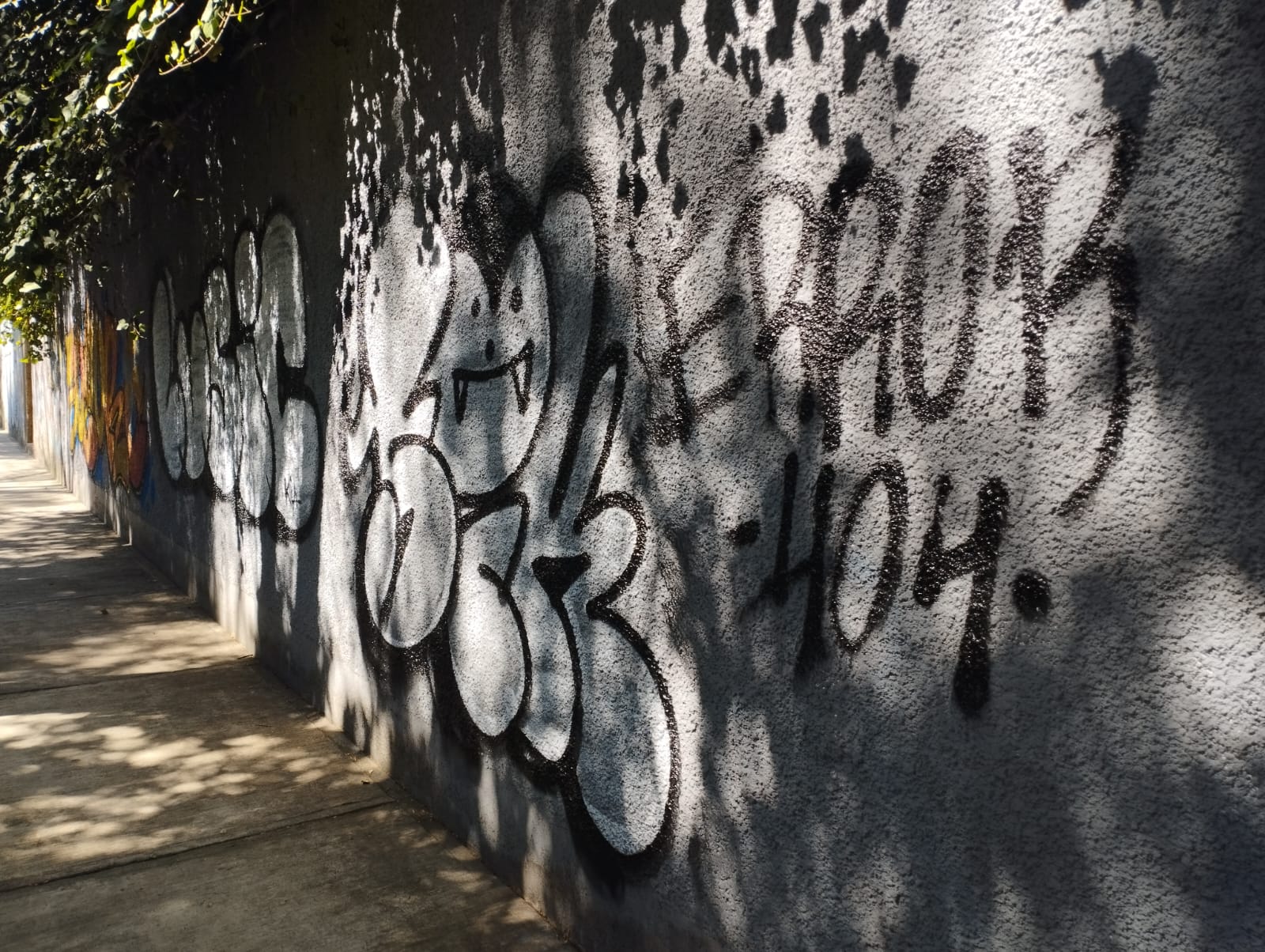
Gunnar Wolf: 404 not found

Found this grafitti on the wall behind my house today: 404 not found!
13 November 2025

Freexian Collaborators: Debian Contributions: Upstreaming cPython patches, ansible-core autopkgtest robustness and more! (by Anupa Ann Joseph)

Debian Contributions: 2025-10 Contributing to Debian is part of Freexian s mission. This article covers the latest achievements of Freexian and their collaborators. All of this is made possible by organizations subscribing to our Long Term Support contracts and consulting services.

Upstreaming cPython patches, by Stefano Rivera Python 3.14.0 (final) released in early October, and Stefano uploaded it to Debian unstable. The transition to support 3.14 has begun in Ubuntu, but hasn t started in Debian, yet. While build failures in Debian s non-release ports are typically not a concern for package maintainers, Python is fairly low in the stack. If a new minor version has never successfully been built for a Debian port by the time we start supporting it, it will quickly become a problem for the port. Python 3.14 had been failing to build on two Debian ports architectures (hppa and m68k), but thankfully their porters provided patches. These were applied and uploaded, and Stefano forwarded the hppa one upstream. Getting it into shape for upstream approval took some work, and shook out several other regressions for the Python hppa port. Debugging these on slow hardware takes a while. These two ports aren t successfully autobuilding 3.14 yet (they re both timing out in tests), but they re at least manually buildable, which unblocks the ports. Docutils 0.22 also landed in Debian around this time, and Python needed some work to build its docs with it. The upstream isn t quite comfortable with distros using newer docutils, so there isn t a clear path forward for these patches, yet. The start of the Python 3.15 cycle was also a good time to renew submission attempts on our other outstanding python patches, most importantly multiarch tuples for stable ABI extension filenames.

ansible-core autopkgtest robustness, by Colin Watson The ansible-core package runs its integration tests via autopkgtest. For some time, we ve seen occasional failures in the expect, pip, and template_jinja2_non_native tests that usually go away before anyone has a chance to look into them properly. Colin found that these were blocking an openssh upgrade and so decided to track them down. It turns out that these failures happened exactly when the libpython3.13-stdlib package had different versions in testing and unstable. A setup script removed /usr/lib/python3*/EXTERNALLY-MANAGED in order that pip can install system packages for some of the tests, but if a package shipping that file were ever upgraded then that customization would be undone, and the same setup script removed apt pins in a way that caused problems when autopkgtest was invoked in certain ways. In combination with this, one of the integration tests attempted to disable system apt sources while testing the behaviour of the ansible.builtin.apt module, but it failed to do so comprehensively enough and so that integration test accidentally upgraded the testbed from testing to unstable in the middle of the test. Chaos ensued. Colin fixed this in Debian and contributed the relevant part upstream.

Miscellaneous contributions
  • Carles kept working on the missing-relations (packages which Recommends or Suggests packages that are not available in Debian). He improved the tooling to detect Suggested packages that are not available in Debian because they were removed (or changed names).
  • Carles improved po-debconf-manager to send translations for packages that are not in Salsa. He also improved the UI of the tool (using rich for some of the output).
  • Carles, using po-debconf-manager, reviewed and submitted 38 debconf template translations.
  • Carles created a merge request for distro-tracker to align text and input-field (postponed until distro-tracker uses Bootstrap 5).
  • Rapha l updated gnome-shell-extension-hamster for GNOME 49. It is a GNOME Shell integration for the Hamster time tracker.
  • Rapha l merged a couple of trivial merge requests, but he did not yet find the time to properly review and test the bootstrap 5 related merge requests that are still waiting on salsa.
  • Helmut sent patches for 20 cross build failures.
  • Helmut refactored debvm dropping support for running on bookworm . There are two trixie features improving the operation. mkfs.ext4 can now consume a tar archive to populate the filesystem via libarchive and dash now supports set -o pipefail. Beyond this change in operation, a number of robustness and quality issues have been resolved.
  • Thorsten fixed some bugs in the printing software and uploaded improved versions of brlaser and ifhp. Moreover he uploaded a new upstream version of cups.
  • Emilio updated xorg-server to the latest security release and helped with various transitions.
  • Santiago worked on and reviewed different Salsa CI MR to address some regressions introduced by the move to sbuild+unshare. Those MR included stop adding the salsa-ci user in the build image to the sbuild group, fix the suffix path used by mmdebstrap to create the chroot and update the documentation about how to use aptly repos in another project.
  • Santiago supported the work on the DebConf 26 organisation, particularly helping with an implemented method to count the votes to choose the conference logo.
  • Stefano reviewed Python PEP-725 and PEP-804, which hope to provide a mechanism to declare external (e.g. APT) dependencies in Python packages. Stefano engaged in discussion and provided feedback to the authors.
  • Stefano prepared for Berkeley DB removal in Python.
  • Stefano ported the backend to reverse-depends to Python 3 (yes, it had been running on 2.7) and migrated it to git from bzr.
  • Stefano updated miscellaneous packages, including beautifulsoup4, mkdocs-macros-plugin, python-pipx.
  • Stefano applied an upstream patch to pypy3, fixing an AST Compiler Assertion error.
  • Stefano uploaded an update to distro-info-data, including data for two additional Debian derivatives: eLxr and Devuan.
  • Stefano prepared an update to dh-python, the python packaging tool, merging several contributed patches and resolving some bugs.
  • Colin upgraded OpenSSH to 10.1p1, helped upstream to chase down some regressions, and further upgraded to 10.2p1. This is also now in trixie-backports.
  • Colin fixed several build regressions with Python 3.14, scikit-learn 1.7, and other transitions.
  • Colin investigated a malware report against tini, making use of reproducible builds to help demonstrate that this is highly likely to be a false positive.
  • Anupa prepared questions and collected interview responses from women contributors in Debian to publish the post as part of Ada Lovelace day 2025.

Next.

Previous.