Search Results: "John Goerzen"

8 August 2008

John Goerzen: Weird Firefox Problem

Once again, I find myself turning to this wonderful series of tubes for help on a weird problem.

I have Firefox (Iceweasel) on all the computers I regularly use. One of these computers has had a persistent problem.

After using it for awhile, it takes a really long time to look up hostnames in DNS. And after upgrading to Firefox 3, it got much worse. Not only did name resolution get slow, but sometimes page loads would get exceptionally slow as well. I could have 5 tabs open, and all of a sudden at the magic moment, nothing would load on any tab. It was as if I was being hit by 75% packet loss. And new pages wouldn't load, either.

tcpdump showed Firefox not even sending out packets at these times. After a few minutes, it might be back to normal. But I could always quit and restart and it would be fine.

Now, here's the weird thing: I've eliminated every possible difference I can think of between this one machine and the others I use Firefox on. My plugins and extensions are the same set with the same versions. My configuration is the same. When this problem is happening, other network-related programs (even other web browsers) on the same machine are working fine. Nobody else here seems to be having this problem.

Any ideas?

1 August 2008

John Goerzen: The Eee 901: Awesome

An Eee 901 showed up here recently, and I've had a (little) time to play with it.

What an awesome little machine that thing is. The keyboard is better than I expected, and so is the screen.

I got annoyed at the lack of things like Emacs on the default Xandros install, so decided to zap it and install Debian. But first, I wanted to take a backup of it.

I was thinking to myself that this is a Linux environment, but I can't just boot up a Linux rescue thingy to get stuff off it because it's not a regular PC.

Oh wait. It IS a regular PC. It is so small that I wasn't even thinking about it in the right terms. So a little dd, gzip, and nc later I have my backup image.

Debian went on smoothly -- booted from a 16MB image on a USB drive. X, suspend/resume, etc. all worked out of the box. Compiled the wifi driver and it works.

This is, I think, the perfect laptop size. Also the price is good, it's solid... what's not to love?

30 July 2008

John Goerzen: Seen in the Haskell wiki

Someone on the Haskell Cafe mailing list pointed out the Haskell humor page on the wiki. Here are a few snippets:

<shapr> In my experience, Flash is mostly used as the hi-tek replacement for <BLINK>

''sigfpe'': Haskell is so strict about type safety that randomly generated snippets of code that successfully typecheck are likely to do something useful, even if you've no idea what that useful thing is.

28 July 2008

John Goerzen: Jacob and Portland

Jacob has sure enjoyed our trip. And he should -- after all, he loves trains. His word for train is "toot" or "toh" (after the sound they make, I guess).

He sure was excited to get on the train in the middle of the night in Kansas, and didn't want to go to sleep after we got on because he was too excitedly jabbering about it. "Bih toot!" (big train) and "Too on!" (on the train) kept getting repeated, over and over.

Jacob loved walking up and down the train. It sways side to side, so he didn't want to walk by himself. Result: Terah and I got sore backs from holding his hands. But he got so many smiles as we walked back and forth, back and forth in the lounge car -- or up and down the entire train.

Los Angeles Union Station brought its own set of fun. A few puddles of water were exciting to splash in, but Jacob spotted a fountain nearby before I did, and we had to go over there and splash around a bit.

On the Coast Starlight, there is a parlor car in addition to the lounge car. The lower level of a parlor car is a theater with a wide-screen TV at the front, but it is usually completely empty during the day. Jacob and I liked to go down there -- Jacob because he could run around without getting into people or things, and me because I could sit down there and watch the scenery go by undisturbed.

Eating on the train was a bit of a challenge, though. On the train, you eat community-style in booths. There are no highchairs, so that meant keeping sticky little hands from touching everything. It turned out I had a knack for making this work, so Jacob sat next to me most of the time.

Sleeping, too, was a bit different than usual. Jacob is used to putting himself to sleep in his own room, and if he can see anyone else in the room, he doesn't want to sleep. So since Terah and I were always around, this didn't go so smooth. But Terah had a knack for that, as much as possible, so she held him for naps.

The greatest fun for Jacob was in Portland. Our hotel was right along the MAX light rail line, and we'd ride it to all sorts of places. While waiting on the platform, Jacob would repeat "Toot ahm?" (Train coming?) Then he'd see it, and go "TOOO!!! TOOO!!!", followed shortly by "Too ON!!! Toot ON!!" And, of course, "Jacob, we can't get on the train until it gets here."

Once on the MAX trains, he quickly noticed that at each stop, a prerecorded voice says "The doors are closing" right before they close. Pretty soon he started warning everybody that the doors would be closing. After the doors opened, he'd point to a door, and yell out, "Doh cloh! Doh cloh!" (door close) until they finally did. After a few more days, he'd notice when the train was coming to a stop and yell out "doh clo" before the doors ever opened. I think TriMet should hire him.

John Goerzen: Cuil looks useless

So lots of technology sites are all excited about the launch of cuil.com, yet another in a long line of companies that the hype says could dethrone Google.

I went to cuil.com and searched for Amtrak.

It came up with hits for various routes, a historical society, etc. Everything except the actual homepage of Amtrak, amtrak.com, which has the most useful information about Amtrak.

#1 hit on Google.

If Cuil can't get that right, why bother?

24 July 2008

John Goerzen: OSCon Update

On Wednesday, OSCon really goes into high gear (and the wifi croaks) at OSCon. The people that aren't going to the tutorials all arrive, and aren't yet sluggish from the late-night vendor parties and BOFs.

The keynotes were OK, and after that, I listened to Keith Packard talk about the future of X. Then it was off to finish the preparation for my own talk on Linux on the corporate desktop. It was the first time I spoke at OSCon, and it seems to have gone well. I keep running into people that were at the talk and thought of some more questions -- and of course I chatted with a number of people right after as well. There are a number of other companies that are planning on doing what we've done, or even started down the implementation path already. It's some effort making something of OSCon quality (Damian Conway suggests something like 10 hours preparing for every 1 hour presenting -- I didn't do that), but I'm glad I did.

The Expo Hall opened Wednesday as well. Met some interesting folks there -- Open Lina, a company that sells Linux hardware, an Open Source groupware product I hadn't heard of before (they are apparently working on Debian Packages too), and some others I can't remember right now...

Tuesday I had dinner at Andina, a Peruvian restaurant, with fellow Haskellers Bryan O'Sullivan and Don Stewart -- the first time the three of us Real World Haskell folks met in one place.

Today brought Nat Torkington's excellent keynote, and also r0ml's great talk this afternoon ("I started this talk in 2003, and it's run a bit long.") Another great time for some networking in the hallways and expo hall. One of the LinuxFest Northwest folks had attended my talk, happened to see me as I was stuffing one of the may free t-shirts that vendors were giving out into my laptop bag (by afternoon, they were getting quite in your face about it), and struck up a conversation.

Went for sushi over lunch with a couple of folks from #oscon on IRC, then dinner with Debian folks.

Been a busy week, but met lots of people. I didn't go to as many talks as I planned because I was so busy talking to people -- guess that means the conference was a hit.

John Goerzen: First 2 Days of OSCon

I'm really enjoying OSCon this year. I've been here two days and just Tuesday afternoon actually went to what I had planned to go to. There's an XMPP summit here (wasn't on the schedule), and I dropped in there a few times. Got one of the XMPP developers to look at my system and figure out why Empathy isn't doing video chat with the N810 right.

Had an OSCon moment yesterday. I was sitting at a table with my laptop, trying to meet up with someone I had only met online before. We were chatting over Jabber. And I realized that person was about 20 feet away. This pattern has repeated itself several times now.

We went to McCormick and Schmick's for dinner. Great seafood and everybody there seemed to really enjoy Jacob too.

The People for Geeks talk was fun. They talked about how geeks tend to apply the tact filter in input, and everybody else on the output, which causes frustration for everyone. Though somebody in the audience asked why that applies to computer geeks but not theater geeks -- an interesting question, and one I wish they had probed a bit more.

I keep running in to interesting people here. One day I was talking to someone about alternatives to cfengine (he suggested parrot). This morning I was talking to someone that works for IBM, who is involved with their project to convert desktop machines to Linux and was interested in how we fared. I've met several people that spot my Haskell ribbon and are interested. One of them told me at breakfast that he heard there is this new Haskell book coming out that's about using Haskell in the real world. Another OSCON momemt when I told him I'm one of the authors of that book. The surprise was fun.

Damian Conway had a great talk Monday night on "how to give a great OSCON talk." I haven't found his slides anywhere.

16 July 2008

John Goerzen: Bicycling to Work Update

Back in May, I wrote about starting to bicycle to work. My plan was to do that 3 days a week. My ride is 10 miles each way, with the first 2.3 miles on dirt, gravel, and sand roads.

It's been going well. Yesterday was the first day that the ride really felt easy. It's been getting more and more fun, too.

And I've been getting faster. My worst time lately was 49 minutes, also yesterday morning. I really was riding slower than I felt normal, just taking it easy. But I had a headwind, and when I started my normal time in calm conditions was 60 minutes or more. That's almost a 20% improvement already.

Due to vacations, holidays, and weather, I haven't been able to average 3 days a week. When it's raining, or has rained recently, our roads get muddy and pretty much impassible on bicycle. Though some days, my ride is 2 miles longer because the short route is too muddy but the long route isn't.

So, overall, I've been enjoying bicycling, and plan to keep doing it.

12 July 2008

John Goerzen: Kernel interrupt weirdness?

I've had a problem with recent kernels. (I think it's the kernel that's doing this.) When my workstation is doing heavy I/O, it repeats keystrokes. For instance, while I was typing this paragraph, audacity was writing audio to disk, and I got this word:

heavvvvvvvvvvvy

It seems as if it thinks I haven't let up on the keys.

I've seen this on two different machines and it seems to have started with 2.6.24 or 2.6.25.

Has anyone else seen this? Any ideas where I'd go to fix it? Incidentally, I'm in X when this happens. I don't use the console much when there would be a chance for it to happen.

This is such a weird problem I've struck out googling, and I'm not even sure which mailing list to take it to.

10 July 2008

John Goerzen: My DNS happiness is complete

I have been using Gandi as my preferred register for some years now. They have probably the most customer-friendly AUP out there, are reliable, and good decent folks. I have liked everything about them.

Except the fact that they don't have whois privacy. But now they do! Woohoo! They did have whois spam protection all along, but your address and phone number was visible to everyone.

Whois privacy services are something that you have to keep a close eye on. What you want is for your name to still show up in the public whois database, but just nothing else. Some whois privacy services put *their* name there, which means technically they own the domain. I wouldn't trust that. Gandi is better about it. Your name, their address and phone number.

Of course, you still have to give Gandi your real contact info, and there are some situations in which it will be revealed. But all in all, I am very happy to see them doing this.

I had looked at other registrars that provided whois privacy, and never liked them for various reasons. Many happened to also have quite restrictive terms of service (hello Dynadot), maybe were good people but had restrictive ToS and crappy interface (register4less), etc.

Now I get to stick with Gandi and get the features I want. I'm very happy with that.

6 July 2008

John Goerzen: Look out Nebraska, Here Comes Jacob!

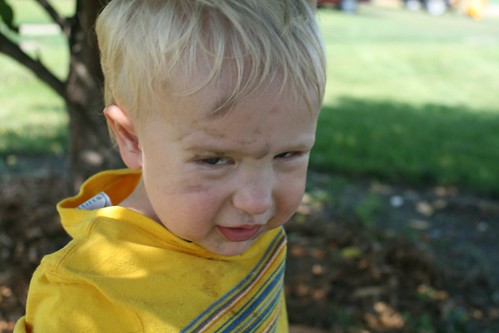
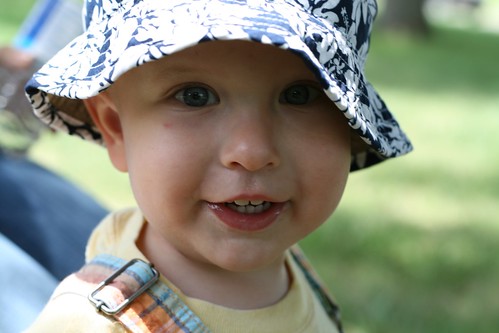
img_5195.jpg

This weekend, the three of us got in the car and drove up to Tekamah, NE for Blogstock 08 at Cliff's. That's Jacob when we were stopped at a park halfway there. Sure looks like he's about to do something ornery, doesn't it? I think he looks even more ornery than the photo of Cliff. That's saying something.

We all really enjoyed Blogstock. Ralph, Cliff, and the rest of the Morrows sure know how to have an event. Ralph said that Cliff's BBQ smoked chicken is the best we'll ever have, and he may just have been right.

I'm going to include a few of my photos in this post; you can see all of my 200+ Blogstock photos on Flickr. (In case anyone else uploads Blogstock photos, you might tag them blogstock08).

Jacob had a blast, and I think he took special pleasure in keeping Terah and me busy. I recall saying something like this, all strung together:

"Jacob, please stop throwing dirt at the cat. That cat doesn't like to have dirt thrown on it. Jacob, stop throwing grass on the cat. Jacob, stop hitting the cat. The cat doesn't like to be hit. Can you pet the cat gently like this? Good job! Jacob, stop sitting on the cat. That hurts the cat. Stop throwing dirt at the cat. Would you like to go play in the corn?"

The Morrow cat was the most tolerant cat I've ever seen, and didn't really seem to mind having a toddler sit on its head. However, we noticed this morning that Jacob's legs mysteriously have some scratches that look very much like cat scratches. We didn't see anything happen, and Jacob didn't come crying to us or anything. I suspect the cat found a way to communicate that it doesn't very much like to have someone sit on it. I also suspect that Jacob understood the message.
img_4996.jpg

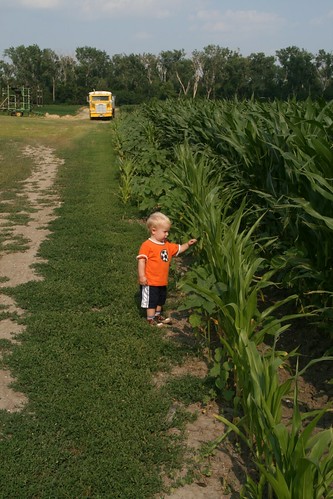
As for corn -- Jacob loves corn. He first noticed it within the past week or two, and always gets excited when we drove past some. He calls it "koh!", and particularly tall corn is "koh-koh" or "ah-koh". Cliff has tall corn, and when I first asked Jacob if he wanted to see it, he immediately stopped pestering the cat, yelled "KOOHHHHH!!! KOH KOH KOH KOH!!!" and started running towards it. He started by carefully inspecting the corn from the edge of the field. (I can't help but thinking he looks a bit like is great-grandpa Yoder in this picture.) I can almost hear him saying "yep, this corn looks pretty good" in a couple of years.
img_5051.jpg

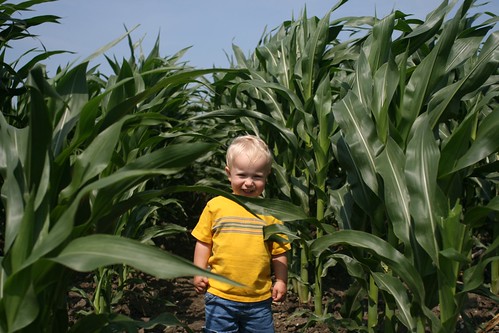
The real fun begins when you get into the corn, apparently. With a little bit of holding my hand to balance while walking over the rows of dirt, he'd get between the rows of corn and have a blast. That means mainly picking up a full handful of dirt, running to another random corn plant somewhere, throwing the dirt in the general direction of the corn, and cackling like this was the best thing ever. I had to watch out with the camera, because I didn't really care for it to be hit by dirt, and well, I was in the general direction of corn, too.

img_5062.jpg

And, in case you didn't know, having fun in the corn is serious business.

Now, what can a toddler possibly do after playing in the corn, eating some cherries off a tree, and smearing some dirt on his face with cherry juice?
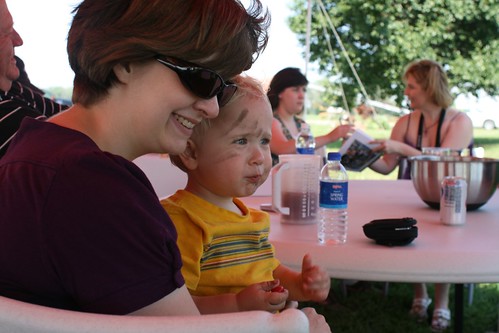
img_5088.jpg

Well, plan his next activity, of course! From the look on his face, it will be another one to keep Terah and me busy.

Jacob seemed to get along really well with everyone. But Ralph said that everytime he came close, Jacob would give him a nasty glare. Here's Ralph holding Jacob. Was this the look, Ralph?
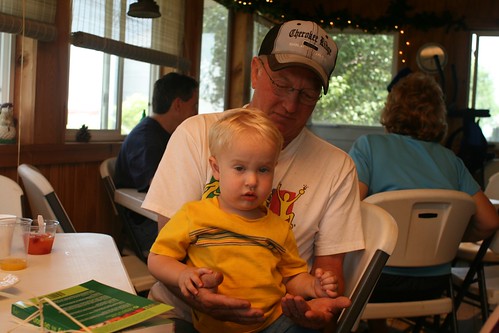
img_5078.jpg

Or maybe it was this:

img_5116.jpg

Friday evening, Cliff and Ralph made up some great hamburgers, hot dogs, and sausages. We all ate under the big tent, and had a nice time visiting. It was sort of an unusual thing -- meeting people you already know for the first time -- but very nice. We left somewhere around 8. Jacob enjoyed the hotel room, too.
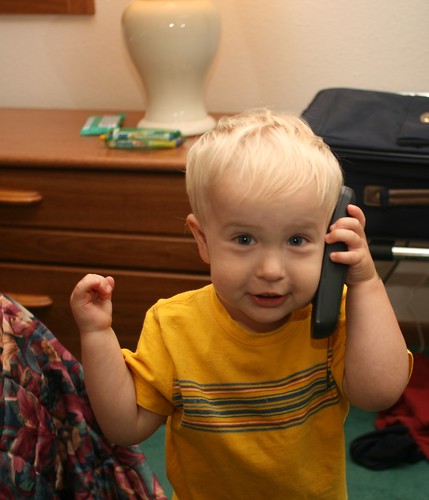
img_5027r.jpg

That's Jacob talking on the telephone. Well, I would normally use it as a TV remote, but to Jacob it looks like a phone, so a phone it is. (I can see his point.) This is Jacob answering the phone by saying Hi! Jacob's word for a phone, by the way, is "hi." He'll find a remote by the TV in the room, point to it, and yell "hi!"

Jacob's usual bedtime is 6:30PM. He normally falls asleep fairly easily and sleeps soundly until 6:30AM. Well, we got him in bed well after 6:30PM. Then he made the discovery that the hotel crib/playpen has a mattress that is not attached to the bottom like our mattresses at home are. This was good for at least an hour of excited playing. As Terah and I were trying to sleep, we'd hear these cackles from Jacob's crib, and the noises of a very active boy. I'd peek around and see him using the mattress as a tent, as a peek-a-boo toy, or just as something to throw. I think he fell asleep at about 11.

And woke up promptly at 6:30 on Saturday, just like clockwork, ready to make some phone calls and start the day.

Now, just a tidbit for anyone that doesn't have kids: a toddler, low on sleep, and endless excitement all combine to make for busy parents. Jacob did pretty well, and got in a good long nap in the afternoon. We did take several trips to the corn field.

For most of us, Saturday was a day for brunch, for sitting around and visiting under the tent, for horse rides, and maybe a massage for those that wanted it. Terah got to ride a horse, and Jacob got to ride a pony, too.

For Jacob, it was a day to make new friends, too.
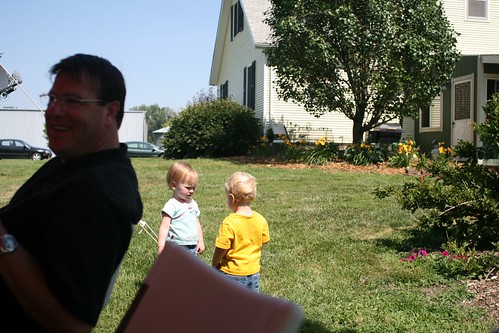
img_5095.jpg

I took this picture just a second after she had given him a hug. I was just a little too slow whipping out the camera.

But when it comes to cherry picking, it's all serious business once again.
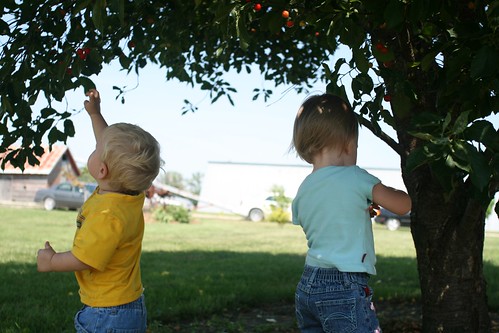
img_5098.jpg

Jacob loved eating these sour cherries. At first, he would pick one cherry off the tree, run over to the tent, give it to Terah for her to get the pit out, eat it, then go back to the tree for another one. He must have decided this was inefficient not long after I did. After a few roundtrips, he started trying to get the closest adult, whoever that might be, to pit the cherry for him. When he found one that would do it, he'd keep bringing cherries back to that person.

And then he was under the tree for a long time. Terah and I noticed, and had a conversation about just how many cherry pits it's OK to swallow. But when I checked it out, I found out that Jacob had figured out how to pit cherries himself. He did lose about half a cherry each time he did it, but I guess that was more efficient than pestering adults to do it for him. Though it may have also worked to carry two cherries to the tent at a time.
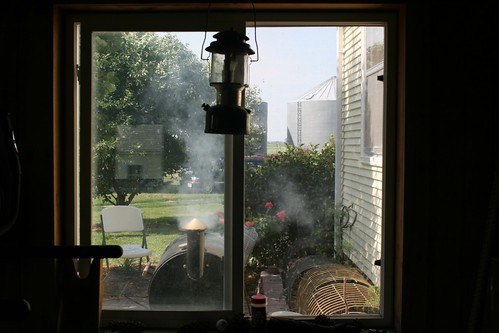
img_5123.jpg

Late in the afternoon, Cliff started up the smoker for the chicken. He had rented a big smoker for the occasion, but it wasn't working, so he made do with his regular smoker, ovens for the corn, and an array of dutch ovens or side grills for everything else. I couldn't keep track of it all, and I was just watching, but somehow it all turned out perfect.
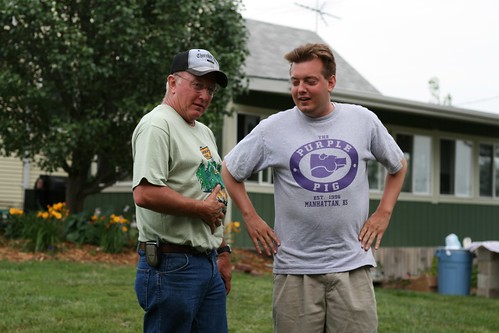
img_5140.jpg

While the chicken was cooking, Ralph and son-of-Ralph (SOR) were having a conversation and patting their bellies. I couldn't hear, and didn't ask questions, so I'm choosing to believe that they were discussing how many pieces of chicken they could eat. When they heard my camera click, Ralph said, "He didn't just take a photo, did he?" Thereby guaranteeing a spot on my blog.

I had the distinction, I think, of being the least-read blogger at Blogstock. I can't quite remember how many times I'd meet someone, and they'd say, "Oh, you're the computer guy, right? I tried reading your blog, but I didn't understand it, sorry!" Completely understandable, I assure you!

After dinner Saturday, we talked about how we got started blogging (hi, Marty and Andy if you're reading), why we were there. Cliff said some very kind things about Terah and me, which really meant a lot.

Later, Cliff told me how Terah showed up in the kitchen with her tray of deviled eggs. Cliff saw them, and said, "Terah, I love you." Later, Cliff said "I love you" to someone else. From the next room, Terah piped up, "What food did she bring?"

Saturday evening, Terah took her horse ride. Jacob was quite tired by that point, and threw a tantrum about not being able to go with mom and ride a horse, too. We were talking about it when Rachel came over. Jacob asked her to pick him up, she did, and he instantly stopped fussing. Maybe it was a "so there" to me, since I had been holding him a minute before, and he took the opportunity to scream in my ear. But in any case, Jacob loved Rachel. She let him sit on a pony, carried him all around the yard, and he managed to hold it together until Terah came back at 9:30.

Saturday evening it was time for goodbyes. We all had a blast and I'm sure we'll do this again. If you weren't there, here's what Blogstock looks like:
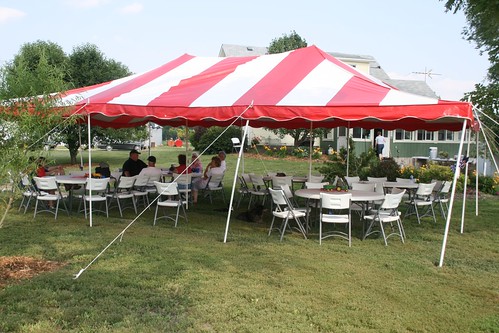
img_4991.jpg

A bunch of friends sitting around chatting under a tent pretty well sums it up.

(There was a full tent of people; some were just elsewhere when this particular photo was taken.)

Jacob shared his thoughts on the whole trip on the way home, too. Well put, Jacob.
img_5202.jpg

3 July 2008

John Goerzen: Video uploading sites?

I'm working on switching from using a Mac to using Linux for editing video. I have a mini-DV camcorder that a bought a few years back, and I've been looking at capture and editing software for Linux.

Along with that, I want to post some videos online for family to be able to see I want to preserve the original quality as much as possible, offer the option to download the video, and be able to share some videos with family only (not the entire Internet).

I've been looking at various reviews of video sites (such as this PCWorld one) and decided to look at blip.tv and Vimeo in more detail.

Blip seems to have lots of controls, options, etc. And, they seem to really care about end users, respond fast, and care about freedom. There's an impressive response from their support team concerning Ogg Theora out there. They offer FTP uploads (which are a huge improvement over HTTP POST uploading, in my opinion, and easily scriptable). They can also automatically post your video to archive.org or about a dozen other video or blogging sites.

But what I want to do is not really what they are aiming at. They are set up for "channels" (you can apparently only have one channel per user), and for more professional users. Most notably, you can't make videos private or restricted without paying for their $100/year or so "pro" account.

Vimeo looks very much like the Flickr of video. They do offer various options for restricting who can see a video. When they transcode video to Flash, they have the option of preserving it in HD, which blip.tv doesn't (both go 640x480 or so by default, and blip maximizes out that that). Though both offer the option to download the full, unmodified original. Vimeo has only one option for uploading, and it doesn't seem to work well with Firefox. They have little detail about anything in their docs. Maybe it's more the Photobucket of video than the Flickr of video. (Oh, who am I kidding -- that's Youtube).

Of course, there is Youtube. Maxes out at 320x240, doesn't offer the original for downloading. Doesn't make me think all that positively about them.

I could also use Flickr. I'm not sure if they offer the original, but there's a 90-second limit on uploads there.

Any other thoughts?

1 July 2008

John Goerzen: Linux on the Desktop

Later this month, I will be giving a talk at OSCon about Linux on the corporate desktop -- something we have done where I work. I've been alloted a 45-minute timeslot. I will, of course, be posting my slides online and I think OSCon also posts videos of these things.

I'm wondering if readers of my blog would like to leave me some comments on what you'd like to see. What would you like to know about Linux on the corporate desktop? Is there anything that you'd like to make sure I discuss?

28 June 2008

John Goerzen: A response to "7 Ways Religion is Detrimental to Science"

I read 7 Ways Religion is Detrimental to Science, and thought it would be an interesting read. It was, but I don't think it really made sense. Let's look at the 7 ways they highlighted:

1. Faith and the Scientific Method are Opposites

The article states:

Faith is a belief in an idea regardless of the evidence for or against it.


Actually, that's not true at all, at least for traditional Christianity. (Note that traditional Christianity is not the same as fundamentalism). Marcus J. Borg describes faith in four ways:

Fiducia -- trusting in God. Borg says, "Faith . . . [means] we trust in God as the one upon whom we rely, as our support and foundation and ground, as our safe place."

Fidelitas -- loyalty, or "the comment of the self at its deepest level, the commitment of the 'heart'. Faith as fidelitas does not mean faithfulness to statements about God. . . Fidelitas refers to a radical centering in God."

Visio -- a way of seeing -- "a way of seeing the whole, a way of seeing 'what is'. . . the ability to love and to be present to the moment. It generates a 'willingness to spend and be spent' for the sake of a vision that goes beyond ourselves."

Assensus -- perhaps the closest to what the author meant, is "faith as belief." Borg goes on to add:

The notion that Christian faith is primarily . . . about belief, about a "head" matter, is recent. . . For many, Christian faith began to mean believing questionable things to be true. . . this is the most widespread contemporary understanding of "belief".

This is very different from what faith as assensus meant. . . A deep but humble (and therefore imprecise) understanding of Christian faith as assensus, as involving affirmation of the centrality of God as known in the Bible and Jesus, is very close to faith as vision. It is a way of seeing reality.


As a Christian, I do not find the scientific method to be a problem. I find it to be enlightening in all sorts of matters, including even the history of religion in some instances. Christian faith is not about believing in certain ideas (such as the world being created in 6 literal 24-hour days), though there are those that distort it to be so. Rather, Christian faith is about living your life a certain way, about the meaning of life, about our duties to make the world a better place.

2. People Vote Base on Religious Ideas

The author says that "Stem Cells weren t the first time a body of research didn t get proper funding because some religious wack-jobs." Well, I agree that that was a problem. Non-religious people can vote in odd ways too. I argue that the rejection of stem-cell research goes against Christian teaching; after all, we are to help the least among us, and do not people with Alzheimer's qualify?

I think the author's point should have been "exremists have odd views." Extremists can be atheist, Christian, Muslim, Buddhist, or other religions. Religion does not have a monopoly on them.

3. Religion Removes the Need For Science

The author says:

When people are content to believe in something that explains why they are here, even if it is wrong, they become less interested in other ideas. Religion often leads people to believe that they have all the answers. Science is self-correcting in that nobody assumes they are absolutely correct.


That is incorrect on several levels. First, science cannot explain why we are here. It can explain some of the mechanics. As an example, let us take for granted that modern scientific thought on the origin of humanity is correct: that there was a Big Bang, that single-celled creatures evolved on earth, and that human life eventually evolved through a complex process of evolution and natural selection. Fine; this does not contradict religion in any way. Science and religion answer different questions. Science answers "how". Religion answers "why". Science cannot answer the question "Why was there a big bang?" or "Did the evolution of humanity serve a larger purpose?"

Moreover, religion should not assume that they have all the answers, either. The canonical Christian Bible was mostly fixed within a few centuries AD. Life in 200AD was a lot different from life today. Part of the reason there are many different groups of Christians is the complexity of applying the stories in the Bible to modern life. The ideas in any given denomination evolve over time, too. I think it would be the height of hubris for anyone, religious or not, to claim that he or she had all the answers. Again, I know that some religious people act that way, but then so do some atheists or agnostics.

4. People Lean on Religion, When They Could Benefit From Science

The author of "7 Ways" cites the quite rare case where a child dies of a curable disease while his/her parents pray, refusing medical care. This is an extreme position that is not shared by the vast majority of religious people. Most religious people are perfectly content to use the latest medical care.

Meditation or prayer does not replace medical care; it supplements it. Scientific studies have even demonstrated its effectiveness.

5. The Church Takes Up Natural Resources

The original author states that "The land that churches take up around the world could be used to build schools, homes, recreational buildings and commercial operations." This is perhaps the most frivolous of arguments. Putting aside the fact that many churches operate schools, churches are often one of the few ways that modern city dwellers have to form a sense of community. They are not just places to engage in religion. They are places to meditate, to get away from it all, to meet your neighbors, to vote.

6. The Church Takes Up Monetary Resources

The original author says "if people donated to scientific advancement like they did to the church, imagine where we would be today." It's not a pleasant picture. Religion, and institutions supported primarily because of the teaching of religion, are the people that feed the hungry after natural disasters, that operate food pantries (our church operates the only one in our community, and it's open to anyone without any questions or talk about religion), that operate schools in disadvantaged areas, that have spread the whole idea of fair trade for third-world artisans, etc.

It is true that acts of evil have been committed in the name of the church, too. It is also unquestionably true that some church groups spend money more carefully than others. As with any donation, people should be careful where they give. Government-operated research studies are not necessarily a good use of money, either.

7. Religion is A Strong Meme

The author of the original story seems to be responding to a particular brand of Christianity: what Borg calls "literal-factual" religion. There are quite a few people that take that stand. They are sometimes inaccurately referred to as "evangelicals" or the "religious right"; while there is some overlap between the groups, they are not one and the same. The people with the literal-factual view are not representative of the whole.

More interestingly, Borg points out that the literal-factual view was actually a response to the development of the scientific method during the Enlightenment. As the modern idea of truth moved to literal, factual, provable truth, some Christians grew defensive about their faith, and started to look for "scientific" ways to prove that the world was created in 6 days, etc. in an attempt to show the world that Christianity fit their new notion of truth.

That makes a compelling argument that the scientific method is the stronger meme in today's Western world -- so strong that the author of the rant against religion has apparently forgotten the more prevalant -- both throughout history and today -- view of Christianity that is "more than" Science, not at odds with science.

27 June 2008

John Goerzen: Troops

Back in 1997, long before the days of Youtube, there was a film short called Troops. Troops is about 10 minutes long, and an absolutely hilarious piece of work. It's done in the style of Cops, but set on Tatooine in the Star Wars universe. Many people today credit it with kickstarting the fan film genre and inspiring what has evolved into stars of Youtube.

I remember giving a talk at the Air Capitol Linux Users Group (Wichita, KS). I brought with me my laptop, and had downloaded Troops onto it. I played it for the group. This was at a time when being able to play video on a laptop was something new and interesting, and under Linux no less, even more so. Also, at a time when video of this size may have taken a day to download. Everyone there loved it. I think I used xanim to play it (remember that?)

Anyhow, you can still download that same original file from theforce.net. Or, for the less patient, just watch it here:

10 June 2008

John Goerzen: What this world is coming to

Today we assigned an IP address to a gas tank.

Yay.

5 June 2008

John Goerzen: Obama, RFK, and Making History

I think that for the first time, when I go to vote this November, I will probably not have to hold my nose as I make a selection for president. I don't agree with Obama on everything, of course, but the core of what he stands for -- that it is time to enter a post-racial, post-partisan time -- and that putting the interests of the people before those of the corporation -- is a powerful message.

And I'm not the only one that thinks so. One interesting read is Why This 55-Year-Old White Lifelong Republican Wants Obama To Win by Frank Schaeffer. He's a pro-life, pro-military Republican that actually campaigned for McCain in 2000, and this year he's supporting Obama. He pointed out another key point: Obama does not play on our fears.

Then there's A Transformational Moment by Jim Wallis, who grew up in a time when white people that supported civil rights were literally putting their lives on the line. He ends with:

This morning I heard several interviews on NPR with black Americans about their response to Obama's nomination. One older woman said, "A black man running for president, did you hear what just I said? A black man running for president of the United States ...." She just kept repeating the words, and succinctly captured my own personal feelings.

Yes, it is truly historic, and the U.K. newspaper headlines captured that sentiment as did papers around the world. Nothing could change the image of America around the world more than this. But it is more than historic; it is very personal for many of my generation. A new generation just sees this as natural -- he's an inspirational leader who happens to be black, which matters little to them. But for my generation -- I'm dating myself now -- this is a transformational moment, one we didn't think would come in our lifetimes. Race was the issue that changed us, shaped us, determined our path, and even defined the meaning of our faith. Now a black man is running for president of the United States. Amazing grace.


Tom Hayden reflects on the similarities between Obama and RFK, another interesting read. He concludes with:

Those who denounce Obama -- and the possibilities of all electoral politics- - should ponder the effectiveness of sitting judgmentally on the sidelines while an Unexpected Future arrives through the sheer will of a new generation. They should consider whether politics and history can be reduced to a fixed determinism that is endlessly repeated, as if there are no surprises. We can have our differences with Obama's specific policies, as I certainly do, but those should be measured against the prospect that a movement might transform him even as his very rise continues to transform the rest of us.


And now for something less inspiring. If you go look over at the latest blog entry at hillaryclinton.com and read the comments, these readers frankly sound more than a little loony. There are rampant accusations that Obama "stole the election" with the help of the DNC. That makes no sense to me; he followed the rules, and the DNC gave Clinton more delegates than she should have had with the rules as they were at the start of the game (which she supported then). The Obama campaign even rejected a plan that was less favorable to Clinton at the DNC rules committee meeting on Saturday. They also go on and on about how Obama has had so many scandals (though the Clinton real estate scandals really are far more serious than a former pastor). It all looks so very petty, and I wonder why Clinton has whipped up her supporters to such a fervent extent. Perhaps it was an accident, but you'd think things like this are rarely an accident with her.

4 June 2008

John Goerzen: Camping

Terah, Jacob, and I went camping last weekend. Terah had asked me what I wanted for Father's Day. I thought for just a second, and said "camping!" She looked like she regretted asking. But it has been a year since our last camping trip, so off we went.

We went to Marion County Park and Lake, a nice park built by FDR's CCC program in the 1930s. It is on the National Register of Historic Places thanks to all the stone buildings, bridges, etc. that were built back then and still survive.

The reason we like it is because one side of the lake has the park office, rentable meeting houses, RV hookups, a swimming area, and really all the things you expect at a park like this (albeit on a small scale). The other side of the lake has gravel roads and fire rings. No power, no running water, but the occasional stone outhouse every half mile or so. Which means that the RV owners are not going to want to spend the night on that side of the lake. So, unlike far too many parks, it is possible to pitch a tent a good distance from the RVs. It's so annoying to go to camping and find it to be noisier than home because of all the TVs and generators running.

Jacob wasn't so sure about the first evening, but he was having a blast all day Saturday. His favorite thing was the campfire. He called it "fie" (rhymes with "buy"). He watched me gathering up brush and preparing the fire, carefully placing the small sticks first, then the big ones. So he picked up a small stick, and carefully laid it inside the fire ring, too. Then he'd watch me light the fire, or blow on some embers, and he'd blow on it, too. Fffffffffffffff! As hard as he could. At one point, I was kneeling next to the fire ring, inspecting the kindling. Terah noticed Jacob kneeling next to the fire ring on the other side, with the exact same posture and expression as I had. It was a perfect Father's Day, I think.

Once the fire got going, he'd walk up towards it, say "HA!" (hot), and then run away. Educational, this camping business. He now knows what "hot" is all about.

Jacob also loved the lake. We would walk the few feet down to the beach, and he'd (holding on to one of us) walk just far enough into it to get his feet covered by the water, then pick up sand and throw it into the water to watch it splash. Or, he'd point at a boat ("bope") in the water ("wah") going past, all excited -- Bope! Bope!!! BOPE!!!

One of my favorite things while camping is sitting outside and watch the sun set. Terah and I did that while munching on banana boats we cooked in the fire (a banana and chocolate concoction that you sort of melt in tinfoil). Or we could sit in the shade on the ground and just relax and enjoy the scenery.

Terah didn't say that she enjoyed camping, but she did agree that there were good times and we could come back. Woohoo, I guess.

We're not really camping pros, and we learned a few things. One is that it would be nice to not have three meals in a day that require a fire. I'm fine with eating fruit, canned stuff, and other no-cooking-needed stuff when camping, but Terah likes more traditional food. And that's fine, and we had some great stuff to eat, but building fires is hard and hot work.

Over the first few days after we got home, Jacob came up to me and said, looking rather sad, "Fie? Fie?" I said, "Jacob, we don't have a fire here. There is no fire here." He would look so sad, and just repeat to himself for a few minutes, "No fie. No fie. No fie." So I asked him if I should build a little fire. "Yeah!" So I got a match and lit a candle. Oh, was that exciting, and almost as soon as it showed up, he tried to blow on it. By today he has learned how to blow out a candle.

A great Father's Day for sure, but we hadn't really tried to sow the seeds of a fascination with fire on the trip.

30 May 2008

Russell Coker: Links May 2008

The Daily WTF has published an interesting essay on why retaining staff is not always a good thing [1]. The main point is that good people get bored and want to move on while mediocre people want to stay, but there are other points and it’s worth reading. Following the links from that article led me to an article comparing managing IT departments to managing professional sports teams [2]. They chose US football (a sport I know little about and have no interest in) so I probably missed some of the content. But they have some good points. John Goerzen gave a good presentation to the idea of increasing petrol taxes and decreasing other taxes to have a revenue neutral result while also discouraging petrol use [3]. I credit him with presenting the idea not inventing it because I have heard similar ideas several times before (but not nearly as well written and not written from a right-wing perspective). Hopefully some people who read his presentation will be more receptive than they were to the other versions of the same idea. Craig Venter spoke at TED about his work in creating artificial life [4]. He spent some time talking about the possibilities of creating artificial organisms to produce fuels directly from CO2 and sunlight. Nick Bostrom published a paper explaining why he hopes that the SETI projects find nothing [5]. His theory is that the fact that our solar system has not been colonised and that we have seen no immediate evidence of extra-terrestrial life indicates that there is a “Great Filter” which is a stage of evolution for which it is most unlikely that any species will pass. If the Great Filter is in our past (he cites the evolution of multi-celled life as one of the possibilities, and the evolution of prokaryotes into eukaryotes as another) then it means that our future might be more successful than if the Great Filter was something that tended to happen to advanced societies. Jared Diamond (the author of Collapse), has written an interesting article about vengeance [6]. He focuses on an example in New Guinea and uses it to explain why personal vendettas tend to run wildly out of control and how society is best served by having the state punish criminals.

John Goerzen: The Democratic Delegate Dance

Several stories on NPR today have featured interviews with Democratic voters in Florida and Michigan. Many of them were mad about the situation, but mad at their state democratic parties. Many of them did not vote because they were told their vote would not count, so now they are upset at these efforts to count the vote from these states.

Meanwhile, there is a very interesting post about how Hillary may want these delegates to remain unavailable to her, as a way to continue pressing her case all the way to the convention. Sigh.

Next.

Previous.