Search Results: "Dirk Eddelbuettel"

13 February 2021

Dirk Eddelbuettel: RcppFastFloat 0.0.2: New Function

The second release of RcppFastFloat is now on CRAN. The package wraps fastfloat, another nice library by Daniel Lemire who showed in a recent arXiv paper that one can convert character representations of numbers into floating point at rates at or exceeding one gigabyte per second. Thanks to Brendan, this release adds a helper function as.double2() modeled after the base R function but using, of course, the features from fast_float in RcppFastFloat. Release notes follow.

Changes in version 0.0.2 (2021-02-13)
  • New function as.double2() demonstrating fast_float (Brendan in #1)

Courtesy of my CRANberries, there is also a diffstat report for this release. If you like this or other open-source work I do, you can now sponsor me at GitHub.

This post by Dirk Eddelbuettel originated on his Thinking inside the box blog. Please report excessive re-aggregation in third-party for-profit settings.
12 February 2021

Dirk Eddelbuettel: RcppSimdJson 0.1.4 on CRAN: New Improvements

Brendan and I are happy to share that a new RcppSimdJson release 0.1.4 arrived on CRAN earlier today. RcppSimdJson wraps the fantastic and genuinely impressive simdjson library by Daniel Lemire and collaborators. Via very clever algorithmic engineering to obtain largely branch-free code, coupled with modern C++ and newer compiler instructions, it results in parsing gigabytes of JSON parsed per second which is quite mindboggling. The best-case performance is faster than CPU speed as use of parallel SIMD instructions and careful branch avoidance can lead to less than one cpu cycle per byte parsed; see the video of the talk by Daniel Lemire at QCon (also voted best talk). This version brings a new option to always return list types, tweaks to setting option in the the request and other small improvements. The NEWS entry follows.

Changes in version 0.1.4 (2021-02-12)
  • Support additional headers in fload (Dirk in #60).
  • Enable continuous integration via GitHub Actions using run.sh from r-ci repo (Dirk in #61, #62).
  • Add option to always return list to fparse()/fload() (Brendan in #65 closing #64).

Courtesy of my CRANberries, there is also a diffstat report for this release. For questions, suggestions, or issues please use the issue tracker at the GitHub repo. If you like this or other open-source work I do, you can now sponsor me at GitHub.

This post by Dirk Eddelbuettel originated on his Thinking inside the box blog. Please report excessive re-aggregation in third-party for-profit settings.

11 February 2021

Dirk Eddelbuettel: td 0.0.1 on CRAN: New Finance Data Package

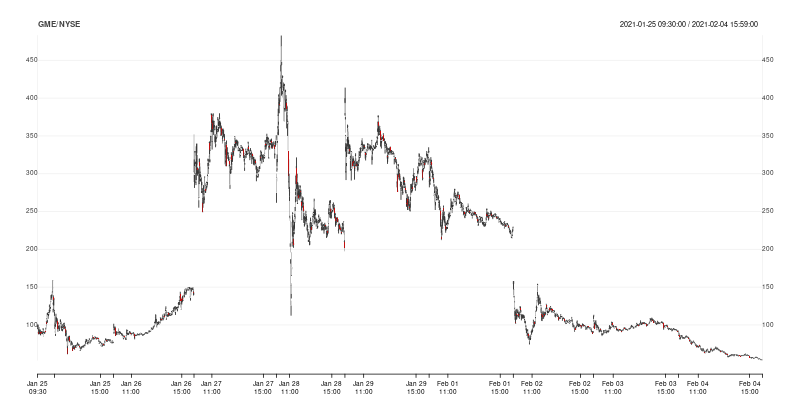
Thrilled to announce that a new package of mine just made it to CRAN: the td package accesses the twelvedata API for financial data. Currently only the time_series REST access point is supported, but it is already supported with all meaningful options (we skipped only JSON or CSV which makes no sense here) so for example any resolution between 1 minute and 1 month can be requested for any stock, etf or currency symbol for a wide array of exchanges. Historical access is available too via (optional) start and end dates. We return either raw JSON or a data.frame or an xts object making it trivial to call high-end plotting functions on the data the project and repo pages show several examples. As just one example, here is GME during the follies. We simply request via
> gme <- time_series("GME", "1min",
+                    start_date="2021-01-25 09:30:00",
+                    end_date="2021-02-04 16:00:00", as="xts")
(where the API key is either in a user-local config file accessed via the new-ish R function tools::R_user_dir("td") pointing at this package s directory, or via an environment variable; either is accessed at package load or attachment) from which we can then plot via quantmod
> quantmod::chart_Series(gme, name=paste0(attr(gme, "symbol"), "/", attr(gme, "exchange")))
which shows how we also helpfully store metadata returned by twelvedata as extra attributes of the object. The chart is You will need an API key to have up to 800 daily accesses for free, higher-performance plans (including websocket access) are available for paying customers too. I have only used the free API so far myself. I plan to add quote and price support this weekend, and generalize the time series access to returning lists of objects as the API does in fact support multi-security access. As always, feedback is welcomed. Please post comments and suggestions at the GitHub repo. If you like this or other open-source work I do, you can now sponsor me at GitHub.

This post by Dirk Eddelbuettel originated on his Thinking inside the box blog. Please report excessive re-aggregation in third-party for-profit settings.

10 February 2021

Dirk Eddelbuettel: RcppSMC 0.2.3 on CRAN: Updated Snapshot

A new release 0.2.3 of the RcppSMC package arrived on CRAN earlier today. Once again it progressed as a very quick pretest-publish within minutes of submission thanks CRAN! RcppSMC provides Rcpp-based bindings to R for the Sequential Monte Carlo Template Classes (SMCTC) by Adam Johansen described in his JSS article. Sequential Monte Carlo is also referred to as Particle Filter in some contexts. This release somewhat belatedly merges a branch Leah had been working on and which we all realized is ready . We now have a good snapshot to base new work on, as maybe with the Google Summer of Code 2021.

Changes in RcppSMC version 0.2.3 (2021-02-10)
  • Addition of a Github Action CI runner (Dirk)
  • Switching to inheritance for the moveset rather than pointers to functions (Leah in #45).

Courtesy of my CRANberries, there is a diffstat report for this release. More information is on the RcppSMC page. Issues and bugreports should go to the GitHub issue tracker. If you like this or other open-source work I do, you can now sponsor me at GitHub.

This post by Dirk Eddelbuettel originated on his Thinking inside the box blog. Please report excessive re-aggregation in third-party for-profit settings.

Dirk Eddelbuettel: RcppArmadillo 0.10.2.1.0: New Upstream Release

armadillo image Armadillo is a powerful and expressive C++ template library for linear algebra aiming towards a good balance between speed and ease of use with a syntax deliberately close to a Matlab. RcppArmadillo integrates this library with the R environment and language and is widely used by (currently) 823 other packages on CRAN. This release brings us Armadillo 10.2 with a few updates as detailed below in the list of changes. Upstream release 10.2 was made a couple of days ago, but we need to balance new upstream updates with a responsible release cadence at CRAN. As we needed a maintenance release in early January, I opted to wait four weeks with this one which hence gets us 10.2.0 and 10.2.1 at once. As tweeted (with a follow-up) it had yet another very smooth passage at CRAN so we again appreciate the excellent work of the CRAN maintainers and say Thank You!. Anybody who desires more frequent updates show look at the RcppCore drat repo which provides more frequent interim updates. Here for example we also had 0.10.2.0.0 available for your testing pleasure. Also of note is that here is now a Python variant pyarma for those who might want enjoy Armadillo with Python. The full set of changes follows.

Changes in RcppArmadillo version 0.10.2.1.0 (2021-02-09)
  • Upgraded to Armadillo release 10.2.1 (Cicada Swarm)
    • faster handling of subcubes
    • added tgamma()
    • added .brief_print() for abridged printing of matrices & cubes
    • expanded forms of trimatu() and trimatl() with diagonal specification to handle sparse matrices
    • expanded eigs_sym() and eigs_gen() with optional shift-invert mode

Courtesy of my CRANberries, there is a diffstat report relative to previous release. More detailed information is on the RcppArmadillo page. Questions, comments etc should go to the rcpp-devel mailing list off the R-Forge page. If you like this or other open-source work I do, you can sponsor me at GitHub.

This post by Dirk Eddelbuettel originated on his Thinking inside the box blog. Please report excessive re-aggregation in third-party for-profit settings.

6 February 2021

Dirk Eddelbuettel: RcppFastFloat 0.0.1: New Package, Already on CRAN

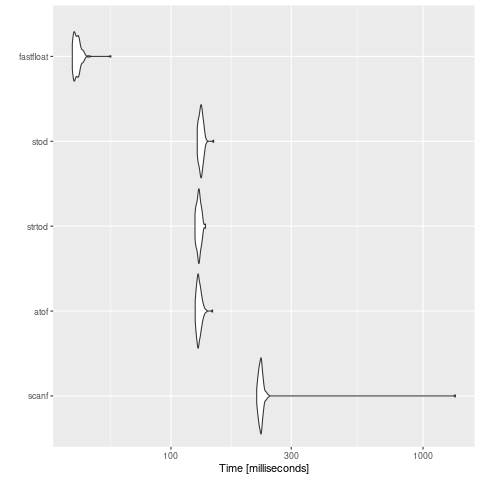
A new package, once again based on wonderful library by Daniel Lemire, is now on CRAN in its initial version 0.0.1. Daniel, in a recent arXiv paper shows that one can convert character representations of numbers into floating point at rates at or exceeding one gigabyte per second. His tests show a fourfold gain over library functions such as strtod. We put a simply package together showing use of the example parser, and containing a simple all-in comparison benchmark (where we time the function call overhead as well) and get roughly 3x. See the repo for details; we are borring the table and figure here:
> source("comparison.R")
Unit: milliseconds
      expr      min       lq     mean   median       uq      max neval cld
     scanf 218.8936 224.1223 238.5650 227.1901 229.9116 1343.433   100   c
      atof 124.8087 127.3274 129.4104 128.5858 130.9138  146.334   100  b 
    strtod 124.5705 127.2157 129.1238 129.1042 130.7504  137.143   100  b 
      stod 127.1751 129.7343 131.7339 131.4854 133.1425  147.763   100  b 
 fastfloat  40.6219  41.3042  42.5729  42.3209  43.1738   57.788   100 a  
> 
Or in chart form: Not much to say yet for the initial release:

Changes in version 0.0.1 (2021-01-31)
  • Initial version and CRAN upload

While the package was waiting to be added to CRAN, Brendan already added a potential as.double() replacement which will be in the next version. If you like this or other open-source work I do, you can now sponsor me at GitHub.

This post by Dirk Eddelbuettel originated on his Thinking inside the box blog. Please report excessive re-aggregation in third-party for-profit settings.

30 January 2021

Dirk Eddelbuettel: RcppDate 0.0.2: Regular Update

RcppDate wraps the date library by Howard Hinnant for use with R. This header-only modern C++ library has been in pretty wide-spread use for a while now, and adds to C++11/C++14/C++17 what will be (with minor modifications) the date library in C++20. Since the original 0.0.1 CRAN release I have also added this package along with RcppCCTZ and nanotime (which uses / requires both) to Debian so an apt based install is also possible for some. Release 0.0.2 arrived on CRAN yesterday. It simply updates the included library to version upstream version 3.0.0, and touches up some packaging internals for continued integration.

Changes in version 0.0.2 (2021-01-29)
  • Added GitHub Actions CI via run.sh from r-ci
  • Updated to upstream version 3.0.0 (plus newer commits)

If you like this or other open-source work I do, you can now sponsor me at GitHub.

This post by Dirk Eddelbuettel originated on his Thinking inside the box blog. Please report excessive re-aggregation in third-party for-profit settings.

23 January 2021

Dirk Eddelbuettel: prrd 0.0.4: More tweaks

prrd facilitates the parallel running [of] reverse dependency [checks] when preparing R packages. It is used extensively for Rcpp, RcppArmadillo, RcppEigen, BH, and possibly others. prrd screenshot image The key idea of prrd is simple, and described in some more detail on its webpage and its GitHub repo. Reverse dependency checks are an important part of package development that is easily done in a (serial) loop. But these checks are also generally embarassingly parallel as there is no or little interdependency between them (besides maybe shared build depedencies). See the (dated) screenshot (running six parallel workers, arranged in split byobu session). This release brings several smaller tweaks and improvements to the summary report that had accumulated in my use since the last realease last April. We also updated the CI runners as one does these days. The release is summarised in the NEWS entry:

Changes in prrd version 0.0.4 (2021-01-23)
  • Report summary mode is now compact, more robust and reports extended CRAN summaries. (Dirk via several changes)
  • Continuous Integration now uses run.sh from r-ci

My CRANberries provides the usual summary of changes to the previous version. See the aforementioned webpage and its repo for details. For more questions or comments use the issue tracker off the GitHub repo. If you like this or other open-source work I do, you can now sponsor me at GitHub.

This post by Dirk Eddelbuettel originated on his Thinking inside the box blog. Please report excessive re-aggregation in third-party for-profit settings.

15 January 2021

Dirk Eddelbuettel: Rcpp 1.0.6: Some Updates

rcpp logo The Rcpp team is proud to announce release 1.0.6 of Rcpp which arrived at CRAN earlier today, and has been uploaded to Debian too. Windows and macOS builds should appear at CRAN in the next few days. This marks the first release on the new six-months cycle announced with release 1.0.5 in July. As reminder, interim dev or rc releases will often be available in the Rcpp drat repo; this cycle there were four. Rcpp has become the most popular way of enhancing R with C or C++ code. As of today, 2174 packages on CRAN depend on Rcpp for making analytical code go faster and further (which is an 8.5% increase just since the last release), along with 207 in BioConductor. This release features six different pull requests from five different contributors, mostly fixing fairly small corner cases, plus some minor polish on documentation and continuous integration. Before releasing we once again made numerous reverse dependency checks none of which revealed any issues. So the passage at CRAN was pretty quick despite the large dependency footprint, and we are once again grateful for all the work the CRAN maintainers do.

Changes in Rcpp patch release version 1.0.6 (2021-01-14)
  • Changes in Rcpp API:
    • Replace remaining few uses of EXTPTR_PTR with R_ExternalPtrAddr (Kevin in #1098 fixing #1097).
    • Add push_back and push_front for DataFrame (Walter Somerville in #1099 fixing #1094).
    • Remove a misleading-to-wrong comment (Mattias Ellert in #1109 cleaning up after #1049).
    • Address a sanitizer report by initializing two private bool variables (Benjamin Christoffersen in #1113).
    • External pointer finalizer toggle default values were corrected to true (Dirk in #1115).
  • Changes in Rcpp Documentation:
    • Several URLs were updated to https and/or new addresses (Dirk).
  • Changes in Rcpp Deployment:
    • Added GitHub Actions CI using the same container-based setup used previously, and also carried code coverage over (Dirk in #1128).
  • Changes in Rcpp support functions:
    • Rcpp.package.skeleton() avoids warning from R. (Dirk)

Thanks to my CRANberries, you can also look at a diff to the previous release. Questions, comments etc should go to the rcpp-devel mailing list off the R-Forge page. Bugs reports are welcome at the GitHub issue tracker as well (where one can also search among open or closed issues); questions are also welcome under rcpp tag at StackOverflow which also allows searching among the (currently) 2616 previous questions. If you like this or other open-source work I do, you can sponsor me at GitHub. My sincere thanks to my current sponsors for me keeping me caffeinated.

This post by Dirk Eddelbuettel originated on his Thinking inside the box blog. Please report excessive re-aggregation in third-party for-profit settings.

11 January 2021

Dirk Eddelbuettel: BH 1.75.0-0: New upstream release, added Beast

Boost Boost is a very large and comprehensive set of (peer-reviewed) libraries for the C++ programming language, containing well over 100 individual libraries. The BH package provides a sizeable subset of header-only libraries for use by R. Version 1.75.0 of Boost was released in December, right on schedule with their April, August and December releases. I now try to follow these releases at a lower (annual) cadence and prepared BH 1.75.0-0 in mid-December. Extensive reverse-depends checks revealed a need for changes in a handful of packages whose maintainers I contacted then. With one exception, everybody responded in kind and brought updated packages to CRAN which permitted us to upload the package there two days ago. And thanks to this planned and coordinated upload, the package is now available on CRAN a mere two days later. My thanks to the maintainers of these packages for helping it along; this prompt responses really are appreciated. The version on CRAN is the same as the one the drat announced in this tweet asking for testing help. If you installed that version, you are still current as no changes were required since December and CRAN now contains same file. This release adds one new library: Boost Beast, an http and websocket library built on top of Boost Asio. Other changes are highlighed below.
Changes in version 1.75.0-0 (2020-12-12)
  • Removed file NAMESPACE as the package has neither R code, nor a shared library to load
  • The file LICENSE_1_0.txt is now included (as requested in #73)
  • Added new beast library (as requested in #74)
  • Upgraded to Boost 1.75.0 (#75)

Via CRANberries, there is a diffstat report relative to the previous release. Its final line is quite impressive: 3485 files changed, 100838 insertions(+), 84890 deletions(-). Wow. Comments and suggestions about BH are welcome via the issue tracker at the GitHub repo. If you like this or other open-source work I do, you can now sponsor me at GitHub.

This post by Dirk Eddelbuettel originated on his Thinking inside the box blog. Please report excessive re-aggregation in third-party for-profit settings.

10 January 2021

Dirk Eddelbuettel: RcppArmadillo 0.10.1.2.2: Minor update

armadillo image Armadillo is a powerful and expressive C++ template library for linear algebra aiming towards a good balance between speed and ease of use with a syntax deliberately close to a Matlab. RcppArmadillo integrates this library with the R environment and language and is widely used by (currently) 802 other packages on CRAN. This release was needed because we use the Matrix package for some (optional) tests related to sparse matrices, and a small and subtle change and refinement in the recent 1.3.0 release of Matrix required us to make an update for the testing. Nothing has changed in how we set up, or operate on, sparse matrices. My thanks to Binxiang and Martin Maechler for feedback and suggestion on the initial fix both Binxiang and I set up independently. At the same time we upgrade some package internals related to continuous integration (for that, also see my blog post and video from earlier this week). Lastly Conrad sent in a one-line upstream fix for dealing with NaN in sign(). The full set of changes follows.

Changes in RcppArmadillo version 0.10.1.2.2 (2021-01-08)
  • Correct one unit test for Matrix 1.3.0-caused changed (Binxiang in #319 and Dirk in #322).
  • Suppress one further warning from Matrix (Dirk)
  • Apply an upstream NaN correction (Conrad in #321)
  • Added GitHub Actions CI using run.sh from r-ci (Dirk)

Courtesy of my CRANberries, there is a diffstat report relative to previous release. More detailed information is on the RcppArmadillo page. Questions, comments etc should go to the rcpp-devel mailing list off the R-Forge page. If you like this or other open-source work I do, you can sponsor me at GitHub.

This post by Dirk Eddelbuettel originated on his Thinking inside the box blog. Please report excessive re-aggregation in third-party for-profit settings.

8 January 2021

Dirk Eddelbuettel: #32: Portable Continuous Integration using r-ci

Welcome to the 32th post in the rarely raucous R recommendations series, or R4 for short. This post covers continuous integration, a topic near and dear to many of us who have to recognise its added value. The popular and widely-used service at Travis is undergoing changes driven by a hard-to-argue with need for monetization. A fate that, if we re honest, lies ahead for most free services so who know, maybe one day we have to turn away from other currently ubiquitous service. Because one never knows, it can pay off to not get to tied to any one service. Which brings us to today s post and my r-ci service which allows me to run CI at Travis, at GitHub, at Azure, and on local Docker containers as the video demonstrates. It will likely also work at GitLab and other services, I simply haven t tried any others.

The slides are here. The r-ci website introduces r-ci at a high-level. This repo at GitHub contains run.sh, and can be used to raise issues, ask questions, or provide feedback. If you like this or other open-source work I do, you can sponsor me at GitHub.

This post by Dirk Eddelbuettel originated on his Thinking inside the box blog. Please report excessive re-aggregation in third-party for-profit settings.

17 December 2020

Dirk Eddelbuettel: RcppEigen 0.3.3.9.1: New upstream

A new release 0.3.3.9.1 of RcppEigen arrived on CRAN today (and just went to Debian too) bringing support for Eigen 3.3.9 to R. Eigen is a C++ template library for linear algebra: matrices, vectors, numerical solvers, and related algorithms. The release started with a gentle nudge from the Stan team to package Eigen 3.3.8. And once I got around to it and sat down, Eigen 3.3.9 had just been released the previous day. The freshly prepared release 0.3.3.9.0 was then announced on Twitter (and the rcpp-devel mailing list) along with a request for testing alongside the usual extended reverse dependency checking we do (just like CRAN asks us to). And it turns out that Eigen 3.3.9 required an update to StanHeaders, a CRAN package that is itself quite widely used. This took a couple of days and its round of testing, but Ben Goodrich shipped it to CRAN last night, so we were able to ship RcppEigen in turn today. So this release once again bring few required changes to Eigen (see this directory for details). As we said for the previous three releases:
One additional and recent change was the accomodation of a recent CRAN Policy change to not allow gcc or clang to mess with diagnostic messages. A word of caution: this may make your compilation of packages using RcppEigen very noisy so consider adding -Wno-ignored-attributes to the compiler flags added in your ~/.R/Makevars.
I actually find this requirement rather annoying. Eigen is then only usable if you set, say,
-Wno-deprecated-declarations -Wno-parentheses -Wno-ignored-attributes -Wno-unused-function
as g++ options in ~/.R/Makevars. But CRAN makes the rules. Maybe if a few of us gently and politely nudge them they may relent one day. One can only hope. The complete NEWS file entry follows.

Changes in RcppEigen version 0.3.3.9.1 (2020-12-17)
  • Upgraded to Eigen 3.3.9 (Dirk in #92 fixing #91).
  • Added GitHub Actions CI using run.sh from r-ci (Dirk)

Courtesy of CRANberries, there is also a diffstat report for the most recent release. If you like this or other open-source work I do, you can sponsor me at GitHub.

This post by Dirk Eddelbuettel originated on his Thinking inside the box blog. Please report excessive re-aggregation in third-party for-profit settings.

16 December 2020

Dirk Eddelbuettel: RcppAnnoy 0.0.18: Tweaks

annoy image A new maintenance release, now at version 0.0.18, of RcppAnnoy is now on CRAN. RcppAnnoy is the Rcpp-based R integration of the nifty Annoy library by Erik Bernhardsson. Annoy is a small and lightweight C++ template header library for very fast approximate nearest neighbours originally developed to drive the famous Spotify music discovery algorithm. This release is follow-up to release 0.0.17 which was made four weeks ago, and which brought the new upstream release 1.17 of Annoy. We now have an updated upstream with a PR by Aaron aiming for improved control of RNG seeding to ensure better reproducibility, along with extended tests and new helpers for RcppAnnoy and Annoy version numbers. The release was once again coordinated with Annoy and James whose BiocNeighbors and uwot packages both consume the Annoy header library shipped here. Detailed changes follow below.

Changes in version 0.0.18 (2020-12-15)
  • Small tweaks to threading policy header defines (Dirk closing #65)
  • Vignette code is again compiled during testing (Aaron Lum and Dirk in #66 addressing #64)
  • Upstream code (with Aaron's PR) was synchronized once more (Dirk in #67)
  • A new helper function was added to report the Annoy version (Aaron in #68)

Courtesy of my CRANberries, there is also a diffstat report for this release. If you like this or other open-source work I do, you can sponsor me at GitHub.

This post by Dirk Eddelbuettel originated on his Thinking inside the box blog. Please report excessive re-aggregation in third-party for-profit settings.

11 December 2020

Dirk Eddelbuettel: RcppSpdlog 0.0.4: New upstream

Not quite two months after the last release, we are happy to announce version 0.0.4 of RcppSpdlog. It contains release 1.8.2 of spdlog made today, along with version 7.1.3 of fmt. RcppSpdlog bundles spdlog, a wonderful header-only C++ logging library with all the bells and whistles you would want that was written by Gabi Melman, and also includes fmt by Victor Zverovich. The NEWS entry for this release follows.

Changes in RcppSpdlog version 0.0.4 (2020-12-11)
  • Upgraded to upstream release spdlog 1.8.2
  • Added GitHub Actions CI using run.sh from r-ci

Courtesy of my CRANberries, there is also a diffstat report. More detailed information is on the RcppSpdlog page. If you like this or other open-source work I do, you can sponsor me at GitHub.

This post by Dirk Eddelbuettel originated on his Thinking inside the box blog. Please report excessive re-aggregation in third-party for-profit settings.

4 December 2020

Dirk Eddelbuettel: #31: Test your R package against bleeding-edge gcc

Welcome to the 31th post in the rapturously rampant R recommendations series, or R4 for short. This post will once again feature Docker for use with R. Earlier this week, I received a note from CRAN about how my RcppTOML package was no longer building with the (as of right now of course unreleased) version 11 of the GNU C++ compiler, i.e. g++-11. And very kindly even included a hint about the likely fix (which was of course correct). CRAN, and one of its maintainers in particular, is extremely forward-looking in terms of toolchain changes. A year ago we were asked to updated possible use of global variables in C code as gcc-10 tightened the rules. This changes is a C++ one, and a fairly simple one of simply being more explicit with include headers. Previous g++ release had done the same. The question now was about the least painful way to get g++-11 onto my machine, with the least amount of side-effects. Regular readers of this blog will know where this is headed, but even use of Docker requires binaries. A look at g++-11 within packages.debian.org comes up empty. No Debian means no Ubuntu. But there is a PPA for Ubuntu with toolchain builds we have used before. And voil there we have it: within the PPA for Ubuntu Toolchain repository is the volatile packages PPA with both g++-10 and g++-11. Here Ubuntu 20.10 works with g++-10, but g++-11 requires Ubuntu 21.04. Docker containers are there for either. So with the preliminaries sorted out, the key steps are fairly straightforward: And that is it! RcppTOML is fairly minimal and could be a member of the tinyverse so no other dependencies are needed if your package has any you could just use the standard steps to install from source, or binary (including using RSPM or bspm). You can see the resulting Dockerfile which contains a minimal amount of extra stuff to deal with some environment variables and related settings. Nothing critical, but it smoothes the experience somewhat. This container is now built (under label rocker/r-edge with tags latest and gcc-11), and you can download it from Docker Hub. With that the proof of the (now fixed and uploaded) package building becomes as easy as
edd@rob:~/git/rcpptoml(master)$ docker run --rm -ti -v $PWD:/mnt -w /mnt rocker/r-edge:gcc-11 g++ --version
g++ (Ubuntu 11-20201128-0ubuntu2) 11.0.0 20201128 (experimental) [master revision fb6b29c85c4:a331ca6194a:e87559d202d90e614315203f38f9aa2f5881d36e]
Copyright (C) 2020 Free Software Foundation, Inc.
This is free software; see the source for copying conditions.  There is NO
warranty; not even for MERCHANTABILITY or FITNESS FOR A PARTICULAR PURPOSE.

edd@rob:~/git/rcpptoml(master)$ 
edd@rob:~/git/rcpptoml(master)$ docker run --rm -ti -v $PWD:/mnt -w /mnt rocker/r-edge:gcc-11 R CMD INSTALL RcppTOML_0.1.7.tar.gz
* installing to library  /usr/local/lib/R/site-library 
* installing *source* package  RcppTOML  ...
** using staged installation
** libs
g++ -std=gnu++11 -I"/usr/share/R/include" -DNDEBUG -I../inst/include/ -DCPPTOML_USE_MAP -I'/usr/lib/R/site-library/Rcpp/include'    -fpic  -g -O2 -fdebug-prefix-map=/build/r-base-Fuvi9C/r-base-4.0.3=. -fstack-protector-strong -Wformat -Werror=format-security -Wdate-time -D_FORTIFY_SOURCE=2 -g  -c RcppExports.cpp -o RcppExports.o
g++ -std=gnu++11 -I"/usr/share/R/include" -DNDEBUG -I../inst/include/ -DCPPTOML_USE_MAP -I'/usr/lib/R/site-library/Rcpp/include'    -fpic  -g -O2 -fdebug-prefix-map=/build/r-base-Fuvi9C/r-base-4.0.3=. -fstack-protector-strong -Wformat -Werror=format-security -Wdate-time -D_FORTIFY_SOURCE=2 -g  -c parse.cpp -o parse.o
g++ -std=gnu++11 -shared -L/usr/lib/R/lib -Wl,-Bsymbolic-functions -Wl,-z,relro -o RcppTOML.so RcppExports.o parse.o -L/usr/lib/R/lib -lR
installing to /usr/local/lib/R/site-library/00LOCK-RcppTOML/00new/RcppTOML/libs
** R
** inst
** byte-compile and prepare package for lazy loading
** help
*** installing help indices
** building package indices
** testing if installed package can be loaded from temporary location
** checking absolute paths in shared objects and dynamic libraries
** testing if installed package can be loaded from final location
** testing if installed package keeps a record of temporary installation path
* DONE (RcppTOML)
edd@rob:~/git/rcpptoml(master)$ 
I hope both the availability of such a base container with gcc-11 (and g++-11 and gfortran-11) as well as a recipe for building similar containers with newer clang version will help other developers. If you like this or other open-source work I do, you can sponsor me at GitHub.

This post by Dirk Eddelbuettel originated on his Thinking inside the box blog. Please report excessive re-aggregation in third-party for-profit settings.

3 December 2020

Dirk Eddelbuettel: RcppTOML 0.1.7: Support for g++-11, Minor Updates

A new RcppTOML release arrived on CRAN earlier today evening. RcppTOML brings TOML to R. TOML is a file format that is most suitable for configurations, as it is meant to be edited by humans but read by computers. It emphasizes strong readability for humans while at the same time supporting strong typing as well as immediate and clear error reports. On small typos you get parse errors, rather than silently corrupted garbage. Much preferable to any and all of XML, JSON or YAML though sadly these may be too ubiquitous now. TOML has been making inroads with projects such as the Hugo static blog compiler, or the Cargo system of Crates (aka packages ) for the Rust language. CRAN had sent us a note that the package no longer compiled under the [unreleased, of course, never change, BDR ;-) ] g++-11 compiler, but were kind enough to hint that it was only lacking an #include <limits>. These things happen: newer compilers are generally more strict, and that is generally a good things. (Last year this time we prepped code for the more stringent view on global variables under gcc-10. Earlier g++ version had similar demands to clarify include headers.) I set up a simple Docker contain with on Ubuntu 21.04 with g++-11, R, and Rcpp to build the package and make this change (which was of course also PR ed upstream at cpptoml), plus some other small ones that update the package since the last release roughly 18 months ago. We also switched CI use to the r-ci setup I should blog about a little more, removed a bashism and updated a few URLs. The bulleted list of changes in this version follows.

Changes in version 0.1.7 (2020-12-01)
  • Add #include <limits> to header file, also contributed upstream, to permit compilation under the (unreleased) g++-11.
  • Switch the simple cleanup script to sh.
  • Switch CI use to r-ci for focal and bspm.
  • Update several TOML URLs to https://toml.io/en/.

Courtesy of my CRANberries, there is a diffstat report for this release. More information is on the RcppTOML page page. Please use the GitHub issue tracker for issues and bugreports. If you like this or other open-source work I do, you can sponsor me at GitHub.

This post by Dirk Eddelbuettel originated on his Thinking inside the box blog. Please report excessive re-aggregation in third-party for-profit settings.

1 December 2020

Dirk Eddelbuettel: inline 0.3.17: Refactored and New Tests

A new release of the inline package arrived on CRAN this evening and has already been shipped to Debian as well. inline facilitates writing code in-line in simple string expressions or short files. The package was used quite extensively by Rcpp in the days before Rcpp Attributes arrived on the scene proving an even better alternative for its use cases. inline is still use by rstan and a number of other packages. One of those other packages is mkin, and its author Johannes Ranke overhauled the saving and re-loading of C functions part with a really well-done set of contributions. In the process we also added unit testing via the lovely tinytest, and changed to continuous integration setup to r-ci. See below for a detailed list of changes extracted from the NEWS file.

Changes in inline version 0.3.17 (2020-11-30)
  • Unit testing is now supported via tinytest (Johannes in #15 addressing #14).
  • CI was updated to use focal and run.sh from r-ci on Travis and GitHub Actions (Dirk)
  • The writing and reading of compiled code was refactored and extended (Johannes in #16 fixing #13).
  • Some minor problems related to CRAN checks and tests were corrected (Johannes and Dirk in #17, Johannes in #18, #19, #20).
  • Small stylistic updates have been applied to some R and Rd files (Dirk).

Courtesy of my CRANberries, there is a comparison to the previous release. If you like this or other open-source work I do, you can now sponsor me at GitHub. For the first year, GitHub will match your contributions.

This post by Dirk Eddelbuettel originated on his Thinking inside the box blog. Please report excessive re-aggregation in third-party for-profit settings.

17 November 2020

Dirk Eddelbuettel: RcppArmadillo 0.10.1.2.0

armadillo image Armadillo is a powerful and expressive C++ template library for linear algebra aiming towards a good balance between speed and ease of use with a syntax deliberately close to a Matlab. RcppArmadillo integrates this library with the R environment and language and is widely used by (currently) 779 other packages on CRAN. This release ties up a few loose ends from the recent 0.10.1.0.0.

Changes in RcppArmadillo version 0.10.1.2.0 (2020-11-15)
  • Upgraded to Armadillo release 10.1.2 (Orchid Ambush)
  • Remove three unused int constants (#313)
  • Include main armadillo header using quotes instead of brackets
  • Rewrite version number use in old-school mode because gcc 4.8.5
  • Skipping parts of sparse conversion on Windows as win-builder fails

Courtesy of my CRANberries, there is a diffstat report relative to previous release. More detailed information is on the RcppArmadillo page. Questions, comments etc should go to the rcpp-devel mailing list off the R-Forge page. If you like this or other open-source work I do, you can now sponsor me at GitHub. For the first year, GitHub will match your contributions.

This post by Dirk Eddelbuettel originated on his Thinking inside the box blog. Please report excessive re-aggregation in third-party for-profit settings.

Dirk Eddelbuettel: RcppAnnoy 0.0.17

annoy image A new release 0.0.17 of RcppAnnoy is now on CRAN. RcppAnnoy is the Rcpp-based R integration of the nifty Annoy library by Erik Bernhardsson. Annoy is a small and lightweight C++ template header library for very fast approximate nearest neighbours originally developed to drive the famous Spotify music discovery algorithm. This release brings a new upstream version 1.17, released a few weeks ago, which adds multithreaded index building. This changes the API by adding a new threading policy parameter requiring code using the main Annoy header to update. For this reason we waited a little for the dust to settle on the BioConductor 3.12 release before bringing the changes to BiocNeighbors via this commit and to uwot via this simple PR. Aaron and James updated their packages accordingly so by the time I uploaded RcppAnnoy it made for very smooth sailing as we all had done our homework with proper conditional builds, and the package had no other issue preventing automated processing at CRAN. Yay. I also added a (somewhat overdue one may argue) header file RcppAnnoy.h regrouping defines and includes which should help going forward. Detailed changes follow below.

Changes in version 0.0.17 (2020-11-15)
  • Upgrade to Annoy 1.17, but default to serial use.
  • Add new header file to regroup includes and defines.
  • Upgrade CI script to use R with bspm on focal.

Courtesy of my CRANberries, there is also a diffstat report for this release. If you like this or other open-source work I do, you can now sponsor me at GitHub. For the first year, GitHub will match your contributions.

This post by Dirk Eddelbuettel originated on his Thinking inside the box blog. Please report excessive re-aggregation in third-party for-profit settings.

Next.

Previous.