Search Results: "spa"

9 September 2012

Erich Schubert: Google Plus replacing blogs not Facebook

When Google launched Google+, a lot of people were very sceptical. Some outright claimed it to be useless. I must admit, it has a number of functions that really rock.
Google Plus is not a Facebook clone. It does not try to mimick Facebook that much. To me, it looks much more like a blog thing. A blog system, where everybody has to have a Google account, and then can comment (plus, you can then restrict access and share only with some people). It also encourages you to share shorter posts. Successful blogs always tried to make their posts "articles". Now the posts themselves are merely comments; but not as crazy short as Twitter (it is not a Twitter clone either), and it does have rich media contents, too.
Those who expect it to replace their Facebook where the interaction is all about personal stuff will be somewhat disappointed. Because it IMHO much less encourages the smalltalk type of interaction.
However, it won a couple of pretty high profile people to share their thoughts and web discoveries with the world. Some of the most active users I follow on Google Plus are: Linus Torvalds and Tim O'Reilly (of the publishing house O'Reilly)
Of course I also have a number of friends that share private stuff on Google Plus. But in my opinion the strength of Google Plus is on sharing publicly. Since Google is the king of search, they can both feed shares of your friends into your regular search results, but there is also a pretty interesting search in Google PLus. The key difference is that with this search, the focus is on what is new. Regular web search is also a lot about searching for old things (where you did not bother to remember the address or bookmark the site - and mind it, today a lot of people even "google for Google" ...) For example I like the plus search for data mining because it occasionally has some interesting links in it. A lot of the stuff is coming in again and again, but using the "j and k" keys, I can quickly scroll through these results to see if there is anything interesting. And there are quite a lot of interesting things I've discovered this way.
Note that this can change anytime. And maybe it is because I'm interested in technology stuff that it works well for me. But say, maybe you are more into HDR photography than me (I think they look unreal, as if someone has done way too much contrast and edge enhancing on the image). But go there, and press "j" a number of times to browse through some HDR shots. That is a pretty neat search function there. And if you come back tomorrow, there will likely be new images!
Facebook tried to clone this functionality. Google+ launched in June 2011, and in September 2011, Facebook added "subscribers". So they realized the need for having "non-friends" that are interested in what you are doing. Yet, I don't know anybody actually using it. And the Public posts search is much less interesting than of Google Plus, and the nice keyboard navigation is also missing.
Don't get me wrong, Facebook still has its uses. When I travel, Facebook is great for me to get into contact with locals to go swing dancing. There are a number of events where people only invite you on Facebook (and that is one of the reasons why I've missed a number of events - because I don't use Facebook that much). But mind it, a lot of the stuff that people share on Facebook is also really boring.
And that will actually be the big challenge for Google: keeping the search results interesting. Once you have millions of people there sharing pictures of lolcats - will it still return good results? Or will just about every search give you more lolcats?
And of course, spam. The SEO crowd is just warming up in exploring the benefits of Google Plus. And there are quite some benefits to be gained from connecting web pages to Google Plus, as this will make your search results stick out somehow, or maybe give them that little extra edge over other results. But just like Facebook at some point was so heavily spammed when every little shop was setting up his Facebook pages, inviting everyone to all the events and so on - this is bound to happen on Google Plus, too. We'll see how Google then reacts, and how quickly and effectively.

8 September 2012

Steinar H. Gunderson: Video editing on Linux

Lessons learned from trying to do some simple non-linear video editing on Linux: Kdenlive has reached a point where it's usable. Not good by any means there are glaring problems such as the color management support being very rudimentary, almost no multicore support, general lack of optimization, frequent near-crashes, and so on but usable to the point where you can actually create a video from start to end. I'd say it's very roughly comparable to Premiere 5 was, circa 1998, but it's not something I'd recommend to my mother. slowmoVideo, on the other hand, was not very useful to me for framerate up-conversions; the end results were simply too poor given the general complexity in my scenes. It can seemingly do an okay (but not perfect) job for down-conversion if you're willing to hack it a bit and live with general slowness and demand for disk space. So, well, behold the end result, I guess. If you like frisbee, that is.

7 September 2012

Dirk Eddelbuettel: RcppArmadillo 0.3.4.0

A new major released of Armadillo came out earlier today. I prepared the corresponding RcppArmadillo package 0.3.4.0 which also arrived on CRAN earlier today. This released contains a few performance improvements, the beginnings of support of sparse matrices and more, see below. We also post the NEWS entry for the beta release which was prepared, but not uploaded to CRAN to minimise the upload frequency there. On the RcppArmadillo side, two enhancements were made for the fastLm() function for faster linear model fits.
Changes in RcppArmadillo version 0.3.4.0 (2012-09-06)
  • Upgraded to Armadillo release 3.4.0 (Ku De Ta)
    • added economical QR decomposition: qr_econ()
    • added .each_col() & .each_row() for vector operations repeated on each column or row
    • added preliminary support for sparse matrices, contributed by Ryan Curtin et al. (Georgia Institute of Technology)
    • faster singular value decomposition via divide-and-conquer algorithm
    • faster .randn()
  • NEWS file converted to Rd format
Changes in RcppArmadillo version 0.3.3.91 (2012-08-30)
  • Upgraded to Armadillo release 3.3.91
    • faster singular value decomposition via "divide and conquer" algorithm
    • added economical QR decomposition: qr_econ()
    • added .each_col() & .each_row() for vector operations repeated on each column or row
    • added preliminary support for sparse matrices, contributed by Ryan Curtin, James Cline and Matthew Amidon (Georgia Institute of Technology)
  • Corrected summary method to deal with the no intercept case when using a formula; also display residual summary() statistics
  • Expanded unit tests for fastLm
Courtesy of CRANberries, there is also a diffstat report for 0.3.4.0 relative to 0.3.2.4 As always, more detailed information is on the RcppArmadillo page. Questions, comments etc should go to the rcpp-devel mailing list off the R-Forge page.

5 September 2012

Raphaël Hertzog: My Debian Activities in August 2012

This is my monthly summary of my Debian related activities. If you re among the people who made a donation to support my work (88.41 , thanks everybody!), then you can learn how I spent your money. Otherwise it s just an interesting status update on my various projects. This month has again been a short one since I have mostly been in vacation during the last 2 weeks. Dpkg Things are relatively quiet during the freeze. I only took care of fixing 3 bugs: a regression of 3.0 (quilt) (#683547), a segfault of dpkg-query -W -f (commit) and a bad auto-completion for French users (#685863). Testing the upgrade to wheezy We got several reports of wheezy upgrade that failed because dpkg ran the trigger while the dependencies of the package with pending triggers are not satisfied. Unfortunately fixing this in dpkg is not without problems (see #671711 for details) so Guillem decided to defer this fix for Jessie. My suggestion of an intermediary solution has fallen in limbo. Instead we now have to find solutions for each case where this can fail (example of failure: 680626). Another way to avoid those errors is to ensure that triggers are run as late as possible. We can improve this in multiple ways. The first way is to modify most triggers so that they use the interest-noawait directive. In that case, the packages activating the trigger will be immediately marked as configured (instead of triggers-awaited ) and the trigger will thus not need to be run as part of further dependency solving logic. But as of today, there s no package using this new feature yet despite a nudge on debian-devel-announce. :-( The second way is to modify APT to use dpkg no-triggers, and to let the trigger processing for the end (with a last dpkg configure -a call). I requested this early in the wheezy timeframe but for various reasons, the APT maintainers did not act on it. I pinged them again in #626599 but it s now too late for wheezy. I find this a bit sad because I have been using those options for the entire wheezy cycle and it worked fine for me (and I used them for a dist-upgrade on my wife s laptop too). It would have been good to have all this in place for wheezy so that we don t have to suffer from the same problems during the jessie upgrade, but unless someone steps up to steer those changes, it seems unlikely to happen. Instead, we re back to finding klumsy work-arounds in individual packages. Packaging I prepared security updates for python-django (1.4.1 for unstable,
1.2.3-3+squeeze3 for stable). I packaged a new upstream version for cpputest (3.2-1). I reviewed ledgersmb 1.3.21-1 prepared by Robert James Clay and asked him to prepare another version with further fixes. I released nautilus-dropbox 1.4.0-2 with supplementary changes of my own to support https_proxy and to display better diagnostic information when the download fails. With the help of Paul van der Vlis and Michael Ziegler, we did what was required to be able to migrate python-django-registration 0.8 to Wheezy even though it s a new upstream version with backwards incompatible changes. Thanks to Adam D. Barratt who unblocked the package, we now have the right version in Wheezy despite the fact that I missed the freeze deadline. Debian France Julien Cristau reminded the board of Debian France that we have to elect officers (President, Secretary, Treasurer) as the current officers have withdrawn. I was somewhat afraid that nobody would take over so I pinged each member to try to get new volunteers. We now have volunteers (me, Julien Danjou and Sylvestre Ledru) and we re waiting until Julien finds some time to run the election. Misc With the help of DSA, I setup antispam rules for the owner@packages.qa.debian.org alias because I was getting tired by the amount of spam. In the process, they asked me to write a wiki page for dsa.debian.org to document everything so that they can refer to it for future queries. I did it but it looks like that they did not apply my patch yet. I also tested an upstream patch for gnome-keyring (see bugzilla #681081) that reintroduces the support of forgetting GPG passphrases after a specified amount of time. Thanks See you next month for a new summary of my activities.

No comment Liked this article? Click here. My blog is Flattr-enabled.

Russ Allbery: Reacting to excitement

I've been slowly noticing, over a number of years now, a place where I don't react to other people the way that I want to. I've been stumbling over defensive reactions that I didn't realize I had. These are a few rules of thumb that I'm formulating for myself to try to improve that, and I thought it might help to write them down. And maybe they'll be meaningful for someone else.
  1. Things people are excited about are probably exciting. If I don't find them exciting, that's probably because I don't know enough about them to understand why they're exciting. Or perhaps I have a different mindset, and therefore the exciting parts don't connect with me. Both of those are okay! There are way more things to learn about than I will ever possibly have time to learn, and I don't have to get excited about everything other people are excited about. But, equally, just because I'm not excited doesn't mean that the thing is not exciting.
  2. My misplaced sense of obligation should not be someone else's buzzkill. This requires a bit of unpacking, since I only intermittantly realize that I'm doing this. But (partly for cultural reasons, partly due to natural inclinations) I've always felt a strong sense of obligation to "keep up" with things. To know a lot about a lot of topics. And one of the things I've realized is that my brain occasionally twists an interest in knowing lots about the world into a sense of obligation to "stay current" and know something about everything important, at least within my vague field of expertise. And usually that part of my brain has a very expansive notion of field of expertise; all of software development, for example, which is, when I pull it out into the light, ridiculously broad. This then sparks one of the standard failure modes of human cognition. I have an unrealistic expectation of myself. I fail to meet that expectation. This makes me feel guilty and stressed. At that point, my brain starts trying to find targets for me to displace negative feelings onto, and that generally ends up being the next person who is excited about something new that I don't know anything about but feel like I should. This is all very interesting psychologically, in the abstract. However, the concrete result is that I sometimes get all snarky and negative about something that someone else is excited about because it happens to be the moment I hit overload, or because I didn't want to hear about another thing that I feel like I should know more about. And that, in turn, can be either confrontational or discouraging to someone who is legitimately excited (and may rarely get the chance to be excited). And that's not the person I want to be.
  3. It's okay not to have an opinion. Seriously, it's okay. The world is full of stuff, far more stuff than any one person can know anything about. It's okay not to go read about everything people say is exciting. It's okay not to know about something new. It's okay to focus on the things I'm already doing. Really. What's not okay is to make up an opinion about something I know nothing about just so that I can feel better about myself by having an opinion. Particularly since that opinion formed under those circumstances tends to be negative, despite the fact that I have no actual basis for having any opinion at all. I need to practice just quietly not having an opinion. No one else needs to know about my lack of opinion.
  4. Before bristling at imposition, be sure someone is actually imposing. I frequently leap to the conclusion that, when someone raises a topic, they want me to do something about it. It's a gut emotional reaction, I think in part because the emotional part of my brain likes to make everything about me. Intellectually, if I can engage that part of my brain, it's often obvious that it's not about me, or that they're not asking me to do anything. Often, when someone brings something up, they just want to tell someone else about it, or make me aware of it. If I've listened to, or read, all the sentences and understood then, then congratulations! I've done everything that I needed to do and was expected to do and need not feel any further obligation. Even if something further needs to be done, it doesn't necessarily need to be done by me. I'm very protective of my time and available resources because I almost always feel overwhelmed by all the things that I want to work on. This does not entitle me to snap at random people who are being excited around me on the grounds that they're trying to put more obligations on me. They're probably not. If it becomes clear that they really want me to do something I don't have time to do, I can politely decline, but if I just shut up and listen for longer, usually that's not the case at all.
(Please note that this is not prompted by any current discussion happening anywhere, and paticularly not by anything in Debian. Insofar as it was prompted by anything, it was by a throwaway comment in an unrelated private discussion. It's just something that gelled enough to write down while I was walking home from work.)

4 September 2012

Gunnar Wolf: Electronic voting in Panama: Slower, more expensive, more uncertainty... Goodbye!

Panama just underwent a nasty e-voting exercise: Electronic-mediated elections were held for the committee of the PRD party. It sounds simple - Even trivial! There were only 4100 authorized voters, it was geographically trivial (all set inside a stadium)... But it blew up in smoke. I won't reiterate all what happened, I'll rather direct you to our project's (the e-voting observatorium) page: News regarding Panama (for those coming from the future, search starting at 2012-08-27 and yes, it's all in Spanish, but there are free-as-in-beer translation services. Many e-vote proponents/sellers/pushers were very eagerly waiting for this election to brag about one more success... So much that they could not just ignore it, and started rationalizing it away. Anyway, while feeding the observatorium, I came across this opinion-article in the Voto Digital website, which makes quite a bit of pro-e-voting noise. I replied to it, and I think my analysis is worth sharing also with you:

So, lets make some simple numbers, rounding the numbers: The PRD vote in Panama was done for a universe of 4100 voters. It took 10 hours (instead of the planned 4), so 410 people were processed every hour. There were 40 voting (electronic) booths, so each processed 10 people per hour. This means, each person spent 6 minutes by the booth. A manual vote in this fashion is highly parallelizable: Each of the voters can be given ballots with anticipation, or many of them cna be allowed in to be given the ballots in situ (depending on the electoral scheme employed). The contention time is the time it takes to each voter to get near the booth and deposit his ballot (either folded or in an envelope) - And it will very rarely be more than a couple of seconds. So, given that using electronic booths parallelism cannot grow (there is a fixed number of machines) and the queues grew wildly, with traditional voting it would have surely fitted in the expected four hours (they were expected, also, based on their past experiences). As for counting, that's the slowest part of manual voting, it's also highly parallelizable: If each of the 40 booths has slightly over 100 ballots, the party personnel can easily count them in under 30 minutes. Capture and aggregation for the 40 partial results would take an extra 10 minutes, even being generous. Manual voting would have saved them around five hours, without demanding additional resources (and being thus much more economical than having to buy 40 specific-purpose computers). And as an additional advantage, the physical and tangible vote proofs would remain, in case they were ever again needed.

Gunnar Wolf: To CURP or not to CURP

To CURP or not to CURP
CURP: Clave nica del Registro Poblacional, or Unique Population Registry Code. This is a (hopefully) unique, 18 character long, string identifying each Mexican - I won't get into the technicalities, but serve yourselves. By following such a convoluted scheme, the authorities should have ensured a biunivocal relation between each person and their CURP number. Well, at some point, due to a bureaucratical mishap completely outside my hands (my patron registered me with the wrong birth date, as you can see in the page at the bottom), I got two CURPs - And the procedure to fix it was far from trivial. Last Sunday, I entered the Consulta CURP system to print a copy of the official document. Much to my surprise... It answered that I was not registered! A couple of minutes later, I tried again, and succeeded. But I could not refrain from printing my Certificate of non-registration. I guess their system follows a strong-but-stupid scheme such as:
  1. begin
  2. db = connect_to_database
  3. curp = find_curp_for_person(query)
  4. generate_document(curp)
  5. rescue
  6. generate_non_reg_certificate(query)
So, right, if a user submits a query during the system maintenance window (after all, it was Sunday after 23:00), the system will fail to connect to the database (or whatever), raise an exception, trap it, and... Well, you no longer exist, thanks for playing!

3 September 2012

Lars Wirzenius: New format to replace tar: some notes

During lunch the other day, I discussed the shortcomings of the tar file format with friend and co-worker Daniel. The tar file format has a lot of legacy by now, and it's not quite up to date with the latest developments in file systems, such as extended attributes. This makes tar badly suited for things such as backups and other situations where precise reproduction of the input data matters. There are several variants of the tar file format, and various more or less standard extensions to it. GNU tar, for example, added support for pathnames longer than 100 bytes many years ago, and it is now commonly supported. Other problems in the tar file format: This led us to discuss the possibility of a new file format. We had a bit of fun exploring the solution space for a while. However, almost all use of tar these days is for distributing sets of files, where the filename and basic set of file permissions is enough. In other words, for things such as source code, tar is just fine. The archives are small enough, and the other limitations are rarely a problem, but the pain of switching to a new format would be great. Thus, with some reluctance, we concluded that a new format would be a waste of time. But I thought I'd write this up anyway, in case one of my readers wants to start working on this.

2 September 2012

Dirk Eddelbuettel: Faster creation of binomial matrices

Scott Chamberlain blogged about faster creation of binomial matrices the other day, and even referred to our RcppArmadillo package as a possible solution (though claiming he didn't get it to work, tst tst -- that is what the rcpp-devel list is here to help with). The post also fell short of a good aggregated timing comparison for which we love the rbenchmark package. So in order to rectify this, and to see what we can do here with Rcpp, a quick post revisiting the issue. As preliminaries, we need to load three packages: inline to create compiled code on the fly (which, I should mention, is also used together with Rcpp by the Stan / RStan MCMC sampler which is creating some buzz this week), the compiler package included with R to create byte-compiled code and lastly the aforementioned rbenchmark package to do the timings. We also set row and column dimension, and set them a little higher than the original example to actually have something measurable:
library(inline)
library(compiler)
library(rbenchmark)
n <- 500
k <- 100
The first suggestion was the one by Scott himself. We will wrap this one, and all the following ones, in a function so that all approaches are comparable as being in a function of two dimension arguments:
scott <- function(N, K)  
    mm <- matrix(0, N, K)
    apply(mm, c(1, 2), function(x) sample(c(0, 1), 1))
 
scottComp <- cmpfun(scott)
We also immediatly compute a byte-compiled version (just because we now can) to see if this helps at all with the code. As there are no (explicit !) loops, we do not expect a big pickup. Scott's function works, but sweeps the sample() function across all rows and columns which is probably going to be (relatively) expensive. Next is the first improvement suggested to Scott which came from Ted Hart.
ted <- function(N, K)  
    matrix(rbinom(N * K, 1, 0.5), ncol = K, nrow = N)
 
This is quite a bit smarter as it vectorises the approach, generating N times K elements at once which are then reshaped into a matrix. Another suggestion came from David Smith as well as Rafael Maia. We rewrite it slightly to make it a function with two arguments for the desired dimensions:
david <- function(m, n)  
    matrix(sample(0:1, m * n, replace = TRUE), m, n)
 
This is very clever as it uses sample() over zero and one rather than making (expensive) draws from random number generator. Next we have a version from Luis Apiolaza:
luis <- function(m, n)  
     round(matrix(runif(m * n), m, n))
 
It draws from a random uniform and rounds to zero and one, rather than deploying the binomial. Then we have the version using RcppArmadillo hinted at by Scott, but with actual arguments and a correction for row/column dimensions. Thanks to inline we can write the C++ code as an R character string; inline takes care of everything and we end up with C++-based solution directly callable from R:
arma <- cxxfunction(signature(ns="integer", ks="integer"), plugin = "RcppArmadillo", body='
   int n = Rcpp::as<int>(ns);
   int k = Rcpp::as<int>(ks);
   return wrap(arma::randu(n, k));
')
This works, and is pretty fast. The only problem is that it answers the wrong question as it returns U(0,1) draws and not binomials. We need to truncate or round. So a corrected version is
armaFloor <- cxxfunction(signature(ns="integer", ks="integer"), plugin = "RcppArmadillo", body='
   int n = Rcpp::as<int>(ns);
   int k = Rcpp::as<int>(ks);
   return wrap(arma::floor(arma::randu(n, k) + 0.5));
')
which uses the the old rounding approximation of adding 1/2 before truncating. With Armadillo in the picture, we do wonder how Rcpp sugar would do. Rcpp sugar, described in one of the eight vignettes of the Rcpp package, is using template meta-programming to provide R-like expressiveness (aka "syntactic sugar") at the C++ level. In particular, it gives access to R's RNG functions using the exact same RNGs as R making the results directly substitutable (whereas Armadillo uses its own RNG).
sugar <- cxxfunction(signature(ns="integer", ks="integer"), plugin = "Rcpp", body='
   int n = Rcpp::as<int>(ns);
   int k = Rcpp::as<int>(ks);
   Rcpp::RNGScope tmp;
   Rcpp::NumericVector draws = Rcpp::runif(n*k);
   return Rcpp::NumericMatrix(n, k, draws.begin());
')
Here Rcpp::RNGScope deals with setting/resetting the R RNG state. This draws a vector of N time K uniforms similar to Luis' function -- and just like Luis' R function does so without looping -- and then shapes a matrix of dimension N by K from it. And it does of course have the same problem as the RcppArmadillo approach earlier and we can use the same solution:
sugarFloor <- cxxfunction(signature(ns="integer", ks="integer"), plugin = "Rcpp", body='
   int n = Rcpp::as<int>(ns);
   int k = Rcpp::as<int>(ks);
   Rcpp::RNGScope tmp;
   Rcpp::NumericVector draws = Rcpp::floor(Rcpp::runif(n*k)+0.5);
   return Rcpp::NumericMatrix(n, k, draws.begin());
')
Now that we have all the pieces in place, we can compare:
res <- benchmark(scott(n, k), scottComp(n,k),
                 ted(n, k), david(n, k), luis(n, k),
                 arma(n, k), sugar(n,k),
                 armaFloor(n, k), sugarFloor(n, k),
                 order="relative", replications=100)
print(res[,1:4])
With all the above code example in a small R script we call via littler, we get
edd@max:~/svn/rcpp/pkg$ r /tmp/scott.r 
Loading required package: methods
              test replications elapsed   relative
7      sugar(n, k)          100   0.072   1.000000
9 sugarFloor(n, k)          100   0.088   1.222222
6       arma(n, k)          100   0.126   1.750000
4      david(n, k)          100   0.136   1.888889
8  armaFloor(n, k)          100   0.138   1.916667
3        ted(n, k)          100   0.384   5.333333
5       luis(n, k)          100   0.410   5.694444
1      scott(n, k)          100  33.045 458.958333
2  scottComp(n, k)          100  33.767 468.986111
We can see several takeaways: Thanks to Scott and everybody for suggesting this interesting problem. Trying the rbinom() Rcpp sugar function, or implementing sample() at the C++ level is, as the saying goes, left as an exercise to the reader.

Lars Wirzenius: Debian discussion culture: what doesn't work

I claim that the way we conduct discussions on debian-devel has gone quickly downhill this year. The discussions around the default init implementation are particularly sad examples of how Debian debates technical topics. I've whined about this before, and people have suggested various things. Here's a list of things that I think we can conclude do not work: Things that can work: Things that might be worthwhile to try: The current situation, where a few hard-nosed, uncompromising people can prevent any rational discussion about init systems cannot be allowed to continue.

Emanuele Rocca: Story of a bug in Ubuntu

Some months ago I have run into a pretty interesting bug while working on a Ubuntu-based remote desktop system. The whole OS was installed on a server somewhere and users could access their desktop remotely. Some call this stuff Desktop-as-a-Service. The operating system we chose was Ubuntu Oneiric (11.10) and the remote access part was implemented with x2go, which uses nxagent to provide NX transport of X sessions. Users could access their Ubuntu machines remotely, with sound, video, youtube, and all you would expect from a desktop machine. The whole thing was working quite well. Now, as I said that was in May. Ubuntu 12.04 LTS was available, and the choice of upgrading to it sounded pretty much obvious. So we upgraded our test system to Precise and everything seemed to work smoothly. Till we tried to open a PDF document, actually. It took evince about 50 seconds to display a relatively small document. Same story with images opened with the default image viewer, eog. The fix delivered to our users was simple: we have set shotwell-viewer as the default image viewer, and epdfview as the default PDF viewer. Everybody happy. In the meantime, obviously, I was interested in this issue so I ve tried to run run evince from a terminal, getting the following output:
(evince:15833): GRIP-WARNING **: Failed to initialize gesture manager.
Funny. On another test system running Debian Sid (unstable) everything was working smoothly. The diff between Ubuntu s version of evince and Debian s is a 6MB monster. Among other changes, I noticed that Ubuntu s version build-depends on libgrip-dev, which depends on libutouch-geis. Multitouch stuff. Why should multitouch support break my remote session? So on May the 10th I filed a bug on launchpad. How this issue got handled is in my opinion one of the many fine examples of the inherent superiority of free software, coupled with a we won t hide problems mindset. For an example of how bad is the proprietary approach, just check a random bug in Adobe s bug tracking system. But let s go back to the evince bug. Other users reported that their VNC sessions were also affected by the same problem. After a few days it was clear that the culprit was utouch-geis, and a patch appeared. Unfortunately it did not actually address the issue. Somebody else reported that RDP sessions were broken too. At the beginning of June Precise was still affected. Finally, on August the 6th a working patch was submitted by Bradley M. Froehle and included by Chase Douglas (thank you guys). End of August, fixed version of geis accepted into precise-updates, case closed. Now for some considerations. The problem was clearly of a certain importance. A Long Term Support, stable version of Ubuntu shipped with broken PDF and image viewing functionalities. It got fixed properly, even though 3 good months are quite a long time for such a bug to get solved. However, the issue only affected a pretty limited number of users, also certainly not Ubuntu s main target audience. This bug never affected Debian, simply because utouch-geis has not made its way into the archive yet. It takes longer to make changes like this in Debian, but for some categories of users stability is more important than new, cool features. Choice is a good thing.

1 September 2012

Tanguy Ortolo: XMPPloit explained

XMPPloit is an exploit tool for a so-called flaw in the XMPP protocol. It has been published recently under the GPLv3 license, and has received much comment. However, it does not seem anybody took the time to study this attack and explain it. Goals XMPPloit is designed to serve as a transparent man-in-the-middle between an XMPP client and its XMPP server, in order to force the client not to encrypt its communications, so that it is possible to read them and modify them on-the-fly. That allows to force the client to use a clear text authentication mechanism, to display its login and password, and to modify any message it sends or receives.
XMPP logo
Mode of operation If you were expecting a tricky, undetectable attack against the XMPP protocol itself, you will be disappointed. This attack could not be simpler:
  1. In XMPP, the clients opens a connection to the server as plain text. In this case, with the attacker between them.
  2. The server offers the STARTTLS extension. The attacker blocks it, that is, does not transmit this offer to the client, so the connection stays in plain text.
  3. The client authenticate over the plain text connection.
Comments In fact, this is only an exploit against design flaws of some XMPP clients that would not warn the user that they are about to send their credentials on a clear text channel. Actually, the protocol most vulnerable to this type of attack is HTTP. Many websites that identify their users are made available over clear text HTTP, with an automatic redirection to HTTPS. Unless they use HSTS, this redirection can be blocked by an attacker without being noticed by most users. And, contrary to XMPP, not warn the user of an insecure login is not the fact of some broken clients, but of all the available browsers. I repeat: not a single browser will currently tell the user: Hey, you are about to transmit a password in clear, it could be intercepted! . Yes, there are browser that warn their users this way the first time: Hey, you are about to transmit your answers to a form in clear! Do you wish to do that, and do you want me to warn you next time? but this not quite the same, and it is just badly designed and in practice neither useful nor usable so everybody disables that.

30 August 2012

Paul Wise: Ponds as time travel devices

I firmly believe that this pond is a time travel device: Space invader pond The proof is in this recording I made1. At minimum, clearly there is some sort of quantum entanglement with computer games from the 70s going on. 1. Folks may want to use this recording in free software. To the extent possible under law, I have waived all copyright and related or neighboring rights to this work. The frogs have too. An email or a link to this page would be appreciated though.

Axel Beckert: deepgrep: grep nested archives with one command

Several months ago, I wrote about grep everything and listed grep-like tools which can grep through compressed files or specific data formats. The blog posting sparked several magazine articles and talks by Frank Hofmann and me. Frank recently noticed that we though missed one more or less mighty tool so far. We missed it, because it s mostly unknown, undocumented and hidden behind a package name which doesn t suggest a real recursive grep everything : deepgrep deepgrep is part of the Debian package strigi-utils, a package which contains utilities related to the KDE desktop search Strigi. deepgrep especially eases the searching through tar balls, even nested ones, but can also search through zip files and OpenOffice.org/LibreOffice documents (which are actually zip files). deepgrep seems to support at least the following archive and compression formats: A search in an archive which is deeply nested looks like this:
$ deepgrep bar foo.ar
foo.ar/foo.tar/foo.tar.gz/foo.zip/foo.tar.bz2/foo.txt.gz/foo.txt:foobar
foo.ar/foo.tar/foo.tar.gz/foo.zip/foo.tar.bz2/foo.txt.gz/foo.txt:bar
deepgrep though neither seems to support any LZMA based compression (lzma, xz, lzip, 7z), nor does it support lzop, rzip, compress (.Z suffix), cab, cpio, xar, or rar. Further current drawbacks of deepgrep: deepfind If you just need the file names of the files in nested archives, the package also contains the tool deepfind which does nothing else than to list all files and directories in a given set of archives or directories:
$ deepfind foo.ar
foo.ar
foo.ar/foo.tar
foo.ar/foo.tar/foo.tar.gz
foo.ar/foo.tar/foo.tar.gz/foo.zip
foo.ar/foo.tar/foo.tar.gz/foo.zip/foo.tar.bz2
foo.ar/foo.tar/foo.tar.gz/foo.zip/foo.tar.bz2/foo.txt.gz
foo.ar/foo.tar/foo.tar.gz/foo.zip/foo.tar.bz2/foo.txt.gz/foo.txt
As with deepgrep, deepfind does not implement any common options of it s normal sister tool find. Dependencies The package strigi-utils doesn t pull in the complete Strigi framework (i.e. no daemon), just a few libraries (libstreams, libstreamanalyzer, and libclucene). On Wheezy it also pulls in some audio/video decoding libraries which may make some server administrators less happy. Conclusion Both tools are quite limited to some basic use cases, but can be worth a fortune if you have to work with nested archives. Nevertheless the claim in the Debian package description of strigi-utils that they re enhanced versions of their well known counterparts is IMHO disproportionate. Most of the missing features and documentation can be explained by the primary purpose of these tools: Being backend for desktop searches. I guess, there wasn t much need for proper commandline usage yet. Until now. ;-) 42.zip And yes, I was curious enough to let deepfind have a look at 42.zip (the one from SecurityFocus, unzip seems not able to unpack 42.zip from unforgettable.dk due a missing version compatibility) and since it just traverses the archive sequentially, it has no problem with that, needing just about 5 MB of RAM and a lot of time:
[ ]
42.zip/lib f.zip/book f.zip/chapter f.zip/doc f.zip/page e.zip
42.zip/lib f.zip/book f.zip/chapter f.zip/doc f.zip/page e.zip/0.dll
42.zip/lib f.zip/book f.zip/chapter f.zip/doc f.zip/page f.zip
42.zip/lib f.zip/book f.zip/chapter f.zip/doc f.zip/page f.zip/0.dll
deepfind 42.zip  11644.12s user 303.89s system 97% cpu 3:24:02.46 total
I though won t try deepgrep on 42.zip. ;-)

29 August 2012

Olivier Berger: Debian Package Tracking System now produces RDF description of source packages

Here s a second post on the subject of RDF descriptions for Debian source packages (see the previous post for some context). From now on, the Debian Package Tracking System (PTS) will produce, alongside HTML pages meant for humans, RDF pages meant for Linked Data / Semantic Web aware applications. Every Debian source package, which used to have an HTML page like http://packages.qa.debian.org/packagename now has a corresponding RDF/XML document available provided that the application/rdf+xml content-type is required (the HTTP client being redirected to the proper HTML or RDF document).

The main objective is to try and produce (closest as possible from the source, at debian.org) an authoritative description of Debian s packages in an interoperable format (RDF using the ADMS.SW 1.0 ontology). Thus, each package in Debian can be identified on the Semantic Web with a unique URI like http://packages.qa.debian.org/apache2, which is dereferenceable as RDF. Here s a graph representing the resources included in http://packages.qa.debian.org/apache2 (click on the image to load it) :
You can see an example of such an RDF representation for the apache2 source package in trying (with the raptor2-utils package installed):

$ rapper -o turtle http://packages.qa.debian.org/apache2
If you prefer more visual/navigatable versions, use one of the Linked Data browsers referenced in wikipedia or see the output of the W3C RDF validator. For more details about the underlying format see a raw RDF/XML dump :

$ curl -L -v -H 'Accept: application/rdf+xml' http://packages.qa.debian.org/apache2
Any Semantic Web application can then reference that resource, which becomes part of the Linked Open Data cloud. There are probably lots of uses that could emerge from this, but the immediate I can think of is the matching of Debian packages with other packages/projects (upstream, downstream, other dists) in an interoperable way (see other projects like distromatch, etc.). At the moment, the doap:homepage of the upstream SoftwareProject resources generated by the PTS can be such a simple matching key (it s actually much more complex than that, but will be the topic of further efforts). AFAICT, this is the first large deployment of an ADMS.SW 1.0 implementation. On my machine, I ve counted almost 1.5 million triples generated. Stay tuned for more installments on similar topics.

28 August 2012

Russell Coker: SSD for a Workstation

SSDs have been dropping in price recently so I just bought four Intel 120G devices for $115 each. I installed the first one for my mother in law who had been complaining about system performance. Her system boot time went from 90 seconds to 20 seconds and a KDE login went from about 35 seconds to about 10 seconds. The real problem that she had reported was occasional excessive application delay, while it wasn t possible to diagnose that properly I think it was a combination of her MUA doing synchronous writes while other programs such as Chromium were doing things. To avoid the possibility of a CPU performance problem I replaced her 1.8GHz E4300 system with a 2.66GHz E7300 that I got from a junk pile (it s amazing what s discarded nowadays). I also installed a SSD in my own workstation (a 2.4GHz E4600). The boot time went down from 45s on Ext4 without an encrypted root to 27s with root on BTRFS including the time taken to enter the encryption password (maybe about 23s excluding my typing time). The improvement wasn t as great, but that s because my workstation does some things on bootup that aren t dependent on disk IO such as enabling a bridge with STP (making every workstation a bridge is quieter than using switches). KDE login went from about 27s to about 12s and the time taken to start Chromium and have it be usable (rather than blocking on disk IO) went from 30 seconds to an almost instant response (maybe a few seconds)! Tests on another system indicates that Chromium startup could be improved a lot by purging history, but I don t want to do that. It s unfortunate that Chromium only supports deleting recent history (to remove incriminating entries) but doesn t support deleting ancient history that just isn t useful. I didn t try to seriously benchmark the SSD (changing from Ext4 to BTRFS on my system would significantly reduce the accuracy of the results), I have plans for doing that on more important workloads in the near future. For the moment the most casual tests have shown a significant performance benefit so it s clear that an SSD is the correct storage option for any new workstation which doesn t need more than 120G of storage space. $115 for SSD vs $35 for HDD is a fairly easy choice for a new system. For larger storage the price of hard drives increases more slowly than that of SSD. In spite of the performance benefits I doubt that I will gain a real benefit from this in the next year. The time taken to install the SSD equates to dozens of boot cycles which given a typical workstation uptime in excess of a month is unlikely to happen soon. One minor benefit is that deleting messages in Kmail is an instant operation which saves a little annoyance and there will be other occasional benefits. One significant extra benefit is that an SSD is quiet and dissipates less heat which might allow the system cooling fans to run more slowly. As noisy computers annoy me an SSD is a luxury feature. Also it s good to test new technologies that my clients may need. The next thing on my todo list is to do some tests of ZFS with SSD for L2ARC and ZIL. Related posts:
  1. How I Partition Disks Having had a number of hard drives fail over the...
  2. Xen and Swap The way Xen works is that the RAM used by...
  3. big and cheap USB flash devices It s often the case with technology that serious changes occur...

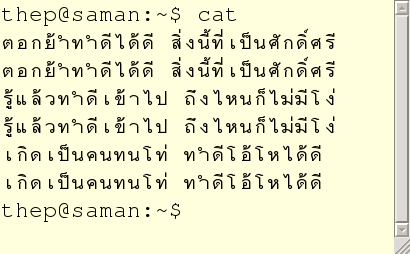
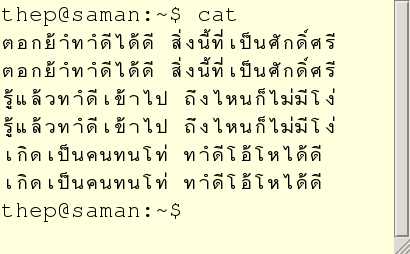
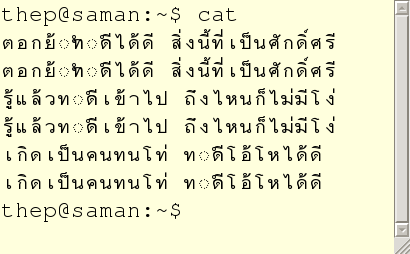
Theppitak Karoonboonyanan: Pango-HarfBuzz Merge and The Effects on Thai Module

One major change in GNOME 3.6 is Pango s shaper engines replacement with HarfBuzz. Only language engines (for word break analysis, for example) are retained. So, I m checking how this affects Thai/Lao rendering and what to do next. Over all, Behdad has put a good effort to make it right. Most Uniscribe behaviors have been achieved for compatibility. He even cares enough to cover some widespread Thai fonts in which the language tag 'latn' is used instead of 'thai', as seen in Mozilla #719366. Unfortunately, this font set has been declared as standard fonts in official documents. The workaround seems inevitable. Supported Fonts In my experiments with some existing Thai OpenType fonts, the new Pango still renders well without regression. Loma font from fonts-tlwg (glyph positioning with GPOS, rearrangement with GSUB): Loma on new Pango Arundina Sans font from Fonts-SIPA-Arundina (positioning by substitution, only GSUB, no GPOS): Arundina Sans on new Pango But for legacy fonts without OpenType features, it renders badly: Non-OpenType on new Pango In addition, according to Behdad, PUA glyphs in legacy fonts are not supported yet. This means there will be regression on fonts designed for Windows XP or below. But modern fonts designed for Windows 7 should be fine. Changes on Bugs The engine replacement from scratch certainly affects existing bugs. Some become obsolete, some still remain. Here are the summary for Thai/Lao engine, as resolved upstream: Closed bugs: Questionable bugs: Remaining bugs:

27 August 2012

Simon Josefsson: Using OATH Toolkit with Dropbox

Today there was an announcement that Dropbox supports two-factor authentication. On their page with detailed instructions there is (at the bottom) a link to the man page of the OATH Toolkit command line utility oathtool. OATH Toolkit is available in Ubuntu 12.04 and Debian Wheezy. (Note that the 1.10.4 version in Ubuntu does not support the base32 features.) There is not a lot of details in the documentation on Dropbox s site on how to use oathtool, but I have experimented a bit with the setup and I d like to share my findings. I assume you are somewhat familiar with the OATH Toolkit; if not I suggest reading my earlier introduction to OATH Toolkit. To use OATH Toolkit s command line utility to generate OTPs that are accepted by Dropbox, here is how you proceed. When you enable two-factor authentication on Dropbox s site, you must select Use a mobile app and on the next screen with the QR code image, click the enter your secret key manually link. You will then be presented with a code that looks like this: gr6d 5br7 25s6 vnck v4vl hlao re Now this code is actually space-delimitted base32 encoded data, without any padding. Since version 1.12.0, oathtool can read base32 encoded keys. However, parsing the raw string fails, so to make it work, you need to remove the spaces and add padding characters. I have yet to see any documentation on the Dropbox implementation, but I assume they always generate 16 binary octets that are base32 encoded into 26 characters like the codes that I have seen. The code is the cryptographic key used for the HMAC-SHA1 computation described in the RFC 6238 that specify OATH TOTP. If you study the base32 encoding you discover that 26 characters needs six pad characters. So converted into proper base32, the string would be gr6d5br725s6vnckv4vlhlaore======. Now generating OTPs are easy, see below.
jas@latte:~$ oathtool --verbose --totp --base32 "gr6d5br725s6vnckv4vlhlaore======"
Hex secret: 347c3e863fd765eab44aaf2ab3ac0e89
Base32 secret: GR6D5BR725S6VNCKV4VLHLAORE======
Digits: 6
Window size: 0
Step size (seconds): 30
Start time: 1970-01-01 00:00:00 UTC (0)
Current time: 2012-08-27 21:22:54 UTC (1346102574)
Counter: 0x2ACA9C5 (44870085)
125860
jas@latte:~$
Dropbox s implementation is robust in that it requests a valid OTP from me, generated using the secret they just displayed, before proceeding. This verifies that the user was able to import the key correctly, and that the users OATH TOTP implementation appears to work. If I type in the OTP generated from oathtool this way, it allowed me to enable two-factor authentication and I agreed. From that point, signing into the Dropbox service will require an OTP. I invoke the tool, using the same arguments as above, and the tool will use the current time to compute a fresh OTP. Reflecting on how things could work smoother, I suppose oathtool could be more permissive when it performs the base32 decoding so that the user doesn t have to fix the base32 spacing/padding manually. I ll consider this for future releases.

flattr this!

Christoph Berg: PostgreSQL in Debian Hackathon

Almost a year has passed since my talk at pgconf.eu 2011 in Amsterdam on Connecting the Debian and PostgreSQL worlds, and unfortunately little has happened on that front, mostly due to my limited spare time between family and job. pgapt.debian.net is up and running, but got few updates and is lagging behind on PostgreSQL releases. Luckily, we got the project moving. Dimitri Fontaine and Magnus Hagander suggested to do a face-to-face meeting, so we got together at my house for two days last week and discussed ideas, repository layouts, build scripts, and whatnot to get all of us aligned for pushing the project ahead. My employer sponsored my time off work for that. We almost finished moving the repository to postgresql.org infrastructure, barring some questions of how to hook the repository into the existing mirror infrastructure; this should get resolved this week. The build server running Jenkins is still located on my laptop, but moving this to a proper host will also happen really soon now. We are using Mika Prokop's jenkins-debian-glue scripts for driving the package build from Jenkins. The big plus point about Jenkins is that it makes executing jobs on different distributions and architectures in parallel much easier than a bunch of homemade shell scripts could get us with reasonable effort. Here's a list of random points we discussed: We really aim at using unmodified packages from Debian as much as possible, and in fact this project doesn't mean to replace Debian's PostgreSQL packaging work, but to extend it beyond the number of server versions (and Debian and Ubuntu versions covered) supported. The people behind the Debian and Ubuntu packages, and this repository are mostly the same, so we will claim that "our" packages will be the same quality as the "original" ones. Big thanks go to Martin Pitt for maintaining the postgresql-common testsuite that really covers every aspect of running PostgreSQL servers on Debian/Ubuntu systems. Stay tuned for updates! :)

Robert Collins: Why platform specific package systems exist and won t go away

A while back mdz blogged about challenges facing Ubuntu and other Linux distributions. He raises the point that runtime libraries for Python / Ruby etc have a unique set of issues because they tend to have their own packaging systems. Merely a month later he attended Debconf 2010 where a presentation was given on the issues that Java packages have on Dpkg based systems. Since then the conversation seems to have dried up. I ve been reminded of it recently in discussions within Canonical looking at how we deploy web services. Matt suggested some ways forward, including: I think its time we revisit and expand on those points. Nothing much has changed in how Ubuntu or other distributions approach integration with other packaging systems but the world has kept evolving. Internet access is growing ever more ubiquitous, more platforms are building packaging systems clojure, scala, node.js, to name but three, and a substantial and ever growing number of products expect to operate in a hybrid fashion with an evolving web service plus a local client which is kept up to date via package updates. Twitter, Facebook and Google Plus are three such products. Android has demonstrated a large scale app store on top of Linux, with its own custom packaging format. In order to expand them, we need some background context on the use cases that these different packaging systems need to support. Platforms such as antivirus scanners, node.js, Python, Clojure and so forth care a great deal about getting their software out to their users. They care about making it extremely easy to get the latest and greatest versions of their libraries. I say this because the evidence is all around us: every successful development community / product has built a targeted package management system which layers on top of Windows, and Mac OSX, and *nux. The only rational explanation I can come up for this behaviour is that the lower level operating system package management tools don t deliver what they need. E.g. this isn t as shallow as wanting a packaging system written in their own language, which would be easy to write off as parochialism rather than a thoughtful solution to their problems. In general packaging systems provide a language for shipping source or binary form, from one or more repositories, to users machines. They may support replications, and they may support multiple operating systems. They generally end up as graph traversal engines, pulling in dependencies of various sorts you can see the DOAP specification for an attempt at generic modelling of this. One problem that turns up rapidly when dealing with Linux distribution package managers is that the versions upstream packages have, and the versions a package has in e.g. Debian, differ. They differ because at some stage, someone will need to do a new package for the distribution when no upstream change has been made. This might be to apply a local patch, or it might be to correct a defect caused by a broken build server. Whatever the cause, there is a many to one relationship between the package versions that end users see via dpkg / rpm etc, and those that upstream ship. It is a near certainty that once this happens to a library package, that comparing package versions across different distribution packages becomes hard. You cannot reliably infer whether a given package version is sufficient as a dependency or not, when comparing binary packages between Red Hat and Debian. Or Debian and Ubuntu. The result of this is that even when the software (e.g. rpm) is available on multiple distributions (say Ubuntu and RHEL), or even on multiple operating systems (say Ubuntu and Windows), that many packages will /have/ to be targeted specifically to build and execute properly. (Obviously, compilation has to proceed separately for different architectures, its more the depedency metadata that says and build with version X of dependency Y that has to be customised). The result of this is that there is to the best of my knowledge no distribution of binary packages that targets Debian/Ubuntu and RHEL and Suse and Windows and Mac OS X, although there are vibrant communities building distributions of and for each in isolation. Some of the ports systems come close, but they are still focused on delivering to a small number of platforms. There s nothing that gives 99% coverage of users. And that means that to reach all their users, they have to write or adopt a new system. For any platform X, there is a strong pressure to have the platform be maintainable by folk that primarily work with X itself, or with the language that X is written in. Consider Python there is strong pressure to use C, or Python, and nothing else, for any tools that is somewhat parochial, but also just good engineering reducing variables and making the system more likely to be well maintained. The closest system I know of Steam is just now porting to Ubuntu (and perhaps Linux in general), and has reached its massive popularity by focusing entirely on applications for Windows, with Mac OSX a recent addition. Systems like pypi which have multi platform eggs do target the wide range of platforms I listed above, but they do so both narrowly and haphazardly: whether a binary or source package is available for a given platform is up to the maintainer of the package, and the packages themselves are dealing with a very narrow subset of the platforms complexity: Python provides compilation logic, they don t create generic C libraries with stable ABI s for use by other programs, they don t have turing complete scripts for dealing with configuration file management and so forth. Anti virus updaters similarly narrow the problem they deal with, and add constraints on latency- updates of anti virus signatures are time sensitive when a new rapidly spreading threat is detected. A minor point, but it adds to the friction of considering a single packaging tool for all needs is the different use cases of low level package management tools like dpkg or rpm vs the use cases that e.g. pypi has. A primary use case for packages on pypi is for them to be used by people that are not machine administrators. They don t have root, and don t want it. Contrast that with dpkg or rpm where the primary use case (to date) is the installation of system wide libraries and tools. Things like man page installation don t make any sense for non-system-wide package systems, whereas they are a primary feature for e.g. dpkg. In short, the per-platform/language tools are (generally):
  1. Written in languages that are familiar to the consumers of the tools.
  2. Targeted at use on top of existing platforms, by non-privileged users, and where temporary breakage is fine.
  3. Intended to get the software packaged in them onto widely disparate operating systems.
  4. Very narrow they make huge assumptions about how things can fit together, which their specific language/toolchain permits, and don t generalise beyond that.
  5. Don t provide for security updates in any specific form: that is left up to folk that ship individual things within the manager.
operating system package managers:
  1. Are written in languages which are very easy to bootstrap onto an architecture, and to deploy onto bare metal (as part of installation).
  2. Designed for delivering system components, and to avoid be able to upgrade the toolchain itself safely.
  3. Originally built to install onto one operating system, ports to other operating systems are usually fragile and only adopted in niche.
  4. Are hugely broad they install data, scripts, binaries, and need to know about late binding, system caches etc for every binary and runtime format the operating system supports
  5. Make special provision to allow security updates to be installed in a low latency fashion, without requiring anything consuming the package that is updated to change [but usually force-uninstalling anything that is super-tightly coupled to a library version].
Anti virus package managers:
  1. Exist to update daemons that run with system wide escalated privileges, or even file system layer drivers.
  2. Update datasets in realtime.
  3. Without permitting updates that are produced by third parties.
Given that, lets look at the routes Matt suggested Decoupling applications from the core as a strategy makes an assumption that the core and applications are partitionable. If they are not, then applications and the core will share common elements that need to be updated together. Consider, for instance, a Python application. If you run with a system installed Python, and it is built without zlib for some reason, but the Python application requires zlib, you have a problem. A classic example of this problem is facing Ubuntu today, with all the system provided tools moving to Python 3, but vast swathes of Python applications still being unported to Python 3 at all. Currently, the Python packaging system virtualenv/buildout + distribute don t provide a way to install the Python runtime itself, but will happily install their own components for everything up the stack from the runtime. Ubuntu makes extensive use of Python for its own tools, so the system Python has a lot of packages installed which buildout etc cannot ignore this often leads to issues with e.g. buildout, when the bootstrap environment has (say) zope.interfaces, but its then not accessible from the built-out environment that disables the standard sys.path (to achieve more robust separation). If we want to pursue decoupling, whether we build a new package manager or use e.g. virtualenv (or gem or npm or ), we ll need to be aware of this issue and perhaps offer, for an extended time, a dedicated no-frills, no-distro-packages install, to avoid it, and to allow an extended supported period for application authors without committing to a massive, distro sponsored porting effort. While its tempting to say we should install pip/npm/lein/maven and other external package systems, this is actually risky: they often evolve sufficiently fast that Ubuntu will be delivering an old, incompatible version of the tool to users well before Ubuntu goes out of support, or even befor the next release of Ubuntu. Treating data as a service. All the cases I ve seen so far of applications grabbing datasets from the web have depended on web infrastructure for validating the dataset. E.g. SSL certificates, or SSL + content checksums. Basically, small self-rolled distribution systems. I m likely ignorant of details here, and I depend on you, dear reader, to edumacate me. There is potential value in having data repackaged, when our packaging system has behind-firewall support, and the adhoc system that (for instance) a virus scanner system has does not. In this case, I specifically mean the problem of updated a machine which has no internet access, not even via a proxy. The challenge I see it is again the cross platform issue: The vendor will be supporting Ubuntu + Debian + RHEL + Suse, and from their perspective its probably cheaper to roll their own solution than to directly support dpkg + rpm + whatever Apple offer + Windows the skills to roll an adhoc distribution tool are more common than the skills to integrate closely with dpkg or rpm What about creating a set of interfaces for talking to dpkg / rpm / the system packagers on Windows and Mac OSX ? Here I think there is some promise, but it needs as Matt said careful thought. PackageKit isn t sufficient, at least today. There are, I think, two specific cases to cater to:
  1. The anti-virus / fresh data set case.
  2. The egg/gem/npm/ specific case.
For the egg/gem/npm case, we would need to support a pretty large set of common functionality, on Windows/Mac OSX / *nux (because otherwise upstream won t adopt what we create: losing 90% of their users (windows) or 5% (mac) isn t going to be well accepted :) . We d need to support multiple installations (because of mutually incompatible dependencies between applications), and we d need to support multiple language bindings in some fashion some approachable fashion where the upstream will feel capable of fixing and tweaking what we offer. We re going to need to support offline updates, replication, local builds, local repositories, and various signing strategies to match the various tradeoffs made by the upstream tools. For the anti-virus / fresh data case, we d need to support a similar set of operating systems, though I strongly suspect that there would be more tolerance for limited support in that most things in that space either have very platform specific code, or they are just a large-scale form of the egg/gem/npm problem, which also wants easy updates. What next? We should validate this discussion with at least two or three upstreams. Find out whats missing I suspect a lot and whats wrong I hope not much :) . Then we ll be in a position to decide if there is a tractable, widespread solution *possible*. Separately, we should stop fighting with upstreams that have their own packaging systems. They are satisfying different use cases than our core distro packaging systems are designed to solve. We should stop mindlessly repackaging things from e.g. eggs to debs, unless we need that specific thing as part of the transitive runtime or buildtime dependencies for the distribution itself. In particular, if us folk that build system packaging tools adopt and use the upstream application packaging tools, we can learn in a deep way the (real) advantages they have, and become more able to reason about how to unify the various engineering efforts going into them and perhaps even eventually satisfy them using dpkg/rpm on our machines.

Next.

Previous.