Search Results: "sf"

29 March 2007

Jan Wagner: Taking Xen guests (domU) alive via routed network

The xend config looks like this:

playground:~# grep -v ^# /etc/xen/xend-config.sxp
(network-script ‘network-bridge netdev=dummy0′)
(vif-script vif-bridge)
(dom0-min-mem 196)
(dom0-cpus 0) Creating volume group for Xen domU (/dev/hdb2 was allready created with id 8e):

playground:~# pvcreate /dev/hdb2
Physical volume “/dev/hdb2″ successfully created
playground:~# vgcreate xen-vol /dev/hdb2
Volume group “xen-vol” successfully created
playground:~# vgscan
Reading all physical volumes. This may take a while…
Found volume group “xen-vol” using metadata type lvm2 Creating first domU:

playground:~# xen-create-image –ip 192.168.222.50 –hostname xetch.blubb.cyconet.org
General Infomation
——————–
Hostname : xetch.blubb.cyconet.org
Distribution : etch
Fileystem Type : ext3
Size Information
—————-
Image size : 4Gb
Swap size : 1024Mb
Image type : full
Memory size : 128Mb
Kernel path : /boot/vmlinuz-2.6.18-4-xen-vserver-686
Initrd path : /boot/initrd.img-2.6.18-4-xen-vserver-686
Networking Information
———————-
IP Address 1 : 192.168.222.50
Netmask : 255.255.255.0
Gateway : 192.168.222.1
Creating ext3 filesystem on /dev/xen-vol/xetch.blubb.cyconet.org-disk
Done
Installing your system with debootstrap mirror ftp://ftp.de.debian.org/debian/
Done
Running hooks
Done
No role script specified. Skipping
Creating Xen configuration file
Done
Setting up root password
Enter new UNIX password:
etype new UNIX password:
passwd: password updated successfully
All done
Logfile produced at:
/var/log/xen-tools/xetch.blubb.cyconet.org.log Add the following to /etc/network/interfaces:

auto dummy0
iface dummy0 inet static
address 192.168.222.1
netmask 255.255.255.0
network 192.168.222.0
broadcast 192.168.222.255 Bringing up network interface, restarting xen and starting the domU:

playground:~# ifup dummy0
playground:~# /etc/init.d/xendomains stop
playground:~# /etc/init.d/xend restart
playground:~# /etc/init.d/xendomains start
playground:~# xm create xetch.blubb.cyconet.org.cfg -c
Using config file “/etc/xen/xetch.blubb.cyconet.org.cfg”.
… If you want to autostart your domUs, you have to symlink the configfile to /etc/xen/auto:

playground:~# mkdir /etc/xen/auto/
playground:~# ln -s /etc/xen/xetch.blubb.cyconet.org.cfg /etc/xen/auto/xetch.blubb.cyconet.org.cfg , , , ,

28 March 2007

Marc 'Zugschlus' Haber: using grml to prepare LVM surgery

One of my dedicated servers was in bad need of major LVM surgery today. Since the rescue system delivered with the server by the housing provider suffers from lack of LVM support, I needed to pull a creative stunt with grub and grml to accomplish this. The dedicated server rented from strato is the Box I tested in a different article. Installing the LVM-based Debian system via the LVM-less rescue system involved first installing without LVM in the partition which was originally supposed to be swap, booting the just installed system and using this temporary system to finally bootstrap the target. I had originally planned to go this way again in case rescue should become necessary. Today, I checked first whether the provider supplied rescue system had improved in the mean time (which it hadn’t), and I didn’t feel like installing a new temporary system. Instead, I decided to go through a different route, using grml. grml is extremely versatile regarding boot. All you need is to get the grml kernel to boot and point it towards the grml initrd, and the initrd automatically searches the available drives for the compressed file system image, mounts it and continues the boot process. This was the point where I hooked myself into grml. I put an ext3fs on the swap partition and copied the contents of a grml CD to that partition. After thinking a while about how to get ISOLINUX to boot this grml, I remembered that the disk already has grub installed, and decided to use grub to boot grml. This was possible because the provider offers a serial console for the machine. If no serial console had been available, things would have been a lot harder since there would be no feedback and one would have to talk to grub via offline editing of menu.lst. Thanks to the serial console, things were a lot faster. Booting grml via grub is actually easy. After finding out which partition grml is on (find /linux26) and setting this partition as root, all you need is “kernel /linux26 ramdisk_size=100000 init=/etc/init lang=us BOOT_IMAGE=grml console=ttyS0,57600n8”, “initrd /minirt26.gz” and finally “boot”. The “57600” given on the kernel command line was actually the hardest part: Strato operates the serial console at unusual 57600 bps, and grml’s serial console feature starts mgetty with hard-coded 9600 bps. The rather frustrating symptom was that you can watch grml booting, with “Finished execution of main grml startup” as the last sign of life. Knowing that there is a login prompt waiting for you at the wrong baud rate. After talking to Mika from the grml team for some minutes, we decided to take two “roads” to solve the issue. Mika hacked grml’s startup process to parse the baud rate to be used for mgetty from the kernel command line. Since I couldn’t wait for Mika’s fix, I used a grml.sh script to put a fixed mgetty.config over the file contained in grml. After fixing some stupid mistakes on my part, I finally received my grml login prompt and could start with the LVM surgery. Grml is a perfect tool for such tasks since it is extremely flexible and not selective in which medium and partition types it can boot from. It has saved me a lot of grief today and has helped me in solving a difficult problem. Oh, btw, pvmove --alloc anywhere can move a logical volume inside a pysical volume without the need of a temporary physical volume, and it is thus possible to “manually” defragment a physical volume in order to allow more clean resizing of logical values. While it is debateable whether this does really make sense, it satisfies my sense of order to have an LVM setup unfragmented.

Jan Wagner: Getting started with XEN on etch

Today I thought it’s time to look deeper into the Xen hype. So I decided to install xen on etch. I followed Ganneffs recommandation

playground:~# aptitude install bridge-utils iproute \
xen-ioemu-3.0.3-1 xen-utils-3.0.3-1\
xen-linux-system-2.6.18-4-xen-vserver-686 libc6-xen Booting the dom0 leeds me into kernel panic, cause no root device was found. Hmm … there seems to be the driver missing. Right - there wasn’t any /boot/initrd.img-2.6.18-4-xen-vserver-686.
Waldi did hint me to /var/lib/dpkg/info/linux-image-2.6.18-4-xen-vserver-686.postinst and I got my ramdisk this way:

playground:~# update-initramfs -c -t -k \
2.6.18-4-xen-vserver-686
playground:~# command -v update-grub > \
/dev/null && update-grub After booting dom0 successfully, my serial console disappeared. After some digging around, I got the clue I need to tell xen, that there is one.
I modified /boot/grub/menu.lst:

# xenhopt=com1=115200,8n1 console=com1
..
# xenkopt=console=vga Dom0 is running now, lets see what we can do next, maybe:

playground:~# aptitude install xen-tools , , , ,

Evan Prodromou: 7 Germinal CCXV

Hard to believe it's already time for DemoCampMontreal2 tomorrow night (Thursday, March 29, at the SAT). I had a pretty good time at the first DemoCampMontreal back in February, despite my demo going belly-up a few times. It was a good space and a fun time to talk. I think the BarCamp page on DemoCampMontreal2 has some good info, too. Check out Fred Ngo's writeup of DemoCampMontreal2, including a fancy photo of yours truly demoing in February. It looks a little like BarCampHell, but in a good way. tags:

Big day Today's our big day -- we're closing on the house at 4690 rue Pontiac tonight at 7. We just got in from Las Vegas last night, but we headed out to the bank this morning to get a cashier's check for our (very large) down payment and dot the t's and cross the i's for the mortgage. Lots more running around today, but we go to the notaire tonight, and we'll have some sort of paper certifying us as homeowners sometime tonight. Shom-pan-yah to follow. tags:

Open Web Design One really great Open Content (or is it Open Source...?) resource that I don't pay enough attention to is the Open Web Design repository. It's a collection of very nicely done Web designs, delivered in convenient packets of HTML and CSS. They make very nice templates for "skins" of blog engines, CMSes, or even wikis. It's a great complement to the tons of Free Web software available out there (most of which is quite skinnable, and most of which has execrable default themes). My favourite part is that all the designs are dedicated to the public domain or made available under the liberal Creative Commons Attribution 2.5 license, which makes them honest-to-goodness Free Culture per the Definition of Free Cultural Works. I'm going to be using one of these Web designs to clean up my kinda bland home site. It could use a bit of editing. tags:

Thanks Mark, Allegra, No ma and Anoushka Thanks to Mark and family for the congratulations on our new house. We signed the papers tonight, and it went surprisingly smoothly. Our seller is a fascinating guy who started the animation lab at Ubisoft, so we enjoyed getting to talk to him in between onslaughts of legalese and flurries of signatures. In other good news, I guess the gang is coming out for RoCoCo. Wow! That'll be pretty fun. Good thing we'll have two houses then. tags:

27 March 2007

Pablo S. Torralba: Keep going

I took this photograph last weekend at Consuegra where we went to observe the night sky, just for fun, as we used to do. I'm sure you don't need to be told that Polaris and Ursa Major are the start on the left and the constellation on the right side. And that's why I am not telling you ;-)

Anyway, the interesting thing for me here is the effect of the Earth rotation movement. Polaris is said to be in the Earth rotation axis prolongation (it is also said this will change with time, a lot of time indeed). But, by now, for us, it can be considered a fixed point in the sky: the north point which remains a point in the picture regardless of rotation. Every other star appears as rotating around Polaris, despite the truth is we are the ones rotating. I almost can imagine I see the Earth from outside.

26 March 2007

Joachim Breitner: Trains in the UK

In June I plan to attend the DebConf 7 in Edinburgh. I like train riding and after all it s good for the climat, so I ruled out flying.If you want to go to UK by train, you have to take the EuroStar through the tunnel. The Deutsche Bahn offers a nice package including a sleeper train for 86, so I got that part covered. But that only gets me to London, and I need to go to Edinburgh.So today, I orderd a one way ticket from London to Edinburgh for 28.50 from GNER, one of the private british rail companies, and payed by credit card. Right after I sucessfully booked the ticket, I noticed some problems with the shipping address: An Umlaut in the street name has turned into weird characters and it did not display the counry (Germany) that I m sure I selected. So I immediatelly sent this mail to GNER:
Hello, I just booked this ticket online. It seems there are problems with the German address, though. The correct address is: Joachim Breitner
Ehb hl 33
71083 Herrenberg
Germany (you can replace by ue if necessary) My Booking Reference: xxxxxxxx Thank you,
Joachim Breitner
And got this response:
Dear Joachim

Thank you for your recent e-mail regarding delivery address of tickets.

I can confirm that we do not deliver tickets overseas. However, since our system is automatic, as soon as you click on the 'Buy tickets' button, the tickets are printed and sent in post.

Please remember that once the booking is confirmed, the delivery address/method cannot be changed.

In this case, if we receive the tickets back from the General Post Office, they can be reissued to a UK address and if we do not receive the tickets back, you will have to buy new tickets as your tickets are non refundable.

Please reply to this e-mail with a UK address, where you would like the tickets to be delivered so that I can update it on the notes, and the tickets will be posted, once received back. If we do not receive the tickets back, you will have to buy new tickets.

If you have any further queries, please do not hesitate in contacting us.

Kind regards

Saurabh
Now I really wonder:Update: I gave them an address in the UK now, I hope it works out (thanks Ben). And the Deutsche Bahn is already privatized, just not publicy traded yet and is 50% owned by the state, I was confusing that.

Simon Law: DemoCamp Montr al 2

I'm proud to announce the next DemoCamp that we're holding in Montr al. DemoCamp Montreal 2 (Fran ais) is a gathering of people, both in high-tech and not, to see demonstrations given by people doing cool stuff. Anyone is welcome to show up and we've got some interesting talks lined up. I'll be there to take photographs again and to chat with people about the projects they've been tending. It should be an exciting and interesting evening. How do you attend? DemoCamp Montr al 2
Thursday, 29 March 2007
18:30 20:30
Societ des arts technologiques
1195 boul. St-Laurent
Free admission
( Sign up Upcoming.org Google Maps ) I hope to see you there!

25 March 2007

Russell Coker: google-bank

Currently many people have Google advertising on their web sites, it may even be that a majority of the serious Internet users host Google advertising. Given that Google is already writing a cheque every month to many people, it wouldn't be difficult for them to change the amount in response to a funds transfer request. Depositing a cheque in a foreign currency can incurr $25 in bank fees (that's what the Commonwealth Bank of Australia charges me), this is a great impediment to international trade in small values. When Google already has an office in a country and writes cheques in the local currency it would be very easy to have that cheque include funds transfers too.

One significant advantage of Google payments would be the fact that Google doesn't write cheques for less than $100, so someone who earns $2 per month through Google adverts will be waiting a long time before they get a cheque - but if someone has an item that costs a small amount of money (EG an online service that costs a few dollars a month) then the user would be enticed to use it.

Currently many people don't place Google adverts because they believe that it would take them an unreasonably large amount of time to reach $100US. But if they could spend the money in small increments on other online services then it would be more enticing.

It seems to me that Google is the only organization that is both capable of running an International online small-payments system and which would be trusted by most people.

If you like this idea please post a comment.

24 March 2007

Christian Perrier: A few views of the partial sun eclipse

This wasn't very widely announced but last week featured a partial sun eclipse over central, south and east Asia. The eclipse was really partial but happening at sunrise in some countries, it gave some opportunities to shoot very nice pictures such as these ones: The new moon, combined with a Venus conjonction, also offered this nice view from Lisbon which is one the nicest cities in Europe, IMHO. Good opportunity for those of you who didn't alreay know about the Astronomy Picture of the Day to learn about it, add Jamie Zawinski's RSS feed (http://www.jwz.org/cheesegrater/RSS/apod.rss) to your feed reader and just enjoy one nice picture daily.

Erich Schubert: Please, think of the animals formerly known as kittens...

(Title stolen from Holger Levsen) Whenever I see this image [mozilla open Standards], I want to make a spoof of it titled: Every time you make an Ajax app, god kills a firefox. But I would certainly be violating Mozilla trademarks by doing so (their artwork, logos and trademarks such as "firefox" are not OpenSource). Anyway: AJAX is a hackaround, in particular it is not an open standard. Please use it only where it's really needed. Granted, there is worse (e.g. Flash; prepare for incompability hell now that the first opensource plugin can playback youtube videos - as you might be aware, many Linux distributions can not ship Adobe Flash, so they'll likely start shipping this plugin as soon as it's somewhat working sufficiently; or ActiveX which only works with MSIE...), but that's not really a good excuse for this abuse of Javascript that is called AJAX. On a side note, since I already mentioned flash - I can really recommend the Flashblock mozilla extension. A must have: you can view any flash if you need to by just clicking on it, but they won't be loaded automatically anymore. So you can easily access youtube (just one extra click!), but won't be bothered by flash ads and such stuff. Oh, and Adobe. They're probably the biggest blocker for a widespread Linux adoption judging by this article [computerworld.com], which is already very positive on Linux ("Unlike many of the applications included on new Windows systems, these don't seem to come with annoying self-launching advertisements, such as the irony-challenged Trend Micro Anti-Spyware pop-up upgrade pleas that plagued my HP system at home."): maybe his biggest issue is that he couldn't just run his Adobe Photoshop Elements on Linux. Of course there are application trying to offer the same functionality; starting with Gimp, digiKam and Krita (and I'm not sure he tried Krita and digiKam as well; they are probably more similar to Adobes product), but I can understand his wish to be able to continue using the same applications. (My personal recommendation: start using Opensource applications on Windows, e.g. Firefox, Thunderbird, Inkscape (great vector graphics program!) (and it's using open standards: SVG), Gaim (multi-protocol instant messenger and tons of others. They're free, so even if you don't use them every day, you didn't waste money on them... and if you happen to like them: you can be sure that they'll be working the same if you do the switch to Linux at some point in the future. Be prepared for when Microsoft says you PC is too old.

23 March 2007

Martin F. Krafft: Managing SSH's known_hosts database

Yoe wonders how to manage SSH's known_hosts database. Here is how I do it: In ~/.ssh/config:
Host *
  StrictHostKeyChecking yes
  CheckHostIP yes
  [...]
[...]
Host wall   wall.madduck.net
  CheckHostIP no
  [...]
This causes SSH to refuse connections unless the host fingerprint is already in the known_hosts database. For the host wall, which has a dynamic IP, I don't bother checking the IP every time I connect. To be able to connect to new hosts, or to hosts that I'll only use once or twice, I make use of two shell functions:
sshtmp ()  
  ssh -o "StrictHostKeyChecking no" -o "UserKnownHostsFile /dev/null" "$@"
 
sshnew ()  
  ssh -o "StrictHostKeyChecking no" "$@"
 
The first of the two effectively disables the known_hosts database and lets me connect to any host. The second function, sshnew, I use to connect to new hosts, which I would like to add to the known_hosts database. This works alright. I would still much more prefer to be able to use something akin to ~/.ssh/known_hosts.d/ or another method that makes it easier to keep known_hosts synchronised across various hosts. NP: Emerson, Lake & Palmer / Tarkus

John Goerzen: bzr, again

I've talked a lot lately about different VCSs.

I got some interesting comments in reply to my most recent post. One person took issue with my complaint that nobody really understood how to specify a revision to git format-patch, and proceeded to issue an incorrect suggestion. And a couple of people complained about my comments about bzr, which generally came down to the released version of bzr didn't have anything compelling and also didn't support tags.

So I went into #bzr, asked them what bzr has that git, Mercurial, and darcs don't. And gave bzr the benefit of the doubt that 0.15 will be out soon and will be stable. What I got back were these general items:

  1. Renaming of directories (not in hg, git)
  2. 2-way sync with Subversion (not in hg, darcs)
  3. Checkouts (not in any others by default)
  4. No server-side push requirement


Let's look at these in more detail.

1. Renaming of directories

All of them can rename files and (excepting git) completely accurately track back the file's history. But consider this: if person A commits a change to branch A that adds a file, and person B then renames the directory that the file is in on his branch, will a merge cause person A's file to appear in the new directory name? In darcs and bzr, yes. In Mercurial and git, no.

So yes, this is a nice thing. But I have never actually had this situation crop up in practice, and even if it did, could be trivially remedied. I would say that for me, I don't really care.

[Update: Current stable releases of Mercurial can do this too. I'm not quite sure how, but it does work. So git is the only one that can't do that.]

2. 2-way sync with Subversion

This is a really nice feature and is present in both git and bzr. I haven't tested it either place, but if it works as advertised -- and properly supports tracking multiple related svn branches and merges -- would be slick. That was enough to make me consider using git, but in retrospect, I so rarely interact with people using svn that it is not that big a deal to me.

Still, for those that have to work with svn users, this feature in bzr and git could be a big one.

Better yet would be to get all those svn holdouts over to DVCS.

3. Checkouts

A bzr checkout is basically a way to make local commits be pushed to the remote repo immediately, as with svn. This is of no utility to me, though I can see some may have a use for it. But it can be done with hg hooks and probably approximated with scripting in others.

4. No server-side process necessary for pushing repos

bzr has built-in support to push to a server that has sftp only, and doesn't require a copy of itself on the server. While I believe that none of the other three have that, it is possible to rsync (and probably ftp) darcs and Mercurial repos to a server in a safe fashion by moving repo files in a defined order. Probably also possible with git. All four can pull repos using nothing but regular HTTP.

What bzr still doesn't have

Integrated patch emailing. The big thing is that it has no built-in emailing of patches support. darcs is extremely strong in this area, followed by hg, and git is probably third. "darcs send" is all it takes to have darcs look at the remote repo, figure out what you have that they don't, and e-mail a bundle of changesets to them. I posted an extension and later a patchset that does all this for Mercurial except for automatically figuring out what default email address to do (that'll come in a few days, I think). One feature Mercurial has had for awhile that Darcs hasn't is sending multiple textual diffs as a thread, with one message per changeset. bzr doesn't have any support for emailing patches yet, which is disappointing. Because of the strong support for this in darcs and Mercurial, people running those systems feel less of a need to publish their repos.

[Update: There is a plugin for bzr that seems to address some of this. I haven't tested it, and it's not in bzr core (so doesn't quite meet my very friendly for a newbie requirement), but this does exist, though apparently not as advanced as Mercurial]

Performance. Supposedly 0.15 is supposed to be better on this, but even if bzr achieves the claimed doubling of performance, most benchmarks I have seen would rate it as still being significantly behind git and Mercurial, though it may overtake darcs in some tests.

Extensive documentation. I would say that bzr's docs are better in some ways than git's (its tutorials especially), but lack depth. If you want to know some detail about how the repository works on-disk, it's not really documented. Darcs still has David's excellent manual, and Mercurial has the hg book which is still great as well.

Merging not as advanced. darcs is pretty obviously way on top here, but of the others, Mercurial does a pretty good job with its automatic handling of renames and automatic resolving of different branches that commit the same change (even if that same change is a rename, or an add of the same content). bzr can't resolve as much automatically.

Summary

Well, I'll say that bzr still doesn't look compelling enough for my use cases to use, and the lack of an easy-for-a-newbie-to-use automated email submission feature is a pretty big disappointment. Though I did appreciate the time those on #bzr spent with me, and if I needed to sync with svn users frequently, I'd probably choose bzr over git.

For now, I'm happy with sticking with darcs for my code and hg for my Debian work.

But all four communities are aggressively working on their weaknesses, and this landscape may look very different in a year.

22 March 2007

Russell Coker: power saving

Adrian von Bidder made an interesting post in response to my post about Spanish wind power. He correctly points out that power sources that have seasonal variations and which may vary during the course of a day can not be used as the sole power source.

The ideal design would be to have wind power stations that are designed to have a peak power that is greater than the expected use for the country. Then when wind power is slightly below peak the entire use for the country could still be satisfied.

There are a number of power sources that can quickly ramp up, this includes hydro-electric and gas-fired power stations. Such forms of power generation could be used as backup for when wind and solar power are limited. Incidentally one thing to note about Solar power is that it is most effective during the day in summer - which is when there is the highest demand for electricity to run cooling systems. There is also an option for having the sun heat up rocks which can be used for generating electricity at night or at periods of peak demand. So eventually we could have all our energy needs supplied by solar and wind power.

If wind power was designed to exceed the demand at windy times there are a number of ways that it could be used. The first thing to do is to implement billing systems that vary the cost according to the supply. This information could be provided to customers via X10 (or a similar technology). Home appliances could take note of this information and perform power-hungry operations when it's cheap. Your freezer could cool itself to -30C when electricity is cheap and allow the temperature to rise to -5C when it's expensive. You could program your washing machine to start when electricity becomes cheap - usually a few hours delay before starting the washing is no inconvenience.

Ideally home power generation from solar and wind sources would be used. There is significant loss in the power lines that lead from power plants to the consumer, so there are efficiency benefits in generating power locally. A wind turbine for a home will give highly variable amounts of power, and the electricity use of a home also varies a lot. So batteries to store the power are required. When you have local battery storage you could use your batteries to power your home when electricity is expensive and use mains power when it's cheap. Also if it was possible to feed power back to the main grid then home battery systems could be used to help power the main grid at expensive times (if the electricity company reimburses you for putting power back in the grid then you want such reimbursement to be done at the highest rate).

Adrian also mentioned turning devices off when leaving home. It is common practice in hotels that when entering your room you will insert your key in a holder by the door which acts as a master switch for all lights and some other electrical devices (such as the TV).

This same idea could be adopted for home use, not based on key storage (although this would be an option) but instead on a switch near the front door. Push a button and all lights turn off as do human-focussed appliances such as the TV and DVD player turn off (not the VCR), etc. There could also be a night option which would turn off the TV, DVD player, and most lights. Obviously at night you want bedroom and bathroom lights to still work but many things can be turned off.

This is all possible with today's technology, small changes to usage patterns, and spending a little more money on technology. Currently you can get a basic solar power system for your house for about $10,000. That isn't much when you spend $300,000 or more buying the house!

Russell Coker: mixing CPUs

Recently I bought a HP DL385 Opteron server at auction. It has an Opteron 265 1.8GHz dual-core CPU and is designed for SFF (Small Form Factor) SAS disks.

A friend told me that S-ATA disks would work in it and so would a faster Opteron CPU. I bought 3 S-ATA disks which work fine in a RAID-5 array. Unfortunately when I tried booting with the second CPU installed the BIOS said that it detected a CPU speed mismatch and would halt.

If anyone knows of a way of swapping Opteron 265 CPUs so that I can get a pair at the same speed then please let me know. I'd prefer to swap the 1.8GHz one for a 2.2 GHz one if possible, but the other way is also an option.

21 March 2007

Paul van Tilburg: Technical Stuff

Hobix There were some issues concerning Hobix and the new Ruby (1.8.6) that entered Sid recently. I’ve solved the problem, as you can see, and uploaded a Subversion snapshot package to experimental. Update: It seems that hobix 0.5~svn20070319-1 accidently was uploaded without share data. This was spotted and fixed by Arnaud, thanks! A new version (0.5~svn20070319-2) is on its way to experimental! Ruby D-Bus A few weeks ago I wrote to Arnaud Cornet about the fact that it is quite amazing that there is no up-to-date implementation of D-Bus for Ruby at all after such a long time. This resulted a few days ago in our Ruby D-Bus project. Some stuff is working already, quite low-level still, but really nice. I’m looking forward to designing the high-level API. I found out that other people had the same thoughts as us and also started to work on an implementations on their own without telling anyone. So, it seems there are three implementions now (as far as I know) that all have specific features working. I hope we can merge everything into one project. We’ll see what happens… OpenID I have taken some interest into OpenID, having to register some accounts on arbitrary forums. I ran into the fact that Rails recently got OpenID support and that support for phpBB is coming up, which is nice. Finally it could be over with all the logins and all the password. At the moment I haven’t found a statisfactory identity provider yet, so I started working on my own service. Ruby OpenID has an example server implementation which I am working on to become FLOIDS: the Free Luon OpenID Service. Koditoj Recently, I inventoried all the programs I authored or co-authored in the past 8 years. There is some stuff in there that maybe deserves a second life or at least some description. So, in a series of posts that I’ll call ‘Koditoj’ (free translatable from Esperanto to ‘things that have been coded’) I want to go over all these programs and libraries and give them some attention. More to come soon…

20 March 2007

Wouter Verhelst: known unknown_hosts

OpenSSH maintains a file called "~/.ssh/known_hosts", where it stores the SSH keys of the hosts it's visited before in an attempt to avoid MITM-attacks. This is good. However, I have a range of IP addresses on this network here that are used for ever-changing hosts; customer's machines that are at my office, and which I need to temporarily give a network connection in order to allow them to download stuff (and because typing in an xterm on my laptop rather than on a different keyboard and to a different monitor is just so much more convenient). Therefore, I know that these IP addresses will change from time to time. At this point, known_hosts is an annoyance. And since I never connect to those hosts except from machines that I trust and/or through routers that I trust, there's no advantage to be gained in having the protection that known_hosts offers, anyway. So, dear lazyweb: is there a way to tell OpenSSH that when it tries to connect to host A, B, or C, that it does not need to store stuff in known_hosts, and that it should just assume the key is valid? Update:StrictHostKeyChecking no and UserKnownHostsFile /dev/null will do what I want. Obviously I do want to set these options in a specific Host stanza—i.e., not Host *. Thanks, madduck!

Biella Coleman: Soft Core, Hard Core, or something else

Awhile back, one of my favorite bloggers, Philip Dawdy of Furious Seasons, deviated from his usual posts that place a big fat critical magnifying glass under the marketing (and other shady) tactics of Big Pharma and wrote a very thoughtful, (also furious) account of Web 2.0 claiming:
this whole Web 2.0, social networking, virtual community business is essentially a pornography of the self a projected, fictionalized self that is then worshipped by the slightly less-perfect self.
It is a little off the top at times but makes some really good points that I agree with (and generated a really interesting discussion). It merits reading alongside Danah Boyd’s recent rumination on the very same topic, fame, narcissism and MySpace, where she seeks to address narcissism but she deflects blame the suite of technologies and places it instead on the broader set of cultural practices that sustain this accentuated inward focus:
My view is that we have trained our children to be narcissistic and that this is having all sorts of terrifying repercussions; to deal with this, we’re blaming the manifestations instead of addressing the root causes and the mythmaking that we do to maintain social hierarchies. Let’s unpack that for a moment.
These two read nicely with an older piece in Harpers Attack of the superzeroes: why Washington, Einstein, and Madonna can t compete with you . The author, Thomas de Zengotita claims “Being famous isn’t what it used to be” because new technologies of mediation and reflexivity (and by new, he means a lot more than web 2.0, it includes reality shows, focus groups, karaoke, the hyper-representation of the real stars, alongside the usual suspects) and concludes that we life as if we were always on stage, concluding somewhat disparagingly “We are all method actors now.” Of course, this is an important part of the story but not the whole story. There are times, for example, these social technologies help to patch up what is arguably as common in North America as is this narcissistic self, which is the fragmented self, that comes into being, for example because many of us, migrate here and the, for example, for work. So a social networking site like Facebook, provides somewhat of a stable point of reference, where there are individuals collected, in the same place, even though the people are no longer really in the same place. It is at least a recognition of certain relationships whose “local” face has now passed but instead of completely completely fading into the realm of memory, the past lives on, albeit in transformed ways, within a virtual space. This facet of social networking is not particularly narcissistic, but is building new technologies of memory that I think works somewhat against the conditions that fragment the self. And while the patching up of the person may make an individual “whole” and “individuated” it seems it is a form that is much more mundane than the “pornography” or “narcissism,” explored above, though of course, they do abound–but karaoke, that is always pornography of the self. But… porn can be fun.

19 March 2007

David Nusinow: Much Like The Internet, Your Mom Is A Series Of Tubes

This article got me thinking about some new ways we could dramatically improve Debian. We had a lot of success in the past because good packaging helps people get over the fearful hump of installing and setting up new software in order to learn it. We're great at that, and the battle is pretty much over there.

Afterwards though, I don't think we're so good at helping our users through the scary parts. We include a lot of documentation, but that's not really cutting it any more. I set out to work on X because the scariest thing for a lot of users is getting X up and running, and I wanted to help them (and myself!) do it. We still don't have that nailed, but it's in the pipeline, so I think the next stage will be to help people do cool things with X that they wouldn't have done before. In the past, this would have involved doing things like setting xrdb settings, but these days such things aren't really useful. I'm going to continue brainstorming this, but to this end I've started a page on the wiki that's expressly for helping users get over some of the more difficult and interesting things that people might want to do with, or to, X.

Currently the only tip is on building packages using upstream's git HEAD and our own packaging, but I'm looking to put more stuff up in the nearish future. While we haven't been maintaining it so well, the XSF FAQ has a lot of these sorts of tips too.

I think we can push harder and be more clever about giving our users and ourselves cool things to do with Debian beyond packaging. The XSF move to git opened up the opportunity to easily track the X.org HEAD with the Debian packaging, and I think that sort of thing is indicative that we can be clever about enabling people at all stages of the development process, not just through the packaging itself. If you guys have any ideas for more X tips you'd like to see documented, please edit that wiki page or at least drop me or debian-x a mail so we can write it up for you. I want to see how far we can push this.

Ian Murdock: Joining Sun

I saw my first Sun workstation about 15 years ago, in 1992. I was a business student at Purdue University, and a childhood love for computers had just been reawakened. I was spending countless hours in the basement of the Math building, basking in the green phosphorescent glow of a Z29 and happily exploring every nook and cranny of the Sequent Symmetry upstairs. It didn’t take too long to discover, though, just a short walk away in the computer science building, several labs full of Sun workstations. Suddenly, the Z29 didn’t have quite the same allure. A few months later, I walked over to the registrar’s office and changed my major to computer science. (OK, advanced tax accounting had something to do with it too.) Everything I know about computing I learned on those Sun workstations, as did so many other early Linux developers; I even had my own for a while, after I joined the University of Arizona computer science department in 1997. But within a year, the Suns were starting to disappear, replaced by Pentiums running Red Hat Linux. More and more people coming through university computer science programs were cutting their teeth on Linux, much as I had on Sun. Pretty soon, Sun was increasingly seen by this new generation as the vendor who didn’t “get it”, and Sun’s rivals did a masterful job running with that and painting the company literally built on open standards as “closed”. To those of us who knew better, it was a sad thing to watch. The last several years have been hard for Sun, but the corner has been turned. As an outsider, I’ve watched as Sun has successfully embraced x86, pioneered energy efficiency as an essential computing feature, open sourced its software portfolio to maximize the network effects, championed transparency in corporate communications, and so many other great things. Now, I’m going to be a part of it. And, so, I’m excited to announce that, as of today, I’m joining Sun to head up operating system platform strategy. I’m not saying much about what I’ll be doing yet, but you can probably guess from my background and earlier writings that I’ll be advocating that Solaris needs to close the usability gap with Linux to be competitive; that while as I believe Solaris needs to change in some ways, I also believe deeply in the importance of backward compatibility; and that even with Solaris front and center, I’m pretty strongly of the opinion that Linux needs to play a clearer role in the platform strategy. It is with regrets that I leave the Linux Foundation, but if you haven’t figured out already, Sun is a company I’ve always loved, and being a part of it was an opportunity I simply could not pass up. I think the world of the people at the LF, particularly my former FSG colleagues with whom I worked so closely over the past year and a half: Jim Zemlin, Amanda McPherson, Jeff Licquia, and Dan Kohn. And I still very much believe in the core LF mission, to prevent the fragmentation of the Linux platform. Indeed, I’m remaining in my role as chair of the LSB—and Sun, of course, is a member of the Linux Foundation. Anyway. Watch this space. This is going to be fun!

Lucas Nussbaum: Condorcet method and the french presidential election

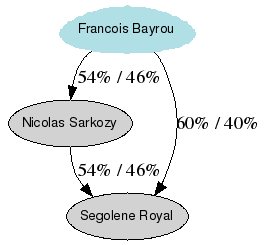
The french presidential election (in april/may 2007) will use plurality voting with two rounds (voters will choose 1 amongst 11 or 12 candidates during the first round. The two candidates with the most votes will be qualified for the second round). The latest polls clearly show how this election method fails to satisfy the Condorcet criterion. Using the second round results from this poll (only considering the 3 main candidates, since the other don’t have any chance to win the presidential election), we get this: 2007 elect results So Francois Bayrou is the Condorcet winner, and should win the election. However, the first round results, according to the same poll, could be:
  1. Sarkozy 31%
  2. Royal 24%
  3. Bayrou 22%
  4. Le Pen 12%
Since only the two first candidates are qualified to second round, Bayrou wouldn’t be elected. It will be interesting to see how those scores evolves until the first round (April 22nd).

Next.

Previous.