Search Results: "ron"

4 June 2013

Keith Packard: dri3 extension

Completing the DRI3 Extension This week marks a pretty significant milestone for the glorious DRI3000 future. The first of the two new extensions is complete and running both full Gnome and KDE desktops. DRI3 Extension Overview The DRI3 extension provides facilities for building direct rendering libraries to work with the X window system. DRI3 provides three basic mechanisms:
  1. Open a DRM device.
  2. Share kernel objects associated with X pixmaps. The direct rendering client may allocate kernel objects itself and ask the X server to construct a pixmap referencing them, or the client may take an existing X pixmap and discover the underlying kernel object for it.
  3. Synchronize access to the kernel objects. Within the X server, Sync Fences are used to serialize access to objects. These Sync Fences are exposed via file descriptors which the underlying driver can use to implement synchronization. The current Intel DRM driver passes a shared page containing a Linux Futex.
Opening the DRM Device Ideally, the DRM application would be able to just open the graphics device and start drawing, sending the resulting buffers to the X server for display. There s work going on to make this possible, but the current situation has the X server in charge of blessing the file descriptors used by DRM clients. DRI2 does this by having the DRM client fetch a magic cookie from the kernel and pass that to the X server. The cookie is then passed to the kernel which matches it up with the DRM client and turns on rendering access for that application. For DRI3, things are much simpler the DRM client asks the X server to pass back a file descriptor for the device. The X server opens the device, does the magic cookie dance all by itself (at least for now), and then passes the file descriptor back to the application.
 
    DRI3Open
    drawable: DRAWABLE
    driverType: DRI3DRIVER
    provider: PROVIDER
       
    nfd: CARD8
    driver: STRING
    device: FD
 
    Errors: Drawable, Value, Match
    This requests that the X server open the direct rendering
    device associated with drawable, driverType and RandR
    provider. The provider must support SourceOutput or SourceOffload.
    The direct rendering library used to implement the specified
    'driverType' is returned in 'driver'. The file
    descriptor for the device is returned in 'device'. 'nfd' will
    be set to one (this is strictly a convenience for XCB which
    otherwise would need request-specific information about how
    many file descriptors were associated with this reply).
Sharing Kernel Pixel Buffers An explicit non-goal of DRI3 is support for sharing buffers that don t map directly to regular X pixmaps. So, GL ancillary buffers like depth and stencil just don t apply here. The shared buffers in DRI3 are regular X pixmaps in the X server. This provides a few obvious benefits over the DRI2 scheme: In the kernel, the buffers are referenced by DMA-BUF handles, which provides a nice driver-independent mechanism.
  1. Lifetimes are easily managed. Without being associated with a separate drawable, it s easy to know when to free the Pixmap.
  2. Regular X requests apply directly. For instance, copying between buffers can use the core CopyArea request.
To create back- and fake-front- buffers for Windows, the application creates a kernel buffer, associates a DMA-BUF file descriptor with that and then sends the fd to the X server with a pixmap ID to create the associated pixmap. Doing it in this direction avoids a round trip.
 
    DRI3PixmapFromBuffer
    pixmap: PIXMAP
    drawable: DRAWABLE
    size: CARD32
    width, height, stride: CARD16
    depth, bpp: CARD8
    buffer: FD
 
    Errors: Alloc, Drawable, IDChoice, Value, Match
    Creates a pixmap for the direct rendering object associated
    with 'buffer'. Changes to pixmap will be visible in that
    direct rendered object and changes to the direct rendered
    object will be visible in the pixmap.
    'size' specifies the total size of the buffer bytes. 'width',
    'height' describe the geometry (in pixels) of the underlying
    buffer. 'stride' specifies the number of bytes per scanline in
    the buffer. The pixels within the buffer may not be arranged
    in a simple linear fashion, but 'size' will be at least
    'height' * 'stride'.
    Precisely how any additional information about the buffer is
    shared is outside the scope of this extension.
    If buffer cannot be used with the screen associated with
    drawable, a Match error is returned.
    If depth or bpp are not supported by the screen, a Value error
    is returned.
To provide for texture-from-pixmap, the application takes the pixmap ID and passes that to the X server which returns the a file descriptor for a DMA-BUF which is associated with the underlying kernel buffer.
 
    DRI3BufferFromPixmap
    pixmap: PIXMAP
       
    depth: CARD8
    size: CARD32
    width, height, stride: CARD16
    depth, bpp: CARD8
    buffer: FD
 
    Errors: Pixmap, Match
    Pass back a direct rendering object associated with
    pixmap. Changes to pixmap will be visible in that
    direct rendered object and changes to the direct rendered
    object will be visible in the pixmap.
    'size' specifies the total size of the buffer bytes. 'width',
    'height' describe the geometry (in pixels) of the underlying
    buffer. 'stride' specifies the number of bytes per scanline in
    the buffer. The pixels within the buffer may not be arranged
    in a simple linear fashion, but 'size' will be at least
    'height' * 'stride'.
    Precisely how any additional information about the buffer is
    shared is outside the scope of this extension.
    If buffer cannot be used with the screen associated with
    drawable, a Match error is returned.
Tracking Window Size Changes When Eric Anholt and I first started discussing DRI3, we hoped to avoid needing to learn about the window size from the X server. The thought was that the union of all of the viewports specified by the application would form the bounds of the drawing area. When the window size changed, we expected the application would change the viewport. Alas, this simple plan isn t sufficient here a few GL functions are not limited to the viewport. So, we need to track the actual window size and monitor changes to it. DRI2 does this by delivering invalidate events to the application whenever the current buffer isn t valid; the application discovers that this event has been delivered and goes to as the X server for the new buffers. There are a couple of problems with this approach:
  1. Any outstanding DRM rendering requests will still draw to the old buffers.
  2. The Invalidate events must be captured before the application sees the related ConfigureNotify event so that the GL library can react appropriately.
The first problem is pretty intractable within DRI2 the application has no way of knowing whether a frame that it has drawn was delivered to the correct buffer as the underlying buffer object can change at any time. DRI3 fixes this by having the application in control of buffer management; it can easily copy data from the previous back buffer to the new back buffer synchronized to its own direct rendering. The second problem was solved in DRI2 by using the existing Xlib event hooks; the GL library directly implements the Xlib side of the DRI2 extension and captures the InvalidateBuffers events within that code, delivering those to the driver code. The problem with this solution is that Xlib holds the Display structure mutex across this whole mess, and Mesa must be very careful not to make any Xlib calls during the invalidate call. For DRI3, I considered placing the geometry data in a shared memory buffer, but my future plans for the Present extension led me to want an X event instead (more about the Present extension in a future posting). An X ConfigureNotify event is sufficient for the current requirements to track window sizes accurately. However, there s no easy way for the GL library to ensure that ConfigureNotify events will be delivered to the application other application code may (and probably will) adjust the window event mask for its own uses. I considered adding the necessary event mask tracking code within XCB, but again, knowing that the Present extension would probably need additional information anyhow, decided to create a new event instead. Using an event requires that XCB provide some mechanism to capture those events, keep them from the regular X event stream, and deliver them to the GL library. A further requirement is that the GL library be absolutely assured of receiving notification about these events before the regular event processing within the application will see a core ConfigureNotify event. The method I came up with for XCB is fairly specific to my requirements. The events are always XGE events, and are tagged with a special event context ID , an XID allocated for this purpose. The combination of the extension op-code, the event type and this event context ID are used to split off these events to custom event queues using the following APIs:
/**
 * @brief Listen for a special event
 */
xcb_special_event_t *xcb_register_for_special_event(xcb_connection_t *c,
                                                    uint8_t extension,
                                                    uint16_t evtype,
                                                    uint32_t eid,
                                                    uint32_t *stamp);
This creates a special event queue which will contain only events matching the specified extension/type/event-id triplet.
/**
 * @brief Returns the next event from a special queue
 */
xcb_generic_event_t *xcb_check_for_special_event(xcb_connection_t *c,
                                                 xcb_special_event_t *se);
This pulls an event from a special event queue. These events will not appear in the regular X event queue and so applications will never see them. There s one more piece of magic here the stamp value passed to xcbregisterforspecialevent. This pointer refers to a location in memory which will be incremented every time an event is placed in the special event queue. The application can cheaply monitor this memory location for changes and known when to check the queue for events. Within GL, the value used is the existing dri2 stamp value. That is checked at the top of the rendering operation; if it has changed, the drawing buffers will be re-acquired. Part of the buffer acquisition process is a check for special events related to the window. For now, I ve placed these events in the DRI3 extension. However, they will move to the Present extension once that is working.
 
    DRI3SelectInput
    eventContext: DRI3EVENTID
    window: WINDOW
    eventMask: SETofDRI3EVENT
 
    Errors: Window, Value, Match, IDchoice
    Selects the set of DRI3 events to be delivered for the
    specified window and event context. DRI3SelectInput can
    create, modify or delete event contexts. An event context is
    associated with a specific window; using an existing event
    context with a different window generates a Match error.
    If eventContext specifies an existing event context, then if
    eventMask is empty, DRI3SelectInput deletes the specified
    context, otherwise the specified event context is changed to
    select a different set of events.
    If eventContext is an unused XID, then if eventMask is empty
    no operation is performed. Otherwise, a new event context is
    created selecting the specified events.
The events themselves look a lot like a configure notify event:
 
    DRI3ConfigureNotify
    type: CARD8         XGE event type (35)
    extension: CARD8        DRI3 extension request number
    length: CARD16          2
    evtype: CARD16          DRI3_ConfigureNotify
    eventID: DRI3EVENTID
    window: WINDOW
    x: INT16
    y: INT16
    width: CARD16
    height: CARD16
    off_x: INT16
    off_y: INT16
    pixmap_width: CARD16
    pixmap_height: CARD16
    pixmap_flags: CARD32
 
    'x' and 'y' are the parent-relative location of 'window'.
Note that there are a couple of odd additional fields offx, offy, pixmapwidth, pixmapheight and pixmap_flags are all place-holders for what I expect to end up in the Present extension. For now, in DRI3, they should be ignored. Synchronization The DRM application needs to know when various X requests related to its buffers have finished. In particular, when performing a buffer swap, the client wants to know when that completes, and be able to block until it has. DRI2 does this by having the application make a synchronous request from the X server to get the names of the new back buffer for drawing the next frame. This has two problems:
  1. The synchronous round trip to the X server isn t free. Other running applications may cause fairly arbitrary delays in getting the reply back from the X server.
  2. Synchronizing with the X server doesn t ensure that GPU operations are necessarily serialized between the application and the X server.
What we want is a serialization guarantee between the X server and the DRM application that operates at the GPU level. I ve written a couple of times (dri3k first steps and Shared Memory Fences) about using X Sync extension Fences (created by James Jones and Aaron Plattner) for this synchronization and wanted to get a bit more specific here. With the X server, a Sync extension Fence is essentially driver-specific, allowing the hardware design to control how the actual synchronization is performed. DRI3 creates a way to share the underlying operating system object by passing a file descriptor from application to the X server which somehow references that device object. Both sides of the protocol need to tacitly agree on what it means.
 
    DRI3FenceFromFD
    drawable: DRAWABLE
    fence: FENCE
    initially-triggered: BOOL
    fd: FD
 
    Errors: IDchoice, Drawable
    Creates a Sync extension Fence that provides the regular Sync
    extension semantics along with a file descriptor that provides
    a device-specific mechanism to manipulate the fence directly.
    Details about the mechanism used with this file descriptor are
    outside the scope of the DRI3 extension.
For the current GEM kernel interface, because all GPU access is serialized at the kernel API, it s sufficient to serialize access to the kernel itself to ensure operations are serialized on the GPU. So, for GEM, I m using a shared memory futex for the DRI3 synchronization primitive. That does not mean that all GPUs will share this same mechanism. Eliminate the kernel serialization guarantee and some more GPU-centric design will be required. What about Swap Buffers? None of the above stuff actually gets bits onto the screen. For now, the GL implementation is simply taking the X pixmap and copying it to the window at SwapBuffers time. This is sufficient to run applications, but doesn t provide for all of the fancy swap options, like limiting to frame rate or optimizing full-screen swaps. I ve decided to relegate all of that functionality to the as-yet-unspecified Present extension. Because the whole goal of DRI3 was to get direct rendered application contents into X pixmaps, the Present extension will operate on those X objects directly. This means it will also be usable with non-DRM applications that use simple X pixmap based double buffering, a class which includes most existing non-GL based Gtk+ and Qt applications. So, I get to reduce the size of the DRI3 extension while providing additional functionality for non direct-rendered applications. Current Status As I said above, all of the above functionality is running on my systems and has booted both complete KDE and Gnome sessions. There have been some recent DMA-BUF related fixes in the kernel, so you ll need to run the latest 3.9.x stable release or a 3.10 release candidate. Here s references to all of the appropriate git repositories: DRI3 protocol and spec:
git://people.freedesktop.org/~keithp/dri3proto      master
XCB protocol
git://people.freedesktop.org/~keithp/xcb/proto.git  dri3
XCB library
git://people.freedesktop.org/~keithp/xcb/libxcb.git dri3
xshmfence library:
git://people.freedesktop.org/~keithp/libxshmfence.git   master
X server:
git://people.freedesktop.org/~keithp/xserver.git    dri3
Mesa:
git://people.freedesktop.org/~keithp/mesa.git       dri3
Next Steps Now it s time to go write the Present extension and get that working. I ll start coding and should have another posting here next week.

Ingo Juergensmann: Problems with DaviCal after Wheezy Upgrade

It's been a while since Wheezy was released, but the problems with DaviCal started with that upgrade. I don't know whether this is a DaviCal bug or not, maybe partly. This is just a informational note, before I'll file a bug report (or not). First problem was that I couldn't add any contacts anymore (CardDAV) from OS X. A friend of mine has the same issue as he's using my server for that. He mailed that he's getting the following error of the Contacts app under OS X:
[NSInvalidArgumentException] -[CoreDAVNullParser rootElement]:
unrecognized selector sent to instance 0x7f91bad6b1d0
When I looked at the webfrontend I discovered that the database of DaviCal didn't get updated. I don't know whether this is a general problem or it just happened to me. Anyway. Executing the proper database upgrade script delivered by DaviCal was no problem at all. Adding new contacts worked again. But then I discovered somewhen later that my calendars on the iPhone didn't update anymore. That was a bigger problem to solve, because it appears that it's an IOS 6.x problem and not a DaviCal issue. Finally I found on Google this mail on the DaviCal mailing list:
As I started using DAViCal, I created calenders with "named" paths, not these
long names, like you stated in your message. With iOS 6 this was not a good
idea. I created every calender new with the iOS 6 device and copied all
calender-items to the new calendars. Was a work auf 15 minutes for me. I
described it in a blog-post (german):
http://tech.blog.rana.at/2012/10/24/davical-caldav-mit-ios-6/ Not a real solution for the problem, but a workaround.
So, as linked page is in German, I'll rephrase the "solution" here: The problem seems to be that the old principal path names like user/calendar or user/home do not work anymore under iOS 6. Instead you'll need to create a new calender from your iPhone. So, just configure your calendar account as usually. You'll end with an empyt calendar. Now create a new event in your calendar on the iPhone. This new calendar should show up under OS X (or other clients). There you can export your existing appointments to an *.ics file which you can import in DaviCal webfrontend to the new prinicipal collection. Your dates should now show up on your iPhone again. But you'll end up with duplicate entries in iCal app under OS X. You need to define your new principal as default calendar to be able to delete your old default calendar, if that's not possible. If everything went well, you can share your dates between OS X and your iPhone via DaviCal again. At least this worked for me. :-) It's late over here, so I'll postpone writing the bugreport for now...
Kategorie:

Daniel Pocock: Using reSIProcate to connect Asterisk with WebRTC

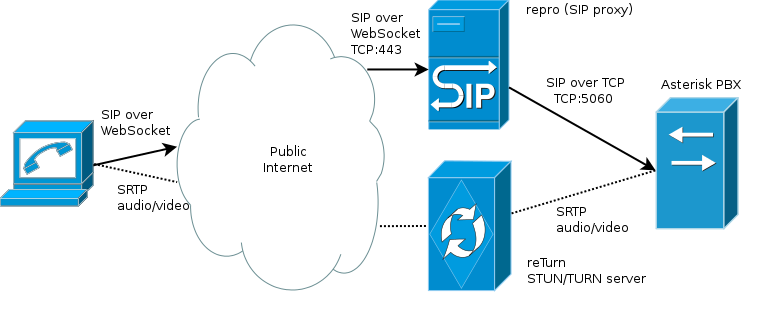
In my previous blog entry about how to get WebRTC going fast I looked at the basics of setting up a SIP proxy (also known as a SIP router) to accept connections from WebRTC clients. As in a traditional, non-WebRTC world, the SIP proxy simply facilitates calling between all the clients it knows. In practice, deployments usually want to add additional functionality in the form of a PBX with queues, voicemail, menus and conferencing. The recent Asterisk 11 release includes support for WebRTC although it is still evolving and I don't currently recomend connecting Asterisk directly to the public Internet. In particular, Asterisk doesn't support features like mutual TLS authentication with the WSS (secure WebSocket) transport. Here, we look at how repro can accept connections from Internet/web users and relay them to an internal Asterisk server. Here is an architecture diagram: Notice that the SIP messages are accepted over repro's WebSocket transport and relayed to Asterisk over a regular SIP TCP transport. This means that we benefit from repro's TLS support too, so the WebSocket client has a much higher chance of escaping their client-side firewall if port 443 is used (repro pretending to be a HTTPS server) and clients can be authenticated with certificates in their browser. Here are the steps to get it running: repro and reTurn setup Set up repro and reTurn server on a Debian server as per my previous blog post. Verify that the clients can talk to repro. Asterisk source build Digium, the creators of Asterisk, are not currently supporting Debian packages, but they do provide RPM packages in their Asterisk package repository However, the pre-built binary packages for Asterisk 11.4 don't include SRTP support. SRTP is a mandatory part of WebRTC. Therefore, we take the Source RPM (SRPM) and build it manually. First, it is recommended that you start with a completely fresh CentOS 6 or RHEL6 server. I built a fresh virtual machine in my XCP environment using a procedure similar to that documented by Grant. After installing and setting a root password, configure yum to access EPEL6 Make sure SELinux and firewall are disabled on the box (they are often enabled by default). A quick way to do this:
# sed -i s/SELINUX=enforcing/SELINUX=disabled/g /etc/selinux/config
# reboot
...
# iptables -I INPUT -j ACCEPT
Next you can tell yum about the Digium repository and install all the necessary dependencies for building Asterisk:
# rpm -Uvh http://packages.asterisk.org/centos/6/current/x86_64/RPMS/asterisknow-version-3.0.0-1_centos6.noarch.rpm
# yum update
# yum install rpm-build libsrtp-devel
In your home directory, set up a work tree for rpmbuild:
$ mkdir ~/rpmbuild
$ cd ~/rpmbuild
$ mkdir BUILD BUILDROOT RPMS SOURCES SPECS SRPMS
$ cd SPECS
$ wget http://danielpocock.com/sites/danielpocock.com/files/asterisk.spec
$ cd ../SRPMS
$ wget http://packages.asterisk.org/centos/6/asterisk-11/SRPMS/asterisk-11.4.0-1_centos6.src.rpm
$ rpmbuild --rebuild asterisk-11.4.0-1_centos6.src.rpm
At this stage, you will have some errors, but it has successfully extracted the tarball into the SOURCES directory:
$ ls -l ../SOURCES
-rw-r--r--   1 daniel daniel 11573400 May 20 23:07 asterisk-sources-11.4.0.tar.gz
$
It will also complain about missing dependencies, you install them using yum:
# yum install make gcc gcc-c++ ....
Notice that you have downloaded a slightly modified version of the asterisk.spec file, the reasons for this are explained in this mailing list discussion. The following should now trigger a successful build:
$ rpmbuild -bb \
  --without tds \
    --without misdn \
    --without odbc \
   ~/rpmbuild/SOURCES/asterisk.spec
Hopefully, Digium will add the SRTP support in the 11.4.1 packages so that source build won't be necessary for every future release. Asterisk configuration: demo application Here we just have to install the RPMs and make a quick configuration change:
$ cd ~/rpmbuild/RPMS/x86_64
$ su -
# rpm -i asterisk*rpm
# yum install asterisk-sounds-core-en-ulaw asterisk-sounds-extra-en-ulaw --enablerepo=asterisk-11
# ln -s /usr/share/asterisk/sounds/demo-* /var/lib/asterisk/sounds/en/
To enable connections from the proxy, we must set a few non-default settings. It is essential to use the TCP transport as the SIP messages from WebSocket clients are usually too big for UDP packets. It is also necessary to enable SRTP and AVPF, as these are mandatory in WebRTC. Here is a diff against the default /etc/asterisk/sip.conf:
--- /etc/asterisk.orig/sip.conf	2013-06-04 10:57:49.428617785 +0200
+++ /etc/asterisk/sip.conf	2013-06-04 11:18:17.825604261 +0200
@@ -207,7 +207,7 @@
 ; subject to change in any release.  If they are changed, the changes will
 ; be reflected in this sample configuration file, as well as in the UPGRADE.txt file.
 ;
-tcpenable=no                    ; Enable server for incoming TCP connections (default is no)
+tcpenable=yes                    ; Enable server for incoming TCP connections (default is no)
 tcpbindaddr=0.0.0.0             ; IP address for TCP server to bind to (0.0.0.0 binds to all interfaces)
                                 ; Optionally add a port number, 192.168.1.1:5062 (default is port 5060)
 
@@ -1371,6 +1371,13 @@
 ; ...
 ;
 
+[1001](public-phone,ulaw-phone)
+avpf = yes
+encryption = yes
+context = public
+icesupport = yes
+
+
 ; Standard configurations not using templates look like this:
 ;
 ;[grandstream1]
This assumes that the SIP user ID of your WebSocket user is 1001 Now you can start Asterisk:
# service asterisk start
Configuring the repro SIP proxy to send calls to Asterisk This is a relatively simple demonstration. The goal is to send calls for the number 1000 to the demo application in Asterisk In repro's web interface, click ADD ROUTE in the menu. Use the following parameters and leave all other options blank:
  • URI: ^sip:1000@
  • Destination: sip:$1@pbx.example.org?transport=tcp
Note: replace pbx.example.org with the hostname or IP address of the box running Asterisk Go to the ADD USER menu link and add a user called 1001. The user ID and password have to be placed in the custom.js file for JsSIP Testing from JsSIP I assume JsSIP was set up following the instructions from my previous blog post Asterisk doesn't support the video codec from a WebRTC client. To work around this, in the custom.js file for JsSIP, make sure video is disabled by default. In the WebRTC client, dial 1000. You should hear the demo greeting from Asterisk. Troubleshooting
  • Check the JavaScript log in the browser
  • Check the logs on the repro proxy and increase the verbosity of the logs if necessary. If the level is set to STACK, you will see full copies of each SIP message sent and received.
  • Connect to the Asterisk console (UNIX command: asterisk -r -vvv) and enable SIP message display: sip set debug on.

Petter Reinholdtsen: Debian Edu interview: C dric Boutillier

It has been a while since my last English Debian Edu and Skolelinux interview last November. But the developers and translators are still pulling along to get the Wheezy based release out the door, and this time I managed to get an interview from one of the French translators in the project, C dric Boutillier. Who are you, and how do you spend your days? I am 34 year old. I live near Paris, France. I am an assistant professor in probability theory. I spend my daytime teaching mathematics at the university and doing fundamental research in probability in connexion with combinatorics and statistical physics. I have been involved in the Debian project for a couple of years and became Debian Developer a few months ago. I am working on Ruby packaging, publicity and translation. How did you get in contact with the Skolelinux / Debian Edu project? I came to the Debian Edu project after a call for translation of the Debian Edu manual for the release of Debian Edu Squeeze. Since then, I have been working on updating the French translation of the manual. I had the opportunity to make an installation of Debian Edu in a virtual machine when I was preparing localised version of some screen shots for the manual. I was amazed to see it worked out of the box and how comprehensive the list of software installed by default was. What amazed me was the complete network infrastructure directly ready to use, which can and the nice administration interface provided by GOsa . What pleased me also was the fact that among the software installed by default, there were many "traditional" educative software to learn languages, to count, to program... but also software to develop creativity and artistic skills with music (Ardour, Audacity) and movies/animation (I was especially thinking of Stopmotion). I am following the development of Debian Edu and am hanging out on #debian-edu. Unfortunately, I don't much time to get more involved in this beautiful project. What do you see as the advantages of Skolelinux / Debian Edu? For me, the main advantages of Skolelinux/Debian Edu are its community of experts and its precise documentation, as well as the fact that it provides a solution ready to use. I would add also the fact that it is based on the rock solid Debian distribution, which ensures stability and provides a huge collection of educational free software. What do you see as the disadvantages of Skolelinux / Debian Edu? Maybe the lack of manpower to do lobbying on the project. Sometimes, people who need to take decisions concerning IT do not have all the elements to evaluate properly free software solutions. The fact that support by a company may be difficult to find is probably a problem if the school does not have IT personnel. One can find support from a company by looking at the wiki dokumentation, where some countries already have a number of companies providing support for Debian Edu, like Germany or Norway. This list is easy to find readily from the manual. However, for other countries, like France, the list is empty. I guess that consultants proposing support for Debian would be able to provide some support for Debian Edu as well. Which free software do you use daily? I am using the KDE Plasma Desktop. But the pieces of software I use most runs in a terminal: Mutt and OfflineIMAP for emails, latex for scientific documents, mpd for music. VIM is my editor of choice. I am also using the mathematical software Scilab and Sage (built from source as not completely packaged for Debian, yet). Do you have any suggestions for teachers interested in using the free software in Debian to teach mathematics and statistics? I do not have any "nice" recommendations for statistics. At our university, we use both R and Scilab to teach statistics and probabilistic simulations. For geometry, there are nice programs: I like also cantor, which provides a uniform interface to SciLab, Sage, Octave, etc... Which strategy do you believe is the right one to use to get schools to use free software? My suggestions would be to

Raphaël Hertzog: My Free Software Activities in May 2013

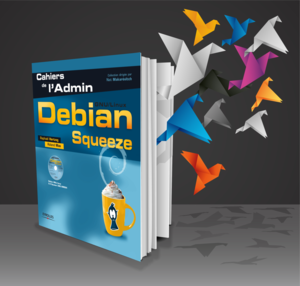
This is my monthly summary of my free software related activities. If you re among the people who made a donation to support my work (70 , thanks everybody!), then you can learn how I spent your money. Otherwise it s just an interesting status update on my various projects. The Debian Administrator s Handbook Spanish translation completed. The Spanish team finished the translation of the book. The PDF build process was not yet ready to build translations so I had to fix this. At the same time, I also improved the mobipocket build script to make use of Amazon s kindlegen when available (since Amazon now requires the use of this tool to generate Mobipocket files that can be distributed on their platform). Once those issues were sorted I made some promotion of this first completed translation because they really deserve some big kudos ! Plans for the French translation. You know that the Debian Administrator s Handbook came to life as a translation of the French book Cahier de l Admin Debian (published by Eyrolles). This means that we currently have a free translation of a proprietary book. It s a bid of an odd situation that I always wanted to fix. I discussed with Eyrolles to find out how we could publish the original book under the same licenses that we picked for the English book and the result is that we setup a new crowdfunding campaign to liberate the French book and then make it an official French translation of the Debian Administrator s Handbook. Read the rest and support us on the ulule project page (a kickstarter like for people who are not based in the US). Liberate the Debian Handbook Debian France I updated our membership management application (galette) to version 0.7.4.1 with numerous bug fixes but the true highlight this month was Solutions Libres et Opensource , a tradeshow in Paris where Tanguy Ortolo, me, and other volunteers (C dric Boutillier, Arnaud G., and some that I have forgotten, thanks to them!), held a Debian booth for two consecutive days (May 28-29). For once we had lots of goodies to sell (buffs, mouse pad, polos, stickers, etc.) and the booth was very well attended. The Debian Booth (Tanguy on the left, Rapha l on the right) Google s Summer of Code Last month I was rater overwhelmed with queries from students who were interested in applying for the Package Tracking System Rewrite project that I offered to mentor as part of Google s Summer of Code. In the end, I got 6 good student applications that Stefano and me evaluated. We selected Marko Lalic. The Community Bonding Period is just starting and we re fleshing out details on how we will organize the work. We ll try to use the IRC channel #debian-qa on OFTC for questions and answers and weekly meetings. Misc Debian packaging I packaged zim 0.60 and with the release of Wheezy, I uploaded to unstable all the packages that I staged in experimental (cpputest, publican). I sponsored the upload of libmicrohttpd 0.9.27-1. I filed a couple of bug reports that I experienced with the upcoming dpkg 1.17.0 (#709172, #709009). In both cases, the package was using a wrongly hardcoded path to dpkg-divert (the binary moved from /usr/sbin/ to /usr/bin/ a while ago and the compatibility symlink is dropped now). I also dealt with #709064 where the user reported upgrade issues related to multiarch. I also filed an upstream bug report on publican to request some way to avoid so much duplication of files (actually I filed it as a response to the Debian bug #708705 that I received). Kali work I had to update OpenVAS for Kali but some parts failed to build in a Debian 7 environment. I diagnosed the problem and submitted a patch upstream. I also got in touch with the Debian OpenVAS maintainer as I wanted to contribute the package back to Debian, but timing issues have pushed this back for a little longer. Thanks See you next month for a new summary of my activities.
One comment Liked this article? Click here. My blog is Flattr-enabled.

1 June 2013

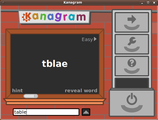
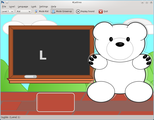
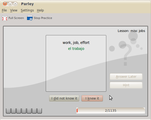
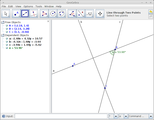
Petter Reinholdtsen: Educational applications included in Debian Edu / Skolelinux (the screenshot collection :-)

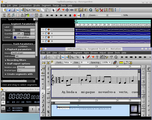
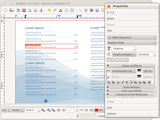
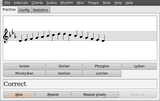
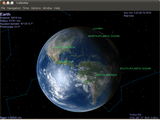
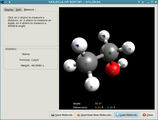
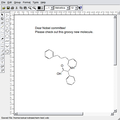
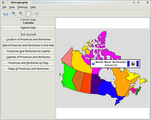
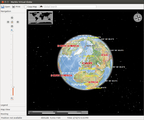
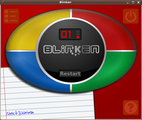
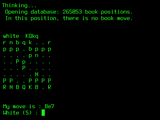
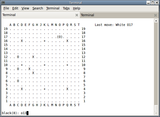
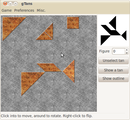
Included in Debian Edu / Skolelinux, there are quite a lot of educational software. Created to help teachers teach, and pupils learn. We have tried to tag them all using debtags use::learning and role::program, and using the debtags I was happy to be able to create a collage of the educational software packages installed by default, sorted by the debtag field. Here it is. Click on a image to learn more about the program. field::arts audacity childsplay denemo freebirth gcompris gimp hydrogen lilypond lmms rosegarden scribus solfege stopmotion tuxpaint field::astronomy celestia-gnome gpredict kstars planets stellarium xplanet field::biology:structural pymol field::chemistry atomix chemtool easychem gchempaint gdis ghemical gperiodic kalzium pymol [viewmol] xdrawchem field::electronics gcompris [gpsim] field::geography kgeography marble xplanet field::linguistics gcompris kanagram khangman klettres parley field::mathematics childsplay drgeo gcompris geogebra [geomview] grace graphmonkey graphthing kalgebra kbruch kig kmplot mathwar rocs scratch tuxmath xabacus field::physics gcompris step field::TODO blinken cgoban childsplay gcompris gnuchess gnugo gtans ktouch librecad scratch In total, 61 applications. 3 of them lacked screen shots on screenshot.debian.net. If you know of some packages we should install by default, please let us know on IRC, #debian-edu on irc.debian.org, or our mailing list debian-edu@.

Daniel Pocock: Democracy down-under is not democracy

This weekend we have the AGM of a local community organisation. Like many organisations I am involved in, there will be a democratic process of decision making, board election and a low-budget social activity afterwards. We take it for granted that democracy is a good thing. In my own country, Australia, people are supposedly happier than they've ever been, no doubt people will suggest that our democracy is part of the recipe for success. While this example is from Australia, it could well happen anywhere. While everybody was slapping themselves on the back about our officially confirmed contentment, the politicians tried to slip something under the radar. With elections expected in September, the press exposed a secret deal between the two biggest political parties, raiding the public piggy bank for $60 million to prop up their campaign accounts. There is even a leaked copy of a letter confirming the deal. It was to be voted through parliament in a stitch-up within 48 hours after the happiness' announcement. Why would these two big political parties engage in a such a gross conspiracy? Weren't they already content with their whopping big pay increases that put our Prime Minister on a bigger salary than the US president or the UK Prime Minister? Well, you don't have to look hard to find out what this special funding was all about: Not long ago, the post office at the University of Melbourne where Wikileaks operates a post-office box was mysteriously shut down. While that may seem like it could just be a co-incidence on it's own, it's worth considering in the wider context: the Wikileaks party is one of the most widely recognised names in Australian politics right now. The party's leader, like the new pope, is seen as somebody who puts his principles ahead of his own comfort, living a humble life in exile while our politicians romp around with prostitutes paid for with stolen money. Whatever you think of Wikileaks or Mr Assange's private life, they are not the only example here. There are other democratic movements in our country that are equally frightening for those who are currently drunk on power. One of the independent MPs holding the balance of power is a former Lieutenant Colonel in Australia's spy agency who was ridiculed by a prior Government and forced out of his job when he exposed the sham of the Iraq war. Neither of the major political parties wants to continue being held accountable by someone who has shown such strong principles against their campaign of death and deception. That $60 million welfare payment to big political parties was intended to be something akin to a weapon of mass destruction, obliterating independent representatives out of the parliament. More recently, the same independent MP has been equally vigorous in his campagin to break the scourge of our mafia-style gambling industry with it's cosy links to Australian politicians. Now it is starting to become obvious just how scary democracy can be. Motivated by the spectacle of a few independents holding our incumbent politicians to account, other Australians have also volunteered to get in on the act and try their hand at running the country. One of Australia's richest men, Clive Palmer has found that even with his enormous wealth (and having started planning more than a year before the election), his plans to form a political party are dampened by the fact that it can't be registered with a proper name to be listed on the ballot paper and all the candidates have to be listed under his name, Palmer, or their own names, barely distinguishable from the independent candidates. This discriminatory approach to the creation of political parties clearly favours the two big incumbent groups. Now it is a lot clearer why existing politicians needed an extra $60 million war chest: like Lance Armstrong's illegal doping program, it was intended to keep themselves ahead of the pack. It all goes to show that people should not take democracy for granted: constant vigilence and involvement is needed to hold leaders to account or replace them when they deviate.
AttachmentSize
piggy-bank.jpg32.83 KB

31 May 2013

Gerfried Fuchs: On Finding Words

There is still a lot of things going on inside me and turning, and I'd like to share two words that I grow attached to, one a fair amount longer now than the other, but both are terms that I seem to had lacking in my vocabulary which I tried to explain in a different way. After finding out about them, I noticed that both what I felt and believed were actual things that were not totally uncommon concepts, even though most people wouldn't know about them. The first term that I stumbled upon years ago was the term of pansexuality. (Do not dare to read the German Wikipedia article. It's ridiculous wrong, insulting and shows that they don't understand the topic at all.) I always had issues to explain my intimate preference to others. Especially after they found out about me being female on the inside. Questions arose (if they understood that I'm open about these things when I post the poem publicly) along the lines of "what are you now: gay, lesbian, hetero and if the latter, what does that mean?". My usual answer was that I fall in love with people, not with their bodies, and that things will eventually work out if meant to be. And thus even though I love my "Bi" shirt, it doesn't really describe properly how I swing, so to say. The latter term I discovered just recently. A friend of mine with whom I chat every now and then told me about it, and when we met again last autumn, they wore a button of the Italian community for Polyamory (I so much prefer the Italian logo to the "widely used symbol", to be honest). It was an eye opening moment for me. I often mentioned to people that I felt like I have a big heart, being able to store multiple people in it. It always puzzled me that when I'm together with someone (and I always was faithful) why I should feel bad and especially keep it a secret when there is someone else who touches my heart, too. Society seems to see this already as a breach of trust, no matter whether it gets pursued or not, just the thought is enough. But it never changed anything with respect to the person I was together with, so what's the deal? Finding out about this term explained so much to me and made a lot of sense. It is about honesty and communication, which I see lagging in a lot of relationships these days... So here you are, getting another inside view on me. And I'm sure that there will be again the one or the other person who considers to use this as ammunition against me, but you know, being open about it acts as a shield. It's not embarrassing for me, never was. And like always, I hope that I can help others feeling similar being lost for words or an understanding that it's not as weird as it might feel. Enjoy!

/personal permanent link Comments: 9 Flattr this

Daniel Pocock: VoIP federation: another milestone

Slashdot recently picked out Federated VoIP as one of the compelling features in the upcoming Fedora 19 (Schrodinger's Cat) release. The same capability was recently part of the Debian 7 (wheezy) release and it is in Ubuntu too. It is ironic that the debates about Federated VoIP have long mirrored the debate about Schrodinger's famous feline - is it dead, is it alive, or is it just a theory? Well, the answer is here today (for VoIP, not the cat).

Does it work? Yes, it does work. Even better, users on all the supported platforms can call each other, for example, user1@debian.org should be able to seamlessly and securely place a call to user2@fedoraproject.org What is involved? Server: Each domain needs a SIP proxy, XMPP server or preferably both. They are alternatives and they happily co-exist. For convenience, they can run on an existing mail server as long as the load is not excessive. See the Real-time communcations (RTC) quick start guide for setting up the server, firewall rules, DNS entries and all other details Clients: Each user can have a hard phone, softphone such as Jitsi or Empathy or a mobile VoIP client like Lumicall. Each of these projects has their own email support lists where users can ask any questions about getting started. Is the server difficult to set up and maintain? Setting up fully featured Asterisk or FreeSWITCH servers and keeping them secure for public Internet use is a daunting task. That's why federated VoIP with a basic SIP proxy is so compelling. It is possible to set up the SIP proxy now, get people talking, and add in a soft PBX later if optional features like queues or menus are needed. The repro SIP proxy from reSIProcate is one of the easiest to set up. It can be configured through a web interface or directly entering users into the MySQL tables. Here is a screenshot: Where to next for federated VoIP? People should not be waiting for their ISP to deploy federated VoIP. Many of them are either looking for ways to monetize VoIP, or keen to keep costs low by just selling bandwidth. Rather, it will be up to power users (like those of us who run their own mail server at home), corporate IT departments and also the IT departments of universities and other large, distributed organisations to take leadership. There is huge opportunity here: by displacing the phone companies, IT departments can provide a wider range of services to their organisations. Money previously lost in contracts for phone systems can bolster the IT department as the one-stop-shop for technology, giving IT workers greater career opportunities and stability in their organisation. The organisation benefits from having a system designed and operated around their business needs with much better value for money and a visible support team.

29 May 2013

Lisandro Damián Nicanor Pérez Meyer: Presenting qtchooser

A few days ago we the Qt/KDE team uploaded a new tool in the Qt ecosystem: qtchooser.

This tool is a wrapper tool used to select between different Qt versions. Of course, the first and easiest example is choosing between Qt4 and Qt5. But it doesn't end there: it can also be used to select a user's build of Qt.

To experienced Debian users, at first sight, it might resemble Debian's alternatives system. But it goes much further than that, allowing users (not sysadmins) to decide their defaults, and even adding new ones, user-wide. All this can be done using different methods like command line arguments, environment variables and configuration files.

Apart from all that, this is the recommended upstream way of managing Qt, being picked up by several (if not all) distributions, so it can easily be supported by upstream in their documentation.

My Qt4 package in Debian does not uses qtchooser, do I need to change anything?No, we have tried to make things as smooth as possible. Your Qt4 packages should be safe. There will be more info on this later.

Russ Allbery: Review: The Making of the Indebted Man

Review: The Making of the Indebted Man, by Maurizio Lazzarato
Translator: Joshua David Jordan
Publisher: Semiotext(e)
Copyright: 2011, 2012
Printing: 2012
ISBN: 1-58435-115-2
Format: Trade paperback
Pages: 199
This is a continuation of my effort to catch up on Marxist thought while pondering workplace governance, this time following the recommendations of a friend after a related conversation (about pension systems and basic income guarantee in a Usenet group Usenet isn't dead yet). As opposed to Democracy at Work, which is a popularization, The Making of the Indebted Man has more of the density of a scholarly text. The version I'm reading is also in translation, which I suspect makes it even harder going in places. The basic thesis, though, is clear: debt is far more central to the way that we construct not only economic systems but social systems and even internal models of our own nature than is often realized. We prefer to think of societies as structured around mutual exchange, but in practice they're more often constructed around concepts of debt and credit that have been fully internalized and used to construct a moral code for a responsible debtor. And this is not a neutral construction; rather, it is a key support mechanism of capitalism and of the financial and economic status quo, used (both intentionally and accidentally) to reduce uncertainty and to support exploitation and economic domination. This is one of those perspectives that didn't occur to me prior to reading this book but which is startlingly obvious in retrospect. Once Lazzarato starts pointing it out, the prevelance and universality of debt as a basic structure of social and economic life is striking. The creditor and debtor concept extends not just to obvious examples, such as consumer credit or mortgages, but also to education (via student loans), law enforcement ("pay one's debt to society"), employment (most employers, particularly during economic downturns, have successfully inverted the natural direction of the creditor relationship and have made employees feel in debt to the employer for having a job), and social services (unemployment and welfare benefits come with significant, if often unstated, debt-like requirements). Debt is also the great leveller. It now cuts across race, gender, and social class. Apart from a small handful of extremely rich individuals and corporations, Lazzarato claims, convincingly, that nearly everyone is enmeshed to some extent in a network of debt, or at least in in attitudes and moral pressures of a debtor. Nor is this a static situation. The role of debt in our social lives seems to be constantly increasing. The past fifteen years in particular have seen drastic increases in debt during a debt-funded economic boom combined with debt-funded asset bubbles. Even after the financial collapse, much of that growth of debt persists. Lazzarato, probably in part because he's Italian, focuses on national debt (more on that in a moment); as an American, I'd identify student loan debt as a more compelling example in the United States. Other countries probably have their own examples. For a system to be this widespread, it must serve some social purpose. Lazzarato sees it as an instrument of control. Debt has been very effectively built up as a moral obligation, and (unlike a society of mutual support) it's a very one-sided moral obligation that strongly favors existing power. The debtor is held to a tight moral standard of repayment of debts, and is morally condemned by all of society, including their peers, for a failure to repay. But there is little or no corresponding moral pressure on the creditor: perhaps a half-hearted dislike of high interest rates or occasional pressure to not change previously agreed terms, but nothing like the moral pressure applied to the debtor. To be a creditor is to have an agreed-upon, one-sided right to dictate to the debtor the terms on which they must conduct a portion of their life, and the larger the debt, the larger the portion. The debtor is expected to realign their life, at least in part, around paying off the debt, including choice of profession, decisions about when to quit a job, about how to prioritize personal spending, and so forth. This is all so automatic and so deeply ingrained that, even while writing this, I'm nodding along and thinking "well, of course." Lazzarato offers an opportunity to take a step back and think about the implications, particularly of the deeply one-sided web of obligations this creates. A Marxist analysis adds another level of consideration. One of the basic questions of Marxist thought is why workers put up with exploitation by capitalists. In a Marxist analysis, workers provide the productive output of society, which is then redirected and controlled by a relatively small capitalists. The workers massively outnumber the capitalists. Why would they be content for this situation to continue? Marx, of course, thought they wouldn't be, that the periodic crises of capitalism would eventually result in a socialist revolution by the workers. But by and large this hasn't happened. Why? Lazzarato offers debt as a partial explanation. The profits redirected by capitalists are returned to workers to some extent, but as debt rather than payment. This allows workers to participate to some extent in the growth of societal wealth from constantly increasing productivity, while simultaneously entangling workers in a system of moral control. Company stores, starvation wages, and other confiscatory practices are clear mechanisms of external control that provoke directed outrage. Debt is something that the debtor has nominally agreed to (however much the situation is manipulated to make that agreement almost inevitable), and to which attaches a deep tradition of moral responsibility. The worker has respected grounds on which to object to inequitable treatment; the debtor is wholly responsible for repayment, and is rarely considered to have grounds to complain about the debt. Most of the historical attempts to balance those scales, such as laws and religious rules against usury or the historical Jewish rule of Jubilee, have fallen by the wayside. This is a rather extended summary of what I got out of the book. I'm doing that in part because the book itself is somewhat heavy going. Lazzarato makes extensive use of specialized terms (often not defined) and fills the book with references to other works without much in the way of useful summary. It's the sort of book where, if you're not already well-versed in the field, you may need to just keep reading through some passages to find a point of reference that makes the argument retroactively make sense. I had a particular difficulty with "subjectivation," a term that Wikipedia tells me is from the writings of Michel Foucault (a major source for this book), which Lazzarato uses extensively but never adequately defines. Some external research indicates that this is a very difficult term to define, which explains why I was never quite comfortable with my understanding. I think Lazzarato is using it to get at the process of internalization of the morality of debt and the way that a debt society forces individuals into a mode of economic individualism in which many of their personal choices are bent towards making themselves better (more reliable, more trustworthy) debtors. But I'm not completely sure. There are also places in which I think Lazzarato takes his argument too far, although one of those, I think, reflects a difference in national economic status. He makes quite a lot of national debt in this book, placing it in the universal position of the overarching debt that turns every citizen into a debtor even if they've avoided other debts. This is possibly true in countries whose national debts are held in other currencies, or in countries like Italy that are part of the Euro (which, if one is not Germany or France, amounts to much the same thing). It's a dubious assertion for countries like the UK, Japan, or the United States, where the national debt is held in their own free-floating currency and is largely owed domestically, and partly plays into some frustratingly incorrect political rhetoric. One of the key dynamics of debt, namely the extreme power imbalance between debtor and creditor, is missing in countries with sovereign debt in their own currency, since those countries can always (if they're willing to pay the inflation price) simply print money to pay off national debt. Creditors know this, and therefore interest rates are much lower, the amount of leverage the creditor has is quite limited, and the sorts of debt crises seen in Italy and elsewhere in the Euro periphery are not seen. Lazzarato is understandably writing from the Italian perspective, but I think he weakens his argument by lumping national debt so completely into the same category as the other types of exploitative debt he discusses. The principle does feel universal to me, but the best examples of debt vary by country, so one has to be careful about generalizing specific examples. Another place where I simply disagree with his conclusions is around some of the more dramatic presentations of subjectivation. Lazzarato talks, at one point, about how debt reduces debtors to mechanical components, and uses as an example an ATM machine, which he portrays as uniquely dehumanizing through the mechanical process that someone has to follow to withdraw money. There may be some point here about the dehumanization of debt and its subsumption into the foundation of day-to-day social interaction, but he lost me entirely with the unwarranted technophobia of the specific example. The idea that machines and automation make us less human is an old argument that's orthogonal to the thrust of his argument. It reminded me of old contentions that human relationships made on-line aren't real, which is nonsense. Overall, this is a fascinating and insightful discussion hampered by a difficult and sometimes overly elliptical presentation, a bit too much drama and grand theorizing, and a few poor choices of examples. I found the basic idea extremely valuable, but the amount of work required to extract it occasionally irritating. (This could be partly due to the limits of translation, but I suspect most of the difficulty was present in the original.) I'm not sure that I would recommend the book, but I definitely recommend considering the underlying ideas. Debt now works alongside the employment relationship as a primary means of reinforcing economic and social control and hierarchy. This is likely via accidental development rather than any grand plan, but it's now being actively exploited by the creditors of society, large corporations most notably. Viewed in that light, the explosive growth of student loan debt in the United States is particularly frightening. After Lazzarato's extensive examination of the distortive effects of permanent debt, not just on economics and society but on our own conceptions of our selves and our duties and roles in life, the idea of trapping a generation in debt from the moment of their financial independence is deeply troubling, even nauseating. Rating: 6 out of 10

28 May 2013

Matthew Garrett: Secure Boot isn't the only problem facing Linux on Windows 8 hardware

There's now no shortage of Linux distributions that support Secure Boot out of the box, so that's a mostly solved problem. But even if your distribution supports it entirely you still need to boot your install media in the first place.

Hardware initialisation is a slightly odd thing. There's no specification that describes the state ancillary hardware has to be in after firmware OS handover, so the OS effectively has to reinitialise it again. This means that certain bits of hardware end up being initialised twice, and that's slow in some cases. The most obvious is probably USB, which has various timeouts as you wait for hardware to settle. Full USB support in the firmware probably adds a couple of seconds to boot time, and it's arguably wasted because the OS then has to do the same thing (but, thankfully, can at least do other things at the same time). So, looking for USB boot media takes time, and since the overwhelmingly common case is that users don't want to boot off USB, it's time that's almost always wasted.

One of the requirements for Windows 8 certified hardware is that it must complete firmware initialisation within a specific amount of time, something that Microsoft refer to as "Fast Boot". Meeting these requirements effectively makes it impossible to initialise USB, and it's likely that certain other things will also be skipped. If you've got a USB keyboard then this obviously means that your keyboard won't work until the OS starts, but even i8042 setup takes time and so some laptops with traditional PS/2-style keyboards may not set it up. That means the system will ignore the keyboard no matter how much you hammer it at boot, and the firmware will boot whichever OS it finds.

For a newly purchased device, that's going to be Windows 8. It's not too much of a problem with a fully installed Windows 8, since you can hold down shift while clicking the reboot icon and get a menu that lets you reboot into the firmware menu. Windows sets a flag in a UEFI variable and reboots the system, the firmware sees that flag and does full hardware initialisation and then drops you into the setup environment. It takes slightly longer to get into the firmware, but that's countered by the time you save every time you don't want to get into the firmware on boot.

So what's the problem? Well, the Windows 8 setup environment doesn't offer that reboot icon. Turn on a brand new Windows 8 system and you have two choices - agree to the Windows 8 license, or power the machine off. The only way to get into the firmware menu is to either agree to the Windows 8 license or to disassemble the machine enough that you can unplug the hard drive[1] and force the system to fall back to offering the boot menu.

I understand the commercial considerations that result in it ranging from being difficult to impossible to buy new hardware without Windows pre-installed, but up until now it was still straightforward to install an alternative OS without agreeing to the Windows license. Now, installing alternative operating systems on many new systems will require you to give up certain rights even if you want nothing other than to reach the system firmware menu.

I'm firmly of the opinion that there are benefits to Secure Boot. I'm also in favour of setups like Fast Boot. But I don't believe that anyone should be forced to agree to a EULA purely in order to be able to boot their own choice of OS on a system that they've already purchased.

[1] Which is a significant and probably warranty-voiding exercise on many systems, and that's assuming that it's not an SSD soldered to the motherboard

comment count unavailable comments

Daniel Pocock: Google's XMPP users left high and dry

A few weeks ago, I was alarmed to discover Empathy's dependency on the Google version of XMPP, particularly for NAT traversal It was surprising to see those fears confirmed so quickly with Google moving away from open XMPP connectivity, particularly for multimedia protocols such as voice and video, leaving open source clients like Empathy who put their trust in Google high-and-dry. With Empathy being the default chat client on the Gnome desktop of Debian and Fedora, this is quite a serious situation. Fortunately, the latest versions of Debian 7 (wheezy) and Fedora 19 (Schrodinger's Cat (beta)) contain their best ever support for VoIP and RTC federation on the server side. Still under construction, the RTCquickStart.org guide tries to make it easier than ever to put the necessary packages to use - anybody who already runs their own mail, DNS or web server can become their own VoIP/SIP/XMPP provider in less than an hour. One particular point to note is that TURN servers work equally well for both SIP and XMPP users. Getting close to 100% support for VoIP users behind NAT requires a TURN server. It is possible to mix and match the reSIProcate TURN server, reTurn with any popular SIP and Jabber servers on Debian, Ubuntu or Fedora. Also look at the Turnserver.org project and RFC 5766 TURN server project I'd strongly encourage those who are concerned about this latest development to come and join the discussion in the Free RTC mailing list sponsored by the Free Software Foundation Europe

Daniel Pocock: The BBC and a confused concept of what is free and open

One of the top 10 read pages on the BBC website today is a feature article by acclaimed computer scientist and inventor Jaron Lanier (inventor of the term virtual reality) urging the middle class to Sell your data to save the economy and your future This particular quote stands out:
"The medicine of our time is purported to be open information. The medicine comes in many bottles: open software, free online education, European pirate parties, Wikileaks, social media, and endless variations of the above."
While Lanier makes some legitimate points about the way people share their personal data (everything from relationships to medical records) his writing in this instance seems to put concepts such as "open software" and free online education in the same basket as the abuse of medical records and the systematic collection of fingerprints and DNA samples by new-age tyrants. Various thoughts come to mind:
  • Would he make these same claims against software that is distributed under a strong copy-left license such as the GPL?
  • Is he arguing that software engineers should work for royalties on use of our code rather than salaries paid to developers who produce free, open source software?
  • Is centralised computer power a black-and-white issue? What is to stop the middle class from pooling their resources into distributed clusters that can compete with data-center owners like Facebook? SETI@home is one particularly well known example. By joining the cloud of their choice, the public is, in a way, democratically exercising control over the way computing power is used.
  • How does he define the difference between "free online education" and the free public libraries that we all know and love? If free online education, research papers and other materials are not available, then does he also believe libraries should start charging door fees?
  • Was this article edited by the BBC in such a way that it no longer coherently represents what he aimed to say? Editing errors are not unheard of in the press.
Of course, this type of confusion is not out of place for a country that has multiple broadcast services promoted under the names Freesat, Freesat and Freeview while none of them are actually free of charge due to a controversial tax on watching TV that a whopping 22% of the population refuse to pay.

Russell Coker: Links May 2013

Cameron Russell (who works as an underwear model) gave an interesting TED talk about beauty [1]. Ben Goldacre gave an interesting and energetic TED talk about bad science in medicine [2]. A lot of the material is aimed at non-experts, so this is a good talk to forward to your less scientific friends. Lev wrote a useful description of how to disable JavaScript from one site without disabling it from all sites which was inspired by Snopes [3]. This may be useful some time. Russ Allbery wrote an interesting post about work and success titled The Why? of Work [4]. Russ makes lots of good points and I m not going to summarise them (read the article, it s worth it). There is one point I disagree with, he says You are probably not going to change the world . The fact is that I ve observed Russ changing the world, he doesn t appear to have done anything that will get him an entry in a history book but he s done a lot of good work in Debian (a project that IS changing the world) and his insightful blog posts and comments on mailing lists influence many people. I believe that most people should think of changing the world as a group project where they are likely to be one of thousands or millions who are involved, then you can be part of changing the world every day. James Morrison wrote an insightful blog post about what he calls Penance driven development [5]. The basic concept of doing something good to make up for something you did which has a bad result (even if the bad result was inadvertent) is probably something that most people do to some extent, but formalising it in the context of software development work is a cencept I haven t seen described before. A 9yo boy named Caine created his own games arcade out of cardboard, when the filmmaker Nirvan Mullick saw it he created a short movie about it and promoted a flash mob event to play games at the arcade [6]. They also created the Imagination Foundation to encourage kids to create things from cardboard [7]. Tanguy Ortolo describes how to use the UDF filesystem instead of FAT for USB devices [8]. This allows you to create files larger than 2G while still allowing the device to be used on Windows systems. I ll keep using BTRFS for most of my USB sticks though. Bruce Schneier gave an informative TED talk about security models [9]. Probably most people who read my blog already have a good knowledge of most of the topics he covers. I think that the best use of this video is to educate less technical people you know. Blaine Harden gave an informative and disturbing TED talk about the concentration camps in North Korea [10]. At the end he points out the difficult task of helping people recover from their totalitarian government that will follow the fall of North Korea. Bruce Schneier has an interesting blog post about the use of a motherboard BMC controller (IPMI and similar) to compromise a server [11]. Also some business class desktop systems and laptops have similar functionality. Russ Allbery wrote an insightful article about the failures of consensus decision-making [12]. He compares the Wikipedia and Debian methods so his article is also informative for people who are interested in learning about those projects. The TED blog has a useful reference article with 10 places anyone can learn to code [13]. Racialicious has an interesting article about the people who take offense when it s pointed out that they have offended someone else [14]. Nick Selby wrote an interesting article criticising the Symantic response to the NYT getting hacked and also criticises anti-viru software in general [15]. He raises the point that most of us already know, anti-virus software doesn t do much good. Securing Windows networks is a losing game. Joshua Brindle wrote an interesting blog post about security on mobile phones and the attempts to use hypervisors for separating data of different levels [16]. He gives lots of useful background information about how to design and implement phone based systems.
Russell Coker: SCSI Failures

For a long time it was widely regarded that SCSI was the interface for all serious drives that were suitable for Enterprise Use or for anything else which requires reliable operation. On the other hand IDE was for cheap disks that were only suitable for home use. The SCSI vs IDE issue continues to this day but now we have SAS and SATA filling the same market niches with the main difference between the current debate and the debate a decade ago being that a SATA disk can be connected on a SAS bus. Both SAS and SATA have a single data cable for each disk which avoids the master/slave configuration on IDE and the issue of bus device ID number (from 0-7 or 0-15) and termination on SCSI. Termination When a high speed electrical signal travels through a cable some portion of the signal will be reflected from any cable end point or any point of damage. To prevent the signal reflection from the end of a cable you can have a set of resistors (or some other terminating device) at the end of the cable, see the Terminator(electrical) Wikipedia page [1] for a brief overview. As an aside I think that page could do with some work, if you are an EE with a bit of spare time then improving that page would be a good thing. SCSI was always designed to have termination while IDE never was. I presume that this was largely due to the cable length (18 for IDE vs 1.5m to 25m for SCSI) and the number of devices (2 for IDE vs 7 or 15 for SCSI). I also presume that some of the problems that I ve had with IDE systems have been related to signal problems that could have been avoided with a terminated bus. My first encounter with SCSI was when working for a small business that focused on WindowsNT software development. Everyone in the office knew a reasonable amount about computers and was happy to adjust the hardware of their own workstation. A room full of people who didn t understand termination who fiddled with SCSI buses tended to give a bad result. On the up-side I learned that a SCSI bus can work most of the time if you have a terminator in the middle of the cable and a hard drive at the end. There have been two occasions when I ve been at ground zero for a large deployment of servers from a company I ll call Moon Computers. In both cases there were two particularly large and expensive servers in a cluster and one of the cluster servers had data loss from bad SCSI termination. This is particularly annoying as the terminators have different colours, all that was needed to get the servers working was to change the hardware to make them look the same. As an aside the company with no backups [2] had one of the servers with bad SCSI termination. Heat SCSI disks and now SAS disks tend to be designed for higher performance, this usually means greater heat dissipation. A disk that dissipates a lot of heat won t necessarily work well in a desktop case with small and quiet fans. This can become a big problem if you have workstations running 24*7 in a hot place (such as any Australian city that s not in Tasmania) and turn the air-conditioner off on the weekends. One of my clients lost a few disks before they determined that IDE disks are the only option for systems that are to survive Australian heat without any proper cooling. Differences between IDE/SATA and SCSI/SAS In 2009 I wrote about vibration and SATA performance [3]. Rumor has it that SCSI/SAS disks are designed to operate in environments where there is a lot of vibration (servers with lots of big fans and fast disks) while IDE/SATA disks are designed for desktop and laptop systems in quiet environments. One thing I d like to do is to test performance of SATA vs SAS disks in a server that vibrates. SCSI/SAS disks have apparently been designed for operation in a RAID array and therefore will give a faster timeout on a read error (so another disk can return the data). While IDE/SATA disks are designed for a non-RAID situation and will spend longer trying to read the data. There are also various claims about the error rates from SCSI/SAS disks being better than those of IDE/SATA disks. But I think that in all cases the error rates are small enough not to be a problem if you use a filesystem like ZFS or BTRFS but they are also large enough to be a significant risk with modern data volumes if you have a lesser filesystem. Data Loss from Storage Failure In the data loss that I ve personally observed from storage failures the loss from SCSI problems (termination and heat) is about equal to all the hardware related data loss I ve seen on IDE disks. Given that the majority of disks I ve been responsible for have been IDE and SATA that s a bad sign for SCSI use in practice. But all serious data loss that I ve seen has involved the use of a single disk (no RAID) and inadequate backups. So a basic RAID-1 or RAID-5 installation will solve most hardware related data loss problems. There was one occasion when heat caused two disks in a RAID-1 to give errors at the same time, but by reading from both disks I managed to get almost all the data back, RAID can save you from some extreme error conditions. That situation would have been ideal for BTRFS or ZFS to recover data. Conclusion SCSI and SAS are designed for servers, using them in non-server systems seems to be a bad idea. Using SATA disks in servers can have problems too, but not typically problems that involve massive data loss. Using technology that is too complex for the people who install it seems risky. That includes allowing programmers to plug SCSI disks into their workstations and whoever it was from Moon computers or their resellers who apparently couldn t properly terminate a SCSI bus. It seems that the biggest advantage of SAS over SCSI is that SAS is simple enough for most people to be able to correctly install it. Making servers similar to the systems that the system administrators use at home seems like a really good idea. I think that one of the biggest benefits of using x86 systems as servers is that skills learned on home PCs can be transferred to administration of servers. Of course it would also be a good idea to have test servers that are identical to servers in production so that the sysadmin team can practice and make mistakes on systems that aren t mission critical, but companies seem to regard that as a waste of money apparently the risk of down-time is cheaper.
Johannes Schauer: New bootstrap analysis results

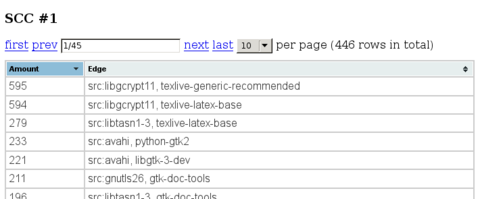
I wrote a small wiki page for botch. It includes links to some hopefully useful resources like my FOSDEM 2013 talk or my master thesis about botch. The final goal of botch is to generate a build order with which Debian can be bootstrapped from zero to more than 18000 source packages. But such a build order can only be generated once enough source packages (by now the number is around 70) incorporate build profiles which allow to compile them with less build dependencies and thereby break all build dependency cycles. So an intermediary goal of botch is, to find a "good" (i.e. a close to minimal amount) selection of such build dependencies that should be dropped from their source packages. So far, the results of all heuristics we use for this task were just dumped to standard output. Since this textual format was hard to read for a human developer and even worse machine readable, that tool now outputs its results in JSON. This data is then converted by another tool to a more human readable format. One such format is HTML and with the help of javascript for sortable and pageable tables, the data can then be presented without producing too much visual clutter (at least compared to the initial textual format). Another advantage of HTML is, that the data can now easily be shared with other developers without them having to run botch or install any other program first. So without further ado, please find the result of running our heuristics on Debian Sid as of 2013-01-01 here: http://mister-muffin.de/bootstrap/stats/ Here is a screenshot of what you can expect (you can see part of the table of edges with most cycles through them): As a developer uses this information to add build profiles to source packages, this HTML page can be regenerated and will show which strongly connected components are now left in the graph and how to best make them acyclic as well. Besides other improvements I also updated the data I used to generate the graphs from this post. I found this update to be necessary since we found and fixed several implementation bugs since October 2012, so this new plot should be more accurate. Here a graph which shows the amount of vertices in the biggest strongly connected component of Debian Sid by date. Some datapoints are missing for dates for which important source packages in Sid were not compilable.

Russ Allbery: Collected haul

I've been slow lately in writing these up (and, for that matter, in doing most other things related to reading; things have been rather busy lately). This is a bunch of here-and-there purchases over the last few months, including Powell's Indiespensible shipments. Sandra Barret Face of the Enemy (sff)
Anne Bishop Written in Red (sff)
Lois McMaster Bujold Captain Vorpatril's Alliance (sff)
Cary Caffrey The Girls from Alcyone (sff)
Jenni Fagan The Panopticon (mainstream)
Niels Ferguson, et al. Cryptography Engineering (non-fiction)
Jen Kirchner The Fourth Channel (sff)
Anothony Marra A Constellation of Vital Phenomena (mainstream)
Steve McConnell Code Complete (non-fiction)
Seanan McGuire Velveteen vs. The Junior Super-Patriots (sff)
Patrick Nielsen Hayden, et al. (ed.) Some of the Best from Tor.com: 2012 (sff anthology)
Lisa O'Donnell The Death of Bees (mainstream)
Susan Palwich Flying in Place (sff)
Kim Stanley Robinson 2312 (sff)
John Scalzi Redshirts (sff)
Ian Tregillis Bitter Seeds (sff)
Leon Trotsky The History of the Russian Revolution (non-fiction)
Simon Van Booy The Illusion of Separateness (mainstream)
Chris Anne Wolfe Shadows of Aggar (sff)
Barbara Ann Wright The Pyramid Waltz (sff) That's a lot of stuff. It includes a couple of non-fiction O'Reilly books from sales, a few months of Powell's Indiespensible subscriptions, a variety of books I picked up after a discussion of good lesbian fiction on Tor.com (romance without the obnoxious gender tropes, or at least as many of them), and the rest of the Hugo nominees for the year. I got a ton of reading done earlier this month. I wish I could say the same thing about reviews, but I only wrote a few. That's something that I want to try to catch up on soon, so there will probably be a flurry of those posted soon. I've already read Blackout and Redshirts of this year's nominees (a review of the latter is coming), so at least I'm not too far behind on the reading. Throne of the Crescent Moon is in progress now.

27 May 2013

Bits from Debian: Debian welcomes its 2013 crop of GSoC students!

We are proud to announce that 16 students have been accepted to work on improving Debian this summer through the Google Summer of Code! This is great news, following our 15 accepted students in 2012, and 9 accepted students in 2011. Here is the list of accepted students and projects: If you're interested in one of the projects, please follow the links and talk directly to the students or the mentors, or come hang out with us on IRC. Welcome everyone, and let's make sure we all have an amazing summer!

Michael Stapelberg: Results of the Debian systemd survey

A week ago, we started the Debian systemd survey. The goal was to figure out a few trends and answer the following two questions:
  1. Do our subjective impressions from the discussions on debian-devel reflect the general sentiment about systemd?
  2. What are the main concerns that most people have?
Thank you all for your participation! General I am happy to tell that 2113 people had a look at the survey and 573 people actually participated. Of those, 45.7% said they are a DD, DM or otherwise maintaining packages. 74.5% said they actually booted and used a computer running systemd. With regards to having systemd in Debian at all, not necessarily as the default init system, answers are as follows: 43.9% said they personally want systemd as the default init system in Debian, while 32.2% don t want that. The remaining 23.7% don t know yet. Top concerns About 50% of participants provided one or more concerns. Evaluating this part of the survey is obviously the hardest, since the answers were provided as free text. I tried categorizing the feedback into a few buckets. Each bucket comes with a number which is a weighted (!) count, i.e. the top concern counts 3 times, the second concern counts 2 times and the last concern just once. If you cannot find your personal concerns, that is because those which were just voiced by less then five people are not listed here. As I said, we cared about trends in this survey, not individual opinions.
  1. systemd is too complex, or bloated, or it does too many things, or has too many dependencies (weight: 217)
  2. systemd is not portable to non-linux systems, e.g. Debian/kFreeBSD or HURD (weight: 199)
  3. Debugging the boot process is harder than in sysvinit (weight: 106)
  4. I have a problem with systemd upstream and/or Lennart in particular (weight: 87)
  5. systemd violates the UNIX philosophy (weight: 35)
  6. I dislike binary logs and/or the journal in general (weight: 30)
  7. systemd is too new, still untested, unstable and experimental (weight: 24)
  8. I cannot find enough documentation in general or about the transition from sysvinit to systemd in particular (weight: 20)
  9. People need to learn new commands/how the new system works (weight: 20)
  10. I don t know what problems systemd solves and/or have no problems with sysvinit currently (weight: 19)
  11. I think the configuration is binary and/or the configuration format is weird (weight: 13)
  12. systemd s code is not good (memory leaks, performance problems) and/or upstream s development lacks best practices such as long-term stable branches (weight: 9)
  13. There are problems with systemd in Debian (e.g. Debian-specific extensions to /etc/fstab not supported, system doesn t boot) (weight: 9)
  14. Customizing the boot is harder than with sysvinit (weight: 8)
  15. systemd is not compatible with sysvinit (weight: 8)
I realize that the choice of buckets is somewhat broad and there are many different, finely nuanced opinions out there. Again, this is for seeing a trend, not accounting for every single individual opinion. In case you strongly believe that I did something wrong when evaluating the survey results, please contact me and we can work something out. Conclusions/Actions I know this is a controversial topic. Please don t start yet another systemd discussion on debian-devel. We, the systemd Debian maintainers, will try to come up with good answers to all listed concerns and communicate them in a friendly and concise way soon. Furthermore, we have recognized the need for more documentation/information about how things are supposed to work with regards to the transition (and systemd in general) and will address that, too. Raw questions/numbers
Total records in survey: 573
Are you a Debian Developer (DD) or Debian Maintainer (DM) or otherwise currently maintaining Debian packages?
262 Yes
311 No
Did you ever boot and use a computer running systemd? It does not matter whether that computer was running Debian or a different operating system.
427 Yes
146 No
What is your general sentiment towards having systemd in Debian (not necessarily as default)?
358 I welcome systemd in Debian, everything is fine.
 81 I am not sure yet.
 46 I don t care.
 88 I don t want systemd in Debian.
Would you personally want systemd as the default init system in Debian?
252 Yes
136 I don t know
185 No

Next.

Previous.