Search Results: "reg"

27 November 2011

Craig Sanders: some more reasons to hate gnome shell

  1. Non-resizable configuration windows. I have a 1920 1200 screen but the window manager provides no way to resize windows like the System Settings window. Result is that the window is quite small and, worse, has a scroll bar for no good reason when another hundred or so vertical pixels would easily display everything. Even another 30 or so horizontal pixels would allow more icons per line under Hardware, reducing the number of lines, and again allowing the entire list of available settings to be displayed without a scroll bar. Instead, to see all of the options I have to scroll down. And these people call themselves user-interface and usability experts. It's not up to the gnome developers to decide that I never need to resize certain windows or certain kinds of windows. It's up to me to decide that. They're not at my desktop, using my screen. I am.
  2. No way to disable a shell extenstion from the command line. I installed the gnome-shell-extensions package and was trying out various extensions to see if they made gnome shell tolerable. Enabling one of them (i forget exactly which one), immediately displayed some "Oh no! Something has gone wrong. A problem has occured and the system can't recover. Please log out and try again." leaving me no option but to log out. An absolutely fucking useless error message. "Something" has gone wrong. A little fucking detail might help me to diagnose the problem and fix it. Like a trace of whatever the fuck it was doing when "Something went wrong". When i logged back in, it crashed again, with the same useless error screen. So, now I can't even log in to Gnome Shell. I've tried logging in to Fallback mode, but the Extensions tab is empty in gnome-tweak-tool (because, of course, nobody would want to configure Shell Extensions from fallback mode, would they?). I can't even find any way of listing which shell extensions are enabled, let alone disable one of them. Hell, I'd settle for disabling all of them, and then carefully re-enabling them one-by-one until I rediscovered the culprit.
  3. Oh, wait. I finally found /org/gnome/shell/enabled-extensions in dconf-editor. it's a text field with an array of items. so far, so good. The "editor" (and i use that term very loosely) for text fields is garbage. It can't even wrap lines so that it displays the whole field without a horizontal scroll bar probably my all-time least favourite user-interface element. Have gnome devs never heard of multi-line text-edit fields? Rather than fuck around with a crappy GUI editor, it's far easier to:
    $ dconf read /org/gnome/shell/enabled-extensions > /tmp/extensions
    $ vi /tmp/extensions
    $ dconf write /org/gnome/shell/enabled-extensions "$(cat /tmp/extensions)"
    
    I guess now it's time to log out from fallback mode to find out if I can log back in to Gnome Shell again. [ nope. didn't work ]
  4. Add non-resizable user-interface elements to item 1. above. So far, Gnome devs are doing a great job of regressing to the crap usability of the Windows GUI here s a useful rule of thumb for things like that: Every single window, every single user-interface element should be resizable and tweakable by the user. And the system should remember all user changes so that they don t have to waste a few minutes every time they run an app resizing things to suit their requirements. Gnome 2 mostly had that. Gnome 3 seems to have lost a large part of it along the way Second rule of thumb: If the user happens to replace their monitor or run it in a mode too small for the current settings, then they should revert to some sane default. Even better, it should remember the settings for each resolution choosing either sane defaults or the user s settings for the nearest similar resolution if the user hasn t created custom settings for that resolution yet.
  5. Lack of documentation. here's a good example:
    $ gnome-shell-extension-tool help
    Usage: gnome-shell-extension-tool [options]
    $ man gnome-shell-extension-tool
    No manual entry for gnome-shell-extension-tool
    See 'man 7 undocumented' for help when manual pages are not available.
    What more needs to be said? At least /usr/bin/dconf has built-in help. Which is great, since it doesn't have a man page either.
Update: About three hours of stuffing around later, and I ve finally got Gnome Shell running again. I have NFI what actually fixed it, it could have any one of the dozens of settings I fucked around with. Nor do i have any idea what the actual problem was. And after all that, the extensions I tried still don t make Gnome Shell tolerable. They make it less *intolerable* (bottom-panel extension in particular), but that s still a long way from being tolerable i m really trying hard to find some way to come to terms with Gnome 3. I ve been trying for months now. But every time I give it another trial, I just end up hating it even more I m glad I have more than one desktop machine to use, so i can experiment with odious shit like Gnome Shell without fucking up my main working environment. So it s back to my main desktop machine and gnome2. Eventually I ll have to upgrade that, but xfce4 is looking to be my best option. I already switched to xfce4 on my desktop machine at work last week, and it s pretty good certainly far better than the Gnome 3 fallback mode i ve been using there for the last 5 or 6 months. Thanks, Gnome devs you re making a fantastic advertisement for XFCE. I wouldn t have bothered trying it again if I hadn t been forced to. ps: before anyone says wait for Gnome 3.2, it s much better . Todays waste of time *was* using Gnome 3.2 some more reasons to hate gnome shell is a post from: Errata

26 November 2011

Christian Perrier: [life] [running] How do you feel after running 70km?

Happy. This is how I feel after I ran the "Le Puy-Firminy" night race last Sunday. 70 kilometers (mixed roads and trails), 1500 meters positive slope, close to my birth town, St-Etienne (the track on Garmin Connect unfortunately has bugs for the profile, sorry for this....this is apparently a bug in Garmin Connect as pyTrainer shows the track very well. And running this by night, starting at midnight and arriving at....09:16 the next day. A full night running. Such "ultra" experience is completely different from marathon running. In marathons, you mostly try keeping a constant pace all along the race, running very close to your limits all along the race. Very long distances involve managing much more than keeping a constant pace. Being able to run (and walk) for many hours requires being very careful at the start of the race, controlling the pace and save energy for the last part of the race. Climbing is most of the time done by walking (except for the very first runners) and going down for kilometers is very hard for legs, even at slow paces. Night running is also making things a lot different. Particularly in a quite small race like this one, it means running alone most of the time. And, by alone, I really mean alone. You and your head lamp, that's all. I am very happy about the way I managed this race. I reached the 32km mark, where an important food/drink point was organised, in a little bit more than 3 hours 15 minutes, where I stopped about 7-8 minutes. That was followed by about 5 kilometers downhill, at 6%, on a paved road, which is really killing legs. The marathon distance was reached in about 5h05, more or less what I planned, but that race is known to be harder in its second half. And completing a marathon, *then* knowing that you still have 2/3 of a marathon to run is kinda challenging..:-) Another important moment of the race was the 55 kilometer mark. This, because this was the longest distance I ever ran in a single race (in March, for the Paris Ecotrail race). Of course, the longer you run, the harder are legs and what was expected happened to me: I had cramps in both legs, at the worst moment, around km 64, when the track brutally goes down for 150 meters in a small canyon, then goes up for about 200 meters. Indeed, I completed kilometer 66 in....22 minutes (I see my marathon runners friends laughing here). This is indeed where you know if you're strong and motivated enough : not abandoning, continue despite cramps, waiting for them to disappear...and finally complete the race. It was really worth it anyway : running by night is really magic. I still remember the though moments at 5am, in the moonlight, alone on a road...and so happy to be there..:-) That race was the last one for me this year. I followed my plans (the only regret being not beating my record at Berlin marathon). Next year plans include two marathons: probably Caen ("Les Routes de la Libert " along the D-Day beaches in Normandy) in June and another one during Fall. I'll also push my limits a bit further with the 80km race of Ecotrail, arriving at Eiffel Tower first floor after running through forests in the SW area of Paris....and probably again that 70km race in November. Once you've tried ultra races, you don't want to stop..:-) Until the end of the year....recovery...and training. After all, Ecotrail is only in 4 months..:-)

25 November 2011

Bernhard R. Link: checking buildd logs for common issues

Being tired of feeling embarrassed when noticing some warning in a buildd log only after having it uploaded and looking at the buildd logs of the other architectures, I've decided to write some little infrastructure to scan buildd logs for things that can be found in buildd logs. The result can be visited at https://buildd.debian.org/~brlink/. Note that it currently only has one real check (looking for E: Package builds NAME_all.deb when binary-indep target is not called.) yet and additionally two little warnings (dh_clean -k and dh_installmanpages deprecation output) which lintian could at catch just as well. The large size of the many logs to scan is a surprisingly small problem. (As some tests indicated it would only take a couple of minutes for a full scan, I couldn't help to run one full scan, only to learn afterwards that wb-team was doing the import of the new architectures at that time. Oops!) More surprising for me using small files to keep track of logs already scanned does not scale at all with the large number of source packages. File system overhead is gigantic and it makes the whole process needlessly IO bound. That problem was be easily solved using sqlite to track things done, though as buildd.debian.org doesn't have that installed yet, so no automatic updates yet. [Update: already installed, will be some semi-automatic days first, though anyway] The next thing to do is writing more checks, where I hope for some help from you: What kind of diagnostics do you know from buildd logs that you would like to be more prominently visible (hopefully soon on packages.qa.debian.org, wishlist item already filed)? Trivial target is everything that can be identified from regular expression applied to every line of the buildd log. For such cases the most complicated part is writing a short description of what this message means. (So if you sent me some suggestions, I'd be very happy to also get a short text suitable for that, together with the message to looks for and ideally some example package having that message in its buildd log). I'm also considering some more complicated tests. I'd really like to have something to test for packages being built multiple times to due Makefile errors and stuff like that.

24 November 2011

Matt Brown: How I m voting in 2011

It s general election time again in New Zealand this year, with the added twist of an additional referendum on whether to keep MMP as our electoral system. If you re not interested in New Zealand politics, then you should definitely skip the rest of this post. I ve never understood why some people consider their voting choices a matter of national security, so when via Andrew McMillan, I saw a good rationale for why you should share your opinion I found my excuse to write this post. Party Vote
I ll be voting for National. I m philosophically much closer to National than Labour, particularly on economic and personal responsibility issues, but even if I wasn t the thought of having Phil Goff as Prime Minister would be enough to put me off voting Labour. His early career seems strong, but lately it s been one misstep and half-truth after another, the remainder of the Labour caucus and their likely support partners don t offer much reassurance either. If I was left-leaning and the mess that Labour is in wasn t enough to push me over to National this year then I d vote Greens and hope they saw the light and decided to partner with National. Electorate Vote
I live in Dublin, but you stay registered in the last electorate where you resided, which for me is Tamaki. I have no idea who the candidates there are, so I ll just be voting for the National candidate for the reasons above. MMP Referendum
I have no real objections to MMP and I think it s done a good job of increasing representation in our parliament. I like that parties can bring in some star players without them having to spend time in an electorate. I don t like the tendency towards unstable coalitions that our past MMP results have sometimes provided. Of the alternatives, STV is the only one that I think should be seriously considered, FPP and it s close cousin SM don t give the proportionality of MMP and PV just seems like a simplified version of STV with limited other benefit. If you re going to do preferential voting, you might as well do it properly and use STV. So, I ll vote for a change to STV, not because I m convinced that MMP is wrong, but because I think it doesn t hurt for the country to spend a bit more time and energy confirming that we have the right electoral system. If the referendum succeeds and we get another referendum between MMP and something other than STV in 2014, I ll vote to keep MMP. If we have a vote between MMP and STV in 2014 I m not yet sure how I d vote. STV is arguably an excellent system, but I worry that it s too complex for most voters to understand. PS. Just found this handy list of 10 positive reasons to vote for National, if you re still undecided and need a further nudge. Kiwiblog: 10 positive reasons to vote National

23 November 2011

Joey Hess: roundtrip latency from a cabin with dialup in 2011

alt="imagine an xkcd-style infographic here" 0 seconds 0.5 seconds 5 seconds 10 seconds 20 seconds 2 minutes 5 minutes 10 minutes 22 minutes 30 minutes 32 minutes 70 minutes 180 minutes 300 minutes

Russell Coker: Receiving Death Threats

On occasion I receive death threats in comments on my blog. This doesn t bother me, I had more than a few pathetic losers say similar things to me in high school but the difference is that a pathetic loser on the other side of the world can t do much about it. The latest one is on my post Is Asperger Syndrome a Good Thing? [1]. At 11:04AM my time (00:04 UTC) on the 23rd of November someone using IP address 82.14.50.190 (registered to NTL Infrastructure for Tesco Guildford ) and with the claimed email address of sharkbait @ tesco.net told me that I m on his to kill list . He was angry because my post apparently didn t satisfy his need to prove to people that they don t want AS . As it s not possible to choose your DNA there is really no point in trying to prove that one set of genes is better than another, unless of course you want to harass people who have different genes to you. Naturally he didn t read my post, in fact the differences between his comment and what I wrote made me suspect that it s something he was pasting in to lots of blogs, but it seems unlikely that he would use an iPhone for such a copy/paste job so he must just not read. For example he rhetorically asks did you even mention it was a form of autism in your negative points when I gave a link to the proposed DSM changes where Asperger Syndrome is being merged with Autistic Disorder and the word Autism appears 5 times in the post. He has one specific complaint about people he knows who are on the Autism Spectrum, he says Every time someone speaks to them they get angry and tell said person to back the fuck off. I ve been on the receiving end. Generally there are two possible reasons for being told to fuck off , one is that the person telling you is an asshole and the other is that you are being an asshole. If you are the type of person who sends death threats to bloggers then you really should consider the latter explanation. He also suggests that I watch Boston Legal presumably because that show has one character who is an Aspie. Now I have actually watched that show and it s the worst legal show I ve ever seen, when a legal show has such unrealistic portrayal of court scenes I don t think it should be relied on for information on any other topic. I watched a couple of episodes of Boston Legal and only saw one scene with the Aspie guy, so I can t even determine whether it s a realistic portrayal he s a minor character. In any case there are plenty of Aspie guys in the Free Software community who I interact with regularly, I read forums such as AspiesForFreedom.com, and I ve read some text books on the topic. So even if a TV show had a very accurate portrayal of an Aspie character I still doubt that I would learn anything by watching it. As a general tip for flamers, if you want to accuse someone of being a member of a NAZI or KKK type organisation then the word you are after is Aryan not ayrien . If you don t know a word then don t use it. Please note the conditions of sending me email [2], I reserve the right to publish all threats in any way that I wish. A Final Note Thanks sharkbait for adding me to your to kill list , I m sure that there are lots of nice people on it and I ve got good company. If I didn t get the occasional death threat I would worry that I m not writing well enough or failing to address important issues. I will write more about Autism in the future.

Philipp Kern: Useful Firefox extensions (followup)

Since my last post about Firefox extensions I've enabled two other addons:

Through the comments I got pointed to Fox to Phone which enables you to send links from your browser directly to your Android phone with Chrome to Phone installed. Thanks for that.

Another useful extension that was recommended to me is LeechBlock. You give it a list of news sites you regularly frequent and it will make sure that you only spend a given time budget on them per day or that you only browse them in the evenings (or even a combination of both).

As I expected I did deactivate RequestPolicy again. That said, Facebook recently switched its certificates, so Certificate Patrol was unhappy. It's impressive and sad how many pages actually do cross-site requests to embed Facebook's buttons. If somebody would invent something less annoying to stop this mess, that would be great.

Jon Dowland: In response to Andrew Cowie

Andrew Cowie blogs about 'A good GNOME 3 Experience'. He writes
I think it s a bit odd not to expect that something that was widely advertised as being such a different user experience is different.
and
if they had gone and bought an Apple laptop with Mac OS X on it they would be perfectly reasonably working through learning how to use a new Desktop and not complaining about it at all. But here we are admonishing the GNOME hackers had the temerity to do something new and different.
I think Andrew's phrasing here is a bit disingeneous. Or perhaps he genuinely mistakes the frustration that has been felt by GNOME 3. I don't want to whine on too much, so I'll try to get this out of the way in one paragraph. F/OSS users are members of a community. There is inevitably a wall between the majority of community members and the blessed: the decision makers, the developers. The art of maintaining a good community is partly to do with making this wall as invisible as possible: encouraging participation, lowering the barrier for contributions; welcoming feedback; etc.1. The GNOME community have invested a lot into the GNOME 2 way of doing things, and GNOME 3, by breaking away from that so fundamentally, has devalued the community's investment. It screams: we don't want your panel widgets! We don't want your themes! Your working practices are wrong: this is the right way! GNOME 3 is opinionated software, and it's opinion differs from a large body of the GNOME community. The result? resentment. Remember: GNOME 3 is not just something new: it's the abrupt termination of something old, tried and tested. and hopefully that's the last time I need to vent about my GNOME 3 frustration. It's hear to stay, the question for the frustrated is: are you? Moving on Andrew goes on to recommend:
One thing I do recommend is mapping (say) CapsLock as an additional Hyper You do the mapping in: System Settings Keyboard Layout Layout tab Options..
I used to do this with GNOME 2, but I couldn't find how to do it on GNOME 3. Andrew's post gave me the important hint that it was still possible, but the precise location doesn't match: On my Fedora 16 / GNOME 3.2 system, it's System Settings Region and Language Layouts Options ". This is especially useful on my beloved UltraNav keyboard which lacks the Windows 95 keys. Sadly it does not work very well through various remote desktop tools: I get an inconsistent capslock state within VMs connected to via VNC. rdesktop seems ok.

  1. I have more to write about GNOME in this context in a future post.

22 November 2011

Steve Kemp: Goodbye mysql ..

Yesterday evening I updated my server to remove MySQL:
steve:~# dpkg --purge mysql-client-5.1 \
                      mysql-common     \
                      mysql-server-5.1 \
                      mysql-server-core-5.1 \
                      python-mysqldb        \
                      libdbd-mysql-perl     \
                      libdatetime-format-mysql-perl
Until last month I had two database in use, one each for a pair of web-applications. As of now one is using redis - which I'm already using for my image hosting - and the other application is using SQLite. Until recently I had a high opinion of SQLite, although that has now been downgraded a little, it is still a thoroughly excellent piece of software. I was just surprised at little things it was missing, to the extent I had to rewrite my applications SQL. Still one less service is a good thing, and the migration wasn't so painful.. In more productive news I recently acquired a nice external flash - the Yongnuo YN-460 II is (very) cheap and cheerful, it can be fired remotely with my triggers so I've had a lot of fun with opportunistically taking pictures and experimenting with lighting. Most of the results are NSFW, but there are some other examples lurking around including the first time I managed to successfully capture a falling water-drop. (Not the best picture, not the most explicit effect, but fun regardless. I both can and will do better next time!)
Somebody recently asked me to write about "camera stuff under linux" and happily I declined. Why decline? Because there are so many good tools, applications, and utilities. (I use local tools for organisation and duplicate detection, rawtherapee for RAW conversion and GIMP for touchups). Having many available options is fantastic though, and something hard to appreciate for "newcomers" to Linux. (Yeah I waited 90 seconds - if I remembered to add -nojava - for Netscape Navigator to start, under X10, with 8Mb of RAM. Happier days are here. Sure DRM is bad, secure boot .. an open question, but damn we have it good compared to almost any previous point in time!)
ObQuote: "Yeah, obviously it is only a tactical party. I'm only having a party to eventually get sex." - Peep Show

Thorsten Glaser: Those small nice tools we all write

This is both a release announcement for the next installment of The MirBSD Korn Shell, mksh R40b, and a follow-up to Sune s article about small tools of various degrees of usefulness. I hope I don t need to say too much about the first part; mksh(1) is packaged in a gazillion of operating environments (dear Planet readers, that of course includes Debian, which occasionally gets a development snapshot; I ll wait uploading R40c until that two month fixed gcc bug will finally find its way into the packages for armel and armhf. Ah, we re getting Arch Linux (after years) to include mksh now. (Probably because they couldn t stand the teasing that Arch Hurd included it one day after having been told about its existence, wondering why it built without needing patches on Hurd ) MSYS is a supposedly supported target now, people are working on WinAPI and DJGPP in their spare time, and Cygwin and Debian packagers have deprecated pdksh in favour of mksh (thanks!). So, everything looking well on that front. I ve started a collection of shell snippets some time ago, where most of those small things of mine ends up. Even stuff I write at work we re an Open Source company and can generally publish under (currently) AGPLv3 or (if extending existing code) that code s licence. I chose git as SCM in that FusionForge instance so that people would hopefully use it and contribute to it without fear, as it s hosted on my current money source s servers. (Can just clone it.) Feel free to register and ask for membership, to extend it (only if your shell-fu is up to the task, KNOPPIX-style scripts would be a bad style(9) example as the primary goal of the project is to give good examples to people who learn shell coding by looking at other peoples code). Maybe you like my editor, too? At OpenRheinRuhr, the Atari people sure liked it as it uses WordStar like key combinations, standardised across a lot of platforms and vendors (DR DOS Editor, Turbo Pascal, Borland C++ for Windows, ) ObPromise: a posting to raise the level of ferrophility on the Planet aggregators this wlog reaches (got pix)

Raphaël Hertzog: People behind Debian: Stefano Zacchiroli, Debian Project Leader

picture by Tiago Bortoletto Vaz, CC BY-NC-SA 2.0


It s been one year since the first People behind Debian interview. For this special occasion, I wanted a special guest and I m happy that our Debian Project Leader (DPL) Stefano Zacchiroli accepted my invitation. He has a difficult role in the community, but he s doing a really great job of it. He s a great mediator in difficult situations, but he s also opinionated and can push a discussion towards a conclusion. Read on to learn how he became a Debian developer and later DPL, what he s excited about in the next Debian release, and much more. Raphael: Who are you? Stefano: I m Stefano Zacchiroli, but I prefer to be called Zack, both on the Internet and in real life. I m 32, Italian, emigrated to France about 4 years ago. I live in Paris, and I find it to be one of the most gorgeous and exciting cities in the world. As my day job I m a Computer Science researcher and teacher at University Paris Diderot and IRILL. In my copious free time I contribute to Debian, and I m firmly convinced that doing so is an effective way to help the cause of Free Software. Besides, I find it to be a lot of fun! Raphael: How did you start contributing to Debian? Stefano: Flash back to 1999, when I was a 2nd year student in Computer Science at the University of Bologna. Back then in Italy it was uncommon for young geeks to get exposed to Free Software: Internet was way less pervasive than today and most computer magazines didn t pay much attention to GNU/Linux. Luckily for me, the professor in charge of the student lab was a Free Software enthusiast and all students machines there were running Debian. Not only that, but there was also a student program that allowed volunteers to become sysadmins after having shown their skills and convinced the director they were trustworthy. Becoming one of those volunteer Debian admins quickly became one of my top objectives for the year, and that is were I ve learned using Debian. The year after that, I got in touch with a research group that was to become the happy bunch of hackers with whom I would have done both my master and PhD theses. They were designing a new proof assistant. Most of the development was in OCaml and happened on Debian. OCaml was available in Debian, but many of the libraries we needed were not. So I approached the Debian OCaml Team offering to help. Before I realize what was going on I was (co-)maintainer of tens of OCaml-related packages. At some point I got told I think you should apply as a Debian Developer . So I did and in a couple of months I went through the New Member (NM) process, that was back then in its infancy. I still remember my happiness while reading the account created mail, the day after my 22nd birthday. I know the NM process went through some bad publicity in the past, but I m happy to see that nowadays the process can be as swift as it has been for me 10 years ago. Raphael: It s your second year as Debian Project Leader (DPL). Are you feeling more productive in the role? Do you fear to burn out? Stefano: I m feeling way more productive, no doubts. The task of the Debian Project Leader is not necessarily difficult, but it is a complex and scarcely documented one. It is also profoundly different from any other task that Debian people usually work on, so that experience doesn t help much in getting started. Before becoming effective as DPL one needs to get to know many people and mechanisms he is not familiar with. More importantly, one needs to set up a personal work-flow that allows to keep up with day-to-day DPL tasks (which are aplenty) as well as with urgencies (that tend to pop-up in the leader@debian.org INBOX at the least convenient time). Finally, one also needs to do proper traffic shaping and always retain enough motivation bandwidth to keep the Project informed about what is going on in DPL-land. Finding the right balance among all these ingredients can take some time. Once one is past it, everything goes way more smoothly. The above is why I m constantly encouraging people interested in running for DPL in the future to reach out to me and work on some tasks of the current DPL s TODO list. I swear it is not just a cheap attempt at slavery!. It is rather an attempt at DPL mentoring that could be beneficial: both to give future candidates more awareness of the task, and to reduce the potential downtime when handing over from one DPL to the next. Regarding burn out, I don t feel prone to its risk these days. If I look back, I can say that my contributions as DPL have been pretty constant in volume over time; my enthusiasm for the task, if anything, is on the rise. The effectiveness of my contributions as DPL are, on the other hand, not mine to judge. Raphael: If you had to single out two achievements where you were involved as DPL, what would they be? Stefano: I d go for the following two, in no particular order: OK, let me cheat and add a third one I m also proud of having been able to report to the Project my whereabouts as DPL, thoroughly and periodically, since the very beginning is first term. People annoyed by my reporting logorrhea now have all my sympathies. Raphael: Among the possible new features of Debian Wheezy, which one gets you excited most? Stefano: It s multi-arch, no doubt. Even though it is not a directly user visible change, it s a very far reaching one. It is also one of those changes that make me feel that moment of truth of coders, when you realize you are finally doing the right thing and ditching piles of ugly hacks.
It s multi-arch [ ] you realize you are finally doing the right thing and ditching piles of ugly hacks.
Raphael: If you were not DPL and could spend all your time on Debian, what project would you do? Stefano: I would sit down and do software development for Debian. It s impressive how many important and beneficial changes for Debian could be delivered by specific software improvements in various parts of our infrastructure. We tend to attract many packagers, but not so many people willing to maintain Debian infrastructure softwares like dak, britney, debbugs, the PTS, etc. Their maintenance burden then falls on the shoulders of the respective teams which are generally very busy with other important tasks. As a project, we seem to be more appealing to packagers than to software developers. That is a pity given the amount of exciting coding tasks that are everywhere in Debian. Part of the reason we are not appealing to developers is that we are not particularly good at collecting coding tasks in a place where interested developers could easily pick them up. It also takes quite a bit of inside knowledge to spot infrastructure bugs and understand how to fix them. I long for some spare hacking time to check if I m still good enough of a coder to hunt down longstanding bugs in our infrastructure, which have ended up being my pet peeves. I d also love to dive again into RCBW. It s less committing than package maintenance, more diverse and challenging, and also an immensely useful activity to get Debian releases done. Raphael: Martin Michlmayr is worried that there is so few paid opportunities around Debian. Do you agree with his sentiment, and if yes do you have ideas on how to improve this situation? Stefano: The idealistic me wishes Debian to be a community made only of volunteers that devote their free time to the Project. Oh, and that me also wishes Debian to be competitive with similar projects, no matter how many full-time employees others have! That is coherent with a view of society where everyone has a day job, but also engages in volunteering activities ensuring that public interest is pursued by people motivated by interests other than profit. But I do realize that for Free Software to succeed companies, employees, and salaries should all have a role. I admire projects that strike a good balance between volunteer and paid work. The Linux kernel is emblematic in that respect: many developers are paid by companies that have a commercial or strategic interest in Linux. Nevertheless volunteers contributions are aplenty and the Linux community gives a convincing impression that choices are driven by the community itself (or by its benevolent dictator) without money-driven impositions.
I do realize that for Free Software to succeed companies, employees, and salaries should all have a role.
Such an ecosystem does not exist around Debian. We do have a partner program that allows for it to happen, but we have very few partners with an interest in doing distribution development work. Like Martin, I m worried by this state of affairs, because it de facto means we lag behind in terms of available people power. In a community of volunteers, that might frustrate people and that is not good. To improve over the status quo the first step is to federate together small and medium companies that have a strategic interest in Debian and listen to their needs. I m already in touch with representatives of such companies that, in many cases, already employ Debian Developers to do some distribution work in Debian. We will be soon sending out a call to reach out to more such companies, but since we are discussing this, why waiting? If some of our readers here are representative of such companies, I encourage them to get in touch with me about this. Raphael: You know that the fundraising campaign for the Debian Administrator s Handbook is on good track but the liberation of the book is not yet assured. What do you think of this project? Stefano: I m happy about the project, to the point that I ve accepted writing a testimonial for it :-) . I m sad about the scarce availability of up to date and high quality (DFSG-)Free books about Debian and I welcome any initiative that might help closing that gap.
I m sad about the scarce availability of up to date and high quality (DFSG-)Free books about Debian.
Free Culture is a great offspring of Free Software and I m convinced we need to stand up against double standards in the two camps. Letting aside software-specific licensing details, the basic freedoms to be defended are the same. They are those freedoms that ensure that a reader is in full control of his book, pretty much as they ensure that a computer user is in full control of the software that runs on it. I m therefore proud that Debian has long resolved that the Debian Free Software Guidelines (DFSG) apply not only to software but also to books and other pieces of documentation. But the status quo implies that not only we have very few up to date, high quality books about Debian. It also implies that, at present, we have no such book that we can distribute in the Debian archive, showing off the Free Software (and Free Culture!) values we stand for.
Crowdfunding is considered to be a good mate for Free Culture, where the services model that applies to Free Software is more difficult to exploit. I so wish any luck to yours and Roland s initiative. A different matter is whether Debian, as a project, should endorse the initiative and actively campaign for it. As you know, I think it should not. While we do advertise general project donations, we don t do mission-specific fundraising campaign for Debian itself. Coherently with that, I don t think we should relay crowdfunding campaigns for 3rd parties, even when the result would be beneficial to Debian. Raphael: Is there someone in Debian that you admire for their contributions? Stefano: There are two classes of people that I particularly admire in Debian:
Thank you to Zack for the time spent answering my questions. I hope you enjoyed reading his answers as I did.

Subscribe to my newsletter to get my monthly summary of the Debian/Ubuntu news and to not miss further interviews. You can also follow along on Identi.ca, Google+, Twitter and Facebook .

7 comments Liked this article? Click here. My blog is Flattr-enabled.

Jonas Smedegaard: Asia 2011

In september I visited Brussels, Belgium. EPFSUG had kindly invited me to give a talk about FreedomBox in the European Parliament, and together we extended to also visit other organizations - both grassroots and more formal. I returned home exhausted but also fuelled with renewed energy and passion, and decided to engage in more such activities. Also, an old promise of mine to visit friends in the Aceh region of Indonesia (whom I met in Taiwan a few years back) rumbled in the back of my head. After a bit of juggling with travel routes and sponsoring options, my course was set for a 2 month journey with Debian Pure Blends as main theme:
  1. England: London
  2. India: Khammam, Hyderabad, Mangaluru, Bengaluru
  3. Vietnam: Ho Chi Minh City, Can Tho
  4. Thailand: Bangkok
  5. Malaysia: Putrajaya
  6. Indonesia: Surabaya, Yogyakarta, Bogor, Banda Aceh, Takengon
  7. England: Cambridge
Debian will be sponsoring East Asia part, and Debian enthusiasts in India seek sponsorship for India part.

Jonas Smedegaard: Asia 2011 - India

Arrival in a new country is always exciting. This was my first time ever to visit India, and although I have heard especially cultural bits and pieces, I was as usual nowhere near "well" prepared. How to fill out the registration forms (surprisingly needed in addition to the visa already gathered ahead of departure) when your only known address in India is on the laptop you completely drained the battery of during the flight? Luckily they tolerated the "address during stay" to be left blank. I got out in the heat of Hyderabad in the late afternoon, got a cab, and had my host instruct the cab driver - over the phone via roaming to Denmark - where to drop me off. After a long ride with cows and beautiful dressed pedestrians casually crossing the high speed road and a short pitstop at an ATM, I finally met Pavithran. Until then we only knew each other from casual online chat. (I should later learn that my first impression was quite unusual - not cows or clothes or chat, but roads capable of driving at high speed!) Pavithran checked me into a small hotel and we visited his home. It was in the middle of being rebuild, so impossible to stay at as had been our original planed. After a few hours of looking at the neighbourhood and talking about possible events during the week, we decided to cancel the hotel and instead go visit his parents in Khammam, some 5 hours away by bus This text is part of my Asia 2011 scriblings.

21 November 2011

Daniel Kahn Gillmor: Adobe leaves Linux AIR users vulnerable

A few months ago, Adobe announced a slew of vulnerabilities in its Flash Player, which is a critical component of Adobe AIR:
Adobe recommends users of Adobe AIR 2.6.19140 and earlier versions for Windows, Macintosh and Linux update to Adobe AIR 2.7.0.1948. [...] June 14, 2011 - Bulletin updated with information on Adobe AIR
However, looking at Adobe's instructions for installing AIR on "Linux" systems, we see that it is impossible for people running a free desktop OS to follow Adobe's own recommendations:
Beginning June 14 2011, Adobe AIR is no longer supported for desktop Linux distributions. Users can install and run AIR 2.6 and earlier applications but can't install or update to AIR 2.7. The last version to support desktop Linux distributions is AIR 2.6.
So on the exact same day, Adobe said "we recommend you upgrade, as the version you are using is vulnerable" and "we offer you no way to upgrade". I'm left with the conclusion that Adobe's aggregate corporate message is "users of desktops based on free software should immediately uninstall AIR and stop using it". If Adobe's software was free, and they had a community around it, they could turn over support to the community if they found it too burdensome. Instead, once again, users of proprietary tools on free systems get screwed by the proprietary vendor. And they wonder why we tend to be less likely to install their tools? Application developers should avoid targeting AIR as a platform if they want to reach everyone.Tags: adobe, proprietary software, security

Craig Small: New procps 3.3.0 for Debian

Coming soon after the upstream procps 3.3.0 being released, the debian packages have been uploaded tonight. The Debian packages have had the added benefit of being a day late by having a tiny 2 line patch to stop pgrep from crashing. One regression that is on purpose, watch is currently not 8-bit clean again until I can sort out how to get the linking right with the new build process. Testing Systems The embarrassing problem with pgrep did start a discussion about testing, especially regression testing. I ve recently started using unit testing in my python programs and love the level of assurance those tests give me that I haven t broken anything (to a degree anyhow). I d really like to be able to type make test and have each of the programs run through a series of tests. The problem with packages like procps (psmisc too) is that you really need to test the entire program, not just a stub, and that the program needs access to a know level of /proc. The only thing I have seen that is even remotely what is needed is the bunch of scripts that coreutils uses which creates dummy files and directories to operate the commands on. I expect we could do something similar with some scripts that create a known process but if anyone has a better idea about how to test a command line program let me know.

20 November 2011

Gregor Herrmann: RC bugs 2011/46

as expected this week was characterised by fixing bugs around the perl 5.14 transition. besides that I've also uploaded a couple of NMUs with patches kindly provided in the BTS by some tireless bug fixers.

17 November 2011

Raphaël Hertzog: People Behind Debian: Mark Shuttleworth, Ubuntu s founder

I probably don t have to present Mark Shuttleworth he was already a Debian developer when he became millionaire after having sold Thawte to Verisign in 1999. Then in 2002 he became the first African (and first Debian developer) in space. 2 years later, he found another grandiose project to pursue: bring the Microsoft monopoly to an end with a new alternative operating system named Ubuntu (see bug #1). I have met Mark during Debconf 6 in Oaxtepec (Mexico), we were both trying to find ways to enhance the collaboration between Debian and Ubuntu. The least I can say is that Mark is opinionated but any leader usually is, and in particular the self-appointed ones! :-) Read on to discover his view on the Ubuntu-Debian relationship and much more. Raphael: Who are you? Mark: At heart I m an explorer, inventor and strategist. Change in technology, society and business is what fascinates me, and I devote almost all of my time and wealth to the catalysis of change in a direction that I hope improves society and the environment. I m 38, studied information systems and finance at the University of Cape Town. My hearts home is Cape Town, and I ve lived there and in Star City and in London, now I live in the Isle of Man with my girlfriend Claire and 14 precocious ducks. I joined Debian in around 1995 because I was helping to setup web servers for as many groups as possible, and I thought Debian s approach to packaging was very sensible but there was no package for Apache. In those days, the NM process was a little easier ;-) Raphael: What was your initial motivation when you decided to create Ubuntu 7 years ago? Mark: Ubuntu is designed to fulfill a dream of change; a belief that the potential of free software was to have a profound impact on the economics of software as well as its technology. It s obvious that the technology world is enormously influenced by Linux, GNU and the free software ecosystem, but the economics of software are still essentially unchanged. Before Ubuntu, we have a two-tier world of Linux: there s the community world (Debian, Fedora, Arch, Gentoo) where you support yourself, and the restricted, commercial world of RHEL and SLES/SLED. While the community distributions are wonderful in many regards, they don t and can t meet the needs of the whole of society; one can t find them pre-installed, one can t get certified and build a career around them, one can t expect a school to deploy at scale a platform which is not blessed by a wide range of institutions. And the community distributions cannot create the institutions that would fix that. Ubuntu brings those two worlds together, into one whole, with a commercial-grade release (inheriting the goodness of Debian) that is freely available but also backed by an institution. The key to that dream is economics, and as always, a change in economics; it was clear to me that the flow of money around personal software would change from licensing ( buying Windows ) to services ( paying for your Ubuntu ONE storage ). If that change was coming, then there might be room for a truly free, free software distribution, with an institution that could make all the commitments needed to match the commercial Linux world. And that would be the achievement of a lifetime. So I decided to dedicate a chunk of my lifetime to the attempt, and found a number of wonderful people who shared that vision to help with the attempt. It made sense to me to include Debian in that vision; I knew it well as both a user and insider, and believed that it would always be the most rigorous of the community distributions. I share Debian s values and those values are compatible with those we set for Ubuntu.
Debian would always be the most rigorous of the community distributions.
Debian on its own, as an institution, could not be a partner for industry or enterprise. The bits are brilliant, but the design of an institution for independence implies making it difficult to be decisive counterparty, or contractual provider. It would be essentially impossible to achieve the goals of pre-installation, certification and support for third-party hardware and software inside an institution that is designed for neutrality, impartiality and independence. However, two complementary institutions could cover both sides of this coin. So Ubuntu is the second half of a complete Debian-Ubuntu ecosystem. Debian s strengths complement Ubuntu s, Ubuntu can achieve things that Debian cannot (not because its members are not capable, but because the institution has chosen other priorities) and conversely, Debian delivers things which Ubuntu cannot, not because its members are not capable, but because it chooses other priorities as an institution. Many people are starting to understand this: Ubuntu is Debian s arrow, Debian is Ubuntu s bow. Neither instrument is particularly useful on its own, except in a museum of anthropology ;)
Ubuntu is Debian s arrow, Debian is Ubuntu s bow.
So the worst and most frustrating attitude comes from those who think Debian and Ubuntu compete. If you care about Debian, and want it to compete on every level with Ubuntu, you are going to be rather miserable; you will want Debian to lose some of its best qualities and change some of its most important practices. However, if you see the Ubuntu-Debian ecosystem as a coherent whole, you will celebrate the strengths and accomplishments of both, and more importantly, work to make Debian a better Debian and Ubuntu a better Ubuntu, as opposed to wishing Ubuntu was more like Debian and vice versa. Raphael: The Ubuntu-Debian relationship was rather hectic at the start, it took several years to mature . If you had to start over, would you do some things differently? Mark: Yes, there are lessons learned, but none of them are fundamental. Some of the tension was based on human factors that cannot really be altered: some of the harshest DD critics of Canonical and Ubuntu are folk who applied for but were not selected for positions at Canonical. I can t change that, and wouldn t change that, and would understand the consequences are, emotionally, what they are. Nevertheless, it would have been good to be wiser about the way people would react to some approaches. We famously went to DebConf 5 in Porto Allegre and hacked in a room at the conference. It had an open door, and many people popped a head in, but I think the not-a-cabal collection of people in there was intimidating and the story became one of exclusion. If we d wanted to be exclusive, we would have gone somewhere else! So I would have worked harder to make that clear at the time if I d known how many times that story would be used to paint Canonical in a bad light. As for engagement with Debian, I think the situation is one of highs and lows. As a high, it is generally possible to collaborate with any given maintainer in Debian on a problem in which there is mutual interest. There are exceptions, but those exceptions are as problematic within Debian as between Debian and outsiders. As a low, it is impossible to collaborate with Debian as an institution, because of the design of the institution.
It is generally possible to collaborate with any given maintainer [ ] [but] it is impossible to collaborate with Debian as an institution.
In order to collaborate, two parties must make and keep commitments. So while one Debian developer and one Ubuntu developer can make personal commitments to each other, Debian cannot make commitments to Ubuntu, because there is no person or body that can make such commitments on behalf of the institution, on any sort of agile basis. A GR is not agile ;-) . I don t say this as a critique of Debian; remember, I think Debian has made some very important choices, one of those is the complete independence of its developers, which means they are under no obligation to follow a decision made by anyone else. It s also important to understand the difference between collaboration and teamwork. When two people have exactly the same goal and produce the same output, that s just teamwork. When two people have different goals and produce different product, but still find ways to improve one anothers product, that s collaboration. So in order to have great collaboration between Ubuntu and Debian, we need to start with mutual recognition of the value and importance of the differences in our approach. When someone criticises Ubuntu because it exists, or because it does not do things the same way as Debian, or because it does not structure every process with the primary goal of improving Debian, it s sad. The differences between us are valuable: Ubuntu can take Debian places Debian cannot go, and Debian s debianness brings a whole raft of goodness for Ubuntu. Raphael: What s the biggest problem of Debian? Mark: Internal tension about the vision and goals of Debian make it difficult to create a harmonious environment, which is compounded by an unwillingness to censure destructive behaviour. Does Debian measure its success by the number of installs? The number of maintainers? The number of flamewars? The number of packages? The number of messages to mailing lists? The quality of Debian Policy? The quality of packages? The freshness of packages? The length and quality of maintenance of releases? The frequency or infrequency of releases? The breadth of derivatives? Many of these metrics are in direct tension with one another; as a consequence, the fact that different DD s prioritise all of these (and other goals) differently makes for interesting debate. The sort of debate that goes on and on because there is no way to choose between the goals when everyone has different ones. You know the sort of debate I mean :-) Raphael: Do you think that the Debian community improved in the last 7 years? If yes, do you think that the coopetition with Ubuntu partly explains it? Mark: Yes, I think some of the areas that concern me have improved. Much of this is to do with time giving people the opportunity to consider a thought from different perspectives, perhaps with the benefit of maturity. Time also allows ideas to flow and and of course introduces new people into the mix. There are plenty of DD s now who became DD s after Ubuntu existed, so it s not as if this new supernova has suddenly gone off in their galactic neighbourhood. And many of them became DD s because of Ubuntu. So at least from the perspective of the Ubuntu-Debian relationship, things are much healthier. We could do much better. Now that we are on track for four consecutive Ubuntu LTS releases, on a two-year cadence, it s clear we could collaborate beautifully if we shared a freeze date. Canonical offered to help with Squeeze on that basis, but institutional commitment phobia reared its head and scotched it. And with the proposal to put Debian s first planned freeze exactly in the middle of Ubuntu s LTS cycle, our alignment in interests will be at a minimum, not a maximum. Pure <facepalm />. Raphael: What would you suggest to people (like me) who do not feel like joining Canonical and would like to be paid to work on improving Debian? Mark: We share the problem; I would like to be paid to work on improving Ubuntu, but that s also a long term dream ;-) Raphael: What about using the earnings of the dormant Ubuntu Foundation to fund some Debian projects? Mark: The Foundation is there in the event of Canonical s failure to ensure that commitments, like LTS maintenance, are met. It will hopefully be dormant for good ;-) Raphael: The crowdfunding campaign for the Debian Administrator s Handbook is still going on and I briefly envisioned the possibility to create the Ubuntu Administrator s Handbook. What do you think of this project? Mark: Crowdfunding is a great match for free software and open content, so I hope this works out very well for you. I also think you d find a bigger market for an Ubuntu book, not because Ubuntu is any more important than Debian but because it is likely to appeal to people who are more inclined to buy or download a book than to dive into the source. Again, this is about understanding the difference in audiences, not judging the projects or the products. Raphael: Is there someone in Debian that you admire for their contributions? Mark: Zack is the best DPL since 1995; it s an impossible job which he handles with grace and distinction. I hope praise from me doesn t tarnish his reputation in the project!
Thank you to Mark for the time spent answering my questions. I hope you enjoyed reading his answers as I did.

Subscribe to my newsletter to get my monthly summary of the Debian/Ubuntu news and to not miss further interviews. You can also follow along on Identi.ca, Google+, Twitter and Facebook .

32 comments Liked this article? Click here. My blog is Flattr-enabled.

Russell Coker: Cruises

It seems that in theory cruises can make for quite economical vacations. The cheapest prices tend to be around $100 per person per night for an inside cabin (IE no window) with two people (there is a significant extra fee for having a cabin with only one person). If you book a room in a half-decent hotel with a pool in some moderately desirable place then you will probably pay about $200 per night which might get you free breakfast but won t include lunch or dinner. Cruises include all the free food you can eat for at least 16 hours of the day with maybe an extra fee for getting food in the middle of the night. When a cruise ship stops at the port you can pay for an expensive shore trip arranged by the cruise company or have a cheap trip that involves walking on the beach or taking a taxi to somewhere local. Of course there are lots of extras that can make a cruise really expensive, but if you don t plan to eat at speciality restaurants or drink much alcohol then that shouldn t be a problem. I ve just booked a short luxury cruise, mostly as a trial of the cruise concept. The process of doing so was difficult enough that even if I hadn t previously needed a holiday then I d probably need one now. It would be interesting to compare the amount of time that a reasonable person would be likely to spend choosing a holiday and purchasing it for the different types of holiday, I expect that cruising would be a long way behind everything that involves flying to a foreign city and staying in a hotel. The Issues of Booking When booking a regular holiday you choose where to visit, then choose the time of year, the accommodation, and travel. While the order can vary it s generally a sequential process without too many variables at any stage. With a cruise one of the first decisions is to choose the cruise line, different lines cater to various market segments it s clear what Disney cruises aim for but often not so clear for others. Apart from Disney the other cruise lines don t seem to make clear statements about who they are and aren t targeting. Then there are a variety of ships run by each cruise line which in many cases offer different features, do you want 1 pool or 4? Do you want ice skating? The cruise lines that I have investigated don t offer clear comparisons of their ships. As a cruise ship is essentially a hotel, a collection of restaurants, and some other entertainment you can t just arbitrarily choose one the way you might choose a random hotel with a suitable price and rating. Now while you can choose a hotel and generally get a room when you want a cruise booking has to be made when the ship is in a convenient port. So your holiday needs to be scheduled around the availability of the ship. CruiseCritic.com is an excellent source of information on cruises and has a very active and useful advice forum [1]. The forum appears to be dominated by retirees, presumably because retirees have time to just wait for a ship they like to visit their local port while people who have to schedule holidays around work projects etc. When booking a hotel I have found that Wotif.com is really good for comparing hotels and finding a reasonably cheap one and they also have periodic mail-outs about special deals. I have made a couple of short vacations based on Wotif offering me unusually good prices on a hotel in a place that I was mildly interested in visiting. There are also special deals on cruises, but it s a lot more difficult to take them. Firstly as cruises aren t as interchangeable as hotels it s not as appealing to take an offer of a cruise you didn t previously consider because it s going cheap. The second factor is that according to cruise reviews there is more variation among cabins than there is among hotel rooms. The design of the ship that is needed to cram everything in the available space means that some cabins apparently have noise pollution from various activities on the ship while others are considered to have problems for people prone to sea-sickness. Discounts probably only apply after people who pay non-discount rates have had a chance to book what might be considered the better cabins. Of course it could be a good thing to have most of the ship booked out, CruiseCritic.com has some reviews of individual cabins and presumably there are people who compare hundreds of cabins to discover what is ideal for them. The Problem with Princess I have booked a Princess cruise. I chose it because it was going cheap, but the first two travel agents that advertised it were unable to take my order because Princess only allows US based agencies (which means the discount agents on the net) to sell to US customers I don t think that the people who run the Princess cruise company know what the Internet is about. So I booked the cruise through the Princess web site, they took my money, told me that a good chunk of that money would never be returned if I cancelled, and then sent me to the web page for providing all the information that they need which is a lot. The big problem was when their web site absolutely demanded a passport number and said that I would not be allowed to board without one even though their FAQ (and common sense) indicated that a cruise which doesn t involve any international travel has no need of a passport. Taking someone s money and then telling them that they can t attend due to not having a valid passport is one way of making a future passenger very unhappy. I called the support people (which was Carnival) and had to listen to some really strange hold music it was difficult to determine if the music was produced by someone with unusual tastes in electronic music vastly different from my own preference or whether the computer which manages the phone calls was producing noise instead of music. Eventually I got through to an operator who was very helpful and stored my drivers license number which was adequate. While on the topic of their web site, when booking a cruise with Princess they list which types of cabin (interior, balcony, etc) are available and list the price for the cheapest category of cabin in each price. However if the cheapest category is all sold out then it will still list that cheapest price and thus be advertising a price that can t be booked. This is misleading and annoying. Further Hassle But the difficulty doesn t end here. On a cruise you have to book in advance for which dinner seating you desire which is usually only early or late but some ships offer anytime . Then if you happen to be travelling with people who are in a separate cabin and paying separately (which one would expect to be fairly common) there is no obvious way of synchronising dinner preferences the ship people might assign people to different tables. I admit that I haven t fully explored the post-booking part of the Princess web site, maybe I can arrange a shared table but for the moment my pain threshold for the cruise booking process has been exceeded. Other Cruising Stuff Insight Cruises (formerly Geek Cruises) offers a variety of educational cruises including science, astronomy, chess, art, history, and some other things [2]. From a casual inspection of their web site it seems that the cruise prices are around $300 per night for a 2 person cabin and the registration fees for the conferences are between $1200 and $1500. Most readers of my blog will consider this to be unreasonably expensive as registration for a Linux conference tends to be a lot less than $1000. But when compared to typical for-profit conferences $1500 isn t anywhere near the high end of the range. Also while someone who is choosing a cruise holiday can easily get a cruise that costs less than $200 per day for a 2 person cabin, for commercial conferences it s not uncommon to spend more than $300 per night for two people on accommodation and food. So the only noteworthy part about the cost is that accommodation will be quite expensive if you aren t sharing a room. If you want to run a conference on a cruise there are companies which specialise in such things, Landry and Kling is one company that specialises in planning corporate events [3]. They do seem to aim for the high end of the market, including chartering a small cruise ship or half a large cruise ship that means ~1000 passengers. While there are some conferences with more than 1000 delegates it seems that most conferences top out at about 500 delegates. However I know that some conferences have limited the number of delegates to the maximum capacity of the biggest lecture hall available as some cruise ships have a theater with more than 1000 seats it seems that similar conferences could potentially arrange a half ship charter. A half ship charter apparently allows exclusive access to one of the theaters (at least when it s not needed for evening entertainment) and exclusive seating at the main dining room. It s a standard feature that cruise ships have all the equipment you might need to run a conference. Autism on the Seas is a brand used by the Alumni Cruise company for their holiday packages for special needs children [4]. They sell cruise tickets at the regular list price and the commission that they receive when acting as a travel agency is enough to hire staff to look after the kids while presumably still running at a profit. It seems to me that a similar model could be used for a computer conference, make a profit on cruise ticket sales and then have no extra costs for the conference for people sharing a room that would be cheaper than most Linux conferences I ve attended. For smaller conferences and un-conferences there is no minimum reservation size. One down-side for a computer conference is the cost of Internet access, according to Wikipedia a personal installation of satellite net access costs $5 per megabyte and ship pricing for their Internet access is up around $30-$100 per hour per person! But in the old days when attending a conference meant a week of no net access we survived somehow. It also seems to me that if a company had a small development team it could be productive to put everyone on a cruise ship with a server for testing and version control. They could do 9 hour days on board and still have lots of time for relaxation as it s only a few minutes walk to the pool. Of course this wouldn t work if some members of the team wanted to stay home due to slow and expensive net access.

14 November 2011

MJ Ray: Growing Your Co-operative, Bristol

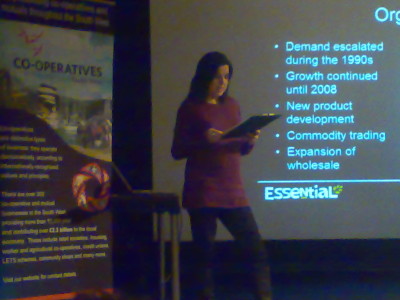
Photo of Eli Sarre

Eli Sarre from Essential Trading speaking at C-SW Annual Conference

Last Friday (11 November 2011), I was at the Cooperatives-SW annual conference at the Cube Cinema in Bristol, titled Growing Your Co-operative and sponsored by the Co-operative Membership South and West. It was another sold-out event, featuring headline talks from Co-op Party member and Labour MP Kerry McCarthy, Eli Sarre of Essential Trading worker co-op (pictured), Carole Theyer of Sparks Inc and Jim Pettipher from Co-operative Futures. There were also some great workshops I went to a finance workshop led by Ian Rothwell from Co-operative and Community Finance and a regulations one with Paul Martin of Kabin (details may appear on their event page) and a brilliant lunch from Runcible Spoon (and those of you who know me will know I have been livid with some co-op event lunches!) with some time to chat and network, although I also went to a fringe meeting about the RISE problems. The event concluded with the formal AGM of Co-operatives SW (electing a new chairperson and approving transfer to a new co-op corporation) as well as a bit more chat afterwards. I felt it was a great event and well worth my time being there. I m glad that some people from outside the co-op movement, from community businesses like the Strawberry Line Cafe and a few people considering joining or forming co-ops, were there and I hope it was good for them too.

Bdale Garbee: RF Immunity

We've had sporadic Altus Metrum customer reports about RF susceptibility issues with their TeleMetrum installations. In almost every case, these problems have been completely resolved by either making sure the system battery has sufficient charge before launch, or through the application of standard engineering techniques such as twisting wire pairs to reduce differential coupling. However, even when every technique we could think of had been applied, once in a while someone still had issues. Around the time of LDRS this year, the incidence of such reports seemed to increase. One customer, in particular, had an installation in which he virtually always saw continuous resets of the board once his 54mm airframe was put on a launch rail, and several customers reported seeing board resets during ejection charge firing. Keith and I saw a board reset during main charge firing happen in person at NCR's Oktoberfest, and with a couple days available to work together after that launch, we decided it was time to figure out what was really going on. Here's what we've learned. In bench testing, it quickly became clear that the problem was the 3.3 volt power supply rail getting pulled down far enough to reset the CPU. This most frequently happened during ejection charge firing, when the input of the LDO regulator is pulled down by the near-short presented by the e-match when a pyro FET is turned on. To keep the 3.3 volt rail voltage up during firing, we include a 100uF bulk capacitor on the regulator's output. In all of our prior bench testing, we never saw the 3.3 volt rail droop significantly. Clearly something had changed... or maybe several things had changed? The first thing I wondered about was whether the new Kalman filtering code, which requires more compute cycles from the processor, might be consuming enough more power to pull the rail down faster during charge firing. After poking around at it, though, we have no data to suggest the new code makes a measurable difference in power consumption. The next thing we pondered was that at least some of the e-matches we and others are using in the hobby now come from the fireworks industry, where it is apparently considered a feature for the match to retain continuity after firing. This means the input of the LDO gets held down for longer than with the e-matches we used to use and Quest Q2G2 igniters that open when fired. But that still didn't make sense as the root cause, as we chose the FET firing time such that even with a dead short across the igniter terminals, the 3.3 volt rail wouldn't be pulled down far enough to cause trouble during firing. One of the big changes between v1.0 and v1.1 on TeleMetrum was that the newer boards incorporate a better reset circuit. This helps ensure the GPS chip always comes up running at power on, which was a problem at temperature extremes with older boards. However, a side-effect of this change is that a v1.1 board will reset any time the 3.3 volt rail drops below 3.15 volts, whereas older boards didn't trip until a much lower voltage. So the recent increase in reports might just be related to more v1.1 boards being placed in service? While experimenting on the bench, we observed that injecting RF energy into the input of the LDO regulator had the effect of pulling down the output voltage, presumably because the internal reference source accumulates charge and is fooled into thinking the output is too high. Since our designs all have the power switch contacts ahead of the LDO, the wires going out to the switch and back are effectively an antenna... as are, to a lesser extent, the wires going to the e-matches. There is some variability from part to part in just how badly the LDO reacts. But by attaching a tuned length of wire as an antenna to the LDO input and playing around, we were finally able to reproduce the problem reliably on a test board at my bench! On further analysis, we realized that the output of the USB battery charger chip and the input of the LDO both expect a 1uF bypass cap to ground. At some point, those looked redundant and we eliminated one of the two. Unfortunately, we weren't internalizing the fact that the switch leads were between the two caps, and the one we left was on the output of the charger and not at the input of the LDO. Placing a suitable bypass cap right at the input of the LDO turns out to have a truly dramatic effect on RF immunity! Once we realized that RF getting into the LDO input was the problem, Keith pointed out that we used to see "noise" in the accelerometer data on earlier boards that was caused by the 3.3 volt rail moving slightly during radio transmit, which we fixed with a hardware change on v1.1. We are now convinced that this was at least partly related to RF coupling to the LDO input, not just the change in power consumption on the LDO output. We didn't realize what was going on in earlier testing because we often didn't have ematches wired up, so RF coupling was minimal. But going back to flights logged with v1.0 boards that included deployment, and studying the magnitude of the "steps" in acceleration data observed when the transmitter was on, Keith was able to compute the amount the 3.3 volt rail must have sagged if the real acceleration wasn't changing... which in some cases was as much as 180mV! We think this proves that RFI could cause the LDO to drop its output voltage below the reset controller set point on v1.1 boards. Based on these observations, I'm making two hardware changes for the next version of TeleMetrum (version 1.2), and Keith is also making a software change. We have tested all of these changes on real boards both on the bench and in test flights, and the net effect is a major improvement in the RF immunity of TeleMetrum. The first hardware change is moving to a slightly lower trip voltage on the reset controller. Instead of 3.15, the new part trips at 3.00 volts nominal. This gives us more "headroom" to tolerate 3.3 volt rail droop during charge firing, and will allow the board to operate longer on a given battery charge. This change is not relevant for v1.0 and prior. The second hardware change is adding an appropriate bypass capacitor right at the LDO input. This requires a PCB update, but it's possible for me to update existing production boards by adding an 0402 cap right across the appropriate pins on the regulator chip. The software change prevents our altimeters from turning on the radio transmitter while an ejection charge is firing. Since the RF transmitter draws substantial additional power, this should help keep the 3.3 volt rail from drooping. This may not really matter, but it feels like the right thing to do. This change will be part of our next stable firmware release. We think most TeleMetrum customers need not worry about these updates. But if you have seen odd resets on the rail or during ejection charge firing in flight with a TeleMetrum v1.1, feel free to contact me about updating your existing board to include these improvements.

Next.

Previous.