Search Results: "ina"

8 December 2015

Mark Brown: Maximising the efficiency of chained regulators

Linux v4.4 will include a cool new feature contributed by Sascha Hauer of Pengutronix which propagates voltages set on a regulator to the regulators that supply it (taking into account the minimum headroom that the child regulator needs). The original reason for implementing it was to allow us to set voltages through simple unregulated power switches but the cool bit is that we can also use this to save power in some systems. There are two standard types of voltage regulator, DCDCs which are very efficient but produce noisy output and LDOs which are much less efficient but a lot cheaper and simpler and produce much cleaner output. What a lot of systems do to avoid a lot of the inefficiency of LDOs is to use a DCDC to reduce the voltage from the main system power supply (eg, the battery) to something close to the minimum power supply for the LDOs in the system This means that most of the voltage reduction (which is what generates inefficiency) comes from the DCDC rather than the LDO but you still get the clean power supply from the LDO and can have several different output voltages from a single expensive DCDC. By managing the voltage we set on the DCDC at runtime depending on the LDO configurations we can maximise the power savings from this setup, putting as much of the work onto the DCDC as we can at any given moment. This has been at the back of my mind for a long time, I m really pleased to see it implemented. It s a pretty small change code wise and probably not worth implementing for any one system but when we do it in the core like this hopefully many systems will be able to use it and the effects will add up.

Vincent Sanders: I said it was wired like a Christmas tree

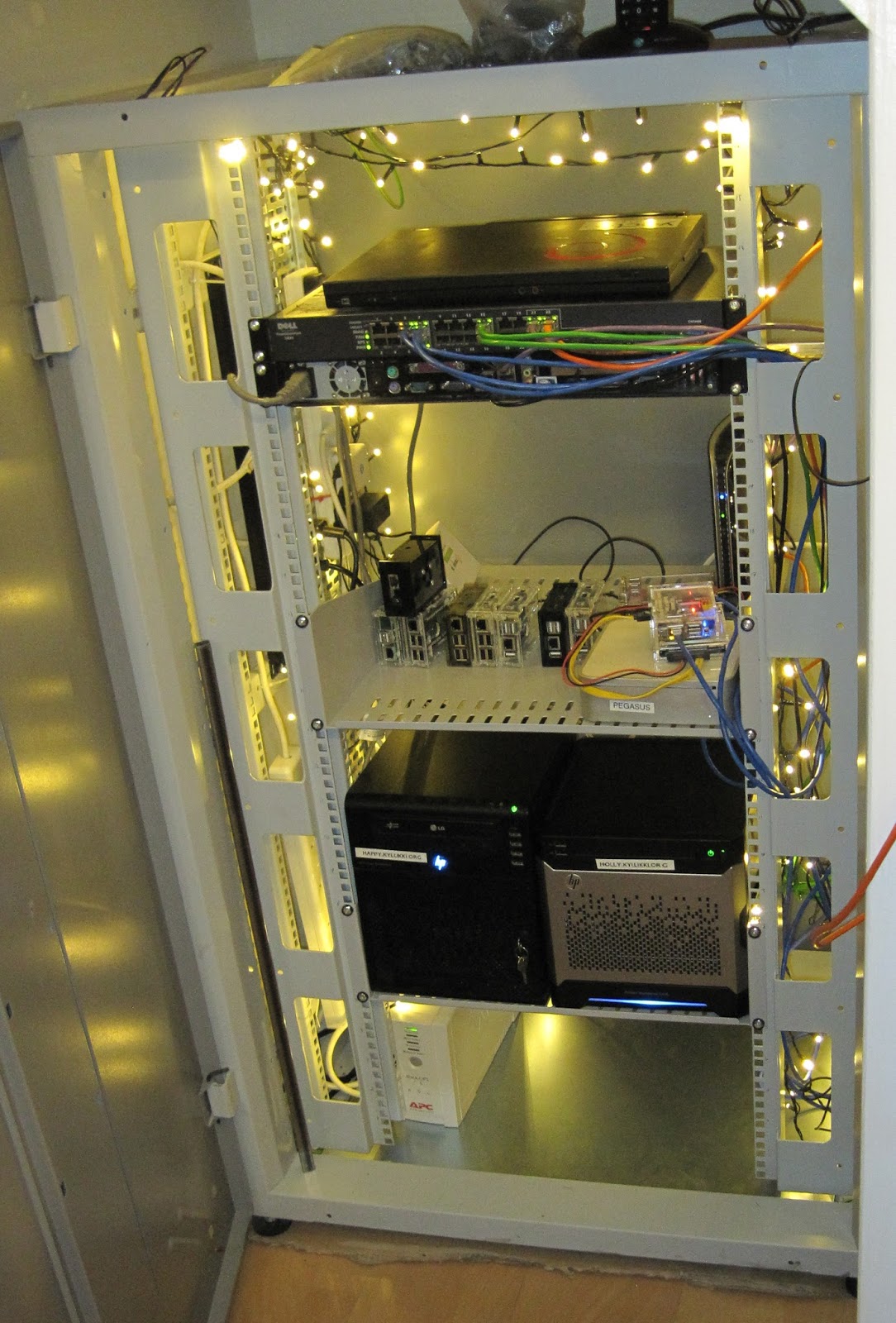
I have recently acquired a 27U high 19 inch rack in which I hope to consolidate all the computing systems in my home that do not interact well with humans.

My main issue is that modern systems are just plain noisy, often with multiple small fans whining away. I have worked to reduce this noise by using quieter components as replacements but in the end it is simply better to be able to put these systems in a box out of the way.

The rack was generously given to me by Andy Simpkins and aside from being a little dirty having been stored for some time was in excellent condition. While the proverbs "never look a gift horse in the mouth" and "beggars cannot be choosers" are very firmly at the front of my mind there were a few minor obstacles to overcome to make it fit in its new role with a very small budget.

The new home for the rack was to be a space under the stairs where, after careful measurement, I determined it would just fit. After an hour or two attempting to manoeuvre a very heavy chunk of steel into place I determined it was simply not possible while it was assembled. So I ended up disassembling and rebuilding the whole rack in a confined space.

The rack is 800mm wide IMRAK 1400 rather than the more common 600mm width which means it employs "cable reducing channels" to allow the mounting of standard width rack units. Most racks these days come with four posts in the corners to allow for longer kit to be supported front and back. This particular rack was not fitted with the rear posts and a brief call to the supplier indicated that any spares from them would be eyewateringly expensive (almost twice the cost of purchasing a new rack from a different supplier) so I had to get creative.

Shelves that did not require the rear rails were relatively straightforward and I bought two 500mm deep cantilever type from Orion (I have no affiliation with them beyond being a satisfied customer).

I took a trip to the local hardware store and purchased some angle brackets and 16mm steel square tube. From this I made support rails which means the racked kit has support to its rear rather than relying solely on being supported by its rack ears.

The next problem was the huge hole in the bottom of the rack where I was hoping to put the UPS and power switching. This hole is intended for use with raised flooring where cables enter from below, when not required it is filled in with a "bottom gland plate". Once again the correct spares for the unit were not within my budget.

Around a year ago I built several systems for open source projects from parts generously donated by Mythic Beasts (yes I did recycle servers used to build a fort). I still had some leftover casework from one of those servers so ten minutes with an angle grinder and a drill and I made myself a suitable plate.

The final problem I faced is that it is pretty dark under the stairs and while putting kit in the rack I could not see what I was doing. After some brief Googling I decided that all real rack lighting solutions were pretty expensive and not terribly effective.

At this point I was interrupted by my youngest son trying to assemble the Christmas tree and the traditional "none of the lights work" so we went off to the local supermarket to buy some bulbs. Instead we bought a 240 LED string for 10 (15usd) in the vague hope that next year they will not be broken.

I immediately had a light bulb moment and thought how a large number of efficient LED bulbs at a low price would be ideal for lighting a rack. So my rack is indeed both wired like and as a Christmas tree!

Now I just have to finish putting all the systems in there and I will be able to call the project a success.

Dirk Eddelbuettel: Rblpapi 0.3.2

The second update to the Rblpapi package (since the initial CRAN upload in August) is now available. Rblpapi connects R to the Bloomberg system, giving access to a truly vast array of time series data and custom calculations. This release brings a new subscribe() function for real-time data, written by Whit. Don't get too excited because R's single-threadedness places some limits of the usefulness of this--but it is still tremendously valuable for checking other data sources etc pp. Also included in this release are a ton of bug fixes, many contributed by Rademeyer -- see below for more details.
Changes in Rblpapi version 0.3.2 (2015-12-07)
  • A new subscribe() function supports live data subscription for a set of tickers and fields (#88).
  • In the beqs() example the correct date format is used (PR #85 by Rademeyer).
  • Both getTicks() and getBars() now check the start and end times for proper Datetime class.
  • The getBars() function now also return the value traded (request of #89).
  • An error in the documentation for bdh was corrected (PR #93 by Rademeyer closing #85).
  • The beqs() function is now more robust with respect to empty return columns (PR #100 by Rademeyer fixing ticket #99).
  • The getBars() function now uses a single (named) vector options to pass optional values to the underlying function (PR #105 updating PR #48 and fixing #47).
  • When R is built with libcurl support, it used to download the build-time library and headers; otherwise curl is used. This avoids an issue on OS X where curl is insufficient.
Courtesy of CRANberries, there is also a diffstat report for the this release. As always, more detailed information is on the Rblpapi page. Questions, comments etc should go to the issue tickets system at the GitHub repo.

This post by Dirk Eddelbuettel originated on his Thinking inside the box blog. Please report excessive re-aggregation in third-party for-profit settings.

6 December 2015

Guido G nther: Debian Fun in November 2015

Debian LTS November was the seventh month I contributed to Debian LTS under the Freexian umbrella. In total I spent ten hours working on: Other Debian stuff

5 December 2015

Lunar: Everyone can be a target

My flight from Athens where I had the pleasure to attend the first reproducible world summit landed at the scheduled time in Paris (CDG). While people were getting their bags and putting their coats on, one member of the cabin crew announced that a police control will take place outside the plane and that we should have ready identity documents. My seat was in the back of the plane, so I had time to wait in the cold of the jetway while all passengers were controlled one after the other. Three cops were set up right at the entrance of the terminal. One was taking cards or passports and looking at people's face. He then passed it to another cop in front of a suitcase that seemed to contain a scanner and a computer. The third one was just standing against the wall watching. When it was my turn, after scanning my passport, the cop had this nice gesture where she started to move her hand holding the passport toward me just like she had just did a hundred times before pulling it backward when the result appeared on the screen. I had the confirmation that I was registered as a dangerous political activist in 2012 when David Dufresne published Magasin G n ral. One report from the interior intelligence service from 2008 was leaked to promote the book. My name had not been properly redacted from the very first version that went online and was associated with a political self-organized space in Dijon. Some Debian Developers had the pleasure to visit that space in 2005, 2006, or 2007. The report was full of mistakes, like almost all police files, so I don't want to comment on it. The good news is that since then, I have stopped being paranoid. I knew, and thus could take appropriate precautions. Just like every time I have to approach an airport, all my (encrypted) electronic devices were turned off. I had shaved a couple hours before. I know a lawyer ready to represent me. I am fully aware that it's best to say as little as possible. Although it has been a while since I had such a blatant confirmation that I was still a registered anarchist. It should not be a surprise though. Once you are in, there's no way out. I was then asked to step aside while they proceeded with the rest of the queue. I put my backpack down and leaned against the wall. Once they were over, one of the cops asked me to follow him. We walked through the corridors to reach the office of the border police. While we were walking, they asked me a series of questions. I'm not mentioning the pauses in between, but here's what I can remember:
Do you have a connection?
No.
Are you going to Paris?
To my parents' in the suburbs.
How long have you been staying in Greece?
5 days.
flipping the pages of my passport And you come back from the U.S. in Feb. 2015?
No, that was the maximum stay. I was there in August 2014.
Why were you in Greece? Vacations?
Work. I was at a meeting.
What do you do?
Free software.
What is that?
I am a developper.
Oh, computers.
Yes.
Is that why you also were in the US?
Yes, it was another conference.
And so you travel because of that. That's nice.

Are you a freelancer?
I work with a coop, but yes.
The cop also commented that they had to do some simple checks and that they would then let me go as I was coming back. I did not trust this but said nothing. When then passed through a door where the cop had to use their badge to unlock it. I was asked to sit on a chair in the corridor between two offices (as far as I could see). I could hear one cop explaining the situation to the next: Il a une fiche. Ah, une fiche. They seemed quite puzzled that I was not controlled when I flew out on Monday. After some minutes, another cop came back asking me for my boarding pass. Some more minutes later, he came back asking me if the address on my passport was still valid. I replied no . They gave me a piece of paper asking me for my current address, a phone number and an email address. As these information are all easy to find, I thought it was easier to comply. I gave my @irq7.fr address that I use for all public administrations. When the cop saw it, he asked:
What is it?
I don't understand.
Is it your company?
It is a non-profit.
He gave me my passport back and showed me the way out. (I will spare you details on the discussion I had to listen while waiting between two cops about how one loved to build models of military weapons used in wars against communism because of his origins. And that he was pissed off because fucking Europe disallowed some (toxic) paints he was used to.) To the best of my understanding, what happened is that they made a phone call and were just asked to update my personal details by the intelligence service. I don't know, but I'm left to wonder if all these people might just have been controlled because I was on the flight. All-in-all this didn't take too long: one hour after leaving the plane I was on the platform for the regional trains. The cops stayed polite the whole time. I am privileged: French citizen, white, able to speak French with a teacher accent. I am pretty sure it would have not been that good if I had been displaying a long beard or a djellaba. I took the time to document this because I know too many people who think that what the French government is doing doesn't concern them. It does. It's been a couple of years now that antiterrorism is how governments keep people in check. But we are reaching a whole new level now. We are talking about cops keeping their guns while off duties, house searches at any hours without judge oversight, and the government wants to change the constitution to make the state of emergency permanent. We've seen so many abuses in just two weeks. It will not go well. Meanwhile, instead of asking themselves why young people are killing others and themselves, state officials prefer dropping bombs. Which will surely prevent people ready to die from using suicidal tactics, right? We are at the dawn of an environmental crisis that will end humanity. Every human on this planet is concerned. People get beaten up when they march to pressure governments to do something about it. We need to unite and resist. And yes, we are going to get hurt but freedom is not free.
Gunnar Wolf: Scientific resarch and a moral stand should go hand in hand

During the last few days, I found several references to a beautiful just-published paper, which I hope everybody reads: The Moral Character of Cryptographic Work, by Phillip Rogaway; Cryptology ePrint Report 2015/1162, published on December 1st this year. It is more an academic essay than most crypto-related papers, and a long one at that (46 pages, packed with references and anecdotal notes). But it is surprisingly easy to read. I am sitting in front of my computer while my students work on their final exam, and I have got over half way through the text; earlier today I looked at the quick presentation (as this work was presented by Rogaway at the Asiacrypt 2015 as an invited talk), and just loved it. Now, I know most of the people reading my blog have a moral stand on their work (after all, I expect most of you to be committed to Free Software just as I am, and that is a tremendous political statement). We are also more a practice community than an academic/scientific one. But many of us dwell on several projects and hold more than one hats in life through which we are defined. This paper/essay is really clicking with me, and it deeply resonates with the justification I presented when I joined the Masters on Security Engineering and Information Technologies program which I'm halfway through. Computer security does not exist in a void, and does not exist just for itself. As professionals, we have a mission to fulfill in society, and that will then shape how society evolves. So, I invite everybody to at least take a casual look at this paper. I hope you enjoy it as much as I did, and I hope it changes people's hearts and career decisions.

4 December 2015

Joachim Breitner: HaL 10

Today I had the honour to hold my first invited talk: I was the keynote speaker at the tenth Haskell in Leipzig workshop. I chose to present how I used the MonadFix type class to conveniently and by-construction-correctly calculate offsets while serialising to a binary data format in the implementation of tttool. Johannes Waldmann could not resist to point out that MonadFix was already a topic at the very first HaL meeting nine years ago, but nevertheless I think that my live-coded slide-less talk was quite suitable for the given audience of roughly 55 attendees. I have uploaded a transcript of this talk.

Lunar: Why is Jack so angry?

Last summer, Innuendo Studios made a series of 6 short videos trying to understand why would anyone get involved in a coordinated harrasment campaign. The recent articles making straw man arguments and gross mischaracterization of the actions of people trying to grow the pool of free software contributors reminded me of these videos, especially the fifth episode which describes why some people get so angry when others point out that maybe the general homogeneity of backgrounds is also related to how we treat people. Guess we can transpose one of the explanation in the video to free software communities:
Bad People do bad things; a sexist is a wife-beater or sexual assailant; I am neither; therefore I am a Good Person and the things I do are good; I work on free software where people report sexist biases; therefore they say I am a wife-beater or sexual assailant; this is a false and ridiculous claim; therefore they are bad.
This slightly helps to better understand why some people would attack efforts that don't concern them so strongly. Sadly, it doesn't help much with what we could do about it. Perhaps we can help them understand that they might be just as biased as everyone else living in an institutionally sexist and racist society. This does not make them bad people. It's just something we all need to keep in mind to improve the situation. (Also, be sure to read the follow-up post if you watch the series until the last episode.) Thanks to Nicolas Dandrimont for his comments and suggestions.

Dirk Eddelbuettel: RcppArmadillo 0.6.200.3.0

armadillo image The regular monthly upstream Armadillo update gave us the second update in the 6.* series: version 6.300.2. This was rolled into RcppArmadillo 0.6.300.2 which was once again tested against all reverse-dependencies before being sent to CRAN and Debian where the new packages arrived yesterday. Besides the changes by Conrad, this version of RcppArmadillo also contains a really nice pull request by Nathan Russell which adds input conversion support for Armadillo Cube types, templated to all common inputs, and along with proper unit tests. Thanks! Armadillo is a powerful and expressive C++ template library for linear algebra aiming towards a good balance between speed and ease of use with a syntax deliberately close to a Matlab. This release brings the following changes:
Changes in RcppArmadillo version 0.6.300.2.0 (2015-12-03)
  • Upgraded to Armadillo 6.300.2 ("Flying Spaghetti Monster")
    • expanded solve() to find approximate solutions for rank-deficient systems
    • faster handling of non-contiguous submatrix views in compound expressions
    • added .for_each() to Mat, Row, Col, Cube and field classes
    • added rcond() for estimating the reciprocal condition number
    • fixes for spsolve(), eigs_sym(), eigs_gen(), svds()
  • Added support for Cube types via as<> converters (PR #64 by Nathan Russell, fixing #63 and #42)
Courtesy of CRANberries, there is also a diffstat report for the most recent CRAN release. As always, more detailed information is on the RcppArmadillo page. Questions, comments etc should go to the rcpp-devel mailing list off the R-Forge page.

This post by Dirk Eddelbuettel originated on his Thinking inside the box blog. Please report excessive re-aggregation in third-party for-profit settings.

Dirk Eddelbuettel: RQuantLib 0.4.2: Now with intra-day times

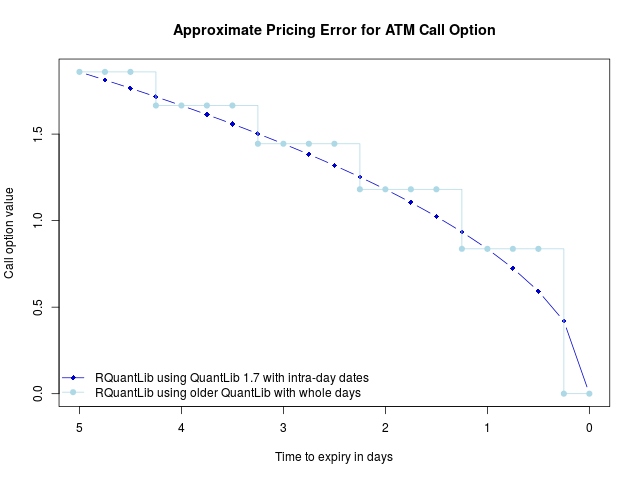
A new minor release of RQuantLib was released onto CRAN and into Debian. It takes advantages of some changes from last week's QuantLib release 1.7. 500 Rcpp packages Particularly noteworthy is the addition of support for intra-daily times in QuantLib based on work by Klaus Spanderen. If QuantLib was configured with the -enable-intraday option, we use the higher granularity of the time representation in all option pricers and implied volatility calculations. The impact of this feature is illustrated in the graph below. The graph shows the valuation of a Call option, European expiry, struck at the money with sensible short rate, dividend yield and volatility. We vary the time to expiry from five days to zero in steps of a quarter day. In darker blue is the correct valuation declining in parabolic shape. In lighter blue is what we get with QuantLib up to release 1.6, or newer releases configured without intra-day time support: an ugly step function that is off, and increasingly so we approach the expiration. Which leads to an appeal: a volunteer is needed to update the QuantLib 1.7 build for Windows. Jeroen tried, but ran into a snag and out of time. If you can help, please get in touch to Jeroen and myself. We suspect that the largest part of RQuantLib users relies on the prebuilt binaries from CRAN, and it would nice to have these updated to the current version of QuantLib. The full changes are detailed below.
Changes in RQuantLib version 0.4.2 (2015-12-03)
  • Changes in RQuantLib code:
    • Intra-day times are now available if QuantLib 1.7 or later is used, and has been configured with --enable-intraday
    • New helper functions getQuantLibVersion() and getQuantLibCapabilties()
    • New package startup code detects and warns about outdated QuantLib versions, or missing intra-day capability, unless not interactive.
    • The missing Monthly parameter has been added to matchFrequency (fixing issue ticket #19)
Courtesy of CRANberries, there is also a diffstat report for the this release. As always, more detailed information is on the RQuantLib page. Questions, comments etc should go to the rquantlib-devel mailing list off the R-Forge page. Issue tickets can be filed at the GitHub repo.

This post by Dirk Eddelbuettel originated on his Thinking inside the box blog. Please report excessive re-aggregation in third-party for-profit settings.

3 December 2015

Bits from Debian: Software Freedom Conservancy needs your support!

Software Freedom Conservancy Logo "Software Freedom Conservancy helps promote, improve, develop, and defend Free, Libre, and Open Source Software (FLOSS) projects. Conservancy provides a non-profit home and infrastructure for FLOSS projects.", that is how Software Freedom Conservancy defines itself. Organizations like Conservancy allow free software developers to focus on what they do the best by doing copyleft enforcement, taking care of legal aspects and provide many services to its project members. Last August, Debian and Conservancy announced a partnership and formed the Copyright Aggregation Project where, among other things, Conservancy will be able to hold copyrights for some Debian works and ensure compliance with copyleft so that those works remain in free software. Recently, Conservancy launched a major fundraising campaign and needs more individual supporters to gain more sustainable and independent funding. This will allow the Conservancy to continue its efforts towards convincing more companies to comply with free software licenses such as the GPL and take legal actions when dialogue turns out to be unsuccessful. Conservancy needs your support now, more than ever! Many Debian Developers and Contributors have already become Conservancy supporters. Please consider signing up as a supporter on https://sfconservancy.org/supporter/!

Arturo Borrero Gonz lez: current status of HA stack on Debian


Let's analyse the current status of the HA (high availability) stack on Debian.

For me, the two most important packages are corosync and pacemaker.
It is widely known that Debian jessie was released without these two packages in shape.

But, why?
Problem 1One of the main problems was with the relationship between pacemaker and libqb.
In short, a libqb issue prevented pacemaker to be built for Debian jessie. And that wasn't fixed in time for the Debian jessie stable release.
You can read the Debian bug #768618 [pacemaker: FTBFS in jessie: build-dependency not installable: libqb-dev (>= 0.16.0.real)] to know a bit more about the issue.
Problem 2
While at it, the corosync package was in very bad shape.
To get an idea of what I mean for bad shape, just look at the size of the changelog of the first try to fix the package, almost 90 lines long.
Problem 3
Perhaps the most important problem: the Debian team behind the HA stack seems inactive.

This was sent by one of the members, 19 Jan 2015:
[...]
I wonder if there are any active members of the Debian linux-ha team.
[...]

So, there is clearly lack of manpower, lack of interest in maintaining the stack.
I'm sure the first 2 problems could have been resolved in time if the Debian team were active.
It's Debian! How is this possible!?I have asked that myself several times. Debian is a community and collaborative project. This means that the quality of the product (the OS itself) is directly related to the amount of effort spent on it (by people that in most cases aren't being paid for the task).
I believe that in such specific pieces of software, we require a bit more push from companies which are using it for their own benefit as well.

Also, perhaps the Debian QA team may step in and do something about the situation, let's say simply distributing a big REQUEST FOR HELP alert in all official Debian channels.
So, what if I need to run now corosync+pacemaker in Debian?
I'm sorry, you should stick to Debian wheezy :-(

Fortunately, the versions shipped in Debian wheezy are fine. Unfortunately, Debian wheezy contains lots of old software (such as the kernel).
What should I expect for Debian stretch?
Well, some good news: corosync and libqb have been already fixed and they look good.
The pacemaker package is still lacking the needed updates, but there are some people [slowly] working on it.
I myself have contributed a bit: tested some related packages, opened some bugs, and so on. See #801853 and #801870 for instance.

Note that the development status is not easy to follow. Among other things, the 'official' git packaging repos aren't being used.

From the user/sysadmin point of view, any important news will be reflected in the Debian package trackers. Here are links to both:
(BTW the new Debian tracker: what a nice tool)
I want to contribute!By now, I recommend you to head to the Debian IRC channel #debian-ha

Dirk Eddelbuettel: RcppCCTZ 0.0.2 -- now with Solaris support

Following on yesterday's announcement of RcppCCTZ, what is the only thing better than another date, time, or timezones library package? One that works on Solaris too :) Bradley White from CCTZ upstream spotted the failed compilation on the machine in Oxford and suggested a quick fix. Jeroen quickly tested what I had put into a branch, and there we have it: version 0.0.2 which now builds everywhere. Changes (for both releases) are summarized here:
Changes in version 0.0.2 (2015-12-02)
  • Additional #ifdef statements suggested by Bradley White in CCTZ ticket #5 permitting compilation on Solaris with thanks to Jeroen for testing our branch.
Changes in version 0.0.1 (2015-12-01)
  • Initial CRAN upload.
  • Package is functional and provides examples.
We now also have a diff to the previous version thanks to CRANberries. More details, issue tickets etc at the GitHub repository.

This post by Dirk Eddelbuettel originated on his Thinking inside the box blog. Please report excessive re-aggregation in third-party for-profit settings.

2 December 2015

Colin Watson: SSH SHA-2 support in Twisted

Launchpad operates a few SSH endpoints: bazaar.launchpad.net and git.launchpad.net for code hosting, and upload.ubuntu.com and ppa.launchpad.net for uploading packages. None of these are straightforward OpenSSH servers, because they don t give ordinary shell access and they authenticate against users SSH keys recorded in Launchpad; both of these are much easier to do with SSH server code that we can use in library form as part of another service. We use Twisted for several other tasks where we need event-based networking code, and its conch package is a good fit for this. Of course, this means that it s important that conch keeps up to date with the cryptographic state of the art in other SSH implementations, and this hasn t always been the case. OpenSSH 7.0 dropped support for some old algorithms, including disabling the 1024-bit diffie-hellman-group1-sha1 key exchange method at run-time. Unfortunately, this also happened to be the only key exchange method that Launchpad s SSH endpoints supported (conch supported the slightly better diffie-hellman-group-exchange-sha1 method as well, but that was disabled in Launchpad due to a missing piece of configuration). SHA-2 support was clearly called for, and the fact that we had to get this sorted out in conch first meant that everything took a bit longer than we d hoped. In Twisted 15.5, we contributed support for several conch improvements: Between them and with some adjustments to the lazr.sshserver package we use to glue all this together to add support for DH group exchange, these are enough to allow us not to rely on SHA-1 at all, and these improvements have now been rolled out to all four endpoints listed above. I ve thus also uploaded OpenSSH 7.1 packages to Debian unstable. If you also run a Twisted-based SSH server, upgrade it now! Otherwise it will be harder for users of recent OpenSSH client versions to use your server, and for good reason.

Andrea Veri: Three years and counting

It s been a while since my last what s been happening behind the scenes e-mail so I m here to report on what has been happening within the GNOME Infrastructure, its future plans and my personal sensations about a challenge that started around three (3) years ago when Sriram Ramkrishna and Jeff Schroeder proposed my name as a possible candidate for coordinating the team that runs the systems behind the GNOME Project. All this followed by the official hiring achieved by Karen Sandler back in February 2013. The GNOME Infrastructure has finally reached stability both in terms of reliability and uptime, we didn t have any service disruption this and the past year and services have been running smoothly as they were expected to in a project like the one we are managing. As many of you know service disruptions and a total lack of maintenance were very common before I joined back in 2013, I m so glad the situation has dramatically changed and developers, users, passionates are now able to reach our websites, code repositories, build machines without experiencing slowness, downtimes or
unreachability. Additionally all these groups of people now have a reference point they can contact in case they need help when coping with the infrastructure they daily use. The ticketing system allows users to get in touch with the members of the Sysadmin Team and receive support right away within a very short period of time (Also thanks to Pagerduty, service the Foundation is kindly sponsoring) Before moving ahead to the future plans I d like to provide you a summary of what has been done during these roughly three years so you can get an idea of why I define the changes that happened to the infrastructure a complete revamp:
  1. Recycled several ancient machines migrating services off of them while consolidating them by placing all their configuration on our central configuration management platform ran by Puppet. This includes a grand total of 7 machines that were replaced by new hardware and extended warranties the Foundation kindly sponsored.
  2. We strenghten our websites security by introducing SSL certificates everywhere and recently replacing them with SHA2 certificates.
  3. We introduced several services such as Owncloud, the Commits Bot, the Pastebin, the Etherpad, Jabber, the GNOME Github mirror.
  4. We restructured the way we backup our machines also thanks to the Fedora Project sponsoring the disk space on their backup facility. The way we were used to handle backups drastically changed from early years where a magnetic tape facility was in charge of all the burden of archiving our data to today where a NetApp is used together with rdiff-backup.
  5. We upgraded Bugzilla to the latest release, a huge thanks goes to Krzesimir Nowak who kindly helped us building the migration tools.
  6. We introduced the GNOME Apprentice program open-sourcing our internal Puppet repository and cleansing it (shallow clones FTW!) from any sensitive information which now lives on a different repository with restricted access.
  7. We retired Mango and our OpenLDAP instance in favor of FreeIPA which allows users to modify their account information on their own without waiting for the Accounts Team to process the change.
  8. We documented how our internal tools are customized to play together making it easy for future Sysadmin Team members to learn how the infrastructure works and supersede existing members in case they aren t able to keep up their position anymore.
  9. We started providing hosting to the GIMP and GTK projects which now completely rely on the GNOME Infrastructure. (DNS, email, websites and other services infrastructure hosting)
  10. We started providing hosting not only to the GIMP and GTK projects but to localized communities as well such as GNOME Hispano and GNOME Greece
  11. We configured proper monitoring for all the hosted services thanks to Nagios and Check-MK
  12. We migrated the IRC network to a newer ircd with proper IRC services (Nickserv, Chanserv) in place.
  13. We made sure each machine had a configured management (mgmt) and KVM interface for direct remote access to the bare metal machine itself, its hardware status and all the operations related to it. (hard reset, reboot, shutdown etc.)
  14. We upgraded MoinMoin to the latest release and made a substantial cleanup of old accounts, pages marked as spam and trashed pages.
  15. We deployed DNSSEC for several domains we manage including gnome.org, guadec.es, gnomehispano.es, guadec.org, gtk.org and gimp.org
  16. We introduced an account de-activation policy which comes into play when a contributor not committing to any of the hosted repositories at git.gnome.org since two years is caught by the script. The account in question is marked as inactive and the gnomecvs (from the old cvs days) and ftpadmin groups are removed.
  17. We planned mass reboots of all the machines roughly every month for properly applying security and kernel updates.
  18. We introduced Mirrorbrain (MB), the mirroring service serving GNOME and related modules tarballs and software all over the world. Before introducing MB GNOME had several mirrors located in all the main continents and at the same time a very low amount of users making good use of them. Many organizations and companies behind these mirrors decided to not host GNOME sources anymore as the statistics of usage were very poor and preferred providing the same service to projects that really had a demand for these resources. MB solved all this allowing a proper redirect to the closest mirror (through mod_geoip) and making sure the sources checksum matched across all the mirrors and against the original tarball uploaded by a GNOME maintainer and hosted at master.gnome.org.
I can keep the list going for dozens of other accomplished tasks but I m sure many of you are now more interested in what the future plans actually are in terms of where the GNOME Infrastructure should be in the next couple of years. One of the main topics we ve been discussing will be migrating our Git infrastructure away from cgit (which is mainly serving as a code browsing tool) to a more complete platform that is surely going to include a code review tool of some sort. (Gerrit, Gitlab, Phabricator) Another topic would be migrating our mailing lists to Mailman 3 / Hyperkitty. This also means we definitely need a staging infrastructure in place for testing these kind of transitions ideally bound to a separate Puppet / Ansible repository or branch. Having a different repository for testing purposes will also mean helping apprentices to test their changes directly on a live system and not on their personal computer which might be running a different OS / set of tools than the ones we run on the GNOME Infrastructure. What I also aim would be seeing GNOME Accounts being the only authentication resource in use within the whole GNOME Infrastructure. That means one should be able to login to a specific service with the same username / password in use on the other hosted services. That s been on my todo list for a while already and it s probably time to push it forward together with Patrick Uiterwijk, responsible of Ipsilon s development at Red Hat and GNOME Sysadmin. While these are the top priority items we are soon receiving new hardware (plus extended warranty renewals for two out of the three machines that had their warranty renewed a while back) and migrating some of the VMs off from the current set of machines to the new boxes is definitely another task I d be willing to look at in the next couple of months (one machine (ns-master.gnome.org) is being decommissioned giving me a chance to migrate away from BIND into NSD). The GNOME Infrastructure is evolving and it s crucial to have someone maintaining it. On this side I m bringing to your attention the fact the assigned Sysadmin funds are running out as reported on the Board minutes from the 27th of October. On this side Jeff Fortin started looking for possible sponsors and came up with the idea of making a brochure with a set of accomplished tasks that couldn t have been possible without the Sysadmin fundraising campaign launched by Stormy Peters back in June 2010 being a success. The Board is well aware of the importance of having someone looking at the infrastructure that runs the GNOME Project and is making sure the brochure will be properly reviewed and published. And now some stats taken from the Puppet Git Repository:
$ cd /git/GNOME/puppet && git shortlog -ns
3520 Andrea Veri
506 Olav Vitters
338 Owen W. Taylor
239 Patrick Uiterwijk
112 Jeff Schroeder
71 Christer Edwards
4 Daniel Mustieles
4 Matanya Moses
3 Tobias Mueller
2 John Carr
2 Ray Wang
1 Daniel Mustieles Garc a
1 Peter Baumgarten
and from the Request Tracker database (52388 being my assigned ID):
mysql> select count(*) from Tickets where LastUpdatedBy = '52388';
+----------+
  count(*)  
+----------+
  3613  
+----------+
1 row in set (0.01 sec)
mysql> select count(*) from Tickets where LastUpdatedBy = '52388' and Status = 'Resolved';
+----------+
  count(*)  
+----------+
  1596  
+----------+
1 row in set (0.03 sec)
It s been a long run which made me proud, for the things I learnt, for the tasks I ve been able to accomplish, for the great support the GNOME community gave me all the time and most of all for the same fact of being part of the team responsible of the systems hosting the GNOME Project. Thank you GNOME community for your continued and never ending backing, we daily work to improve how the services we host are delivered to you and the support we receive back is fundamental for our passion and enthusiasm to remain high!

Daniel Pocock: Is giving money to Conservancy the best course of action?

There has been a lot of discussion lately about Software Freedom Conservancy's fundraiser. Various questions come to my mind: Is this the only way to achieve goals such as defending copyright? (There are other options, like corporate legal insurance policies) When all the options are compared, is Conservancy the best one? Maybe it is, but it would be great to confirm why we reached that conclusion. Could it be necessary to choose two or more options that complement each other? Conservancy may just be one part of the solution and we may get a far better outcome if money is divided between Conservancy and insurance and something else. What about all the other expenses that developers incur while producing free software? Many other professionals, like doctors, do work that is just as valuable for society but they are not made to feel guilty about asking for payment and reimbursement. (In fact, for doctors, there is no shortage of it from the drug companies). There seems to be an awkwardness about dealing with money in the free software world and it means many projects continue to go from one crisis to the next. Just yesterday on another mailing list there was discussion about speakers regularly asking for reimbursement to attend conferences and at least one strongly worded email appeared questioning whether people asking about money are sufficiently enthusiastic about free software or if they are only offering to speak in the hope their trip will be paid. The DebConf team experienced one of the more disappointing examples of a budget communication issue when developers who had already volunteered long hours to prepare for the event then had to give up valuable time during the conference to wash the dishes for 300 people. Had the team simply insisted that the high cost of local labor was known when the country was selected then the task could have been easily outsourced to local staff. This came about because some members of the community felt nervous about asking for budget and other people couldn't commit to spend. Rather than stomping on developers who ask about money or anticipate the need for it in advance, I believe we need to ask people if money was not taboo, what is the effort they could contribute to the free software world and how much would they need to spend in a year for all the expenses that involved. After all, isn't that similar to the appeal from Conservancy's directors? If all developers and contributors were suitably funded, then many people would budget for contributions to Conservancy, other insurances, attending more events and a range of other expenses that would make the free software world operate more smoothly. In contrast, the situation we have now (for event-related expenses) is that developers funding themselves or with tightly constrained budgets or grants often have to spend hours picking through AirBNB and airline web sites trying to get the best deal while those few developers who do have more flexible corporate charge cards just pick a convenient hotel and don't lose any time reading through the fine print to see if there are charges for wifi, breakfast, parking, hidden taxes and all the other gotchas because all of that will be covered for them. With developer budgets/wishlists documented, where will the money come from? Maybe it won't appear, maybe it will. But if we don't ask for it at all, we are much less likely to get anything. Mozilla has recently suggested that developers need more cash and offered to put $1 million on the table to fix the problem, is it possible other companies may see the benefit of this and put up some cash too? The time it takes to promote one large budget and gather donations is probably far more efficient than the energy lost firefighting lots of little crisis situations. Being more confident about money can also do a lot more to help engage people and make their participation sustainable in the long term. For example, if a younger developer is trying to save the equivalent of two years of their salary to pay a deposit on a house purchase, how will they feel about giving money to Conservancy or paying their own travel expenses to a free software event? Are their families and other people they respect telling them to spend or to save and if our message is not compatible with that, is it harder for us to connect with these people? One other thing to keep in mind is that budgeting needs to include the costs of those who may help the fund-raising and administration of money. If existing members of our projects are not excited about doing such work we have to be willing to break from the "wait for a volunteer or do-it-yourself" attitude. There are so many chores that we are far more capable of doing as developers that we still don't have time for, we are only fooling ourselves if we anticipate that effective fund-raising will take place without some incentives going back to those who do the work.

Russ Allbery: podlators 4.01

The previous release, switching to Module::Build, created a circular dependency with Module::Build itself with older versions of Perl. I pondered various ways to get around this, since I'm no longer a fan of ExtUtils::MakeMaker, but I finally decided that I was being silly. So podlators now just uses ExtUtils::MakeMaker it does support the new metadata keys these days rather than trying to support two separate build systems. (ExtUtils::MakeMaker is required for Perl core integration.) This release also didn't fix the problems with Term::Cap 1.16 in particular (although it worked with 1.17). That's also now fixed in this release by ensuring that Pod::Text::Termcap doesn't override an existing TERMPATH environment variable setting, something it shouldn't have been doing in the first place. You can get the latest release from the podlators distribution page.

Dirk Eddelbuettel: RcppCCTZ 0.0.1

A new package! A couple of weeks ago folks at Google released CCTZ: a C++ library for translating between absolute and civil times using the rules of a time zone. It requires only a proper C++11 compiler and the standard IANA time zone data base which standard Unix, Linux, OS X, ... computers tend to have in /usr/share/zoneinfo. And as the world needs nothing more than additional date, time, or timezones libraries, I started to quickly create a basic R wrapper package. This stalled as the original version of CCTZ used an __int128 for extended precision. That is not only not portable, but also prohibits compilation on baby computers still running a 32 OS (such as my trusted X1 laptop merrily plugging along with 4 gb of ram under Linux). Hence I filed an issue ticket which, lo and behold, got resolved two days ago. And so now we have a shiny new RcppCCTZ package on CRAN in a very basic version 0.0.1. It happily runs all the original examples from CCTZ as e.g. this one:
// from examples/hello.cc
//
// [[Rcpp::export]]
int helloMoon()  
    cctz::TimeZone syd;
    if (!cctz::LoadTimeZone("Australia/Sydney", &syd)) return -1;
    // Neil Armstrong first walks on the moon
    const auto tp1 = cctz::MakeTime(1969, 7, 21, 12, 56, 0, syd);
    const std::string s = cctz::Format("%F %T %z", tp1, syd);
    Rcpp::Rcout << s << "\n";
    cctz::TimeZone nyc;
    cctz::LoadTimeZone("America/New_York", &nyc);
    const auto tp2 = cctz::MakeTime(1969, 7, 20, 22, 56, 0, nyc);
    return tp2 == tp1 ? 0 : 1;
 
which results in
R> library(RcppCCTZ)
R> helloMoon()
1969-07-21 12:56:00 +1000
[1] 0
R>
indicating that the two civil times in fact correspond to the same absolute times when Armstrong walked on the moon. If you want to learn more about CCTZ, there was a corresponding talk CppCon (Youtube, Slides). I hope this provides a starting point for some new interesting computation on time from R. Collaboration welcome via the RcppCCTZ GitHub repo.

This post by Dirk Eddelbuettel originated on his Thinking inside the box blog. Please report excessive re-aggregation in third-party for-profit settings.

1 December 2015

Scott Kitterman: Debian LTS Work November 2015

This was my seventh month as a Freexian sponsored LTS contributor. I was assigned 8 hours for the month of November. As I did last month, I worked on review and testing of the proposed MySQL 5.5 packages for squeeze-lts and did a bit more work on Quassel. It has been suggested that maybe we ought to just EOL Quassel since backporting the necessary fixes is so complicated. I think they may be right, but I haven t quite given up yet. I reviewed CVE-2015-6360 for SRTP and my assessment was that squeeze-lts was not affected (same for the other Debian releases while I was at it). I published one security update, it was for libphp-snoopy. This resolves the outstanding security issues by updating to the newest version as was done for all other Debian releases. Finally, in the interest of getting better support in tools for Debian LTS, I came up with a patch for the pull-debian-source[1] script in ubuntu-dev-tools so that it will download Debian LTS packages correctly. Although it took a bit of investigating, the patch turned out to be very simple. I filed bug #806749. I also started looking at the distro-info package (thinking I d need it updated to fix pull-debian-source, which turned out not to be the case), but didn t finish it yet. I plan to work on that this month. [1] Even though this is in ubuntu-dev-tools and not devscripts, there s really nothing Ubuntu specific about it.

Laura Arjona: Software Freedom Conservancy supporter

I think it s important that organizations as Software Freedom Conservancy exist.
They provide a non-profit home, infrastructure, and advice for FLOSS projects. They take care that the will of the project members, choosing free software licenses, is respected by third parties. They care about all the rest so free software contributors can focus in improving the software itself. They have an agreement with the Debian community to protect the freedoms that Debian Developers provide to the Debian end users (and derivative distributions). So I decided to join as supporter. I m happy that this week there is a matching fund so my donation will count double. I hope that many others join too, so the organization s voice and action continues loyal to their goals and representative of all the projects (wether big or small) under their umbrella. This way (small donations from many individuals as funding model), no single or few actors can use their big money as pressure to deviate or block Conservancy s action. We free software/free knowledge contributors know very well the power that many micro actions can provide, when coordinated towards the common good, isn t it?
Filed under: My experiences and opinion Tagged: Communities, Contributing to libre software, Debian, Economic Aspects, English, Free Software, licenses, Project Management

Next.

Previous.