Search Results: "ean"

29 December 2012

Russell Coker: Samsung Galaxy Camera a Quick Review

I recently had a chance to briefly play with the new Samsung Galaxy Camera [1]. The Galaxy Camera is an Android device with a 4.8 display (the same size as the Samsung Galaxy S3) that has a fairly capable camera (IE nothing like a typical phone camera). It runs Android 4.1 (Jelly Bean) and the camera has 21* zoom with a 16 megapixel sensor. Camera Features It seems that professional photographers are often annoyed when they see someone with a DSLR set in auto mode. It s widely regarded that auto mode is a waste of a good camera, although the better lenses used with DSLRs will usually give a better result than any compact camera even when it s in auto mode. The problem is that photography is quite complex, in an earlier post about digital cameras I summarised some of the technical issues related to cameras and even without any great detail it became a complex issue [2]. The Galaxy Camera has a reasonably friendly GUI for changing camera settings which even includes help on some of the terms, I expect that most people who use it will end up using most of the features which could make it a good training camera for someone who is going to move to a DSLR. A DSLR version of the Galaxy Camera could also be an interesting product. The camera also has modes such as Waterfall and Panorama , hopefully the settings for those would be exposed to the user so they could devise their own similar groups of settings. I ve seen the phone criticised for the lack of physical controls as the expert mode in software is inherently slower than manually turning dials on a DSLR. But it seems obvious to me that anyone who knows how to use the controls manually should be using a DSLR or bridge camera and anyone who doesn t already know how to do such things will be better suited by the software controls. It supports 120fps video at 720*480 resolution (with a file format stating that it s 30fps to give 1/4 speed) which could be useful. I used to have a LG Viewty smart-phone that did 120fps video but the resolution was too low to be useful. 720*480 is enough resolution to see some detail and has the potential for some interesting video, one use that I ve heard of is filming athletes to allow them to analyse their performance in slow motion. It also does 60fps video at 720p (1280*720) resolution. One down-side to the device is that the lens cover doesn t seem particularly sturdy. It s quite OK for a device that will be stored in a camera case but not so good for a device that will be used as a tablet. I didn t get to poke at the lens cover (people don t like it if you mess with their Christmas presents) but it s design is a couple of thin flaps that automatically retract when the camera is enabled which looks quite weak. I d like to see something solid which doesn t look like it will slide back if the device is treated as roughly as a phone. I think that the lack of a solid lens cover could be the one factor that prevents it from being used as a replacement for a smart phone. Apart from that a Galaxy Camera and a cheap GSM phone could perform all the functions of a high end phone such as the Galaxy S3 while also producing great pictures. It would probably make sense for retailers to bundle a cheap phone with a Galaxy Camera for this purpose. Tablet Features The device boasts WiFi Direct to allow multiple cameras and phones to talk to each other without a regular WiFi access point [3]. I didn t test this and I don t think it would be particularly useful to me, but it seems like a handy feature for less technical users. It can connect to the Internet via Wifi or 3G, supports automatic upload of pictures (it comes with Dropbox support by default like the Galaxy S3), and has a suite of photo and video editing software. I don t expect that any photo editing software that runs on an Android device would be much good (I think that you really need fine cursor control with a mouse and a high resolution screen), but it would probably be handy for sending out a first draft of photos. Most Android apps should just work, the exceptions being apps that rely on a camera that faces the user or full phone functionality. So the Galaxy Camera can do almost anything that an Android phone or tablet can do. Value The RRP for the Galaxy Camera is $599, that puts it in the same price range as a DSLR with a single lens. While that s not a bad price when compared to smart-phones (it s cheaper than the LTE version of the Galaxy S3 phone) it s still quite expensive for a camera that s not a DSLR. Fortunately Kogan is selling it for $469 and has free shipping at the moment [4]. This still makes it more expensive than some of Bridge Cameras which probably have significantly better optical features, but in terms of what the typical user can do with a camera the Galaxy Camera will probably give a much better result. The sensor in the Galaxy Camera is smaller than that in the Nokia 808 PureView [5] (1/2.3 vs 1/1.2 ) so the Nokia PureView should be able to take better pictures in some situations. Unfortunately the Nokia 808 doesn t run Android, I d probably own one if it did. Some of the reviews are rather harsh, the Verge has a harsh but fair review by Aaron Souppouris which makes a number of negative comparisons to cheaper cameras [6]. I really recommend reading Aaron s review as there s a lot of good information there. But I think that Aaron is missing some things, for example he criticises the inclusion of ebook software by saying that he wouldn t read a book on a camera. But the device is a small tablet computer which also has a compact camera included. I can easily imagine someone reading a book or playing Angry Birds on their camera/tablet while in transit to where they are will photograph something. I can also imagine a Galaxy Camera being a valuable tool for a journalist who wants to be able to write short articles and upload pictures and video when out of the office. Aaron concludes by suggesting that the Galaxy Camera is a $200 camera with $300 of editing features. I think of it as $200 in camera hardware with software that allows less skilled users to take full advantage of the hardware and the ability to do all the software/Internet things that you would do on a $450+ smart-phone. Would I Buy One? No. The Galaxy Camera is among other things a great toy, I d love to have one to play with but I can t spare $469 on one. Part of the reason for this is that my wife just bought a DSLR and is getting lessons from a professional photographer, so I really won t get better pictures from a Galaxy Camera. The DSLR on auto mode will allow me to take pictures that will usually be better than a Galaxy Camera can achieve (sometimes you just can t beat a good lens). For more demanding pictures my wife can tweak the DSLR. The 120fps video is a really nice feature, I don t know if my wife s DSLR can do that, but it s a toy feature not something I really need. I ve just bought a Galaxy S3 which is a great little tablet computer (most of the time it won t be used for phone calls). I don t need another 4.8 tablet so a significant part of the use of the Galaxy Camera doesn t apply to me. I recommend the Galaxy Camera to anyone who wants to take good photos but can t get a DSLR and lessons on how to use it properly. But if you would rather get a 35mm camera with interchangeable lenses that runs Android then it might be worth waiting. I expect that the Galaxy Camera will be a great success in the market (it s something you will love when you see it). That will drive the development of similar products, if Samsung doesn t release a 35mm Android camera soon then someone else will (for example Sony develops both high end cameras and Android phones). If my wife didn t have a DSLR then I d probably have bought a Galaxy Camera already. I will recommend it to my parents and many other people I know who want an OK camera and can benefit from a tablet, but don t know how to use a DSLR properly (or don t want to carry a bulky camera).

28 December 2012

Hideki Yamane: How to associate with distribution


I know there is a reason why you rebuild/create your own packages.

  • Unfortunately, there's no official package that is necessary to provide service to your customers
  • distro package is not suitable for your purpose by default
    • maybe since its features
    • maybe since performance issue


However, I want to ask you one question.
Is it necessary that you'd maintain it in your private repository?
Because create custom package repository is a kind of "fork"


  • Of course, you can do folk. But if you don't want to be "upstream", every time you need to follow your upstream to fix bugs, vulnerabilities and introduce new features. Important: Merge cost would become larger and larger from the time you did folk.
  • It's best that if your system can be used "out of box", but you need to modify packages for some reason (as above).
    Then, what would you do? - minimize
    • minimize numbers of private package
      = reduce maintenance cost
    • minimize diff with distro package
      = minimize diff with upstream = reduce maintenance cost

If you could minimize diff with distro, you can update and introduce new attractive features from updated distro package easily (maybe you don't need to maintain your custom package since its feature is merged to upstream).

Yes, you can get Agility.


And, if you would put your package to Debian official repository, we Debian can give you below benefits

  • build daemon with many architectures
  • open bug tracking system
  • world wide mirror network
  • security vulnerabilities tracker
  • users

  1. We can provide build system, including non-x86 arch (none of you have thought arm* architecture become important, right?) You can deal with porting as daily job, no huge jump to support newer architectures. It also brings the view to build cleaner structures in your code.
    It is much work to setup such system, but you can use it without any trouble.
  2. You can get bug report/wishlist/patches from Debian BTS (without any pay for it! :-)
    It will help you to improve software packages, it cannot be sent to you if you would put packages to closed private repository.
  3. Package is mirrored to many repositories in world wide. Robust. You can get binary/source code immediately, anywhere. No need to backup your package source.
  4. Any CVE is tracked. You can analyze security status in your system easily (it means you don't need to pay much money to build such system)
  5. Debian has huge user base. It would work as good "showcase" test (of course, without any pay for it...)


Conclusion)

It's okay to create/modify package. It's FLOSS. As you like! :)

However, to maintain custom package, you need to pay its cost (someone should work for it. If it's in only your own repository, it means you should work, no one can help it).

To maintain packages in distro can reduce its cost, can get many benefit - Less cost, more benefit - why not? Let's get involved to distribution!

Russ Allbery: Review: Perl Best Practices

Review: Perl Best Practices, by Damian Conway
Publisher: O'Reilly
Copyright: July 2005
Printing: April 2011
ISBN: 0-596-00173-8
Format: Trade paperback
Pages: 492
I had a rather bad first reaction to this book or, rather, the existence of this book. Some time ago, I started hearing about a new program named perlcritic that served as a lint program for Perl and decided to give it a try. I was taken aback by the flood of diagnostics, but even more taken aback by the fact that most of them were apparently explained only by a reference to a book that I didn't own. It struck me wrong in an open source project and gave me a negative reaction towards the book, which lingered for years. That was exacerbated by discovering that it recommended using use English in some circumstances, something that I consider to be a horrible idea. So, when a coworker recommended it and suggested I really should read it, I was dubious. I'm glad I gave it a chance, since it turns out that nearly all of my objections were based on misunderstandings or false information. (Well, except for the use English part, but more on that in a moment.) Perl Best Practices does provide a lot of advice, explaining that flood of diagnostics, but perlcritic also warns about the same thing repeatedly, inflating a handful of issues into a lot of messages. Most of the recommendations in Perl Best Practices were things I was doing already; most of the rest are entirely sensible. Also, perlcritic does come with complete explanations of its diagnostics once you know where they're hidden (the perldoc of Perl::Critic::Policy modules whose names you can get at by insisting perlcritic divulge them). And, even more delightfully, once I got past my objections, I discovered that Perl Best Practices is one of the best books on coding style that I've read. Coding style is a notoriously difficult subject, since nearly everyone is convinced their personal style is the best (or at least that they don't want to change). Conway acknowledges that up-front, and acknowledges that some things are just arbitrary and consistency with any rule set is better than following some specific rule set. He then spends surprisingly little time on the sorts of things that dominate most coding style discussions (indentation, spacing, commenting, etc.). Instead, this is primarily a book about how to write efficient and transparent Perl code, one that focuses much more on the content and structure of that code than on how it is indented. The best part is that there are no undefended rules here. Perl Best Practices contains 256 separate guidelines, some quite general ("Provide an optimal interface, rather than a minimal one") and some quite specific ("Pass constructor arguments as labeled values, using a hash reference"), but every one of them has a supporting argument and specific reasons behind it. Conway backs up every recommendation with code samples and practical scenarios showing the pluses and minuses of different approaches. This is a book unconcerned with being an authority; rather, it reads like optional advice from a good mentor, complete with insightful discussions on each point raised. You may come away from it disagreeing with Conway's specific recommendation (and I did, in several places), but you'll almost certainly be better-informed about the problem for having read it. Plus, this book is just fun to read. Admittedly, I love this sort of thing; I spend lots of time thinking about coding style in any language, and a lot more time refactoring coding style when working on my own projects to try to achieve clarity and simplicity. But even without sharing my love of the material, I think this book will be a delight for any practicing Perl programmer who hasn't yet read it. Conway clearly has a wealth of experience and years in the trenches of working with other people's Perl code. The examples he draws on are brief, comprehensible, and illuminating. He also gave me a tour of a variety of helper modules and libraries that I didn't know existed. List::Util is the most prominant example; this incredibly helpful supply of list manipulation functions that I've always half-known I wanted but never bothered to write is now part of Perl core (as of 5.7.3), so there's no reason to avoid it. You too can stop using grep when you actually mean first, or rewriting max in ad hoc ways. That does raise two of the rare flaws in this book, though. One is that I disagree (partially) with Conway's willingness to recommend non-core modules. He is a particular champion of the Readonly module over either normal file global variables or use constant, for very good reasons. But making Readonly a prerequisite for all other Perl code that one releases seems a bit annoying (speaking as someone who used to maintain local Perl installations). Maybe this isn't as big of a deal in these days of ubiquitous Linux distributions and willingness to use the CPAN shell, but I still dislike releasing code that depends on a half-dozen (or more) other CPAN modules for reasons of coding convenience and minor readability rather than core functionality. (His advocacy of Sub::Install raised similar objections.) The second flaw is not something Conway could have done anything about: this book is from 2005, and it's now 2012. Now, the Perl ecosystem is now quite mature, so that hampers the book much less than it would a corresponding book about Ruby or even Python. I also aim for compatibility with the oldest thing out there I know someone is still running, so I'm still hesitant to require anything newer than Perl 5.8. But still, this book was written seven years ago, and Perl is now at 5.14. In the meantime, we've seen core language features like given/when added, the addition of state variables, the need for substantial reworking of how Unicode I/O is handled, the addition of the new // operator, and the new package syntax, among many other things. The Perl taught here is a bit dated, and I would love to hear Conway's opinion about when (or if) to use say. Maybe someday we'll get a second edition. There are two other points that I do have to argue with. One is that Conway does advocate, in a limited way, use English. I could almost go along with his recommendation to use it only for those variables that one has to look up, except that in nearly every case there are other options and one can take the much better approach of simply not using those variables at all. But he then writes the remaining examples in the book using $EVAL_ERROR rather than $@, and I'm sorry, but no. One could not construct a more frustrating annoyance for an experienced Perl programmer than sending them on a futile hunt for where the global variable $EVAL_ERROR is defined. One can debate the merits of Larry Wall's original decision to use variables like $_, @_, $?, $!, and $?, but for better or ill this is Perl, and marginal readability gains for inexperienced programmers do not warrant confusing experienced programmers. This is particularly true when the use English variables are completely indistinguishable from normal global variables, and not infrequently look like a global variable that a programmer might choose. The second is more of an amusement that a real disagreement. Conway rightfully points out that Perl OO, and particularly the way that Perl stores object instance data, is awkward, and none of the commonly-used techniques are particularly satisfying. He then introduces a completely new way of doing instance data that, while having some advantages, has a very strange syntax and is utterly unlike how any OO code one finds in the wild is written. While the discussion of the problem that he's trying to solve is still interesting, I think the solutions he proposes will be more of a curiosity than a style that most programmers will adopt. But, those disagreements aside, I thoroughly enjoyed this book. I found it so engrossing that I kept reading it straight through a long train ride rather than switching to fiction halfway, like I do with most programming books. I've since recommended it to several other coworkers, and we're in the process of revising our internal Perl coding style based heavily on it. It's the sort of book that I expect to re-read several times to refresh my memory of Conway's analysis. If you've been avoiding this one due to misconceptions like I had, or because you think it might be too dry, or even just because you're afraid it's outdated, I strongly recommend it. If you're worried about the price of a printed (or electronic) book on this topic and you do Perl programming as part of your job, see if your employer will buy you a copy as training. It's worth it. I've been writing Perl professionally for more than fifteen years, and I learned a ton from this book. (And if it inspires you to change your coding style, take a look at perlcritic. It requires some configuration, and getting started is quite frustrating, but it reliably detects a surprisingly high percentage of the issues discussed here and can help a great deal in making the coding style shift stick until you can build new habits.) Rating: 9 out of 10

Matthew Garrett: Secure Boot distribution support

It's after Christmas, and some number of people doubtless ended up with Windows 8 PCs and may want to install Linux on them. If you'd like to do that without fiddling with firmware settings, here are your options.

comment count unavailable comments

27 December 2012

Jan Wagner: Roast Goose

This year it turned out that we had to care the first time for ourself about Christmas dinner. So we decided to try a roast goose. Obtaining the goose is a different story and will maybe told later. The second challenge was to select a recipe. We found a great one at Die Rezeptesammlung der Unix-AG

Russ Allbery: Charity review

I'm thankfully in a place where I can afford to give money to charity, and I've slowly built up a set of charities that I give money to. But I've never been that systematic about it. I've had a vague target for how much I want to give, I add new charities when they seem neat, I'll rarely drop a charity when it doesn't seem to be effective, and I probably spread my money out too much. Recently, I followed a chain of blog references and discovered GiveWell, a site that's devoted to doing more in-depth analysis of charities than the basic financial analysis done by sites like Charity Navigator. In particular, they do literature surveys to try to dig into the effectiveness of particular interventions and take a closer look at how effectively a charity can use new donations. After reading quite a bit on their site and some related sites, I sat down yesterday and did a comprehensive review of my goals and principles and then put together a new plan. Some of that may be interesting to other people, so I'll write up that process here. This will be somewhat US-centric, since charities vary a lot by tax regime, but I think some of the general principles will still apply elsewhere. (But most of my specific examples will be US charities.) First, a few basic principles about charitable giving:
  1. Charity goals cannot be evaluated uniformly. Different types of organizations need different criteria. I've found that charities divide generally into ones that are trying to accomplish a specific task and ones that are trying to create political change. For the former, small and quiet organizations are often the best. For the latter, the charity has to get to a certain size before it's part of the conversation, and that involves a different set of tradeoffs.
  2. When you care about efficiency (number of lives saved or quality of life improvement per dollar spent), don't give money to organizations you've heard about via means other than word of mouth or third-party evaluations. This is for a simple reason: if the charity has successfully made you aware of it, that means they're advertising themselves to you. Advertising generally costs quite a bit of money. That's money they're not spending on whatever they're trying to accomplish. Excellent examples are many of the health research and education charities, such as the American Heart Association and the American Lung Association, or the massive disaster relief organizations like the American Red Cross. These are not efficient organizations. If you're trying to get the most impact for your dollar, this isn't a good place to spend it. As a special case of this, please don't ever give money to any organization that produces TV commercials showing starving children in Africa. If the commercial makes you want to give money, that's great; just don't give it to the organization on TV. TV commercials are extremely expensive, and those organizations are notorious for being some of the least efficient charities in existence (in some cases bordering on scams). You'll be lucky if 50% of your money actually goes to Africa, and the money that is spent probably isn't spent wisely.
  3. If your donation gets you a membership that comes with a glossy magazine, remember that means that the organization is spending your money producing that magazine. This is counted as program funding, not administrative costs, in sites like Charity Navigator because the charity probably counts the magazine as part of their educational mission. If you want to subscribe to the magazine and enjoy it, there's not necessarily anything wrong with this. But if you were giving them money to do something else, be aware that money is being used to produce the magazine (and the Christmas cards and the mailing labels and the tote bag) instead of doing things that you might consider program funding. For example, I stopped giving money to the Audubon Foundation because I want my environmental giving to go directly to protecting the environment, not towards printing calendars and making a glossy magazine full of bird pictures. As a counter-example, I consider the Southern Poverty Law Center to be one of the most effective US political charities, despite the fact that they produce a glossy magazine. That's because a large part of their mission is investigative reporting and research, and that magazine is how they publish that research. In this case, I both want to read the magazine and consider the magazine something that I'm happy to fund.
  4. Efficiency isn't everything. For some types of charities, the charity has to be huge in order to be effective. This is particularly true of political charities. For example, the ACLU is not a particularly efficient charity and has several fund-raising practices that I dislike. However, what the ACLU does requires that they have extensive media access and respect from legislators and the judicial system. It cannot be done effectively by a smaller and more efficient organization. Similar principles apply to a lot of political and environmental charities, and to some international aid charities such as Doctors without Borders (M decins Sans Fronti res).
If you're looking to increase the efficiency and effectiveness of your giving according to objective measures, I highly recommend reading through GiveWell's site. They recommend charities that avoid all the pitfalls above. You've probably never heard of them because they don't spend their money on advertising and marketing. However, keep in mind that efficiency isn't everything. With those principles in mind, and after doing a lot of reading on GiveWell, I redid my charity plan by dividing my giving up into five categories with different goals. Services. There are some things that I use that I think should be paid for by tax dollars but aren't, and are instead funded by charitable donations. I don't consider this charity in the same sense as the rest of this list. Rather, I'm paying for what I use plus some extra so that other people who can't afford it can use the service for free. Efficiency doesn't matter as much because there's usually only one organization supporting the thing that I personally use. Examples include my local PBS (public broadcasting) station, the non-profit that works with city government to support the local library system, and the trust that helps maintain the state parks where I go on vacation. Education. This is a special category for me since I regularly give money to the community college I attended. I know the region and the college and have some idea of what they need and what matters to the students there, so I can make specific choices. I give all the money in this category to the same place. Free software. Here, I know that my donations won't be used as efficiently in terms of quality of life as they could be if sent somewhere else, but this is my community and I want to support it because it's my community. Here, as with education, I have a lot more data and can pick and choose places that I think can use my money. Examples here are the Ada Initiative and the Free Software Foundation. Politics. This is the hardest area for efficiency, since it's so difficult to measure effectiveness in any organization where much of the goal of the organization is to persuade politicians or the general public. I try to measure effectiveness by how many concrete actions the organization takes (rather than press releases), which is easiest for organizations like the ACLU or the EFF that file lawsuits or legal documents and requests. As mentioned above, I think the standout in this area is the Southern Poverty Law Center, but political charities are so targeted that I give to multiple charities to cover my range of interests. I've found environmental charities particularly difficult to evaluate, but the one that appears the most effective to me so far is the Environmental Defense Fund, so that's where I concentrate my environmental money. I used to give to small political charities but have given up on that as basically useless, at least for national politics. I think the charity has to be of a minimum size to get anyone in government to listen to them. Poverty and Health. This is where efficiency matters much more than size. GiveWell's analysis is very interesting here, and sadly shows that most interventions either don't work or at least can't be proven to work. Here, I abandoned nearly all of my traditional large charities and have gone almost entirely with GiveWell's recommendations, with two exceptions. I still cycle money through Kiva (a microfinance support charity) because I have a bit of an emotional attachment to it, although microfinance is looking increasingly suspect as an effective charity method and I may yet drop them. And I still give money to Doctors without Borders because, despite being less efficient, I think their size and history has won them an international credibility that lets them get into areas that smaller, more efficient charities wouldn't be able to help. One of GiveWell's recommendations is my new favorite charity: GiveDirectly. All aid charities run a serious risk of having a colonialist bent, where rich countries come into poor countries and build things or tell them how to do things following the priorities of the rich countries. (This is one of the reasons why I prefer medical charities, since they're less susceptible to this.) GiveDirectly identifies the poorest people in a region (using a very transparent process) and transfers money to them directly using the M-Pesa cell system to spend however they choose, with no strings attached other than some due diligence to protect against fraud. This is refreshingly non-paternalistic and makes me far more comfortable than typical aid projects. Originally, I was going to assign money into those buckets and then break the buckets down further, but I ended up not quite doing that. The services bucket is more driven by the services I use than by an even allocation. Of the rest, it goes approximately three shares to poverty and health, two to politics, and one each to education and free software. I think I've managed to eliminate most of the places where I'm giving money to multiple organizations that do the same thing, but I'm still spreading my money rather widely and could stand to focus it more. That's hard, though; there are a lot of different things that I care about, and political charities in particular aren't very interchangeable. I'm currently not giving locally very much, which might be worth changing. The easiest way to do so would be to find a good local food bank and start donating to them (giving cash, not food). For a more comprehensive list of charities I support, see my charities link page.

Tanguy Ortolo: Tiling window managers

Floating and tiling window managers In the X Window System, the window manager is that piece of software that places your windows and allows you to move them, resize them, hide them, etc. If your windows have titles on top of them, with buttons to close them or reduce them, it is thanks to the window manager. There are two major types of window managers:
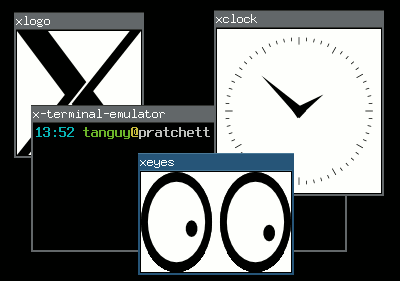
Floating window managers
They are the most usual window managers, that allow you to place an size your windows freely on the screen, in a way where they are independent of each other, possibly overlapping, just as you would be able to place sheets of paper on your desk.
Tiling window managers
They are a more elitist type of window manager, that adjust the size and position of the windows so there is no overlapping and no space lost between windows, thus tiling the screen.
Four computer windows managed in floating mode

Floating window management

Four computer windows managed in tiling mode

Tiling window management

The frontier between these two types is not very tight, because some floating window managers have limited tiling features, and almost all the tiling window manager have floating modes for programs that are not adapted to tiling. For what it is worth, here is a report on my experience with three tiling window managers. Perhaps it may help people that are still hesitating to switch to tiling window management?Using tiling window managers Five years ago I switched to tiling window management, feeling that managing windows was the window manager's job (a quote from larswm). At that time, I started using wmii, then switched to awesome, and now I am trying i3.
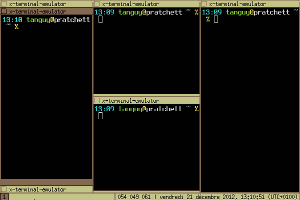
Screenshot of the wmii window manager

wmii: three columns, first one stacked ()

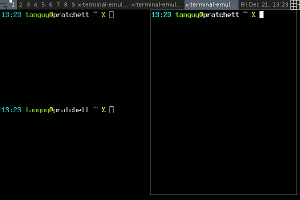
Screenshot of the awesome window manager

awesome: fair layout

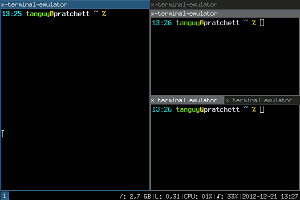
screenshot of the i3 window manager

i3: three containers, second one stacked, third one tabbed

For people in a hurry, here is a comparative table:
wmii awesome i3
Configuration Shell script Lua script config file
Scriptability any language, 9P-based Lua, API-based any language, socket-based
Layout simple, column-based automatic layout-based flexible, manual tiling-based
Multi-monitor sucks OK OK
Modern stuff XCB, Xft, notification area, dock windows XCB, Xft, notification area
Special features
  • tag-based workspace system
  • XDG convention to locate the config file
  • real framework for customization
  • powerful status bar
wmii wmii is a rather minimalist window manager which used to be part of the suckless project, but is now hosted at Google Code and seems to have lost all its documentation during the move (why is it that all the software I have seen hosted at Google Code or worst, at Launchpad, have almost not documentation, and never, ever a single screenshot?). It uses a column-based layout: you place windows in a number of columns, and for each column you can choose either vertical split, stacking or full column mode. This system is very simple to control flexible enough for most situations, but it does not allow for arbitrary tiling. It is fully scriptable in any language, in an interesting way: it exposes all its functions on a 9P virtual filesystem. In fact, wmii itself only implements window management functions, and all the user interaction logic takes place in a distinct script which calls that functions using that 9P filesystem. wmii comes with a default script, written in shell, which makes it a bit hard to extend, and slow if you start calling external programs such as grep, sed and co. You can script it in any language you like however, and there are some already made implementations in Ruby and Python IIRC. A special feature of wmii is that its workspaces are in fact tags, and that you can tag a window so that it will appear in several ones. While this is interesting, in practice I did not find much use for that feature. It is explicitly minimalist, and the developers used to impose themselves a limit on its numbers of lines of codes (not sure if this is still true with the switch to Google Code). While I was using it, it had no notification area, no support for Xft fonts and it sucked with multiple monitors, which is the reason I switched to awesome. awesome awesome is a very flexible window manager that provides advanced automatic layouts. It has become quite popular, and it has a very well documented wiki. It is not officially a tiling window manager but a framework window manager, and to emphasize on that it start in floating mode by default. I think most people use it in tiling mode however. It uses automatic layouts, that place your windows according to rules, for instance the fair layout, which tiles in columns and rows so that each window occupies a similar space. Thanks to that automation, this system is very easy to control and to get used to, and although it certainly does not allow arbitrary tiling, you can cycle between several available layouts which are suitable for most situations (most of them are entirely automatic, but some have parameters you can modify, such as the number and width of columns), and if you miss one, I think you can even code your own. It is fully scriptable using the Lua language. In fact, just as wmii, the user interaction logic is defined in the configuration file, which allows efficient customization. The Lua API is fully documented, and there is a series of useful libraries to extend the basic configuration in any way you like, which is why awesome calls itself a framework window manager . It is not designed to be minimalist, and it implements some modern stuff, such as using XCB rather than Xlib, a notification area, and specific support for dock or utility-type windows such as GIMP's tools. i3 i3 is a window manager inspired by wmii, although they do not have much in common in my opinion. for what I have seen, I think it would be closer the defunct Ion. It uses a layout based on manual splitting: as you open windows you can choose to split an existing window either vertically or horizontally, leading to arbitrarily complex layouts. In addition to that you can tab or stack windows in containers instead of splitting them. This system is very flexible but it requires more user intervention. In its standard mode of operation, i3 is simply configured in a regular way, which allows to customize the user interaction but not to script it in an arbitrary way. It offers an IPC system that can be used for that however, by the mean of a Unix socket, so it can actually be scripted in any language too if needed, although this possibility is probably not as popular and easy as with wmii and awesome. It implements modern features such as XCB, a notification area and a powerful status bar that uses the standard output of a dedicated program that is easy to replace by your own if you need.

26 December 2012

Gunnar Wolf: Brazilian electronic booths hacked in a real election Surprised, anyone?

Doing my regular news scan, I stumbled across this: Hacker reveals in Rio how he rigged an election (in Portuguese; you can try the Google-translated version). Why am I reposting this? Because, even after the reported studies by Diego Aranha and the information disclosure exploited by Sergio Freitas, Brazil is still portrayed as the biggest example on how electronic voting can be 100% secure and tamper-proof. Well, in this case, Rangel (his full name ahs not yet been disclosed), a 19 year old hacker, not only demonstrated how elections could be rigged, but admitted on doing so together with a small group, and even pointed at who was benefitted from this. Rangel's attack was done during the transmission phase After ~50% of the electoral results had been sent over the Oi network. And yes, the provider will most likely close the hole that was pointed at, but this basically shows (again!) that no system can be 100% tamperproof, and that the more electronic devices are trusted for fundamental democratic processes, the more we as a society will be open to such attacks. The security-minded among us will not doubt even for a second that, as this attack was crafted, new attacks will continue to be developed. And while up to some years ago the attack surface was quite smaller (i.e. booths didn't have a communications phase, just stored the votes, and communication was done by personal means), earlier booths have been breached as well. And so will future booths be breached. So, the news of this attack are indeed very relevant for the field. The presentation I am quoting was held around two weeks ago And December will surely dillute attention from this topic. Anyway, I will look for further details on the mechanism that was used, as well as to the process that follows in the TSE (Supreme Electoral Tribunal). I hope we have news to talk about soon!

Russ Allbery: git-pbuilder 1.29

git-pbuilder is a shell script suitable for use as the builder command in git-buildpackage that simplifies using pbuilder, cowbuilder, or qemubuilder to build packages in a chroot. It's now part of the git-buildpackage Debian package, but I maintain it somewhat separately. This version supports a new environment variable, GIT_PBUILDER_OUTPUT_DIR, that can be set to override the default output location of ".." (the parent directory). It also changes the script to be a bash script and uses arrays to handle the options passed to the builder command so that shell metacharacters in the GIT_PBUILDER_OPTIONS environment variable will hopefully be handled correctly. As part of that change, it also tries to escape any options that will be passed to --debbuildopts to hopefully protect them from the additional layer of shell parsing that they'll be subject to. Thanks to Guido G nther and paul cannon for the patches. I hate having to make the script bash-specific, but trying to get the shell expansion right is otherwise a huge headache. That probably means that it's outlived the usefulness of the original implementation language (which was shell only because this started life as a quick hack). I should probably take the time to rewrite it in either Perl (which I know best) or Python (which is the language the rest of git-buildpackage is written in). But that's for another day. (Here's an excellent case in point for why one shouldn't embed language-specific extensions in the name of an executable that's part of a user interface or configuration interface.) You can get the latest version from my scripts page.

25 December 2012

Russ Allbery: Kindle haul

Happy winder holiday of choice to all and sundry! Enough new Kindle books have accumulated that it seems time for another post so that I can remember what I bought. Elizabeth Bear Garret Investigates (sff)
eluki bes shahar Hellflower (sff)
Elizabeth Cleghorn Gaskell Cranford (mainstream)
John Scalzi Subterranean Scalzi Super Bundle (sff) Cranford was free since it was written in the 1800s. I picked it up because of Jo Walton's review on Tor.com. The eluki bes shahar novel is from Daniel Moran's e-book site FS&, an impulse buy from browsing through his catalog while picking up the Long Run bundle for my mother. The Scalzi super-bundle is a collection of five separately-published novellas and chapbooks plus one non-fiction essay, only one of which I already owned (The God Engines), which seemed like a fairly good deal. In a separate note, the problem with watching interesting lectures on YouTube (apart from the fact that it's very easy to lose a day doing so) is that I usually end up wanting to buy the book on the topic and then read that. That happened to me today: I finally got around to watching Philip Ball's lecture on the chemistry of painting, and now Bright Earth is in my non-fiction want list. And there are three more hour-long TVO programs linked off of related material that look interesting. I fear the day may disappear.... Well, I will be rescued at least partly by being called to help decorate Christmas cookies. This is the beginning of by far my favorite two weeks of the year, although not for the reasons that people might suspect. Other than food (yum) my family doesn't do Christmas: no decorations, no huge family get-togethers, and we all give each other the freedom from guilt and stress of having to find presents. But I get two weeks of mandatory vacation from work, as does, importantly, everyone else. Which means there's nothing going on to suck me in from vacation and a very pleasant sense of resting and resetting for the new year. It's quiet, I can sit and read, I can focus on one thing at a time, and I can reorganize and order my life and revisit priorities and to-do lists with a lovely sense of perspective. Any other mandatory or at least widespread holiday would work as well, so it's unrelated to the season. (I find the commercialism somewhat distracting rather than a positive part of the experience.) But this is the one that we get, and it happens to coincide nicely with the meaningless but psychologically significant change of the year number. And it's delightful every year.

Petter Reinholdtsen: How to backport bitcoin-qt version 0.7.2-2 to Debian Squeeze

Let me start by wishing you all marry Christmas and a happy new year! I hope next year will prove to be a good year. Bitcoin, the digital decentralised "currency" that allow people to transfer bitcoins between each other with minimal overhead, is a very interesting experiment. And as I wrote a few days ago, the bitcoin situation in Debian is about to improve a bit. The new debian source package (version 0.7.2-2) was uploaded yesterday, and is waiting in the NEW queue for one of the ftpmasters to approve the new bitcoin-qt package name. And thanks to the great work of Jonas and the rest of the bitcoin team in Debian, you can easily test the package in Debian Squeeze using the following steps to get a set of working packages:
git clone git://git.debian.org/git/collab-maint/bitcoin
cd bitcoin
DEB_MAINTAINER_MODE=1 DEB_BUILD_OPTIONS=noupnp fakeroot debian/rules clean
DEB_BUILD_OPTIONS=noupnp git-buildpackage --git-ignore-new
You might have to install some build dependencies as well. The list of commands should give you two packages, bitcoind and bitcoin-qt, ready for use in a Squeeze environment. Note that the client will download the complete set of bitcoin "blocks", which need around 5.6 GiB of data on my machine at the moment. Make sure your ~/.bitcoin/ directory have lots of spare room if you want to download all the blocks. The client will warn if the disk is getting full, so there is not really a problem if you got too little room, but you will not be able to get all the features out of the client. As usual, if you use bitcoin and want to show your support of my activities, please send Bitcoin donations to my address 15oWEoG9dUPovwmUL9KWAnYRtNJEkP1u1b.

Russ Allbery: Review: A Paradise Built in Hell

Review: A Paradise Built in Hell, by Rebecca Solnit
Publisher: Penguin
Copyright: 2009
Printing: 2010
ISBN: 0-14-311807-2
Format: Trade paperback
Pages: 319
A Paradise Built in Hell is a book with an agenda. Solnit's goal is to convince the reader that nearly everything we're shown in movies and popular culture about human behavior during disasters is wrong. Not only is destructive mass panic unusual verging on nonexistent, spontaneous cooperation and acts of startling courage and resourcefulness are commonplace. The heroes that we hear about afterwards are more the norm than the exception. Disasters are far more likely to bring out the best in people than the worst. They break down barriers and form spontaneous human communities that survivors remember for a lifetime. Rather than natural disasters leading inevitably to an exacerbating human crisis in the absence of strong authority, Solnit argues that they are an amazing human opportunity, and that the most negative and destructive human behavior during crises is not from untrained victims but from the panic of the elites who are supposedly responsible for protecting the public. I think her analysis and presentation is both deeply appealing and deeply flawed. The flaws involve extrapolation and generalization beyond the applicability of her research, and I'll say more about that in a moment. But the appeal is still surprising and satisfying, and I think there's a lot of truth in this book despite its one-sided presentation. I like to tell people, half-jokingly, that I'm an anarchosyndicalist. It's my political alliegance of the heart: the political structure that I know would never work, but that matches the world I want to live in. (I suspect much of the belief in libertarianism is of this form.) Now I have a book to point people at when they ask what the appeal of anarchosyndicalism is. The sense of spontaneous community, of bonding, of reaching out to other people to do something necessary, together, that Solnit describes here in the aftermath of a disaster matches that vision of a world without imposed economic authority, where people spontaneously collaborate to solve problems. A Paradise Built in Hell is structured by disaster, providing a tour of major disasters and their aftermath interspersed with extended musings on what the human reactions mean and how disaster communities functioned. The major disasters discussed are the 1906 San Francisco earthquake, the Halifax explosion, the 1985 Mexico City earthquake, 9/11, and Hurricane Katrina. Solnit moves through them in chronological order, closing the book with Katrina, which had (at least for me) the most infuriating and uplifting mixes of community bonding and elite panic. But both of those factors are present from the beginning in the 1906 earthquake: spontaneous human organization that (from multiple first-hand accounts) transformed people's lives mixed with a military reaction and elite panic that possibly did more damage to the city than the earthquake did. Elite panic is the dark side of Solnit's celebration of human altruism and spontaneous community organization. The primary picture she paints is of ordinary people responding with great courage and creativity and finding, in their reaction, a transformative experience and a sense of purpose that often becomes the most powerful and positive experience of their life. But this is at odds with a deeply-entrenched elite belief in mass panic, in the necessity of keeping information from the public to suppress their reaction, and in the need to re-establish "order." And with that, Solnit is absolutely scathing, and with some justification. Along with detailed accounts of these major disasters, Solnit also gives the reader a tour of the research literature on disasters, research that has shown that the panic and chaos that is at the center of practically every disaster movie ever made is essentially a myth. Mass panic in disasters is not only rare, it's close to non-existent. As you might expect, the handling of Katrina by both the government and by neighboring white communities is the subject of the harshest attacks. The material on Katrina presented here is enough to make anyone want to throw out the current playbook on how we react to disasters (and lest one think Solnit is unfair, her research matches very closely with other research and journalism on Katrina that I've seen from a wide variety of sources). But Solnit shows that this is a pattern: the combination of our media-driven belief in how people will react to disasters combined with the elite need to re-establish control plays out in many major disasters, and almost always negatively. Even in 9/11, the official response in some cases hampered and undermined an already-effective unofficial response. This is very interesting and has concrete implications for public policy around disasters. But where Solnit moves onto thinner anarchosyndicalist ice is the story that she tells about disasters as dramatic upheavals of the established social order that could point to a revolution in how we interact with each other. Solnit is deeply inspired by human altruism during disasters, and her enthusiasm is somewhat contageous, but it was useful to read this book shortly after Bruce Schneier's Liars and Outliers. I think Solnit, in her understandable eagerness to find a way to extend disaster behavior to general life, does not understand the relationships between what Schneier terms moral, reputational, and institutional pressures. And that's the core of why we need to both enable spontaneous human response in disasters and have organized first responders and supporting infrastructure, and why disaster communities will break down when extended beyond the disaster. When I first mentioned A Paradise Built in Hell to my mother, her first reaction was dubiousness due to her memory of the 1977 New York City blackout. There was a disaster that resulted in widespread looting and destruction, rather than the positive reaction Solnit describes. Solnit does have a cogent argument for why looting is poorly analyzed (we don't, for example, distinguish between breaking into stores to get desperately needed supplies and doing so for personal gain) and should not be a priority in a life-threatening disaster. But it's not completely convincing; in some disasters, particularly ones like the 1977 power outage that were not particularly life-threatening, the looting has been the most destructive part of the disaster. Schneier provides what I think is the missing piece, both to this and to why the wonderful behavior during disasters doesn't last into everyday life. During a life-threatening disaster, moral pressures are massively increased. Nearly all of us have self-images and moral beliefs that provide very strong incentives to help others and collaborate in the face of life-threatening emergencies, incentives that override other motives and lead to the sort of behavior that Solnit celebrates. But moral pressures have inherent limitations. That moral reaction applies most strongly to small groups (such as bands of survivors), and will start to break down as larger society re-establishes itself. And disasters, like a power outage, that are not immediately life-threatening will not provoke the same intensification of moral pressures: we don't have strong moral beliefs and internal stories about staying quietly at home during power outages the way that we do for saving people from burning buildings or pulling them out of rubble. Once larger communities have reformed and that short-term emergency reaction has dissipated, the need for institutional pressures (police, law, and formal authority structures) will return. I wish Solnit had been able to read Schneier's book before writing hers. I think his analysis structure provides a healthy dose of realism and perspective to her desire for a self-organizing communal world, and might have blunted her enthusiastic but somewhat unrealistic hopes for finding some key to a revolution in human organization in the heart of disasters. But if A Paradise Built in Hell is unlikely to lead to a radical change in how we organize societies, it should at least provoke a radical rethinking of some of our unnecessary pessimism about our fellow humans. The evidence is substantial and compelling: crisis brings out the best in people, not the worst, and the ordinary people who happen to be around are capable of becoming some of the most amazing disaster response teams that we can imagine. This has numerous mundane implications for social policy. We should consider simple training for the general public, for example, to strengthen that reaction, should allow for it in legal structures and training of first responders (around looting, for instance), and should do everything we can to kill the destructive myth that people cannot be trusted in disasters or that mass panic will be as much of a threat as the disaster. But the best part of this book is that it provides a concrete, well-documented, and well-defended reason to let go of some of our cynicism and to extend a bit of trust to our fellow humans. There sadly aren't earth-shaking implications for everyday society, but there is a wealth of evidence that shows that we're better people in the crunch than we believe we are, or that we expect of others. And the more that we can embrace the dissolution of boundaries and social hierarchies in the middle of disasters, the more we are likely to be surprised by deep human connection and a sense of shared, focused purpose. Solnit is a bit long-winded with her agenda, but that bright hope has stuck with me. Recommended. Rating: 8 out of 10

Ingo Juergensmann: Resurrecting m68k - We're on track again!

Mid of November I already wrote about "Resurrecting m68k" - and went on holidays right after that writing. So, nothing really happened until December. But then things happened rather quickly one after one. First, I got Elgar up and running. Then I upgraded Arrakis and Vivaldi again. And then it was a lucky coincedence that my parents made a short trip to Nuremberg. Back then there were another buildd located in that city: Akire, which was operated by Matthias "smurf" Urlichs. So I mailed him and asked, if Akire still do exists and he answered surprising quickly that it is - but he wanted to take it to the garbage soon. I asked Smurf if my parents could pick it up and we managed to exchange contact addresses/phone numbers. To all of our surprise the Hotel, where my parents were staying, was just 180m away from Smurfs home! So it was really easy for my parents to pick up the machine, until they continued their trip to visit me in Rostock. That way I had just another machine to upgrade! Whoohoo! I used most of the time in December to upgrade the machines, migrating to larger disks, setting up everything as someone on debian-68k list popped up to offer a hosting facility in Berlin. That was really perfect timing! I took Elgar from NMMN in Hamburg, where it was hosted until August, and had now a second machine, Akire, where I didn't know where to host. So the offer made it easy to decide: Elgar & Akire will go to Berlin whereas Kullervo & Crest will move back to NMMN, when those two boxes got upgraded. That way we have some kind of redundancy. Perfect! Except that we would still need a running Buildd on those machines. During the last few years, I think 4-5 years, the sbuild/buildd suite did change in a great way. Nothing worked any longer as it did. So I concentrated on getting sbuild ready to pick a source and build it. But I got faced with some segfaults of various stuff. After all, it happened to be a somewhat broken kernel that caused all the problems. After upgrading the kernel, schroot suddenly did work and I could continue in setting up sbuild. After some days things got clearer and finally it worked: 6tunnel was the first newly build package by sbuild on m68k on 20. December 2012! During the next days I tried to get a larger disk (18G) for Spice, another machine, working, so I could use the big disk (36G) for Akire, instead of the old 2 & 4G disks and tried to deploy the sbuild config to Arrakis and Vivaldi. That was about two days ago. The missing part was an updated buildd config. This was addressed by Wouter today (well, actually yesterday in the meantime) and now we have a working buildd again since years! Hooray! :-)) Now we are back on track with the m68k port and will add more buildds, as well native as emulated ones, to come down from that "Needs-Build : 5261" number. So, very big thanks to all that made this possible:
  • Wouter for configuring the buildd setup on Arrakis
  • Aurelien for adding the m68k buildd back to debian-ports.org.
  • John Paul Adrian Glaubitz for offering the hosting
  • Matthias "smurf" Urlichs for keeping care of Akire all of these years
  • NMMN in Hamburg for willing to continue the hosting for Kullervo & Crest
  • adb@#debian-68k for donating 4x 32MB PS/2 RAM
and finally, last but not least, a very, very BIG THANKS to Thorsten Glaser who acted all these years as a human buildd and for solving the TLS problem on m68k and keeping the port alive in some kind of one-man-show!
Kategorie:

24 December 2012

Wouter Verhelst: m68k: back from the dead

It's been a few years coming, but the day has finally arrived. Contrary to some rumours which I've had to debunk over the years, the m68k port did not go into limbo because it was kicked out of the archive; instead, it did because recent versions of glibc require support for thread-local storage, a feature that wasn't available on m68k, and nobody with the required time, willingness, and skill set could be found to implement it. This changed a few years back, when some people wrote the required support, because they were paid to do so in order to make recent Linux run on ColdFire processors again. Since ColdFire and m68k processors are sufficiently similar, that meant the technical problem was solved. However, by that time we'd fallen so far behind that essentially, we needed to rebootstrap the port all over again. Doing that is nontrivial, and most of the m68k porters team just didn't have the time or willingness anymore to work on this; and for a while, it seemed like the m68k port was well and truly dead. But then, two things happened. The first thing that happened was called "ARAnyM", short for "Atari Running on Any Machine". An atari emulator, it started supporting running Linux at some point, allowing us to work on the port while on the road, using a laptop something not possible beforehand. While there were some bugs in the emulation of early versions of aranym, these were all fairly quickly fixed, and before long we could run Debian/m68k in the emulator. However, that was still the etch-m68k port on debian-ports.org, some time after Debian etch wasn't even supported anymore; this still required work. The second "thing" that happened was called "Thorsten Glaser". A fresh DD and maintainer of the "mksh" shell, he wanted to make sure his shell would work on all Debian architectures, including the ones on debian-ports.org. When he found out that the m68k port was in a pretty bad shape, he did not, like many before him, shrug and move on; instead, he took it upon himself to start compiling things, just so he could compile his shell. How's that for dedication. Anyway, fast-forward two years, and we're now, finally, at a point where I spent most of today getting buildd up and running on arrakis, one of our oldest buildd hosts. There were some issues while trying that, but it looks like everything is in working order now; and the first package to start building on the first functioning buildd host since a long time (the build of which is still ongoing at the time of this writing) is "babl". Of course, with only one buildd, we'll have no hope whatsoever of ever catching up. But that can be remedied easily by using more than one buildd host... Update: It built! Party!

Russ Allbery: Review: Cry Wolf

Review: Cry Wolf, by Patricia Briggs
Series: Alpha and Omega #2
Publisher: Ace
Copyright: August 2008
ISBN: 0-441-01615-4
Format: Mass market
Pages: 310
Cry Wolf is a sequel to the novella Alpha and Omega. This was originally included in the anthology On the Prowl, which I had no particular interest in, but it's now available as a standalone novella if you have an ebook reader. I recommend reading it first if you have any interest in this series; it's not particularly expensive, and piecing together what happened in it while reading the beginning of Cry Wolf is not particularly enjoyable. There are some mild spoilers for Alpha and Omega here, so if you're planning on reading the novella first, you may want to do that before reading on. Anna is an Omega, an extremely rare form of werewolf who does not fall into the normal pack hierarchy. With normal werewolves, either the wolf is dominant or is submissive, and the most dominant wolf leads the pack and can force their will on the other pack members. Omegas are strange. Normal pack dominance doesn't really work on them, but neither are they dominant themselves. At the start of Cry Wolf, Anna has very little idea what any of this means. She's been rescued from a horribly abusive situation and is being brought to Montana by Charles, the enforcer and son of the leader of all North American werewolves. And, apparently, her mate, according to both of their wolf natures, but she's not entirely sure what that means either. She doesn't have a lot of time to find out, since the local pack is immediately threatened by a rogue werewolf and she's pulled into both pack politics and that hunt. Cry Wolf, despite being the first full book of the Alpha and Omega series, is set in the same world as Briggs's Mercy Thompson series. (At a guess, somewhere around Iron Kissed.) This is not just a vague link within the universe, unfortunately. The characters here refer frequently to Mercy and previous events in her series in that way that implies the reader should have read them, without explaining fully what happened. If, like me, you're more interested in this series than the Mercy Thompson series (I preferred it because there are no vampires and I'm sick of vampires), be aware that starting here will feel like starting in the middle of a series. This will be even worse if you don't read Alpha and Omega first, making the first section of the book feel like constant namedropping when you don't know any of the references. The story, otherwise, is basically hurt/comfort with a side of coming of age. Whether you will enjoy this will depend on whether you're in the mood for a fairly predictable story that hits those buttons. Anna is a mess, thrown into survival mode after years of abuse and hating what she's become. (She is, actually, somewhat less of a mess than I think she should be given what happened to her, although Briggs has both her Omega nature and her wolf as outs there.) Charles wants to comfort her and isn't sure how. She misreads things, he misreads things, there's lots of missed communication... you've probably read this story before and have a pretty good idea how it will go. They are somewhat less stupid about their communication problems than the typical novel of this type, but they still don't use words very well. The rest of the plot felt like mostly an excuse to throw Anna and Charles together doing something external to their relationship and to give Anna a chance to use her unique talents. It takes a bit to get going, since most of the early book is introductions and setting up all the connections to the Mercy Thompson stories, but there is some meat to it, including fleshing out the mythology of werewolves in Briggs's world. (And some passable descriptions of Montana wilds.) I'm not a big fan of how power struggles and combat seem binary and very hierarchical, but that seems to be the way that Briggs differentiates her werewolves, and it does form a sharp contrast with Anna's ability. I think Omegas could have been even more subtle than they are here, but the interplay between the conflict-driven approach of everyone else and Anna's inherent calm can be fun. The biggest problem I had with Cry Wolf, apart from the general predictability of the story and relationships, is that the hurt/comfort angle never felt adequately resolved. Hurting a character very badly and then having others offer comfort is a very common story technique that brings with it some reader expectations in terms of emotional payoff. The point at which the comfort finally works can be very empowering and very affecting. I don't think Briggs hit the payoff as well as she could have. Anna recovers, but she does so rather more easily than felt correct, and without the emotional punch that I was waiting for. It seems odd to complain about this sort of urban fantasy novel having too little angst, and maybe I was just hoping for a story other than the one I was reading, but I wanted a story that dug a bit deeper into Anna's psyche. I think the best word for Cry Wolf is okay. If this is the story you're in the mood for, it delivers that story. Briggs's werewolves are mildly interesting, and the Omega concept is a good one, although not as thoroughly or convincingly explored as I would have liked. I would have preferred more intensity in the hurt/comfort plot and a more difficult healing, but I still enjoyed the book. Followed by Hunting Ground. Rating: 6 out of 10

23 December 2012

Russ Allbery: Review: Alpha and Omega

Review: Alpha and Omega, by Patricia Briggs
Series: Alpha and Omega #1
Publisher: Berkley
Copyright: 2007
ISBN: 1-101-41379-4
Format: Kindle
Pages: 112
Alpha and Omega is a novella set in Briggs's Mercy Thompson universe, an urban fantasy world that started with Moon Called. There's a limited edition hardcover version which is, at this point, ridiculously expensive, but it's available relatively inexpensively on the Kindle. (The page count in the sidebar may be high, since that's from the hardcover version; the Kindle version doesn't have page numbers.) It's the prequel novella to the novel Cry Wolf. You don't have to have read any of the Mercy Thompson novels to follow the story; it stands alone fairly well. I actually read Cry Wolf first, but (as I was warned) that proved to be a mistake, so I'm publishing my reviews in the "correct" reading order. Unusually for a niche novella leading into a regular series, Cry Wolf leans heavily on Alpha and Omega and works best if you've read it first. Anna is a werewolf, but not a very happy one. She's been a werewolf for three years, cutting herself off from everything before at the insistance of her pack, and she's at the bottom of the pecking order: abused, mistreated, and ordered about (although some of the abuse has gotten mildly better). That makes it startling that, when she sees a photograph in the paper of a missing teenager that she recognizes, she's willing to call the Marrok, the ruler of all wolves in North America, to report her pack's possible involvement. The Marrok sends his enforcer, Charles, to investigate. As soon as he arrives, he can tell that far more is wrong than anyone had realized. Anna's pack is completely dysfunctional, and Anna herself... well, that's the point of the story. Alpha and Omega has one of the more appealing qualities of novellas: a clear narrative drive that goes from point A to point B without many sidetracks or digressions. It's told in alternating tight third person perspectives, a traditional choice for this sort of story. Very little here will surprise an urban fantasy reader. It's the hurt/comfort story that one expects from the early going, but it's one that moves right along and hits most of the right notes. The biggest drawback for me was that I'm not horribly fond of Briggs's werewolf mythology. There are some parts that I like, such as Anna herself and the role that she discovers, but there's rather a lot of characters wrestling with their instinctive reactions or finding pack hierarchy enforced via means that appear to be magic. Given that the sort of absolute dominance hierarchy portrayed here is now considered dubious or refuted even in wild wolves, and given that I have a knee-jerk dislike of simplified, absolute structures, that part of Briggs's world-building makes my teeth itch. But, if you can get past that, and if you're not looking for any complex plotting (it is just a novella, after all), this isn't a bad way to spend an afternoon. It's comfort reading: things go roughly as you would expect them to go, and you can have the emotional satisfaction of seeing Anna's growth with very little risk. Followed by Cry Wolf. Rating: 7 out of 10

Russell Coker: Finding an ATM Skimmer

A member of SAGE-AU [1] found two ATM skimmers [2] and gave me permission to publish his description and analysis of the situation. I ve lightly edited this from a mailing list post to a blog format with permission from the author. This Courier-Mail article refers to the skimmers in question [3]. People were wondering what gave the skimmers away so here goes, NB this is only about the 2 I discovered.
  1. The actual atms in question were the free standing type (but even this doesn t matter in the scheme of things because they can be on those in a bank of the things).
  2. I d actually conducted transaction and was waiting for my card to come out of the machine these things looked that good. The colours matched especially in the 3/4 or less light that you typically have on the fascia s of such machine. The backing plate grey matched atm fascia as did the green bubble where the card goes.
  3. WHAT REALLY CAUSED SUSPICION my card was having difficulty coming out of the atm at end of transaction i.e. card coming out extra slow then only the end couple of mm, I had to physically grab my card with fingertips to get it out and there was barely perceptible movement of skimmer due to my fingers using the green bubble as purchase point, THAT was what made me suspect. I then really had close look and found that I could move the bubble with its backing plate I pulled it off the machine and then looked at the atm next to it and found it to look exactly the same. These things are held on by double sided tape.
  4. Grabbed the cleaning lady wandering past showed her the device and asked her to get security. Security and centre operations manager subsequently showed up, while waiting for them I had to stop people from using either machine (everyone amazed at how good these things looked). Centre ops guy went and checked other machines in the centre, I left my details and they called the cops I went straight to my credit union and reported what had happened and they cancelled my card and ordered a new one on the spot for me.
  5. Coincidently (or not) the centre ops and security lady told me that the machines had been serviced (refilled) not too much earlier that day i.e. I wondered if the bad guys did the service or were tracking armaguard servicing types.
Quick side notes:
  1. 3 more skimmers have been found since then.
  2. Subsequently, I found out these were the type that needed to be picked up for the bad guys to retrieve the data i.e. these weren t the type that transmitted to some-one sitting near by via Bluetooth/wireless i.e. in this instance I need not have cancelled my card and gotten a new one from my credit union.
    HOWEVER, it is best practice if you discover one and you ve used that machine to immediately have your financial institution cancel your card and issue you a new one though getting the new one can take up to a week.
  3. As I understand it, These 2 devices (i.e. others could be different) have 2 usb ports one for the reader and the other to a pinhole camera (commercially available type removed from it s original housing). The magnetic stripe data is held on the audio track associated with the video and there was an 8GB storage card to hold it all i.e. it makes things easier for the bad guys to match PINs to card details.
  4. If you do find a skimmer DO NOT touch the insides (non public facing parts) of it this is where the cops can really try lift dna and prints from; gathering prints from externally is far more fraught as everyone and their dog has probably touched the exterior of the skimmer.
  5. In the lead up to Xmas these things or similar are highly likely to become more prevalent as we all go about parting with dosh while gift shopping SO BE AWARE AND CAREFUL.

Cyril Brulebois: d-i hacking recipe #3: Debugging debconf

Problem #3: How to find out what s going on with debconf? Slightly longer version: As reported in #679327, the grub prompt during the installation process is entitled Configuring man-db , which isn t exactly great. Given man-db is a known dpkg trigger, I suspected this would be the reason for the broken title, and here s how I debugged it. For starters, using d-i basically means asking a lot of questions, which is implemented using the debconf mechanism. One should note that two implementations are available:
  1. the historic implementation, in Perl: debconf
  2. the C reimplementation: cdebconf
d-i uses cdebconf udebs, but joy begins when packages get installed in /target: debconf is used there. We ll see why that matters. Recipe #3: Set DEBCONF_DEBUG=developer and read logs!
  1. Both implementations support the DEBCONF_DEBUG environment variable. The installer supports passing that as a kernel parameter; example from the syslinux prompt: select the Graphical install entry, press Tab , remove -- quiet and put DEBCONF_DEBUG=developer there instead.
  2. Let s look at /var/log/syslog; there s a tail -f on it in VT4, but one can run grep and friends on it in VT2 or VT3. There, one can see what happens at the debconf level (the debconf protocol is documented in debconf-devel(7)). Tiny excerpt (timestamps removed for clarity):
    frontend: --> GET preseed/early_command
    frontend: <-- 0
     
    frontend: --> GET debian-installer/framebuffer
    frontend: <-- 0 true
     
    debconf: --> GET debconf/language
    debconf: <-- 0 en
    debconf: --> SET debconf/language en
    debconf: Setting debconf/language to en
    debconf: <-- 0 value set
    debconf: --> GET debconf/priority
    debconf: <-- 0 high
    debconf: --> GET rescue/enable
    debconf: <-- 0 false
    
  3. The interesting point was titles, right? So let s look at the last TITLE occurrences:
    debconf: --> SETTITLE debian-installer/main-menu-title
    debconf: --> SETTITLE debian-installer/grub-installer/title
    in-target: debconf (developer): ----> TITLE Configuration de man-db
    debconf: --> TITLE Configuration de man-db
    in-target: debconf (developer): <-- TITLE Configuration de man-db
    in-target: debconf (developer): ----> TITLE Configuration de man-db
    in-target: debconf (developer): ----> TITLE Configuration de grub-pc
    debconf: --> TITLE Configuration de grub-pc
    in-target: debconf (developer): <-- TITLE Configuration de grub-pc
    in-target: debconf (developer): ----> TITLE Configuration de grub-pc
    in-target: debconf (developer): ----> TITLE Configuration de man-db
    debconf: --> TITLE Configuration de man-db
    in-target: debconf (developer): <-- TITLE Configuration de man-db
    in-target: debconf (developer): ----> TITLE Configuration de man-db
    in-target: debconf (developer): ----> TITLE Configuration de grub-pc
    debconf: --> TITLE Configuration de grub-pc
    in-target: debconf (developer): <-- TITLE Configuration de grub-pc
    in-target: debconf (developer): ----> TITLE Configuration de grub-pc
    debconf: --> SETTITLE debian-installer/grub-installer/title
    
    Bad news: the last one is about grub, so the title should be correct, right?
  4. At this point, it might be the Gtk frontend behaving strangely. It s shipped in cdebconf-gtk-udeb, built from the cdebconf source. Let s look:
    • src/modules/frontend/gtk/ui.c has cdebconf_gtk_update_frontend_title(), which does what the function name suggests.
    • src/modules/frontend/gtk/di.c has cdebconf_gtk_di_run_dialog(), which calls the first function.
    • src/modules/frontend/gtk/progress.c has cdebconf_gtk_show_progress() (also calls the first function), which comes with the following comments:
      /** Show the progress widgets.
        *
        * This will actually add the widgets to the corresponding containers.
        * The main title saved when starting the PROGRESS operation will be restored
        * from the value saved when START was called.  This is needed when GO is
        * called during a PROGRESS operation.
      
    Now that s something! Even if the last entry is about grub, some previous value could be restored and could be the reason for the bad behaviour (that is easily confirmed by adding some debug_printf() calls on fe->title in cdebconf, thanks to an extra "debug.h" include). Maybe that s what needs fixing!
  5. Now it s time to take a step back. A d-i environment is nice, but testing things can easily become a burden. Taking a random wheezy or sid chroot, and installing/removing a tiny package shipping a manpage should be enough to run into the man-db trigger. Exporting DEBCONF_DEBUG=developer there too, let s either install or remove x11-apps (the trigger does the same job, and the debconf trace is the same), here s the output:
    Processing triggers for man-db ...
    debconf (developer): frontend started
    debconf (developer): frontend running, package name is man-db
    debconf (developer): starting /var/lib/dpkg/info/man-db.config configure /usr/share/man
    debconf (developer): <-- VERSION 2.0
    debconf (developer): --> 0 2.0
    debconf (developer): <-- INPUT medium man-db/install-setuid
    debconf (developer): --> 30 question skipped
    debconf (developer): <-- GO
    debconf (developer): --> 0 ok
    debconf (developer): starting /var/lib/dpkg/info/man-db.postinst triggered /usr/share/man
    debconf (developer): <-- VERSION 2.0
    debconf (developer): --> 0 2.0
    debconf (developer): <-- GET man-db/auto-update
    debconf (developer): --> 0 true
    
    Even if one didn t know about the cdebconf/debconf thing, the frontend started bit in the d-i syslog would have been the key: it s only found in debconf, in the frontend script. That one has several ways to determine the package being acted on, and it finally calls:
    debug developer => "frontend running, package name is $package";
    $frontend->default_title($package) if length $package;
    
    Tada, that s likely to be the issue.
  6. Tweaking that frontend script, it s easy to make sure that the code path for this use case is:
    elsif ($ARGV[0]=~m!^.*/(.*?)\.(?:postinst postrm prerm)$!)  
            $package=$1;
     
    
    Since $ARGV[1] is the action being passed to the maintainer script, one can intercept the triggered action, and avoid emitting a title update in this case; I ve therefore reassigned #679327 to the debconf package, and proposed a patch implementing that, which Joey Hess seems to find reasonable.
In my message to the bug report I wrote I actually tested it in a d-i environment, and made sure the issue had gone away. How I did that will likely be described in the next d-i hacking recipe.

22 December 2012

Dirk Eddelbuettel: Kurt Elling Quintet at the Green Mill

Kurt Elling is back in Chicago for two gigs at the Green Mill (where I last saw him in a wonderful big-band setting), along with his long-time collaborator Laurence Hobgood on piano, Clark Sommers on bass, Chicago's own John McLean on guitar, and the new kid Bryan Carter on drums. And they were, of course, awesome. Great mix of standards as well as new stuff from the Grammy-nominated new recording. If you can see Kurt Elling live, go. Now. They return for another gig tonight and I will have to see if I can swing that.

Bartosz Fe&#324;ski: Two full-time days to work on Debian

My current employer as a benefit offers two days of paid volunteer time every calendar year. In September I decided to devote this time for Debian project. It wasn t easy to convince HR and my manager (hi Gloria ;) ) that such activity can be considered as volunteering but I eventually did it! So last Thursday and Friday were days I could spent working on my packages and other stuff related to Debian ;) Let s talk about effects. 5 packages updated, 16 bugs closed, more than 50 lintian warnings/errors solved. Here goes changelogs from updated packages:
calcurse (3.1.2-1) unstable; urgency=low
* The Akamai Technologies paid volunteer days release.
* Package made from scratch (this was funny experience):
- uses new quilt source format
- uses new copyright format
- uses debhelper compatibility level 9 w/hardening options
- uses the newest Standards-Version
* New upstream version:
- supports UTF8 (Closes: #558671)
- hopefully fixes problem with accented characters (Closes: #466010) -- Bartosz Fenski <fenio> Thu, 20 Dec 2012 13:51:08 +0100 httpie (0.3.1-1) unstable; urgency=low * The Akamai Technologies paid volunteer days release.
* Includes manual page (Closes: #673067)
Courtesy of Khalid El Fathi <khalid>. Thanks!
* New upstream version. (Closes: #693810)
- handles binary transfers properly (Closes: #689974) -- Bartosz Fenski <fenio> Thu, 20 Dec 2012 14:27:59 +0100 skipfish (2.10b-1) unstable; urgency=low * The Akamai Technologies paid volunteer days release.
* New upstream version.
* Bumped Standards-Version (no changes needed).
* Various path fixes because of upstream changes.
* Added new libpcre3-dev build dependency.
* Totally rewritten copyright file to comply with new copyright standard. -- Bartosz Fenski <fenio> Thu, 20 Dec 2012 14:59:36 +010 ipcalc (0.41-3) unstable; urgency=low * The Akamai Technologies paid volunteer days release.
* ACK previous NMU, thanks Christopher!
* Documents some missing features in the manpage (Closes: #588143)
Thanks Tanguy Ortolo <tanguy>!
* Fixes other minor problems in manpage (Closes: #688148)
* Description now says it's tool IPv4 only (Closes: #628955)
* Fixes lack of </table> tag when printing supernets (Closes: #600251)
* The following changes are courtesy of Jari Aalto <jari.aalto>:
- Remove deprecated dpatch and upgrade to packaging format "3.0 quilt".
- Update to Standards-Version to 3.9.3 and debhelper to 9.
- Add build-arch and build-indep targets; use dh_prep in rules file.
- Patch 03: update with "quilt refresh" to make it apply cleanly.
Thanks to these changes (Closes: #670737) -- Bartosz Fenski <fenio> Fri, 21 Dec 2012 12:30:11 +0100 netw-ib-ox-ag (5.39.0-1) unstable; urgency=low * The Akamai Technologies paid volunteer days release.
* New upstream version.
* Uses Homepage header. (Closes: #615219, #615294, #615321, #615436, #645522)
* Bumped Standards-Version (no changes needed).
* Switch to dpkg-source 3.0 (quilt) format)
* Fixes FTBFS on s390x and sparc64 (Closes: #639493)
* Fixes 29 (sic!) lintian warnings/errors thus many small changes
in packaging scripts.
-- Bartosz Fenski <fenio> Fri, 21 Dec 2012 15:38:29 +0200
Despite this I did something else. I sent end of the world joke-mail to debian-mentors mailing list stating (ignore the fact that my own server marked me as spammer; fixed already ;P) that I m going to review and try to upload every package that will be send to me during end-of-the-world day.
That action was quite successful although no package has been uploaded yet. I reviewed 4 of them and two more are yet to come. So it looks that these two days sponsored by Akamai motivated me enough to spent few more days or even months and help other people to contribute to Debian. Thank you Akamai!

Next.

Previous.