Search Results: "mak"

11 March 2015

Joey Hess: 7drl 2015 day 5 type directed spell system development

I want my 7drl game Scroll to have lots of interesting spells. So, as I'm designing its spell system, I've been looking at the types, and considering the whole universe of possible spells that fit within the constraints of the types. My first throught was that a spell would be a function from World -> World. That allows any kind of spell that manipulates the game map. Like, for instance a "whiteout" that projects a stream of whitespace from the player's mouth. Since Scroll has a state monad, I quickly generalized that; making spell actions a state monad M (), which lets spells reuse other monadic actions, and affect the whole game state, including the player. Now I could write a spell like "teleport", or "grow". But it quickly became apparent this was too limiting: While spells could change the World map, the player, and even change the list of supported spells, they had no way to prompting for input. I tried a few types of the Event -> M () variety, but they were all too limiting. Finally, I settled on this type for spell actions: M NextStep -> M NextStep. And then I spent 3 hours exploring the universe of spells that type allows! To understand them, it helps to see what a NextStep is:
type Step = Event -> M NextStep
data NextStep = NextStep View (Maybe Step)
Since NextStep is a continuation, spells take the original continuation, and can not only modify the game state, but can return an altered continuation. Such as one that prompts for input before performing the spell, and then calls the original continuation to get on with the game. That let me write "new", a most interesting spell, that lets the player add a new way to cast an existing spell. Spells are cast using ingredients, and so this prompts for a new ingredient to cast a spell. (I hope that "new farming" will be one mode of play to possibly win Scroll.) And, it lets me write spells that fail in game-ending ways. (Ie, "genocide @"). A spell can cause the game to end by returning a continuation that has Nothing as its next step. Even better, I could write spells that return a continuation that contains a forked background task, using the 66 line contiuation based threading system I built in day 3. This allows writing lots of fun spells that have an effect that lasts for a while. Things like letting the player quickly digest letters they eat, or slow down the speed of events. And then I thought of "dream". This spell stores the input continuation and game state, and returns a modified continuation that lets the game continue until it ends, and then restores from the point it saved. So, the player dreams they're playing, and wakes back up where they cast the spell. A wild spell, which can have different variants, like precognitive dreams where the same random numbers are used as will be used upon awaking, or dreams where knowledge carries back over to the real world in different ways. (Supports Inception too..) Look how easy it was to implement dreaming, in this game that didn't have any notion of "save" or "restore"!
runDream :: M NextStep -> M NextStep -> (S -> S) -> M NextStep
runDream sleepcont wakecont wakeupstate = go =<< sleepcont
   where
         go (NextStep v ms) = return $ NextStep v $ Just $
        maybe wake (go <=<) ms
         wake _evt = do
                 modify wakeupstate
                 wakecont
I imagine that, if I were not using Haskell, I'd have just made the spell be an action, that can do IO in arbitrary ways. Such a spell system can of course do everything I described above and more. But, I think that using a general IO action is so broad that it hides the interesting possibilities like "dream". By starting with a limited type for spells, and exploring toward more featureful types, I was able to think about the range of possibilities of spells that each type allowed, be inspired with interesting ideas, and implement them quickly. Just what I need when writing a roguelike in just 7 days!
Fun comment thread on reddit

10 March 2015

Joey Hess: 7drl 2015 day 4 coding through exhaustion

Slow start today; I was pretty exhausted after yesterday and last night's work. Somehow though, I got past the burn and made major progress today. All the complex movement of both the player and the scroll is finished now, and all that remains is to write interesting spells, and a system for learning spells, and to balance out the game difficulty.
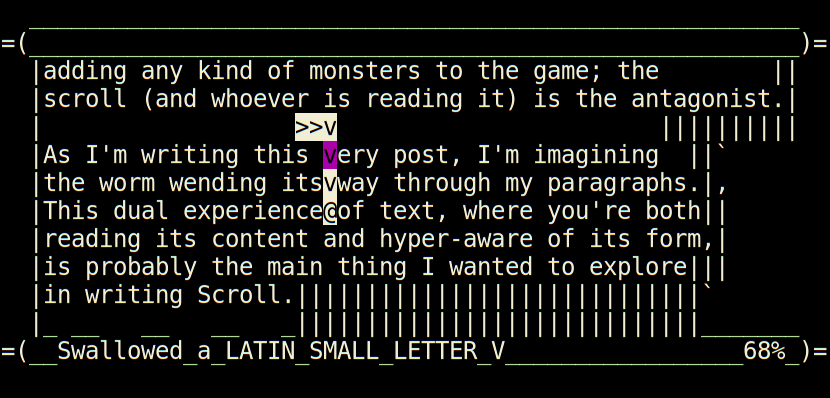
I haven't quite said what Scroll is about yet, let's fix that: In Scroll, you're a bookworm that's stuck on a scroll. You have to dodge between words and use spells to make your way down the page as the scroll is read. Go too slow and you'll get wound up in the scroll and crushed. The character is multiple chars in size (size is the worm's only stat), and the worm interacts with the scroll in lots of ways, like swallowing letters, or diving through a hole to the other side of the scroll. While it can swallow some letters, if it gets too full, it can't move forward anymore, so letters are mostly consumed to be used as spell components. I think that I will manage to get away without adding any kind of monsters to the game; the scroll (and whoever is reading it) is the antagonist. As I'm writing this very post, I'm imagining the worm wending its way through my paragraphs. This dual experience of text, where you're both reading its content and hyper-aware of its form, is probably the main thing I wanted to explore in writing Scroll. As to the text that fills the scroll, it's broadly procedurally generated, in what I hope are unusual and repeatedly surprising (and amusing) ways. I'm not showing any screenshots of the real text, because I don't want to give that surprise away. But, the other thing about Scroll is that it's scroll, a completely usable (if rather difficult..) Unix pager!

Holger Levsen: 20150310-lts-february-2015

My LTS February In February I didn't get much LTS work done, as other projects grabbed my attention. I started working on #761859 but that took a lot more time than initially thought, as the database design has been bended several times to make it fit for some new usecases. For example, "end-of-life" information is saved in the urgency field, making this one of several reasons why a bug can have different urgencies in different releases (despite that a CVE always only has one urgency). There are more oddities in the code base which was written with the (now long gone) assumption to be a tracker for security issues in testing. Constantly adding more requirements and use cases didn't really help to make it more maintainable. I'm glad that at least since yesterday https://security-tracker.debian.org/tracker/data/json provides valid JSON, though probably still a bit of finetuning is needed before I'll consider the output stable and close the bug. In related news I've filed #780201: "new codename needed for oldstable (due to squeeze-lts) when stable becomes oldstable" today as else the security tracker will cease to work for squeeze LTS once we release jessie. And that would spoil that day a bit...

9 March 2015

Joey Hess: 7drl 2015 day 3 movement at last

Got the player moving in the map! And, got the map to be deadly in its own special way.
        HeadCrush -> do
                showMessage "You die."
                endThread
Even winning the game is implemented. The game has a beginning, a middle, and an end. I left the player movement mostly unconstrained, today, while I was working on things to do with the end of the game, since that makes it easier to play through and test them. Tomorrow, I will turn on fully constrained movement (an easy change), implement inventory (which is very connected to movement constraints in Scroll), and hope to start on the spell system too.
At this point, Scroll is 622 lines of code, including content. Of which, I notice, fully 119 are types and type classes. Only 4 days left! Eep! I'm very glad that scroll's central antagonist is already written. I don't plan to add other creatures, which will save some time.
Last night as I was drifting off to sleep, it came to me a way to implement my own threading system for my roguelike. Since time in a roguelike happens in discrete ticks, as the player takes each action, normal OS threads are not suitable. And in my case, I'm doing everything in pure code anyway and certianly cannot fork off a thread for some background job. But, since I'm using continuation passing style, I can just write my own fork, that takes two continuations and combines them, causing both to be run on each tick, and recursing to handle combining the resulting continuations. It was really quite simple to implement. Typechecked on the first try even!
fork :: M NextStep -> M NextStep -> M NextStep
fork job rest = do
        jn <- job
        rn <- rest
        runthread jn rn
  where
        runthread (NextStep _ (Just contjob)) (NextStep v (Just contr)) =
                return $ NextStep v $ Just $ \i -> do
                        jn <- contjob i
                        rn <- contr i
                        runthread jn rn
        runthread (NextStep _ Nothing) (NextStep v (Just contr)) =
                return $ NextStep v (Just contr)
        runthread _ (NextStep v Nothing) =
                return $ NextStep v Nothing
endThread :: M NextStep
endThread = nextStep Nothing
background :: M NextStep -> M NextStep
background job = fork job continue
demo :: M NextStep
demo = do
    showMessage "foo"
    background $ next $ const $
        clearMessage >> endThread
That has some warts, but it's good enough for my purposes, and pretty awesome for a threading system in 66 LOC.

Ulrike Uhlig: Final report from the Outreach Program round 9

Between december 9th 2014 and march 9th 2015 I ve been working as an intern for Debian on Improving AppArmor support in Debian. Progress Before the internship started, I had no clue about AppArmor at all. Reading the Wikipedia page and the AppArmor wiki did barely enlighten me. At least, until I got my hands dirty and installed and activated it. I was able to do this only because there was already some basic documentation on the Debian wiki on how to get AppArmor running on a Debian system. When the internship started I felt a little bit lost. I started to read the documentation and to play around with some AppArmor profiles. But the error messages I saw and the profiles I opened for reading overwhelmed me. What did all these lines mean? Then one mentor briefed me about the current status of AppArmor in Debian. I took many notes and tried to bring some order into the information I was being given. These notes became the first page of the documentation and my first blog post.
Surprise: suddenly I was in the middle of knowing what we were talking about and how the next few weeks would look like. To start with, I have set up a test environment and continued to test some of the profiles which came with the packages I had installed, namely apparmor-profiles-extra which provided me with a profile for Pidgin. I was very much interested in securing this several thousand lines long C-code application on my machine! As a Pidgin user, I noticed immediately that one of my favourite features pidgin blinklight threw an error in the logs. I tried to fix it on my test VM and eventually made it work. Now knowing that such fixes should first be done upstream, i cloned the corresponding upstream repository and sent my first patch. It was not easy at first to switch to another VCS than Git, although I had been using Bazaar and Subversion years ago. Shortly afterwards, I saw my patch showing up on the upstream mailing list, and some days later it got merged. That was a huge encouragement. I was now able to write more documentation on how to contribute upstream. In order to organize the documentation, we ve set up some User Stories. I did not know about this tool before and had quite a hard time to grasp all the details but it proved to be very useful as some pages started to become long and confusing. Writing the documentation took up a lot of time, but before being able to write anything down, I needed to work everything out! This way I incidentally learned how to interact with many parts of Debian s infrastructure: While playing around with the tools provided to inspect AppArmor status on the system, I even accidentally found a little bug in one of the upstream tools. It got fixed very quickly after I mentioned it on the AppArmor team s mailing list. Organization Although I was uncomfortable with this in the beginning, we organized public meetings every two weeks on IRC. These meetings were also attended by MeetBot who took care of taking notes and leaving a trace of our discussions.
Based on the meetings, I maintained a progress page and todo list on the Debian wiki, which helped us to know which tasks were planned for the next two weeks. Before each meeting I sent a status update to the mailing list, so the mentors could catch up with my work. During the meetings I was not only asked to provide feedback on progress but also on mentoring itself. It proved to be very useful to be able to say where I was stuck and if the mentoring process worked out well enough (it did!).
Furthermore, I got regular, detailed and pedantic (thanks for trying to push me to perfection!) feedback on the team s mailing list. The mentors had introduced me on the upstream IRC channel in the beginning, so most of the people who are active there knew about my existence, something which also proved to be handy! Future The internship time is over, but some work remains to be done. As a new member of the AppArmor Packaging team, I am committed to make it happen: Thanks I feel much more confident after these three months, technically but also personally. Thank you: Holger Levsen and intrigeri for mentoring and encouraging me on this journey and to upstream contributors Christian Boltz, Steve Beattie (and everybody else I might forget here) for providing help and feedback. The Debian community (OPW organizers, sponsors, Alioth maintainers, planet.debian.org maintainers although my posts don t show up anymore :( -and others) has been very friendly and welcoming and I am very happy to be part of it.

Petter Reinholdtsen: Frikanalen, Norwegian TV channel for technical topics

The Norwegian Unix User Group, where I am a member, and where people interested in free software, open standards and UNIX like operating systems like Linux and the BSDs come together, record our monthly technical presentations on video. The purpose is to document the talks and spread them to a wider audience. For this, the the Norwegian nationwide open channel Frikanalen is a useful venue. Since a few days ago, when I figured out the REST API to program the channel time schedule, the channel has been filled with NUUG talks, related recordings and some Creative Commons licensed TED talks (from archive.org). I fill all "leftover bits" on the channel with content from NUUG, which at the moment is almost 17 of 24 hours every day. The list of NUUG videos uploaded so far include things like a one hour talk by John Perry Barlow when he visited Oslo, a presentation of Haiku, the BeOS re-implementation, the history of FiksGataMi, the Norwegian version of FixMyStreet, the good old Warriors of the net video and many others. We have a large backlog of NUUG talks not yet uploaded to Frikanalen, and plan to upload every useful bit to the channel to spread the word there. I also hope to find useful recordings from the Chaos Computer Club and Debian conferences and spread them on the channel as well. But this require locating the videos and their meta information (title, description, license, etc), and preparing the recordings for broadcast, and I have not yet had the spare time to focus on this. Perhaps you want to help. Please join us on IRC, #nuug on irc.freenode.net if you want to help make this happen. But as I said, already the channel is already almost exclusively filled with technical topics, and if you want to learn something new today, check out the Ogg Theora web stream or use one of the other ways to get access to the channel. Unfortunately the Ogg Theora recoding for distribution still do not properly sync the video and sound. It is generated by recoding a internal MPEG transport stream with MPEG4 coded video (ie H.264) to Ogg Theora / Vorbis, and we have not been able to find a way that produces acceptable quality. Help needed, please get in touch if you know how to fix it using free software.

NOKUBI Takatsugu: Travatar, an OpenSource statistical machine translation system

Graham Neubig published Travater , an OpenSource statistical machine translation system and the demosite (http://ahclab.naist.jp/travatar/translator/). Graham said It makes good result likely Google Translation. Unfortunately, it seems to be crwoded, so I can t get correct result (output IO Error dialog). Anyway, it is a good new for Japanese processing scene.

8 March 2015

Joey Hess: 7drl 2015 day 2 level generation and game concept

Much as I want to get my @ displayed and moving around screen, last night and today have focused on level generation instead. Scroll has kinda strange level generation method, compared to how I suppose most roguelikes do it. There are only 3 calls to rand in all of Scroll. Just a 3 random parameters, but that's enough to ensure a different level each time.
-- Random level generation function.
level :: Bool -> StdGen -> [String]
level randomize r = concat
        [ final (length tutorial + extra) $ concat $ rand mariner1body
        , concat $ rand mariner1end
        , concatMap rand kubla
        ]
  where
    -- here be spoilers
You could say there are two influences in Scroll's level generation method: Nick Montfort and Samuel Taylor Coleridge.
I have thought some about Scroll before starting the 7drl week, but my idea for the game was missing some key concepts. There was nothing to keep the player engaged in moving forward, an unclear victory condition, no clue how to generate appropriate random levels, a large potential for getting stuck, and no way to lose the game. This is all a problem for a roguelike. But, I had an idea finally last night, about a single unified thing that all of that stuff falls out from. And it's right there in the name of the game! Now that I understand Scroll better, I wrote the tutorial level. It's a very meta tutorial level that sets the scene well and serves more purposes than are at first apparent. I count a total of 6 things that this "tutorial level" will let the user do. And interestingly, while the tutorial level is static, it interacts with the rest of the game in a way that will make it be experienced differently every time through.
The strangest line of code I wrote today is:
import GPL
Somehow, I have never before, in all my time programming, written a line like that one.
Finally, after 7 hours of nonstop coding, I got ncurses to display the generated game world, scrolling around in the display viewport. No @ yet; that will need to wait for tonight or tomorrow!

7 March 2015

Joey Hess: 7drl 2015 day 1 groundwork

Scroll is a roguelike, with a twist, which I won't reveal until I've finished building it. I'll just say: A playable roguelike pun, set in a filesystem near you. I'm creating Scroll as part of the 7DRL Challange. If all goes well, I'll have a usable roguelike game finished in 7 days. This is my first time developing a roguelike, and my first time writing a game in Haskell, and my first time writing a game to a time limit. Wow!
First, some groundwork. I'm writing Scroll in Haskell, so let's get the core data types and monads and IO squared away. Then I can spend days 2-7 writing entirely pure functional code, in the Haskell happy place. To represent the current level, I'm using a Vector of Vectors of Chars. Actually, MVectors, which can be mutated safely by pure code running inside the ST monad, so it's fast and easy to read or write any particular location on the level.
-- Writes a Char to a position in the world.
writeWorld :: Pos -> Char -> M ()
writeWorld (x, y) c = modWorld $ \yv -> do
    xv <- V.read yv y
    V.write xv x c
showPlayer :: M ()
showPlayer = writeWorld (5,8) '@'
(I wish these Vectors had their size as part of their types. There are vector libraries on hackage that do, but not the standard vector library, which has mutable vectors. As it is, if I try to access outside the bounds of the world, it'll crash at runtime.) Since the game will need some other state, I'm using the state monad. The overall monad stack is type M = StateT S (ST RealWorld). (It could be forall s. StateT S (ST s), but I had some trouble getting that to type check, so I fixed s to RealWorld, which is ok since it'll be run using stToIO. Next, a concept of time, and the main event loop. I decided to use a continutation passing style, so the main loop takes the current continuation, and runs it to get a snapshot of the state to display, and a new continutation. The advantage of using continuations this way is that all the game logic can be handled in the pure code. I should probably be using the Cont monad in my monad stack, but I've not learned it and lack time. For now I'm handling the continuations by hand, which seems ok.
updateWorld :: Step
updateWorld (Just 'Q') = do
        addMessage "Are you sure you want to quit? [yn]"
        next $ \i -> case i of
                Just 'y' -> quit
                _ -> continue
updateWorld input = do
        addMessage ("pressed " ++ show input)
        continue
Finally, I wrote some ncurses display code, which is almost working.
Start time: After midnight last night. Will end by midnight next Friday. Lines of code written today: 368 Craziest type signature today: writeS :: forall a. ((Vec2 a -> ST RealWorld ()) -> M ()) -> Pos -> a -> M ()
By the way, there's a whole LambdaHack library for Haskell, targeted at just this kind of roguelike construction. It looks excellent. I'm not using it for two reasons:
  1. Scroll is going to be unusual in a lot of ways, and LambdaHack probably makes some assumptions that don't fit.
  2. mainSer :: (MonadAtomic m, MonadServerReadRequest m) => [String] -> COps -> (m () -> IO ()) -> (COps -> DebugModeCli -> ((FactionId -> ChanServer ResponseUI RequestUI -> IO ()) -> (FactionId -> ChanServer ResponseAI RequestAI -> IO ()) -> IO ()) -> IO ()) -> IO ()
    That's a lot of stuff to figure out! I only have a week, so it's probably easier to build my own framework, and this gives me an opportunity to learn more generally useful stuff, like how to use mutable Vectors.

6 March 2015

Eddy Petri&#537;or: Occasional Rsnapshot v1.3.1

I was writing in the previous post about Occasional Rsnapshot and how I ended up writing it.

Just before releasing v1.2.1 I realized it would make sense Semantic Versioning which, in just a few words means:
Given a version number MAJOR.MINOR.PATCH, increment the:
MAJOR version when you make incompatible API changes,
MINOR version when you add functionality in a backwards-compatible manner, and
PATCH version when you make backwards-compatible bug fixes.
I just released Occasional Rsnapshot v1.3.1 which mainly fixed issue 4:
When deciding to do a backup for interval INT, there should be a check that the oldest snapshot in INT-1 interval is older than the threshold for the INT interval. Otherwise the INT interval will be populated with backups more frequent than desired and it is possible older backups in INT interval to completely lost.
The condition should be:
ts(oldest(INT-1)) - ts(newest(INT)) >= threshold(INT)
For example:
  • if weekly.0 is from 15th of February and daily.6 is from 17th of February, weekly should not be triggered, but
  • if weekly.0 is from 15th of February and daily.6 is from 23rd of February, weekly shall be triggered
This extra check should probably added in can_backup_interval.
It was a small bug, but it might have lead to losing important older backups because newer and more frequent backups would be pushed from hourly, interval by interval up to the yearly interval, in spite of the fact that the distance between backups wouldn't have been respecting the upper interval minimum distance in time.

There was also a small syntax bugfix, but functionally nothing has changed because bash was doing the right thing even with that small error.

If you have started using Occasional Rsnapshot, you definitely want now Occasional Rsnapshot v1.3.1. If you haven't started and you don't have backups, please start doing backups, and while you're at it, you might want to try Occasional Rsnapshot (with Rsnapshot).

Richard Hartmann: Release Critical Bug report for Week 10

The UDD bugs interface currently knows about the following release critical bugs: How do we compare to the Squeeze and Wheezy release cycles?
Week Squeeze Wheezy Jessie
43 284 (213+71) 468 (332+136) 319 (240+79)
44 261 (201+60) 408 (265+143) 274 (224+50)
45 261 (205+56) 425 (291+134) 295 (229+66)
46 271 (200+71) 401 (258+143) 427 (313+114)
47 283 (209+74) 366 (221+145) 342 (260+82)
48 256 (177+79) 378 (230+148) 274 (189+85)
49 256 (180+76) 360 (216+155) 226 (147+79)
50 204 (148+56) 339 (195+144) ???
51 178 (124+54) 323 (190+133) 189 (134+55)
52 115 (78+37) 289 (190+99) 147 (112+35)
1 93 (60+33) 287 (171+116) 140 (104+36)
2 82 (46+36) 271 (162+109) 157 (124+33)
3 25 (15+10) 249 (165+84) 172 (128+44)
4 14 (8+6) 244 (176+68) 187 (132+55)
5 2 (0+2) 224 (132+92) 175 (124+51)
6 release! 212 (129+83) 161 (109+52)
7 release+1 194 (128+66) 147 (106+41)
8 release+2 206 (144+62) 147 (96+51)
9 release+3 174 (105+69) 152 (101+51)
10 release+4 120 (72+48) 112 (82+30)
11 release+5 115 (74+41)
12 release+6 93 (47+46)
13 release+7 50 (24+26)
14 release+8 51 (32+19)
15 release+9 39 (32+7)
16 release+10 20 (12+8)
17 release+11 24 (19+5)
18 release+12 2 (2+0)
Graphical overview of bug stats thanks to azhag:

Rapha&#235;l Hertzog: My Free Software Activities in February 2015

My monthly report covers a large part of what I have been doing in the free software world. I write it for my donators (thanks to them!) but also for the wider Debian community because it can give ideas to newcomers and it s one of the best ways to find volunteers to work with me on projects that matter to me. Debian LTS This month I have been paid to work 14.5 hours on Debian LTS. I worked mostly on CVE triage (41 commits in the security tracker) and organizational issues. One maintainer complained that he had not been kept in the loop for an LTS update of his package. After some discussion, I decided to change the way I did CVE triage so that any time that I add a package to our list of packages needing an update, I also send a mail to the maintainer, thus offering him the opportunity to step in. To make this sustainable, I wrote a small helper script that will generate a mail out of a template. And to kickstart the process I mailed all maintainers of packages that were already listed in our queue of packages to update. To improve the email generated, I requested a JSON export of the security tracker data (see discussions in #761859). In the mean time, Holger worked on this already and after a few iterations we did converge on an output format that will be really useful both for my needs in terms of CVE triage but also for the Package Tracker to be able to display the list of security vulnerabilities affecting each release (see #761730). Last but not least, I don t want to be the only one doing CVE triage for our LTS release so I documented the process in our wiki page. As a side note, I sponsored an e2fsprogs update prepared by Nguyen Cong and I sent the DLA for the embargoed samba update that had been prepared by Ivo de Decker (thanks to both of them!). Tryton Like last month, I invested again a copious amount of time on Tryton, fixing some bugs that were affecting me and improving the French chart of accounts to properly manage purchases and sales within the European Union. Here are some links for more details: Debian I did some work on Distro Tracker, I fixed #777453 (password reset not working because the generated email was using an invalid From email) and #779247 (obsolete build reproducibility action items were not dropped). I also started to work on restructuring the mail handling in distro-tracker (cf #754913) but it s not public yet. While I have no plans to stop contributing to Debian (it s part of my day job!), I reduced my non-work related involvement by officially recognizing that I was no longer properly assuming some of my responsibilities and that I was following too many mailing lists and RSS feeds. The most notable changes are that I removed myself from the maintenance of dpkg, developers-reference, quilt, sql-ledger, and a few perl/python modules. Misc Voting software. Part of the reason why I m reducing my involvement in Debian is that I got more involved in Nouvelle Donne (a French political party) and in particular in the handling of its digital infrastructure (currently running on Ubuntu, doh!). As part of this, I was looking for free software to handle secure votes and elections (and if possible adhering to the principles of liquid democracy). There s no perfect solution and no clear winner. That said I started following the evolution of AgoraVoting because it seems to have a good momentum and has some interesting features (it already supports votes with ranked choices, supports good crypto, has been used for elections involving large numbers of voters in the context of Podemos in Spain). But it still has some ways to go to establish itself as a truly international and community-backed project. GDM bug. Due to my work on Kali, I filed a bug against GDM (this one has been quickly fixed upstream, it s still open in Debian) and another one against accountsservice to request the possibility to define the default graphical session. Dirvish formula for Salt. I contributed another formula to manage backups with dirvish. Thanks See you next month for a new summary of my activities.

One comment Liked this article? Click here. My blog is Flattr-enabled.

Dirk Eddelbuettel: Rcpp 0.11.5

The new release 0.11.5 of Rcpp just reached the CRAN network for GNU R, and a Debian package has also been be uploaded. Rcpp has become the most popular way of enhancing GNU R with C++ code. As of today, 345 packages on CRAN depend on Rcpp for making analyses go faster and further; BioConductor adds another 41 packages, and casual searches on GitHub suggests dozens mores. This release continues the 0.11.* release cycle, adding another large number of small bug fixes, polishes and enhancements. Since the previous release in January, we incorporated a number of pull requests and changes from several contributors. This time, JJ deserves a special mention as he is responsible for a metric ton of the changes listed below, making Rcpp Attributes even more awesome. As always, you can follow the development via the GitHub repo and particularly the Issue tickets and Pull Requests. And any discussions, questions, ... regarding Rcpp are always welcome at the rcpp-devel mailing list. See below for a detailed list of changes extracted from the NEWS file.
Changes in Rcpp version 0.11.5 (2015-03-04)
  • Changes in Rcpp API:
    • An error handler for tinyformat was defined to prevent the assert() macro from spilling.
    • The Rcpp::warning function was added as a wrapper for Rf_warning.
    • The XPtr class was extended with new checked_get and release functions as well as improved behavior (throw an exception rather than crash) when a NULL external pointer is dereferenced.
    • R code is evaluated within an R_toplevelExec block to prevent user interrupts from bypassing C++ destructors on the stack.
    • The Rcpp::Environment constructor can now use a supplied parent environment.
    • The Rcpp::Function constructor can now use a supplied environment or namespace.
    • The attributes_hidden macro from R is used to shield internal functions; the R_ext/Visibility.h header is now included as well.
    • A Rcpp::print function was added as a wrapper around Rf_PrintValue.
  • Changes in Rcpp Attributes:
    • The pkg_types.h file is now included in RcppExports.cpp if it is present in either the inst/include or src.
    • sourceCpp was modified to allow includes of local files (e.g. #include "foo.hpp"). Implementation files (.cc; .cpp) corresponding to local includes are also automatically built if they exist.
    • The generated attributes code was simplified with respect to RNGScope and now uses RObject and its destructor rather than SEXP protect/unprotect.
    • Support addition of the rng parameter in Rcpp::export to suppress the otherwise automatic inclusion of RNGScope in generated code.
    • Attributes code was made more robust and can e.g. no longer recurse.
    • Version 3.2 of the Rtools is now correctly detected as well.
    • Allow 'R' to come immediately after '***' for defining embedded R code chunks in sourceCpp.
    • The attributes vignette has been updated with documentation on new features added over the past several releases.
  • Changes in Rcpp tests:
    • On Travis CI, all build dependencies are installed as binary .deb packages resulting in faster tests.
  • Thanks to CRANberries, you can also look at a diff to the previous release As always, even fuller details are on the Rcpp Changelog page and the Rcpp page which also leads to the downloads page, the browseable doxygen docs and zip files of doxygen output for the standard formats. A local directory has source and documentation too. Questions, comments etc should go to the rcpp-devel mailing list off the R-Forge page.

    This post by Dirk Eddelbuettel originated on his Thinking inside the box blog. Please report excessive re-aggregation in third-party for-profit settings.

    DebConf team: Valessio Brito wins DebConf15 logo contest (Posted by Penny Leach)

    In May, the DebConf15 Team held a competition to design the logo for DebConf15, which will take place in Heidelberg, Germany. We received many great entries, and after a week-long voting period, this logo by Valessio Brito was selected:
    DebConf15 logo (by Valessio Brito)
    The lion depicted is the Kurpf lzer L we , which makes up Heidelberg s coat of arms. Valessio is Brazilian, graduated in Communication and Advertising, and specialised in Free Software Development. He is currently a consultant to UI Design of the Secretariat-General of the Presidency of the Republic, living in Brasilia, Brazil. He has been a Debian user since 2000, contributing to local communities, Inkscape and the Debian project. Valessio has a tattoo of the red spiral! His personal website is valessiobrito.com.br (pt_BR). He invites you to visit www.DebianArt.org to discover the work of other artists and designs that contribute to the Debian project. Thanks very much Valessio for your great contribution!

    Steve Kemp: Free hosting, and key-signing

    Over the past week I've mailed many of the people who had signed my previous GPG key and who had checked my ID as part of that process. My intention was to ask "Hey you trusted me before, would you sign my new key?". So far no replies. I may have to be more dedicated and do the local-thing with people. In other news Bytemark, who have previously donated a blade server, sponsored Debconf, and done other similar things, have now started offering free hosting to Debian-developers. There is a list of such offers here: I think that concludes this months blog-posting quota. Although who knows? I turn 39 in a couple of days, and that might allow me to make a new one.

    5 March 2015

    Ulrike Uhlig: So, how usable is AppArmor in Debian?

    The short answer is: using AppArmor in Debian is fairly straight forward. Installing and activating it though is not yet a very user friendly experience. One needs to install the apparmor package, then activate it in the kernel by editing a line in the GRUB bootloader and then reboot. The procedure is explained in detail here.
    We are working on fixing Debian Bug #702030 which aims at making the installation process easier for normal users by activating the module automatically as soon as one installs the apparmor package. Once you have set this up though, you re good to go. Profiles for confining processes and programs should then be activated automatically. One can verify this through the sudo aa-status command which should output something like this:
    apparmor module is loaded.
    30 profiles are loaded.
    30 profiles are in enforce mode.
     /usr/bin/evince
     /usr/bin/evince-previewer
     /usr/bin/evince-previewer//sanitized_helper
     /usr/bin/evince-thumbnailer
     /usr/bin/evince-thumbnailer//sanitized_helper
     /usr/bin/evince//sanitized_helper
     /usr/bin/irssi
     /usr/bin/pidgin
     /usr/bin/pidgin//launchpad_integration
     /usr/bin/pidgin//sanitized_helper
     /usr/bin/tlsdate
     /usr/bin/tlsdate-helper
     /usr/bin/torbrowser-launcher
     /usr/bin/totem
     /usr/bin/totem-audio-preview
     /usr/bin/totem-video-thumbnailer
     /usr/lib/cups/backend/cups-pdf
     /usr/lib/libvirt/virt-aa-helper
     /usr/sbin/apt-cacher-ng
     /usr/sbin/cups-browsed
     /usr/sbin/cupsd
     /usr/sbin/cupsd//third_party
     /usr/sbin/libvirtd
     /usr/sbin/ntpd
     /usr/sbin/tcpdump
     /usr/sbin/tlsdated
     gst_plugin_scanner
     system_tor
    0 profiles are in complain mode.
    8 processes have profiles defined.
    8 processes are in enforce mode.
     /usr/bin/pidgin
     /usr/bin/torbrowser-launcher
     /usr/sbin/cups-browsed 
     /usr/sbin/cupsd
     /usr/sbin/libvirtd
     system_tor
    0 processes are in complain mode.
    0 processes are unconfined but have a profile defined.
    As of today there are only a dozen packages which ship their own profile in Debian: bind9, clamav, cups-browsed & cups-daemon, libvirt-daemon-system, mysql-5.5, lightdm, obfsproxy, sssd, tlsdate, tor, torbrowser-launcher, vidalia. In order to confine other applications, like evince, irssi, ntpd, pidgin, totem or tcpdump, one can install the apparmor-profiles-extra package. All those profiles work very well in a Debian Wheezy environment or higher, from my own experience. (Only the torbrowser-launcher profile needs to be fixed in wheezy-backports, but works well in Jessie or higher I m working on it.) If you want to confine other applications and found a profile which you want to use on your system, you can copy that profile into /etc/apparmor.d/ and then run
    aa-enforce /etc/apparmor.d/myprofile
    And that s pretty much it!

    4 March 2015

    Zlatan Todori : Interviews with FLOSS developers: Paul Wise

    After starting with Joey Hess, we continue with Paul Wise. What makes his star to shine are many things such as being a DSA (Debian System Administrator), a helpful hand on mailings list, encouraging people to join Debian teams but most of all - he has encyclopedia knowledge on Debian as a whole which he gladly shares with anyone who asks (very fast response on IRC channels). It is almost impossible for any single person to count all Debian teams, work and places - to know most of those things, you can image the vast knowledge which Paul has. The legend says that his brain has better and faster search engine algorithm on Debian related queries than all other engines combined. So lets see what he has to share with world. me: Who are you? pabs: Paul Wise (pabs) and I have to say that I'm no-where near as knowledgeable as your intro suggests. me: How did you start programming? pabs: Messing around with fractals and graphics things in MS BASIC. me: How would you now advise others to start programming? pabs: Pick an issue in a tool you use, investigate how the tool works and how you can change it, fix that and contribute the change back to the project that created that tool. In the process you will learn skills, interact with the community and contribute to the project. me: Setup of your development machine? pabs: Lenovo Thinkpad with external monitor, Debian testing and some tweaks me What is your preferable language (for hacking)? Why? How do you compare it to other languages? pabs: I currently prefer Python for its readability. It still has some rough edges though the documentation covers them fairly well. I generally pick up new languages when working on projects written in them. Haskell is next on the horizon due to Nikki and the Robots. me: Describe your current most memorable situation as software developer/hacker? pabs: I had a great time creating fractals in BASIC, learning about the Mandelbrot set, L-systems and more. My days and nights of hacking on frhed (a GPLed hex editor for Windows) to help me cheat at Civilisation were pretty memorable. frhed led to my work on reverse engineering the CHM file format (a documentation format for Windows programs). A stand-out moment during my time with Debian was hacking on the derivates census patch generation code during the Debian UK BBQ weekend, surrounded by geeks playing Portal, cooking things, hacking on Debian and generally having a good time (thanks Steve!). me: Some memorable moments from Debian conferences? pabs: There are so many; meeting Debian folks, playing Mao once and then never again, late night games of werewolf, both delectably delicious and hideously disgusting cheeses, fried insects, day trips to beautiful landscapes, inspiring keynotes, exciting BoFs, secret IRC channels for planning surprise birthday parties, blue hair, wet air, blocks of fried cheese, a vast quantity of icecream, pants, geeks in the surf, volcanoes, hiking, a wonderful view, a uni-cycling stormtrooper & more. me: How do you see future of Debian development? pabs: I hope we will continue to exist and uphold our principles for the foreseeable future. I don't have any crystal balls though. me: You recently became member of Debian DSA - what is that like, what roles do you have and what tasks are in front of DSA? pabs: We wrote a bit of text about that for DPN recently. me: You have large knowledge on Debian and you share it with anyone who wants to know more. What motivates you to do so? pabs: I want the operating system I personally rely on to exist into the future, helping folks work on and join Debian can help with that. me: Why should developers and users join Debian community? What makes Debian a great and happy place? pabs: Every Debian contributor has different reasons for joining the community. Personally the Social Contract, the DFSG and the spirit and culture behind them are the main reason to be involved. I also like our many efforts towards technical excellence and correctness. Of course I've made a number of good friends over the years, especially as a result of attending DebConf every year since 2007. me: You are member of Debian publicity team which writes Debian news - do you need more people to join that team and how can they start? pabs: Since there is an infinite amount of work to do, pretty much every part of Debian always needs help, that includes the publicity team. We published a post about ways to help here. me: If someone wants to contribute to Debian in terms of packaging, can they do it anonymously (for example over Tor network, does Debian have .onion address)? pabs: Due to Debian's penchant for transparency it is harder but there are definitely package maintainers who have built up a reputation for good work under a pseudonym over the years and become Debian contributors as a result. I'm not aware of completely anonymous package maintainers but there are definitely people who file bugs using one-off pseudonyms, which is almost the same thing as anonymously. There are definitely Debian contributors and members who use Tor while contributing to Debian. In fact, as Debian is very highly dependent on OpenPGP and the best practices for OpenPGP include refreshing your keyring slowly over Tor, so probably quite a number of Debian contributors use Tor. As far as I know Debian itself does not run any Tor relays or onion services. me: What are places that non-packaging developers and people could join and help spread Debian even more? pabs: There are many ways to help Debian, including non-technical ones. Unfortunately our web page about helping Debian isn't quite up-to-date with all of them but a few more are to volunteer at DebConf, helo with artwork requests, speak about Debian at events or even come up with ideas for projects. Whatever skills you have, Debian can probably make use of them. If you aren't sure where to start, jump on the debian-mentors mailing list or IRC channel and we can probably guide you to the right place within Debian. Don't worry about not being skilled enough, everyone starts somewhere. me: How do you see Debian will manage webapps? pabs: Personally I prefer locally installed software, standard data formats and standard data transfer protocols to the wild webapps world but I understand they are becoming very popular to produce and use due to the ubiquity of the web browser platform. Antonio Terceiro is mentoring a project for this year's newcomer mentorship programs (outreachy/gsoc) that aims to improve support for installing web apps on Debian installations. I hope it succeeds as it could help make Debian more popular on servers and home servers in particular. me: How would you advise Debian (and other FLOSS users) to setup their machine in terms of security and anonymity? pabs: All technology has upsides and downsides. I would advise anyone to analyse their situation and protect themselves accordingly. For example if you have a bad memory, full disk encryption, which is based on pass-phrases might lead to data loss and physical security might be a better choice for protecting your data. The right choices around technology are very much a personal thing. me: Is it better to setup xmonad (because it is Haskell based WM) with small dependency chain or GNOME (because it is getting sandboxed apps) in term of security and privacy implications? pabs: Again, the right choices around technology are very much a personal thing. Due to the design of X11, both of these are approximately equivalent from a window-manager security properties point of view, that is to say, pretty bad. Wayland is one of the possible X11 successors and offers much better security properties. GNOME folks are working on switching to Wayland. Ultimately though it comes down to how each person uses their window manager and which software they run under it. me: Should Debian join Tor project as distro that installs Tor relays by default - should it offer that as option in installer in Debian 9? pabs: Running a Tor relay requires a reasonably fast and reliable Internet connection and should be a conscious decision on behalf of the sysadmin for a computer so Debian probably shouldn't install them by default. If tasksel gets support for installing tasks from Debian Pure Blends, then we could add a Tor relay task to the Debian Sanctuary Pure Blend. me: Have you ever considered joining initiatives such as FreedomBox? pabs: I was quite moved by Eben Moglen's talk at DebConf10 in New York and the resulting BoF. It seemed like a very ambitious project but I didn't really have the knowledge, skills or time to contribute yet. me: Are you a gamer? Valve Steam games are offered for free to Debian Developers - do you use steam and play Valve games? Your thoughts on Steam and non-free Linux gaming? pabs: I play computer games occasionally, all from Debian main or ones that I'm packaging. 0ad is my current go-to for a bit of gaming. I don't have any experience with Steam or non-free games on Linux. me: Is there something you would change in FLOSS ecosystem? pabs: Various folks have highlighted new and ongoing challenges for the FLOSS ecosystem in various places in recent years. Something that I would like to highlight that does not get talked about enough is the choices we make around our digital artefacts. This is the discussion around "preferred form for modification" or "source". The "source" for a particular digital artefact is a deliberate choice on behalf of the authors. Often generated files are distributed alongside the "source" without any instructions for reproducing the generated files from the "source". It sometimes happens that FLOSS contributors forget to distriute what they have chosen as "source", instead just distributing the generated files. This is a fairly well known issue but still happens. What isn't thought about quite as much is that the choice of "source" has consequences for future development possibilities of that "source". Some forms of "source" are more expressive than others, can be modified in a wider variety of ways and are better choices in general. Sometimes the consequences of choosing less expressive forms are mild and other times they are quite important. I hope more people will start to think about these choices. Some examples where, in my opinion, various people could have made better choices are listed in the mail I sent to the games team list last year. Another thing I would like to highlight is the work that organisations like Software Freedom Conservancy and Software in the Public Interest do to protect, defend, promote and support FLOSS projects. It is very important work that needs our interest and support. me: Can FLOSS world create great alternatives to Viber, Dropbox, WhatsUp, Facebook, Skype and other non-free services? pabs: I think that the FLOSS world has already created alternatives to all of those. The success of non-free services doesn't take these alternatives away but it does mean some of them are less useful because some of them are the kind of tools that become more useful with a larger amount of people using them. I don't know what it would take for the FLOSS alternatives to achieve similar success as network effects are hard to overcome. Hopefully mako is right and the network effects are overrated. me: Your thoughts and compare Cloud, IaaS, PaaS, SaaSS? To what should the FLOSS world pay more attention and energy? pabs: Initially I dismissed these as buzzwords and a threat to Free Software. These days I view them as potential opportunities for Free Software. Cloud-related technologies such as OpenStack and virtual machines can make private compute farm hardware more flexible and useful to their owners. IaaS providers can be used to run Debian more simply and cheaply and therefore bring Debian to more people than possible with hardware. PaaS providers can be used to run Free Software services. SaaSS can be based entirely on Free Software and respect users. Of course, just like running Free Software on hardware (proprietary or libre), cloud technology, IaaS, PaaS and SaaSS all come with downsides. The FLOSS world should aim to inform users of our software of these downsides. For example, the Debian installer could note that it is running on Intel CPUs with a proprietary BIOS and various proprietary software running, that it is running on a mobile phone with a locked bootloader, that it is running in a Xen VM on machines owned by Amazon. Free Software services could note they are running on Google App Engine etc. Free Software web browsers, chat clients etc could note when they are connecting to proprietary network services. All these notes could inform users about the downsides present in the particular situation encountered. There is also much work to be done making it easier to run Free Software on top of or use Free Software to connect to all manner of platforms from lowRISC to UEFI to VMware to Google App Engine to GitHub to Facebook. The more places Free Software can reach, the more people will be exposed to the philosophy behind it and the more potential there is for folks to join the community. While co-option of the FLOSS world is a dangerous certainty, co-option of proprietary platforms might be able to expand the reach of the philosophy behind Free Software. me: Your thoughts on Purism (the open hardware laptop initiative that got recently funded on CrowdSupply)? pabs: I don't know enough about that to comment but personally I am more interested in a laptop based on a libre CPU architecture. The RISC-V ISA and the lowRISC project seems to be one of the more promising possibilities at this point in time. me: Did you watch Citizenfour - comments on it? pabs: I've seen the trailer and look forward to watching it at some point, I read there might be a screening at DebConf15.

    2 March 2015

    Gergely Nagy: Distributed Version Control from another angle

    I've been using distributed version control systems for a good while, started with TLA back in 2001, when it was still a bunch of shell scripts and was simply called "Arch". I jumped the Git bandwagon quite early too, sometime around May 2005, I believe, though it was only something to test and play with on the side: I didn't migrate my projects over yet. There are many reasons why I preferred these over the systems I used in the past (RCS and CVS; never considered Subversion an option), most of those reasons have been discussed at length over the years, and there's no reason to do so again.The reason for this post, is because I read a blog post about why Git and the other DVCSes fall short. There are a number of things in that article that I find... well, lets just say misinformed. I'll try to explain why.But here's the rub
    I have wanted to have the full history while offline a grand total of maybe about six times. And this is merely going down over time as bandwidth gets ever more readily available. If you work as a field tech, or on a space station, or in a submarine or something, then okay, sure, this is a huge feature for you. But for the rest of us, I am going to assert that this is not the use case you need to optimize for when choosing a VCS.
    I'm neither a field tech, nor do I work on a space station or a submarine. Yet, having the full history available locally has been crucial for my work for at least the past six years. Initially, I worked offline primarily, because my internet connection was incredibly limited (slow, expensive and unreliable), yet, I had a habit of committing small changes often. I needed a full clone to work effectively, and conveniently. Throw-away branches and all that - I needed them local, I didn't have the resources to push them online every time I wanted a merge.But now that I have fast and reliable internet, why do I need the full history on my own computer? I do, because I do much more research than I do development. The vast majority of my work between 2010 and 2012 involved reading histories, cherry picking and so on. About six hours a day, I was reading the past. Having the full history locally is a terrific aid when your job involves digging through it.Between 2013 and 2014, the amount of history reading dropped significantly, but I still worked with long-lived branches a lot, branches where history matters, where having easy and fast access to them is indispensable. I still had to find changes based on content (not commit message, branch, date or anything - content) on a daily basis. Hitting the network for each and every search would have wasted not only tremendous bandwidth and processing power on the server, but also a significant amount of time.If you do more maintenance and research, or follow a good number of branches (or forks), with the intent to merge and cherry-pick actively from them, having all the histories available locally is a huge improvement. I'm happy to pay the price of "wasting" disk space to have this available. I couldn't work otherwise. Without full, local history, the things I did for syslog-ng would not have been possible. No maintenance, none of the features I implemented, none of the fixes I found. Why? Because I rely on the project's history to aid me in learning the whys, not just the hows.Thank you, but - perhaps unlike others - I like to learn from the past, and prefer doing it efficiently.Say goodbye to blobs (or your sanity (and sometimes both))
    You know what kind of external binary asset management system works really well? Subversion. Turns out it works tolerably for source control, too. Maybe you should take a look at it.
    Sure, some systems are better at managing binary assets. Git - and usually DVCSes - are terrible at it. There's nothing stopping anyone from using two systems: one for source, another for data. Mind you, I am extremely happy with git-annex. I disagree with Subversion being tolerable for source control. I'd turn this assertion around instead: You know what kind of system works really well for source code? Git. Turns out it works tolerably as an external binary assest management system, too. Maybe you should take a look at it.But then, I rarely need to work with blobs, so I'm likely not the best person to disagree here.Say goodbye to sane version synchronizationOkay, so this part of the article is ill-titled, I believe. Large repositories and version synchronisation are two different, not necessarily related topic. Granted DVCSes may not be the best fit for large repositories, but neither are centralised version control systems, based on my past experience. I had the misfortune of working with a roughly 3-4Gb (checked out) project, with extensive history, managed with a centralised version control system, without local history. It was terrible (and blame was so slow and expensive that we were told never to use it, because it crashed the server). While the system allowed us to have a reasonable overview over the whole project, but it utterly failed at allowing us to work at the component level. How do I see which version of component X we had in project release A? Or the version of component Y we had two weeks ago? Or what if we have component M, made up from components J and K, and belonging to component Z? Good luck managing that in a single repository.With TLA, we had configs, which were a bit cumbersome to use, but captured most of the essential parts of managing component bundling and hierarchical versioning far better than any other solution I've seen so far. I've yet to find an acceptable solution, but I'm convinced it will not have anything to do with centralised systems. You can't capture the delicate relations there.Say what again, I dare you, I double dare you
    All of the above might be almost tolerable if DVCSes were easier to use than traditional SCMs, but they aren t.
    I'm sorry, but have you tried managing a decently sized project, with a large history, built from multiple components with a traditional SCM? Because that is a colossal pain in the backside.Does Git's UI suck? Yes. But so did CVS's and Subversion's. If you rely on the command-line tools, you're going to feel the pain. That is why you use the IDE integration you surely have, which makes the most common tasks a breeze. That may sound like a git-apology, but remember, we did the same with every other version control system, because smart people prefer integration, and want the computer to work for them.
    And yet, when someone dares to say that Git is harder than other SCMs, they inevitably get yelled at, in what I can only assume is a combination of Stockholm syndrome and groupthink run amok by overdosing on five-hour energy buckets.
    If you feel the need to understand the innards of Git - then yes, it is harder than traditional SCMs. It is distributed, and different than what you're used to. If you do not have prior knowledge though, the difference in learning the internal working of Git and - say - Subversion all that different. And if you do not care how it works down below (and I dare say, a lot of developers should not, and do not care), then there is nothing to learn, apart from your IDE integration, which ain't different from a traditional SCM's.Mind you, I found it both interesting, and beneficial to learn Git's inner workings. Not only because it allowed me to make better use of my VCS, but because it taught me a bunch of things I could make use of elsewhere. I learned nothing from traditional SCMs.Do you hear the people sing, singing the song of angry men
    There is one last major argument that I hear all the time about why DVCSes are superior, which is that they somehow enable more democratic code development.
    The reason Git and other tools make code contribution easier is not GitHub pull requests (although, for drive-by contributions those are pretty useful too). The reason they make contribution easier is because you have your own copy of the full history. You can create your own branches easily, you can work with it as if you were the owner. For one-off contributions, that is no real advantage, I'll give you that. It takes more effort to fork & do a PR on GitHub, than to send a patch, I'll also agree with that.But once you start working with a project for more than a few patches, when you want to work with its history too, once you have long-lived branches, the local copy quickly becomes a great asset. Once you want to submit more than a few changes, you won't have to repeat a all steps. And not only that: since you have the full history, merging upstream changes (or just cherry picking from them), rebasing your work, and many other tasks become simpler.That is what it buys you, that is why it makes contribution easier. GitHub pull requests are an icing over the cake at best (and there are a good number of cases where the icing is completely unnecessary, because it doesn't go well with the cake).In closingIn closing, I'd like to highlight that different projects have different requirements. For example, I understand why Facebook, Google and a number of others use a single, huge repository. I happen to hate that setup, and would find working in such an environment horrible. But luckily, I don't work for those companies, and they don't listen to me, either, so everyone's happy. That does not mean I would go out and tell them they're wrong to use such a centralised, single-repository setup. For their use, in their situation, for their requirements, that may be the better option. For mine, not so much.In the end, what we need to realise is that there is no single tool that will fit all needs. There are tasks where Git is a terrible choice, but that does not make it terrible for all cases. Similarly, there are cases where Subversion is superior (I assume - I didn't have the misfortune of meeting with such a case).Instead of bashing the DVCS world, and assuming the Big Company use cases are all that matter, and that everyone uses the tools the same way, accept that some use it to achieve things you didn't think of, jobs you didn't consider.

    Michal &#268;iha&#345;: Gammu 1.35.0

    Gammu 1.35.0 has been just released. This is just bugfix release to fix some major issues introduced in 1.34.0. Full list of changes: You can download it from http://wammu.eu/download/. I will not make any promises for future releases (if there will be any) as the tool is not really in active development.

    Filed under: English Gammu Wammu 0 comments Flattr this!

    1 March 2015

    Robert Edmonds: Converting to --upstream-vcs-tag

    Recently, the Google protobuf developers announced a migration of their project's source code from an svn repository to a git repository. Up until this point, the Debian protobuf package repository had only tracked upstream development by embedding upstream release tarballs using gbp import-orig with pristine-tar. It would be nice to smoothly migrate the packaging repository to additionally make use of the --upstream-vcs-tag option to gbp import-orig, the advantages of which have been well described by Russ Allbery. This turned out to be harder than expected, so for reference I documented the steps I took below. Note that this packaging repository uses the default gbp import-orig repository layout, where upstream sources are placed on a branch named upstream, and the Debian branch is named master. Add an upstream remote configured to track the upstream repository's master branch and tags.
    $ git remote add --tags --track master upstream https://github.com/google/protobuf.git
    
    The upstream remote shouldn't be confused with our upstream branch. Note that git-remotes are local to the repository, so the upstream remote should probably be documented in the debian/README.source file. Fetch the upstream branch and tags.
    $ git fetch upstream
    warning: no common commits
    remote: Counting objects: 5210, done.
    remote: Compressing objects: 100% (861/861), done.
    remote: Total 5210 (delta 3869), reused 5194 (delta 3855)
    Receiving objects: 100% (5210/5210), 3.57 MiB   1.43 MiB/s, done.
    Resolving deltas: 100% (3869/3869), done.
    From https://github.com/google/protobuf
     * [new branch]      master     -> upstream/master
     * [new tag]         v2.6.0     -> v2.6.0
    $
    
    We now have a git-remote upstream, a remote-tracking branch upstream/master which corresponds to the master branch that upstream makes releases from, and a release tag v2.6.0. Note that the remote-tracking branch upstream/master shouldn't be confused with our master branch. Up until this point, our upstream branch has been synthetically generated by importing upstream's release tarballs with gbp import-orig. We need to merge this synthetic history with upstream/master. Unfortunately, I couldn't find a way to do this without using a temporary branch.
    $ git checkout -b tmp upstream/master
    Branch tmp set up to track remote branch master from upstream.
    Switched to a new branch 'tmp'
    $ git merge -s ours -m \
      "Merge the original 'upstream' branch with upstream's new master branch" upstream
    Merge made by the 'ours' strategy.
    $ git checkout upstream
    Switched to branch 'upstream'
    Your branch is up-to-date with 'origin/upstream'.
    $ git merge --ff-only tmp
    Updating 7ed940b..9ba221e
    Fast-forward
     CHANGES.txt                                                          49 +-
     COPYING.txt => LICENSE                                                0
     Makefile.am                                                          64 +-
     Makefile.in                                                        1041 --
     README.txt => README.md                                              49 +-
    [...many more lines...]
    $ git branch -D tmp
    Deleted branch tmp (was 5f18f02).
    $
    
    There are now an additional 400 or so commits on our upstream branch, corresponding to the new git repository history published by upstream. Import the 2.6.0 release tarball against the upstream v2.6.0 tag, using the --upstream-vcs-tag option.
    $ git checkout master
    Switched to branch 'master'
    Your branch is up-to-date with 'origin/master'.
    $ gbp import-orig -u 2.6.0 --upstream-vcs-tag=v2.6.0 ~/debian/tarballs/protobuf_2.6.0.orig.tar.gz
    gbp:info: Importing '/home/edmonds/debian/tarballs/protobuf_2.6.0.orig.tar.gz' to branch 'upstream'...
    gbp:info: Source package is protobuf
    gbp:info: Upstream version is 2.6.0
    pristine-tar: committed protobuf_2.6.0.orig.tar.gz.delta to branch pristine-tar
    gbp:info: Merging to 'master'
    gbp:info: Successfully imported version 2.6.0 of /home/edmonds/debian/tarballs/protobuf_2.6.0.orig.tar.gz
    $
    
    The upstream branch now contains a mixture of the original series of release tarball content imported by plain gbp import-orig and the upstream/master branch as published by upstream. Updating the Debian packaging repository when new upstream releases occur only requires a git fetch to pull down upstream's updated git history and release tag and using the --upstream-vcs-tag option when importing the release tarball with gbp import-orig.

    Next.

    Previous.