Search Results: "ema"

20 June 2011

Raphaël Hertzog: apt-get, aptitude, pick the right Debian package manager for you

This is a frequently asked question: What package manager shall I use? . And my answer is the one that suits your needs . In my case, I even use different package managers depending on what I m trying to do. APT vs dpkg, which one is the package manager? In the Debian world, we re usually thinking of APT-based software when we re referring to a package manager . But in truth, the real package manager is dpkg. It s the low-level tool that takes a .deb file and extracts its content on the disk, or that takes the name of a package to remove the associated files, etc. APT is better known because it s the part of the packaging infrastructure that matters to the user. APT makes collection of software available to the user and does the dirty work of downloading all the required packages and installing them by calling dpkg in the correct order to respect the dependencies. But APT is not a simple program, it s a library and several different APT frontends have been developed on top of that library. The most widely known is apt-get since it s the oldest one, and it s provided by APT itself. Graphical APT front-ends update-manager is a simple frontend useful to install security updates and other trivial daily upgrades (if you re using testing or sid). It s the one that you get when you click in the desktop notification that tells you that updates are available. In cases, where the upgrade is too complicated for update-manager, it will suggest to run synaptic which is full featured package manager. You can browse the list on installed/available packages in numerous ways, you can mark packages for installation/upgrade/removal/purge and then run in one go all the recorded actions. software-center aims to be an easy to use application installer, it will hide most of the packaging details and will only present installed/available applications (as defined by a .desktop file). It s very user friendly and has been developed by Ubuntu. Of the graphical front-ends, I use mainly synaptic and only when I m reviewing what I have installed to trim the system down. Console-based GUI APT front-ends In this category, I ll cite only aptitude. Run without parameter, it will start a powerful console-based GUI. Much like synaptic, you can have multiple views of the installed/available packages and mark packages for installation/upgrade/removal/purge before executing everything at once. Command-line based package managers and APT front-ends This is where the well known apt-get fits, but there are several other alternatives: aptitude, cupt, wajig. Wajig and cupt are special cases as they don t use libapt: the former wraps several tools including apt-get, and the latter is a (partial) APT reimplementation (versions 1.x were in Perl, 2.x are now is C++). You re welcome to try them out and find out which one you prefer, but I have never felt the need to use something else than apt-get and aptitude. apt-get or aptitude? First I want to make it clear that you can use both and mix them without problems. It used to be annoying when apt-get did not track which packages were automatically installed while aptitude did, but now that both packages share this list, there s no reason to avoid switching back and forth. I would recommend apt-get for the big upgrades (i.e. dist-upgrade from one stable to the next) because it will always find quickly a relatively good solution while aptitude can find several convoluted solutions (or none) and it s difficult to decide which one should be used. On the opposite for regular upgrades in unstable (or testing), I would recommend aptitude safe-upgrade . It does a better job than apt-get at keeping on hold packages which are temporarily broken due to some not yet finished changes while still installing new packages when required. With aptitude it s also possible to tweak dynamically the suggested operations while apt-get doesn t allow this. And aptitude s command line is probably more consistent: with apt-get you have to switch between apt-get and apt-cache depending on the operation that you want to do, aptitude on the other hand does everything by itself. Take some time to read their respective documentation and to try them.
Click here to subscribe to my free newsletter and get my monthly analysis on what s going on in Debian and Ubuntu. Or just follow along via the RSS feed, Identi.ca, Twitter or Facebook.

11 comments Liked this article? Click here. My blog is Flattr-enabled.

Nathan Handler: Google Summer of Code Report #2

A lot of work has taken place since my last report. First, since my original mentor, Matt Zimmerman, is going to be moving, he helped arrange for Stefano Zacchiroli to fill in for him temporarily. I have had a call with Stefano, and I am looking forward to getting to work with him more over the next couple of weeks. Shortly after my first report, we realized that having the dashboard only display bugs severely limited its usefulness. In our original design, we had it pulling a list of bugs with specific usertags from the BTS. This forced all information to be added to bugs, which we viewed as a good thing since it made the information available to the Debian Maintainers without requiring them to familiarize themselves with DEX. The issue was that when looking back at the ancient-patches project or forward to the big merges project, a large portion of the work will be triaging and determining whether or not the changes are even applicable in Debian. If they aren t, there is no reason for a bug to be filed on the BTS. As a result, I spent a fair amount of time re-writing most of the dashboard. It still supports finding bugs on the BTS that have been tagged with a specific DEX usertag, but it is now task-based rather than bug-based. A task can be a bug number, a package name, a patch name, or anything. It is merely something that needs to be done for a project. Each task will have a name, an assignee, a status, a note, and a bug associated with it. There are two ways to define a list of tasks for a project. The first is to tag bugs on the BTS with a user of debian-derivatives@lists.debian.org and a tag with a format of dex-<distribution>- <project> (i.e. dex-ubuntu-ancient-patches). The script will convert the bugs to tasks and automatically set all of the fields. The second method is to specify the list of tasks in a plain text file on the server the scripts are being run on. Eventually, this list will be able to be specified via a web interface. Currently, you are only able to specify the task name in the file. This means that all of the other fields for a task created in this manner are initially blank. I am still deciding on the best way to specify additional information about each task in the file. Once I decide on a method, it should not be too difficult to modify the script to parse and store that additional information. For the ancient patches DEX project, everyone involved had to update a status file stored in a VCS on alioth. This was rather annoying, so we decided early on that we want to be prevent this from being necessary for future projects. This means that the dashboard needs a way for users to modify the information on it. For tasks that are based on bugs, this is rather easy; you simply use the BTS email interface to adjust the bug. However, for other tasks, we needed the ability to modify them on the dashboard. I have managed to get this partially implemented. Currently, all cells on the table are text input fields (with css being used to hide the boxes). This means that you can click on any cell and edit its contents. Hitting the submit button will execute a script to save these changes. This is the tricky part. The dashboard is a collection of html files generated by a python script. The script is meant to be run by cron every n minutes. When you update something via a web interface, you usually expect to see the changes instantly. This means that we can t wait for the python script to run again and re-generate the html files. As a result, I currently have it setup so that when you submit the form, it will go and modify the html files to reflect the changes. The next time cron runs the python script, the html files will be re-created, and the changes made by the user will be lost. Once I come up with a method for storing additional information about a task, it shouldn t be too hard to make changes made by a user via the web interface permanent. I also did some work on a script to generate graphs. There are two types of graphs I hope to be able to display on the dashboard. One graph will help show which individuals have done the most work on a project. I have not started working on this graph yet. The second type of graph is meant to show the number of open tasks versus time. This will allow people to quickly see the progress of a project, estimate how long the project will take to complete, and notice if things start to slow down. I have some initial code for this graph using matplotlib. However, due to the many changes that were made to the dashboard, I had to hold off a bit on this graph, as it relies on certain information provided by the dashboard. I hope to sort out some of the last few issues with this graph, such as getting the axes to display properly, and then merge it with the dashboard sometime in the next few weeks. Allison Randal approached me a while ago to see if my Summer of Code project might be in a state where it could be used to assist with a Python 2.7 DEX project that she was working on. For a while, I did not think that it would be ready. However, last week, I helped her get the related bugs usertagged appropriately, and they now show up in the DEX dashboard. While the dashboard is still not complete, it does allow her and everyone else working on the project to clearly see the tasks (bugs) that they need to focus on and the current status of each of them. I plan to try and incorporate any feedback I receive from people working on this project into my designs. All of my code is available in a git repository on alioth. Keep in mind that it should not be considered stable at this point. Further status updates will be posted on my blog, and I will try to keep the wiki page updated. I am still trying work out where we will host the actual dashboard. In the meantime, you can try out my testing version of it. During the next few weeks, I will be focusing my efforts on coming up with a method for storing additional task information. That will allow me to support permanently storing changes made by users via the web interface. I also hope to finish the first graph script and merge it with the dashboard. Finally, I hope to find a permanent home for the dashboard, as having it on my personal server is not a viable long-term solution. Finally, if anyone is interested in getting involved with DEX, feel free to join the debian-derivatives mailing list, join #debian-derivatives on OFTC, or contact me via email or on IRC (nhandler).</project></distribution>

19 June 2011

Alastair McKinstry: So are we headed for a permanent El Ni o <80><93>?

Maps and Coastlines in Debian #tags enso,climate,paleooceanography #postdate 2011-06-19 18:00 #ignore yes Thanks to Brian Lawrence for a pointer to an interesting review by George Philander: Where are you from? Why are you here? An African perspective on global warming. in the Annual Review of Earth and Planetary Sciences. Scroxton et al. at Oxford, in the latest edition of Paleooceanography published < href="http://www.agu.org/pubs/crossref/2011/2010PA002097.shtm"> Persistent El Ni o Southern Oscillation variation during the Pliocene Epoch Scroxton et al. study fossil foraminera, plankton remains from the mid-Pliacezian warm period (3.26 - 3.03 million years ago). By studying isotope ratios in the carbonate skeletons of these plankton, they can reconstruct the surface water temperatures in the Eastern Pacific, where the El Nino is today. They discover conditions similar to today, with El Nino-like events.

Leo 'costela' Antunes: Importing an Outlook PST into IMAP

Well, every once in a while we re forced to do something that isn t particularly interesting or pleasant. Last week it happened again: I had to import a few pretty big PSTs (most 2Gig, one 10Gig, with about 100.000 emails) into our dovecot IMAP. Doing this with Outlook itself was out of the question: it took way too long, even on the local network (many hours for a 1G file) and was prone to hanging and crashes, which were obviously a pain to debug and start over.
Thunderbird was unfortunately not much better, since at least in our tests it didn t import the read status of the emails (they were all marked as unread) and also wasn t particularly good at handling folders with strange names, containing . , / or some more obscure characters. We had used it before for smaller files, where manually dealing with the problems was acceptable, but this time it required something a bit more elaborate, if we were to keep our sanity. Enter libpst. It includes the handy readpst utility which dumps all emails in usable formats in a directory tree, one directory per folder. Unfortunately the Debian version is somewhat outdated and doesn t support the newer Outlook formats, so I did some packaging and even a little bit of patching. It seems Thunderbird also uses this library, which would explain why it didn t handle the Read-Status (haven t confirmed this though; just read it somewhere). The last step was this not-so-little script, which uses the dumped directories from readpst and imports them in IMAP. It would have probably been a bit more elegant to use libpst directly, but I unfortunately didn t have the time to mess around with that. I did have to mess around a lot with encodings though, ergo the unholy chaos with unicode()s and str.encode()s thrown around like rice at a wedding (I could never really wrap my head around charset problems; the subject boggles my mind to this very day).
#!/usr/bin/env python2.7
#-*- encoding: utf-8 -*-
 
import os, sys, time
import re
 
from argparse import ArgumentParser
from getpass import getpass
 
import imaplib
from email.header import decode_header
from mailbox import mbox
 
from twisted.mail import imap4 # for their imap4-utf7 implementation
 
parser = ArgumentParser(description="""Recursively import mbox files in a directory 
                                        structure to an IMAP server.\n
                                        The expected structure is that generated by 
                                        'readpst -r'.""")
parser.add_argument('-s', dest='imap_server', default='localhost', help='IMAP server to import emails to')
parser.add_argument('-u', dest='imap_user', required=True, help='user for logging in to IMAP')
parser.add_argument('-p', dest='imap_passwd', help="will be prompted for if not provided")
parser.add_argument('-c', dest='charset', default='utf8', help='charset in which the folders are stored (for versions older than 2003)')
parser.add_argument('-f', dest='force', action='store_true', help='import mail even if we think it might be a duplicate')
parser.add_argument('-m', dest='mappings', help='a JSON file with mappings between folder names and mailbox names (no slashes or dots)')
parser.add_argument('folder', nargs='+', help="the base folders to import")
 
args = parser.parse_args()
 
if not args.imap_passwd:
    args.imap_passwd = getpass()
 
 
if args.mappings:
    import json
    folderToMailbox = json.load(open(args.mappings,'r'))
else:
    folderToMailbox =   


def mailboxFromPath(path):
    paths = []
    for p in path.split(os.path.sep):
        p = folderToMailbox.get(p, p)
 
        # only other invalid char besides '/', which can't be created by readpst anyway
        p = p.replace('.','')
 
        paths.append(p)
 
    return '.'.join(paths)
 
def imapFlagsFromMbox(flags):
    # libpst only sets R and O
    f = []
    if 'R' in flags or 'O' in flags:
        f.append(r'\Seen')
    if 'D' in flags:
        f.append(r'\Deleted')
    if 'A' in flags:
        f.append(r'\Answered')
    if 'F' in flags:
        f.append(r'\Flagged')
    return '('+' '.join(f)+')'
 
def utf7encode(s):
    return imap4.encoder(s)[0]
 
def headerToUnicode(s):
    h = decode_header(s)[0]
    try:
        if h[1]: # charset != None
            try:
                return unicode(*h)
            except LookupError:
                return unicode(h[0],'utf8','replace')
        else:
            return unicode(h[0], 'utf8')
    except UnicodeDecodeError:
        try:
            return unicode(h[0], 'cp1252') # the usual culprits for malformed headers
        except UnicodeDecodeError:
            pass
 
        try:
            return unicode(h[0], 'latin1') # the usual culprits for malformed headers
        except UnicodeDecodeError:
            pass
 
        return unicode(h[0], 'ascii', 'ignore') # give up...
 
def main():
    imap = imaplib.IMAP4_SSL(args.imap_server)
    imap.login(args.imap_user, args.imap_passwd)
 
    imap.select()
    for base in args.folder:
        print "importing folder "+base
        for root, dirs, files in os.walk(base):
            if 'mbox' in files:
                folder = unicode(os.path.relpath(root, base), args.charset)
                mailbox = mailboxFromPath(folder)
                print u'importing mbox in  0  to  1 '.format(folder, mailbox)
                mailbox_encoded = utf7encode(mailbox)
                m = mbox(os.path.join(root, 'mbox'), create=False)
                for msg in m:
                    if imap.select(mailbox_encoded)[0] != 'OK':
                        print "creating mailbox "+mailbox
                        r = imap.create(mailbox_encoded)
                        if r[0] != 'OK':
                            sys.stderr.write("Could not create mailbox: "+str(r))
                            continue
                        imap.subscribe(mailbox_encoded)
                        imap.select(mailbox_encoded)
 
 
                    # skip possibly duplicated msgs
                    query = 'FROM " 0 " SUBJECT " 1 "'.format(
                                utf7encode(headerToUnicode(msg['from']).replace('"','')),
                                utf7encode(headerToUnicode(msg['subject']).replace('"',r'\"'))
                            )
                    if msg.has_key('date'):
                        query += ' HEADER DATE " 0 "'.format(utf7encode(msg['date']))
                    if msg.has_key('message-id') and msg['message-id']:
                        query += ' HEADER MESSAGE-ID " 0 "'.format(utf7encode(msg['message-id']))
 
                    r = imap.search(None, '( 0 )'.format(query))
                    if r[1][0] and not args.force:
                        print "skipping "+mailbox+": '"+headerToUnicode(msg['subject'])[:20]+"' (mid: "+str(msg['message-id'])+")"
                        continue
 
                    r = imap.append(mailbox_encoded, '', imaplib.Time2Internaldate(time.time()), str(msg))
                    if r[0] != 'OK':
                        sys.stderr.write("failed to import  0  ( 1 ):  2 ".format(msg['message-id'], msg['date'], r[1]))
                        continue
                    num = re.sub(r'.*APPENDUID \d+ (\d+).*', r'\1', r[1][0])
                    r = imap.uid('STORE', str(num), "FLAGS", imapFlagsFromMbox(msg.get_flags()))
 
                    if r[0] != 'OK':
                        sys.stderr.write("failed to set flags for msg  0  in  1 ".format(num, mailbox))
 
    imap.logout()
 
if __name__ == '__main__':
    main()
Another useful automation is using the mappings file, which looks something like
 
"Deleted items": "Trash",
"Sent items": "Sent"
 
to automatically import in the right destinations, in case you have a standardized structure.

18 June 2011

John Goerzen: Music Powerful and Fun

Sometimes there s nothing quite so heartwarming as hearing a 4-year-old that doesn t think anybody is listening. When Jacob is all alone in his room, sometimes he will sing. Maybe it s a song he knows, or fragments of a song he knows. Or maybe it s something he just made up on the fly. It might be about trains, cats, letters, or who knows what. Maybe it will crack him up and he ll keep singing and then laugh. Or maybe it will stop in 30 seconds and he ll go on to something else. Brief and out of tune though it may be, it is still one of the most beautiful sounds I know and I love to hear it. Jacob loves to have other people sing, too. Sometimes I will make up songs while we drive: We are driving, we are driving, we are driving down the road; we are driving down the old country road and we re making some dust, yes a lot of dust Or Jacob likes me to sing the songs in the Winnie the Pooh book he has (the original, pre-Disney version, which has the words for the songs but not a tune, so I make up a little bit different one each time). Very occasionally he will sing with me, but if he does, he doesn t want anybody to comment about it. I sing with the Kansas Mennonite Men s Chorus. We re a group of about 300 singers (all men, though not all Kansan and not all Mennonite) that sing for charity. We ve raised over $600,000 for charity so far. I still remember the first time I went to a KMMC practice 3 years ago. It was my first year singing, and the first practice of the season. We started singing the first song, and wow what a powerful moment. Even at its imperfect first practice state, hearing 300 people sing quietly is a powerful sound and when they get to the top of their lungs, it s indescribable. No CD can ever quite do that justice. Jacob and Oliver come to KMMC concerts sometimes, but this year they took a special interest. Oliver pointed to, hm, perhaps 300 men and said dad for each one. (He was quite far away and probably couldn t pick me out specifically.) Jacob, for the first time, sat quietly engrossed in the concert until we got to Dry Bones (a song involving surprise and lots of homemade instruments) which made him laugh out loud. Then he would hide under his seat from the applause. Last week, KMMC went on tour. This was my first choir tour, and Terah came along while the boys spent time with grandparents in Kansas. We sang in Bloomington, IL, and then in Goshen, IN at the fairly new Sauder Concert Hall. That hall is a few years old, and has been reviewed as once of the best concert halls in the world acoustically. It seats 1100 people and was perfect for this. The 85 or so singers from KMMC that went on tour joined the Indiana and Ohio Men s Choruses to make a combined group of about 200 singers. And what an experience that was. I learned later this was the first event to completely pack Sauder Concert Hall. We ended the concert singing the Mennonite Anthem a souped-up version of the doxology. (You can see a video of a different group singing it to get an idea of what it was). This is often joked about as being part of Mennonite DNA. You can gather a random group of Mennonites and ask to hear 606 (its number in, well, an old hymnbook that we don t use anymore) and you can probably get a fairly well-sounding rendition, from memory, a cappella, complete with 4-part harmony, at the drop of the hat. Mennonite youth have been known to sing it in train stations, airports, soccer stadiums, and with kazoos. At Goshen, we had 200 men on stage, plus a brass band, plus 1100 people in the audience facing us. They were, of course, invited to sing along. (That s one of the rules of 606: you can t exclude anybody because even if you tried, they d still sing, because how can you resist?) So I was up there on stage, singing a song I love, and hearing the 1100 people in the audience sing it to me. I could glance out over the front rows and saw the smiles on so many faces as they sang, and what a moving moment that was. The excitement and thrill of it all hit me so much that I could barely finish the song. The numbers aren t all in yet, but I m guessing that we raised over $15,000 for charity last weekend (the choir members paid their own expenses in advance, so 100% of the money raised goes to international relief efforts.) A 4-year-old singing alone in his room is really heartwarming. I have to say that 1300 people singing a song that touches each one of them is a pretty close second.

Joachim Breitner: Better PDF screenshots with gtk 3

Half a year ago, I experimented with gtk+ and cairo to extract a PDF screenshot out of a progam, i.e. a screenshot of the window that is not a table of colored dots as a regular PNG file would be, but rather a vector graphic that scales perfectly and has selectable text. The main use that I see is documentation: A scalable screenshots looks much better in print, and even in an online-PDF-file, having the full-text-search also find the text in the images is useful. My experiments back then were successful in a proof-of-concept way, but they were very ugly hacks. With the new version 3 of gtk+, though, things become much easier, as only one cairo context is used, instead of each widget creating its own context to draw on. By now, the first gtk-3 applications have reached Debian unstable, so I thought it would be time to re-do the experiment. And the result is very pleasing: The pdf screenshot program comes as a gtk module that you can load by setting an environment variable before launching a gtk-3 program. The application will run as usual, but there is an additional PDF screenshot button. If you click it, you get a Save File dialog (with a nice, live-updated preview of the screenshot, as an additional gimmick) that lets you save a PDF file. Its as easy as that. You can check out the resulting PDF file of gucharmap and a screencast of me creating that file, including copy n pasting from the resulting document.
<video controls="true" height="592" preload="none" src="http://www.joachim-breitner.de/various/pdf_screenshot_3.ogv" tabindex="0" width="800"> Your browser does not support the video tag, but you can still download and view the screencast with the above link. </video>
PS: I would offer the video as well on YouTube, but it seems it does not accept Ogg Theora videos. I hope all of you can make use of the above links. Update: By popular demand, I also created a SVG version. It even looks better because the embedded pixmaps have a higher resolution probably gtk is confused by the resolution of the PDF cairo surface. The code is almost trivially the same. I guess I could add other formats (PNG, PS) as well. Now I just have to find out how to tame GtkFileChooser to offer this feature better.

17 June 2011

John Goerzen: APRS: World s Best Social Mapping and Wide-Area Ad-Hoc Wireless Mesh Network

That was quite a headline, and I m going to try to back it up below. APRS is the Automatic Packet Reporting System. It s a system for exchanging brief packets of information. It is most frequently used for mapping applications, but it really does a lot more than that. It has its biggest home in the amateur radio world, but isn t limited to that, either. The most common way to use APRS is to have some device hooked up to a GPS transmit packets with the GPS information in them. These packets can then be plotted on a map in real-time or with history. That in itself isn t particularly newsworthy these days. An interesting thing about APRS is that it s not just positioning. Let s say that there was a search-and-rescue operation. A person could draw a rectangle on the map indicating the search area, and within about 3 seconds everyone else s map also shows that rectangle. People have even been known to play chess by sharing and moving objects on APRS! The next piece that makes this interesting is that APRS is an ad-hoc mesh network. In its traditional implementation, VHF amateur radio, a radio emits a packet with a geolocation in it (a beacon ) and any other radio within direct range of that can receive it. Radios can display basic information (such as distance to the other radio, heading, etc.) or hooked up to a laptop or mapping device for a better display. So if everyone is within a few miles, APRS works without any pre-existing infrastructure at all. This makes it wonderful for use in disaster areas, and was put to heavy use in Joplin after the tornado there. But what about radios that are too far away? Any APRS station could also be a digipeater. When a packet is transmitted, it has a maximum hop count. A digipeater hears the packet, decrements the maximum hop count, and re-transmits it. With this mechanism, packets can travel hundreds of miles. It creates a highly resilient network, one that can route around trouble without even having to have an explicit backup route. I could bring in a digipeater in my car it can be small enough to hold in my hand and instantly improve APRS reception in an area. One interesting aspect is that packets can be digipeated more than the maximum hop count. For instance, if a packet leaves my radio and is picked up by a digipeater to my west and one to my east, it can keep on traveling in both directions. This is part of what leads to resiliency. APRS also functions over the Internet. There is a large network of interconnected Internet servers that exchange all global APRS traffic amongst themselves. Gateways between the radio (RF) and Internet (APRS-IS) services exist, and are called iGates. They are not generally required, but make useful websites like aprs.fi and email gateways possible. As long as an iGate is within a reasonable number of hops from you, you re effectively linked. And again, if one iGate drops off, another iGate is probably monitoring your traffic too and you never notice. It s an ad-hoc mesh network that is actually reliable how about that? On the PC side, there are many programs for using APRS. The most common one for Windows is called UI-View, but I don t use Windows so I can t comment. On Linux, there are programs (such as aprx) for running your digipeater, but the best-known program is Xastir. Xastir lets you download map files to your local disk, and can interface with the APRS-IS Internet service, radios, weather stations, or simply other arbitrary machines to exchange information. Xastir is a very nice program and is well worth the install, despite its somewhat dated-looking interface. APRS clients, such as APRSDroid, exist for Android and iOS platforms as well. So let s say you re doing something like helping handle food/water stations for a long bike ride. Even if you don t have anybody with an amateur radio license, you can use APRS to great effect. At your headquarters, you can run Xastir and turn on its server mode . This puts everyone on a map. Then you can have everyone turn on APRS on their phone, and have it report to your custom server instead of APRS-IS. Now you have instant visibility into your entire team s location and status. If you have transport people driving supplies between locations, that s especially helpful. In an amateur radio scenario, you would instead have people with radios at each location, and one laptop hooked up to a radio at HQ. This provides an added bonus of not relying on third-party infrastructure such as cellphone towers. APRS also has a messaging system, similar in concept to text messaging. It works the same as other things. If I want to send a message to Jane, my radio simply emits a packet that lists the message and Jane as a recipient. It s digipeated up to its maximum hop count. If Jane is within RF range of one of those digipeaters, she gets the message and her radio ACKs it. Otherwise, it s delivered into the APRS-IS network probably several times, which isn t a problem and the APRS-IS network delivers it to the iGate closest to her, and from there it gets digipeated the rest of the way to her. Here s an example of something created with APRS. While I was on a bus choir tour last weekend, I had a radio with me that was beaconing all the while. Now it was a small handheld radio inside a large metal bus, so it didn t always have a digipeater in range. But still, you can go see a detailed map with the trail and even see exactly what path each packet took before it hit the Internet. If you want to try out Xastir, please grab at least version 2.0 the version in squeeze has some bugs.

Cyril Brulebois: mesa: a disturbance in the Force!

Things aren t exactly going as smoothly as expected. Here are some explanations. First collateral damage: non-free fglrx and nvidia drivers. We have to admit we didn t think of those when we moved libGL.so.1 (and friends) from /usr/lib to /usr/lib/<triplet> (that s the move we call adding multiarch support ). In the mesa 7.10.3-2 upload, some Breaks statements were added to prevent users from installing new mesa packages if they still have old (without multiarch support) fglrx or nvidia packages. Solution: Sticking to the mesa packages in testing is the way to go until fixed fglrx and nvidia packages are uploaded. Second collateral damage: xserver-xorg-core in testing. The plan was to rebuild the server in unstable against the new mesa libraries, so that it would look into the new /usr/lib/<triplet> directory for mesa drivers. Since no source changes were needed, we went for a binNMU as explained in the previous blog post. That s the usual way to deal with libraries, and does the job very nicely. But that failed in this special case, for the following reasons:
  1. The server only has libgl1-mesa-dri in Recommends, so there s no hard dependency here.
  2. Usually, rebuilding a package against a new library means getting a dependency on the new library (typically because the binary compatibility has been broken, so the SONAME got bumped, meaning one depends on libfoo42 instead of libfoo41). And that means going in testing at the same time as the new library.
But in this case, rebuilding against the new library just means having a different search path somewhere in libglx.so. So the rebuilt package (2:1.10.2-1+b1) happily reached testing, which still contains the old mesa packages, which ship their files in the old /usr/lib path! Solution: Stick to 2:1.10.2-1 packages (snapshot.debian.org to the rescue), or wait a bit and get fixed packages. To get fixed packages, two things were needed:
  1. Getting the server package fixed in unstable: that means adding Breaks against old (pre-multiarch) mesa packages, as seen in 2:1.10.2-2. This will ensure that new server package built against new mesa will not be co-installable with old mesa packages, and both mesa and the server should migrate together to testing.
  2. Getting the server built again within testing, so that it gets built against old mesa, so that both mesa and the server in testing remains without multiarch until the packages in unstable are ready to migrate together.
While taking care of that second step, it was discovered that many buildds are still lacking a testing chroot, so there might be some delay until the server is rebuilt in testing (as 2:1.10.2-1+wheezy1). Eager users can use the time travel machine mentioned above to get stuff working again sooner. (As far as I can tell, the last problematic combination which would remain would be 2:1.10.2-1+wheezy1 server with new mesa, but we ll make sure we update the Breaks in the new mesa to make sure that it can t happen. Since it s not as urgent as getting the server in testing fixed, it s only queued for mesa 7.10.3-3 for now.)

Sam Dunne: DPKG - Declarative Diversaions - Report 2

DECLARATIVE DIVERSIONS ====================== REPORT 2 This is the second report for declarative diversions for debian as part of Google Summer of Code. My first report was just a design draft but I have since been advised to structure it differently. So in this report I will talk about what I have done to date with the project and what my plans for the immediate future are. For the first while in this project I spent a lot of time with my mentor planning out what we were going to do and we discussed it with everyone who is involved with dpkg to get feedback. I quickly got a great deal of feedback and produced my first design draft. After which I got even more feedback and produced my second design draft. This week is the first week I have spent coding. So far I have coded a parser which works quite well for what we need. I spent the later part of this week integrating it into the existing codebase. But so far everything is looking extremely promising. My plans for the immediate future are to release a third design draft based on feedback from my existing code and to finalise the main part of the work. I believe this will be achieved by the next report date (1st of July) as well as a lot of basic functionality for the project. Anyone who wishes to discuss the project with me can either mail me through the mailing list, catch me on IRC (SCD[Eire]) or email me at sam.dunne101@gmail.com My blog: http://blog.sam-dunne.com My Github: https://github.com/samdunne/dpkg-diversions My code is located in /lib/dpkg/test in the gsoc-testing branch of my code Until next time, ~Sam

Nathan Handler: Google Summer of Code Update #4

Since Matt is going to be busy the next few weeks moving and traveling, he arranged for Stefano Zacchiroli to fill in for him temporarily as my mentor. I must say, I am quite lucky to have the chance to have both Matt and Stefano as mentors this summer. Yesterday, I had my first call with Stefano. I started by filling him in on the current status of the project. We discussed how the dashboard is going to be based on tasks rather than bug . He reminded me that we want to make sure all useful information makes its way back to the BTS (ideally in an automated or) in a fast and easy way. Most of the information that will be stored in the dashboard probably won t be that useful to the package maintainers. However, there will be a column for DEX members to add notes about tasks. This column could potentially contain some useful information. That is one reason that the dashboard will parse this column for bug numbers and then display extended information about the bug. Hopefully, this will encourage DEX members to send information to the BTS when relevant. Having the bug numbers will also allow us to automate sending information from the DEX dashboard to the BTS if we choose to. I also spent some time this week working on a script to generate some graphs. These graphs will allow us to track the number of remaining tasks in a project vs. time. Stefano mentioned possibly borrowing some code from the Ubuntu burndown charts, but right now, I think the Ubuntu charts might be a bit more complicated than what we need. We can always decide to borrow some features/code down the road if necessary. It is also just about time for me to prepare my second formal report for the Summer of Code. I will use that to showcase the current status of the code and make it available for people to test and review.

16 June 2011

Rapha&#235;l Hertzog: Installing GNOME 3 on Debian 6.0 Squeeze? No, sorry

Ever since I blogged about the status of GNOME 3 in Debian experimental, my web logs show that many people are looking for ways to try out GNOME 3 with Debian Squeeze. No GNOME 3 for Debian 6.0 Don t hold your breath, it s highly unlikely that anyone of the Debian GNOME team will prepare backports of GNOME 3 for Debian 6.0 Squeeze. It s already difficult enough to do everything right in unstable with a solid upgrade path from the current versions in Squeeze But if you are brave enough to want to install GNOME 3 with Debian 6.0 on your machine then I would suggest that you re the kind of person who should run Debian testing instead (or even Debian unstable, it s not so horrible). That s what most people who like to run recent versions of software do. How to run Debian testing You re convinced and want to run Debian testing? It s really easy, just edit your /etc/apt/sources.list and replace stable with testing . A complete file could look like this:

# Main repository
deb http://ftp.debian.org/debian testing main contrib non-free
deb-src http://ftp.debian.org/debian testing main contrib non-free
# Security updates
deb http://security.debian.org/debian-security testing main contrib non-free
Now you should be able to run apt-get dist-upgrade and end up with a testing system. How to install GNOME 3 on Debian testing aka wheezy If you want to try GNOME 3 before it has landed in testing, you ll have to add unstable and experimental to your sources.list:
deb http://ftp.debian.org/debian unstable main contrib non-free
deb http://ftp.debian.org/debian experimental main contrib non-free
You should not install GNOME 3 from experimental if you re not ready to deal with some problems and glitches. Beware: once you upgraded to GNOME 3 it will be next to impossible to go back to GNOME 2.32 (you can try it, but it s not officially supported by Debian).

To avoid upgrading all your packages to unstable, you will tell APT to prefer testing with the APT::Default-Release directive:
# cat >/etc/apt/apt.conf.d/local <<END
APT::Default-Release "testing";
END
To allow APT to upgrade the GNOME packages to unstable/experimental, you will also install the following pinning file as /etc/apt/preferences.d/gnome:
Package: *gnome* libglib2.0* *vte* *pulse* *peas* libgtk* *gjs* *gconf* *gstreamer* alacarte *brasero* cheese ekiga empathy* gdm3 gcalctool baobab *gucharmap* gvfs* hamster-applet *nautilus* seahorse* sound-juicer *totem* remmina vino gksu xdg-user-dirs-gtk dmz-cursor-theme eog epiphany* evince* *evolution* file-roller gedit* metacity *mutter* yelp* rhythmbox* banshee* system-config-printer transmission-* tomboy network-manager* libnm-* update-notifier shotwell liferea *software-properties* libunique-3.0-0 libseed-gtk3-0 libnotify* libpanel-applet-4-0 libgdata11 libcamel* libcanberra* libchamplain* libebackend* libebook* libecal* libedata* libegroupwise* libevent* gir1.2-* libxklavier16 python-gmenu libgdict-1.0-6 libgdu-gtk0
Pin: release experimental
Pin-Priority: 990
Package: *gnome* libglib2.0* *vte* *pulse* *peas* libgtk* *gjs* *gconf* *gstreamer* alacarte *brasero* cheese ekiga empathy* gdm3 gcalctool baobab *gucharmap* gvfs* hamster-applet *nautilus* seahorse* sound-juicer *totem* remmina vino gksu xdg-user-dirs-gtk dmz-cursor-theme eog epiphany* evince* *evolution* file-roller gedit* metacity *mutter* yelp* rhythmbox* banshee* system-config-printer transmission-* tomboy network-manager* libnm-* update-notifier shotwell liferea *software-properties* libunique-3.0-0 libseed-gtk3-0 libnotify* libpanel-applet-4-0 libgdata11 libcamel* libcanberra* libchamplain* libebackend* libebook* libecal* libedata* libegroupwise* libevent* gir1.2-* libxklavier16 python-gmenu libgdict-1.0-6 libgdu-gtk0
Pin: release unstable
Pin-Priority: 990
Package: *
Pin: release experimental
Pin-Priority: 150
Note that I used Pin-Priority: 990 this time (while I used 500 in the article explaining how to install GNOME 3 on top of unstable), that s because you want these packages to have the same priority than those of testing, and they have a priority of 990 instead of 500 due to the APT::Default-Release setting. You re done, your next dist-upgrade should install GNOME 3. It will pull a bunch of packages from unstable too but that s expected since the packages required by GNOME 3 are spread between unstable and experimental.
If you want to read more articles like this one, click here to subscribe to my free newsletter. You can also follow me on Identi.ca, Twitter and Facebook.

13 comments Liked this article? Click here. My blog is Flattr-enabled.

15 June 2011

Christian Perrier: So, what happened with Kikithon?

I mentioned this briefly yesterday, but now I'll try to summarize the story of a great surprise and a big moment for me. All this started when my wife Elizabeth and my son Jean-Baptiste wanted to do something special for my 50th birthday. So, it indeed all started months ago, probably early March or something (I don't yet have all the details). Jean-Baptiste described this well on the web site, so I won't go again into details, but basically, this was about getting birthday wishes from my "free software family" in, as you might guess, as many languages as possible. Elizabeth brought the original idea and JB helped her by setting up the website and collecting e-mail addresses of people I usually work with: he grabbed addresses from PO files on Debian website, plus some in his own set of GPG signatures and here we go. And then he started poking dozens of you folks in order to get your wishes for this birthday. Gradually, contributions accumulated on the website, with many challenges for them: be sure to get as many people as possible, poking and re-poking all those FLOSS people who keep forgetting things... It seems that poking people is something that's probably in the Perrier's genes! And they were doing all this without me noticing. As usually in Debian, releasing on time is a no-no. So, it quickly turned out that having everything ready by April 2nd wouldn't be possible. So, their new goal was offering this to me on Pentecost Sunday, which was yesterday. And...here comes the gift. Aha, this looks like a photo album. Could it be a "50 years of Christian" album? But, EH, why is that pic of me, with the red Debconf5 tee-shirt (that features a world map) and a "bubulle" sign, in front of the book? But, EH EH EH, what the .... are doing these word by H0lger, then Fil, then Joey doing on the following pages? And only then, OMG, I discover the real gift they prepared. 106, often bilingual, wishes from 110 people (some were couples!). 18 postcards (one made of wood). 45 languages. One postcard with wishes from nearly every distro representatives at LinuxTag 2011. Dozens of photos from my friends all around the world. All this in a wonderful album. I can't tell what I said. Anyway, JB was shooting a video, so...we'll see. OK, I didn't cry...but it wasn't that far and emotion was really really intense. Guys, ladies, gentlemen, friends....it took me a while to realize what you contributed to. It took me the entire afternoon to realize the investment put by Elizabeth and JB (and JB's sisters support) into this. Yes, as many of you wrote, I have an awesome family and they really know how to share their love. I also have an awesome virtual family all around the world. Your words are wholeheartedly appreciated and some were indeed much much much appreciated. Of course, I'll have the book in Banja Luka so that you can see the result. I know (because JB and Elizabeth told me) that many of you were really awaiting to see how it would be received (yes, that includes you, in Germany, who I visited in early May!!!). Again, thank you so much for this incredible gift. Thank you Holger Levsen, Phil Hands, Joey Hess, Lior Kaplan, Martin Michlmayr, Alberto Gonzalez Iniesta, Kenshi "best friend" Muto, Praveen Arimbrathodiyil, Felipe Augusto van de Wiel, Ana Carolina Comandulli (5 postcards!), Stefano Zacchiroli (1st contribution received by JB, of course), Gunnar Wolf, Enriiiiiico Zini, Clytie Siddall, Frans Pop (by way of Clytie), Tenzin Dendup, Otavio Salvador, Neil McGovern, Konstantinos Margaritis, Luk Claes, Jonas Smedegaard, Pema Geyleg, Meike "sp tzle queen" Reichle, Alexander Reichle-Schmehl, Torsten Werner, "nette BSD" folks, CentOS Ralph and Brian, Fedora people, SUSE's Jan, Ubuntu's Lucia Tamara, Skolelinux' Paul, Rapha l Hertzog, Lars Wirzenius, Andrew McMillan (revenge in September!), Yasa Giridhar Appaji Nag (now I know my name in Telugu), Amaya Rodrigo, St phane Glondu, Martin Krafft, Jon "maddog" Hall (and God save the queen), Eddy Petri or, Daniel Nylander, Aiet Kolkhi, Andreas "die Katze geht in die K che, wunderbar" Tille, Paul "lets bend the elbow" Wise, Jordi "half-marathon in Banja Luka" Mallach, Steve "as ever-young as I am" Langasek, Obey Arthur Liu, YAMANE Hideki, Jaldhar H. Vyas, Vikram Vincent, Margarita "Bronx cross-country queen" Manterola, Patty Langasek, Aigars Mahinovs (finding a pic *with* you on it is tricky!), Thepittak Karoonboonyanan, Javier "nobody expects the Spanish inquisition" Fern ndez-Sanguino, Varun Hiremath, Moray Allan, David Moreno Garza, Ralf "marathon-man" Treinen, Arief S Fitrianto, Penny Leach, Adam D. Barrat, Wolfgang Martin Borgert, Christine "the mentee overtakes the mentor" Spang, Arjuna Rao Chevala, Gerfried "my best contradictor" Fuchs, Stefano Canepa, Samuel Thibault, Eloy "first samba maintainer" Par s, Josip Rodin, Daniel Kahn Gillmor, Steve McIntyre, Guntupalli Karunakar, Jano Gulja , Karolina Kali , Ben Hutchings, Matej Kova i , Khoem Sokhem, Lisandro "I have the longest name in this list" Dami n Nicanor P rez-Meyer, Amanpreet Singh Alam, H ctor Or n, Hans Nordhaugn, Ivan Mas r, Dr. Tirumurti Vasudevan, John "yes, Kansas is as flat as you can imagine" Goerzen, Jean-Baptiste "Piwet" Perrier, Elizabeth "I love you" Perrier, Peter Eisentraut, Jesus "enemy by nature" Climent, Peter Palfrader, Vasudev Kamath, Miroslav "Chicky" Ku e, Mart n Ferrari, Ollivier Robert, Jure uhalev, Yunqiang Su, Jonathan McDowell, Sampada Nakhare, Nayan Nakhare, Dirk "rendez-vous for Chicago marathon" Eddelbuettel, Elian Myftiu, Tim Retout, Giuseppe Sacco, Changwoo Ryu, Pedro Ribeoro, Miguel "oh no, not him again" Figueiredo, Ana Guerrero, Aur lien Jarno, Kumar Appaiah, Arangel Angov, Faidon Liambotis, Mehdi Dogguy, Andrew Lee, Russ Allbery, Bj rn Steensrud, Mathieu Parent, Davide Viti, Steinar H. Gunderson, Kurt Gramlich, Vanja Cvelbar, Adam Conrad, Armi Be irovi , Nattie Mayer-Hutchings, Joerg "dis shuld be REJECTed" Jaspert and Luca Capello. Let's say it gain:
14 June 2011

Tim Retout: HMRC data

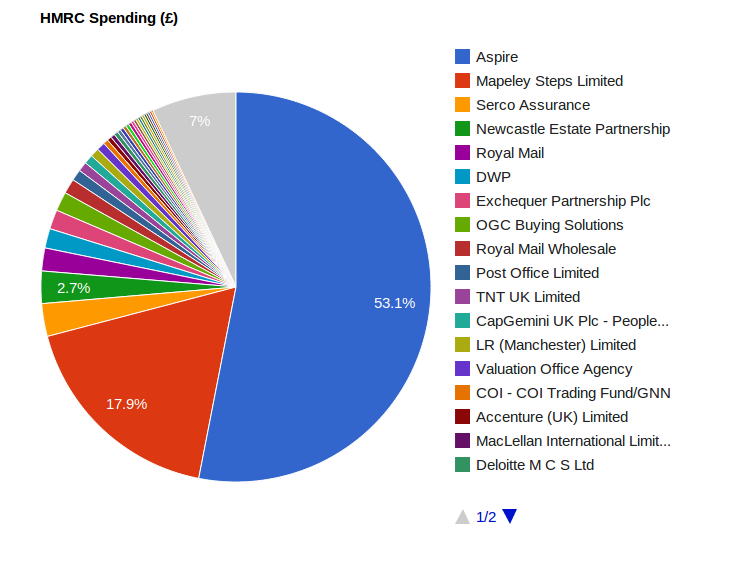
The UK government publishes lots of spending data now. Let's do cool stuff! HMRC spending pie chart ScraperWiki is one of these new-fangled cloud services, hosting code that scrapes websites. You can throw some python (or ruby, or php) together to download all the CSV files for a department. Google Refine is like a spreadsheet on crack, with features ideal for cleaning up messy data sets. I saw it for the first time at OpenTech 2011 a few weeks ago in London. You can take the government data, clean up the worst typos, and integrate it into the scraperwiki scraper. For bonus marks, throw in a bit of jQuery and Google Charts, and create a dynamically generated pie chart, or maybe a word cloud. There must be more imaginative ways to visualize this... email me if you have any ideas! They interviewed me last week - I must say, that's the first time that's happened, but I'm very flattered. None of the above would exist without the work done by @DataMinerUK et. al., so thank you, everyone.

Biella Coleman: Manifestos

It is about time I get back to this blog. It has been way way too long and there are a few things I want to say (a lot to report). But I will start with something small, a mother of a programming manifesto. Enjoy.

13 June 2011

Jonathan Wiltshire: StartSSL: finally, a trustworthy certifier*

Matt Brown writes about StartCom, the Israeli issuer providing basic SSL certificates for nothing. In fact I ve been using StartSSL certificates for about three years now, but I get them issued to Level 2 verification which incurs a fee. (It s more expensive now than when I was first validated, but still good value.) StartCom are the only issuer I ve ever dealt with who work like this. They validate the individual, using: This makes me trust them far more than other issuers, who don t bother with any meaningful validation at all. Their approach is to establish identity, then allow you to: Although this doesn t make up for trust (the presence of an SSL certificate doesn t guarantee the data you send is safe upon arrival) it does make me much happier to see a CA taking proper verification measures instead of just handing out certificates at random and it s much cheaper for me too, being verified once and then issuing as many certificates as I need. Highly recommended. *that is, more trustworthy
Comments
StartSSL: finally, a trustworthy certifier* is a post from: jwiltshire.org.uk Flattr

Christian Perrier: So, what happened with Kikithon?

I mentioned this briefly yesterday, but now I'll try to summarize the story of a great surprise and a big moment for me. All this started when my wife Elizabeth and my son Jean-Baptiste wanted to do something special for my 50th birthday. So, it indeed all started months ago, probably early March or something (I don't yet have all the details). Jean-Baptiste described this well on the web site, so I won't go again into details, but basically, this was about getting birthday wishes from my "free software family" in, as you might guess, as many languages as possible. Elizabeth brought the original idea and JB helped her by setting up the website and collecting e-mail addresses of people I usually work with: he grabbed addresses from PO files on Debian website, plus some in his own set of GPG signatures and here we go. And then he started poking dozens of you folks in order to get your wishes for this birthday. Gradually, contributions accumulated on the website, with many challenges for them: be sure to get as many people as possible, poking and re-poking all those FLOSS people who keep forgetting things... It seems that poking people is something that's probably in the Perrier's genes! And they were doing all this without me noticing. As usually in Debian, releasing on time is a no-no. So, it quickly turned out that having everything ready by April 2nd wouldn't be possible. So, their new goal was offering this to me on Pentecost Sunday, which was yesterday. And...here comes the gift. Aha, this looks like a photo album. Could it be a "50 years of Christian" album? But, EH, why is that pic of me, with the red Debconf5 tee-shirt (that features a world map) and a "bubulle" sign, in front of the book? But, EH EH EH, what the .... are doing these word by H0lger, then Fil, then Joey doing on the following pages? And only then, OMG, I discover the real gift they prepared. 106, often bilingual, wishes from 110 people (some were couples!). 18 postcards (one made of wood). 45 languages. One postcard with wishes from nearly every distro representatives at LinuxTag 2011. Dozens of photos from my friends all around the world. All this in a wonderful album. I can't tell what I said. Anyway, JB was shooting a video, so...we'll see. OK, I didn't cry...but it wasn't that far and emotion was really really intense. Guys, ladies, gentlemen, friends....it took me a while to realize what you contributed to. It took me the entire afternoon to realize the investment put by Elizabeth and JB (and JB's sisters support) into this. Yes, as many of you wrote, I have an awesome family and they really know how to share their love. I also have an awesome virtual family all around the world. Your words are wholeheartedly appreciated and some were indeed much much much appreciated. Of course, I'll have the book in Banja Luka so that you can see the result. I know (because JB and Elizabeth told me) that many of you were really awaiting to see how it would be received (yes, that includes you, in Germany, who I visited in early May!!!). Again, thank you so much for this incredible gift. Thank you Holger Levsen, Phil Hands, Joey Hess, Lior Kaplan, Martin Michlmayr, Alberto Gonzalez Iniesta, Kenshi "best friend" Muto, Praveen Arimbrathodiyil, Felipe Augusto van de Wiel, Ana Carolina Comandulli (5 postcards!), Stefano Zacchiroli (1st contribution received by JB, of course), Gunnar Wolf, Enriiiiiico Zini, Clytie Siddall, Frans Pop (by way of Clytie), Tenzin Dendup, Otavio Salvador, Neil McGovern, Konstantinos Margaritis, Luk Claes, Jonas Smedegaard, Pema Geyleg, Meike "sp tzle queen" Reichle, Alexander Reichle-Schmehl, Torsten Werner, "nette BSD" folks, CentOS Ralph and Brian, Fedora people, SUSE's Jan, Ubuntu's Lucia Tamara, Skolelinux' Paul, Rapha l Hertzog, Lars Wirzenius, Andrew McMillan (revenge in September!), Yasa Giridhar Appaji Nag (now I know my name in Telugu), Amaya Rodrigo, St phane Glondu, Martin Krafft, Jon "maddog" Hall (and God save the queen), Eddy Petri or, Daniel Nylander, Aiet Kolkhi, Andreas "die Katze geht in die K che, wunderbar" Tille, Paul "lets bend the elbow" Wise, Jordi "half-marathon in Banja Luka" Mallach, Steve "as ever-young as I am" Langasek, Obey Arthur Liu, YAMANE Hideki, Jaldhar H. Vyas, Vikram Vincent, Margarita "Bronx cross-country queen" Manterola, Patty Langasek, Aigars Mahinovs (finding a pic *with* you on it is tricky!), Thepittak Karoonboonyanan, Javier "nobody expects the Spanish inquisition" Fern ndez-Sanguino, Varun Hiremath, Moray Allan, David Moreno Garza, Ralf "marathon-man" Treinen, Arief S Fitrianto, Penny Leach, Adam D. Barrat, Wolfgang Martin Borgert, Christine "the mentee overtakes the mentor" Spang, Arjuna Rao Chevala, Gerfried "my best contradictor" Fuchs, Stefano Canepa, Samuel Thibault, Eloy "first samba maintainer" Par s, Josip Rodin, Daniel Kahn Gillmor, Steve McIntyre, Guntupalli Karunakar, Jano Gulja , Karolina Kali , Ben Hutchings, Matej Kova i , Khoem Sokhem, Lisandro "I have the longest name in this list" Dami n Nicanor P rez-Meyer, Amanpreet Singh Alam, H ctor Or n, Hans Nordhaugn, Ivan Mas r, Dr. Tirumurti Vasudevan, John "yes, Kansas is as flat as you can imagine" Goerzen, Jean-Baptiste "Piwet" Perrier, Elizabeth "I love you" Perrier, Peter Eisentraut, Jesus "enemy by nature" Climent, Peter Palfrader, Vasudev Kamath, Miroslav "Chicky" Ku e, Mart n Ferrari, Ollivier Robert, Jure uhalev, Yunqiang Su, Jonathan McDowell, Sampada Nakhare, Nayan Nakhare, Dirk "rendez-vous for Chicago marathon" Eddelbuettel, Elian Myftiu, Tim Retout, Giuseppe Sacco, Changwoo Ryu, Pedro Ribeoro, Miguel "oh no, not him again" Figueiredo, Ana Guerrero, Aur lien Jarno, Kumar Appaiah, Arangel Angov, Faidon Liambotis, Mehdi Dogguy, Andrew Lee, Russ Allbery, Bj rn Steensrud, Mathieu Parent, Davide Viti, Steinar H. Gunderson, Kurt Gramlich, Vanja Cvelbar, Adam Conrad, Armi Be irovi , Nattie Mayer-Hutchings, Joerg "dis shuld be REJECTed" Jaspert and Luca Capello. Let's say it gain:

Vincent Bernat: Anycast DNS

In a recently published article, Paul Vixie, past author and architect of BIND, one of the most popular internet domain server, explains why DNS servers should use anycast for increased reliability and faster answers. The main argument against unicast is that some resolvers may not be smart enough to select the best server to query and therefore, they may select a server on the other side of the planet. Since, you cannot go faster than light, you get a penalty of about 100 milliseconds in this case.

Unicast & anycast Most addresses that you handle are unicast addresses, i.e. the address of a single receiver. Any time you send a packet to an unicast address, it will be forwarded to this single receiver. Another common network addressing system is multicast (which happens to include broadcast). When you send a packet to a multicast address, several receivers may get it. The packet is copied as needed by some nodes. Anycast addresses allow you to send a packet to a set of receivers but only one of them will receive it. The packet will not be copied. Usually, the idea behind anycast is that the packet is sent to the nearest receiver. There is no universal way to determine if an IP address is an unicast address or an anycast address just by looking at it. For example 192.5.5.241 is an anycast address while 78.47.78.132 is an unicast address. ISC, which maintains BIND, operates the F root domain server, one of the 13 Internet root name servers. This server is queried by using 192.5.5.241 IPv4 anycast address or 2001:500:2f::f IPv6 anycast address. ISC has published a document explaining how anycast works. Several nodes around the globe announces the same subnet using BGP. When one router running BGP has to send a query to the anycast address, it will have several choices in its BGP table. It will usually select the shortest path and route the query to the corresponding router. Some nodes may choose to restrict the announcement about the subnet containing the anycast address. They are called local nodes (by opposition to other global nodes). This allows them to serve query only from their clients and use cheaper connectivity and hardware.

Lab Let s play with anycast by setting up a lab to experiment with it. We want to setup an IPv6 anycast DNS service using two global nodes, G1 and G2, and one local node, L1. We build some kind of mini-Internet. See : Anycast lab

Setting up the lab This lab will use UML guests for all nodes. For more details on how this works, look at my previous article about network labs with User Mode Linux. You first need to grab the lab:
$ git clone https://vincentbernat@github.com/vincentbernat/network-lab.git
$ cd network-lab/lab-anycast-dns
$ ./setup
You will need to install the dependencies needed by the script on your host system. The script was tested on Debian unstable. If some of the dependencies do not exist in your distribution, if they don t behave as in Debian or if you don t want to install them on your host system, you can use debootstrap to create a working system:
$ sudo debootstrap sid ./sid-chroot http://ftp.debian.org/debian/
[...]
$ sudo chroot ./sid-chroot /bin/bash
# apt-get install iproute zsh aufs-tools
[...]
# apt-get install bird6
[...]
# exit
$ sudo mkdir -p ./sid-chroot/$HOME
$ sudo chown $(whoami) ./sid-chroot/$HOME
$ ROOT=./sid-chroot ./setup
We are running a lot of UML guests in this lab. We assign 64 MB to each host. UML guests do not use host memory until they need it but because of cache subsystem, you can expect that each guest will use 64 MB of memory. This means that you need about 2 GB of RAM to run this lab. Moreover, each guest will create a file representing its memory. Therefore, you need about 2 GB of free space in /tmp too. Routers are named after their AS number. The router of AS 64652 is just 64652. Paris, NewYork and Tokyo are the exception. The lab will use only one switch but we will use VLAN to create several L2 networks. Each link in our schema is an L2 network. Each link will get its own L3 network. Those networks are prefixed with 2001:db8:ffff:. Leaf AS have their own L3 network 2001:db8:X::/48 where X is the AS number minus 60000. Look at /etc/hosts on each host to get the IP of all hosts.

Mini-Internet routing AS 64600 is some kind of Tier-1 transit network (like Level 3 Communications). It has three points of presence: Paris, New York and Tokyo. AS 64650 is an European regional transit network, AS 64640 is an East Asian regional transit network and AS 64610, 64620 and 64630 are North American regional transit network which are peering each other. Other leaf AS are local ISP. This is not really what Internet looks like but shaping our lab like a tree allows us to not deal with a lot of BGP stuff: we ensure that the shortest path (in number of BGP hops) from one client to one server is the best path. Each BGP router will get a basic BGP configuration containing only the list of peers. Since Paris, Tokyo and NewYork are in the same AS, they will use iBGP. They are fully meshed for this purpose but this does not provide redundancy because iBGP routes are not redistributed inside iBGP. A more complex setup would be needed to provide redundancy inside AS 64600. We don t use an IGP inside leaf AS as we should: for the sake of simplicity, we redistribute directly connected routes into BGP. While in my previous lab, I used Quagga, I will use BIRD in this one. It is a more modern daemon with a clean design on how routing tables may interact. It also performs better. However, it lacks several features from Quagga. The configuration for BIRD is autogenerated from /etc/hosts. We use only one routing table inside BIRD. This table will be exported to the kernel and to any BGP instance. Some directly connected routes will be imported (those representing client networks) as well as all routes from BGP instances. Here is an excerpt of 64610 s configuration:
protocol direct  
   description "Client networks";
   import filter  
     if net ~ [ 2001:db8:4600::/40 40,48  ] then accept;
     reject;
    ;
   export none;
 
protocol kernel  
   persist;
   import none;
   export all;
 
protocol bgp  
   description "BGP with peer NewYork";
   local as 64610;
   neighbor 2001:db8:ffff:4600:4610::1 as 64600;
   gateway direct;
   hold time 30;
   export all;
   import all;
 
We do not export inter-router subnets to keep our routing tables small. This also means that those IP addresses are not routable in spite of the use of public IP addresses. Here is the routing table as seen by 64610 (use birdc6 to connect to BIRD):
bird> show route
2001:db8:4622::/48 via 2001:db8:ffff:4610:4620::2 on eth3 [bgp4 18:52] * (100) [AS64622i]
                   via 2001:db8:ffff:4600:4610::1 on eth0 [bgp1 18:52] (100) [AS64622i]
2001:db8:4621::/48 via 2001:db8:ffff:4610:4620::2 on eth3 [bgp4 18:52] * (100) [AS64621i]
                   via 2001:db8:ffff:4600:4610::1 on eth0 [bgp1 18:52] (100) [AS64621i]
2001:db8:4612::/48 via 2001:db8:ffff:4610:4612::2 on eth2 [bgp3 18:52] * (100) [AS64612i]
2001:db8:4611::/48 via 2001:db8:ffff:4610:4611::2 on eth1 [bgp2 18:52] * (100) [AS64611i]
As you can notice, it knows several paths to the same network, however, it only selects the best one (based on the length of the AS path):
bird> show route 2001:db8:4622::/48 all
2001:db8:4622::/48 via 2001:db8:ffff:4610:4620::2 on eth3 [bgp4 18:52] * (100) [AS64622i]
        Type: BGP unicast univ
        BGP.origin: IGP
        BGP.as_path: 64620 64622
        BGP.next_hop: 2001:db8:ffff:4610:4620::2 fe80::e05f:a3ff:fef2:f4e0
        BGP.local_pref: 100
                   via 2001:db8:ffff:4600:4610::1 on eth0 [bgp1 18:52] (100) [AS64622i]
        Type: BGP unicast univ
        BGP.origin: IGP
        BGP.as_path: 64600 64620 64622
        BGP.next_hop: 2001:db8:ffff:4600:4610::1 fe80::3426:63ff:fe5e:afbd
        BGP.local_pref: 100
Let s check that everything works with traceroute6 on C1:
# traceroute6 G2.lab
traceroute to G2.lab (2001:db8:4612::2:53), 30 hops max, 80 byte packets
 1  64652-eth1.lab (2001:db8:4652::1)  -338.277 ms  -338.449 ms  -338.502 ms
 2  64650-eth2.lab (2001:db8:ffff:4650:4652::1)  -338.324 ms  -338.363 ms  -338.384 ms
 3  Paris-eth2.lab (2001:db8:ffff:4600:4650::1)  -338.191 ms  -338.329 ms  -338.282 ms
 4  NewYork-eth0.lab (2001:db8:ffff:4600:4600:1:0:2)  -338.144 ms  -338.182 ms  -338.235 ms
 5  64610-eth0.lab (2001:db8:ffff:4600:4610::2)  -338.078 ms  -337.958 ms  -337.944 ms
 6  64612-eth0.lab (2001:db8:ffff:4610:4612::2)  -337.778 ms  -338.103 ms  -338.041 ms
 7  G2.lab (2001:db8:4612::2:53)  -338.001 ms  -338.045 ms  -338.080 ms
Let s see what happens if we shut the link between NewYork and 64610. This link is VLAN 10. Since vde_switch does not allow to shut a port, we will change the VLAN of port 9 to VLAN 4093. After at most 30 seconds, the BGP session between NewYork and 64610 will be torn down and packets from C1 to G2 will take a new path:
# traceroute6 G2.lab
traceroute to G2.lab (2001:db8:4612::2:53), 30 hops max, 80 byte packets
 1  64652-eth1.lab (2001:db8:4652::1)  -338.382 ms  -338.499 ms  -338.503 ms
 2  64650-eth2.lab (2001:db8:ffff:4650:4652::1)  -338.284 ms  -338.317 ms  -338.151 ms
 3  Paris-eth2.lab (2001:db8:ffff:4600:4650::1)  -337.954 ms  -338.031 ms  -337.924 ms
 4  NewYork-eth0.lab (2001:db8:ffff:4600:4600:1:0:2)  -337.655 ms  -337.751 ms  -337.844 ms
 5  64620-eth0.lab (2001:db8:ffff:4600:4620::2)  -337.762 ms  -337.507 ms  -337.611 ms
 6  64610-eth3.lab (2001:db8:ffff:4610:4620::1)  -337.531 ms  -338.024 ms  -337.998 ms
 7  64612-eth0.lab (2001:db8:ffff:4610:4612::2)  -337.860 ms  -337.931 ms  -337.992 ms
 8  G2.lab (2001:db8:4612::2:53)  -337.863 ms  -337.768 ms  -337.808 ms

Setting up anycast DNS Our anycast DNS service has three nodes. Two global ones, located in Europe and North America and one local one targeted at customers of AS 64620 only. The IP address of this anycast DNS server is 2001:db8:aaaa::53/48. We assign this address to G1, G2 and L1. We also assign 2001:db8:aaaa::1/48 to 64651, 64612 and 64621. BIRD configuration is adapted to advertise this network:
protocol direct  
   description "Client networks";
   import filter  
     if net ~ [ 2001:db8:4600::/40 40,48  ] then accept;
     if net ~ [ 2001:db8:aaaa::/48 ] then accept;
     reject;
    ;
   export none;
 
We use NSD as a name server. This is an authoritative only name server. The configuration is pretty simple. We just ensure that it is bound to the IPv6 anycast address (otherwise, it may answer with the wrong address). The zone file is customized to answer the name of the server:
#(C1) host -t TXT example.com 2001:db8:aaaa::53
Using domain server:
Name: 2001:db8:aaaa::53
Address: 2001:db8:aaaa::53#53
Aliases:
example.com descriptive text "G1"
#(C5) host -t TXT example.com 2001:db8:aaaa::53
Using domain server:
Name: 2001:db8:aaaa::53
Address: 2001:db8:aaaa::53#53
Aliases:
example.com descriptive text "G2"
If we try from C3, we may be redirected to L1 while we are not a customer of AS 64620. A common way to handle this is to let 64621 tag the route with a special community that will let know 64620 that the route should not be exported.
protocol direct  
   description "Client networks";
   import filter  
     if net ~ [ 2001:db8:4600::/40 40,48  ] then accept;
     if net ~ [ 2001:db8:aaaa::/48 ] then  
          bgp_community.add((65535,65281));
          accept;
      
     reject;
    ;
   export none;
 
The community used is known as the no-export community. BIRD knows how to handle it. However, we hit here some limitations of BIRD:
  1. The correct way to let 64622 knows about this route is to build a BGP confederation for AS 64620 and let AS 64622 and AS 64621 be part of it. This means that those three AS will be seen as AS 64200 from outside of the confederation. Moreover, the no-export community would allow to export the route only within the confederation. This is exactly what we need but BIRD does not support confederations.
  2. BIRD first selects the best route to export then apply filtering. This means that even if 64620 knows non-filtered route to 2001:db8:aaaa::/48, it will select the route to L1, filter it out and export nothing to 64622.
Therefore, we need to fallback to ask BIRD to not export the route to AS 64600, 64610 and 64630 on 64620. We could use a special community to filter out the route but we keep it simple and just filter the route directly.
filter keep_local_dns  
   if net ~ [ 2001:db8:aaaa::/48 ] then reject;
   accept;
 
protocol bgp  
   description "BGP with peer NewYork";
   local as 64620;
   neighbor 2001:db8:ffff:4600:4620::1 as 64600;
   gateway direct;
   hold time 30;
   export filter keep_local_dns;
   import all;
 
Voil . Only C4 will be able to query L1. If AS 64621 is missing, it will query G2 instead. One major point about anycast is to know that redundancy is done at the AS level only. If the name server on L1 does not work correctly, requests will still be routed to it. Therefore, with anycast, you still need to provide redundancy inside each AS (or stop advertising the anycast network as soon as there is a failure).

Beyond DNS Anycast can be used to serve HTTP requests too. This is less commonly used because your connection may be rerouted to another node while it is still running. This is not a problem with DNS because there is no connection (you send a query, you receive an answer). There are at least two CDN (MaxCDN and CacheFly) which uses anycast to ensure low roundtrip time and very high reliability. Setting up an HTTP server with an anycast address is no different than setting up a DNS server. However, you need to ensure maximum stability of the routing path to avoid the connection to be dropped while running. I suppose that this is done by hiring some high-level BGP expert. You can also mix unicast and anycast:
  • anycast DNS answers the IP address of a nearby unicast HTTP server, or
  • anycast DNS answers the IP address of an anycast HTTP server that will issue a redirect to an unicast HTTP server when downloading or streaming large files.

Rapha&#235;l Hertzog: Why you should always have a network connection when installing Debian

This is a simple tip but an important one: when you re installing Debian, take the time required to ensure the machine is connected to the Internet with a wired connection. If you have DHCP available, the debian-installer will use it to configure the network. Why not use the wireless connection? Because debian-installer in Squeeze doesn t support WPA encryption, but only WEP. So if you re using WPA, picking the wireless connection will lead to no working network during the installation and this is to be avoided. If you re still using WEP, you can go ahead of course. If you only have a wireless connection with WPA, your might want to help the debian-installer team and add the required support. Matthew Palmer did some work on it a few months ago (see this mail and his branch in the netcfg git repository) but he resigned from the d-i team in the mean time. So WPA support is still not available in the wheezy debian-installer. Why is the network so important?
  1. The tasks that you select during the installation process might suggest installation of supplementary packages that are not available on your installation disc. If you install without network, the resulting system might differ from the expected one since it will be missing some packages that are available in the Debian repositories but not on your installation disc.
  2. Your installation media might be old and there are security updates that have been published. If you do your initial installation with network, the security updates will be installed before the reboot and thus before the services are exposed over the network.
  3. If you re not installing a desktop with network-manager (Debian s default GNOME Desktop provides it), the initial network configuration is important since this configuration is kept for the future. And you surely want network connectivity on your machine, don t you?
  4. Without network, APT s sources.list will not be properly configured to include an HTTP mirror of your country. And really, I prefer when apt-get install can work without the initial installation disc.
If you want to read more articles like this one, click here to subscribe to my free newsletter. You can also follow me on Identi.ca, Twitter and Facebook.

22 comments Liked this article? Click here. My blog is Flattr-enabled.

Craig Small: Debian Linux on HP DV6-6023TX

It was time to update my creaking old laptop. I ordered HP6-6023TX online and after a few days it arrived just before a long weekend. I first backed up Windows 7 onto a set of DVDs and found that either my blank DVDs are old or this new DVD drive is far more fussy. There were quite a few coasters made until I gave up and bought some new ones. DVDs seemed to be trouble for me that day. I downloaded the Debian 6.0.4 DVD image but couldn t burn it. Brasero would just keep saying calculating checksum and go no further. So after waiting too long, the CD iso was downloaded and installed. Installation of debian onto the laptop was straightforward. That is if you used a wired connection. Wireless needs the non-free firmware and I gave up trying to work out how to install it at debian-installer time as it didn t see the tar.gz full of firmware on the USB stick. Wireless worked perfectly once I loaded everything on. So at this point with not much trouble I had an almost fully working setup. Even the webcam and sound was working. Video Fun The laptop is one of these strange modern ones that has two video cards. The low-spec one is an Intel Sandybridge while the higher one is an AMD/ATI Radeon HD 6700M. The idea being you use the ATI when plugged in and the Intel on batteries. Xorg worked first go, but only on the Intel chip. Trying to force X to use the ATI driver with an Xorg configuration resulted in the Xserver crashing. Next attempt was the fglrx packages within Debian. aticonfig said it didn t know about the card. The reason for this is that the Debian packages use fglrx version11.4 and I needed for my card 11.5 So close but so far away. OK, so building the ATI software can t be that hard can it? A nice set of instructions on the Debian wiki and we had errors. The first problem is that the packaging used is ancient. The second problem is much more serious; it won t compile. I was stuck about here until I hopped onto the Debian irc channel and asked about it and someone found a very useful webpage about compiling the ATI drivers on Debian which importantly had information about the patches you need, especially the blk patch. Success! the program compiled and installed. A small xorg.conf specifying the fglrx driver and the BusID and we were up and running. I now have accelerated graphics on the laptop. Ouch, my eyes! I do actually get outside (one of my hobbies is gardening and that is an outdoor activity) so I don t need a monitor screen trying to give me a suntan. The default screen brightness on the laptop could be described as sub-nova . I m sure there is some alien astronomers several light-years away who will in many years time wonder what that flash from the unimpressive end of the milky-way was about. To protect your eyes and keep the neighborhood complaints down you can reduce the brightness to something sane. You do this in the power management settings which for me is System -> Preferences -> Power Management. I can see again!

12 June 2011

Steve McIntyre: How to not embarrass yourself with missing attachments in mutt

I keep on seeing people sending messages saying "see attached file" or similar in their emails, but then forgetting to actually attach the file. I used to do it myself lots, but then with the help of some ideas I found on the net I wrote the following script to use with mutt. To use it, use the setting "set sendmail=" to point at it.
#!/bin/bash
#
# mutt-sendmail
# helper script to reduce embarrassment with mutt :-)
#
# Copyright 2011 Steve McIntyre <steve>
# GPL v2
###
# save msg in file to re-use it for multiple tests
###
TMPFILE= mktemp -p ~/tmp -t mutt.XXXXXX    exit 2
cat > $TMPFILE
## Attachment keywords that the message body will be searched for:
KEYWORDS='attach patch'
## Define test for multipart message.
function multipart  
    grep -q '^Content-Type: multipart' "$TMPFILE"
 
## Define test for keyword search.
function word-attach  
    grep -v '^>' "$TMPFILE"   grep -v "^X-attached:"   grep -E -i -q "$KEYWORDS"
 
## Header override.
function header-override  
    grep -i -E "^X-attached: *none *$" "$TMPFILE"
 
###
# FINAL DECISION:
# chain series of functions, use !   && for logic connections,
###
if multipart   ! word-attach   header-override; then
    formail -I bcc < $TMPFILE   /usr/lib/sendmail -oi -oem "$@"
    status=$?
else
    echo "No file was attached but a search of the message text suggests there"
    echo "should be one.  Add a header \"X-attached: none\" to override this"
    echo "check if no attachment is intended."
    status=1
fi
rm -f $TMPFILE
exit $status

Next.

Previous.