Search Results: "ean"

6 January 2013

Neil Williams: bootstrapping arm64

I'm still working on perl-cross-debian (just uploaded 0.0.2) and there's more to do on that with upstream but part of the reason to work on perl cross-building is to do what I can to help with the ARM64 port.

So, I went back to Wookey's talk at DebConf12 which leads to the current list of cross-build results for arm64 and started through the list.

coreutils is listed as failing but that was an archive error (MD5sum hash mismatch), so that just needs a retry. I don't have access to that buildd, yet, so nothing I can do there.

Next on the list (excluding those just waiting for build-deps) was klibc.

aarch64-linux-gnu-gcc -Wp,-MD,usr/klibc/.__static_init.o.d -nostdinc -iwithprefix
include -I/ PKGBUILDDIR /usr/include/arch/x86_64 -Iusr/include/arch/x86_64
-I/ PKGBUILDDIR /usr/include/bits64
-Iusr/include/bits64 -I/ PKGBUILDDIR /usr/klibc/../include
-Iusr/klibc/../include -I/ PKGBUILDDIR /usr/include -Iusr/include
-I/ PKGBUILDDIR /linux/include -Ilinux/include
-I/ PKGBUILDDIR /linux/arch/x86/include -Ilinux/arch/x86/include
-D__KLIBC__=2 -D__KLIBC_MINOR__=0 -D_BITSIZE=64 -fno-stack-protector -fwrapv -m64 -Os
-fno-asynchronous-unwind-tables -fomit-frame-pointer -falign-functions=1 -falign-jumps=1 -falign-loops=1
-W -Wall -Wno-sign-compare -Wno-unused-parameter -c -o usr/klibc/__static_init.o usr/klibc/__static_init.c
aarch64-linux-gnu-gcc: error: unrecognized command line option '-m64'
make[4]: *** [usr/klibc/__static_init.o] Error 1


Turns out that this is a build failure I understood, at least initially. A little digging and a trivial patch was begun:

--- a/usr/klibc/arch/arm/MCONFIG
+++ b/usr/klibc/arch/arm/MCONFIG
@@ -30,6 +30,13 @@
ifeq ($(CONFIG_AEABI),y)
KLIBCREQFLAGS += -mabi=aapcs-linux -mno-thumb-interwork
else
+# aarch64
+ifeq ($(CONFIG_AARCH64),y)
+KLIBCREQFLAGS +=
+KLIBCOPTFLAGS += -mgeneral-regs-only
+else
KLIBCREQFLAGS += -mabi=apcs-gnu -mno-thumb-interwork
endif
endif
+endif
+

Alongside a trivial change to debian/rules

ifeq ($(DEB_HOST_ARCH),arm64)
DEB_MAKE_ENVVARS := ARCH=arm CONFIG_AARCH64=y CPU_ARCH=armv8-a CPU_TUNE=generic
endif

OK, then things get a bit more awkward,

....
code/debian/cross/klibc/klibc-2.0.1/linux/arch/arm/include -Ilinux/arch/arm/include -D__KLIBC__=2
-D__KLIBC_MINOR__=0 -D_BITSIZE=32 -fno-stack-protector -fwrapv -fno-exceptions -Os
-march=armv8-a -mtune=generic -mgeneral-regs-only -W -Wall -Wno-sign-compare -Wno-unused-parameter
-c -o ../foo.o usr/klibc/arch/arm/crt0.S
usr/klibc/arch/arm/crt0.S: Assembler messages:
usr/klibc/arch/arm/crt0.S:19: Error: operand 1 should be an integer register -- mov r0,sp'
usr/klibc/arch/arm/crt0.S:20: Error: operand 1 should be an integer register -- mov r1,#0'

Hmm. Assembly, well, yes, I've done assembly before, I know what mov should normally do, sp is likely to be the stack pointer .... where's my AARCH64 assembly PDF again... PRD03-GENC-010197 ...

OK, so maybe the r0 and r1 should be x0 and x1, hmm, that at least doesn't raise assembly errors. So a tentative change:

--- a/usr/klibc/arch/arm/crt0.S
+++ b/usr/klibc/arch/arm/crt0.S
@@ -15,9 +15,13 @@
#ifdef __thumb__
.thumb_func
#endif
-
+#ifdef __aarch64__
+_start: mov x0, sp
+ mov x1, #0
+ bl __libc_init
+#else
_start: mov r0, sp
mov r1, #0
bl __libc_init
-
+#endif
.size _start,.-_start

Next stage, however, leaves me quite a bit more lost:

....
klibc-2.0.1/linux/arch/arm/include -Ilinux/arch/arm/include
-D__KLIBC__=2 -D__KLIBC_MINOR__=0 -D_BITSIZE=32 -fno-stack-protector -fwrapv -fno-exceptions -Os
-march=armv8-a -mtune=generic -mgeneral-regs-only -W -Wall -Wno-sign-compare -Wno-unused-parameter
-c -o usr/klibc/arch/arm/setjmp.o usr/klibc/arch/arm/setjmp.S
usr/klibc/arch/arm/setjmp.S: Assembler messages:
usr/klibc/arch/arm/setjmp.S:32: Error: unknown mnemonic stmia' -- stmia r0, r4,r5,r6,r7,r8,r9,r10,fp,sp,lr '
usr/klibc/arch/arm/setjmp.S:33: Error: operand 1 should be an integer register -- mov r0,#0'
usr/klibc/arch/arm/setjmp.S:34: Error: operand 1 should be an integer register -- mov pc,lr'
usr/klibc/arch/arm/setjmp.S:42: Error: unknown mnemonic ldmia' -- ldmia r0, r4,r5,r6,r7,r8,r9,r10,fp,sp,lr '
usr/klibc/arch/arm/setjmp.S:43: Error: unknown mnemonic movs' -- movs r0,r1'
usr/klibc/arch/arm/setjmp.S:44: Error: unknown mnemonic moveq' -- moveq r0,#1'
usr/klibc/arch/arm/setjmp.S:45: Error: operand 1 should be an integer register -- mov pc,lr'
make[5]: *** [usr/klibc/arch/arm/setjmp.o] Error 1


So now I'm out of my depth of AARCH64 assembly (apart from the recurrence of mov r0 vs mov x0 etc.). If the above is useful then maybe someone can work out what is wrong with setjmp.S or whether AARCH64 just means that klibc needs to gain a arch/arm64/ directory and not try to duplicate each entire assembly block within #ifdef clauses.

I don't really know where else to put an incomplete investigation like this, so it's here for anyone to find.

(Oh, and if you're reading those arm64 cross-build logs, then a few hundred occurrences of ldconfig: /usr/lib/aarch64-linux-gnu/*.so is for unknown machine 183. in every build log (success or fail) is apparently entirely normal until more packages get fixed. Really slows down scanning the build log. :-(

I may try busybox or libusb next. libusb looks like a classic "you might have told me to cross-compile but I'm going to use g++ anyway because I know best" cross-building problem, indicative of yet another BDBS. sigh.

Resources:
Getting started with 64-bit ARM development
ARMv8 images for developers
AArch64 for everyone, Marcin Juszkiewicz
Howto/HelloAarch64 - Linaro wiki
AArch64 gcc options

Russ Allbery: Pod::Thread 1.00 (and spin 1.80)

Well, this wasn't really what I intended to do with the tail end of my vacation, but I got started on it last night after fixing a different bug and failed to stop. Thread is the macro language (converted to HTML by a program called spin) that I use for maintaining all of my web pages, as mentioned in the previous release announcements from this week. Pod::Thread converts POD documentation into thread so that spin can convert it to HTML. This has multiple advantages over converting it directly to HTML for my web site, such as being able to use spin's methods for adding navigation links and not having to come up with separate style sheets. This release finally converts Pod::Thread to use Pod::Simple as the POD parser, which means I no longer have any modules using Pod::Parser. I find Pod::Simple a bit more fiddly to work with, but it's actively maintained and higher-quality. This conversion, for example, fixes a problem with being too aggressive about turning =item into a numeric list, something that I really couldn't fix with Pod::Parser. Also fixed in this release is the bug that got me started down this path: mishandling of URLs with anchor text. This is the second Perl module that I've converted to my new coding style and augmented test suite, and I'm getting a little bit faster at it, but it still took me a full day. (Although that included the Pod::Simple rewrite, which required touching most of the code.) I'm not entirely sure that should have been my top priority today, but oh well, I had to do it sometime. You can get the latest version from my web tools distribution page. I also uploaded a new Debian package to my personal repository. I also released spin 1.80, a follow-on from the previous release, that fixes a bug in the new code to determine last modification date from Git.

5 January 2013

Ian Wienand: Position Independent Code and x86-64 libraries

A comment pointed out that the original article from 2008 made a few simplifications that were a bit misleading, so I have taken some time to update this. Thanks for the feedback. If you've ever tried to link non-position independent code into a shared library on x86-64, you should have seen a fairly cryptic error about invalid relocations and missing symbols. Hopefully this will clear it up a little. Let's start with a small program to illustrate.
int global = 100;
int function(int i)  
    return i + global;
 
Firstly, inspect the disassembley of this function:
$gcc -c function.c
$objdump --disassemble function.o
0000000000000000 <function>:
   0:   55                      push   %rbp
   1:   48 89 e5                mov    %rsp,%rbp
   4:   89 7d fc                mov    %edi,-0x4(%rbp)
   7:   8b 05 00 00 00 00       mov    0x0(%rip),%eax        # d <function+0xd>
   d:   03 45 fc                add    -0x4(%rbp),%eax
  10:   c9                      leaveq
  11:   c3                      retq
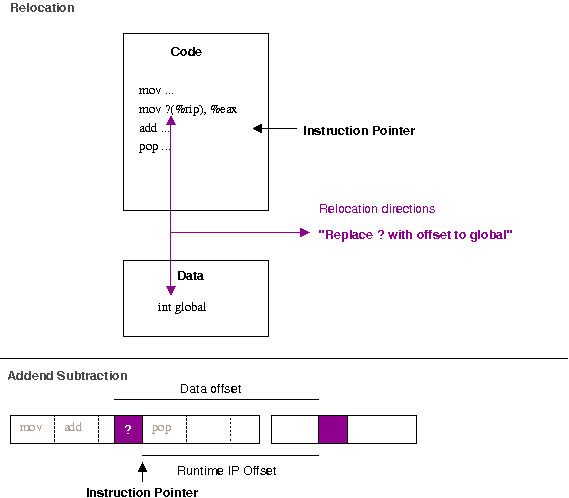
Lets just go through that for clarity: The IP relative move is really the trick here. We know from the code that it has to move the value of the global variable here. The zero value is simply a place holder - the compiler currently does not determine the required address (i.e. how far away from the instruction pointer the memory holding the global variable is). It leaves behind a relocation -- a note that says to the linker "you should determine the correct address of foo (global in our case), and then patch this bit of the code to point to that addresss". Relocations with addend The top portion of the image above gives some idea of how it works. We can examine relocations in binaries with the readelf tool.
$ readelf --relocs ./function.o
Relocation section '.rela.text' at offset 0x518 contains 1 entries:
  Offset          Info           Type           Sym. Value    Sym. Name + Addend
000000000009  000800000002 R_X86_64_PC32     0000000000000000 global + fffffffffffffffc
There are many different types of relocations for different situations; the exact rules for different relocation types are described in the ABI documentation for the architecture. The R_X86_64_PC32 relocation is defined as "the base of the section the symbol is within, plus the symbol value, plus the addend". The addend makes it look more tricky than it is; remember that when an instruction is executing the instruction pointer points to the next instruction to be executed. Therefore, to correctly find the data relative to the instruction pointer, we need to subtract the extra. This can be seen more clearly when layed out in a linear fashion (as in the bottom of the above diagram). If you try and build a shared object (dynamic library) with an object file with this type of relocation, you should get something like:
$ gcc -shared function.c
/usr/bin/ld: /tmp/ccQ2ttcT.o: relocation R_X86_64_32 against  a local symbol' can not be used when making a shared object; recompile with -fPIC
/tmp/ccQ2ttcT.o: could not read symbols: Bad value
collect2: ld returned 1 exit status
If you look back at the disassembly, we notice that the R_X86_64_32 relocation has left only 4-bytes (32-bits) of space left for the relocation entry (the zeros in 7: 8b 15 00 00 00 00). So why does this matter when you're creating a shared library? The first thing to remember is that in a shared library situation, we can not depend on the local value of global actually being the one we want. Consider the following example, where we override the value of global with a LD_PRELOAD library.
$ cat function.c
int global = 100;
int function(int i)  
    return i + global;
 
$ gcc -fPIC -shared -o libfunction.so function.c
$ cat preload.c
int global = 200;
$ gcc -shared preload.c -o libpreload.so
$ cat program.c
#include <stdio.h>
int function(int i);
int main(void)  
   printf("%d\n", function(10));
 
$ gcc -L. -lfunction program.c -o program
$ LD_LIBRARY_PATH=. ./program
110
$ LD_PRELOAD=libpreload.so LD_LIBRARY_PATH=. ./program
210
If the code in libfunction.so were to have a fixed offset into its own data section, it will not be able to be overridden at run-time by the value provided by libpreload.so. Additionally, there are only 4-bytes available to patch in for the address of global -- since a shared library could conceivably be loaded anywhere in the 64-bit (8-byte) address space we therefore need 8-bytes of space to cover ourselves for all possible addresses global might turn up at. The two basic possibilities for an object file are to be either linked into an executable or linked into a shared-library. In the executable case, the value of global will be in the exectuable's data section, which should definitely be reachable with a 32-bit offset of the current instruction-pointer. The instruction-pointer relative address can simply be patched in and the executable is finalised. But what about the shared-library case, where we know the value of global could essentially be anywhere within the 64-bit address space? It is possible to leave 8-bytes of space for the address of global, by telling gcc to use the large-code model. e.g.
$ gcc -c -mcmodel=large function.c
$ objdump --disassemble ./function.o
./function.o:     file format elf64-x86-64
Disassembly of section .text:
0000000000000000 <function>:
   0:  55                      push   %rbp
   1:  48 89 e5                mov    %rsp,%rbp
   4:  89 7d fc                mov    %edi,-0x4(%rbp)
   7:  48 b8 00 00 00 00 00    movabs $0x0,%rax
   e:  00 00 00
  11:  8b 10                   mov    (%rax),%edx
  13:  8b 45 fc                mov    -0x4(%rbp),%eax
  16:  01 d0                   add    %edx,%eax
  18:  5d                      pop    %rbp
  19:  c3                      retq
However, this creates a problem if you really want to share this code. By having to patch in an address of global directly, this means the run-time code above does not remain unchanged. Two separate processes therefore can't share this code -- they each need separate copies that are identical but for their own addresses of global patched into it. By enabling Position Independent Code (PIC, with the flag -fPIC) you can ensure the code remains share-able. PIC means that the output binary does not expect to be loaded at a particular base address, but is happy being put anywhere in memory (compare the output of readelf --segments on a binary such as /bin/ls to that of any shared library). This is obviously critical for implementing lazy-loading (i.e. only loaded when required) shared-libraries, where you may have many libraries loaded in essentially any order at any location. Of course, any problem in computer science can be solved with a layer of abstraction and that is essentially what is done when compiling with -fPIC. To examine this case, let's see what happens with PIC turned on.
$ gcc -fPIC -shared -c  function.c
$ objdump --disassemble ./function.o
./function.o:     file format elf64-x86-64
Disassembly of section .text:
0000000000000000 <function>:
   0:   55                      push   %rbp
   1:   48 89 e5                mov    %rsp,%rbp
   4:   89 7d fc                mov    %edi,-0x4(%rbp)
   7:   48 8b 05 00 00 00 00    mov    0x0(%rip),%rax        # e <function+0xe>
   e:   8b 00                   mov    (%rax),%eax
  10:   03 45 fc                add    -0x4(%rbp),%eax
  13:   c9                      leaveq
  14:   c3                      retq
It's almost the same! We setup the frame pointer with the first two instructions as before. We push the first argument into memory in the pre-allocated "red-zone" as before. Then, however, we do an IP relative load of an address into rax. Next we de-reference this into eax (e.g. eax = *rax in C) before adding the incoming argument to it and returning.
$ readelf --relocs ./function.o
Relocation section '.rela.text' at offset 0x550 contains 1 entries:
  Offset          Info           Type           Sym. Value    Sym. Name + Addend
00000000000a  000800000009 R_X86_64_GOTPCREL 0000000000000000 global + fffffffffffffffc
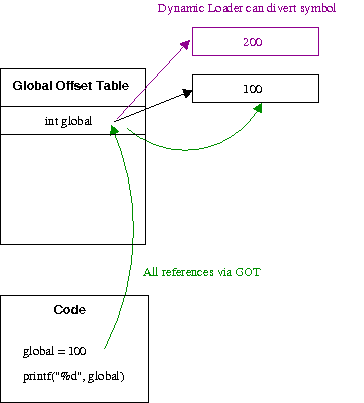
The magic here is again in the relocations. Notice this time we have a P_X86_64_GOTPCREL relocation. This says "replace the data at offset 0xa with the global offset table (GOT) entry of global. Global Offset Table operation with data variables As shown above, the GOT ensures the abstraction required so symbols can be diverted as expected. Each entry is essentially a pointer to the real data (hence the extra dereference in the code above). Since we can assume the GOT is at a fixed offset from the program code within plus or minus 2Gib, the code can use a 32-bit IP relative address to gain access to the table entries. So, taking a look a the final shared-library binary we see a final offset hard-coded
$ gcc -shared -fPIC -o libfunction.so function.c
$ objdump --disassemble ./libfunction.so
00000000000006b0 <function>:
 6b0:  55                      push   %rbp
 6b1:  48 89 e5                mov    %rsp,%rbp
 6b4:  89 7d fc                mov    %edi,-0x4(%rbp)
 6b7:  48 8b 05 8a 02 20 00    mov    0x20028a(%rip),%rax        # 200948 <_DYNAMIC+0x1d8>
 6be:  8b 10                   mov    (%rax),%edx
 6c0:  8b 45 fc                mov    -0x4(%rbp),%eax
 6c3:  01 d0                   add    %edx,%eax
 6c5:  5d                      pop    %rbp
 6c6:  c3                      retq
 6c7:  90                      nop
Every process who wants to share this code just needs to make sure they have their unique address of global at 0x20028a(%rip). Since each process has a separate address-space, this means they can all have different values for global but share the same code! Thus the default of the small-code model is sensible. It is exceedingly rare for an executable to need more than 4-byte offsets for a relative access to a variable in it's data region, so using a full 8-byte value would just be a waste of space. Although leaving 8-bytes would allow access to the variable anywhere in the 64-bit address space; when building a shared library, you really want to use -fPIC to ensure the library can actually be shared, which introduces a different relocation and access to data via the GOT. This should explain why gcc -shared function.c works on x86-32, but does not work on x86-64. Inspecting the code reveals why:
$ objdump --disassemble ./function.o
00000000 <function>:
   0:   55                      push   %ebp
   1:   89 e5                   mov    %esp,%ebp
   3:   a1 00 00 00 00          mov    0x0,%eax
   8:   03 45 08                add    0x8(%ebp),%eax
   b:   5d                      pop    %ebp
   c:   c3                      ret
$ readelf --relocs ./function.o
Relocation section '.rel.text' at offset 0x2ec contains 1 entries:
 Offset     Info    Type            Sym.Value  Sym. Name
00000004  00000701 R_386_32          00000000   global
We start out the same, with the first two instructions setting up the frame pointer. However, next we load a memory value into eax -- as we can see from the relocation information, the address of global. Next we add the incoming argument from the stack (0x8(%ebp)) to the value in this memory location; implicitly dereferencing it. But since we only have a 32-bit address-space, the 4-bytes allocated is enough to access any possible address. So while this can work, you're not creating position-independent code and hence not enabling code-sharing. The disadvantage of PIC code is that you require "bouncing" through the GOT, which requires more loads and reads to find an address than directly referencing it. However, if your program is at the point that this is becoming a performance issue you're probably not reading this blog! Hopefully, this helps clear up that possibly cryptic error message. Further searches around position-independent code, global-offset tables and code-sharing should also yield you more information if it remains unclear.

Jan Wagner: Brainfucked intellectual property rights

This issue is about a bit specific situation in Germany and it's (mainly tax-financed) public service broadcasting. If you think you are not interested, please skip this entry. :) Just beginning from scratch... In Germany we have (like most european countries) a public service broadcasting. Starting with 2013 the system collecting the funding of the public service broadcasting changed from GEZ to Beitragsservice.
To make it short (and a bit simplified) ... it changed from "most 'families' have to pay" to "every menage has to pay". This means, even if you don't have any device to use the service of the german public service broadcasting but are a menage, you have to pay for it. This sitiation is even more worse than pay-TV. Don't get me wrong ... I'm neither against public service broadcasting nor against paying for it in principle. In the rare cases I'm watching TV, this is most likely a channel of the public service broadcasting. Same counts for the rest of my small family. Mostly we are watching news and documentations ... also some movies are watched. The kids are watching KiKA, which we like cause it's Ads-free and it's not just some cartoons with hidden violence. So we most likely benefit from public service broadcasting. Anyways ... in common we are not using "TV" as most of the others may do. We still like some sort of the broadcast, but we are missing it cause various reasons. For our luck there is a service called 'Mediathek' provided by the most german public service broadcasting channels. If you missed a broadcast or are prevented for any reason, you may watch the broadcast there. Unfortunately the timeframe you can access the broadcast is very short, in most cases 7 days. This is manifested in the so called Rundfunkstaatsvertrag, more precisely in the 12. Rundfunk nderungsstaatsvertrag. The 'Tagesschau' has a good explanation about the issue. This means, in simple words, the tax payed broadcasts needs to be deleted after a (in my eyes) short time. WTF?!? Why do we wipe work we all payed for it? Guess what ... it was implemented by lobbying from commercial print media and private (e.g. ads-financed) TV-channels. A comment about a related problem, which I agree, can be found here. Another challenge ... How do you know there is a broadcasting your are interested in? How do you know when it is broadcasted? I remember, my parents was subscribed to a daily newspaper, which included an additional TV paper, my parents-in-law bought also one.
As we are neither subscribed to a daily newspaper nor buying a TV paper, we have to solve that differently (beside that a printed paper won't help us I think). When we use the opportunity to watch TV at the evening, I just use an electronical TV paper (-app). If we find something which fits, we are fine .. if not, we do other things. This sounds a bit like an old school behaviour and it is not, how I would like to use a media today. I like using a feedreader. You can subscribe differnt 'channels' of information feeds and it is a way I would love to use TV. In the past I used a tool called 'Mediathek', which is a tool for Mac OSX. With this tool it was easily possible to find broadcasts, you could subscribe to so called 'channels', which means broadcasts of a same series for example. You could also mark them as "unread" und "read" .. something like a feedreader.
On the other way, it was also possible to list recent broadcast per genres and popular broadcast of the recent and the last week. This was very comfortable as this was working for several mediathek sites for german public service broadcasting channels in one central place. For every broadcast you could just view it or download it to view it later. You could even download subscribed channels automatically. After using the Mediathek-App and being satisfied by the Mediathek sites of the german public service broadcasting channels for several years, this week the server(s) behind the App was shut down. What the f....?!? On Twitter the author stated that the shutdown was cause by problems with the copyright law. Das Erste, ZDF and WDR denied that they has anything todo with this recent issue. The question is ... what is the direct cause for shutting down such a good service. This smells a bit like the PirateBay issue, but in this case the content which is Mediathek providing access to isn't pirated, but legal hosted. So where is the real issue? In my mind, the german citizen has payed to produce this content and should have the right to access the content is an usable way. The Mediathek App did provide such a way and it is really pissing me off that this access isn't available anymore, at least for this reason. Actually I don't see any solution to access our payed content in a decent way. Footnote: I think it's obscenely, that publishing houses and commercial broadcaster trying to gain their turnover at the expense of the german citizen by forcing the german legislature to implement Depublication,.

4 January 2013

David Welton: The Software Millionaire Next Door

I've been reading "The Millionaire Next Door" and have so far found it to be a pleasant book with a good message: don't waste your money on silly things and appearance (fancy suits, fancy cars, expensive boats, etc...), save what you do earn consistently and constantly, invest wisely, and so on. Wikipedia has a good summary:
http://en.wikipedia.org/wiki/The_Millionaire_Next_Door
One of the things I like about it is that it focuses on "ordinary" wealthy people, those with a million or more in the bank, but not the Warren Buffets or Bill Gates types that are extreme statistical outliers. There are plenty of people in the US who have done well by themselves by slowly but surely putting together enough money to be financially independent, without, however, being in the spotlight. As the book says, these are the kind of people who maybe own a local chain of businesses doing something fairly ordinary, but doing it well enough to succeed. They may very well not live in a fancy house, nor drive an expensive car, or otherwise outwardly draw much attention to themselves. The world of software does not revolve around "dressing for success" (you noticed?), but we do tend to focus on the "big winners". Gates, Jobs, Zuckerberg, Larry & Sergey, Larry Ellison, and so on are the stars of the show. Of course, the economics of software being what they are, instances of winner-take-all markets with one big fish and a lot of also-rans are not uncommon. However, that is not the only story, and I think it'd be interesting to know more about those in our industry who have accumulated significant wealth, yet are not the guys with more money than they could possibly ever spend on things that aren't, say, country-sized chunks of real-estate. I'm guessing they'd fall into these categories: It'd be very interesting to gather some actual data on this, although I'm not in a position to do so myself - I wouldn't even really know where to start. As I age, I think the third category has begun to seem appealing in many ways - I'm simply not cut out for the Big Company life, and I'm not interested in living in Silicon Valley and going "all in" on the latest startup - I already did that, and while it was fun and I don't regret it, it's not the kind of thing I'd want to do now that I'm married and have kids. Incidentally, this more relaxed, under the radar approach is exactly what is expoused in one of my favorite books of the past few years, Start Small, Stay Small. Edit : I finished reading the book and reviewed it here: http://davids-book-reviews.blogspot.com/

Stefano Zacchiroli: bits from the DPL for December 2012

Happy new year, Debian! To celebrate, here are some freshly posted, bits from the DPL for December 2012.
Dear Project Members, happy new year! Here goes another report of DPL activities, this time for December 2012. This issue of the DPL-monthly is skinnier than usual: during the past month I've been struck by the catastrophe also known as "family holiday season", enjoying a solid 10 day break from computer-related activities. Talks Assets DPL helpers Collaboration with the outer world That's all for last year, enjoy the new one, which will soon see a new Debian release out of the door. And to make it happen sooner, let's go back fix RC bugs! Cheers.
PS the day-to-day activity log for December 2012 is available at the usual place master:/srv/leader/news/bits-from-the-DPL.txt.201212

Ian Wienand: Tagging handbrake output for iTunes

If you rip your DVD's with a unix-y name like longish-show-name-season-01-01.m4v then the iPad and iPhone video player only shows the prefix of the file-name to it's string limit, so you only ever see longish-show-na and can never tell what episode is what in the overview list. You can edit the files in iTunes to add meta-data information, but that's annoying and non-unix-y. It is of course easy, but I went down several dead-ends with tools that didn't recognise file-extensions, corrupted files and plain didn't work. The package I had most success with is mp4v2-utils and the mp4tags utility. The help is fairly self-explanatory, but something like
mp4tags -show "Show Name" -season <season> -episode <episode> -type "tvshow"  file.m4v
will mean that when you import your file into iTunes it displays correctly as a TV show (and not a movie), is grouped correctly into series and has a name you can see. Unfortunately, it doesn't seem my Nexus 7 tablet picks up these tags. And both players interfaces remain terrible at indicating which episodes have been watched and which have not. But this has allowed me to re-visit my old box-set of Yes Minister which, despite a few odd references to Quango's still seems as relevant as ever!

Russ Allbery: spin 1.79

spin is the program that I use to generate all of my web pages, including this journal, from a bespoke macro language. I've been slowly evolving it since 1999 and really do intend to turn it into a proper Perl module one of these days.... My web site was one of the few places left that I was still using Subversion, and I finally decided to do something about that during this vacation. The main reason why it wasn't trivial was that I was using Subversion Id strings to get a more accurate last change date for files rather than just using file timestamps. (Nit-picky, I know, but if I'm not allowed to be nit-picky on my own web site, where can I be?) This release recognizes when the source directory is a Git working tree and supports determining the last modification date from git log instead (by way of the Git::Repository Perl module). I also updated all my various (not released) helper scripts for maintaining the site to use Git rather than Subversion, which mostly involved changing svn to git and removing some fiddly bits that Git doesn't require. Of course, this means that I also removed the \id thread commands on all my pages, which in turn means that I just updated the last modification date of every file, making it somewhat hard to test since every thread-generated page on my site has now been modified today. *heh* You can get the latest release of spin from my web tools distribution page. I also released version 1.44 of my release utility, which I use to help automate some of the work of generating software releases. The change there is to use Git rather than Subversion to commit changes to the .versions file that drives some of the software-related parts of my web site. You can get the latest version of release from my scripts page.

2 January 2013

Niels Thykier: Getting space for more packages

In 2011, I wrote about how small files could consume a lot of space. I meant to do a follow-up on the savings but I forgot about it until now. In 2.5.7, we started compressing some of the collected data files. Some of these are ridiculously compressable (#664794). Even better, compressing them is sometimes faster than writing them directly to the disk, so in some cases it is a pure win/win. For lintian.d.o, we also see a vast size reduction in overall size of the laboratory. I have taken a few samples occasionally. The samples were done with du(1):
$ du -csh [--apparent-size] laboratory/*
Version/date du -csh apparent-size
N/A around 20 Mar 2012 (#664794) 16G 13G
2.5.6 (Fri Apr 27 2012) 14GB N/A
2.5.6 (Mon Jun 04 2012)) N/A 12G
2.5.10.2 (Fri Sep 21 2012) 12G 8.3G
2.5.11 (Wed Jan 2 2013) 10G 6.1G
And the most awesome part of this? The comparison is quite biased against the 2.5.11 entry, which is the only entry to also process experimental (approx. 10% extra packages). Some of the early entries (2.5.6 and older ) might also have suffered from the too many links issue[1]. I only wish I had been better at collecting data points, so I could have made a proper graph of it. :) It sounds almost too good to be true, but if you look at the size of one of the linux-image packages[1], the space usage dropped from 27M to 15M between 2.5.5 to 2.5.9. Currently it is squeezed down to 14M (tested with head of the git master branch). [1] I believe is about 5-10% less binary packages processed for those runs. [2] linux-image-3.2.0-2-amd64_3.2.20-1_amd64.deb

Russ Allbery: podlators 2.5.0

podlators is the package that contains Pod::Man and Pod::Text and the pod2man and pod2text driver scripts, which convert Perl's POD documentation format into text and *roff (for man pages) output. This release is a "clearing the decks" release that rolls up various smallish feature requests and bug fixes that have been pending for a while. I want to do the same reworking to podlators that I did to Term::ANSIColor, but it's going to take longer since it's quite a bit more code. (And Term::ANSIColor took me about two days.) I didn't want to block the various pending issues on that work, so this tries to clean up all the open bugs I was aware of other than sorting out the defaults for Unicode output. (That's a much larger problem and will probably be fixed in a major release.) The primary change is that pod2man and pod2text now die by default if the POD contains syntax errors. This will hopefully flush out numerous POD documents around the world that have been carrying POD ERRORS sections around forever. I considered just warning by default but not failing, since this will also cause CPAN builds to fail, and I may fall back to that if there are too many complaints. But usually fixing the POD syntax is straightforward, and normally parsing programs will fail on syntax errors. Note that the defaults for the modules, Pod::Man and Pod::Text, continue to be to add a POD ERRORS section, since aborting inside a module isn't very friendly to the caller. There is a new option for both the modules and the driver scripts to set the error handling behavior, which can be set to die, report to standard error but continue, add a POD ERRORS section, or ignore errors entirely. Also in this release is a new nourls option that suppresses the URLs in text and *roff output for L<> codes that have anchor text, which can declutter some POD texts, and fixes for X<> formatting codes containing whitespace and small-caps handling of paragraphs consisting entirely of all-caps text. You can get the latest release from the podlators distribution page.

1 January 2013

Craig Small: procps 3.3.6 and Mudlet 2.0

Mudlet - Graphical MUD clientYesterday was a busy Debian day for me with the release of not one but two packages. procps procps version 3.3.6 was released both as an upstream and a Debian package. While there were many bug fixes in this release, the main new feature for it was the top inspect feature. The top inspect feature allows you to run top in the normal way then you can inspect a specific process you have selected within top for more information. Examples of this include fuser or lsof type output to see what files or libraries are open but really the limit is how clever the operator is and how often you would need this information. Even scripts can be run off this feature if you have some customised or cooked output you need to see. Once the output is there, you can search for text. There will be a small hold-up with the Debian packages as the section for the library has been moved to libs, where it should be. At least I think that s why there is a delay. procps infrastructure procps currently has only an email list and a gitorious git repository. While this works most of the time, there are two main problems with this setup. The first is that the only two ways you can report bugs is send an email to the list or create a git merge request. The email has the problem with tracking and gathering history while the git sets the bar pretty high for reporting something has gone wrong. Second problem is there is no tarball file repository. gitorious does have the feature of downloading tarballs of the tag checkpoints, but this is the raw repository. When you make a tarball with make dist there are some generated files included in the tarball that don t appear in the gitorious ones, which means its not a simple for some as you expect. So I ll be creating a project for these two features soon. Not sure where they will be but I use sourceforge for both these for a few other projects so that might be where they end up. Mudlet Mudlet, the multi-user dungeon or MUD client, has finally made it to version 2.0! It looks a lot more stable and polished at least from the scripting side than the previous RC versions but has all the features that we ve come to expect with it. The most important thing is that the developers have finally put a line in the sand and said this is version 2.0 . The Debian package was uploaded yesterday and should be on its way to your local mirror soon.

Vincent Sanders: I don't drink coffee I take tea my dear, I like my toast done on one side...

Choices, options, selections if you rather. These are what set us all apart from our fellow man, perhaps it is only the appearance of free will and individuality but our world is full of choice.

In software it might be argued programming is nothing more than making thousands perhaps millions of choices which result in a list of instructions for a machine incapable of making decisions of its own.

On a more mundane level sometimes a programmer cannot make a choice suitable for all expected use cases and a user option is created. These options have become something of a cause for arguments within certain sections of the open source software community especially amongst the groups that influence the graphical user experience.

The discussion should be nuanced and varied (perhaps that is my age, or maybe I am more diplomatic than I thought?) but there seems to be little compromise on this discussion which (from an outsiders point of view) splits into two viewpoints:


The reductionist group is currently winning the argument in the popular graphical environments and seem to be removing functionality which requires user choice wherever they can find it. This results in the absurd "joke" that the UI will become a single button, which they are trying to remove.

Personally my view is that an option should be present only when an option cannot be satisfactorily selected by the computer and even then a default suitable for as many users as possible should be picked.

You may ask why I have raised this topic at all? well over the last few days I have been trying to fix the preferences selection for the GTK port of NetSurf. The NetSurf project follows my view on this subject pretty closely but being a browser its very difficult to do the right thing for everyone

NetSurf has numerous frontends for the core browser, I use the term frontend because in some places the toolkit and OS are conflated (windows, cocoa) and not in others (gtk). For each frontend NetSurf is a native application, this is an important distinction, the windows and widgets a user interfaces with are produced by that platforms toolkit.

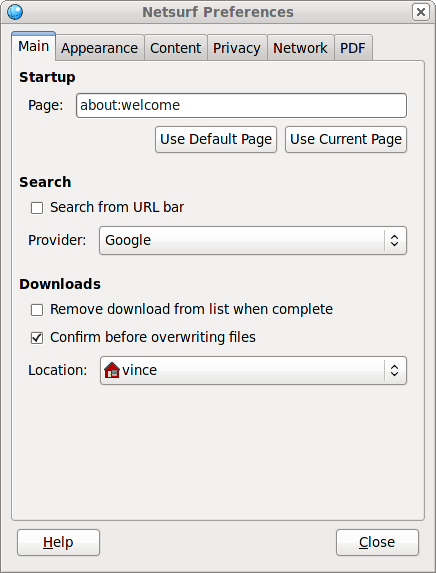
Old NetSurf Preferences Dialog
This is a deliberate choice unlike other browsers which render their UI themselves as web content, this is a beguiling solution when the authors wish there to be a single browsing "experience" with a common look and feel. However NetSurf looks and feels like a native browser for each frontend, which is what the project decided it wanted to achieve.

Given this the gtk frontend (is it a Gnome application? not sure of the distinction TBH) has had no dedicated maintainer for some time it has suffered from a bad case of bitrot from both GTK library changes and general neglect.

I have slowly been improving this situation, the browser can now be compiled with GTK version 2 (2.12 onwards) or 3, the menus and other UI elements have been translated for the supported languages and now the turn has come for the options dialog.

Oh, right, its "Preferences" not options, fair enough a common semantic throughout all applications does give a degree of homogeneousness but the word choice does seem to indicate the users control has been reduced. At this point I gained an education in just how unfriendly GTK and its tools have become towards the casual programmer.

The dialog I wanted to construct was a pretty standard tabbed layout which reflected the current options and allowed the user to change them in an obvious way. Given that I have constructed and equivalent interface in idiomatic manner for cocoa and windows I thought this would be straightforward, I was very wrong.

The interface construction tool is called glade which used to be the name of the UI "resource" file and interfaces. However the tool is still called glade but the interface is now GtkBuilder which has a different (but similar) XML based file format. Then we discover that despite it being an extensible file format the UI files are specifically versioned against the GTK library. Also why on earth can these resources not be compiled into my program? OK make them over-ridable perhaps. Generally it is yet another file to distribute and update in step with the executable.

New NetSurf Properties Dialog open on Main tab
New NetSurf Preferences
So because I want to support back to version 2.12 of GTK I do not get to use any of the features from 2.16 in my UI unless I load a different UI builder file...oh and GTK3? requires a completely different version of glade and the UI files which are incompatible with gtk 2. Once this was worked round with having multiple UI files I then moved on to the next issue.

The GTK model uses function callbacks on events, these are known as signals. Perfectly reasonable but because the ui files are loaded at runtime and not compiled in there must be a way for the GTKBuilder to map the textural signal names to function pointers.

The way the GTK developers have chosen to do this is to search the global function table which means any signal handler function symbol has also to be global which means unnecessary overhead for the ELF loader increasing load times.

This lookup should have been confined to a single object or even placed in an alternative section to avoid these issues, this would not have seemed especially challenging to implement as all callback handlers have to use a preprocessor to define already (G_MODULE_EXPORT).

Another thing that makes developing GTK applications worse is the documentation, this seems to be a continuous complaint about may open source projects, which is taciturn or simply missing in many cases. GTK seems to suffer dreadfully from having multiple API versions all subtly different resulting in a lot of work on the developers part to simply find what they want.

A specific example of this is the signals and under what circumstance they occur I wanted to update all the widgets with the current configuration state whenever the options window is shown (using gtk_widget_show()) so I figured that would be the "show" signal...right? nope, never did find the right one to use, ended up with "realize" which occurs once when the dialog is created, not what I wanted, but is at least consistent and works.

NetSurf with is Properties dialog open on the content tab
NetSurf with Preferences Dialog
Overall my impression of developing just one small dialog (60 widgets total exclusing labels and containers) for a GTK program is that the toolkit and its tooling is missing the facilities to make developers life easier when doing the drudge work that a good proportion of graphical program development.

It is not the case that one cannot do things, just that everything has to be done manually instead of having the tools do the work, and because of the documentation that tedium is magnified.

I did eventually reach the stage that the thought of writing the boilerplate to add another check button to enable "do not track" had me thinking "do they really need this or can I avoid the work?" perhaps that is why they are all reductionist?


Russ Allbery: Review: City of Diamond

Review: City of Diamond, by Jane Emerson
Publisher: DAW
Copyright: March 1996
ISBN: 0-88677-704-6
Format: Mass market
Pages: 624
The setting is deep into the star-faring future of humanity. Humans have settled many other worlds, thanks largely to technology from a race named the Curosa. There is a thriving network of settlement based around a sort of warp conduit network. But, standing apart from most human settlements, are three huge ships: the City of Opal, the City of Pearl, and the City of Diamond. Their inhabitants are devout members of the Redemptionist faith, a merging of Christian (primarily Catholic) belief and Curosa religion. Their ships are gifts from the now-departed Curosa, featuring drives unknown to the rest of humanity that allows them to ignore the normal transport network. They are meant to witness and spread their religion, but now, six centuries later, they primarily trade. Much of this is not apparent at the start. City of Diamond opens with Adrian Mercati, chosen heir of the current dying Protector, dodging people in what seems to be an oddly-organized city. Impudent, occasionally flippant, utterly charming, and in love with danger, he inherits the position of Protector shortly after we meet him. Emerson slowly reveals more of the nature of the ship while Adrian is shocking (and charming) the nobility and the church, and consorting with demons. Or, at least, one demon: Tal, an entirely human-appearing creature except for his eyes, who the Redemptionists claim is born without a soul. Slowly, it becomes clear that he's actually the offspring of an alien and a human, a mating of species whose children cannot socialize as human and behave in ways that seem like human sociopaths. Tal is no exception, but his interests align with Adrian's for the time. To those two viewpoint characters, Emerson adds four more: a low-rank administrator named Spider who works for Tal after Tal saved him from death by recycling, Adrian's politically-arranged bride-to-be from the rival (and even more religious) ship City of Opal, a guard from a French-descended slum on City of Opal, and a dangerously honorable and literal mercenary from an off-shoot culture of humanity that's now only a legend. This is a book that tends to sprawl. There's quite a lot going on, starting with the negotiations between City of Diamond and City of Opal to put to rest the remnants of a civil war and leading to the search for a legendary Curosa artifact on the planet they're both visiting. All of the characters have their own agendas, their own history, and their own goals, and are pursuing them in parallel and occasionally in opposition. Emerson takes the time to let all of this build. Despite that, there is very little in this book that drags or bores, and that's due primarily to the strength of the characters. Every one of the viewpoint characters is unique, bringing a different perspective to the story, and every one of them changes and grow over the course of the story. They also play off of each other in delightful ways. This is a book that makes full use of the fact that three characters make seven character interactions. For example, Tal by himself is logical but just slightly askew, Tal seen by Spider is uncomfortable and worrisome, Tal and Adrian is a dance of mutual amusement and respect, and Tal and Keylinn finding points of commonality is just delightful. I did wish that there was a bit more Keylinn and Tal and a bit less of Spider, but once Emerson built her world, introduced her characters, and got the story moving, there aren't many weak pieces. Part of the fun is figuring out the world background. There are almost no infodumps here; Emerson just starts telling stories of characters in the surroundings in which they find themselves, and the reader is left to piece things together from background description, the occasional explanation from one character to another, and parallels with long-standing SF tropes. It's not a puzzle book, but it is a book of where the reader is dropped as an alien into a fully-developed culture. In both that way and in the use of nobility, religion, and formal hierarchy against a starfaring backdrop, City of Diamond reminds me of the sort of classic space opera that led up to Star Wars but isn't seen as much these days. It's also funny. I was unsurprised to discover that Emerson is a pseudonym for Doris Egan, who (in addition to writing some other SF) is an occasional writer and producer for House. The humor isn't entirely obvious at the start, although Adrian frequently provokes a grin from the start of the book, but Tal's perceptive but obliviously blunt comments become more and more fun as the book progresses, and both Iolanthe (Adrian's bride) and Keylinn (the mercenary, sort of) are a delight. I want to see more of both of them, but sadly the book ends just as they (particularly Iolanthe) are hitting their strides. And that's the biggest problem with City of Diamond: it's a failed (or at least postponed) trilogy. As with Walter Jon Williams's Metropolitan and City on Fire, there were supposed to be more books, but apparently either the publisher lost interest or other projects took precedence. The story does come to something of a conclusion, but most of the major story arcs aren't resolved. Emerson is still bringing more guns onto the set late in the book. None of the villains truly get their just desserts, nor do most of the character arcs fully resolve, although friendships and more have formed satisfyingly by the end of the book. There is obviously far more to both these characters and this universe, including an entire ship that was never visited and an alien whose presence should prove startling. This is a great book: warm, funny, full of interesting characters, and with a nicely complex background universe. If it were complete in itself, or if the sequels had materialized, I would recommend it unreservedly. As is, you will have to weigh your dislike of unfinished stories against its stand-alone merits. But I enjoyed it a great deal. Rating: 7 out of 10

31 December 2012

Thorsten Glaser: Not just Amigas, editors and errnos

mksh made quite some waves (machine translation of the third article) recently. Let s state it s not just Amigas ara5 is a buildd running the Atari kernel, an emulated though. On the other hand, the bare-metal Ataris used to be the fastest buildds, so I expect we get them back online soonish. I m currently fighting with some buildd software bugfixes, but once they re in, we will make more of them. Oh, and porterboxen! Does anyone want to host a VM with a porterbox? Requirements: wheezy host system (can be emulated), 1 GiB RAM, one CPU core with about 6500 BogoMIPS or more (so the emulated system has decent speed; an AMD Phenom II X4 3.2 GHz does just fine). Oh, and mksh is ported to more and more platforms, like 386BSD 0.0 with GCC 1.39, and QNX 4 with Watcom and more bugfixes are also being worked on. And let s not forget features! jupp got refreshed: it s got a bracketed paste mode, which is even auto-enabled on xterm-xfree86 (though the xterm(1) in MirBSD s a tad too old to know it; will update that later, just imported sendmail(8) 8.14.6 and lynx(1) 2.8.8dev.15 into base, more to come) and will be enhanced later (should disable auto-indent, wordwrap, status line updates, and possibly more), lots of new functions and bindings, now uses mkstemp(3) to create backup files race-free, and more (read the NEWS file). In MirBSD, Benny and I just added a number of errnos, mostly for SUSv4 compliance and being able to compile more software from pkgsrc without needing to patch. This is being tested right now (although I should probably go out and watch fireworks in less than a half-hour), together with the new imports and the bunch of small fixes we accumulate (even though most development in MirBSD is currently in mksh(1) and similar doesn t mean that all is, or worse, we were dead, which we aren t). I ll publish a new snapshot some time in January. The Grml 2012.12 also contains a pretty up-to-date MirBSD, with a boot(8/i386)loader that now ignores GUID partition table entries when deciding what to use for the a slice. If you haven t already done so, read Benjamin Mako Hill s writings!

Joey Hess: no longer a perl programmer

This year, I've gradually realized that I no longer identify as a perl programmer. For a decade and a half, perl was the language I reached for to solve any problem that didn't have a good reason to be solved in some other language. Now I only reach for it in the occasional one-liner -- and even then I'm more likely to find myself in ghci and end up with a small haskell program. I still maintain plenty of perl code, but even when I do, I'm not thinking in perl, but traslating from some internal lambda calculus. There's quite a few new-ish perl features that I have not bothered to learn, and I can feel some of the trivia that perl encourages be kept in mind slipping gradually away. Although the evil gotchas remain fresh in my mind! More importantly, my brain's own evaluation of code has changed; it doesn't evaluate it imperatively (unless forced to by an appropriate monad), but sees the gesalt, sees the data flow, and operates lazily and sometimes, I think in parallel. The closest I can come to explaining the feeling is how you might feel when thinking about a shell pipeline, rather than a for loop. Revisiting some of my older haskell code, I could see the perl thinking that led to it. And rewriting it into pure, type-driven, code that took advantage of laziness for automatic memoization, I saw, conclusively that the way I think about code has changed. (See the difference for yourself: before after ) I hear of many people who enjoy learning lots of programming languages, one after the other. A new one every month, or year. I suspect this is a fairly shallow learning. I like to dive deep. It took me probably 6 years to fully explore every depth of perl. And I never saw a reason to do the same with python or ruby or their ilk; they're too similar to perl for it to seem worth the bother. Though they have less arcania in their learning curves and are probably better, there's not enough value to redo that process. I'm glad haskell came along as a language that is significantly different enough that it was worth learning. The deep dive for haskell goes deep indeed. I'm already 5 years in, and have more to learn now than I ever did before. I'm glad I didn't get stuck on perl. But I may be stuck on haskell now instead, for the foreseeable future. I'd sort of like to get really fluent in javascript, but only as a means to an end -- and haskell to javascript compilers are getting sufficiently good that I may avoid it. Other than that, I sense adga and coq beckoning with their promises of proof. Perhaps one of these years. Of course if Bradley Kuhn is right and perl is the new cobol, I know what I'll be doing come the unix rollover in 2038. ;)

Russ Allbery: Review: Wasted Heart

Review: Wasted Heart, by Lynn Galli
Publisher: Penikila
Copyright: 2010
ISBN: 1-935611-32-1
Format: Kindle
Pages: 252
Austy is a lawyer working for the US District Attorney's office in Seattle. Six months ago, she moved there from Virginia, in large part because she fell in love with her best friend. Her married best friend. Now, she's trying (mostly unsuccessfully) to deal with the Seattle lesbian scene while becoming (successfully) the go-to lawyer for prosecuting cases with a substantial technology component. Two things are about to complicate that life: meeting and working with FBI special agent Elise Bridie, and working on a case that involves her best friend's company. Yes, that best friend. This is, as you might have guessed, a lesbian romance novel, so with that should come my "reading out of genre disclaimer": it's rather easy, when reading a genre one normally doesn't read, to find books fresh and interesting when they're unoriginal to regular genre readers, or to miss genre conventions or reactions because one has not read the previous work. You should therefore take my opinions with a grain of salt, particularly if you read more romance novels than I do (which wouldn't be hard). I grabbed this book for a few reasons: I felt like reading a warm-hearted story focused on human relationships, I wanted a reasonably fast read (since I'm obsessed with meaningless numeric milestones, like how many books I read in a year), and I wanted something with an upbeat ending. Romance generally delivers on those fronts. Lesbian romance has the added bonus of avoiding a whole bunch of gender essentialism and heterosexual romance tropes that tend to give me hives. Landing was excellent, so I thought I'd see if I could find more of that. Wasted Heart does indeed deliver, although it's not quite as good as Landing. There's a bit too much physical attraction and love based on appearance for my taste, but Galli leavens that with quite a lot of interesting psychology. Both Austy and Elise are private and cautious people, and for me that makes the romance feel more realistic. It also draws out the initial phase of getting to know the other person, which is the part of the romance that I often find the most interesting. Elise in particular is a great character maybe a little too ideal in a few places, but smart and observant in a way that's very fun to read about. Like a lot of romances, there is some annoying miscommunication and misunderstanding (predictably right around the height of the tension), but it's not quite as stupid as those problems usually are, and Galli doesn't drag it out until one starts wanting to hit the characters with blunt objects. As good or better is the community that surrounds the main characters. Galli has a full cast of believable and interesting characters, most notably including Austy's old gang from Virginia. The tensions between having a group of friends one cares about deeply, wanting to build a new life after making a major break and major decision but having difficulty sustaining that under the onslaught of those friends, and being easily tossed about by expressive and outgoing people when one is private and a bit quiet all play out here. And, refreshingly, without a lot of angst, and with quite a bit of intelligent introspection. Both Austy and her friends are smarter and more considerate than most of the characters I've seen in this sort of situation. Another good bit is the little pieces of legal drama. Galli doesn't neglect Austy's work life, and while this is certainly not a legal thriller or procedural, we do get some nice scenes of Austy doing her job. I love courtroom scenes, particularly ones (like these) that are more on the realistic side, so that was a nice bonus. Austy and Elise's jobs also lead to a somewhat predictable bit of drama, and I was a bit less enamored of that; the more I thought about it, the less well it hung together for me. But I did like that it stayed firmly on the realistic side, including a look at psychological aftereffects for real people rather than thriller protagonists. This is not the sort of book that I would tell someone to rush out and buy, but it met my criteria nicely and delivered just the sort of entertainment I was looking for. (And it's not particularly expensive on Kindle, at least in the US.) There was a bit too much focus on physical appearance and physical infatuation, and Elise might be just a little too perfect, but I enjoyed it. Note that I read the special edition, which includes a (much appreciated) epilogue that closes out the story. That seems to be the default edition for sale everywhere I look, but in case you see the older version, I recommend the special edition. Rating: 7 out of 10

Russell Coker: Modern Swap Use

A while ago I wrote a blog post debunking the idea that swap should be twice as large as RAM [1]. The issue of swap size has come up for discussion in a mailing list so it seems that it s worth another blog post. Swap Size In my previous post I suggested making swap space equal to RAM size for systems with less than 1G of RAM and half RAM size for systems with 2-4G of RAM with a maximum of 2G for any system. Generally it s better to have the kernel Oom handler kill a memory hungry process than to have the entire system go so slow that a hardware reset is needed. I wrote memlockd to lock the important system programs and the shared objects and data files they use into RAM to make it easier to recover from some bad paging situations [2], but even that won t always make it possible to login to a thrashing system in a reasonable amount of time. But it s not always good to reduce swap size. Sometimes if you don t have enough swap then performance sucks in situations where it would be OK if there was more swap. One factor in this regard is that pages mapped read-only from files are discarded when there is great memory pressure and no swap space to page-out the read-write pages. This can mean that you get thrashing among memory for executables and shared objects while there s lots of unused data pages in RAM that can t be paged out. One noteworthy corner case in this regard is Chromium which seems to take a lot of RAM if you have many tabs open for a long time. Another factor is that there is a reasonable amount of memory allocated which will almost never get used (EG all the X based workstations which have 6 gettys running on virtual consoles which will almost never be used). So a system which has a large amount of RAM relative to it s use (EG a single-user workstation with 8G of RAM) can still benefit from having a small amount of swap to allow larger caches. One workstation I run has 8G of RAM for a single user and typically has about 200M of the 1G swap space in use. It doesn t have enough swap to make much difference if really memory hungry programs are run, but having 4G of memory for cache instead of 3.8G might make a difference to system performance. So even systems which can run without using any swap can still be expected to give better performance if there is some swap space for programs that are very inactive. I have some systems with as much 4G of swap, but they are for corner cases where swap is allocated but there isn t a lot of paging going on. For example I have a workstation with 3G of RAM and 4G of swap for the benefit of Chromium. Hardware Developments Disk IO performance hasn t increased much when compared to increases in RAM size over the last ~15 years. A low-end 1988 era hard drive could sustain 512KB/s contiguous transfer rates and had random access times of about 28ms. A modern SATA disk will have contiguous transfer rates getting close to 200MB/s and random access times less than 4ms. So we are looking at about 400* the contiguous performance and about 10* the random access since 1988. In 1988 2MB was a lot of RAM for a PC, now no-one would buy a new PC with less than 4G so we are looking at something like 2000* the RAM size in the same period. When comparing with 1993 (when I first ran a Linux server 24*7) it was 4M of RAM, maybe 15ms random access, and maybe 1MB/s contiguous IO approximately double everything I had in 1988. But I ll use the numbers from 1988 because I m more certain of them even though I never ran an OS capable of proper memory management on the 1988 PC. In the most unrealistically ideal situation paging IO will be a factor of 5* more expensive now relatively than it was in 1988 (RAM size increase by a factor of 2000 divided by contiguous IO performance increase by a factor of 400). But in a more realistic situation (random IO) it will be 200* more expensive relatively than it was. In the early 90s a Linux system with swap use equal or greater than RAM could perform well (my recollection is that a system with 4M of RAM and 4M of active swap performed well and the same system with 8M of active swap was usable). But nowadays there s no chance of a system that has 4G of RAM and 4G of swap in active use being usable in any way unless you have some corner case of an application allocating RAM and not using it much. Note that 4G of RAM doesn t make a big system by today s standards, so it might be reasonable to compare 2M in 1988 to 8G or 16G today. But I think that assuming 4G of RAM for the purpose of comparison makes my point. Using Lots of Swap It is probably possible to have some background Chromium tabs using 4G of paged out RAM with good system performance. I ve had a system use 2G of swap for Chromium and perform well overall. There are surely many other ways that a user can launch processes that use a lot of memory and not use them actively. But this will probably require that the user know how the system works and alter their usage patterns. If you have a lot of swap in use and one application starts to run slowly you really don t want to flip to another application which would only make things worse. If you use tmpfs for /tmp then you need enough swap to store everything that is written to /tmp. There is no real upper limit to how much data that could be apart from the fact that applications and users generally don t want to write big data files that disappear on reboot. I generally only use a tmpfs for /tmp on servers. Programs that run on servers tend not to store a large amount of data in /tmp and that data is usually very temporary, unlike workstation users who store large video files in /tmp and leave them there until the next reboot. Are there any other common corner cases that allow using a lot of swap space without serious performance problems? My Swap Space Allocation When I setup Linux workstations for other people I generally use 1G of swap. For a system that often has multiple users (via the user-switch feature) I use 2G of swap if it only has 3G of RAM (I run many systems which are limited to 3G of RAM by their chipset). For systems that I personally use I generally allocate 4G of swap, this is to cater to excessive RAM use by Chromium and also because I test out random memory hungry programs and can t easily predict how much swap space will be needed a typical end-user desktop system is a lot more predictable than a workstation used for software development. For servers I generally allocate 512M of swap space. That s enough to page out things that aren t used and make space for cache memory. If that turns out to be inadequate then it s probably best to just let the watchdog daemon reboot the system.

30 December 2012

Keith Packard: MicroPeakSerial

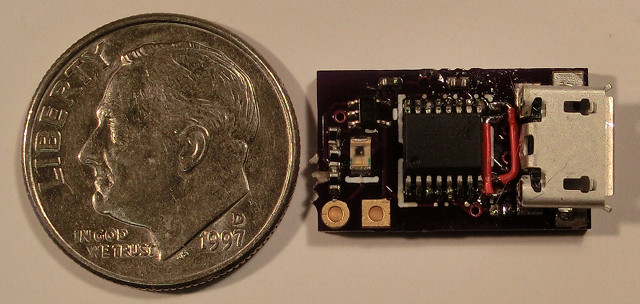
MicroPeak Serial Interface Flight Logging for MicroPeak MicroPeak was original designed as a simple peak-recording altimeter. It displays the maximum height of the last flight by blinking out numbers on the LED. Peak recording is fun and easy, but you need a log across apogee to check for unexpected bumps in baro data caused by ejection events. NAR also requires a flight log for altitude records. So, we wondered what could be done with the existing MicroPeak hardware to turn it into a flight logging altimeter. Logging the data The 8-bit ATtiny85 used in MicroPeak has 8kB of flash to store the executable code, but it also has 512B (yes, B as in bytes ) of eeprom storage for configuration data. Unlike the code flash, the little eeprom can be rewritten 100,000 times, so it should last for a lifetime of rocketry. The original MicroPeak firmware already used that to store the average ground pressure and minimum pressure (in Pascals) seen during flight; those are used to compute the maximum height that is shown on the LED. If we store just the two low-order bytes of the pressure data, we d have room left for 251 data points. That means capturing data at least every 32kPa, which is about 3km at sea level. 251 points isn t a whole lot of storage, but we really only need to capture the ascent and arc across apogee, which generally occurs within the first few seconds of flight. MicroPeak samples air pressure once every 96ms, if we record half of those samples, we ll have data every 192ms. 251 samples every 192ms captures 48 seconds of flight. A flight longer than that will just see the first 48 seconds. Of course, if apogee occurs after that limit, MicroPeak will still correctly record that value, it just won t have a continuous log. Downloading the data Having MicroPeak record data to the internal eeprom is pretty easy, but it s not a lot of use if you can t get the data into your computer. However, there aren t a whole lot of interfaces avaialble on MicroPeak. We ve only got: First implementation I changed the MicroPeak firmware to capture data to eeprom and made a test flight using my calibrated barometric chamber (a large syringe). I was able to read out the flight data using the AVR programming pins and got the flight logging code working that way. The plots I created looked great, but using an AVR programmer to read the data looked daunting for most people as it requires: With the hardware running at least $120 retail, and requiring a pile of software installed from various places around the net, this approach didn t seem like a great way to let people easily capture flight data from their tiny altimeter. The Blinking LED The only other interface available is the MicroPeak LED. It s a nice LED, bright and orange and low power. But, it s still just a single LED. However, it seemed like it might be possible to have it blink out the data and create a device to watch the LED and connect that to a USB port. The simplest idea I had was to just blink out the data in asynchronous serial form; a start bit, 8 data bits and a stop bit. On the host side, I could use a regular FTDI FT230 USB to serial converter chip. Those even have a 3.3V regulator and can supply a bit of current to other components on the board, eliminating the need for an external power supply. To see the LED blink, I needed a photo-transistor that actually responds to the LED s wavelength. Most photo-transistors are designed to work with infrared light, which nicely makes the whole setup invisible. There are a few photo-transistors available which do respond in the visible range, and ROHM RPM-075PT actually has its peak sensitivity right in the same range as the LED. In between the photo-transistor and the FT230, I needed a detector circuit which would send a 1 when the light was present and a 0 when it wasn t. To me, that called for a simple comparator made from an op-amp. Set the voltage on the negative input to somewhere between light and dark and then drive the positive input from the photo-transistor; the output would swing from rail to rail. Bit-banging async The ATtiny85 has only a single serial port , which is used on MicroPeak to talk to the barometric sensor in SPI mode. So, sending data out the LED requires that it be bit-banged directly modulated with the CPU. I wanted the data transmission to go reasonably fast, so I picked a rate of 9600 baud as a target. That means sending one bit every 104 S. As the MicroPeak CPU is clocked at only 250kHz, that leaves only about 26 cycles per bit. I need all of the bits to go at exactly the same speed, so I pack the start bit, 8 data bits and stop bit into a single 16 bit value and then start sending. Of course, every pass around the loop would need to take exactly the same number of cycles, so I carefully avoided any conditional code. With that, 14 of the 26 cycles were required to just get the LED set to the right value. I padded the loop with 12 nops to make up the remaining time. At 26 cycles per bit, it s actually sending data at a bit over 9600 baud, but the FT230 doesn t seem to mind. A bit of output structure I was a bit worried about the serial converter seeing other light as random data, so I prefixed the data transmission with MP ; that made it easy to ignore anything before those two characters as probably noise. Next, I decided to checksum the whole transmission. A simple 16-bit CRC would catch most small errors; it s easy enough to re-try the operation if it fails after all. Finally, instead of sending the data in binary, I displayed each byte as two hex digits, and sent some newlines along to keep the line lengths short. This makes it easy to ship flight logs in email or whatever. Here s a sample of the final data format:
MP
dc880100fec000006800f56d8f63b059
73516447273fa93728301927d91b7712
730bbf0491fe88f7c5ee8ee896e3fadc
9dd9d3d502d1afcea2cbafc6b4c34ec1
bfbfcabf10c03dc05dc070c084c08fc0
9cc0abc0b9c0c1c0ccc0dcc020c152c4
71c9a6cf45d623db7de05ee758edd9f2
b4f9fd00aa074311631a9221c4291330
c035873b2943084bbb52695c0c67eb6b
d26ee5707472fb74a4781f7dee802b84
09860a87e786ad868a866e8659865186
4e8643863e863986368638862e862d86
2f862d86298628862a86268629862686
28862886258625862486
d925
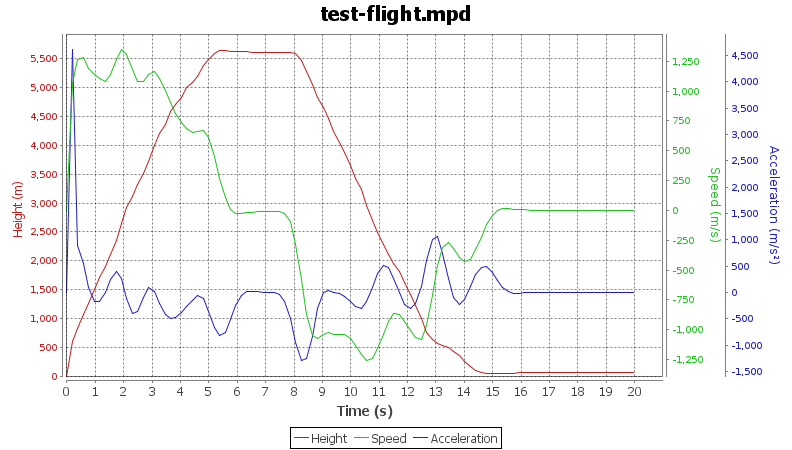
Making the photo-transistor go fast enough The photo-transistor acts as one half of a voltage divider on the positive op-amp terminal, with a resistor making the other half. However, the photo-transistor acts a bit like a capacitor, so when I initially chose a fairly large value for the resistor, it actually took too long to switch between on and off the transistor would spend a bunch of time charging and discharging. I had to reduce the resistor to 1k for the circuit to work. Remaining hardware design I prototyped the circuit on a breadboard using a through-hole op-amp that my daughter designed into her ultrasonic guided robot and a prefabricated FTDI Friend board. I wanted to use the target photo-transistor, so I soldered a couple of short pieces of wire onto the SMT pads and stuck that into the breadboard. Once I had that working, I copied the schematic to gschem, designed a board and had three made at OSHPark for the phenomenal sum of $1.35. Aside from goofing up on the FT230 USB data pins (swapping D+ and D-), the board worked perfectly. The final hardware design includes an LED connected to the output of the comparator that makes it easier to know when things are lined up correctly, otherwise it will be essentially the same. Host software Our AltosUI code has taught us a lot about delivering code that runs on Linux, Mac OS X and Windows, so I m busy developing something based on the same underlying Java bits to support MicroPeak. Here s a sample of the graph results so far: Production plans I ve ordered a couple dozen raw boards from OSH Park, and once those are here, I ll build them and make them available for sale in a couple of weeks. The current plan is to charge $35 for the MicroPeak serial interface board, or sell it bundled with MicroPeak for $75.

Russ Allbery: Review: Countdown

Review: Countdown, by Mira Grant
Publisher: Orbit
Copyright: August 2011
ISBN: 0-316-20448-X
Format: Kindle
Pages: 75
Countdown is a novella that tells the "origin story" of Grant's Newsflesh universe, the setting for Feed and sequels. It's the story of the initial creation of Kellis-Amberlee and the first zombie Rising, mixed with a small bit of backstory for the Mason family. There are two ways to read this novella that work. It's possible to read it prior to reading any of the Newsflesh books as a sort of teaser. It sets up the universe, shows the devastation of society, and raises the question of how society will respond. Alternately, and I think more effectively, it can be read as an appendix to the Newsflesh trilogy that fills in the backstory. Reading it after all three books led to some fun moments of "oh, that's how that happened." It shows the accidents and bad decisions that led to the Rising, and provides a bit of a counterbalance to some of Georgia and Shaun's snarky comments about the government, scientists, and the media. The way to read it that doesn't work is to try to read it as a stand-alone work. Countdown has very little in the way of a story. It's told in the disaster epic style of brief scenes following numerous characters, some who are only seen once. There are small plot arcs following the Kellis virus, the Amberlee virus, and the Masons, but none of them are satisfying when read as a traditional story. Some events, particularly in the Masons' thread, have no real meaning by themselves and only acquire significance as part of Georgia and Shaun's backstory. The reason to read this novella is because you're invested in the universe, either to whet your appetite for more or to fill in some of the background. With that caveat, I think Countdown is more effective as horror than the Newsflesh trilogy itself is. Feed and its sequels are more action novels that become political thrillers, and the confident first-person narration and snark undermines most of the sense of dread or horror in the world. (Please note: not being a horror fan, I consider this a feature.) Countdown doesn't have that strong narrative presence. Instead, it covers events that are both horrific and inevitable and towards which the characters are largely helpless. Some of the scenes towards the end are haunting. Grant still isn't very subtle, but I think she does a good job writing quiet desperation and leaving some of the emotions for the reader to interpolate. Countdown could be read after Feed, if you're interested enough in the world to want more, but I think it works best after Blackout (for reasons that are minor spoilers). It could be read before the whole series, but I recommend reading it as an appendix instead. Don't expect too much of it it's background filler rather than more story but I thought it was effective and enjoyed the additional filling-in of the world. Rating: 7 out of 10

29 December 2012

Russ Allbery: Review: Blackout

Review: Blackout, by Mira Grant
Series: Newsflesh #3
Publisher: Orbit
Copyright: 2012
ISBN: 0-316-20218-5
Format: Kindle
Pages: 631
Blackout is the third book in the Newsflesh series that started with Feed. As with the second book, Deadline, you do not want to read this book out of order. All the emotional heavy lifting is done in Feed, and the book won't mean as much without that. Also, as with Deadline, be very careful about any information you read bout the sequels if you've not yet read Feed, since it's very easy to spoil that book and most information about subsequent books will do so. I'm going to try to write this review without spoilers. That's going to be a bit tricky due to events in Feed, so bear with me if I'm less specific than normal. This is the grand finale of the series, and it is a firm conclusion. As you might expect, particularly from Deadline, that involves a lot more politics, a few more big revelations, some reunions, escalating scale, and a lot of fighting. Unfortunately, it also involves setup. A lot of setup. I didn't expect that, given that Deadline ended at a run, but it takes about half of Blackout and a whole lot of pages before we get to the events that logically follow from the end of Blackout. And those pages dragged for me. There are some great moments. The banter continues to be strong, there are some deeply affecting scenes with Shaun, and Maggie continues to be wonderful. Grant also introduces some new secondary characters (Monkey and the rest of his household) who are brilliant and feel like they could have come directly from Borderlands. All of Blackout has a bit more of that mad scientist feel, full of slightly deranged people who take the fight to the world in their own ways. But it still drags. One branch of the book has the protagonists going here, there, and everywhere in several roundabout attempts to advance the plot. The other branch is more psychologically tense, but it takes too long to get moving and therefore turns into a repetition of the same emotions and the same complaints. I wanted to get to the key events that happen about halfway through the book in about half as many pages as they took. Thankfully, things do pick up when the two strands of the book come together. Some of the emotional dynamics strengthen as well, which I'd been missing. Grant does a great job here tying the whole series together in a way that shows the differences between Feed and Deadline and digs into their nature a bit more. There is one big reveal that I found disappointing, both because it had been obvious since early in Deadline and yet was treated as a big reveal and because I think it put the book and series onto slightly more conventional territory in a place where it had previously been interestingly distinct. (I'm being vague because of spoilers.) But that didn't bother me too much, and the surrounding character dynamics I think made up for it. The final ending isn't exactly bad, but neither did it entirely work for me. The whole series seems a touch too naive. This worked in Feed (at least for me; some other reviewers disliked it) since the naivete felt like part of the dynamic of the story and the characters, and the stakes were mostly kept small enough that it was believable. The stakes are large enough here that I needed the world to be a touch more complicated and the villains less hissable. (If there's been one consistent flaw throughout this series, it's that Grant's villains are too purely evil.) And, in the end, I didn't quite buy the conflict at the heart of the story; after everything that had happened, I wanted something more complex and nuanced. I'm a bit unsatisfied, but, like Deadline, Blackout is still a good book. Neither of them live up to Feed, but they're both enjoyable, action-filled, and creative looks at a zombie apocalypse. I think Blackout is at its best when it's being Fallout or Borderlands and emphasizing the mad scientist angle of Grant's world, and I would have happily read several more chapters about Monkey. The mix of wacky risk-taking and serious political idealism doesn't quite gel, and the latter never worked for me in Blackout, but I still had a lot of fun with the core character interactions. If you read Deadline, you certainly want to read Blackout. If you stopped at Feed, Blackout is probably not a persuasive argument to continue. Rating: 7 out of 10

Next.

Previous.