Search Results: "dom"

2 May 2007

Michal Čihař: What happened on last day of April?

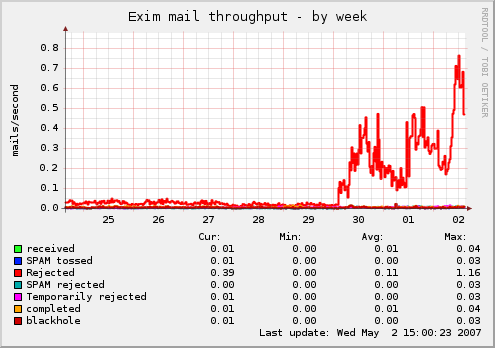
I just looked on server statistics and I was shocked by amount of spam and viruses rejected during last three days. Is there some new virus for Windows which tries random email addresses on all servers it can reach? I didn't analyse those messages, as they are rejected at RCPT time, because sender tries random addresses which do not work on my server. For now I try to reduce them by blacklisting in iptables, but this doesn't seem to help much as IP addresses change too often. I think that graph shows best what big change has happened: Mail graphs Update: It seems to be new Sober variant causing this mess.

1 May 2007

Simon Law: Party on for Net Freedom


CFP 2007
Originally uploaded by sfllaw.
Tonight, I'm going to be attending an open panel discussion at Computers, Freedom, and Privacy 2007. It's completely open to the public and will be a discussion on freedom on the Internet. There are going to be a number of famous people there, including Whit Diffie, Peter Neumann, Anita Allen, Bruce Schneier, and Ed Viltz. I'm not sure exactly what they're going to be talking about, but I bet it'll be thought-provoking. At around 20:30, I'll be down at the CFP Welcome Party, which is basically a big fundraiser for Creative Commons and EPIC. You've probably heard me mention Creative Commons a few times, because they're a big proponent of having a healthy body of creative work that artists can draw from. Almost all of the art I produce is available under a Creative Commons license, which I've chosen so that you can share, copy, and modify it. So I'm more than happy to socialize with interesting people and to support a good cause. Sounds interesting? You bet! How do you get there? Well, the panel is at Hotel Bonaventure, and starts at 18:30. Details here. Then the welcome party is at 20:30, at Austin's place. Details here. For directions to Austin's house, send me an e-mail. Austin's address is on this flyer. If you're leaving from the Hilton, try these directions. Hope to see you there!

29 April 2007

Biella Coleman: Blogus Christ, My Savior

Academics in the humanities and social sciences often struggle with their writing. I just figured that as you did more and more, you got better and better. Well this recent post by Radical Tenure was pretty eye opening because she confesses about losing her writing groove (in part because of sh*t going down at her university) and then she gives a fascinating account about how blogging “saved” her. Now I am stunned because her writing is pretty darn succulent. Really. I love reading her( and am proud that she is a lady blogger too given how many males dominate the “famous” scene). Now I am more inspired because I think indeed writing, especially in very competitive environments, can be a torturous and fraught task. And while it may get easier, there are circumstances that may derail even the strongest of writers. It is great to see this confronted head-on, in ways positive, honest, inspiring. Here are the relevant bits:
Another reason being anonymous didn t work for me is really internal to Zen - er, Wesleyan, stultifying features of which I was trying to escape following the Unfortunate Events. Like being watched and talked about all the time and treated like yesterday’s news for having done the teaching and institutional work I was asked to do while struggling to find time for my scholarship even as other people were chosen to be groomed as “the scholars.” What happened to me during the last three years nearly destroyed me as a writer and an intellectual (I am actually not joking about this), and I had to start all over again, recreating a literary voice for myself and a confidence that I could command an audience with my thoughts and prose, from the ground up. It was either that or quit. ….
Do not dare feel sorry for me about this, and let me underline the point: I am a highly privileged, senior faculty member at a very wealthy institution, and many other bloggers are not. Furthermore, regardless of this messy coming-out period, my strategy actually worked. Because of this blog *and its audience*, I was able to start writing again, to finish articles that were lying about undone, to write a book review for the Village Voice, to write a book proposal, to get going on revising the book that various people and committees eliminated all over during the Unfortunate Events, to do a ton of research on a new project and to begin speaking about some critical reforms that might really help faculty on the right and the left enjoy their work as academics again. In other words: I Saved Myself. And I have been transformed into something more powerful as a result of my trials.

28 April 2007

Annabelle Tully: ipw2200

Why oh why does my X40 wifi card suck so much..
It will randomly drop while I’m doing something, so I have to reload the module again.
Sometimes it has a hard time associating properly. It gets IP, but can’t ping the gateway or anything. (The other devices are taken down) so I have to reload module again. It also generally gets very low signal strength.
And also, dmesg gives me strange output
eth1: NETDEV_TX_BUSY returned; driver should report queue full via ieee_device->is_queue_full. eth1: no IPv6 routers present eth1: no IPv6 routers present Update:
A friend of mine had a similiar problem, and he found that the wifi card at the bottom was slightly loose, so he opened the casing and pushed it a bit, and since then its been stable with no issues. Will try the same to see if it works once I can find it in my heart to turn the machine off. Shall update again if this seems to work.

27 April 2007

Martin F. Krafft: Moving in pieces, with and without morphine

As readers of my blog know, I moved to a new flat just after Easter. Unfortunately, on that Monday afternoon, just after we finished hauling most of the furniture (the heavy stuff at least) over to the new place, I slipped as I was leaping off the transporter vehicle, lost an argument against gravity and hit the asphalt more or less horizontally after a 1.5 metre fall. I landed on both wrists and my left knee, and while my consciousness never left, reality sort of blurred away, as I rolled over on the ground and waves of pain began rippling through my body. People started assembling around me and the adrenaline faded away, then I realised that this move of mine was not going to end as smoothly as it had begun. My body refused to bend my left wrist and knee and I knew I was injured, but it did not hurt so much for me to conclude anything serious. I remembered the ice packs in my freezer and had my cousin fetch them, then let two colleagues carry me to bed to regain my bearing, but the pain got worse and I started to accept that I would have to go to the hospital. Still optimistic ("it's just a contusion, it's just a sprain"), I crawled from my cousins car to the wheel chair, into the hospital and onto a bed to await the verdict. Still thinking about returning home tomorrow, I spent hours on the bed, being pushed between the x-ray, casting, and diagnostic rooms until finally I was told of my fate: multiple fractures of my left knee cap, broken ulna and radius on my left arm with splinters in the joints, and a fractured metacarpal bone on the right my pinky's tendon was supposed to snap, but it proved too strong and rather caused the part of the bone to which it was attached to rip off. They deciced to perform surgery on the two left limbs but to leave the metacarpal bone alone because of the complexity of the fracture and the proximity of all my hand's and fingers' nerves. Because everything was swollen like a balloon ready to burst, I had to wait three days for the surgery with casts and a splint on my leg. The surgery was scheduled for Thursday morning and even though I was actually looking forward to it all (especially the administration of the anesthetic), I was simply too tired in the early morning hours, and the Dormicum tablet they fed me did the rest: I was asleep when we entered the surgery room and woke up at noon with new casts and a morphine injection pumping a comparatively large dose of the drug into my veins every eight minutes apparently, my body was going through a lot of pain during the surgery, so the "pain management service" (in German, they're just called "Schmerzdienst" "pain service", actually) opted to pump it up. Here's what I looked liked shortly after the surgery: madduck post-surgery Meanwhile, Gian-marco, my future flat mate, had spent the day packing up everything that was left in my old flat, where I had left an utter mess. A colleague of mine was to sublet the place starting that Saturday, so there were roughly 48 hours left to empty and clean it, and to hand it over. There are more pleasant things in heaven and earth than to have someone else empty your flat for you. Morphine is a really crazy drug. Most people think of it as fuzzy and often joke about taking it if only they could get their hands on it. Having made the experience, I'd rather not take it again unless I have to. Watching television turned out to be impossible, even the weather report went too fast for me. Visitors appeared sort of blurry, I would often not follow the things they said, and it was definitely impossible to entertain thoughts for prolonged periods of time, or to engage in any sort of productive thinking. Organising a cleaning lady for my old flat and giving instructions to my cousin, who would hand over the flat took all my energy On Friday, I was to have an important business meeting with three people, so I organised a room in the hospital and asked the nurses to put me on optional morphine so I could be a bit more present during the meeting. As a consequence, I could press a button once every ten minutes for a dose of morphine, and with this new level of control, I began to reduce the drug amount in my blood gradually. The meeting did not take place in the end but I came to regret my choice to reduce the morphine at around midnight, when the pain in my knee became unbearable. I kept pressing the button for more morphine like a madman, but the device would only deliver a new shot every 10 minutes. The nurse was not authorised to change that and instead gave me other pain and sleep medication, but not even the combination of morphine, Tramal (an opiod), Novalgin, Mefenacid, and Paracetamol could dampen the level of pain, and so I spent almost three hours in real agony, biting the pillow with tears running down my cheeks, until finally the medication won, I became indifferent (thanks to Temesta) and drifted off into sleep. After breakfast the next morning, the morphine applicator suddenly had a fit, started beeping, and pumped more drug into my body than it should have. It took me about 20 minutes or maybe an hour (who knows ) to put my brain together, realise what had happened, and come up with a way to lift my finger to the button to call the nurse. Despite the horrible night, I told them to remove the morphine because I'd rather stand the pain than have my brain mushed like that, plus there are always plain morphine injections delivered by humans instead of machines. In fact, the next night I could feel the pain approaching and since it's easier to suppress pain than it is to remove it, I asked for a sleeping pill and a morphine injection. The injection did three things: first, it hurt so much that my knee immediately became pain-free while nerve central was occupied trying to figure out what the heck had just happened in my right thigh. Second, it did not take three minutes to kick in, and it kicked in so strongly that I just barely realised that my head was suboptimally positioned on the pillow and the lights still on, but failed to do anything about it. I did not wake once until breakfast. And third, I am glad to know that morphine does actually (still) work. Pain is complex, fascinating, useful, sometimes even pleasurable to some, but when you know the cause and you'd rather make it stop, it's comforting to know that there are ways the previous night had instilled some doubt in me. From then it was all downhill and I left the hospital after eleven days on Thursday, got by without pain medication the same day and off the sleeping pills the next night. Two days later I was already racing around town in my wheel chair: madduck racing in a wheel chair By now I can actually walk again, albeit slowly, and even though I still cannot lift heavy stuff or get my hands wet, my hands are a lot better; on 21 May, the casts shall be removed and I'll be able to bend my knee again, but it may take up to a year to return to sports, such as running, to which I had just become addicted. In fact, I can comfortably claim that I had just reached an acceptable level of fitness just before the injury. Tough luck. My mother has come to Zurich twice already to help unpack and with her invaluable help, as well as the help of Gian-marco and several others, we are actually almost done moving in. Ironically, it's actually quite annoying to sit and watch others do your work; I would have helped as well, had the roles been inverted, and yet I am still greatly indebted. Human relations tend to be funny like that. Let me end with two points: first, Zurich's university hospital probably ranks among the best hospitals in the world, and that makes Zurich even more attractive to me (even though I certainly don't plan my next hospital stay). I felt very comfortable throughout my stay, had the impression of being in very capable hands, and had most of my countless questions answered. In addition, the hospital is very nicely surrounded by a park and could not be more central, which makes it easier for visitors. And that brings me to my final thought: thanks to everyone who stopped by or called in to make my stay a lot more pleasant. I spent eleven days in the hospital and I got bored and annoyed for the first time on Wednesday, the day before my release. Most of the credit for those ten days of lack of boredom goes to everyone who supported me. It did help that I had Internet access via a convenient 2 /day GPRS flatrate (even though I could not really type), but it became crystal clear to me that visiting someone in the hospital, whether you're close to the patient or not, is one of the most beautiful gifts you can give. In the past I have neglected this opportunity occasionally; now I would want to make a special effort (even though I hope there won't be any need). And I would not be a geek if I did not end this post with a reference to Debian: I know of a case when one of our developers ended up in hospital and two others (or was it more?) drove hours to visit and check in on him/her. Now even more than before can I say that I am proud to be a member of a project in which such things happen. PS: this post took me about 4 hours to compose. Sucks to be typing one-handed.
MJ Ray: Daddy or Chips? MJ Ray or Sony?

Joey Hess: random news bits

Gliese 581 c: First Earth-like planet discovered in a star's habitable zone, only 20 light years out. It's always interesting when stuff like this stops being science fiction. Valenti dead: Thanks Seth for giving me a tasteful reaction to link to. I couldn't come up with one on my own!

26 April 2007

Dirk Eddelbuettel: random 0.1.2

Following yesterday's minor maintenance release of random, a small brown bag fix release just went out to CRAN. Kurt Hornik, diligent as usual, spotted that the vignette would not build, and that has been corrected. The code itself is unchanged.

Dirk Eddelbuettel: random 0.1.1

A minor maintenance release of random was just uploaded to CRAN. The only change is a correction on regular expression string: R 2.5.0 now warns that percentage signs should not be escaped. Not other code changes were made.

Dirk Eddelbuettel: random 0.1.1

A minor maintenance release of random was just uploaded to CRAN. The only change is a correction on regular expression string: R 2.5.0 now warns that percentage signs should not be escaped. Not other code changes were made.

25 April 2007

Axel Beckert: The days of my last running Woody are numbered...

As many of the Planet Debian readers know, I bemoan Galeon 1.2 and therefore Woody. For a long time I haven’t found an appropriate browser replacement for Galeon 1.2 in Sarge, so I never switched my home workstation called “gsa” (Pentium II, 400 MHz, 572 MB RAM) to Sarge, since Woody was rockstable and just worked. Though, after a few Galeon 1.3/2.0 rants, someone pointed me to Kazehakase, which indeed is a fine Galeon 1.2 replacement. But I noticed that Kazehakase in Sarge was in an early stage and the Kazehakase from testing (now Etch) were already much more matured. So in comparison to Sarge with Etch I won’t have the problem of not having a mature and sage web browser in main. And due to security support for Woody ceased a few months ago and Etch is now declared stable, it’s time to reinstall my last Woody box with Etch. For that, a repartioning of it’s two hard disks (8 GB and 40 GB) sounds like a good idea and so I had look, what’s on all those partitions where I once had a shot on quite a few Linux distributions and other unix-like operating systems. (Although I was already a big fan of Debian at that time, I wanted to look over my own nose and ordered a few CDs of free operating system at LinISO.de.) So here’s what I found, never really used and will throw away quite soon: That should give enough space for an Etch installation without touching the Woody installation first. Thanks to Venty, I’ve got a DVD drive for that box, so I can install from DVD. And for toying around with all those other neat and free operating systems nowadays, I’ve got my MicroClient Jr. named “c2”.

Jordi Mallach: natura upgraded to etch

Last week I started the final round of Debian upgrades for the servers I maintain here and there, which is mostly complete today. I haven't been so lucky with upgrades this time, for a long list of different reasons. In the end, the smoothest upgrades were those boxes I upgraded when etch froze or so. natura.oskuro.net is the box serving these pages. It's an old, extremely noisy Pentium 150 which I've been intending to replace for a while now. I started the upgrade early on Thursday, knowing it'd take a while (natura takes its time only to read the Dpkg database), and it had apparently finished when I was ready to leave the office. Three issues: The very same night of last Thursday, I decided to dist-upgrade the box which serves the Spanish Debian website mirror. That's the only purpose on the box, so you can imagine the upgrade should have been pretty straight-forward. And so it seemed, until, in the middle of unpacking, dpkg died with a horrible I/O error, and I dropped into an unusable remote terminal with no working commands. Fortunately, apache2 was still up and running, and the web service has been working without interruption since the hard drive crash, albeit with no syncs from www-master. Today, Sergio visited the campus and had a look. It was a XFS crash, which got cleanly repaired using an install CD. We have an empty partition in the box, and will probably move the system to it temporarily, and back to the RAID, but on ext3. When the box was back online, I just had to resume the upgrade process, make mdadm happy and update lilo.conf before rebooting into the new kernel. This box uses LILO for some obscure reason I can't remember too clearly anymore. The box has just one partition on a md array, on two SCSI disks on a aic7xxx-based controller. Can anyone hint me why GRUB would have failed on us back in sarge, and if any fixes in the etch version would work any better? Using LILO here is error prone, and basically feels like a step back. Anyway, www.es.debian.org is now back up and running with updated content. Sindominio.net had its bi-annual upgrading party last monday, but unfortunately I wasn't able to help much as when I tried to log into the server, I must have caught the system in the middle of some key lib upgrade or something, and again I was locked in a unusable shell which would only segfault. Given my previous experience, I assumed that something had gone wrong and the box would need to be fixed at the console, and after 20 minutes I gave up helping on that front. Until I noticed, quite a long while later that I was still getting mail from the server. I managed to log in to discover the upgrade was done, with just a few bits remaining to be done. The major issues were encountered with our pam and ldap setup, plus nscd kept dying causing quite a lot of mayhem all over the place. Great work from Seajob, Syvic, nogates, apardo and the rest of the people who handled it! With etch, we can finally move back to an official Debian kernel, something we've been longing to do for a long time. The only pending upgrade issue is that we need to move from our old jabber server to either the traditional jabberd 1.x or ejabberd; our current implementation is no longer supported in Debian. The last of the etch upgrades stories involves Sofcatal 's servers. The box was running on a CentOS 4.4, which was moved away into a subdir just after booting Debian-Installer, and then lobotomised so it would run as a Linux-VServer under a new Debian etch install. I'll probably write more details about it soon though, as it could be a maybe less scary alternative to Guillem's debtakeover. Yay for etch!

24 April 2007

Jan Wagner: windows in domU on etch. where is the showstopper?

Since some days I’m trying to install windows into a domU just for fun. All went fine until accessing discs. Sometime partition is not formatable, sometimes files could not read from cdrom. To be sure, it’s not the disc image, I used a fresh one from a MSDN Subscription, but it didn’t help. Searching around on web, I found that I’m not the only one, with this issue. The common(s) seems to be etch (and AMD CPU). I found traces of the issue at SP Team Blog, xen-users and xen-forum (german). Maybe anybody can enlighten me? , , ,

Annabelle Tully: Nokia 5500

Someone at Nokia please bitchslap the designer of the Nokia 5500 keypad. It randomly loosened and became like this
Other than that the phone is very nice.
How is it supposed to be water resistant when the keypad is merely a bad glue-on though.

Russell Coker: booting from USB for security

Sune Vuorela asks about how to secure important data such as GPG keys on laptops.

I believe that the ideal solution involves booting from a USB device with an encrypted root filesystem to make subversion of the machine more difficult (note that physically subverting the machine is still possible - EG through monitoring the keyboard hardware).

The idea is that you boot from the USB device which contains the kernel, initrd, and the decryption key for the root filesystem. The advantage of having the key on a USB device is that it can be longer and more random than anything you might memorise.

In my previous posts about a good security design for an office, more about securing an office, and biometrics and passwords I covered some of the details of this.

My latest idea however is to have the root filesystem encrypted with both a password that is entered and by a password stored on the USB device. This means that someone who steals both my laptop and my USB key will still have some difficulty in getting at my data, but also someone who steals just the laptop will find that it is encrypted with a key that can not be brute-forced with any hardware that doesn't involve quantum-computing.

Also coincidentally also on Planet Debian in the same day Michael Prokop documents how to solve some of the problems relating to booting from a USB flash device.

Russell Coker: first look at CentOS 5 Xen

I have just installed a machine running CentOS 5 as a Xen server. I installed a full GUI environment on the dom0 so that GUI tools can be used for managing the virtual servers.

The first problem I had was selecting the "Installation source", it's described in the error message as an "Invalid PV media address" when you get it wrong which caused me a little confusion when installing it at 10PM. Then I had a few problems getting the syntax of a nfs://1.2.3.4:/directory URL correct. But these were trivial annoyances. It was a little annoying that my attempts to use a "file://" URL were rejected, I had hoped that it would just run exportfs to make the NFS export from the local machine (much faster than using an NFS server over the network which is what the current setup will lead people to do).

The first true deficiency I found with the tools is that it provides no way of creating filesystems on block devices. The process of allocating a block device or file from the Xen configuration tool is merely assigning a virtual block device to the Xen image - and only one such virtual block device is permitted. Then the CentOS 5 installation instance that runs under Xen will have to partition the disk (it doesn't support installing directly to an unpartitioned disk) which will make things painful when it comes time to resize the filesystems.

When running Debian Xen servers I do everything manually. A typical Debian Xen instance that I run will have a virtual block device /dev/hda for the root FS, /dev/hdb for swap, and /dev/hdc for /home. Then if I want to resize them I merely stop the Xen instance, run "e2fsck -f" on the filesystem followed by "resize2fs" and the LVM command "lvresize" (in the appropriate order depending on whether I am extending or reducing the filesystem).

Xen also supports creating a virtual partitioned disk. This means I could have /dev/lvm/xenroot, and /dev/lvm/xenswap, and /dev/lvm/xenhome appear in the domU as /dev/hda1, /dev/hda2, and /dev/hda3. This means that I could have a single virtual disk that allows the partitions to be independently resized when the domU in question is not running. I have not tried using this feature as it doesn't suit my usage patterns. But it's interesting and unfortunate that the GUI tools which are part of CentOS don't support it.

When I finally got to run the install process it had a virtual graphics environment (which is good) but unfortunately it suffered badly from the two-mouse-cursor problem with different accellerations used for both cursors so the difference in position of the two cursors varied in different parts of the screen. This was rather surprising as the dom0 had a default GNOME install.

23 April 2007

Erich Schubert: Tomcat and SELinux strict

Does anyone have a (partial?) policy for Tomcat on SELinux "strict"? It's definitely something I'd like to confine, however Java needs tons of permissions. Multiple ports, execmem, log files, fifos, on-demand extracted webapps and so on. :-(Has anyone started on writing a policy for this beast? If there is any way to confine it actually, given that it's pretty much a system on it's own.[Update: I'd like to point out that running tomcat on a SELinux 'targeted' system works fine by running tomcat in an 'unconfined' domain. Since tomcat usually isn't run with root privileges anyway, it's not that risky]

Russell Coker: the Right to Fork

Leon Brooks blogged about the Right to Fork (an essential right for free software development) but notes that governments of countries don't permit such a right.

One of the criteria for the existence of a state is the ability to control it's own territory. Lose control of the territory and you lose the state, lose some of the territory and the state is diminished. Therefore preventing a division of the territory (a split after a civil war) is the primary purpose of a state. The other criteria of a state are the ability to tax the population, impose civil order, and to administer all other aspects of government. All of these operations are essential to the government and lead to the destruction of the state if they are lost.

It's not that governments want to prevent forking, it's the fact that the existence of the state (on which the existence of the government depends) demands that it be prevented in all but the most extreme situations.

With free software forking is not a problem as multiple groups can work on similar software without interference. If someone else works on a slightly different version of your program then the worst that they can do is to get the interest of more developers than you get. This competition for developers leads to better code!

With proprietary software the desire to prevent forking is due to the tiny marginal cost of software. Most of the costs of running a software company are in the development. The amount of work involved in development does not vary much as the user-base is increased. So doubling the number of sales can always be expected to significantly more than double the company's profit.

One thing that would benefit the computer industry would be to have all the source to proprietary programs put in escrow and then released freely after some amount of time or some number of versions have been released. If Windows NT 4.0 was released freely today it would not take many sales from the more recent versions of Windows. But it would provide significant benefits for people who want to emulate older systems and preserve data. I expect that current versions of MS-Office wouldn't properly read files created on NT 4.0, I'm sure that this is a problem for some people and will become more of a problem as new machines that are currently being designed are not capable of booting such old versions of Windows.

22 April 2007

Christian Perrier: Vote - 1st round

So, today is the first round of the French presidential election. I already explained where is my preference going, also who I fear the most and who I absolutely don't want ever (no link here: I will never give a link to this guy and his party's web site. You don't want to read the kind of crap they write, do you? This is of course Le Pen). For those reading this and not familiar with the French presidential eletion voting system, a few more hints: We have 12 candidates this year. on first round, a president may be elected if (s)he gets more than 50% of votes (not counting white and null votes). This is of course nearly impossible. The highest probability is thus for a second round. Here, the two best ranked candidates would stay and the president is elected among one of them two. That second round will happen on May 5th. Candidates are (non neutral comments!): Though choice, isn't it? Out of these 12, 4 have some chances to reach the second round: Bayrou, Royal, Le Pen and Sarkozy. It is pretty sure that Sarkozy will reach the second round (unfortunately, should I say). Bayrou and Royal have the best chances to be the second candidate (apparently the disaster of 2002 where Le Pen reached the second round will not happen, though still possible). So, let's vote and vote well...but, first of all, vote! See you at 20:01 +02:00.

20 April 2007

Christian Perrier: Dropping the size of my server's mail queue

In my server's postfix main.cf file: bounce_queue_lifetime = 8h This, instead of the "5d" default, reduced the size of the mail queue on my server from 1200 mails to 130. In these days where spammers just spam randomized addresses on servers, that sounds to be a good idea. Dear Lazyweb, other suggestions? Or is this indedd a not so good idea?

Next.

Previous.