Search Results: "cas"

4 July 2012

Johannes Schauer: enumerating elementary circuits of a directed_graph

For my GSoC project this year I need to be able to enumerate all elementary circuits of a directed graph. My code is written in Ocaml but neither the ocamlgraph library nor graph libraries for other languages seem to implement a well tested algorithm for this task. In lack of such a well tested solution to the problem, I decided to implement a couple of different algorithms. Since it is unlikely that different algorithms yield the same wrong result, I can be certain enough that each individual algorithm is working correctly in case they all agree on a single solution. As a result I wrote a testsuite, containing an unholy mixture of Python, Ocaml, D and Java code which implements algorithms by D. B. Johnson, R. Tarjan, K. A. Hawick and H. A. James.

Algorithm by R. Tarjan The earliest algorithm that I included was published by R. Tarjan in 1973.
Enumeration of the elementary circuits of a directed graph
R. Tarjan, SIAM Journal on Computing, 2 (1973), pp. 211-216
http://dx.doi.org/10.1137/0202017
I implemented the pseudocode given in the paper using Python. The git repository can be found here: https://github.com/josch/cycles_tarjan

Algorithm by D. B. Johnson The algorithm by D. B. Johnson from 1975 improves on Tarjan's algorithm by its complexity.
Finding all the elementary circuits of a directed graph.
D. B. Johnson, SIAM Journal on Computing 4, no. 1, 77-84, 1975.
http://dx.doi.org/10.1137/0204007
In the worst case, Tarjan's algorithm has a time complexity of O(n e(c+1)) whereas Johnson's algorithm supposedly manages to stay in O((n+e)(c+1)) where n is the number of vertices, e is the number of edges and c is the number of cycles in the graph. I found two implementations of Johnson's algorithm. One was done by Frank Meyer and can be downloaded as a zip archive. The other was done by Pietro Abate and the code can be found in a blog entry which also points to a git repository. The implementation by Frank Meyer seemed to work flawlessly. I only had to add code so that a graph could be given via commandline. The git repository of my additions can be found here: https://github.com/josch/cycles_johnson_meyer Pietro Abate implemented an iterative and a functional version of Johnson's algorithm. It turned out that both yielded incorrect results as some cycles were missing from the output. A fixed version can be found in this git repository: https://github.com/josch/cycles_johnson_abate

Algorithm by K. A. Hawick and H. A. James The algorithm by K. A. Hawick and H. A. James from 2008 improves further on Johnson's algorithm and does away with its limitations.
Enumerating Circuits and Loops in Graphs with Self-Arcs and Multiple-Arcs.
Hawick and H.A. James, In Proceedings of FCS. 2008, 14-20
www.massey.ac.nz/~kahawick/cstn/013/cstn-013.pdf
In contrast to Johnson's algorithm, the algorithm by K. A. Hawick and H. A. James is able to handle graphs containing edges that start and end at the same vertex as well as multiple edges connecting the same two vertices. I do not need this functionality but add the code as additional verification. The paper posts extensive code snippets written in the D programming language. A full, working version with all pieces connected together can be found here: https://github.com/josch/cycles_hawick_james The algorithm was verified using example output given in the paper. The project README states how to reproduce it.

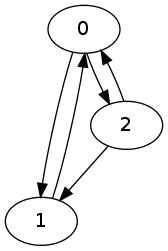
Input format All four codebases have been modified to produce executables that take the same commandline arguments which describes the graphs to investigate. The first argument is the number of vertices of the graph. Subsequent arguments are ordered pairs of comma separated vertices that make up the directed edges of the graph. Lets look at the following graph as an example: cycle example The DOT source for this graph is:
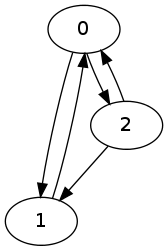
digraph G  
  0;
  1;
  2;
  0 -> 1;
  0 -> 2;
  1 -> 0;
  2 -> 0;
  2 -> 1;
   
To generate the list of elementary circuits using Tarjan's algorithm for the graph above, use:
$ python cycles.py 3 0,1 0,2 1,0 2,0 2,1
0 1
0 2
0 2 1
The commandline arguments are the exact same for the other three methods and yield the same result in the same order. If the DOT graph is in a format as simple as above, the following sed construct can be used to generate the commandline argument that represents the graph:
$ echo  sed -n -e '/^\s*[0-9]\+;$/p' graph.dot   wc -l   sed -n -e 's/^\s*\([0-9]\) -> \([0-9]\);$/\1,\2/p' graph.dot 

Testsuite As all four codebases take the same input format and have the same output format, it is now trivial to write a testsuite that compares the individual output of each algorithm for the same input and checks for differences. The code of the testsuite is available via this git repository: https://github.com/josch/cycle_test The other four repositories exist as submodules of the testsuite repository.
$ git clone git://github.com/josch/cycle_test.git
$ cd cycle_test
$ git submodule update --init
A testrun is done via calling:
$ ./test.sh 11
The argument to the shell script is an integer denoting the maximum number N of vertices for which graphs will be generated. The script will compile the Ocaml, Java and D sourcecode of the submodules as well as an ocaml script called rand_graph.ml which generates random graphs from v = 1..N vertices where N is given as a commandline argument. For each number of vertices n, e = 1..M number of edges are chosen where M is maximum number of edges given the number of vertices. For every combination of number of vertices v and number of edges e, a graph is randomly generated using Pack.Digraph.Rand.graph from the ocamlgraph library. Each of those generated graphs is checked for cycles and written to a file graph-v-e.dot if the graph contains a cycle. test.sh then loops over all generated dot files. It uses the above sed expression to convert each dot file to a commandline argument for each of the algorithms. The outputs of each algorithm are then compared with each other and only if they do not differ, does the loop continue. Otherwise the script returns with an exit code. The tested algorithms are the Python implementation of Tarjan's algorithm, the iterative and functional Ocaml implementation as well as the Java implementation of Johnson's algorithm and the D implementation of the algorithm by Hawick and James.

Future developments Running the testsuite with a maximum of 12 vertices takes about 33 minutes on a 2.53GHz Core2Duo and produces graphs with as much as 1.1 million cycles. It seems that all five implementations agree on the output for all 504 generated graphs that were used as input. If there should be another implementation of an algorithm that enumerates all elementary circuits of a directed graph, I would like to add it. There are some more papers that I would like to read but I lack access to epubs.siam.org and ieeexplore.ieee.org and would have to buy them. Benchmarks seem a bit pointless as not only the algorithms are very different from each other (and there are many ways to tweak each of them) but also the programming languages differ. Though for the curious kind, it follows the time each algorithm takes to enumerate all cycles for all generated graphs up to 11 vertices.
algorithmtime (s)
Johnson, Abate, Ocaml, iterative137
Johnson, Abate, Ocaml, functional139
Tarjan, Python153
Hawick, D175
Johnson, Meyer, Java357
The iterative Ocaml code performs as well as the functional one. In practice, the iterative code should probably be preferred as the functional code is not tail recursive. On the other hand it is also unlikely that cycles ever grow big enough to make a difference in the used stack space. The Python implementation executes surprisingly fast, given that Tarjan's algorithm is supposedly inferior to Johnson's and given that Python is interpreted but the Python implementation is also the most simple one with the least amount of required datastructures. The D code potentially suffers from the bigger datastructures and other bookkeeping that is required to support multi and self arcs. The java code implements a whole graph library which might explain some of its slowness.

Michael Banck: 4 Jul 2012

Update on computational chemistry packages in Debian

For many years, me and the Debichem team maintained two computational chemistry packages, first MPQC and later PSI3. In recent years however, two respected quantum chemistry codes have been open sourced and are now available in Debian: ACESIII and NWChem. Make no mistake, those are not recently started codes or some Ph.D.'s pet-project but state-of-the-art projects targeted at massively parallel supercomputers and developed at the University of Florida's Quantum Chemistry Project (QTP) in the case of ACESIII and at Pacific Northwest National Laboratory (PNNL) for NWChem.

While ACESIII has a somewhat narrow focus on Coupled-Cluster (unfortunately, the current version does not yet implement analytic gradients for the "golden standard" CCSD(T) method) and Multi-Body Perturbation Theory methods, NWChem is a very versatile package supporting a variety of molecular quantum chemistry methods (including Density Functional Theory (DFT)), as well as periodic plane-wave electronic structure and (ab-initio and classical) molecular dynamics. At this point, NWChem probably covers 90% of all use cases for routine computational chemistry compared to the popular non-free codes Gaussian and GAMESS, while likely exhibiting superior parallel scaling at least compared to Gaussian.

Over the last year, I have packaged and integrated NWChem and ACESIII for Debian, and they are now both in testing. Furthermore, I have recently overhauled the packaging of MPQC and enabled parallel execution via MPI. Further, both MPQC and PSI will see updated versions (MPQC3 and PSI4) in the near future with significant increased functionality, including some unique (at least among open source codes) features like Symmetry-Adapted Perturbation Theory (SAPT) for PSI4 and general explicitly correlated corrections ([2]f12) for MPQC3. Unfortunately, they both did not get released in time for the wheezy freeze.

On the periodic/plane-wave front, I have also packaged and uploaded Quantum ESPRESSO (formerly PwSCF), a set of plane-wave programs, and I have been working with lafur Jens Sigur sson to get the latest Abinit release packaged. The nanoscale-physics team is also targeting further periodic ab-initio packages like BigDFT and Octopus, but those as well did not land in time for the freeze.

Finally, I also packaged and uploaded CP2K, a well-engineered and versatile periodic plane-wave/pseudo-potential code which focuses on state-of-the-art ab-initio Molecular Dynamics (AIMD) using Density Functional Theory. Some of the authors have recently published a paper reporting linear scaling benchmark calculations on a system with a million atoms using almost 50,000 CPU cores.

All of the above mentioned packages are included either in the molecular ab-initio or the periodic ab-initio Debichem tasks.

Michal Čihař: Weblate 1.1

Pretty much on schedule, Weblate 1.1 has been released today. It comes with translation updates, bug fixes, improvements in working with Git repositories and brings support for offloading indexing. Full list of changes for 1.1: You can find more information about Weblate on it's website, the code is hosted on Github. If you are curious how it looks, you can try it out on demo server. You can login there with demo account using demo password or register your own user. Ready to run appliances can be found in SUSE Studio Gallery. Weblate is also being used https://l10n.cihar.com/ as official translating service for phpMyAdmin, Gammu, Weblate itself and others. If you are free software project which would like to use Weblate, I'm happy to help you with set up or even host Weblate for you (this will be decided case by case as my hosting space is limited). Update: Weblate appliace has now also been updated to 1.1.

Filed under: English Phpmyadmin Suse Weblate 0 comments Flattr this!

Stefano Zacchiroli: bits from the DPL for June 2012

Monthly DPL bits, fresh from the oven^W^W^W hot from DebConf12, and just posted to d-d-a.
Howdy from DebConf12. It's hot, but it's also time to bother you again with a (not so) brief DPL activity report, this time for June 2012. Time-based freeze: DONE, short freeze: TODO Two highlights for this month. First, you've probably noticed Wheezy is now frozen, YAY. This is huge achievement for the release, but also for the project. It's the first time we do a time-based freeze, and it took some quite heated discussion at the beginning of the release cycle to decide to do this. And we did it properly: respecting the planned month and narrowing down the period later. This exercise has hopefully helped both DDs in their package planning and our upstreams in targeting Wheezy with stable releases of their software. Kudos to the release team for their coordination work! Now we've the second part still TODO: releasing Wheezy, without RC bugs, with a freeze period as short as possible. See the beginning of my last "bits from the DPL" mail for my usual song and dance :-P on how to deliver that, together. DebConf12 A lot of us will attend DebConf12. Enjoy it! ... and take the chance to both have fun and make great plans for Debian's future. But remember that "if it didn't happen on a mailing list, it didn't happen". Not all of us will be lucky enough to attend DebConf (in person or remotely). Make sure that those who don't can take part in your team decisions and get informed of what is going to happen here. Politics Zack's spring tour I spent a significant part of June doing Debian talks ins some sort of "spring tour" between Italy and France. In particular: Many thanks to the organizers of these events for inviting and sponsoring me (as well as other Debian people, in the ESRF case) and for their interest in Debian. Sprints Assets Discussions Some relevant discussions for project evolution has been going on in June and I took part into them. You might want to have a look at them: Misc Cheers.

PS the boring day-to-day activity log for June is available at master:/srv/leader/news/bits-from-the-DPL.txt.201206

3 July 2012

Petter Reinholdtsen: Can Zimbra be told to send autoreplies to the From: address?

In the NUUG FiksGataMi project (Norwegian version of FixMyStreet from mySociety), we have discovered a problem with the municipalities using Zimbra. When FiksGataMi send a problem report to the government, the email From: address is set to the address of the person reporting the problem, while envelope sender is set to the FiksGataMi contact address. The intention is to make sure the municipality send any replies to the person reporting the problem, while any email delivery problems are sent to us in NUUG. This work well in most cases, but not for Karm y municipality using Zimbra. Karm y is using the vacation message function in Zimbra to send an automatic reply to report that the message has been received, and this message is sent to the envelope sender and not the address in the From: header. This causes the automatic message from Karm y to go to NUUGs request-tracker instance instead of to the person reporting the problem. We can not really change the envelope sender address, as this would make it impossible for us to discover when there are problems with the MTAs receiving problem reports. We have been in contact with the people at Karm y municipality, and they are willing to adjust Zimbra if something can be changed there to get a better behaviour. The default behaviour of Zimbra is as far as I can tell according to the specification in RFC 3834, which recommend that vacation messages are sent to the envelope sender and not to the From: address. But I wonder if it is possible to adjust or configure Zimbra to behave differently. Anyone know? Please let us know at fiksgatami (at) nuug.no.

2 July 2012

Michal Čihař: Surprising uses of Weblate

When I wrote Weblate I expected that major use cases will be free software projects, which will use it for public translating service. At least this was my intention for it. But I seem to be wrong, at least for now. Most of people who contact me regarding Weblate are doing private installations and I already know few places where it was massively used. Unfortunately most of them rejected to be publicly mentioned, so I can't tell you the names. But they do exist :-). Anyway I hope for some free software projects to adopt Weblate as well, otherwise I should have written it as commercial software :-)

Filed under: English Weblate 6 comments Flattr this!

Thibaut Girka: apt-get install gcc-4.7-arm-linux-gnueabihf

Hi! As you may know, I'm working on multiarch cross-toolchains as part of the Google summer of Code (see my previous post for details), and although there is still a lot to do, the project is doing fairly well, and a cross-gcc is already installable and working. I'll proceed with detailed instructions on how to install the cross-compiler, along with some explanations on multiarch itself, and how to build cross-toolchains from source. Prerequisites First, you need specific versions apt (>= 0.9.6) and dpkg (>= 1.16.5).
This is because the cross-toolchains packages I'm working on depend on specific cross-arch dependencies, such as libc6:armhf. Support for such dependencies has been added in the aforementioned versions of apt and dpkg. This means you should be running unstable, or at least use dpkg from unstable. Adding a foreign architecture Adding a foreign architecture is straightforward, but I've seen users do overcomplicated, or just plain wrong things. So, let's do this step by step (well, there are only two of them), with some explanations.
  1. Tell dpkg to handle an additional architecture by typing dpkg --add-architecture armhf. There isn't much to say. It will only add an architecture to the list of architectures dpkg would accept to handle.
  2. Update APT's database. You need to run apt-get update after adding or removing an architecture to get package lists for all wanted architectures and rebuild APT's database, including the implicit cross-arch dependencies/conflicts brought by multiarch.
And that's it for the common case. Now, a word on architecture restrictions: a common misconception about multiarch seems to be that you have to tell APT which architectures you want from the mirrors by modifying your sources.list file(s). This is not true, as, by default, APT gets the list of accepted architectures from dpkg, and gets the correct package lists from the mirrors configured in the sources.list. You only need to use arch restrictions ( deb [arch=arch1,arch2,...] ... ) when you want to get packages from a mirror only for a subset of your accepted architectures. This is very unlikely, and in the general you do not need to modify your sources.list, at all. Getting the cross-compilers from my repository I provide compiled versions of gcc-4.7-arm-linux-gnueabihf for i386 and amd64 in my repository. If you have followed the previous paragraphs, nothing should be easier than adding a deb http://emdebian.org/~thibg/repo/ sid main line to your sources.list and doing the following:
# apt-get update
[...]
# apt-get --no-install-recommends install gcc-4.7-arm-linux-gnueabihf
Reading package lists... Done
Building dependency tree       
Reading state information... Done
The following extra packages will be installed:
  binutils-arm-linux-gnueabihf cpp-4.7-arm-linux-gnueabihf gcc-4.7-arm-linux-gnueabihf-base gcc-4.7-base:armhf libc6:armhf libgcc1:armhf
  libgmp10 libgomp1:armhf libmpc2 libmpfr4
Suggested packages:
  binutils-doc gcc-4.7-locales libmudflap0-4.7-dev:armhf gcc-4.7-doc libgcc1-dbg:armhf libgomp1-dbg:armhf libitm1-dbg:armhf
  libquadmath-dbg:armhf libmudflap0-dbg:armhf binutils-gold glibc-doc:armhf locales:armhf
Recommended packages:
  libc6-dev:armhf
The following NEW packages will be installed:
  binutils-arm-linux-gnueabihf cpp-4.7-arm-linux-gnueabihf gcc-4.7-arm-linux-gnueabihf gcc-4.7-arm-linux-gnueabihf-base gcc-4.7-base:armhf
  libc6:armhf libgcc1:armhf libgmp10 libgomp1:armhf libmpc2 libmpfr4
0 upgraded, 11 newly installed, 0 to remove and 0 not upgraded.
Need to get 23.5 MB of archives.
After this operation, 57.2 MB of additional disk space will be used.
Do you want to continue [Y/n]?
I've disabled the recommends since, libc6-dev:armhf would recommend gcc:armhf itself, which is not co-installable with your native gcc if you have it installed. Building the cross-toolchain yourselves If you don't trust the repository above, or simply want to rebuild the toolchain yourself, it is rather simple: get my gcc-4.7 patches and:
$ apt-get source binutils
$ cd binutils-*/
$ TARGET=arm-linux-gnueabihf dpkg-buildpackage -uc -us -b
$ cd ../
# dpkg -i binutils*arm-linux-gnueabihf*.deb
$ apt-get source gcc-4.7
$ cd gcc-4.7/
$ for patch in path/to/the/patches/*.patch; do patch -p1 < $patch ; done
$ GCC_TARGET=armhf debian/rules control
$ GCC_TARGET=armhf dpkg-buildpackage -uc -us -b
Using the cross-compiler It's easy, but there is a trick, and dpkg-buildpackage -aarmhf won't work out of the box yet, as gcc-4.7-arm-linux-gnueabihf provides the arm-linux-gnueabihf-gcc-4.7 executable, but no arm-linux-gnueabihf-gcc symlink. So, for the moment:
$ cat > test.c << __EOF__
#include <stdio.h>
int main(void)
 
  printf("Hello world\\n");
  return 0;
 
__EOF__
$ arm-linux-gnueabihf-gcc-4.7 test.c
$ qemu-arm ./a.out 
Hello world
Conclusion The toolchain is not complete yet (there is some more work to do on binutils and libstdc++, and equivalents to the gcc , cpp , and build-essential packages to provide), but it should still be useful to cross-compile C programs. Multi-arch cross-toolchains for wheezy can definitely be hosted at emdebian, and I hope to clean up the build process so that it could get included in the archive for wheezy+1.

Johannes Schauer: port bootstrap build-ordering tool report 3

A copy of this post is sent to soc-coordination@lists.alioth.debian.org as well as to debian-bootstrap@lists.mister-muffin.de.

Diary

June 18 Pietro suggests a faster way to generate installation sets for a list of packages. In my case, I need an installation set for every source package in the archive to find out how often a binary package is needed to build a source package. As a result, the speed is doubled in contrast to the original approach.

June 19
  • adapt code to work with new dose release 3.0
  • remove unneeded parts of code
  • add different possibilities to find amount of source packages that need a binary package
  • add code to get multiple installation sets using Depsolver_int.solve

June 20
  • add ~global_constraints:false to Depsolver.listcheck, Depsolver.trim and Depsolver.edos_install calls
  • adapt output graph to limited xdot capabilities

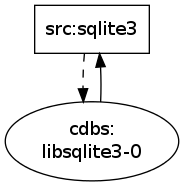
June 21 I formulate an email to the list, reporting of dependency graphs of debhelper, cdbs, pkg-config and libgtk2.0-dev. My current technique gets an installation set for a source package, removes all those that are already installable and adds the others as a dependency of that source package. This dependency will include an installation set of that binary as well minus all packages that are already available. The problem with that approach are dependency cycles created by long dependency chains. Example: src:A needs B needs C needs A. B and C would both be added as a dependency of src:A. B as well as C would also include their installation set which in both cases includes A. So now there are two cycles: src:A->B->A and src:A->C->A. For a real life example, look at the following situation of cdbs and src:sqlite3. cdbs old situation It is created because src:sqlite3 needs cdbs needs python-scour needs python needs python2.7 needs libsqlite3-0. Therfor libsqlite3-0 is in the installation set of cdbs, python-scour, python and python2.7. This creates five cycles in the graph even though there is only one. It would be better to reduce the dependencies added to src:sqlite3 to its direct dependency which is cdbs. Package dependencies are disjunctions from which the solver chooses one or the other to build an installation set. To solve the problem above I would need to know which disjunction the solver chose and then only add the direct dependency of a package to the dependency graph.
  • improve build_compile_rounds performance
  • big overhaul of menu structure
  • fix subgraph extraction code

June 22
  • do not create a universe if not needed - use hashtables instead
  • for sorting packages, generating difference of package sets and otherwise comparing packages, always use CudfAdd.compare
  • as a custom list membership function, use List.exists instead of trying List.find
  • more speedup for build_compile_rounds
  • the number of source packages that can be built does NOT include the cross built packages
  • print closure members in graph
  • refactor code and move common functions to bootstrapCommon.ml
  • add breakcycles.ml for future code to break cycles using staged build dependencies
  • use more extlib functionality
  • extended package list input format

June 23 After several emails with Pietro I learn about syntactic dependency graphs. To document my progress and prove my efforts I committed the code as commit 6684c13. But this code was soon found out to be unecessary so it will be removed later and just serves as documentation.

June 24 I came up with another (better?) solution to get the chosen disjunctions. It simply uses the calculated installation set to decide for each disjunction which one was taken by the solver. I reported that important step and the open questions involved with it in an email to the list. The problem always was, that an installation set can easily contain more than one package of a disjunction. In this case it is not clear which branch was chosen by the solver. I found, that in Ubuntu Natty there are only 6 such packages and for each of them the situation can be solved. It can be solved because in all of those cases it is that either one package of a disjunction provides the other or that both packages depend upon each other, which means that both have to be included.

June 27
  • use installation set to flatten build dependencies of source packages
  • refactor code and move common functions to bootstrapCommon.ml

June 25 I have to have an algorithm that finds all circuits in a given graph. This is necessary so that:
  1. cycles can be enumerated for huge dependency graphs where cycles are hard to see
  2. cycles can be enumerated to find a cycle that can be broken using staged build dependencies
It seems that Johnson's algorithm is the best way to do this complexity wise and Pietro already blogged about the problem together with an implementation of the algorithm in ocaml. Unfortunately it turns out that his code doesnt implement the algorithm correctly and hence misses out on some cycles. The fix seems not to be too trivial so I'm still investigating it.

June 28
  • add crosseverything.ml to obtain a list of source packages that, if cross compiled, would make the whole archive available

Results While the first week was productive as usual, I had to work some time on a University project during the second week as well as attend a family meeting. I will catch up with the lost time over the course of the next week.

dose3 Using dose 3.0 (which fixes a bug about essential packages) the output of the algorithms is now likely less wrong then before.

performance Performance was improved in the generation of installation sets as well as in the code that tries out how many packages can be built in multiple rounds. This was achieved by more caching, less unnecessary operations in looping constructs, replacing lists with hashtables, not creating universes where not necessary.

user interface The main program, basenocycles.ml now has a much better menu structure.

input format The programs take two package file inputs. The list of source packages that has to be cross built for a minimal build system and the list of source packages that was chosen to be cross compiled in addition to that. Both files list one source package per line and now allow comments.

refactoring As more and more scripts are added, more and more functionality is moved to bootstrapCommon.ml which makes each script much cleaner.

what to test for cross building As discussed in the "Future" section of the last report, I now automated the process of finding out which packages, if they were cross compiled, would make the whole archive available because they break all cycles and allow native compilation of the rest. The outcome: to build 3333 out of 3339 packages in natty natively, at most 186 source packages must be cross compiled. The other six cannot be compiled because of version mismatches in the Natty Sources.bz2 and Packages.bz2. The code can be run from crosseverything.ml.

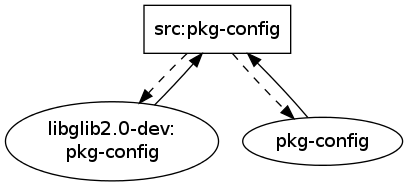
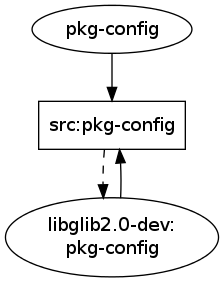
limit source dependencies to direct dependencies Reducing the dependencies of source packages from their full installation set to their direct dependencies by finding out which disjunction of their dependency list were taken, greatly simplifies the dependency graphs. The dependency graph created for libgtk2.0-dev could be reduced from 491 to 247 vertices for a depth of three. For cdbs it is now clearly visible that cdbs depends on libsqlite3-0 which builds from src:sqlite3 which depends on cdbs. Before: cdbs old situation After: cdbs new situation For pkg-config the graph also has been reduced to the one single cycle that matters: src:pkg-config needs libglib2.0-dev which depends on pkg-config which builds from src:pkg-config. Before: pkg-config old situation After: pkg-config old situation

Future I will prepare content for wookey's debconf talk on crossbuilding and bootstrapping. As this will include directions how to use the current code, I will kill two birds with one stone and write some proper documentation for my current source. The following two lists will be displayed after a dependency graph is calculated and reduced to its scc:
  • those source packages that have the least build dependencies not fulfilled. Those might be candidates for easy staged build dependencies. Since the source package is part of the scc, it will definitely be involved in some cycle somewhere.
  • those binary packages that most source packages depend upon. Those could be candidates for cross compilation as it might be easier to cross compile the source package than using staged build dependencies.
Patrick managed to cross build packages with sbuild now. So the list of packages that crosseverything.ml produces can now be checked efficiently for cross buildability. With this list, potentially more cycles can be broken out of the box. A feature will be added that allows the user to remove all packages from a dependency graph that can be cross compiled without any additional effort. Version mismatches between source and binary packages in Sources.bz2 and Packages.bz2 respectively in Ubuntu make the scripts fail and/or produce wrong results. Debian (even Sid) doesnt have this problem so I should find out where to report this problem to Ubuntu. I need to write a working version of Johnson's algorithm because much functionality depends upon it. I have the option to improve Pietro's version or write one from scratch. Writing one from scratch might be easier as I have Pietro's code as template as well as a Java implementation of Johnson's algorithm which seems to work. The following functionalities need working cycle enumeration:
  • given source packages with staged build dependencies, an enumeration of cycles is needed to find out which cycles can be broken by building packages staged. It makes less sense to blindly build a package stage and then check if this makes more packages available.
  • display cycles of a dependency graph to the user. After obtaining all cycles in the graph it makes sense to sort them by their length. The user would then investigate the situation of the smallest cycles first. This makes sense because breaking small cycles can potentially break bigger cycles. Since in the end, all cycles have to be eliminated anyway, it makes sense for the user to first tackle the small ones.
  • display the feedback arc set to the user. The packages in the feedback arc set might be very good candidates for reduced build dependencies or cross compilation.

1 July 2012

Lucas Nussbaum: Introducing the Debian Maintainer Dashboard help needed!

The brand new machine for Ultimate Debian Database motivated me to do UDD-related work again, so I implemented an old idea: build a maintainer/team-centric dashboard relying on UDD, the Debian Maintainer Dashboard. The idea is to expose as much useful information as possible about a maintainer s packages, both in the traditional (Developers Packages Overview-like) big table with all the info , but also in a task-oriented listing (to answer the ok, I have two hours for Debian, what should I do now? question). At this point, the Debian Maintainer Dashboard already brings several cool features (try it with my packages or pkg-ruby s packages, or your own!): Of course, as of now, it s pretty ugly: that s the help needed part of the post. I really suck at web design, and would really appreciate if someone would help me to turn it into something nice to use. Besides adding links and colors everywhere, it could probably be nice to add sortable tables, and to create tabs for TODO items , Versions and Bugs (and possibly Lintian, for example). Contact me if you are interested.

Niels Thykier: Performance bottlenecks in Lintian

Thanks to a heads up from Bastian Blank, I learned that Lintian 2.5.7 and 2.5.8 were horribly slow on the Linux binaries. Bastian had already identified the issue and 2.5.9 fixed the performance regression. But in light of that, I decided to have a look at a couple of other bottlenecks. First, I added a simple benchmark support to Lintian 2.5.10 (enabled with -dd) that prints the approximate run time of a given collection. As an example, when running lintian -dd on lintian 2.5.10, you can see something like:
N: Collecting info: unpacked for source:lintian/2.5.10 ...
[...]
N: Collection script unpacked for source:lintian/2.5.10 done (0.699s)
When done on linux-image, the slowest 3 things with 2.5.10 are (in order of appearance):
[...]
N: Collection script strings for binary:linux-image-3.2.0-2-amd64/3.2.20-1/amd64 done (12.333s)
N: Collection script objdump-info for binary:linux-image-3.2.0-2-amd64/3.2.20-1/amd64 done (15.915s)
[...]
N: Finished check: binaries (5.911s)
[...]
(The mileage (and order) probably will vary a bit.) These 3 things makes up about 22 seconds of a total running time on approximately 28-30s on my machine. Now if you wondering how 12, 16 and 6 becomes 22 the answer is parallelization . strings and objdump-info are run in parallel so only the most
expensive of the two counts in practise (with multiple processing units). The version of linux-image I have been testing (3.2.20-1, amd64) has over 2800 ELF binaries (kernel modules). That makes the runtime of strings and objdump-info much more dominating than in your average package . For the fun of it I have done a small informal benchmark of various Lintian versions on the binary. I have used the command line:
# time is the bash shell built-in and not /usr/bin/time
$ time lintian -EvIL +pedantic linux-image-3.2.0-2-amd64_3.2.20-1_amd64.deb >/dev/null
# This was used with only versions that did not accept -L +pedantic
$ time lintian -EvI --pedantic linux-image-3.2.0-2-amd64_3.2.20-1_amd64.deb >/dev/null
With older versions of Lintian (<= 2.5.3) Perl starts to emit warnings; these have been manually filtered out. I used lintian from the git repository (i.e. I didn t install the packages, but checked out the relevant git tags). I had libperlio-gzip-perl installed (affects the 2.5.10 run). Most results are only from a single run, though I ran it twice on the first version (hoping my kernel would cache the deb for the next run). The results are:
2.5.10
real  0m28.836s
user  0m36.982s
sys  0m3.280s
2.5.9
real  1m9.378s
user  0m33.702s
sys  0m11.177s
2.5.8
real  4m54.492s
user  4m0.631s
sys  0m30.466s
2.5.7 (not tested, but probably about same as 2.5.8)
2.5. 0..6 
real  1m20s  - 1m22s
user  0m19.0s - 0m20.7s
sys  0m5.1s  - 0m5.6s
I think Bastian s complaint was warranted for 2.5. 7,8 . :) While it would have been easy to attribute the performance gain in 2.5.10 on the new parallelization improvements, it is simply not the case. These improvements only apply to running collections when checking multiple packages. On my machine, the parallelization limit for a package is effectively determined by the dependencies between the collections on my machine. Instead the improvements comes from reducing the number of system(3) (or fork+exec) calls Lintian does. Mostly through using xargs more, even if it meant slightly more complex code. But also, libperlio-gzip-perl shaved off a couple of seconds on binaries check. But as I said, linux-image is not your average package . Most of the improvements mentioned here are hardly visible on other packages. So let s have a look at some more other bottlenecks. In my experience the following are the worst offenders : But enough Lintian for now time to fix some RC bugs!

30 June 2012

Timo Jyrinki: Where computing takes you...

Do you ever have those afternoons you get a great idea and you've all the evening time for that task. The task is a relaxing one and won't need much attention, and you can watch a movie or something. But then, it happens that the evening turns into night as you realize a couple of little details adding complexity to the idea, and the task turns out to be much more invasive to your evening than you thought?

In this example, I got the great idea to upgrade my Debian running NAS device (thanks Martin for everything!) to use ext4 instead of ext3. The kind of idea that takes a long time for relatively little practical benefit, but it just feels like a nice thing do when you've the extra amounts of nerd time available. It's basically just opening the NAS device up, mounting its hard disk to a laptop via external case, running the tune2fs and fsck then putting the disk back. It just takes a long time for the initial fsck (to make sure everything's intact) and then the required fsck run to get ext4 mountable.

Only in this situation, it would have been beneficial to have the ext4 support in the flashed initramfs before the migration. So... before the photo below, I've already:
  1. done the ext4 migration and fsck:s
  2. screwed the disk back to the NAS case, attached cables and found that it doesn't boot
  3. (on the laptop with the hard disk attached again tried manually unpacking initramfs and adding ext4 module... also had time to bind mount everything and chroot into the ARM system to run update-initramfs manually... also tried booting with those... until remembered the simple fact that the /boot partition is only for show and also the initramfs is loaded directly from flash)
  4. copied the main root filesystem content from the original disk to another external disk with ext3 partition
  5. attached the another disk (with same UUID:s) to the QNAP NAS device, booted, double-checked that I have now ext4 specified under /etc/initramfs-tools/modules, reconfigured the linux image that also regenerates initramfs and flashes it
And in the photo, what's happening is that:
  1. I've again the original disk reattached and system booted with the initramfs generated and flashed from the ext3 disk
  2. the NAS device is hanging in the air, cover open, from the closet where I've things stuffed in (normally secured with cable ties), and I need to support it with a knee or one hand since the 2TB disk is much heavier than the small SSD I used as the ext3 disk so the power cable and RJ-45 cable would have pretty heavy load
  3. Since I've only one hand in use and can't use a laptop, I'm logging in via my Nokia N9 and then reflashing the kernel + initramfs from this original disk, just to make sure everything is now alright and also after that flashing it still boots (it does!). Note that I feel like the setup is secure enough for non-interrupted flashing so that I can indeed support the NAS with a knee, use one hand to keep N9 and another hand to take a photo with a camera.

And so we have had a productive and educating afternoon/evening/night once again. Does this ever happen to you?

Leandro G&oacute;mez: DebCamp -1

DebCamp starts tomorrow and the local team is relaxing and enjoying some free time with a cup of Debian Coffee. See you soon in Managua! (In case you wonder yes!!! both the Debian Coffee and the DebConf coffee mug will be for sale during DebConf12 in Managua)

Wouter Verhelst: On my way to dc12

I'm writing this from a hotel room near Heathrow airport, where I'll spend the night I don't like having to get up at early-o-clock in order to get to the airport, so I took a flight on the 30th in the comfortable afternoon, rather than one on the 1st in the uncomfortable morning. Of course that means I get to spend the night in London tonight. As it happens, it'll be my first time that I'll do that; I've been in London before, but it's always been when I was in transit changing planes or trains in Heathrow, or when I was on my way (by car) to Steve's last summer. But I've never been to London for London. Tonight, that isn't the case either, but at least this time I'll get to see more of this city than the airport, King's Cross and Waterloo station, the underground, and the highway network. And then tomorrow, again in the comfortable afternoon, I'll be on my way to Managua. I can hardly wait.

Andrea Veri: Nagios IRC Notifications

Lately (as I earlier pointed out on my blog) I ve been working on improving GNOME s infrastructure monitoring services. After configuring XMPP it was time to find out a good way for sending out relevant notifications to our IRC channel hosted on GIMPNET. I achieved that with a nice combo: supybot + supybot-notify, all that mixed up with a few grains of Nagios command definitions. But here we go with a little step-by-step guide: Requirements 1. Install supybot and configure a new installation:
apt-get install supybot or yum install supybot
mkdir /home/$user/nagbot && cd /home/$user/nagbot
supybot-wizard (follow the directions to get the bot initially configured)
2. Install and load the supybot-notify plugin by doing:
git clone git://git.fedorahosted.org/supybot-notify.git && cd supybot-notify
mkdir -p /home/$user/nagbot/plugins/notify && cp -r * /home/$user/nagbot/plugins/notify
Finally, load the plugin. (this will require you to authenticate to the bot) Nagios configuration 1. Add the relevant command definitions to the commands.cfg file:
# 'notify-by-ircbot' command definition
define command 
    command_name    notify-by-ircbot
    command_line    /usr/bin/printf "%b" "#channel $NOTIFICATIONTYPE$ - $HOSTALIAS$/$SERVICEDESC$ is $SERVICESTATE$: $SERVICEOUTPUT$ ($$(hostname -s))"   nc -w 1 localhost 5050
     
# 'host-notify-by-ircbot' command definition
define command 
	command_name	host-notify-by-ircbot
	command_line	/usr/bin/printf "%b" "#channel $NOTIFICATIONTYPE$ - $HOSTALIAS$ is $HOSTSTATE$: $HOSTOUTPUT$ ($$(hostname -s))"   nc -w 1 localhost 5050
	 
* adjust the Netcat s host and port to your needs, in my case Supybot and Nagios were running on the same host. In the case of a Supybot running on a different host than Nagios, tweak Iptables to allow the desired port:
-A INPUT -m state --state NEW,ESTABLISHED -m tcp -p tcp --dport 5050 -j ACCEPT
2. Add a new entry on the contacts.cfg file:
define contact 
 	contact_name    nagbot
   	use             generic-contact
        alias		Nagios IRC Bot
        email           example@example.com
        service_notification_commands   notify-by-ircbot
 	host_notification_commands      host-notify-by-ircbot
 
3. Reload Nagios:
sudo /etc/init.d/nagios3 reload
And finally, enjoy the result:
 PROBLEM - $hostalias/load average is CRITICAL: CRITICAL - load average: 30.45, 16.24, 7.16 (nagioshost)
 RECOVERY - $hostalias/load average is OK: OK - load average: 0.06, 0.60, 3.65 (nagioshost)

Raphael Geissert: One week later

It's been over a week since I publicly announced the Debian mirrors redirector.
It was covered in several places, including Linux Magazin and mentioned in the latest Debian Project News.

Thanks to all that, and quite a number of early testers of the wheezy image for the Raspberry Pi, http.debian.net has processed over one million requests from APT clients alone. This figure doesn't count users of apt-cacher/apt-cacher-ng/approx, or those who happen to be mirroring Debian with wget. Oh, and this is only the number of requests since last Sunday, when the logs were rotated.

By the way, if you are going to Debconf12 in Nicaragua, why don't you give http.debian.net a try and forget about switching mirrors?

I'm happy to see how it was welcomed and the many emails, blog comments, IRC messages, and other sorts of messages I've received about it. There are surely some rough edges but the service is still under development and all the feedback helps.

In some cases there appear to be some confusion as to how exactly it chooses the mirrors and why sometimes some mirrors are not used. I'll try to cover some of those topics in this blog, hoping the

P.S. If you've sent me an email about http.d.n and I haven't replied, please rest assured I try to take a quick look at them but I can't reply to every single message fast enough.

Thanks to everyone!

Bernhard R. Link: ACPI power button for the rest of us

The acpi-support maintainer unfortunately decided 2012-06-21 that having some script installed by a package to cleanly shut down the computer should not be possible without having consolekit and thus dbus installed. So (assuming this package will migrate to wheezy which it most likely will tomorrow) with wheezy you will either have to write your own event script or install consolekit and dbus everywhere. You need two files. You need one in /etc/acpi/events/, for example a /etc/acpi/events/powerbtn:
event=button[ /]power
action=/etc/acpi/powerbtn.sh
Which causes a power-button even to call a script /etc/acpi/powerbtn.sh, which you of course also need:
#!/bin/sh
/sbin/shutdown -h -P now "Power button pressed"
You can also name it differently, but /etc/acpi/powerbtn.sh has the advantage that the script from acpi-support-base (in case it was only removed and not purged) does not call shutdown itself if it is there. (And do not forget to restart acpid, otherwise it does not know about your event script yet). For those too lazy I've also prepared a package acpi-support-minimal, which only contains those scripts (and a postinst to restart acpid to bring it into effect with installation), which can be get via apt-get using
deb http://people.debian.org/~brlink/acpi-minimal wheezy-acpi-minimal main
deb-src http://people.debian.org/~brlink/acpi-minimal wheezy-acpi-minimal main
or directly from http://people.debian.org/~brlink/acpi-minimal/pool/main/a/acpi-support-minimal/. Sadly the acpi-support maintainer sees no issue at all and ftp-master doesn't like so tiny packages (which is understandable but means the solution is more than a apt-get away).

28 June 2012

Sylvain Le Gall: Installing a new SSD on my laptop

3 years ago I bought a OCZ Core v2 SSD... I was very disappointed by write freeze, price and capacity. Recently a friend of mine, told me that I should try the new ones that has much improved in the meantime. So I decided to give another try to SSD on my laptop. I bought a Crucial M4 128GB SSD, because they seems to be of better quality than OCZ (and probably because of my first failed attempt). The price is correct (~130 ) and after some tests it seems quite good at write and read speed. So from this point of view, I am more convinced than my first attempt. Now, the real problem of the SSD is how to migrate your old data to your new drive. I have always upgraded my HD to a larger one and so a simple dd if=/dev/sda of=/dev/sdb bs=32M was enough... In the case of SSD you have to migrate to a smaller capacity. This includes to juggle a little bit with your partition to get something that fits. In order to improve a little bit the lifetime of my SSD, I have tried to follow various advice you can found on the Internet. One of this advice that seems to make sense, is to align your partition to a number modulo 2048 (rather than the default which is to start at 63). I followed this forum to do that. I end up with all partitions aligned to 2048. The GOOD news: doing data migration for Linux is a breeze. As a matter of fact, Linux support pretty well being move around, ending up on a different partition and so on... It just took me the time to transfer data, update grub and disk UUID and reboot. The BAD news: doing data migration for Windows is a hell. I always keep a Windows partition to test various OCaml software. But Windows doesn't like you like to be moved around. It especially doesn't like that the first sector of its partition get moved (i.e. from sector 63 to sector 2048). I spend a week trying to 'repair windows' but it was a pure waste of time. Thinkpad comes with a special ways to store passwords which is not compatible with the rescue mode of Windows, so you cannot access the repair mode -- because you need the Administrator password -- which is not readable... I decided to get back to the standard first sector on 63... Now Windows complained about 'hal.dll' missing. You know why ! Because the partition number has changed (from /dev/sda1 to /dev/sda3). Boot in Linux, run fdisk, enter expert mode, fix order -- after having remounted read-only the root partition and unmount everything else. Grub complains a little bit, fall into rescue mode. I fix that following these instructions and running 'grub-install --recheck /dev/sda'. So after 2 weeks of fights, I end up with a working windows (honestly, this is a pain, don't try to play with Windows partition, this OS is a lot more sensible sensitive than Linux).

DebConf team: DebConf12 schedule ready! (Posted by Gunnar Wolf)

The DebConf12 schedule is finally available! As usual, the DebConf conference can only be finalized a couple of days before DebConf itself starts. But hey Take a look at it, and start planning your activities! Not final, never final Remember that, even now that the conference schedule is announced, you can still submit talks to DebConf, following what we call ad-hoc talks. What are the steps to do it?
  1. Check the schedule and find the timeslot (day, hour and room) you want to talk in
  2. Register your event in Pentabarf, and note the generated event ID (the last number in the URL after the submission is accepted)
  3. Send a mail to schedule@debconf.org detailing the event ID, title (just to confirm it), and the requested timeslot
  4. All requests _must_ be received at least 24hr before the requested event for the scheduling team to act accordingly and for the video team to be able to plan on resources to cover the requested session
  5. Video team coverage (event recording plus streaming on a best-effort basis) will be given to activities scheduled on the Aula Magna and Roberto Ter n auditoriums.
  6. We will try to grant requests on a first-come-first-serve basis. If two events are requested for the same timeslot, the first will have precedence, and we will schedule the second as close as possible to it. We will notify the submitters if this happens, of course.
Conference tracks In DebConf12, many talks are organized around the following tracks:
DebianDay
This track is meant for the local (Nicaraguan/Central American) community to be attracted to Debian. It does not usually have technically minded talks; the DebConf general audience is, of course, invited to take part in it, as there will surely be interesting angles on how Debian is used in different use-cases, and there will be interesting Q&A session with the audience.
Getting involved in Debian
Central America is a very special region. It has vibrant Free Software user groups and communities, among which there is an important interest to get involved in Debian.
This track will have some talks in Spanish, some talks in English, explaining different Debian processes and tools, aiming at attracting locals to contribute to Debian.
Debian for the cloud
All about virtualization. Management infrastructure, details on virtual machine engines, insight on how to tweak your kernel for optimum virtualized performance, and of course how to get it all humming perfectly with your Debian packages.
Building and porting
With an every day stronger transit to mobile computing, we are seeing a renaissance of porting. At the same time, we finally have multiarch as part of Debian. And were that not to be enough, we finally have more than one compiler that can be used for most of the software in the archive. Put all this together, and you will have a very interesting track.
Social activities
DebConf is as much about technical stuff as it is about building closer ties within the members of its community. Eating cheese+wine, going on a trip to the guts of a volcano, having a nice banquet Do you want to add an activity to this pseudo-track?
Skills exchange
Knowledge can also be built by all of us putting our grain of sand. We first had explicit skills exchange sessions in Bosnia last year, and they were very well received. Feel free to propose similar sessions!
And Well, three days to DebCamp and counting. See you Real Soon Now in Managua!

Michal &#268;iha&#345;: Preview of Weblate 1.1

Upcoming Weblate 1.1 is now installed on both http://demo.weblate.org and http://l10n.cihar.com. There release is almost ready (I plan to add only one minor feature) and this setup was done to get more testing in real life setup before making actual release. As you can see from list of changes, there are no big changes from user point of view. In case indexing offloading is enabled (what is the case for l10n.cihar.com), the interface should respond more quickly while translating (and not produce errors in some setups). The rest of changes are even more hidden, like smarter handling of merges and commits (still there is place for improvements here) or better validation of admin forms. Anyway I hope to complete missing features and do possible bug fixes in first two week of July and you can expect 1.1 to be released around Friday 13th.

Filed under: English Phpmyadmin Weblate 0 comments Flattr this!

26 June 2012

Bastian Venthur: .inputrc

A few days ago I found this blog explaining how to improve the tab completion by tinkering with your .inputrc. The magic lines are:

set show-all-if-ambiguous on
set completion-ignore-case on
set completion-map-case on
Last two lines make tab-completion ignore case, hyphens, underscores, the first one spares you one tab when more than one match was found. Very neat! I would have never found out, since there wasn t even an .inputrc in my home directory. Do you know any other cool .inputrc-tricks?

Next.

Previous.