Search Results: "agi"

7 August 2008

Joachim Breitner: pam-dbus: authentication by bubbles

Imagine you have a device, such as a linux phone, that allows login via ssh, e.g. when on a wireless network. You don t want to set a password with the (limited) phone UI. On the other hand, you don t want to allow passwordless root logins into your phone. But you do want the ability to login via ssh, after all that s why you have bought a linux smartphone. This led me to the idea of a pam module and corresponding UI piece that asks the currently logged in user: Hey, someone tries to login. Is that ok or not? This might also be useful for guest accounts on regular laptops. For more on that, see my last blog post.So I hacked it together (actually twice, due to some unfortunate use of rm at some point), invested most of the time in learning more about the python garbage collector vs. callbacks, explicitly marked global variables and proper automake stuff. In the end I got, well, just what I wanted. A simple pam module, dubbed pam-dbus that sends a request via the dbus system bus and an autostart program (written in python for now, but I might re-implement it in C) that uses notification-daemon to get confirmation from the user.You are welcome to try the sources and binary debian packages or have a look at the darcs repository for pam-dbus (with debian/ directory, repository browser). This will end up in Debian later, I guess.Update: Erik Johansson pointed out that if you want to use this with ssh, you need to set UsePAM yes in /etc/ssh/ssd_config.

Russell Coker: A Basic IPVS Configuration

I have just configured IPVS on a Xen server for load balancing between multiple virtual hosts. The benefit is not load balancing but management. With two virtual machines providing a service I can gracefully shut one down for maintenance and have the other take the load. When there are two machines providing a service a load balancing configuration is much better than a hot-spare, one reason is the fact that there may be application scaling issues that prevent one machine with twice the resources from giving as much performance as two smaller machines. Another is the fact that if you have a machine configured but never used there will always be some doubt as to whether it would work… The first thing to do is to assign the IP address of the service to the front-end machine so that other machines on the segment (IE routers) will be able to send data to it. If the address for the service is 10.0.0.5 then the command “ip addr add dev eth0 10.0.0.5/24 broadcast +” will make it a secondary address on the eth0 interface. On a Debian system you would add the line “up ip addr add dev eth0 10.0.0.5/24 broadcast + true” to the appropriate section of /etc/network/interfaces, for a Red Hat system it seems that /etc/rc.local is the best place for it. I expect that it would be possible to merely advertise the IP address via ARP without adding it to the interface, but the ability to ping the IPVS server on the service address seems useful and there seems no benefit in not assigning the address. There are three methods used by IPVS for forwarding packets, gatewaying/routing (the default), IPIP encapsulation (tunneling), and masquerading. The gatewaying/routing method requires the back-end server to respond to requests on the service address. That would mean assigning the address to the back-end server without advertising it via ARP (which seems likely to have some issues for managing the system). The IPIP encapsulation method requires setting up IPIP which seemed like it would be excessively difficult (although maybe not more than required to set up masquerading). The masquerading option (which I initially chose) rewrites the packets to have the IP address of the real server. So for example if the service address is 10.0.0.5 and the back-end server has the address 10.0.1.5 then it will see packets addresses to 10.0.1.5. A benefit of masquerading is that it allows you to use different ports, so for example you could have a non-virtualised mail server listening on port 25 and a back-end server for a virtual service listening on port 26. While there is no practical limit to the number of private IP addresses that you might use it seems easier to manage servers listening on different ports with the same IP address - and there is the issue of server programs that are not written to support binding to an IP address. ipvsadm -A -t 10.0.0.5:25 -s lblc -p
ipvsadm -a -t 10.0.0.5:25 -r 10.0.1.5 -m The above two commands create an IPVS configuration that listens on port 25 of IP address 10.0.0.5 and then masquerades connections to 10.0.1.5 on port 25 (the default is to use the same port). Now the problem is in getting the packets to return via the IPVS server. If the IPVS server happens to be your default gateway then it’s not a problem and it will already be working after the above two commands (if a service is listening on 10.0.1.5 port 25). If the IPVS server is not the default gateway and you have only one IP address on the back-end server then this will require using netfilter to mark the packets and then route based on the packet matching. Marking via netfilter also seems to be the only well documented way of doing similar things. I spent some time working on this and didn’t get it working. However having multiple IP addresses per server is a recommended practice anyway (a back-end interface for communication between servers as well as a front-end interface for public data). ip rule add from 10.0.1.5 table 1
ip route add default via 10.0.0.1 table 1 I use the above two commands to set up a new routing table for the data for the virtual service. The first line causes any packets from 10.0.1.5 to be sent to routing table 1 (I currently have a rough plan to have table numbers match ethernet device numbers, the data in question is going out device eth1). The second line adds a default router to table 1 which sends all packets to 10.0.0.1 (the private IP address of the IPVS server). Then it SHOULD all be working, but in the network that I’m using (RHEL4 DomU and RHEL5 Dom0 and IPVS) it doesn’t. For some reason the data packets from the DomU are not seen as part of the same TCP stream (both in Net Filter connection tracking and by the TCP code in the kernel). So I get an established connection (3 way handshake completed) but no data transfer. The server sends the SMTP greeting repeatedly but nothing is received. At this stage I’m not sure whether there is something missing in my configuration or whether there’s a bug in IPVS. I would be happy to send tcpdump output to anyone who wants to try and figure it out. My next attempt at this was via routing. I removed the “-m” option from the ipvsadm command and added the service IP address to the back-end with the command “ifconfig lo:0 10.0.0.5 netmask 255.255.255.255” and configured the mail server to bind to port 25 on address 10.0.0.5. Success at last! Now I just have to get Piranha working to remove back-end servers from the list when they fail. Update: It’s quite important that when adding a single IP address to device lo:0 you use a netmask of 255.255.255.255. If you use the same netmask as the front-end device (which would seem like a reasonable thing to do) then (with RHEL4 kernels at least) you get proxy ARPs by default. For example you used netmask 255.255.255.0 to add address 10.0.0.5 to device lo:0 then on device eth0 the machine will start answering ARP requests for 10.0.0.6 etc. Havoc then ensues.

6 August 2008

Kartik Mistry: I AM DD now!


* I think it will take time to have updated status on my NM status page but I can’t resist myself because, - kartik@debian.org works - I updated db.debian.org - Added uid in my GPG key and synchronized it with Debian Keyserver - Updated Developers location So, in short, all these things means: I AM DD NOW! Many thanks to My family (Koki, Mom, Papa, brother Rinit and Little Kavin for supporting and encouraging me during this long journey), Jaldhar Vyas for advocating my application, my AM Mohammed Adn ne Trojette (adn), all kind and helpful sponsors of my n number of packages (jaldhar, mones, adn, daniel (special thanks for number of uploads), pabs, joeyh for Festival upload, rkrishnan, acid, tolimar, twerner, bubulle, nijel, bernat, marillat, akumar, hertzog and finally gwolf). Special mention and thanks to bubulle and sam - for coming down and having nice meet at BLR during foss.in/2007, that gave my power back to continue my work when I was frustrated with certain situations. Another special thanks to dear friends - nirav, pradeepto, tuxmaniac and atul chitnis for always encouraging me for my Debian work. In short, you all people rocks! Now, what next? I will keep continue doing my packging work as it is, I have plan to get involve more in near future, but as of now - I first need give time and focus RC bugs for Lenny :P

5 August 2008

Wouter Verhelst: Re: Government

One of the things of getting too much mail is that you will get swamped in it, sometimes to the level of not even managing to figure out there's been replies on your blog for the past several weeks. Oops. Apparently quite a number of people answered to my blog post about the belgian government issues, and I only found out right before leaving for Argentina. They're now all accepted from moderation, but that doesn't mean I can't follow up on them anymore. Most of them just agree with what I have to say, or posit another opinion (which is fine), but some clearly show a misunderstanding of what I was trying to say. So, since I don't want to appear as one posting gibberish, allow me to clarify:
"I could say that some other things about the past deb cle also puzzle me, such as the insistence of some people to get an unconditional split of BHV, thereby destroying all chances of even remotely reaching a compromise." You are saying that you would accept giving in to the demands of the Francophones that the Flemish give up territory. (Think about it, what century are they from? In what other country does one community demand the enlargement of its territory as an exchange for fixing a situation which the constitutional court has ruled to be illegal?)
Thanks for asking, but no, I'm not saying that. Let's be clear about this: there's a huge difference between a position that says "we need to split BHV, period" on the one hand, and "we need to give territory to the francophone community" on the other. It should be perfectly possible to, say, have the flemish community come up with some benefit to the francophone community in some respect somewhere that does not include "giving territory to the south of france"; but apparently the "negotiators" think not. To quote just one example: at some point Reinders (MR) suggested that a federal election circle be created to replace BHV, so that francophone politicians could still be elected in flanders, but also the other way around. This proposal was however killed by flemish politicians before the press as "not even negotiable" without even having discussed it. This, and other similar examples, I do not understand. After all, the fact that the constitutional court has ruled the current situation to be illegal does not change anything about the fact that this is still a request from the Flemish part of the country, and not from the Francophones; anyone telling you anything else is simply lying. There's nothing wrong with wanting something and being declared correct in court, of course; but there is something wrong with wanting that unconditionally. Unless you won a war, that is. And then still. Of course, not caring about much of the definitions of many political parties and not being a politician in any way, I ticked off someone who just happens to be a member of one of the parties I don't even like in the first place. Amedee, in case it matters: I didn't call CD&V a "Catholic" party to imply anything, but simply because I'm blissfully ignorant of the difference between Catholic and Christian. And happily so, too, given the CD&V's current behaviour. Oh, and the SP.A is not my favourite party; it's just that they seemed to be the more sensible of the lot during the last elections' campaigns. What's really my favourite party isn't something I'll tell you (or anyone), though.

4 August 2008

Russell Coker: New HP Server

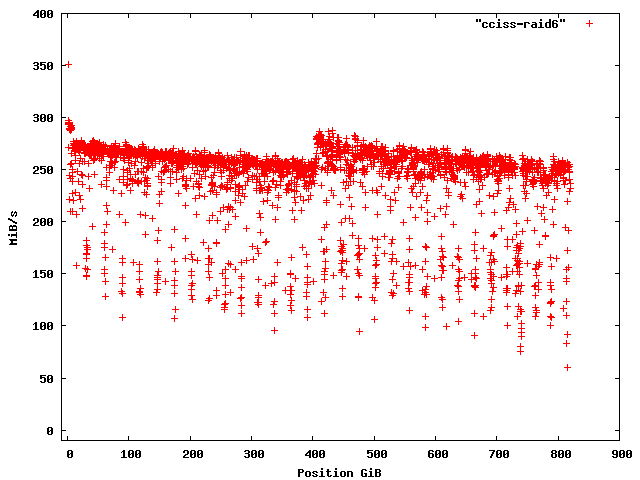
I’ve just started work on a new HP server running RHEL5 AS (needs to be AS to support more than 4 DomU’s). While I still have the Xen issues that made me give up using it on Debian [1] (the killer one being that an AMD64 Xen Dom0 would kernel panic on any serious disk IO) but the Xen implementation in RHEL is quite solid. The first thing I did was run zcav (part of my Bonnie++ benchmark suite) [2] to see how the array performs (as well as ensuring that the entire array actually appears to work). The result is below. For a single disk performance is expected to decrease as you read along the disk (from outer to inner tracks). I don’t know why the performance decreases until the half-way point and then starts with good performance again and again decreases. The next thing was to ensure that the machine had RAID-6 (I have been convinced that that using only RAID-5 verges on professional malpractice). As the machine is rented from a hosting company there was no guarantee that they would follow my clear written instructions involving running RAID-6. The machine is a HP rack-mounted server with a CCISS RAID controller, so to manage the array the command /usr/sbin/hpacucli is used. The command hpacucli controller all show reveals that there is a “Smart Array P400 in Slot 1“. The command hpacucli controller slot=1 show gives the following (amongst a lot of other output):
RAID 6 (ADG) Status: Enabled
Cache Board Present: True
Cache Status: OK
Accelerator Ratio: 25% Read / 75% Write
Drive Write Cache: Disabled
Total Cache Size: 512 MB
Battery Pack Count: 1
Battery Status: OK
SATA NCQ Supported: True So the write-back cache is enabled, 384M of data is for the write-back cache and 128M is for the read cache (hopefully all for read-ahead - the OS should do all the real caching for reads). The command hpacucli controller slot=1 array all show reveals that there is one array: “array A (SAS, Unused Space: 0 MB)“. The command hpacucli controller slot=1 array a show status tells me that the status is “array AOK“. Finally the command hpacucli controller slot=1 show config gives me the data that I really want at this time and says:
Smart Array P400 in Slot 1 (sn: *****)
array A (SAS, Unused Space: 0 MB)
logicaldrive 1 (820.2 GB, RAID 6 (ADG), OK) Then it gives all the data on the disks. It would be nice if there was a command to just dump all that. I would like to be able to show the configuration of all controllers with a single command. Also it would be nice if the fact that hpacucli is the tool to use for managing CCISS RAID arrays when using Linux on HP servers was more widely documented. It took me an unreasonable amount of effort to discover what tool to use for CCISS RAID management.

2 August 2008

Russell Coker: On Talking to Police

The lecture by Professor James Duane about why you should not talk to the police (in the US at least) is doing the rounds at the moment. The Google video site doesn’t work for me, so I downloaded it from youtube with the following references:
part 1 [rVq6N0xAEEM]
part 2 [-Z0bpj3EEHI]
part 3 [44-GSZofXIE]
part 4 [zSvxiaO-TG8]
part 5 [gzYHnWrqfWg]
part 6 [BErNzdOnWGY] The first thing that struck me about this is that it’s the first time I’ve ever seen someone clearly state the problem with the excessive number and complexity of the laws. It’s impossible to know whether you are breaking the law. This is obviously wrong and it should be a legislative priority to reduce the number of laws and the complexity of the laws. If for every law they sought evidence regarding whether it helped people or helped preserve the state then that would be a good start. The excessive number of laws is not just a problem due to the risk of accidentally breaking a law, but also due to the fact that a malicious cop could arrest anyone that they wished - it would merely be a matter of following them for long enough. In the second half of the lecture Officer George Bruch from the Virginia Beach Police Department gives his side of the story. At one point he cites an example of the road laws where he can follow a car and find a legitimate reason for booking the driver if he wishes. Virginian law allows the police to destroy primary evidence. If they tape an interview then they can transcribe it to a written record and then destroy the original tape. If the transcription removes some of the content that has meaning then the defendant is probably going to suffer for it. It’s often stated that on the net you have to make extra effort to make your meaning clear as jokes can’t be recognised by the tone of voice. It seems that the same effort would need to be made in a police interview (but without the possibility of going back and saying “sorry I was misunderstood” that you have in email). It’s also legal for police to lie to suspects. While I can imagine some situations where this could be reasonable, it seems that at a minimum there should be some protection for child suspects against being lied to by police (there have been some travesties of justice stemming from children trusting police in an interview room). It seems that if someone doesn’t get a good lawyer and refuse to talk to the police then they will be likely to be convicted regardless of whether they are guilty or innocent. Officer Bruch says that he tries to avoid interviewing innocent people. So I guess whether someone ends up in jail or not will depend to some extent on the opinion of a cop who may or may not interview them. While I guess a high rate of success at securing convictions is in most cases a good thing, the fact that convicting an innocent person is the absolute best way of letting a criminal escape justice seems to be forgotten. Another issue is the fact that a witness may have reason to believe that they could be a suspect. The advice that a suspect should never talk to a police officer seems to logically imply that intelligent people will be hesitant about providing witness statements in situations where they may be a suspect. I wonder how the legal system in Australia compares to the US in regard to these issues. I know that we have far too many laws and too many complex laws which can not be understood and obeyed by a reasonable person.

1 August 2008

Petr Rockai: adept 3.0 alpha 5

Short introduction: Adept is an APT frontend for KDE. You can use it to search for packages, install, uninstall, upgrade, all the usual things. It’s gone through a number of changes since 2.1, which has been the default package manager on Kubuntu for some time now. What’s new since 2.1 Where to get Since compilation is still not that trivial (well, it’s 3 packages to compile and install, really, and you have to get them with darcs), I have prepared binary packages for the two main “target distributions”. In Debian, you can install alpha 5 from experimental:
apt-get install -t experimental adept
The sources.list line is:
deb http://ftp.debian.org/debian experimental main
If you are on Kubuntu Intrepid, the line is
deb http://ppa.launchpad.net/mornfall/ubuntu intrepid main
(more instructions on https://launchpad.net/~mornfall/+archive) What (and how) to test All of the previous components (save for notifier, which is not included at all yet) have been merged into a single binary, that is adept. I have missed desktop files in this alpha (it might be a little on purpose too, as I’d like people to run the program from terminal to be able to check the debug output and possibly send it along with problem reports). If you have sudo (Kubuntu-ers do, the rest can use kdesu or similar):
sudo adept
sudo adept installer
sudo adept updater
are the magic commands. Please give a go to all of them, report rough edges, crashes and all that, either through irc (mornfall at freenode, oftc) or mail me-at-mornfall-dot-net or use KDE Bugzilla to report bugs. Missing features I have one outstanding issue on “must have for 3.0”, that being filtering packages according to their state. There is also no actual way to browse through the 19k+ packages, but might have to give for 3.0. A “browsing” mode is likely for 3.1, although still could make it for 3.0 if I get my act together on that one. We’ll see how alpha testing goes, maybe I’ll have hands full of bugs to fix and won’t get anywhere on features… Known Issues Reward For the brave, fearless testers, I unfortunately cannot promise anything else than fuzzy feeling for doing a good thing… I won’t be at aKademy nor Debconf this year, so I can’t even promise beers. Maybe next time. ; - )

31 July 2008

Romain Beauxis: Icecast2 backport for DebConf8

Some weeks ago, we (the icecast packaging team) were requested an icecast2 backport for debconf8. It is now stuck in backports.org's NEW queue, feel free to unblock it.

30 July 2008

Juan Luis Belmonte: Open Source people life cycle


First lets talk about freedom. Is not an utopia, freedom can be conquered in a lot of little bits of our life, just because we are not always free somewhere or somehow. We cant forget that there are billions of other things you can do to feel the freedom. You lose your freedom when if you stop looking for it. We can also talk about technology. It is everywhere, satellites, tvs, cell phones, internet, computers, games, microwaves, dvd… Is part of our life. What happen if we mix this all together? Well let’s talk about … me? Fourteen years old. My parents bought a computer , with his Windows 98. Everything works till it brokes. I brought it to a technician, and I had to spent all of my pocket money. So I promised my self not to bring my pc again to a technician. That made me a bit more free, I learned how to fix it and then I was able to do what I want with the machine, so I had the way to fix it without spending money. Great!. The magic tool exists is knowledge. In a couple of years, nothing in that windows was enough so, I started very light to read some about that thing called “linux” affiliate to some news account. But i was 17 when I started to use half linux and half windows. Things weren’t very trivial and I hadn’t broadband, so I had a quite big amount of CDs with different distros, and when i want to use my winmodem, I used suse, for little funny games redhat, and other times, mandrake, Caldera… I didn’t know how anything was working, but was funny and each time easier to deal with it. So the first step in open source was experimenting, sometimes a bit frustrating but… is part of the game. When the broadband was up to my pocket. I got my connection, and started to learn from forums, online tutorials, irc… Debian, seven Debian CDs. … that day I wasn’t conscious, what that will supose for me, and my future. I’ve annoyed a lot of people with questions, read a lot of tutorials, spent hours learning of other people experiences… But all of that is something that one day you will give it back to someone else, is the cycle. One day is you who helps other to begin with his distro, or compiling an app, or making his sound card to work. I’ve studied computer engineering and I’ve been in touch with free software the last 5 years, I don’t have to pay for my software, i can do with it what I want. One more step is promote it. Convincing people, telling how wonderful it is, and how many people you’ve met, and how you can enjoy it, and what advantages are ready for you and for free. 6 years using linux, make me to work as system administrator and i love it. So the free software one day let me to earn money and build my life. Now the last part. CONTRIBUTE! Is the best part, documentation, developing, translating, whatever you want, you can do things for people as people has done for you. A popular sensation when you begin, is that there a lot of gurus, and you are not able to be in this world, everywhere are levels, you can be an user, a contributor, or just become a fan :) Experiment, Use, Share, Work, Contribute. But never finish, is an inphinite cycle where you can always learn from everybody and you have a lot to teach the other. Isn’t that the freedom?. Enjoy it.

Joerg Jaspert: Argentina - Mar del Plata

After a night at Tinchos place, then driving and walking around Buenos Aires a day and finally taking a 5hours bus trip, Mark, Stephen and I arrived in Mar del Plata early this morning, at around 05:30AM. Brr, early. We could checkin to the Hotel at 06:30. During checkin we discovered that Stephen and my birthday are, in absolute numbers, 6 years, 6 months and 6 days apart, ie. 666. And we are managing the evil, I mean, the network for DebConf. HA. HAHA. HAHAHAHAHAHAHAHAHAHAHAHA. Ignoring that - stuff looks pretty nice over here. Most machines are working, most services we (as in admins, not video team) care about are setup or will be ready within the next 2 days, the Hotel stuff is doing the last preparations, it all looks great. There hasn’t been a DebConf that was that prepared, ever. We currently have a local smtp server accessible for everyone here (no direct outgoing smtp, we firewall that), a local OFTC IRC Server (Freenode IRCd is in setup), soon a full (pushed) mirror, preparing an upload queue for ftp-master, a schedule announce bot is also ready to run, most of the building has good wireless covering (and the rest is scheduled to get better soon). And lots of other nice things that are surely there and I just forgot to mention but which we will mention in some wiki page in time for you. (Oh, and make sure to listen to what DHCP tells your machine, all the various services get send to you :) ). Comments: 0

Pablo Lorenzzoni: DNS mess and what I think about DNSSEC

I am following closely this new DNS mess. In fact, there s nothing really new in that. DNS has been attacked lots of times over the years as a result of not being designed with security in mind from the ground up -, just this new one is a combination of known attacks against known security flaws. The quick fix is not a real fix, and just incorporate old ideas into the most used DNS software, strengthening it to face the attack. The details leaked, and there s already at least one public exploit (and who knows how many in the wild). The new buzzword is DNSSEC. I don t like DNSSEC. I never did. The first time I heard of it, around year 2001, it was a centralization of a decentralized database: A proposed company (called Network Solutions) would serve as a central authority, signing every root DNS entry. It was a joke! Come on! DNS is suppose to be decentralized! Having a central company anywhere is just a huge step back in decentralization (not to mention a huge step back in security). Time passed, and the DNSSEC specs evolved to a more decentralized way of thinking. The state it is now, and the implementations we saw so far are not good. No! I am not talking about security I am talking about the KISS principle: DNSSEC turns something really simple to deploy into a full-time job, with frequent key roll-overs and re-signing everytime you change the zone a huge mess! Yes, there are automated tools, but, come on! you still have to wait for TTL to expire before publishing this part or that part of the cryptographic machinery And, if we are talking about real security, are we going to build some automated tool fire-and-forget -style and not follow it? If we are not looking at it as it goes, and it fails, we could end up with a completely wrong set-up or (even worse) a non-validating zone. And I haven t yet mentioned the increase in payload I am not completely convinced that this alone would not lead to DoS attacks just by compromising the responsiveness of the servers (and DoS attacks are already available for quite some time maybe the DNSSEC-medicine is worse than the disease ). The root ( . ) servers are not even DNSSEC-aware, and there s a whole class of other stuff to work-around the fact that they may not be DNSSEC-aware for quite some time yet. There has to be a simpler way! I can imagine at least three ways to fix the problem until we can fix DNS in a KISS way And they re all KISS also: Maybe some of those three solutions are flawed Maybe none are flawed and can be deployed together Maybe I am wrong and DNSSEC is the only way to go But let s not panic, let s cool our minds and begin thinking it through. I still don t think DNSSEC is the holy grail Now I already spent more time than intended on this let me go back signing some zones ;-)

29 July 2008

Wouter Verhelst: Debian testing

Martijn isn't too sure about Debian testing, though he doesn't go into much detail about the "not sure" bits. Well, Martijn, even though I could really use some more detail, let me make an attempt: In all, I still prefer Debian over Ubuntu, mostly because of the higher attention to detail you'll find in Debian; I find that ubuntu developers usually don't have the time to pay too much attention to pesky details. This makes the system work slightly better. But, of course, YMMV, and if you decide to stay with Ubuntu because you think it works better in your particular use cases, more power to you!

28 July 2008

Steve Kemp: I spent my life trying not to be careless

There should be a word for those silly little ways you can fool your body & brain. For example recently I've been having trouble with my boiler - so getting hot water is a challenge. I find myself doing the crazy thing: Lather, rinse, repeat. Similarly there are times when you can imaging all kinds of bodily sensations. More than once I've been walking out, or sat at home, convinced that my mobile phone vibrated in my pocket. And it hadn't at all. I remember, random, conversations with people who agreed they sometimes believe their phones are vibrating when they are not. Seems to be a common thing. Which begs the question, is this a modern thing? Ten years ago if you had something vibrating against your body you damn well knew about it ... because you were doing it deliberately! It is only recently that it was possible to have something semi-randomly vibrating against you, without your explicit control. Right? (OK that sounds rude. It'll be our little secret.) ObQuote: Godfather (Pt.1)

25 July 2008

Gerfried Fuchs: Blosxom 2.1

Sometimes things like these happen. Noone really did expect it, but it did: blosxom Version 2.1 got released by the new Upstream Team. It does incorporate all previous Debian patches which I'm quite happy about, and contains other long standing and needed fixes and changes. Though, there is also a tiny drawback in that, especially for the Debian package: some of the changes might not be totally approved by all the users of the Debian package. This is unfortunate, but it had to be done to get the package finally yet in a cleaner state (maybe you remember the cleanup run when I originally took over the package). Please be sure to read the NEWS.Debian entry (apt-listchanges might help here) about the most important changes, one of them might even mean that upgrades to this package will flood planets. This is extremely unfortunate but for getting things clean unavoidable:
blosxom (2.1.0-1) unstable; urgency=low
  * This update is a major switch, all local patches have been incorporated
    into upstream version again. Furthermore, html and rss flavours are now
    included in the blosxom script directly and the old 1993 and index
    flavours are not included anymore, to get rid of some further historical
    annoyances with the packaging.
  * MOST IMPORTANTLY: This update adds a new tag into rss feeds:
    <guid isPermanentLink="true"> which helps to notice duplicates and not let
    them appear again on planets. Though, for the time of switching it might
    mean that your last entries might appear as new when planet doesn't check
    <link> (which already should be cached) when finding <guid>. This is
    unfortunate but not really avoidable. To limit impact a new plugin was
    added: 00RssLimit which turns the syndicated feed in only pick up the last
    5 entries.
  * The plugin timezone got disabled and gets only installed into a new
    /etc/blosxom/plugins-available directory which is the first step to the
    planned blosxom-plugins package. If you found it useful and made use of it
    just symlink it from the plugins directory.
 -- Gerfried Fuchs <rhonda@debian.at>  Fri, 25 Jul 2008 16:19:49 +0200
Technically it means you might want to tweak the included 00RssLimit plugin to even just 1 until you blogged some more and raise it with time if your blog runs through some planet. If you do the upgrade, did set 00RssLimit to 1 and do not reappear with your last entry on your planet sites feel free to switch it back. Again, this is an unfortunate situation, and it's not really related to the Debian package only–the addition of the <guid> tag happened upstream and will affect all users of blosxom. It's just that I added the selfwritten 00RssLimit plugin to reduce the impact for the Debian users. Hope you don't mind. ;) Ah yes, and if you might ask where the package is: I did put it into my website for now so people have some time to stumble upon this blog entry before they install the package from unstable without prior notice and maybe not even using apt-listchanges. I will upload the package within the next day.

24 July 2008

Steve Kemp: I think I'll take this back

KVM Utility
Gunnar Wolf made an interesting post about KVM today which is timely. He points to a simple shell script for managing running instances of KVM which was a big improvement on mine - and so is worth a look if you're doing that stuff yourself. Once I find time I will document my reasons for changing from Xen to KVM, but barring a few irritations I'm liking it a lot.
Chronicle Theme Update
I made a new release of the chronicle blog compiler yesterday, mostly to update one of the themes. That was for purely selfish reasons as I've taken the time to update the antispam protection site I'm maintaining. There have been some nice changes to make it scale more and now it is time for me to make it look prettier. (A common theme - I'm very bad at doing website design.) So now the site blog matches the real site.
ObQuote: Resident Evil

23 July 2008

Gunnar Wolf: Virtually having fun

Several weeks ago, the people in charge of maintaining the Windows machines in my institute were desperate because of a series of virus outbreaks - Specially, as expected, in the public lab - but the whole network smell virulent. After seeing their desperation, I asked Rolman to help me come up with a solution. He suggested me to try replacing the Windows workstations by substituting local installations by a server having several virtual machines, all regenerated from a clean image every day, and exporting rdesktop sessions. He suggested using Xen for this, as it is the virtualization/paravirtualization solution until now best offered and supported by most Linux distributions (including, of course, RedHat, towards which he is biased, and Debian, towards I am... more than biased, even bent). So far, no hassle, right?
Of course, I could just stay clear of this mess, as everything related to Windows is off my hands... But in October, we will be renewing ~150 antivirus licences. I want to save that money by giving a better solution, even if part of that money gets translated to a big server.
Get the hardware
But problems soon arose. The first issue was hardware. Xen can act in its paravirtualization mode on basically any x86 machine - but it requires a patched guest kernel. That means, I can paravitualize many several different free OSs on just any computer I lay my hands on here, but Windows requires full- or hardware-assisted- virtualization. And, of course, only one of the over 300 computers we have (around 100 of which are recent enough for me to expect to be usable as a proof-of-concept for this) has a CPU with VT extensions - And I'm not going to de-comission my firewall to become a test server! ;-)
When software gets confused for hardware
So, I requested a Intel Core 2 Quad Q9300 CPU, which I could just drop in any box with a fitting motherboard. But, of course, I'm not the only person requiring computer-related stuff. So, after pestering the people in charge for buying stuff on a daily basis for three weeks, the head of acquisitions came smiling to my office with a little box in his hands.
But no, it was not my Core 2 Quad CPU.
It was a box containing... Microsoft Visio. Yes, they spent their effort looking for the wrong computer-related thingy :-/ And meanwhile, Debconf 8 is getting nearer and nearer. Why does that matter? Because I have a deadline: By October, I want the institute to decide not to buy 150 antivirus licenses! Debconf will take some time off that target from me.
Anyway... The university vacations started on July 5. The first week of vacations I went to sweat my ass off at Monterrey, by Monday 14 I came back to my office, and that same day I finally got the box, together with two 2GB DIMMs.
Experiences with a nice looking potential disaster
Anyway, by Tuesday I got the CPU running, and a regular Debian install in place. A very nice workhorse: 5GB RAM, quad core CPU at 2.5GHz, 6MB cache (which seems to be split in two 3MB banks, each for two cores - but that's pure speculation from me). I installed Lenny (Debian testing), which is very soon going to freeze and by the time this becomes a production server will be very close to being a stable release, and I wanted to take advantage of the newest Xen administration tools. Of course, the installation was for AMD64 - Because 64 bitness is a terrible thing to waste.
But I started playing with Xen - And all kind of disasters stroke. First, although there is a Xen-enabled 2.6.25 Linux kernel, it is -686 only (i.e. no 64 bit support). Ok, install a second system on a second partition. Oh, but this kernel is only domU-able (this is, it will correctly run in a Xen paravirtualized host), but not dom0-able (it cannot act as a root domain). Grmbl.
So, get Etch's 2.6.18 AMD64 Xen-enabled kernel, and hope for the best. After all, up to this point, I was basically aware of many of the facts I mentioned (i.e. up to this point I did reinstall once, but not three times)... And I hoped the kernel team would have good news regarding a forward-port of the Xen dom0 patches to 2.6.25 - because losing dom0 support was IMO a big regression.
But quite on time, this revealing thread came up on the debian-devel mailing list. In short: Xen is a disaster. The Xen developers have done their work quite far away from the kernel developers, and the last decent synchronization that was made was in 2.6.18, over two years ago. Not surprisingly, enterprise-editions of other Linux distributions also ship that kernel version. There are some forward-patches, but current support in Xen is... Lacking, to say the least. From my POV, Xen's future in the Linux kernel looks bleakish.
Now, on the lightweight side...
Xen is also a bit too complicated - Of course, its role is also complicated as well, and it has a great deal of tunability. But I decided to keep a clean Lenny AMD64 install, and give KVM, the Kernel Virtual Machine a go. My first gripe? What a bad choice of name. Not only Google searches for KVM gives completely unrelated answers (to a name that's already well known, even in the same context, even in the same community).
KVM takes a much, much simpler approach to virtualization (both para- and full-): We don't need no stinkin' hypervisors. The kernel can just do that task. And then, kvm becomes just another almost-regular process. How nice!
In fact, KVM borrows so very much from qemu that it even refers to qemu's manpage for everything but two command-line switches.
Qemu is a completely different project, which gets to a very similar place but from the other extreme - Qemu started off as Bochs, a very slow but very useful multi-architecture emulator. Qemu started adding all kinds of optimizations, and it is nearly useful (i.e. I use it in my desktop whenever I need a W2K machine).
Instead of a heavyweight framework... KVM is just a modprobe away - Just ask Linux to modprobe kvm, and kvm -hda /path/to/your/hd/image gets you a working machine.
Anyway - I was immediatly happy with KVM. It took me a week to get a whole "lab" of 15 virtual computers (256MB RAM works surprisingly well for a regular XP install!) configured to start at boot time off a single master image over qcow images.
KVM's shortcomings
Xen has already been a long time in the enterprise, and has a nice suite of administrative tools. While Xen depends on having a configuration file for each host, KVM expects them to be passed at the command line. To get a bird-eye view of the system, xen has a load of utilities - KVM does not. And although RedHat's virt-manager is said to support KVM and qemu virtualization (besides its native Xen, of course), it falls short of what I need (i.e. it relies on a configuration file... which lacks expresivity to specify a snapshot-based HD image).
To my surprise, KVM has attained much of Xen's most amazing capabilities, such as the live migration. And although it's easier to just use fully virtualized devices (i.e. to use an emulation of the RTL8139 network card), as they require no drivers extraneous to the operating system, performance can be greatly enhanced by using the VirtIO devices. KVM is quickly evolving, and I predict it will largely overtake Xen's (and of course, vmware and others) places.
Where I am now
So... Well, those of us that adopt KVM and want to get it into production now will have some work of building the tools to gracefully manage and report it, it seems. I won't be touching much my setup until after Debconf, but so far I've done some work over Freddie Cash's kvmctl script. I'm submitting him some patches to make his script (IMHO) more reliable and automatizable (if you are interested, you can get my current version of the script as well). And... Starting September, I expect to start working on a control interface able to cover my other needs (such as distributing configuration to the terminals-to-be, or centrally managing the configurations).

22 July 2008

Russell Coker: Bad Telstra

77020 packets transmitted, 18029 received, 76% packet loss, time 77049435ms
rtt min/avg/max/mdev = 20.026/130.848/2245.752/287.550 ms, pipe 3 Above are the ping results from pinging my server (hosted on a business DSL connection). Telstra stuffed up and appear to have entirely disconnected DSL for a few suburbs (based on reports from a client who has several clients in that region that all went offline simultaneously). It’s affected at least two ISPs (every DSL service uses Telstra’s backbone). The above ping results show almost 17 hours of outage, but it was really more like 18 (I didn’t start pinging until I realised it was down). Telstra’s response to the problem reports (which my client raised via two ISPs) was that it would take until the end of the next business day. The problem was reported at 10AM, so Telstra was apparently happy with two entire business days of outage. I think that the root cause of such problems is the terrible performance of Sol Trujillo [1] (or “Telstra’s Sole True Hero” as suggested in Crikey [2]). Under Sol’s leadership Telstra stock has not performed well (it’s a monopoly - it’s supposed to reap money), it’s lost market share in every area where competition is permitted and it hasn’t made it’s customers happy. Sol is taking an approach to business that works well for some big companies in the US (and for the mining and automative industries in Australia). He has been trying to force the government to extend the Telstra monopoly with the Fibre To The Node (FTTN) plan [3]. His idea was to have small Telstra boxes (nodes) spread around the suburbs with short copper runs to each home, each node would have absolutely no spare space for other ISP equipment and therefore the other ISPs would not be able to provide a service. The claim was that FTTN was needed for decent performance but ADSL2+ has been shown to work well in the areas where FTTN was proposed. Telstra even sent out brochures to stock-holders encouraging them to lobby members of Parliament on behalf of Telstra’s rent seeking [4]. However Australia is not like the US and this didn’t work, they couldn’t even get Telstra stock holders to support such plans. Speaking for myself, my interests as a Telstra stock-holder (and I own more Telstra shares than the median stock holder) are vastly outweighed by my interests as a consumer of telecommunications services. I would like to see the government nationalise the local loop and the exchange buildings and then provide fair and equal access to all telephone companies and ISPs (including Telstra). Then we can have true competition in this market and the companies that provide the best services will win. Currently Telstra resembles one of those inefficient Soviet monopolies. We need some capitalism in the telco industry!

21 July 2008

Matthew Garrett: The fallacy of the completely inclusive community

Emma Jane Hogbin gave a presentation on the gender gap in free software at Lugradio Live this weekend. One of the central messages was that a great deal of how to avoid putting women off computing can be distilled down to "Don't be a dick". This ties in well with Mako's restatement of the Ubuntu code of conduct as "Be excellent to each other" (a wonderful phrasing which demonstrates that Bill and Ted's Excellent Adventure is the most philosophically worthwhile film that Keanu Reeves has ever appeared in, and certainly not The fucking Matrix) and led to my 5 minute rant on why I hate the Linux community slightly later in the day, but does leave a certain problem. What standards are used to define whether given behaviour is dickish or not? The comments here show that there's disagreement even within a single sub-community of the larger free software world. Ben suggests that the reaction to perceived inappropriate behaviour is perhaps even more discouraging than the original behaviour, suggesting that bitching about things that offend you is dickish behaviour in and of itself. How do we decide whether someone is being a dick or helping the community? Is lack of tolerance a form of exclusionary behaviour?

This topic is actually one of the issues discussed in the Geek Social Fallacies, but here's a nice easy example. Would tolerating planet posts encouraging the eradication of the Jewish population be inclusive or exclusive? I suspect that most people would agree that it wouldn't be acceptable behaviour, which leads us to the next question. Why? There's two obvious arguments here. The first is that at a community level we have some form of rough moral consensus that advocating genocide is Just Wrong, and so criticising Nazis is obviously the right thing to do. The second argument is more pragmatic than philosophical - alienating millions of people in order to avoid alienating hate groups could be considered to reduce our potential contributor base in an unfortunate way.

I'm a fan of the second argument. The example I gave is emotive and relatively recent history has resulted in people tending to be pretty uniform in considering genocide to be a bad thing, but many other cases aren't clear cut. What I consider to be objectification of women is seen by others as appreciation of natural beauty. What I think of as sexist jokes are perceived by others as acceptable humour. When I advocate intolerance of certain behaviour, people are going to see me not having enough tolerance. So we end up in a situation where people make the "We should all just get along and be tolerant of each other" argument, which sounds fine but is fundamentally flawed in one significant way.

Advocating tolerance excludes the intolerant.

The reason people fail to see this is that it doesn't sound like a flaw. If you ask people whether we need to support intolerance, the immediate answer is probably no. But by advocating exclusion of intolerance, you're excluding all those who have good reasons to be intolerant. You're excluding the women who don't want to feel that the community sees them as a pair of breasts attached to some legs. You're excluding the ethnic groups who would prefer to avoid racist slurs or ethnic stereotyping. Telling anti-fascism protestors that they're being intolerant isn't likely to endear you to them. Advocating tolerance is telling the intolerant that they're wrong and should just deal with whatever it is that makes them unhappy.

So, ironically, tolerating certain types of intolerance is probably required in order to avoid alienating many potential contributors. That means some way of deciding what kinds of behaviour are acceptable and which are unacceptable. In the absence of either pre-existing community consensus or some philosophical breakthrough that allows unambiguous determination of the "rightness" of a given action, I'm going to suggest that we look at it from a pragmatic viewpoint. How many potential contributors do we discourage by criticising a certain type of behaviour? How many do we discourage by tolerating it?

The fallacy of the completely inclusive community is the idea that it includes everyone. The reality is that a certain level of social exclusion is required in order to include a wider range of people. So don't criticise people purely for criticising someone else's behaviour - make an argument for why that behaviour benefits the community. And when you see behaviour that you think discourages others, call people on it. Even if nobody's behaviour changes as a result, you're sending a signal that not everyone in the community agrees. Sometimes all people want is to know that there'll be some people on their side.

But, above all, try not to be a dick.

19 July 2008

Luciano Bello: Exploiting DSA-1571: How to break PFS in SSL with EDH

( I love acronyms :-D )

At this point, all of you should know and see how the H D Moore s toys work. Those toys attack SSH public-key authentication using clone keys and online brute force.

Furthermore, many of you know that there are other effects produced by a biased PRNG besides this one.

Strangely, I could not find more of those toys exploiting these aspects. So, I would like to show you a Wireshark patch which attacks Perfect Forward Secrecy (PFS) provided by Ephemeral Diffie Hellman (EDH).
Introduction to EDHLet s put it in plain words (if you know what we are talking about, ignore this and jump to the next heading):
In an insecure communications channel the parties agree a common key to cipher their dialog. This is what happens in SSL (in most of the cases, depending on the cipher suite):
The exploit If an eavesdropper can explore the complete private key space (the all possible numbers for Xc or Xs), he/she will be able to get access to the shared secret. With it all the communication can be deciphered. That s what this patch can do.

A Wireshark with this patch and a list of possible private keys will try to brute force the share secret. If one of the parties is using the vulnerable OpenSSL package the communication is totally insecure and will be decrypted.


The patch was submitted in order to be committed on the Wireshark trunk. There you can find the patch against the on-develop source revision 25765.
Issues that can be improvedWe (the other developers and myself) detected few things to be improved. But we will do nothing for them. So, if you want to contribute with some code, start from these items and submit the patches to the Wireshark s bugzilla:CreditsPaolo Abeni <paolo.abeni at email.it>
Luciano Bello <luciano at debian.org>
Maximiliano Bertacchini <mbertacchini at citefa.gov.ar>

This work was partially supported by Si6 Labs at CITEFA, Argentina.

UPDATE Jul. 21st: See more and updated info here, especially this.

Luciano Bello: Exploiting DSA-1571: How to break PFS in SSL with EDH

( I love acronyms :-D )

At this point, all of you should know and see how the H D Moore s toys work. Those toys attack SSH public-key authentication using clone keys and online brute force.

Furthermore, many of you know that there are other effects produced by a biased PRNG besides this one.

Strangely, I could not find more of those toys exploiting these aspects. So, I would like to show you a Wireshark patch which attacks Perfect Forward Secrecy (PFS) provided by Ephemeral Diffie Hellman (EDH).
Introduction to EDHLet s put it in plain words (if you know what we are talking about, ignore this and jump to the next tittle):
In an insecure communications channel the parties agree a common key to cipher their dialog. This is what happens in SSL (in most of the cases, depending on the cipher suite):
The exploit If an eavesdropper can explore the complete private key space (the all possible numbers for Xc or Xs), he/she will be able to get access to the share secret. With it all the communication can be deciphered. That s what this patch can do.

A Wireshark with this patch and a list of possible private keys will try to brute force the share secret. If one of the parties is using the vulnerable OpenSSL package the communication is totally insecure and will be decrypted.


The patch was submitted in order to be committed on the Wireshark trunk. There you can find the patch against the on-develop source revision 25765.
Issues that can be improvedWe (the other developers and myself) detected few things to be improved. But we will do nothing for them. So, If you want to contribute with some code, start from these items and submit the patches to the Wireshark s bugzilla:CreditsPaolo Abeni <paolo.abeni at email.it>
Luciano Bello <luciano at debian.org>
Maximiliano Bertacchini <mbertacchini at citefa.gov.ar>

This work was partially supported by Si6 Labs at CITEFA, Argentina.

Next.

Previous.