Search Results: "will"

29 August 2015

Tassia Camoes Araujo: Report from the MicroDebconf Bras lia 2015

This was an event organized due to a coincidental meeting of a few DD s in the city of Brasilia on May 31st 2015. What a good thing when we can mix vacations, friends and Debian ;-)

Group photo

We called it Micro due to its short duration and planning phase, to be fair with other Mini DebConfs that take a lot more of organization. We also ended up having a translation sprint inside the event that attracted contributors from other cities. Our main goal was to boost the local community and bring new contributors to Debian. And we definitely made it! The meeting happened at University of Brasilia (UnB Gama). It started with a short presentation where each DD and Debian contributor presented their involvement with Debian and plans for the hacking session. This was an invitation for new contributors to choose the activities they were willing to engage, taking advantage of being guided by more experienced people. Then we moved to smaller rooms where participants were split in different groups to work on each track: packaging, translation and community/contribution. We all came together later for the keysigning party. Some of the highlights of the day: For more details of what happened, you can read our full report. The MicroDebconf wouldn t be possible without the support of prof. Paulo Meirelles from UnB Gama and all the LAPPIS team for the local organization and students mobilization. We also need to thank to Debian donnors, who covered the travel costs of one of our contributors. Last but not least, thanks to our participants and the large Brazilian community who is giving a good example of team work. A similar meeting happened in July during the Free Software International Forum (FISL) and another one is already planned to happen in October as part of the LatinoWare. I hope I can join those folks again in the near future!

Zlatan Todori : Interviews with FLOSS developers: Elena Grandi

One of fresh additions to Debian family, and thus wider FLOSS family is Elena Grandi. She is from realms of Valhalla and is setting her footprint into the community. A hacker mindset, a Free software lover and a 3D printing maker. Elena has big dedication to make the world free and better place for all. She tries to push limits on personal level with much care and love, and FLOSS community will benefit from her work and way of life in future. So what has the Viking lady to say about FLOSS? Meet Elena "of Valhalla" Grandi. Read more (12 min remaining to read)

28 August 2015

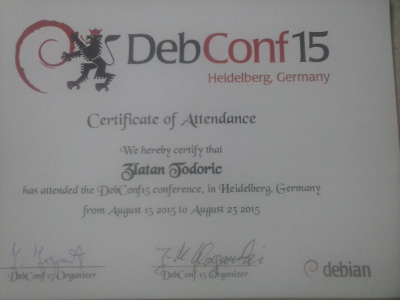
Zlatan Todori : The big life adventure called DebConf15

By the help of sponsorship I managed again to attend the conference where Debian family gathers. This is going to be a mix without any particular order of everything, anything and nothing else ;) attendance pic I arrived to Heidelberg Main Train Station around 9am on 15th August and almost right away found Debian people so it made my trip to hostel easier. After arrival I checked in but needed to wait for 3 hours to get the key (it seems that SA will not have that problem at all, which is already an improvement). Although waiting was 3 hours long, it wasn't actually difficult at all as I started hugging and saying hi to many old (the super old super friend of mine - moray, or how I call him, "doc") and new friends. I just must say - if you know or don't know Rhonda, try to get somehow into her hugs. With her hug I acknowledged that I really did arrive to reunion. Read more (14 min remaining to read)

Dimitri John Ledkov: Go enjoy Python3

Given a string, get a truncated string of length up to 12.

The task is ambiguous, as it doesn't say anything about whether or not 12 should include terminating null character or not. None the less, let's see how one would achieve this in various languages.
Let's start with python3

import sys
print(sys.argv[1][:12])

Simple enough, in essence given first argument, print it up to length 12. As an added this also deals with unicode correctly that is if passed arg is , it will correctly print . (note these are just random Unicode strings to me, no idea what they stand for).

In C things are slightly more verbose, but in essence, I am going to use strncpy function:

#include <stdio.h>
#include <string.h>
void main(int argc, char *argv[])
char res[12];
strncpy(res,argv[1],12);
printf("%s\n",res);

This treats things as byte-array instead of unicode, thus for unicode test it will end up printing just . But it is still simple enough.
Finally we have Go
package main

import "os"
import "fmt"
import "math"

func main()
fmt.Printf("%s\n", os.Args[1][:int(math.Min(12, float64(len(os.Args[1]))))])

This similarly treats argument as a byte array, and one needs to cast the argument to a rune to get unicode string handling. But there are quite a few caveats. One cannot take out of bounds slices. Thus a na ve os.Args[1][:12] can result in a runtime panic that slice bounds are out of range. Or if a string is known at compile time, a compile time error. Hence one needs to calculate length, and do a min comparison. And there lies the next caveat, math.Min() is only defined for float64 type, and slice indexes can only be integers and thus we end up writing ]))))])...

12 points for python3, 8 points for C, and Go receives nul points Eurovision style.

EDIT: Andreas R ssland and James Hunt are full of win. Both suggesting fmt.Printf("%.12s\n", os.Args[1]) for go. I like that a lot, as it gives simplicity & readability without compromising the default safety against out of bounds access. Hence the scores are now: 14 points for Go, 12 points for python3 and 8 points for C.

EDIT2: I was pointed out much better C implementation by Keith Thompson - http://pastebin.com/5i7rFmMQ in essence it uses strncat() which has much better null termination semantics. And Ben posted a C implementation which handles wide characters http://www.decadent.org.uk/ben/blog/truncating-a-string-in-c.html. I regret to inform you that this blog post got syndicated onto hacker news and has now become the top viewed post on my blog of all time, overnight. In retrospect, I regret awarding points at the end of the blog post, as that's just was merely an expression of opinion and is highly subjective measure. But this problem statement did originate from me reviewing go code that did "if/then/else" comparison and got it wrong to truncate a string and I thought surely one can just do [:12] which has lead me down the rabbit hole of discovering a lot about Go; it's compile and runtime out of bounds access safeguards; lack of universal Min() function; runes vs strings handling and so on. I'm only a beginner go programmer and I am very sorry for wasting everyone's time on this. I guess people didn't have much to do on a Throwback Thursday.

The postings on this site are my own and don't necessarily represent Intel s positions, strategies, or opinions.

Lucas Nussbaum: DebConf 15

I attended DebConf 15 last week. After being on semi-vacation from Debian for the last few months, recovering after the end of my second DPL term, it was great to be active again, talk to many people, and go back to doing technical work. Unfortunately, I caught the debbug quite early in the week, so I was not able to make it as intense as I wanted, but it was great nevertheless. I still managed to do quite a lot: DC15 was a great DebConf, probably one of the two bests I ve attended so far. I m now looking forward to DC16 in Cape Town!

Ben Hutchings: Securing debcheckout of git repositories

Some source packages have Vcs-Git URLs using the git: scheme, which is plain-text and unauthenticated. It's probably harder to MITM than HTTP, but still we can do better than this even for anonymous checkouts. git is now nearly as efficient at cloning/pulling over HTTP-S, so why not make that the default? Adding the following lines to ~/.gitconfig will make git consistently use HTTP-S to access Alioth. It's not quite HTTPS-Everywhere, but it's a step in that direction:
[url "https://anonscm.debian.org/git/"]
	insteadOf = git://anonscm.debian.org/
	insteadOf = git://git.debian.org/
Additionally you can automatically fix up the push URL in case you have or are later given commit access to the repository on Alioth:
[url "git+ssh://git.debian.org/git/"]
	pushInsteadOf = git://anonscm.debian.org/
	pushInsteadOf = git://git.debian.org/
Similar for git.kernel.org:
[url "https://git.kernel.org/pub/scm/"]
	insteadOf = git://git.kernel.org/pub/scm/
[url "git+ssh://ra.kernel.org/pub/scm/"]
	pushInsteadOf = git://git.kernel.org/pub/scm/
RTFM for more information on these configuration variables.

Ben Hutchings: Securing git imap-send in Debian

I usually send patches from git via git imap-send, which gives me a chance to edit and save them through my regular mail client. Obviously I want to make a secure connection to the IMAP server. The upstream code now supports doing this with OpenSSL, but git is under GPL and it seems that not all relevant contributors have given the extra permission to link with OpenSSL. So in Debian you still need to use an external program to provide a TLS tunnel. The commonly used TLS tunnelling programs, openssl s_client and stunnel, do not validate server certificates in a useful way - at least by default. Here's how I've configured git imap-send and stunnel to properly validate the server certificate. If you use the PLAIN or LOGIN authentication method with the server, you will still see the warning:
*** IMAP Warning *** Password is being sent in the clear
The server does see the clear-text password, but it is encrypted on the wire and git imap-send just doesn't know that. ~/.gitconfig
[imap]
	user = ben
	folder = "drafts"
	tunnel = "stunnel ~/.git-imap-send/stunnel.conf"
~/.git-imap-send/stunnel.conf
debug = 3
foreground = yes
client = yes
connect = mail.decadent.org.uk:993
sslVersion = TLSv1.2
renegotiation = no
verify = 2
; Current CA for the IMAP server.
; If you don't want to pin to a specific CA certificate, use
; /etc/ssl/certs/ca-certificates.crt instead.
CAfile = /etc/ssl/certs/StartCom_Certification_Authority.pem
checkHost = mail.decadent.org.uk
If stunnel chokes on the checkHost variable, it doesn't support certificate name validation. Unfortunately no Debian stable release has this feature - only testing/unstable. I'm wondering whether it would be worthwhile to backport it or even to make a stable update to add this important security feature.

27 August 2015

Ben Hutchings: Truncating a string in C

This version uses the proper APIs to work with the locale's multibyte encoding (with single-byte encodings being a trivial case of multibyte). It will fail if it encounters an invalid byte sequence (e.g. byte > 127 in the "C" locale), though it could be changed to treat each rejected byte as a single character.
#include <locale.h>
#include <stdio.h>
#include <stdlib.h>
#include <string.h>
#include <wchar.h>
int main(int argc, char **argv)
 
    size_t n = 12, totlen = 0, maxlen, chlen;
    setlocale(LC_ALL, "");
    if (argc != 2)
	return EXIT_FAILURE;
    maxlen = strlen(argv[1]);
    while (n--)  
	chlen = mbrlen(argv[1] + totlen, maxlen - totlen, NULL);
	if (chlen > MB_CUR_MAX)
	    return EXIT_FAILURE;
	totlen += chlen;
     
    printf("%.*s\n", (int)totlen, argv[1]);
    return 0;
 

Ritesh Raj Sarraf: Laptop Mode Tools - 1.68

I am please to announce the release of Laptop Mode Tools, version 1.68. This release is mainly focused on integration with the newer init system, systemd. Without the help from the awesome Debian systemd maintainers, this would not have been possible. Thank you folks. While the focus now is on systemd, LMT will still support the older SysV Init. With this new release, there are some new files: laptop-mode.service, laptop-mode.timer and lmt-poll.service. All the files should be documented well enough for users. lmt-poll.service is the equivalent of the module battery-level-polling, should you need it. Filtered git log:
1.68 - Thu Aug 27 22:36:43 IST 2015
    * Fix all instances for BATTERY_LEVEL_POLLING
    * Group kill the polling daemon so that its child process get the same signal
    * Release the descriptor explicitly
    * Add identifier about who's our parent
    * Narrow down our power_supply subsystem event check condition
    * Fine tune the .service file
    * On my ultrabook, AC as reported as ACAD
    * Enhance lmt-udev to better work with systemd
    * Add a timer based polling for LMT. It is the equivalent of battery-polling-daemon,
      using systemd
    * Disable battery level polling by default, because most systems will have systemd running
    * Add documentation reference in systemd files
The md5 checksum for the tarball is 15edf643990e08deaebebf66b128b270

Categories:

Keywords:

Like:

Joey Hess: then and now

It's 2004 and I'm in Oldenburg DE, working on the Debian Installer. Colin and I pair program on partman, its new partitioner, to get it into shape. We've somewhat reluctantly decided to use it. Partman is in some ways a beautful piece of work, a mass of semi-object-oriented, super extensible shell code that sprang fully formed from the brow of Anton. And in many ways, it's mad, full of sector alignment twiddling math implemented in tens of thousands of lines of shell script scattered amoung hundreds of tiny files that are impossible to keep straight. In the tiny Oldenburg Developers Meeting, full of obscure hardware and crazy intensity of ideas like porting Debian to VAXen, we hack late into the night, night after night, and crash on the floor. sepia toned hackers round a table It's 2015 and I'm at a Chinese bakery, then at the Berkeley pier, then in a SF food truck lot, catching half an hour here and there in my vacation to add some features to Propellor. Mostly writing down data types for things like filesystem formats, partition layouts, and then some small amount of haskell code to use them in generic ways. Putting these peices together and reusing stuff already in Propellor (like chroot creation). Before long I have this, which is only 2 undefined functions away from (probably) working:
let chroot d = Chroot.debootstrapped (System (Debian Unstable) "amd64") mempty d
        & Apt.installed ["openssh-server"]
        & ...
    partitions = fitChrootSize MSDOS
        [ (Just "/boot", mkPartiton EXT2)
        , (Just "/", mkPartition EXT4)
        , (Nothing, const (mkPartition LinuxSwap (MegaBytes 256)))
        ]
 in Diskimage.built chroot partitions (grubBooted PC)
This is at least a replication of vmdebootstrap, generating a bootable disk image from that config and 400 lines of code, with enormous customizability of the disk image contents, using all the abilities of Propellor. But is also, effectively, a replication of everything partman is used for (aside from UI and RAID/LVM). sailboat on the SF bay What a difference a decade and better choices of architecture make! In many ways, this is the loosely coupled, extensible, highly configurable system partman aspired to be. Plus elegance. And I'm writing it on a lark, because I have some spare half hours in my vacation. Past Debian Installer team lead Tollef stops by for lunch, I show him the code, and we have the conversation old d-i developers always have about partman. I can't say that partman was a failure, because it's been used by millions to install Debian and Ubuntu and etc for a decade. Anything that deletes that many Windows partitions is a success. But it's been an unhappy success. Nobody has ever had a good time writing partman recipes; the code has grown duplication and unmaintainability. I can't say that these extensions to Propellor will be a success; there's no plan here to replace Debian Installer (although with a few hundred more lines of code, propellor is d-i 2.0); indeed I'm just adding generic useful stuff and building further stuff out of it without any particular end goal. Perhaps that's the real difference.

26 August 2015

Holger Levsen: 20150826-jenkins-fourth-state

jenkins has a fourth state So, at the jenkins.debian.org BOF (very short summary: j.d.o will be coming soonish, long summary thanks to the awesome video team) I shared a trick I discovered almost a year ago, but had never really announced anywhere yet, which enables one to programatically use a fourth state to the existing three jenkins job states ("success", "unstable" and "failed"), which is "aborted". Common knowledge is that it's only possible to abort jobs manually, but it's also possible to do that like this:
TMPFILE=$(mktemp)
curl https://jenkins.debian.net/jnlpJars/jenkins-cli.jar -o $TMPFILE
java -jar $TMPFILE -s http://localhost:8080/ set-build-result aborted
rm $TMPFILE
exit
The nice thing about aborted job runs is that these don't cause any notifications (neither mail nor IRC), so I intend to use this for several cases: I've no idea when I'll get along to actually implement that, so help doing this is very much welcome and I'd also be glad to help hooking this into the existing jenkins.debian.net.git codebase. In related news, I'm back home since Monday and am thankful for having shared a very nice and productive DebConf15 with many old and new friends in Heidelberg. Many thanks to everyone involved in making this happen!

Rapha&#235;l Hertzog: Freexian s report about Debian Long Term Support, July 2015

A Debian LTS logoLike each month, here comes a report about the work of paid contributors to Debian LTS. Individual reports In July, 79.50 work hours have been dispatched among 7 paid contributors. Their reports are available: Evolution of the situation August has seen a small decrease in terms of sponsored hours (71.50 hours per month) because two sponsors did not pay their renewal invoice on time. That said they reconfirmed their willingness to support us and things should be fixed after the summer. And we should be able to reach our first milestone of funding the equivalent of a half-time position, in particular since a new platinum sponsor might join the project. DebConf 15 happened this month and Debian LTS was featured in a talk and in a work session. Have a look at the video recordings: In terms of security updates waiting to be handled, the situation is better than last month: the dla-needed.txt file lists 20 packages awaiting an update (4 less than last month), the list of open vulnerabilities in Squeeze shows about 22 affected packages in total (11 less than last month). The new LTS frontdesk ensures regular triage of CVE reports and the difference between both counts dropped significantly. That s good! Thanks to our sponsors Thanks to Sig-I/O, a new bronze sponsor, which joins our 35 other sponsors.

One comment Liked this article? Click here. My blog is Flattr-enabled.

25 August 2015

Richard Hartmann: Tor-enabled Debian mirror, part 2

Well, that was quite some feedback to my last post; via blog, email, irc, and in person. I actually think this may be the most feedback I ever got to any single blog post. If you are still waiting for a reply after this new post, I will get back to you. To handle common question/information at once: So this whole thing is a lot easier now:
# apt-get install torsocks apt-transport-tor
# mv /etc/apt/sources.list /etc/apt/sources.list--backup2
# > /etc/apt/sources.list << EOF
deb tor+http://vwakviie2ienjx6t.onion/debian/ unstable main contrib non-free
deb tor+http://earthqfvaeuv5bla.onion/debian/ unstable main contrib non-free
EOF
# apt-get update
# apt-get install vcsh

Lunar: Reproducible builds: week 17 in Stretch cycle

A good amount of the Debian reproducible builds team had the chance to enjoy face-to-face interactions during DebConf15.
Names in red and blue were all present at DebConf15
Picture of the  reproducible builds  talk during DebConf15
Hugging people with whom one has been working tirelessly for months gives a lot of warm-fuzzy feelings. Several recorded and hallway discussions paved the way to solve the remaining issues to get reproducible builds part of Debian proper. Both talks from the Debian Project Leader and the release team mentioned the effort as important for the future of Debian. A forty-five minutes talk presented the state of the reproducible builds effort. It was then followed by an hour long roundtable to discuss current blockers regarding dpkg, .buildinfo and their integration in the archive. Picture of the  reproducible builds  roundtable during DebConf15 Toolchain fixes Reiner Herrmann submitted a patch to make rdfind sort the processed files before doing any operation. Chris Lamb proposed a new patch for wheel implementing support for SOURCE_DATE_EPOCH instead of the custom WHEEL_FORCE_TIMESTAMP. akira sent one making man2html SOURCE_DATE_EPOCH aware. St phane Glondu reported that dpkg-source would not respect tarball permissions when unpacking under a umask of 002. After hours of iterative testing during the DebConf workshop, Sandro Knau created a test case showing how pdflatex output can be non-deterministic with some PNG files. Packages fixed The following 65 packages became reproducible due to changes in their build dependencies: alacarte, arbtt, bullet, ccfits, commons-daemon, crack-attack, d-conf, ejabberd-contrib, erlang-bear, erlang-cherly, erlang-cowlib, erlang-folsom, erlang-goldrush, erlang-ibrowse, erlang-jiffy, erlang-lager, erlang-lhttpc, erlang-meck, erlang-p1-cache-tab, erlang-p1-iconv, erlang-p1-logger, erlang-p1-mysql, erlang-p1-pam, erlang-p1-pgsql, erlang-p1-sip, erlang-p1-stringprep, erlang-p1-stun, erlang-p1-tls, erlang-p1-utils, erlang-p1-xml, erlang-p1-yaml, erlang-p1-zlib, erlang-ranch, erlang-redis-client, erlang-uuid, freecontact, givaro, glade, gnome-shell, gupnp, gvfs, htseq, jags, jana, knot, libconfig, libkolab, libmatio, libvsqlitepp, mpmath, octave-zenity, openigtlink, paman, pisa, pynifti, qof, ruby-blankslate, ruby-xml-simple, timingframework, trace-cmd, tsung, wings3d, xdg-user-dirs, xz-utils, zpspell. The following packages became reproducible after getting fixed: Uploads that might have fixed reproducibility issues: Some uploads fixed some reproducibility issues but not all of them: Patches submitted which have not made their way to the archive yet: St phane Glondu reported two issues regarding embedded build date in omake and cduce. Aur lien Jarno submitted a fix for the breakage of make-dfsg test suite. As binutils now creates deterministic libraries by default, Aur lien's patch makes use of a wrapper to give the U flag to ar. Reiner Herrmann reported an issue with pound which embeds random dhparams in its code during the build. Better solutions are yet to be found. reproducible.debian.net Package pages on reproducible.debian.net now have a new layout improving readability designed by Mattia Rizzolo, h01ger, and Ulrike. The navigation is now on the left as vertical space is more valuable nowadays. armhf is now enabled on all pages except the dashboard. Actual tests on armhf are expected to start shortly. (Mattia Rizzolo, h01ger) The limit on how many packages people can schedule using the reschedule script on Alioth has been bumped to 200. (h01ger) mod_rewrite is now used instead of JavaScript for the form in the dashboard. (h01ger) Following the rename of the software, debbindiff has mostly been replaced by either diffoscope or differences in generated HTML and IRC notification output. Connections to UDD have been made more robust. (Mattia Rizzolo) diffoscope development diffoscope version 31 was released on August 21st. This version improves fuzzy-matching by using the tlsh algorithm instead of ssdeep. New command line options are available: --max-diff-input-lines and --max-diff-block-lines to override limits on diff input and output (Reiner Herrmann), --debugger to dump the user into pdb in case of crashes (Mattia Rizzolo). jar archives should now be detected properly (Reiner Herrman). Several general code cleanups were also done by Chris Lamb. strip-nondeterminism development Andrew Ayer released strip-nondeterminism version 0.010-1. Java properties file in jar should now be detected more accurately. A missing dependency spotted by St phane Glondu has been added. Testing directory ordering issues: disorderfs During the reproducible builds workshop at DebConf, participants identified that we were still short of a good way to test variations on filesystem behaviors (e.g. file ordering or disk usage). Andrew Ayer took a couple of hours to create disorderfs. Based on FUSE, disorderfs in an overlay filesystem that will mount the content of a directory at another location. For this first version, it will make the order in which files appear in a directory random. Documentation update Dhole documented how to implement support for SOURCE_DATE_EPOCH in Python, bash, Makefiles, CMake, and C. Chris Lamb started to convert the wiki page describing SOURCE_DATE_EPOCH into a Freedesktop-like specification in the hope that it will convince more upstream to adopt it. Package reviews 44 reviews have been removed, 192 added and 77 updated this week. New issues identified this week: locale_dependent_order_in_devlibs_depends, randomness_in_ocaml_startup_files, randomness_in_ocaml_packed_libraries, randomness_in_ocaml_custom_executables, undeterministic_symlinking_by_rdfind, random_build_path_by_golang_compiler, and images_in_pdf_generated_by_latex. 117 new FTBFS bugs have been reported by Chris Lamb, Chris West (Faux), and Niko Tyni. Misc. Some reproducibility issues might face us very late. Chris Lamb noticed that the test suite for python-pykmip was now failing because its test certificates have expired. Let's hope no packages are hiding a certificate valid for 10 years somewhere in their source! Pictures courtesy and copyright of Debian's own paparazzi: Aigars Mahinovs.

Next.

Previous.