Search Results: "spa"

18 October 2012

M nica Ram rez Arceda: Hackafou: C mo empezar a colaborar en Debian

Last Saturday (13/10/2012), I gave a talk about Debian in Hackafou, the Hackmeeting 2012. The talk was titled C mo empezar a colaborar en Debian ( How to start to collaborate in Debian ) and I think all the attendants enjoyed it very much :) Here you have all the produced material (slides and audio), both in Spanish: Talk: C mo empezar a colaborar en Debian You'll find a README inside the slides tar file with a summary of what I talked about during each slide. This is because slides are very visual, with almost no text. I hope you like it!

17 October 2012

Gunnar Wolf: Cycling: Atzcapozalco's cycle path; @p00k4 sends me rail-riding!

Yesterday I went to FES Iztacala, the faculty where I worked between 1999 and 2003. It's nice to go visit some good friends (even if to talk for work issues). It is somewhat far from my usual roaming area (~25Km straight to the North), so I cannot do it as often as I'd like. But anyway - I had to be at work early in the morning, but leaving from here a bit early for lunchtime, and leaving home at ~14:30, I managed to arrive to Iztacala in ~75 minutes. Sustained cycling for 20 Km/h, even counting stops at traffic lights on the way, yay! Anyway, had a productive and fun evening there, but around 18:00 I decided to head back before night got me Specially for the first part of the way, as I'm not familiar with Atzcapozalco. Alejandro suggested me to go by the recently (some months ago) opened cycle path that covers 4Km and almost exactly crosses the delegation (each of the 16 constitutive parts of Distrito Federal, where an important part of Mexico City is located). The cycle path is a good initiative... But I must say, I'm very very glad I took it still with good daylight. As well as the Recreative cyclepath that goes to the South, until the border of Morelos state, this one was built over abandoned rail tracks. Good use for a vacant and useless public space Rail tracks which lay unclaimed in the city are uncomfortable to walk, and useless for anything else, so they basically mean a useless 2m-wide strip of common grounds. So, I welcome any initiatives that make it into a useful space again! And two meters are just enough for a comfortable cycling path - Yes, which will surely be shared with pedestrians, and sometimes becomes uncomfortable. But lets try it! However... When rail tracks are decomissioned and cycle paths built over them... the metal should be dismounted! Not only because of economic concerns (good metal used for rail tracks is much more expensive and useful than asphalt), but because if it stays there, it just becomes a danger. Specially, as is the case, if the asphalt is just deep enough to sometimes cover the tracks And sometimes not. Had I known, I would have taken several photographs of important mistakes in the rail layout. I know I was very close to having an accident at least once (this means, I lost balance and miraclously managed to slow down from ~15Km/h by running with the bike between my legs!), and got in uncomfortable situations several more times. For a good portion of the track, there is a train track running at about of its width, so I had to constantly ring the bell or shout whenever I saw pedestrians As changing from side to side to route around them would put both them and me in danger. Towards the Southern part of the cycle path, as it is a much more active industrial area, there are many places where multiple tracks cross each other under the thin asphalt, sometimes completely unpaved. In one of those points I even decided to step down of the bike and make ~20m walking. This cycle path seems like it was done in a great hurry to present a successful project to the Politicians in Charge, without much thought on what it requires to be really a good project. It provides, yes, a very useful and good mobility solution for cyclists in the North-West. But it is too dangerous... And I am not sure whether I'd take it again. Probably not. So, all in all... Oh, and lastly: Some might be surprised I'm using bits of Twitterspeak here. But well, I now have presence a bot repeating my posts over there, so I'd better get Alejandro to read this using the proper channels ;-)

MJ Ray: I ve got anti-spam, so why am I still seeing some spam?

So you ve got lots of shiny spam-detection software (not eyetests or similar rubbish) installed but are still getting some spam on your email and your website? Why aren t your spam detectors and preventative measures effective at dealing with it? Basically, the spam detectors are pretty effective, but it s a problem of scale. The underlying problem is that there s so much spam now something like 73% of email is spam just now (I suspect the web is worse). I expect much of the rest is legitimate robots too, like newsletters, automated billing, or notifications about social network activity. So, we want to trap the spam, while letting humans and good robots through. We can t use physical ability tests because there are both human spammers who are paid to spam trickier sites manually, and people like me who fail things like Google s human test because we use technology to overcome our physical limitations: there are now robots that are better than me at voice recognition or passing eyetests! We try to design websites so that the return on investment for spammers is too low (don t give untrusted users outgoing links automatically, basically). Even so, when we re using some popular software like WordPress, our site settings don t give them a return, but most stupid automatic spammers don t bother to check and still have a go. After that, the main things we re trying are rules of thumb to trap spammers (which is usually enough to filter out 90% or so) and to group sites together in informal co-operative spam-fighting networks like blogspam.net, so that once a spammer is spotted, they should get blocked on lots of sites (which blocks a bit over half of the remaining 10%). Sadly, the rest gets shown to humans for decision. Real comments are so few and far between now that we really don t want to risk turning real people away and killing discussions. We used to go after spammers who got shown to humans, but there are now too many spammers and too many service providers who won t kick spammers off their services: the spammers pay them and we don t: all we could do was waste their money in support, so they stopped offering any support to non-customers. Is that a flaw in the co-operative nature of the Internet? Can we overcome it? Wish I knew

15 October 2012

Tanguy Ortolo: Why phishers must looove smartphones

Phishing is a fraud technique that consists in reproducing the content of a targeted website, directing users to it, and recording their credentials when they log into your website. It is like fishing fish with fake food, only you phish humans with fake websites. Well, I have a good news for the phishers: people are using more and more smartphones, and mobile browsers are making your job really easy. In fact, many regular smartphone user simply have no way to tell your fake website apart from the real one.For instance, this is what my bank website looks like in my desktop browser, and what a corresponding phishing website would look like:
Iceweasel Web browser, with  caisse-epargne.fr  in its address bar

A bank website in Iceweasel

Iceweasel Web browser, with  evilpirate.net/caisse-epargne  in its address bar

A phishing website in Iceweasel

See the difference? It is not that obvious, but it is easy to detect when you are trained: the page address is not the same, with the fake website it refers to the phisher's server instead of the bank's one. Now, what does it look like on a Firefox Mobile? Well, here is the answer: the same, absolutely the same:
Firefox Mobile Web browser, with  Banque et Assurances  in its address bar

A bank website in Firefox Mobile

Firefox Mobile Web browser, with  Banque et Assurances  in its address bar

A phishing website in Firefox Mobile

The page address is hidden for space reasons, and only shown when touching the address page title bar. Want to browse the Web safely? After each link you follow, click on the page title bar. Good luck if you are using such a mobile Web browser. Fortunately, I am not.

Pietro Abate: Improved dose-builddebcheck

The new release of dose, apart from a few bug fixes, ships a new and improved version of dose-builddebcheck (man page). All the improvements done to dose-builddebcheck are from a set of patches submitted by Johannes Schauer in the context of the Bootstrap GSoC. We are still actively working on this. I invite you to read josh's recent blog post on the topic. For more background and discussion, you can have a look at the archives of this mailing list. Dose-builddebcheck (or buildcheck for short) is similar in intent to dose-debcheck but for source packages. Buildcheck allows you to check, just by looking at the Source and Packages files, if all the dependencies can be satisfied and installed, all this in a matter of seconds (less then 30 secs to test all the source packages in sid on my laptop). A simple example :
deb-buildcheck.native \
--deb-native-arch=amd64 \
tests/DebianPackages/Sid-amd64-Packages-050812.bz2
tests/DebianPackages/Sid-Sources-050812.bz2

native-architecture: amd64
background-packages: 55945
foreground-packages: 18175
broken-packages: 64

real 0m22.223s
user 0m21.937s
sys 0m0.204s
This will check for all source packages in the Source file if their build dependencies can satisfied on amd64 given the Packages binary file. This is nice but nothing new. A script based on the old edos tools has been around for quite a long time. We want more ! The new exciting feature brought by Johannes is the capability of checking source packages for cross-compilation :
dose-builddebcheck -f -e -s --checkonly picolisp \
--deb-native-arch=amd64 \
--deb-foreign-archs=armel \
--deb-host-arch=armel \
tests/DebianPackages/Sid-amd64-Packages-050812.bz2 \
tests/DebianPackages/Sid-armel-Packages-050812.bz2 \
tests/DebianPackages/Sid-Sources-050812.bz2

(I)Sources: Parsing Sources file tests/DebianPackages/Sid-Sources-single-version-050812.bz2...
(I)Format822: total packages 17723
(I)Format822: Merging repositories
(I)Packages: Parsing Packages file tests/DebianPackages/Sid-armel-Packages-050812.bz2...
(I)Packages: Parsing Packages file tests/DebianPackages/Sid-amd64-Packages-050812.bz2...
(I)Format822: total packages 58095

native-architecture: amd64
foreign-architecture: armel
host-architecture: armel
report:
-
package: src:apicolisp
version: 3.1.0.7-1
architecture: kopensolaris-amd64,solaris-amd64,amd64,any-i386,any-armel,any-armeb,any-arm,any-avr32,any-hppa,any-m32r,any-m68k,any-mips,any-mipsel,any-powerpc,any-s390,any-sh3,any-sh3eb,any-sh4,any-sh4eb,any-sparc,any-armhf
source: picolisp (= 3.1.0.7-1)
status: ok

background-packages: 75818
foreground-packages: 17723
broken-packages: 0
This will check, if the source package 'picolisp' in the Sources file can be cross compiled for 'armel' on the native architecture 'amd64' given the list of binary packages in the Packages file. The generated report is, as for dose-debcheck, encoded in yaml and it can be simply parsed using an off-the-shelf library. Apt is the canonical tool that can be used to check if a package can be cross compiled. Josh found a few discrepancies between dose and apt results. This was a very good test for both tools: Bug #683786 is a very interesting read... Dose 3.1.1 (the latest release) should land soon in experimental. Otherwise you can get it from our (new) project homepage.

Eddy Petrișor: HOWTO: sudo + cowbuilder (+git-buildpackage)

In case you tried to use git-buildpackage and wanted to use cowbuilder as a builder, you might have ran into the error

sudo: sorry, you are not allowed to preserve the environment

This is due to a change in sudo default configuration in version 1.7.4p4-2 (I know, is true since 2010) which doesn't allow the execution of commands via sudo using the parameter '-E' which means 'setenv'.

The news item even explicitly states pbuilder can be affected by this because it wants to port over to the pbuilder environment the HOME environment variable and suggests using

Defaults env_keep += HOME

But adding such a line to your /etc/sudoers.d/01_pbuilders file (/etc/sudoers is recommended to be touched only by the package) will do the same for all commands and users ran via sudo, which is, according to my preferences, too permissive.

The irony is that running git-buildpackage --git-pbuilder will invoke sudo -E cowbuilder so the env_keep suggested fix will not work because for -E to be allowed, setenv needs to be set in sudoers. This would defeat the purpose of env_reset, if done for all commands, but we can do a better job if we allow this kind of change only for the cowbuilder and pbuilder commands. You do have different commands that are allowed explicitly stated, don't you?

On my system I have made a group especially for people allowed to do packaging work, the group is called 'pack'. The only account in that group is my own.

Also, I have defined a command alias named PBUILDERS which looks something like this:

Cmnd_Alias PBUILDERS = /usr/sbin/pbuilder, /usr/sbin/cowbuilder

Running PBUILDERS is already restricted to the pack group. Here is an example that requires password on run:

%pack ALL=PBUILDERS

So all that needs to be done is to allow setenv for the PBUILDERS commands. Reading through the sudoers manpage and after some trial and error (use visudo for editting sudoers files - visudo -f /etc/sudoers.d/01_pbuilders) I found out that the symbols that distinguish between commands, users and groups in a 'Defaults' line needs to be right next to the 'Defaults' word. For command the sign is an exclamation sign '!' (for user lists it's ':') so since we want to link the exception to the command, not the user list, we'll use 'Defaults!':

Defaults! PBUILDERS setenv

Assuming you also have a PBUILDERS commands alias, this is what you need to be able to use git-buildpackage in conjunction with cowbuilder and sudo.

If there is a non-intrusive way to prevent sudo to use -E when invoking cowbuilder, please add your comment, I would be interested to know it.

John Sullivan: Libre Software World Conference

I'm off to Spain to attend and speak at the Libre Software World Conference. If you're going to be there too, let me know.

14 October 2012

Jonathan Wiltshire: Tips for a successful BSP

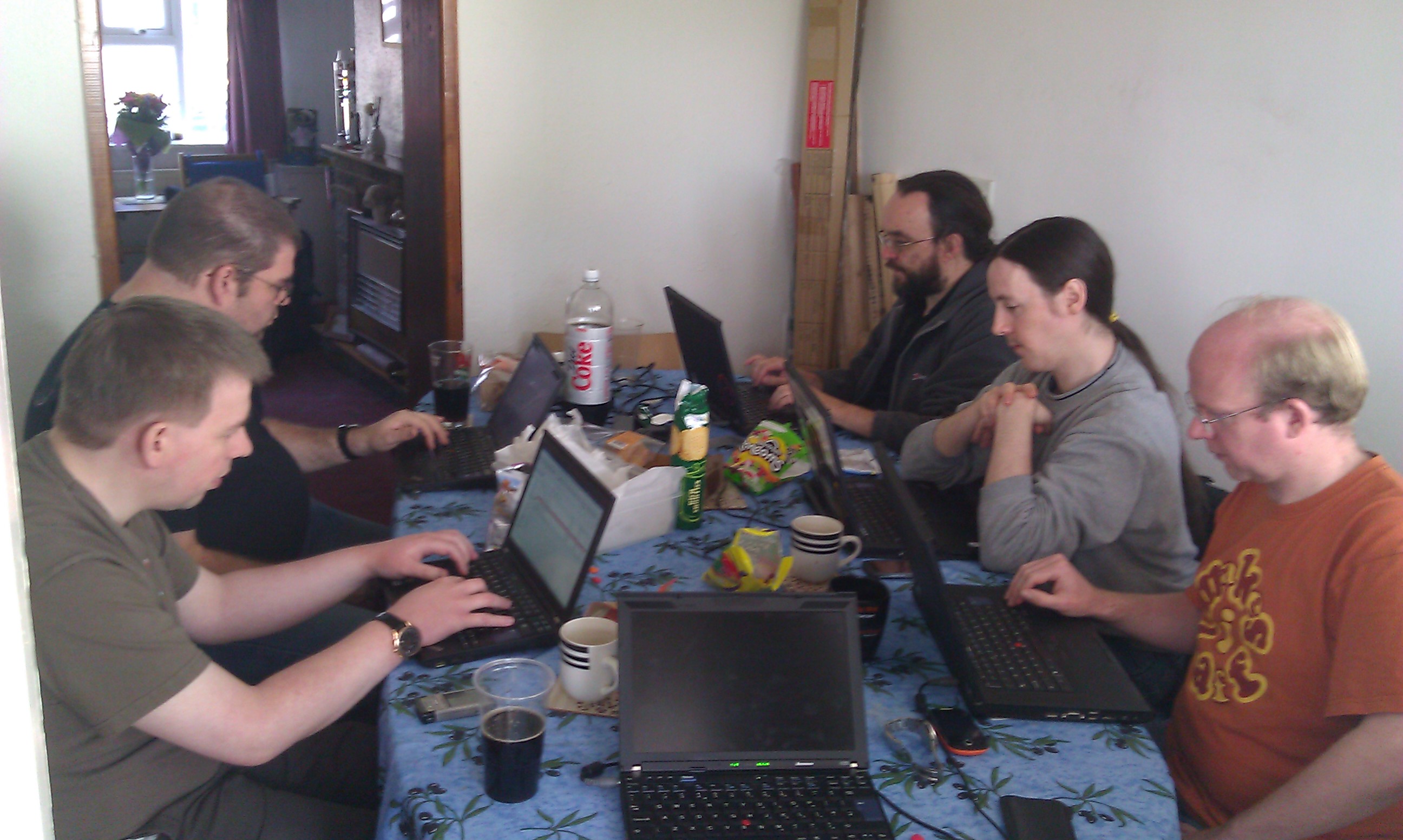
  1. It is important to rehearse your space carefully. Find a quantity of friends equal to the attendees you expect, lay out the intended room, and check that everybody has free and easy access to their chair.
  2. Invest in a decent access point and some power strips with a decent cord length.
  3. Relax. I cannot stress enough the importance of this step!

Happy Hackers Hacking


Tips for a successful BSP is a post from: jwiltshire.org.uk Flattr

Pietro Abate: dose has a new git repository and mailing list !

Recently we did a bit of clean up of our git repositories and now thanks to roberto's efforts we have a new shiny git repository on the inria forge and two mailing lists to discuss development and user questions. If you are a user, or interested in dose development, please sign up to these mailing lists: if you already have a copy of the latest git repository, you can change the upstream repository issuing the following command :
git config remote.origin.url git://gforge.inria.fr/dose/dose.git
If you are curious, you can clone dose git clone git://gforge.inria.fr/dose/dose.git and let us know what you think about it. The API documentation is available here. The man pages or various applications developed on top of the dose library are available here. We are still actively working on the documentation and any contribution is very much welcome. I'm working on a nice homepage... You can get the latest tar ball release here : https://gforge.inria.fr/frs/?group_id=4395 Old releases will be left on the old forge.

Update And now we are even social ! follow us on identi.ca : http://identi.ca/group/dose3

13 October 2012

Steve Kemp: Software and hardware..

Software
I've been using redis for a while now. It is a fast in-memory storage system which offers persistence (unlike memcached), as well as several primitive data-types such as lists & hashes. Anyway it crossed my mind that I don't have a backup of the data it contains, so I knocked up a simple script to dump the contents in plain-text: In other software-news I've had some interesting and useful feedback and made two new releases of my slaughter sysadmin tool - it now contains a wee test suite and more robustness.
Hardware
I received an email last night to say that my Raspberry PI has shipped. Ordered 24/05/2012, and dispatched 12/10/2012 - I'd almost forgotten about it. My plan is to make it a media-serving machine, SNES emulator, or similar. Not 100% decided yet. Finally I've taken the time to repaint my office. When I last wrote about working from home I didn't include pictures - I just described the process of using a "work computer" and a "personal computer". So this is what my office used to look like. As you can see there are two machines and a huge desk. With a few changes I now have an office which looks like this - the two machines are glued-together with a KVM. and I have much more room behind it for another desk, more books, and similar toys. Additionally my dedication is now enforced - I simply cannot play with both computer as the same time. The chair was used to mount the picture - usually I sit on a kneeling chair, which is almost visible. What inspired the painting? Partly the need for more space, but mostly water damage. I had a leaking ceiling. (Local people will know all about my horrible leaking roof situation).
The end?

12 October 2012

Russell Coker: Cheap Bulk Storage

The Problem Some of my clients need systems that store reasonable amounts of data. This is enough data that we can expect some data corruption on disk such that traditional RAID doesn t work, that old fashioned filesystems like Ext3/4 will have unreasonable fsck fimes, and that the number of disks in a small server isn t enough. NetApp is a really good option for bulk reliable storage, but their products are very expensive. BTRFS has a lot of potential, but the currently released versions (as supported in distributions such as Debian/Wheezy) lack significant features. One significant lack in current BTRFS releases is something equivalent to the ZFS send/receive functionality for remote backups, this was a major factor when I analysed the options for hard drive based backup [1], and you should always think about backup before deploying a new system. Currently ZFS is the best choice for bulk storage which is reliable if you can t afford NetApp. Any storage system needs a minimum level of reliability if only to protect it s own metadata and a basic RAID array doesn t protect against media corruption with current data volumes. The combination of performance, lack of fsck (which is a performance feature), large storage support, backup, and significant real-world use makes ZFS a really good option. Now I need to get some servers for more than 8.1TiB of storage (the capacity of a RAID-Z array of 4*3TB disks). One of my clients needs significantly more, probably at least 10 disks in a RAID-Z array so none of the cheaper servers will do. Basically the issue that some of my clients are dealing with (and which I have to solve) is how to provide a relatively cheap ZFS system for storing reasonable amounts of data. For some systems I need to start with about 10 disks and be able to scale to 24 disks or more without excessive expense. Also to make things a little easier and cheaper 24*7 operation is not required, so instead of paying for hot-swap disks we can just schedule down-time outside business hours. The Problem with Dell Dell is really good for small systems, the PowerEdge tower servers that support 2*3.5 or 4*3.5 disks and which have space for an SSD or two are really affordable and easy to order. But even in the mid-size Dell tower servers (which are small by server standards) you have problems with just getting a few disks operating outside a RAID array [2]. The Dell online store is really great for small servers, any time I m buying a server for less than $2500 I check the Dell online store first and usually their price is good enough that there is no need to get a quote from another company. Unfortunately all the servers with bigger storage involve disks that are unreasonably expensive (it seems that Dell makes their profit on the parts) and prices are not available online. I gave my email address and phone number to the Dell web site on Wednesday and they haven t cared to get back to me yet. This is the type of service that makes me avoid IBM and HP for any server deployment where the Dell online store sells something suitable! BackBlaze For some time BackBlaze have been getting interest by describing how they store lots of data in a small amount of space by tightly stacking SATA disks. They don t think that ZFS on Linux is ready for production, but their hardware ideas are useful. They have recently described their latest architecture [3]. They describe it as 135TB for $7,384. Of course the 135TB number is based on the idea of getting the full 3TB capacity out of each disk which they can do as they have redundancy over multiple storage pods. But anyone who wants a single fileserver needs some internal redundancy to cover disk failure. One option might be to have three RAID-Z2 arrays of 15 disks which gives a usable capacity of 42*3TB==126TB==113TiB. Note that while the ZFS documentation recommends between 3 and 9 disks per zpool for performance I don t expect performance problems, when you only have a gigabit Ethernet connection there shouldn t be a problem with three ZFS zpools making the network the bottleneck. For this option the way to go would be to start with an array of 15 disks and then buy a second set of 15 disks when the first storage pool becomes full. It seems likely that 4TB disks will become cheap before a 35TiB array is filled so we can get more efficiency by delaying purchases. The BackBlaze pod isn t cheap, they are sold as a complete system without storage disks for $US5,395 by Protocase [4]. That gives a markup of $US3,411 over the BackBlaze cost which isn t too bad given that BackBlaze are quoting the insane bulk discount hardware prices that I could never get. Protocase also offer the case on it s own for anyone who wants to build a system around it. It seems like the better option is to buy the system from Protocase, but that would end up being over $6,000 when Australian import duty is added and probably close to $7,000 when shipping etc is included. Norco Norco offers a case that takes 24 hot-swap SATA/SAS disks and a regular PC motherboard for $US399 [5]. It s similar to the BackBlaze pod but smaller, cheaper, and there s no obvious option to buy a configured and tested system. 24 disks would allow two RAID-Z2 arrays of 12 disks, the first array could provide 27TiB and the second array could provide something bigger when new disks are released. SuperMicro SuperMicro has a range of storage servers that support from 12 to 36 disks [6]. They seem good, but I d have to deal with a reseller to buy them which would involve pain at best and at worst they wouldn t bother getting me a quote because I only want one server at a time. Conclusion Does anyone know of any other options for affordable systems suitable for running ZFS on SATA disks? Preferably ones that don t involve dealing with resellers. At the moment it seems that the best option is to get a Norco case and build my own system as I don t think that any of my clients needs the capacity of a BackBlaze pod at the moment. Supermicro seems good but I d have to deal with a reseller. In my experience the difference between the resellers of such computer systems and used car dealers is that used car dealers are happy to sell one car at a time and that every used car dealer at least knows how to drive. Also if you are an Australian reader of my blog and you want to build such storage servers to sell to my clients in Melbourne then I d be interested to see an offer. But please make sure that any such offer includes a reference to your contributions to the Linux community if you think I won t recognise your name. If you don t contribute then I probably don t want to do business with you. As an aside, I was recently at a camera store helping a client test a new DSLR when one of the store employees started telling me how good ZFS is for storing RAW images. I totally agree that ZFS is the best filesystem for storing large RAW files and this is what I am working on right now. But it s not the sort of advice I expect to receive at a camera store, not even one that caters to professional photographers. Related posts:
  1. Cheap SATA Disks in a Dell PowerEdge T410 A non-profit organisation I support has just bought a Dell...
  2. ZFS vs BTRFS on Cheap Dell Servers I previously wrote about my first experiences with BTRFS [1]....
  3. Flash Storage and Servers In the comments on my post about the Dell PowerEdge...

Matthew Garrett: Further UEFI bootloader work

I've been continuing to work on Shim this week, and it's now getting pretty close to feature complete. The biggest change has been migrating the MokList variable from a custom format to the one used by the UEFI spec databases, which means it's easier for the kernel to import the MOK entries and use them for validating module signatures.

The other benefit of this format is that it supports hashes as well as certificates, and so I've added support for enrolling hashes through the MokManager UI. This means that distributions can now ship with a signed copy of Shim without having to sign any other components of their distribution. When the user attempts to boot off the media they'll be faced with a menu and a countdown. If the countdown reaches 0, the system will simply fall back to the next entry in the bootlist. If they hit a key, they can choose to enrol a hash. The user then navigates the filesystem explorer, chooses the bootloader, confirms that they want to enrol it and then exits. Shim then verifies the bootloader against the hash and boots successfully.

The big advantage of this over the Linux Foundation approach is that once a hash has been enrolled the need for physical end-user presence is removed - ie, if you enrol the hash, you don't need to hit a key every time you boot. This is still slightly sub-optimal in that if you update your bootloader you'll need to enrol a new hash, but that can be partially automated by calling MokUtil in the postinst - the user then simply needs to confirm that they want to enrol the hash, rather than having to choose it manually. Completely transparent updates are going to require a signed bootloader and an enrolled signing key.

A couple of people have asked whether we're planning on implementing the Linux Foundation approach of simply asking the user whether they want to boot an unsigned file. We've considered it, but at the moment are leaning towards "no" - it's simply too easy to use to trick naive users into running untrusted code. Users are trained to click through pretty much any security prompt that they see, and if an attacker replaces a legitimate bootloader with one that asks them to press "y" to make their computer work, they'll press "y". If that bootloader then launches a trojaned Windows bootloader that launches a trojaned Windows kernel, that's kind of a problem. This could be somewhat mitigated by limiting this feature to removable media, and we're seriously considering that, but there are still some risks associated. We might just end up writing the code but disabling it at build time, and then anyone who wants to distribute with that policy can do so at their own risk.

Meanwhile, Peter Jones is working on tidying up the code we're using for the actual signing and will be publishing that once the last couple of kinks are worked out. We're using hardware cryptography, so even if someone compromises the build systems they won't be able to obtain the private key that we use. However, should something disastrous and unanticipated happen, we do have a plan in place for migrating to new keys with minimal user impact. We'll document the code and infrastructure we're using in order to make it as easy as possible for other distributions to implement equivalent functionality.

As I've mentioned before, our goal is to make it as easy as possible for distributions to implement whatever level of Secure Boot policy they want without having to engage with Microsoft themselves. Shim allows distributions to ship an OS that has no signed binaries at all, or alternatively to ship an OS that uses filesystem-level cryptography to ensure that even userspace is completely signed. I'm expecting to see a range of options available, and I hope that the majority of users will find something to suit their needs.

comment count unavailable comments

11 October 2012

Eddy Petrișor: A shitstorm is comming

It has been brought to my attention that a company selling some so-called colon cleansing product wanted to threat with a law suit a Romanian skeptical blogger because he wrote some articles showing that any such products (the one produced by the said company is the most known/popular in Romania) are pure quackery and there is no scientific basis for the claim they make in order to promote their products.

In his articles he also explained how, in fact, the mucoid plaque, the thing that supposedly proves the efficiency of the product, it is a result of taking the product due to its ingredients, and how no such mucoid plaque was ever observed in any colonoscopy, colon surgery or any other situation where you'd expect it to be seen. He also quoted specialists and lots of other scientific references, showing an honest approach to the issue.

As a response to the initial take-down message from the company doing business with people's crap, the blogger said would like to see scientific proof for the claims made for the product, and when that was to happen, he would take down the articles and publish a correction.

The company decided that the best way to continue this was to try to make a legal threat and ask 100.000 euros (one hundred thousands Euros) as damage in a country where, according to the latest data from the National Statistics Institute, the total average monthly personal income is about 180 Euros.

The blogger, as a reply, decided the threat should be made public and wrote another article which probably made the company very unhappy, because they decided to sue Wordpress so they would take down the blog.

And that's exactly what they did, they sued Wordpress, and sent some documents to Wordpress who sent them to the blogger. Among the documents there were 4 pdf files containing each an original article (in Romanian) from the blog and only 3 pdf containg English translation for only 3 of them. The one missing was the one where the blogger himself showed there wasn't any legal basis for the threats they made initially against him.

Here are the translations (ironically, made on the company's own expense):

Initial article entitled "ColonHelp doesn't help the colon. But it empties your wallet!" (original here)
Initial Article.en<iframe class="scribd_iframe_embed" data-aspect-ratio="0.701030927835051" data-auto-height="true" frameborder="0" height="600" id="doc_83859" scrolling="no" src="http://www.scribd.com/embeds/109756494/content?start_page=1&amp;view_mode=scroll&amp;access_key=key-19l4sbejfk4l4na4feoe" width="100%"></iframe>


The second article entitled "Again about ColonHelp and intestinal cleansers" (original here)
Follow Up.en<iframe class="scribd_iframe_embed" data-aspect-ratio="0.70264064293915" data-auto-height="true" frameborder="0" height="600" id="doc_46722" scrolling="no" src="http://www.scribd.com/embeds/109757646/content?start_page=1&amp;view_mode=scroll&amp;access_key=key-1d0z2779liaialmv90r5" width="100%"></iframe>


** Missing translation of the first reply to threats (original Romanian text here)


The second article about the threats entitled "People who clean the colon have filled the fan with shit" (original here)
Threats 2<iframe class="scribd_iframe_embed" data-aspect-ratio="0.705069124423963" data-auto-height="true" frameborder="0" height="600" id="doc_72956" scrolling="no" src="http://www.scribd.com/embeds/109758037/content?start_page=1&amp;view_mode=scroll&amp;access_key=key-2d3c3eq1d6lo313fogho" width="100%"></iframe>


The Romanian blogger explains himself more of the details on this issue in his latest article on his blog.

The company is called Zenyth Pharmaceuticals and Wordpress will probably lose the lawsuit by not presenting themselves in any way in the Romanian courts, but I think some Streisand effect would really help the asses of this company to get them kicked in their rightful place, at the top of the hall of shame.

The product name is called ColonHelp.

Please spread this information as wide as possible.
Do NOT link to the company's site (it would raise its search engine rank), but link to the blogger' article or the translations.


If any Romanian speaker cares to translate the untranslated article and publish it somewhere on the web, I would be more than glad to update this article and add a link to that translation.

9 October 2012

David Welton: Fast, Light and Asynchronous

I am a big fan of Ruby on Rails: it does a lot of things, and it does most of them pretty well. When starting a new web project, it's the first thing I would reach for: most of the time, your problem is going to be figuring out a good product/market fit, or whipping up some internal tool without wasting a lot of programmer time. Once you've got a firm grasp of the problem, then maybe you can consider optimizing. Who cares if you do something that no one wants really really fast? However, Ruby on Rails is not beautiful in terms of being particularly fast or lightweight. No complaints from me: most of the time, I'm happy to have something that does so much for me, leaving me to work on the actual problem at hand. Once in a while, though, you do need fast and relatively lightweight, and that space has been getting more interesting over the past few years, at least in terms of the web. First of all, technologies like "Comet", utilizing web sockets or some other always-on connection are becoming more common, where a socket with the server remains open in order to quickly exchange data from the server to the client - and back. That seems to be a poor fit for something like Rails, where it can tie up a lot of resources if one isn't careful. And while computing costs continue to decline, no one minds getting more for less in terms of what their server can do. Furthermore, with frameworks like Backbone.js, pushing more and more code to the client, the server can afford to be a bit simpler and do less, so it may as well be snappy to boot. Java has long been fairly popular for "heavy lifting" types of applications, partially because it does end up being reasonably fast. But it's not something I've ever had much fun using and is usually kind of wordy, and makes you feel like you need a crew of people in Palo Alto, one in Bangalore, and one in Stockholm just to churn out all the code. And it certainly is no lightweight in terms of memory either. So... while it can certainly do pretty much anything you need, I don't see it as being the strongest player when someone needs "real time web" code, and needs it to be reasonably light weight. Ruby, outside of standard Rails stuff like Passenger, seems to offer some interesting possibilities for this kind of work, like Reel but they don't seem to have the traction other solutions do. Python is in a similar situation: the Twisted framework has been around for a while, and while it has some success stories, never seems to have really 'caught fire'. Neither of these languages was built for "concurrency" from the ground up, and that seems to have, to date, inhibited people from using them extensively for this kind of job. My gut feeling is that the need for speed and "concurrency" (or at least handling a lot of concurrent users) will drive adoption of languages heretofore not so popular on the server. Let's have a look at them. Erlang: This is by no means a new language, having been developed in Ericsson in the late 1980ies; and it implements several interesting concepts. First and foremost, concurrency is handled in the form of many small "processes", which are not actually Unix processes at all, but processes internal to the Erlang VM. The Erlang system contains a scheduler that allocates resources to all of these processes, so even if one of them dies or behaves badly, it's not a problem: the system as a whole can continue to function well. The way Erlang is built, the scheduler is preemptive: the internal "processes" don't need to yield to let other processes run. Beyond the scheduler and simple processes, Erlang gives you the tools to create elaborate trees of supervisors and workers that are quite robust to failures in any one portion of the system, as well as giving you the tools to set up a system to run on multiple, distributed computers. This kind of thinking is necessary when you write applications, such as phone switches, where downtime is really, really not ok. Erlang processes comunicate almost exclusively via message passing, meaning that state is not shared. Altogether, this makes for a fast, rock solid system that can easily handle thousands of concurrent connections without breaking a sweat. The computing world being what it is though, Erlang is likely to be more of a Lisp or Smalltalk: it's a trailblazer that did many things years before their time in other languages, but I don't see it as ever quite catching on amongst 'the masses'. It has a wonky syntax, it's a functional programming language, and because it is used in environments where too much experimentation is not good, it does not have a lot of room to break with its own past and innovate in terms of the language itself: it's slow to change and improve, even where the need to is clearly perceived. Node.js: is the opposite, in some ways: being based on Javascript, it draws on a huge number of potential programmers - orders of magnitude more than Erlang. And thanks to design decisions enforcing the use of asynchronous code and callbacks for anything that could block, it deals quite well with concurrent connections, even if the language and libraries don't really give you much in terms of "true" concurrency. This is a simple model that works pretty well, even if, theoretically, all it would take is one "while (1)" loop in a callback to block the entire system. In practice, this doesn't seem to be a big problem, though. More of a problem is writing maintainable code, when everything is a callback. Keeping the network of callbacks straight can be a bit of a chore, and is probably not an optimal model in terms of programmer productivity. That said, people seem to do make due with it, although Node is young enough that we haven't seem projects that are 5 or 6 years old and maintained by people who didn't write them. One of the advantages of being such a popular language is that lots of people have a strong interest in seeing Javascript being very, very performant. That need begat the V8 Javascript engine, from Google, which they were kind enough to release as free software. So one of the advantages that Node has is that the underlying implementation is extremely fast for a dynamic language. For many people who know Javascript, picking up Node.js is also an easy choice, even though people used to browser side programming with Javascript will have to adjust their way of thinking to succesfully tackle server projects. Go language: this is an interesting one, written by some luminaries who work at Google. It can best be described as something akin to C with some updated features, such as garbage collection, that make it more suitable for working on large projects, where things like memory leaks are going to make life very frustrating. It has the feel of a "real language, for real programmers" in that it doesn't stray far too far from what people are used to - it's not going to cause the "what the hell is this?!" reactions that Erlang might in more close-minded circles. Between the big company backing it, and the approachable syntax and concepts, Go looks like it has a good shot at the mainstream. Where it gets interesting is their concurrency model, which is apparently based on something called "communicating sequential processes" which, superficially at least, looks like it has some things in common with Erlang's "actor model" of concurrency. Under the hood, Go apparently hives off its "goroutines" to different OS level threads, but does not have a preemptive scheduler like Erlang: http://code.google.com/p/go/issues/detail?id=543 - although according to this, they may change that in the future. I'm not enough of a computer science guy to comment much on the details of CSP vs Actors, but both seem like valid models with strengths compared to trying to keep threads straight, which always seems to be a source of problems for programmers. Conclusions So, what's actually going to happen? I see Node.js as the clear front runner. It takes a worse-is-better approach that seems to work well enough as people get started. If they encounter difficulties later, they can always rewrite in something else, if needs be, but by "luring people in", Node.js has gathered a large group of users who continue, in turn, to churn out more code for use with the system, making it more attractive to new users. Programming languages are not winner-take-all markets though, so perhaps there is room for a few more languages to have decent followings in this space. Hopefully the competition will lead to ever better tools for those of us utilizing them! What do you think?

Christian Perrier: Bug #690000

(doh, I nearly had it. I just got #690019, #690020 and #690022 for l10n stuff) Bartek Krawczyk reported Debian bug #690000 on Monday October 8th, against guake. And my friend Sylvestre Ledru, the package maintainer, now has to fix it instead of trying to promote the use of Scilab over proprietary alternatives in the French aerospace research organizations..:-) Bug #680000 was reported as of July 2nd: 3 months and 8 days for 10,000 bugs. This is a VERY significant drop in the bug reporting rate in Debian. Last time, I wrote: "How will the wheezy freeze affect this? We'll see in two months!". We have the answer: the wheezy freeze triggerred an important drop in bug reporting rate in Debian. My general feeling is somehow different: for whatever reason, I feel like the *overall* activity in the project has dropped significantly. I seem to have less mails to read, less bugs reported against my packages, even less heated discussions here and there, as well as several very quiet channels on IRC. Am I pessimistic when feeling that the overall momentum is sliding out of Debian? Maybe I am, so, folks, please make me optimistic and move you fingers out of the place where they are and help releasing that damn penguin. Apart from that, our next milestone (apart from the wheezy release!) will be bug #700000. Remember the bet?. It looks like the probability of Kartik Mistry winning it is now away (he bet for Now 8th 2012) and the best position is hel by David Pr vot (he bet for December 12th). On the other hand, my own chances are increasing if the bug rate drop is confirmed and if bug #700000 is reported in more than 3 months (I bet for February 14th 2013, guess why?). We'll see that in a few weeks!

8 October 2012

Eddy Petri&#537;or: HOWTO fix git-buildpackage signs with wrong signature

If you have two or more available gpg keys that can be used for the same identity (e.g.: 'John Doe <john@doe.com>') that you might use to add entries to changelogs of packages, you might end up in situations where git-buildpackage or other similar tool might want to sign packages with the wrong key.

It seems debsign (the tool that actually does the signing) just picks up the first key that is still valid (I also have a revoked key) and matches the used identity.

There are many ways to fix this, but the one that will work for most cases is to run this command:

echo 'DEBSIGN_KEYID=0x0123ABCD' >> ~/.devscripts

Of course, you should replace 0x0123ABCD with the keyid which you prefer.

This will create a ~/.devscripts file (if it didn't exist) which will contain the DEBSIGN_KEY variable with the desired value. This file will be sourced by debsign before doing its actual work, so it will do the right thing when ran.

There are also git-buildpackage specific fixes like defining builder in the [DEFAULT] section of ~/.gbp.conf and passing '-k0x0123ABCD' to debuild something like:

[DEFAULT]
builder = debuild -i -I -k1234ABCD
...

But that probably gets ugly if you use a custom builder.


P.S.: I have just deleted my old key 0xDD1F1F9F since I won't be using it anymore. I don't remember where I put the revocation certificate, but I'll revoke the key, once and if I find the revocation certificate. Otherwise, it will expire in July, next year.

From now on, I am going to use only the key 0xE3E083A1 to which I even added a photo and some newer identities and updated with a few signatures I got during DebConf 9.

Luke Faraone: Where I've gone off to

For those of you back at my university, you may have noticed I'm not there this semester.

Google's 2012 FEP team

I spent this past summer at Google, Inc, developing internal tools for the AdSense team, specifically Google Programmable Ads. Being at Google was great; I loved my team and my intern cohort, the rest of the interns in the Freshman Engineering Practicum.

I'm not currently at Google; my internship ended at the beginning of August. Although it was a blast, all good things must come to an end.

I'm not at Mason, either. I was super excited to return to university, and was just about to buy my books and get ready to move in when I got an email from a former coworker at Ksplice, a startup Oracle acquired while I interned there last year. He was starting a new company which would focus on business communications. I'd be working with a bunch of my former coworkers, and based on what I had heard of the company's plans I was confident in their ability to make an awesome product.

Needless to say, when they decided to offer me a position working there full time, I jumped on it.

From an academic point of view, Mason didn't really have much of a mechanism to support this. Co-ops are uncommon there, and not really supported for more than one semester; a full year away had never been done, according to our career services. My department was fully supportive, however, so we managed to find a way to make it work. This involved filling out some oddly-named forms, such as Special Registration for Graduation Request, which the registrar asserted was the right form, trust us on this one.

Myself and Obey Arthur Liu
at a SIPB hackathon
But that's all neither here nor there. I'm now up in Cambridge, MA, working with awesome people (including but not limited to tabbott, wdaher, jesstess, and keegan), and exploring the city. I'm hanging out with MIT SIPB, helping with the maintenance of Sugar Labs' servers in E15 and spending more time working on various open source projects.

To my friends at Mason: I miss you all. I know regardless of how the next year+ turns out, it'll be one one hell of a ride.

Rudy Godoy: MySQL data enconding conversion latin1 utf8

I was about to post a different story but things turned out differently, for good. Now I ll post tips that may save the day in the event of encoding issues when dealing with MySQL table data. Hopefully you find it useful. Say you have a MySQL table that has collation set to latin1 but you have utf8-encoded data stored. This happened when importing a dump, or because of Murphy s law. When querying the data from your application or from mysql s tools you get awful results for non-ascii characters such tildes. Changing the table s collation definition will only work for new columns and records. Altering the collation for the said column would make things worse. So what to do? Fortunately MySQL offers a nice way to save the day. You can use a transition conversion and then set the table encoding back to utf8, so it pairs accordingly with the encoding type for the data it has stored. ALTER TABLE table_name CHANGE column_name column_name BLOB; Issuing the previous command will make the table change it s type to BLOB. Why? Because by doing it the stored data is kept untouched. This is important. If you use the CONVERT or MODIFY commands the data will be converted by MySQL. We don t want that since the data is already in the encoding type we want. You can note that column_name is repeated twice, this is because the CHANGE command copies the data and we want the resulting column to have the same name. Now, we have to put the data back on the encoding we want, so everything is under control again. This is done by issuing the following command. ALTER TABLE table_name CHANGE column_name column_name COLUMN_TYPE CHARACTER SET utf8; COLUMN_TYPE depends on the content s column type. For instance, for a TEXT column it should be. ALTER TABLE table_name CHANGE column_name column_name TEXT CHARACTER SET utf8; It works for VARCHAR, LONGTEXT and other data types that are used to store characters.

Craig Small: NTP control messages

I have had an opportunity to rework some code to query NTP servers directly in python rather than running ntpq -pn and scraping the result. The over-the-wire protocol format is reasonably straight forward and my little module is now passing all of its nosetests which is wonderful. While its only a single table, ntpq actually does multiple requests to get its results. NTP control messages are all mode 6 which tells the client and server its not time sort of things, but more about queries. A control packet has a sequence number which the server responds with so you can line up your requests with responses. For large responses, the more, offset and count fields work together to knit up a large block of data. The first packet of the response will have the offset field of 0. The count is the size of the data payload in bytes. If the response is too big, the more bit will be set to 1 to say there is more coming. The second packet will have an offset that is the same value as the previous packets count value, so you can stitch them together. The first query is a READSTAT which uses opcode 1. This returns a list of 4 byte responses with the association ID taking the first two bytes and the peer status taking the second. If you look at the output of ntpq you will notice a character in the first column which is the peer selection. The important one for us is asterix, which equates to 110 in the lower 3 bits of the first status byte. This is the system peer which is the main one. There may be others, up to 2, (usually symbol +) which are compared to the system peer. ntpq doesn t really care about the different peers and just displays the status but I want to know what peer the server is synchronised to. Next we need more details about the system peer (or all peers in ntpq). To do this a READVAR or opcode 2 is sent to the server. The association ID is set to the association or peer we are interested in. The response for my setup is sent over two packets which need to be reassembled and it is all in plain ascii which is a comma-separated list with a key=value pair. I use the following python line to split it up.
self.assoc_data.update(dict([tuple(ad.strip().split("=")) for ad in data[header_len:].split(",") if ad.find("=") &gt; -1]))
I m sure people that know python better than I will say I am doing it wrong (it looks a bit klunky to me too) but it does work. From that I can query the various values that are returned by the server about its peers, including the source of its clock.

6 October 2012

Timo Jyrinki: Light-weight security, Grub2 password setup problems 1.99 vs 2.00

I believe I'm not the only one who thinks that use case oriented Grub2 documentation is hard to find, and a lot of the documentation is obsolete or wrong. My main cause for writing this blog post is a currently unanswered question regarding 2.00, but meanwhile it seems months have passed and still most 1.99 documentation is wrong as well, which might be interesting to some.

The aim is to prevent grub entries from being edited, while not restricting actual booting. This protection is meant for computers not having any confidential stuff, but just wanting to do some light weight security with the assumption that the computer isn't physically opened.

Common setup

You will obviously want to disable any automatically generated root access giving entries, by for example uncommenting GRUB_DISABLE_RECOVERY="true" in /etc/default/grub on Debian or Ubuntu. Also you would disable allowing any external boot devices to be used in BIOS/EFI/coreboot, which you would also have protected with a password. And that often means you need to also disable USB legacy support, since some BIOSes tend to offer all USB devices as bootable without password otherwise (note that I guess that could also cause problems accessing setup on desktop computers if your only keyboard is USB).

1.99

So to first fix the false instructions in various places - no, setting the superuser in 00_header as instructed is not enough. It might be, but does not apply if eg. old kernels are put into submenu (Ubuntu bug 718670, Fedora bug 836259). The protection from editing does not apply there. And if you remove all but one kernel so that there is no submenu, a submenu will be automatically created when there is a new kernel installed via security updates. I didn't need the submenu feature anyway, so I used to comment out the following lines in /etc/grub.d/10_linux:

#if [ "$list" ] && ! $in_submenu; then
#echo "submenu \"Previous Linux versions\" "
#in_submenu=:
#fi
...
#if $in_submenu; then
# echo " "
#fi

I hope that was useful. I can imagine it causing a couple of family battles if the commonly instructed setup was the only protection used and there's for example a case of two computer savvy siblings that are eager to get to each others' computers...

2.00 & The Question

The problem with 2.00 is that the superusers setup yields a non-bootable system, ie. password is required for booting. But Google wasn't smiling at me today! Terrible. Can you help me (and others) with 2.00? The aim would be to have a 1.99-like setup where superuser password protects all entries from editing, but booting is fine without any passwords.

Update: Thanks, problem solved, see comments! Find the following line in /etc/grub.d/10_linux:

echo "menuentry '$(echo "$os" grub_quote)' $ CLASS \$menuentry_id_option 'gnulinux-simple-$boot_device_id' " sed "s/^/$submenu_indentation/"

And add --unrestricted there. Don't mix the line with the another menuentry line two lines earlier. The submenu problem doesn't exist anymore in 2.00.

Next.

Previous.