Search Results: "ina"

31 December 2015

Laura Arjona Reina: Thanks Ian, thanks Debian

I didn t know Ian Murdock but the news about his passing left me with a very strange and sad feeling, because he started the project that creates the tool that I use every day in my work, and everyday in my communication with my family and friends, and everyday for anything computer related It s like if somebody puts a treasure in your hands and you got distracted looking at it and when you head up to look at the person and say Thank you , he s gone And, in the last years, Debian for me is not just my favorite tool , I ve been slowly getting involved in the community, known some people here and there, been able to put some work to try to improve some small parts, been able to work with other people as a team, and I ve been touched many times admiring how the Debianers work, how they talk and write, how they behave to each other and to the ones that reach the community for first time, and to the world, since most of the communication and work is public I ve felt myself helped, welcomed, encouraged, empowered. Not only in my computer related skills or the improved capabilities of my humble hardware. I ve felt myself helped, welcomed, encouraged and empowered in important areas of my life (understanding other points of view, caring about the ones that don t speak aloud, enjoying diversity and becoming flexible to make it flourish, making friends ). And I like to think that I try to emulate that and help, welcome, encourage, empower others too I m learning. Thanks Ian, for this alive and growing treasure that is Debian (the OS, the community), and thanks Debian, for the past, present and future miracles.
Filed under: My experiences and opinion Tagged: Communities, Contributing to libre software, Debian, English, Moving into free software

Chris Lamb: Free software activities in December 2015

Here is my monthly update covering a large part of what I have been doing in the free software world (previously):
Debian My work in the Reproducible Builds project was also covered in more depth in Lunar's weekly reports (#31, #32, #33, #34).
LTS

This month I have been paid to work 12 hours on Debian Long Term Support (LTS). In that time I did the following:
  • Issued DLA 363-1 for libphp-phpmailer fixing a header injection vulnerability.
  • Issued DLA 365-1 for foomatic-filters correcting a shell injection vulnerability.
  • Issued DLA 369-1 for pygments fixing an issue shell injection vulnerability.
  • Issued DLA 374-1 for cacti to fix an SQL injection vulnerability.
  • Did some futher investigation of CVE-2011-5325 in busybox.

Uploads
  • python-django (1.9) New upstream release.
  • redis (3.0.6) New upstream stable release. I additionally backported this package to Debian stable.
  • redis (3.2~rc1) Uploaded upstream's "testing/next" branch to experimental for testing.
  • gunicorn (19.4.1) New upstream release.


Patches contributed

I also filed FTBFS bugs against acpid, android-platform-frameworks-base, antlr3, artemis, beignet, bisonc++, bobcat, bustle, cargo, checkbox-ng, code2html, cplay, datanommer.commands, dcmtkpp, debci, diffutils, diod, django-restricted-resource, docker-libkv, doomsday, dvdauthor, dwww, elasticsearch, elki, flask-script, freeipa, fso-frameworkd, funny-manpages, ggcov, ghc-mod, gmpc-plugins, gparted, gs-collections, guacamole-server, guncat, haskell-concrete-typerep, haskell-geniplate, haskell-nats, haskell-x509-util, hawtbuf, heimdal, htsjdk, inspircd, jboss-xnio, jenkins-winstone, jpeginfo, jruby-openssl, kaffeine, kdbg, ktp-accounts-kcm, kuser, libcommons-cli-java, libcommons-openpgp-java, libconfig-model-lcdproc-perl, libdata-faker-perl, libexplain, libgettext-commons-java, libgtk2-ex-printdialog-perl, libmoops-perl, libnet-frame-perl, libsendmail-milter-perl, libupnp, libuv, libvpx, liwc, m4, maven2, meep-mpich2, nagios-plugin-check-multi, natlog, netpipe, ocserv, ogre-1.8, orthanc-dicomweb, perspectives-extension, php-mail, php-pinba, phpseclib, pkg-haskell-tools, plastimatch, plexus-compiler, plexus-compiler-1.0, python-acme, python-crontab, python-cs, python-csscompressor, python-debian, python-distutils-extra, python-django-compressor, python-django-openstack-auth, python-django-tagging, python-pygit2, python-pyramid, python-pywcs, python-releases, python-shade, python-statsd, python-tasklib, python-tasklib, python-webm, python-websockets, regina-normal, rinetd, roboptim-core, rpm2html, rpm2html, ruby-factory-girl, ruby-fogbugz, ruby-i18n-inflector, ruby-loofah, ruby-protected-attributes, ruby-rack-contrib, ruby-rufus-scheduler, ruby-sanitize, ruby-sidetiq, ruby-sinatra, scsh-0.6, shogun, sleekxmpp, slugimage, spatial4j, sqwebmail-de, trac-announcer, ttt, txaws, umbrello, wine-gecko-2.21, xboxdrv, xfonts-wqy, xserver-xorg-video-openchrome, yorick & yoshimi.

30 December 2015

Bits from Debian: Debian lamenta el dec s de l'Ian Murdock

Ian Murdock Amb el cor compungit, Debian lamenta la p rdua d'Ian Murdock, ferm partidari del programari lliure i de codi obert, pare, fill i l'"ian" a Debian. L'Ian va comen ar el projecte Debian l'agost de 1993, i va publicar les primeres versions m s tard el mateix any. Debian es convertiria en el sistema operatiu universal pel m n, que funciona en tot tipus de dispositius, des de sistemes encastats fins a l'estaci especial. L'Ian es va centrar en crear una distribuci i una cultura de comunitat que fessin el correcte, ticament o t cnica. Publicar quan estigui a punt i la ferma posici sobre la llibertat de programari s n les regles d'or en el m n del programari lliure i de codi obert. La seva devoci per fer el correcte va guiar la seva feina, tant a Debian com els seg ents anys, sempre treball per assolir el millor futur possible. El somni de l'Ian est viu, la comunitat de Debian continua incre blement activa, amb milers de desenvolupadors que treballen innumerables hores per proporcionar un sistema operatiu segur i fiable. Els pensaments de la comunitat de Debian s n amb la fam lia de l'Ian en aquests moments tant durs. La seva fam lia ens ha demanat privacitat en aquests moments dif cils i volem respectar-ho. Des de Debian i des de la comunitat de Linux en general podem enviar mostres de condol a in-memoriam-ian@debian.org; seran guardades i arxivades.

Christoph Egger: Finally moving the Weblog

As of a few minutes ago, the old weblog on christoph-egger.org is past. I've added redirects for all the entries to the new one at weblog.siccegge.de.if you find any dead links please contact me so I can fix it up. Note that comments are gone. I'll try to include the already present comments on the new blog some time in the future. Not sure if I will ever add a comment function again (though chronicle seems to have some support for that)

Steve Kemp: I joined the internet of things.

In my old flat I had a couple of simple radio-controlled switches, which allowed me to toggle power to a pair of standing lamps - one at each side of the bed. This was very lazy, but also really handy and I've always been curious about automation.. When it comes to automation there seems to be three main flavours:
X10
The original standard, with stuff produced by many vendors and good Linux support. X10 supports two ways of sending/receiving commands - over the electrical wiring, and over RF.
Z-Wave
This is the newcomer, which despite that seems to be well-supported and extensible. It allows "measurements" to be sent/received in addition to the broadcast of events like "switch on", and "switch off".
Other systems - often lighting-centric
There are toy-things like the previously noted power-controlling things, there are also stand-alone devices from people like Philips with their philips hue system, but given how Philips recently crippled their devices to disable third-party bulbs I've no desire to use them. One company caught my eye though, Osram make a smart lightbulb and mini-hub to work with it.
So I bought one of the osram lightify systems, consisting of a magic box and a pair of lightbulbs. The box connects to your wifi, and gets an IP address. The IP address is then used by the application on your mobile phone (i.e. the magic box does the magic, not the bulbs). The phone application can be used to trigger "on", "off", "dim", "brighter", and the various colour-changing commands, as you would expect. You absolutely must use the phone-based application to do the setup, but after that the whole point was that I could automate things. I wanted to be able to setup my desktop computer to schedule events, and started hacking. I've written a simple Perl module to let me discover bulbs, and turn them off and on. No doubt it'll be on CPAN in the near future, once I can pick a suitable name for it:
$ ol --bridge=192.168.10.136 --list
hall       MAC:8418260000d9c70c RGBW:255,255,255,255 STATE:On
kitchen    MAC:8418260000cb433b RGBW:255,255,255,255 STATE:On
$ ol --bridge=192.168.10.136 --off=kitchen
$ ol --bridge=192.168.10.136 --list
hall       MAC:8418260000d9c70c RGBW:255,255,255,255 STATE:On
kitchen    MAC:8418260000cb433b RGBW:255,255,255,255 STATE:Off
The only niggle was the fiddly pairing, and the lack of any decent documentation. The code I wrote was loosely based on the python project python-lightify written by Mikael Magnusson. Also worth noting that the bridge/magic-box only exposes a single port so you can find the device on your VLAN by nmapping for port 4000:
$ nmap -v 192.168.10.0/24 -p 4000
The device doesn't seem to allow any network setup at all - it only uses DHCP. So you might want to make sure it gets assigned a stable IP. Anyway I'm going to bed. When I do so I'll turn the lights off with my mobile phone. Neat. In the future I will look at more complex automation, and I think Z-wave is the way I'll go. Right now I'm in a rented flat so replacing wall-switches, etc, is something I can't do. But the systems I've looked at seem neat, and this current setup will keep me amused for several months!

Julian Andres Klode: APT 1.1.8 to 1.1.10 going faster

Not only do I keep incrementing version numbers faster than ever before, APT also keeps getting faster. But not only that, it also has some bugs fixed and the cache is now checked with a hash when opening. Important fix for 1.1.6 regression Since APT 1.1.6, APT uses the configured xz compression level. Unfortunately, the default was set to 9, which requires 674 MiB of RAM, compared to the 94 MiB required at level 6. This caused the test suite to fail on the Ubuntu autopkgtest servers, but I thought it was just some temporary hickup on their part, and so did not look into it for the 1.1.7, 1.1.8, and 1.1.9 releases. When the Ubuntu servers finally failed with 1.1.9 again (they only started building again on Monday it seems), I noticed something was wrong. Enter git bisect. I created a script that compiles the APT source code and runs a test with ulimit for virtual and resident memory set to 512 (that worked in 1.1.5), and let it ran, and thus found out the reason mentioned above. The solution: APT now defaults to level 6. New Features APT 1.1.8 introduces /usr/lib/apt/apt-helper cat-file which can be used to read files compressed by any compressor understood by APT. It is used in the recent apt-file experimental release, and serves to prepare us for a future in which files on the disk might be compressed with a different compressor (such as LZ4 for Contents files, this will improve rred speed on them by factor 7). David added a feature that enables servers to advertise that they do not want APT to download and use some Architecture: all contents when they include all in their list of architectures. This is to allow archives to drop Architecture: all packages from the architecture-specific content files, to avoid redundant data and (thus) improve the performance of apt-file. Buffered writes APT 1.1.9 introduces buffered writing for rred, reducing the runtime by about 50% on a slowish SSD, and maybe more on HDDs. The 1.1.9 release is a bit buggy and might mess up things when a write syscall is interrupted, this is fixed in 1.1.10. Cache generation improvements APT 1.1.9 and APT 1.1.10 improve the cache generation algorithms in several ways: Switching a lookup table from std::map to std::unordered_map, providing an inline isspace_ascii() function, and inlining the tolower_ascii() function which are tiny functions that are called a lot. APT 1.1.10 also switches the cache s hash function to the DJB hash function and increases the default hash table sizes to the smallest prime larger than 15000, namely 15013. This reduces the average bucket size from 6.5 to 4.5. We might increase this further in the future. Checksum for the cache, but no more syncs Prior to APT 1.1.10 writing the cache was a multi-part process:
  1. Write the the cache to a temporary file with the dirty bit set to true
  2. Call fsync() to sync the cache
  3. Write a new header with the dirty bit set to false
  4. Call fsync() to sync the new header
  5. (Rename the temporary file to the target name)
The last step was obviously not needed, as we could easily live with an intact cache that has its dirty field set to false, as we can just rebuild it. But what matters more is step 2. Synchronizing the entire 40 or 50 MB takes some time. On my HDD system, it consumed 56% of the entire cache generation time, and on my SSD system, it consumed 25% of the time. APT 1.1.10 does not sync the cache at all. It now embeds a hashsum (adler32 for performance reasons) in the cache. This helps ensure that no matter what parts of the cache are written in case of some failure somewhere, we can still detect a failure with reasonable confidence (and even more errors than before). This means that cache generation is now much faster for a lot of people. On the bad side, commands like apt-cache show that previously took maybe 10 ms to execute can now take about 80 ms. Please report back on your performance experience with 1.1.10 release, I m very interested to see if that works reasonably for other people. And if you have any other idea how to solve the issue, I d be interested to hear them (all data needs to be written before the header with dirty=0 is written, but we don t want to sync the data). Future work We seem to have a lot of temporary (?) std::string objects during the cache generation, accounting for about 10% of the run time. I m thinking of introducing a string_view class similar to the one proposed for C++17 and make use of that. I also thought about calling posix_fadvise() before starting to parse files, but the cache generation process does not seem to spend a lot of its time in system calls (even with all caches dropped before the run), so I don t think this will improve things. If anyone has some other suggestions or patches for performance stuff, let me know.
Filed under: Debian, Ubuntu

Clint Adams: Oh what a night, late December 1963

24 Dec. 63 Dear Uncle Ron and Aunt Helen, It has been quite awhile since I have written you folks. I am not too much of one for writing, and when I do write, I keep putting it off, and putting it off; and the next thing you know, the weeks turn into months and then the months into years. I haven't sent any Christmas cards, so at this time I'll offer my best wishes for the season to you. It is Christmas Eve and I am working tonight. I will also work New Year's eve and day. It really doesn't seem like Christmas here, and there isn't that much to do in the evening's; So I'm just as well off working. As I had mentioned, I had intended to send you some coins from Korea but I believe that I put them in with a package that I had sent to Mom and told her to give them to you. In any event, here are some in this box. The Korean coin with the 10 on it is 10 Won, and worth about $.0769. The large copper coin is Japanese ( 10 Yen) and about 2.8 Wait! I was wrong on the Korean coins.They are 10 Hwan which is the old money. When they Changed to Won, they made 10 Hwan equal to 1 Won. (Sounds confusing and tongue-tying, doesn't it?) So these 10 copper pieces with the 10 on them altogether are only worth 7 / The Viet Namese coins with the former president Diem picture on them are soon being taken out of circulation. ( Since he was overthrown and killed, they are going to replace the money also.) The small pieces marked 1 dong are 1 piastre; also called one Viet Namese dollar. 1 piastre is about .7 . I also recall sending some coins home in my hold baggage. I'll tell Mom to look for them and give them to you. Now that I look back on it, the year I spent in Korea wasn't bad. It was difficult at first having to work for an arrogant Jew boss, but after a few months I got out of his office and was on my own working directly for the army people ( U.S.) The country of Korea isn't too bad. As you can see on the coins they were in the year 4294 last year. It is surprising for a civilization to be that far along in years and still live under very primitive conditions. Going from Korea to Japan is like going from the dark ages into the future science fiction world. Those people are really progressing in Japan. I spent several days in Japan after I left Korea. Then I went to Honolulu for almost a month. Then I went back to Japan for Leave for 3 weeks and then down here to Viet Nam in October. They were building like crazy in Japan to get ready for the Olympics. Working 4 hours a day, 7 days a week on construction. You could drive into Tokyo early in the evening and return late in the night and find the road you had gone in on was now completely torn away. And downtown Tokyo is vey nice. Lots of modern building and just about any modern gadget you can think of. I really like their cooking also. Their Kobe Beef is excellent. In this beef, the cattle are pampered from the time they are born until they are slaughtered. They massage them, feed them beer, and let them live a lazy life. I would really like to work a year or two in Japan. The hot baths and big tubs are also great. Only it is almost impossible to stand the hot temperatures that they can. Westerners always have to add quite a lot of cold water before they can get in the tub. The Viet Namese people are much dirtier than the Japanese or Koreans. They don't have any hot baths here in Viet Nam. In fact, the majority of hotels ( built by the French) don't even have hot water in them. The Korean houses don't look like much from the outside, but inside they are spotlessly clean. The older Japanese buildings look nic efrom the outside and are also clean inside. I am here in the town of Nha Trang. It is a small town on the coast of the China Sea. I like it here. My hotel is less than a hundred yards from the beach. We are now in the winter season also, but it just got a little cooler from having winds the past few weeks. This afternoon as we came to work there were all sorts of people in swimming. Lobster is also plentiful here and I eat quite a bit of it. Most of the restaurant make a creamed corn soup with lots of chunks of crab meat in it. This is very good. Being out here in Nha Trang, we missed the coup d'etat. Things were quiet here and the only way we knew what was happening was to listen to the radio and talk to our co-workers of our radio system in Saigon. When they lifted martial law and the curfew in Saigon, it took them several days later to follow suit here. There seems to be a noticed improvement since the coup. The people in general seem much happier and there appears to be much more general activity going on. Well, I guess that's about it for now. I think I may have some Korean Won notes back in my room and I'll check and enclose them if I can find them. Say hello to Ira & family when you see them, and also to Aunt Marie if she is still there with you. 'Bye for now Your nephew PS The Viet Namese coins with 50 XU on them are piastres.

29 December 2015

Jose M. Calhariz: Preview of switchconf 0.0.15-1

Since the last version 0.0.9 on Debian, I have made some changes until version 0.0.14. The version 0.0.15 is only to include a fix for the new findutils. I thank you to Andreas Metzler for the fix and the prompt NMU. The files are here, take notice about the replaced ~ in the original by _: switchconf_0.0.15.orig.tar.xz switchconf_0.0.15-1_wip1.debian.tar.xz switchconf_0.0.15-1_wip1_all.deb If you need the dsc file, just ask me. Here comes the changelog since 0.0.9, without the lastest NMU:
switchconf (0.0.15-1~wip1) UNRELEASED; urgency=low
  * New upstream version:
    * Replace 'find -perm +1' by 'find -perm /1', thank you Andreas
      Metzler for the patch and the NMU.
  * Add systemd service file, thank you Felipe Sateler for reviewing it.
  * Bump standards-version to 3.9.6, no changes needed.
  * New maintainer email address.
 -- Jose M Calhariz <jose@calhariz.com>  Tue, 29 Dec 2015 19:59:07 +0000
switchconf (0.0.14-1) UNRELEASED; urgency=low
  * Force the use of bash, instead of a POSIX shell.
 -- Jose M Calhariz <jose.calhariz@ist.utl.pt>  Sun, 24 Aug 2014 04:37:04 +0100
switchconf (0.0.13-2) UNRELEASED; urgency=low
  * Add Homepage field pointing to alioth page of the project
 -- Jose M Calhariz <jose.calhariz@ist.utl.pt>  Sun, 02 Mar 2014 18:01:07 +0000
switchconf (0.0.13-1) wheezy; urgency=low
  * New upstream version:
    * Distribution tar is now compressed by xz
  * Change to source format 3.0 (quilt)
 -- Jose M Calhariz <jose.calhariz@ist.utl.pt>  Sun, 02 Mar 2014 15:56:31 +0000
switchconf (0.0.12-1) wheezy; urgency=low
  * Fixed some typos on switchconf
 -- Jose M Calhariz <jose.calhariz@ist.utl.pt>  Sun, 02 Mar 2014 15:39:09 +0000
switchconf (0.0.11-1) wheezy; urgency=low
  * New upstream version:
    * Makefile: add target dist-exp to build distribution files.
    * Add flag -f with the path to the configuration file.
  * Update debian/rules to version 0.24.
  * Update debian/control with new name and email address of Maintainer.
  * Update copyright.
 -- Jose M Calhariz <jose.calhariz@ist.utl.pt>  Sun, 16 Feb 2014 18:04:22 +0000
switchconf (0.0.10-1) UNRELEASED; urgency=low
  * New upstream version:
    * Fix return code on error.
    * Use syslog system to report errors.
 -- Jose M Calhariz <jose.calhariz@ist.utl.pt>  Thu, 16 Jan 2014 20:23:46 +0000

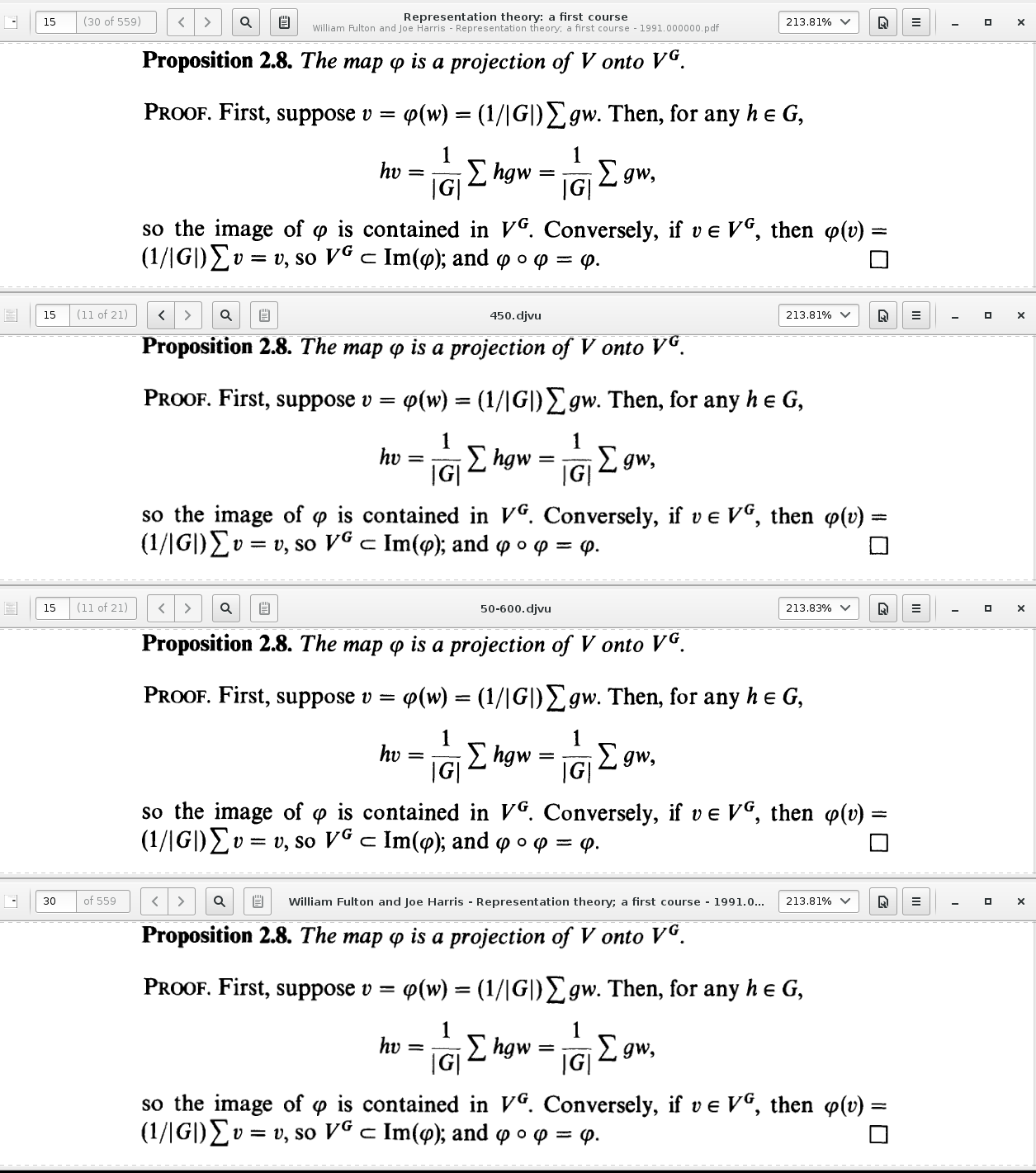
David Bremner: Converting PDFs to DJVU

Today I was wondering about converting a pdf made from scan of a book into djvu, hopefully to reduce the size, without too much loss of quality. My initial experiments with pdf2djvu were a bit discouraging, so I invested some time building gsdjvu in order to be able to run djvudigital. Watching the messages from djvudigital I realized that the reason it was achieving so much better compression was that it was using black and white for the foreground layer by default. I also figured out that the default 300dpi looks crappy since my source document is apparently 600dpi. I then went back an compared djvudigital to pdf2djvu a bit more carefully. My not-very-scientific conclusions: Perhaps most compellingly, the output from pdf2djvu has sensible metadata and is searchable in evince. Even with the --words option, the output from djvudigital is not. This is possibly related to the error messages like
Can't build /Identity.Unicode /CIDDecoding resource. See gs_ciddc.ps .
It could well be my fault, because building gsdjvu involved guessing at corrections for several errors. Some of these issues have to do with building software from 2009 (the instructions suggestion building with ghostscript 8.64) in a modern toolchain; others I'm not sure. There was an upload of gsdjvu in February of 2015, somewhat to my surprise. AT&T has more or less crippled the project by licensing it under the CPL, which means binaries are not distributable, hence motivation to fix all the rough edges is minimal.
Version kilobytes per page position in figure
Original PDF 80.9 top
pdf2djvu --dpi=450 92.0 not shown
pdf2djvu --monochrome --dpi=450 27.5 second from top
pdf2djvu --monochrome --dpi=600 --loss-level=50 21.3 second from bottom
djvudigital --dpi=450 29.4 bottom
djvu-compare.png

Ben Hutchings: Comparing dracut and initramfs-tools

initramfs-tools version 0.121~rc2 and dracut version 044+3-2 have moved most of what was in their main binary packages into a 'core' package (dracut-core, initramfs-tools-core), leaving only automation hooks in the main package. The core packages can be coinstalled without conflicts and without creating any initramfs images at installation time. If you're been wondering how they compare but were afraid to break your system by overwriting your current working initramfs, now is the time to try the other option. Testing dracut, for initramfs-tools users
  1. Install dracut-core from unstable.
  2. Make an alternate initramfs image by running:
    dracut /boot/initrd.img-$(uname -r).dracut
  3. Add an entry to the boot loader configuration that uses your current kernel and the alternate initramfs image. (In GRUB, you can do this interactively at boot time.)
  4. Reboot through the new boot entry.
  5. In case of problems, check the dracut(8) and dracut.conf(5) manual pages.
By default, dracut creates an initramfs suitable for the current hardware, which will not boot if you move the disk to a system that requires different drivers. This is controlled by the hostonly configuration variable or --hostonly command-line option. Testing initramfs-tools, for dracut users
  1. Install initramfs-tools-core from experimental.
  2. Make an alternate initramfs image by running:
    mkinitramfs -o /boot/initrd.img-$(uname -r).i-t
  3. Add an entry to the boot loader configuration that uses your current kernel and the alternate initramfs image. (In GRUB, you can do this interactively at boot time.)
  4. Reboot through the new boot entry.
  5. In case of problems, check the mkinitramfs(8) and initramfs.conf(5) manual pages.
By default, initramfs-tools creates an initramfs suitable for most hardware, which will still boot if you move the disk to a system that requires different drivers. This is controlled by the MODULES configuration variable.

Neil Williams: Experimenting with LXQt in Debian

LXQt is a Qt lightweight desktop the Qt port of LXDE. Packages exist in Debian albeit without a top level metapackage or task package to make installing it easier. So I wrote up a simple-ish vmdebootstrap call:
$ sudo vmdebootstrap --image lxqt.img --size=5G --package=lxqt-panel --package=libqt5xcbqpa5 --package=qterminal --package=openbox --package=xdm --package=lxqt-session --package=lxqt-about --package=lxqt-policykit --package=lxqt-globalkeys --package=lxqt-notificationd --package=lxqt-sudo --package=dbus-x11 --package=lxqt-admin --package=lxqt-runner --package=lxqt-config --package=task-desktop --package=locales --package=xserver-xorg-core --package=oxygen-icon-theme --grub --distribution=unstable --mirror=http://mirror.bytemark.co.uk/debian --configure-apt --enable-dhcp --serial-console --sudo --verbose --owner=neil --user='neil/neil'
(You ll need to adapt the last two commands to be a real user.) This uses xdm instead of lxdm as this tests LXQt without having any GTK+ dependencies installed. lxdm does give a nicer experience at the cost of needing GTK+. YMMV. Note the explicit additions:--package=libqt5xcbqpa5 --package=dbus-x11 as debootstrap does not follow Recommends, libqt5xcbqpa5 needs to be specified explicitly or the desktop will fail to start. dbus-x11 is also needed to get things working. task-desktop adds the Debian artwork and needs to be in the list of packages passed to debootstrap so that the Recommends of the task packages are not selected. (Note that I have so far failed to get LXQt to use the Debian artwork as a desktop background.) So, what is it like? Well alpha is how I might describe it. Not in terms of stability, more in terms of functionality. I do have a second install using lxdm which has been tweaked but it depends on your objective. If your aim is to not have GTK+ but not have KDE, then LXQt is a beginning only. In particular, if you really are intent on not having GTK+ at all, your choice of web browser is somewhat limited, to lynx. (There s no bare Qt file manager in Debian pcmanfm-qt depends on libfm-modules which uses GTK+ nor a bare text editor despite this being one of the simplest examples of a QApplication). There is a large gap in the software availability which is Qt but not KDE, despite the power and flexibility of Qt itself. (I ve written applications using Qt directly before, it is much more flexible and configurable than GTK+). So there would seem to be a reason why a metapackage and a task package do not yet exist, there is a lot more to do. I m happy to mix GTK+ applications, so my test environment can use iceweasel, chromium, leafpad and thunar. Overall, this was an interesting diversion prompted by a separate discussion about the merits and controversies of GTK+, GNOME etc. I failed to work out why the icon theme works if lxdm was installed but not with xdm (so there s a missing package but I m not yet sure exactly which), so the screenshot is more bare than I expected. lxqt-unstable With iceweasel installed and various other tweaks:
lxqt-unstable-2 Finally, note #809339 I have local changes which are being tested to use systemd-networkd but currently the masking of PredictableInterfaceNames as documented does not work, so some editing of /etc/network/interfaces.d/setup (or enable systemd-networkd yourself and add a suitable file to /etc/systemd/network/) will be needed to get a working network connection in the VM.

Stefano Zacchiroli: Shuttleworth Foundation Flash Grant - 2015 report

1 year of Shuttleworth Foundation Flash Grant As announced last year, starting January 2015 I've benefited from a "Flash Grant" kindly awarded to me by the Shuttleworth Foundation. This post reports publicly about how I've used the money to promote Free Software via my own activism, over the period January-December 2015. I'm lucky to have a full-time academic job that provides me with a salary and basic computer hardware. But Free Software not being the only focus of my job, it gets difficult at times to get travel funding to specific Free Software events. So that is what I've mostly used the grant money for: attend Free Software events that I wouldn't have been able to attend otherwise. On grant money I've attended LibrePlanet 2015 (2015-03-19-boston-libreplanet label in the financial reports below), where I've given the talk Distributions and the Free "Cloud", and FSFE's LLW 2015 (2015-04-15-barcelona-fsfe-legal) workshop. Furthermore I've used the grant to reimburse otherwise not reimbursed out of pocket expenses in a trip to San Francisco (2015-11-06-san-francisco-gsoc+osi) that have been otherwise sponsored by Google (to attend the Summer of Code Mentor Summit) and OSI (to attend a F2F meeting of the Board of Directors). Finally, I've used grant money to offer lunch to invited lecturers in my master-level Free Software class at the university (label 2015-foss-class). Actual financial reports are reported below, in ledger format. It should be noted that, contrary to the usual expected 6-month duration of flash grants, I've used only about half the grant amount over a 12-month period; I do not plan to pocket what remains, but rather keep on using it over the next year, reporting again publicly at the end of the period. Also, I did not breakdown further out of pocket expenses, but they invariably stand for public transport tickets and meals. Balance sheet Overall:
         1966,11 EUR  Assets:Funds
        -4052,52 EUR  Equity:Opening balances
         2086,41 EUR  Expenses
           15,90 EUR    Bank:Commissions
          424,00 EUR    Conference:Registration
           56,50 EUR    Teaching:Speaker-invitation
         1590,01 EUR    Travel
          249,02 EUR      Lodgement
          562,51 EUR      Out-of-pocket
          778,48 EUR      Plane
--------------------
                   0

Breakdown by purpose: Journal
2014-12-03 Shuttleworth Foundation flash grant                                    Equity:Opening balances                     -4052,52 EUR    -4052,52 EUR
                                                                                  Assets:Funds                                 4052,52 EUR               0
2014-12-04 bank commissions on incoming transfer                                  Expenses:Bank:Commissions                      15,90 EUR       15,90 EUR
                                                                                  Assets:Funds                                  -15,90 EUR               0
2014-12-24 plane tickets Paris-Boston round trip to attend LibrePlanet 2015       Expenses:Travel:Plane                         627,84 EUR      627,84 EUR
                                                                                  Assets:Funds                                 -627,84 EUR               0
2015-01-02 LibrePlanet 2015 registration + travel fund contribution               Expenses:Conference:Registration              424,00 EUR      424,00 EUR
                                                                                  Assets:Funds                                 -424,00 EUR               0
2015-03-02 plane tickets Paris-Barcelona round trip to attend LLW 2015            Expenses:Travel:Plane                         150,64 EUR      150,64 EUR
                                                                                  Assets:Funds                                 -150,64 EUR               0
2015-03-19 lunch with invited speaker for lecture about FOSS release management   Expenses:Teaching:Speaker-invitation           28,00 EUR       28,00 EUR
                                                                                  Assets:Funds                                  -28,00 EUR               0
2015-03-25 lunch with invited speaker for lecture about FOSS business models      Expenses:Teaching:Speaker-invitation           28,50 EUR       28,50 EUR
                                                                                  Assets:Funds                                  -28,50 EUR               0
2015-04-03 LibrePlanet 2015 out of pocket expenses                                Expenses:Travel:Out-of-pocket                 213,38 EUR      213,38 EUR
                                                                                  Assets:Funds                                 -213,38 EUR               0
2015-04-15 LLW 2015 out of pocket expenses                                        Expenses:Travel:Out-of-pocket                  80,00 EUR       80,00 EUR
                                                                                  Assets:Funds                                  -80,00 EUR               0
2015-05-06 hotel in Barcelona for LLW 2015 (3 nights)                             Expenses:Travel:Lodgement                     249,02 EUR      249,02 EUR
                                                                                  Assets:Funds                                 -249,02 EUR               0
2015-11-29 OSI F2F Fall 2015 out of pocket expenses                               Expenses:Travel:Out-of-pocket                 269,13 EUR      269,13 EUR
                                                                                  Assets:Funds                                 -269,13 EUR               0

Mike Gabriel: Jolla has received financing to continue the development of Sailfish OS

The force re-awakens. Jolla has received financing to continue the development of Sailfish OS. For futher reading, see...
https://blog.jolla.com/jolla-back-business/ People, please consider switching over to the Jolla phone and (hopefully) to the upcoming Jolla tablet. Stop using gated community [1] products [2,3]. The efforts done by Jolla on non-gated mobiled hardware is essential and should be supported by buying those products (i.e., help generating revenue). Providing Jolla with financial support can be one means of helping open-sourcing the Sailfish OS UIX developed by Jolla. I wish everyone reading this a good transition into 2016 and a fine 'Twelfth Night' (German: Rauhn chte) period. light+love from 32c3 [4]
Mike [1] https://media.ccc.de/v/32c3-7550-opening_event#video
[2] http://www.apple.com/iphone/
[3] http://www.android.com/
[4] https://streaming.media.ccc.de/32c3/

Norbert Preining: CafeOBJ 1.5.5 released

Yesterday we have released CafeOBJ 1.5.5 with a long list of changes, and many more internal changes. Documentation pages have been updated with the latest reference manual (PDF, Html) as well as some new docs on CITP (in Japanese for now) and tutorials. cafeobj-logo To quote from our README:
CafeOBJ is a new generation algebraic specification and programming language. As a direct successor of OBJ, it inherits all its features (flexible mix-fix syntax, powerful typing system with sub-types, and sophisticated module composition system featuring various kinds of imports, parameterised modules, views for instantiating the parameters, module expressions, etc.) but it also implements new paradigms such as rewriting logic and hidden algebra, as well as their combination.
Changes Availability Binary packages for Windows, MacOS, and Linux have been built, and can be found at the CafeOBJ download page. The source code can also be found on the download page, or directly from here: cafeobj-1.5.5.tar.gz. The CafeOBJ Debian package will be updated soon. Macports file has also been updated, please see the above download/install page for details how to add our sources to your macport. Bug reports If you find a bug, have suggestions, or complains, please open an issue at the issue tracker for CafeOBJ. For other inquiries, please use info@cafeobj.org

28 December 2015

Dirk Eddelbuettel: BH 1.60.0-1

A new release of BH is now on CRAN. BH provides a large part of the Boost C++ libraries as a set of template headers for use by R, possibly with Rcpp as well as other packages. This release both upgrades the version of Boost to the recently-released upstream version Boost 1.60.0 and also adds Boost Phoenix. A brief summary of changes from the NEWS file is below.
Changes in version 1.60.0-1 (2015-12-24)
  • Upgraded to Boost 1.60 installed directly from upstream source
  • Added Boost phoenix as discussed in GH ticket #19
Courtesy of CRANberries, there is also a diffstat report for the most recent release. Comments and suggestions are welcome via the mailing list or the issue tracker at the GitHubGitHub repo.

Edited on 2015-12-30: Typo in titled corrected, it is BH 1.60.0-1

This post by Dirk Eddelbuettel originated on his Thinking inside the box blog. Please report excessive re-aggregation in third-party for-profit settings.

Steinar H. Gunderson: The difference between logs and no logs

An USB3 device of mine stopped working one day. In Windows (its native environment; Linux is not officially supported), there would be a device plugged in sound and then nothing. Nothing in the event log, no indication there was ever a device of any kind in Device Manager. In Linux, after 20 seconds or so, this would come up:
[   71.831659] usb usb2-port1: Cannot enable. Maybe the USB cable is bad?
I bought a new and shorter cable. The card started working again.

27 December 2015

Ben Hutchings: What's new in initramfs-tools

I spent much of my Debian time in the last few weeks triaging and fixing bugs in initramfs-tools. All of the important bugs should be fixed, except for two where I needed more information from the submitter. Due to the scope of these changes and potential for regressions, I've made a release candidate, version 0.121~rc2, rather than a full release. This is now available in experimental, and I would appreciate real-world testing feedback in the next few weeks. (If you're wondering what happened to rc1, that had 'unstable' as the distribution, which I didn't notice until after pushing the tag.) From the release announcement, the major changes are: Thanks to Andy Whitcroft, Boris Egorov, Laurent Bigonville, Roger Leigh, Roger Shimizu and Salvatore Bonaccorso for their patches which I applied in this version.

Gregor Herrmann: RC bugs 2015/51-52

the upload of perl 5.22 to unstable some days ago provided ample opportunity to fix some new RC bugs. here's the list of my work:

Gregor Herrmann: RC bugs 2015/51-52

the upload of perl 5.22 to unstable some days ago provided ample opportunity to fix some new RC bugs. here's the list of my work:

Steinar H. Gunderson: Going to FOSDEM 2016

I've ordered my tickets and my hotel room, so it's clear; I'm going to FOSDEM 2016! I'll be having a talk in the Open Media devroom (H.2214), Saturday 17:00, about my new project, Nageru. (Actually, it's sort of a launch as well, since the source code isn't out yet.) So, what is Nageru, might you ask? Well it has to do with video. And it's made for 2016, not 1996, so it uses your GPU via Movit, also released at FOSDEM two years ago. For the rest, come see my talk :-)

Next.

Previous.