Search Results: "ag"

20 September 2020

Dirk Eddelbuettel: RcppSpdlog 0.0.2: New upstream, awesome new stopwatch

Following up on the initial RcppSpdlog 0.0.1 release earlier this week, we are pumped to announce release 0.0.2. It contains upstream version 1.8.0 for spdlog which utilizes (among other things) a new feature in the embedded fmt library, namely completely automated formatting of high resolution time stamps which allows for gems like this (taken from this file in the package and edited down for brevity):
    spdlog::stopwatch sw;                                   // instantiate a stop watch

    // some other code

    sp->info("Elapsed time:  ", sw);
What we see is all there is: One instantiates a stopwatch object, and simply references it. The rest, as they say, is magic. And we get tic / toc alike behaviour in modern C++ at essentially no cost us (as code authors). So nice. Output from the (included in the package) function exampleRsink() (again edited down just a little):
R> RcppSpdlog::exampleRsink()
[13:03:23.845114] [fromR] [I] [thread 793264] Welcome to spdlog!
[...]
[13:03:23.845205] [fromR] [I] [thread 793264] Elapsed time: 0.000103611
[...]
[13:03:23.845281] [fromR] [I] [thread 793264] Elapsed time: 0.00018203
R> 
We see that the two simple logging instances come 10 and 18 microseconds into the call. RcppSpdlog bundles spdlog, a wonderful header-only C++ logging library with all the bells and whistles you would want that was written by Gabi Melman, and also includes fmt by Victor Zverovic. The NEWS entry for this release follows.

Changes in RcppSpdlog version 0.0.2 (2020-09-17)
  • Upgraded to upstream release 1.8.0
  • Switched Travis CI to using BSPM, also test on macOS
  • Added 'stopwatch' use to main R sink example

Courtesy of my CRANberries, there is a diffstat report relative to previous release. More detailed information is on the RcppSpdlog page. The only sour grapes, again, are once more over the CRAN processing. And just how 0.0.1 was delayed for no good reason for three weeks, 0.0.2 was delayed by three days just because well that is how CRAN rules sometimes. I d be even more mad if I had an alternative but I don t. We remain grateful for all they do but they really could have let this one through even at one-day update delta. Ah well, now we re three days wiser and of course nothing changed in the package. If you like this or other open-source work I do, you can now sponsor me at GitHub. For the first year, GitHub will match your contributions.

This post by Dirk Eddelbuettel originated on his Thinking inside the box blog. Please report excessive re-aggregation in third-party for-profit settings.

Russell Coker: Links September 2020

MD5 cracker, find plain text that matches MD5 hash [1]. Debian Quick Image Baker Debian VM images for various architectures [2]. Insightful article on Scientific American about how dental and orthodontic problems are caused by our modern lifestyle [3]. Cory Doctorow wrote an insightful article for Locus Magazine about Intellectual Property [4]. He makes the case that we are losing our rights due to changes in the legal system that benefits corporations. Anarcat has an informative blog post about how to stop people using your Mailman installation to attack others [5]. Since version 1:2.1.27-1 the Debian package of Mailman has created a SUBSCRIBE_FORM_SECRET by default on install, but any installation upgraded from an older version of the Debian package won t have it.

Andy Simpkins: Using an IP camera in conference calls

My webcam has broken, something that I have been using a lot during the last few months for some reason. A friend of mine suggested that I use the mic and camera on my mobile phone instead. There is a simple app droidcam that makes the phone behave as a simple webcam, it also has a client application to run on your PC to capture the web-stream and present it as a video device. All well and good but I would like to keep propitiatory software off my PCs (I have a hard enough time accepting it on a phone but I have to draw a line somewhere). I decided that there had to be a simple way to ingest that stream and present it as a local video device on a Linux box. It turns out that it is a lot simpler than I thought it would be. I had it working within 10 minutes! Packages needed: ffmpeg, v4l2loopback-utils
sudo apt-get install ffmpeg v4l2loopback-utils
Start the loop-back device:
sudo modprobe v4l2loopback
Ingest video and present on loop-back device:
ffmpeg -re -i <URL_VideoStream> -vcodec rawvideo -pix_fmt yuv420p -f v4l2 /dev/video0
Where

-re
Read input at native frame rate. Mainly used to simulate a grab
device, or live input stream (e.g. when reading from a file). Should
not be used with actual grab devices or live input streams (where it
can cause packet loss). By default ffmpeg attempts to read the
input(s) as fast as possible. This option will slow down the reading
of the input(s) to the native frame rate of the input(s). It is
useful for real-time output (e.g. live streaming).
-i <source>
In this case my phone running droidcam http://10.14.1.100:4747/video
-vcodec rawvideo
Select the output video codec to raw video (as expected for /dev/video#)
-pix_fmt yuv420p
Set pixel format. in this example tell ffmpeg that the video will
be yuv colour space at 420p resolution
-f v4l2 /dev/video0
Force the output to be in video for Linux 2 (v4l2) format bound to
device /dev/video0

19 September 2020

Vincent Bernat: Keepalived and unicast over multiple interfaces

Keepalived is a Linux implementation of VRRP. The usual role of VRRP is to share a virtual IP across a set of routers. For each VRRP instance, a leader is elected and gets to serve the IP address, ensuring the high availability of the attached service. Keepalived can also be used for a generic leader election, thanks to its ability to use scripts for healthchecking and run commands on state change. A simple configuration looks like this:
vrrp_instance gateway1  
  state BACKUP          #  
  interface eth0        #  
  virtual_router_id 12  #  
  priority 101          #  
  virtual_ipaddress  
    2001:db8:ff/64
   
 
The state keyword in instructs Keepalived to not take the leader role when starting. Otherwise, incoming nodes create a temporary disruption by taking over the IP address until the election settles. The interface keyword in defines the interface for sending and receiving VRRP packets. It is also the default interface to configure the virtual IP address. The virtual_router_id directive in is common to all nodes sharing the virtual IP. The priority keyword in helps choosing which router will be elected as leader. If you need more information around Keepalived, be sure to check the documentation. VRRP design is tied to Ethernet networks and requires a multicast-enabled network for communication between nodes. In some environments, notably public clouds, multicast is unavailable. In this case, Keepalived can send VRRP packets using unicast:
vrrp_instance gateway1  
  state BACKUP
  interface eth0
  virtual_router_id 12
  priority 101
  unicast_peer  
    2001:db8::11
    2001:db8::12
   
  virtual_ipaddress  
    2001:db8:ff/64 dev lo
   
 
Another process, like a BGP daemon, should advertise the virtual IP address to the network . If needed, Keepalived can trigger whatever action is needed for this by using notify_* scripts. Until version 2.21 (not released yet), the interface directive is mandatory and Keepalived will transmit and receive VRRP packets on this interface only. If peers are reachable through several interfaces, like on a BGP on the host setup, you need a workaround. A simple one is to use a VXLAN interface:
$ ip -6 link add keepalived6 type vxlan id 6 dstport 4789 local 2001:db8::10 nolearning
$ bridge fdb append 00:00:00:00:00:00 dev keepalived6 dst 2001:db8::11
$ bridge fdb append 00:00:00:00:00:00 dev keepalived6 dst 2001:db8::12
$ ip link set up dev keepalived6
Learning of MAC addresses is disabled and one generic entry for each peer is added in the forwarding database: transmitted packets are broadcasted to all peers, notably VRRP packets. Have a look at VXLAN & Linux for additional details.
vrrp_instance gateway1  
  state BACKUP
  interface keepalived6
  mcast_src_ip 2001:db8::10
  virtual_router_id 12
  priority 101
  virtual_ipaddress  
    2001:db8:ff/64 dev lo
   
 
Starting from Keepalived 2.21, unicast_peer can be used without the interface directive. I think using VXLAN is still a neat trick applicable to other situations where communication using broadcast or multicast is needed, while the underlying network provide no support for this.

Vincent Bernat: Syncing NetBox with a custom Ansible module

The netbox.netbox collection from Ansible Galaxy provides several modules to update NetBox objects:
- name: create a device in NetBox
  netbox_device:
    netbox_url: http://netbox.local
    netbox_token: s3cret
    data:
      name: to3-p14.sfo1.example.com
      device_type: QFX5110-48S
      device_role: Compute Switch
      site: SFO1
However, if NetBox is not your source of truth, you may want to ensure it stays in sync with your configuration management database1 by removing outdated devices or IP addresses. While it should be possible to glue together a playbook with a query, a loop and some filtering to delete unwanted elements, it feels clunky, inefficient and an abuse of YAML as a programming language. A specific Ansible module solves this issue and is likely more flexible.

Notice I recommend that you read Writing a custom Ansible module as an introduction, as well as Syncing MySQL tables for a first simpler example.

Code The module has the following signature and it syncs NetBox with the content of the provided YAML file:
netbox_sync:
  source: netbox.yaml
  api: https://netbox.example.com
  token: s3cret
The synchronized objects are:
  • sites,
  • manufacturers,
  • device types,
  • device roles,
  • devices, and
  • IP addresses.
In our environment, the YAML file is generated from our configuration management database and contains a set of devices and a list of IP addresses:
devices:
  ad2-p6.sfo1.example.com:
     datacenter: sfo1
     manufacturer: Cisco
     model: Catalyst 2960G-48TC-L
     role: net_tor_oob_switch
  to1-p6.sfo1.example.com:
     datacenter: sfo1
     manufacturer: Juniper
     model: QFX5110-48S
     role: net_tor_gpu_switch
# [ ]
ips:
  - device: ad2-p6.example.com
    ip: 172.31.115.18/21
    interface: oob
  - device: to1-p6.example.com
    ip: 172.31.115.33/21
    interface: oob
  - device: to1-p6.example.com
    ip: 172.31.254.33/32
    interface: lo0.0
# [ ]
The network team is not the sole tenant in NetBox. While adding new objects or modifying existing ones should be relatively safe, deleting unwanted objects can be risky. The module only deletes objects it did create or modify. To identify them, it marks them with a specific tag, cmdb. Most objects in NetBox accept tags.

Module definition Starting from the skeleton described in the previous article, we define the module:
module_args = dict(
    source=dict(type='path', required=True),
    api=dict(type='str', required=True),
    token=dict(type='str', required=True, no_log=True),
    max_workers=dict(type='int', required=False, default=10)
)
result = dict(
    changed=False
)
module = AnsibleModule(
    argument_spec=module_args,
    supports_check_mode=True
)
It contains an additional optional arguments defining the number of workers to talk to NetBox and query the existing objects in parallel to speedup the execution.

Abstracting synchronization We need to synchronize different object types, but once we have a list of objects we want in NetBox, the grunt work is always the same:
  • check if the objects already exist,
  • retrieve them and put them in a form suitable for comparison,
  • retrieve the extra objects we don t want anymore,
  • compare the two sets, and
  • add missing objects, update existing ones, delete extra ones.
We code these behaviours into a Synchronizer abstract class. For each kind of object, a concrete class is built with the appropriate class attributes to tune its behaviour and a wanted() method to provide the objects we want. I am not explaining the abstract class code here. Have a look at the source if you want.

Synchronizing tags and tenants As a starter, here is how we define the class synchronizing the tags:
class SyncTags(Synchronizer):
    app = "extras"
    table = "tags"
    key = "name"
    def wanted(self):
        return  "cmdb": dict(
            slug="cmdb",
            color="8bc34a",
            description="synced by network CMDB") 
The app and table attributes defines the NetBox objects we want to manipulate. The key attribute is used to determine how to lookup for existing objects. In this example, we want to lookup tags using their names. The wanted() method is expected to return a dictionary mapping object keys to the list of wanted attributes. Here, the keys are tag names and we create only one tag, cmdb, with the provided slug, color and description. This is the tag we will use to mark the objects we create or modify. If the tag does not exist, it is created. If it exists, the provided attributes are updated. Other attributes are left untouched. We also want to create a specific tenant for objects accepting such an attribute (devices and IP addresses):
class SyncTenants(Synchronizer):
    app = "tenancy"
    table = "tenants"
    key = "name"
    def wanted(self):
        return  "Network": dict(slug="network",
                                description="Network team") 

Synchronizing sites We also need to synchronize the list of sites. This time, the wanted() method uses the information provided in the YAML file: it walks the devices and builds a set of datacenter names.
class SyncSites(Synchronizer):
    app = "dcim"
    table = "sites"
    key = "name"
    only_on_create = ("status", "slug")
    def wanted(self):
        result = set(details["datacenter"]
                     for details in self.source['devices'].values()
                     if "datacenter" in details)
        return  k: dict(slug=k,
                        status="planned")
                for k in result 
Thanks to the use of the only_on_create attribute, the specified attributes are not updated if they are different. The goal of this synchronizer is mostly to collect the references to the different sites for other objects.
>>> pprint(SyncSites(**sync_args).wanted())
 'sfo1':  'slug': 'sfo1', 'status': 'planned' ,
 'chi1':  'slug': 'chi1', 'status': 'planned' ,
 'nyc1':  'slug': 'nyc1', 'status': 'planned' 

Synchronizing manufacturers, device types and device roles The synchronization of manufacturers is pretty similar, except we do not use the only_on_create attribute:
class SyncManufacturers(Synchronizer):
    app = "dcim"
    table = "manufacturers"
    key = "name"
    def wanted(self):
        result = set(details["manufacturer"]
                     for details in self.source['devices'].values()
                     if "manufacturer" in details)
        return  k:  "slug": slugify(k) 
                for k in result 
Regarding the device types, we use the foreign attribute linking a NetBox attribute to the synchronizer handling it.
class SyncDeviceTypes(Synchronizer):
    app = "dcim"
    table = "device_types"
    key = "model"
    foreign =  "manufacturer": SyncManufacturers 
    def wanted(self):
        result = set((details["manufacturer"], details["model"])
                     for details in self.source['devices'].values()
                     if "model" in details)
        return  k[1]: dict(manufacturer=k[0],
                           slug=slugify(k[1]))
                for k in result 
The wanted() method refers to the manufacturer using its key attribute. In this case, this is the manufacturer name.
>>> pprint(SyncManufacturers(**sync_args).wanted())
 'Cisco':  'slug': 'cisco' ,
 'Dell':  'slug': 'dell' ,
 'Juniper':  'slug': 'juniper' 
>>> pprint(SyncDeviceTypes(**sync_args).wanted())
 'ASR 9001':  'manufacturer': 'Cisco', 'slug': 'asr-9001' ,
 'Catalyst 2960G-48TC-L':  'manufacturer': 'Cisco',
                           'slug': 'catalyst-2960g-48tc-l' ,
 'MX10003':  'manufacturer': 'Juniper', 'slug': 'mx10003' ,
 'QFX10002-36Q':  'manufacturer': 'Juniper', 'slug': 'qfx10002-36q' ,
 'QFX10002-72Q':  'manufacturer': 'Juniper', 'slug': 'qfx10002-72q' ,
 'QFX5110-32Q':  'manufacturer': 'Juniper', 'slug': 'qfx5110-32q' ,
 'QFX5110-48S':  'manufacturer': 'Juniper', 'slug': 'qfx5110-48s' ,
 'QFX5200-32C':  'manufacturer': 'Juniper', 'slug': 'qfx5200-32c' ,
 'S4048-ON':  'manufacturer': 'Dell', 'slug': 's4048-on' ,
 'S6010-ON':  'manufacturer': 'Dell', 'slug': 's6010-on' 
The device roles are defined like this:
class SyncDeviceRoles(Synchronizer):
    app = "dcim"
    table = "device_roles"
    key = "name"
    def wanted(self):
        result = set(details["role"]
                     for details in self.source['devices'].values()
                     if "role" in details)
        return  k: dict(slug=slugify(k),
                        color="8bc34a")
                for k in result 

Synchronizing devices A device is mostly a name with references to a role, a model, a datacenter and a tenant. These references are declared as foreign keys using the synchronizers defined previously.
class SyncDevices(Synchronizer):
    app = "dcim"
    table = "devices"
    key = "name"
    foreign =  "device_role": SyncDeviceRoles,
               "device_type": SyncDeviceTypes,
               "site": SyncSites,
               "tenant": SyncTenants 
    remove_unused = 10
    def wanted(self):
        return  name: dict(device_role=details["role"],
                           device_type=details["model"],
                           site=details["datacenter"],
                           tenant="Network")
                for name, details in self.source['devices'].items()
                if  "datacenter", "model", "role"  <= set(details.keys()) 
The remove_unused attribute is a safety implemented to fail if we have to delete more than 10 devices: this may be the indication there is a bug somewhere, unless one of your datacenter suddenly caught fire.
>>> pprint(SyncDevices(**sync_args).wanted())
 'ad2-p6.sfo1.example.com':  'device_role': 'net_tor_oob_switch',
                             'device_type': 'Catalyst 2960G-48TC-L',
                             'site': 'sfo1',
                             'tenant': 'Network' ,
 'to1-p6.sfo1.example.com':  'device_role': 'net_tor_gpu_switch',
                             'device_type': 'QFX5110-48S',
                             'site': 'sfo1',
                             'tenant': 'Network' ,
[ ]

Synchronizing IP addresses The last step is to synchronize IP addresses. We do not attach them to a device.2 Instead, we specify the device names in the description of the IP address:
class SyncIPs(Synchronizer):
    app = "ipam"
    table = "ip-addresses"
    key = "address"
    foreign =  "tenant": SyncTenants 
    remove_unused = 1000
    def wanted(self):
        wanted =  
        for details in self.source['ips']:
            if details['ip'] in wanted:
                wanted[details['ip']]['description'] = \
                    f" details['device']  (and others)"
            else:
                wanted[details['ip']] = dict(
                    tenant="Network",
                    status="active",
                    dns_name="",        # information is present in DNS
                    description=f" details['device'] :  details['interface'] ",
                    role=None,
                    vrf=None)
        return wanted
There is a slight difficulty: NetBox allows duplicate IP addresses, so a simple lookup is not enough. In case of multiple matches, we choose the best by preferring those tagged with cmdb, then those already attached to an interface:
def get(self, key):
    """Grab IP address from NetBox."""
    # There may be duplicate. We need to grab the "best".
    results = super(Synchronizer, self).get(key)
    if len(results) == 0:
        return None
    if len(results) == 1:
        return results[0]
    scores = [0]*len(results)
    for idx, result in enumerate(results):
        if "cmdb" in result.tags:
            scores[idx] += 10
        if result.interface is not None:
            scores[idx] += 5
    return sorted(zip(scores, results),
                  reverse=True, key=lambda k: k[0])[0][1]

Getting the current and wanted states Each synchronizer is initialized with a reference to the Ansible module, a reference to a pynetbox s API object, the data contained in the provided YAML file and two empty dictionaries for the current and expected states:
source = yaml.safe_load(open(module.params['source']))
netbox = pynetbox.api(module.params['api'],
                      token=module.params['token'])
sync_args = dict(
    module=module,
    netbox=netbox,
    source=source,
    before= ,
    after= 
)
synchronizers = [synchronizer(**sync_args) for synchronizer in [
    SyncTags,
    SyncTenants,
    SyncSites,
    SyncManufacturers,
    SyncDeviceTypes,
    SyncDeviceRoles,
    SyncDevices,
    SyncIPs
]]
Each synchronizer has a prepare() method whose goal is to compute the current and wanted states. It returns True in case of a difference:
# Check what needs to be synchronized
try:
    for synchronizer in synchronizers:
        result['changed']  = synchronizer.prepare()
except AnsibleError as e:
    result['msg'] = e.message
    module.fail_json(**result)

Applying changes Back to the skeleton described in the previous article, the last step is to apply the changes if there is a difference between these states. Each synchronizer registers the current and wanted states in sync_args["before"][table] and sync_args["after"][table] where table is the name of the table for a given NetBox object type. The diff object is a bit elaborate as it is built table by table. This enables Ansible to display the name of each table before the diff representation:
# Compute the diff
if module._diff and result['changed']:
    result['diff'] = [
        dict(
            before_header=table,
            after_header=table,
            before=yaml.safe_dump(sync_args["before"][table]),
            after=yaml.safe_dump(sync_args["after"][table]))
        for table in sync_args["after"]
        if sync_args["before"][table] != sync_args["after"][table]
    ]
# Stop here if check mode is enabled or if no change
if module.check_mode or not result['changed']:
    module.exit_json(**result)
Each synchronizer also exposes a synchronize() method to apply changes and a cleanup() method to delete unwanted objects. Order is important due to the relation between the objects.
# Synchronize
for synchronizer in synchronizers:
    synchronizer.synchronize()
for synchronizer in synchronizers[::-1]:
    synchronizer.cleanup()
module.exit_json(**result)

The complete code is available on GitHub. Compared to using netbox.netbox collection, the logic is written in Python instead of trying to glue Ansible tasks together. I believe this is both more flexible and easier to read, notably when trying to delete outdated objects. While I did not test it, it should also be faster. An alternative would have been to reuse code from the netbox.netbox collection, as it contains similar primitives. Unfortunately, I didn t think of it until now.

  1. In my opinion, a good option for a source of truth is to use YAML files in a Git repository. You get versioning for free and people can get started with a text editor.
  2. This limitation is mostly due to laziness: we do not really care about this information. Our main motivation for putting IP addresses in NetBox is to keep track of the used IP addresses. However, if an IP address is already attached to an interface, we leave this association untouched.

Russell Coker: Burning Lithium Ion Batteries

I had an old Nexus 4 phone that was expanding and decided to test some of the theories about battery combustion. The first claim that often gets made is that if the plastic seal on the outside of the battery is broken then the battery will catch fire. I tested this by cutting the battery with a craft knife. With every cut the battery sparked a bit and then when I levered up layers of the battery (it seems to be multiple flat layers of copper and black stuff inside the battery) there were more sparks. The battery warmed up, it s plausible that in a confined environment that could get hot enough to set something on fire. But when the battery was resting on a brick in my backyard that wasn t going to happen. The next claim is that a Li-Ion battery fire will be increased with water. The first thing to note is that Li-Ion batteries don t contain Lithium metal (the Lithium high power non-rechargeable batteries do). Lithium metal will seriously go off it exposed to water. But lots of other Lithium compounds will also react vigorously with water (like Lithium oxide for example). After cutting through most of the center of the battery I dripped some water in it. The water boiled vigorously and the corners of the battery (which were furthest away from the area I cut) felt warmer than they did before adding water. It seems that significant amounts of energy are released when water reacts with whatever is inside the Li-Ion battery. The reaction was probably giving off hydrogen gas but didn t appear to generate enough heat to ignite hydrogen (which is when things would really get exciting). Presumably if a battery was cut in the presence of water while in an enclosed space that traps hydrogen then the sparks generated by the battery reacting with air could ignite hydrogen generated from the water and give an exciting result. It seems that a CO2 fire extinguisher would be best for a phone/tablet/laptop fire as that removes oxygen and cools it down. If that isn t available then a significant quantity of water will do the job, water won t stop the reaction (it can prolong it), but it can keep the reaction to below 100C which means it won t burn a hole in the floor and the range of toxic chemicals released will be reduced. The rumour that a phone fire on a plane could do a China syndrome type thing and melt through the Aluminium body of the plane seems utterly bogus. I gave it a good try and was unable to get a battery to burn through it s plastic and metal foil case. A spare battery for a laptop in checked luggage could be a major problem for a plane if it ignited. But a battery in the passenger area seems unlikely to be a big problem if plenty of water is dumped on it to prevent the plastic case from burning and polluting the air. I was not able to get a result that was even worthy of a photograph. I may do further tests with laptop batteries.

Jelmer Vernooij: Debian Janitor: Expanding Into Improving Multi-Arch

The Debian Janitor is an automated system that commits fixes for (minor) issues in Debian packages that can be fixed by software. It gradually started proposing merges in early December. The first set of changes sent out ran lintian-brush on sid packages maintained in Git. This post is part of a series about the progress of the Janitor. As of dpkg 1.16.2 and apt 0.8.13, Debian has full support for multi-arch. To quote from the multi-arch implementation page:

Multiarch lets you install library packages from multiple architectures on the same machine. This is useful in various ways, but the most common is installing both 64 and 32- bit software on the same machine and having dependencies correctly resolved automatically. In general you can have libraries of more than one architecture installed together and applications from one architecture or another installed as alternatives.
The Multi-Arch specification describes a new Multi-Arch header which can be used to indicate how to resolve cross-architecture dependencies. The existing Debian Multi-Arch hinter is a version of dedup.debian.net that compares binary packages between architectures and suggests fixes to resolve multi-arch problems. It provides hints as to what Multi- Arch fields can be set, allowing the packages to be safely installed in a Multi-Arch world. The full list of almost 10,000 hints generated by the hinter is available at https://dedup.debian.net/static/multiarch-hints.yaml. Recent versions of lintian-brush now include a command called apply-multiarch-hints that downloads and locally caches the hints and can apply them to a package maintained in Git. For example, to apply multi-arch hints to autosize.js:
 $ debcheckout autosize.js
 declared git repository at https://salsa.debian.org/js-team/autosize.js.git
 git clone https://salsa.debian.org/js-team/autosize.js.git autosize.js ...
 Cloning into 'autosize.js'...
 [...]
 $ cd autosize.js
 $ apply-multiarch-hints
 Downloading new version of multi-arch hints.
 libjs-autosize: Add Multi-Arch: foreign.
 node-autosize: Add Multi-Arch: foreign.
 $ git log -p
 commit 3f8d1db5af4a87e6ebb08f46ddf79f6adf4e95ae (HEAD -> master)
 Author: Jelmer Vernoo  <jelmer@debian.org>
 Date:   Fri Sep 18 23:37:14 2020 +0000
     Apply multi-arch hints.
     + libjs-autosize, node-autosize: Add Multi-Arch: foreign.
     Changes-By: apply-multiarch-hints
 diff --git a/debian/changelog b/debian/changelog
 index e7fa120..09af4a7 100644
 --- a/debian/changelog
 +++ b/debian/changelog
 @@ -1,3 +1,10 @@
 +autosize.js (4.0.2~dfsg1-5) UNRELEASED; urgency=medium
 +
 +  * Apply multi-arch hints.
 +    + libjs-autosize, node-autosize: Add Multi-Arch: foreign.
 +
 + -- Jelmer Vernoo  <jelmer@debian.org>  Fri, 18 Sep 2020 23:37:14 -0000
 +
  autosize.js (4.0.2~dfsg1-4) unstable; urgency=medium
    * Team upload
 diff --git a/debian/control b/debian/control
 index 01ca968..fbba1ae 100644
 --- a/debian/control
 +++ b/debian/control
 @@ -20,6 +20,7 @@ Architecture: all
  Depends: $ misc:Depends 
  Recommends: javascript-common
  Breaks: ruby-rails-assets-autosize (<< 4.0)
 +Multi-Arch: foreign
  Description: script to automatically adjust textarea height to fit text - NodeJS
   Autosize is a small, stand-alone script to automatically adjust textarea
   height to fit text. The autosize function accepts a single textarea element,
 @@ -32,6 +33,7 @@ Package: node-autosize
  Architecture: all
  Depends: $ misc:Depends 
   , nodejs
 +Multi-Arch: foreign
  Description: script to automatically adjust textarea height to fit text - Javascript
   Autosize is a small, stand-alone script to automatically adjust textarea
   height to fit text. The autosize function accepts a single textarea element,
The Debian Janitor also has a new multiarch-fixes suite that runs apply-multiarch-hints across packages in the archive and proposes merge requests. For example, you can see the merge request against autosize.js here.

For more information about the Janitor's lintian-fixes efforts, see the landing page.

18 September 2020

Daniel Lange: Fixing the Nextcloud menu to show more than eight application icons

I have been late to adopt an on-premise cloud solution as the security of Owncloud a few years ago wasn't so stellar (cf. my comment from 2013 in Encryption files ... for synchronization across the Internet). But the follow-up product Nextcloud has matured quite nicely and we use it for collaboration both in the company and in FLOSS related work at multiple nonprofit organizations. There is a very annoying "feature" in Nextcloud though that the designers think menu items for apps at the top need to be limited to eight or less to prevent information overload in the header. The whole item discussion is worth reading as it it an archetypical example of design prevalence vs. user choice. And of course designers think they are right. That's a feature of the trade.
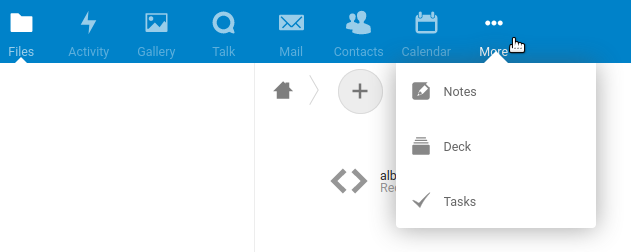
And because they know better there is no user configurable option to extend that 8 items to may be 12 or so which would prevent the annoying overflow menu we are seeing with 10 applications in use: Screenshot of stock Nextcloud menu Luckily code can be changed and there are many comments floating around the Internet to change const minAppsDesktop = 8. In this case it is slightly complicated by the fact that the javascript code is distributed in compressed form (aka "minified") as core/js/dist/main.js and you probably don't want to build the whole beast locally to change one constant. Basically
const breakpoint_mobile_width = 1024;

const resizeMenu = () =>
const appList = $('#appmenu li')
const rightHeaderWidth = $('.header-right').outerWidth()
const headerWidth = $('header').outerWidth()
const usePercentualAppMenuLimit = 0.33
const minAppsDesktop = 8
let availableWidth = headerWidth - $('#nextcloud').outerWidth() - (rightHeaderWidth > 210 ? rightHeaderWidth : 210)
const isMobile = $(window).width() < breakpoint_mobile_width
if (!isMobile)
availableWidth = availableWidth * usePercentualAppMenuLimit

let appCount = Math.floor((availableWidth / $(appList).width()))
if (isMobile && appCount > minAppsDesktop)
appCount = minAppsDesktop

if (!isMobile && appCount < minAppsDesktop)
appCount = minAppsDesktop


// show at least 2 apps in the popover
if (appList.length - 1 - appCount >= 1)
appCount--


$('#more-apps a').removeClass('active')
let lastShownApp
for (let k = 0; k < appList.length - 1; k++)
const name = $(appList[k]).data('id')
if (k < appCount)
$(appList[k]).removeClass('hidden')
$('#apps li[data-id=' + name + ']').addClass('in-header')
lastShownApp = appList[k]
else
$(appList[k]).addClass('hidden')
$('#apps li[data-id=' + name + ']').removeClass('in-header')
// move active app to last position if it is active
if (appCount > 0 && $(appList[k]).children('a').hasClass('active'))
$(lastShownApp).addClass('hidden')
$('#apps li[data-id=' + $(lastShownApp).data('id') + ']').removeClass('in-header')
$(appList[k]).removeClass('hidden')
$('#apps li[data-id=' + name + ']').addClass('in-header')


// show/hide more apps icon
if ($('#apps li:not(.in-header)').length === 0)
$('#more-apps').hide()
$('#navigation').hide()
else
$('#more-apps').show()

gets compressed during build time to become part of one 15,000+ character line. The relevant portion reads:
var f=function() var e=s()("#appmenu li"),t=s()(".header-right").outerWidth(),n=s()("header").outerWidth()-s()("#nextcloud").outerWidth()-(t>210?t:210),i=s()(window).width()<1024;i (n*=.33);var r,o=Math.floor(n/s()(e).width());i&&o>8&&(o=8),!i&&o<8&&(o=8),e.length-1-o>=1&&o--,s()("#more-apps a").removeClass("active");for(var a=0;a<e.length-1;a++) var l=s()(e[a]).data("id");a<o?(s()(e[a]).removeClass("hidden"),s()("#apps li[data-id="+l+"]").addClass("in-header"),r=e[a]):(s()(e[a]).addClass("hidden"),s()("#apps li[data-id="+l+"]").removeClass("in-header"),o>0&&s()(e[a]).children("a").hasClass("active")&&(s()(r).addClass("hidden"),s()("#apps li[data-id="+s()(r).data("id")+"]").removeClass("in-header"),s()(e[a]).removeClass("hidden"),s()("#apps li[data-id="+l+"]").addClass("in-header"))) 0===s()("#apps li:not(.in-header)").length?(s()("#more-apps").hide(),s()("#navigation").hide()):s()("#more-apps").show()
Well, we can still patch that, can we? Continue reading "Fixing the Nextcloud menu to show more than eight application icons"

Daniel Lange: Getting rid of the Google cookie consent popup

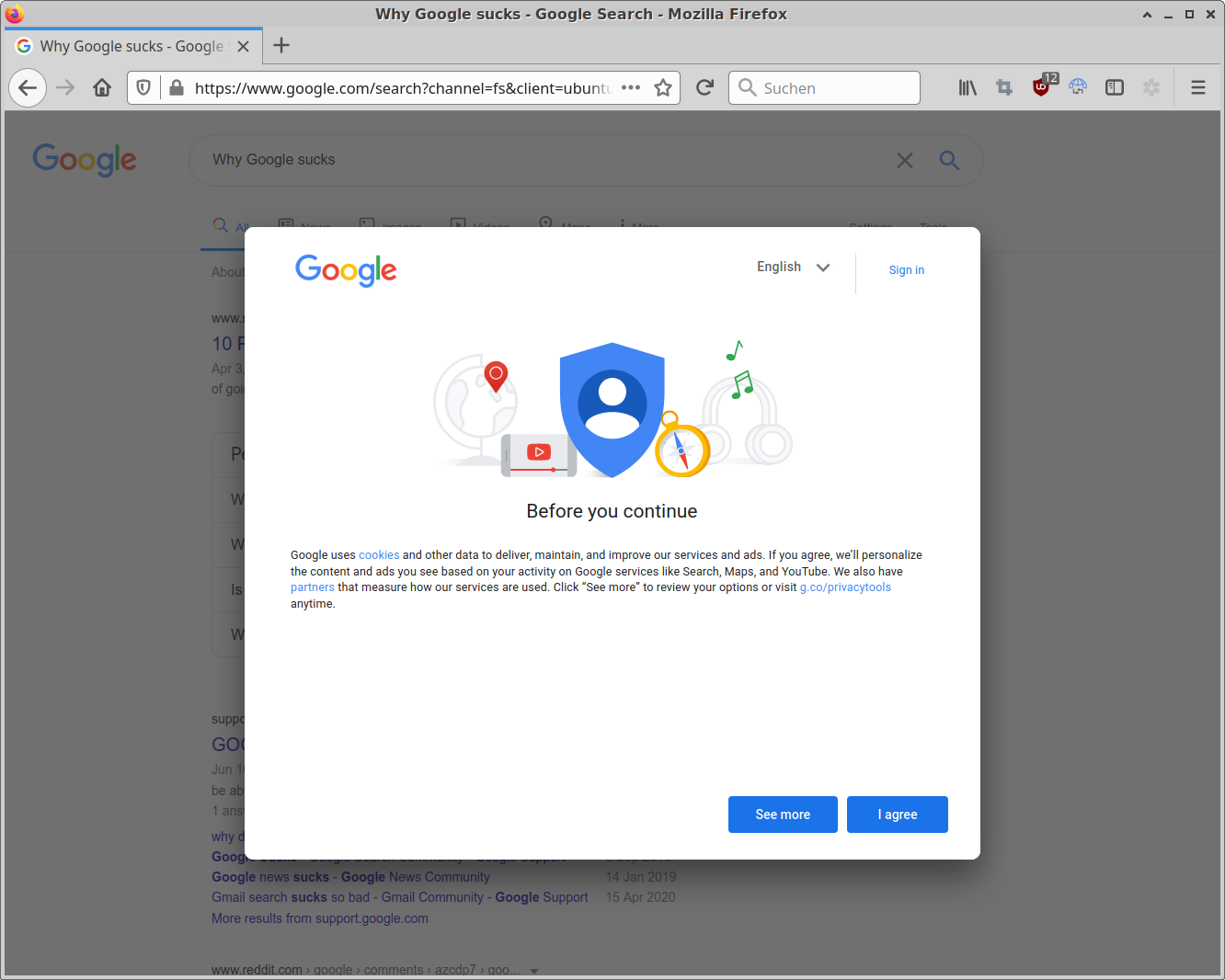
If you clear your browser cookies regularly (as you should do), Google will annoy you with a full screen cookie consent overlay these days. And - of course - there is no "no tracking consent, technically required cookies only" button. You may log in to Google to set your preference. Yeah, I'm sure this is totally following the intent of the EU Directive 2009/136/EC (the "cookie law"). Google cookie consent pop-up Unfortunately none of the big "anti-annoyances" filter lists seem to have picked that one up yet but the friendly folks from the Computerbase Forum [German] to the rescue. User "Sepp Depp" has created the following filter set that WFM: Add this to your uBlock Origin "My filters" tab:

! Google - remove cookie-consent-popup and restore scroll functionality
google.*##.wwYr3.aID8W.bErdLd
google.*##.aID8W.m114nf.t7xA6
google.*##div[jsname][jsaction^="dg_close"]
google.*##html:style(overflow: visible !important;)
google.*##.widget-consent-fullscreen.widget-consent

17 September 2020

Russell Coker: Dell BIOS Updates

I have just updated the BIOS on a Dell PowerEdge T110 II. The process isn t too difficult, Google for the machine name and BIOS, download a shell script encoded firmware image and GPG signature, then run the script on the system in question. One problem is that the Dell GPG key isn t signed by anyone. How hard would it be to get a few well connected people in the Linux community to sign the key used for signing Linux scripts for updating the BIOS? I would be surprised if Dell doesn t employ a few people who are well connected in the Linux community, they should just ask all employees to sign such GPG keys! Failing that there are plenty of other options. I d be happy to sign the Dell key if contacted by someone who can prove that they are a responsible person in Dell. If I could phone Dell corporate and ask for the engineering department and then have someone tell me the GPG fingerprint I ll sign the key and that problem will be partially solved (my key is well connected but you need more than one signature). The next issue is how to determine that a BIOS update works. What you really don t want is to have a BIOS update fail and brick your system! So the Linux update process loads the image into something (special firmware RAM maybe) and then reboots the system and the reboot then does a critical part of the update. If the reboot doesn t work then you end up with the old version of the BIOS. This is overall a good thing. The PowerEdge T110 II is a workstation with an NVidia video card (I tried an ATI card but that wouldn t boot for unknown reasons). The Nouveau driver has some issues. One thing I have done to work around some Nouveau issues is to create a file ~/.config/plasma-workspace/env/nouveau-broken.sh (for KDE sessions) with the following contents:
export LIBGL_ALWAYS_SOFTWARE=1
I previously wrote about using this just for Kmail to stop it crashing [1]. But after doing that I still had other problems with video and disabling all GL on the NVidia card was necessary. The latest problem I ve had is that even when using that configuration things don t go well. When I run the reboot command I end up with a kernel message about the GPU not responding and then it doesn t reboot. That means that the BIOS update doesn t apply, a hard reboot signals to the system that the new BIOS wasn t good and I end up with the old BIOS again. I discovered that disabling sddm (the latest xdm program in Debian) from starting on boot meant that a reboot command would work. Then I ran the BIOS update script and it s reboot command worked and gave a successful BIOS update. So I ve gone from a 2013 BIOS to a 2018 BIOS! The update list says that some CVEs have been addressed, but the spectre-meltdown-checker doesn t report any fewer vulnerabilities.

Dirk Eddelbuettel: RcppSpdlog 0.0.1: New and Exciting Logging Package

Very thrilled to announce a new package RcppSpdlog which is now on CRAN in its first release 0.0.1. We had tweeted once about the earliest version which had already caught the eyes of Gabi upstream. RcppSpdlog bundles spdlog, a wonderful header-only C++ logging library with all the bells and whistles you would want that was written by Gabi Melman, and also includes fmt by Victor Zverovic. I had meant to package this for a few years now but didn t find an (easy, elegant) way to completely lift stdout / stderr and related uses which R wants us to remove for smoother operations from R itself including synchronized input/output. It was only a few weeks ago that I realized I should subclass a logger (or, more concretely, a sink for a logger) which could then use R input/output. With the right idea the implementaton was easy, and [Gabi]((https://github.com/gabime) was most helpful in making sure R CMD check would not see one or two remaining C++ i/o operations (which we currently do by not activating a default logger, and substituing REprintf() in one call). So this is now clean and sween and a simple use is included in an example in the package we can show here too (in slightly shorter form minus the documentation header):
// this portmanteau include also defines the r_sink we use below, and which
// diverts all logging to R via the Rcpp::Rcout replacement for std::cout
#include <RcppSpdlog>

// [[Rcpp::export]]
void exampleRsink()  

    std::string logname = "fromR";                          // fix a name for this logger
    auto sp = spdlog::get(logname);                         // retrieve existing one
    if (sp == nullptr) sp = spdlog::r_sink_mt(logname);     // or create new one if needed

    // change log pattern (changed from [%H:%M:%S %z] [%n] [%^---%L---%$] )
    sp->set_pattern("[%H:%M:%S.%f] [%n] [%^%L%$] [thread %t] %v");

    sp->info("Welcome to spdlog!");
    sp->error("Some error message with arg:  ", 1);

    sp->warn("Easy padding in numbers like  :08d ", 12);
    sp->critical("Support for int:  0:d ;  hex:  0:x ;  oct:  0:o ; bin:  0:b ", 42);
    sp->info("Support for floats  :03.2f ", 1.23456);
    sp->info("Positional args are  1   0 ..", "too", "supported");
    sp->info(" :<30 ", "left aligned");

 
The NEWS entry for the first release follows.

Changes in RcppSpdlog version 0.0.1 (2020-09-08)
  • Initial release with added R/Rcpp logging sink example

The only sour grapes, if any, are over the CRAN processing. This was originally uploaded three weeks ago. As a new package, it got extra attention and some truly idiosyncratic attention to two details that were already supplied in the first uploaded version. Yet it needed two rounds of going back and forth for really no great net gain, yet wasting a week each time. I am not all that impressed by this, and not particularly pleased either, but I presume is the tax we all pay in order to enjoy the unsurpassed richness of the CRAN repository system which continues to work just flawlessly. If you like this or other open-source work I do, you can now sponsor me at GitHub. For the first year, GitHub will match your contributions.

This post by Dirk Eddelbuettel originated on his Thinking inside the box blog. Please report excessive re-aggregation in third-party for-profit settings.

16 September 2020

Steve Kemp: Implementing a FORTH-like language ..

Four years ago somebody posted a comment-thread describing how you could start writing a little reverse-polish calculator, in C, and slowly improve it until you had written a minimal FORTH-like system: At the time I read that comment I'd just hacked up a simple FORTH REPL of my own, in Perl, and I said "thanks for posting". I was recently reminded of this discussion, and decided to work through the process. Using only minimal outside resources the recipe worked as expected! The end-result is I have a working FORTH-lite, or FORTH-like, interpreter written in around 2000 lines of golang! Features include:
  • Reverse-Polish mathematical operations.
  • Comments between ( and ) are ignored, as expected.
    • Single-line comments \ to the end of the line are also supported.
  • Support for floating-point numbers (anything that will fit inside a float64).
  • Support for printing the top-most stack element (., or print).
  • Support for outputting ASCII characters (emit).
  • Support for outputting strings (." Hello, World ").
  • Support for basic stack operations (drop, dup, over, swap)
  • Support for loops, via do/loop.
  • Support for conditional-execution, via if, else, and then.
  • Load any files specified on the command-line
    • If no arguments are included run the REPL
  • A standard library is loaded, from the present directory, if it is present.
To give a flavour here we define a word called star which just outputs a single start-character:
: star 42 emit ;
Now we can call that (NOTE: We didn't add a newline here, so the REPL prompt follows it, that's expected):
> star
*>
To make it more useful we define the word "stars" which shows N stars:
> : stars dup 0 > if 0 do star loop else drop then ;
> 0 stars
> 1 stars
*> 2 stars
**> 10 stars
**********>
This example uses both if to test that the parameter on the stack was greater than zero, as well as do/loop to handle the repetition. Finally we use that to draw a box:
> : squares 0 do over stars cr loop ;
> 4 squares
****
****
****
****
> 10 squares
**********
**********
**********
**********
**********
**********
**********
**********
**********
**********
For fun we allow decompiling the words too:
> #words 0 do dup dump loop
..
Word 'square'
 0: dup
 1: *
Word 'cube'
 0: dup
 1: square
 2: *
Word '1+'
 0: store 1.000000
 2: +
Word 'test_hot'
  0: store 0.000000
  2: >
  3: if
  4: [cond-jmp 7.000000]
  6: hot
  7: then
..
Anyway if that is at all interesting feel free to take a peak. There's a bit of hackery there to avoid the use of return-stacks, etc. Compared to gforth this is actually more featureful in some areas:
  • I allow you to use conditionals in the REPL - outside a word-definition.
  • I allow you to use loops in the REPL - outside a word-definition.
Find the code here:

Bastian Blank: Salsa hosted 1e6 CI jobs

Today, Salsa hosted it's 1,000,000th CI job. The price for hitting the target goes to the Cloud team. The job itself was not that interesting, but it was successful.

Bits from Debian: Debian Local Groups at DebConf20 and beyond

There are a number of large and very successful Debian Local Groups (Debian France, Debian Brazil and Debian Taiwan, just to name a few), but what can we do to help support upcoming local groups or help spark interest in more parts of the world? There has been a session about Debian Local Teams at Debconf20 and it generated quite a bit of constructive discussion in the live stream (recording available at https://meetings-archive.debian.net/pub/debian-meetings/2020/DebConf20/), in the session's Etherpad and in the IRC channel (#debian-localgroups). This article is an attempt at summarizing the key points that were raised during that discussion, as well as the plans for the future actions to support new or existent Debian Local Groups and the possibility of setting up a local group support team. Pandemic situation During a pandemic it may seem strange to discuss offline meetings, but this is a good time to be planning things for the future. At the same time, the current situation makes it more important than before to encourage local interaction. Reasoning for local groups Debian can seem scary for those outside. Already having a connection to Debian - especially to people directly involved in it - seems to be the way through which most contributors arrive. But if one doesn't have a connection, it is not that easy; Local Groups facilitate that by improving networking. Local groups are incredibly important to the success of Debian since they often help with translations, making us more diverse, support, setting up local bug squashing sprints, establishing a local DebConf team along with miniDebConfs, getting sponsors for the project and much more. Existence of a Local Groups would also facilitate access to "swag" like stickers and mugs, since people not always have the time to deal with the process of finding a supplier to actually get those made. The activity of local groups might facilitate that by organizing related logistics. How to deal with local groups, how to define a local group Debian gathers the information about Local Groups in its Local Groups wiki page (and subpages). Other organisations also have their own schemes, some of them featuring a map, blogs, or clear rules about what constitutes a local group. In the case of Debian there is not a predefined set of "rules", even about the group name. That is perfectly fine, we assume that certain local groups may be very small, or temporary (created around a certain time when they plan several activities, and then become silent). However, the way the groups are named and how they are listed on the wiki page sets expectations with regards to what kinds of activities they involve. For this reason, we encourage all the Debian Local Groups to review their entries in the Debian wiki, keep it current (e.g. add a line "Status: Active (2020)), and we encourage informal groups of Debian contributors that somehow "meet", to create a new entry in the wiki page, too. What can Debian do to support Local Groups Having a centralized database of groups is good (if up-to-date), but not enough. We'll explore other ways of propagation and increasing visibility, like organising the logistics of printing/sending swag and facilitate access to funding for Debian-related events. Continuation of efforts Efforts shall continue regarding Local Groups. Regular meetings are happening every two or three weeks; interested people are encouraged to explore some other relevant DebConf20 talks (Introducing Debian Brasil, Debian Academy: Another way to share knowledge about Debian, An Experience creating a local community on a small town), websites like Debian flyers (including other printed material as cube, stickers), visit the events section of the Debian website and the Debian Locations wiki page, and participate in the IRC channel #debian-localgroups at OFTC.

15 September 2020

Molly de Blanc: Actions, Inactions, and Consequences: Doctrine of Doing and Allowing W. Quinn

There are a lot of interesting and valid things to say about the philosophy and actual arguments of the Actions, Inactions, and Consequences: Doctrine of Doing and Allowing by Warren Quinn. Unfortunately for me, none of them are things I feel particularly inspired by. I m much more attracted to the many things implied in this paper. Among them are the role of social responsibility in making moral decisions. At various points in the text, Quinn makes brief comments about how we have roles that we need to fulfill for the sake of society. These roles carry with them responsibilities that may supersede our regular moral responsibilities. Examples Quinn makes include being a private life guard (and being responsible for the life of one particular person) and being a trolley driver (and your responsibility is to make sure the train doesn t kill anyone). This is part of what has led to me brushing Quinn off as another classist. Still, I am interested in the question of whether social responsibilities are more important than moral ones or whether there are times when this might occur. One of the things I maintain is that we cannot be the best versions of ourselves because we are not living in societies that value our best selves. We survive capitalism. We negotiate climate change. We make decisions to trade the ideal for the functional. For me, this frequently means I click through terms of service, agree to surveillance, and partake in the use and proliferation of oppressive technology. I also buy an iced coffee that comes in a single use plastic cup; I shop at the store with questionable labor practices; I use Facebook. But also, I don t give money to panhandlers. I see suffering and I let it pass. I do not get involved or take action in many situations because I have a pass to not. These things make society work as it is, and it makes me work within society. This is a self-perpetuating, mutually-abusive, co-dependent relationship. I must tell myself stories about how it is okay that I am preferring the status quo, that I am buying into the system, because I need to do it to survive within it and that people are relying on the system as it stands to survive, because that is how they know to survive. Among other things, I am worried about the psychic damage this causes us. When we view ourselves as social actors rather than moral actors, we tell ourselves it is okay to take non-moral actions (or in-actions); however, we carry within ourselves intuitions and feelings about what is right, just, and moral. We ignore these in order to act in our social roles. From the perspective of the individual, we re hurting ourselves and suffering for the sake of benefiting and perpetuating an caustic society. From the perspective of society, we are perpetuating something that is not just less than ideal, but actually not good because it is based on allowing suffering.[1] [1] This is for the sake of this text. I don t know if I actually feel that this is correct. My goal was to make this only 500 words, so I am going to stop here.

Jonathan Dowland: Come Together

Primal Scream   Come Together
This one rarely returns to its proper place, instead living in the small pile of records permanently next to my turntable. I'm a late convert to Primal Scream: I first heard the 10 minute Andrew Weatherall mix of Come Together on Tom Robinson's 6Music show. It's a remarkable record, more so to think that it's quite hard, in isolation, to actually hear Primal Scream's contribution. This is very much Weatherall's track, and (to me, at least) it does a great job of encapsulating the house music explosion of the time. It's interesting to hear Terry Farley's mix, partially because the band's contribution is more evident, so you can get a glimpse of the material that Weatherall had to work with. RIP Andrew Weatherall, 1963-2020.

Rapha&#235;l Hertzog: Freexian s report about Debian Long Term Support, August 2020

A Debian LTS logo Like each month, here comes a report about the work of paid contributors to Debian LTS. Individual reports In August, 237.25 work hours have been dispatched among 14 paid contributors. Their reports are available: Evolution of the situation August was a regular LTS month once again, even though it was only our 2nd month with Stretch LTS.
At the end of August some of us participated in DebConf 20 online where we held our monthly team meeting. A video is available.
As of now this video is also the only public resource about the LTS survey we held in July, though a written summary is expected to be released soon. The security tracker currently lists 56 packages with a known CVE and the dla-needed.txt file has 55 packages needing an update. Thanks to our sponsors Sponsors that recently joined are in bold.

No comment Liked this article? Click here. My blog is Flattr-enabled.

Russell Coker: More About the PowerEdge R710

I ve got the R710 (mentioned in my previous post [1]) online. When testing the R710 at home I noticed that sometimes the VGA monitor I was using would start flickering when in some parts of the BIOS setup, it seemed that the horizonal sync wasn t working properly. It didn t seem to be a big deal at the time. When I deployed it the KVM display that I had planned to use with it mostly didn t display anything. When the display was working the KVM keyboard wouldn t work (and would prevent a regular USB keyboard from working if they were both connected at the same time). The VGA output of the R710 also wouldn t work with my VGA->HDMI device so I couldn t get it working with my portable monitor. Fortunately the Dell front panel has a display and tiny buttons that allow configuring the IDRAC IP address, so I was able to get IDRAC going. One thing Dell really should do is allow the down button to change 0 to 9 when entering numbers, that would make it easier to enter 8.8.8.8 for the DNS server. Another thing Dell should do is make the default gateway have a default value according to the IP address and netmask of the server. When I got IDRAC going it was easy to setup a serial console, boot from a rescue USB device, create a new initrd with the driver for the MegaRAID controller, and then reboot into the server image. When I transferred the SSDs from the old server to the newer Dell server the problem I had was that the Dell drive caddies had no holes in suitable places for attaching SSDs. I ended up just pushing the SSDs in so they are hanging in mid air attached only by the SATA/SAS connectors. Plugging them in took the space from the above drive, so instead of having 2*3.5 disks I have 1*2.5 SSD and need the extra space to get my hand in. The R710 is designed for 6*3.5 disks and I m going to have trouble if I ever want to have more than 3*2.5 SSDs. Fortunately I don t think I ll need more SSDs. After booting the system I started getting alerts about a fault in one SSD, with no detail on what the fault might be. My guess is that the SSD in question is M.2 and it s in a M.2 to regular SATA adaptor which might have some problems. The data seems fine though, a BTRFS scrub found no checksum errors. I guess I ll have to buy a replacement SSD soon. I configured the system to use the nosmt kernel command line option to disable hyper-threading (which won t provide much performance benefit but which makes certain types of security attacks much easier). I ve configured BOINC to run on 6/8 CPU cores and surprisingly that didn t cause the fans to be louder than when the system was idle. It seems that a system that is designed for 6 SAS disks doesn t need a lot of cooling when run with SSDs. Update: It s a R710 not a T710. I mostly deal with Dell Tower servers and typed the wrong letter out of habit.

Norbert Preining: GIMP washed out colors: Color to Alpha and layer recombination

Just to remind myself because I keep forgetting it again and again: If you get washed out colors when doing color to alpha and then recombine layers in GIMP, that is due to the new default in GIMP 2.10 that combines layers in linear RGB.

This creates problems because Color to Alpha works in perceptual RGB, and the recombination in linear creates washed out colors. The solution is to right click on the respective layer, select Composite Space , and there select RGB (perceptual) . Here is the bug report that has been open since 2 years. Hoping that for next time I remember it.

14 September 2020

Jonathan McDowell: onak 0.6.1 released

Yesterday I did the first release of my OpenPGP compatible keyserver, onak, in 4 years. Actually, 2 releases because I discovered my detection for various versions of libnettle needed some fixing. It was largely driven by the need to get an updated package sorted for Debian due to the removal of dh-systemd, but it should have come sooner. This release has a number of clean-ups for dealing with the hostility shown to the keyserver network in recent years. In particular it implements some of dkg s Abuse-Resistant OpenPGP Keystores, and finally adds support for verifying signatures fully. That opens up the ability to run a keyserver that will only allow verifiable updates to keys. This doesn t tie in with folk who want to run PGP based systems because of the anonymity, but for those of us who think PGP s strength is in the web of trust it s pretty handy. And it s all configurable to taste; you can turn off all the verification if you want, or verify everything but not require any signatures, or even enable v3 keys if you feel like it. The main reason this release didn t come sooner is that I m painfully aware of the bits that are missing. In particular:
  • Documentation. It s all out of date, it needs a lot of work.
  • FastCGI support. Presently you need to run the separate CGI binaries.
  • SKS Gossip support. onak only supports the email syncing option. If you run a stand alone server this is fine, but Gossip is the right approach for a proper keyserver network.
Anyway. Available locally or via GitHub.
0.6.0 - 13th September 2020
  • Move to CMake over autoconf
  • Add support for issuer fingerprint subpackets
  • Add experimental support for v5 keys
  • Add read-only OpenPGP keyring backed DB backend
  • Move various bits into their own subdirectories in the source tree
  • Add support for full signature verification
  • Drop v3 keys by default when cleaning keys
  • Various code cleanups
  • Implement pieces of draft-dkg-openpgp-abuse-resistant-keystore-03
  • Add support for a fingerprint blacklist (e.g. Evil32)
  • Deprecate the .conf configuration file format
  • Drop version info from armored output
  • Add option to deny new keys and only allow updates to existing keys
  • Various pieces of work removing support for 32 bit key IDs and coping with colliding 64 bit key IDs.
  • Remove support for libnettle versions that lack the full SHA2 suite
0.6.1 - 13th September 2020
  • Fixes for compilation without nettle + with later releases of nettle

Next.

Previous.
