Search Results: "sf"

21 May 2007

Bernd Zeimetz: hi, planet // iso8859-15 to utf8 with netatalk magic

<div xmlns='http://www.w3.org/1999/xhtml'> <h1><a name="hi_planet_iso8859-15_to_utf8_with_netatalk_magic" id="hi_planet_iso8859-15_to_utf8_with_netatalk_magic">hi, planet // iso8859-15 to utf8 with netatalk magic</a></h1> <p> <em><strong>Hi, Planet!</strong> <br/> Welcome to my blog, and thanks to <a href="http://blog.zobel.ftbfs.de/" title="http://blog.zobel.ftbfs.de/" rel="nofollow">Martin</a> for subscribing me. I m not going to bother you with any details about me, if you have any questions feel free to ask me on <a href="http://freenode.net/" title="http://freenode.net/" rel="nofollow">freenode</a> or <a href="http://www.oftc.net/" title="http://www.oftc.net/" rel="nofollow">oftc</a> (in case you re wondering: my nick is bzed).</em> <br/> <br/> After a longer time of planning we ve upgraded our main file server at <a href="http://www.architektur.tu-darmstadt.de" title="http://www.architektur.tu-darmstadt.de" rel="nofollow">work</a>: New machine, new storage (7TB - woohoo!), Etch instead of Sarge and <a href="http://en.wikipedia.org/wiki/UTF-8" title="http://en.wikipedia.org/wiki/UTF-8">UTF-8</a> for file names instead of <a href="http://en.wikipedia.org/wiki/ISO8859-15" title="http://en.wikipedia.org/wiki/ISO8859-15">ISO8859-15</a>. Everything not a too complicated thing, except for renaming the about 10,000,000 files from ISO8859-15 to UTF-8 in a proper way. <br/> In theory this is easy, as <a href="http://packages.debian.org/unstable/utils/convmv" title="http://packages.debian.org/unstable/utils/convmv" rel="nofollow">convmv</a> happily takes care of the problem. But this did not work for us unfortunately, as we re not only providing NFS and Samba services, but also AFP (<a href="http://en.wikipedia.org/wiki/Apple_Filing_Protocol" title="http://en.wikipedia.org/wiki/Apple_Filing_Protocol">Apple_Filing_Protocol</a>) via netatalk. Years ago you had to choose ISO8859-15 if you wanted to allow your Apple and Windows users to see the same, non-broken file names - not only because AFP didn t support UTF8 before version 3, which came out with OSX<a href="#fn__1" name="fnt__1" id="fnt__1">1)</a>. Normally you d think that a server would not allow a client to write a file with a file name which includes not supported characters - again, OSX and netatalk go their own way here:<br/> Characters which are not supported by the underlying file system are character(!)-wise encoded using the <a href="http://netatalk.sourceforge.net/2.0/htmldocs/configuration.html#id2898845" title="http://netatalk.sourceforge.net/2.0/htmldocs/configuration.html#id2898845" rel="nofollow">CAP encoding</a>. So we had to find a way to </p> <ul> <li> convert file names from ISO8859-15 to UTF-8 </li> <li> replace CAP encoded characters by the appropriate UTF-8 character </li> </ul> <p> Luckily netatalk ships the <a href="http://netatalk.sourceforge.net/2.0/htmldocs/uniconv.1.html" title="http://netatalk.sourceforge.net/2.0/htmldocs/uniconv.1.html" rel="nofollow">uniconv(1)</a> util<a href="#fn__2" name="fnt__2" id="fnt__2">2)</a> which is able to take care of this problem. It also updates the CNID<a href="#fn__3" name="fnt__3" id="fnt__3">3)</a> Database at the same time. There s two things you need to take care of in case you re using the dbd <a href="http://netatalk.sourceforge.net/2.0/htmldocs/configuration.html#CNID-backends" title="http://netatalk.sourceforge.net/2.0/htmldocs/configuration.html#CNID-backends" rel="nofollow">CNID backend</a>: </p> <ul> <li> uniconv assumes that <em>cnid_metad</em> is listening on port 4700, you need to start it first. Don t run afpd at the same time! </li> <li> If you ve specified external CNID dbpaths in your <em>AppleVolumes.default</em> (normally they re located in the root of each volume, prone to be deleted by users accidentally), you need to move the .AppleDB directory into your volume s root directory, otherwise uniconv will create a new CNID database. Just move it back as soon as uniconv is finished. </li> </ul> <p> Be careful: uniconv assumes that all colons in a file name are part of a CAP encoded character. That s not a problem as long as you have only Mac and Windows clients accessing your server, as both systems do not allow colons in file names. In our case we found a number of cache files from Nautilus (which is running on our sunray/Solaris web-surf terminals as default browser) with colons in the file name. I hope no user will miss them <img src="http://bzed.de/lib/images/smileys/icon_wink.gif" alt=";-)" /> </p> <p> Including a final synchronisation of all files to the new storage, about two hours it took uniconv to convert the file names and a aunch break, we were finished after about 14 hours of work. Until now it seems that our users didn t notice the change at all, except for those who realized that they have much more free space now. Looks like a successful weekend so far! <img src="http://bzed.de/lib/images/smileys/icon_biggrin.gif" alt=":-D" /> </p> <p> <strong>update:</strong> full html in the feed. </p> <div class="tags"><span> <a href="http://bzed.de/tags/debian" class="wikilink1" title="tags:debian" rel="tag">debian</a>, <a href="http://bzed.de/tags/linux" class="wikilink1" title="tags:linux" rel="tag">linux</a> </span></div> <a href="#fnt__1" id="fn__1" name="fn__1">1)</a> and uses a NFD variant of Unicode normalization (<a href="http://en.wikipedia.org/wiki/UTF-8%23Mac_OS_X" title="http://en.wikipedia.org/wiki/UTF-8%23Mac_OS_X">UTF-8#Mac_OS_X</a>), but netatalk takes care of this and translates it into the NFC form, which is used on most other platforms <a href="#fnt__2" id="fn__2" name="fn__2">2)</a> it s called netatalk-uniconv in Debian and shipped with <a href="http://packages.debian.org/stable/net/netatalk" title="http://packages.debian.org/stable/net/netatalk" rel="nofollow">netatalk</a> <a href="#fnt__3" id="fn__3" name="fn__3">3)</a> Catalog Node ID, another crust from old Mac <acronym title="Operating System">OS</acronym> versions </div>

20 May 2007

Benjamin Mako Hill: Free Culture Talk Recording

As I mentioned previously, I was graciously given the opportunity to speak the crowd at the Free Software Foundation's Members Meeting in March about some of my work and activism around Free Culture. In front of what was probably the friendliest audience possible, I compared the free software and free culture movements and explained why I think that free culture movement may be off track -- and, of course, what we as a community might be able to do about it. If you listen to it, please try to forgive my faults as a speaker. The message I tried to convey is what I think is one the most important tactical issues facing free culture. If this talk dwells a little too long on free software and the lessons we might take from that world, please consider my audience. You can listen to the talk here:

19 May 2007

Evan Prodromou: 29 Flor al CCXV

Busy day yesterday; the first day of RoCoCoCamp, and the first day seeing a lot of friends and friendly faces from out of town. I was out of bed at 6AM yesterday. I stopped at St. Viateur Bagel on Mont Royal and got 10 dozen bagels -- enough for our expected crowd. I got to SAT at about 8AM, just in time to start the coffee machines. The big percolators I rented for the event require about an hour to make coffee, so if people were going to be coming in at 9AM, I really wanted to get them started by 8. Alain Bernardeau from computation.to got there soon after, and set up the spare computers his organization is lending us. Brandon Sanders, Mark Dilley and Nathan R also came in early, looking for work to do. I got them all into the job of setting up the food for breakfast. By 9AM we were trucking along, and I figured I'd go try a cup of joe, which should be ready. But all I got from the carafe was cold water. The percolators draw so much current that they'd blown a circuit. Guillaume, the SAT tech, and I tried about 8 different ways to keep them running, but nothing worked. Finally he put them on the 220V industrial circuit, which they didn't blow. Awesome, but at 9:30AM, with almost everyone there, we had no expectation of coffee for another hour. Yikes! But by the time people started filtering into the circle for starting the event proper, coffee was rolling and I was much relieved. Our facilitator, Deborah Hartmann, gave a great bilingual introduction to Open Space Technology and got the ball rolling. I always have a moment of dread during the beginning of a Open Space event: what if this is the time that Open Space doesn't work? But it did, again, which is great. The first session I went to was Zach Copley's, about consensus-supporting software features. Brandon Sanders had some great cases from AboutUs's adult content policy. We shared a lot of Wikitravel's culture, too. I also stopped in to talk about Wikitravel:RDF with Reini Urban, who was demoing Semantic MediaWiki. It's a neat project, and it's a different tack than I've taken with Wikitravel. I'd like to see the two approaches harmonized at some time in the future. Lunch came quickly, and we had far too much to eat. I spent a lot of time talking to Simon Law about possibly using Open Space in some way for BarCampMontreal. I think it's a good idea -- it's growing to a point where our current format is straining under the load. We also talked about ubiquitous wikis and the cool browser Amaya, where Web pages are in edit mode by default. It's a good idea. After lunch I had a chance to hang out with Earle Martin of Open Guides and talk about wiki and the geospatial web. Mark Jarowski of Wikevent was there, and together we've decided to hammer out a RDF vocabulary for exchanging RDF data about business listings. It's the kind of productive talk I like having. I also spent some time with Jack Herrick talking about wiki entrepreneurship. Jack had a prepared presentation about wikiHow's business experience, which was really great, and provided a great case study for talking about commercialization of wikis in general. With Angela Beesley and Ray King around us, we had most of the interesting wiki content businesses represented. Pretty neat. It was a really productive first day, but by the time we got around to 5PM I was exhausted. Maj, Zach, Mark, Niko and I all went to our new house at 4690 rue Pontiac to meet Allegra and their two daughters, No ma and baby Anoushka. We got pizza and had beers and sat on our new couch and had a good old time. Technorati's rocococamp tag shows a lot of other positive responses on the Web: Matt Forsythe's sketches from RoCoCoCamp, NathanR's continuing paranoia, CITIZENShift (which quotes me, when I was talking about wiki entrepreneurship), and Patrick Tanguay.
 
I'm off to SAT again this morning. Should be a fun one, and I hope to get a little more time to myself before the event starts today. tags:

18 May 2007

Russell Coker: PC prices drop again!

A few weeks ago Dell advertised new laptops for $849AU, this was a significant development but I didn’t get around to blogging about it. Now I have just discovered that they have a special deal for $799AU for a laptop including delivery! This is an amazing deal and gives you an AMD Sempron 3500 CPU (not a really fast CPU and only 32bit, but it’s faster than the 1.7GHz Pentium-M that is currently satisfying all my requirements for portable computing), 512M of RAM, an 80G hard drive and a 1280×800 display. It’s far from a high-end laptop (having a lower screen resolution and less RAM than my 3yo Thinkpad) but it will suffice for most things you might want to do on the move apart from running Xen. The exciting thing about this is that as it’s so cheap that most people will probably choose it in preference to a desktop system - the cheapest desktop system that Dell currently offers as a package is $898. The cheap desktop has a dual-core Athlon64, 1G of RAM, and a 160G hard drive. But for most tasks other than games such things aren’t really required. Also a local PC company Suntrom has advertised a new Lenovo Thinkpad with a Celeron-M 1.5GHz, 256M of RAM, 1024×768 display, and a 40G hard drive for $799. The Thinkpad has considerably less compute power than the Dell laptop, but it is a bit cheaper. If Lenovo has maintained the Thinkpad quality (while IBM owned the brand Thinkpad was the Rolls-Royce of laptops) then it would probably be the better choice. On many occasions I have heard people say that they want a laptop computer to save space. When a desktop machine cost $1200 and a laptop cost $3500 that idea was ridiculous. But now that a laptop appears to be the cheapest system in the Dell range on sale in Australia that would be quite a reasonable criteria for purchases. Of course the extra sales of laptops will help fund further laptop technology developments (such as flash storage) that will be of use to those of us who are serious about computing and use laptops they way that they were intended.

Eddy Petri&#537;or: (Not) Getting Carbide C++ to run on your amd64 Debian Etch. But you get CodeWarrior!

A while ago I decided I wanted to make a couple of nice little apps for my Nokia 6600.
After my successful adventure with pys60 I decided/realized that the Python API does not contain appropriate functions for what I need in my apps, so I decided to setup the development environment for C++ with Carbide C/C++ (the recommended IDE for S60 development for Nokia).

Of course, the IDE is a Windows application and the reason for which Nokia doesn't provide an IDE for Linux (is expected since they are developing maemo and are so into OS) eludes me.
On top of that, I have an Debian Etch amd64 installation[1], so that's more fun.

Fortunately, thanks to Robert Millan and Ove Kaaven, wine is installable from unstable on amd64 and a chroot is not needed[2] anymore.


Now let's see the dependency tree:
Yes, that is all ... summarized. And you can imagine I went though leaps and bounds and wasted a night with this to find out the hard way.

If you don't care about the reasons/story, you can skip to the paragraph where I ran into license issues.

So, first Carbide needs Active Perl. Not any version, but ActivePerl-5.6.1.635. You will find out after you install Carbide c++.

Active Perl, by default, will refuse to install in wine. It relies on some Script Host support.
Good news: it is available on Microsoft's support pages. Bad news: the file is not provided until you go through some crazy scheme[3] to certify you have a genuine Windows installation.

Of course, the genuine stuff failed to work in wine, duh, but having a windows XP OS in qemu was really useful... to try to go further.

Now that I mentioned the Windows XP machine in qemu you might be wondering 'why didn't you installed Carbide c++ in there and start hacking in qemu?' . Well, I wish it was that simple! Believe it or not, the installation in the Windows virtual machine failed in a muuuuch earlier stage it initially did in Wine! It failed in the unpacking phase of the installation, while in Wine that part worked without problems (default config is for Windows XP emulation). Talk about irony!

After a while of trying, I took the risky path (maybe I should install an antivirus, as suggested by wine) and downloaded the kit for the script host stuff from some site on the net (shhh!). Good. I don't remember if I used cabextract or if it worked quite straight forward, but the special configuration entry in Wine Configurator suggests otherwise.

Back to Active-Perl. Now we can try again to install it.

wine msiexec ActivePerl-5.6.1.635-MSWin32-x86.msi

Guess what? The installation failed now, too. After some time of poking, I realised the bastard was looking for mfc42.dll in the installation. There was no word about that in the error message, only in the wine logs there were some hints. No wonder Windows users learn very early to ignore error messages (the error message was plain uninformative).

Where to get mfc42.dll from? The virtual machine! I tried to send them via email, but the link was too slow. Now I realised I could have used winscp, but I didn't thought of that at the time.

The rescue did come this time from M$, but with some effort. It appears that mfc42.dll is by default present on XP, so you only find it for download in some kit (vc6redistsetup_enu.exe) for Windows 9x. That works (lost some time to figure that out, too) since the kit contains a mix of 9x, NT and independent dlls. I think this installation didn't work and I had to cabextract the files by hand and copy them in system32. I registered the mfc42.dll module, after copying it in windows/system32.

wine msiexec /y mfc42.dll

Well, now I have everything installed Carbide should start... Well, no! License issues! I got a message about not having a license for the installation. Ain't that great? I just installed the thing and is the free/handicapped version. What gives? Well, in Carbide C++ 1.2, the Express part of the kit is broken and doesn't install the license file.

So, I installed the professional version since it had a longer trial period, hoping that now I'll be able to see the IDE and start working.

After this, I tried several times to start Carbide itself, but it failed at different points in time. I "just"[4] configured wine for this app to set the order to 'native,builtin' for msvcrt, ole32, oleacc and shdocw and got further.

Hopeless attempts follow....

At this point I got stuck. There was still some error from ole32.dll (apparently), but I couldn't go further.

I tried to install the 1.1 trial version. Got stuck. In any way I couldn't start Carbide c++ :-(( .

GRAND FINALE!

In the end, I also tried the deprecated CodeWarior. Guess what? It installed and ran immediately. Although I am not sure if any of the previous poking had anything to do with it.


[1] I have some packages from unstable
[2] although I had one, I wanted to get rid of it, since gnash started to perform better in the latest versions - still not satisfactory, but OK
[3] some browser plugin WPGInstall.exe, iirc and some app which should send your privat^W^W^Wanalise your system to generate some code that should identify your system as genuine
[4] this also took me some time... start, identify the dll, change the order, restart...

Evan Prodromou: 27 Flor al CCXV

Well, today started out really anxious and is ending pretty reasonably. (Or so I think -- maybe tomorrow is going to be really nuts). First, RoCoCoCamp buzz is just nuts! Lots of people are blogging about it, planning to attend, and having fun talking about it. I count at least Patrick Tanguay, Sekhmet Design, Montreal Tech Watch, Montreal Tech League (no relation), Michel LeBlanc, Fred Ngo, Sylvain Carle, Rhymin' Simon Law, NathanR, Creative Commons Canada (thanks for the shout-out, gang!), Adrien O'Leary, Andreas Gohr (coming all the way from Berlin!). We're flirting with almost 100 people on the participants list, which I think is going to mean about 120-150 people. So I'm no longer worried that not enough people are going to come. Last night I got a quote for someone to provide coffee in the morning and at afternoon break for all three days... for $1800! So this morning I rented three coffee percolators (one for regular, one for decaf, and one for tea) and a bunch of cups and plates from Celebrations up on Jean-Talon. Maj and I shopped for coffee this afternoon. Total cost? $250. That means more money left over for pizza Saturday night! It means some more hassle for me and for the attendees, but I think we can handle it. Tomorrow morning early I have to stop in at St. Viateur and get 10 dozen bagels for the whole gang. I think many people who are attending don't know Montreal bagels, so they'll be in for a treat. Of course, some of the Montrealers will be mad I didn't get rival Fairmount Bagels instead. Tough for them. I know tomorrow is going to be crazy, but tonight I'm feeling pretty mellow. My good friend Zach Copley is on his way into town right now; we're working together on the kei.ki project and it will be great to have him here. Tomorrow Mark and Allegra arrive. So many good folks are going to be at RoCoCo: I think it's going to be a lot of fun. tags:

17 May 2007

Jordi Mallach: Google shuts down the Google Translation program

Via Quico Llach's blog, I just learned about Google no longer hiring independent translators to work on their many web applications. Since Quico was hired by them to do their Catalan translators, a few millions of users have been benefitting from his very professional work in Google's most used services: mail, maps, search... Like Quico, I really hope they already have deals with translation companies to take care of minorised and minority language translations. When Catalan translations were made by random volunteers, I remember the results were quite... unsatisfying, as each one of them used their own glossary and style. When Quico took over, the interfaces were normalised using the Guia de estil and everything improved dramatically (this problem is something people involved in Rosetta as a developer, translator and team leader know well, and is tricky to solve). Having Google suddenly drop Catalan as a supported language would be a huge step back for Catalan on technology. Either way, we'll find out soon.

Andrew Stribblehill: Timing random disk seeks

I asked an interviewee how long it takes for a disk seek, and he replied that he thought it was between 4 and 8 milliseconds. Speaking with colleagues, the conventional wisdom was that it was around 10 ms. I was unsatisfied so I thought I would try it for myself.

time sudo perl -we '$disk="/dev/sda"; $n=1500; $blocks= blockdev --getsz $disk ; if (!$blocks) print "Enter capacity in manufacturer GB\n: "; $blocks=1953125*(
) ; use Time::HiRes "time"; open DISK, $disk; $start=time; for (0..$n) seek DISK, int(rand($blocks))*512, 0; sysread DISK, $x, 512 die; $now=time; $times[int(($now-$start)*1000)]++; $x=$now-$start; $s2+=$x**2; $s+=$x; $start=$now ; for (0..$#times) if ($t=$times[$_]) $tot+=$t; $median =$_ if $tot>=$n/2; printf "%3d %s\n", $_, "x" x ($t/2) . ($t%2?":":"") ; printf "\nTook %3.4gs for %d seeks of %s (%d GB)\n", $s, $n, $disk, $blocks/2097152; printf "Mean: %2.03gms; Median: %d-%dms; Std dev: %2.03gms\n", 1000*$s/$n, $median-1, $median, 1000*sqrt($s2/$n - ($s/$n)**2);’
It should be obvious that before you run this, you should check for yourself that it doesn’t do anything dangerous. Or at least check that $disk is set appropriately for your hardware and operating system. If you don’t have blockdev, estimate the number of 512-byte blocks and set $blocks to that value. (There are 1953125 blocks in a hard disk manufacturer’s "Gigabyte".) The graph it produces prints an ‘x’ for two seeks of a given number of milliseconds and a trailing ‘:’ if there was one left over. For me, on my one year old Linux 2.6.18 workstation with a 160 "GB" Western Digital (WDC WD1600JS — quoted seek time 8.9 ms) the typical output is:
  0 :
  3 :
  4 :
  5 x:
  6 xxxx:
  7 xxxxxxx
  8 xxxxxxxxxxx:
  9 xxxxxxxxxxxxxxxxx
 10 xxxxxxxxxxxxxxxxxxxxxxx
 11 xxxxxxxxxxxxxxxxxxxxxxxxxxxx:
 12 xxxxxxxxxxxxxxxxxxxxxxxxx
 13 xxxxxxxxxxxxxxxxxxxxxxxxxxxxxxx:
 14 xxxxxxxxxxxxxxxxxxxxxxxxxxxxxxxxxxxx
 15 xxxxxxxxxxxxxxxxxxxxxxxxxxxxxxxxxxxxxxxxxxxxx:
 16 xxxxxxxxxxxxxxxxxxxxxxxxxxxxxxxxxxxxxxxxxxxxxxxxxxxxxx
 17 xxxxxxxxxxxxxxxxxxxxxxxxxxxxxxxxxxxxxxxxxxxxxxxxxxxxxxxxxxxxxx:
 18 xxxxxxxxxxxxxxxxxxxxxxxxxxxxxxxxxxxxxxxxxxxxxxxxxxxxxx:
 19 xxxxxxxxxxxxxxxxxxxxxxxxxxxxxxxxxxxxxxxxxxxxxxxxxxxxxxxxxx
 20 xxxxxxxxxxxxxxxxxxxxxxxxxxxxxxxxxxxxxxxxxxxxxxxxxxxxx
 21 xxxxxxxxxxxxxxxxxxxxxxxxxxxxxxxxxxxxxxxxxxxxx
 22 xxxxxxxxxxxxxxxxxxxxxxxxxxxxxxxxxxxxxxxxx:
 23 xxxxxxxxxxxxxxxxxxxxxxxxxxxxxxxxxxxxx:
 24 xxxxxxxxxxxxxxxxxxxxxxxxxxxxxx:
 25 xxxxxxxxxxxxxxxxxxxxxxxxxxxxx:
 26 xxxxxxxxxxxxxxxxxx
 27 xxxxxxxxxxxxxxx
 28 xxxxxx:
 29 xxxxx:
 30 xxxx
 31 :
 32 :
 34 x
 35 :
 57 :
Took 27.69s for 1500 seeks of /dev/sda (149 GB)
Mean: 18.5ms; Median: 17-18ms; Std dev: 5.24ms
real    0m27.859s
user    0m0.116s
sys     0m0.044s
Why might I care? 18 milliseconds is almost a lifetime compared with anything else a modern PC does. It’s slower than my monitors’ refresh period! I can read around 1 MB from disk, 10 MB over a GigE link or 20 MB from RAM in this time. I can ping from Ireland to England, crossing 40 routers there and back, in the time it takes for my disk head to seek. Every time you read something from a previously unread file, it costs on average EIGHTEEN MILLISECONDS even before it starts reading. That’s just 55 in a second. This has obvious implications for I/O program performance, i.e. that of most servers. If anyone has a concern about my method, I’d be interested to hear it. I’d also like to see the timings for different disks. Either post the whole histogram or just the stats, plus the make and model of the disk. On Linux you can get this from dmesg or hdparm -I device. Update: I’ve made the script more robust under non-existence of blockdev.

Simon Law: RoCoCoCamp 2007


Evan Prodromou
Originally uploaded by sfllaw.
Tomorrow is the beginning of RoCoCoCamp 2007, a three-day unconference held right here in Montr al. It starts at 9:30 on Friday at the SAT and runs until Sunday evening. It's for all who are interested in wikis, weblogs, and creators interested in collaborating in on-line spaces. RoCoCoCamp is organized with OpenSpace Technology, where we collectively decide on an agenda where everybody has a chance to speak. There's no artifical divide between speakers and audience, so you can lead your own session if you have something to say. Think of RoCoCoCamp as a real-life wiki, where anybody can contribute. A detailed explaination of what RoCoCoCamp is about can be found on this invitation. I'm inviting you because I'm flying out on Saturday and can't make the whole conference, but I really hope you come. There will be discussions on: So how can you attend? I thought you'd never ask!
RoCoCoCamp 2007
Friday, 18 May 2007 at 9:30
     until Sunday, 20 May 2007 at 18:00
Societ des arts technologiques
     1195 boul. St-Laurent
Free admission
( Sign up Upcoming Google Maps )
See you there!

16 May 2007

Edd Dumbill: XTech heatmaps

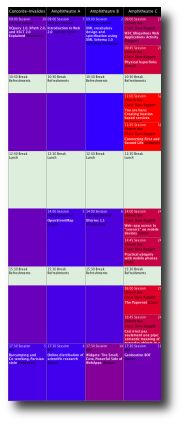
One of the fun and useful things we've been able to do in Expectnation with the personal scheduler is to use the data to help us as organizers. We recently added in dynamic overlays to the organizer's view of the schedule, enabling us to create heatmaps of the most popular talks. Heatmap
Screenshot of personal scheduler popularity overlaid on event timetable As well as satisfying natural curiosity, the heatmaps let us identify issues such as possible room overcrowding in advance. We're able also to record actual attendance figures as the conference goes on, and I will try and make an analysis of how attendees' intentions stack up against their actions. 

Adeodato Sim : Better sorting of maildirs in the Mutt browser

I’ve been always dissatisfied with the sort_browser=date option in Mutt, particularly when dealing with maildirs. For me, the reasonable behavior is to sort by the newest entry under the new/ directory, so that reverse sorting places the maildirs with most recent mails first. There is a patch by Dale Woolridge to address this issue, but since it only looks at the mtime of the new/ directory, once new mail has been read in a maildir, it still stays on the top of the list. So for me, the solution was to write an external program that would sort the list of maildirs by the date of the most recent new file, and have mutt read that list. Maybe you find it useful as well.

Michal &#268;iha&#345;: No current Wammu for Windows

You might have noticed that current Wammu is not available for Windows. The reason is simple - I was not able to produce working binary in reasonable time. Python-gammu itself seems to work, but when I run Wammu, it crashes quite soon. I tried to debug it for few evenings, but I was not successful. Therefore I again ask for somebody who would be willing to maintain Windows build. Somebody with Windows experiences will be probably able to resolve problems much faster and will help creating application that will behave good on Windows. I am not able to achieve this as I do not know Windows much and do not use it at all.

15 May 2007

Adam Rosi-Kessel: Grimmelmann on PrawfsBlawg

Not to be missed: well-known enfant terrible James Grimmelmann is guest-blogging on PrawfsBlawg. His opening commentary on the relationship between law practice and computer science:
Practicing lawyers, like practicing programmers, are professional pragmatists. Both must make their cases (and case mods) out of the materials they have available; both starve or eat steak depending on whether their creations work. The day-to-day practice of law is unlikely ever to require much high theory. We can mourn that fact because it means that they look at us with suspicion, or celebrate it because it frees us to chase Truth and Beauty and it will remain a fact either way.
Aside from the fact that I don’t eat steak, I think this is correct. Via a commenter on James’ entry, I learned that the 7th Circuit Court of Appeals is implementing a wiki (the entry page could surely use some more content). Surprisingly, it was not Posner but Easterbrook who spearheaded the effort. This is a very interesting development, but I expect it will be quite a while before any other circuit takes up the idea. Finally, I have been meaning to write about this New York Times story describing Jonathan Coulton’s success as a musician breaking with the traditional distribution /promotional channels (via 43 folders, a productivity blog that is still on my “probation” list). Unfortunately, slashdot beat me to it. I first re-discovered Jonathan Coulton during his guest episode of the Show with Ze Frank. In any event, the article is well worth reading:
More than 3,000 people, on average, were visiting his site every day, and his most popular songs were being downloaded as many as 500,000 times; he was making what he described as a reasonable middle-class living between $3,000 and $5,000 a month by selling CDs and digital downloads of his work on iTunes and on his own site Coulton realized he could simply poll his existing online audience members, find out where they lived and stage a tactical strike on any town with more than 100 fans, the point at which he d be likely to make $1,000 for a concert. It is a flash-mob approach to touring: he parachutes into out-of-the-way towns like Ardmore, Pa., where he recently played to a sold-out club of 140 . In total, 41 percent of Coulton s income is from digital-music sales, three-quarters of which are sold directly off his own Web site. Another 29 percent of his income is from CD sales; 18 percent is from ticket sales for his live shows. The final 11 percent comes from T-shirts, often bought online

14 May 2007

Bastian Venthur: 4GB RAM on a T60?

Dear Lazyweb, at work we have bought some of those shiny new ThinkPad T60s with 64Bit. Some of them have 4GB RAM installed, but unfortunately those with 4GB only seem to have 3GB available under Debian/Etch/AMD64. Since those laptops are running on AMD64 kernels, they should work with > 3GB RAM out of the box, right? Unfortunately they don’t and thinkwiki says:
Note: While you can install 4GB of memory, the chipset in the T60 supports a maximum of 3GB usable memory.
while the BIOS correctly shows the full amount of installed RAM! So my question is: Has anyone out there a T60 running successfully with 4GB RAM or is it really a chipset constraint?

Kai Hendry: Customized Web kiosk

Hannux alpha screenshot One of the most requested features for Webconverger is a “customization kit”. Before I pointed enquirers to Debian Live and a guide, which didn’t seem to satisfy the “easy to use” crowd. Now I’ve created a Web form where you can easily tell me what customized homepage you would like and I will go away and build it for you. For 20GBP. I just need 25 orders a month and I can pay my rent. ;) Since Webconverger is a collection of free software Debian packages, feel free to become a competitor. :)

Uwe Hermann: Playing audio on the NSLU2

3D Sound USB Audio Device I'm a happy NSLU2 user since a few months now, and I'm using it for all kinds of things, e.g. as a 24/7 remote ssh server at home (using DynDNS and the ddclient Debian package), as IRC logger (screen + irssi), etc. etc. I was considering multiple options as to where/how to install the slug (USB thumb drive, Compact Flash, disk drive, ...) but I settled with a full Debian install on an 1 GB USB thumb drive for now. I implemented some measures to maximize the life time of the USB thumb drive, maybe I'll post some info on that later... One new thing I've been trying lately is to use the slug as an audio player. As it doesn't come with an integrated sound card, you have to use an external USB audio device. I've got mine (see photo) from eBay for ca. 5 Euro (+ shipping) and it works out of the box with Linux 2.6.18 using the snd_usb_audio kernel module. You simply attach it via USB (the module is automatically loaded) and then attach external speakers to it. Here's an lsusb of the device:
Bus 001 Device 011: ID 1130:f211 Tenx Technology, Inc.
One problem with playing audio on the slug is the slow CPU. At 266 MHz (and without FPU!) playing audio with "normal" audio players such as mplayer or mpg321 is not possible. But there are several ways to make the slug play your favorite music. Here's a list of players I tested and a status report of whether they work at all. If yes, I listed a rough percentage of CPU load resulting from playing the music.
  • Ogg vorbis:
    • mplayer, aplay, playsound, and ogg123 don't work.
    • $ apt-get install libvorbisidec-dev
      $ cd /usr/share/doc/libvorbisidec-dev/examples
      $ make
      $ cat foo.ogg   ./ivorbisfile_example   aplay -f cd
      
      Result: 40% CPU load
  • MOD, XM, S3M, IT, etc.:
    • $ mikmod foo.mod: 10% CPU load (even with compressed MOD files)
  • WAV:
  • FLAC:
  • SPEEX:
    • $ speexdec foo.spx: doesn't work, 100% CPU load. Any known alternatives?
  • AU:
    • $ cat foo.au > /dev/dsp: 3% CPU load (but sounds crappy)
    • $ cat foo.au > /dev/audio: 3% CPU load (sounds better)
    • $ mplayer foo.au: 5% CPU load
    • $ aplay foo.au: 5% CPU load
    • $ playsound foo.au: 5% CPU load
  • AIFF:
    • $ sox foo.aiff -t wav - aplay: 50% CPU load (a bit stupid, but it works)
  • Streaming MP3:
    • $ mplayer http://www.example.com/foo.mp3: doesn't work, 100% CPU load.
    • $ wget http://www.example.com/foo.mp3 -O - madplay - : 17% CPU load
  • Streaming Ogg Vorbis:
    • $ cd /usr/share/doc/libvorbisidec-dev/examples
      $ wget http://www.example.com/foo.ogg -O - ./ivorbisfile_example aplay -f cd
      : 40% CPU load
  • The SlugAsAudioPlayer page in the NSLU2-Linux wiki might have further information on this topic. Feel free to add comments if you know of other audio types which can be played on an NSLU2.

    12 May 2007

    Luk Claes: Rebuilds

    About the difference between retry, give-back and binNMU. They are all kind of rebuilds on the build daemons, though have each another goal: In my previous blog post I spoke about binNMUs. They are needed when a version of a package was built successfully and installed in the archive before. Normally this means that the version of the package is not installable on the system anymore because one of the dependencies is not installable anymore and rebuilding the package should fix it. A binNMU also means a new version (typically adding +bN where N is a positive integer) and a new changelog entry. A retry or give-back is used when a version of a package failed to build before and rebuilding the package should work. Normally this means that a build dependency was not available or some other temporary problem has been fixed. So the main difference with a binNMU is that the version of the package didn't build successfully before, so it's also not installed in the archive. A retry is used to rebuild that version of the package on the build daemon where the build failed. Normally this is used when the individualstalledpkg_timeout of a package has been increased. A give-back is used to put the version of the package in the wanna-build state 'Needs-Build' again. So it may be rebuilt on another build daemon than the one were the build failed. Note that when I talk about a version of a package in the above it should actually be a version of a package on a particular architecture as binNMUs, retries and give-backs are scheduled for a known triplet (package, version, architecture).

    Russell Coker: career risks

    Paul Graham makes some interesting observations about taking risks to achieve career benefits. One thing he doesn’t mention is that the risks have to match your life situation. If you are 21, living with your parents, and single (typical for a CS graduate) then you should take the riskiest options in terms of your career (apart from working in Iraq of course). If you don’t have much money then you don’t have much to lose. If you live with your parents then you still have accommodation and food even if you have no money. If you have no dependents (SO or children) then there’s nothing compelling you to earn a certain income. When you get older you may get a mortgage, a SO, and/or children. Also you won’t live with your parents forever. Most career risks that you might want to take aren’t possible if you leave them too late. Finally if you do something risky such as starting your own company and it doesn’t work out then it’s still going to look good on your CV. If you already have a lot of experience in the industry then the CV improvement may not be worth the time and effort invested in an unsuccessful company. When I was 22 I (along with two business partners) started an Internet cafe. It went reasonably well (by the standards of small businesses), it lasted for a few years before cheap net access at home killed most of the business. At the time the cafe had to close the ISP side of the business was doing reasonably well and one of my partners bought the operating ISP business. This buy-out caused me to approximately break even out of the entire business which is a lot better than most small businesses do. When I was 26 I moved to London (I have dual nationality, UK and Australian). The experience I had gained from running my own business allowed me to immediately get contract work for large ISPs in Europe. Most of the risks in my career were ones that I took while living with my parents. At the time I didn’t think through the issues of mortgages etc, my thinking was mostly along the lines of “it could work, I’m bored, so why not?”. ;) Update: While in the process of writing this blog post I forwarded the URL of a dating service for scientists (sciconnect.com) to some friends. The main page has pictures of single people wearing lab coats and using laptops which I found amusing. I have no idea whether it’s a good service or not, but the pictures on the main page made it worth a look. It seems that I accidentally pasted the wrong URL into my blog post so people who were looking for the Paul Graham article ended up at the dating service instead. But I guess if you are the type of person who reads my blog and who is interested in a link to Paul Graham’s blog and you happen to be single then a dating service for scientists might be of some interest. Thanks to MJ Ray for pointing out my error.

    11 May 2007

    Thijs Kinkhorst: SquirrelMail 1.4.10a released

    Yesterday we released version 1.4.10a of SquirrelMail. It fixes mostly small-time bugs and glitches, and a security bug in the HTML filter. While the 1.4 branch is getting very solid, the HTML filter remains the main point of sorrow. The problem is that we receive incoming HTML in a mail message, and then need to transform that into HTML that's safe to present to the user. This is done by stripping out anything that could cause trouble. You wouldn't believe which degenerated content is still parsed by some browsers, so this is a never ending fight. A proper solution would be to white list what is allowed. This essentially means implementing a full HTML parser that parses the incoming mail and only accepts things known to be good. Co-developer Marc Groot Koerkamp has done good work towards this already, but it's no simple feat and not quite finished yet. So we'll have to keep patching up the current filter for a while I'm afraid.

    Next.

    Previous.