Search Results: "sf"

29 May 2007

Joey Hess: atari fun

I set up my Atari 130XE today, for the first time in eight years. Eight years ago I got it working long enough to make several backups of all the program disks, which are all going on 20 years old. Unfortunatly all the disks with the tetris clone I wrote fail to boot. All the other programs are still surviving. Playing with the Atari is still fun! I need to get a SIO cable and a SIO2PC and transfer these programs off and put them in subversion.
Update: Tetris is on those disks, they're just not bootable, but it can be loaded by hand. Then it fails at line 10380 since the high score files are missing. (This is not the well-polished tetris disk I remember..) Fixable:
10380 RETURN
Then it works. Yay!

Jos Parrella: Axesstel, Inc.: FOAD

Yesterday I wrote in Planet Debian requesting information on how to copy binary files to a Linux-based Axesstel modem. Meanwhile, I wrote Axesstel Customer Service with a friendly thank you for making a great product and kindly asking them for pointers. I’ve had some degree of satisfaction when writing to the Customer Services of several enterprises, and I really hoped this would be another one. 48 hours later, they replied with this message: Dear Customer,
First, thank you very much for purchasing Axesstel product and your kind feedback.
Unfortunately, we cannot released requested information because it is against security policy. We hope for your understanding.
Also, we recommend that you refrain yourself from accessing internal commands of the unit because it may violated service agreement enforced by your local service provider.
Once again, thank you for your understanding.
Axesstel Support So, if you have an Axesstel modem or if you are interested on having a free OS in your Axesstel, you may join the Laxative project in BerliOS or just make some noise in your blog, webpages or mailing lists with your Axesstel-related projects. If you happen to work at a place where you export your Security Policy to any aspect of your relationship with your customesr and where you tell them to refrain themselves of trying to improve your products for free, please read on about Open Source Hardware and its business models. It might be the time to start sharing information and sleeping without guilt :)

Cameron Dale: May-28-2007: Start of Coding / New Release

The start has finally arrived, today is officially the first day of coding for the 2007 Google Summer of Code. To commemorate this occasion, I have prepared the next release (the second so far) of the software package I am writing for it, DebTorrent. You can download it from the Alioth project. Some of the changes in this release are: You can read detailed instructions for how to download using it in the README file, but the basic idea for using DebTorrent as part of an update is to: This is still an alpha release, but at least it has some more functionality than the previous one. Feel free to test it, but keep in mind that at this early stage most of the torrents will be unseeded.

Evan Prodromou: 8 Prairial CCXV

So, I forgot to mention that I had a great evening last Thursday. In the afternoon, Niko and I met with Marie-Claude Doyon to talk about a new project we're working on. I think it's going to be pretty fun. That evening, I met up with Eugene Eric Kim and Seb Paquet at La ka, which was really great. I brought Niko along because we were having fun and thought it would be good to take a walk along av. Mont-Royal. It was great hanging out with EEK and Seb. There's something about talking to people who are as deep into wiki as I am that's really satisfying. It happens too seldom in my life -- just around conferences, really. Eugene got a shot of the four of us together. tags:

Gymnophobia i.never.nu sounds a lot like "I'm never nude". I'm just saying. tags:

28 May 2007

Andrew Pollock: [tech] LVM, you've done it again

The good thing about having kept a blog these last few years, is I have a searchable record of hardware changes. Recently, I noticed a few disk errors on caesar, and I was wondering how old that disk was. I disk some searching, and found via this post that the disk in it was a hand-me-down from when I decommissioned daedalus Mk I. One of the reasons I decommissioned it when I did, was the RAID-1 was exhibiting some strange errors during resynchronisation, and I didn't want to leave the country leaving behind an ageing problematic server with my stuff on it. I'd previously been unable to fault either 120 Gb disk under some light testing with badblocks, so I just reused them, and so around October 2005, I put the larger disk in caesar. So this disk has seen a fair bit of use, originally in daedalus, and then in caesar for another 20 months. It's allowed to fail, it's served me well. Anyway, so I bought a 750 Gb drive a couple of weeks ago, because one thing that I've wanted to do with caesar was do remote backups of daedalus, and there just wasn't enough space to do that, so I went for as big as I could find, and essentially repeated the same trick as last time, to upsize:
  1. Power down, attach new disk as a slave
  2. Boot into single user mode
  3. Unmount everything, remount root read-only
  4. sfdisk -d /dev/hda sfdisk /dev/hdb to copy the partition table (I use a root, swap, LVM, three partition layout)
  5. dd if=/dev/hda1 of=/dev/hdb1 bs=1M to copy the root filesystem to the new disk
  6. mkswap /dev/hdb2 to put the swap signature on what will become the new swap device
  7. cfdisk /dev/hdb and blow away the third partition and recreate it using all of the available space (there's probably a programmatic way of doing this, but hey, it's not exactly hard to do in cfdisk either)
  8. pvcreate /dev/hdb3 to put an LVM signature on the new LVM physical volume
  9. vgextend base /dev/hdb3 to tell LVM there's two disks in the volume group for the time being
  10. Remount the root filesystem read-write
  11. rm /boot/grub/device.map and run /usr/sbin/grub-install /dev/hdb to install GRUB in the MBR of what will become the new boot disk
  12. Power down, swap the disks around so that the new disk is now primary and the old disk is now the slave
  13. Boot into single user mode again, unmount everything except root
  14. pvmove /dev/hdb3 /dev/hda3 to relocate all of the allocated physical extents off the old disk onto the new one
  15. Twiddle thumbs for a couple of hours. Admire artwork on computer's motherboard (did you know Compaq EVO's have a picture of a car on their motherboards? A map of Texas?)
  16. vgreduce base /dev/hdb3 to take the old disk out of the volume group
  17. pvremove /dev/hdb3 to remove the LVM signature from the old disk
  18. Power down and remove the old disk
  19. Reboot into multi-user mode and profit from all the additional free physical extents
I absolutely love how I can do this with LVM, with a minimum of fuss. Last time I did this, I had a kernel panic during the pvmove, but that didn't even stop it, I just rebooted and reran the pvmove and it carried on from the last checkpoint. No such excitement this time. I'm sure Solaris' ZFS does all of this with substantially less manual steps, but hey, I like my Linux :-)

27 May 2007

loldebian - Can I has a RC bug?: Im in ur conference

Im in ur conference snoring my RC off

Im in ur conference. Snoring my RC off

Simon Law (sfllaw)

Toronto, Debconf2, 2002


26 May 2007

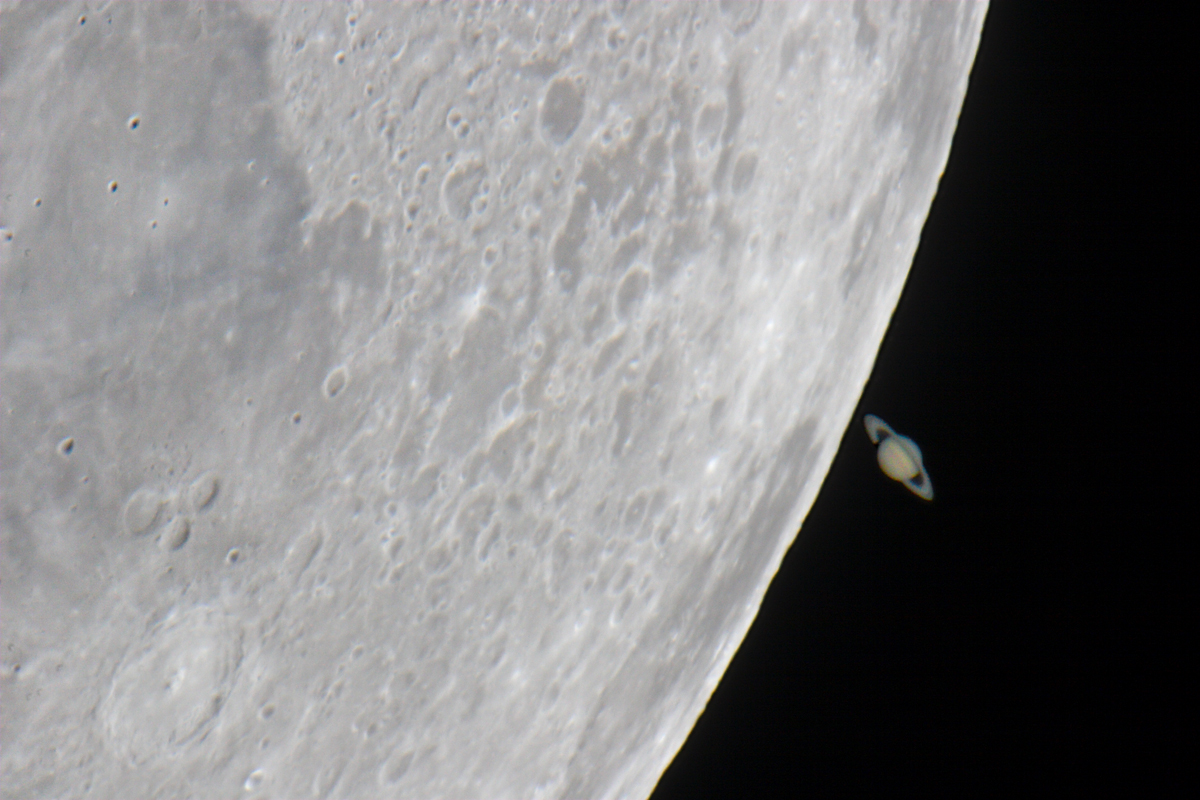
Christian Perrier: Moon and Saturn

Just enjoy: And if you do not already have, I really suggest you to add Jamie Zawinski's RSS feed of "Astronomy Picture Of the Day" to your feed reader (again: (http://www.jwz.org/cheesegrater/RSS/apod.rss).

Evan Prodromou: 5 Prairial CCXV

Incredible day here in Montreal. The temperature got over 31C today -- about 88 F -- which made for a steamy, jungly day. Remember how I said we had predictions of snow flurries two weeks ago? Things change quickly. Of course, hot weather and high humidity are a recipe for smog. Add on top of that the fact that Montreal is in the middle of a public transit strike, and you've got a serious air quality problem. Fortunately we should have some rain this weekend to shake that out. tags:

EC2 I spent a big part of my day twiddling around getting a nice Ubuntu server running on Amazon Web Services. Amazon's EC2 is an innovative server-provisioning API; beta testers for EC2 can build or tear down servers for any purpose in a few minutes using EC2 and Amazon S3. I wrote a few years ago, in a widely-reproduced email, a reply making fun of Jeff Bezos and Amazon's supposed innovations. But let me be frank: Amazon Web Services are a shithouse crazy idea. I think that Jeff Bezos must have been a complete nutjob to bet the company on these zany technologies; I also think it's brilliant, and it's going to change the way we think about using computers. I included EC2 in Ten Web 2.0 APIs you can really use. I think that decision was really justified. My EC2 instances now run Ubuntu Feisty Fawn; lighty, MySQL and PHP. It seems to be a winning combination; I'm looking forward to using EC2 for a production Web or database server. tags:

rel-edit I mentioned already the great work that AboutUs.org is doing to organize a Universal Wiki Edit Button. I decided to kick in on the machine-readable side and proposed a rel-edit microformat. So far the microformats-discuss mailing list has been pretty positive on the idea, but I'm going to wait a few days before posting a draft on the microformats wiki. tags:

Salt I just finished reading Salt: A World History, a nice non-fiction book by researcher extraordinaire Mark Kurlansky. The book covers this important mineral, its importance to human life, and the many ways to extract it to make it available for us. The book covers mummification in ancient Egypt, salt taxes in China, fish sauce in Vietnam, and Mahatma Gandhi's great salt march in India. It's so comprehensive that it can really make your head spin; but it's also exciting to see world history refracted through these whitish crystals. I think it's a great book, and I'm looking forward to reading Cod: A Biography of the Fish That Changed the World, by the same author. But we just got Everything is Miscellaneous from Amazon this week, so I think I'll be digging through that before I get to Cod. tags:

reCAPTCHA I heard about recaptcha via Hugh's article about same. Brilliant idea; why didn't someone think of this before? (Update: it was about 5 minutes after I posted this that I realized, "Hey! That can't work!" So I went back and re-read the docs on reCAPTCHA again. Now I'm even more impressed.) tags:

I want to ride my I've been thinking of picking up a bicycle for a few weeks now, as the weather has cleared here in town. So today I went up to Garantie Bicycle on rue Marie-Anne and bought the cheapest damn bike they had that wasn't made specifically for pre-pubescent children. Woohoo! The last time I had I bike, I lived in San Francisco. It was a beautiful cherry-red Cannondale hybrid -- with that great fat Cannondale tube, but light enough that I could lift it with one finger. I rode it around SF a lot, and took it out for trail biking on weekends in Marin County and the Peninsula and even the Sierra Nevada. It was a tough bike to ride, but once you got used to it it was a dream to take up hills. But that bike was stolen at Burning Man 2001, during the actual Burn. It's a classic mistake: professional bike thieves go to Burning Man each year to snag bikes left unlocked by tired and idealistic Burners, especially at times when camps are left empty, like during the Burn. To be honest, it was kind of a relief: I'd already moved out of my apartment and was planning a trip around North America, and I didn't have room in my Citro n DS for a bike. Nor in my storage locker at the weird and wonderful Sunshine Storage in Oakland. But it was too nice a bike to throw away or give to one of my no-good friends, who were mostly too short for it anyways. So bicycle theft was the best solution. Sam Phillips had his bike stolen at the same time. The bike thieves left a lot of cheapo bikes around our camp. They liked mine and Sam's, though. Anyways, my new bike was quite inexpensive, and it weighs a metric ton. It's built like you're supposed to drive trains over it. I could never, ever carry it up a steep and muddy hill, and I wouldn't bother. Fortunately for me Montreal is really, really flat, so I don't really need to worry about riding this thing up hills. It will look pretty good with a baby seat on the back, though. tags:

Sam Hocevar: Bits from the DPL: FSF, expenses, DSA

chat with the FSF I had a nice talk with Peter Brown, FSF Executive Director and Brett Smith, Licensing Compliance Engineer. We mostly talked about the GPLv3, the GFDL and the Nexenta project. The official GPLv3 launch is approaching very fast, and the FSF was wondering how Debian could play an active part in it. As I also said on debian-devel I am not eager to promote the use of this new licence until we know how much of our libraries are GPLv2-only. Any ideas about what Debian could do are of course welcome. We didn t talk much about the GFDL. The FSF s absolute priority right now is the GPLv3, the GFDL will be addressed later. After last year s GR Debian decided that works under that licence were free if they didn t use unmodifiable sections. We are still waiting for a fix for the badly worded DRM clause, which the FSF told me they re going to address. The Wikipedia project also has concerns with the GFDL so we should expect the licence to change a lot. I opened a licensing questions ticket on May 16th to ask the FSF to clarify their position about the Nexenta and other OpenSolaris projects (full text available here). There are good chances that the answer will be in favour of allowing the redistribution, but it will take the FSF lawyers a few weeks to carefully write it down. I am personally enthusiastic about having this new port in Debian if possible. disbursement of Debian funds Around $4,300 USD (3,200 EUR) of Debian funds were spent or pledged to be spent this month, mainly on travel reimbursement for developers attending Debian meetings or representing Debian at various places. I will send any details to debian-private until I m confident this is the kind of information I can really make public. DSA team Three weeks ago I posted about how not many people were proposing to help with the various core teams, and immediately got a lot more candidacies. Two weeks ago I sent a list and short description of 6 of these people to the current members of the DSA team for comment. Depending on what they are going to answer I ll decide on what to do next. I haven t done anything similar about the other teams yet, apart from collecting proposals and ideas.

25 May 2007

Biella Coleman: From Past to Future

In the last two weeks, life has been jam packed, full of movement and travel and a bit of sensory overload. I went to San Francisco to visit friends from the past but also took a trip to NYC to help set things up for the future. Logistically, it certainly was not enjoyable to travel from Edmonton to SF to NYC and back to SF before heading back to Edmonton, which was only made worse by the fact that I was sick flying back from NYC to SF. But taken from an aesthetic point of view, there was something that made sense about going back and forth between cities that in reality connect my past with my future. For it was my time in SF when I did my research that more or less made possible my future life in NYC. I had not been back to SF since I had left in the summer of 2003. My mom’s illness kept me away from the west, pulled instead toward the east. In fact, right before I left SF was also the time when my mother’s condition took a turn for the worse and I started to travel only for work or to visit my mom PR (or Debconf, which is, well, somewhere in between work and play). Because of my relatively long absence and the many memories of the area, my return hit vividly. You may leave a place, but when you return you are reminded of how much a place always leaves some imprint in your body and soul, which resurface upon your return. Feelings and memories of the past flickered to consciousness when my eyes first absorbed the stunningly beautiful (but also vulnerable) geography of the Bay Area: the pale blue sky, the colorful bridges and houses, the ridiculously steep hills, the wispy and thick fog. San Francisco is a city, it seems to me, that has made a Faustian pact with nature. Nature and the geography have not been completely conquered. They seep right into the man-made environment, which is why it is so beautiful here. But it comes at a price measured in ways small and large. Daily battle with the hills is a small reminder and the larger reminders come in the form of terrifying earthquakes. It was really great to see many friends, many of whom I have stayed in constant touch with on IRC, but of course, from time to time, a little flesh and blood goes a lot further than the bits and bytes. While SF does not have a high retention rate (apparently 30% of the population changes every 2 years), many of my techie friends have faithfully remained and other techie friends have since made their way to Bay Area. As much as I find this city amazing, I was reminded of how much I find San Francisco’s weather completely objectionable, disliking it even more than the cold Canadian north (really).The damp cold and constant wind are impossible to escape, only made worse by lousy indoor heating like the cozy heater I already blogged about (and apparently, this is how you can fix it). I am staying in the outer Mission district, which is where I lived for a while, and I do love the slightly warmer temperatures, flatness of the streets, and very colorful murals. While Valencia street has moved up a few notches on the gentrification scale, it does not seem out of control. And of course, the city is brimming with a particular mixture of youth and tech. In the many coffee shops, youthful faces are illuminated by Shiny New Laptops and it seems like at least every third person you meet works in the technology industry. I had not planned on heading out to the east coast but since I was given the option of seeing a couple of apartments courtesy of NYU housing, I decided it was well worth my while to make the cross country trip, given that it may be my future home for many years. Spring in NYC is one of its more flattering incarnations for there is a slight touch of nature that drapes the city, a touch that is absent during the height of the summer when the hot concrete jungle overtakes the flowers and trees. Heading to NYC briefly also reminded me that moving to NYC feels like a really BIG move. And not because the distance between Edmonton and NYC is 3900 KM but because of what it represents. It sort of dawned on me recently that becoming an assistant professor is not unlike the grueling period real doctors go through once they graduate medical school: residency. Even though by the time you start your job, you have been bequeathed with the title of a doctor, and are prepared to teach, advise, etc., in reality you are only half-baked and there is more cooking for you to go under. You need to go through a few more years of somewhat intense training to seal the deal and that is what is awaiting me starting this fall.

Jonathan McDowell: Thoughts on calendars

I keep having what I've started to think of as the "calendar conversation" with various people. I start by outlining what I think are some fairly reasonable requirements. I'd like to have multiple calenders viewable by different sets of people. So Simon would be able to view my work calendar, while Katherine could see my personal calender (and possibly small bits of work calender where I was going to be away from home). I also want to be able to view my calenders from a variety of devices. My desktop, my phone and my laptop, for example. A web interface might be nice too, though less important to me. This doesn't seem like a lot to ask. My general hope is that whoever I'm boring about this will then say "Oh, you need to look at foo and maybe bar". After all, that's the case with most software related things I need - it's already been done, and there's a good solution available. What actually happens is the person I'm talking to nods in agreement and says they'd like the same sort of things but don't know of anything that manages it. I think the problem comes down to syncing. Sharing my calendars with other people is effectively allowing them to sync their calendar(s) with mine, with some sort of filtering so we each see only what the other wants to see. Likewise, multiple devices is all about syncing. Changes made via one method need to be visible on all of them (ideally as soon as possible). Decent syncing also brings another advantage; client independence. If I can reliably sync my information to a variety of devices/clients then I can try a different client with little risk. We have this already for mail - anything that can talk POP3, IMAP and/or mbox is easy to try out and if you don't like it then you can just change back to what you had before or try something else. Calendaring doesn't seem to have that. I don't think that the interface a client exposes needs to be complex. At a basic level what you need is a way to find out what the client thinks has been added, removed or changed. You also need to present this information in a standard format. Unfortunately iCal (RFC2445) appears to be what we've got here. I think it's a bit overly inclusive, which seems to lead to incomplete implementations. Is there a complete iCal parser library out there? The best hope for syncing that I'm aware of is OpenSync. And I haven't been that impressed; while I managed to get it to move the contacts from my SonyEricsson v600i to my Nokia E70 some of the details got mangled on the way. And lack of things like recurring event support in some of the plugins (eg the Google Calendar syncing adaptor) or warnings about data loss in the Sunbird plugin aren't encouraging. Speaking of Sunbird, I'm not impressed. Last time I looked (and it doesn't appear to have moved very far since then) it didn't make any attempt to support syncing. I'm sorry, WebDAV isn't a syncing system. It's a way of storing files remotely. Sure, I found the interface ok, but I need to make my calendaring data accessible for it to be useful. The Windows approach to all of this seems to be ActiveSync and the use of Outlook. I don't believe that it really handles more than the desktop client and a remote device though? And group calendar sharing requires an Exchange server? Not exactly the flexible solution I'm looking for. I think a key point is that all of this needs to be reliable. I didn't spend time debugging my OpenSync contact syncing issues partly because I didn't notice straight away that there was a problem (it was with additional details like email addresses rather than names/numbers IIRC), but also because it was a lot of work to delve into the code and find out just what on earth was going on. A while back I started looking at writing some calendar syncing code (called Pony) and hit a problem with complete inconsistency in handling time zones between clients that put me right off. If it's not reliable it's not useful. If it's not useful people won't test it and fix it. I think a starting point is a reliable iCal implementation that can handle everything in the spec. From there you can write plugins that will take whatever bastardised variant your device/client supports and translate to and from it. The syncing tool will need to keep a master copy of all the data, because there's no guarantee anything else will be able to support all the fields. A local complete copy should enable appropriate frobbing of data to/from any device/client without losing the information if a new device/client that can handle the data is added. Of course almost all the above applies to contacts as well; I have work contacts, personal contacts, boring house contacts (plumber, garage etc). vCard is the appropriate interchange format for that (why did vCalendar become iCalendar, but vCard not change?), but contacts feature similar issues to calendars I believe. Does this seem reasonable? Please tell me someone has already done it. Point me at Debian packages that will let me sync my phone, my Google Calendar and a local client and make me very happy. I have visions of a suite of tools all chatting over DBus; a little client that looks for my phone to appear over bluetooth and then syncs when it does, a little client that monitors Google Calendar for changes. Sunbird reporting when something changes (and accepting notification of changes). Some other client ([Dates http://www.pimlico-project.org/dates.html]?) doing the same. Another sending the data over WebDAV or SFTP so that my laptop can pick up the info when I'm on the move. I don't think I'm the only person looking for this sort of stuff. Where is it?

24 May 2007

Nico Golde: creating (dynamic) function call graphs

I am currently writing a general purpose shared library for acpi (more on that soon).
I was interested in having a function call graph especially to see if the interface looks somehow clean and to include it in the documentation of the library. Of course I wanted to do it with open source tools. There are several tools for static call graphs but if you want dynamic call graphs you have to use additional features of your compiler to generate a graph based on code during runtime.

The first variant I tried was using egypt a small perl script to generate a dot file. Dot (today included into graphviz? is a tool originally developed at AT&T to generate hierarchical or layered drawings of directed graphs.

So what is needed?
First install software (here on a Debian systen, egypt is not included in Debian):
$ aptitude install graphviz graphicsmagick (+ download egypt from the homepage)

Compile your software using gcc with the option -dr to dump an RTL file of the source.
Most of gcc's work is done in an intermediate representation of your code, called register transfer language (RTL). This pretty much describes the instructions in plain text and is inspired by LISP lists.
Ok, here we go:
$ gcc -dr list.c libacpi.c test.c
This generates three RTL files, for every source file one. Depending on the gcc version the names may vary, here the names are libacpi.c.00.expand list.c.00.expand and test.c.00.expand.

Now use egypt to create a dot file (I don't want one for test.c now):
$ egypt libacpi.c.00.expand list.c.00.expand dot -Gsize=100,100 -Grankdir=LR -Tps -o graph.ps
Egypt will create dot-output and by piping it to dot with -Tps -o graph.ps you get the resulting graph as a ps file. -Grankdir is used to generate a graph which runs from the left to the right, default is up-down which looks a bit strange.

Now convert the ps file into a png:
$ gm convert graph.ps graph.png
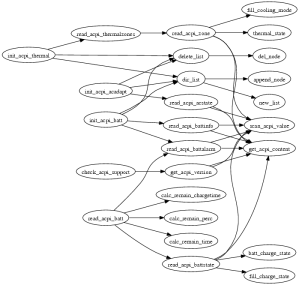
The result looks like this (looks cool huh? :-)):


The second variant I tested is a bit different and in my opinion the resulting graph looks a bit better.
The gcc commandline switch -finstrument-functions allows easy creations of call-graphs for C/C++ (script languages used but I haven't tried).
You need to compile every file with the -finstrument-functions switch. Then gcc places a call to the functions __cyg_profile_func_enter upon entering a function and __cyg_profile_func_exit on leaving a function.

Compile your sources with -g and -finstrumental-functions:
$ gcc -g -finstrumental-functions list.c libacpi.c test.c -o test
Now you need to get some source code by Sebastian Krahmer (SuSE):
$ wget http://www.suse.de/~krahmer/instrumental/instrumental.tgz && tar xvfz instrumental.tgz && cd instrumental
Compile a shared object file:
$ cc -fPIC -c instrumental.c && ld -Bshareable instrumental.o -o inst.so
This generates a shared object file you can preload with LD_PRELOAD
$ LD_PRELOAD=./inst.so test
.....

Now you will find a log.inst.dot.<pid> and log.inst.ascii.<pid> in /tmp (path can be modified in instrumental.c).
The first file is a dot file you can now create a ps and a png file with but you need to attach a closing bracket at the end of the file since the package is not
able to intercept exit() or aborts. echo ' ' >> log.inst.dot.<pid>
$ dot -Gsize=15,20 -Grankdir=LR -Tps -o graph.ps log.inst.dot.<pid> && gm convert graph.ps graph.png
The result looks like:


PDF file which scales a bit better

The other file represents the call graph in ascii:
~ [1000 1000 1000] -- main (0x8049ea4)
~ [1000 1000 1000] -- check_acpi_support (0x8048984)
~ [1000 1000 1000] -- get_acpi_version (0x8048782)
~ [1000 1000 1000] -- get_acpi_content (0x80486b4)
~ [1000 1000 1000] -- scan_acpi_value (0x8048837)
~ [1000 1000 1000] -- init_acpi_batt (0x80489d6)
~ [1000 1000 1000] -- dir_list (0x804a447)
~ [1000 1000 1000] -- new_list (0x804a23c)
~ [1000 1000 1000] -- append_node (0x804a309)
~ [1000 1000 1000] -- read_acpi_battinfo (0x80497d3)
~ [1000 1000 1000] -- get_acpi_content (0x80486b4)
....

So both methods work but the first seems to be more useful if you want a graph for a specific file, not a specific program since you get an RTL file for each source file and you don't need all to create the dot file. The second method however looks better but has the limitation that you actually need to run the program (but that's dynamic and not static) and you can't (correct me if I miss something) create graphs for single files.

Have fun creating graphs for your favorite software and have a look into Sebastian Krahmers paper http://www.suse.de/~krahmer/instrumental/instrumental.pdf and http://www.ibm.com/developerworks/library/l-graphvis/. He also created a graph for openssh http://www.suse.de/~krahmer/ossh4.6.pdf.

Biella Coleman: Just Say No

I am in SF now and saw that the local weekly just published a really good article on those who steer clear of psychiatric drugs, called Just Say No. It is quite good, check it out.

Adam Rosi-Kessel: Christopher Hitchens vs. God

Christopher Hitchens goes to war against religion–on a recent episode of Radio Open Source: “Religion does not say that there is a mystery. Religion says there is an answer to a mystery.” It’s an interesting observation, but, I think, wrong. For a hyper-rationalist, Hitchens resorts to a lot of irrational attacks. If nothing else, his caustic approach is probably not winning many converts. Although he refuses to admit it, I think his problem is really with fundamentalists, not with religion. By taking such a polemical approach, though, he is probably selling more books. Check out his appearance on the show, as well as the follow-up on a later show (and comments). Radio Open Source is a rare example of a successful melding of old and new media. Often traditional media efforts to create a web-based “community” around an existing show fall flat. Open Source was started as a multimedia show, though, and maybe that’s why it works.

23 May 2007

Luk Claes: BSP l10n

Last weekend we organised a Bug Squashing Party where more than 70 packages got fixed. Personally I fixed more than half of these :-) I noticed two unexpected things. Some maintainers were not aware that in a BSP with uploads to DELAYED-0 they should mark bugs pending or comment in the BTS if they don't want people to work on these bugs. Next some NMUers only fixed RC bugs even if there could be translations included or updated. Anyway the BSP was very successfull though I hope even more people will be involved in the next one ;-)

MJ Ray: Government Use of Free Software on TV

There's a TV Show about Bolzano adopting Free Software with English subtitles in-vision. It's quite good, emphasising the double win of more freedom and fairer costs. Tip to Graham and you might want ytplay

22 May 2007

Cameron Dale: May-22-2007: The Long Weekend of Documentation

I spent most of this past weekend (a long weekend in Canada, thanks to our royal heritage) writing documentation for the DebTorrent code. The original BitTornado code was seriously lacking in this area, having only 670 lines of comments out of almost 20,000 total lines of code, which is 3.5% if you're counting. (In fairness, this may be due in part to it being based on the original bittorrent client.) Since Python is supposed to be known for it's well-documented code, I decided to tackle this shortcoming sooner rather than later. It's also a good opportunity for me to become familiar with all of the code. I'm only about halfway there, but the end result of my weekend's worth of work is this diffstat:
DebTorrent/BT1/Choker.py             99 ++++++++
DebTorrent/BT1/Connecter.py         313 +++++++++++++++++++++++++++
DebTorrent/BT1/Downloader.py        448 ++++++++++++++++++++++++++++++++++++++-
DebTorrent/BT1/Storage.py           418 ++++++++++++++++++++++++++++++++++--
DebTorrent/BT1/__init__.py            9
DebTorrent/BT1/btformats.py          47 ++++
DebTorrent/BTcrypto.py              147 ++++++++++++
DebTorrent/ConfigDir.py             248 +++++++++++++++++++++
DebTorrent/ConnChoice.py             12 -
DebTorrent/CurrentRateMeasure.py     69 +++++-
DebTorrent/__init__.py               14 +
DebTorrent/bencode.py               193 ++++++++++++++++
DebTorrent/bitfield.py               89 +++++++
DebTorrent/clock.py                  53 ++++
DebTorrent/download_bt1.py          380 ++++++++++++++++++++++++++++++++-
DebTorrent/inifile.py                70 ++++--
btcompletedir.py                     25 ++
btcopyannounce.py                    20 +
btdownloadheadless.py               111 +++++++++
btlaunchmany.py                      56 ++++
btmakemetafile.py                    19 +
btreannounce.py                       6
btrename.py                          11
btsethttpseeds.py                     6
btshowmetainfo.py                     6
bttrack.py                            6
setup.py                             20 +
27 files changed, 2809 insertions(+), 86 deletions(-)
I've also started using the epydoc program to automatically generate some documentation web pages for easy browsing of the code. So far it's worked out great! So well that I decided to use some of the new features available in a recent beta release that was not yet in the debian archive. The packaging seemed simple enough, so I created my own package containing the new upstream version, which is now available in my repository.

Alastair McKinstry: Election 2007: Choices in Galway West ?

Has anyone seen a recent poll for Galway West? (In the Irish General Election, that is). The last poll was March 26th, which is way out-of-date : long prior to the election being called, before the Cryptosporidium Crisis, etc. The result is, I'm in the unusual position of having to make a decision. Ordinarily I'd vote Number 1 for Niall O'Brolch in (Green) and 2. Micheal D. Higgins (Labour). Ireland uses the unusual Single Transferable Vote system, with multi-member constituencies. Galway West is a 5-seat constituency, and Micheal D. is a long-sitting TD, who most would have expected to be automatically returned. Niall O'Brolch in is fairly new; he's a member of the City Council and current Mayor of Galway (thats a relatively powerless post in the Irish local council scheme of things, though). Unfortunately news from the Labour camp appears that too many people assume he will be automatically returned; the word they are getting on the street is "Yes, you'll be getting my no.2 ". But in the STV system, this could mean he wouldn't be in the running. Those votes for the Greens and others will perhaps stay with the Greens and won't transfer to him. So the choice, Vote 1. Greens, which is my natural preference, or 1. Labour, in the hope of getting both Micheal D. and Niall elected? a poll of the current situation would help. BTW, for voting geeks, following the link and reading about STV is worth it. It makes Irish election counts the most fun election counts in the World. One of the main arguments against electronic voting in Ireland has been that it would take all the fun out of the count, which would be over too soon ... Tags ,

21 May 2007

Joachim Breitner: Spontanious DHCP-Server

Sometime someone connects his computer to mine using a network cable, to transfer some files or similar. In a perfect world, both computers would run something like zeroconf or avahi-autoip, and IP adresses were taken care of. But in the real world, this is not often the case. Then, this would be easiest:
$ ifconfig eth0 192.168.42.1
$ simpledhcpd eth0
Where simpledhcpd would, without any configuration, start listening for DHCP requests on eth0 and serve IPs from the just configured subnet. No configuration file, no leases, not even a deamon mode. Just Real Simple IPs for your ad-hoc-network. Does that already exists?

Bernd Zeimetz: hi, planet // iso8859-15 to utf8 with netatalk magic

<div xmlns='http://www.w3.org/1999/xhtml'> <h1><a name="hi_planet_iso8859-15_to_utf8_with_netatalk_magic" id="hi_planet_iso8859-15_to_utf8_with_netatalk_magic">hi, planet // iso8859-15 to utf8 with netatalk magic</a></h1> <p> <em><strong>Hi, Planet!</strong> <br/> Welcome to my blog, and thanks to <a href="http://blog.zobel.ftbfs.de/" title="http://blog.zobel.ftbfs.de/" rel="nofollow">Martin</a> for subscribing me. I m not going to bother you with any details about me, if you have any questions feel free to ask me on <a href="http://freenode.net/" title="http://freenode.net/" rel="nofollow">freenode</a> or <a href="http://www.oftc.net/" title="http://www.oftc.net/" rel="nofollow">oftc</a> (in case you re wondering: my nick is bzed).</em> <br/> <br/> After a longer time of planning we ve upgraded our main file server at <a href="http://www.architektur.tu-darmstadt.de" title="http://www.architektur.tu-darmstadt.de" rel="nofollow">work</a>: New machine, new storage (7TB - woohoo!), Etch instead of Sarge and <a href="http://en.wikipedia.org/wiki/UTF-8" title="http://en.wikipedia.org/wiki/UTF-8">UTF-8</a> for file names instead of <a href="http://en.wikipedia.org/wiki/ISO8859-15" title="http://en.wikipedia.org/wiki/ISO8859-15">ISO8859-15</a>. Everything not a too complicated thing, except for renaming the about 10,000,000 files from ISO8859-15 to UTF-8 in a proper way. <br/> In theory this is easy, as <a href="http://packages.debian.org/unstable/utils/convmv" title="http://packages.debian.org/unstable/utils/convmv" rel="nofollow">convmv</a> happily takes care of the problem. But this did not work for us unfortunately, as we re not only providing NFS and Samba services, but also AFP (<a href="http://en.wikipedia.org/wiki/Apple_Filing_Protocol" title="http://en.wikipedia.org/wiki/Apple_Filing_Protocol">Apple_Filing_Protocol</a>) via netatalk. Years ago you had to choose ISO8859-15 if you wanted to allow your Apple and Windows users to see the same, non-broken file names - not only because AFP didn t support UTF8 before version 3, which came out with OSX<a href="#fn__1" name="fnt__1" id="fnt__1">1)</a>. Normally you d think that a server would not allow a client to write a file with a file name which includes not supported characters - again, OSX and netatalk go their own way here:<br/> Characters which are not supported by the underlying file system are character(!)-wise encoded using the <a href="http://netatalk.sourceforge.net/2.0/htmldocs/configuration.html#id2898845" title="http://netatalk.sourceforge.net/2.0/htmldocs/configuration.html#id2898845" rel="nofollow">CAP encoding</a>. So we had to find a way to </p> <ul> <li> convert file names from ISO8859-15 to UTF-8 </li> <li> replace CAP encoded characters by the appropriate UTF-8 character </li> </ul> <p> Luckily netatalk ships the <a href="http://netatalk.sourceforge.net/2.0/htmldocs/uniconv.1.html" title="http://netatalk.sourceforge.net/2.0/htmldocs/uniconv.1.html" rel="nofollow">uniconv(1)</a> util<a href="#fn__2" name="fnt__2" id="fnt__2">2)</a> which is able to take care of this problem. It also updates the CNID<a href="#fn__3" name="fnt__3" id="fnt__3">3)</a> Database at the same time. There s two things you need to take care of in case you re using the dbd <a href="http://netatalk.sourceforge.net/2.0/htmldocs/configuration.html#CNID-backends" title="http://netatalk.sourceforge.net/2.0/htmldocs/configuration.html#CNID-backends" rel="nofollow">CNID backend</a>: </p> <ul> <li> uniconv assumes that <em>cnid_metad</em> is listening on port 4700, you need to start it first. Don t run afpd at the same time! </li> <li> If you ve specified external CNID dbpaths in your <em>AppleVolumes.default</em> (normally they re located in the root of each volume, prone to be deleted by users accidentally), you need to move the .AppleDB directory into your volume s root directory, otherwise uniconv will create a new CNID database. Just move it back as soon as uniconv is finished. </li> </ul> <p> Be careful: uniconv assumes that all colons in a file name are part of a CAP encoded character. That s not a problem as long as you have only Mac and Windows clients accessing your server, as both systems do not allow colons in file names. In our case we found a number of cache files from Nautilus (which is running on our sunray/Solaris web-surf terminals as default browser) with colons in the file name. I hope no user will miss them <img src="http://bzed.de/lib/images/smileys/icon_wink.gif" alt=";-)" /> </p> <p> Including a final synchronisation of all files to the new storage, about two hours it took uniconv to convert the file names and a aunch break, we were finished after about 14 hours of work. Until now it seems that our users didn t notice the change at all, except for those who realized that they have much more free space now. Looks like a successful weekend so far! <img src="http://bzed.de/lib/images/smileys/icon_biggrin.gif" alt=":-D" /> </p> <p> <strong>update:</strong> full html in the feed. </p> <div class="tags"><span> <a href="http://bzed.de/tags/debian" class="wikilink1" title="tags:debian" rel="tag">debian</a>, <a href="http://bzed.de/tags/linux" class="wikilink1" title="tags:linux" rel="tag">linux</a> </span></div> <a href="#fnt__1" id="fn__1" name="fn__1">1)</a> and uses a NFD variant of Unicode normalization (<a href="http://en.wikipedia.org/wiki/UTF-8%23Mac_OS_X" title="http://en.wikipedia.org/wiki/UTF-8%23Mac_OS_X">UTF-8#Mac_OS_X</a>), but netatalk takes care of this and translates it into the NFC form, which is used on most other platforms <a href="#fnt__2" id="fn__2" name="fn__2">2)</a> it s called netatalk-uniconv in Debian and shipped with <a href="http://packages.debian.org/stable/net/netatalk" title="http://packages.debian.org/stable/net/netatalk" rel="nofollow">netatalk</a> <a href="#fnt__3" id="fn__3" name="fn__3">3)</a> Catalog Node ID, another crust from old Mac <acronym title="Operating System">OS</acronym> versions </div>

Next.

Previous.