Search Results: "tar"

23 November 2015

Riku Voipio: Using ser2net for serial access.

Is your table a mess of wires? Do you have multiple devices connected via serial and can't remember which is /dev/ttyUSBX is connected to what board? Unless you are a embedded developer, you are unlikely to deal with serial much anymore - In that case you can just jump to the next post in your news feed. Introducting ser2netUsually people start with minicom for serial access. There are better tools - picocom, screen, etc. But to easily map multiple serial ports, use ser2net. Ser2net makes serial ports available over telnet. Persistent usb device names and ser2netTo remember which usb-serial adapter is connected to what, we use the /dev/serial tree created by udev, in /etc/ser2net.conf:

# arndale
7004:telnet:0:'/dev/serial/by-path/pci-0000:00:1d.0-usb-0:1.8.1:1.0-port0':115200 8DATABITS NONE 1STOPBIT
# cubox
7005:telnet:0:/dev/serial/by-id/usb-Prolific_Technology_Inc._USB-Serial_Controller_D-if00-port0:115200 8DATABITS NONE 1STOPBIT
# sonic-screwdriver
7006:telnet:0:/dev/serial/by-id/usb-FTDI_FT230X_96Boards_Console_DAZ0KA02-if00-port0:115200 8DATABITS NONE 1STOPBIT
The by-path syntax is needed, if you have many identical usb-to-serial adapters. In that case a Patch from BTS is needed to support quoting in serial path. Ser2net doesn't seems very actively maintained upstream - a sure sign that project is stagnant is a homepage still at sourceforge.net... This patch among other interesting features can be also be found in various ser2net forks in github. Setting easy to remember names Finally, unless you want to memorize the port numbers, set TCP port to name mappings in /etc/services:

# Local services
arndale 7004/tcp
cubox 7005/tcp
sonic-screwdriver 7006/tcp
Now finally:
telnet localhost sonic-screwdriver
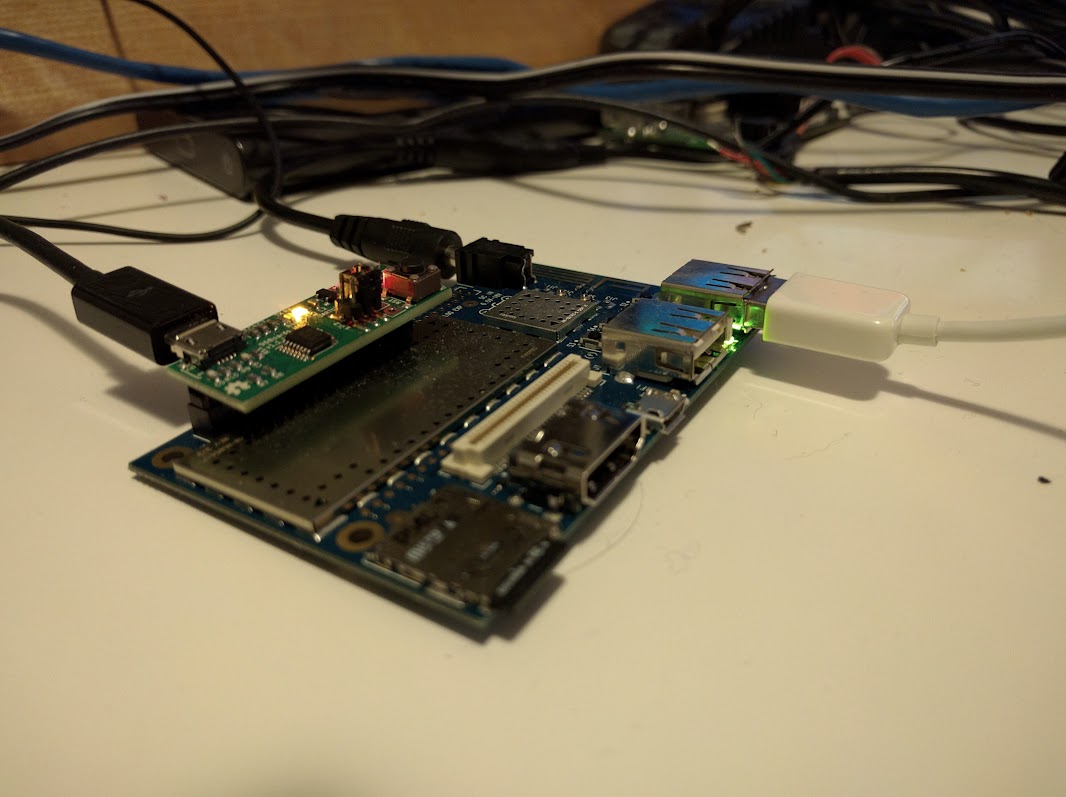
^Mandatory picture of serial port connection in action

Lunar: Reproducible builds: week 30 in Stretch cycle

What happened in the reproducible builds effort this week: Toolchain fixes Mattia Rizzolo uploaded a version of perl to the reproducible repository including the patch written by Niko Tyni to add support for SOURCE_DATE_EPOCH in Pod::Man. Dhole sent an updated version of his patch adding support for SOURCE_DATE_EPOCH in GCC to the upstream mailing list. Several comments have been made in response which have been quickly addressed by Dhole. Dhole also forwarded his patch adding support for SOURCE_DATE_EPOCH in libxslt upstream. Packages fixed The following packages have become reproducible due to changes in their build dependencies: antlr3/3.5.2-3, clusterssh, cme, libdatetime-set-perl, libgraphviz-perl, liblingua-translit-perl, libparse-cpan-packages-perl, libsgmls-perl, license-reconcile, maven-bundle-plugin/2.4.0-2, siggen, stunnel4, systemd, x11proto-kb. The following packages became reproducible after getting fixed: Some uploads fixed some reproducibility issues, but not all of them: reproducible.debian.net Vagrant Cascadian has set up a new armhf node using a Raspberry Pi 2. It should soon be added to the Jenkins infrastructure. diffoscope development diffoscope version 42 was release on November 20th. It adds a missing dependency on python3-pkg-resources and to prevent similar regression another autopkgtest to ensure that the command line is functional when Recommends are not installed. Two more encoding related problems have been fixed (#804061, #805418). A missing Build-Depends has also been added on binutils-multiarch to make the test suite pass on architectures other than amd64. Package reviews 180 reviews have been removed, 268 added and 59 updated this week. 70 new fail to build from source bugs have been reported by Chris West, Chris Lamb and Niko Tyni. New issue this week: randomness_in_ocaml_preprocessed_files. Misc. Jim MacArthur started to work on a system to rebuild and compare packages built on reproducible.debian.net using .buildinfo and snapshot.debian.org. On December 1-3rd 2015, a meeting of about 40 participants from 18 different free software projects will be held in Athens, Greece with the intent of improving the collaboration between projects, helping new efforts to be started, and brainstorming on end-user aspects of reproducible builds.

Thomas Goirand: OpenStack Liberty and Debian

Long over due post It s been a long time I haven t written here. And lots of things happened in the OpenStack planet. As a full time employee with the mission to package OpenStack in Debian, it feels like it is kind of my duty to tell everyone about what s going on. Liberty is out, uploaded to Debian Since my last post, OpenStack Liberty, the 12th release of OpenStack, was released. In late August, Debian was the first platform which included Liberty, as I proudly outran both RDO and Canonical. So I was the first to make the announcement that Liberty passed most of the Tempest tests with the beta 3 release of Liberty (the Beta 3 is always kind of the first pre-release, as this is when feature freeze happens). Though I never made the announcement that Liberty final was uploaded to Debian, it was done just a single day after the official release. Before the release, all of Liberty was living in Debian Experimental. Following the upload of the final packages in Experimental, I uploaded all of it to Sid. This represented 102 packages, so it took me about 3 days to do it all. Tokyo summit I had the pleasure to be in Tokyo for the Mitaka summit. I was very pleased with the cross-project sessions during the first day. Lots of these sessions were very interesting for me. In fact, I wish I could have attended them all, but of course, I can t split myself in 3 to follow all of the 3 tracks. Then there was the 2 sessions about Debian packaging on upstream OpenStack infra. The goal is to setup the OpenStack upstream infrastructure to allow packaging using Gerrit, and gating each git commit using the usual tools: building the package and checking there s no FTBFS, running checks like lintian, piuparts and such. I knew already the overview of what was needed to make it happen. What I didn t know was the implementation details, which I hoped we could figure out during the 1:30 slot. Unfortunately, this didn t happen as I expected, and we discussed more general things than I wished. I was told that just reading the docs from the infra team was enough, but in reality, it was not. What currently needs to happen is building a Debian based image, using disk-image-builder, which would include the usual tools to build packages: git-buildpackage, sbuild, and so on. I m still stuck at this stage, which would be trivial if I knew a bit more about how upstream infra works, since I already know how to setup all of that on a local machine. I ve been told by Monty Tailor that he would help. Though he s always a very busy man, and to date, he still didn t find enough time to give me a hand. Nobody replied to my request for help in the openstack-dev list either. Hopefully, with a bit of insistence, someone will help. Keystone migration to Testing (aka: Debian Stretch) blocked by python-repoze.who Absolutely all of OpenStack Liberty, as of today, has migrated to Stretch. All? No. Keystone is blocked by a chain of dependency. Keystone depends on python-pysaml2, itself blocked by python-repoze.who. The later, I upgraded it to version 2.2. Though python-repoze.what depends on version <= 1.9, which is blocking the migration. Since python-repoze.who-plugins, python-repoze.what and python-repoze.what-plugins aren t used by any package anymore, I asked for them to be removed from Debian (see #805407). Until this request is processed by the FTP masters, Keystone, which is the most important piece of OpenStack (it does the authentication) will be blocked for migration to Stretch. New OpenStack server packages available On my presentation at Debconf 15, I quickly introduced new services which were released upstream. I have since packaged them all: Congress, unfortunately, was not accepted to Sid yet, because of some licensing issues, especially with the doc of python-pulp. I will correct this (remove the non-free files) and reattempt an upload. I hope to make them all available in jessie-backports (see below). For the previous release of OpenStack (ie: Kilo), I skipped the uploads of services which I thought were not really critical (like Ironic, Designate and more). But from the feedback of users, they would really like to have them all available. So this time, I will upload them all to the official jessie-backports repository. Keystone v3 support For those who don t know about it, Keystone API v3 means that, on top of the users and tenant, there s a new entity called a domain . All of the Liberty is now coming with Keystone v3 support. This includes the automated Keystone catalog registration done using debconf for all *-api packages. As much as I could tell by running tempest on my CI, everything still works pretty well. In fact, Liberty is, to my experience, the first release of OpenStack to support Keystone API v3. Uploading Liberty to jessie-backports I have rebuilt all of Liberty for jessie-backports on my laptop using sbuild. This is more than 150 packages (166 packages currently). It took me about 3 days to rebuild them all, including unit tests run at build time. As soon as #805407 is closed by the FTP masters, all what s remaining will be available in Stretch (mostly Keystone), and the upload will be possible. As there will be a lot of NEW packages (from the point of view of backports), I do expect that the approval will take some time. Also, I have to warn the original maintainers of the packages that I don t maintain (for example, those maintained within the DPMT), that because of the big number of packages, I will not be able to process the usual communication to tell that I m uploading to backports. However, here s the list of package. If you see one that you maintain, and that you wish to upload the backport by yourself, please let me know. Here s the list of packages, hopefully, exhaustive, that I will upload to jessie-backports, and that I don t maintain myself: alabaster contextlib2 kazoo python-cachetools python-cffi python-cliff python-crank python-ddt python-docker python-eventlet python-git python-gitdb python-hypothesis python-ldap3 python-mock python-mysqldb python-pathlib python-repoze.who python-setuptools python-smmap python-unicodecsv python-urllib3 requests routes ryu sphinx sqlalchemy turbogears2 unittest2 zzzeeksphinx. More than ever, I wish I could just upload these to a PPA^W Bikeshed, to minimize the disruption for both the backports FTP masters, other maintainers, and our OpenStack users. Hopefully, Bikesheds will be available soon. I am sorry to give that much approval work to the backports FTP masters, however, using the latest stable system with the latest release, is what most OpenStack users really want to do. All other major distributions have specific repositories too (ie: RDO for CentOS / Red Hat, and cloud archive for Ubuntu), and stable-backports is currently the only place where I can upload support for the Stable release. Debian listed as supported distribution on openstack.org Good news! If you go at http://www.openstack.org/marketplace/distros/ you will see a list of supported distributions. I am proud to be able to tell that, after 6 months of lobbying from my side, Debian is also listed there. The process of having Debian there included talking with folks from the OpenStack foundation, and having Bdale to sign an agreement so that the Debian logo could be reproduced on openstack.org. Thanks to Bdale Garbee, Neil McGovern, Jonathan Brice, and Danny Carreno, without who this wouldn t have happen.

20 November 2015

Daniel Pocock: Databases of Muslims and homosexuals?

One US presidential candidate has said a lot recently, but the comments about making a database of Muslims may qualify as the most extreme. Of course, if he really wanted to, somebody with this mindset could find all the Muslims anyway. A quick and easy solution would involve tracing all the mobile phone signals around mosques on a Friday. Mr would-be President could compel Facebook and other social networks to disclose lists of users who identify as Muslim. Databases are a dangerous side-effect of gay marriage In 2014 there was significant discussion about Brendan Eich's donation to the campaign against gay marriage. One fact that never ranked very highly in the debate at the time is that not all gay people actually support gay marriage. Even where these marriages are permitted, not everybody who can marry now is choosing to do so. The reasons for this are varied, but one key point that has often been missed is that there are two routes to marriage equality: one involves permitting gay couples to visit the register office and fill in a form just as other couples do. The other route to equality is to remove all the legal artifacts around marriage altogether. When the government does issue a marriage certificate, it is not long before other organizations start asking for confirmation of the marriage. Everybody from banks to letting agents and Facebook wants to know about it. Many companies outsource that data into cloud CRM systems such as Salesforce. Before you know it, there are numerous databases that somebody could mine to make a list of confirmed homosexuals. Of course, if everybody in the world was going to live happily ever after none of this would be a problem. But the reality is different. While discrimination: either against Muslims or homosexuals - is prohibited and can even lead to criminal sanctions in some countries, this attitude is not shared globally. Once gay people have their marriage status documented in the frequent flyer or hotel loyalty program, or in the public part of their Facebook profile, there are various countries where they are going to be at much higher risk of prosecution/persecution. The equality to marry in the US or UK may mean they have less equality when choosing travel destinations. Those places are not as obscure as you might think: even in Australia, regarded as a civilized and laid-back western democracy, the state of Tasmania fought tooth-and-nail to retain the criminalization of virtually all homosexual conduct until 1997 when the combined actions of the federal government and high court compelled the state to reform. Despite the changes, people with some of the most offensive attitudes are able to achieve and retain a position of significant authority. The same Australian senator who infamously linked gay marriage with bestiality has successfully used his position to set up a Senate inquiry as a platform for conspiracy theories linking Halal certification with terrorism. There are many ways a database can fall into the wrong hands Ironically, one of the most valuable lessons about the risk of registering Muslims and homosexuals was an injustice against the very same tea-party supporters a certain presidential candidate is trying to woo. In 2013, it was revealed IRS employees had started applying a different process to discriminate against groups with Tea party in their name. It is not hard to imagine other types of rogue or misinformed behavior by people in positions of authority when they are presented with information that they don't actually need about somebody's religion or sexuality. Beyond this type of rogue behavior by individual officials and departments, there is also the more sinister proposition that somebody truly unpleasant is elected into power and can immediately use things like a Muslim database, surveillance data or the marriage database for a program of systematic discrimination. France had a close shave with this scenario in the 2002 presidential election when
Jean-Marie Le Pen, who has at least six convictions for racism or inciting racial hatred made it to the final round in a two-candidate run-off with Jacques Chirac. The best data security The best way to be safe- wherever you go, both now and in the future - is not to have data about yourself on any database. When filling out forms, think need-to-know. If some company doesn't really need your personal mobile number, your date of birth, your religion or your marriage status, don't give it to them.

Gergely Nagy: Looking for a keyboard

Even though I spend more time staring at the screen than typing, there are times when I - after lots and lots of prior brain work - sit down and start typing, a lot. A couple of years ago, I started to feel pain in my wrists, and there were multiple occasions when I had to completely stop writing for longer periods of time. These were situations I obviously did not want repeated, so I started to look for remedies. First, I bought a new keyboard, a TypeMatrix 2300, which while not ergonomic, was a huge relief for my hands and wrists. I also started to learn Dvorak, but that's still something that is kind-of in progress: my left hand can write Dvorak reasonably fast, but my right one seems to be Qwerty-wired, even after a month of typing Dvorak almost exclusively.This keyboard served me well for the past five year or so. But recently, I started to look for a replacement, partly triggered by a Clojure/conj talk I watched. I got as far as assembling a list of keyboards I'm interested in, but I have a hard time choosing. This blog post here serves two purposes then: first to make a clear pros/cons list for myself, second, to solicit feedback from others who may have more experience with any of the options below.Update: There is a [follow up post], with a few more keyboards explored, and a semi-final verdict. Thanks everyone for the feedback and help, much appreciated!Lets start with the current keyboard!TypeMatrix 2030TypeMatrix 2030Pros Cons SummaryAll in all, this is a keyboard I absolutely love, and am very happy with. Yet, I feel I'm ready to try something different. With my skins aging, and the aforementioned Clojure/conj talk, the desire to switch has been growing for a while now.Desired propertiesThere are a few desired properties of the keyboard I want next. The perfect keyboard need not have all of these, but the more the merrier. I plan to buy one keyboard for a start, but may end up buying another to bring to work (like I did with the TypeMatrix, except my employer at the time bought the second one for me). At work, I will continue using the TypeMatrix, most likely, but I'm not sure yet.Anyhow, there are a number of things I do with my computer that require a keyboard: I am looking for a keyboard that helps me do these things. A keyboard that will stay with me not for five years or a decade, but pretty much forever.The optionsUltimate Hacking KeyboardUltimate Hacking KeyboardPros Cons SummaryThe keyboard looks nice, has a lot of appealing features. It is programmable, so much so that by the looks of it, I could emulate the hardware dvorak switch my TypeMatrix has. However, I'm very unhappy with the addons, so there's that too.All in all, this would cost me about $304 (base keyboard, modules, palm rest and shipping). Not too bad, certainly a strong contender, despite the shortcomings.ErgoDoxErgoDoxPros Cons SummaryThe keyboard looks interesting, primarily due to the thumb keys. From the ErgoDox EZ campaign, I'm looking at $270. That's friendly, and makes ErgoDox a viable option! (Thanks @miffe!)Kinesis AdvantageKinesis AdvantagePros Cons SummaryThe key wells look interesting, but it's not a split keyboard, nor is it open source. The cost come out about $325 plus shipping and VAT and so on, so I'm probably looking at something closer to $400. Nah. I'm pretty sure I can rule this out.Kinesis FreeStyle2Kinesis FreeStyle2Pros Cons SummaryWhile a split keyboard, at a reasonably low cost ($149 + shipping + VAT), it lacks too many things to be considered a worthy contender.MaltronMaltronPros Cons SummaryWithout shipping, I'm looking at 450. That's a very steep price. I love the wells, and the thumb keys, but it's not split, and customisability is a big question here.AtreusAtreusPros Cons SummaryWhile not a split keyboard, it does look very interesting, and the price is much lower than the rest: $149 + shipping ($50 or so). It is similar - in spirit - to my existing TypeMatrix. It wouldn't take much to get used to, and is half the price of the alternatives. A strong option, for sure.Keyboardio M01Keyboardio Model 01Pros Cons SummaryWith shipping cost and whatnot, I'm looking at something in the $370 ballpark, which is on the more expensive side. On the other hand, I get a whole lot of bang for my buck: LEDs, two center bars (tripod mounting sounds really awesome!), hardwood body, and a key layout that is very similar to what I came to love on the TypeMatrix.I also have a thing for wooden stuff. I like the look of it, the feel of it.The Preference ListAfter writing this all up, I think I prefer the Model 01, but the UHK and ErgoDox come close too!The UHK is cheaper, but not by a large margin. It lacks the thumb keys and the palm key the M01 has. It also looks rather dull (sorry). They'd both ship about the same time, but, the M01 is already funded, while the UHK is not (mind you, there's a pretty darn high chance it will be).The ErgoDox has thumb keys, split keyboard, and is open source. Compared to the UHK, we have the thumb keys, and less distraction, for a better price. But the case is not so nice. Compared to the Model 01: no leds, or center bar, and an inferior case. But, much better price, which is an important factor too.Then, there's the Atreus. While it's a DIY kit, it is much more affordable than the rest, and I could have it far sooner. Yet... it doesn't feel like a big enough switch from my current keyboard. I might as well continue using the TypeMatrix then, right?The rest, I ruled out earlier, while I was reviewing them anyway.So, the big question is: should I invest close to $400 into a keyboard that looks stunning, and will likely grow old with me? Or should I give up some of the features, and settle for one of the $300 ones, that'll also grow old with me. Or is there an option I did not consider, that may match my needs and preferences better?If you, my dear reader, got this far, and have a suggestion, please either tweet at me, or write an email, or reach me over any other medium I am reachable at (including IRC, hanging out as algernon on FreeNode and OFTC).Thank you in advance, to all of you who contact me, and help me choose a keyboard!

Sylvain Beucler: No to ACTA - Paris

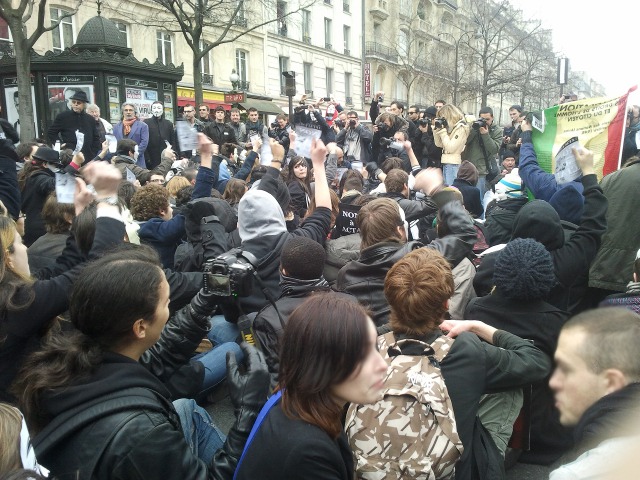
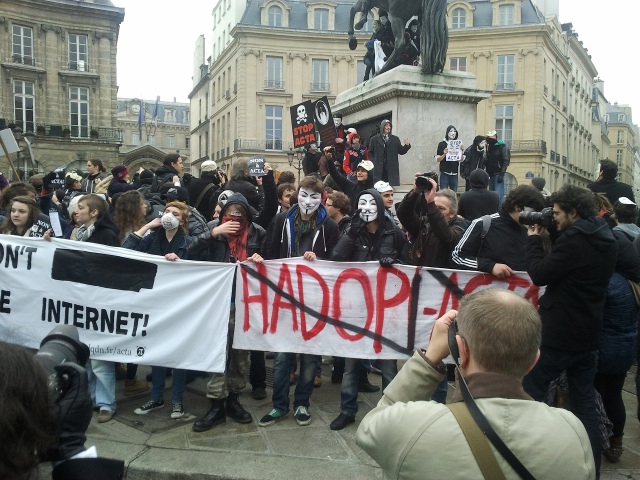
Today, there were events all around Europe to block ACTA. In Paris, the protest started at Place de la Bastille : APRIL was present, with in particular its president Lionel Allorge, and two members who wore the traditional anti-DRM suit : J r mie Zimmermann from La Quadrature du Net gave a speech and urged people to contact their legal representatives, in addition to protesting in the street : The protest was cheerful and free of violence : It got decent media coverage : Notable places it crossed include Place des Victoires : and Palais Royal, where it ended : Next protest is in 2 weeks, on March 10th. Update your agenda!

Sylvain Beucler: Rebuilding Android proprietary SDK binaries

Going back to Android recently, I saw that all tools binaries from the Android project are now click-wrapped by a quite ugly proprietary license, among others an anti-fork clause (details below). Apparently those T&C are years old, but the click-wrapping is newer. This applies to the SDK, the NDK, Android Studio, and all the essentials you download through the Android SDK Manager. Since I keep my hands clean of smelly EULAs, I'm working on rebuilding the Android tools I need.
We're talking about hours-long, quad-core + 8GB-RAM + 100GB-disk-eating builds here, so I'd like to publish them as part of a project who cares. As a proof-of-concept, the Replicant project ships a 4.2 SDK and I contributed build instructions for ADT and NDK (which I now use daily). (Replicant is currently stuck to a 2013 code base though.) I also have in-progress instructions on my hard-drive to rebuild various newer versions of the SDK/API levels, and for the NDK whose releases are quite hard to reproduce (no git tags, requires fixes committed after the release, updates are partial rebuilds, etc.) - not to mention that Google doesn't publish the source code until after the official release (closed development) :/ And in some cases like Android Support Repository [not Library] I didn't even find the proper source code, only an old prebuilt. Would you be interested in contributing, and would you recommend a structure that would promote Free, rebuilt Android *DK? The legalese Anti-fork clause:
3.4 You agree that you will not take any actions that may cause or result in the fragmentation of Android, including but not limited to distributing, participating in the creation of, or promoting in any way a software development kit derived from the SDK.
So basically the source is Apache 2 + GPL, but the binaries are non-free. By the way this is not a GPL violation because right after:
3.5 Use, reproduction and distribution of components of the SDK licensed under an open source software license are governed solely by the terms of that open source software license and not this License Agreement.
Still, AFAIU by clicking "Accept" to get the binary you still accept the non-free "Terms and Conditions". (Incidentally, if Google wanted SDK forks to spread and increase fragmentation, introducing an obnoxious EULA is probably the first thing I'd have recommended. What was its legal team thinking?) Indemnification clause:
12.1 To the maximum extent permitted by law, you agree to defend, indemnify and hold harmless Google, its affiliates and their respective directors, officers, employees and agents from and against any and all claims, actions, suits or proceedings, as well as any and all losses, liabilities, damages, costs and expenses (including reasonable attorneys fees) arising out of or accruing from (a) your use of the SDK, (b) any application you develop on the SDK that infringes any copyright, trademark, trade secret, trade dress, patent or other intellectual property right of any person or defames any person or violates their rights of publicity or privacy, and (c) any non-compliance by you with this License Agreement.
Usage restriction:
3.1 Subject to the terms of this License Agreement, Google grants you a limited, worldwide, royalty-free, non-assignable and non-exclusive license to use the SDK solely to develop applications to run on the Android platform. 3.3 You may not use the SDK for any purpose not expressly permitted by this License Agreement. Except to the extent required by applicable third party licenses, you may not: (a) copy (except for backup purposes), modify, adapt, redistribute, decompile, reverse engineer, disassemble, or create derivative works of the SDK or any part of the SDK; or (b) load any part of the SDK onto a mobile handset or any other hardware device except a personal computer, combine any part of the SDK with other software, or distribute any software or device incorporating a part of the SDK.
If you know the URLs, you can still direct-download some of the binaries which don't embed the license, but all this feels fishy. GNU licensing didn't answer me (yet). Maybe debian-legal has an opinion? In any case, the difficulty to reproduce the *DK builds is worrying enough to warrant an independent rebuild. Did you notice this?

Timo Jyrinki: Converting an existing installation to LUKS using luksipc

This is a burst of notes that I wrote in an e-mail in June when asked about it, and I'm not going to have any better steps since I don't remember even that amount as back then. I figured it's better to have it out than not.

So... if you want to use LUKS In-Place Conversion Tool, the notes below on converting a shipped-with-Ubuntu Dell XPS 13 Developer Edition (2015 Intel Broadwell model) may help you. There were a couple of small learnings to be had...

The page http://www.johannes-bauer.com/linux/luksipc/ itself is good and without errors, although funnily uses reiserfs as an example. It was only a bit unclear why I did save the initial_keyfile.bin since it was then removed in the next step (I guess it's for the case you want to have a recovery file hidden somewhere in case you forget the passphrase).

For using the tool I booted from a 14.04.2 LTS USB live image and operated there, including downloading and compiling luksipc in the live session. The exact reason of resizing before luksipc was a bit unclear to me at first so I simply indeed resized the main rootfs partition and left unallocated space in the partition table.


Then finally I ran ./luksipc -d /dev/sda4 etc.


I realized I want /boot to be on an unencrypted partition to be able to load the kernel + initrd from grub before entering into LUKS unlocking. I couldn't resize the luks partition anymore since it was encrypted... So I resized what I think was the empty small DIAGS partition (maybe used for some system diagnostic or something, I don't know), or possibly the next one that is the actual recovery partition one can reinstall the pre-installed Ubuntu from. And naturally I had some problems because it seems vfatresize tool didn't do what I wanted it to do and gparted simply crashed when I tried to use it first to do the same. Anyway, when done with getting some extra free space somewhere, I used the remaining 350MB for /boot where I copied the rootfs's /boot contents to.

After adding the passphrase in luks I had everything encrypted etc and decryptable, but obviously I could only access it from a live session by manual cryptsetup luksOpen + mount /dev/mapper/myroot commands. I needed to configure GRUB, and I needed to do it with the grub-efi-amd64 which was a bit unfamiliar to me. There's also grub-efi-amd64-signed I have installed now but I'm not sure if it was required for the configuration. Secure boot is not enabled by default in BIOS so maybe it isn't needed.


I did GRUB installation I think inside rootfs chroot where I also mounted /dev/sda6 as /boot (inside the rootfs chroot), ie mounted dev, sys with -o bind to under the chroot (from outside chroot) and mount -t proc proc proc too. I did a lot of trial and effort so I surely also tried from outside the chroot, in the live session, using some parameters to point to the mounted rootfs's directories...


I needed to definitely install cryptsetup etc inside the encrypted rootfs with apt, and I remember debugging for some time if they went to the initrd correctly after I executed mkinitramfs/update-initramfs inside the chroot.


At the end I had grub asking for the password correctly at bootup. Obviously I had edited the rootfs's /etc/fstab to include the new /boot partition, I changed / to be "UUID=/dev/mapper/myroot / ext4 errors=remount-ro 0 ", kept /boot/efi as coming from the /dev/sda1 and so on. I had also added "myroot /dev/sda4 none luks" to /etc/crypttab. I seem to also have GRUB_CMDLINE_LINUX="cryptdevice=/dev/sda4:myroot root=/dev/mapper/myroot" in /etc/default/grub.

The only thing I did save from the live session was the original partition table if I want to revert.


So the original was:

Found valid GPT with protective MBR; using GPT.
Disk /dev/sda: 500118192 sectors, 238.5 GiB
Logical sector size: 512 bytes
...
First usable sector is 34, last usable sector is 500118158
Partitions will be aligned on 2048-sector boundaries
Total free space is 6765 sectors (3.3 MiB)

Number Start (sector) End (sector) Size Code Name
1 2048 1026047 500.0 MiB EF00 EFI system partition
2 1026048 1107967 40.0 MiB FFFF Basic data partition
3 1107968 7399423 3.0 GiB 0700 Basic data partition
4 7399424 467013631 219.2 GiB 8300
5 467017728 500117503 15.8 GiB 8200

And I now have:


Number Start (sector) End (sector) Size Code Name

1 2048 1026047 500.0 MiB EF00 EFI system partition
2 1026048 1107967 40.0 MiB FFFF Basic data partition
3 1832960 7399423 2.7 GiB 0700 Basic data partition
4 7399424 467013631 219.2 GiB 8300
5 467017728 500117503 15.8 GiB 8200
6 1107968 1832959 354.0 MiB 8300

So it seems I did not edit DIAGS (and it was also originally just 40MB) but did something with the recovery partition while preserving its contents. It's a FAT partition so maybe I was able to somehow resize it after all.


The 16GB partition is the default swap partition. I did not encrypt it at least yet, I tend to not run into swap anyway ever in my normal use with the 8GB RAM.


If you go this route, good luck! :D

Pau Garcia i Quiles: Desktops DevRoom @ FOSDEM 2016: Have you submitted your talk yet?

FOSDEM 2016 is going to be great (again!) and you still have the chance to be one of the stars. Have you submitted your talk to the Desktops DevRoom yet? No? Remember: we will only accept proposals until December 6th. After that, the Organization Team will get busy and vote and choose the talks. Here is the full Call for Participation, in case you need to check the details on how to submit: FOSDEM Desktops DevRoom 2016 Call for Participation Topics include anything related to the Desktop: desktop environments, software development for desktop/cross-platform, applications, UI, etc

18 November 2015

Daniel Pocock: Improving DruCall and JSCommunicator user interface

DruCall is one of the easiest ways to get up and running with WebRTC voice and video calling on your own web site or blog. It is based on 100% open source and 100% open standards - no binary browser plugins and no lock-in to a specific service provider or vendor. On Debian or Ubuntu, just running a command such as
# apt-get install -t jessie-backports drupal7-mod-drucall
will install Drupal, Apache, MySQL, JSCommunicator, JsSIP and all the other JavaScript library packages and module dependencies for DruCall itself. The user interface Most of my experience is in server-side development, including things like the powerful SIP over WebSocket implementation in the reSIProcate SIP proxy repro. In creating DruCall, I have simply concentrated on those areas related to configuring and bringing up the WebSocket connection and creating the authentication tokens for the call. Those things provide a firm foundation for the module, but it would be nice to improve the way it is presented and optimize the integration with other Drupal features. This is where the projects (both DruCall and JSCommunicator) would really benefit from feedback and contributions from people who know Drupal and web design in much more detail. Benefits for collaboration If anybody wants to collaborate on either or both of these projects, I'd be happy to offer access to a pre-configured SIP WebSocket server in my lab for more convenient testing. The DruCall source code is a Drupal.org hosted project and the JSCommunicator source code is on Github. When you get to the stage where you want to run your own SIP WebSocket server as well then free community support can also be provided through the repro-user mailing list. The free, online RTC Quick Start Guide gives a very comprehensive overview of everything you need to do to run your own WebRTC SIP infrastructure.

17 November 2015

Norbert Preining: Debian/TeX Live 2015.20151116-1

One month has passed since the big multiarch update, and not one bug report concerning it did come in, that are good news. So here is a completely boring update with nothing more than the usual checkout from the TeX Live tlnet distribution as of yesterday. Debian - TeX Live 2015 I cannot recall anything particular to mention here, so this time let me go with the list of updated and new packages only: Updated packages alegreya, algorithm2e, animate, archaeologie, articleingud, attachfile, bankstatement, beebe, biber, biblatex, biblatex-manuscripts-philology, biblatex-opcit-booktitle, bidi, br-lex, bytefield, catcodes, chemfig, chemformula, chemgreek, comprehensive, computational-complexity, ctable, datetime2, dowith, dvipdfmx, dvipdfmx-def, dynamicnumber, e-french, epspdf, etoc, fetamont, findhyph, fix2col, gitinfo2, gradstudentresume, indextools, kotex-oblivoir, kotex-utils, kpathsea, l3build, l3experimental, l3kernel, l3packages, latex, latex2e-help-texinfo, lisp-on-tex, ltxfileinfo, luatexja, makedtx, mathastext, mathtools, mcf2graph, media9, medstarbeamer, morehype, nameauth, nicetext, ocgx2, perltex, preview, prftree, pst-eucl, pstricks, reledmac, resphilosophica, selnolig, substances, tcolorbox, tetex, teubner, tex4ht, texdoc, texinfo, texlive-scripts, toptesi, translations, turabian-formatting, uptex, xepersian, xetex, xetex-def, xint. New packages asciilist, babel-macedonian, bestpapers, bibtexperllibs, fixcmex, iffont, nucleardata, srcredact, texvc, xassoccnt. Enjoy.

Sven Hoexter: Failing with F5: assign a http profile and an irule at the same time

Beside of an upgrade to TMOS 11.4.1HF9 I wanted to use a maintenance today to assign some specific irule to a VS. Within the irule I use some HTTP functions so when I tried to add the irule to the already existing VS the tmsh correctly told me that I also need a http profile on this VS. Thanks tmsh you're right, oversight by myself. So what I did was:
tmsh modify ltm virtual mySpecialVS rules   mySpecialiRule   profiles add   company-http-profile  
tmsh accepted but all my tests ended at the VS. I could connect but got no reply at all. That was strange because I tested this irule extensively. So I reverted back to the known good state with just plain tcp forwarding. My next try was to assign only the http profile without the irule.
tmsh modify ltm virtual mySpecialVS profiles add   company-http-profile  
Tested that and it worked. So what on earth was wrong with my irule? I added some debug statements and readded the irule like this:
tmsh modify ltm virtual mySpecialVS rules   mySpecialiRule  
And now it worked as intended. So I went on and removed my debug statements, tested again and it still works. Let's see if I can reproduce that case some time later this week to fill a proper bugreport with F5. Update: Turns out it was all my fault. Due to a misunderstanding about RULE_INIT and the static namespace, I managed to overwrite important variables globally. Lesson learned: Be very careful if you use "static::" or better avoid it. Also think twice if you start to set things on the RULE_INIT event. Since it's only called on saving an irule or restarts of the device, your errors might show only later when you do not expect that.

16 November 2015

Daniel Pocock: Quick start using Blender for video editing

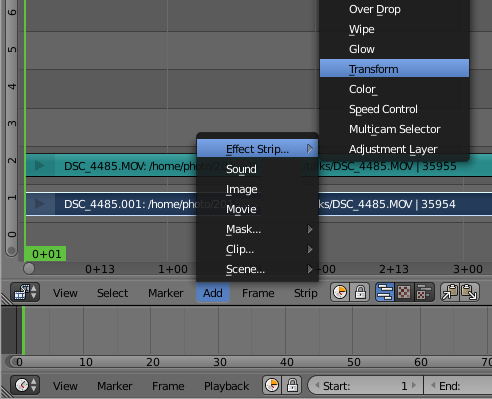
Updated 2015-11-16 for WebM Although it is mostly known for animation, Blender includes a non-linear video editing system that is available in all the current stable versions of Debian, Ubuntu and Fedora. Here are some screenshots showing how to start editing a video of a talk from a conference. In this case, there are two input files:
  • A video file from a DSLR camera, including an audio stream from a microphone on the camera
  • A separate audio file with sound captured by a lapel microphone attached to the speaker's smartphone. This is a much better quality sound and we would like this to replace the sound included in the video file.
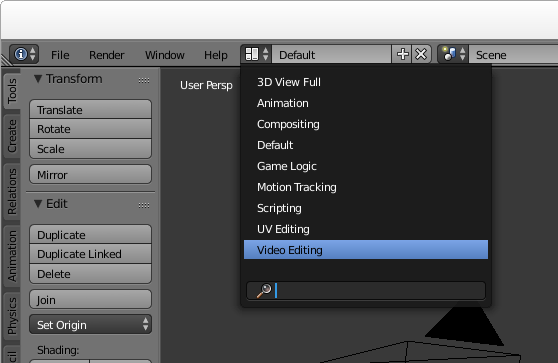
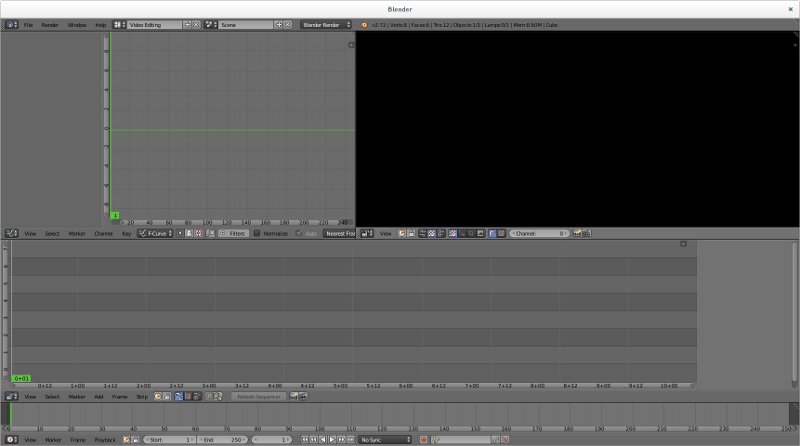
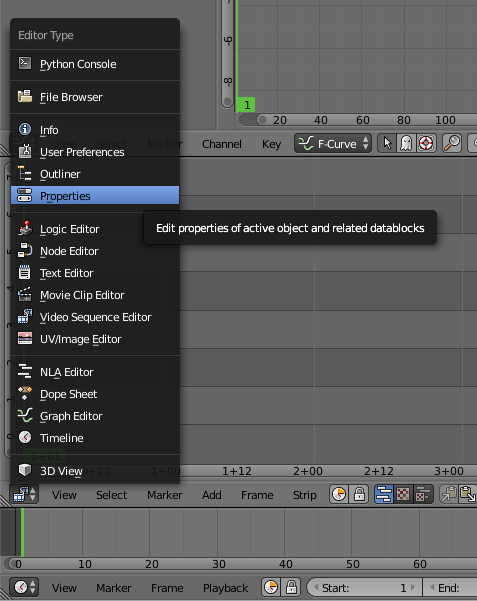
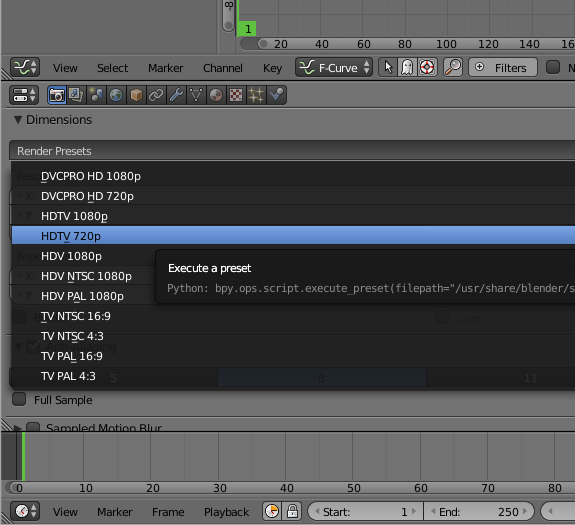
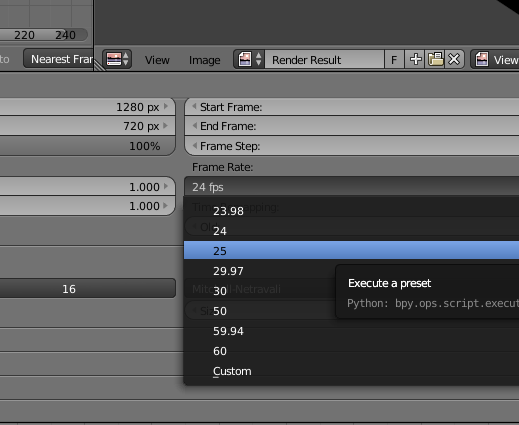
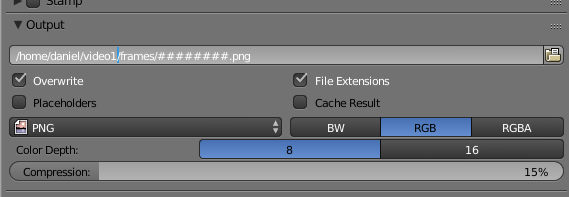
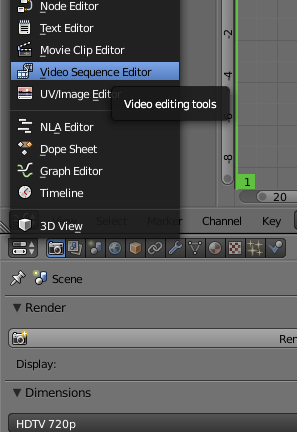
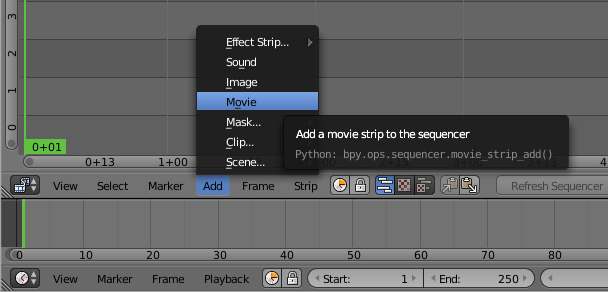
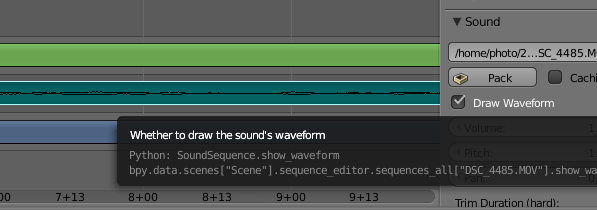
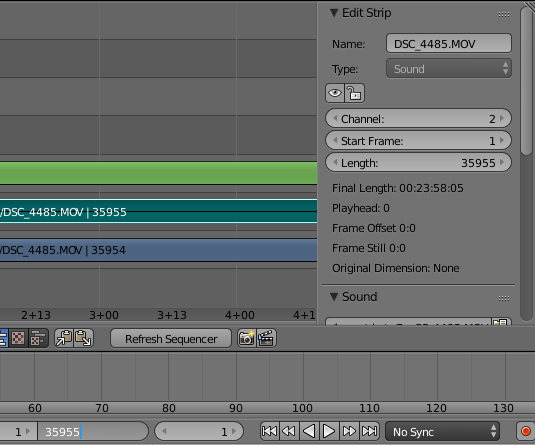
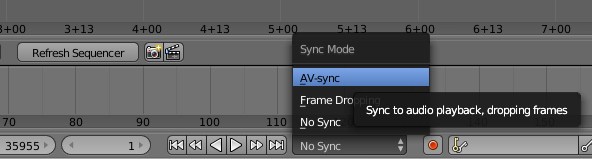
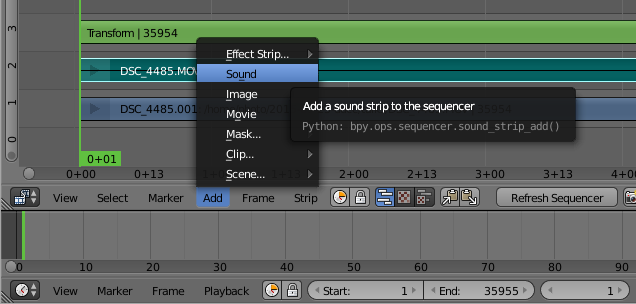
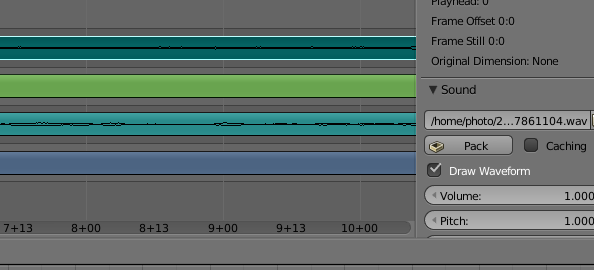
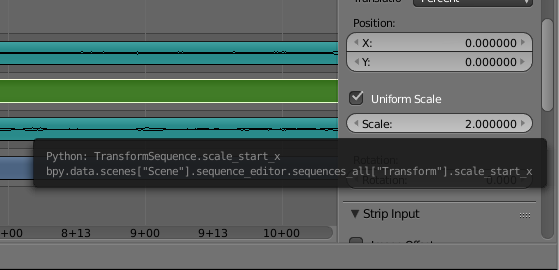
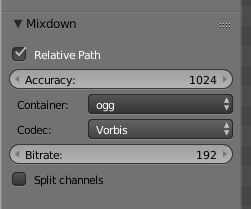
Open Blender and choose the video editing mode Launch Blender and choose the video sequence editor from the pull down menu at the top of the window: Now you should see all the video sequence editor controls: Setup the properties for your project Click the context menu under the strip editor panel and change the panel to a Properties panel: The video file we are playing with is 720p, so it seems reasonable to use 720p for the output too. Change that here: The input file is 25fps so we need to use exactly the same frame rate for the output, otherwise you will either observe the video going at the wrong speed or there will be a conversion that is CPU intensive and degrades the quality. Also check that the resolution_percentage setting under the picture dimensions is 100%: Now specify output to PNG files. Later we will combine them into a WebM file with a script. Specify the directory where the files will be placed and use the # placeholder to specify the number of digits to use to embed the frame number in the filename: Now your basic rendering properties are set. When you want to generate the output file, come back to this panel and use the Animation button at the top. Editing the video Use the context menu to change the properties panel back to the strip view panel: Add the video file: and then right click the video strip (the lower strip) to highlight it and then add a transform strip: Audio waveform Right click the audio strip to highlight it and then go to the properties on the right hand side and click to show the waveform: Rendering length By default, Blender assumes you want to render 250 frames of output. Looking in the properties to the right of the audio or video strip you can see the actual number of frames. Put that value in the box at the bottom of the window where it says 250: Enable AV-sync Also at the bottom of the window is a control to enable AV-sync. If your audio and video are not in sync when you preview, you need to set this AV-sync option and also make sure you set the frame rate correctly in the properties: Add the other sound strip Now add the other sound file that was recorded using the lapel microphone: Enable the waveform display for that sound strip too, this will allow you to align the sound strips precisely: You will need to listen to the strips to make an estimate of the time difference. Use this estimate to set the "start frame" in the properties for your audio strip, it will be a negative value if the audio strip starts before the video. You can then zoom the strip panel to show about 3 to 5 seconds of sound and try to align the peaks. An easy way to do this is to look for applause at the end of the audio strips, the applause generates a large peak that is easily visible. Once you have synced the audio, you can play the track and you should not be able to hear any echo. You can then silence the audio track from the camera by right clicking it, look in the properties to the right and change volume to 0. Make any transforms you require For example, to zoom in on the speaker, right click the transform strip (3rd from the bottom) and then in the panel on the right, click to enable "Uniform Scale" and then set the scale factor as required: Render the video output to PNG Click the context menu under the Curves panel and choose Properties again. Click the Animation button to generate a sequence of PNG files for each frame. Render the audio output On the Properties panel, click the Audio button near the top. Choose a filename for the generated audio file. Look on the bottom left-hand side of the window for the audio file settings, change it to the ogg container and Vorbis codec: Ensure the filename has a .ogg extension Now look at the top right-hand corner of the window for the Mixdown button. Click it and wait for Blender to generate the audio file. Combine the PNG files and audio file into a WebM video file You will need to have a few command line tools installed for manipulating the files from scripts. Install them using the package manager, for example, on a Debian or Ubuntu system: # apt-get install mjpegtools vpx-tools mkvtoolnix
Now create a script like the following:
#!/bin/bash -e
# Set this to match the project properties
FRAME_RATE=25
# Set this to the rate you desire:
TARGET_BITRATE=1000
WORK_DIR=$ HOME /video1
PNG_DIR=$ WORK_DIR /frames
YUV_FILE=$ WORK_DIR /video.yuv
WEBM_FILE=$ WORK_DIR /video.webm
AUDIO_FILE=$ WORK_DIR /audio-mixed.ogg
NUM_FRAMES= find $ PNG_DIR  -type f   wc -l 
png2yuv -I p -f $FRAME_RATE -b 1 -n $NUM_FRAMES \
    -j $ PNG_DIR /%08d.png > $ YUV_FILE 
vpxenc --good --cpu-used=0 --auto-alt-ref=1 \
   --lag-in-frames=16 --end-usage=vbr --passes=2 \
   --threads=2 --target-bitrate=$ TARGET_BITRATE  \
   -o $ WEBM_FILE -noaudio $ YUV_FILE 
rm $ YUV_FILE 
mkvmerge -o $ WEBM_FILE  -w $ WEBM_FILE -noaudio $ AUDIO_FILE 
rm $ WEBM_FILE -noaudio
Next steps There are plenty of more comprehensive tutorials, including some videos on Youtube, explaining how to do more advanced things like fading in and out or zooming and panning dynamically at different points in the video. If the lighting is not good (faces too dark, for example), you can right click the video strip, go to the properties panel on the right hand side and click Modifiers, Add Strip Modifier and then select "Color Balance". Use the Lift, Gamma and Gain sliders to adjust the shadows, midtones and highlights respectively.

Julien Danjou: Profiling Python using cProfile: a concrete case

Writing programs is fun, but making them fast can be a pain. Python programs are no exception to that, but the basic profiling toolchain is actually not that complicated to use. Here, I would like to show you how you can quickly profile and analyze your Python code to find what part of the code you should optimize. What's profiling? Profiling a Python program is doing a dynamic analysis that measures the execution time of the program and everything that compose it. That means measuring the time spent in each of its functions. This will give you data about where your program is spending time, and what area might be worth optimizing. It's a very interesting exercise. Many people focus on local optimizations, such as determining e.g. which of the Python functions range or xrange is going to be faster. It turns out that knowing which one is faster may never be an issue in your program, and that the time gained by one of the functions above might not be worth the time you spend researching that, or arguing about it with your colleague. Trying to blindly optimize a program without measuring where it is actually spending its time is a useless exercise. Following your guts alone is not always sufficient. There are many types of profiling, as there are many things you can measure. In this exercise, we'll focus on CPU utilization profiling, meaning the time spent by each function executing instructions. Obviously, we could do many more kind of profiling and optimizations, such as memory profiling which would measure the memory used by each piece of code something I talk about in The Hacker's Guide to Python. cProfile Since Python 2.5, Python provides a C module called cProfile which has a reasonable overhead and offers a good enough feature set. The basic usage goes down to:
>>> import cProfile
>>> cProfile.run('2 + 2')
2 function calls in 0.000 seconds

Ordered by: standard name

ncalls tottime percall cumtime percall filename:lineno(function)
1 0.000 0.000 0.000 0.000 <string>:1(<module>)
1 0.000 0.000 0.000 0.000 method 'disable' of '_lsprof.Profiler' objects

Though you can also run a script with it, which turns out to be handy:
$ python -m cProfile -s cumtime lwn2pocket.py
72270 function calls (70640 primitive calls) in 4.481 seconds

Ordered by: cumulative time

ncalls tottime percall cumtime percall filename:lineno(function)
1 0.004 0.004 4.481 4.481 lwn2pocket.py:2(<module>)
1 0.001 0.001 4.296 4.296 lwn2pocket.py:51(main)
3 0.000 0.000 4.286 1.429 api.py:17(request)
3 0.000 0.000 4.268 1.423 sessions.py:386(request)
4/3 0.000 0.000 3.816 1.272 sessions.py:539(send)
4 0.000 0.000 2.965 0.741 adapters.py:323(send)
4 0.000 0.000 2.962 0.740 connectionpool.py:421(urlopen)
4 0.000 0.000 2.961 0.740 connectionpool.py:317(_make_request)
2 0.000 0.000 2.675 1.338 api.py:98(post)
30 0.000 0.000 1.621 0.054 ssl.py:727(recv)
30 0.000 0.000 1.621 0.054 ssl.py:610(read)
30 1.621 0.054 1.621 0.054 method 'read' of '_ssl._SSLSocket' objects
1 0.000 0.000 1.611 1.611 api.py:58(get)
4 0.000 0.000 1.572 0.393 httplib.py:1095(getresponse)
4 0.000 0.000 1.572 0.393 httplib.py:446(begin)
60 0.000 0.000 1.571 0.026 socket.py:410(readline)
4 0.000 0.000 1.571 0.393 httplib.py:407(_read_status)
1 0.000 0.000 1.462 1.462 pocket.py:44(wrapped)
1 0.000 0.000 1.462 1.462 pocket.py:152(make_request)
1 0.000 0.000 1.462 1.462 pocket.py:139(_make_request)
1 0.000 0.000 1.459 1.459 pocket.py:134(_post_request)
[ ]

This prints out all the function called, with the time spend in each and the number of times they have been called. Advanced visualization with KCacheGrind While being useful, the output format is very basic and does not make easy to grab knowledge for complete programs. For more advanced visualization, I leverage KCacheGrind. If you did any C programming and profiling these last years, you may have used it as it is primarily designed as front-end for Valgrind generated call-graphs. In order to use, you need to generate a cProfile result file, then convert it to KCacheGrind format. To do that, I use pyprof2calltree.
$ python -m cProfile -o myscript.cprof myscript.py
$ pyprof2calltree -k -i myscript.cprof

And the KCacheGrind window magically appears!
Concrete case: Carbonara optimization I was curious about the performances of Carbonara, the small timeserie library I wrote for Gnocchi. I decided to do some basic profiling to see if there was any obvious optimization to do. In order to profile a program, you need to run it. But running the whole program in profiling mode can generate a lot of data that you don't care about, and adds noise to what you're trying to understand. Since Gnocchi has thousands of unit tests and a few for Carbonara itself, I decided to profile the code used by these unit tests, as it's a good reflection of basic features of the library. Note that this is a good strategy for a curious and naive first-pass profiling. There's no way that you can make sure that the hotspots you will see in the unit tests are the actual hotspots you will encounter in production. Therefore, a profiling in conditions and with a scenario that mimics what's seen in production is often a necessity if you need to push your program optimization further and want to achieve perceivable and valuable gain. I activated cProfile using the method described above, creating a cProfile.Profile object around my tests (I actually started to implement that in testtools). I then run KCacheGrind as described above. Using KCacheGrind, I generated the following figures.
The test I profiled here is called test_fetch and is pretty easy to understand: it puts data in a timeserie object, and then fetch the aggregated result. The above list shows that 88 % of the ticks are spent in set_values (44 ticks over 50). This function is used to insert values into the timeserie, not to fetch the values. That means that it's really slow to insert data, and pretty fast to actually retrieve them. Reading the rest of the list indicates that several functions share the rest of the ticks, update, _first_block_timestamp, _truncate, _resample, etc. Some of the functions in the list are not part of Carbonara, so there's no point in looking to optimize them. The only thing that can be optimized is, sometimes, the number of times they're called.
The call graph gives me a bit more insight about what's going on here. Using my knowledge about how Carbonara works, I don't think that the whole stack on the left for _first_block_timestamp makes much sense. This function is supposed to find the first timestamp for an aggregate, e.g. with a timestamp of 13:34:45 and a period of 5 minutes, the function should return 13:30:00. The way it works currently is by calling the resample function from Pandas on a timeserie with only one element, but that seems to be very slow. Indeed, currently this function represents 25 % of the time spent by set_values (11 ticks on 44). Fortunately, I recently added a small function called _round_timestamp that does exactly what _first_block_timestamp needs that without calling any Pandas function, so no resample. So I ended up rewriting that function this way:
def _first_block_timestamp(self):
- ts = self.ts[-1:].resample(self.block_size)
- return (ts.index[-1] - (self.block_size * self.back_window))
+ rounded = self._round_timestamp(self.ts.index[-1], self.block_size)
+ return rounded - (self.block_size * self.back_window)

And then I re-run the exact same test to compare the output of cProfile.
The list of function seems quite different this time. The number of time spend used by set_values dropped from 88 % to 71 %.
The call stack for set_values shows that pretty well: we can't even see the _first_block_timestamp function as it is so fast that it totally disappeared from the display. It's now being considered insignificant by the profiler. So we just speed up the whole insertion process of values into Carbonara by a nice 25 % in a few minutes. Not that bad for a first naive pass, right?

Dirk Eddelbuettel: Rcpp 0.12.2: More refinements

The second update in the 0.12.* series of Rcpp is now on the CRAN network for GNU R. As usual, I will also push a Debian package. This follows the 0.12.0 release from late July which started to add some serious new features, and builds upon the 0.12.1 release in September. It also marks the sixth release this year where we managed to keep a steady bi-montly release frequency. Rcpp has become the most popular way of enhancing GNU R with C or C++ code. As of today, 512 packages on CRAN depend on Rcpp for making analytical code go faster and further. That is up by more than fifty package from the last release in September (and we recently blogged about crossing 500 dependents). This release once again features pull requests from two new contributors with Nathan Russell and Tianqi Chen joining in. As shown below, other recent contributors (such as such as Dan) are keeping at it too. Keep'em coming! Luke Tierney also email about a code smell he spotted and which we took care of. A big Thank You! to everybody helping with code, bug reports or documentation. See below for a detailed list of changes extracted from the NEWS file.
Changes in Rcpp version 0.12.2 (2015-11-14)
  • Changes in Rcpp API:
    • Correct return type in product of matrix dimensions (PR #374 by Florian)
    • Before creating a single String object from a SEXP, ensure that it is from a vector of length one (PR #376 by Dirk, fixing #375).
    • No longer use STRING_ELT as a left-hand side, thanks to a heads-up by Luke Tierney (PR #378 by Dirk, fixing #377).
    • Rcpp Module objects are now checked more carefully (PR #381 by Tianqi, fixing #380)
    • An overflow in Matrix column indexing was corrected (PR #390 by Qiang, fixing a bug reported by Allessandro on the list)
    • Nullable types can now be assigned R_NilValue in function signatures. (PR #395 by Dan, fixing issue #394)
    • operator<<() now always shows decimal points (PR #396 by Dan)
    • Matrix classes now have a transpose() function (PR #397 by Dirk fixing #383)
    • operator<<() for complex types was added (PRs #398 by Qiang and #399 by Dirk, fixing #187)
  • Changes in Rcpp Attributes:
    • Enable export of C++ interface for functions that return void.
  • Changes in Rcpp Sugar:
    • Added new Sugar function cummin(), cummax(), cumprod() (PR #389 by Nathan Russell fixing #388)
    • Enabled sugar math operations for subsets; e.g. x[y] + x[z]. (PR #393 by Kevin and Qiang, implementing #392)
  • Changes in Rcpp Documentation:
    • The NEWS file now links to GitHub issue tickets and pull requests.
    • The Rcpp.bib file with bibliographic references was updated.
Thanks to CRANberries, you can also look at a diff to the previous release As always, even fuller details are on the Rcpp Changelog page and the Rcpp page which also leads to the downloads page, the browseable doxygen docs and zip files of doxygen output for the standard formats. A local directory has source and documentation too. Questions, comments etc should go to the rcpp-devel mailing list off the R-Forge page.

This post by Dirk Eddelbuettel originated on his Thinking inside the box blog. Please report excessive re-aggregation in third-party for-profit settings.

Norbert Preining: Movies: Monuments Men and Interstellar

Over the rainy weekend we watched two movies: Monuments Men (in Japanese it is called Michelangelo Project!) and Interstellar. Both blockbuster movies from the usual American companies, they are light-years away when it comes to quality. The Monuments Men are boring, without a story, without depth, historically inaccurate, a complete failure. Interstellar, although a long movie, keeps you frozen in the seat while being as scientific as possible and starts your brain working heavily. monuments-men-interstellar My personal verdict: 3 rotten eggs (because Rotten Tomatoes are not stinky enough) for the Monuments Men, and 4 stars for Interstellar. Story First for the plot of the two movies: The Monuments Men is loosely based on a true story about rescuing pieces of art at the end of the second world war, before the Nazis destroy them or the Russian take them away. A group of art experts is sent into Europe and manages to find several hiding places of art taken by the Nazis. Interstellar is set in near future where the conditions on the earth are deteriorating to a degree that human life seems to be soon impossible. Some years before the movie plays a group of astronauts were sent through a wormhole into a different galaxy to search for new inhabitable planets. Now it is time to check out these planets, and try to establish colonies there. Cooper, a retired NASA officer and pilot, now working as farmer, and his daughter are guided by some mysterious way to a secret NASA facility. Cooper is drafted for being a pilot on the reconnaissance mission, and leaves earth and our galaxy through the same wormhole. (Not telling more!) Monuments Men Looking at the cast of Monuments Men (George Clooney, Matt Damon, Bill Murray, John Goodman, Jean Dujardin, Bob Balaban, Hugh Bonneville, and Cate Blanchett) one would expect a great movie but from the very first to the very last scene, it is a slowly meandering shallow flow of sticked together scenes without much coherence. Tension is generated only through unrelated events (stepping onto a landmine, patting a horse), but never developed properly. Dialogs are shallow and boring with one exception: When Frank Stokes (George Clooney) meets the one German and inquires general about the art, predicting his future being hanged. Historically, the movie is as inaccurate as it can be despite Clooney stating that 80 percent of the story is still completely true and accurate, and almost all of the scenes happened . That contrasts starkly with the verdict of Nigel Pollard (Swansea University): There s a kernel of history there, but The Monuments Men plays fast and loose with it in ways that are probably necessary to make the story work as a film, but the viewer ends up with a fairly confused notion of what the organisation was, and what it achieved. The movie leaves a bitter aftertaste, hailing of American heroism paired with the usual stereotypes (French amour, German retarded, Russian ignorance, etc). Together with the half baked dialogues it feels like a permanent coitus interruptus. Interstellar Interstellar cannot serve with a similar cast, but still a few known people (Matthew McConaughey, Anne Hathaway, and Michael Caine!). But I believe this is actually a sign of quality. Well balancing scientific accuracy and the requirements for blockbusters, the movie successfully spans the bridge between complicated science, in particular general gravity, and entertainment. While not going so far to call the move edutainment (like both the old and new Cosmos), it is surprising how much of hard science is packed into this movie. This is mostly thanks to the theoretical physicist Kip Thorne acting as scientific consultant for the movie, but also due to the director Christopher Nolan being serious about it and studying relativity at Caltech. Of course, scientific accuracy has limits nobody knows what happens if one crosses the event horizon of a black hole, and even the existence of wormholes is purely theoretical by now. Still, throughout the movie it follows the two requirements laid out by Kip Thorne: First, that nothing would violate established physical laws. Second, that all the wild speculations would spring from science and not from the fertile mind of a screenwriter. I think the biggest compliment was that, despite the length, despite a long day out (see next blog), despite the rather unfamiliar topic, my wife, who is normally not interested in space movies and that kind, didn t fall asleep throughout the movie, and I had to stop several times to explain details of the theory of gravity and astronomy. So in some sense it was perfect edutainment!

15 November 2015

Manuel A. Fernandez Montecelo: Work on aptitude

Midsummer for me is also known as Noite do Lume Novo (literally New Fire Night ), one of the big calendar events of the year, marking the end of the school year and the beginning of summer. On this day, there are celebrations not very unlike the bonfires in the Guy Fawkes Night in England or Britain [1]. It is a bit different in that it is not a single event for the masses, more of a friends and neighbours thing, and that it lasts for a big chunk of the night (sometimes until morning). Perhaps for some people, or outside bigger towns or cities, Guy Fawkes Night is also celebrated in that way and that's why during the first days of November there are fireworks rocketing and cracking in the neighbourhoods all around. Like many other celebrations around the world involving bonfires, many of them also happening around the summer solstice, it is supposed to be a time of renewal of cycles, purification and keeping the evil spirits away; with rituals to that effect like jumping over the fire when the flames are not high and it is safe enough. So it was fitting that, in the middle of June (almost Midsummer in the northern hemisphere), I learnt that I was about to leave my now-previous job, which is a pretty big signal and precursor for renewal (and it might have something to do with purifying and keeping the evil away as well ;-) ). Whatever... But what does all of this have to do with aptitude or Debian, anyway? For one, it was a question of timing. While looking for a new job (and I am still at it), I had more spare time than usual. DebConf 15 @ Heidelberg was within sight, and for the first time circumstances allowed me to attend this event. It also coincided with the time when I re-gained access to commit to aptitude on the 19th of June. Which means Renewal. End of June was also the time of the announcement of the colossal GCC-5/C++11 ABI transition in Debian, that was scheduled to start on the 1st of August, just before the DebConf. Between 2 and 3 thousand source packages in Debian were affected by this transition, which a few months later is not yet finished (although the most important parts were completed by mid-end September). aptitude itself is written in C++, and depends on several libraries written in C++, like Boost, Xapian and SigC++. All of them had to be compiled with the new C++11 ABI of GCC-5, in unison and in a particular order, for aptitude to continue to work (and for minimal breakage). aptitude and some dependencies did not even compile straight away, so this transition meant that aptitude needed attention just to keep working. Having recently being awarded again with the Aptitude Hat, attending DebConf for the first time and sailing towards the Transition Maelstrom, it was a clear sign that Something Had to Be Done (to avoid the sideways looks and consequent shame at DebConf, if nothing else). Happily (or a bit unhappily for me, but let's pretend...), with the unexpected free time in my hands, I changed the plans that I had before re-gaining the Aptitude Hat (some of them involving Debian, but in other ways maybe I will post about that soon). In July I worked to fix the problems before the transition started, so aptitude would be (mostly) ready, or in the worst case broken only for a few days, while the chain of dependencies was rebuilt. But apart from the changes needed for the new GCC-5, it was decided at the last minute that Boost 1.55 would not be rebuilt with the new ABI, and that the only version with the new ABI would be 1.58 (which caused further breakage in aptitude, was added to experimental only a few days before, and was moved to unstable after the transition had started). Later, in the first days of the transition, aptitude was affected for a few days by breakage in the dependencies, due to not being compiled in sequence according to the transition levels (so with a mix of old and new ABI). With the critical intervention of Axel Beckert (abe / XTaran), things were not so bad as they could have been. He was busy testing and uploading in the critical days when I was enjoying a small holiday on my way to DebConf, with minimal internet access and communicating almost exclusively with him; and he promptly tended the complaints arriving in the Bug Tracking System and asked for rebuilds of the dependencies with the new ABI. He also brought the packaging up to shape, which had decayed a bit in the last few years. Gruesome Challenges But not all was solved yet, more storms were brewing and started to appear in the horizon, in the form of clouds of fire coming from nearby realms. The APT Deities, which had long ago spilled out their secret, inner challenge (just the initial paragraphs), were relentless. Moreover, they were present at Heidelberg in full force, in or close to their home grounds, and they were Marching Decidedly towards Victory: apt BTS Graph, 2015-11-15 In the talk @ DebConf This APT has Super Cow Powers (video available), by David Kalnischkies, they told us about the niceties of apt 1.1 (still in experimental but hopefully coming to unstable soon), and they boasted about getting the lead in our arms race (should I say bugs race?) by a few open bug reports. This act of provocation further escalated the tensions. The fierce competition which had been going on for some time gained new heights. So much so that APT Deities and our team had to sit together in the outdoor areas of the venue and have many a weissbier together, while discussing and fixing bugs. But beneath the calm on the surface, and while pretending to keep good diplomatic relations, I knew that Something Had to Be Done, again. So I could only do one thing jump over the bonfire and Keep the Evil away, be that Keep Evil bugs Away or Keep Evil APT Deities Away from winning the challenge, or both. After returning from DebConf I continued to dedicate time to the project, more than a full time job in some weeks, and this is what happened in the last few months, summarised in another graph, showing the evolution of the BTS for aptitude: aptitude BTS Graph, 2015-11-15 The numbers for apt right now (15th November 2015) are: The numbers for aptitude right now are: The Aftermath As we can see, for the time being I could keep the Evil at bay, both in terms of bugs themselves and re-gaining the lead in the bugs race the Evil APT Deities were thwarted again in their efforts. ... More seriously, as most of you suspected, the graph above is not the whole truth, so I don't want to boast too much. A big part of the reduction in the number of bugs is because of merging duplicates, closing obsolete bugs, applying translations coming from multiple contributors, or simple fixes like typos and useful suggestions needing minor changes. Many of remaining problems are comparatively more difficult or time consuming that the ones addressed so far (except perhaps avoiding the immediate breakage of the transition, that took weeks to solve), and there are many important problems still there, chief among those is aptitude offering very poor solutions to resolve conflicts. Still, even the simplest of the changes takes effort, and triaging hundreds of bugs is not fun at all and mostly a thankless effort althought there is the occasionally kind soul that thanks you for handling a decade-old bug. If being subjected to the rigours of the BTS and reading and solving hundreds of bug reports is not Purification, I don't know what it is. Apart from the triaging, there were 118 bugs closed (or pending) due to changes made in the upstream part or the packaging in the last few months, and there are many changes that are not reflected in bugs closed (like most of the changes needed due to the C++11 ABI transition, bugs and problems fixed that had no report, and general rejuvenation or improvement of some parts of the code). How long this will last, I cannot know. I hope to find a job at some point, which obviously will reduce the time available to work on this. But in the meantime, for all aptitude users: Enjoy the fixes and new features! Notes [1] ^ Some visitors of the recent mini-DebConf @ Cambridge perhaps thought that the fireworks and throngs gathered were in honour of our mighty Universal Operating System, but sadly they were not. They might be, some day. In any case, the reports say that the visitors enjoyed the fireworks.

Carl Chenet: Retweet 0.5 : only retweet some tweets

Retweet 0.5 is now available ! The main new feature is: Retweet now lets you define a list of hashtags that, if they appear in the text of the tweet, this tweet is not retweeted.

You only need this line in your retweet.ini configuration file:

do_not_retweet_hashes=dnr,donotretweet,noretweet,

Have a look at the official documentation to read how it extensively works.

Retweet 0.5 is available on the PyPI repository and is already in the official Debian unstable repository. Proposed Debian Logo Retweet is in production already for Le Journal Du hacker , a French FOSS community website to share and relay news and LinuxJobs.fr , a job board for the French-speaking FOSS community.

logo-journal-du-hacker

linuxjobs-horizontale What about you? does Retweet allow you to develop your Twitter account? Let your comments in this article.

Lunar: Reproducible builds: week 29 in Stretch cycle

What happened in the reproducible builds effort this week: Toolchain fixes Emmanuel Bourg uploaded eigenbase-resgen/1.3.0.13768-2 which uses of the scm-safe comment style by default to make them deterministic. Mattia Rizzolo started a new thread on debian-devel to ask a wider audience for issues about the -Wdate-time compile time flag. When enabled, GCC and clang print warnings when __DATE__, __TIME__, or __TIMESTAMP__ are used. Having the flag set by default would prompt maintainers to remove these source of unreproducibility from the sources. Packages fixed The following packages have become reproducible due to changes in their build dependencies: bmake, cyrus-imapd-2.4, drobo-utils, eigenbase-farrago, fhist, fstrcmp, git-dpm, intercal, libexplain, libtemplates-parser, mcl, openimageio, pcal, powstatd, ruby-aggregate, ruby-archive-tar-minitar, ruby-bert, ruby-dbd-odbc, ruby-dbd-pg, ruby-extendmatrix, ruby-rack-mobile-detect, ruby-remcached, ruby-stomp, ruby-test-declarative, ruby-wirble, vtprint. The following packages became reproducible after getting fixed: Some uploads fixed some reproducibility issues, but not all of them: Patches submitted which have not made their way to the archive yet: reproducible.debian.net The fifth and sixth armhf build nodes have been set up, resulting in five more builder jobs for armhf. More than 10,000 packages have now been identified as reproducible with the reproducible toolchain on armhf. (Vagrant Cascadian, h01ger) Helmut Grohne and Mattia Rizzolo now have root access on all 12 build nodes used by reproducible.debian.net and jenkins.debian.net. (h01ger) reproducible-builds.org is now linked from all package pages and the reproducible.debian.net dashboard. (h01ger) profitbricks-build5-amd64 and profitbricks-build6-amd64, responsible for running amd64 tests now run 398.26 days in the future. This means that one of the two builds that are being compared will be run on a different minute, hour, day, month, and year. This is not yet the case for armhf. FreeBSD tests are also done with 398.26 days difference. (h01ger) The design of the Arch Linux test page has been greatly improved. (Levente Polyak) diffoscope development Three releases of diffoscope happened this week numbered 39 to 41. It includes support for EPUB files (Reiner Herrmann) and Free Pascal unit files, usually having .ppu as extension (Paul Gevers). The rest of the changes were mostly targetting at making it easier to run diffoscope on other systems. The tlsh, rpm, and debian modules are now all optional. The test suite will properly skip tests that need optional tools or modules when they are not available. As a result, diffosope is now available on PyPI and thanks to the work of Levente Polyak in Arch Linux. Getting these versions in Debian was a bit cumbersome. Version 39 was uploaded with an expired key (according to the keyring on ftp.debian.org which will hopefully be updated soon) which is currently handled by keeping the files in the queue without REJECTing them. This prevented any other Debian Developpers to upload the same version. Version 40 was uploaded as a source-only upload but failed to build from source which had the undesirable side effect of removing the previous version from unstable. The package faild to build from source because it was built passing -I to debbuild. This excluded the ELF object files and static archives used by the test suite from the archive, preventing the test suite to work correctly. Hopefully, in a nearby future it will be possible to implement a sanity check to prevent such mistakes in the future. It has also been identified that ppudump outputs time in the system timezone without considering the TZ environment variable. Zachary Vance and Paul Gevers raised the issue on the appropriate channels. strip-nondeterminism development Chris Lamb released strip-nondeterminism version 0.014-1 which disables stripping Mono binaries as it is too aggressive and the source of the problem is being worked on by Mono upstream. Package reviews 133 reviews have been removed, 115 added and 103 updated this week. Chris West and Chris Lamb reported 57 new FTBFS bugs. Misc. The video of h01ger and Chris Lamb's talk at MiniDebConf Cambridge is now available. h01ger gave a talk at CCC Hamburg on November 13th, which was well received and sparked some interest among Gentoo folks. Slides and video should be available shortly. Frederick Kautz has started to revive Dhiru Kholia's work on testing Fedora packages. Your editor wish to once again thank #debian-reproducible regulars for reviewing these reports weeks after weeks.

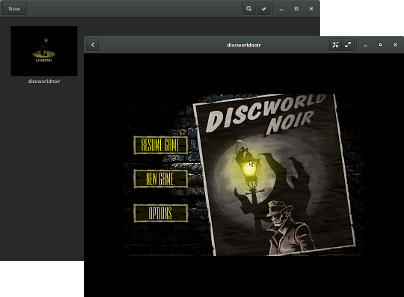
Simon McVittie: Discworld Noir in a Windows 98 virtual machine on Linux

Discworld Noir was a superb adventure game, but is also notoriously unreliable, even in Windows on real hardware; using Wine is just not going to work. After many attempts at bringing it back into working order, I've settled on an approach that seems to work: now that qemu and libvirt have made virtualization and emulation easy, I can run it in a version of Windows that was current at the time of its release. Unfortunately, Windows 98 doesn't virtualize particularly well either, so this still became a relatively extensive yak-shaving exercise. discworldnoir-boxes.jpg These instructions assume that /srv/virt is a suitable place to put disk images, but you can use anywhere you want. The emulated PC After some trial and error, it seems to work if I configure qemu to emulate the following: A modern laptop CPU is an order of magnitude faster than what Discworld Noir needs, so full emulation isn't a problem, despite being inefficient. There is deliberately no networking, because Discworld Noir doesn't need it, and a 17 year old operating system with no privilege separation is very much not safe to use on the modern Internet! Software needed Windows 98 installation It seems to be easiest to do this bit by running qemu-system-i386 manually:
qemu-img create -f qcow2 /srv/virt/discworldnoir.qcow2 30G
qemu-system-i386 -hda /srv/virt/discworldnoir.qcow2 \
    -drive media=cdrom,format=raw,file=/srv/virt/windows98.iso \
    -no-kvm -vga cirrus -m 256 -cpu pentium3 -localtime
Don't start the installation immediately. Instead, boot the installation CD to a DOS prompt with CD-ROM support. From here, run
fdisk
and create a single partition filling the emulated hard disk. When finished, hard-reboot the virtual machine (press Ctrl+C on the qemu-system-i386 process and run it again). The DOS FORMAT.COM utility is on the Windows CD-ROM but not in the root directory or the default %PATH%, so you'll have to run:
d:\win98\format c:
to create the FAT filesystem. You might have to reboot again at this point. The reason for doing this the hard way is that the Windows 98 installer doesn't detect qemu as supporting ACPI. You want ACPI support, so that Windows will issue IDLE instructions from its idle loop, instead of occupying a CPU core with a busy-loop. To get that, boot to a DOS prompt again, and use:
setup /p j /iv
/p j forces ACPI support (Thanks to "Richard S" on the Virtualbox forums for this tip.) /iv is unimportant, but it disables the annoying "billboards" during installation, which advertised once-exciting features like support for dial-up modems and JPEG wallpaper. I used a "Typical" installation; there didn't seem to be much point in tweaking the installed package set when everything is so small by modern standards. Windows 98 has built-in support for the Cirrus VGA card that we're emulating, so after a few reboots, it should be able to run in a semi-modern resolution and colour depth. Discworld Noir apparently prefers a 640 480 16-bit video mode, so right-click on the desktop background, choose Properties and set that up. Audio drivers This is the part that took me the longest to get working. Of the sound cards that qemu can emulate, Windows 98 only supports the SoundBlaster 16 out of the box. Unfortunately, the Soundblaster 16 emulation in qemu is incomplete, and in particular version 2.1 (as shipped in Debian 8) has a tendency to make Windows lock up during boot. I've seen advice in various places to emulate an Eqsonic ES1370 (SoundBlaster AWE 64), but that didn't work for me: one of the drivers I tried caused Windows to lock up at a black screen during boot, and the other didn't detect the emulated hardware. The next-oldest sound card that qemu can emulate is a Realtek AC97, which was often found integrated into motherboards in the late 1990s. This one seems to work, with the "A400" driver bundle linked above. For Windows 98 first edition, you need a driver bundle that includes the old "VXD" drivers, not just the "WDM" drivers supported by Second Edition and newer. The easiest way to get that into qemu seems to be to turn it into a CD image:
genisoimage -o /srv/virt/discworldnoir-drivers.iso WDM_A400.exe
qemu-system-i386 -hda /srv/virt/discworldnoir.qcow2 \
    -drive media=cdrom,format=raw,file=/srv/virt/windows98.iso \
    -drive media=cdrom,format=raw,file=/srv/virt/discworldnoir-drivers.iso \
    -no-kvm -vga cirrus -m 256 -cpu pentium3 -localtime -soundhw ac97
Run the installer from E:, then reboot with the Windows 98 CD inserted, and Windows should install the driver. Installing Discworld Noir Boot up the virtual machine with CD 1 in the emulated drive:
qemu-system-i386 -hda /srv/virt/discworldnoir.qcow2 \
    -drive media=cdrom,format=raw,file=/srv/virt/DWN_ENG_1.iso \
    -no-kvm -vga cirrus -m 256 -cpu pentium3 -localtime -soundhw ac97
You might be thinking "... why not insert all three CDs into D:, E: and F:?" but the installer expects subsequent disks to appear in the same drive where CD 1 was initially, so that won't work. Instead, when prompted for a new CD, switch to the qemu monitor with Ctrl+Alt+2 (note that this is 2, not F2). At the (qemu) prompt, use info block to see a list of emulated drives, then issue a command like
change ide0-cd1 /srv/virt/DWN_ENG_2.iso
to swap the CD. Then switch back to Windows' console with Ctrl+Alt+1 and continue installation. I used a Full installation of Discworld Noir. Transferring the virtual machine to GNOME Boxes Having finished the "control freak" phase of installation, I wanted a slightly more user-friendly way to run this game, so I transferred the virtual machine to be used by libvirtd, which is the backend for both GNOME Boxes and virt-manager:
virsh create discworldnoir.xml
Here is the configuration I used. It's a mixture of automatic configuration from virt-manager, and hand-edited configuration to make it match the qemu-system-i386 command-line. Running the game If all goes well, you should now see a discworldnoir virtual machine in GNOME Boxes, in which you can boot Windows 98 and play the game. Have fun!

Next.

Previous.