Search Results: "spa"

14 December 2012

Roland Mas: Back to space

A long time ago, I spent many many hours playing Frontier (Elite 2) on the family Atari ST. It was nice-looking (oh, those sunrises on distant planets!), playable, varied, had ample room for progression, very different possible roles, a huge universe of which nobody could ever hope of exploring more than a tiny fraction, and it was basically the first game I encountered with no set goals. You are a spaceship pilot in a galaxy colonised left and right, and it's up to you to decide what you want the game to be. Pirate, headhunter, mercenary, trader, taxi, explorer, there's no end goal to achieve except what you fix for yourself. That was, for me as a youngster, a mind-opening experience, which I never felt as strongly since (with the possible exception of the Creatures game, but I barely tried it). Then came modernity, the PC, and the First Encounters sequel (Elite 3). It added moderate complexity to the gameplay, some sort of political evolution among the factions and a kind of plot so the galaxy was no longer quite so static, but the end results were still a bit disappointing. It felt like Frontier with a few not-exactly-overwhelming textures stuck onto the ships, a loose plot arc, and a third faction, the Alliance of Independent Systems, beyond the Federation and the Empire. Not that exciting, although the name of the Alliance's capital star system stayed in my mind. So, like many others, I came to wait for Elite 4. That wait started in 1995, more than seventeen years ago. During that time, Duke Nukem Forever was announced, promised, developed, postponed, abandoned, found again, developed again, and it was even actually released in 2011, while Elite 4 went into the same kind of hell only without the actual release (yet). At some point I started trying various substitutes to help pass time. There was Parsec which was a nice-looking space combat simulator, multiplayer and all, but never felt like finished. Development slowed down to a thin trickle, and it seems like it only recently started again as Open Parsec. Hopefully it won't wither off again, but since it's only focused on combat, it's not exactly the same spirit as Elite. There's Oolite, but it looks and feels very much like a lightly-modernised Frontier. Better textures, sure, but the UI still looks like it got taken from the times where games mentioned they required an EGA/VGA video card. There's Vega Strike. It's very promising too, and I did try it at some point, but it was crashing too often for my tastes. Development seems to have slowed down, but not stopped; maybe it's time I gave it another go. I just recently found out about Pioneer, and I admit I'm excited. Really excited. It feels like like Frontier felt at the time. It's not finished yet (the on-planet cities in particular look a bit weird), but from the alpha I tried and the videos on the website it's really impressive. I'm going to keep an eye on that, knowing I could spend quite some time in there even before it's quite finished, if only to fly a spaceship in the canyons of Europa with Jupiter rising in the distance. I'll let you know if I find a black monolith. But the main event triggering this blog post is that apparently Elite 4 is not dead (yet). Much better, it's under heavy development, under the Elite Dangerous name, and the current state seems to be rather good already. And Frontier Developments, the company behind it, opened a Kickstarter campaign to fund the project. The screenshots and the videos look impressive, and the interviews of the lead developer imply that the gameplay will be awesome. The galaxy will apparently be really dynamic, and the player's actions could really influence its geopolitical (galactopolitical?) evolution, the profitability of trade routes, the prevalence and repartition of space pirates in various sectors, and so on. Combine with a multi-player mode, and this could become the greatest game ever made (for my personal taste at least). So I'm very much hoping the funding campaign reaches its target. The release date is set to March 2014. It's going to be a long wait, fraught with incertitudes. But then again, Duke Nukem Forever was eventually released, wasn't it? [No, I never played the original Elite. I'm not that old.]

Russell Coker: Globalisation and Phone Calls

I just watched an interesting TED talk by Pankaj Ghemawat (of which the most important points are summarised in a TED blog post) about the world not being as globalised as people expect [1]. One point is that only 2% of traditional voice phone calling minutes (and ~6% when you include VOIP) are for international calls which is less than most people expect. After reading that it occurred to me that most of the included value in my mobile phone contract goes unused, I pay for extra data transfer and it includes voice calling credit that I don t use. So out of $450 of included calls I typically use much less than $50. $400 of calls to even the most expensive countries is about 100 minutes of talking. So the logical thing to do is to find people in other countries to call. If you are involved in the FOSS community and would like to speak to me then send me an email with your phone number, time zone, and a range of times that are convenient. I won t make any promises about calling you soon (I could use up my monthly credit on a single call), but I will call you eventually. I will also send email to some people I know by email and suggest a chat. Some years ago I did this with people who were involved in SE Linux development and it seemed to help the development of the SE Linux community. Also if anyone in Australia wants to speak to me then that s OK too. While Pankaj s talk inspired me to call people I m not dedicated to calling other countries.

Paul Tagliamonte: Scripting Python in Clojure

Yeah, wait, what? No, really! I took a look through clojure-py, and found out something pretty rad. In order to get clojurepy scripts to load other clojurepy, it had to shim out and add a new importer for clojure scripts. What this really means, is that you can import Clojure from Python, which is pretty sweet. I abused the internals here, and added it to dput-ng as a quick hack. Basically, I just had to import clojure.main, and let the main function set up the sys shim. I would set it up in dput, but I d have to import that module anyway. Remember, when doing this, the namespace ((ns ...)) needs to match the filename. So, I present the first Clojure hook for dput-ng:
; Copyright (c) Paul R. Tagliamonte <paultag@debian.org>, 2012, under the
; terms of dput-ng itsself.
(ns clojtest
  (:require dput.core
            dput.exceptions))
(defn log [x]  ; for debug output
  (.debug dput.core/logger x))
(defn dput-checker [changes profile interface]
  (cond (>= (-> changes (.get "maintainer") (.find "arno@debian.org")) 0)
    (throw (dput.exceptions/HookException. "Maintainer's Arno. Aborting upload"))
  :else
    (log "Nah, it's not arno, we're good")))
This, of course, checks if the maintainer is Arno, and throws a fit if it is. Gist is over on gist.github. After, Algernon added his own checker, which throws a fit if you have a package in the B-Ds that you aught to not use (such as dpatch)
; Copyright (c) Gergely Nagy <algernon@debian.org>, 2012, under the
; terms of dput-ng itself.
(ns bd-blacklist
  (:require dput.core
            dput.exceptions
            dput.dsc))
(defn prune-build-deps
  "Prune a string representation of the build-depends so that only a
  list of packages remain."
  [bd-string]
  (map #(first (-> % (.strip) (.split " "))) (.. bd-string (split ","))))
(defn has-blacklisted?
  "Given a dsc file and a blacklist, check if any of the
  build-depencencies are in that list. Throws an error if there are
  matches."
  [dsc-file blacklist]
  (let [dsc (dput.dsc/parse_dsc_file dsc-file)
        build-deps (prune-build-deps (.. dsc (get "build-depends")))]
    (if-let [bad-bd (some blacklist build-deps)]
      (throw (dput.exceptions/HookException. (str "Blacklisted build-dependency found: " bad-bd)))
      (-> dput.core/logger (.trace "Build-Dependencies do not have anything on the blacklist")))))
(defn blacklist-checker
  "Checks whether the dsc has blacklisted build-dependencies, ignores
  the check when no dsc is to be found."
  [changes profile interface]
  (if-let [dsc-file (.. changes (get_dsc))]
    (has-blacklisted? dsc-file (set (get profile "bd-blacklist")))
    (-> dput.core/logger (.trace "No .dsc found, build-dependencies cannot be checked"))))
You can check that out in the git tree Hacks welcome!

13 December 2012

Andrea Veri: The future is Cloudy

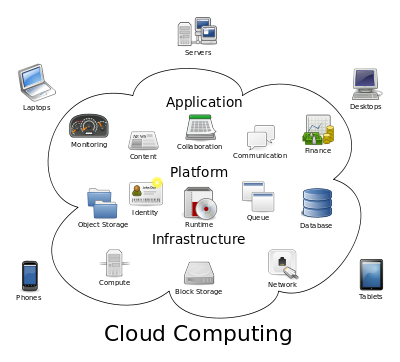
Have you ever heard someone talking extensively about Cloud Computing or generally Clouds? and have you ever noticed the fact many people (even the ones who present themselves as experts) don t really understand what a Cloud is at all? That happened to me multiple times and one of the most common misunderstandings is many see the Cloud as something being on the internet. Many companies add a little logo representing a cloud on their frontpage and without a single change on their infrastructure (but surely with a price increment) they start calling their products as being on the Cloud. Given the lack of knowledge about this specific topic people tend to buy the product presented as being on the Cloud without understanding what they really bought. But what Cloud Computing really means? it took several years and more than fifteen drafts to the National Institute of Standards and Technology s (NIST) to find a definition. The final accepted proposal:

Cloud computing is a model for enabling ubiquitous, convenient, on-demand network access to a shared pool of configurable computing resources (e.g., networks, servers, storage, applications and services) that can be rapidly provisioned and released with minimal management effort or service provider interaction.

The above definition requires a few more clarifications specifically when it comes to understand where should we focus on while checking for a Cloud Computing solution. A few key points:
  1. On-demand self-service: every consumer will be able to unilaterally provision multiple computing capabilities like server time, storage, bandwidth, dedicated RAM or CPU without requiring any sort of human interaction from their respective Cloud providers.
  2. Rapid elasticity and scalability: all the computing capabilities outlined above can be elastically provisioned and released depending on how much demand my company will have in a specific period of time. Suppose the X company is launching a new product today and it expects a very large number of customers. The X company will add more resources to their Cloud for the very first days (where they suppose the load to be very high) and then it ll scale the resources back as they were before. Elasticity and scalability permit the X company to improve and enhance their infrastructure when they need it with an huge saving in monetary terms.
  3. Broad network access: capabilities are available over the network and accessed through standard mechanisms that promote use by heterogeneous thin or thick client platforms (e.g., mobile phones, tablets, laptops, and workstations).
  4. Measured service: Cloud systems allow maximum transparency between the provider and the consumer, the usage of all the resources is monitored, controlled, and reported. The consumer knows how much will spend, when and in how long.
  5. Resource pooling: each provider s computing resources are pooled to serve multiple consumers at the same time. The consumer has no control or knownledge over the exact location of the provided resources but may be able to specify location at a higher level of abstraction (e.g., country, state, or datacenter).
  6. Resources price: when buying a Cloud service make sure the cost for two units of RAM, storage, CPU, bandwidth, server time is exactly the double of the price of one unit of the same capability. An example, if a provider offers you one hour of bandwitdh for 1 Euro, the price of two hours will have to be 2 Euros.
Another common error I usually hear is people feeling Cloud Computing just as a place to put their files online as a backup or for sharing them with co-workers and friends. That is just one of the available Cloud features , specifically the Cloud Storage , where typical examples are companies like Dropbox, Spideroak, Google Drive, iCloud and so on. But let s make a little note about the other three features :
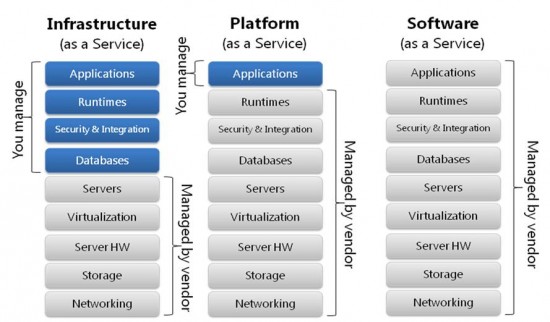
  1. Infrastructure as a Service (IaaS): the capability provided to the consumer is to provision processing, storage, networks, and other fundamental computing resources where the consumer is able to deploy and run arbitrary software, which can include operating systems and applications. In this specific case the consumer has still no control or management over the underlying Cloud infrastructure but has control over operating systems, storage, and deployed applications. A customer will be able to add and destroy virtual machines (VMs), install an operating system on them based on custom kickstart files and eventually manage selected networking components like firewalls, hosted domains, accounts.
  2. Platform as a Service (PaaS). the capability provided to the consumer is to deploy onto the cloud infrastructure consumer-created or acquired applications created using programming languages, libraries, services, and tools (like Mysql + PHP + PhpMyAdmin or Ruby on Rails) supported by the provider. In this specific case the consumer has still no control or management over the Cloud infrastructure itself (servers, OSs, storage, bandiwitdh etc.) but has control over the deployed applications and configuration settings for the application-hosting environment.
  3. Software as a Service (SaaS): the capability provided to the consumer is to use the provider s applications running on a Cloud infrastructure. The applications are accessible through various client devices, such as a browser, a mobile phone or a program interface. The consumer doesn t not manage nor control the Cloud infrastructure (servers, OSs, storage, bandwidth, etc.) that allows the applications to run. Even the provided applications aren t customizable by the consumer, which should rely on limited configuration settings.
The Cloud Computing technology is reasonably the future but can we trust Cloud providers? Are we sure that no one will ever have access to our files except us? and what about governments interested in acquiring a specific customer data hosted on the Cloud? I always suggest to read deeply both the Privacy Policy and Terms of Use of a certain service before signing in especially when it comes to choose a Cloud storage provider. Many providers have the same aspect, they seem to provide the same resources, the same amount of storage for the same price but legally they may present different problems, and that is the case of Spideroak vs Dropbox. Quoting from the Dropbox s Privacy Policy:
Compliance with Laws and Law Enforcement Requests; Protection of DropBox s Rights. We may disclose to parties outside Dropbox files stored in your Dropbox and information about you that we collect when we have a good faith belief that disclosure is reasonably necessary to (a) comply with a law, regulation or compulsory legal request; (b) protect the safety of any person from death or serious bodily injury; (c) prevent fraud or abuse of DropBox or its users; or (d) to protect Dropbox s property rights. If we provide your Dropbox files to a law enforcement agency as set forth above, we will remove Dropbox s encryption from the files before providing them to law enforcement. However, Dropbox will not be able to decrypt any files that you encrypted prior to storing them on Dropbox.
It s evident that Dropbox employees can access your data or be forced by legal process to turn over your data unencrypted. On the other side, Spideroak on its latest update to its Privacy Policy states that data stored on their Cloud is encrypted and inaccessible without user s key, which is stored locally on user s computers. And what about the latest research paper, titled Cloud Computing in Higher Education and Research Institutions and the USA Patriot Act written by the legal experts of the University of Amsterdam s Institute for Information Law stating the anti-terror Patriot Act could be theoretically used by U.S. law enforcement to bypass strict European privacy laws to acquire citizen data within the European Union without their consensus? The only requirement for the data acquisition is the provider being an U.S company or an European company conducting systematic business in the U.S. For example an Italian company storing their documents (protected by the European privacy laws and under the general Italian jurisdiction) on a provider based in Europe but conducting systematic business in the United States, could be forced by U.S. law enforcement to transfer data to the U.S. territory for inspection by law enforcement agencies. Does someone really care about the privacy of companies, consumers and users at all? or better does privacy exists at all for the millions of the people that connect to the internet every day?

12 December 2012

Sylvestre Ledru: Mini Debconf 2012 - videos and feedbacks

A bit more than two weeks after the Mini Debconf in Paris, I am glad to say that the videos of the event are finally published (the sound is not very good for the 4 first presentations, sorry about that).
They will be also available on the new IRILL website with a video player when ready.
All slides are also available on the page of the event. I believe that there is a consensus about the quality of the event. We had around 150 people attending to the event, many interesting and various talks.
As usual, it was nice to meet some old and new friends from Debian. Mini debconf - group picture
Group picture by Frederic Lehobey
For those who wonder, I am confident there will be a 2013 Parisian Mini Debconf. Various feedbacks about the event:
Lucas Nussbaum
Stefano Zacchiroli
Vincent Untz
Raphael Hertzog
Pietro Abate
Logilab (Julien Cristau)
The 'official' Debian news And, once more, many thanks to the sponsors!
Logilab SmartJog
Bearstech Evolix
IRILL

11 December 2012

Francesca Ciceri: Welcome Malatesta, Goodbye Kasbah!

Kasbah, my old laptop, is almost dead. It was my first laptop, an Asus X50C, which worked like a charm and was robust like a tank. But then the screen hinges broke. Time for a new one. So, ladies and gentlemen, I'm glad to present you malatesta. Malatesta is a Lenovo Thinkpad E335. Sadly, while kasbah worked with free drivers, malatesta requires proprietary drivers both for the video card and the wifi. Which sounds a bit ironic for a laptop named after a famous anarchist. The only two problems I encountered with it were related to the video card (00:01.0 VGA compatible controller: Advanced Micro Devices [AMD] nee ATI Device 9808) and the special keys. Malatesta worked well with the kernel of Squeeze, but freezed during the boot with Wheezy. Thankfully, I stumbled upon this blogpost by Blars Blarson suggesting to use the fglrx-driver with Sid. And that solved the problem. Another little odissey was the brightness of the monitor. With kernels < 3.2.0-4-amd64 the thinkpad_acpi didn't recognize my model and I was stuck with a brightness level probably visible from the outer space. Neither xrandr nor xbacklight could help, and I was seriously considering to use sunglasses to work (a slight unusual approach to the brightness problem, I know, but I suffer of migraines and couldn't bear an hyper-bright monitor), when the upgrade to Sid solved the problem. On the bright side (pun intended) this laptop was born without Windows. (Both malatesta and kasbah were shipped with FreeDOS). Now, if you're wondering about the names: my first namescheme was "references to songs by the Clash" (and kasbah is obviously for "Rock the Casbah", with a typo). But it wasn't really scalable. Since last year, I've decided to name my systems after famous anarchists. The server is named after one of my all time favourite anarchists, Buenaventura Durruti.
madamezou@durruti:~$ cat /etc/motd
%%%%%%%%%%%%%%%%%%%%%%%%%%%%%%%%%%%%%%%%%%%%%%%%%%%%%%%%%%%%%%%%%%%%%
Llevamos un mundo nuevo en nuestros corazones;
y ese mundo est  creciendo en este instante
                        Buenaventura Durruti
%%%%%%%%%%%%%%%%%%%%%%%%%%%%%%%%%%%%%%%%%%%%%%%%%%%%%%%%%%%%%%%%%%%%%
While the new laptop's name comes from Errico Malatesta.
madamezou@malatesta:~$ cat /etc/motd 
%%%%%%%%%%%%%%%%%%%%%%%%%%%%%%%%%%%%%%%%%%%%%%%%%%%%%%%%%%%%%%%%%%%%%
We anarchists do not want to emancipate the people;
We want the people to emancipate themselves.
            Errico Malatesta, L'Agitazione (18 June 1897)
%%%%%%%%%%%%%%%%%%%%%%%%%%%%%%%%%%%%%%%%%%%%%%%%%%%%%%%%%%%%%%%%%%%%%

Russell Coker: Dependencies in Online Ordering

I have just ordered two Samsung Galaxy S3 phones and matching cases from Kogan. The price was good and Kogan gave me 30 cents discount as part of a verification process. Instead of billing the full amount for a large order (for which the cutoff is somewhere between $25 and $1014) Kogan will deduct a random number of cents and demand that you confirm the amount of money on your credit card statement, if you don t know the amount that was billed then it s a fraudulent transaction. But now Kogan have decided that my phones and cases are separate things, they have dispatched the cases but not the phones. This is really annoying, I will have to arrange to receive two separate parcels and the first of which won t be of any immediate use to me. I can use a phone without a case, but a case without a phone isn t useful. If I had wanted to receive two parcels then I would have gone through the checkout process twice! It should have been really obvious to Kogan that I didn t want two parcels, they suggested that I buy cases after I selected the phones, so while it s theoretically possible that I might want to buy two new phones at the same time as buying two cases for entirely unrelated phones I don t think that the people who programmed the Kogan web server expected that to be the case.

9 December 2012

Stefano Zacchiroli: bits from the DPL for November 2012

Just posted, bits from the DPL for November 2012.
 ---------------------------------------------------------------------------------
/ Pop-up advertisement. Breaking news. Help the Release Team [0] by reviewing     \
  pending unblock requests. Oh, and by fixing RC bugs too.                         
                                                                                   
  [0]: http://nthykier.wordpress.com/2012/12/09/wheezy-release-progress-december/  
\---------------------------------------------------------------------------------/

Dear Project Members, here is another (delayed) monthly report of DPL activities, this time for November 2012. Highlights Events Assets That's all for now,
let's go back releasing Wheezy,
Cheers.
PS the day-to-day activity log for November 2012 is available at the usual place master:/srv/leader/news/bits-from-the-DPL.txt.201211

8 December 2012

Dirk Eddelbuettel: Rcpp attributes: Even easier integration of GSL code into R

Following the Rcpp 0.10.0 release, I had written about simulating pi easily by using the wonderful new Rcpp Attributes feature. Now with Rcpp 0.10.1 released a good week ago, it is time to look at how Rcpp Attributes can help with external libraries. As this posts aims to show, it is a breeze! One key aspect is the use of the plugins for the inline package. They provide something akin to a callback mechanism so that compilation and linking steps can be informed about header and library locations and names. We are going to illustrate this with an example from GNU Scientific Library (GSL). The example I picked uses B-Spline estimation from the GSL. This is a little redundant as R has its own spline routines and package, but serves well as a simple illustration---and, by reproducing an existing example, followed an established path. So we will look at Section 39.7 of the GSL manual which has a complete example as a standalone C program, generating both the data and the fit via cubic B-splines. We can decompose this two parts: data generation, and fitting. We will provide one function each, and then use both from R. These two function will follow the aforementioned example from Section 39.7 somewhat closely. We start with the first function to generate the data.
// [[Rcpp::depends(RcppGSL)]]
#include <RcppGSL.h>
#include <gsl/gsl_bspline.h>
#include <gsl/gsl_multifit.h>
#include <gsl/gsl_rng.h>
#include <gsl/gsl_randist.h>
#include <gsl/gsl_statistics.h>
const int N = 200;                              // number of data points to fit 
const int NCOEFFS = 12;                         // number of fit coefficients */
const int NBREAK = (NCOEFFS - 2);               // nbreak = ncoeffs + 2 - k = ncoeffs - 2 since k = 4 */
// [[Rcpp::export]]
Rcpp::List genData()  
    const size_t n = N;
    size_t i;
    double dy;
    gsl_rng *r;
    RcppGSL::vector<double> w(n), x(n), y(n);
    gsl_rng_env_setup();
    r = gsl_rng_alloc(gsl_rng_default);
    //printf("#m=0,S=0\n");
    /* this is the data to be fitted */
    for (i = 0; i < n; ++i)  
        double sigma;
        double xi = (15.0 / (N - 1)) * i;
        double yi = cos(xi) * exp(-0.1 * xi);
        sigma = 0.1 * yi;
        dy = gsl_ran_gaussian(r, sigma);
        yi += dy;
        gsl_vector_set(x, i, xi);
        gsl_vector_set(y, i, yi);
        gsl_vector_set(w, i, 1.0 / (sigma * sigma));
                
        //printf("%f %f\n", xi, yi);
     
    Rcpp::DataFrame res = Rcpp::DataFrame::create(Rcpp::Named("x") = x,
                                                  Rcpp::Named("y") = y,
                                                  Rcpp::Named("w") = w);
    x.free();
    y.free();
    w.free();
    gsl_rng_free(r);
    return(res);
 
We include a few header files, define (in what is common for C programs) a few constants and then define a single function genData() which returns and Rcpp::List as a list object to R. A primary importance here are the two attributes: one to declare a dependence on the RcppGSL package, and one to declare the export of the data generator function. That is all it takes! The plugin of the RcppGSL will provide information about the headers and library, and Rcpp Attributes will do the rest. The core of the function is fairly self-explanatory, and closely follows the original example. Space gets allocated, the RNG is setup and a simple functional form generates some data plus noise (see below). In the original, the data is written to the standard output; here we return it to R as three columns in a data.frame object familiar to R users. We then free the GSL vectors; this manual step is needed as they are implemented as C vectors which do not have a destructor. Next, we can turn the fitting function.
// [[Rcpp::export]]
Rcpp::List fitData(Rcpp::DataFrame ds)  
    const size_t ncoeffs = NCOEFFS;
    const size_t nbreak = NBREAK;
    const size_t n = N;
    size_t i, j;
    Rcpp::DataFrame D(ds);              // construct the data.frame object
    RcppGSL::vector<double> y = D["y"]; // access columns by name, 
    RcppGSL::vector<double> x = D["x"]; // assigning to GSL vectors
    RcppGSL::vector<double> w = D["w"];
    gsl_bspline_workspace *bw;
    gsl_vector *B;
    gsl_vector *c; 
    gsl_matrix *X, *cov;
    gsl_multifit_linear_workspace *mw;
    double chisq, Rsq, dof, tss;
    bw = gsl_bspline_alloc(4, nbreak);      // allocate a cubic bspline workspace (k = 4)
    B = gsl_vector_alloc(ncoeffs);
    X = gsl_matrix_alloc(n, ncoeffs);
    c = gsl_vector_alloc(ncoeffs);
    cov = gsl_matrix_alloc(ncoeffs, ncoeffs);
    mw = gsl_multifit_linear_alloc(n, ncoeffs);
    gsl_bspline_knots_uniform(0.0, 15.0, bw);   // use uniform breakpoints on [0, 15] 
    for (i = 0; i < n; ++i)                     // construct the fit matrix X 
        double xi = gsl_vector_get(x, i);
        gsl_bspline_eval(xi, B, bw);            // compute B_j(xi) for all j 
        for (j = 0; j < ncoeffs; ++j)           // fill in row i of X 
            double Bj = gsl_vector_get(B, j);
            gsl_matrix_set(X, i, j, Bj);
         
     
    gsl_multifit_wlinear(X, w, y, c, cov, &chisq, mw);  // do the fit 
    
    dof = n - ncoeffs;
    tss = gsl_stats_wtss(w->data, 1, y->data, 1, y->size);
    Rsq = 1.0 - chisq / tss;
    
    Rcpp::NumericVector FX(151), FY(151);       // output the smoothed curve 
    double xi, yi, yerr;
    for (xi = 0.0, i=0; xi < 15.0; xi += 0.1, i++)  
        gsl_bspline_eval(xi, B, bw);
        gsl_multifit_linear_est(B, c, cov, &yi, &yerr);
        FX[i] = xi;
        FY[i] = yi;
     
    Rcpp::List res =
      Rcpp::List::create(Rcpp::Named("X")=FX,
                         Rcpp::Named("Y")=FY,
                         Rcpp::Named("chisqdof")=Rcpp::wrap(chisq/dof),
                         Rcpp::Named("rsq")=Rcpp::wrap(Rsq));
    gsl_bspline_free(bw);
    gsl_vector_free(B);
    gsl_matrix_free(X);
    gsl_vector_free(c);
    gsl_matrix_free(cov);
    gsl_multifit_linear_free(mw);
    
    y.free();
    x.free();
    w.free();
    return(res);   
 
The second function closely follows the second part of the GSL example and, given the input data, fits the output data. Data structures are setup, the spline basis is created, data is fit and then the fit is evaluated at a number of points. These two vectors are returned along with two goodness of fit measures. We only need to load the Rcpp package and source a file containing the two snippets shown above, and we are ready to deploy this:
library(Rcpp)
sourceCpp("bSpline.cpp")                # compile two functions
dat <- genData()                        # generate the data
fit <- fitData(dat)                     # fit the model, returns matrix and gof measures
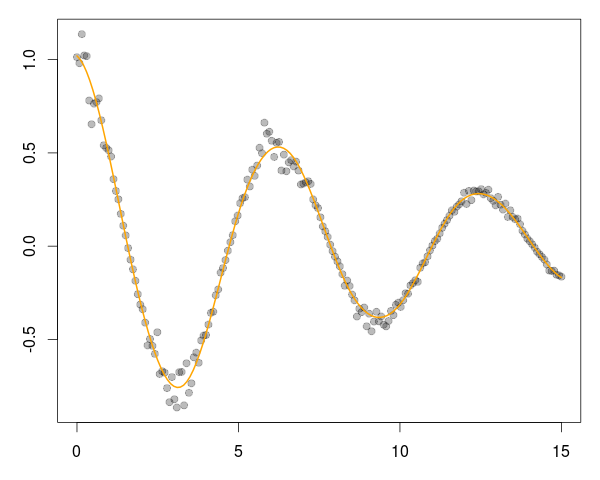
And with that, we generate a chart such as Spline fitting example from GSL manual redone with Rcpp Attributes via a simple four lines, or as much as it took to create the C++ functions, generate the data and fit it!
op <- par(mar=c(3,3,1,1))
plot(dat[,"x"], dat[,"y"], pch=19, col="#00000044")
lines(fit[[1]], fit[[2]], col="orange", lwd=2)
par(op)
The RcppArmadillo and RcppEigen package support plugin use in the same way. Add an attribute to export a function, and an attribute for the depends -- and you're done. Extending R with (potentially much faster) C++ code has never been easier, and opens a whole new set of doors.

Dirk Eddelbuettel: RcppArmadillo 0.3.6.0

Conrad launched the 3.6 series of Armadillo earlier today with a first 3.6.0 release. So RcppArmadillo, our wrapper for R and Armadillo, is now on CRAN with its corresponding version 0.3.6.0. No R level or interface changes were needed, and the upstream changes are summarized below.
Changes in RcppArmadillo version 0.3.6.0 (2012-12-07)
  • Upgraded to Armadillo release Version 3.6.0 (Piazza del Duomo)
    • faster handling of compound expressions with submatrices and subcubes
    • added support for loading matrices as text files with NaN and Inf elements
    • added stable_sort_index(), which preserves the relative order of elements with equivalent values
    • added handling of sparse matrices by mean(), var(), norm(), abs(), square(), sqrt()
    • added saving and loading of sparse matrices in arma_binary format
Courtesy of CRANberries, there is also a diffstat report for the most recent release As always, more detailed information is on the RcppArmadillo page. Questions, comments etc should go to the rcpp-devel mailing list off the R-Forge page.

7 December 2012

Thorsten Glaser: Collision resolution in open addressing hashtables

Before we begin, everyone should read up on hashtables and what open addressing / closed hashing is. The context is lines 111 190 of Python s Objects/dictobject.c as of today (so we get the line numbers straight). (I ve reworded this wlog entry a bit; I originally wrote it too late at night for it to read coherent.) Basically, I ve got an application where I d like to use a hashtable for a number of things not as generic as Python, and with focus on small footprint. I d like to offer associative arrays in a scripting language, where the keys are always arbitrary byte strings excluding NUL. Also, I d like to use the hashtable as backend for indexed arrays, where the keys are uint32_t and the usual use case is sequential. Finally, I m using it for several internal tables, such as a list of keywords, one of builtins, one of special variables, etc. which is a reason for me to not use a self-balancing binary tree as data structure (reading further below might suggest that, but getting a sorted list of hashtable keys is not the focus, though not unimportant).

My questions on this are:

Why is the shift on perturb done after its first use? In my experiments (using 32-bit width everywhere), for the pathological case of an 8-element (i = 3) table with three entries 0, 0x40000000 and 0x800000000, the second round yields 1 for all three, so it cannot have to do with the upper bits. My lookup looks like:

	mask = 2  - 1;
	j = perturb = hash(key);
	goto find_first_slot;
	 find_next_slot:
	j = (j << 2) + j + perturb + 1;
	perturb >>= PERTURB_SHIFT;
	/* FALLTHROUGH */
	 find_first_slot:
	entry = table[j & mask];
	if (!match(entry)) goto find_next_empty_slot;
 

This means that my first check is always the bare hash (so only do it if needed is no reason) and, since I m using gotos, I could just move the perturb >>= PERTURB_SHIFT; line before the line recalculating the next j to use. This seems to make more sense, even in the face of Python. (I actually looked at the Python file s comments again today because I thought to use a different resolution, but they have a good rationale for using the multiplication by 5.) Why can t we just use i as the PERTURB_SHIFT? Sure, this changes a shift-right by a constant, which can possibly be encoded as immediate value in assembly (unless you re on a pre-80186, which can only do SHR AX,1 and SHR AX,CL but not SHR AX,4, but that s outside of mksh s scope) into a right-shift by a variable, but i is already known, and I think the behaviour is better (it wouldn t eat any bits; assume the same 8-entry hashtable and pathologic keys 0, 8 and 16). Again: who do I think I am to go against the wisdom of the Python people, who seem to have shed more thought on this than everyone else I saw, asked, read about (including Spammipedia). That s why I m asking here. On that reference: I don t support spammers or people nagging for donations or premium accounts, like Xing and Groundspeak/Geocaching.COM, at all. In fact, I urge others to do the same, so it really hurts them; it may be their business model, but not if they spam me. Besides, OpenCaching.DE exists. Another thing is: to avoid CVE-2011-4815, I m randomising the hash used, with one seed value per hashtable, changed before a resize operation. I originally thought to seed it with nonzero, but then I have to rehash on hashtable resize, so I ll be XORing the final hash value instead (thanks ciruZ for the idea). I m thinking of omitting that for indexed arrays, as an attacker almost certainly cannot determine the keys there. (To directly use the indexed array keys, which are already uint32_t, as hashes makes using i from even more important.) The hash I m using is a modified Jenkins one-at-a-time called NZAAT: it s my new generic standard n n-cryptographic hash, and the changes are thus: while adding a byte, another increment of the hash is done (so NUL counts), and the finaliser got prefixed with the shift-left-add+shift-right-xor sequence of the adder (but not adding any value or the +1), to get best avalanche for all bytes. I actually compiled several versions of Hash.cs on a Windows VM at work to analyse the original one-at-a-time and all of my modifications; these turned out to be the simplest ones (I originally had added 0x100 instead of 1, but the effect was the same, and +1 is usually cheaper on most CPUs). Also, to avoid people being able to get to the seed, a user will always get only a sorted list of hashtable keys (numeric for indexed arrays, ASCIIbetically otherwise; see also my thoughts on JSON from the previous wlog entry). What algorithm do I use? For strings, comparisons are much more expensive, so I d like to keep them low. Memory use is also a factor; allocating one large(r) block is better than many small ones due to the pool allocator overhead and due to portability to ancient Unic s (which is another reason for me to use a hashtable which is a small struct plus an array of pointers, and then pass the list of keys as array of string pointers, instead of a tree). For both reasons, I m thinking a relatively simple MergeSort: I need to allocate the result array anyway, so I can just get two and free the one that isn t the end result, and it s AFAICT the cheapest on comparisons other than Tree Sort (which nobody really seems to use, and which would effect to using a balanced binary tree again). Since keys are unique, stability and duplicate handling is never an issue. I d like to use only one algorithm and one data structure, not a combination, as compactness is a design goal. Please drop your thoughts on Freenode, e.g. by /msg MemoServ send mirabilos your text here or per eMail to the domains debian, freewrt or mirbsd, which are organisations, with the localpart tg. Or just contact me as usual, if you re already acquainted. Or lookup 0xE99007E0. Thanks in advance! (Especially, Python Developers thoughts are welcome.)

Paul Tagliamonte: converting kml to csv (for consumption of google latitude)

Google Latitude history dumps come in KML, and KML isn t super compatible with existing GIS tools. I wrote a quick snippit to output CSV from a KML dump on google latitude.
from lxml import etree
import sys
root = etree.fromstring(open(sys.argv[1], 'r').read())
track = root.xpath("//*[local-name()='Track']")[0]
coord = None
when = None
print "time,lat,lon"
for node in track.iter():
    name = node.xpath("local-name()")
    if name == 'coord':
        lon, lat, z = node.xpath("text()")[0].split()
        coord =  
            "lat": lat,
            "lon": lon,
            "zee": z
         
    elif name == 'when':
        when = node.xpath("text()")[0]
    if coord and when:
        print "%s,%s,%s" % (
            when,
            coord['lat'],
            coord['lon']
        )
        coord, when = None, None
P.S. namespaces in lxml is nasty.

6 December 2012

Leo 'costela' Antunes: Silly Wal(l Cloc)k 2.0

So I finally got the first laser-cut version of the Silly Wal(l Cloc)k done: The back plate was cut from a 1mm plexiglass sheet using this SVG. The black parts were spray painted with matte black and inserted back into the hollowed out sections (I should have made pictures of the pieces before assembling; too lazy to do it now). This proved out to be somewhat problematic, since keeping the small pieces (the chin and the white part of the suitcase handle) in place isn t really easy without gluing everything together, which I wanted to avoid because I m not sure what effect the glue might have on plexiglass in the long term. Another problem was the fact that the plexiglass sheet is white, but slightly translucent. Since the back piece of the clock is black, this caused the white parts to look dirty . As a workaround for both problems I ended up using a thin white cardboard sheet as additional background, where the small hollowed out pieces could be affixed and the translucency of the plexiglass could be hidden. On the other hand, the 1mm thickness for the plexiglass turned out to be perfect for the clock hands (or feet). I think it would still have worked with 2mm, but that might be too heavy for the puny clock torque and they might start snagging on each other. Careful eyes will also note that I made a stupid mistake when writing down the dimensions for the back plate and it ended up being slightly smaller than the available space. Not my brightest moment, but it worked out alright with the additional cardboard background. The next iteration will probably be made with a different two-color plexiglass sheet that can be engraved. Let s see how that works out. Related: Silly Wal(l Cloc)k

Steve Kemp: December 2012 Software Updates

Some brief software updates:
Custodian
This is the monitoring tool I wrote for Bytemark. It still rocks, and has run over 10 million tests without failure.I'd love more outside feedback, even if just to say "documentation needs work".
Slaughter
This is my sysadmin tool for multiple hosts - consider it cfengine-lite, or cfengine-trivial more likely. The 2.x release is finally out, and features pluggable transports. That means your central server can be running HTTP, RSYNC, FTP, or anything you like. 90% of the changes came from or were inspired by Csillag Tamas, to whom I owe a debt of thanks.
Templer
A static-site generator, written in Perl. I use this to generate blogspam.net, and other sites from simple layouts. Tutorial available online.
redis-document-store
A trivial hack which allows using Redis as a schema-less document storage system. Assuming you never delete documents it is simple, transparent, and already in live use for Debian Administration
Random Comment on Templer:
Although I've made extensive notes on common static site generators, and they will be discussed at length in the near future, I do want to highlight one problem common to 90% of them: Symbolic links. For example webgen fails my simple test:
~/hg/websites$ webgen create test.example.com
~/hg/websites$ cd test.example.com/src/
~/hg/websites/test.example.com/src$ mkdir jquery-1.2.3
~/hg/websites/test.example.com/src$ touch jquery-1.2.3/jquery.js
~/hg/websites/test.example.com/src$ ln -s jquery-1.2.3 jquery
~/hg/websites/test.example.com$ webgen
Starting webgen...
...
Finished
~/hg/websites/test.example.com$ ls out/    grep jq
jquery-1.2.3
Here we see creating a symlink to a directory has not produced a matching symlink in the output. Something I use frequently. for example. Some tools mangled symlinked directories, or files, some ignore them completely. Neither is acceptible.

Kurt Roeckx: iDEAL and ING

For the e-webshops site I run I started implementing iDEAL because we have a lot customers in the Netherlands. iDEAL is a standard used in the Netherlands to do online payments. We needed to open a bank account for that in the Netherlands, so we did that with ING in October. It first took them a month to reject us, stating we needed to register our company in Belgium. Of course we're already registered, we couldn't be in business in the first place if we weren't. After pointing them to the government website it seems to have sorted itself out a few days later. So once we were approved I could actually start to test the software for iDEAL. It uses XML sig which I think is a horrible standard. Once I started testing it I directly ran into a problem. They give me an error back saying that the signature wasn't valid. So I contacted them about 2 weeks ago and have yet to get answer back that's useful. So far it went like this:
So I'm now back to step 1.

5 December 2012

Francesca Ciceri: recipe for a bsp

Take a well known FLOSS friendly hotel located in the German region of Nordrhein-Westfalen. Take a bunch of nasty Release Critical bugs affecting the next Debian stable release. Add a dozen of Debian Developers and contributors (allocating slots for two Italians and a Spaniard). Add a couple of packs of Haribo, some Parmigiano-Reggiano, various liters of Club Mate and Salmiakki candies. Lock the doors (well, metaphorically speaking) for an entire weekend and mix all. You'll end up with a great Bug Squashing Party! On Monday morning, you'll wake up with: The only thing to do, then, will be to thanks Rhonda for organizing it and all the people who participated for making it a success.

Francesca Ciceri: recipe for a bsp

Take a well known FLOSS friendly hotel located in the German region of Nordrhein-Westfalen. Take a bunch of nasty Release Critical bugs affecting the next Debian stable release. Add a dozen of Debian Developers and contributors (allocating slots for two Italians and a Spaniard). Add a couple of packs of Haribo, some Parmigiano-Reggiano, various liters of Club Mate and Salmiakki candies. Lock the doors (well, metaphorically speaking) for an entire weekend and mix all. You'll end up with a great Bug Squashing Party! On Monday morning, you'll wake up with: The only thing to do, then, will be to thanks Rhonda for organizing it and all the people who participated for making it a success.

4 December 2012

Daniel Kahn Gillmor: Error messages are your friend (postgres is good)

Here is a bit of simple (yet subtly-flawed) sql, which produces different answers on different database engines:

0 dkg@pip:~$ cat test.sql
drop table if exists foo;
create table foo (x int, y int);
insert into foo VALUES (1,3);
insert into foo VALUES (1,5);
select y from foo group by x;
0 dkg@pip:~$ sqlite3 < test.sql
5
0 dkg@pip:~$ mysql -N dkg < test.sql
3
0 dkg@pip:~$ psql -qtA dkg < test.sql
ERROR:  column "foo.y" must appear in the GROUP BY clause or be used in an aggregate function
LINE 1: select y from foo group by x;
               ^
0 dkg@pip:~$ 
are two of the many reasons postgresql is my database engine of choice.Tags: errors, postgresql, sql

Andrea Veri: My favorite WordPress Plugins

It took me a while to build a complete WordPress blog with all the things I needed, from modifying the default Twenty Eleven theme to broadcasting my posts directly on Twitter. WordPress has a nice selection of plugins and given the fact I spent a few days evaluating all the possibilities, I decided to share my own setup to speed up the process in case you are willing to build a WordPress powered blog. The plugins: And a few modifications I made on my Child theme for the Twenty Eleven theme to suit my needs: Remove the navigation buttons on the header. On the Child theme s style.css:
#access, #branding .only-search #s, .entry-header .comments-link  
display: none;
 
Remove the gray line on the top of the header s banner. On the Child theme s style.css:
#branding  
border-top: none;
 
.and a little tip about WordPress itself: have you ever wondered how you could install/update/remove a WordPress theme or plugin without FTP access? Here s how! On the config.php file:
/*** Updates WordPress without FTP credentials. ***/
define('FS_METHOD','direct');
If you know any other handy WordPress Tip or Plugin, please share!

3 December 2012

Jon Dowland: Wheezy problems

I've recently replaced my laptop's HDD as the S.M.A.R.T. data suggested a potential failure. I took the opportunity to try out beta4 of debian-installer and to install a pure wheezy system. Prior to this I've been running a mostly wheezy system with some bits from sid or experimental. I've got quite a few notes about bugs I've hit in the installer, most of which I still need to file, but perhaps the most problematic appears to be known as #661789. Unless I'm reading this wrong, it would appear this show-stopper bug makes booting on an EFI system impossible without some workarounds, it's been a known problem for 9 months, and d-i beta4's images opt for EFI booting where possible. After the 8th install run I must admit I started getting angry that someone was wasting my time. Perhaps this is covered in some install notes somewhere. Anyway, I got an install working eventually (with legacy BIOS boot mode). and have been running wheezy for the last week. I've just now had a string of problems which were a fairly typical experience for me running a mixed system. Whenever I hit a problem, particularly in the GNOME3 stack, my first response was to check "am I running the latest version of the packages?" inevitably not and so I got around my problems via a reboot or something similarly drastic; updated the packages and left things. Until the next time. Just now, the following things happened: I've experienced all of the above (except for the PAM thing) more than once over the last 12 months or so since I blogged about moving to GNOME3. Now I'm running a pure wheezy system, at this point in the freeze the relevant packages are likely to be more stable. So, not running the latest version is no longer a reason to avoid fixing the problem. Time for me to start proper analysis! Debian is now in deep freeze. I've heard it said a few times that we are coming to the end of that process. Based on my experiences, in my humble opinion, we've got some work to do before we're release worthy.

Next.

Previous.