Search Results: "pa"

21 November 2020

Michael Stapelberg: Debian Code Search: positional index, TurboPFor-compressed

See the Conclusion for a summary if you re impatient :-)

Motivation Over the last few months, I have been developing a new index format for Debian Code Search. This required a lot of careful refactoring, re-implementation, debug tool creation and debugging. Multiple factors motivated my work on a new index format:
  1. The existing index format has a 2G size limit, into which we have bumped a few times, requiring manual intervention to keep the system running.
  2. Debugging the existing system required creating ad-hoc debugging tools, which made debugging sessions unnecessarily lengthy and painful.
  3. I wanted to check whether switching to a different integer compression format would improve performance (it does not).
  4. I wanted to check whether storing positions with the posting lists would improve performance of identifier queries (= queries which are not using any regular expression features), which make up 78.2% of all Debian Code Search queries (it does).
I figured building a new index from scratch was the easiest approach, compared to refactoring the existing index to increase the size limit (point ). I also figured it would be a good idea to develop the debugging tool in lock step with the index format so that I can be sure the tool works and is useful (point ).

Integer compression: TurboPFor As a quick refresher, search engines typically store document IDs (representing source code files, in our case) in an ordered list ( posting list ). It usually makes sense to apply at least a rudimentary level of compression: our existing system used variable integer encoding. TurboPFor, the self-proclaimed Fastest Integer Compression library, combines an advanced on-disk format with a carefully tuned SIMD implementation to reach better speeds (in micro benchmarks) at less disk usage than Russ Cox s varint implementation in github.com/google/codesearch. If you are curious about its inner workings, check out my TurboPFor: an analysis . Applied on the Debian Code Search index, TurboPFor indeed compresses integers better:

Disk space
8.9G codesearch varint index
5.5G TurboPFor index Switching to TurboPFor (via cgo) for storing and reading the index results in a slight speed-up of a dcs replay benchmark, which is more pronounced the more i/o is required.

Query speed (regexp, cold page cache)
18s codesearch varint index
14s TurboPFor index (cgo)

Query speed (regexp, warm page cache)
15s codesearch varint index
14s TurboPFor index (cgo) Overall, TurboPFor is an all-around improvement in efficiency, albeit with a high cost in implementation complexity.

Positional index: trade more disk for faster queries This section builds on the previous section: all figures come from the TurboPFor index, which can optionally support positions. Conceptually, we re going from:
type docid uint32
type index map[trigram][]docid
to:
type occurrence struct  
    doc docid
    pos uint32 // byte offset in doc
 
type index map[trigram][]occurrence
The resulting index consumes more disk space, but can be queried faster:
  1. We can do fewer queries: instead of reading all the posting lists for all the trigrams, we can read the posting lists for the query s first and last trigram only.
    This is one of the tricks described in the paper AS-Index: A Structure For String Search Using n-grams and Algebraic Signatures (PDF), and goes a long way without incurring the complexity, computational cost and additional disk usage of calculating algebraic signatures.
  2. Verifying the delta between the last and first position matches the length of the query term significantly reduces the number of files to read (lower false positive rate).
  3. The matching phase is quicker: instead of locating the query term in the file, we only need to compare a few bytes at a known offset for equality.
  4. More data is read sequentially (from the index), which is faster.

Disk space A positional index consumes significantly more disk space, but not so much as to pose a challenge: a Hetzner EX61-NVME dedicated server ( 64 /month) provides 1 TB worth of fast NVMe flash storage.
6.5G non-positional
123G positional
93G positional (posrel) The idea behind the positional index (posrel) is to not store a (doc,pos) tuple on disk, but to store positions, accompanied by a stream of doc/pos relationship bits: 1 means this position belongs to the next document, 0 means this position belongs to the current document. This is an easy way of saving some space without modifying the TurboPFor on-disk format: the posrel technique reduces the index size to about . With the increase in size, the Linux page cache hit ratio will be lower for the positional index, i.e. more data will need to be fetched from disk for querying the index. As long as the disk can deliver data as fast as you can decompress posting lists, this only translates into one disk seek s worth of additional latency. This is the case with modern NVMe disks that deliver thousands of MB/s, e.g. the Samsung 960 Pro (used in Hetzner s aforementioned EX61-NVME server). The values were measured by running dcs du -h /srv/dcs/shard*/full without and with the -pos argument.

Bytes read A positional index requires fewer queries: reading only the first and last trigram s posting lists and positions is sufficient to achieve a lower (!) false positive rate than evaluating all trigram s posting lists in a non-positional index. As a consequence, fewer files need to be read, resulting in fewer bytes required to read from disk overall. As an additional bonus, in a positional index, more data is read sequentially (index), which is faster than random i/o, regardless of the underlying disk.
1.2G
19.8G
21.0G regexp queries
4.2G (index)
10.8G (files)
15.0G identifier queries The values were measured by running iostat -d 25 just before running bench.zsh on an otherwise idle system.

Query speed Even though the positional index is larger and requires more data to be read at query time (see above), thanks to the C TurboPFor library, the 2 queries on a positional index are roughly as fast as the n queries on a non-positional index ( 4s instead of 3s). This is more than made up for by the combined i/o matching stage, which shrinks from 18.5s (7.1s i/o + 11.4s matching) to 1.3s.
3.3s (index)
7.1s (i/o)
11.4s (matching)
21.8s regexp queries
3.92s (index)
1.3s
5.22s identifier queries Note that identifier query i/o was sped up not just by needing to read fewer bytes, but also by only having to verify bytes at a known offset instead of needing to locate the identifier within the file.

Conclusion The new index format is overall slightly more efficient. This disk space efficiency allows us to introduce a positional index section for the first time. Most Debian Code Search queries are positional queries (78.2%) and will be answered much quicker by leveraging the positions. Bottomline, it is beneficial to use a positional index on disk over a non-positional index in RAM.

Kentaro Hayashi: Introduction about recent debexpo (mentors.debian.net)

I've make a presentation about "How to hack debexpo (mentors.debian.net)" at Tokyo Debian (local Debian meeting) 21, November 2020. Here is the agenda about presentation. The presentation slide is published at Rabbit Slide Show (Written in Japanese) I hope that more people will be involved to hack debexpo!

20 November 2020

Shirish Agarwal: Rights, Press freedom and India

In some ways it is sad and interesting to see how personal liberty is viewed in India. And how it differs from those having the highest fame and power can get a different kind of justice then the rest cannot.

Arnab Goswami This particular gentleman is a class apart. He is the editor as well as Republic TV, a right-leaning channel which demonizes the minority, women whatever is antithesis to the Central Govt. of India. As a result there have been a spate of cases against him in the past few months. But surprisingly, in each of them he got hearing the day after the suit was filed. This is unique in Indian legal history so much so that a popular legal site which publishes on-going cases put up a post sharing how he was getting prompt hearings. That post itself needs to be updated as there have been 3 more hearings which have been done back to back for him. This is unusual as there have been so many cases pending for the SC attention, some arguably more important than this gentleman . So many precedents have been set which will send a wrong message. The biggest one, that even though a trial is taking place in the sessions court (below High Court) the SC can interject on matters. What this will do to the morale of both lawyers as well as judges of the various Sessions Court is a matter of speculation and yet as shared unprecedented. The saddest part was when Justice Chandrachud said
Justice Chandrachud If you don t like a channel then don t watch it. 11th November 2020 .

This is basically giving a free rope to hate speech. How can a SC say like that ? And this is the Same Supreme Court which could not take two tweets from Shri Prashant Bhushan when he made remarks against the judiciary .

J&K pleas in Supreme Court pending since August 2019 (Abrogation 370) After abrogation of 370, citizens of Jammu and Kashmir, the population of which is 13.6 million people including 4 million Hindus have been stuck with reduced rights and their land being taken away due to new laws. Many of the Hindus which regionally are a minority now rue the fact that they supported the abrogation of 370A . Imagine, a whole state whose answers and prayers have not been heard by the Supreme Court and the people need to move a prayer stating the same.

100 Journalists, activists languishing in Jail without even a hearing 55 Journalists alone have been threatened, booked and in jail for reporting of pandemic . Their fault, they were bring the irregularities, corruption made during the pandemic early months. Activists such as Sudha Bharadwaj, who giving up her American citizenship and settling to fight for tribals is in jail for 2 years without any charges. There are many like her, There are several more petitions lying in the Supreme Court, for e.g. Varavara Rao, not a single hearing from last couple of years, even though he has taken part in so many national movements including the emergency as well as part-responsible for creation of Telengana state out of Andhra Pradesh .

Then there is Devangana kalita who works for gender rights. Similar to Sudha Bharadwaj, she had an opportunity to go to UK and settle here. She did her master s and came back. And now she is in jail for the things that she studied. While she took part in Anti-CAA sittings, none of her speeches were incendiary but she still is locked up under UAPA (Unlawful Practises Act) . I could go on and on but at the moment these should suffice.

Petitions for Hate Speech which resulted in riots in Delhi are pending, Citizen s Amendment Act (controversial) no hearings till date. All of the best has been explained in a newspaper article which articulates perhaps all that I wanted to articulate and more. It is and was amazing to see how in certain cases Article 32 is valid and in many it is not. Also a fair reading of Justice Bobde s article tells you a lot how the SC is functioning. I would like to point out that barandbench along with livelawindia makes it easier for never non-lawyers and public to know how arguments are done in court, what evidences are taken as well as give some clue about judicial orders and judgements. Both of these resources are providing an invaluable service and more often than not, free of charge.

Student Suicide and High Cost of Education
For quite sometime now, the cost of education has been shooting up. While I have visited this topic earlier as well, recently a young girl committed suicide because she was unable to pay the fees as well as additional costs due to pandemic. Further investigations show that this is the case with many of the students who are unable to buy laptops. Now while one could think it is limited to one college then it would be wrong. It is almost across all India and this will continue for months and years. People do know that the pandemic is going to last a significant time and it would be a long time before R value becomes zero . Even the promising vaccine from Pfizer need constant refrigeration which is sort of next to impossible in India. It is going to make things very costly.

Last Nail on Indian Media Just today the last nail on India has been put. Thankfully Freedom Gazette India did a much better job so just pasting that
Information and Broadcasting Ministry bringing OTT services as well as news within its ambit.
With this, projects like Scam 1992, The Harshad Mehta Story or Bad Boy Billionaires:India, Test Case, Delhi Crime, Laakhon Mein Ek etc. etc. such kind of series, investigative journalism would be still-births. Many of these web-series also shared tales of woman empowerment while at the same time showed some of the hard choices that women had to contend to live with. Even western media may be censored where it finds the political discourse not to its liking. There had been so many accounts of Mr. Ravish Kumar, the winner of Ramon Magsaysay, how in his shows the electricity was cut in many places. I too have been the victim when the BJP governed in Maharashtra as almost all Puneities experienced it. Light would go for just half or 45 minutes at the exact time. There is another aspect to it. The U.S. elections showed how independent media was able to counter Mr. Trump s various falsehoods and give rise to alternative ideas which lead the team of Bernie Sanders, Joe Biden and Kamala Harris, Biden now being the President-elect while Kamala Harris being the vice-president elect. Although the journey to the white house seems as tough as before. Let s see what happens. Hopefully 2021 will bring in some good news. Update On 27th November 2020 Martin who runs the planet got an e-mail/notice by a Mr. Nikhil Sethi who runs the wikibio.com property. Mr. Sethi asked to remove the link pointing Devangana Kalita from my blog post to his site as he has used the no follow link. On inquiring further, the gentleman stated that it is an Updated mandate (his exact quote) from Google algorithm. To further understand the issue, I went to SERP as they are one of the more known ones on the subject. I also looked it up on Google as well. Found that the gentleman was BSing the whole time. The page basically talks about weightage of a page/site and authoritativeness which is known and yet highly contested ideas. In any case, the point for me was for whatever reason (could be fear, could be something else entirely), Mr. Sethi did not want me to link the content. Hence, I have complied above. I could have dragged it out but I do not wish Mr. Sethi any ill-being or/and further harm unduly and unintentionally caused by me. Hence, have taken down the link.

19 November 2020

Molly de Blanc: Transparency

Technology must be transparent in order to be knowable. Technology must be knowable in order for us to be able to consent to it in good faith. Good faith informed consent is necessary to preserving our (digital) autonomy. Let s now look at this in reverse, considering first why informed consent is necessary to our digital autonomy. Let s take the concept of our digital autonomy as being one of the highest goods. It is necessary to preserve and respect the value of each individual, and the collectives we choose to form. It is a right to which we are entitled by our very nature, and a prerequisite for building the lives we want, that fulfill us. This is something that we have generally agreed on as important or even sacred. Our autonomy, in whatever form it takes, in whatever part of our life it governs, is necessary and must be protected. One of the things we must do in order to accomplish this is to build a practice and culture of consent. Giving consent saying yes is not enough. This consent must come from a place of understand to that which one is consenting. Informed consent is consenting to the unknowable. (1) Looking at sexual consent as a parallel, even when we have a partner who discloses their sexual history and activities, we cannot know whether they are being truthful and complete. Let s even say they are and that we can trust this, there is a limit to how much even they know about their body, health, and experience. They might not know the extent of their other partners experience. They might be carrying HPV without symptoms; we rarely test for herpes. Arguably, we have more potential to definitely know what is occurring when it comes to technological consent. Technology can be broken apart. We can share and examine code, schematics, and design documentation. Certainly, lots of information is being hidden from us a lot of code is proprietary, technical documentation unavailable, and the skills to process these things is treated as special, arcane, and even magical. Tracing the resource pipelines for the minerals and metals essential to building circuit boards is not possible for the average person. Knowing the labor practices of each step of this process, and understanding what those imply for individuals, societies, and the environments they exist in seems improbable at best. Even though true informed consent might not be possible, it is an ideal towards which we must strive. We must work with what we have, and we must be provided as much as possible. A periodic conversation that arises in the consideration of technology rights is whether companies should build backdoors into technology for the purpose of government exploitation. A backdoor is a hidden vulnerability in a piece of technology that, when used, would afford someone else access to your device or work or cloud storage or whatever. As long as the source code that powers computing technology is proprietary and opaque, we cannot truly know whether backdoors exist and how secure we are in our digital spaces and even our own computers, phones, and other mobile devices. We must commit wholly to transparency and openness in order to create the possibility of as-informed-as-possible consent in order to protect our digital autonomy. We cannot exist in a vacuum and practical autonomy relies on networks of truth in order to provide the opportunity for the ideal of informed consent. These networks of truth are created through the open availability and sharing of information, relating to how and why technology works the way it does. (1) Heintzman, Kit. 2020.

Daniel Silverstone: Withdrawing Gitano from support

Unfortunately, in Debian in particular, libgit2 is undergoing a transition which is blocked by gall. Despite having had over a month to deal with this, I've not managed to summon the tuits to update Gall to the new libgit2 which means, nominally, I ought to withdraw it from testing and possibly even from unstable given that I'm not really prepared to look after Gitano and friends in Debian any longer. However, I'd love for Gitano to remain in Debian if it's useful to people. Gall isn't exactly a large piece of C code, and so probably won't be a huge job to do the port, I simply don't have the desire/energy to do it myself. If someone wanted to do the work and provide a patch / "pull request" to me, then I'd happily take on the change and upload a new package, or if someone wanted to NMU the gall package in Debian I'll take the change they make and import it into upstream. I just don't have the energy to reload all that context and do the change myself. If you want to do this, email me and let me know, so I can support you and take on the change when it's done. Otherwise I probably will go down the lines of requesting Gitano's removal from Debian in the next week or so.

17 November 2020

Raphaël Hertzog: Freexian s report about Debian Long Term Support, October 2020

A Debian LTS logo Like each month, here comes a report about the work of paid contributors to Debian LTS. Individual reports In October, 221.50 work hours have been dispatched among 13 paid contributors. Their reports are available: Evolution of the situation October was a regular LTS month with a LTS team meeting done via video chat thus there s no log to be shared. After more than five years of contributing to LTS (and ELTS), Mike Gabriel announced that he founded a new company called Frei(e) Software GmbH and thus would leave us to concentrate on this new endeavor. Best of luck with that, Mike! So, once again, this is a good moment to remind that we are constantly looking for new contributors. Please contact Holger if you are interested! The security tracker currently lists 42 packages with a known CVE and the dla-needed.txt file has 39 packages needing an update. Thanks to our sponsors Sponsors that joined recently are in bold.

No comment Liked this article? Click here. My blog is Flattr-enabled.

Jaldhar Vyas: Sal Mubarak 2077!

[Celebrating Diwali wearing a mask] Best wishes to the entire Debian world for a happy, prosperous and safe Gujarati new year, Vikram Samvat 2077 named Paridhawi.

Louis-Philippe V ronneau: A better git diff

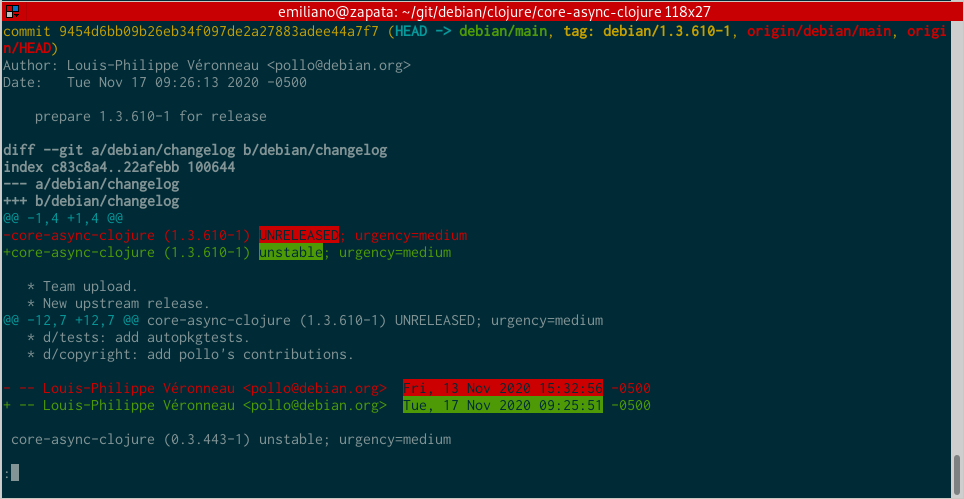
A few days ago I wrote a quick patch and missed a dumb mistake that made the program crash. When reviewing the merge request on Salsa, the problem became immediately apparent; Gitlab's diff is much better than what git diff shows by default in a terminal. Well, it turns out since version 2.9, git bundles a better pager, diff-highlight. la Gitlab, it will highlight what changed in the line. The output of git diff using diff-highlight Sadly, even though diff-highlight comes with the git package in Debian, it is not built by default (925288). You will need to:
$ sudo make --directory /usr/share/doc/git/contrib/diff-highlight
You can then add this line to your .gitconfig file:
[core]
  pager = /usr/share/doc/git/contrib/diff-highlight/diff-highlight   less --tabs=4 -RFX
If you use tig, you'll also need to add this line in your tigrc:
set diff-highlight = /usr/share/doc/git/contrib/diff-highlight/diff-highlight

Dirk Eddelbuettel: RcppArmadillo 0.10.1.2.0

armadillo image Armadillo is a powerful and expressive C++ template library for linear algebra aiming towards a good balance between speed and ease of use with a syntax deliberately close to a Matlab. RcppArmadillo integrates this library with the R environment and language and is widely used by (currently) 779 other packages on CRAN. This release ties up a few loose ends from the recent 0.10.1.0.0.

Changes in RcppArmadillo version 0.10.1.2.0 (2020-11-15)
  • Upgraded to Armadillo release 10.1.2 (Orchid Ambush)
  • Remove three unused int constants (#313)
  • Include main armadillo header using quotes instead of brackets
  • Rewrite version number use in old-school mode because gcc 4.8.5
  • Skipping parts of sparse conversion on Windows as win-builder fails

Courtesy of my CRANberries, there is a diffstat report relative to previous release. More detailed information is on the RcppArmadillo page. Questions, comments etc should go to the rcpp-devel mailing list off the R-Forge page. If you like this or other open-source work I do, you can now sponsor me at GitHub. For the first year, GitHub will match your contributions.

This post by Dirk Eddelbuettel originated on his Thinking inside the box blog. Please report excessive re-aggregation in third-party for-profit settings.

Dirk Eddelbuettel: RcppAnnoy 0.0.17

annoy image A new release 0.0.17 of RcppAnnoy is now on CRAN. RcppAnnoy is the Rcpp-based R integration of the nifty Annoy library by Erik Bernhardsson. Annoy is a small and lightweight C++ template header library for very fast approximate nearest neighbours originally developed to drive the famous Spotify music discovery algorithm. This release brings a new upstream version 1.17, released a few weeks ago, which adds multithreaded index building. This changes the API by adding a new threading policy parameter requiring code using the main Annoy header to update. For this reason we waited a little for the dust to settle on the BioConductor 3.12 release before bringing the changes to BiocNeighbors via this commit and to uwot via this simple PR. Aaron and James updated their packages accordingly so by the time I uploaded RcppAnnoy it made for very smooth sailing as we all had done our homework with proper conditional builds, and the package had no other issue preventing automated processing at CRAN. Yay. I also added a (somewhat overdue one may argue) header file RcppAnnoy.h regrouping defines and includes which should help going forward. Detailed changes follow below.

Changes in version 0.0.17 (2020-11-15)
  • Upgrade to Annoy 1.17, but default to serial use.
  • Add new header file to regroup includes and defines.
  • Upgrade CI script to use R with bspm on focal.

Courtesy of my CRANberries, there is also a diffstat report for this release. If you like this or other open-source work I do, you can now sponsor me at GitHub. For the first year, GitHub will match your contributions.

This post by Dirk Eddelbuettel originated on his Thinking inside the box blog. Please report excessive re-aggregation in third-party for-profit settings.

15 November 2020

Jamie McClelland: Being your own Certificate Authority

There are many blogs and tutorials with nice shortcuts providing the necessary openssl commands to create and sign x509 certficates. However, there is precious few instructions for how to easily create your own certificate authority. You probably never want to do this in a production environment, but in a development environment it will make your life signficantly easier. Create the certificate authority Create the key and certificate Pick a directory to store things in. Then, make your certificate authority key and certificate:
openssl genrsa -out cakey.pem 2048
openssl req -x509 -new -nodes -key cakey.pem -sha256 -days 1024 -out cacert.pem
Some tips: Want to review what you created?
openssl x509 -text -noout -in cacert.pem 
Prepare your directory You can create your own /etc/ssl/openssl.cnf file and really customize things. But I find it safer to use your distribution's default file so you can benefit from changes to it every time you upgrade. If you do take the default file, you may have the dir option coded to demoCA (in Debian at least, maybe it's the upstream default too). So, to avoid changing any configuration files, let's just use this value. Which means... you'll need to create that directory. The setting is relative - so you can create this directory in the same directory you have your keys.
mkdir demoCA
Lastly, you have to have a file that keeps track of your certificates. If it doesn't exist, you get an error:
touch demoCA/index.txt
That's it! Your certificate authority is ready to go. Create a key and ceritificate signing request First, pick your domain names (aka "common" names). For example, example.org and www.example.org. Set those values in an environment variable. If you just have one:
export subjectAltName=DNS:example.org
If you have more then one:
export subjectAltName=DNS:example.org,DNS:www.example.org
Next, create a key and a certificate signing request:
openssl req -new -nodes -out new.csr -keyout new.key
Again, you will be prompted for some values (country, state, etc) - be sure to choose the same values you used with your certficiate authority! I honestly don't understand why this is necessary (when I set different values I get an error on the signing request step below). Maybe someone can add a comment to this post explaining why these values have to match? Also, you must provide a common name for your certificate - you can choose the same name as the altSubjectNames value you set above (but just one domain). Want to review what you created?
openssl req -in new.csr -text -noout 
Sign it! At last the momenet we have been waiting for.
openssl ca -keyfile cakey.pem -cert cacert.pem -out new.crt -outdir . -rand_serial -infiles new.csr
Now yu have a new.crt and new.csr that you can install via your web browser, mail server, etc specification. Sanity check it This command will confirm that the certificate is trusted by your certificate authority.
openssl verify -no-CApath -CAfile cacert.pem new.crt 
But wait, there's still a question of trust You probably want to tell your computer or browser that you want to trust your certificate signing authority. Command line tools Most tools in linux by default will trust all the certificates in /etc/ssl/certs/ca-certificates.crt. (If that file doesn't exist, try installing the ca-certificates package). If you want to add your certificate to that file:
cp cacert.pem /usr/local/share/ca-certificates/cacert.crt
sudo dpkg-reconfigure ca-certificates
Want to know what's funny? Ok, not really funny. If the certificate name ends with .pem the command above won't work. Seriously. Once your certificate is installed with your web server you can now test to make sure it's all working with:
gnutls-cli --print-cert $domainName
Want a second opinion?
curl https://$domainName
wget https://$domainName -O-
Both will report errors if the certificate can't be verified by a system certificate. If you really want to narrow down the cause of error (maybe reconfiguring ca-certificates didn't work)?
curl --cacert /path/to/your/cacert.pem --capath /tmp
Those arguments tell curl to use your certificate authority file and not to load any other certificate authority files (well, unless you have some installed in the temp directory). Web browsers Firefox and Chrome have their own store of trusted certificates - you'll have to import your cacert.pem file into each browser that you want to trust your key.

Vincent Bernat: Zero-Touch Provisioning for Juniper

Juniper s official documentation on ZTP explains how to configure the ISC DHCP Server to automatically upgrade and configure on first boot a Juniper device. However, the proposed configuration could be a bit more elegant. This note explains how.

TL;DR Do not redefine option 43. Instead, specify the vendor option space to use to encode parameters with vendor-option-space.


When booting for the first time, a Juniper device requests its IP address through a DHCP discover message, then request additional parameters for autoconfiguration through a DHCP request message:
Dynamic Host Configuration Protocol (Request)
    Message type: Boot Request (1)
    Hardware type: Ethernet (0x01)
    Hardware address length: 6
    Hops: 0
    Transaction ID: 0x44e3a7c9
    Seconds elapsed: 0
    Bootp flags: 0x8000, Broadcast flag (Broadcast)
    Client IP address: 0.0.0.0
    Your (client) IP address: 0.0.0.0
    Next server IP address: 0.0.0.0
    Relay agent IP address: 0.0.0.0
    Client MAC address: 02:00:00:00:00:01 (02:00:00:00:00:01)
    Client hardware address padding: 00000000000000000000
    Server host name not given
    Boot file name not given
    Magic cookie: DHCP
    Option: (54) DHCP Server Identifier (10.0.2.2)
    Option: (55) Parameter Request List
        Length: 14
        Parameter Request List Item: (3) Router
        Parameter Request List Item: (51) IP Address Lease Time
        Parameter Request List Item: (1) Subnet Mask
        Parameter Request List Item: (15) Domain Name
        Parameter Request List Item: (6) Domain Name Server
        Parameter Request List Item: (66) TFTP Server Name
        Parameter Request List Item: (67) Bootfile name
        Parameter Request List Item: (120) SIP Servers
        Parameter Request List Item: (44) NetBIOS over TCP/IP Name Server
        Parameter Request List Item: (43) Vendor-Specific Information
        Parameter Request List Item: (150) TFTP Server Address
        Parameter Request List Item: (12) Host Name
        Parameter Request List Item: (7) Log Server
        Parameter Request List Item: (42) Network Time Protocol Servers
    Option: (50) Requested IP Address (10.0.2.15)
    Option: (53) DHCP Message Type (Request)
    Option: (60) Vendor class identifier
        Length: 15
        Vendor class identifier: Juniper-mx10003
    Option: (51) IP Address Lease Time
    Option: (12) Host Name
    Option: (255) End
    Padding: 00
It requests several options, including the TFTP server address option 150, and the Vendor-Specific Information Option 43 or VSIO. The DHCP server can use option 60 to identify the vendor-specific information to send. For Juniper devices, option 43 encodes the image name and the configuration file name. They are fetched from the IP address provided in option 150. The official documentation on ZTP provides a valid configuration to answer such a request. However, it does not leverage the ability of the ISC DHCP Server to support several vendors and redefines option 43 to be Juniper-specific:
option NEW_OP-encapsulation code 43 = encapsulate NEW_OP;
Instead, it is possible to define an option space for Juniper, using a self-descriptive name, without overriding option 43:
# Juniper vendor option space
option space juniper;
option juniper.image-file-name     code 0 = text;
option juniper.config-file-name    code 1 = text;
option juniper.image-file-type     code 2 = text;
option juniper.transfer-mode       code 3 = text;
option juniper.alt-image-file-name code 4 = text;
option juniper.http-port           code 5 = text;
Then, when you need to set these suboptions, specify the vendor option space:
class "juniper-mx10003"  
  match if (option vendor-class-identifier = "Juniper-mx10003")  
  vendor-option-space juniper;
  option juniper.transfer-mode    "http";
  option juniper.image-file-name  "/images/junos-vmhost-install-mx-x86-64-19.3R2-S4.5.tgz";
  option juniper.config-file-name "/cfg/juniper-mx10003.txt";
 
This configuration returns the following answer:1
Dynamic Host Configuration Protocol (ACK)
    Message type: Boot Reply (2)
    Hardware type: Ethernet (0x01)
    Hardware address length: 6
    Hops: 0
    Transaction ID: 0x44e3a7c9
    Seconds elapsed: 0
    Bootp flags: 0x8000, Broadcast flag (Broadcast)
    Client IP address: 0.0.0.0
    Your (client) IP address: 10.0.2.15
    Next server IP address: 0.0.0.0
    Relay agent IP address: 0.0.0.0
    Client MAC address: 02:00:00:00:00:01 (02:00:00:00:00:01)
    Client hardware address padding: 00000000000000000000
    Server host name not given
    Boot file name not given
    Magic cookie: DHCP
    Option: (53) DHCP Message Type (ACK)
    Option: (54) DHCP Server Identifier (10.0.2.2)
    Option: (51) IP Address Lease Time
    Option: (1) Subnet Mask (255.255.255.0)
    Option: (3) Router
    Option: (6) Domain Name Server
    Option: (43) Vendor-Specific Information
        Length: 89
        Value: 00362f696d616765732f6a756e6f732d766d686f73742d69 
    Option: (150) TFTP Server Address
    Option: (255) End
Using vendor-option-space directive allows you to make different ZTP implementations coexist. For example, you can add the option space for PXE:
option space PXE;
option PXE.mtftp-ip    code 1 = ip-address;
option PXE.mtftp-cport code 2 = unsigned integer 16;
option PXE.mtftp-sport code 3 = unsigned integer 16;
option PXE.mtftp-tmout code 4 = unsigned integer 8;
option PXE.mtftp-delay code 5 = unsigned integer 8;
option PXE.discovery-control    code 6  = unsigned integer 8;
option PXE.discovery-mcast-addr code 7  = ip-address;
option PXE.boot-server code 8  =   unsigned integer 16, unsigned integer 8, ip-address  ;
option PXE.boot-menu   code 9  =   unsigned integer 16, unsigned integer 8, text  ;
option PXE.menu-prompt code 10 =   unsigned integer 8, text  ;
option PXE.boot-item   code 71 = unsigned integer 32;
class "pxeclients"  
  match if substring (option vendor-class-identifier, 0, 9) = "PXEClient";
  vendor-option-space PXE;
  option PXE.mtftp-ip 10.0.2.2;
  # [ ]
 
On the same topic, do not override option 125 VIVSO. See Zero-Touch Provisioning for Cisco IOS.

  1. Wireshark knows how to decode option 43 for some vendors, thanks to option 60, but not for Juniper.

Russ Allbery: PGP::Sign 1.04

The refactor of PGP::Sign in the 1.00 release to use IPC::Run instead of hand-rolled process management code broke signing large files, which I discovered when trying to use the new module to sign checkgroups for the Big Eight Usenet hierarchies. There were two problems: IPC::Run sets sockets to talk to the child process to non-blocking, and when you pass a scalar in as the data to pass to a child socket, IPC::Run expects to use it as a queue and thus doesn't send EOF to the child process when the input is exhausted. This release works around both problems by handling non-blocking writes to the child using select and using a socket to write the passphrase to the child process instead of a scalar variable. It also adds a test to ensure that signing long input keeps working. You can get the latest release from CPAN or from the PGP::Sign distribution page.

12 November 2020

Dirk Eddelbuettel: tidyCpp 0.0.2: More documentation and features

A first update of the still fairly new package tidyCpp is now on CRAN. The packages offers a C++ layer on top of the C API for R which aims to make its use a little easier and more consistent. The vignette has been extended with a new examples, a new section and some general editing. A few new defines have been added mostly from the Rinternals.h header. We also replaced the Shield class with a simpler yet updated version class Protect. The name better represent the core functionality of offering a simpler alternative to the PROTECT and UNPROTECT macro pairing. We also added a short discussion to the vignette of a gotcha one has to be mindful of, and that we fell for ourselves in version 0.0.1. We also added a typedef so that code using Shield can still be used. The NEWS entry follows.

Changes in tidyCpp version 0.0.2 (2020-11-12)
  • Expanded definitions in internals.h to support new example.
  • The vignette has been extended with an example based on package uchardet.
  • Class Shield has been replaced by an new class Protect; a compatibility typdef has been added.
  • The examples and vignette have been clarified with respect to proper ownership of protected objects; a new vignette section was added.

Thanks to my CRANberries, there is also a diffstat report for this release. For questions, suggestions, or issues please use the issue tracker at the GitHub repo. If you like this or other open-source work I do, you can now sponsor me at GitHub. For the first year, GitHub will match your contributions.

This post by Dirk Eddelbuettel originated on his Thinking inside the box blog. Please report excessive re-aggregation in third-party for-profit settings.

Bits from Debian: "Homeworld" will be the default theme for Debian 11

The theme "Homeworld" by Juliette Taka has been selected as default theme for Debian 11 'bullseye'. Juliette says that this theme has been inspired by the Bauhaus movement, an art style born in Germany in the 20th century. Homeworld wallpaper. Click to see the whole theme proposal Homeworld debian-installer theme. Click to see the whole theme proposal After the Debian Desktop Team made the call for proposing themes, a total of eighteen choices have been submitted. The desktop artwork poll was open to the public, and we received 5,613 responses ranking the different choices, of which Homeworld has been ranked as the winner among them. This is the third time that a submission by Juliette has won. Juliette is also the author of the lines theme that was used in Debian 8 and the softWaves theme that was used in Debian 9. We'd like to thank all the designers that have participated and have submitted their excellent work in the form of wallpapers and artwork for Debian 11. Congratulations, Juliette, and thank you very much for your contribution to Debian!

Mike Hommey: Announcing git-cinnabar 0.5.6

Please partake in the git-cinnabar survey. Git-cinnabar is a git remote helper to interact with mercurial repositories. It allows to clone, pull and push from/to mercurial remote repositories, using git. Get it on github. These release notes are also available on the git-cinnabar wiki. What s new since 0.5.5?

11 November 2020

Vincent Fourmond: Solution for QSoas quiz #1: averaging spectra

This post describes the solution to the Quiz #1, based on the files found there. The point is to produce both the average and the standard deviation of a series of spectra. Below is how the final averaged spectra shoud look like:
I will present here two different solutions. Solution 1: using the definition of standard deviation There is a simple solution using the definition of the standard deviation: $$\sigma_y = \sqrt <y^2> - <y> ^2 $$ in which \(<y^2>\) is the average of \(y^2\) (and so on). So the simplest solution is to construct datasets with an additional column that would contain \(y^2\), average these columns, and replace the average with the above formula. For that, we need first a companion script that loads a single data file and adds a column with \(y^2\). Let's call this script load-one.cmds:
load $ 1 
apply-formula y2=y**2 /extra-columns=1
flag /flags=processed
When this script is run with the name of a spectrum file as argument, it loads it (replaces $ 1 by the first argument, the file name), adds a column y2 containing the square of the y column, and flag it with the processed flag. This is not absolutely necessary, but it makes it much easier to refer to all the spectra when they are processed. Then to process all the spectra, one just has to run the following commands:
run-for-each load-one.cmds Spectrum-1.dat Spectrum-2.dat Spectrum-3.dat
average flagged:processed
apply-formula y2=(y2-y**2)**0.5
dataset-options /yerrors=y2
The run-for-each command runs the load-one.cmds script for all the spectra (one could also have used Spectra-*.dat to not have to give all the file names). Then, the average averages the values of the columns over all the datasets. To be clear, it finds all the values that have the same X (or very close X values) and average them, column by column. The result of this command is therefore a dataset with the average of the original \(y\) data as y column and the average of the original \(y^2\) data as y2 column. So now, the only thing left to do is to use the above equation, which is done by the apply-formula code. The last command, dataset-options, is not absolutely necessary but it signals to QSoas that the standard error of the y column should be found in the y2 column. This is now available as script method-one.cmds in the git repository.

Solution 2: use QSoas's knowledge of standard deviation The other method is a little more involved but it demonstrates a good approach to problem solving with QSoas. The starting point is that, in apply-formula, the value $stats.y_stddev corresponds to the standard deviation of the whole y column... Loading the spectra yields just a series of x,y datasets. We can contract them into a single dataset with one x column and several y columns:
load Spectrum-*.dat /flags=spectra
contract flagged:spectra
After these commands, the current dataset contains data in the form of:
lambda1	a1_1	a1_2	a1_3
lambda2	a2_1	a2_2	a2_3
...
in which the ai_1 come from the first file, ai_2 the second and so on. We need to use transpose to transform that dataset into:
0	a1_1	a2_1	...
1	a1_2	a2_2	...
2	a1_3	a2_3	...
In this dataset, values of the absorbance for the same wavelength for each dataset is now stored in columns. The next step is just to use expand to obtain a series of datasets with the same x column and a single y column (each corresponding to a different wavelength in the original data). The game is now to replace these datasets with something that looks like:
0	a_average
1	a_stddev
For that, one takes advantage of the $stats.y_average and $stats.y_stddev values in apply-formula, together with the i special variable that represents the index of the point:
apply-formula "if i == 0; then y=$stats.y_average; end; if i == 1; then y=$stats.y_stddev; end"
strip-if i>1
Then, all that is left is to apply this to all the datasets created by expand, which can be just made using run-for-datasets, and then, we reverse the splitting by using contract and transpose ! In summary, this looks like this. We need two files. The first, process-one.cmds contains the following code:
apply-formula "if i == 0; then y=$stats.y_average; end; if i == 1; then y=$stats.y_stddev; end"
strip-if i>1
flag /flags=processed
The main file, method-two.cmds looks like this:
load Spectrum-*.dat /flags=spectra
contract flagged:spectra
transpose
expand /flags=tmp
run-for-datasets process-one.cmds flagged:tmp
contract flagged:processed
transpose
dataset-options /yerrors=y2
Note some of the code above can be greatly simplified using new features present in the upcoming 3.0 version, but that is the topic for another post. About QSoasQSoas is a powerful open source data analysis program that focuses on flexibility and powerful fitting capacities. It is released under the GNU General Public License. It is described in Fourmond, Anal. Chem., 2016, 88 (10), pp 5050 5052. Current version is 2.2. You can download its source code and compile it yourself or buy precompiled versions for MacOS and Windows there.

Reproducible Builds: Reproducible Builds in October 2020

Welcome to the October 2020 report from the Reproducible Builds project. In our monthly reports, we outline the major things that we have been up to over the past month. As a brief reminder, the motivation behind the Reproducible Builds effort is to ensure flaws have not been introduced in the binaries we install on our systems. If you are interested in contributing to the project, please visit our main website.

General On Saturday 10th October, Morten Linderud gave a talk at Arch Conf Online 2020 on The State of Reproducible Builds in Arch. The video should be available later this month, but as a teaser:
The previous year has seen great progress in Arch Linux to get reproducible builds in the hands of the users and developers. In this talk we will explore the current tooling that allows users to reproduce packages, the rebuilder software that has been written to check packages and the current issues in this space.
During the Reproducible Builds summit in Marrakesh in 2019, developers from the GNU Guix, NixOS and Debian distributions were able to produce a bit-for-bit identical GNU Mes binary despite using three different versions of GCC. Since this summit, additional work resulted in a bit-for-bit identical Mes binary using tcc, and last month a fuller update was posted to this effect by the individuals involved. This month, however, David Wheeler updated his extensive page on Fully Countering Trusting Trust through Diverse Double-Compiling, remarking that:
GNU Mes rebuild is definitely an application of [Diverse Double-Compiling]. [..] This is an awesome application of DDC, and I believe it s the first publicly acknowledged use of DDC on a binary
There was a small, followup discussion on our mailing list. In openSUSE, Bernhard M. Wiedemann published his monthly Reproducible Builds status update. This month, the Reproducible Builds project restarted our IRC meetings, managing to convene twice: the first time on October 12th (summary & logs), and later on the 26th (logs). As mentioned in previous reports, due to the unprecedented events throughout 2020, there will be no in-person summit event this year. On our mailing list this month El as Alejandro posted a request for help with a local configuration

Software development This month, we tried to fix a large number of currently-unreproducible packages, including: Bernhard M. Wiedemann also reported three issues against bison, ibus and postgresql12.

Tools diffoscope is our in-depth and content-aware diff utility. Not only could you locate and diagnose reproducibility issues, it provides human-readable diffs of all kinds too. This month, Chris Lamb uploaded version 161 to Debian (later backported by Mattia Rizzolo), as well as made the following changes:
  • Move test_ocaml to the assert_diff helper. [ ]
  • Update tests to support OCaml version 4.11.1. Thanks to Sebastian Ramacher for the report. (#972518)
  • Bump minimum version of the Black source code formatter to 20.8b1. (#972518)
In addition, Jean-Romain Garnier temporarily updated the dependency on radare2 to ensure our test pipelines continue to work [ ], and for the GNU Guix distribution Vagrant Cascadian diffoscope to version 161 [ ]. In related development, trydiffoscope is the web-based version of diffoscope. This month, Chris Lamb made the following changes:
  • Mark a --help-only test as being a superficial test. (#971506)
  • Add a real, albeit flaky, test that interacts with the try.diffoscope.org service. [ ]
  • Bump debhelper compatibility level to 13 [ ] and bump Standards-Version to 4.5.0 [ ].
Lastly, disorderfs version 0.5.10-2 was uploaded to Debian unstable by Holger Levsen, which enabled security hardening via DEB_BUILD_MAINT_OPTIONS [ ] and dropped debian/disorderfs.lintian-overrides [ ].

Website and documentation This month, a number of updates to the main Reproducible Builds website and related documentation were made by Chris Lamb:
  • Add a citation link to the academic article regarding dettrace [ ], and added yet another supply-chain security attack publication [ ].
  • Reformatted the Jekyll s Liquid templating language and CSS formatting to be consistent [ ] as well as expand a number of tab characters [ ].
  • Used relative_url to fix missing translation icon on various pages. [ ]
  • Published two announcement blog posts regarding the restarting of our IRC meetings. [ ][ ]
  • Added an explicit note regarding the lack of an in-person summit in 2020 to our events page. [ ]

Testing framework The Reproducible Builds project operates a Jenkins-based testing framework that powers tests.reproducible-builds.org. This month, Holger Levsen made the following changes:
  • Debian-related changes:
    • Refactor and improve the Debian dashboard. [ ][ ][ ]
    • Track bugs which are usertagged as filesystem , fixfilepath , etc.. [ ][ ][ ]
    • Make a number of changes to package index pages. [ ][ ][ ]
  • System health checks:
    • Relax disk space warning levels. [ ]
    • Specifically detect build failures reported by dpkg-buildpackage. [ ]
    • Fix a regular expression to detect outdated package sets. [ ]
    • Detect Lintian issues in diffoscope. [ ]
  • Misc:
    • Make a number of updates to reflect that our sponsor Profitbricks has renamed itself to IONOS. [ ][ ][ ][ ]
    • Run a F-Droid maintenance routine twice a month to utilise its cleanup features. [ ]
    • Fix the target name in OpenWrt builds to ath79 from ath97. [ ]
    • Add a missing Postfix configuration for a node. [ ]
    • Temporarily disable Arch Linux builds until a core node is back. [ ]
    • Make a number of changes to our thanks page. [ ][ ][ ]
Build node maintenance was performed by both Holger Levsen [ ][ ] and Vagrant Cascadian [ ][ ][ ], Vagrant Cascadian also updated the page listing the variations made when testing to reflect changes for in build paths [ ] and Hans-Christoph Steiner made a number of changes for F-Droid, the free software app repository for Android devices, including:
  • Do not fail reproducibility jobs when their cleanup tasks fail. [ ]
  • Skip libvirt-related sudo command if we are not actually running libvirt. [ ]
  • Use direct URLs in order to eliminate a useless HTTP redirect. [ ]

If you are interested in contributing to the Reproducible Builds project, please visit the Contribute page on our website. However, you can also get in touch with us via:

10 November 2020

Thorsten Alteholz: My Debian Activities in October 2020

FTP master This month I accepted 208 packages and rejected 29. The overall number of packages that got accepted was 563, so yeah, I was not alone this month :-). Anyway, this month marked another milestone in my NEW package handling. My overall number of ACCEPTed package exceeded the magic number of 20000 packages. This is almost 30% of all packages accepted in Debian. I am a bit proud of this achievement. Debian LTS This was my seventy-sixth month that I did some work for the Debian LTS initiative, started by Raphael Hertzog at Freexian. This month my all in all workload has been 20.75h. During that time I did LTS uploads of: I also started to work on golang-1.7 and golang-1.8 Last but not least I did some days of frontdesk duties. Debian ELTS This month was the twenty eighth ELTS month. During my allocated time I uploaded: The first upload of python3.4, last month, did not build on armel, so I had to reupload an improved package this month. For amd64 and i386 the ELTS packages are built in native mode, whereas the packages on armel are cross-built. There is some magic in debian/rules of python to detect in which mode the package is built. This is important as some tests of the testsuite are not really working in cross-build-mode. Unfortunately I had to learn this the hard way The upload of libsndfile now aligns the number of fixed CVEs in all releases. Last but not least I did some days of frontdesk duties. Other stuff Despite my NEW-handling and LTS/ELTS stuff I hadn t much fun with Debian packages this month. Given the approaching freeze, I hope this will change again in November.

Jonathan Dowland: Borg, confidence in backups, GtkPod and software preservation

Over the summer I decided to migrate my backups from rdiff-backup to borg, which offers some significant advantages, in particular de-duplication, but comes at a cost of complexity, and a corresponding sense of unease about how sound my backup strategy might be. I've now hit the Point Of No Return: my second external backup drive is overdue being synced with my NAS, which will delete the last copy of the older rdiff-backup backups. Whilst I hesitate over this last action to commit to borg, something else happened. My wife wanted to put a copy of her iTunes music library on her new phone, and I couldn't find it: not only could I not find it on any of our computers, I also couldn't find a copy on the NAS, or in backups, or even in old DVD-Rs. This has further knocked my confidence in our family data management, and makes me even more nervous to commit to borg. I'm now wondering about stashing the contents of the second external backup disk on some cloud service as a fail-safe. There was one known-good copy of Sarah's music: on her ancient iPod Nano. Apple have gone to varying lengths to prevent you from copying music from an iPod. When Music is copied to an iPod, the files are stripped of all their metadata (artist, title, album, etc.) and renamed to something non-identifying (e.g. F01/MNRL.m4a), and the metadata (and correlation to the obscure file name) is saved in separate database files. The partition of the flash drive containing all this is also marked as "hidden" to prevent it appearing on macOS and Windows systems. We are lucky that the iPod is so old, because Apple went even further in more recent models, adding a layer of encryption. To get the music off the iPod, one has to undo all of these steps. Luckily, other fine folks have worked out reversing all these steps and implemented it in software such as libgpod and its frontend, GtkPod, which is still currently available as a Debian package. It mostly worked, and I got back 95% of the tracks. (It would have been nice if GtkPod had reported the tracks it hadn't recovered, it was aware they existed based on the errors it did print. But you can't have everything.) GtkPod is a quirky, erratic piece of software, that is only useful for old Apple equipment that is long out of production, prior to the introduction of the encryption. The upstream homepage is dead, and I suspect it is unmaintained. The Debian package is orphaned. It's been removed from testing, because it won't build with GCC 10. On the other hand, my experience shows that it worked, and was useful for a real problem that someone had today. I'm in two minds about GtkPod's fate. On the one hand, I think Debian has far too many packages, with a corresponding burden of maintenance responsibility (for the whole project, not just the individual package maintainers), and there's a quality problem: once upon a time, if software had been packaged in a distribution like Debian, that was a mark of quality, a vote of confidence, and you could have some hope that the software would work and integrate well with the rest of the system. That is no longer true, and hasn't been in my experience for many years. If we were more discerning about what software we included in the distribution, and what we kept, perhaps we could be a leaner distribution, faster to adapt to the changing needs in the world, and of a higher quality. On the other hand, this story about GtkPod is just one of many similar stories. Real problems have been solved in open source software, and computing historians, vintage computer enthusiasts, researchers etc. can still benefit from that software long into the future. Throwing out all this stuff in the name of "progress", could be misguided. I'm especially sad when I see the glee which people have expressed when ditching libraries like Qt4 from the archive. Some software will not be ported on to Qt5 (or Gtk3, Qt6, Gtk4, Qt7, etc., in perpetuity). Such software might be all of: unmaintained, "finished", and useful for some purpose (however niche), all at the same time.

Next.

Previous.