Search Results: "nic"

13 August 2013

Russell Coker: Nexus 4 Ringke Fusion Case

LG Nexus 4 phone with Ringke Fusion case I ve been using Android phones for 2.5 years and for all my phones (Sony-Ericsson Xperia X10, Samsung Galaxy S, Samsung Galaxy S3, and LG Nexus 4) I ve bought gel cases. The gel cases are made of soft rubber which allows phones to bounce rather than break if dropped and also provide better grip (both for holding the phone and for resting it on a vibrating surface such as a tray in a car or plane). The cases have cost me between $12.50 and $15, I haven t felt inclined to pay any more because a case has always seemed like a needless expense, something that merely compensates for deficiencies in phone design. There are some problems with the gel cases, the first one is that they are rather ugly, while I m not really interested in decorating my phones it seems a waste to have a nice phone like the Nexus 4 which has a neat sparkling pattern on the back and then use a case that entirely covers it. The next problem is the fact that the gel cases tend to restrict access to the buttons on the outside of the case. I have been given a Rearth Ringke Fusion case for my Nexus 4 by MobileZap (this is a link for the Nexus 4 cases they sell) [1]. The case features a transparent layer of plastic at the back which protects the phone against having the rear glass of the case break (a known risk with the Nexus 4) while still allowing the user to admire it. With good lighting the sparkling pattern on the back of the phone can still be enjoyed, unfortunately this doesn t show up at all in my photo. It s impossible for a photo to capture a shimmering effect although other photographers have done a better job at showing off a Nexus 4. Also the transparent back to the case gives the option of putting any form of decoration between the phone and the case, for example one could print the logo of their Ingress team and put it between the phone and the case. One thing that is visible in the photo is the feet on the back of the case. With small feet at the corners the transparent back usually won t touch a surface that it rests on, this should prevent unsightly scratches to the back of the case. Also the feet can get some grip on the surface that it rests on, my car has a tray suitable for resting a phone which has a pattern of dimples that catch the feet of the Ringke case and prevent it from sliding. Finally the external buttons for power and volume control are not obstructed in any way. After using 7 phones of 4 different models with gel cases I ve become accustomed to buttons either being difficult to press or easy to press accidentally. The Ringke case allows the buttons to be pressed easily when needed but doesn t seem prone to accidental presses. I m not about to buy a new case for my Galaxy Note 2 (my main phone at the moment) because I don t like paying to replace something that works. But next time I buy a case I ll look for something better than a plain gel case, it s worth paying an extra $9 to get a good case for a phone that costs $350 (the current discount rate for a Nexus 4) or more. I definitely recommend the Ringke case for a Nexus 4.

Joey Hess: swiss cheese

typical DebConf cheese & wine table Organic smelly mystery cheese (Vogon planet Whalke milk)

12 August 2013

Richard Hartmann: DebConf13 I

DebConf! The venue here at Le Camp is pretty much perfect. Short walking distances, organic layout of the buildings, and a stunning view of the lake. I would be hard pressed to think of other venues which could be as nice... After arriving Fri/Sat night at 0330, Saturday was spent setting up the Access points: Me prior to pull-ups on the roof beams Access Point in pillow cases This little green valve caused a power outage in the server room, messing with servers, and resetting several switches to old configs. Xtaran had a lot of fun as a result of this. The valve of evil. And water. The ikiwiki BoF on sunday was rather interesting. I will try to publish some notes from this BoF and the other Git-related ones towards the end of the week. The Gitify ALL the things BoF managed to fill the room from "full-ish" over "good thing we don't need the beamer and can use the space in front of the whitescreen" over "out of chairs" over "the chairs from other rooms won't fit any more" to the final state of "people stand around near the walls and in the doors". At a total of 54 people, turnout has been... unexpectedly high.. The BoF started at 1130 and usually, slots are 45 minutes long. We extended our BoF into lunch time (I chose the slot just prior to lunch for precisely that reason) and finally finished at around 1245, i.e. 30 minutes late. After a quick show of hands on if there's interest in another BoF, I applied for and got the next slot, tomorrow at 11:30, once again in BoF room 1 and just before lunch. It's called Gitify EVEN MORE of the things and will expand on use cases and best practices. At a guess, we will focus on managing configurations and photos in default and complex situations. Sadly, neither of those BoF are taped. Afterwards, I had a chance to sit down with Lucas Nussbaum to talk over some points regarding the Debian Trademark Team. Finally, during Why Debian should (or should not) make systemd the default (it probably should not, but that's a different story), my kernel panicked. 3.9 and 3.10 have been less than ideal on my new X1 Carbon, but this was the first panic. I was not even done cussing and Ben Hutchings suddenly appeared on my side, telling me that yes, this particular module (mei) has been causing issues recently. Kernel panic As a closing note, I am really enjoying my first DebConf. Great venue, great people, great content, winebeer and cheese party tonight, and I found out that we have a fire place and fire wood...

Joachim Breitner: A song about Isabelle (the theorem prover)

For the final dinner of the Marktoberdorf Summer School 2013 I created the song This is a theorem about working with the theorem prover Isabelle, to the lyrics of Boomtown Rat s I don t like mondays . Nice-to-print PDF version available as well. Enjoy, and if you like it, have a look at other song texts that I wrote.

11 August 2013

Lisandro Damián Nicanor Pérez Meyer: Qt in Debian: using Qt4 and/or Qt5 in your packages

Hi everyone! We now have both Qt4 and Qt5 in the archive. Those using Qt4 should not need to make any changes in their packages, although you can be extra-safe with a few steps. Don't rush, just read below.
Some backgroundSune took the time some months ago to consult upstream for a sane way to allow both SDKs to coexist without us distros having to reinvent the wheel choosing which tools have to be in use in each case.

After a long discussion, upstream decided to write qtchooser (already in the archive) to be able to select between Qt4, Qt5 and even special user's cases like cross-platform builds.

So instead of going trough Debian's alternatives as we did with Qt3/Qt4, we will make use of this new tool.
My package uses Qt, how should I proceed?There are many ways of choosing either of the versions of Qt:

- Using any qtchooser method (preferred):

* Exporting QT_SELECT with 4, qt4, 5 or qt5 as a value in debian/rules.
* Call the tool using the '-qtx' parameter, where x can be replaced with any of the options above.

- Build-depending on qt4-default or qt5-default. You can't B-D on both of them, as they can't coexist.

It is good to notice that:

- any qtchooser method will take precedence over build depending on qtX-default.
- If you export XDG_CONFIG_DIRS it will ignore the default paths to qtchooser's configs we setted up in the packages.

We have also provided qt4-[arch-triplet] and qt5-[arch-triplet] options for special cases.

Once again, if you are already using Qt4, there is no need to rush. See below.

Can is use both Qt4 and Qt5 in my package?You can't mix Qt4 and Qt5 in the same binary, but you may provide libraries compiled against one or the other. For example, your source package foo could provide both libqt4foo1 and libqt5foo1. You need to mangle your debian/rules and/or build system accordingly to achieve this. At the time of this writing I don't know of any examples yet.

So are you going to break the archive with a big transition?No, we have done our best to avoid having to make any changes to existing Qt4 packages. Qt tools should default to Qt4 except if overriden by any method described above.

My package uses Qt4, can I leave it as it is?While there is no need to apply the changes in this case, explicitly setting the Qt version will surely not hurt at all. But don't rush ;-)

10 August 2013

Rémi Vanicat: This is Debconf13

Neuch tel Lac The same In full resolution

Rudy Godoy: Bulding non-service cartridges for RedHat Openshift

Cloud is passing the hype curve and we are seeing more stable developments and offerings on the market. Lately I ve been playing with RedHat s Openshift. Openshift is a PaaS (Platform as a Service) offering that intends to be an alternative for vendors such as Heroku. The focus for such offerings is to give developers enough flexibility and tools that handle the application deployment and maintenance process in a way that is integrated with their existing development workflow and tools. I ve been using Heroku for a while to deploy small to medium size projects. I liked the tools and developer-centered experience they offer. Openshift is quite new on the market and it comes in two flavors: Openshift Online, which is a PaaS service, and Openshift Enterprise, which allows organization to setup a PaaS within their own infrastructure. Both of them powered by the Openshift origin software. I ll not compare Heroku vs. Openshift feature by feature but from my experience I can tell that Openshift is far from mature and will need to give developers more features to increase adoption. When developing applications for Openshift developers are given a set of application stack components, similar to Heroku s buildpacks. They call them cartridges. You can think of them as operating system packages, since the idea is the same: have a particular application stack component ready to be used by application developers. Most of the cartridges offered by the service are base components such as application server, programming language interpreters (Ruby, Python, etc), web development frameworks and data storage, such as relational and non-relational databases. Cartridges are installed inside a gear, which is a sort of application container (I believe it uses LXC internally). Unsurprisingly this Openshift component doesn t leverage on existing packaging for RHEL 64bit, the OS that powers the service. I d expect such things from the RedHat ecosystem. I had to develop a cartridge to have a particular BI engine to be used as embed component by application developers. After reading docs and reference I realized this can be piece of cake, since I have packaging experience. Wrong. Well, quite so. The tricky part for Openshift Online is that it does not offer enough information on the cartridge install process so you can see what s going wrong. To be able to see more details on the process you ll need to setup an Openshift origin server and use it as a testing facility. Turns out that having a Origin server to operate correctly is also a challenging task and consumed a lot of my time. Over the recent weeks I ve learned from origin developers that such features are on the road map for the upcoming releases. That s good news. One of the challenges I had, and still have to figure out, is that unlike the normal cartridges mine didn t required to launch any service. Since it is a BI engine I just needed to configure and deploy to an application server such as JBoss. Cartridge format requires to have a sort of service init.d script under bin along with setup, install and configuration scripts that are ran on install. Although every day I become more familiar with origin and Openshift internals I still have work to do. Nice thing is that I was already familiar with LXC and Ruby-based applications so I could figure where things are placed and where to look for errors on origin quite easily. The cartridges are on my github account if you care to take a look and offer advice.

Wouter Verhelst: Debconf13

So debcamp has been going on for just over five days now, and it's been a success and a failure at the same time. A success, because the organization is wonderful, the food is good, the location is excellent, and the fun is everywhere. A failure, because with all these nice things going on, I've done only 300 lines of code (or so) of the nbd-server rewrite that I'd planned to do. Ah well. I suppose I'll have to either cram, or find another time to do so, then.

Rémi Vanicat: I'm going to Debconf13 Vaumarcus

Going to Debconf13 I'm going to debconf13. After been in debian for quite a long time, I finally will see in person some of those mail address I see for so long.

9 August 2013

Justus Winter: My worst week yet...

This hasn't been my week. I had to fix two of my Hurd installations I use for development and testing. I spent countless hours waiting for some package to be rebuilt, reading scientific papers about adding stuff to the Mach kernel. Fascinating stuff like thread migration that would (among other things) allow for proper resource accounting on Mach kernels. Oh, and gcc is a sadistic bastard:
In file included from printf-parsewc.c:2:0:
printf-parsemb.c: In function  __parse_one_specwc :
printf-parsemb.c:407:1: internal compiler error: Segmentation fault
Please submit a full bug report,
with preprocessed source if appropriate.
See <file:///usr/share/doc/gcc-4.7/README.Bugs> for instructions.
The bug is not reproducible, so it is likely a hardware or OS problem.
A similar error came up like five hours into my libc rebuild. How nice of gcc to retry the build to figure out whether it is to blame or the environment only to throw away the successful build and abort my build process :/ Next week I'll finally propose my sysvinit patch series. Oh, and implement the -d flag in our umount. I thought I had implemented all the flags used by the initscripts, but somehow I missed -d. If I get bored, I'll take a look at the network related issues, but I bet I won't get there...

Gunnar Wolf: Not in Switzerland But still, cheering for Debian's 20th anniversary!

So... Well, contrary to the popular sentiment in Planet Debian, this year I'm very sorry to inform that... -( This is the first DebConf I miss in ten years, so... Yes, it's a big bummer for me. I'm not attending because this year, DebC(amp onf) coincide with the two first weeks of classes at my university And as a new teacher, I cannot afford to miss it! Anyway, but that should not stand in the way to attend a nice Debian 20th anniversary party! Parties will be held around the world. (Didn't find your city? Plan something and add it *now!*). In Mexico City, the nice guys at the very interesting Rancho Electr nico hackerspace took the lead, and organized the following activities: Debian Day 2013 Mexico City program Don't you yet know the hackerspace? You should go there! It's in a very centric location, just two blocks West from Metro San Antonio Abad (Juan Lucas Lassaga 114, col. Obrera). And the only two times I have been there, it has been good fun. Surely this Saturday we can have a nice party as well! The planned activities are from 13:30 to 20:30. See you there!

Daniel Pocock: GSoC students progress

I've been lucky enough to be involved in a team mentoring two students contributing to Debian under the Google Summer of Code program this year. Both students have demonstrated a lot of enthusiasm and talent and have just passed their mid-term evaluations. Students often provide a fresh insight to projects. Their potential is not to be underestimated: one diligent student, Thomas Herndon from UMass Amherst recently came to fame exposing fundamental spreadsheet errors in calculations used to back the IMF case for austerity. Herndon was lucky to receive a copy of the spreadsheet (the source was not published openly as in free software): that is one problem that GSoC students don't have to wrestle with. Both of our GSoC students have exposed previously unknown issues in the code they are working on: Fabian discovered API differences in GnuTLS caused problems for dynalogin, while Catalin helped discover that some headers from reSIProcate are susceptible to ABI-breaking behavior dependending on the combination of CPPFLAGS. DebConf this month Both students are going to discuss some of their work on 17 August at DebConf - they are particularly keen to meet with other members of the Debian community throughout the week and find out how their work can best be leveraged by the community and Debian's wider userbase (and derivatives). Fabian Gr nbichler : one time passwords Fabian's project has been working on oath-toolkit and dynalogin. These are excellent projects, helping us realise new opportunities to use tokens for various types of authentication exchanges, such as login. Part of his project involves implementing the recently formalized IETF RFC 6287 for OCRA in a practical way that developers can use. Catalin Usurelu : real-time communications Catalin's project involves working with a variety of open source communications applications to make them work well together on a Debian system. One piece of work he is just completing provides a turn-key SIP conferencing solution that could replace Mumble (which attracted quite some controversy in the previous Debian release cycle) Community development These are all community projects and any feedback from users and other developers is always very welcome. For example, if you have time to test or provide suggestions, please feel free to jump in on the mailing lists we use for these projects.

8 August 2013

Nicolas Dandrimont: Hello from DebCamp

DebConf flag (minus the wind) Small update as someone was complaining about the lack of pictures from DebCamp on planet. Not to worry, everything is going fine, and some of the most important stuff is ready s3kr3t You can see a few pictures from the gallery. The view from the venue is quite outstanding (it was better when there was some sun on Tuesday, but my camera battery was out ). On my TODO-list: See you there!

Neil McGovern: IT recruitment sexism is alive and well

sexismWith the number of female software engineers standing at 20.9% [1], recruitment of females into the industry is a major concern. A friend of mine, Rosemary Francis who's MD of Ellexus, has a great talk about this issue. It mentions various methods you can use to tailor your job applications to be more attractive to females, by simply being careful not to exclude or put off potential applicants. However, there is also a very poor way of doing so, which is highly sexist and plays to stereotypes. As we can see from Bloopark's hiring page, this is exactly what they have done.
Web developer (m)
Need for programming
You are addicted to PHP, MySQL and Javascript since years? Your life makes no sence without programming? Your girlfriend doesn't understand, why you start learning the fifth php framework and your parents say, your head is full of unix and linux. Do you want to talk to us about this? We want to invite you to an anonymous or maybe very personal meeting. No worries, we will bring you to a team that understands you and will support your passion of programming. Web developer (f)
Beautiful und sexy code wanted
We are convinced that woman are great programmers. Woman write sexy code: neat and clean. Many of them have long relationship... with PHP5, MySQL and Javascript. They like to talk and communication is essential in our work. Female programmers get along with customers very well and take such a good care of code quality, as if it is a pair of their new shoes. The best thing is that their detailed documentation and code organisation match the rules of Feng-Shui. Are you a female programmer with passion? May we invite you for coffee?
Really? New pair of shoes? Pictures of nail varnish? They're in a relationship with code? And why does the male version need to have a girlfriend rather than a boyfriend? [1] US Bureau of Labor Statistics (BLS) - ftp://ftp.bls.gov/pub/special.requests/lf/aa2010/aat11.txt

Enrico Zini: Getting new Front Desk members (part of things to do at Debconf)

Getting new Front Desk members (part of things to do at Debconf) We need more Front Desk members. Jonathan Wiltshire has kindly put together a job description for the current status quo. Currently we'd like a person to have been an Application Manager before joining Front Desk, but FD tasks are now more diverse than they used to be, and I'd like to spend some time thinking about it, for example here. Job Description for Front Desk Assistant Front Desk assistants are often the first point of contact for new applicants to Debian's New Member process, and are responsible for guiding them through all stages. Front Desk collates applications, assigns them to an Application Manager, checks over the completed application and hands it off to the Account Managers. Front Desk also handles membership of the collab-maint Alioth project. It is not currently involved with applications for Debian Maintainer status. You will 'meet' a wide variety of applicants, some of whom are excited to be starting their journey to Debian membership, whilst others are already established and taking the next step to full developer status. This is a mostly procedural role, but some diplomatic skills are required, particularly when applications are held up for reasons beyond your control. You must have excellent written communication, an eye for detail, and a thorough understanding of what it is to be Debian Members. Expect to spend 2-3 hours per week on this role, divided by as many days as you can manage (to ensure mail is dealt with as soon as possible). The most time-consuming part is processing the completed application. Responsibilities:
  1. To be the first point of contact at Front Desk
  2. To perform initial triage of applications
  3. To match each application with an appropriate Application Manager
  4. To ensure applicants are processed in a timely manner, which may require intervening with an application when it is not progressing satisfactorily
  5. To check completed applications for any missing detail and pass them on to the Account Managers
  6. To handle collab-maint membership business
  7. To answer any queries from applicants, Application Managers, and other stakeholders
  8. To monitor output from the NM routine jobs and fix or escalate any problems
Front Desk staff are not expected to make a judgement call on applicants, though some discretion can be used when appropriate.

7 August 2013

Keith Packard: embedded cpus

Choosing Embedded Processors for AltOS When Bdale and I started building rocketry hardware together, we had already picked out a target processor, the TI cc1111. We picked that chip almost entirely based on the digital transceiver that is built in to the chip, and not because we had any particular love for the 8051 microcontroller. At that time, I d seen people struggle with PIC processors, battle AVR to a draw and spend a lot of time trying to get various ARM processors running. So, the 8051 didn t seem all that far from normal, and the cc1111 implementation of it is pretty reasonable, including credible USB support and a built-in DMA engine. Since those early days, we ve gone on to build boards with a slightly wider range of processors: Bdale thinks we should reduce the number of components we use to focus our efforts better. He s probably right, but I have to admit that I ve had way too much fun getting each of these chips running. I thought I d spend a bit of time describing our general process for selecting a new CPU. CC1111 involved a lot of software hacking The 8051 processor in the CC1111 is very well documented, including the two-wire debugging interface. What was missing was a canned solution for programming and debugging the chip from Debian. However, with sufficient motivation and accurate docs, I was able to create a programmer from a USB device with a couple of GPIOs and a lot of ugly software on Linux. That sufficed to get the USB stack limping along, at which point I wrote a much faster programmer that ran on the cc1111 itself and could program another cc1111. With that, I created an assembly-level debugger that could be hooked to the existing SDCC source level debugger and had a full source-level debugging environment for the 8051. This turned out to be way better than what I could get on the Atmel processors, where I ve got a program loader and a whole lot of printf debugging. STM has been great The STM32L-Discovery board has a standard STM debugging setup for the Cortex SWD interface right on the same board as a target CPU. That made for completely self-contained development, with no jumper wires (a first for me, for sure). There s free software, stlink which can talk over the debugger USB connection to drive the SWD interface. This is sufficient to flash and debug applications using GDB. Of course, GCC supports ARM quite well; the only hard part was figuring out what to do for a C library. I settled on pdclib, which is at least easy to understand, if not highly optimized for ARM. We ve built a ton of boards with the STM32L151 and STM32L152; at this point I m pretty darn comfortable with the architecture and our tool chain. Adventures with NXP The NXP LPC11U14 is a very different beast. I m using this because: The LPCXpresso board looks much like the STM32L-Discovery, with a debugger interface wired to the CPU directly on the board. However, I haven t found free software tools to drive this programmer; all I ve found are binary-only tools from NXP. No thanks. Fortunately, the LPC11U14 uses exactly the same SWD interface as the STM32L, so I was able to sever the link between the programmer and the target on the LPCXpresso board and hook the target to an ST-Link device (either the one on the STM32L-Discovery board, or the new stand-along programming dongle I bought). With that, I wrote an openocd script to talk to the LPC11U14 and was in business. What I found in the NXP processor was a bit disturbing though there s a mask ROM that contains a boot loader, which always runs when the chip starts, and a bunch of utility code, including the only documented interface to programming the flash memory. I cannot fathom why anyone thought this was a good idea I don t want a BIOS in my embedded CPU, thankyouverymuch; I d really like my code to be the first instructions executed by the CPU. And, any embedded developer is more than capable of programming flash using a register specification, and calling some random embedded code in ROM from the middle of my operating system is more than a bit scary. NXP could do two simple things to make me like their parts a whole lot more: Right now, I m hoping the STM32L100C6 parts become available in small quantities so I can try them out; they promise to be as cheap as the LPC11U14, but are better supported by free software and offer more complete hardware documentation. Yeah, they re a bit larger; that will probably be annoying.

6 August 2013

Daniel Pocock: DebConf next week, free real-time communications session

DebConf13 is just about to get under way. While last year's event involved an exciting visit to Nicaragua, this year it is right here in Switzerland making it very convenient for many of those in the very populous community of free software enthusiasts across western Europe.
A long queue has already formed on the freeway going north from Italy into Switzerland's Gotthard Tunnel: did somebody put Debian's 20th birthday party on a social networking site? The big invitation On the final day of DebConf, Saturday 17 August, there is an afternoon track dedicated to the topic of free real-time communications. While DebConf is traditionally aimed at the Debian Developer community, real-time communications, by definition, requires cross-platform collaboration in order to succeed and it is a particularly hot topic thanks to recent revelations about communications privacy. Therefore, there is a wider invitation for visitors to attend this session, please just remember to register your details here, it is free (and private). To get a feel for the topic, please see the video of the Free, Open and Secure Communications panel from FOSDEM 2013 Seeing Switzerland
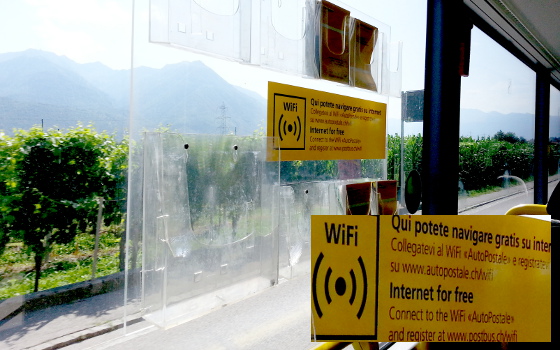
Who said Switzerland is expensive? Swiss Postbus is offering free wifi now Please see some of my previous blogs about Swiss travel for videos and pictures if you are looking for ideas for your time in .ch

3 August 2013

Steve Langasek: Network services and Upstart

So Debian bug #710747 led to an interesting discussion the other night on IRC which made me realize there are a lot of people who have yet to understand why sysvinit needs replacing. I can't speak to whether upstart solves this bug in particular. The tftpd-hpa package in Ubuntu (and in Debian experimental) does have an upstart job, and I have used tftpd-hpa on systems whose network interfaces are managed entirely with NetworkManager, and I have not seen this bug; but I can't say that this is more than coincidence. However, I can speak to how upstart provides facilities that address the general problem of starting services that require a working network connection to be present before they start up. Traditionally on Linux systems, init scripts could assume that the network connection is up before starting any services for the target runlevel. With LSB dependencies, you could also express this as
Required-Start:    $network
The trouble with both of these approaches is that they assume that there is a single point in time, early in the boot of the system, when the "network" is up. This was an ok assumption 15 years ago, when the Linux kernel initialized all devices serially and all our network configuration was static. But nowadays, you simply cannot rely on systems booting in such a way that the network is fully up shortly after boot - or in a way that you can block the system boot waiting for the network to be up. If all of our services would cope gracefully with being started without the network, this would be a non-issue. Unfortunately, not all network services are written in such a way as to work without a network; nor do they all cope with dynamic changes to interfaces or addresses. While it would be better if these services were written more robustly, since there's no shortage of daemons written this way, it's convenient that upstart provides tools for coping with this behavior in the meantime. Here's a real (simplified) example of an upstart job for a service that needs to wait for a non-loopback interface before it starts:
start on (local-filesystems and net-device-up IFACE!=lo)
stop on runlevel [!2345]
expect fork
respawn
exec nmbd -D
Now, you might also have a service that you only want to start up when a particular network device comes up. This is easily expressed in upstart, and might look like this hypothetical job:
start on net-device-up IFACE=wlan0
stop on net-device-down IFACE=wlan0
expect daemon
respawn
exec mydaemon
If you need to restart a daemon whenever the set of active network connections changes, that's less straightforward. Upstart doesn't have the notion of a 'restart' rule, so you would need two jobs to handle this - one for the daemon itself that starts on the first network connection, and a second job to trigger a restart of the daemon when the network status changes. For the tftpd-hpa case in the abovementioned bug, this might look like:
$ cat /etc/init/tftpd-hpa.conf
start on runlevel [2345]
stop on runlevel [!2345]
expect fork
respawn
script
        if [ -f $ DEFAULTS  ]; then
                . $ DEFAULTS 
        fi
        exec /usr/sbin/in.tftpd --listen  --user $ TFTP_USERNAME  --address $ TFTP_ADDRESS  $ TFTP_OPTIONS  $ TFTP_DIRECTORY 
end script
$ cat /etc/init/tftpd-hpa-restart.conf
start on net-device-up
task
instance $IFACE
script
        status tftpd-hpa   grep -q start/   stop
        restart tftpd-hpa
end script
For this case, upstart doesn't provide quite so great an advantage. It's nice to be able to use upstart natively for both pieces, but you can do the same thing with an init script plus an if-up.d script for ifupdown, which is what maintainers do today. I think adding a restart on stanza to upstart in the future to address this would be a good idea. Though in any event, this is far simpler to do with upstart than with any if-up.d script I've ever seen for managing an initscript-based service. Between the more friendly declarative syntax, and the enhanced semantics for expressing when to run (or restart) a job, upstart offers clear advantages over other init systems.

EvolvisForge blog: Nicht Hardlink, sondern ?

TANSTA softlink . ITYM: symlink(7) Actually, there s link (also hardlink ) and symbolic link (short symlink ). (Oh, and reparse points, but let s not get there, lest we mention *.lnk files ) Inspired by a posting on the klibc mailing list.

R&#233;mi Vanicat: Xorg and special keys

Xorg and special keys: one solution for keycode>255 An historic I've buy an IR receiver, and an universal controller to control my multimedia computer, my TV, my ADSL box and my 2.1 Home cinema. I've been pleased to see that my universal controller do now more control than the remote that was sold with my IR receiver. But a lot of those control didn't work with Xorg, so I had to find someway to use them. At first, my logs where spamed with line like:
imon 4-4:1.0: imon_incoming_packet: unknown keypress, code 0x100000e
(imon is the real builder of the IR receiver). I looked for this on the internet and found So I waited, and Linux 3.10 was released, and the Debian Kernel Team did include it in debian sid, so I could easily use it. But some command was still unrecognized as key by Xorg, so I had to find how to let X know them. Reading documentation on internet, and trying some command lead nowhere: the kernel did in fact understood very well the command, but X did ignore them. After two day of trying to understood XKB, I found this bug: those key was unavailable to X and XKB because their keycode was bigger than 255. The first solution to this problem is this patch, but I prefer to use standard tool. I finally found that udev can remap key, hence my solution: The Solution To use key that have keycode bigger than 255, you need to have keycode smaller than 255. keycode are determined by a map in the kernel, that udev can set when the receiver is plugged. You need a keymap. input-kbd from the input-utils package will list the available scancode, and their current keycode (to know the number of your input device, use lsinput):
% sudo input-kbd 6
0x100007f = 106  # KEY_RIGHT
0x1000080 = 105  # KEY_LEFT
0x1007f00 = 108  # KEY_DOWN
0x1008000 = 103  # KEY_UP
0x1010000 = 272  # BTN_LEFT
0x1010080 = 272  # BTN_LEFT
0x1020000 = 273  # BTN_RIGHT
0x1020080 = 273  # BTN_RIGHT
0x200001e = 513  # KEY_NUMERIC_1
0x200001f = 514  # KEY_NUMERIC_2
(There is more, I just cut it there). Putting this in some file (say keymap), editing it, and running sudo input-kbd -f keymap 6 should change the kernel mapping. But it don't. It's not a problem, because the best solution is to use udev. Wrote a keyboard mapping in say /etc/udev/imon:
0x200001e  KP1
0x200001f  KP2
0x2000020  KP3
0x2000021  KP4
0x2000022  KP5
0x2000023  KP6
0x2000024  KP7
0x2000025  KP8
0x2000026  KP9
0x2000027  KP0
0x2800000  MENU
0x288795b7 PAGEDOWN
0x289395b7 PAGEUP
You then need to tell udev to load this mapping, with /etc/udev/rules.d/96-local-keymap.rules:
ACTION=="remove", GOTO="mykeyboard_end"
KERNEL!="event*", GOTO="mykeyboard_end"
ENV ID_INPUT_KEY =="", GOTO="mykeyboard_end"
SUBSYSTEMS=="bluetooth", GOTO="mykeyboard_end"
SUBSYSTEMS=="usb", IMPORT builtin ="usb_id"
ENV ID_VENDOR =="15c2", ENV ID_MODEL_ID =="0042", RUN+="keymap $name /etc/udev/imon"
LABEL="mykeyboard_end"
You will need to adapt 15c2 and 0042 to you own remote. I've found those using lsusb
Bus 004 Device 014: ID 15c2:0042 SoundGraph Inc.
I could now use xkb to further refine the way those key are used by xorg...

Next.

Previous.