Search Results: "ean"

14 March 2013

Richard Hartmann: Gitify your life

sage@guug This January, I held an updated version of my "Gitify your life" talk at sage@guug, which is the Munich chapter of the German Unix User Group. Once again, it was quite successful and turnout was about three times that of normal attendance. Afterwards, I was asked if I would be willing to hold the same talk at the German Unix User Group's Spring Meeting in 2014 as the programme for 2013 has been finalized for quite some time, already. Obviously, I said I would be willing to do that and will submit the talk once registration opens. Open Source Days By the way, I am writing this post from a hotel room in Copenhagen. Tomorrow, there will be a world first... "Gitify your life" will not only be held as a talk, it will be expanded into a full three hour workshop (with the option of extending it if there's interest as the room will be free after my workshop). Having never held a workshop of this scope, I am really looking forward to this experience. Besides enabling me to get people up and running with their personal data, this will allow me to see where new users are having issues with vcsh. I keep hearing of people not getting their heads around the concept easily, but no matter how many promises of updates to my docs I get while helping them, no one really follows through with that promise once they know how to use vcsh. Maybe I will find someone willing to follow through and/or simply gather enough material for docs 2.0. Your place? As an aside, and I will probably try to put a real announcement together as well, if you know of a conference, user group or other place where a lightning talk, a full talk, or a workshop about one or all of these topics would fit, please let me know. I will gladly submit proposals to or accept invitations from most places as long as I can spread this message. Especially if the venue happens to be reasonably close to Southern Germany, covers travel cost, or if they can guarantee video recording of the talk. Joey Hess has speculated if the talk isn't really called "git naked" as I seem to keep on giving that particular talk at venues which don't have video recordings. Please help me make Joey happy... ...with a video recording, I mean.

Matthias Klumpp: Tanglu

Hi everyone! Today I make an announcement I thought I would never ever make. But things changed. Discussion about this has a long history, starting as a non-serious suggestion at DesktopSummit 2011, continued with people on IRC, but it was decided back then that it wouldn t be worth the effort. This has changed too, and a small team has formed to work on it. We hereby announce Tanglu, a new Debian-based-Linux distribution. A new logo?Why do we need another one? Let me explain the concepts of that distro: Tanglu will be based on Debian Testing and follow the Debian development closely. It will have a 6-months release-cycle and it s target audience are Linux desktop users. We will make installing and setting up the distro as easy as possible. Tanglu will be usable for both developers of upstream software and the average Linux user and Linux newbie. This is possible because in our opinion developers and users don t have different needs for a desktop system. Both kinds of users like a polished desktop which just works . We will, hwever, not apply any kind of fancy modification on upstream software, we will basically just distribute what upstream created, so users can get an almost pure GNOME and KDE experience. Tanglu is designed to be able to solve the issue that Debian is frozen for a long time and Debian Developers can t make new upstream versions available for testing easily. During a Debian freeze, DDs can upload their software to the current Tanglu development version and later start the new Debian cycle with already tested packages from Tanglu. The delta between Tanglu and Debian should be kept as minimal as possible. However, Tanglu is not meant as experimental distribution for Debian, so please upload experimental stuff to Experimental. Only packages good enough for a release should go into Tanglu. Ideally, Tanglu and Debian should be working well together in mixed environments, where you for example have Debian servers and multiple Tanglu desktops with the new software, targeted at desktop user. Since the differences between Tanglu and Debian should not be very high, administering both systems should be very easy (if you know Debian). Tanglu will be an open project, driven by community. At the beginning of each cycle, people can make suggestions for release goals they want to implement (similar to Fedora, but without FESCo). These proposals are discussed in public and are rejected if there are major technical concerns. If consensus about a certain proposal is lacking, a vote is done for it. The proposal can be accepted with absolute majority. If this does not happen, the proposal is postponed for the next release, where people can vote for it again. If nobody wants that function, it is rejected. In general, decisions made by Debian are superior and have to be followed. We don t think we know every package and every software better than the original upstream. That s why it makes much sense to rely on feedback from others and to have a community-based and peer-reviewed distribution, instead of secretly developing stuff and dumping it on the community. Tanglu will have a highly predictable set of features, defined at the beginning of a cycle, so you will know what you can expect from the next release as soon as possible and plan for it. Tanglu will make it easy to deploy applications for it. It will contain a software-center, similar to what Ubuntu has. We will also try to establish a solution for a Linux-AppCenter , a place for Linux applications, which will be open not only for Tanglu, but can be implemented in any other distribution too. Possible income will flow back into development of the platform. Now, let s answer the FQA (Future Questions Asked): Why don t you contribute to Debian directly and create yet another distribution? First of all, we contribute to Debian ;-) And for me, I can say that I will contribute to Debian even more. The point is that Debian can not cover all possible use-cases, and with Tanglu we want to make a distro which solves this. You might ask why we have to create a new distro for that, instead of creating improvements inside Debian? Creating a new distro allows us to do stuff we can never do in Debian. For example, we will include proprietary firmware in that distro, we will make installations of proprietary stuff possible easily (but don t ship with it by default) and we will have a time-based release cycle. These are already things which are a no-go for Debian, and that s fine. We don t want Debian to support these cases, as it is already a great distribution. We want to offer a distro as close to Debian as possible, but with a few modifications for use-cases which are not covered by Debian itself. Of course we will participate in DEX. If Debian Developers contribute to Tanglu, freezes will take even longer! This is an often-heard concern, it comes up on every mailinglist discussion about continuing development while freeze. I would disagree here, packaging new upstream stuff is not slowing down testing and improving of packages in Testing. Also, Tanglu is an offer for Debian developers to participate (we will sync privileges for their packages) we don t expect anyone to work on it, but as we think DDs know their packages best, we will make it possible for them to participate without extra barriers. We hope that Tanglu can add value to Debian and that Debian cycles can start with better-tested packages. You said you are a small team you cannot develop a whole distribution with it! Let s put that to the test! ;-) All people working on this are well aware of the issue that the project can not survive without much community-involvement on the long run. But we see a chance that many people are interested in it and that there is a high demand for it. At the beginning, we will just start with a small set of packages. We will also sync many packages from Ubuntu, to reduce workload. For example, it is planned to use the Ubuntu-Kernel and KDE packaging. By doing this, we keep the workload at the beginning low. We also reduce duplicate work with that. We even have some possible sponsors for the new distribution. But nothing is set in stone yet, so just wait for it to happen. :) Why not participate in Arch, OpenSUSE $other_distro? These are not Debian ;-) . I know, it sounds odd, but if you like the Debian way of doing things, you want to use a Debian-based distribution. There is nothing wrong with OpenSUSE. And Debian has issues too. But we want to be close to Debian and use it s tools and way of doing things. I hate you!!! You are doing it wrong!! The project is useless!

Well, that s fine. But there is no reason for hating us. If you dislike our idea, there are basically two options: First, you hate us but the project is successful. In that case, you have been wrong with hate, as there are definitely people who liked the project and contributed to it. Second, you hate us and we fail. In this case, there is no reason for hate, as the project will just vanish and you don t have to worry about it. So hating it would ve been just a big waste of energy. Also keep in mind that forking is a way to keep development healthy and to adapt software to new use-cases which it didn t target before. And we are not introducing incompatibilities here (like e.g. writing our own display server could). Instead, we want to stay close to Debian and reuse as much code as possible. Which desktop will you use? Everyone can add a new desktop to Tanglu, as long as the desktop-environment is present in Debian. Long term, we will have to offer Linux-newbies a default flavour, probably by setting a default download on the website. But as long as there is a community for a given desktop-environment, the desktop is considered as supported. At the beginning, we will focus on KDE, as many people have experience with it. But adding vanilla GNOME is planned too. Can you say something about the software used in Tanglu? Yes, but this is still in flow, so I can t promise final decisions here. On the server, side, we will try to use the Dak for repository management, as soon as we have enough server capacity. We will also use the standard Debian repository GUI and basically reuse most of the software there, to diverge less from Debian. The distribution itself will use a Linux Kernel from Ubuntu and systemd as the primary init system, as well as the login manager logind. It will be based on current Debian Testing with some fresh packages from Unstable and Experimental. We might also use the Ubuntu driver packages and KDE packaging. We expect to have a very rough start with the first release, but there will be enough time to polish Tanglu. Nice idea! How can I help? Well, you can help with basically anything at time from writing manuals, over designing logos and pages to administering a webserver and create packages. We are at an early stage of development at the moment, but we wanted to go public with it as soon as possible, to include the community and receive feedback so we can make that distro community-centric from the beginning. Most of the infrastructure is currently in progress too. So, if you want to get started with Tanglu, subscribe to our mailinglist tanglu-devel and write a mail to it, intruducing yourself. We can then include you in the loop. Generally, if you want to get access to our machines, a trusted GPG-signature will help a lot. If you want to talk to us, join #tanglu-devel or Freenode! Most discussions are currently happening there. And that s it! Tanglu will be awesome!

Some other projects of mine will develop a bit slower because I am now involved in Tanglu. But nothing will stop, and there is some pretty cool stuff coming for both GNOME and KDE (and I still have to implement DEP-11 for Debian). :)

Joerg Jaspert: zsh config - and prompt

As most people that are using that funny grey on black thing with the blinking white box AKA a commandline, I do have a heavily configured shell. zsh in my case. Some while ago my old configuration for it started to annoy me and so I set out to redo it. With the basic requirement to be flexible and able to adjust to various zsh versions (back as far as Lenny). I ve set out and looked how others do it and took the (I hope) best bits and put them together in a way I like it. Maybe others want to pick from me, so here I describe a little, maybe someone is interested First - the config is completly inside .zsh. The only thing directly in my $HOME is a symlink from $HOME/.zshenv to $HOME/.zsh/zshenv.home. All in one place, nicer this way. The zshenv just sets ZDOTDIR, so zsh then uses the .zsh itself. Next I am using modules . Well, actually everything is splitted out in small(er) files, so its way easier to maintain. And to overwrite stuff wherever I need to. So my .zshrc just loads those module files - and then goes and checks if it finds the same file inside a series of subdirectories. Those subdirectories are based on the hostname, the kernel name, the username, the domain name and the name of the distribution of the system. And a number of combinations of those. That system allows me, for example, to have a set of aliases defined only on Debian systems (like those to do with apt-get & co). Or define some extra variables if I login to the host franck, domain debian.org. Or whatever more. I m also on the way of doing something similar for all my dotfiles. While I was working at that I finally got fed up with the fact that my prompt, which is based on Phil! s wasn t doing what I wanted it on various of the hosts I access. Thankfully someone pointed me at a change to the grml zsh config: Frank Terbeck rewrote their prompt to make use of the zstyle system. Now that got me going, I like the idea of having the whole prompt easily configurable and changeable. My prompt always has shown slight differences depending on where the shell runs, which meant I had to carefully craft PS1 for every such change, and when one changes something one had to check all the places to adjust them too. No longer. I took Franks work and extended it for me. I wanted to still have a design matching my old prompt (minus colors, I changed color themes anyways), but with full flexibility the zstyle system can offer here. Now I am at a point where As an example, on the ftp-master host my prompt, while otherwise being the same as everywhere else, contains one extra item - displaying the current status of the archive (dinstall). If you want to try it, the setup file is available, but note that I don t give any warranty. :) Works for me . I load it in my Prompts module, while having the prompt setup file in my function path. The 4 commented lines, my testcase, are a nice example of a custom token, though a real life one, the setup for the ftp-master prompt with the one extra item can be found over here. Comments? Bugfixes? Enhancements? Update: Got asked for an example how to use my prompt to fake another. So here is what you need to do to use my prompt setup to imitate the prompt clint, as delivered with zsh:
autoload promptinit && promptinit
zstyle ':prompt:ganneff' vcs_info true
# Alternatively you can set whatever you like it to be.
zstyle ':prompt:ganneff' set_vcs_info_defaults true
zstyle ':prompt:ganneff' colors true
## no right prompt
zstyle ':prompt:ganneff:right:setup' use-rprompt false
## color of brackets depending on variable
zstyle ':prompt:ganneff:*:items:openbracket' pre '$ $ SSH_CLIENT+"$ PR_YELLOW " :-"$ PR_RED " '
zstyle ':prompt:ganneff:*:items:openbracket' post '$ PR_NO_COLOR '
zstyle ':prompt:ganneff:*:items:closebracket' pre '$ $ SSH_CLIENT+"$ PR_YELLOW " :-"$ PR_RED " '
zstyle ':prompt:ganneff:*:items:closebracket' post '$ PR_NO_COLOR '
zstyle ':prompt:ganneff:*:items:openanglebracket' pre '$ $ SSH_CLIENT+"$ PR_YELLOW " :-"$ PR_RED " '
zstyle ':prompt:ganneff:*:items:openanglebracket' post '$ PR_NO_COLOR '
zstyle ':prompt:ganneff:*:items:closeanglebracket' pre '$ $ SSH_CLIENT+"$ PR_YELLOW " :-"$ PR_RED " '
zstyle ':prompt:ganneff:*:items:closeanglebracket' post '$ PR_NO_COLOR '
## extra date format, and its color
zstyle ':prompt:ganneff:*:items:date' token '%D %a %y/%m/%d %R %Z '
zstyle ':prompt:ganneff:*:items:date' pre '$ PR_CYAN '
## pts. %l instead of %y, also color again
zstyle ':prompt:ganneff:*:items:pts' token '%l'
zstyle ':prompt:ganneff:*:items:pts' pre '$ PR_GREEN '
zstyle ':prompt:ganneff:*:items:pts' post '$ PR_NO_COLOR '
## host ends with :
zstyle ':prompt:ganneff:*:items:host' token '%m:'
## and a different style for the rc level
zstyle ':prompt:ganneff:*:items:rc' token '%(?..[%?%1v] )'
zstyle ':prompt:ganneff:*:items:rc' pre ''
## change color for other parts that differ to my default
zstyle ':prompt:ganneff:*:items:user' pre '$ PR_GREEN '
zstyle ':prompt:ganneff:*:items:host' pre '$ PR_GREEN '
zstyle ':prompt:ganneff:*:items:at' pre '$ PR_GREEN '
zstyle ':prompt:ganneff:*:items:path' pre '$ PR_GREEN '
zstyle ':prompt:ganneff:*:items:history' pre ''
## Show the shell level in a different way
zstyle ':prompt:ganneff:*:items:shell-level' pre ''
zstyle ':prompt:ganneff:*:items:shell-level' token 'zsh%(2L./$SHLVL.) '
## And history is just a bold number. Lazy here, not using pre and post
zstyle ':prompt:ganneff:*:items:history' token '%B%h%b '
## And the last part in prompt, a # or % depending on privileges
## Using standard zsh tokens for bold
zstyle ':prompt:ganneff:*:items:privileges' pre '%B'
zstyle ':prompt:ganneff:*:items:privileges' post '%b'
## Now there are two parts not defined by default, so lets create them
## Both are simple existing variables, no need for extra precmd functions
## system info
zstyle ':prompt:ganneff:extra:ostype' pre '$ PR_CYAN '
zstyle ':prompt:ganneff:extra:ostype' post '$ PR_NO_COLOR '
zstyle ':prompt:ganneff:extra:ostype' token "$ MACHTYPE /$ OSTYPE /$(uname -r)"
## zsh version
zstyle ':prompt:ganneff:extra:zshvers' pre '$ PR_CYAN '
zstyle ':prompt:ganneff:extra:zshvers' post '$ PR_NO_COLOR '
zstyle ':prompt:ganneff:extra:zshvers' token "$ ZSH_VERSION "
zstyle ':prompt:ganneff:left:full:setup' items \
    openbracket date closebracket openbracket pts closebracket openbracket ostype closebracket \
    openbracket zshvers closebracket newline openanglebracket user at host \
    path closeanglebracket newline \
    shell-level space history rc space vcs privileges space
prompt ganneff
And if you now tell me Uh, thats so much more than just saying /prompt clint/ , then you are right. But then: This way is flexible. As I wrote above, my prompt on the ftpmaster host is different. Actually, my prompt on all machines inside the domain debian.org differs, by having
zstyle ':prompt:ganneff:*:items:host' pre '$ PR_YELLOW '
in the Prompts definition for domain:debian.org. And thats enough to show me im on a .debian.org machine by a yellow hostname, instead of my default red. On the ftpmaster host I have the additional few lines: # Want one more piece in my prompt here, dinstall status zstyle :prompt:ganneff:left:full:setup items \ ulcorner line openparentheses user at host pts closeparentheses line history \ line dinstall line shell-level line flexline openparentheses path closeparentheses line urcorner newline \ llcorner line rc openparentheses time closeparentheses line vcs line change-root pipe space
zstyle ':prompt:ganneff:extra:dinstall' pre '$ PR_CYAN '
zstyle ':prompt:ganneff:extra:dinstall' post '$ PR_NO_COLOR '
zstyle ':prompt:ganneff:extra:dinstall' token '$DINSTALL'
zstyle ':prompt:ganneff:extra:dinstall' precmd jj_update_dinstall
zmodload zsh/mapfile
jj_update_dinstall ()  
    DINSTALL="$ $ (z)$ (f)mapfile[/srv/ftp.debian.org/web/dinstall.status] [2] [3,99] "
 
And woo, thats simple. I think. (There ought to be a way to just easily add the item at a defined place in the items zstyle, but meh, too lazy to look).

Wouter Verhelst: LOADays 2013

I just received confirmation that my talk proposal for LOADays 2013 has been accepted. That means that for the fourth time in a row, I'll be speaking at LOADays. This time around, the talk will be about NBD: what is it, what does it, what can you do with it. I didn't consider that as an interesting subject at first; but after discussing the matter with someone else around the time I had to submit a proposal, he suggested I'd think about it... which made sense. So, all I have left to do now is to actually come up with an interesting talk. I'm sure that can be arranged.

Mike Hommey: Google Reader death, or how the cloud model can fail you

If you re a Google Reader user, you probably read in one of your subscriptions that Google is pulling the plug on Google Reader. It is yet another demonstration of why putting data in the cloud isn t so much of a nice idea: the service you rely on may well disappear some day, with all the data it contains. Sure Google, in its extreme goodness, allows you to take out the Google Reader data. Or does it?
These are what you ll get from Google Takeout for Reader: Interestingly, while looking into shared-by-followers.json, I found urls that would correspond to friend streams. For instance, Tim Bray s is http://www.google.com/reader/public/atom/user/05198174665841271019/state/com.google/broadcast. But it s useless: all it displays is permission denied . As for subscriptions, one of the strengths of Google Reader is that it allowed to search though past items, which means a big part of the interesting data is the archived items. But that s not part of the take out . Sure, you have the feed urls, but most RSS feeds contain a limited amount of items, not the entire history of items for the given feed. So, history is more or less lost. Except if I star, like or share all items in all my subscriptions and take out again. So much goodness. It could have been worse, though.

13 March 2013

Ian Campbell: Linaro Connect Asia 2013

I've just got back from Linaro Connect Asia 2013 in Hong Kong. This was my first time back in Hong Kong since 1995 when I left after living there for 10 years. It was really interesting to see how much the place had changed, as well as how much it hadn't! I started the week by giving a talk together with Stefano Stabellini Introducing Xen on ARM to a full house. The slides can be found on the event page or google docs. There is a video on youtube but due to the cameras being setup for a fish-bowl style panel it is unfortunately mostly of my backside. The reception was excellent and the talk seeded a large number of hallway track conversations with all the many folks who are interested in Xen on the ARM platform. The day after our talk Lars Kurth (Xen.org community manager) and Mark Heath (VP of XenServer Engineering, and my boss) gave a keynote (video) announced Citrix's intention to join the Linaro Enterprise Group (AKA "LEG") on the 1st of April. This is pretty exciting for me since it means I'll get to work much more closely with the Linaro and ARM communities and spend even more of my time hacking on Xen on ARM! At some point Stefano and myself were also video interviewed by Charbax of http://armdevices.net/ but it doesn't appear to have gone online yet. Lars and Mark also gave interviews which are online already. One nice thing about Connect is that the afternoons are left free of talks so I managed to find time in the hackrooms to implement SMP host support and 64-bit domain 0 support for Xen on ARM as well as getting multiarch cross building working for upstream Xen with Wookey's kind assistance (no patches for this yet since I still need to clean them up). It was also useful to catch up with the ARM kernel developers and KVM guys to see what they are up to and share ideas etc. Finally right at the end Stefano and myself showed Xen on ARM at Demo Friday. We had Xen running on the Arndale Board, ARM Chromebook and 64-bit ARMv8 using the emulators (no hardware being available yet). All in all I had an excellent (if tiring) week, there was loads of interest in Xen on ARM and in Citrix joining LEG and everyone was very welcoming. I'm really looking forward to the next Connect in Dublin. Outside of Connect I managed to find time to visit Sham Shui Po at look at all the gadgets but managed to resist buying anything (Stefano got a Thinkpad X230, which was enough retail therapy for both of us!). I caught up with my sister (who lives there again), her boyfriend and my parents (who happened to be visiting her that week). I also managed have some drinks with some old school friends, most of whom I've not seen for nearly twenty years, but it was just like old times ;-). I'm off again to Hong Kong next week with my family to visit my sister (yes, there was some bad planning involved here...). This time I plan to do all the toursity type stuff that I never did while I lived there. I've also got tickets for the Hong Kong Rubgy Sevens and hopefully I'll manage catch up with some more old friends. I probably won't be able to resist buying gadgets this time around though.

Russ Allbery: WebAuth 4.4.3

WebAuth is the site-wide web authentication system that we use at Stanford. After a lot of time focusing on things at work other than coding, it's been my primary job for the past nine months or so, which has been a lovely change. I wasn't planning on doing another 4.4 release and instead focusing on 4.5.0 (which is well underway and adds significant new features to multifactor support), but I kept finding bugs, including several that were quite embarassing. So this is another bug-fix release, and hopefully the last one before 4.5.0. WebAuthTrustAuthzIdentity enabled WebAuthDoLogout in the same scope (ever since it was added in 4.4.0). It's horribly embarassing to have been writing C for more than 20 years and still manage to omit a break in a switch statement. Benjamin Coddington found another bug in authorization identity handling where if the user changed their authorization identity to match their authentication identity, their authentication would be rejected. We now detect that case and just discard the authorization identity if it's the same as the authentication identity. There are multiple fixes in the mod_webauth logging of bad app tokens: expired app tokens are now logged with a proper message (and at info level rather than error), empty app tokens (created internally and therefore seen by subqueries before fixup to delete expired app tokens) are now just ignored, and invalid app tokens don't result in spewing binary strings into the Apache error log. mod_webauthldap has, since the beginning, refused to add more than 127 values of a multivalued LDAP attribute to the environment. We ran into that limit with entitlements, so it's now been removed. This runs the risk of overflowing the environnment, but I did some calculations, and it looks like you're going to have to try really hard and have impressively large multivalued attributes to create that problem. If it actually becomes a problem for someone, I'll add a configuration option. There's also a syntax fix to the default WebLogin error template and a variety of minor bug fixes, mostly around error handling conditions, to correct problems caught by clang --analyze. (The current master branch gets a completely clean bill of health from clang --analyze using clang 3.0.) You can get the latest release from the official WebAuth distribution site or from my WebAuth distribution pages.

12 March 2013

Richard Hartmann: Gitify your life

These Open Source Days were kind of a mixed experience. The social part Things started off quite nicely; the speaker dinner was very pleasant and the people at my table interesting to talk with. The way back to the hotel and breakfast on Saturday were even more interesting; talking with Amelia Andersdotter, a member of the European Parliament for the Swedish Pirate Party, about anti-trust measures, privacy protection, lobbyists, and creating the right incentives for companies to actually protect user data was fun and engaging. My own claim to fame is that I told her that while Microsoft is willing to sign UEFI payloads for x86, they refuse to do so for ARM which she didn't know. From my understanding, their interpretation is that any anti-trust rulings apply to PCs only, and not general computing devices like tablets. It will be interesting to see how that plays out in the long run, especially once ARM processors start appearing in laptops and desktops as main CPUs where Microsoft clearly still has a near monopoly. It was fascinating to discuss all those issues with someone who's actively involved with legislation, mainly because her style of talking was markedly different from what I am used to. One point which she stressed repeatedly is that the most important skill within the context of political work in the EU is to be able to track down, read, and then reference all the content that's being produced in Brussels and Strasbourg. Maybe that tidbit is useful to people who want to try themselves at political activism. She nicely, and maybe unknowingly, emphasized that point by always referring to specific papers, directives, and studies after making any point. Statement of opinion, reference to supporting document. Statement of opinion, reference to supporting document. Statement of opinion, reference to supporting document. Rinse, repeat. It's no secret that I'm continuously disappointed by the political process in general and politicians in particular. Yet, I have to say that this encounter had a lasting and positive impression on me. Amelia has an incredible amount of energy and genuinely cares about the issues which too many other politicians ignore completely. It's good to know someone like this is on our side. If you're Swedish, please inform yourself about her and consider voting in her favour. Other than that, I met several other people, new and old. This year's OSD felt a lot more relaxed and there were more informal and spontaneous conversations going on in hallways and at tables. Even though I failed to have any intense discussion of Mercurial vs git this year, all those conversation were still really interesting. The "workshop" I already knew that the room assignment for my workshop on Saturday afternoon would be a last-minute thing. What I didn't expect was that the final confirmation by Copenhagen Business School would be given on Friday evening. Mixed with a very cumbersome process to update the slides of the CBS-owned and -operated information beamer in the lobby, this resulted in the official schedule showing my room as "Workshop" instead of "SP 214". The official schedule repeatedly stated that people had to pre-register for the workshop which was a left-over from last year where they actually had to plan the amount of hardware kits needed; the registration itself was was very well hidden behind a rather generic link you saw exactly once after purchasing your ticket. Add to this that my room was literally in the farthest corner of the building and on the top floor and things start to turn sour real quick. All other rooms were either close to the main entrance or on the ground floor. Helpers at the front desk had a lot of people asking where my room was and gave out directions, yet... ...the grand total of six people who arrived were all telling me how they couldn't find the room and almost gave up on finding it. As more people asked for directions than turned up at the workshop, this means that even with directions, the room was really hard to find. Myself, it took me two attempts to find the room after which I was led there by one of the helpers who wasn't completely sure we were going in the right direction, himself. Still, I managed to get everyone who had a laptop and access to a UNIX-based system set up with working mr and vcsh repositories they can work from as well as a demo git-annex repository to play with. Sadly, not everyone had a laptop, or access to UNIX, or the tools installed, or even an idea where to install them from, even though I had noted these "requirements" in the description. Next time I do this workshop, I will need to make sure to include information on what distributions have the relevant packages and how to find and install the software on Max OS X in the workshop description. Feedback from the very few people who actually managed to find me was very good and one of the attendants asked if I would be willing to hold the workshop again at another conference in Denmark. I am still awaiting details on this, but I would obviously enjoy having the chance to reach more people. At least I fared better than the guys who did the workshop on "Binary exploitation 101" in yet another room. Two guys held a workshop with a total attendance of... one... I know the organizers of OSD were really unhappy with how this turned out and I believe them when they say that something like this will never happen again. It's the second year that this team is running the conference, running conferences is an incredible amount of work, and things were smoother this year than last year. Iterate and improve, etc. The talk Saturday evening, Alex offered me the chance to hold a reparation talk on Sunday morning to compensate for the botched workshop. Said talk was scheduled for the first slot and not really announced (but the schedule on both www and the beamer was changed over night). Additionally, this was merely an updated and extended version of the talk which I already held at OSD 2012 so at least part of the visitors knew most of what I had to say, already. To be honest I didn't expect too much, but more than twenty people turned up which is a very decent turnout, all things considered. Same as with the workshop, feedback was extremely positive and I was told afterwards by Bryan that several people mentioned my talk as one of the highlights, or even the highlight, of OSD when he was talking to them. To make things even better this talk has, finally, been videotaped; I will update this blog with a link as soon as the video is online.

11 March 2013

Russ Allbery: Small non-fiction haul

Long time no write. A variety of things, including getting sick with a particularly bad cold (I'm still coughing up phlegm), led to my schedule and general life organization getting turned on its head, and I'm only slowly recovering. Work gets top priority (including a security release of OpenAFS), so I'm afraid non-work things such as reviews and journal posts (and Debian, and non-work-related software development, and conversations with friends...) have been getting second shrift. Hopefully this is finally starting to improve, and I have a block of time for working remotely coming up that should help. In the meantime, more books have, of course, been acquired. This particular order was mostly to get one book (The Making of the Indebted Man), which I'm going to read and discuss as part of a surprisingly fun political discussion about basic income guarantee and, somewhat by extension, Marxist analysis of capitalism. But it's impossible to buy just one book, similar to how it's impossible to eat just one potato chip: Neil Barofsky Bailout (non-fiction)
E. Gabriella Coleman Coding Freedom (non-fiction)
Joshua Foer Moonwalking with Einstein (non-fiction)
Maurizio Lazzarato The Making of the Indebted Man (non-fiction)
Isabel Wilkerson The Warmth of Other Suns (non-fiction) I of course preordered Coding Freedom and am quite looking forward to reading it, although it will surprise no one to hear that I have rather a long queue. The Warmth of Other Suns I picked up based on a recommendation by Ta-Nehisi Coates, whose writing for The Atlantic I wholeheartedly recommend. I have such a large pile of books that I've read but not yet reviewed that I cringe to think about it. But no progress will be made on that this evening (damn you, Benjamin Franklin! *shakes fist*). More tomorrow if I survive five and a half hours of scheduled forced social interaction.

9 March 2013

Lars Wirzenius: Can the world be saved by coding?

I love programming. I was born to code. I want to save the world by writing code. I feel very strongly about software freedom. As I get older, and my eyes open to see more of the evil in the world, I become more concerned about freedom in general. Software freedom is, at least traditionally, about permission use, study, modify, and re-distribute software. The Free Software Foundation expresses this as the four essential freedoms. Debian expanded on that, and produced the Debian Free Software Guidelines. This is no longer enough. It is not enough to have all the freedom when you using your own computer, to have the source code to every bit of code that runs on your hardware. We live in the era of the Internet. Much of what we use computers for involves communication over the Internet, and the Internet is being actively used to curtail the freedom of people. For example, governments and corporations do large-scale surveillance of everyone, by eavesdropping on private communications, gathering enormous databases of personal data, and by analysing everything they can in order to find patterns and make conclusions both at the statistical level and about individuals. This ruins privacy. Without privacy, democracy cannot survive. Another example: in the name of various strawmen, such as terrorism, copyright violations, drugs, and child pornography, governments and corporations are collaborating in limiting private people's communications. I'm a Finnish citizen living in the UK. Both countries are among the closest ones to an ideal democractic nation state. Both countries arbitrarily block access to websites based on lists provided by private organisations, assuming that those organisations produce accurate lists of sites that contain copyright violations. As a result, both countries blocked, for example, a site where musical artists promoted their own works, bypassing the large media corporations that fund the list-making organisation. These issues transcend software freedom, though they interact with it. Software freedom is a necessary requirement for freedom, in a world where almost everything is done with, or controlled by, the use of computers. Software freedom is not enough to prevent censorship or surveillance: even if all the software in the world were free, including the national firewalls of China, Finland, and the UK, this would not prevent those countries from censoring and surveilling their citizens. The firewall would run free software, but that does not give the citizens the freedom to disable, or modify, the firewall systems. Fixing these issues is not a coding task. It is a job for politics, and it is going to take a long time, I fear. In the mean time, is there something a hacker can do to improve things? My main hobby project is Obnam, my backup program. Does that help people to protect their freedom? I think it does, in a small way: Obnam supports online, encrypted backups (and de-duplication even for encryption is used), which means they can make backups to servers anywhere on the Internet without having to fear their data gets read and analysed by hostile entities such as their own government, other governments, large corporations, or criminals. Obviously this does not help them if their government prohibits the use of encryption, or requires key escrow, or mandates backdoors to all encryption methods. But it's a step in the right direction. I don't claim Obnam will save the world, but a million small such steps by a thousand individual hackers, even without any particular organisation or guidance, will make a big impact. What step can you take?

8 March 2013

Sylvain Le Gall: Always test your HD first

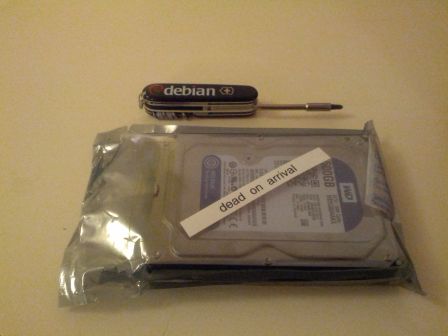
I just received a WD 500GB Blue, to replace the hard drive of my wife's computer. First thing after unpacking: start to test. And I was right to do it... there are bad blocks on it. WD 500GB DOA The story: I tend to do proactive replacement of hard drive, to avoid losing too much data or be in hurry when the current one fails. There are two ways to monitor a hard drive: Logcheck is pretty straightforward to install. It scans your log every two hours and send you a report of what is happening. It is not a very precise tool and you have to tune it a little bit to just send you what is relevant (install extra rules to ignore what you know is not of interest). Whenever you start to see log entry like that:
Jan 24 18:16:08 foo kernel: [ 1965.343980] ata5.00: exception Emask 0x50 SAct 0x39 SErr 0x800 action 0x6 frozen
Jan 24 18:16:08 foo kernel: [ 1965.343991] ata5.00: irq_stat 0x08000000, interface fatal error
Jan 24 18:16:08 foo kernel: [ 1965.344001] ata5: SError:   HostInt  
Jan 24 18:16:08 foo kernel: [ 1965.344036] ata5.00: failed command: READ FPDMA QUEUED
Jan 24 18:16:08 foo kernel: [ 1965.344055] ata5.00: cmd 60/08:00:18:31:44/00:00:1a:00:00/40 tag 0 ncq 4096 in
Jan 24 18:16:08 foo kernel: [ 1965.344059]          res 40/00:2c:e6:c2:fd/00:00:26:00:00/40 Emask 0x50 (ATA bus error)
Jan 24 18:16:08 foo kernel: [ 1965.344071] ata5.00: status:   DRDY  
Jan 24 18:16:08 foo kernel: [ 1965.344081] ata5.00: failed command: WRITE FPDMA QUEUED
It is a good time to think about changing your hardrive -- but it is maybe too late. Smartmontools (aka smartd) is dedicated tool to monitor hard drives and do a good job. I think it is not installed by default in Debian, but it should be. It scans your hard drive for SMART capabilities and monitor the health of the HD using internal tools. In the case of bad blocks, you will start to see entry like that:
Feb 17 14:05:17 bar smartd[1268]: Device: /dev/sda [SAT], 1 Currently unreadable (pending) sectors
Feb 17 14:35:17 bar smartd[1268]: Device: /dev/sda [SAT], 1 Currently unreadable (pending) sectors
Obviously when you see this log, it is also a good time to change your hard drive. In the case of my wife's HD, I just got data from logcheck. It means that the error is not that important (transient failure, something is wrong but the HD can cope with it). But I still decided to get a new one for my wife. Whenever, I receive a new drive, the first thing I do is to check it for errors. You can do that using the program badblocks in write mode. It takes ages to test (count up to 1 day for 1TB on USB), but at the end you know that you have a good candidate -- where it is worth install your data. You just have to follow this procedure
  1. dmesg grep sd
  2. try to find what drive is the one you want to test in the output of 1.
  3. cfdisk /dev/sdX, sdX being the drive you want to test
  4. check that what you see in cfdisk is what you expect to test: right name and capacity for the drive
  5. sudo badblocks -wvs /dev/sdX
  6. run sudo tail -f /var/log/syslog in parallel just in case
  7. wait
If some errors appears in /var/log/syslog, you know something bad is happening. Whenever you have a single failing block, don't think it is ok. It is NOT ok for a HD to start its life with failing blocks. In this case, repack the drive and send it for replacement ASAP. In the case of my hard drive: smartd mail:
The following warning/error was logged by the smartd daemon:
Device: /dev/sda [SAT], 15 Currently unreadable (pending) sectors
syslog entries:
Mar  2 20:52:57 foo kernel: [ 8317.419715] ata4.00: exception Emask 0x0 SAct 0x1 SErr 0x0 action 0x0
Mar  2 20:52:57 foo kernel: [ 8317.419724] ata4.00: irq_stat 0x40000008
Mar  2 20:52:57 foo kernel: [ 8317.419732] ata4.00: failed command: READ FPDMA QUEUED
Mar  2 20:52:57 foo kernel: [ 8317.419747] ata4.00: cmd 60/80:00:00:af:08/00:00:28:00:00/40 tag 0 ncq 65536 in
Mar  2 20:52:57 foo kernel: [ 8317.419750]          res 41/40:00:65:af:08/00:00:28:00:00/40 Emask 0x409 (media error) <F>
Mar  2 20:52:57 foo kernel: [ 8317.419758] ata4.00: status:   DRDY ERR  
Mar  2 20:52:57 foo kernel: [ 8317.419764] ata4.00: error:   UNC  
Mar  2 20:52:57 foo kernel: [ 8317.423959] ata4.00: configured for UDMA/133
I am not blaming any particular brand (like Western Digital), all computer parts I have ever bought had to follow the same procedure and it is a known fact that computer parts as a non-zero percentage of chance to be DOA (dead on arrival) or after a few weeks. But as a consumer you should be aware of that and take action to avoid spending 10h configuring your computer to see it failing after a week... The waste of time to test is a win on the long term.

7 March 2013

Pau Garcia i Quiles: Mark s divisive leadership

Mark Shuttleworth recently critized Jonathan Riddell for proposing Xubuntu and others join the Kubuntu community. I thought I could make a few amendments to Mark s writing:
Jonathan Mark says that Canonical Kubuntu is not taking care of the Ubuntu community.

Consider for a minute, Jonathan Mark, the difference between our actions.

Canonical Kubuntu, as one stakeholder in the Ubuntu community, is spending a large amount of energy to evaluate how its actions might impact on all the other stakeholders, and offering to do chunks of work in support of those other stakeholder needs.

You, as one stakeholder in the Ubuntu community, are inviting people to contribute less to the broader project [all the X and Wayland -based desktops], and more to one stakeholder [Unity and Mir].

Hmm. Just because you may not get what you want is no basis for divisive leadership.

Yes, you should figure out what s important to Kubuntu Ubuntu Unity and Mir, and yes, you should motivate folks to help you achieve those goals. But it s simply wrong to suggest that Canonical Kubuntu isn t hugely accommodating to the needs of others, or that it s not possible to contribute or participate in the parts of Ubuntu which Canonical Kubuntu has a particularly strong interest in. Witness the fantastic work being done on both the system and the apps to bring Ubuntu Plasma to the phone and tablet. That may not be your cup of tea, but it s tremendously motivating and exciting and energetic. See Mark? I only needed to do a little search and replace on your words and suddenly, meaning is completely reversed! Canonical started looking only after its own a couple of years ago and totally dumped the community. Many people have noticed this and written about this in the past two years. How dare you say Jonathan or anyone from Kubuntu is proposing contributing less to the broader community? The broader community uses X and/or Wayland. Canonical recently came with Mir, a replacement for X and Wayland, out of thin air. Incompatible with X and Wayland. No mention of it at all to anyone from X or Wayland. No mention of it at FOSDEM one month ago, even though I, as the organizer of the Cross Desktop DevRoom, had been stalking your guy for months because we wanted diversity (and we got it: Gnome, KDE, Razor, XFCE, Enlightenment, etc, we even invided OpenBox, FVWM, CDE and others!). I even wrote a mail to you personally warning you Unity was going to lose its opportunity to be on the stand at FOSDEM. You never answered, of course. Don t you think Mir, a whole new replacement for X and Wayland, which has been in development for 8 months, deserved a mention at the largest open source event in Europe? Come on, man. It is perfectly fine to say yes, Canonical is not so interested in the community. It s our way or the highway . But do not pretend it s anything else or someone else is a bad guy. In fact, is there any bad guy in this story at all!? I think there is not, it s just people with different visions and chosen paths to achieve them. Maybe Mir and Unity are great ideas, much better than X and Wayland. But that s not what we are talking about. We are talking about community, and Canonical has been steadily destroying it for a long time already. If you cannot or do not want to see that, you ve got a huge problem going on.

Vincent Sanders: Man cannot discover new oceans unless he has the courage to lose sight of the shore

Continuing with my whirlwind introduction to NetSurf Development now is the time to start examining the code, how its arranged and how to interact with the existing developers.

The way the NetSurf source is structured is around the idea of the frontends each being a native browser. While this implies that there are nine separate browsers that happen to share a common code base the separation is not quite that well defined.

Each frontend provides the OS entry point (the main() function in a c program) and calls out to standard browser initialisation entry function netsurf_init() and then starts running the browsers main dispatch loop with netsurf_main_loop() when that exits the frontend cleans up with netsurf_exit().

The frontends provide a large selection of functions which are called from the core code. These routines run from running the event scheduler through to rendering graphics and text.
Finding your way aroundThe browsers directory layout is fairly shallow consisting of some Makefiles, the nine frontend directories and eleven others.

The Makefiles are GNU make and represent a pretty straightforward linear build system. We do not use recursive make or autotools. There are plans to use the core buildsystem that all the other components use.

The frontend directories contain the code for the frontend and the makefile fragments to build them which are included by the top level Makefile.

In addition there is:
desktop
This contains the non frontend specific code that actually behaves like a browser. For example desktop/netsurf.c contains the three primary functions we outlined in the introduction. You will also find much of the function and data structures interfaces the frontend must provide. It is unlikely someone new to the project will need to change anything in here (there be dragons) but is an important set of routines.
utils
Here you will find the utility and compatibility interfaces, things like url handling, logging, user messages, base64 handling. These are utility interfaces that do not justify splitting out their functionality to a separate library but are useful everywhere. Changing an interface in here would likely result in a major refactor.
For example one quirk is the logging macro was created before varadic C preprocessor macros were universal so it must be called as LOG(("hello %s world", world_type)) e.g. with double brackets. Fixing this and perhaps improving the logging functionality would be "nice" but the changes would be massive and potentially conflict with ongoing work.
content
This contains all the core code to handle contents i.e. html, css, javascript, images. The handling includes retrieval of the resources from URI , correct caching of the received objects and managing the objects state. It should be explicitly stated that the content handlers are separate and use this core functionality. The actual content handlers to deal with object contents such as the routines to decode image files or render html are elsewhere.
image
This is where the content handlers for the various image types are kept. The majority of these image types (jpeg, png, webp, gif, bmp) use a standard library to perform the actual decode (libjpeg, libpng etc.). One special feature used by most image handlers is that of a decoded image cache which is distinct and separate from the content cache.
The decoded image cache manages decoding of the source images (the jpegs and pngs) into frontend specific "render" bitmaps. For example the gtk frontend keeps the decoded images as a cairo surface ready for immediate plotting.
The cache uses a demand based (when the browser actually displays the image) just in time strategy which has been carefully balanced, with real world input, to reduce the overhead of unnecessary image decoding and processing against memory usage for the render bitmaps.
css
The css content handlers provide for the processing of css source text and use the NetSurf libcss library to process into a bytecode suitable for applying style selection at render time.
javascript
The javascript handlers (strictly speaking this should be named the "script" directory as all types of script are handled here) provide basic functionality to bind a javascript engine to the rest of the browser, principally the Document Object Model (DOM) accessed with libdom. The only engine that currently has bindings is Spidermonkey from the Mozilla foundation.
render
This is the heart of the browser containing the content handler for html (and plain text). This handler deals with:
  • Acquiring the html.
  • Running the base parser as data arrives which generates the DOM and hence DOM events from which additional resource (stylesheets etc.) fetches are started.
  • Deal with script loading
  • Constructing the box model used for layout
  • Performing the Layout and rendering of the document.
Because this module has so many jobs to do it has inevitably become very complex and involved, it is also the principle area of core development . Currently NetSurf lacks a dynamic renderer so changes made by scripts post document load event are not visible. This also has the side effect that the render is only started after the DOM has finished construction and all the resources on a page have completed their fetch which can lead to undesirable display latency.
Docs
Documentation about building and using NetSurf. If anyone wants a place to start improving NetSurf, this is it, it is very incomplete. It must be noted this is not where dynamically generated documentation is found. For the current Doxygen output the best place to look is the most recent build on the Continuous Integration system.
resources
These are runtime resources which are common to all frontends. To be strictly correct they may be the sources which get converted into runtime resources e.g. The FatMessages file which is teh message text for all frontends in all languages, this gets processed at build time into separate files ready.
!NetSurf
This is another resources directory and technically the resources for the riscos frontend. The naming and reliance on this directory are historical. To allow the RISC OS frontend to be run directly from the source directory and an inability of RISC OS to process symbolic links most common runtime resources end up in here and linked to from elsewhere.
test
These are some basic canned test programs and files, principally to test elements of the utils and perform specific exercise of various javascript components.
Getting started
Once a developer has a checked out working build environment and can run the executable for their chosen frontend (and maybe done some web browsing :-) it is time to look at contributing.

If a developer does not have a feature or bug in mind when they begin the best way to get started is often to go bug hunting. The NetSurf bugtacker has lots to choose from unfortunately. Do remember to talk to us (IRC is the best bet if you are bug hunting) about what you are up to but do not be impatient. Some of those bugs are dirty great Shelob types and are not being fixed because even the core developers are stumped!

When first getting going I cannot recommend reading the code enough, this seems to be a skill that many inexperienced open source developers have yet to acquire, especially if they are from a predominately proprietary development background. One wonderful feature of open source software is you get to see all of it, all the elegant nice code and all the "what the hell were they thinking" code too.

One important point is to use your tools well the source is in git, if you learn how to use git well you will gain a skill that is readily portable, not just for NetSurf. And not just revision control tools, learn to use your debugger well and tools like valgrind. Those skills will replay the time spent learning them themselves many times over.

When using git one thing to remember is commit early and often, it does not matter if you have lots of junk commits and dead ends, once you have something viable you can use
git rebase --interactive
and rewrite it all into a single sensible set of commits. Also please do remember to develop on a branch, or if you did not
git pull --rebase
is your friend to avoid unnecessary merges.
Playing nicely with othersThe NetSurf community is a small band of unpaid volunteers. On average we manage to collectively put in, perhaps, ten hours a week with the occasional developer weekend where we often manage over twenty hours each.

The result is that developer time is exceptionally valuable, add in a mature codebase with its fair share of technical debt and you get a group who, when they get to work on NetSurf, are incredibly busy. To be fair we are just like every other small open source project in that respect.

What this means to a new contributor is that they should try and do their homework before asking the obvious questions. The documentation is there for a reason and in spite of its obvious shortcomings please read it!

When asking questions it should be noted that currently the majority of active contributors are in the Europe so if you visit the IRC channel or post questions to lists the time difference is something to keep in mind.

I carefully said contributor above and not developer, users trying the CI builds and reporting results are welcome...as long as they report useful bugs to the bug tracker. Simon Tatham has produced an excellent resource on this subject.

Also we are always happy to receive translations to new languages (diff against the FatMessages file would be outstandingly useful but anything is welcome), artwork, documentation. Just recall what I mentioned about busy developers. Surest way to get us to see something is the development mailing list, you will probably get a reply, though I will not promise how fast!

Some of the more common mistakes when interacting with the community are:
In conclusion
Hopefully this has been of some use although I had hoped to cover more and provide deeper insights and advice on the codebase but there is only so much generalisation to be done before it is just easier for the developer to go read the code for themselves.

I look forward to lots of new contributions :-) though I fear this may all end up as more of a crib sheet for next time we do GSOC, time will tell.

Vincent Sanders: The way to get started is to quit talking and begin doing

When Walt Disney said that he almost certainly did not have software developers in mind. However it is still good advice, especially if you have no experience with a piece of software you want to change.

Others have written extensively on the topic of software as more than engineering and the creative aspects, comparing it to a craft, which is a description I am personally most comfortable with. As with any craft though you have to understand the material you have to work with and an existing codebase is often a huge amount of material.

While developing NetSurf we get a lot of people who talk a lot about what we "ought" or "should" do to improve the browser but few who actually get off their collective posteriors and contribute. In fact according to the ohloh analysis of the revision control system there are roughly six of us who contribute significantly on a regular basis and of those only four who have interests beyond a specific frontend.

It has been mentioned by a couple of new people who have recently compiled the browser from source that it is somewhat challenging to get started. To address this criticism I intend to give a whirlwind introduction to getting started with the NetSurf codebase, perhaps we can even get some more contributors!

This first post will cover the mechanics of acquiring and building the source and the next will look at working with the codebase and the Netsurf community.

This is my personal blog, the other developers might disagree with my approach, which is why this is in my blog and not on the NetSurf website. That being said comments are enabled and I am sure they will correct anything I get wrong.
ResourcesNetSurf has a selection of resources which are useful to a new developer:
Build environmentThe first thing a new developer has to consider is their build environment. NetSurf supports nine frontends on several Operating Systems (OS) but is limited on the build environment that can be used.

The developer will require a Unix like system but let's be honest, we have not tried with anything other than Linux distributions in some time or MAC OS X for the cocoa frontend because its a special snowflake.

Traditionally at this point in this kind of introduction it would be traditional to provide the command line for various packaging systems to install the build environment and external libraries. We do have documentation that does this but no one reads it, or at least it feels like that. Instead we have chosen to provide a shell fragment that encodes all the bootstrap knowledge in one place, its kept in the revision control system so it can be updated.

To use: download it, read it (hey running random shell code is always a bad idea), source it into your environment and run ns-apt-get-install on a Debain based system or ns-yum-install on Fedora. The rest of this posting will assume the functionality of this script is available, if you want to do it the hard way please refer to the script for the relevant commands and locations.

For Example:
$ wget http://git.netsurf-browser.org/netsurf.git/plain/Docs/env.sh
$ less env.sh
$ source env.sh
$ ns-apt-get-install

Historically NetSurf built on more platforms natively but the effort to keep these build environments working was extensive and no one was prepared to do the necessary maintenance work. This is strictly a build setup decision and does not impact the supported platforms.

Since the last release NetSurf has moved to the git version control system from SVN. This has greatly improved our development process and allows for proper branching and merging we previously struggled to implement.

In addition to the core requirements external libraries NetSurf depends on will need to be installed. Native frontends where the compiled output is run on the same system it was built on are pretty straightforward in that the native package management system can be used to install the libraries for that system.

For cross building to the less common frontends we provide a toolchain repository which will build the entire cross toolchain and library set (we call this the SDK) direct from source. This is what the CI system uses to generate its output so is well tested.
External LibrariesNetSurf depends upon several external development libraries for image handling, network fetching etc. The libraries for the GTK frontend are installed by default if using the development script previously mentioned.

Generally a minimum of libcurl, libjpeg and libpng are necessary along with whatever libraries are required for the toolkit.
Project Source and Internal Libraries
One important feature of NetSurf is that a lot of functionality is split out into libraries. These are internal libraries and although technically separate projects, releases bundle them all together and for development we assume they will all be built together.

The development script provides the ns-clone function which clones all the project sources directly from their various git repositories. Once cloned the ns-make script can be used to build and install all the internal libraries into a local target ready for building the browser.

For Example:

$ source env.sh
$ ns-clone
$ ns-make-libs install
Frontend selectionAs I have mentioned NetSurf supports several windowing environments (toolkits if you like) however on some OS there is only one toolkit so the two get conflated together.

NetSurf currently has nine frontends to consider:
Building and running NetSurfFor a developer new to the project I recommend that the gtk version be built natively which is what I describe here.

Once the internal libraries have been installed, building NetSurf itself is as simple as running make.

For Example:
$ source env.sh
$ ns-make -C $ TARGET_WORKSPACE /$ NS_BROWSER TARGET=gtk

Though generally most developers would change into the netsurf source directory and run make there. The target (frontend) selection defaults to gtk on Linux systems so that can also be omitted Once the browser is built it can be run from the source tree to test.

For Example:
$ source env.sh
$ cd $ TARGET_WORKSPACE /$ NS_BROWSER
$ ns-make
$ ./nsgtk

The build can be configured by editing a Makefile.config file. An example Makefile.config.example can be copied into place and the configuration settings overridden as required. The default values can be found in Makefile.defaults which should not be edited directly.

Logging is enabled with the command line switch -v and user options can be specified on the command line, options on the command line will override those sourced from a users personal configuration, generally found in ~/.netsurf/Choices although this can be compile time configured.

5 March 2013

Tanguy Ortolo: Suspend your computer from a non-mainstream desktop environment

Battery icon UPower for regular users Major desktop environments usually provide a user-friendly menu to suspend your computer. Internally, if seems to use something called UPower, which uses something called PolicyKit, which in turn may or may not use another piece called ConsoleKit (do not ask me what all these pieces are and how they relate to each other, I do not know and I do not want to know). For the regular user, the result is the following: when they click on that button, it suspends their computer.UPower for command line users However, if you are using a more unusual desktop environment, for instance a simple, light window manager, you will not have such a button. And no, UPower does not provide a simple command line tool to suspend your computer (they probably consider that command line is out of fashion ). Well, in case you need it, here is a way to suspend your computer from a command line or whatever: just alias it or bind it to a key shortcut. It uses some dark DBus magic:
$ dbus-send --system --print-reply --dest='org.freedesktop.UPower' \
    /org/freedesktop/UPower org.freedesktop.UPower.Suspend
If you prefer to hibernate your computer, that is, to suspend it, not to RAM but to disk:
$ dbus-send --system --print-reply --dest='org.freedesktop.UPower' \
    /org/freedesktop/UPower org.freedesktop.UPower.Hibernate
As you can see, for some reason it requires some duplication of information: the name org.freedesktop.UPower appears three times in that command line: in the destination , object path and interface member , whatever that could mean. Again, do not ask me why, I know nothing about that and I do not want to. Notes
  1. Actually, UPower does provide a command line tool called upower, but the only thing it does (monitoring power sources) is not really useful for that matter.

Lisandro Dami&aacute;n Nicanor P&eacute;rez Meyer: My Debian freeze experience (so far)

This is the first freeze in which I'm involved with upload rights. And it turned out to be a quite interesting ride so far, so I thought it would be nice to write about it.

As some of you may know, I'm a part of the Qt/KDE team. Before the freeze I was mostly involved in leaf packages, with some patch here or there, nothing fancy. And then the freeze came...

Bugs in Qt

...and bugs appeared in Qt. But they didn't get solved, even if the patches were there. Due to personal reasons, the manpower in Qt/KDE land decreased below normal levels (which were already low).

I took the time to review them, apply them in a local branch, build and test the fixes. I did a Qt upload before, but it was a team-consented one. This time there was not much reaction in our IRC channel as it used to be, so I was doubting if going ahead or not. I asked Ana, my great friend and former sponsor, for an opinion on the subject, and she gave me a really important advice: the patches were looking good and there is one really big true: if something get's broken, it can be fixed with a later upload.

You might be asking yourself why I was that afraid of doing the upload. Well, when one maintains such a medular package for many users one has to be careful And I also got used that those "big ones" like Qt where normally handled by hand skilled people. Do not take me wrong here, it's not that those people where keeping them for themselves, it's knowing that one does not has the same skills nor experience as them.

But again, no one was able to upload and I had the chance and will to do another upload if needed, so off it went. That was Qt 4:4.8.2-2.

Then new experiences followed: asking a buildd maintainer for a giveback, asking the Release Team for an unblock (more on this later), etc. While sponsoring me, Ana gave me another excellent advice which I always keep in my mind:

You can't know **everything** about Debian.

And that also includes a not so technical skill: communicating with other teams. But finally we got this new version of Qt in testing. Cool :-)

Of course, new bugs appeared, and my lack of skills (and sometimes, time) where replaced by team work: Pino looking at patches and Sune contacting upstream. The eleven uploads that followed are a nice example of team work, even if I was the one who signed and did the uploads. Whoever uses Qt must know that these wonderful people (including those who are not so active nowadays like Modestas or Fathi) have done lots to bring the better to their users.Thank you guys!

Be careful, they might bite you back!

Coming back to the non-technical skills, sometimes you have to communicate with other teams in Debian. And each team is (naturally) a separate world: possibly different people, different goals, etc. Of course, we share the goal to make Debian the best experience we can, but we do not necessarily agree on the paths to achieve so.

During the freeze, there is a team that gets lots of pressure, and not by chance: the Release Team. They handle a very important task, which is to ride the freeze to get to a release. OK, that's what everyone knows. Now, one thing is knowing that and another is really understanding what does that means.

Of course I was in the first group. From the outside, communicating with the RT was a kind of "special art", and not an easy one. I have even been advised to not ask for more than one or two unblocks per weekend, as they might "bite me back". So I put on my flamesuit on and... launched reportbug release.debian.org.

Now I'm really happy to say that my experience was far from what I described above. And yes, I had the chance to even disagree on some stuff. But remember: non-technical skills, a.k.a. social skills. Once I started to know what was going on inside the RT (joining #debian-release was a big help for that) I learnt some nice tips to approach them. Please allow me to list some of them:

  • Remember: you are the maintainer of the package, they are like gatekeepers that are there to help us coordinate to do a release. But they don't maintain the code, you do that. So try to be verbose when needed, explain the changes and don't forget a nice diff. They need to understand what is going on: they can't read your mind.
  • They are human beings too: not everyday might be their best day (the same goes for you too!). And they are under the pressure of a release. Be patient, that finally pays off.
  • Does your changes seem not so clear? try to improve them.
  • The package has a lot of changes but you really feel they are needed? Try to explain that as good as you can.
  • Try to put yourself in their position: do we really want this? If in doubt, there is a nice way to know what they think: a pre-approval bug.
I want to make a stop in this last point. A pre-approval bug it's an unblock bug in which you edit the subject to add "pre-approval" in it. Easy, isn't it? It gives you the opportunity to know what the RT thinks before doing the upload. In other words: it gives you the chance to communicate and do things in the best possible way for all the parts involved.

I've have also seen pre-approval bugs that were really not needed. But to learn where the threshold of what can be directly uploaded and what deserves a pre-approval bug is you need to know the guidelines the RT gives you. Do you still have doubts? fire a pre-approval bug and try to be clear.

Of course, this are all fruits of my experience with the RT during this time. If the RT thinks different from what I'm writing here, please stand up: we are hear to listen to you and learn :-)

As a side note, I think I should file a wishlist bug to include the pre-approval bug option in reportbug. Yes, I'm lazy :-)

Summing up

Overall this was a very nice and positive experience. We are not done yet. Are we really done at some point? Let's hope not, because this is where the fun comes from :-)

Russell Coker: Kogan Mobile

Kogan Mobile is the newest virtual telco in Australia [1]. They resell Telstra 3G (not NextG or LTE) and while their coverage isn t as good as the full Telstra service it s more than adequate for my needs as they provide 3G coverage to 97% of the population and 2G+3G coverage to 98.5%. Their coverage is probably a lot better than Three who had the worst record of network coverage in Australia yet managed to always provide coverage where I wanted it I was a happy Three customer for more than 6 years. Kogan s main selling point is that they offer unlimited calls to Australian mobile phones and land-lines and unlimited SMS for a pre-paid fee of only $300 per annum ($25 per month on average). My parents have been getting unpleasantly large phone bills which have considerably more than $25 of calls to mobile phones every month so an obvious solution for them is to sign up for a Kogan mobile phone and use it for all such calls. There are other ways my parents could save money on calls (such as VOIP) but a mobile phone is easiest and offers other benefits such as running Android apps (when compared to using a non-smart phone). 6G of Data! Kogan also offers 6G of data per month, the down-side to this is that they bill in 1MB increments per session . I was worried that this might be per TCP connection or something else silly but I decided to sign my parents up for it as they aren t going to use a lot of data (they claim that they don t want to use the Internet on their phone but I know better). I ve done some tests on the SIM I got for my parents. For testing purposes I installed the Kogan SIM in my wife s new Nexus 4 and had it provide Wifi net access to my phone while we were playing Ingress. So far after 2 days which involved a reasonable amount of Ingress (I reached level 7) as well as all the usual stuff that happens in the background for two phones (checking email, news, weather, etc) Kogan considers that 177MB have been used out of the 6144MB for the month, which means that even with what is an unusual amount of traffic for us the account in question still isn t going to use half the quota for the month. Now that 10 days have elapsed with less intense usage Kogan considers that a total of 1373MB have been used.
days received sent Kogan
2 127.24 41.54 177
10 959.39 299.6 1373
Kogan also don t seem to mention whether they bill for transmitted data. I used the 3G Watchdog app to measure the amount data transferred, the above table has the amounts of data that 3G Watchdog considers were sent and received along with the amount that is listed by the Kogan Android app. My past experience with 3G Watchdog and Virgin Mobile is that it s usually quite accurate but has been over-reporting the data transfers recently (I think that Virgin is only billing me for downloads while 3G Watchdog counts uploads). So the relatively small difference between the 3G Watchdog report and what Kogan thinks I ve done means that either rounding the session up to the nearest meg doesn t make any significant difference (which would imply that a session can be a long time) or that Kogan isn t counting uploaded data and the session rounding up only adds about 40% to the total recorded transfer. My current plan with Virgin Mobile gives me 1.5G per month of quota, so as long as Kogan s rounding doesn t increase the recorded data transfer by a factor of 4 I will still be able to transfer more data with Kogan while paying less. One disadvantage of using Kogan is that I might have to tweak programs like my email program to poll less frequently to avoid excessive session charges (a program polling every 5 minutes would use up the 6G quota in 21 days if each poll counted as a session) although current tests indicate that this won t be necessary. But the up-side is that there are no extra fees with Kogan, they merely restrict data access for my use and that of most people I know it s better to have data access cut off than to receive a large bill. The Kogan Android App Kogan has an Android app that will give the status of your account and allow you to change the plan etc. This is quite nice but one major disadvantage is that it s also a sales app for the Kogan online store. This is bad for the user as some aspects of what I consider the core functionality are limited (for example there s no way to force a poll of the data usage count or determine how current the data is). But there s an obvious advantage to Kogan in providing a way to sell their goods that is going to be used by every customer of Kogan Mobile. The sales part of the app isn t very functional IMHO, it doesn t seem to have basic functionality such as sorting a list of items by price. Benefits of Kogan 6G of data is a lot! $300 per annum is quite cheap, anyone who makes any serious use of phones will be paying more than that in Australia. Lack of extra fees means that there is little need to restrict net access. I can risk getting cut off near the end of the month but I can t risk the potential for hundreds of dollars in excess fees. The Kogan app shows me the data used so I will probably uninstall 3G Watchdog, having one less program running is a good thing. You get a free SIM (value $5) when you buy a phone from Kogan. Disadvantages of Kogan They are new to the Telco business and admit that their customer service is lacking due to unexpected demand. If you order a SIM now they state that it will arrive in April. Apparently they are deliberately delaying orders because they can t cope with demand. The included call quota doesn t include international calls. While unlimited free calls in Australia is great if you make many international calls then this could end up costing you more. Other mobile telcos such as Lebara offer good deals for International calls, it could be an option to use a Lebara SIM with an old non-smart phone while using Kogan for your smart phone. I am concerned about the lack of detail about how data is accounted. If the definition of a session changes then 6G could turn out not to be enough. As Kogan is reselling a Telstra service it is possible that Telstra could change the deal without Kogan being able to stop them. Conclusion I will move my phone and my wife s phone to Kogan ASAP. My general idea is to sign us up for Kogan about 2 weeks apart, so if one phone runs out of the 6G data quota then the other phone can be used as a Wifi access point for 2 weeks. If the phones don t both have their quota end at the same time then there is less chance of both phones running out during a high traffic month.

3 March 2013

Gregor Herrmann: DPL game

when francesca started her DPL game, I also started thinking about people I'd like to encourage to stand as a DPL candidate. unfortunately my initial "short list" contained 18 names, which doesn't fit the game's rules very well. after waiting a bit, 9 of them were mentioned by others already, so I can leave them out here (which also means no public hug, sorry, please complain to the inventor of the game!). from the remaining 9, I've now chosen my Fantastic Four (in alphabtic order of first names): in my opinion, the DPL task is mostly about managing, & those four people are in my experience all very good at organising projects & dealing with people, & are therefore well suited for this task. let's see if they feel motivated to take on the challenge! (the nomination period has already started, so don't hestitate!)

Petter Reinholdtsen: Frikanalen - Complete TV station organised using the web

Do you want to set up your own TV station, schedule videos and broadcast them on the air? Using free software? With video on demand support using free and open standards? Included a web based video stream as well? And administrate it all in your web browser from anywhere in the world? A few years now the Norwegian public access TV-channel Frikanalen have been building a system to do just this. The source code for the solution is licensed using the GNU LGPL, and available from github. The idea is simple. You upload a video file over the web, and attach meta information to the file. You select a time slot in the program schedule, and when the time come it is played on the air and in the web stream. It is also made available in a video on demand solution for anyone to see it also outside its scheduled time. All you need to run a TV station - using your web browser. There are several parts to this web based solution. I'll mention the three most important ones. The first part is the database of videos and the schedule. This is written in Django and include a REST API. The current database is SQLite, but the plan is to migrate it to PostgreSQL. At the moment this system can be tested on beta.frikanalen.tv. The second part is the video playout, taking the schedule information from the database and providing a video stream to broadcast. This is done using CasparCG from SVT and Media Lovin' Toolkit. Video signal distribution is handled using Open Broadcast Encoder. The third part is the converter, handling the transformation of uploaded video files to a format useful for broadcasting, streaming and video on demand. It is still very much work in progress, so it is not yet decided what it will end up using. Note that the source of the latter two parts are not yet pushed to github. The lead author want to clean them up a bit more first. The development is coordinated on the #frikanalen IRC channel (irc.freenode.net), and discussed on the frikanalen mailing list. The lead developer is Benjamin Bruheim (phed on IRC). Anyone is welcome to participate in the development.

2 March 2013

Rapha&#235;l Hertzog: My Free Software Activities in February 2013

This is my monthly summary of my free software related activities. If you re among the people who made a donation to support my work (78.31 , thanks everybody!), then you can learn how I spent your money. Otherwise it s just an interesting status update on my various projects. Debian packaging I wanted to update publican to the latest upstream release but I stopped after a few hours of work during which I filed two bugs that a modicum of testing should have caught before release. So I decided to wait for the next minor release. I uploaded python-django 1.4.4 and 1.4.5, new upstream maintenance and security releases which thus went into wheezy. I also prepared a stable update of Django (1.2.3-3+squeeze5) which required me to backport the last 2 sets of security patches. I uploaded a new revision of wordpress to fix a problem with TinyMCE (#700289) and to update/add many translation files (#697208). Bug reporting and misc fixes Live-build issue. I experienced some intermittent failures when building HDD live images with live-build on armel. Daniel Baumann directed me to the problematic piece of code (the oversizing of the image size was not enough) so I committed a small fix by increasing the oversizing factor to 6%. Live-config issue. I also reported another issue that I diagnosed in live-config (#701788), namely that the script which setups sudo was failing when the default user is root. git-buildpackage issue. I filed #700411 after noticing that git-import-orig imported the debian directory provided by upstream. Those directories are not used with 3.0 (quilt) source package and their presence in the upstream branch is thus harmful: any change to the upstream debian directory will result in conflicts when you merge a new upstream release in your packaging branch. rubygems integration. Later I had to package a bunch of ruby applications that were using Bundler and I wanted to reuse as many packaged ruby modules that I could. But for this, those modules had to provide the required rubygems meta-information. I filed #700419 to request those on rake-compiler and with the help of C dric Boutillier (and others on #debian-ruby), we identified a bunch of ruby modules which could get those with a simple recompilation. I filed bin-nmu requests in #700605. Misc bugs. simple-cdd offers to select profiles to install but I noticed that the associated debconf template was not translated (#700915). The startup scripts (provided by initscripts) in charge of activating the swap are supposed to handle a noswap kernel command line option to disable swap. In #701301, I reported that the option was not working correctly if quiet was present first in the command line due to spurious break statements. Debian France Administrative work. We were late for some legal procedures so I wrote the report of the last general assembly and sent it to the Tribunal d instance of Sarreguemines to record the changes in the administrative board. I also completed the special register of the association, it s a notebook that is legally required and that must document any important change in the governance structure of the association (new members of the board, headquarters change, new bylaws, etc.). Galette developments. Debian France is funding a few enhancements to the Galette free software that we re using to manage the association. I am in touch with the Galette developer to answer his questions and ensure that his work will meet our needs. Librement I have been looking for talented developers who have a genuine interest in my Librement project. I want to fund the initial development of the project but I don t have the means to fund it entirely. So I really wanted to find developers who would find an interest beside the money that I would pay. I got in touch with the team of developers from Scopyleft and they look like very good candidates. But they re heavy users of the Scrum development method and asked me to play the role of product owner . So I started to describe the project with user stories (i.e. create the backlog in the Scrum jargon), you can have a look at them here on trello.com. If you re interested by the topic of free software funding, feel free to review and to send me your comments. My goal is clearly to have a minimal viable product with the first iteration(s) that I fund and then use the platform itself to fund further developments of the project. Thanks See you next month for a new summary of my activities.

5 comments Liked this article? Click here. My blog is Flattr-enabled.

Next.

Previous.