Search Results: "ana"

18 November 2012

Russ Allbery: Powell's anniversary haul

Powell's was holding an anniversary sale and giving out free gift cards with a qualifying order, so it seemed like a good idea to pick up a few books. Ben Aaronovitch Midnight Riot (sff)
Patricia Briggs Alpha & Omega (sff)
Patricia Briggs Moon Called (sff)
Mark Forster Get Everything Done (non-fiction)
Lynn Galli Wasted Heart (romance)
Sam Harris Lying (non-fiction)
K.E. Lane And Playing the Role of Herself (romance)
Jack McDevitt Firebird (sff)
Marshall Rosenberg Nonviolent Communication (non-fiction)
Deborah Tannen The Argument Culture (non-fiction)
Bill Willingham, et al. Fables: Animal Farm (graphic novel) I'm not sure if the Forster will be worth the cost, but I've really liked his other writing about time management, so I thought I'd take a chance on it. I think the Tannen and the Rosenberg are on roughly the same topic, but I arrived at them through different recommendation paths. I've been feeling like reading about how to communicate lately. The McDevitt novel is the latest in the Alex Benedict series. I'm only a couple of books away from being caught up. I've gotten lots of positive recommendations for Aaronovitch's series, so thought I'd get the first one. There's also a variety of random stuff, mostly on the Kindle, that I'd not added to one of these posts, noted here mostly for my own records. Alpha & Omega is a novella rather than a novel, which I grabbed because I picked up and read Cry Wolf during vacation.

Mike Hommey: Debian EFI mode boot on a Macbook Pro, without rEFIt

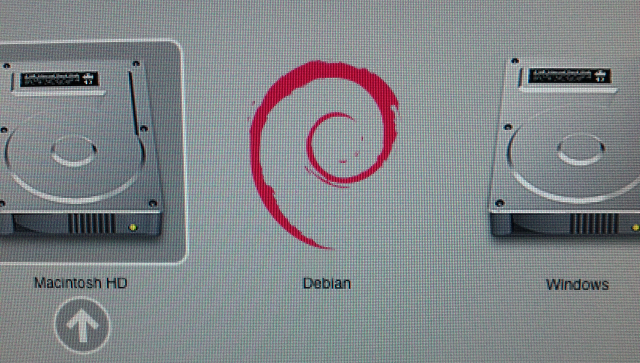
Diego s post got me to switch from grub-pc to grub-efi to boot Debian on my Macbook Pro. But I wanted to go further: getting rid of rEFIt. rEFIt is a pretty useful piece of software, but it s essentially dead. There is the rEFInd fork, which keeps it up-to-date, but it doesn t really help with FileVault. Moreover, the boot sequence for a Linux distro with rEFIt/rEFInd looks like: Apple EFI firmware rEFIt/rEFInd GRUB Linux kernel. Each intermediate step adding its own timeout, so rEFIt/rEFInd can be seen as not-so-useful intermediate step. Thankfully, Matthew Garrett did all the research to allow to directly boot GRUB from the Apple EFI firmware. Unfortunately, his blog post didn t have much actual detail on how to do it. So here it is, for a Debian system: Now, the Apple Boot Manager, shown when holding down the option key when booting the Macbook Pro, looks like this:
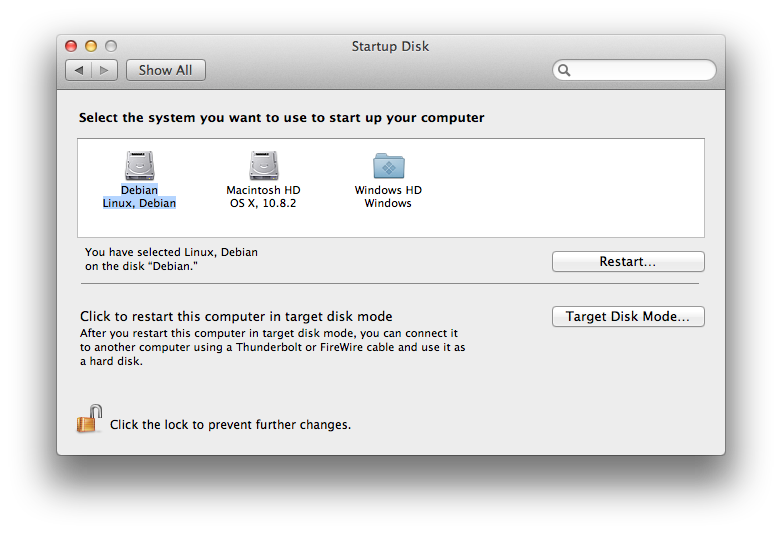
And the Startup disk preferences dialog under OSX, like this:

17 November 2012

Craig Sanders: done

OK, I m finished my experiment. It s over now and I can break character . First, I have to offer special thanks to tshirtman for being the first to unambiguously exemplify one of my main points. well done! In case it s not blindingly obvious (as it should be), the reason for my post was that I was outraged by the spectacle of one fairly high-profile member of the linux community trying to rally support to shun and exclude another fairly high-profile member because a nightmare had upset her. WTF? Is that really all it s going to take to destroy someone s reputation and perhaps their career? even with the shunning target s own words available and archived to disprove the ridiculous straw-man mis-characterisations of what he actually said? Not one of the arguments against him actually addressed anything he said, they ALL attacked him for things he didn t say, for things that other people claimed he said. I was further outraged by seeing everyone who even suggested that questioning of stats (or, indeed, ANY claim of fact or evidence) may be, in some small way, a valid and reasonable thing to do get instantly put in their place and dismissed as Yet Another Rape Apologist. Are we supposed to be anti-science, anti-scientific method now? or are rape stats a special case like religion where we are just supposed to switch off our analytical brains and accept what we are told on faith, without question? Surely we are capable of better than that? i know we are capable of better than that. Or, at least, i used to know that. Now i m not so sure. In 2011, all it took was Ted Tso ( TT ) making some fairly reasonable statements about the need for any claimed evidence or statistics to be viewed skeptically and that dissenting research should also be considered and he was instantly vilified as a rape apologist . Sorry, but questioning extremely dodgy stats (that even in feminist circles are viewed more as ideological propaganda than as serious research) is NOWHERE NEAR SUFFICIENT to earn the label of rape-apologist. That is not how debate works you can t just refuse to engage with someone s point and simply accuse them of being the enemy for not agreeing 100% with whatever you say at least, not if you have any intellectual honesty or self-respect. (sure, some people are complete jerks and deserve to be told to FOAD in no uncertain terms but a) jerks like that are self-evident and obvious, and b) TT s participation in that thread was at all times civil and reasonable) But that thread is ancient history it was over and done with nearly two years ago.
In October this year, for reasons which are not at all clear, Valerie Aurora ( VA ) decided to revive the issue (which had been resolved back in 2011 with a resounding fuck no, we don t want misogynist shit or porn in our conferences from pretty much the entire linux community including near-universal support for improved anti-harassment policies both for linux.conf.au and for geek conferences in general) and use it to attack TT. And she did so by twisting his words and claiming in a post on The Ada Initiative blog that he said something which he didn t, that rape was impossible if both people were drunk enough . If he chose, he could quite easily win a libel case against her and TAI on that. It s not what he said, it s not even close to what he said, and VA is clearly too smart to honestly believe that it is what he said. In another post on her personal, blog she talks about how what he said was so terrible that it even now gives her nightmares, and that she can t bear the thought of working with him. Again, WTF? VA can say I had nightmares and was upset and furious and THAT is enough to justify a call to shun TT?? He didn t attack her, or threaten her (explicitly or implicitly), he was polite and civil. What he did was disagree with VA by referring to other research that disputed VA s preferred studies. I agree with and support many (perhaps most) of VA s and The Ada Initiative s aims, I certainly believe that linux and open source etc should be very welcoming and supportive of human diversity (including gender and sexuality, identity, religion, politics and so on), believe that it s a good thing that The Ada Initiative exists as part of that diversity welcome to be particularly supportive of women in geekdom. And i wholeheartedly agree that Linux leaders should not make public statements belittling and condoning rape BUT: a) I haven t seen one instance of that happening, ever and b) I find VA s choice of tactics here to be despicable. as i do when anyone else uses similar tactics, because they ARE despicable tactics. They are exactly the same as accusing someone of being a child pornographer for being against net censorship: You dared to disagree with me so I m going to accuse you of being a monster. (and, i must admit, the enthusiasm level of my support for The Ada Initiative is somewhat .diminished by this tactical blunder by the spokesperson and co-founder) There are far more deserving targets of VA s ire than TT. And there are far better ways for the Ada Initiative to achieve their aims.
Why? So why did I decide to comment when I knew that I was inevitably going to be accused of hating women and being a rape apologist? Mostly because I thought it would be gutless of me not to. Hardly anyone else had, and they quickly backed down under the accusations of misogyny and since I consider myself to be psychologically fairly strong, I felt that I am capable of wearing a little shit (or even a lot) for a while. In my egocentric fashion, I thought if I can t do then it s no wonder that no one else dares . And also because anyone who cared to make even the slightest effort to find out what my actual views on sexual harassment, rape, women s rights and numerous inter-related issues are can fairly easily see a very consistent record of the kinds of things I argue for and against, and my scathing responses to actual misogynists when they appear on lists that I participate in. they are not my kind of people. and even then, i hesitated. it s scary and intimidating to be putting yourself forward to be accused of being one of the things you hate. this is, of course, an instance of the chilling effect. So, I found the prospect scary, almost terrifying .and I can t think of a single person who has met me online or in real life who would even remotely describe me as being any kind of delicate or sensitive wall-flower. again, if i can t do it, it s no wonder no one else dares . so i clicked the Publish button. an ego is useful for some things. Also, I took VA s words but don t be silent as inspiration. In the process, i discovered why it is that some people just simply refuse to engage in rational discourse. I ve seen it many times from the other side, but i ve never experienced the seductive pleasure of indulging in it myself before there s a liberating freedom in just ignoring any and every point that someone makes and simply accuse them of being the enemy. You don t have to try to understand what they wrote, hell you don t even have to really read it you just need to quickly scan it for overall tone and if they don t seem like they re 100% supportive, you just accuse them of being the enemy or an apologist for the enemy. it s that fucking simple and easy. well, sort of easy. easy for some, perhaps. i personally found it extremely difficult a struggle to refrain from engaging, to remain in character (i m not much of an actor). especially when i kind of agreed with whoever was arguing against my experimental character or if i thought they made a good point. and even more so when i thought that some comments skirted a bit too close to being the kind of misogynist crap that i didn t want to tolerate having on MY blog. (i resolved that issue by just approving any reply that didn t squick me or that i could squint at and think hmmm borderline, give benefit of doubt ) but even though i don t like it, i can recognise the attraction it holds for some people.
Other thoughts: I m particularly disgusted by the men who intervene way too early without an explicit invitation or request for help or a clear need such as an immediate threat of violence in womens issues. Many or maybe even most may not realise it, but they are just taking over and asserting male strength and control by protecting women rather than giving them the support and space to discover and practice their own strength and their own voices. These uninvited interventions do not help women, they weaken and undermine them, they perpetuate dependence, they steal strength from the movement. It is patronising and enfeebling. But mostly, they just re-assert male dominance and are an attempt to make women s spaces more comfortable, more palatable, for men.(*) (it s also quite often very transparent self-serving and ingratiating behaviour from blokes who want to lay the groundwork for perhaps getting laid one day) IMO this goes far beyond a problem with men over-involving themselves in feminist causes i feel the same way for any relatively less-privileged group with a need to find their own voice and their own power they ll never find it if members of the privileged class (i.e. white males like me) just ride roughshod over the movement and speak FOR them rather then just silently lending their strength in support. For the most part, they (we) should just shut up and listen we already have more than enough opportunities to have our say. (*) yes, i m well aware of the difficulty in writing something like that paragraph as a member of a privileged class, without coming across as either self-hating or patronising or both. if i ve failed here, it s not for want of trying. done is a post from: Errata

Antoine Beaupr : First stable release of the Drupal OpenID Provider

A short announcement to mark the release of the first stable OpenID provider for Drupal. Started by James Walker around 4 years ago, I have since then got commit access and taken care of the module for the last 2 years. And while it was not an easy task, with the help of the community, this module was able to mature to a fully featured, flexible and standard implementation during that time. One has to wonder however, is it too late for OpenID?

A bit of history Drupal was one of the pioneers in OpenID support. Back in 2006 when the protocol was still in its infancy (less than a year old!), Drupal was adding OpenID support to its 4.7 release through a contrib module and two years later, the Drupal 6.0 release was sporting OpenID in core, although not without significant interoperability issues. Still, we could say that rapid adoption by such a popular CMS as Drupal really boosted OpenID's adoption. At about the same time, Yahoo, Sourceforge, Myspace, Microsoft and Google would all join the OpenID bandwagon. On the OpenID "provider" side of things, things were not so great however. Back when I started experimenting with this, it wasn't actually that easy to host your own OpenID provider, to allow your users to login to other OpenID-enabled sites. While there are a lot of different libraries to provide OpenID support in your application there was not (and still isn't) any software that gives you an OpenID provider and is dedicated to that. No official reference implementation either, other than the code from the one of the founding companies of OpenID, JanRain. There was an OpenID provider module in Drupal, but there was no official release done until a two beta releases in 2010.

Koumbit's community involvement It is about that time I started getting involved in the project. Koumbit needed an easy way for our workers to log into multiple sites without too much trouble, so I started looking at OpenID provider implementations. The lack of dedicated software somehow made the Drupal implementation a natural fit, and I started experimenting with the module, filing bugs and reviewing patches, as there were a lot of interoperability and design issues with the provider. After a while, walkah was kind enough to give me full access to the project and I started doing regular releases (every few months), culminating in today's official 1.0 release for both Drupal 6 and Drupal 7, which I am very proud and happy about. While I am here, I want to send many thanks to the people behind the Drupal 7 port: paranojik, mikecar, xamanu and testing from neizod. A lot of issues were also patched, reviewed and tested by numerous contributors that are unfortunately difficult to track down other than reading the commit log. So we at Koumbit have been running our own OpenID provider for a good while now, and it has the key advantage of being connected to our LDAP directory (with the D6 LDAP integration module so it is, in a sense, a central point for authentication at Koumbit. Very often people don't clearly understand what their LDAP password does, and I can easily remind them "it's the OpenID thing", or "try your password in the OpenID site" if they think they have forgotten it. So much goes on in the web browser these days that it makes everything much easier.

The problem with Drupal's OpenID provider However, it is kind of embarrassing that it took so long. More than 6 years after the OpenID protocol was written, we have a stable OpenID provider. Now, this may be because I am overly conservative about stable releases, but I don't think so: the OpenID provider module had, for a long time, serious interoperability issues with OpenID sites. There was also a clear lack of features on the OpenID provider, a gap that various third party modules, now documented on the OpenID provider homepage are now trying to fill. There is also serious security issues with the protocol itself. The complexity and lack of clarity of the OpenID specification have rendered my work quite difficult at time, as the protocol has significant ambiguities and no clear reference implementation. OpenID is unfortunately renowned to be vulnerable to phishing and while Koumbit's use of the HTTPS protocol alleviates some of those issues (especially the redirect session hijack), tools like sslstrip can bypass those protections easily. The privacy aspect is also problematic, as the user is usually not free to choose which information from his or her profile is divulged to the site they are logging into. Of course those issues may be overlooked if the security trade off is not worth it. In the case of Koumbit, we use OpenID on a lot of client sites, but usually nothing critical, and we train our users to pay attention to the HTTPS icon when login in their OpenID account.

Are there alternatives? But unfortuantely, the reality is that there are not really any alternatives to OpenID out there. Mozilla's new BrowserID initiative (now rebranded Persona, boy those guys sure love rebranding..) is interesting, but actually has even more flaws than OpenID itself. Not only is it not resolving the phishing problem, it actually creates new problems, including my personal favorite, trusting server-side Javascript code, which OpenID is not using that much. I should also mention the Shibboleth module which has a surprising number of installs recorded on Drupal.org, but that depends on the much more complicated Shibboleth federation, for which there is no server implementation for Drupal, from what I understand. Oauth, on the other end, is even more widely used, and has server-side components like Oauth Login Provider and Services 3.x. We could also simply give up and use our souls stored at Facebook, Google and Twitter for authentication everywhere. Maybe OpenID opened the door for those corporations to see that there is a real opportunity in leveraging user's profile to track their online activity. It is not something that OpenID was necessarily designed for but it's an idea that certainly permeates Facebook connect and "like" buttons or Twitter and Google online business strategies, where you are the product sold to advertisers. I personally believe we should keep the struggle for distributed and standard identity mechanisms for the web that respect users' privacy. With Drupal's OpenID Provider, it is possible to create a secure, privacy-aware identity provider, although I still have to perform that damn security audit. Experiments with those third party modules should also be encouraged and I welcome any feedback on those modules. While I do not plan to attend OpenID conferences or do significant development on the OpenID provider right now, I will certainly make sure Koumbit keeps its commitment to maintaining stewardship on the OpenID provider module in Drupal. I encourage people to try it out, submit issues and patches to make it even better. Long life to OpenID! PS: if people are interested in funding that security audit, I would be happy to perform this through my regular work at Koumbit.org, just file a request at services@koumbit.org.

16 November 2012

Paul Tagliamonte: pathfinding debian's social connections

As a followup to my toy over at debtree, I ve taken some suggestions from my buddy Arno and found some time in the hotel during a visit for work up to Canada with the Open North folks hacking on open13. The hack is called debfriends (I need to purge personal details from the source tree before I can push it to VCS, since it uses the nm.d.o dump. Sorry, I should have been better about that.) I ve posted a cute front-end on my staging machine to play with over at graph.lucifer.pault.ag There s also an API, but it has all the data in the NM dump exposed. If you re a DD who will treat this data right, I can add a key (it s not secure, like, at all). I m going to publish the source ASAP so that others can stand up an instance if they d like. It s a cute toy, though! In the tradition of using nhandler for my examples, here s an example path from pabs to Nathan: pabs > nhandler Also, we re a shockingly well connected bunch. Well done :) Feel free to play with it!

Matt Zimmerman: Decoding a .mobileconfig file containing a Cisco IPsec VPN configuration

When someone wants to give you access to a Cisco VPN, they might give you a .mobileconfig file. This is apparently used by MacOS and iOS to encapsulate the configuration parameters needed to connect to a VPN. You should be able to connect to it with open source software (such as NetworkManager and vpnc) as long as you have the right configuration. Some helpful soul has tried to give you that configuration, but it s wrapped up in an Apple-specific container. Here s how you rip it open and get the goodies. File format A .mobileconfig appears to contain:
  1. Some binary garbage which is safe to ignore
  2. An XML document containing the good bits, i.e.:
    1. The local identifier (i.e. IPsec group name)
    2. The remote address (i.e. IPsec gateway host)
    3. The shared secret (base64 encoded)
  3. Some more binary garbage which is safe to ignore
and it looks like this:
<plist version="1.0">
<dict>
  <key>PayloadContent</key>
  <array>
    <dict>
      <key>IPSec</key>
      <dict>
        <key>AuthenticationMethod</key>
        <string>SharedSecret</string>
        <key>LocalIdentifier</key>
        <string>LOCAL_IDENTIFIER_HERE</string>
        <key>LocalIdentifierType</key>
        <string>KeyID</string>
        <key>RemoteAddress</key>
        <string>REMOTE_ADDRESS_HERE</string>
        <key>SharedSecret</key>
        <data>
        BASE64_ENCODED_SHARED_SECRET_HERE
        </data>
      </dict>
      <key>IPv4</key>
      <dict>
        <key>OverridePrimary</key>
        <integer>0</integer>
      </dict>
      <key>PayloadDescription</key>
      <string>...</string>
      <key>PayloadDisplayName</key>
      <string>...</string>
      <key>PayloadIdentifier</key>
      <string>...</string>
      <key>PayloadOrganization</key>
      <string>...</string>
      <key>PayloadType</key>
      <string>com.apple.vpn.managed</string>
      <key>PayloadUUID</key>
      <string>...</string>
      <key>PayloadVersion</key>
      <integer>1</integer>
      <key>Proxies</key>
      <dict>
        <key>HTTPEnable</key>
        <integer>0</integer>
        <key>HTTPSEnable</key>
        <integer>0</integer>
        <key>ProxyAutoConfigEnable</key>
        <integer>0</integer>
        <key>ProxyAutoDiscoveryEnable</key>
        <integer>0</integer>
      </dict>
      <key>UserDefinedName</key>
      <string>...</string>
      <key>VPNType</key>
      <string>IPSec</string>
    </dict>
  </array>
  <key>PayloadDescription</key>
  <string>...</string>
  <key>PayloadDisplayName</key>
  <string>...</string>
  <key>PayloadIdentifier</key>
  <string>...</string>
  <key>PayloadOrganization</key>
  <string>...</string>
  <key>PayloadRemovalDisallowed</key>
  <false/>
  <key>PayloadType</key>
  <string>Configuration</string>
  <key>PayloadUUID</key>
  <string>...</string>
  <key>PayloadVersion</key>
  <integer>1</integer>
</dict>
</plist>
The shared secret is base64-encoded, so you can decode it with: $ echo -n 'BASE64_ENCODED_SECRET_HERE' base64 -d Network Manager configuration
  1. Make sure you have network-manager-vpnc installed
  2. Click the Network Manager icon, select VPN Connections , Configure VPN
  3. Create a Cisco-compatible (vpnc) connection

    Create a Cisco-compatible (vpnc) VPN connection

  4. Configure the connection settings as follows:

    Configure the connection settings

    • Enter the remote address in the Gateway field
    • Enter the local identifier in the Group name field
    • Enter the shared secret in the Group password field
  5. To connect, click the Network Manager icon, select VPN Connections , and select the connection you just configured
Good luck and enjoy!

15 November 2012

Peter Makholm: Deploying Half of CPAN on Debian using Carton

As systems developer I like just being able to pick the most useful Perl modules from CPAN and preferably use quite recent versions of the modules I need. On the other hand our systems administrators prefer running Debian Stable and deploy software using .deb packages. I do not want to maintain hundred small packages by hand. I just want a single package with all needed the Perl dependencies for a given project. After looking at different possibilities for bundling Perl dependencies I finally found Carton written by Tatsuhiko Miyagawa. Given a list of your direct Perl dependencies, Carton can maintain the full dependency chain and manage which versions of each module you deploy. One of the nice features is that you get a reproducible set of versions each time and not just the latest, greatest, and recently broken versions. The initial step is to set Carton up to install the dependencies for my project. This part is done just like the Carton documentation describes. To ensure independence from whatever is available on CPAN I end by calling carton bundle. The next step is to write a small Perl module making sure you load modules from the right place. I end up with installing modules in /usr/lib/projectname. My module looks like this:
package My::Bundle::ProjectName;
=head1 NAME
My::Bundle::ProjectName - Bundle of CPAN modules used by ProjectName
=cut
our $VERSION = 1.0;
use Config;
use Carp;
use Carp::Heavy;  # Ensure that all parts of Carp are loaded before @INC mangling
use File::Spec;
our $BASE = '/usr/lib/projectname';
sub import  
    carp (__PACKAGE__ . " bundle not installed")
        unless -d $BASE;
    unshift @INC, 
        File::Spec->catdir( $BASE, 'lib', 'perl5' ),
        File::Spec->catdir( $BASE, 'lib', 'perl5', $Config archname );
 
1;
Now I need to install this module and all the modules maintained by Carton. I do this by a enhanced Module::Build script:
use v5.10.0;
use strict;
use warnings;
use Module::Build;
my $class = Module::Build->subclass(
    class => "My::Builder",
    code  => q 
        sub ACTION_build  
            my $self = shift;
            $self->SUPER::ACTION_build;
            !system 'carton', 'install', '--cached';
         
        sub ACTION_install  
            my $self = shift;
            $self->SUPER::ACTION_install;
            
            my $installdir = $self->destdir . "/usr/lib/projectname";
            system 'install', '-d', $installdir;
            !system 'cp', '-a', 'local/lib', $installdir;
         
     ,
);
$class->new(
    module_name       => 'My::Bundle::ProjectName',
    dist_author       => 'Peter Makholm <peter>',
    dist_version_from => 'lib/My/Bundle/ProjectName.pm',
    add_to_cleanup    => [ 'local/lib', 'local/bin' ],
)->create_build_script;
The last step is to create a .deb package. This is mostly just a standard debian/ directory using debhelper. You just need to override the dh_perl to pick up the correct binary dependencies. So this is my debian/rules:
#!/usr/bin/make -f
%:
        dh $@
override_dh_perl:
        dh_perl /usr/lib/projectname/lib
That s it. Then all the scripts and applications making up my project just needes to use My::Bundle::ProjectName and the rest is automatic. I am thinking about enhancing Carton to provide individual .deb packages instead of just installing the modules. This would make it quite easy to maintain the packages in a more The Debian Perl Group-compatible way. That could be cool.

Martin Pitt: python-dbusmock templates

With python-dbusmock you can provide mocks for arbitrary D-BUS services for your test suites or if you want to reproduce a bug. However, when writing actual tests for gnome-settings-daemon etc. I noticed that it is rather cumbersome to always have to set up the skeleton of common services such as UPower. python-dbusmock 0.2 now introduces the concept of templates which provide those skeletons for common standard services so that your code only needs to set up the particular properties and specific D-BUS objects that you need. These templates can be parameterized for common customizations, and they can provide additional convenience methods on the org.freedesktop.DBus.Mock interface to provide more abstract functionality like add a battery . So if you want to pretend you have one AC and a half-charged battery, you can now simply do
  def setUp(self):
     (self.p_mock, self.obj_upower) = self.spawn_server_template('upower',  )
  def test_ac_bat(self):
     self.obj_upower.AddAC('mock_AC', 'Mock AC')
     self.obj_upower.AddChargingBattery('mock_BAT', 'Mock Battery', 50.0, 1200)
Or, if your code is not in Python, use the CLI/D-BUS interface, like in shell:
  # start a fake system bus
  eval  dbus-launch 
  export DBUS_SYSTEM_BUS_ADDRESS=$DBUS_SESSION_BUS_ADDRESS
  # start mock upower on the fake bus
  python3 -m dbusmock --template upower &
  # add devices
  gdbus call --system -d org.freedesktop.UPower -o /org/freedesktop/UPower \
      -m org.freedesktop.DBus.Mock.AddAC mock_ac 'Mock AC'
  gdbus call --system -d org.freedesktop.UPower -o /org/freedesktop/UPower \
      -m org.freedesktop.DBus.Mock.AddChargingBattery mock_bat 'Mock Bat' 50.0 1200
In both cases upower --dump or gnome-power-statistics will show you the expected devices (of course you need to run that within the environment of the fake $DBUS_SYSTEM_BUS_ADDRESS, or run the mock on the real system bus as root). Iftikhar Ahmad contributed a template for NetworkManager, which allows you to easily set up ethernet and wifi devices and wifi access points. See pydoc3 dbusmock.templates.networkmanager for details and the test cases for how this looks like in practice. I just released python-dbusmock 0.2.1 and uploaded the new version to Debian experimental. I will sync it into Ubuntu Raring in a few hours.

Matthew Garrett: More in the series of bizarre UEFI bugs

A (well, now former) coworker let me know about a problem he was having with a Lenovo Thinkcentre M92p. It booted Fedora UEFI install media fine, but after an apparently successful installation refused to boot. UEFI installs on Windows worked perfectly. Secure Boot was quickly ruled out, but this could still have been a number of things. The most interesting observation was that the Fedora boot option didn't appear in the firmware boot menu at all, but Windows did. We spent a little while comparing the variable contents, gradually ruling out potential issues - Linux was writing an entry that had an extra 6 bytes in a structure, for instance[1], and a sufficiently paranoid firmware implementation may have been tripping up on that. Fixing that didn't help, though. Finally we tried just taking the Windows entry and changing the descriptive string. And it broke.

Every UEFI boot entry has a descriptive string. This is used by the firmware when it's presenting a menu to users - instead of "Hard drive 0" and "USB drive 3", the firmware can list "Windows Boot Manager" and "Fedora Linux". There's no reason at all for the firmware to be parsing these strings. But the evidence seemed pretty strong - given two identical boot entries, one saying "Windows Boot Manager" and one not, only the first would work. At this point I downloaded a copy of the firmware and started poking at it. Turns out that yes, actually, there is a function that compares the descriptive string against "Windows Boot Manager" and appears to return an error if it doesn't match. What's stranger is that it also checks for "Red Hat Enterprise Linux" and lets that one work as well.

This is, obviously, bizarre. A vendor appears to have actually written additional code to check whether an OS claims to be Windows before it'll let it boot. Someone then presumably tested booting RHEL on it and discovered that it didn't work. Rather than take out that check, they then addded another check to let RHEL boot as well. We haven't yet verified whether this is an absolute string match or whether a prefix of "Red Hat Enterprise Linux" is sufficient, and further examination of the code may reveal further workarounds. For now, if you want to run Fedora[2] on these systems you're probably best off changing the firmware to perform a legacy boot.

[1] src/include/efi.h: uint8_t padding[6]; /* Emperically needed */, says the efibootmgr source code. Unhelpful.
[2] Or Ubuntu, or Suse, or

comment count unavailable comments

14 November 2012

Petter Reinholdtsen: Debian Edu interview: Angela Fu

Here is another interview with one of the people in the Debian Edu and Skolelinux community. I am running short on people willing to be interviewed, so if you know about someone I should interview, Please send me an email. After asking for many months, I finally managed to lure another one of the people behind the German "IT-Zukunft Schule" project out from maternity leave to conduct an interview. Give a warm welcome to Angela Fu . :) Who are you, and how do you spend your days? I am a 39-year-old woman living in the very north of Germany near Denmark. I live in a patchwork family with "my man" Mike Gabriel, my two daughters, Mikes daughter and Mikes and my rather newborn son. At the moment - because of our little baby - I am spending most of the day by being a caring and organising mom for all the kids. Besides that I am really involved into and occupied with several inner growth processes: New born souls always bring the whole familiar system into movement and that needs time and focus ;-). We are also in the middle of buying a house and moving to it. In 2013 I will work again in my job in a German foundation for nature conservation. I am doing public relation work there. Besides that - and that is the connection to Skolelinux / Debian Edu - I am working in our own school project "IT-Zukunft Schule" in North Germany. I am responsible for the quality assurance, the customer relationship management and the communication processes in the project. Since 2001 I constantly have been training myself in communication and leadership. Besides that I am a forester, a landscaping gardener and a yoga teacher. How did you get in contact with the Skolelinux / Debian Edu project? I fell in love with Mike ;-). Very soon after getting to know him I was completely enrolled into Free Software. At this time Mike did IT-services for one newly founded school in Kiel. Other schools in Kiel needed concepts for their IT environment. Often when Mike came home from working at the newly founded school I found myself listening to his complaints about several points where the communication with the schools head or the teachers did not work. So we were clear that he would not work for one more school if we did not set up a structure for communication between him, the schools head, the teachers, the students and the parents. Together with our friend and hardware supplier Andreas Buchholz we started to get an overview of free software solutions suitable for schools. One day before Christmas 2010 Mike and I had a date with Kurt Gramlich in G tersloh. As Kurt and I are really interested in building networks of people and in being in communication we dived into Skolelinux and brought it to the first grammar schools in Northern Germany. For information about our school project you can read the interview with Mike Gabriel. What do you see as the advantages of Skolelinux / Debian Edu? First I have to say: I cannot answer this question technically. My answer comes rather from a social point of view. The biggest advantage of Skolelinux / Debian Edu I see is the large and strong international community of Debian Developers in the background which is very alive and connected over mailinglists, blogs and meetings. My constant feeling for the Debian Community is: If something does not work they will somehow fix it. All is well ;-). This is of course a user experience. What I also get as a big advantage of Skolelinux / Debian Edu is that everybody who uses it and works with it can also contribute to it - that includes students, teachers, parents... What do you see as the disadvantages of Skolelinux / Debian Edu? I will answer this question relating to the internal structure of Skolelinux / Debian Edu. What I see as a major disadvantage is that there is a gap between the group of developers for Debian Edu and the people who make the marketing, that means the people that bring Skolelinux to the schools. There is a lack of communication between these two groups and I think that does not really work for Skolelinux / Debian Edu. Further I appreciate that Skolelinux / Debian Edu is known as a do-ocracy. Nevertheless I keep asking myself if at some points a democracy or some kind of hierarchical project structure would be good and helpful. I am also missing some kind of contact between the Skolelinux / Debian Edu communities in Europe or on an international level. I think it would be good if there was more sharing between the different countries using Skolelinux / Debian Edu. Which free software do you use daily? On my laptop I am still using an Ubuntu 10.04 with a Gnome Desktop on. As applications I use Openoffice.org, Gedit, Firefox, Pidgin, LaTeX and GnuCash. For mails I am using Horde. And I am really fond of my N900 running with Maemo. Which strategy do you believe is the right one to use to get schools to use free software? I am really convinced that in our school project "IT-Zukunft Schule" we have developed (and keep developing) a great way to get schools to use Free Software. We have written a detailed concept for that so I cannot explain the whole thing here. But in a nutshell the strategy has three crucial pillars:

13 November 2012

Steve McIntyre: Spoiling my vote

Ever since I passed the age of 18, I've used my legal right in the UK to vote in every poll I could: local council, British Parliament, European Parliament and even the messed-up referendum on the Alternative Vote that we had last year. In each of those cases, I made a point of considering my available options and I voted accordingly. I went along and marked my ballot paper in person where possible, or I filled in a postal vote for the last Westminster election in 2010 as I was on vacation in Florida when it was held. Unfortunately, it seems that my diligence in voting makes me unusual amongst the UK population these days. The long-term trend for voter turnout is downwards (as you can see). However, the latest election that's happening in the UK (well, England and Wales outside London) this week is for the newly-created posts of Police and Crime Commissioners. It's a textbook example of how not to organise an election, as pointed out eloquently by the Electoral Reform Society. This election has been incredibly badly managed and publicised by the Government, and lots of early polls are suggesting a tiny turnout of less than 20%. Despite the political crap about "democracy" being spouted by some Tory ministers, it's clear that very few people want this change in how the police are run, and it has simply been imposed from the top. Too few people care about the results of these elections for them to be valid - most people don't want the police politicised. After a lot of thought about the issue, I've decided how I'm going to vote this time. For the first time ever, I'm explicitly going to turn up and spoil my ballot paper as a protest - I do not want this crap. I urge other people in England and Wales to consider doing the same.

Erich Schubert: Migrating from GNOME3 to XFCE

I have been a GNOME fan for years. I actually liked the switch from 1.x to 2.x, and at some point switched to 3.x when it became somewhat usable. At some point, I even started some small Gnome projects, one even was uploaded to the Gnome repositories. But I didn't have much time for my Linux hobby anymore back then.
However, I am now switching to XFCE. And for all I can tell, I am about the last one to make that switch. Everybody I know hates the new Gnome.
My reason is not emotional. It's simple: I have systems that don't work well with OpenGL, and thus don't work well with Gnome shell. Up to now, I can live fine with "Fallback mode" (aka: Gnome classic). It works really good for me, and does exactly what I need. But it has been all over the media: Gnome 3.8 will drop 'fallback' mode.
Now the choice is obvious: instead of switching to shell, I go to XFCE. Which is much closer to the original Gnome experience, and very productivity oriented.
There are tons of rants on GNOME 3 (for one of the most detailed ones, see Gnome rotting in threes, going through various issues). Something must be very wrong about what they are doing to receive this many sh*tstorms all the time. Every project receives some. I've even received a share of the Gnome 2 storms when Galeon (an early Gnome browser) made the move and started dropping some of the hard-to-explain and barely used options that would break with every other Mozilla release. And Mozilla embedding was a major pain these days. Yet, for every feature there would be some user somewhere that loved it, and as Debian maintainer of Galeon, I got to see all the complaints (and at the same time was well aware of the bugs caused by the feature overload).
Yet with Gnome 3, things are IMHO a lot different. In Gnome 2, it was a lot about making things more usable as they are, a bit cleaner and more efficient. With Gnome 3, it seems to be about experimenting with new stuff. Which is why it keeps on breaking APIs all the time. For example themeing GTK 3 is constantly broken; most of the themes available just don't work. Similar Gnome Shell extensions - most of them work with exactly one version of Gnome Shell (doesn't this indicate the author has abandoned Gnome shell?).
But the one thing that was really sticking out was when my I updated the PC of my dad. Apart from some glitches, he could not even shutdown his PC with Gnome-shell. Because you needed to press the Alt button to actually get a shutdown option.
This is indicative of where Gnome is heading: something undefined inbetween of PCs, tablets, media centers and mobile phones. They just decided that users don't need to shutdown anymore, so they could as well drop that option.
But the worst thing about the current state of GNOME is: They happily live with it. They don't care that they are losing users by the dozens. Because to them, these are just "complainers". Of cousre there is some truth in "Complainers gonna complain and haters gonna hate". But what Gnome is receiving is way above average. At some point, they should listen. 200 posts long comment chains from dozens of peopls on LWN are not just your average "complaints". It's an indicator that a key user base is unhappy with the software. In 2010 GNOME 2 had 45% market share in the LinuxQuestions poll, XFCE had 15%. In 2011, GNOME 3 had 19%, and XFCE jumped to 28%. And I wouldn't be surprised if GNOME 3 shell (not counting fallback mode) would clock at less than 10% in 2012 - despite being default.
Don't get me wrong: there is a lot on Gnome that I really like. But as they decided to drop my preferred UI, I am of course looking for alternatives. In particular, as I can get lots of the Gnome 3 benefits with XFCE. There is a lot in the Gnome ecosystem that I value, and that IMHO is driving Linux forward. Network-manager, Poppler, Pulseaudio, Clutter just to name a few. Usually, the stuff that is modular is really good. And in fact I have been a happy user of the "fallback" mode, too. Yet, the overall "desktop" Gnome 3 goals are in my opinion targeting the wrong user group. Gnome might need to target linux developers more again, to keep a healthy development community around. Frequently triggering sh*tstorms by high-profile people such as Linux Torvalds is not going to strengthen the community. There is nothing wrong in the FL/OSS community to encourage people to use XFCE. But these are developers that Gnome might need at some point.
On a backend / technical level (away from the Shell/UI stuff that most of the rants are about), my main concern about the Gnome future is GTK3. GTK2 was a good toolkit for cross-platform development. GTK3 as of now is not, but is largely a Linux/Unix only toolkit - in particular, because there apparently is no up to date Win32 port. With GTK 3.4 it was said that they are now working on Windows - but as of GTK 3.6 they are still nowhere to be found. So if you want to develop cross-platform, as of now, you better stay away from GTK 3. If this doesn't change soon, GTK might sooner or later lose the API battle to more portable libraries.

12 November 2012

Stefano Zacchiroli: Debian newcomer experience survey

In recent times we have worked quite a bit to improve the NM process, i.e. the process newcomers go through to become members of the Debian Project. As it happens, I've just read Nathan's recent post on his NM experience and I think it is a perfect example of the joining experience we are trying to offer to all newcomers. But examples, be them positive or negative, are only anecdotal. To evaluate a process one needs actual data and someone analyzing them, ideally with a scientific approach. This is why I'm happy to host below a guest blog post by Kevin Carillo, who is doing a pretty thorough scientific study about how newcomers join a wide range of Free Software projects, including KDE, OpenSUSE, GNOME, and Debian, of course! TL;DR: if you started contributing to Debian after January 2010, there's a survey for you; participating will help us improving the NM process even further. Kevin's guest blog post follows.
Newcomer experience in Debian and other FOSS communities - Survey My name is Kevin Carillo. I am a PhD student currently living in Wellington (New Zealand) and I am doing some research on Free/Open Source Software communities. If you have started contributing to the Debian project after January 2010 (within approximately the last 3 years), I would like to kindly request your help. I am interested in hearing from people who are either technical or non-technical contributors, and who have had either positive or negative newcomer experiences. The purpose of the research is to work out how newcomers to a FOSS community become valued sustainable contributors. The survey is online and will be available until Tuesday, 27 November, 2012. Inspiration from Debian New Member Debian is a successful community that keeps attracting new contributors and that relies on a very unique way to handle the integration of new contributors: the New Member process. The idea behind the NM process is that it is some sort of filtering procedure allowing to only retain the individuals who have the potential to become valued sustainable contributors in Debian. Within Debian, there is a lot of enthusiasm and pride around the NM process as it seems to be functioning pretty well but the question is: Is this really enough to ensure that Debian remains a healthy and growing community? How does it compare to the way newcomers are integrated in other large projects such as KDE, GNOME, or in other non-Linux related communities such as Mozilla? I have to admit that the Debian NM process has been among the main sources of inspiration that made me embark in this research project. I have kept being quite impressed when talking to people who had gone through the process as all of them came out of it with a real passion for the project and love for its community. When reflecting on the reasons why the NM process succeeds, I have a feeling it is some instance of ritualized socialization. In other words, barriers and initiation rituals that require some effort from newcomers, generate members with higher commitment and sense of identification towards the Debian community. What do newcomers really experience? The main assumption that motivated this project is that attracting new members has become crucial for a large majority of FOSS communities but this is not a sufficient condition to ensure the success and prosperity of a project. A proportion of a community's newcomers must contribute to the well-being and growth of the community. Keeping all that in mind, FOSS projects have thus to do a good job at "socializing" their newcomers and turning them into 'good' contributors. Doing a good job here means that FOSS projects shall ensure that they help generate citizenship-like behaviors from newcomers by designing appropriate newcomer programs and procedures. FOSS communities rely on a wide array of initiatives to facilitate the integration of newcomers but it seems like the other side of the coin is less understood: What do newcomers really experience? And how does this influence their contributions and actions within a project? How is this study going to help Debian? The data will help gain insights about the experience of newcomers within the Debian community. In addition, it will allow to understand how to design effective newcomer initiatives to ensure that Debian will remain a successful and healthy community. The dataset will be released under a share-alike ODbL license so that Debian contributors can extract as much value as possible from the data. Since this survey also involves other large FOSS projects such as Mozilla, KDE, Gnome, Ubuntu, Gentoo, OpenSUSE, and NetBSD, it will also be possible to compare practices across projects in order to identify what works from what does not work when facilitating the integration of newcomers. About the survey This survey is anonymous. The raw dataset of everything one fills in the survey will be released under the ODbL. Since all the questions but one are optional, one is free to control the amount of information they are giving away about themselves. I expect the survey to take around 20 minutes of your time. If you know members of the Debian community who you think would be interested in completing it, please do not hesitate to let them know about this research. I will post news about my progress with this research, and the results on my blog. Don't hesitate to contact me. --- Kevin Carillo

11 November 2012

Ian Campbell: Becoming A Debian Maintainer

This is slightly old news now, but I've decided to starting blogging and this seems like a good place to start. At this year's debconf in Nicaragua I finally got around to applying to be a Debian Maintainer. Thanks to the various people who advocated me (and prodded me to apply in the first place!). My key was added to the DM keyring in mid-August. I intend to continue to maintain the various IVTV capture card packages that I maintain (ivtv-utils and xserver-xorg-video-ivtv) as well as continuing my involvement with the packaging of Xen and associated stuff like the kernel and installer. I also plan keep working on improved support for the DreamPlug, for which I have a few fixes queued up for post-Wheezy already. More recently I've bought a QNAP TS-210 (which is a nice little NAS that can run Debian) and ended up adopting the qcontrol package, which ended up being my first actual upload to Debian! Anyway, hopefully I'll manage to post here at least semi-regularly.

Nathan Handler: Debian Developer

Today, I officially got approved by the Debian Account Managers as a Debian Developer (still waiting on keyring-maint and DSA). Over the years, I have seen many people complain about the New Member Process. The most common complaint was with regards to the (usually) long amount of time the process can take to complete. I am writing this blog post to provide one more perspective on this process. Hopefully, it will prove useful to people considering starting the New Member Process. The most difficult part about the New Member Process for me had to do with getting my GPG key signed by Debian Developers. I have not been able to attend any large conferences, which are great places to get your key signed. I also have not been able to meet up with the few Debian Developers living in/around Chicago. As a result, I was forced to patiently wait to start the NM process. This waiting period lasted a couple of years. It wasn't until this October, at the [Association for Computing Machinery at Urbana-Champaign's Reflections Projections Conference], that this changed. Stefano Zacchiroli was present to give a talk about Debian. Asheesh Laroia was also present to lead an OpenHatch Workshop about contributing to open source projects. Both of these Developers were more than willing to sign my key when I asked. If you look at my key, you will see that these signatures were made on October 7 and October 9, 2012. With the signatures out of the way, the next step in the process was to actually apply. Since I did not already have an account in the system, I had to send an email to the Front Desk and have them enter my information into the system. Details on this step, along with a sample email are available here. Once I was in the system, the next step was to get some Debian Developers to serve as my advocates. Advocates should be Debian Developers you have worked closely with, and usually include your sponsor(s). If these people believe you are ready to become a Debian Developer, they write a message describing the work you have been doing with them and why they feel you are ready. Paul Tagliamonte had helped review and sponsor a number of my uploads. I had been working with him for a number of years, and he really helped encourage and help me to reach this milestone. He served as my first advocate. Gregor Herrmann is responsible for getting me started in contributing to Debian. When I first tried to get involved, I had a hard time finding sponsors for my uploads and bugs to work on. Eventually, I discovered the Debian Perl Group. This team collectively maintains most of the Perl modules that are included in the Debian repositories. Gregor and the other Debian Developers on the team were really good about reviewing and sponsoring uploads in a very timely manner. This allowed me to learn quickly and make a number of contributions to Debian. He served as my second advocate. With my advocations taken care of, the next step in the process was for the Front Desk to assign me an Application Manager and for the Application Manager to accept the appointment. Thijs Kinkhorst was appointed as my Application Manager. He also agreed to take on this task. For those of you who might not know, the Application Manager is in charge of asking the applicant questions, collecting information, and ultimately making a recommendation to the Debian Account Managers about whether or not they should accept the applicant as a Developer. They can go about this in a variety of ways, but most choose to utilize a set of template questions that are adjusted slightly on a per-applicant basis. Remember that period of waiting to get my GPG key signed? I had used that time to go through and prepare answers to most of the template questions. This served two purposes. First, it allowed me to prove to myself that I had the knowledge to become a Debian Developer. Second, it helped to greatly speed up the New Member process once I actually applied. There were some questions that were added/removed/modified, but by answering the template questions befrehoand, I had become quite familiar with documents such as the Debian Policy and the Debian Developer's Rerference. These documents are the basis for almost all questions that are asked. After several rounds of questions, testing my knowledge of Debian's philosophy and procedures as well as my technical knowledge and skills, some of my uploads were reviewed. This is a pretty standard step. Be prepared to explain any changes you made (or chose not to make) in your uploads. If you have any outstanding bugs or issues with your packages, you might also be asked to resolve them. Eventually, once your Application Manager has collected enough information to ensure you are capable of becoming a Debian Developer, they will send their recommendation and a brief biography about you to the debian-newmaint mailing list and forward all information and emails from you to the Debian Account Managers (after the Front Desk checks and confirms that all of the important information is present). The Debian Account Managers have the actual authority to approve new Debian Developers. They will review all information sent to them and reach their own decision. If they approve your application, they will submit requests for your GPG key to be added to the Debian Keyring and for an account to be created for you in the Debian systems. At this point, the New Member process is complete. For me, it took exactly 1 month from the time I officially applied to become a Debian Developer until the time of my application being approved by the Debian Account Managers. Hopefully, it will not be long until my GPG key is added to the keyring and my account is created. I feel the entire process went by very quickly and was pain-free. Hopefully, this blog post will help to encourage more people to apply to become Debian Developers.

Jakub Wilk: All those translations, how did you ever manage it?

I've just released initial version of gettext-inspector, a tool for checking gettext PO/POT/MO files. While it's in an early stage of development, it's already able to detect wide rage of problems. For example, this is what it emits on my system:
$ gettext-inspector /usr/share/locale/*/LC_MESSAGES/*.mo   cut -d ' ' -f 1,3   sort   uniq -c   sort -rn
   1902 P: no-language-header-field
   1601 P: no-version-in-project-id-version
   1372 W: no-report-msgid-bugs-to-header-field
    273 P: invalid-content-transfer-encoding
    201 W: invalid-date
     78 W: syntax-error-in-plural-forms
     77 I: no-package-name-in-project-id-version
     63 W: boilerplate-in-report-msgid-bugs-to
     50 W: language-disparity
     47 I: unknown-header-field
     38 W: invalid-language
     25 W: boilerplate-in-project-id-version
     10 I: unknown-poedit-language
      8 W: no-date-header-field
      5 W: no-project-id-version-header-field
      5 W: c1-control-characters
      3 P: no-mime-version-header-field
      3 P: no-content-transfer-encoding-header-field
      2 W: non-portable-encoding
      1 W: invalid-report-msgid-bugs-to
      1 W: ancient-date
      1 I: unable-to-determine-language

9 November 2012

Gunnar Wolf: Road trip to ECSL 2012 in Guatemala

Encuentro Centroamericano de Software Libre! Guatemala! During a national (for us) holiday, so it's easy to go without missing too much work time! How would I miss the opportunity? Several years ago, I started playing with the idea of having a road trip Probably this was first prompted with the UK crew and the Three Intrepid Motorcycle Riders arriving by land to DebConf 9 I don't know. Fact is, I wanted to go to DebConf10 in New York by land, as well as to DebConf12 in Nicaragua. Mostly due to a lack of time, I didn't Although we did start making some longish trips. Of course, my desire to show Regina what Mexico is like also helped! So, up until a week ago, our (according to my standards) long distance driving experience included:
  • M xico Guanajuato Puerto Vallarta Guanajuato M xico, in early November 2011, for Festival de Software Libre and with Regina and our Blender friends Octavio and Claudia. Totalling almost 1900Km, mostly consisting of wide, toll highway.
  • M xico Xilitla San Luis Potos M xico, in April 2012, just for fun and for a nice short vacation, alone with Regina. Totalling almost 1200Km, but through Sierra Gorda de Quer taro, a very tough stretch of about 250Km which we did at about 50Km/h on average. Beautiful route for sure! We didn't originally intend to go through San Luis Potos , and it does not appear to make much sense, as it adds ~350Km to the total, but it was even quicker than going back by the same route and according to those who now, even faster than our planned route, via Tamazunchale and Ixmiquilpan!
  • M xico San Luis Potos Zacatecas Aguascalientes Guanajuato M xico, in May 2012, for Congreso Internacional de Software Libre, again with Octavio and Claudia. Totalling 1250Km, and following very good roads, although most of them were toll-free.
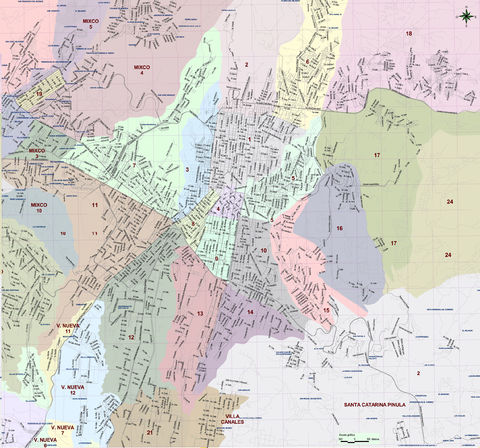
But there is always a certain halo over crossing a border, maybe more so in countries as large as Mexico. We convinced Pooka and Moni, and granted, with some aprehension, as we knew of some important security risks in the more rural areas we wanted to go through we decided to go to Guatemala. And, although we wanted to go with a bit more time, Real Life took its toll: We could not take more time than the intersection of what our respective jobs offered. So, here goes a short(?) recap of our six day long, 3200Km trip. Of course, we have a map detailing this. Mexico Veracruz I came to my office early on Wednesday (31-oct), and left with Regina around 10AM towards Veracruz. We agreed to meet there with Moni and Pooka, who would take the night bus, and continue together. Crossing Mexico City proved to be the longest obstacle We arrived to Veracruz already past 3PM, and spent a nice evening walking down the center and port of the city. Veracruz port can still be seen as part of central Mexico; I knew the road quite well. Veracruz San Andr s Tuxtla Catemaco San Cristobal de las Casas We met with our friends at the iconic Gran Caf de la Parroquia at 6:30AM. Had a nice breakfast with coffee, and by 7:30 we were heading south-west. The reason to have a road trip was to get to know the route, to enjoy the countryside So, given we "only" had to make 650Km this day, we took the non-toll road A narrow path stretching along the coastal plains of Veracruz, until Acayucan. Doing so, we also saved some money, as the equivalent toll road is around MX$300 (~US$25)! Veracruz is a hot state. We ended up all sweaty and tired by 19:00, when we reached San Cristobal. We had agreed not to drive at night, due to security issues, but fortunately there was quite a bit of traffic both ways between Tuxtla Guti rrez (Chiapas State capital, around 1hr from San Cristobal, where darkness got us) and our destination, so we carried on. Now, San Cristobal is a high city, almost as high as Mexico City (2100m), and being more humid, it was quite chilly. We went for a walk, and were convinced that at a later time, we had to stay for several days there. The city is beautiful, the region is breath-taking, there is a lot of great handicrafts as well, and it's overall very cheap. Really lovely place. San Cristobal de las Casas Cd. Cuauht moc La Mesilla Guatemala Once again, this day started early. We woke up ready to leave at 7AM, and not earlier because the hotel's parking didn't open earlier. After a very quick visit to San Cristobal downtown, to take some photos that were not right the night before, we took the road to Comit n, stopping just for some tamales de bola y chipil n for breakfast. Central Chiapas is almost continuously populated, differing from most of my experience in Mexico. It is all humid, and has some very beautiful landscapes. We passed Comit n, which is a much larger city than what we expected, went downhill after La Trinitaria, crossed a plain, and continued until hills started taking over again. We stopped in a very chaotic, dirty place: Just accross the border, where Ciudad Cuauht moc becomes La Mesilla. This border was basically what we expected: There is no half-official place to exchange money, so we had to buy quetzales from somebody who offered them on the street, at MX$2 per Q1 (where the real exchange should be around 1.50 to 1). While on the road, I was half-looking for exchange posts in Comit n and onwards, and found none (and being a festive day, they would probably be closed anyway). But we were expecting this, after all, and exchanged just the basic minimum: MX$600 (US$50, which by magic became Q300, US$40). The tramit consists of:
  • Spraying the car against diseases (which has a cost of Q18)
  • Each of us has to go through migration. Note, in case you cross this border: We didn't expressly cross Mexican migration, so officially there was no record of us going out. Be sure to go through migration to avoid problems at re-entry!
    Migration has no cost.
  • Customs. As we were entering by car, I had to purchase a permit for circulation. I don't remember the exact quote, but it was around Q150, and the permit is valid for 90 days.
  • That's it! Welcome to Guatemala!
La Mesilla is in Guatemala's Huehuetenango Department, and from all of the Departments we crossed until Guatemala city (Huehuetenango, Quetzaltenango, Totonicap n, Solol , Chimaltenango, Sacatep quez and Guatemala), this is the largest one. Huehuetenango is home to the Cuchumatanes mountain ridge. We found beautiful, really steep, really fertile mountains. It is plainly amazing: Mountains over 60 , and quite often full with agricultural use Even at their steepest points! The CA-1 highway is, in general, in very good shape. There are however many (many, many) speed bumps (or topes, in Mexican terminology. Or t mulos in Guatemalan), at least a couple at every village we crossed, not always painted. The road is narrow and quite winding; it follows river streams for most of the way. We feared it would be in much worse shape, from what we have heard, but during the whole way we found only three points where the road was unusable due to landslides and an alternative road was always in place when we needed it. After Totonicap n, the narrow road becomes a wide (four lane) highway. Don't let that fool you! It still goes through the center of every village along the road, so it's really not meant for speeding. Also, even though the pavement is in very good condition, it is really steep quite often. It is not the easiest road to drive, but it's (again) by far not as bad as we expected. We arrived to Guatemala City as dawn was falling, and got promptly lost. Guatemala has a very strange organization scheme: The city is divided in several zones, laid out in a swirl-like fashion. East-west roads are called Calle and North-south roads are called Avenida (except for zona 4, I think, where they are diagonal, and some are Rutas while the others are V as). I won't go into too much detail). Thing is, many people told us it's a foolproof design, and people from different countries understand the system perfectly. We didn't... At least not when we arrived. We got quite lost, and it took us around one hour to arrive to our hotel, at almost 19:00 Almost 12 hours since we left San Cristobal. Went for a quick dinner, and then waited for our friends to arrive after the first day of work of ECSL, which we missed completely. And, of course, we were quite tired, so we didn't stay up much longer. Antigua Guatemala On Saturday, ECSL's activities started after 14:00 so we almost-kidnapped Wences, the local organization lead, and took him to show us around Antigua Guatemala. Antigua was the capital of Guatemala until an earthquake destroyed it in the 1770s; the capital was moved to present-day Guatemala city, but Antigua was never completely abandoned. Today, it is a world heritage site, a beautiful city, where we could/should have stayed for several days. But we were there for the conference, so we were in Antigua just a couple of hours, and headed back to Guatemala. Word of caution: Going from Guatemala to Antigua, we went down via the steepest road I have ever driven. Again, a real four-lane highway... but quite scary! The main focus for this post is to give some roadtrip advice to potential readers... So, this time around, I won't give much detail regarding ECSL. It was quite interesting, we had some very good discussions... but it would take me too much space to talk about it! The road back: Guatemala Tec n Um n; Cd. Hidalgo Arriaga So, about the road back: Yes, we just spent three days getting to Guatemala City. We were there only for ~36 hours. And... We needed to be here by Tuesday morning no matter what. So, Sunday at noon we said goodbye to our good friends in ECSL and started the long way back. To get to know more of Guatemala, we went back by the CA-2 highway, which goes via the coastal plains Not close to the Pacific ocean, which we didn't get to see at all, but not through the mountains. To get to CA-2, we took CA-9 from Guatemala. If I am not mistaken, this is the only toll road in Guatemala (at least, the only we used, and we used some pretty good highways!) It is not expensive; I don't remember right now, but must have been around Q20 (US$3). Went South past Palin and until CA-2, just outside Escuintla city, and headed West. All of Escuintla and Suchitep quez it is again a four lane highway; somewhere in Retalhueu it becomes a two lane highway. We were strongly advised not to take this road at night because, as the population density is significantly lower than in CA-1, it can get lonely at times And there are several reports of robberies. We did feel the place much less populated, but saw nothing suspicious in any way. Something important: There are almost no speedbumps in CA-2! The terrain stayed quite flat and easy as we crossed Quetzaltenango, and only in San Marcos we found some interesting hills and a very strong rain that would intermitetntly accompany us for the rest of the ride. So, we finally arrived to the border city of Tec n Um n at around 16:30 Approximately four hours after leaving the capital. The Tec n Um n Cd. Hidalgo cities and border pass are completely different from the disorderly and dirty Cd. Cuauht moc La Mesilla ones. The city of Tec n Um n could be just a nice town anywhere in the country, it does not feel aggressive as most border cities I have seen in our continent. We stopped to eat at El pollo campero and headed to the border. In the Mexican side, we also saw a very well consolidated, big and ordered migration area. Migration officers were very kind and helpful As we left Cd. Cuauht moc, Regina didn't get a stamp of leaving Mexico, so technically she was ilegally out of the country (as she is not a national... They didn't care about the rest of us). The tramit to fix this was easy, simple, straightforward. We only paid for the fumigation again (MX$60, US$5), and were allowed to leave. Anyway, we crossed the border. There is a ~30Km narrow road between Cd. Hidalgo and Tapachula, but starting in Tapachula we went on Northwards via a very good, four lane and very straight highway. Even though we had agreed not to drive at night... Well, we were quite hurried and still too far from Mexico City, so we decided to push it for three more hours, following the coastline until the city of Arriaga, almost at the border between Chiapas and Oaxaca. Found a little hotel to sleep some hours and collapsed. Word of warning: This road (from Tapachula to Arriaga) is also known for its robberies. We saw only one suspicious thing: Two guys were pushing up their motorcycle, from which they had apparently fallen. We didn't stop, as they looked healthy and not much in need of help, but later on talked about this Even though this was at night, they were not moving as if they had just crashed; nothing was scratched, not the motorcycle and not their clothes. That might have been an attempt to mug us (or whoever stopped by). This highway is very lonely, and the two directions are separated by a wall of vegetation, so nobody would have probably seen us were we to stop for some minutes. Be aware if you use this road! The trip comes to an end: Arriaga Niltepec Istmo C rdoba M xico The next (last, finally!) day, we left at 6:30AM. After driving somewhat over one hour, we arrived to Niltepec, where a group of taxi drivers had the highway closed as a protest against their local government's tolerance of mototaxis. We evaluated going back to Arriaga and continue via the Tuxtla Guti rrez highway, but that would have been too long. We had a nice breakfast of tlayudas (which resulted in Pooka getting an alergic reaction shortly afterwards) and, talking with people here and there, were told about an alternative route by an agricultural road that surrounds the blockade. So, we took this road the best way we could, and after probably 1hr of driving at 20Km/h, finally came back to the main road. We planned on crossing the isthmus using the Acayucan-Juchit n road We were amazed at the La Ventosa ("the windy") area, where we crossed a huge eolic plant for electricity generation, so of course we got our good share of photos. From then onwards, not much more worth mention. Crossed the isthmus via a quite secondary road in not too good shape (although there is a lot of machinery, and the road will much likely improve in the next few months/years), then took the toll freeway along Veracruz until C rdoba. We stopped for a (delilcious and revigorizing!) cup of coffee in Hotel Zeballos, where Agust n de Iturbide signed with Viceroy Juan O'Donoj the treaties that granted Mexico the independence. Traveller, beware: When crossing between Puebla and Veracruz, there is a steep slope of almost 1000m where , you will almost always (except if it's close to noon) find very thick fog; taking the highway from C rdoba, this is in the region known as Cumbres de Maltrata. We had the usual fog, and just as we left it, a thin but constant rain that went on with us up until we got home. Crossed Puebla state with no further eventualities, and arrived to Pooka and Moni's house by 22:00. Less than one hour later, Regina and me arrived home as well. This was four days ago... and I have finally finished writing it all down ;-) Hope you find this useful, or if not, at least entertaining! If you read this post in my blog, you will find many pictures taken along the trip below (Well, if you are reading the right page, not in the general blog index...). If you are reading from a planet or other syndication service... Well, come to the blog! Dreamhost woes Oh, and... Yes, it sometimes happens: My blog is hosted at Dreamhost. This means that usually it works correctly... But sometimes, specially when many people request many nontrivial pages, it just gives an error. If you get an error, reload once or twice... Or until your patience manages ;-)
8 November 2012

Tanguy Ortolo: Licence to kill -9

The title of the next James Bond movie! Or will that be the next OpenBSD release song? ;-)

Parody of a James Bond movie poster: licence to kill -9

7 November 2012

Russell Coker: Rape Apology and LCA 2011

After a lecture at LCA 2011 included some inappropriate slides there was a long discussion on several mailing lists about the issues related to this. In February 2011 I wrote a blog post debunking some of the bogus arguments in question [1]. Of course the matter didn t end there, at LCA 2012 I was drawn into a few debates IRL about the issues, as long as there are more than a few men who want such porny pictures used in LCA talks the issue can t be properly resolved. The most serious aspect of the discussion in question is that of rape apology, the bad ideas that were presented have a real impact on the way people behave, merely making public statements saying that something is OK is going to increase the incidence of it happening. The Geek Feminism Wiki has a good page summarising the issue [2]. The Finally Feminism 101 post about Rape Culture is also worth reading in this context [3]. Recently Valeria Aurora wrote a post for the Ada Initiaive blog about the rape apology issue and how the community needs to act to prevent such behavior [4]. This inspired Matthew Garrett to write about the issue and state the position that In the absence of an apology and explanation from Ted, I ll be interacting with him to the bare minimum that I m compelled to as a result of my job [5]. I agree with Matthew s article, everything he writes is logical and I believe that it is all for the benefit of the FOSS community as a whole. I think that most guys have quietly defriended guys who are rape-positive in the past (for example when I was 12 I refused to play D&D with boys who were raping NPCs). But blogging about it, explaining the problem, and giving the offender the possibility to reform is a good idea and it s something that should be done more often. Sam Varghese has written about the issue for ITWire [6]. He has taken the wrong approach to this, he specifically claims that Matthew Garrett has kicked off what could be a damaging episode . I think that Matthew s approach is necessary and the situation demands it. If Matthew had been on holidays and I had read the TAI post earlier then I would probably have written a blog post which Sam could have described in a similar manner. So I don t think that Matthew kicked anything off (I think that someone had to do it). I also don t think that this has to be damaging it depends on how everyone reacts. On her personal blog Valerie says When I first read Ts o s comments, I couldn t sleep for two nights. I wanted to throw up every time I thought about it. I was furious and frightened at the same time. Every time I think about this, even now, I literally have nightmares. I can t bear the thought of working with him even over email, much less attending the same conferences [7]. I don t think that any of us who are seriously involved in the FOSS community have a way of avoiding this issue, allowing Valerie and other women who have the same understanding of the situation to go through that without any support is not a neutral action. I think we need to consider whether someone who gives other delegates and speakers nightmares should be welcome to attend a conference. Valerie s post makes sense to me and I can understand why she doesn t want to associated with Ted, my understanding of the issue isn t important or even required, I merely note this because I m sure that there are lots of readers who will ignore anything that a woman might say. ITWire has a follow-up article with Ted s response, Ted fails to address all the issues and seems to think that the people who disagree with him merely don t appreciate his nuance [8]. The thing is that the issue of the incidence of rape was raised in discussion to consider the probability that rape survivors would have been in the audience for the Mark Pesce talk in question. None of Ted s claims indicate that rape could be rare enough that a crowd of 500+ random people could be expected not to have multiple rape survivors so his comments weren t even relevant to the discussion. Ted seems unwilling to try to understand the position of all the people who disagree with him.

6 November 2012

Jon Dowland: Debian Day #12

A few bits and pieces:

Next.

Previous.