Issues with Farm Laws
While I have written about the farm laws a bit sometime back. The issue is still in the nation s eye and that is due to the policies which have been done. I have been reading up on it quite a bit and also have been seeing what has been happening in here and now. The problems are with the three bills themselves which I have shared as below
Click to access farmers-produce-trade-and-commerce-promotion-and-facilation-bill.pdfClick to access farmers-empowerment-and-protection-bill.pdfClick to access essential-commodities-bill-2020.pdfBiggest issue with the laws
While there are many issues with the laws themselves but for me the biggest issue is that the fundamental right of the farmer to get justice via civil courts has been railroaded. From the laws itself. Standard disclaimer not a lawyer, please consult one for any issues per-se.
Farmers-produce-trade-and-commerce (promotion and facilitation-bill) 2020
Page 4 Chapter 3 Section 8 (1)8. (1) In case of any dispute arising out of a transaction between the farmer and a trader under section 4, the parties may seek a mutually acceptable solution through conciliation by filing an application to the Sub-Divisional Magistrate who shall refer such dispute to a Conciliation Board to be appointed by him for facilitating the binding settlement of the dispute.
(2) Every Board of Conciliation appointed by the Sub-Divisional Magistrate under sub-section (1), shall consist of a chairperson and such members not less than two and not more than four, as the Sub-Divisional Magistrate may deem fit.10
(5) If the parties to the transaction under sub-section (1) are unable to resolve the dispute within thirty days in the manner set out under this section, they may approach the Sub-Divisional Magistrate concerned who shall be the Sub-Divisional Authority for settlement of such dispute.
(8) Any party aggrieved by the order of the Sub-Divisional Authority may prefer an appeal before the Appellate Authority (Collector or Additional Collector nominated by the Collector) within thirty days of such order who shall dispose of the appeal within thirty days from the date of filing of such appeal.
10. (1) Any person aggrieved by an order under section 9 may, prefer an appeal within sixty days from the date of such order, to an officer not below the rank of Joint Secretary to the Government of India to be nominated by the Central Government for this purpose:
Page 6 of the bill. 13. No suit, prosecution or other legal proceedings shall lie against the Central Government or the State Government, or any officer of the Central Government or the State Government or any other person in respect of anything which is in good faith done or intended to be done under this Act or of any rules or orders made thereunder.
Page 7 of the bill, 15. No civil court shall have jurisdiction to entertain any suit or proceedings in respect of any matter, the cognizance of which can be taken and disposed of by any authority empowered by or under this Act or the rules made thereunder.
Now the same laws have been reiterated for the farmers (Empowerment and Protection) Agreement on Price Assurance and Farm Services Bill, 2020.
The problem is that too much power is being put into the hands of the executive. All the three, whether it is SDM (Sub-Divisional Magistrate) , the Appellate Authority or the Government Secretary directly are subservient to the whims and fancies of the Central Govt. They after all get their salaries from the Govt. itself. So there will be no independent oversight to any injustices done to the farmer.
The third bill i.e. the Essential Commodities Bill, 2020 does away with stock limits on traders and big players like Adani and Ambani. This means that both these players can take and keep produce at their end thereby forcing consumers like you and me who at the retail end would have to pay higher prices for fruits and vegetables while from the producer they will take at the lowest price possible.
While I have shared is just one of the points. That is the reason why even the Supreme Court bar association which almost never takes part in politics has been forced to take sides with the farmers. In many ways, one is forced to remember the Emergency
Update 11/12/20 Came across this article on the wire which tells how everybody s rights, not just the farmer s rights are being shod over. I think it depicts correctly the signs of time to come. While arguing on SM, also came to know about Article 300 (1), thanks to Sachin Kumar which shows multiple instances where Government was sued because somebody was working in official capacity and did mistakes, malafide or otherwise and it was the state who was made to pay.
FWIW, today farmers from Maharashtra, my state arrived at Delhi border where they were also kept at bay. I did come across an infographic which shows how the various states have fared. Most tellingly, is the state of Bihar. It was in 2006 (one of the most backward states) where APMC was taken off. While others have tried to paint a flattering picture of Bihar, they have failed to share that in the interim 15 odd years, there hasn t been any sort of infrastructure created for farmers which is the reason it is still the lowest earner. These are the last available figures we have about the farmer s income. From 2014 to 2020 there hasn t been any update.
Situation Assessment Survey of Agricultural Household 2013 Copyright GOI,
This concludes just one portion of the bill. I will take other parts of the bill. I may dwell on some other parts as and when I have the time. A cartoon which depicts the current issue
I stand with farmers Copyright Sanitary Panels Too much democracy Amitabh Kant
Yesterday, the Niti Aayog chief Amitabh Kant remarked that we are too much of a democracy at an event called for Atmanirbhar Bharat which is basically a coinage for import substitution. Whether this is desirable or not I have argued and if needed will re-argue the same later as well. What is and was interesting were the gentleman s context, the media reactions and our overall Democracy Index which has been going downhill for quite some years. Now the gentleman who is the Niti Aayog chief and who is supposed to have the ear of the Prime Minister had opined it in an event organized by Swarajya Magazine (a far-right magazine) known to be Islamophobic and all things undemocratic. It has been a target of defundthehate campaign and with good reason. But that s a different story altogether. His full statement was as below
Tough reforms are very difficult in the Indian context, as we are too much of a democracy but the government has shown courage and determination in pushing such reforms across sectors, including mining, coal, labour and agriculture. Niti Aayog chief. The upper quotation remarks and the statement has been from the article in Indian Express which I have linked to. I have archived it as a pdf just in case the link goes dead. Yesterday, after the statement became viraled, tweets of media houses which shared the tweet suddenly become unavailable. Seems too much democracy, became too little democracy all of a sudden. I think Mr. Amitabh Kant didn t visualize as the opposition as well as most people who are on Twitter to share their opinion on the same. Few examples
Too much Democracy copyright Satish Acharya
Too much democracy Illustration and Copyright Alok
Sterlite protest 13 dead, 100 injured Copyright Business Standard too much democracy
Erosion of Democracy V-dem institute Copyright The Hindu Web Team
The last one requires a bit more information. This comes from V-Dem Institute which is an independent research institute based out of Department of Political Science, University of Gothenburg, Sweden. I am gonna leave the methods they use for another day as the blog post itself has become rather big/large.
Apart from that is the Economists own Democracy Index -2019
Click to access democracy-index-2019.pdf
Now for many people, both the V-Dem report and the Economist Index are some sort of attack against India. Doesn t matter that in V-Dem 200+ countries have been taken a variety of indicators and data or the Economist which has data from 150+- countries. Somehow India is supposed to be bigger than all these countries, they do think that other countries data specifically our neighbor China or any other neighbor, those are all accurate. How the dissonance is, has to be gauged from statements of various people.
Update 11/12/20 Sadly, the newest V-Dem report marks India as getting into authoritarianism.
Gag on Press and Media owners
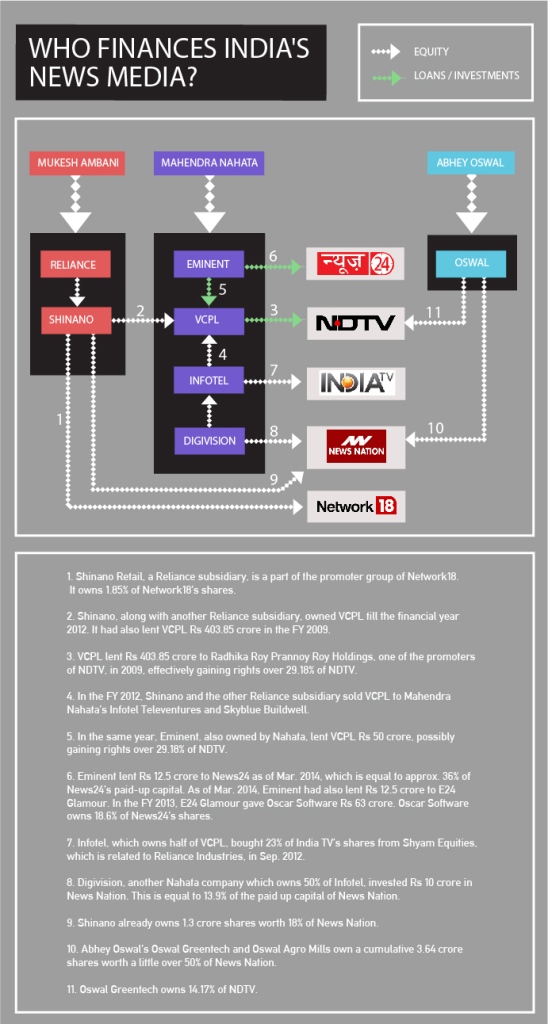
I had shared about the gag on the press especially with respect to western media or reports or anything. This news made its way to straitstimes which normally covers a wide-range of stories covering East Asia vis-a-vis India/South-East Asia. What has also been a big worry that most of the media has been in the hands of a few people. Caravan ran a story on the same in 2016, it has been four years, god only knows what the current situation might be. Any wonder that there is dearth of investigative journalism in India.
India media ownership 2016 Copyright Caravan
Incidentally, a reporter called Akarshan Uppal, who is a reporter on a channel called IBN24 had showecased just few days back how Adani has got land which was shot down for land change use in 2017 to 2020 around 100 acres. There seem to be very less details as to how the land was acquired, whose land it was etc. etc. The reporter was supposedly following a story on drugs on which he was attacked and is now lying in hospital.
Akarshan Uppal Reporter, IBN24 Copyright IBN24
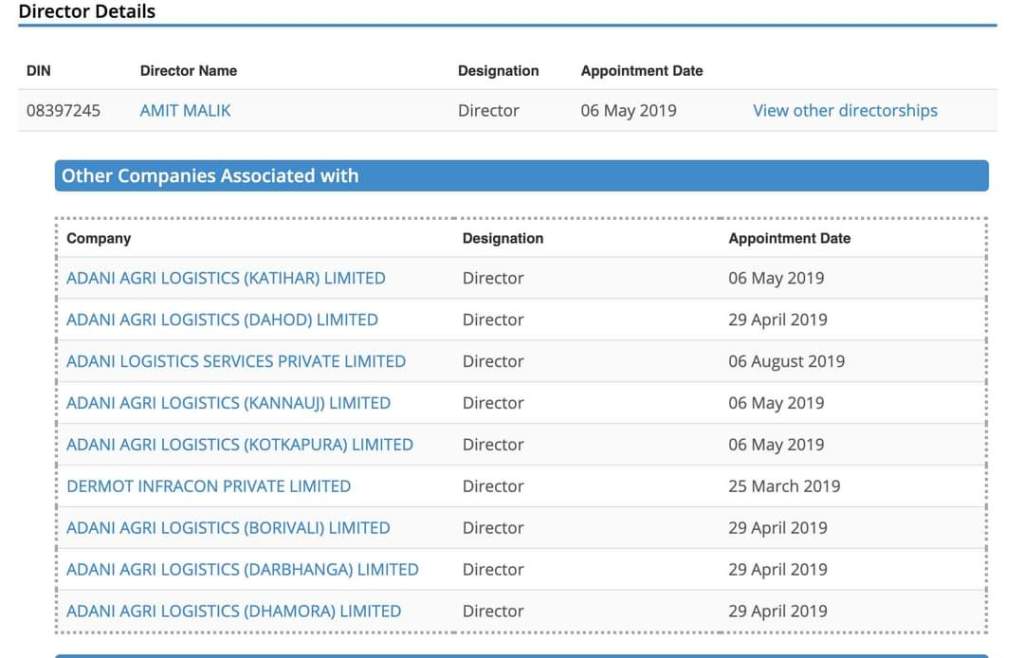
While it would take a whole article/blog post to talk about either Adani or Ambani, in the recent case, the land that has been taken over by Adani is 100 acres and there are private rail lines. And all of this was secret till few days back. The place where these massive godowns/silos have been made are Panipat s Jondhan Kalan and Naultha villages in Haryana. This is Adani AgiLogistics. Almost 7 odd companies have registered and come up in the last couple of years. As can be seen, almost all have come up within the last 2-3 years. Seems to be a lot of coincidence, isn t it?
Personal Anecdote on Data Collection and child marriages in India.
Around 1995 -96 when Internet had started to become a thing in India, there had been quite a few non-profits which were working on various issues. One of those which I initially came in contact with and which I found to be a bit absurd was non-profit which was working in the field of women against Violence. Now it is and was not the concept or the idea which was absurd to me, it was what these women were doing. Instead of the traditional ways in which you counsel women and try and figure out issues, these women were collecting data points from newspapers and magazines. This was way way before data science became a thing in India. They had their own structure where a story about violence against women which would be above the fold would be 5 points, the one below 2.5 points, in inner pages, it would be less and less. Patriarchy at that time was so strong, even today is but at that time it was such, that it felt a waste of time. I did consult them but never said that but did privately feel the above. In hindsight, they were doing the right thing and yet even today crimes against women goes unreported and is suppressed by both State and Central Governments as well as NCRB (National Crime Records Bureau).
Interestingly, just few days back, the case against M.J. Akbar by Priya Ramani had taken a back seat and the defamation case by M.J. Akbar was taken forward. Even then, Priya Ramani s counsel s arguments were such that the court wound up in half an hour when they were expecting to do a whole day hearing. The next hearing would be happening today which I will look at in few hours from now. Why Priya Ramani was singled out rather than other tweets may probably be because she is an NRI and most NRI s usually do not want to be part of the bureaucratic Indian court system. This is also the reason that most companies from outside India especially those who are into startups prefer to change ownership, IPR etc. to their own or any country outside India which does make a loss to the exchequer. But this again is a story for another day.
At the end, while I did not want to end on a negative note, it seems in many ways status-quo remains. For e.g. 2 years back, a BJP candidate (part of the ruling dispensation) had made a controversy saying that if they win the police won t interfere in child marriages. This is and was in Rajasthan where they have been trying to eradicate it forever. Till date, neither the NHRC (National Human Rights Commission) nor NCW (National Commission for Women) has taken cognizance of the statement. This is our state of democracy.
A few years ago, the advertising industry introduced the ads.txt
project in order to defend against
widespread domain spoofing vulnerabilities in programmatic
advertising.
I decided to use this technology to opt out of having ads sold for my
domains, at least through ad exchanges which perform this check, by hosting
a text file containing this:
(In order to get this to work on my blog, running
Ikiwiki on
Branchable, I had to disable the txt
plugin in order to get ads.txt to be
served as a plain text file instead of being automatically rendered as
HTML.)
Specification
The key parts of the specification for our purposes are:
[3.1] If the server response indicates the resource does not exist (HTTP
Status Code 404), the advertising system can assume no declarations exist
and that no advertising system is unauthorized to buy and sell ads on the
website.
[3.2.1] Some publishers may choose to not authorize any advertising system
by publishing an empty ads.txt file, indicating that no advertising system
is authorized to buy and sell ads on the website. So that consuming systems
properly read and interpret the empty file (differentiating between web
servers returning error pages for the /ads.txt URL), at least one properly
formatted line must be included which adheres to the format specification
described above.
As you can see, the specification sadly ignores
RFC8615 and requires that the
ads.txt file be present directly in the root of your web server, like the
venerable robots.txt file, but unlike the
newer security.txt standard.
If you don't want to provide an email address in your ads.txt file, the
specification recommends using the following line verbatim:
I have an Asustor (Nimbuster 4 / AS5304T) NAS at home, which allows me to perform regular backups. Unfortunately, I couldn't manage to find a way to configure remote backups from the NAS to rsync.net using the "Remote Sync" option of the "Backup & Restore" app provided in the ADM OS of the Asustor NAS.
I'm used to using rsync -e ssh commands and would have expected some such configuration to be possible... it may just be some UI issue, but I couldn't find how to add one for rsync.net.
I've then used the following workaround : the NAS can run a "Linux VM" (LXC ?) with the provided "Linux Center" app. It allows me to run a regular Debian installation inside this Linux guest. On which I installed backupninja, which performs backups over rsync, from the NAS filesystem, to the rsync.net remote.
Along the way I had to overcome a few issues, whose documentation may be useful to others :
the Debian server Linux guest created with the "Linux Center" app can be accessed using SSH with the admin/admin login/pwd (couldn't find a clue in the docs or the UI)
the "Mount shared folder" option in the Debian guest configuration leads to the "/.share/" mountpoint which exibits the NAS filesystem under the Linux guest. This allows to retrieve files being backedup to the NAS to be copied out with rsync
backupninja provides an rsync handler which allows to backup files with rsync, but some default options weren't valid (see debian bug #976650).
the Seagate ironwolf HD less that 4TB aren't compatible with IHM (Ironwolf Health Management), even if the "Storage Manager" app tends to mislead you.
FTP master
Unfortunately a day only has 24h. As the freeze is approaching, I had to concentrate a bit more on keeping my packages in shape. So this month I only accepted nine packages. The good news, I rejected no package. The overall number of packages that got accepted was 328.
Debian LTS
This was my seventy-seventh month that I did some work for the Debian LTS initiative, started by Raphael Hertzog at Freexian.
This month my all in all workload has been 22.75h. During that time I did LTS uploads of:
[DLA 2446-1] moin security update for two CVEs
[DLA 2451-1] libvncserver security update for one CVE
[DLA 2459-1] golang-1.7 security update for two CVEs
[DLA 2460-1] golang-1.8 security update for three CVEs
[DLA 2468-1] tcpflow security update for one CVE
[DLA 2469-1] qemu security update for five CVEs
I also started to work on x11vnc and slirp.
Last but not least I did some days of frontdesk duties.
Debian ELTS
This month was the twenty ninth ELTS month.
During my allocated time I uploaded:
ELA-319-1 for libass
ELA-320-1 for tcpflow
ELA-321-1 for qemu
Unfortunately I also had to give back some hours.
Last but not least I did some days of frontdesk duties.
Other stuff
This month I uploaded new upstream versions of:
As it is again this time of the year, I would also like to draw some attention to the Debian Med Advent Calendar. Like the past years, the Debian Med team starts a bug squashing event from the December 1st to 24th. Every bug that is closed will be registered in the calendar. So instead of taking something from the calendar, this special one will be filled and at Christmas hopefully every Debian Med related bug is closed. Don t hesitate, start to squash :-).
The announcement on the mailing list can be found here.
TL;DR: Some mildly tricky tricks allow you to select subgoals by name, like in Isabelle. This leads to more readable proofs, and proofs that are more robust against changes.
The need for case names
Consider the following Coq proof, right out of the respected Software Foundations book, Chapter Inductively Defined Propositions (and slightly simplified):
Lemma star_app: forall T (s1 s2 : list T) (re : reg_exp T),
  s1 =~ Star re ->
  s2 =~ Star re ->
  s1 ++ s2 =~ Star re.
Proof.
  intros T s1 s2 re H1.
  remember (Star re) as re'.
   generalize dependent s2.
  induction H1.
  - (* MEmpty *) discriminate.
  - (* MChar *) discriminate.
  - (* MApp *) discriminate.
  - (* MUnionL *) discriminate.
  - (* MUnionR *) discriminate.
  - (* MStar0 *)
    injection Heqre' as Heqre''. intros s H. apply H.
  - (* MStarApp *)
    injection Heqre' as Heqre''.
    intros s3 H1. rewrite <- app_assoc.
    apply MStarApp.
    + apply H1_.
    + apply IHexp_match2.
      * rewrite Heqre''. reflexivity.
      * apply H1.
Qed.
This is a very typical example for a proof by induction over an inductively defined relation (in this case, the relations s =~ re which indicates that the string s matches the regular expression re): After some preparation, the invocation of a tactic like induction (could also be inversion or others) creates a number of new goals, one of for each rule of the relation. Then the modern(!) Coq user uses proof bullets to focus the goals, one after another, in order, to solve them.
We can see from this example that proof bullets (which were a big improvement) are not quite satisfactory, and the author of this proof felt the need to annotate each subproof with the case it corresponds to.
But these are mere comments! This is unsatisfactory, as there is nothing keeping them correct as my proof changes. And anyone who came to Coq from Isabelle is just flabbergasted that the state of art in Coq is still at that level
So, wouldn t it be great if
I could focus goals by their name (e.g. MEmpty)
Focus them in any order (so that refactoring of my data types do not break my proofs)
This even worked when simultaneously inducting over or inverting multiple relations?
Simulating named goals in Coq
Well, with a few tricks we can! It just takes three simple steps:
I load a small file full of hacks (explained below):
Require Import NamedCases.
This allows me to prefix the type of the constructors of the inductive relations (i.e. the rules of the relation) with case <name>, , as follows:
Reserved Notation "s =~ re" (at level 80).
Inductive exp_match  T  : list T -> reg_exp T -> Prop :=
    MEmpty:
    case empty,
    [] =~ EmptyStr
    MChar:
    case char,
    forall x,
    [x] =~ (Char x)
    MApp:
    case app,
    forall s1 re1 s2 re2
    (H1 : s1 =~ re1)
    (H2 : s2 =~ re2),
    (s1 ++ s2) =~ (App re1 re2)
    MUnionL:
    case union_l,
    forall s1 re1 re2
    (H1 : s1 =~ re1),
    s1 =~ (Union re1 re2)
    MUnionR:
    case union_r,
    forall re1 s2 re2
    (H2 : s2 =~ re2),
    s2 =~ (Union re1 re2)
    MStar0:
    case star0,
    forall re,
    [] =~ (Star re)
    MStarApp:
    case star_app,
    forall s1 s2 re
    (H1 : s1 =~ re)
    (H2 : s2 =~ (Star re)),
    (s1 ++ s2) =~ (Star re)
  where "s =~ re" := (exp_match s re).
This is the definition from the Software Foundations book; only the case <name>, lines are added.
Now I can change the proof: After the induction tactic I use ; name_cases to name the cases, and then I can use the relatively new named goal focusing feature ([name]: , which I suggested two years ago, and was implemented by Th o Zimmermann) to focus a specific case:
Lemma star_app2: forall T (s1 s2 : list T) (re : reg_exp T),
  s1 =~ Star re ->
  s2 =~ Star re ->
  s1 ++ s2 =~ Star re.
Proof.
  intros T s1 s2 re H1.
  remember (Star re) as re'.
   generalize dependent s2.
  induction H1; name_cases.
  [empty]:
     discriminate.

  [char]:
     discriminate.

  [app]:
     discriminate.

  [unionL]:
     discriminate.

  [unionR]:
    discriminate.

  [star0]:
    injection Heqre' as Heqre''. intros s H. apply H.

  [starApp]:
    injection Heqre' as Heqre''.
    intros s3 H1. rewrite <- app_assoc.
    apply MStarApp; clear_names.
    + apply H1_.
    + apply IHexp_match2.
      * rewrite Heqre''. reflexivity.
      * apply H1.

Qed.
The comments have turned into actual names!
Goal focusing is now just much more reliable. For example, let me try to discharge the boring cases by using ; try discriminate after the induction. This means there are suddenly only two goals left. With bullets, the first bullet would now suddenly focus a different goal, and my proof script would likely fail somewhere. With named goals, I get a helpful error message No such goal: empty and I can t even enter the first subproof. So let me delete these goals and, just to show off, focus the remaining goals in the wrong order:
Lemma star_app: forall T (s1 s2 : list T) (re : reg_exp T),
  s1 =~ Star re ->
  s2 =~ Star re ->
  s1 ++ s2 =~ Star re.
Proof.
  intros T s1 s2 re H1.
  remember (Star re) as re'.
   generalize dependent s2.
  induction H1; name_cases; try discriminate.
  [starApp]:
    injection Heqre' as Heqre''.
    intros s3 H1. rewrite <- app_assoc.
    apply MStarApp; clear_names.
    + apply H1_.
    + apply IHexp_match2.
      * rewrite Heqre''. reflexivity.
      * apply H1.

  [star0]:
    injection Heqre' as Heqre''. intros s H. apply H.

Qed.
I did not explain the clear_names tactic yet that I had to use after apply MStarApp. What I am showing here is a hack, and it shows these case names are extra hypothesis (of a trivially true type CaseName), and this tactic gets rid of it.
Even better than Isabelle
The above even works when there are multiple inductions/inversions involved. To give an example, let s introduce another inductive predicate, and begin proving a lemma that one can do by induction on one and inversion on the other predicate.
Inductive Palindrome  T  : list T -> Prop :=
  EmptyPalin:
  case emptyP,
  Palindrome []
  SingletonPalin:
  case singletonP,
  forall x,
  Palindrome [x]
  GrowPalin:
  case growP,
  forall l x,
  Palindrome l -> Palindrome ([x] ++ l ++ [x])
.
Lemma palindrome_star_of_two:
  forall T (s : list T) x y,
  Palindrome s -> s =~ Star (App (Char x) (Char y)) ->
  s = [] \/ x = y.
Proof.
  intros T s x y HPalin HRe.
  induction HPalin; inversion HRe; name_cases.
At this point we have four open goals. Can you tell why there are four, and which ones they are?
Luckily, Show Existentials will tell us their names (and Coq 8.13 will just show them in the proof state window). These names not only help us focus the goal in a reliable way; they even assist us in understanding what goal we have to deal with. For example, the last goal arose from the GrowP rule and the StarApp rule. Neat!
  [emptyP_star0]:
    left. reflexivity.

  [emptyP_starApp]:
     left. reflexivity.

  [singletonP_starApp]:
    inversion HRe; clear HRe.
    inversion H5; clear H5.
    inversion H10; clear H10.
    inversion H11; clear H11.
    subst.
    inversion H3.

 [growP_starApp]:
    admit. (* I did not complete the proof *)
Under the hood (the hack)
The above actually works, but it works with a hack, and I wish that Coq s induction tactic would just do the right thing here. I hope eventually this will be the case, and this section will just be curiosity but until, it may actually be helpful.
The trick1 is to leave markers in the proof state. We use a dedicate type CaseName, and a hypothesis name : CaseName indicates that this goal arose from the that case.
Inductive CaseName := CaseNameI.
With this, we can write StarApp: forall (starApp : CaseName), to name this case.
For a little bit of polish, we can introduce notation for that:
Notation "'case' x , t" := (forall x : CaseName , t) (at level 200).
This allows us to use the syntax you saw above.
To easily discharge these CaseName assumptions when using the introduction forms, I wrote these tactics:
Finally I wrote the tactic name_cases. What it does is relatively simple:
For each subgoal: Take all hypotheses of type CaseName, concatenate their names, change the name of the current goal to that, and clear these hypotheses
Unfortunately, my grasp of Coq tactic programming is rather rudimentary, and the only way I manged to solve this is a horrible monster of Ltac2, including hand-rolled imperative implementations of string concatenation and a little nested Ltac1 tactic within. You have been warned:
From Ltac2 Require Import Ltac2.
From Ltac2 Require Option.
Set Default Proof Mode "Classic".
Ltac name_cases := ltac2:(
  (* Horribly manual string manipulations. Does this mean I should
     go to the Ocaml level?
  *)
  let strcpy s1 s2 o :=
    let rec go := fun n =>
      match Int.lt n (String.length s2) with
        true => String.set s1 (Int.add o n) (String.get s2 n); go (Int.add n 1)
        false => ()
      end
    in go 0
  in
  let concat := fun s1 s2 =>
    let l := Int.add (Int.add (String.length s1) (String.length s2)) 1 in
    let s := String.make l (Char.of_int 95) in
    strcpy s s1 0;
    strcpy s s2 (Int.add (String.length s1) 1);
    s
  in
  Control.enter (let rec go () :=
    lazy_match! goal with
      [ h1 : CaseName, h2 : CaseName  - _ ] =>
      (* Multiple case names? Combine them (and recurse) *)
      let h := concat (Ident.to_string h1) (Ident.to_string h2) in
      Std.clear [h1; h2];
      let h := Option.get (Ident.of_string h) in
      assert ($h := CaseNameI);
      go ()
      [ _ : CaseName  - _ ] =>
      (* A single case name? Set current goal name accordingly. *)
      ltac1:(
        (* How to do this in ltac2? *)
        lazymatch goal with
          [ H : CaseName  - _ ] => refine ?[H]; clear H
        end
      )
      [  - _ ] =>
      Control.backtrack_tactic_failure "Did not find any CaseName hypotheses"
    end
  in go)
).
If someone feels like re-implementing this in a way that is more presentable, I ll be happy to update this code (and learn something along the way
That s all it takes!
Conclusion
With some mild hackery, we can get named cases in Coq, which I find indispensable in managing larger, evolving proofs. I wonder why this style is not more common, and available out of the box, but maybe it is just not known well enough? Maybe this blog post can help a bit here.
I have vague recollections of seeing at least parts of this trick on some blog some years ago, and I do not claim originality here.
As is normal for these days: I post a quick update on how we're doing.Working through the test suite: RattusRattus, Sledge, Isy, Schweer and I. We've been joined by somebody new - jlsantos - who has done his first test for us :)A couple of changes: there's now a different automatic partitioning layout. /boot has been resized to ~500MB - to allow for more than one kernel but also the other initramfs files. The filesystem size allocated for a swap partition is now 1GB by default.We're doing fairly well - one hardware failure on an old laptop replaced by a newer model from Sledge's stock - everybody cheerful and all working well.Separately, there was a quiet release of Bullseye Alpha3 last night - that has had minimal testing - as ever, we're not yet near the release of Bullseye yet.
Version 2.0 of ZFS has been released, it s now known as OpenZFS and has a unified release for Linux and BSD which is nice.
One new feature is persistent L2ARC (which means that when you use SSD or NVMe to cache hard drives that cache will remain after a reboot) is an obvious feature that was needed for a long time.
The Zstd compression invented by Facebook is the best way of compressing things nowadays, it s generally faster while giving better compression than all other compression algorithms and it s nice to have that in the filesystem.
The PAM module for encrypted home directories is interesting, I haven t had a need for directory level encryption as block device encryption has worked well for my needs. But there are good use cases for directory encryption.
I just did a quick test of OpenZFS on a VM, the one thing it doesn t do is let me remove a block device accidentally added to a zpool. If you have a zpool with a RAID-Z array and mistakenly add a new disk as a separate device instead of replacing a part of the RAID-Z then you can t remove it. There are patches to allow such removal but they didn t appear to get in to the OpenZFS 2.0.0 release.
For my use ZFS on Linux 0.8.5 has been working fairly well and apart from the inability to remove a mistakenly added device I haven t had any problems with it. So I have no immediate plans to upgrade existing servers. But if I was about to install a new ZFS server I d definitely use the latest version.
People keep asking about license issues. I m pretty sure that Oracle lawyers have known about sites like zfsonlinux.org for years, the fact that they have decided not to do anything about it seems like clear evidence that it s OK for me to keep using that code.
One of my workstations is running Debian/Unstable with KDE and SDDM on an AMD Radeon R7 260X video card. Recently it stopped displaying things correctly after a reboot, all the icons failed to display as well as many of the Qt controls. When I ran a KDE application from the command line I got the error QSGTextureAtlas: texture atlas allocation failed, code=501 . Googling that error gave a blog post about a very similar issue in 2017 [1]. From that blog post I learned that I could stop the problem by setting MESA_EXTENSION_OVERRIDE= -GL_EXT_bgra -GL_EXT_texture_format_BGRA8888 in the environment. In a quick test I found that the environment variable setting worked, making the KDE apps display correctly and not report an error about a texture atlas.
I created a file ~/.config/plasma-workspace/env/bgra.sh with the following contents:
Then after the next login things worked as desired!
Now the issue is, where is the bug? GL, X, and the internals of KDE are things I don t track much. I welcome suggestions from readers of my blog as to what the culprit might be and where to file a Debian bug or a URL to a Debian bug report if someone has already filed one.
Update
When I run the game warzone2100 with this setting it crashes with the below output. So this Mesa extension override isn t always a good thing, just solves one corner case of a bug.
$ warzone2100
/usr/bin/gdb: warning: Couldn't determine a path for the index cache directory.
27      ../sysdeps/unix/sysv/linux/wait4.c: No such file or directory.
No frame at level 0x7ffc3392ab50.
Saved dump file to '/home/etbe/.local/share/warzone2100-3.3.0//logs/warzone2100.gdmp-VuGo2s'
If you create a bugreport regarding this crash, please include this file.
Segmentation fault (core dumped)
Update 2
Carsten provided the REAL solution to this, run apt remove libqt5quick5-gles which will automatically install libqt5quick5 which makes things work. Another workstation I run that tracks Testing had libqt5quick5 installed which was why it didn t have the problem.
The system in question had most of KDE removed due to package dependency issues when tracking Unstable and when I reinstalled it I guess the wrong one was installed.
Welcome to the 31th post in the rapturously rampant R recommendations series, or R4 for short. This post will once again feature Docker for use with R.
Earlier this week, I received a note from CRAN about how my RcppTOML package was no longer building with the (as of right now of course unreleased) version 11 of the GNU C++ compiler, i.e.g++-11. And very kindly even included a hint about the likely fix (which was of course correct). CRAN, and one of its maintainers in particular, is extremely forward-looking in terms of toolchain changes. A year ago we were asked to updated possible use of global variables in C code as gcc-10 tightened the rules. This changes is a C++ one, and a fairly simple one of simply being more explicit with include headers. Previous g++ release had done the same.
The question now was about the least painful way to get g++-11 onto my machine, with the least amount of side-effects. Regular readers of this blog will know where this is headed, but even use of Docker requires binaries. A look at g++-11 within packages.debian.org comes up empty. No Debian means no Ubuntu. But there is a PPA for Ubuntu with toolchain builds we have used before. And voil there we have it: within the PPA for Ubuntu Toolchain repository is the volatile packages PPA with both g++-10 and g++-11. Here Ubuntu 20.10 works with g++-10, but g++-11 requires Ubuntu 21.04. Docker containers are there for either. So with the preliminaries sorted out, the key steps are fairly straightforward:
start from ubuntu:21.04 to be able to install g++-11 later
install the software-properties-common package to be able to add a PPA
(plus a few more packages to deal with the repository signing key)
run the sudo add-apt-repository ppa:ubuntu-toolchain-r/volatile command to add the volatile packages PPA
install g++-11 (along with, for good measure) gcc-11 and gfortran-11
use update-alternative (a clever Debian/Ubuntu command) to make version 11 the default
install R itself (via r-base-core) which we simply take from the distro as 21.04 is by construction very recent
install Rcpp via the r-cran-rcpp binary which covers all dependencies for the package in question
And that is it! RcppTOML is fairly minimal and could be a member of the tinyverse so no other dependencies are needed if your package has any you could just use the standard steps to install from source, or binary (including using RSPM or bspm). You can see the resulting Dockerfile which contains a minimal amount of extra stuff to deal with some environment variables and related settings. Nothing critical, but it smoothes the experience somewhat.
This container is now built (under label rocker/r-edge with tags latest and gcc-11), and you can download it from Docker Hub. With that the proof of the (now fixed and uploaded) package building becomes as easy as
edd@rob:~/git/rcpptoml(master)$ docker run --rm -ti -v $PWD:/mnt -w /mnt rocker/r-edge:gcc-11 g++ --versiong++ (Ubuntu 11-20201128-0ubuntu2) 11.0.0 20201128 (experimental) [master revision fb6b29c85c4:a331ca6194a:e87559d202d90e614315203f38f9aa2f5881d36e]Copyright (C) 2020 Free Software Foundation, Inc.This is free software;see the source for copying conditions. There is NOwarranty;not even for MERCHANTABILITY or FITNESS FOR A PARTICULAR PURPOSE.edd@rob:~/git/rcpptoml(master)$ edd@rob:~/git/rcpptoml(master)$ docker run --rm -ti -v $PWD:/mnt -w /mnt rocker/r-edge:gcc-11 R CMD INSTALL RcppTOML_0.1.7.tar.gz* installing to library /usr/local/lib/R/site-library * installing *source* package RcppTOML ...** using staged installation** libsg++ -std=gnu++11 -I"/usr/share/R/include" -DNDEBUG -I../inst/include/ -DCPPTOML_USE_MAP -I'/usr/lib/R/site-library/Rcpp/include' -fpic -g -O2 -fdebug-prefix-map=/build/r-base-Fuvi9C/r-base-4.0.3=. -fstack-protector-strong -Wformat -Werror=format-security -Wdate-time -D_FORTIFY_SOURCE=2 -g -c RcppExports.cpp -o RcppExports.og++ -std=gnu++11 -I"/usr/share/R/include" -DNDEBUG -I../inst/include/ -DCPPTOML_USE_MAP -I'/usr/lib/R/site-library/Rcpp/include' -fpic -g -O2 -fdebug-prefix-map=/build/r-base-Fuvi9C/r-base-4.0.3=. -fstack-protector-strong -Wformat -Werror=format-security -Wdate-time -D_FORTIFY_SOURCE=2 -g -c parse.cpp -o parse.og++ -std=gnu++11 -shared -L/usr/lib/R/lib -Wl,-Bsymbolic-functions -Wl,-z,relro -o RcppTOML.so RcppExports.o parse.o -L/usr/lib/R/lib -lRinstalling to /usr/local/lib/R/site-library/00LOCK-RcppTOML/00new/RcppTOML/libs** R** inst** byte-compile and prepare package for lazy loading** help*** installing help indices** building package indices** testing if installed package can be loaded from temporary location** checking absolute paths in shared objects and dynamic libraries** testing if installed package can be loaded from final location** testing if installed package keeps a record of temporary installation path* DONE (RcppTOML)edd@rob:~/git/rcpptoml(master)$
I hope both the availability of such a base container with gcc-11 (and g++-11 and gfortran-11) as well as a recipe for building similar containers with newer clang version will help other developers.
If you like this or other open-source work I do, you can sponsor me at GitHub.
The Linux Foundation has published its annual report today. LWN calls it glossy and yeah, boy, it is shiny.
So shiny that people that work in the publishing industry immediately see this has been produced with the Adobe toolchain which - unfortunately - is one of the big suites of software not yet available for Linux.
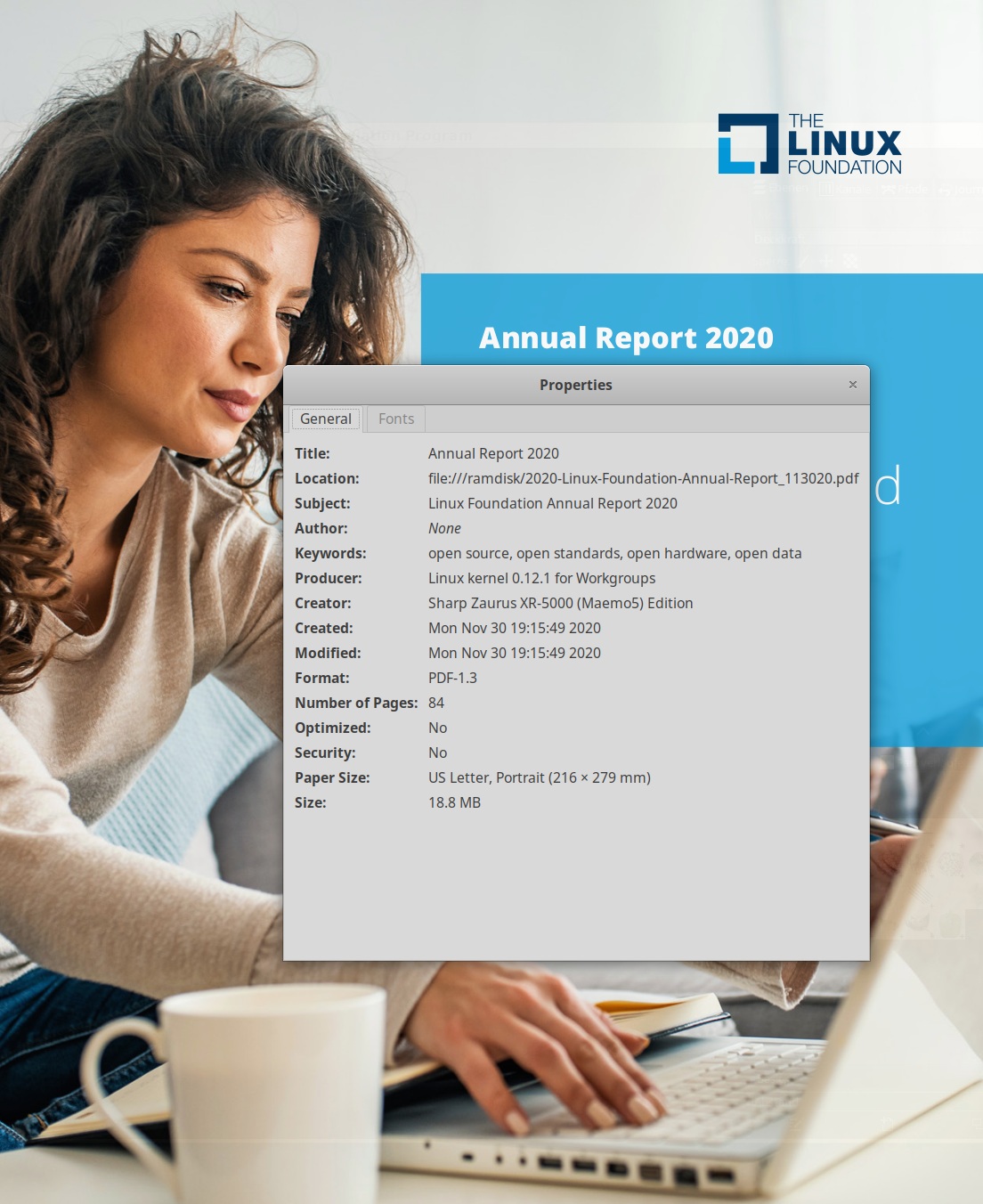
Checking the PDF file metadata reveals the keywords "open source, open standards, open hardware, open data". That is what the Linux Foundation is about. Good stuff.
The PDF producer meta data for the annual report PDF has been set to "Linux kernel 0.12.1 for Workgroups" and the PDF creator meta data element to "Sharp Zaurus XR-5000 (Maemo5) Edition". Somebody thought to better hide the real data and had some tongue-in-cheek ideas. Kudos.
But nicer would have been to use Open Source software to produce the report, not?
Running strings 2020-Linux-Foundation-Annual-Report_113020.pdf grep Adobe wc -l gives us 1229 lines and confirms the suspicion of the toolchain.
A stale /Title (Annual Report 2020) /Producer (macOS Version 10.15.7 \(Build 19H15\) Quartz PDFContext) has been forgotten in the document to tell us about the platform.
So, ladies and gentlemen, the Linux Foundation 2020 annual report has been produced on a Mac.
Running Adobe Creative Cloud on MacOS Catalina 10.15.7.
Which is proprietary software. Its kernel (and some userland pieces) are based on BSD. Not Linux.
The image on the front page also struck me as a bit odd ... using a ballpoint pen on the laptop screen?
Unbranded laptop.
Unbranded cup in the foreground.
Kid in the background not paying attention to his tablet.
All of that cries stock image so loud it hurts.
Google currently finds ~560 uses of the picture and any editorial use nicely tells us that it is Dragana Gordic / Shutterstock.
The image is "Smiling mom working at home with her child on the sofa while writing an email. Young woman working from home, while in quarantine isolation during the Covid-19 health crisis".
See the Daily Mail for a wonderful example of the working mum in context. I hope, if her laptop had been powered on, it would have run Linux. I mean, what else would still run on an old white MacBook with an Intel "Core 2 Duo" processor from 2008?
Continue reading "No dog food today - the Linux Foundation annual report"
For those keeping score:This weekend - 5th December 2020 - should see us release Debian 10.7 - an update to Debian stable (Buster) so I should be spending a day or so in the company of my friends and colleagues.Red Hat 6.10 is now out of support unless you pay Extended Update subscriptions for individual Red Hat machines. This means that CentOS 6.* has now been removed from CentOS mirrors since these were dependent on Red Hat 6 sources.. Similarly, Scientific Linux have also removed their fork of 6.*. They are continuing to support a Scientific Linux 7 but suggest a move to CentOS 8 thereafter. Separately, Fedora Linux have removed EPEL 6.* - definitely time to update to Red Hat/CentOS/Scientific Linux 7.* or greater for those affected. All the very best to all:
In previous blog posts I talked about QEMU s qcow2 file format and how to make it faster. This post gives an overview of how the data is structured inside the image and how that affects performance, and this presentation at KVM Forum 2017 goes further into the topic.
This time I will talk about a new extension to the qcow2 format that seeks to improve its performance and reduce its memory requirements.
Let s start by describing the problem.
Limitations of qcow2
One of the most important parameters when creating a new qcow2 image is the cluster size. Much like a filesystem s block size, the qcow2 cluster size indicates the minimum unit of allocation. One difference however is that while filesystems tend to use small blocks (4 KB is a common size in ext4, ntfs or hfs+) the standard qcow2 cluster size is 64 KB. This adds some overhead because QEMU always needs to write complete clusters so it often ends up doing copy-on-write and writing to the qcow2 image more data than what the virtual machine requested. This gets worse if the image has a backing file because then QEMU needs to copy data from there, so a write request not only becomes larger but it also involves additional read requests from the backing file(s).
Because of that qcow2 images with larger cluster sizes tend to:
grow faster, wasting more disk space and duplicating data.
increase the amount of necessary I/O during cluster allocation,
reducing the allocation performance.
Unfortunately, reducing the cluster size is in general not an option because it also has an impact on the amount of metadata used internally by qcow2 (reference counts, guest-to-host cluster mapping). Decreasing the cluster size increases the number of clusters and the amount of necessary metadata. This has direct negative impact on I/O performance, which can be mitigated by caching it in RAM, therefore increasing the memory requirements (the aforementioned post covers this in more detail).
Subcluster allocation
The problems described in the previous section are well-known consequences of the design of the qcow2 format and they have been discussed over the years.
I have been working on a way to improve the situation and the work is now finished and available in QEMU 5.2 as a new extension to the qcow2 format called extended L2 entries.
The so-called L2 tables are used to map guest addresses to data clusters. With extended L2 entries we can store more information about the status of each data cluster, and this allows us to have allocation at the subcluster level.
The basic idea is that data clusters are now divided into 32 subclusters of the same size, and each one of them can be allocated separately. This allows combining the benefits of larger cluster sizes (less metadata and RAM requirements) with the benefits of smaller units of allocation (less copy-on-write, smaller images). If the subcluster size matches the block size of the filesystem used inside the virtual machine then we can eliminate the need for copy-on-write entirely.
So with subcluster allocation we get:
Sixteen times less metadata per unit of allocation, greatly reducing the amount of necessary L2 cache.
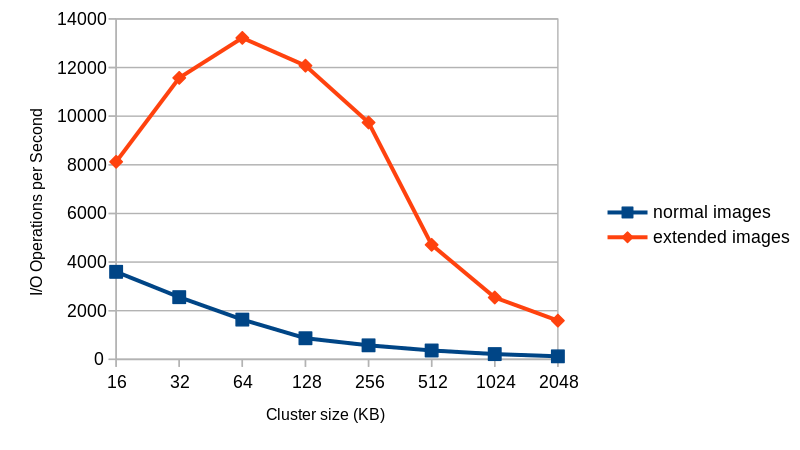
Much faster I/O during allocating when the image has a backing file, up to 10-15 times more I/O operations per second for the same cluster size in my tests (see chart below).
Smaller images and less duplication of data.
This figure shows the average number of I/O operations per second that I get with 4KB random write requests to an empty 40GB image with a fully populated backing file.
Things to take into account:
The performance improvements described earlier happen during allocation. Writing to already allocated (sub)clusters won t be any faster.
If the image does not have a backing file chances are that the allocation performance is equally fast, with or without extended L2 entries. This depends on the filesystem, so it should be tested before enabling this feature (but note that the other benefits mentioned above still apply).
Images with extended L2 entries are sparse, that is, they have holes and because of that their apparent size will be larger than the actual disk usage.
It is not recommended to enable this feature in compressed images, as compressed clusters cannot take advantage of any of the benefits.
Images with extended L2 entries cannot be read with older versions of QEMU.
How to use this?
Extended L2 entries are available starting from QEMU 5.2. Due to the nature of the changes it is unlikely that this feature will be backported to an earlier version of QEMU.
In order to test this you simply need to create an image with extended_l2=on, and you also probably want to use a larger cluster size (the default is 64 KB, remember that every cluster has 32 subclusters). Here is an example:
And that s all you need to do. Once the image is created all allocations will happen at the subcluster level.
More information
This work was presented at the 2020 edition of the KVM Forum. Here is the video recording of the presentation, where I cover all this in more detail:
You can also find the slides here.
Acknowledgments
This work has been possible thanks to Outscale, who have been sponsoring Igalia and my work in QEMU.
And thanks of course to the rest of the QEMU development team for their feedback and help with this!
I joined the
Debian project in late 1994, well before the first
stable release was issued, and have been involved in various ways continuously
ever since. Over the years, I adopted a number of packages that are, or at
least were at one time, fundamental to the distribution.
But, not surprisingly, my interests have shifted over time. In the more than
quarter century I've contributed to Debian, I've adopted existing packages
that needed attention, packaged new software I wanted to use that wasn't yet
in Debian, offered packages up for others to adopt, and even sometimes
requested the removal of packages that became obsolete or replaced by
something better. That all felt completely healthy.
But over the last couple weeks, I realized I'm still "responsible" for some
packages I'd had for a very long time, that generally work well but over time
have accumulated bugs in functionality I just don't use, and frankly haven't
been able to find the motivation to chase down. As one example, I just
noticed that I first uploaded the gzip package 25 years ago today, on
2 December 1995. And while the package works fine for me and most other
folks, there are 30 outstanding bugs and 3 forwarded bugs that I just can't
muster up any energy to address.
So, I just added gzip to a short list of packages I've offered up for
adoption recently. I'm pleased that tar already has a new maintainer, and
hope that both sudo and gzip will get more attention soon.
It's not that I'm less interested in Debian. I've just been busy recently
packaging up more software I use or want to use in designing high
power model
rockets and the solid propellant motors I fly in them, and would rather spend
the time I have available for Debian maintaining those packages and all their
various build dependencies than continuing to be responsible for core
packages in the distribution that "work fine for me" but could use attention.
I'm writing about this partly to mark the passing of more than a quarter
century as a package maintainer for Debian, partly to encourage other Debian
package maintainers with the right skills and motivation to consider adopting
some of the packages I'm giving up, and finally to encourage other long-time
participants in Debian to spend a little time evaluating their own package
lists in a similar way.
A new RcppTOML release arrived on CRAN earlier today evening. RcppTOML brings TOML to R.
TOML is a file format that is most suitable for configurations, as it is meant to be edited by humans but read by computers. It emphasizes strong readability for humans while at the same time supporting strong typing as well as immediate and clear error reports. On small typos you get parse errors, rather than silently corrupted garbage. Much preferable to any and all of XML, JSON or YAML though sadly these may be too ubiquitous now. TOML has been making inroads with projects such as the Hugo static blog compiler, or the Cargo system of Crates (aka packages ) for the Rust language.
CRAN had sent us a note that the package no longer compiled under the [unreleased, of course, never change, BDR ;-) ] g++-11 compiler, but were kind enough to hint that it was only lacking an #include <limits>. These things happen: newer compilers are generally more strict, and that is generally a good things. (Last year this time we prepped code for the more stringent view on global variables under gcc-10. Earlier g++ version had similar demands to clarify include headers.) I set up a simple Docker contain with on Ubuntu 21.04 with g++-11, R, and Rcpp to build the package and make this change (which was of course also PR ed upstream at cpptoml), plus some other small ones that update the package since the last release roughly 18 months ago. We also switched CI use to the r-ci setup I should blog about a little more, removed a bashism and updated a few URLs. The bulleted list of changes in this version follows.
Changes in version 0.1.7 (2020-12-01)
Add #include <limits> to header file, also contributed upstream, to permit compilation under the (unreleased) g++-11.
Another month worth of updates on KDE/Plasma in Debian has accumulated, so here we go. The highlights are: Plasma 5.19.5 based on Qt 5.15 is in Debian/unstable and testing, Plasma 5.20.4 is waiting to be uploaded soon to experimental, and my own builds at OBS have been updated to Plasma 5.20.4, Frameworks 5.76, Apps 20.08.3.
OBS packages
The OBS packages as usual follow the latest release, and currently ship KDE Frameworks 5.76, KDE Apps 20.08.3, and new, Plasma 5.20.4. The package sources are as usual (only the other-dep has disappeared, these packages are now all in Debian proper), for Debian/unstable:
deb https://download.opensuse.org/repositories/home:/npreining:/debian-kde:/frameworks/Debian_Unstable/ ./
deb https://download.opensuse.org/repositories/home:/npreining:/debian-kde:/plasma520/Debian_Unstable/ ./
deb https://download.opensuse.org/repositories/home:/npreining:/debian-kde:/apps2008/Debian_Unstable/ ./
deb https://download.opensuse.org/repositories/home:/npreining:/debian-kde:/other/Debian_Unstable/ ./
and the same with Testing instead of Unstable for Debian/testing.
The latest update to 5.20.4 will probably need one or two install cycles due to missing Replaces. The reason is that the packages in OBS have been synced with the work we have done for the official Debian packages, and thus some files have moved between packages.
Debian main packages
After a few hiccups, the whole Plasma 5.19.5 stack has landed in Debian/testing, and we are working on an upload of 5.20.4 to Debian/experimental. This takes a bit, because we want to add infrastructure to automatically force all packages to be upgraded only together, so that there is no mix between old and new packages. This has shown quite some problems during the upgrade from 5.17 to 5.19 in testing. Also, I don t think Debian needs to do something else than everybody else by allowing to mix Plasma released.
That said, I hope that we have an upload of 5.20 to experimental soon, followed by testing and an upload to unstable, so that it can migrate to testing in time for the freeze of Bullseye. Getting 5.20.5 into Bullseye is possible, but not guaranteed, not too much time between the release of 5.20.5 and proper freeze in Debian. But we will see.
Enjoy.
Truth, Untruths and Education in India.
I read this somewhat disturbing and yet pretty raw truth from foreign affairs. It took me quite a few days to not only digest but also say yes and see the same situation playing out in India. I have been seeing the discourse on Twitter and while a part of it is the equivalent of road rage, a huge part is a disconnect to not acknowledge and be civil. We may come to different conclusions from the same data but being civil seems to be difficult for a lot of people. One part is of course ego, where nobody wants to lose, but more than that are the plain comprehension issues. Most of the literature, good literature is unfortunately based in English.
And while we can have differing opinions of what constitutes good literature, for me it s books like Battle of Belonging,The:On Nationalism, Patriotism, and What it Means Shashi Tharoor. From what little I have understood, the book makes the case of civic nationalism which is far more inclusive than the narrow confines of patriotism. Now this begs the question when you have such books and many books which do tell you about different aspects of social, political and knowledge, why are so many people prone to disinformation in India similar to U.S. and probably other countries as well. One of the biggest reasons per-se is lack of education and quality education. When the number of graduates is less than five percent how do you expect that population to be able to take decisions in their economic self-interest? So sadly the understanding is ingrained from WhatsApp and there is no need to check from alternate sources. And just like Mr. Trump followers, they believe those versions to be the unvarnished truth. I do understand that no truth is immutable except for life and death. All others are imperfect unless it is validated by some sort of scientific validation behind it. At the same time, these truths may themselves be invalidated if a stronger scientific evidence establishes itself. This is the reason why hypothesis and facts themselves are challenged again and again. Sharing couple of examples below.
Nationalization of Banking, RERA and RCEP
Most of the people want freedom of the banks i.e. private banking don t really know that private banking existed at a time in free India before they were nationalized and these banks failed at surprisingly regular intervals. Now it isn t as if this fact is hidden but it is not as popular as maybe some other facts or ideas. Now the Government in the center obviously doesn t want to share these facts as they want corporates in banking. And if that fact is known by many people it will be a huge setback to their plans. RBI failures have been to many to count. Even recent legislations like RERA and others which were supposed to bring relief to millions of potential homeowners has become a pawn in the hands of builders and this has been known.
One of the interesting points of RCEP which is not so much in public domain is that RCEP would have a mere 4.5% duty on most products which will go down to 1.5% over a 20 year period. Now with India staying out of it, we have done two things. We have said that we will not be competitive even after 20 years of this which is the more damning part. And we will not take part in the growth that other countries will have due to this.
Contempt Proceedings against Comic Artist because she has an opinion on SC
The fall in SC and constitutional values grows day by day. The AG today consented to have contempt proceedings against a comic artist saying she insulted the SC. Gone are the days when an artist made fun of the PM, and she gave him a Padam Shri (one of the highest civilian honors) for his contributions. Then, even dissent or being cynical was looked as being a contribution to the national effort rather than today. This is the reason why India has been continuously falling in the Global Freedom of Expression Index. I have seen censoring many a time here. I, myself has been locked out of Wikipedia many times. Can you imagine, being locked out of Wikipedia which is perhaps one of the more neutral sites on the web. And then there was this wikibio thing, such a sad thing to happen. Guessing this is the future of the Indian interweb. Stick figure by Sanitary Panels on SC
I was assigned 16 hours of work by Freexian's Debian LTS initiative
and carried over 4.5 hours from earlier months. I worked 11.5 hours
this month, so I will carry over 9 hours to December.
I continued working on backporting fixes for some less urgent
security issues in Linux 4.9. I had to give up on some filesystem
fixes as they caused regressions. The others have now been applied
to the 4.9 stable branch at kernel.org.
I updated the linux packaging branch for stretch to Linux 4.9.246,
but haven't made a new package upload yet.
Here s my (fourteenth) monthly update about the activities I ve done in the F/L/OSS world.
Debian
This was my 23rd month of contributing to Debian.
I became a DM in late March last year and a DD last Christmas! \o/
Apart from doing a bunch of activities like attending KubeCon + RubyConf (blog to follow!), et al and simultaneously giving
my undergrad exams, I did (relatively) more work than I had really anticipated!
Here are the following things I did in Debian this month:
micro (2.0.8-1) - New upstream version, v2.0.8. Finally! \o/
ruby-zeitwerk (2.4.2-1) - New upstream version, v2.4.2.
Other $things:
Attended the Debian Ruby team meeting.
Mentoring for newcomers.
FTP Trainee reviewing.
Moderation of -project mailing list.
Sponsored phpmyadmin for William and libexif for Hugh.
Debian (E)LTS
Debian Long Term Support (LTS) is a project to extend the lifetime of all Debian stable releases to (at least) 5 years. Debian LTS is not handled by the Debian security team, but by a separate group of volunteers and companies interested in making it a success.
And Debian Extended LTS (ELTS) is its sister project, extending support to the Jessie release (+2 years after LTS support).
This was my fourteenth month as a Debian LTS and fourth month as a Debian ELTS paid contributor.
I was assigned 22.75 hours for LTS and 45.00 hours for ELTS and worked on the following things:
(for ELTS, I worked for 5.25 hours last month, so I had to work for 39.75 (+1 extra) hours this month)
(also, I did over-work by 5.00 hours for LTS this month, but I ll re-compensate it later to avoid so much fuss!)
LTS CVE Fixes and Announcements:
Issued DLA 2425-1, fixing CVE-2020-25692, for openldap.
For Debian 9 Stretch, these problems have been fixed in version 2.4.44+dfsg-5+deb9u5.
Issued DLA 2427-1, fixing CVE-2020-14355, for spice.
For Debian 9 Stretch, these problems have been fixed in version 0.12.8-2.1+deb9u4.
Issued DLA 2428-1, fixing CVE-2020-14355, for spice-gtk.
For Debian 9 Stretch, these problems have been fixed in version 0.33-3.3+deb9u2.
Issued DLA 2430-1, fixing CVE-2020-15238, for blueman.
For Debian 9 Stretch, these problems have been fixed in version 2.0.4-1+deb9u1.
Issued DLA 2439-1, fixing CVE-2020-0452, for libexif.
For Debian 9 Stretch, these problems have been fixed in version 0.6.21-2+deb9u5.
Issued DLA 2443-1, fixing CVE-2020-15166, for zeromq3.
For Debian 9 Stretch, these problems have been fixed in version 4.2.1-4+deb9u3.
Issued DLA 2444-1, fixing CVE-2020-8037, for tcpdump.
For Debian 9 Stretch, these problems have been fixed in version 4.9.3-1~deb9u2.
ELTS CVE Fixes and Announcements:
Issued ELA 306-1, fixing CVE-2020-25692, for openldap.
For Debian 8 Jessie, these problems have been fixed in version 2.4.40+dfsg-1+deb8u7.
Issued ELA 310-1, fixing CVE-2020-0452, for libexif.
For Debian 8 Jessie, these problems have been fixed in version 0.6.21-2+deb8u5.
Issued ELA 311-1, fixing CVE-2020-8037, for tcpdump.
For Debian 8 Jessie, these problems have been fixed in version 4.9.3-1~deb8u2.
Issued ELA 312-1, backporting a new upstream release, 2020d, for tzdata.
For Debian 8 Jessie, these problems have been fixed in version 2020d-0+deb8u1.
Issued ELA 313-1, fixing CVE-2020-15166, for zeromq3.
For Debian 8 Jessie, these problems have been fixed in version 4.0.5+dfsg-2+deb8u3.
Prepared a debdiff for lxml (3.4.0-1+deb8u2) upload, which Emilio completed and rolled out later.
Other (E)LTS Work:
Front-desk duty from 26-10 until 01-10 and from 23-11 until 29-11 for both LTS and ELTS.

 Update 11/12/20 Came across this article on the wire which tells how everybody s rights, not just the farmer s rights are being shod over. I think it depicts correctly the signs of time to come. While arguing on SM, also came to know about Article 300 (1), thanks to Sachin Kumar which shows multiple instances where Government was sued because somebody was working in official capacity and did mistakes, malafide or otherwise and it was the state who was made to pay.
FWIW, today farmers from Maharashtra, my state arrived at Delhi border where they were also kept at bay. I did come across an infographic which shows how the various states have fared. Most tellingly, is the state of Bihar. It was in 2006 (one of the most backward states) where APMC was taken off. While others have tried to paint a flattering picture of Bihar, they have failed to share that in the interim 15 odd years, there hasn t been any sort of infrastructure created for farmers which is the reason it is still the lowest earner. These are the last available figures we have about the farmer s income. From 2014 to 2020 there hasn t been any update.
 Situation Assessment Survey of Agricultural Household 2013 Copyright GOI,
 This concludes just one portion of the bill. I will take other parts of the bill. I may dwell on some other parts as and when I have the time. A cartoon which depicts the current issue
 I stand with farmers Copyright Sanitary Panels
 Too much Democracy copyright Satish Acharya
 Too much democracy Illustration and Copyright Alok
 Sterlite protest 13 dead, 100 injured Copyright Business Standard too much democracy
 Erosion of Democracy V-dem institute Copyright The Hindu Web Team
 India media ownership 2016 Copyright Caravan
 Akarshan Uppal Reporter, IBN24 Copyright IBN24

 I have an Asustor (Nimbuster 4 / AS5304T) NAS at home, which allows me to perform regular backups. Unfortunately, I couldn't manage to find a way to configure remote backups from the NAS to rsync.net using the "Remote Sync" option of the "Backup & Restore" app provided in the ADM OS of the Asustor NAS.
I'm used to using rsync -e ssh commands and would have expected some such configuration to be possible... it may just be some UI issue, but I couldn't find how to add one for rsync.net.
I've then used the following workaround : the NAS can run a "Linux VM" (LXC ?) with the provided "Linux Center" app. It allows me to run a regular Debian installation inside this Linux guest. On which I installed backupninja, which performs backups over rsync, from the NAS filesystem, to the rsync.net remote.
Along the way I had to overcome a few issues, whose documentation may be useful to others :
 TL;DR: Some mildly tricky tricks allow you to select subgoals by name, like in Isabelle. This leads to more readable proofs, and proofs that are more robust against changes.
 Welcome to the 31th post in the rapturously rampant R recommendations series, or
 The Linux Foundation has published its
 The PDF producer meta data for the annual report PDF has been set to "Linux kernel 0.12.1 for Workgroups" and the PDF creator meta data element to "Sharp Zaurus XR-5000 (Maemo5) Edition". Somebody thought to better hide the real data and had some tongue-in-cheek ideas. Kudos.
But nicer would have been to use Open Source software to produce the report, not?
Running

 In previous blog posts I talked about QEMU s qcow2 file format and how to make it faster.

 I joined the
 Another month worth of updates on KDE/Plasma in Debian has accumulated, so here we go. The highlights are: Plasma 5.19.5 based on Qt 5.15 is in Debian/unstable and testing, Plasma 5.20.4 is waiting to be uploaded soon to experimental, and my own builds at OBS have been updated to Plasma 5.20.4, Frameworks 5.76, Apps 20.08.3.
 OBS packages
The OBS packages as usual follow the latest release, and currently ship KDE Frameworks 5.76, KDE Apps 20.08.3, and new, Plasma 5.20.4. The package sources are as usual (only the
 Been implementing something for pair programming.
Sharing the display is probably the most core part and the
rest are minor improvements.

 I was assigned 16 hours of work by Freexian's Debian LTS initiative
and carried over 4.5 hours from earlier months. I worked 11.5 hours
this month, so I will carry over 9 hours to December.
I continued working on backporting fixes for some less urgent
security issues in Linux 4.9. I had to give up on some filesystem
fixes as they caused regressions. The others have now been applied
to the 4.9 stable branch at kernel.org.
I updated the linux packaging branch for stretch to Linux 4.9.246,
but haven't made a new package upload yet.

