Search Results: "nic"

1 September 2013

Raphaël Hertzog: My Free Software Activities in August 2013


This is my monthly summary of my free software related activities. If you re among the people who made a donation to support my work (47.50 , thanks everybody!), then you can learn how I spent your money. Otherwise it s just an interesting status update on my various projects. Package Tracking System There are only 2-3 weeks left in the summer of code project dedicated to rewrite the package tracking system. We have come a long way during August check it out yourself in pts.debian.net. The rewrite doesn t have all the features of the old PTS yet, but I opted to keep some of the easy and less interesting features for others to re-implement. Instead I asked Marko to work in the coming weeks on new features that will bring more value, like the possibility to have user accounts with the possibility to easily review and tweak all your subscriptions on the web, and like the possibility to subscribe to groups of packages (i.e. those managed by a team). Our main problem right now is that exim has a pretty poor default behavior of forking hundreds of processes if you get hundreds of mails (in a batch) to an address that delivers via a pipe (postfix is saner, it serializes the deliveries on pipes). The new PTS is much more modular and its memory footprint is bigger (about 3 times more for the process that delivers mails, 30Mb instead of 10Mb), and in such a situation we managed to run out of memory for now we worked around the situation with an exim setting that queues mails once the load gets too high but it s a poor workaround IMO. We could obviously implement our own queue and a daemon but I d like to avoid this. So who knows how to tell exim to behave? :-) On the positive side, Marko has gotten some feedback from people who like the new PTS and are using it daily already. And several persons have expressed their interest to work on the new codebase already. On my side, I created a package so that it s easy to deploy for derivatives. In this process, I revamped the way we manage the Django settings (for development and for production). The package is not finished yet, but it s mostly usable already. But I still want to do some cleanup/refactoring in the models before others start deploying it. We must also enable South to make it possible to upgrade easily afterwards. DebConf 13 in Vaumarcus From August 10th to 17th, I was attending DebConf 13. It matched the only week of vacation that my wife had this summer so we went there with the whole family (that is with a 3 years old son, and 6 months old one). Thus I could not immerse myself in Debconf and missed all the nice things that happen outside of the talk rooms. I picked 3-4 interesting talks per day and I spent the rest with my family. On the positive side, I was pleased that my wife could meet (or at least see) some other Debian people. She knows quite a few (of you) by name because I have been telling her Debian stories for years now Debian France Debian France sold quite some merchandise during Debconf but I didn t take care of that. It was supervised by Sylvestre Ledru but fortunately he got the help of multiple persons, both to bring everything there, to sell it, and to bring back the rest. The good news of the month is that the upstream author of galette published a new version with all the features that we ordered him a few months ago. We send now automatic reminders to members who must renew their subscription, we have automatic update of our accounting books (in a ledger file in a git repository) when we people donate or pay their subscription via the paypal form on our website. I was so pleased to finally have this that I took some hours to finalize the packaging of galette, so that it could be uploaded to Debian. It s now waiting in the NEW queue. I also spent multiple hours to write the python script that is executed by galette and that updates the accounting files. Misc Debian stuff Debian Packaging. I did two uploads of logidee-tools to fix bugs #718671 and #718836. I created a package for Dolibarr a PHP-based CRM and ERP software (it doesn t do accounting however), it s sitting in the NEW queue for almost a month already. I forwarded #719000 to the upstream Publican developers. I filed #720393 to request a new upstream version of libphp-mailer. git-multimail. After its deployment on Alioth last month, Niels Thykier reported me a case where it lead to bounces, I filed this as a new upstream ticket and in fact I fixed it myself a few days after. I got the fixed version installed on Alioth. dpkg. I investigated why the the automatic builds of dpkg were no longer happening and asked Michael Prokop if he could install a newer version of gettext in the build chroot. He told me that he would need a backport for that so I asked Santiago Vila if he was willing to provide it and he kindly accepted. A few days after, the package was in backports and I m now again running the latest dpkg out of git thanks to the nice service provided by Michael. Misc discussions. The thread about user planets drifted into a discussion of how to avoid promotional posts on such planets and in that context someone again brought up the Debian Machine Usage Policy as a way to shut down any kind of (self-)promotional content on planet if there s money involved. This always irritates me and this time I opted to ask James Troup about the origin of that clause in the DMUP. So who is willing to work with DSA to fix the DMUP so that people stop abusing it in contexts where it doesn t make sense? I also participated in some discussions concerning dgit. I like the ideas behind the tool, but I m saddened by the behavior of Ian Jackson. I helped him to fill his gap of knowledge about new sources formats but he keeps on bashing about the 3.0 (quilt) source format both in the manual page and in the output of the program. He believes that dgit is no longer an experiment but the truth is that it s still a poorly commented Perl script doing lots of hackish things. Kali Linux Between Debconf and all, I haven t done much for Kali except a couple of fixes. There s a nice story of how I tracked a bug in live-installer on the Kali blog. That fix has been committed to Debian. I also improved live-build to include xfsprogs/jfsutils on the ISO image when you include the debian-installer (so that you don t end up in problems when you pick JFS or XFS as file systems for your installation). Thanks See you next month for a new summary of my activities.

One comment Liked this article? Click here. My blog is Flattr-enabled.

Robert Collins: Subunit and subtests

Python 3 recently introduced a nice feature subtests. When I was putting subunit version 2 together I tried to cater for this via a heuristic approach permitting the already known requirement that some tests which are reported are not runnable be combined with substring matching to identify subtests. However that has panned out poorly, when I went to integrate this with testr the code started to get fugly. So, I m going to extend the StreamResult API to know about subtests, and issue a subunit protocol bump to 2.1 to add a new field for labelling subtest events. My plan is to make this build a recursive tree structure that is given test test_foo with subtest i=3 which the Python subtest code would identify as test_foo (i=3) , they should be identified in StreamResult as test_id test_foo (i=3) and parent_test_id test_foo . This can then nest arbitrarily deep if test runners decide to do that, and the individual runnability becomes up to the test runner, not testrepository / subunit / StreamResult.

Ritesh Raj Sarraf: Laptop Mode Tools 1.64

I just released Laptop Mode Tools @ version 1.64. And am pleased to introduce the new graphical utility to toggle individual power saving modules in the package. The GUI is written using the PyQT Toolkit and the options in the GUI are generated at runtime, based on the list of available power saving modules. Apart from the GUI configuration tool, this release also includes some bug fixes:
  • Don't touch USB Controller power settings. The individual devices, when plugged in, while on battery, inherit the power settings from the USB controller
  • start-stop-programs: add support for systemd. Thanks to Alexander Mezin
  • Replace hardcoded path to udevadm with "which udevadm". Thanks to Alexander Mezin
  • Honor .conf files only. Thanks to Sven K hler
  • Make '/usr/lib' path configurable. This is especially useful for systems that use /usr/lib64, or /lib64 directly. Thanks to Nicolas Braud-Santoni
  • Don't call killall with the -g argument. Thanks to Murray Campbell
  • Fix RPM Spec file build errors
The Debian package will follow soon. I don't intend to introduce a new package for the GUI tool because the source is hardly 200 lines. So the dependencies (pyqt packages) will go as Recommeds or Suggests

AddThis:

Categories:

Keywords:

Andrew Pollock: [life] My first Bridge to Brisbane

One of the goals I set for myself on returning to Brisbane was running in the Bridge to Brisbane. The City2South run ended up being a longer distance, sooner, so I only stuck with the Bridge to Brisbane so I could say I'd done it. The added variable was I had Zoe, and I was pushing her in a jogging stroller. I did a couple of practice runs up the bridge with Zoe in the weeks leading up to the run. Mostly to get her used to it, and for me to get a feel for what the incline was like. I found I had the stamina to easily do the bridge, but ran out of steam on the return leg. No big deal, I didn't need to do that for the real run. I did a poor job of publicising that I was doing the run, so I didn't end up raising a whole lot of money for my chosen charity, beyondblue, because I had the added variable of Zoe. I knew I had to get her up early to get to the start line in time, and I wasn't sure if she was going to be cooperative or not, or whether she'd have a tantrum half way through the run and I'd have to stop, so I didn't feel good about taking money from people for running a run that I wasn't sure I could complete. My main concern had been getting to the starting line in time. I wanted to take the train from Morningside to Murarrie and then walk to the start line (about 10 minutes) because that way I could take the train back to Morningside from the finish to collect the car and not have to worry about trying to get back to the start. That meant I'd have to get Zoe up before 5am to get to the station, and if she didn't cooperate, I'd miss the train, and it'd all be over. Fortunately, my cousin Renata offered to drop us off, and we did a complicated car switcharoo, which involved her leaving my car at Morningside station for me after dropping us off at Murarrie. Now that I've seen the road closure situation, I feel pretty confident that I could have just driven to Murarrie and ditched the car somewhere there. Interestingly, a train that was packed to the rafters with people was arriving at the station at the time we arrived to leave Renata's car there. I'm not sure if it was the 5:07am train running late, or if I'd mis-interpreted the timetable and there was a later train we could have more comfortably made without Renata's assistance. Anyway, we uneventfully got to Murarrie station by about 5:40am, and walked to the start. It was ridiculously packed. People as far as the eye could see. Apparently there were 29,479 entrants and 24,596 finishers in the 10km run, so that explains it. I was seeded in the "joggers" group, which was a fair way back from the start line, and as it was, technically had to walk around some massive barrier to get in with the runners, but I snuck in the side after the pack started moving. Zoe was really, really good for the whole run. I couldn't have asked for her to be better behaved, really. She was wanting a cuddle at the top of the bridge, and claimed she wanted to go to the toilet the first time she saw some portable toilets, but easily talked out of both. My strategy of having a broad array of snacks for her to eat during the run worked well to keep her happy, and the course was heavily packed the entire way, so she had plenty to look at. It was a nice father/daughter thing to do for Fathers Day. My official time was 57:28, which I'm extremely happy with, given the conditions I ran under. I was going to be happy with anything under an hour. My personal best for 10km (not that course) is 51:52 I'm very grateful to those people who did donate some money on short notice. I've managed to raise $180, which is better than nothing. Now that I've done the run, and seen how it works, I'm game to try it again next year, and I'm game to do more 10km runs with Zoe. My running overall has been going very well, and so I think it's time to step things up a bit and I've decided to set myself a goal of running the half-marathon in the Gold Coast Marathon next year.

30 August 2013

Joey Hess: best DebConf ever

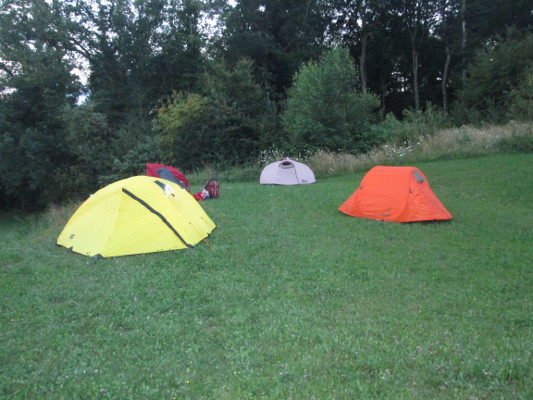
For me, DebConf13 in Switzerland was a perfect DebConf, and generally an great developer meeting and conference. I've attended several past DebConfs in Canada, Norway, Brazil, Finland, Mexico, Scotland, Spain, NYC, Bosnia, and Nicaragua. I have special memories of each. DebConf13 was ideal in every way. Let's start with the camping. Only a minority of us did it, and my campsite was located in a small field behind a bar that was often noisy late into the night, when I was trying to rest and preserve my European jetlag remedy of inverted sleeping schedule. Still, I love sleeping cocooned in a tent, and going through the routines of camping and spending time alone there was a good counterpoint to DebConf. I generally find myself retreating for a day or two in the middle of a week-long conference, burnt out with social interactions. That didn't happen this time. I need to find way to camp at future DebConfs. (Also special shout out to wonderful people who lent me a warmer sleeping bag, and bought me a pillow while on a trip to town! Upgraded my first backpacking in Europe experience's comfort level a lot!) The next perfect thing for me were the talks I gave at DebConf. I always enjoy presenting at DebConf, and barely remember when I'd get nervous doing it. But I really felt comfortable giving these talks in a way I've not before. I'm pleased with how the Debian Cosmology talk turned out; I'd worried it would be a downer talk, or too light, or not well received, and none of those problems surfaced. I was especially happy with my dh_busfactor session, which I prepared for all of 10 minutes and was structured entirely to benefit me by talking over my thoughts and getting feedback, and in which I probably drove the camerapeople crazy running my own mic into the audience. Despite all that, I think it succeeded being interesting for the participants as well as for me. Hope to follow up on it soon.. But beyond the two talks I submitted, there were a series of ad-hoc scheduled talks. It seemed that every day I spent at least an hour discussing something I'm deeply involved in. This started with the Ikiwiki bof, and then there was an epic series of (unrecorded) BoFs about git stuff, which basically turned into an unofficial git track at DebConf. Much, much discussion of git-annex and other things I'm involved in. BTW, I really like that DebConf, as well as being a formal conference on top, is really an un-conference underneath, with new BoFs and things popping up on the schedule all week long. You can even have completely unscheduled meetings that somehow get just the right mix of people to make something awesome happen.
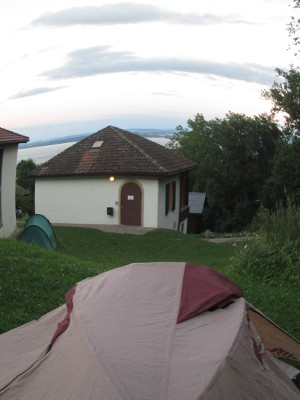
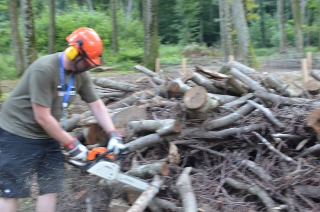
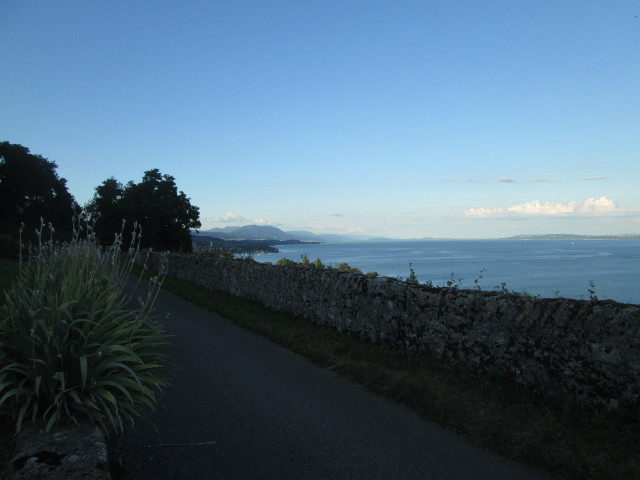
But it wasn't all about talks. Indeed, I only attended 2 or 3 sessions a day. The DebConf13 venue was controversial, but I found it excellent for getting things done. Rather than one or two massive rooms that get too noisy to think in, this venue had many little nooks and crannies suited for different types of work. There were so many I only discovered some while walking down the hill as I was leaving the venue! Anchoring it all was the excellent view, and I particularly enjoyed the "scenic hacklab". I was particularly impressed with the flexability of the venue's management. Someone asked if we could have cheese for breakfast, and every breakfast thereafter had not one but often three excellent cheeses. One day we'd be complaining that there were not enough vegetables in the food, and the next we'd be eating an excellent vegetarian Swiss lunch. They even apparently relaxed stringent Swiss rules on not allowing tents in sightlines visible from people further up the hill. They were clearly happy to welcome our crazy gathering to Le Camp. They let a DD borrow and use a chain saw and build a bonfire! The venue also encouraged getting out and exploring the surrounding countryside. Too often I end up spending the whole DebConf without seeing much of the area around. This time I at least got down the hill to see the castle in Vaumarcus a few times, and enjoyed many evening walks amoung the grape fields. The conference dinner (on a boat!) tied into this well too. And the daytrip to CERN was a great addition. We got to poke around the control center for a massive particle accellerator! My only regret is we didn't get a chance to actually go inside the LHC tunnels. Back to DebConf, another thing I really liked about this one was that its location allowed several upstream authors of software in Debian (other than the usual suspects who are both upstreams and Debian Developers) to attend. I don't know if Lennart Poettering changed any minds about systemd with his talk, but I was happy for the opportunity to buy him a beer. I didn't get to Monty's talk, but it was excellent to see him attend as well. Finally, I got to meet old friends I'd not seen in years, and new ones I've not met in real life before. We're still not sure where this whole DebConf thing is going -- will it be all about the cheese and wine party and greybeards in 20 years time? But one thing we know is we enjoy our little slice of the year where kilts and coding are equally unremarkable, where problems that seem intractable online somehow solve themselves in person, where we come away with ideas for an entire year and memories for a lifetime.

Justus Winter: What will I do next? cgroupfs \o/

With the ifupdown fixes that I published last week I actually reached my initial goal, that is to make Debian/Hurd boot using sysvinit and the initscripts provided by Debian. So on Monday we were discussing in #hurd what I could do next. Michael Banck suggested that I should port Upstart, but we agreed to do something different instead for two reasons:
  1. Upstart and systemd are somewhat competing to be the default init system for Debian, and we felt it might be inappropriate to get involved with this question as porting Upstart to Hurd would probably also enable it to be used on FreeBSD. The Upstart folks could then point out that Upstart is more portable because it runs on all kernels used by Debian.
  2. Upstart uses ptrace(2) to track child processes of servers it monitors. Obviously this is kind of a hack, and it was conjectured that Upstart would eventually use cgroups to do that. Also, the Hurd lacks support for ptrace(2) (that is most likely by choice by the way, ptrace(2) is not a nice interface and the Hurd (Mach actually) has much nicer interfaces to implement a debugger).
So we decided that no matter how the struggle between Upstart and systemd turns out, the Hurd would eventually need to support cgroups. So I started to write a cgroupfs translator, it is in its early stages but it already looks and acts a lot like Linux' cgroups:
% settrans -ac cg ./cgroupfs --release-agent=foobar
% ls cg
release_agent  tasks
% tail -n3 cg/tasks
11395
12869
1266
% mkdir cg/foo
% echo 1266 >> cg/foo/tasks
% tail -n3 cg/tasks cg/foo/tasks
==> cg/tasks <==
215
11395
12869
==> cg/foo/tasks <==
1266
To make this fully functional I will have to modify /hurd/proc and most likely also GNU Mach, but on the bright side this will help make subhurds (Hurds native, by-design-for-free-and-without-overhead container like functionality) work better and more securely (among other things this could enable non-root users to start subhurds). I will also look into porting libcg (I have a hacky patch series ready) so that we can actually test the cgroupfs translator. All current users of the cgroup interface are very Linux specific (surprise!), and libcg looks like the easiest one to port. And they do have a test suite that could help me improve the cgroupfs translator.

29 August 2013

Mark Brown: New job

A few months ago I started a new job at Linaro as the technical lead for the Linaro Stable Kernel I just posted a brief thing what I m up to now over on the Linaro blog.

28 August 2013

Vincent Sanders: Men admire the man who can organize their wishes and thoughts in stone and wood and steel and brass.


I would probably not yet worthy of the admiration Emerson was alluding to but I do like to make things. As anyone who has read previous posts knows I have pretty much embraced the "do things, tell people" idea.

One small wrinkle is doing things needs somewhere to work. Since moving myself and the family to rented accommodation in Cambridge (swampy 3,500 year old English city, not the one in Massachusetts) I have been lacking space to do practical projects.

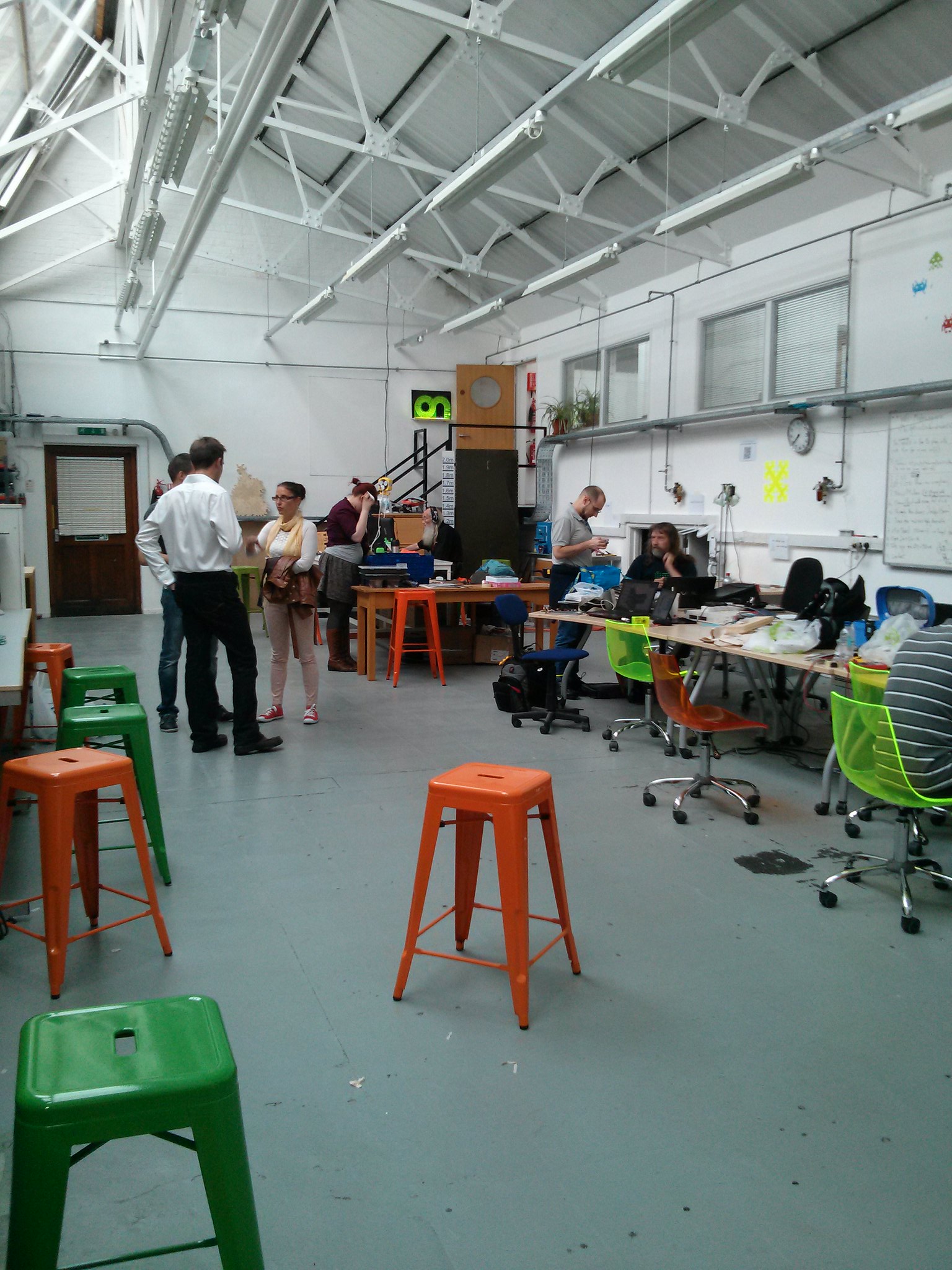
The main space
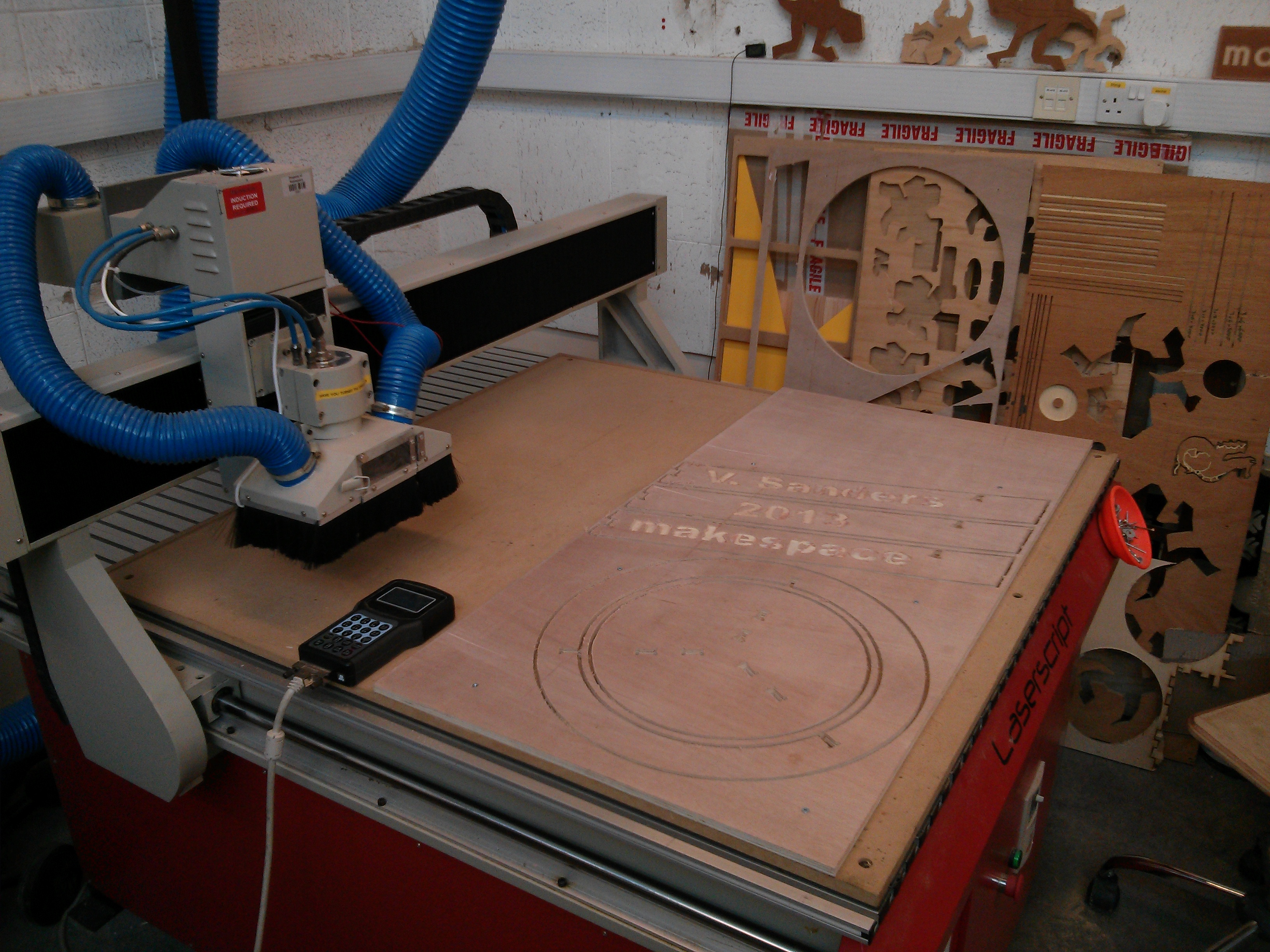
To fix this lack I have joined the cambridge makespace which, in addition to somewhere I can work gives me access to some tools I was previously unable to afford. The space gives practical training on the more complex machines (any tool can be dangerous if you do not use it correctly) which recently allowed my induction on the CNC router.

My instructor , Mark Mellors, who was good enough to give up some of his valuable making time to train me (and accidentally get his car stuck in a car park overnight by staying late) suggested that it was a good idea to have a design to try.

I decided to use this opportunity to actually create something useful (though now I re-read Marks message it did suggest a simple design...oopsy). I had been working at the electronics bench in previous weeks and been uncomfortable using the existing stools and chairs as they were either a bit high or unable to be adjusted high enough for the 80cm tall benches. I decided to design a 60cm tall stool for use at this workbench.

My initial idea was for a simple three leg stool, round top, three legs, how hard could it be? Initial research showed that showed that above 30cm the legs needed to be braced to each other. This is because the leg to seat joints simply cannot handle the stress caused by leverage which longer legs introduce.

I looked at the structure of several stools online and was initially drawn towards creating something like the IKEA Dalfred bar stool. It was discovered that the design would be easier to realise if it were made from sheet material which give a smaller challenge to a naive operator of a CNC router. Because of this simpler designs were researched and I eventually found a simple design I liked.

The design could not however be used directly as it was for imperial sized material which is not available in europe. I selected the QCAD open source CAD package and recaptured the design adjusting for the available 12mm plywood sheet material. This resulted in an imperial measurement design for metric materials.

Mark helped me transfer the DXF into the CAM software (vcarve pro 7, after I discovered the demo version of this software generates files which cannot be imported into the full edition!) and generate toolpaths for our machine. Once the toolpaths are saved to a USB stick (no modern conveniences like direct upload here) the job can be run on the machine.

Here I ran into reality, turns out that tolerances in imperial combined with lack of understanding how plywood reacts resulted in excessive play in the joints. This resulted in an unusable stool, which simply tried to rotate around its central axis and become flatpack. I had successfully turned 10 worth of plywood into some sawdust and a selection of useless shapes. On the other hand I did become competent with the router workflow so it was not a complete failure.

I was determined to make the design work so I decided to start from scratch with a similar design but entirely in metric. I performed some material research both online and practically (why yes i did spend an informative hour in several cambridge DIY shops with digital calipers, why do you ask?) it turns out that generally available 12mm thick plywood actually ranges between 11.9 and 12mm thick.

I did some test slot cuts of varying width and determined that the available stock can be "persuaded" to fit into a 11.8mm wide slot. This Interference fit joint is strong and removes the need for adhesive in most cases.

Second cut still attached to the bed. Leftovers of first attempt in the background
The sheet plywood material is readily available with a width of 1220mm and a height of 606mm (a full sheet is 2440mm long which is cut into four with a 4mm wide saw blade) so making the legs fit within a sheet and be close to the 60cm target should be possible.

I selected a suitable seat radius (175mm) and from that determined the minimal gap to the base ring with a 6mm end mill tool (20mm for two toolpaths and some separation) and hence the minimum suitable width of the base ring (50mm) giving a total radius of 245mm.

For the legs allowance was made for two joints of 30mm with 30mm separation between them the legs come out at 90mm width. If a 6mm space and a 6mm toolpath top and bottom of the sheet is accounted for a 582mm height (606 - 24) is available in which to fit the legs. The top of the leg which fits into the seat is 12mm tall leaving 570mm total leg height.

12mm plywood stool design
At this point I selected some arbitrary values for the leg positioning and angle (30mm from seat centre and 15 ) using a right angle triangle triganometry this produced a stool with a base of around 550mm or 100mm outside the radius of the seat. This seemed a pleasing shape and when the values for the holding ring were calculated it is at 104mm height which also seems to work out well.

This design was cut on the machine, lightly finished with some sandpaper and assembled. The legs slotted into the ring first and then the legs eased into the seat slots, the whole thing flipped and the seat hammered home onto the legs.

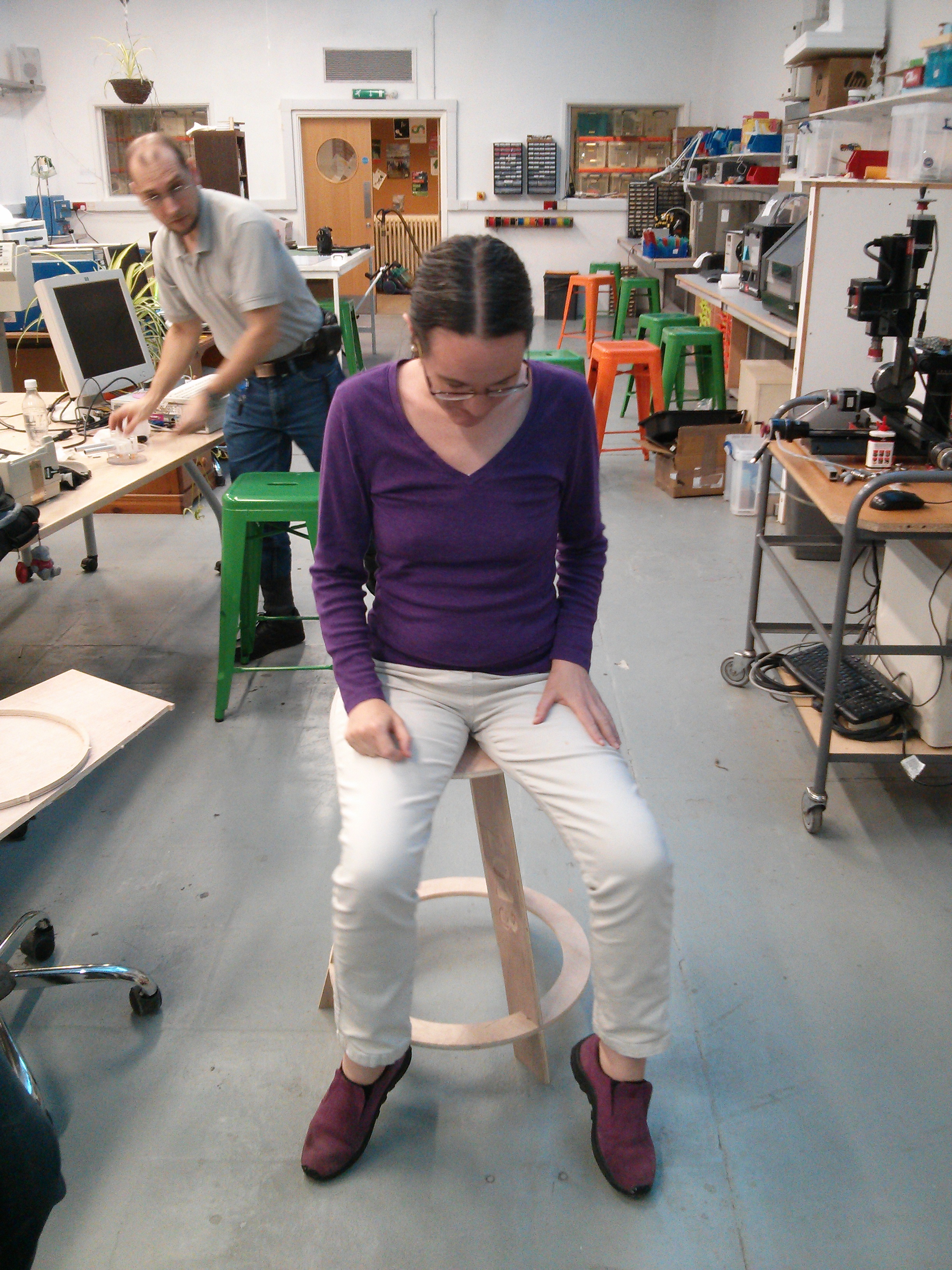
Anne Harrison volunteering to try the wobbly stool of doom
Success! It physically fit together and if you were brave enough you could sit on it. Unfortunately the plywood seemed to flex around the central axis of rotation in a rather alarming way, fine if you are under 70 kilos but not giving the impression of security most people want from their seating.

Ok, lets try with five legs instead of three (at least we can reuse the existing three legs)...nope still not good enough and another 10 gone.

18mm Plywood stool design
The others in the space suggested a few ideas to improve matters and the one I selected was to use 18mm plywood instead of 12mm, this should improve rigidity. There was a brief pause in proceedings to discover 18mm sheet is actually 17.7mm and needs a 17.5mm slot to make the interference fit work.

Completed 18mm stool
A swift redesign later altering the seat radius, gap, ring width and leg height to accommodate the new material and we have version 4 and it works without caveat. Tested up to 150Kg load without trouble, there is a small amount of flex still but nothing that feels worrying.

I finished the stool by rounding the seat top edge with a ball bearing rounding bit in a manual router and applying a couple of coats of gloss acrylic varnish. Finished stool is now doing service at the space.

In conclusion the final design allows someone with a CNC router to create a useful 580mm high fixed stool for 7.50 in timber plus cutter wear and varnish so maybe 8.50 total.

You can actually get five legs and a seat/ring out of a 1220x606 sheet and with intelligent arrangement a single 1220x2440 sheet will probably yield five or possibly six stools in total

I am making the design files of the proven 18mm version available (heck they are all there...but you have been warned, none of the other solutions produce a satisfactory result) under the MIT licence so anyone can reproduce. More pretty pictures are also available.

Matt Zimmerman: Scaling Human Systems: Roles and Responsibilities

This is part 5 in a series on organizational design and growth. What it means

Each of us has a job to do, probably more than one, and our teammates should know what they are. Why it s important

Roles are a kind of standing commitment we make to each other. They re a way of dividing up work which is easy to understand and simple to apply. Utilizing this tool will make it easier for us to coordinate our day to day work, and manage the changes and growth we re going through. Old Status Quo

Roles are vague or nonexistent. Management roles in particular are probably not well understood. Many people juggle multiple roles, all of which are implicit. Moving to a new team means learning from scratch what other people do. People take responsibility for tasks and decisions largely on a case-by-case basis, or based on implicit knowledge of what someone does (or doesn t do). In many cases, there is only one person in the company who knows how to perform a certain function. When someone leaves or goes on vacation, gaps are left behind. New Status Quo

Each individual has a clear understanding of the scope of their job. We have a handful of well defined roles, which are used by multiple teams and have written definitions. People who are new or transfer between teams have a relatively easy time understanding what the people around them are doing. Many day to day responsibilities are defined by roles, and more than one person can fill that role. When someone leaves a team, another person can cover their critical roles. Behaviors that help

Obstacles that stand in our way

26 August 2013

Vincent Fourmond: Announcing version 0.5 of ctioga2

I've just released version 0.5 of ctioga2, my plotting program. While there is still quite a lot of improvements I'd like to get in some day, the past few days have seen a lot of activity. Probably the most important change is the new space-separated command file format, much simpler than the old one (which is still supported, although marked clearly as deprecated now). Another important change for the users is the large improvement of error reporting: in most cases, ctioga2 pinpoints the exact location where things go wrong; it also features reporting on LaTeX errors. The last important feature is also the introduction of real contour plots, such as the one below, coming from the documentation:
Now, I feel like ctioga2 is coming close to gnuplot in terms of features and ease of use. Part of my plans for the website is to create a gnuplot mockup gallery, in which I would take as many examples from the gnuplot website as possible (ie all the ones ctioga2 can reproduce) and compare the code and look of both.Among features I'd like to implement for ctioga2, here are the ones that I think are the most important ones:But maybe you have other ideas you'd like to see before that ?

Steve Kemp: Lack of referrers on github is an annoyance

Github is a nice site, and I routinely monitor a couple of projects there. I've also been using it to host a couple of my own projects, initially as an experiment, but since then because it has been useful to get followers and visibility. I'm a little disappointed that you don't get to see more data though; today my sysadmin utilities repository received several new "stars". Given that these all occurred "an hour ago" it seems likely that they we referenced in a comment somewhere on LWN, hacker news, or similar. Unfortunately I've no clue where that happened, or if it was a coincidence. I expect this is more of a concern for those users who use github-pages, where having access to the access.logs would be more useful still. But ..

25 August 2013

Matthias Klumpp: Some Tanglu updates

Tanglu Logo (big)Long time since I published the last update about Tanglu. So here is a short summary about what we did meanwhile (even if you don t hear that much, there is lots of stuff going on!) Better QA in the archive We now use a modified version of Debian s Britney tool to migrate packages from the newly-created staging suite to our current development branch aequorea . This ensures that all packages are completely built on all architectures and don t break other packages. New uploads and syncs/merges now happen through the staging area and can be tested there as well as being blocked on demand, so our current aequorea development branch stays installable and usable for development. People who want the *very* latest stuff, can embed the staging-sources into their sources.list (but we don t encourage you to do that). Improved syncs from Debian The Synchrotron toolset we use to sync packages with Debian recently gained the ability to sync packages using regular expressions. This makes it possible to sync many packages quickly which match a pattern. Tons of infrastructure bugfixes The infrastructure has been tweaked a lot to remove quirks, and it now works quite smoothly. Also, all Debian tools now work flawless in the Tanglu environment. A few issues are remaining, but nothing really important is affected anymore (and some problems are merely cosmetic). Long term we plan to replace the Jenkins build-infrastructure with the software which is running Paul Tagliamontes debuild.me (only the buildd service, the archive will still be managed by dak). This requires lots of work, but will result in software not only usable by Tanglu, but also by Debian itself and everyone who wants a build-service capable of building a Debian-distro. KDE 4.10 and GNOME 3.8 Tanglu now offers KDE 4.10 by default, a sync of GNOME 3.8 is currently in progress. The packages will be updated depending on our resources and otherwise just be synced from Debian unstable/experimental (and made working for Tanglu). systemd 204 & libudev1 Tanglu now offers systemd 204 as default init system, and we transitioned the whole distribution to the latest version of udev. This even highlighted a few issues which could be fixed before the latest systemd reached Debian experimental. The udev transition went nicely, and hopefully Debian will fix bug#717418 too, soon, so both distributions run with the same udev version (which obviously makes things easier for Tanglu ^^) Artwork We now have a plymouth-bootscreen and wallpapers and stuff is in progress :-) Alpha-release & Live-CD ? This is what we are working on we have some issues in creating a working live-cd, since live-build does have some issues with our stack. We are currently resolving issues, but because of the lack of manpower, this is progressing slowly (all contributors also work on other FLOSS projects and of course also have their work :P ) As soon as we have working live-media, we can do a first alpha release and offer installation media. You! Tanglu is a large task. And we need every help we can get, right now especially technical help from people who can build packages (Debian Developers/Maintainers, Ubuntu developers, etc.) We especially need someone to take care of the live-cd. But also the website needs some help, and we need more artwork or improved artwork ;-) In general, if you have an idea how to make Tanglu better (of course, something which matches it s goals :P ) and want to realize it, just come back to us! You can reach us on the mailiglists (tanglu-project for stuff related to the project, tanglu-devel for development of the distro) or in #tanglu / #tanglu-devel (on Freenode).

23 August 2013

Thorsten Glaser: FrOSCon 2013, or, why is there no MirBSD exhibit?

FrOSCon is approaching, and all MirBSD developers will attend but why s there no MirBSD exhibit? The answer to that is a bit complex. First let s state that of course we will participate in the event as well as the Open Source world. We ll also be geocaching around the campus with other interested (mostly OSS) people (including those we won for this sport) and helping out other OSS projects we ve become attached to. MirOS BSD, the operating system, is a niche system. The conference on the other hand got younger and more mainstream. This means that almost all conference visitors do not belong to the target group of MirOS BSD which somewhat is an ancient solution : the most classical BSD around (NetBSD loses because they have rc.d and PAM and lack sendmail(8), sorry guys, your attempt at being not reformable doesn t count) and running on restricted hardware (such as my 486SLC with 12 MiB RAM) and exots (SPARCstation). It s viable even as developer workstation (if your hardware is supported otherwise just virtualise it) but its strength lies with SPARC support and embedded x86 . And being run as virtual machine: we re reportedly more stable and more performant than OpenBSD. MirBSD is not cut off from modern development and occasionally takes a questionable but justified choice (such as using 16-bit Unicode internally) or a weird-looking but beneficial one (such as OPTU encoding saving us locale(1) hassles) or even acts as technological pioneer (64-bit time_t on ILP32 platforms) or, at least, is faster than OpenBSD (newer GNU toolchain, things like that), but usually more conservatively, and yes, this is by design, not by lack of manpower, most of the time. The MirPorts Framework, while technically superiour in enough places, is something that just cannot happen without manpower. I (tg@) am still using it exclusively, continuing to update ports I use and occasionally creating new ones (mupdf is in the works!), but it s not something I d recommend someone (other than an Mac OSX user) to use on a n n-MirBSD system (Interix is not exactly thriving either, and the Interix support was only begun; other OSes are not widely tested). The MirBSD Korn Shell is probably the one thing I will be remembered for. But I have absolutely no idea how one would present it on a booth at such an exhibition. A talk is much more likely. So no on that front too. jupp, the editor which sucks less, is probably something that does deserve mainstream interest (especially considering Natureshadow is using it while teaching computing to kids) but probably more in a workshop setting. And booth space is precious enough in the FH so I think that d be unfair. All the other subprojects and side projects Benny and I have, such as mir c , josef stalin, FreeWRT, Lunix Ewe, Shellsnippets, the fonts, etc. are interesting but share few, if any, common ground. Again, this does not match the vast majority of visitors. While we probably should push a number of these more, but a booth isn t it here, either. MirOS Linux ( MirLinux ) and MirOS Windows are, despite otherwise-saying rumours called W*k*p*d*a, only premature ideas that will not really be worked on (though MirLinux concepts are found in mir c and stalin). As you can see, despite all developers having full-time dayjobs, The MirOS Project is far from being obsolete. We hope that our website visitors understand our reasons to not have an exhibition booth of our own (even if the SPARCstation makes for a way cool one, it s too heavy to lift all the time), and would like to point out that there are several other booths (commercial ones, as well as OSS ones such as AllBSD, Debian and (talking to) others) and other itineries we participate in. This year both Benny and I have been roped into helping out the conference itself, too (not exactly unvoluntarily though). The best way to talk to us is IRC during regular European geek hours (i.e. until way too late into the night which Americans should benefit from), semi-synchronously, or mailing lists. We sort of expect you to not be afraid to RTFM and look up acronyms you don t understand; The MirOS Project is not unfriendly but definitely not suited for your proverbial Aunt Tilly, newbies, desktop users, and people who aren t at least somewhat capable of using written English (this is by design).

Justus Winter: No noweb anymore...

... which is probably a good thing. But here is the boot log you all have been waiting for:
start ext2fs: Hurd server bootstrap: ext2fs[device:hd0s1] exec init proc auth
INIT: version 2.88 booting
Using makefile-style concurrent boot in runlevel S.
Activating swap...done.
Checking root file system...fsck from util-linux 2.20.1
hd2 : tray open or drive not ready
end_request: I/O error, dev 02:00, sector 0
/dev/hd0s1: clean, 44693/181056 files, 291766/723200 blocks
done.
Activating lvm and md swap...(default pager): Already paging to partition hd0s5!
done.
Checking file systems...fsck from util-linux 2.20.1
hd2 : tray open or drive not ready
end_request: I/O error, dev 02:00, sector 0
done.
Cleaning up temporary files... /tmp.
Mounting local filesystems...done.
Activating swapfile swap...(default pager): Already paging to partition hd0s5!
done.
df: Warning: cannot read table of mounted file systems: No such file or directory
Cleaning up temporary files....
Configuring network interfaces...Internet Systems Consortium DHCP Client 4.2.2
Copyright 2004-2011 Internet Systems Consortium.
All rights reserved.
For info, please visit https://www.isc.org/software/dhcp/
Listening on Socket//dev/eth0
Sending on   Socket//dev/eth0
*** stack smashing detected ***: dhclient terminated
Aborted
Failed to bring up /dev/eth0.
done.
Cleaning up temporary files....
Setting up X socket directories... /tmp/.X11-unix /tmp/.ICE-unix.
INIT: Entering runlevel: 2
Using makefile-style concurrent boot in runlevel 2.
Starting enhanced syslogd: rsyslogd.
Starting deferred execution scheduler: atd.
Starting periodic command scheduler: cron.
Starting system message bus: dbusFailed to set socket option"/var/run/dbus/system_bus_socket": Protocol not available.
Starting OpenBSD Secure Shell server: sshd.
unexpected ACK from keyboard
GNU 0.3 (debian) (console)
login: root
[...]
root@debian:~# ifup /dev/eth0
Internet Systems Consortium DHCP Client 4.2.2
Copyright 2004-2011 Internet Systems Consortium.
All rights reserved.
For info, please visit https://www.isc.org/software/dhcp/
Listening on Socket//dev/eth0
Sending on   Socket//dev/eth0
*** stack smashing detected ***: dhclient terminated
Aborted
Failed to bring up /dev/eth0.
root@debian:~# dhclient -v -pf /run/dhclient.-dev-eth0.pid -lf /var/lib/dhcp/dhclient.-dev-eth0.leases /dev/eth0
Internet Systems Consortium DHCP Client 4.2.2
Copyright 2004-2011 Internet Systems Consortium.
All rights reserved.
For info, please visit https://www.isc.org/software/dhcp/
Listening on Socket//dev/eth0
Sending on   Socket//dev/eth0
*** stack smashing detected ***: dhclient terminated
Aborted
root@debian:~# dhclient -pf /run/dhclient.-dev-eth0.pid -lf /var/lib/dhcp/dhclient.-dev-eth0.leases /dev/eth0
root@debian:~# ifup /dev/eth0
Internet Systems Consortium DHCP Client 4.2.2
Copyright 2004-2011 Internet Systems Consortium.
All rights reserved.
For info, please visit https://www.isc.org/software/dhcp/
Listening on Socket//dev/eth0
Sending on   Socket//dev/eth0
DHCPREQUEST on /dev/eth0 to 255.255.255.255 port 67
DHCPACK from 10.0.2.2
bound to 10.0.2.15 -- renewal in 34108 seconds.
ps: comm: Unknown format spec
root@debian:~# halt
Broadcast message from root@debian (console) (Fri Aug 23 19:42:19 2013):
The system is going down for system halt NOW!
INIT: Switching to runlevel: 0root@debian:~#
INIT: Sending processes the TERM signal
INIT: Sending processes the KILL signal
Using makefile-style concurrent boot in runlevel 0.
Stopping deferred execution scheduler: atd.
task c10f53f8 deallocating an invalid port 2098928, most probably a bug.
Asking all remaining processes to terminate...done.
All processes ended within 1 seconds...done.
Stopping enhanced syslogd: rsyslogd.
Deconfiguring network interfaces...Internet Systems Consortium DHCP Client 4.2.2
Copyright 2004-2011 Internet Systems Consortium.
All rights reserved.
For info, please visit https://www.isc.org/software/dhcp/
Listening on Socket//dev/eth0
Sending on   Socket//dev/eth0
DHCPRELEASE on /dev/eth0 to 10.0.2.2 port 67
/dev/eth0 (2):
  inet address  0.0.0.0
  netmask       255.255.255.0
  broadcast     10.0.2.255
  flags         BROADCAST ALLMULTI MULTICAST
  mtu           1500
done.
Deactivating swap...swapoff: /dev/hd0s5: 177152k swap space
done.
Unmounting weak filesystems...umount: /etc/mtab: Warning: duplicate entry for device /dev/hd0s1 (/servers/socket/26)
umount: /etc/mtab: Warning: duplicate entry for device /dev/hd0s1 (/dev/cons)
umount: could not find entry for: /dev/cons
umount: could not find entry for: /servers/socket/26
done.
mount: cannot remount /: Device or resource busy
Will now halt.
store a new irq 11init: notifying pfinet of shutdown...init: notifying tmpfs swap of shutdown...init: notifying tmpfs swap of shutdown...init: notifying tmpfs swap of shutdown...init: notifying ext2fs device:hd0s1 of shutdown...init: halting Mach (flags 0x8)...
In tight loop: hit ctl-alt-del to reboot
With some tiny patches for ifupdown I've been able to resolve network related issues. All of them? Of course not, funny thing about developing for the Hurd is that once you fix one thing, then some other thing or code path is executed that has never been run on Hurd before, and therefore something else breaks. In this case I fixed ifupdown to generate valid names for the pid file and leases file and all of the sudden dhclient starts dying. Funny thing about that is, if one drops the -v flag from the dhclient invocation as I did it above, the crash isn't triggered and once the lease file has been successfully written, it is safe to add the -v flag again. Not yet sure what goes on there, then again, looking at the source of isc-dhcp-client it is not so surprising that it crashes :/ When I first looked at ifupdown it was written in noweb, a literate programming tool. It is an interesting idea, even more so since (classic) c can be very verbose and cryptic. But it decouples the control flow from the structure of the program, which makes patching it quite a challenge since it is not as obvious where the changes have to go in. This is how ifupdown looked some weeks ago:
% wc --lines ifupdown.nw
6123 ifupdown.nw
% pdftk ifupdown.pdf dump_data   grep NumberOfPages
NumberOfPages: 113
The ifupdown.nw is the noweb source, from which seven .c, four .h, two .pl and one Makefile are generated. It also contains a redicioulus amount of documentation, to the point that the authors at several points did not now what to write and just drop some nonsensical lines into the file. The source also compiles to a 113 page pdf file, that contains all of the documentation and all of the code, not at all in the order that one would expect a program to be written, but in the order the authors chose to structure the documentation. Fortunately for me the maintainer decided to drop the noweb source and to add the generated files to the source control system. This made my job much easier :) So here are the patches I published this week: I must admit that I do not know exactly what I will do next week. Obviously fixing the dhclient crash would be nice, I'll look into that. But I'm surely find some useful thing to do.

Gregor Herrmann: DebConf 2013

[still no pictures here, feel free to go to gallery.debconf.org]. After my report about DebCamp, & after being home for 5 days now, here are some thoughts about DebConf13: First of all, I really enjoyed being there, & this was one of the best DebConfs for me so far. An important reason for this was the place: Le Camp was in my opinion the best DebConf venue ever (I've been to), with everything & everyone in one place, & still enough space (especially outdoors space!) for work & relaxing. Kudos to the local team for finding this spot, & for sticking to it despite some criticism. In general, I'd like to say thanks to the local team for the perfect organisation of all aspects you did a great job! What else did I enjoy? As usual, meeting old friends & making new ones was an important part. It was great to see people I've worked together with on-line in person for the first time, & also to get to know new people. Debian not only produces a great operating system, it also is an awesome community! Speaking of which: I attended quite a few seesions from the Community and Team tracks, & it's good to see that lots of energy & thoughts are going into improving how we deal with new or existing contributors. Like each year, we had the "use Perl;" BoF, the annual meeting of the Debian Perl Group, where we discussed various topics around our tasks, tools, & workflow. As each year, in a very friendly & collaborative atmosphere. Besides that, I attended talks about systemd & upstart; the first one disappointed me, since it felt more like a sales pitch than a technical talk & the presenter come across alot like "I know better than you what's good for you", the latter was better but tried to avoid upstart's main issue, the infamous Canonical Contributor License Agreement; of course the audience raised this topic in the Q&A part afterwards. Rock vs. hard place Other interesting topics were what Debian can learn from Ubuntu's QA processes for its own testing migration (mail from the Release Team pending, AFAIK); lots of git stuff, & especially the "birth" of dgit, a tool to treat the Debian archive as a git remote. If this gets traction, it could be a revolution in packaging! The lintian BoF encouraged me further to try to create some pkg-perl specific checks, & then there was jenkins, piuparts, autopkgtest, etc. On Friday we celebrated Debian's 20th birthday with a huge Krem nita/Cr meschnitte/mille-feuille. & with the Poetry Night at the campfire. Usually I'd close with "See you next year in Portland!"; but since it seems like the local team has decided to scratch DebCamp (which they only said after being asked in the Q&A after their presentation), I'm not sure how attractive this really is for me We'll see. Thanks again to everyone who made this DebConf possible!

22 August 2013

Matthew Garrett: Re: Default offerings, target audiences, and the future of Fedora

Eric (a fellow Fedora board member) has a post describing his vision for what Fedora as an end goal should look like. It's essentially an assertion that since we have no idea who our users are or what they want, we should offer them everything on an equal footing.

Shockingly enough, I disagree.

At the most basic level, the output of different Special Interest Groups is not all equal. We've had issues over the past few releases where various spins have shipped in a broken state, because the SIG responsible for producing them doesn't have the resources to actually test them. We're potentially going to end up shipping F20 with old Bluetooth code because the smaller desktops aren't able to port to the new API in time[1]. Promoting these equally implies that they're equal, and doing so when we know it isn't the case is a disservice to our users.

But it's not just about our users. Before I joined the Fedora project, I'd worked on both Debian and Ubuntu. Debian is broadly similar to the current state of Fedora - no strong idea about what is actually being produced, and a desire among many developers to cater to every user's requirements. Ubuntu's pretty much the direct opposite, with a strongly defined goal and a willingness to sacrifice some use cases in order to achieve that goal.

This leads to an interestingly different social dynamic. Ubuntu contributors know what they're working on. If a change furthers the well-defined aim of the project, that change happens. Moving from Ubuntu to Fedora was a shock to me - there were several rough edges in Fedora that simply couldn't be smoothed out because fixing them for one use case would compromise another use case, and nobody could decide which was more important[2]. It's basically unthinkable that such a situation could arise in Ubuntu, not just because there was a self appointed dictator but because there was an explicit goal and people could prioritise based on that[3].

Bluntly, if you have a well-defined goal, people are more likely to either work towards that goal or go and do something else. If you don't, people will just do whatever they want. The risk of defining that goal is that you'll lose some of your existing contributors, but the benefit is that the existing contributors will be more likely to work together rather than heading off in several different directions.

But perhaps more importantly, having a goal can attract people. Ubuntu's Bug #1 was a solid statement of intent. Being freer than Microsoft wasn't enough. Ubuntu had to be better than Microsoft products on every axis, and joining Ubuntu meant that you were going to be part of that. Now it's been closed and Ubuntu's wandered off into convergence land, and signing up to spend your free time on producing something to help someone sell phones is much less compelling than doing it to produce a product you can give to your friends.

Fedora should be the obvious replacement, but it's not because it's unclear to a casual observer what Fedora actually is. The website proudly leads with a description of Fedora as a fast, stable and powerful operating system, but it's obvious that many of the community don't think of Fedora that way - instead it's a playground to produce a range of niche derivatives, with little consideration as to whether contributing to Fedora in that way benefits the project as a whole. Codifying that would actively harm our ability to produce a compelling product, and in turn reduce our ability to attract new contributors even further.

Which is why I think the current proposal to produce three first-class products is exciting. Offering several different desktops on the download page is confusing. Offering distinct desktop, server and cloud products isn't. It makes it clear to our users what we care about, and in turn that makes it easier for users to be excited about contributing to Fedora. Let's not make the mistake of trying to be all things to all people.

[1] Although clearly in this case the absence of a stable ABI in BlueZ despite it having had a dbus interface for the best part of a decade is a pretty fundamental problem.
[2] See the multi-year argument over default firewall rules and the resulting lack of working SMB browsing or mDNS resolving
[3] To be fair, one of the reasons I was happy to jump ship was because of the increasingly autocratic way Ubuntu was being run. By the end of my involvement, significant technical decisions were being made in internal IRC channels - despite being on the project's Technical Board, I had no idea how or why some significant technical changes were being made. I don't think this is a fundamental outcome of having a well-defined goal, though. A goal defined by the community (or their elected representatives) should function just as well.

comment count unavailable comments

Jose Luis Rivas: Starting a Raspbery Pi without a display

Recently (actually 3 weeks ago) I bought a Raspberry Pi for myself and it wasn't until today that I power it on by the first time. Call it RealLife for simplicity. Anyway, one of my first issues was that I do not own any display with RCA or HDMI inputs, and all I have is a router that works as my WiFi hotspot as well. Since this starter kit comes with Raspbian by default I made some research and found that the default user:password is pi:raspberry, ssh-server is on by default and the network interface eth0 tries to grab an IP automatically via DHCP. So starting my Raspberry Pi was as easy as connect a wire to my device and the router, then a quick nmap -sP 192.168.0.0/24 and there it was, under the hostname raspberry my brand new raspberry. After a ssh pi@192.168.0.X a nice raspi-conf was receiving me to start setting up my device.

Matthew Garrett: If you ever use text VTs, don't run XMir right now

It'd be easy to assume that in a Mir-based world, the Mir server receives input events and hands them over to Mir clients. In fact, as I described here, XMir uses standard Xorg input drivers and so receives all input events directly. This led to issues like the duplicate mouse pointer seen in earlier versions of XMir - as well as the pointer being drawn by XMir, Mir was drawing its own pointer.

But there's also some more subtle issues. Mir recently gained a fairly simple implementation of VT switching, simply listening for input events where a function key is hit while the ctrl and alt modifiers are set[1]. It then performs the appropriate ioctl on /dev/console and the kernel switches the VT. The problem here is that Mir doesn't tell XMir that this has happened, and so XMir still has all of its input devices open and still pays attention to any input events.

This is pretty easy to demonstrate. Open a terminal or text editor under Xmir and make sure it has focus. Hit ctrl+alt+f1 and log in. Hit ctlr+alt+f7 again. Your username and password will be sitting in the window.

This is Launchpad bug 1192843, filed on the 20th of June. A month and a half later, Mir was added to the main Ubuntu repositories. Towards the bottom, there's a note saying "XMir always listening to keyboard, passwords may appear in other X sessions". This is pretty misleading, since "other X sessions" implies that it's only going to happen if you run multiple X sessions. Regardless, it's a known bug that can potentially leak user passwords.

So it's kind of odd that that's the only mention of it, hidden in a disused toilet behind a "Doesn't work on VESA" sign. If you follow the link to installation instructions you get this page which doesn't mention the problem at all. Now, to be fair, it doesn't mention any of the other problems with Mir either, but the other problems merely result in things not working rather than your password ending up in IRC.

This being developmental software isn't an excuse. There's been plenty of Canonical-led publicity about Mir and people are inevitably going to test it out. The lack of clear and explicit warnings is utterly inexcusable, and these packages shouldn't have landed in the archive until the issue was fixed. This is brutally irresponsible behaviour on the part of Canonical.

So, if you ever switch to a text VT, either make sure you're not running XMir at the moment or make sure that you never leave any kind of network client focused when you switch away from X. And you might want to check IRC and IM logs to make sure you haven't made a mistake already.

[1] One lesser-known feature of X is that the VT switching events are actually configured in the keymap. ctrl+alt+f1 defaults to switching to VT1, but you can remap any key combination to any VT switch event. Except, of course, this is broken in XMir because Mir catches the keystroke and handles it anyway.

comment count unavailable comments

21 August 2013

Joey Hess: experimental multiuser git-annex repository

On the last day of DebConf 13, RichiH and Ganneff and I set up a git-annex repository that all Debian developers have automatic commit access to, and everyone can clone and browse. See the announcement email. This is an interesting repository for me for several reasons. Selfishly, I have always wanted an easy way to download lots of DebConf photos for offline viewing, and never seem to get around to downloading everything from gallery.debconf.org when I have bandwidth. I've also wanted an example repository that shows how git-annex can be used by a large group for collaboration. Finally, the way this repository is set up with an incoming queue is fairly unique. With 430 files in the repository, totaling over 3.5 gigabytes (which doesn't include all the talk videos that are #included into it), and at least 18 people having cloned the repository so far, the debconf-share repository is well on its way to being a sort of large git-annex repository. Just running git annex whereis is interesting; many of the files already have 8 copies. Some talk videos are more popular than others and you can see when they're downloaded too. But enough snooping.. ;) So far people have uploaded mostly photos and talk slides. Other places exist to store those things in the DebConf infrastructure, but it's nice to have them all available in one tree. I particularly like today's addition of chrysn's files which include the raw photos and hugin files used to produce panoramas, and then pull those together into a postcard which has all its sources available. In my corner of the debconf-share repository, I'm collecting together files regarding the possibly-historic dpkg-source-git-re-re-redesign process that would have otherwise been scattered around various places and probably not all published. This includes an hour long recording of the main design session (recorded with permissions) made by my laptop's mic, which, surprisingly, turned out to be pretty listenable. I will probably have more to say about this process later, once Ian announces dgit. So, we're still seeing how usage develops. I hope that having this available during the next DebConf, and other Debian meetings, rather than only at the end, will further facilitate file sharing and storage. Especially if a fast clone is available right on the DebConf LAN. ;)
The technical details of how the repository is put together are: I've found at least 4 bugs in git-annex as a result of this repository, which is a rather unusual use case. And fixed 2 of them so far..

Rog rio Brito: SNA Acceleration vs. UXA Acceleration

Seeing as recent versions of Xorg have made it into Debian's testing (which I am using right now, instead of my usual sid installations), I decided to see what they would bring me in terms of performance, since they have the SNA acceleration implemented as well as the standard UXA acceleration. Well, I did not have any other tests to perform, but below are the results on my wife's laptop (a Core i5 2410M), when running gtkperf: With UXA
GtkPerf 0.40 - Starting testing: Mon Aug 12 20:33:20 2013
GtkEntry - time:  0.19
GtkComboBox - time:  5.36
GtkComboBoxEntry - time:  3.59
GtkSpinButton - time:  0.60
GtkProgressBar - time:  0.41
GtkToggleButton - time:  0.73
GtkCheckButton - time:  0.48
GtkRadioButton - time:  0.97
GtkTextView - Add text - time: 21.72
GtkTextView - Scroll - time:  2.29
GtkDrawingArea - Lines - time:  6.18
GtkDrawingArea - Circles - time:  6.74
GtkDrawingArea - Text - time:  4.32
GtkDrawingArea - Pixbufs - time:  0.67
 --- 
Total time: 54.25
With SNA
GtkPerf 0.40 - Starting testing: Mon Aug 12 20:36:58 2013
GtkEntry - time:  0.21
GtkComboBox - time:  4.86
GtkComboBoxEntry - time:  2.67
GtkSpinButton - time:  0.59
GtkProgressBar - time:  0.24
GtkToggleButton - time:  0.61
GtkCheckButton - time:  0.51
GtkRadioButton - time:  1.00
GtkTextView - Add text - time: 17.19
GtkTextView - Scroll - time:  1.84
GtkDrawingArea - Lines - time:  2.70
GtkDrawingArea - Circles - time:  2.65
GtkDrawingArea - Text - time:  1.72
GtkDrawingArea - Pixbufs - time:  0.11
 --- 
Total time: 36.91
So, with SNA, the timing that I get are almost 2 times lower, which is superb for a very simple /etc/X11/xorg.conf config file:
Section "Device"
        Identifier "Intel Graphics"
        Driver "intel"
        Option "AccelMethod" "sna"
EndSection
I have not noticed any change, but if drawing graphics faster means that I get a bit more of battery life, then I will be super happy. I still have not tested if this works on my notebook with a Core2Duo T7250. Crossing my fingers so that it does.

Next.

Previous.