Search Results: "cas"

20 October 2012

Ritesh Raj Sarraf: Debian Boot time

<iframe frameborder="0" height="350" src="http://www.youtube.com/embed/cTK3aIZbe2A" width="425"></iframe> In case, the video doesn't show on the page, http://www.youtube.com/watch?v=cTK3aIZbe2A This blog post is to show-off the impressive performance I saw with my machine.
I recently switched to a ThinkPad W530 laptop. It is a fairly recent machine with the following hardware config:
  • Intel(R) Core(TM) i7-3720QM CPU @ 2.60GHz
  • 8 GiB RAM
  • nVIDIA Optimus
  • Samsung SSD Drive
On the software front, I decided to take my chances. Hence:
  • BTRFS File System
  • SystemD Init
The rest is in the video. It is impressive to see how drastically the experience has changed with this combination.
From my limited time spent exploring the machine, all credit goes to the SSD technology.

Vincent Bernat: Network lab with KVM

To experiment with network stuff, I was using UML-based network labs. Many alternatives exist, like GNS3, Netkit, Marionnet or Cloonix. All of them are great viable solutions but I still prefer to stick to my minimal home-made solution with UML virtual machines. Here is why: The use of UML had some drawbacks: However, UML features HostFS, a filesystem providing access to any part of the host filesystem. This is the killer feature which allows me to not use any virtual disk image and to get access to my home directory right from the guest. I discovered recently that KVM provided 9P, a similar filesystem on top of VirtIO, the paravirtualized IO framework.

Setting up the lab The setup of the lab is done with a single self-contained shell file. The layout is similar to what I have done with UML. I will only highlight here the most interesting steps.

Booting KVM with a minimal kernel My initial goal was to experiment with Nicolas Dichtel s IPv6 ECMP patch. Therefore, I needed to configure a custom kernel. I have started from make defconfig, removed everything that was not necessary, added what I needed for my lab (mostly network stuff) and added the appropriate options for VirtIO drivers:
CONFIG_NET_9P_VIRTIO=y
CONFIG_VIRTIO_BLK=y
CONFIG_VIRTIO_NET=y
CONFIG_VIRTIO_CONSOLE=y
CONFIG_HW_RANDOM_VIRTIO=y
CONFIG_VIRTIO=y
CONFIG_VIRTIO_RING=y
CONFIG_VIRTIO_PCI=y
CONFIG_VIRTIO_BALLOON=y
CONFIG_VIRTIO_MMIO=y
No modules. Grab the complete configuration if you want to have a look. From here, you can start your kernel with the following command ($LINUX is the appropriate bzImage):
kvm \
  -m 256m \
  -display none \
  -nodefconfig -no-user-config -nodefaults \
  \
  -chardev stdio,id=charserial0,signal=off \
  -device isa-serial,chardev=charserial0,id=serial0 \
  \
  -chardev socket,id=con0,path=$TMP/vm-$name-console.pipe,server,nowait \
  -mon chardev=con0,mode=readline,default \
  \
  -kernel $LINUX \
  -append "init=/bin/sh console=ttyS0"
Of course, since there is no disk to boot from, the kernel will panic when trying to mount the root filesystem. KVM is configured to not display video output (-display none). A serial port is defined and uses stdio as a backend1. The kernel is configured to use this serial port as a console (console=ttyS0). A VirtIO console could have been used instead but it seems this is not possible to make it work early in the boot process. The KVM monitor is setup to listen on an Unix socket. It is possible to connect to it with socat UNIX:$TMP/vm-$name-console.pipe -.

Initial ramdisk UPDATED: I was initially unable to mount the host filesystem as the root filesystem for the guest directly by the kernel. In a comment, Josh Triplett told me to use /dev/root as the mount tag to solve this problem. I keep using an initrd in this post but the lab on Github has been updated to not use one. Here is how to build a small initial ramdisk:
# Setup initrd
setup_initrd()  
    info "Build initrd"
    DESTDIR=$TMP/initrd
    mkdir -p $DESTDIR
    # Setup busybox
    copy_exec $($WHICH busybox) /bin/busybox
    for applet in $($ DESTDIR /bin/busybox --list); do
        ln -s busybox $ DESTDIR /bin/$ applet 
    done
    # Setup init
    cp $PROGNAME $ DESTDIR /init
    cd "$ DESTDIR " && find .   \
       cpio --quiet -R 0:0 -o -H newc   \
       gzip > $TMP/initrd.gz
 
The copy_exec function is stolen from the initramfs-tools package in Debian. It will ensure that the appropriate libraries are also copied. Another solution would have been to use a static busybox. The setup script is copied as /init in the initial ramdisk. It will detect it has been invoked as such. If it was omitted, a shell would be spawned instead. Remove the cp call if you want to experiment manually. The flag -initrd allows KVM to use this initial ramdisk.

Root filesystem Let s mount our root filesystem using 9P. This is quite easy. First KVM needs to be configured to export the host filesystem to the guest:
kvm \
  $ PREVIOUS_ARGS  \
  -fsdev local,security_model=passthrough,id=fsdev-root,path=$ ROOT ,readonly \
  -device virtio-9p-pci,id=fs-root,fsdev=fsdev-root,mount_tag=rootshare
$ ROOT can either be / or any directory containing a complete filesystem. Mounting it from the guest is quite easy:
mkdir -p /target/ro
mount -t 9p rootshare /target/ro -o trans=virtio,version=9p2000.u
You should find a complete root filesystem inside /target/ro. I have used version=9p2000.u instead of version=9p2000.L because the later does not allow a program to mount() a host mount point2. Now, you have a read-only root filesystem (because you don t want to mess with your existing root filesystem and moreover, you did not run this lab as root, did you?). Let s use an union filesystem. Debian comes with AUFS while Ubuntu and OpenWRT have migrated to overlayfs. I was previously using AUFS but got errors on some specific cases. It is still not clear which one will end up in the kernel. So, let s try overlayfs. I didn t find any patchset ready to be applied on top of my kernel tree. I was working with David Miller s net-next tree. Here is how I have applied the overlayfs patch on top of it:
$ git remote add torvalds git://git.kernel.org/pub/scm/linux/kernel/git/torvalds/linux-2.6.git
$ git fetch torvalds
$ git remote add overlayfs git://git.kernel.org/pub/scm/linux/kernel/git/mszeredi/vfs.git
$ git fetch overlayfs
$ git merge-base overlayfs.v15 v3.6
4cbe5a555fa58a79b6ecbb6c531b8bab0650778d
$ git checkout -b net-next+overlayfs
$ git cherry-pick 4cbe5a555fa58a79b6ecbb6c531b8bab0650778d..overlayfs.v15
Don t forget to enable CONFIG_OVERLAYFS_FS in .config. Here is how I configured the whole root filesystem:
info "Setup overlayfs"
mkdir /target
mkdir /target/ro
mkdir /target/rw
mkdir /target/overlay
# Version 9p2000.u allows to access /dev, /sys and mount new
# partitions over them. This is not the case for 9p2000.L.
mount -t 9p        rootshare /target/ro      -o trans=virtio,version=9p2000.u
mount -t tmpfs     tmpfs     /target/rw      -o rw
mount -t overlayfs overlayfs /target/overlay -o lowerdir=/target/ro,upperdir=/target/rw
mount -n -t proc  proc /target/overlay/proc
mount -n -t sysfs sys  /target/overlay/sys
info "Mount home directory on /root"
mount -t 9p homeshare /target/overlay/root -o trans=virtio,version=9p2000.L,access=0,rw
info "Mount lab directory on /lab"
mkdir /target/overlay/lab
mount -t 9p labshare /target/overlay/lab -o trans=virtio,version=9p2000.L,access=0,rw
info "Chroot"
export STATE=1
cp "$PROGNAME" /target/overlay
exec chroot /target/overlay "$PROGNAME"
You have to export your $ HOME and the lab directory from host:
kvm \
  $ PREVIOUS_ARGS  \
  -fsdev local,security_model=passthrough,id=fsdev-root,path=$ ROOT ,readonly \
  -device virtio-9p-pci,id=fs-root,fsdev=fsdev-root,mount_tag=rootshare \
  -fsdev local,security_model=none,id=fsdev-home,path=$ HOME  \
  -device virtio-9p-pci,id=fs-home,fsdev=fsdev-home,mount_tag=homeshare \
  -fsdev local,security_model=none,id=fsdev-lab,path=$(dirname "$PROGNAME") \
  -device virtio-9p-pci,id=fs-lab,fsdev=fsdev-lab,mount_tag=labshare

Network You know what is missing from our network lab? Network setup. For each LAN that I will need, I spawn a VDE switch:
# Setup a VDE switch
setup_switch()  
    info "Setup switch $1"
    screen -t "sw-$1" \
        start-stop-daemon --make-pidfile --pidfile "$TMP/switch-$1.pid" \
        --start --startas $($WHICH vde_switch) -- \
        --sock "$TMP/switch-$1.sock"
    screen -X select 0
 
To attach an interface to the newly created LAN, I use:
mac=$(echo $name-$net   sha1sum   \
            awk ' print "52:54:" substr($1,0,2) ":" substr($1, 2, 2) ":" substr($1, 4, 2) ":" substr($1, 6, 2) ')
kvm \
  $ PREVIOUS_ARGS  \
  -net nic,model=virtio,macaddr=$mac,vlan=$net \
  -net vde,sock=$TMP/switch-$net.sock,vlan=$net
The use of a VDE switch allows me to run the lab as a non-root user. It is possible to give Internet access to each VM, either by using -net user flag or using slirpvde on a special switch. I prefer the latest solution since it will allow the VM to speak to each others.

Debugging This lab was mostly done to debug both the kernel and Quagga. Each of them can be debugged remotely.

Kernel debugging While the kernel features KGDB, its own debugger, compatible with GDB, it is easier to use the remote GDB server built inside KVM.
kvm \
  $ PREVIOUS_ARGS  \
  -gdb unix:$TMP/vm-$name-gdb.pipe,server,nowait
To connect to the remote GDB server from the host, first locate the vmlinux file at the root of the source tree and run GDB on it. The kernel has to be compiled with CONFIG_DEBUG_INFO=y to get the appropriate debugging symbols. Then, use socat with the Unix socket to attach to the remote debugger:
$ gdb vmlinux
GNU gdb (GDB) 7.4.1-debian
Reading symbols from /home/bernat/src/linux/vmlinux...done.
(gdb) target remote   socat UNIX:$TMP/vm-$name-gdb.pipe -
Remote debugging using   socat UNIX:/tmp/tmp.W36qWnrCEj/vm-r1-gdb.pipe -
native_safe_halt () at /home/bernat/src/linux/arch/x86/include/asm/irqflags.h:50
50   
(gdb)
You can now set breakpoints and resume the execution of the kernel. It is easier to debug the kernel if optimizations are not enabled. However, it is not possible to disable them globally. You can however disable them for some files. For example, to debug net/ipv6/route.c, just add CFLAGS_route.o = -O0 to net/ipv6/Makefile, remove net/ipv6/route.o and type make.

Userland debugging To debug a program inside KVM, you can just use gdb as usual. Your $HOME directory is available and it should be therefore straightforward. However, if you want to perform some remote debugging, that s quite easy. Add a new serial port to KVM:
kvm \
  $ PREVIOUS_ARGS  \
  -chardev socket,id=charserial1,path=$TMP/vm-$name-serial.pipe,server,nowait \
  -device isa-serial,chardev=charserial1,id=serial1
Starts gdbserver in the guest:
$ libtool execute gdbserver /dev/ttyS1 zebra/zebra
Process /root/code/orange/quagga/build/zebra/.libs/lt-zebra created; pid = 800
Remote debugging using /dev/ttyS1
And from the host, you can attach to the remote process:
$ libtool execute gdb zebra/zebra
GNU gdb (GDB) 7.4.1-debian
Reading symbols from /home/bernat/code/orange/quagga/build/zebra/.libs/lt-zebra...done.
(gdb) target remote   socat UNIX:/tmp/tmp.W36qWnrCEj/vm-r1-serial.pipe
Remote debugging using   socat UNIX:/tmp/tmp.W36qWnrCEj/vm-r1-serial.pipe
Reading symbols from /lib64/ld-linux-x86-64.so.2...(no debugging symbols found)...done.
Loaded symbols for /lib64/ld-linux-x86-64.so.2
0x00007ffff7dddaf0 in ?? () from /lib64/ld-linux-x86-64.so.2
(gdb)

Demo For a demo, have a look at the following video (it is also available as an Ogg Theora video).
<iframe frameborder="0" height="270" src="http://www.dailymotion.com/embed/video/xuglsg" width="480"></iframe>

  1. stdio is configured such that signals are not enabled. KVM won t stop when receiving SIGINT. This is important for the usage we want to have.
  2. Therefore, it is not possible to mound a fresh /proc on top of the existing one. I have searched a bit but didn t find why. Any comments on this is welcome.

19 October 2012

Lior Kaplan: LibreOffice conference 2012 (day 2)

I ve started the morning with the easy hacks for non developers talks, which for my opinion lacked some code related tasks that even non developers can do like fixing translation problems in the source (in the English strings), fixing some simple logic bugs which doesn t require reading complex code (e.g. traversing records and first/last special cases). The other options mentioned in the talk aren t less important, but I think people shouldn t be afraid reading/touching the code to some level even with very limited coding skills. Later I ve used Rene s 3.7/master builds for Debian to verify two RTL bugs (fdo#43210, fdo#44925) fixed by the Motah guys from Saudi Arabia. After the verification, I pushed the changes to the 3.6 branch (should appear in 3.6.4).
Katya, which I ve met in the last conference, told me see watched my talked remotely, and took interest in RTL ui forcing right alignment to non aligned text. While reproducing the bug on her computer we were able to narrow the problem a bit, to be related to the locale and not only to the RTL interface. Till the end of the day she d identified the problem in the odp file and I hope a fix will be available by tomorrow. Jan (kendy) had a good progress with fdo#44657 (RTL problem #1). Checking the fix is quite confusing, and we had to use two laptops to understand and compare the right and desired behavior. Hopefully this problem will end soon, which will make coming to the conference worthwhile (as for the RTL status and efforts). Later I started working on moving the RTL status page from a wiki in Hebrew to the TDF wiki RTL Bugs page in English . By this I hope to get more visibility to the current status, and as a base to collaboration, let others help with RTL more easily. During one of the breaks I heard Lionel encourages someone to do builds on his own, and I decided that after avoiding this tasks for two years, it s about time. By the evening I got a build running according to the native build guide in the wiki (which took half the night on my laptop). There are still a few things to learn how to do with this build, but I how to now be more active in testing things without waiting for official Debian builds (which are quite hard when Debian is frozen). Thanks to Lionel for the encouragement. http://cgit.freedesktop.org/libreoffice/core/commit/?id=a662d6d8c00f5a1cff724db51b0914aab36e201b
Filed under: LibreOffice

Martin F. Krafft: Digital picture frames and random image order

I am moving into an office. And as any proud husband and father, I want to have photos of my wife and daughter on my desk. The year being 2012, I did not hike to the photo shop to get a print framed, but instead thought to myself that I should put a digital photo frame onto my table. This idea exposed me to the ridiculous world of consumer electronics. It led me to conclude that digital picture frame designers need to be whacked with cluebats. Step by step Once accepted, the thought of a digital photo frame developed into a product definition along the following lines: my idea photo frame would connect to my Wifi-network, and obtain the photos on-the-go from a folder exposed via HTTP or CIFS, and then go on to display them in random order, incorporating new photos as it encounters them. With this in mind, I went to the shops, and since I believe in specialised retailers and want to support them, my first stop was Foto Sauter at Sendlinger Tor. Unfortunately, none of the frames they had came with Wifi, so I decided to look further. I vehemently oppose to the business practices of the Metro group, thus skipped Saturn and MediaMarkt, and eventually ended up at Conrad. They had a frame with Wifi! I jumped for joy, until I read the manual: pictures can be obtained from Flickr and Picasa. Period. All other models on the Internet seem to be similarly limited, including the new Sony S-frame. The night before, Penny had researched the field a bit and came to the conclusion that the S-frame would be the best product available. This led me to scratch Wifi off my requirements list and get a model that would read photos off a USB stick. I went back to the photo store and bought a "Sony S-frame", only to discover that it cannot show photos in random order. It has three viewing modes (single photo, collage, single photo with clock), and a random mode, but guess what: the random mode randomly switches the viewing modes, which then display the photos in lexicographical order. How stupid is that??? I returned the product and left the store after discovering that none of their products could do random playback. I went back to Conrad and found an "Intenso MediaCreator" (what media does it create???), which displayed the photos seemingly randomly. But at home I found out that the "random" order is always the same, probably because the bright engineer that programmed this thought it was better to sort filenames by last letter and call it random, than to figure out a way to roll a dice on the device. I wrote to the support team and asked them. The response was that the desired functionality (random selection) is not possible and won't be made available. So I am returning the product. Gah! Would someone please tell me about a digital picture frame (8 inch or so) that can display images in random order, ideally loading them off a CIFS share via Wifi? Or is it really the case that consumer electronics are completely useless these days, by which I mean that "consumers" have dumbed down so far to buy this crap? Update: a lot of people wrote in suggesting to invest in a cheap Android tablet. Some suggested Raspberry Pis in USB host mode (emulating the USB stick and hence the source of the images, provided that the frame doesn't cache). Other suggestions included the Samsung SPF-85V which can display images according to an RSS feed but needs Microsoft for that (or maybe not), and the community-developed, Linux-based Joggler. Regarding the non-random order on the Intenso frame, Paul Hedderly postulated that the order comes from the filesystems (FAT order) and can be changed by writing the files differently.

Martin F. Krafft: Configuration management

Puppet I've really had it with Puppet. I used to be able to put up with all its downsides
  • Non-Unix approach to everything (own transport, self-made PKI, non-intuitive configuration language, a faint attempt at versioning (bitbucket), and much much more )
  • Ruby
  • Abysmal slowness
  • Lack of basic functionality (e.g. replace a line of text)
  • Host management and configuration programming intertwined, lack of a high-level approach to defining functionality
  • Horrific error messages
  • Catastrophic upgrade paths
  • Did I mention Ruby and its speed?
  • Lack of IPv6 support
  • [I could keep going ]
but now that my fourth attempt to upgrade my complex configuration from version 0.25.5 to version 2.7 failed due to a myriad of completely incomprehensible errors ("err: Could not run Puppet configuration client: interning empty string") and many hours were lost in trying to hunt these down using binary searches, I am giving up. Bye bye Puppet.

An alternative But I need an alternative. I want a system that is capable of handling a large number of hosts, but not so complex that one wouldn't put it to use for half a dozen machines. The configuration management system I want looks about as follows: It
  • makes use of existing infrastructure (e.g. SSH transport and public keys, Unix toolchain, Debian package management and debconf)
  • interacts with the package management system (Debian only in my case)
  • can provision files whose contents might depend on context, particular machine data and conditionals. There should be a unified templating approach for static and dynamic files, with the ability to override the source of data (e.g. a default template used unless a template exists for a class of machine, or a specific hostname)
  • can edit files on the target machine in a flexible and robust manner
  • can remove files
  • can run commands when files change
  • can reference data from other machines (e.g. obtain the certificate fingerprint of each hosts that define me as their SMTP smarthost)
  • can control running services (i.e. enable init.d scripts, check that a process is running
  • is written in a sensible language
  • is modular and easily extensible, ideally using a well-known language (e.g. Python!)
  • allows to specify infrastructure with tags ("all webservers", "all machines in Zurich", "machines that are in Munich and receive mail"), but with the ability to override every parameter for a specific host
  • should just do configuration management, and not try to take away jobs from monitoring software
  • logs changes per-machine and collects data about applied configurations in a central location
  • is configured using flat files that are human-readable so that the configuration may be stored in Git (e.g. YAML, not XML)
  • can be configured using scripts in a flexible way
Since for me, Ruby is a downside of Puppet, I won't look at Chef, but from this page, I gleaned a couple of links: Ansible, Quattor, Salt, and bcfg2 (which uses XML though). And of course, there remains the ephemeral cfengine.

cfengine I haven't used cfengine since 2002, but I am not convinced it's worth a new look because it seems to be an academic project with gigantic complexity and a whole vernacular to its own. There is no doubt that it is a powerful solution, and the most mature of all of them, but it's far away from the Unix-like simplicity that I've come to love in almost 20 years of Debian. Do correct me if I am wrong.

Ansible Ansible looks interesting. It seems rather bottom-up, first introducing a way to remotely execute commands on hosts, which you can then later extend/automate to manage the host configurations. It uses SSH for transport, and its reason-to-be made me want to look at it. My ventures into the Ansible domain are not over yet, but I've put them on hold. First of all, it's not yet packaged for Debian (Ubuntu-PPA packages work on Debian squeeze and wheezy). Second, I was put off a bit by its gratuitous use of the shell to run commands, as well as other design decisions. Check this out: there are modules for the remote execution of commands, namely "shell", "command", and "raw". The shell modules should be self-explanatory; the command module provides some idempotency, such as not running the command if a file exists (or not). To do this, it creates a Python script in /tmp on the target and then executes that like so:
$SHELL -c /tmp/ansible/ansible-1350291485.22-74945524909437/command

Correct me if I am wrong, but there is zero need for this shell indirection. My attempts at finding an answer on IRC were met by user "daniel_hozac" with a reason along the lines of "it's needed, believe me", and on the mailing list, I am told that only the shell can execute a script by parsing the interpreter line at the top of the module. Finally, the raw execution module also executes using the shell And there a few other design decisions that I can't quite explain, around the command-line switch --sudo see the aforementioned message In short: running a command like
ansible -v arnold.madduck.net -a "/usr/bin/apt-get update" --sudo

does not invoke apt-get with sudo, as one might like; it invokes the shell that runs the Python script that runs the command. Effectively therefore, you need to allow sudo shell execution, and for proper automation, this has to be possible without a password. And then you might just as well allow root logins again. The author seems to think that "core behaviour" is that sudo allows all execution and that limiting the commands to run is not a use-case that Ansible will support. Apparently, I was the first to ever suggest this. There are always ways around (e.g. skip --sudo and just use sudo as the command, simply ignore the useless shell invocation and trust that your machine can handle it, but when such design decisions remain incomprehensible and get defended by the project people, then I am hesitant to invest more time on principle.

Salt Finally, I've looked at Salt, which is what I've spent most time on so far. From the discussions I started on host targeting and data collection, it soon became apparent that Salt is very thin and flexible, and that the user community is accomodating. Unfortunately, Salt does not use SSH, but at least it reuses existing functionality (ZeroMQ). As opposed to the push/pull model, Salt "minions" interestingly maintain a persistent connection to the server (which is not yet very stable), and while non-root usage is still not unproblematic, at least there has already been work done in this direction. I think I will investigate Salt more as it does look like it can do what I want. The YAML-based syntax does seem a bit brittle, but it's the best I've found so far. NP: The Pineapple Thief: Someone Here is Missing

18 October 2012

Tanguy Ortolo: An email header field to indicate you would like encrypted replies

A letter with a wax seal As you may know, when Phil Zimmermann published PGP, his goal was to counter the wide spying possibilities the development of electronic communications offered to the authorities, by promoting the general use of encryption so that 1. governments would not be able to restrict it afterwards and 2. it becomes possible to encrypt messages for privacy without drawing suspicion. Now, cryptography has made its way and is widely use, but mostly for commercial website and only sparsely for mail. Indeed, contrary to signing, encrypting a message requires that the recipient has a crypto key and is able and willing to use it to decrypt your message. To alleviate this problem, I thought that it would be useful to have a way, when sending a message, to tell your recipients that you would like that they encrypt their answers, because you are able and willing to get encrypted mail. I think the most relevant way to do that would be by adding a dedicated header field: In that header, one would be able to indicate what protocols he accepts. I suggest a comma-separated list, with the following possible values: PGP (or PGP/MIME and PGP/traditional for people that only accept one of these two PGP formats), S/MIME. For instance: It may be useful to be able to indicate that you either always wish your messages to be encrypted, or that it is only for this message's replies. If this is really relevant, it would take two distinct headers: and . Any thought about that proposal? Next thing to do, determine how to have that standardized at IANA and how to promote it.

Jonas Smedegaard: SOME DESCRIPTIVE TITLE

# Copyright (C) YEAR Free Software Foundation, Inc. # This file is distributed under the same license as the PACKAGE package. # FIRST AUTHOR <email>, YEAR. # #, fuzzy msgid "" msgstr "" "Project-Id-Version: PACKAGE VERSION\n" "POT-Creation-Date: 2012-10-12 11:14+0300\n" "PO-Revision-Date: YEAR-MO-DA HO:MI+ZONE\n" "Last-Translator: FULL NAME <email>\n" "Language-Team: LANGUAGE <ll>\n" "Language: \n" "MIME-Version: 1.0\n" "Content-Type: text/plain; charset=UTF-8\n" "Content-Transfer-Encoding: 8bit\n" #. type: Title # #, no-wrap msgid "Retro-style live webcam of our couch" msgstr "" #. type: Plain text #, no-wrap msgid "\n" msgstr "" #. type: Plain text #, no-wrap msgid "\n" msgstr "" #. type: Title ## #, no-wrap msgid "Here's my office - Live!" msgstr "" #. type: Plain text msgid "I generally work from home, sitting in our big red couch." msgstr "" #. type: Plain text msgid "Last fall, when I told this to" msgstr "" #. type: Title ## #, no-wrap msgid "Technical setup" msgstr "" #. type: Plain text #: #, no-wrap msgid "[[!graph src="""\n" msgstr "" #. type: Plain text #, no-wrap msgid "" "rankdir=LR\n" "webcam -> motion -> stream;\n" msgstr "" #. type: Plain text msgid "" "Most of my work is in trying to avoid ways things might go wrong which so " "often happens when computers are involved." msgstr "" #. type: Plain text #, no-wrap msgid "" "What if \n" " * messages are delayed or lost?\n" " * a chain of messages arrive out of order?\n" " * messages are sent faster than they can be delivered?\n" msgstr "" #. type: Plain text #, no-wrap msgid "" "[Copenhagen Carpool]: http://www.kobenhavnsdelebiler.dk/\n" " "K benhavns Delebiler"\n" msgstr "" #. type: Title ## #, no-wrap msgid "Reliable conversation" msgstr "" #. type: Plain text msgid "" "Human conversation is most reliable when using plain speak. Slang, sarcasm " "or jokes raise the risk of misunderstandings. This is quite similar in " "computer conversation." msgstr "" #. type: Plain text msgid "" "When surfing the Web, you normally "GET" a web page or "POST" new data " "like a search query. The words "GET" and "POST" are "plain speak" of " "the World Wide Web defined as a principle called "[REST][]" or " ""RESTful design"." msgstr "" #. type: Plain text #, no-wrap msgid "" "rankdir=LR\n" ""fetch document" -> website [label="GET", dir="back"];\n" ""provide info" -> website [label="POST"];\n" msgstr "" #. type: Plain text msgid "" "I use the [Kannel][] tool to talk directly to the phones. When an sms " "arrives on the phone, Kannel "GET"s it to the calendar. That's weakly " "expressed better if it had "POST"ed the message instead." msgstr "" #. type: Plain text #, no-wrap msgid "" "rankdir=LR\n" ""provide sms info" -> "calendar" [label="GET" style="dotted"];\n" msgstr "" #. type: Plain text msgid "" "Kannel is a quite reliable tool, but not RESTful in conversations. That " "requires extra attention at other parts of the setup to avoid breakage in " "special situations." msgstr "" #. type: Plain text msgid "That worries me." msgstr "" #. type: Plain text #, no-wrap msgid "" "[Kannel]: http://www.kannel.org/\n" " "Kannel: Open Source WAP and SMS Gateway"\n" msgstr "" #. type: Plain text #, no-wrap msgid "" "[REST]: http://en.wikipedia.org/wiki/REST\n" " "Representational State Transfer"\n" msgstr "" #. type: Title ## #, no-wrap msgid "Each car has a blog" msgstr "" #. type: Plain text msgid "" "So I setup a gateway from Kannel to RESTful conversation. And choose " "classic blogging as style of conversation:" msgstr "" #. type: Bullet: ' * ' msgid "The carpool fleet is a blogroll" msgstr "" #. type: Bullet: ' * ' msgid "each car has a blog" msgstr "" #. type: Bullet: ' * ' msgid "each sms emitted from a car is a blog entry" msgstr "" #. type: Plain text msgid "" "Blogging comes in two flavors, [RSS][] and [Atom][]. Both cover " "distribution of messages. I use Atom because it is newest and coolest, and " "because it also covers creating and editing meesages with the [AtomPub][] " "extension." msgstr "" #. type: Plain text msgid "" "AtomPub allows the calendar to create an empty message which then " "triggers an sms from the car which "fills it in."" msgstr "" #. type: Plain text msgid "" "AtomPub also let the calendar "PUT" tags onto existing messages, to mark " "them as processed, read etc., and let an admin or a cleanup script " ""DELETE" outdated entries or blogs. The words "PUT" and "DELETE" are " "RESTful conversation as well." msgstr "" #. type: Plain text #, no-wrap msgid "" "[Atom]: http://en.wikipedia.org/wiki/Atom\n" " "Atom"\n" msgstr "" #. type: Plain text #, no-wrap msgid "" "[RSS]: http://en.wikipedia.org/wiki/RSS\n" " "RSS"\n" msgstr "" #. type: Plain text #, no-wrap msgid "" "[AtomPub]: http://en.wikipedia.org/wiki/AtomPub\n" " "AtomPub"\n" msgstr "" #. type: Title ## #, no-wrap msgid "The system is dancing!" msgstr "" #. type: Plain text msgid "My sms-to-blog gateway is written in [Perl][], using the [Dancer][] toolkit." msgstr "" #. type: Plain text msgid "" "Dancer makes it simple to setup a RESTful web conversation, and when I " "contacted the authors on [IRC][], they swiftly added support for the " "non-RESTful quirk that I needed." msgstr "" #. type: Plain text #, no-wrap msgid "" "rankdir=LR\n" "phone -> "sms gateway" [dir="both"];\n" ""sms gateway" -> "blog gateway" [dir="both", style="dotted"];\n" ""blog gateway" -> calendar [dir="both"];\n" msgstr "" #. type: Plain text msgid "" "My sms-to-blog gateway is not yet ready, but basic routines work. The " "[project is public][], and code is [Free Software][]." msgstr "" #. type: Plain text #, no-wrap msgid "" "[Perl]: http://en.wikipedia.org/wiki/Perl\n" " "Perl"\n" msgstr "" #. type: Plain text #, no-wrap msgid "" "[Dancer]: http://www.perldancer.org/\n" " "Dancer: Perl web development framework"\n" msgstr "" #. type: Plain text #, no-wrap msgid "" "[IRC]: http://www.perldancer.org/irc\n" " "IRC Chat system (Internet Relay Chat)"\n" msgstr "" #. type: Plain text #, no-wrap msgid "" "[project is public]: git://source.delebilfonden.dk/msg/\n" " "Kannel-to-AtomPub Gateway"\n" msgstr "" #. type: Plain text #, no-wrap msgid "" "[Free Software]: http://www.debian.org/social_contract#guidelines\n" " "The Debian Free Software Guidelines (DFSG)"\n" msgstr ""

17 October 2012

Gunnar Wolf: Cycling: Atzcapozalco's cycle path; @p00k4 sends me rail-riding!

Yesterday I went to FES Iztacala, the faculty where I worked between 1999 and 2003. It's nice to go visit some good friends (even if to talk for work issues). It is somewhat far from my usual roaming area (~25Km straight to the North), so I cannot do it as often as I'd like. But anyway - I had to be at work early in the morning, but leaving from here a bit early for lunchtime, and leaving home at ~14:30, I managed to arrive to Iztacala in ~75 minutes. Sustained cycling for 20 Km/h, even counting stops at traffic lights on the way, yay! Anyway, had a productive and fun evening there, but around 18:00 I decided to head back before night got me Specially for the first part of the way, as I'm not familiar with Atzcapozalco. Alejandro suggested me to go by the recently (some months ago) opened cycle path that covers 4Km and almost exactly crosses the delegation (each of the 16 constitutive parts of Distrito Federal, where an important part of Mexico City is located). The cycle path is a good initiative... But I must say, I'm very very glad I took it still with good daylight. As well as the Recreative cyclepath that goes to the South, until the border of Morelos state, this one was built over abandoned rail tracks. Good use for a vacant and useless public space Rail tracks which lay unclaimed in the city are uncomfortable to walk, and useless for anything else, so they basically mean a useless 2m-wide strip of common grounds. So, I welcome any initiatives that make it into a useful space again! And two meters are just enough for a comfortable cycling path - Yes, which will surely be shared with pedestrians, and sometimes becomes uncomfortable. But lets try it! However... When rail tracks are decomissioned and cycle paths built over them... the metal should be dismounted! Not only because of economic concerns (good metal used for rail tracks is much more expensive and useful than asphalt), but because if it stays there, it just becomes a danger. Specially, as is the case, if the asphalt is just deep enough to sometimes cover the tracks And sometimes not. Had I known, I would have taken several photographs of important mistakes in the rail layout. I know I was very close to having an accident at least once (this means, I lost balance and miraclously managed to slow down from ~15Km/h by running with the bike between my legs!), and got in uncomfortable situations several more times. For a good portion of the track, there is a train track running at about of its width, so I had to constantly ring the bell or shout whenever I saw pedestrians As changing from side to side to route around them would put both them and me in danger. Towards the Southern part of the cycle path, as it is a much more active industrial area, there are many places where multiple tracks cross each other under the thin asphalt, sometimes completely unpaved. In one of those points I even decided to step down of the bike and make ~20m walking. This cycle path seems like it was done in a great hurry to present a successful project to the Politicians in Charge, without much thought on what it requires to be really a good project. It provides, yes, a very useful and good mobility solution for cyclists in the North-West. But it is too dangerous... And I am not sure whether I'd take it again. Probably not. So, all in all... Oh, and lastly: Some might be surprised I'm using bits of Twitterspeak here. But well, I now have presence a bot repeating my posts over there, so I'd better get Alejandro to read this using the proper channels ;-)

Martin Pitt: Running a Samba server as normal user for testing

For writing tests for GVFS (current tests, proposed improvements) I want to run Samba as normal user, so that we can test gvfs smb backend without root privileges and thus can run them safely and conveniently in a make check environment for developers and in JHBuild for continuous integration testing. Before these tests could only run under gvfs-testbed, which needs root. Unlike other servers such as ssh or ftp, this turned out surprisingly non-obvious and hard, so I want to document it in this blog post for posterity s benefit. Running the server Running smbd itself is mainly an exercise of figuring out all the options that you need to set; Alex Larsson and I had some fun figuring out all the quirks and hiccups that happen between Ubuntu s and Fedora s packaging and 3.6 vs. 4.0, but finally arrived at something working. First, you need to create an empty directory where smbd can put all its databases and state files in. For tests you would use mkdtemp(), but for easier reading I just assume mkdir /tmp/samba here. The main knowledge is in the Samba configuration file, let s call it /tmp/smb.conf:
[global]
workgroup = TESTGROUP
interfaces = lo 127.0.0.0/8
smb ports = 1445
log level = 2
map to guest = Bad User
passdb backend = smbpasswd
smb passwd file = /tmp/smbpasswd
lock directory = /tmp/samba
state directory = /tmp/samba
cache directory = /tmp/samba
pid directory = /tmp/samba
private dir = /tmp/samba
ncalrpc dir = /tmp/samba
[public]
path = /tmp/public
guest ok = yes
[private]
path = /tmp/private
read only = no
For running this as a normal user you need to set a port > 1024, so this uses 1445 to resemble the original (privileged) port 445. The map to guest line makes anonymous logins work on Fedora/Samba 4.0 (I m not sure whether it s a distribution or a version issue). Don t ask about dir vs. directory , that s an inconsistency in Samba; with above names it works on both 3.6 and 4.0. We use the old smbpasswd backend as shipping large tdb files is usually too inconvenient and brittle for test suites. I created an smbpasswd file by running smbpasswd on a real Samba installation, and then using pdbedit to convert it to a smbpasswd file:
sudo smbpasswd -a martin
sudo pdbedit -i tdbsam:/var/lib/samba/passdb.tdb -e smbpasswd:/tmp/smbpasswd
The result for password foo is
myuser:0:XXXXXXXXXXXXXXXXXXXXXXXXXXXXXXXX:AC8E657F83DF82BEEA5D43BDAF7800CC:[U          ]:LCT-507C14C7:
which you are welcome to copy&paste (you can replace myuser with any valid user name, of course). This also defines two shares, one public, one authenticated. You need to create the directories and populate them a bit:
mkdir /tmp/public /tmp/private
echo hello > /tmp/public/hello.txt
echo secret > /tmp/private/myfile.txt
Now you can run the server with
smbd -iFS -s /tmp/smb.conf
The main problem with this approach is that smbd exits ( Server exit (failed to receive smb request) ) after a client terminates, so you need to write your tests in a way to only run one connection/request per test, or to start smbd in a loop. Running the client If you merely use the smbclient command line tool, this is rather simple: It has a -p option for specifying the port:
$ smbclient -p 1445 //localhost/private
Enter martin's password: [enter "foo" here]
Domain=[TESTGROUP] OS=[Unix] Server=[Samba 3.6.6]
smb: \> dir
  .                                   D        0  Wed Oct 17 08:28:23 2012
  ..                                  D        0  Wed Oct 17 08:31:24 2012
  myfile.txt                                   7  Wed Oct 17 08:28:23 2012
In the case of gvfs it wasn t so simple, however. Surprisingly, libsmbclient does not have an API to set the port, it always assumes 445. smbclient itself uses some internal libcli API which does have a way to change the port, but it s not exposed through libsmbclient. However, Alex and I found some mailing list posts ([1], [2]) that mention $LIBSMB_PROG, and it s also mentioned in smbclient s manpage. It doesn t quite work as advertised in the second ML post (you can t set it to smbd, smbd apparently doesn t speak the socket protocol over stdin/stdout), and it s not being used anywhere in the current Samba sources, but what does work is to use good old netcat:
export LIBSMB_PROG="nc localhost 1445"
with that, you can use smbclient or any program using libsmbclient to talk to our test smb server running as user.

16 October 2012

Eddy Petri&#537;or: Zenyth Pharmaceuticals cannot face(book) critics, so they cleanse them

A few days ago I wrote an article about the lawsuit the producers of ColonHelp are trying against Wordpress in the attempt to silence a blogger who wrote some unfavourable and science-based articles on his blog.

Meanwhile Petter Reinholdtsen (who seems to be a fellow skeptic, hi!) sent further this information via his blog, but on another front, I found out the German skeptics tried to contact Zenyth Phamaceuticals on Facebook and asked them why did they use lawyers for threats against critics, instead of using words and thorough scientific studies to talk to the critics.


The people at Zenyth Pharmaceuticals probably wanted to show they do not only use lawyers, but they can be very proficient at using the 'Delete' function of Facebook, so they did just that, it seems.

This really motivates me to go ahead and translate the article Zenyth's money didn't translate, the one that shows their entire case is baseless.

15 October 2012

Eddy Petri&#537;or: HOWTO: sudo + cowbuilder (+git-buildpackage)

In case you tried to use git-buildpackage and wanted to use cowbuilder as a builder, you might have ran into the error

sudo: sorry, you are not allowed to preserve the environment

This is due to a change in sudo default configuration in version 1.7.4p4-2 (I know, is true since 2010) which doesn't allow the execution of commands via sudo using the parameter '-E' which means 'setenv'.

The news item even explicitly states pbuilder can be affected by this because it wants to port over to the pbuilder environment the HOME environment variable and suggests using

Defaults env_keep += HOME

But adding such a line to your /etc/sudoers.d/01_pbuilders file (/etc/sudoers is recommended to be touched only by the package) will do the same for all commands and users ran via sudo, which is, according to my preferences, too permissive.

The irony is that running git-buildpackage --git-pbuilder will invoke sudo -E cowbuilder so the env_keep suggested fix will not work because for -E to be allowed, setenv needs to be set in sudoers. This would defeat the purpose of env_reset, if done for all commands, but we can do a better job if we allow this kind of change only for the cowbuilder and pbuilder commands. You do have different commands that are allowed explicitly stated, don't you?

On my system I have made a group especially for people allowed to do packaging work, the group is called 'pack'. The only account in that group is my own.

Also, I have defined a command alias named PBUILDERS which looks something like this:

Cmnd_Alias PBUILDERS = /usr/sbin/pbuilder, /usr/sbin/cowbuilder

Running PBUILDERS is already restricted to the pack group. Here is an example that requires password on run:

%pack ALL=PBUILDERS

So all that needs to be done is to allow setenv for the PBUILDERS commands. Reading through the sudoers manpage and after some trial and error (use visudo for editting sudoers files - visudo -f /etc/sudoers.d/01_pbuilders) I found out that the symbols that distinguish between commands, users and groups in a 'Defaults' line needs to be right next to the 'Defaults' word. For command the sign is an exclamation sign '!' (for user lists it's ':') so since we want to link the exception to the command, not the user list, we'll use 'Defaults!':

Defaults! PBUILDERS setenv

Assuming you also have a PBUILDERS commands alias, this is what you need to be able to use git-buildpackage in conjunction with cowbuilder and sudo.

If there is a non-intrusive way to prevent sudo to use -E when invoking cowbuilder, please add your comment, I would be interested to know it.

Kartik Mistry: [Life] Relocation and running

* In case you re not watching my twitter (and other social medias), I ve moved to none other than Bangalore. I m working with credativ. So, hello all DDs there! * On running front, I m back to track from today. Planning to run Bangalore Ultra 50K next month and then Mumbai Marathon (SCMM) in January 2013. BLR Ultra registration should be done in next 1-2 days. * It is challenging to stay along after four and half years of staying with family (and out of it 3 years of working from home!). I hope to move them here as soon as some things are fixed and start enjoying real life.

14 October 2012

Diego Escalante Urrelo: Enabling SATA AHCI on a Linux Macbook3,1

I have a Macbook3,1 with the following SATA controller: 00:1f.2 SATA controller: Intel Corporation 82801HM/HEM (ICH8M/ICH8M-E) SATA Controller [AHCI mode] (rev 03) This chip can work either in AHCI or IDE mode. Even though (in numbers) AHCI and IDE should have similar performance, I have found that AHCI mode is much better. Specially when the disk is under heavy siege by more than one application. The catch is that Macbooks turn off AHCI when booting in BIOS mode, which is the mode I use for GNU/Linux. I understand this also affects Windows.

Pictured: a girl after enabling AHCI on her Linux Macbook After some googling I found this post that explains how to activate AHCI mode using GRUB2. The fix is to just add a setpci call on your GRUB configuration. To be safe you can test it by going into command line mode in GRUB, and doing something like this: > lspci
(check for the ID for IDE mode, in my case 8086:2828)
> setpci -d 8086:2828 90.b=40
> lspci
(The 2828 ID is now gone, replaced by 8086:2829, AHCI/SATA mode)
You can add this to your GRUB configuration, and avoid losing it on upgrades, by adding a script like this to /etc/grub.d/:

#!/bin/sh
set -e
## Enable SATA (AHCI) mode on macbook 3,1
echo "setpci -d 8086:2828 90.b=40"
I understand this is also relevant for newer Macbooks and standard PC hardware, so you might want to do some googling. The easy way to know if you are on the right mode is to run lspci -nn on a regular terminal (not GRUB) and see if you have a SATA controller that is in the wrong mode.

13 October 2012

Johannes Schauer: Does it become harder to bootstrap Debian?

My last post explained how I retrieved and corrected data from snapshot.debian.org so that dose3 was able to parse it. In this post I will cover some surprising results I found when using my tools on those Packages and Sources files from 2005 until today. For each pair of Packages and Sources files I did the following:
  1. created a reduced distribution
  2. calculated the dependency graph
I call a reduced distribution the smallest set of binary and source packages with the following properties:
  • all source packages can be built with the available binary packages
  • all binary packages are built from the available source packages
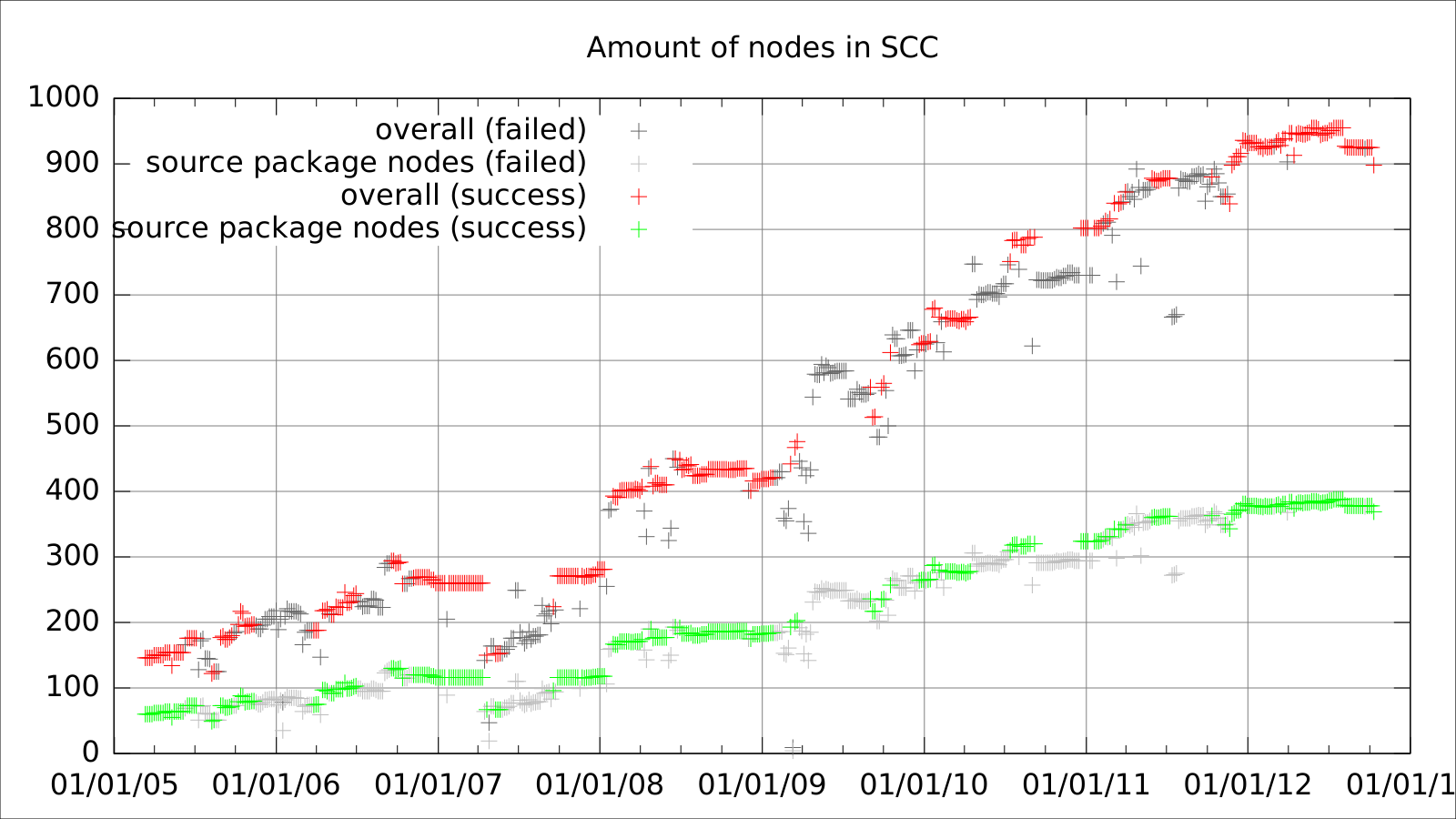
Creating a reduced distribution first, greatly increases the execution speed of my algorithms as it reduces the amount of binary and source packages by an order of magnitude while still preserving the dependency cycle situation of the core packages. In many cases, once the packages of a reduced distribution are available, all the rest of Debian can be compiled from them without any dependency cycles. As also mentioned in earlier posts, there is always one central, big strongly connected component (SCC) in the dependency graph. I am especially interested in how the size of the reduced distribution and the SCC change over time as both are an indication of:
  • the amount of interdependencies between core packages
  • the amount of dependency cycles in the dependency graph
Lets look at the plots I did from the data I gathered. The gray data points indicate that at that point in time, one or more of the core source packages (the ones in the reduced distribution) in Debian Sid was not compilable. This means that the resulting values cannot be fully trusted. But as it is mostly only a single source package that doesnt compile, it doesnt influence the overall result much and therefor I included them anyways. Red and green data points represent a fully successful run. The only thing that I do not yet understand is what happened in 2007... So while a potential porter in 2005 only had to look at a graph of 150 nodes, he now needs to solve a graph of nearly 1000 nodes. The amount of edges in the dependency graph grew even more dramatic from about 500 to over 8000 edges. While the dependency situation for Debian Sid in 2005 can easily be printed using xdot and visually solved, this in not possible anymore in 2012. While dependencies of only a few dozen source packages had to manually be dropped in 2005, now even dropping build dependencies from a few hundred source packages doesnt solve the dependency situation. So my assumption is, that due to a growing amount of interdependencies between source and binary packages (as both gain more features), bootstrapping Debian for a new architecture becomes harder over time. Is this also the perceived subjective impression of people that ported Debian in the past? If my assumption is correct, then there is a growing need for official support of droppable build dependencies (or "stage builds" or "profile builds") to break dependency cycles during the bootstrapping process. Work of a porter would be much easier if source packages would already contain information about what build dependencies can be dropped (if so needed). In the best case, a machine could use those annotations to calculate a build order automatically. As one can see in the graph above, there are currently 370 source packages in the main SCC. This means that no more than this amount of packages (but probably much less) have to be annotated to break the SCC into a directed acyclic graph. Discussion about what syntax to use to mark potentially droppable build dependencies currently happens in bug#661538 but should maybe be discussed by a wider audience. The currently favored solution was proposed in said bugreport by Guillem Jover and is called "build profiles". It has the advantage that it is not only trivial to implement (a patch exist for dpkg and dose3 already supports them) but would also be useful for other purposes like embedded builds. The format is similar to how architecture restrictions for individual dependencies are specified but uses "triangular brackets":
Build-Depends: huge (>= 1.0) [i386 arm] <!embedded !bootstrap>, tiny
The work Patrick McDermott did for his GSoC project over the summer already uses above syntax.

Joachim Breitner: Creating a Debian source package without unpacking the source

There may be a situation where you want to create a Debian source package without having to unpack the upstream source. One case is where you store your debian/ directory in a version control system of its own and to build your package, you pass the .dsc file to a tool like pbuilder or some remote builder. Now a modern debian source package is just a text file (the .dsc file) that references two tarballs, one being the upstream source and the other being the Debian directory. Thanks to Niels Thykier on #debian, I found the magic invocation of dpkg-source that allows you to create the .dsc directly from the two tarballs, the control file and the changelog:

> apt-get source --download-only -t experimental haskell-mtl
Reading package lists... Done
Building dependency tree       
Reading state information... Done
NOTICE: 'haskell-mtl' packaging is maintained in the 'Darcs' version control system at:
http://darcs.debian.org/darcs/pkg-haskell/haskell-mtl
Need to get 18.8 kB of source archives.
Get:1 http://http.debian.net/debian/ experimental/main haskell-mtl 2.1.2-1 (dsc) [1616 B]
Get:2 http://http.debian.net/debian/ experimental/main haskell-mtl 2.1.2-1 (tar) [13.7 kB]
Get:3 http://http.debian.net/debian/ experimental/main haskell-mtl 2.1.2-1 (diff) [3509 B]
Fetched 18.8 kB in 0s (22.3 kB/s)    
Download complete and in download only mode
> cp ./haskell-mtl_2.1.2-1.dsc ./haskell-mtl_2.1.2-1.dsc-orig
> tar xzf haskell-mtl_2.1.2-1.debian.tar.gz
> dpkg-source -cdebian/control -ldebian/changelog --format="3.0 (custom)" --target-format="3.0 (quilt)" -b / haskell-mtl_2.1.2.orig.tar.gz haskell-mtl_2.1.2-1.debian.tar.gz
dpkg-source: info: using source format  3.0 (custom)'
dpkg-source: info: building haskell-mtl in haskell-mtl_2.1.2-1.dsc
> diff  -u haskell-mtl_2.1.2-1.dsc haskell-mtl_2.1.2-1.dsc-orig
--- haskell-mtl_2.1.2-1.dsc	2012-10-13 15:09:00.031695856 +0200
+++ haskell-mtl_2.1.2-1.dsc-orig	2012-10-13 15:08:47.267696329 +0200
@@ -1,3 +1,6 @@
+-----BEGIN PGP SIGNED MESSAGE-----
+Hash: SHA1
+
 Format: 3.0 (quilt)
 Source: haskell-mtl
 Binary: libghc-mtl-dev, libghc-mtl-prof, libghc-mtl-doc
@@ -23,3 +26,11 @@
 Files: 
  943c110524d96126bfa0e61f7df1ebcd 13723 haskell-mtl_2.1.2.orig.tar.gz
  dda5ded58a8d009ecddeed68058ca787 3509 haskell-mtl_2.1.2-1.debian.tar.gz
+
+-----BEGIN PGP SIGNATURE-----
+Version: GnuPG v1.4.12 (GNU/Linux)
+
+iEYEARECAAYFAlBzRQIACgkQ9ijrk0dDIGwymwCfW87jwCv5ZvAXPBwh0LbvYLP9
+n+wAn3TCJwPRuBDEWRYmcv3Opn1Kb9+F
+=/Llc
+-----END PGP SIGNATURE-----
As you can see, the resulting .dsc file is identical to the original one, so this approach works. The parameter to -b does not matter as long as it is some existing directory. Of course you can easily shoot yourself and others in the foot, almost as easily as hand-editing the .dsc file... but if you know what you are doing, then this can be quite handy. Next to do: Write a tool that takes an unpacked Debian directory as an argument, packs it, finds the original tarball using uscan and creates the .dsc file. Would this be something that people would want in the devscripts package?

Guido G nther: Preseeding Debian virtual machines with virt-install

Interactively installing Debian virtual machines with virt-install without having to download anything in advance can already be done by pointing it to a Debian mirror via --location. But you can also add files to the initrd after downloading using --initrd-inject. Upstreams intended use is for kickstart files but we can also feed it a preseed.cfg to automate the whole installation:
virt-install --connect=qemu:///system \
             --location=http://ftp.us.debian.org/debian/dists/stable/main/installer\-i386 \
             --initrd-inject=/path/to/preseed.cfg \
             --extra-args="auto" \
             --name d-i --ram=512 \
             --disk=pool=default,size=5,format=qcow2,bus=virtio
preseed.cfg is a regular preseed file (as described in the Debian Wiki) in your local filesystem. I'm using this one for Squeeze and Wheezy VMs. It must be named preseed.cfg in order for d-i to pick it up from the initrd. This also works for URLs like qemu+ssh://<remotehost>/system/ since virt-install uses libvirt's streaming API to upload the kernel and modified initrd to the remote host. In case you're running this on an i386 you'll need this fix which already sits in experimental. This blog is flattr enabled.

Russell Coker: Creating WordPress Packages

deb http://www.coker.com.au wheezy wordpress I maintain Debian packages of a number of WordPress themes and plugins for my personal use which I am not planning to upload to Debian due to the maintenance and security issues. Generally the way things work with WordPress packages (and apparently most things in PHP) is that new versions are released whenever the author feels like it with little documentation and often now way of determining whether it s a security issue. When there is a security issue it s often fixed in a new version that includes new features giving no good option for someone who was happy with the old functionality and just wants a secure system. This isn t the way we like to do things in Debian. The result of this is that I maintain a number of packages for my personal use (and for the benefit of any interested people on the Internet) that often get new updates. I ve written the below script to create a new version of a Debian package. It searches my repository for the most recent .debian.tar.gz file for the package, applies that, runs dch -i to update the changelog, and then builds the package. So far this has only been tested on one package, I expect that I ll have to put a sed command in there to cover the case where the zip file name doesn t match what I want as the package name and I ll probably find other bugs in future, but I think it s good enough to publish now. #!/bin/bash
set -e
REPOSITORY=/home/whatever
unzip $1
FILE=$(basename $1)
PACKAGE=$(echo $FILE sed -e "s/\..*$//")
LEN=$(($(echo $PACKAGE wc -c)+1))
VER=$(echo $FILE cut -c $ LEN -200 sed -e s/.zip//)
DIRNAME=wordpress-$ PACKAGE -$ VER
mv $PACKAGE $DIRNAME
tar czf wordpress-$ PACKAGE _$ VER .orig.tar.gz $ DIRNAME
cd $DIRNAME
tar xzf $(ls -tr $ REPOSITORY /wordpress-$ PACKAGE _*.debian.tar.gz tail -1)
dch -i
dpkg-buildpackage Any suggestions for improvement will be welcome, I don t claim to be the world s greatest shell scripter. But please note that I generally aim to write shell scripts that can be understood by people who aren t experts. So if you can replace the program with a single line of Perl I will be impressed but I won t implement your solution. Related posts:
  1. WordPress Maintainability For a while I ve been maintaining my own WordPress packages....
  2. permalinks in wordpress, Apache redirection, and other blog stuff When I first put my new blog online I didn t...
  3. WordPress Plugins I ve just added the WordPress Minify [1] plugin to my...

12 October 2012

Russell Coker: Cheap Bulk Storage

The Problem Some of my clients need systems that store reasonable amounts of data. This is enough data that we can expect some data corruption on disk such that traditional RAID doesn t work, that old fashioned filesystems like Ext3/4 will have unreasonable fsck fimes, and that the number of disks in a small server isn t enough. NetApp is a really good option for bulk reliable storage, but their products are very expensive. BTRFS has a lot of potential, but the currently released versions (as supported in distributions such as Debian/Wheezy) lack significant features. One significant lack in current BTRFS releases is something equivalent to the ZFS send/receive functionality for remote backups, this was a major factor when I analysed the options for hard drive based backup [1], and you should always think about backup before deploying a new system. Currently ZFS is the best choice for bulk storage which is reliable if you can t afford NetApp. Any storage system needs a minimum level of reliability if only to protect it s own metadata and a basic RAID array doesn t protect against media corruption with current data volumes. The combination of performance, lack of fsck (which is a performance feature), large storage support, backup, and significant real-world use makes ZFS a really good option. Now I need to get some servers for more than 8.1TiB of storage (the capacity of a RAID-Z array of 4*3TB disks). One of my clients needs significantly more, probably at least 10 disks in a RAID-Z array so none of the cheaper servers will do. Basically the issue that some of my clients are dealing with (and which I have to solve) is how to provide a relatively cheap ZFS system for storing reasonable amounts of data. For some systems I need to start with about 10 disks and be able to scale to 24 disks or more without excessive expense. Also to make things a little easier and cheaper 24*7 operation is not required, so instead of paying for hot-swap disks we can just schedule down-time outside business hours. The Problem with Dell Dell is really good for small systems, the PowerEdge tower servers that support 2*3.5 or 4*3.5 disks and which have space for an SSD or two are really affordable and easy to order. But even in the mid-size Dell tower servers (which are small by server standards) you have problems with just getting a few disks operating outside a RAID array [2]. The Dell online store is really great for small servers, any time I m buying a server for less than $2500 I check the Dell online store first and usually their price is good enough that there is no need to get a quote from another company. Unfortunately all the servers with bigger storage involve disks that are unreasonably expensive (it seems that Dell makes their profit on the parts) and prices are not available online. I gave my email address and phone number to the Dell web site on Wednesday and they haven t cared to get back to me yet. This is the type of service that makes me avoid IBM and HP for any server deployment where the Dell online store sells something suitable! BackBlaze For some time BackBlaze have been getting interest by describing how they store lots of data in a small amount of space by tightly stacking SATA disks. They don t think that ZFS on Linux is ready for production, but their hardware ideas are useful. They have recently described their latest architecture [3]. They describe it as 135TB for $7,384. Of course the 135TB number is based on the idea of getting the full 3TB capacity out of each disk which they can do as they have redundancy over multiple storage pods. But anyone who wants a single fileserver needs some internal redundancy to cover disk failure. One option might be to have three RAID-Z2 arrays of 15 disks which gives a usable capacity of 42*3TB==126TB==113TiB. Note that while the ZFS documentation recommends between 3 and 9 disks per zpool for performance I don t expect performance problems, when you only have a gigabit Ethernet connection there shouldn t be a problem with three ZFS zpools making the network the bottleneck. For this option the way to go would be to start with an array of 15 disks and then buy a second set of 15 disks when the first storage pool becomes full. It seems likely that 4TB disks will become cheap before a 35TiB array is filled so we can get more efficiency by delaying purchases. The BackBlaze pod isn t cheap, they are sold as a complete system without storage disks for $US5,395 by Protocase [4]. That gives a markup of $US3,411 over the BackBlaze cost which isn t too bad given that BackBlaze are quoting the insane bulk discount hardware prices that I could never get. Protocase also offer the case on it s own for anyone who wants to build a system around it. It seems like the better option is to buy the system from Protocase, but that would end up being over $6,000 when Australian import duty is added and probably close to $7,000 when shipping etc is included. Norco Norco offers a case that takes 24 hot-swap SATA/SAS disks and a regular PC motherboard for $US399 [5]. It s similar to the BackBlaze pod but smaller, cheaper, and there s no obvious option to buy a configured and tested system. 24 disks would allow two RAID-Z2 arrays of 12 disks, the first array could provide 27TiB and the second array could provide something bigger when new disks are released. SuperMicro SuperMicro has a range of storage servers that support from 12 to 36 disks [6]. They seem good, but I d have to deal with a reseller to buy them which would involve pain at best and at worst they wouldn t bother getting me a quote because I only want one server at a time. Conclusion Does anyone know of any other options for affordable systems suitable for running ZFS on SATA disks? Preferably ones that don t involve dealing with resellers. At the moment it seems that the best option is to get a Norco case and build my own system as I don t think that any of my clients needs the capacity of a BackBlaze pod at the moment. Supermicro seems good but I d have to deal with a reseller. In my experience the difference between the resellers of such computer systems and used car dealers is that used car dealers are happy to sell one car at a time and that every used car dealer at least knows how to drive. Also if you are an Australian reader of my blog and you want to build such storage servers to sell to my clients in Melbourne then I d be interested to see an offer. But please make sure that any such offer includes a reference to your contributions to the Linux community if you think I won t recognise your name. If you don t contribute then I probably don t want to do business with you. As an aside, I was recently at a camera store helping a client test a new DSLR when one of the store employees started telling me how good ZFS is for storing RAW images. I totally agree that ZFS is the best filesystem for storing large RAW files and this is what I am working on right now. But it s not the sort of advice I expect to receive at a camera store, not even one that caters to professional photographers. Related posts:
  1. Cheap SATA Disks in a Dell PowerEdge T410 A non-profit organisation I support has just bought a Dell...
  2. ZFS vs BTRFS on Cheap Dell Servers I previously wrote about my first experiences with BTRFS [1]....
  3. Flash Storage and Servers In the comments on my post about the Dell PowerEdge...

8 October 2012

Eddy Petri&#537;or: HOWTO fix git-buildpackage signs with wrong signature

If you have two or more available gpg keys that can be used for the same identity (e.g.: 'John Doe <john@doe.com>') that you might use to add entries to changelogs of packages, you might end up in situations where git-buildpackage or other similar tool might want to sign packages with the wrong key.

It seems debsign (the tool that actually does the signing) just picks up the first key that is still valid (I also have a revoked key) and matches the used identity.

There are many ways to fix this, but the one that will work for most cases is to run this command:

echo 'DEBSIGN_KEYID=0x0123ABCD' >> ~/.devscripts

Of course, you should replace 0x0123ABCD with the keyid which you prefer.

This will create a ~/.devscripts file (if it didn't exist) which will contain the DEBSIGN_KEY variable with the desired value. This file will be sourced by debsign before doing its actual work, so it will do the right thing when ran.

There are also git-buildpackage specific fixes like defining builder in the [DEFAULT] section of ~/.gbp.conf and passing '-k0x0123ABCD' to debuild something like:

[DEFAULT]
builder = debuild -i -I -k1234ABCD
...

But that probably gets ugly if you use a custom builder.


P.S.: I have just deleted my old key 0xDD1F1F9F since I won't be using it anymore. I don't remember where I put the revocation certificate, but I'll revoke the key, once and if I find the revocation certificate. Otherwise, it will expire in July, next year.

From now on, I am going to use only the key 0xE3E083A1 to which I even added a photo and some newer identities and updated with a few signatures I got during DebConf 9.

7 October 2012

Gregor Herrmann: RC bugs 2012/40

this week I focussed mostly on bugs where conffiles are modified in maintainer scripts. thanks to the recipe in debconf-devel(7) many cases are not so hard to solve.
  • #632604 src:libatomic-ops: "libatomic-ops: FTBFS on i386"
    prepare a patch for testing-proposed-updates, upload after ack from maintainer and release team
  • #687858 tasksel-data: "tasksel-data: copyright file missing after upgrade (policy 12.5)"
    add info and tag in BTS
  • #687944 mason: "mason: modifies conffiles (policy 10.7.3): /etc/masonrc"
    fix configuration file handling, upload to DELAYED/2
  • #688196 mimedefang: "mimedefang: modifies conffiles (policy 10.7.3): /etc/default/mimedefang"
    fix configuration file handling, upload to DELAYED/2, then included in maintainer upload
  • #688200 fprobe: "fprobe: modifies conffiles (policy 10.7.3): /etc/default/fprobe"
    fix configuration file handling, upload to DELAYED/2
  • #688205 mono-xsp2: "mono-xsp2: modifies conffiles (policy 10.7.3): /etc/default/mono-xsp2"
    fix configuration file handling, upload to DELAYED/2, rescheduled to 0-day with maintainer's permission
  • #688375 ntlmaps: "ntlmaps: modifies conffiles (policy 10.7.3): /etc/ntlmaps/server.cfg"
    fix configuration file handling, upload to DELAYED/2
  • #688378 gom: "gom: modifies conffiles (policy 10.7.3): /etc/default/gom"
    fix configuration file handling, upload to DELAYED/2
  • #688499 netmrg: "netmrg: modifies conffiles (policy 10.7.3): /etc/netmrg/netmrg.xml"
    install only template configuration file, upload to DELAYED/2
  • #688565 mono-apache-server2,mono-apache-server4: "mono-apache-server2, mono-apache-server4: modifies conffiles (policy 10.7.3): /etc/default/mono-apache-server[24]"
    fix configuration file handling, upload to DELAYED/2, rescheduled to 0-day with maintainer's permission
  • #688736 w3c-linkchecker: "w3c-linkchecker: modifies conffiles (policy 10.7.3): /etc/w3c/checklink.conf"
    remove configuration file on purge (pkg-perl)

Next.

Previous.