Search Results: "agi"

15 November 2008

Stefano Zacchiroli: from Vim to Emacs - part 2

One month with Emacs and counting - Part 2
Other posts in the from Vim to Emacs series: part 1
A while ago I've blogged about my switch from Vim to Emacs, promising a blog post series, quite a mouthful :-) nevertheless, it's time to continue the series. The first part was about why I think that nowadays Emacs is ready to be switching to. This second part is about flawed Vim design choices which substantially contributed to my choice. (Of course all this post is under a IMO-/rant-disclaimer, it can't be otherwise, so take it cum grano salis) Flawed Vim design choices Vim started as a wonderful editor, following the path of Vi, which in turn has got right a good deal of design choices. One is the often debated modality. In spite of being a HCI PITA in general, modality is not a problem at all for software you are using every single day (and the editor is the 2nd program I use the most, with the terminal being the 1st), because you learn it as a habit. In the case of Vim, modality is good because it let you use powerful yet simple motions in command mode, which can be easily combined with operator-pending commands. This can be considered yet another incarnation of the UNIX philosophy, casted inside the editor itself. ... which brings us to the good old joke which describes Emacs as a great operating system, lacking only a decent editor. In fact, Vim is no longer the nice Unix philosophy player which it used to be, and Emacs plays much more nicely with external tools than Vim. As arguments, let's consider a few (not so) recent Vim evolutions: Well, I acknowledge that Emacs got this choice right, and that it's an important one: Emacs supports interaction with external processes, and plugin authors have been happy to exploit it to create really cool stuff (sticking to the UNIX philosophy). Please welcome: Flyspell, M-x grep (shameless smartass plug: same number of keystroke of :grep), Grand Unified Debugger, a sampling of language-specific major modes with top-level support. (But I recommend having a look at least once at the coolness of other stuff built-on top of external process support, like Flymake, mentioned by dancer not a long ago.) Even in this respect, I acknowledge that Emacs got this right. It has chosen a single, now full-fledged, programming language (Elisp), which is offered both to the final user (fact: the average Emacs user knows much better how to program her own editor than the average Vim user) and to extensions developer. The standard library of the language is organized with a consistent naming (even though not always intuitive) and documented in an organized manner. You might not like the language, but at least is has been taken seriously and managed as such. Finally, being a Lisp dialect, you might need what you learn with Elisp elsewhere. Vim script is too committing: it is useful only inside Vim. I believe that contributed significantly in its scarce diffusion among Vim users. The fact that Elisp was born together with Emacs and that it is also used internally for the editor implementation is not relevant here: I do care about what is offered to me as an user and as an extension developer. What I see on the Emacs side in this respect is much better that what I see on the Vim side. Moreover, from the point of view of the users, is the difference between what is inside the editor and what is outside (i.e., the extensions) that relevant? I think it is not, and that brings me to the final Vim choice which I consider flawed and which has the potential of seriously limit its future evolutions: Where to from here in this blog post series? For sure some tips on how to migrate for hard-core Vim users, then we'll see ... If you did enjoy the read please let me know commenting in the discussion page (as you did in the last post, thanks!).

13 November 2008

Sean Finney: (experimental) ps3 packages for debian

when not being distracted by other uses of the system, i've managed to spend some more time on packaging some more stuff that's useful on a debian ps3. namely: the last of which i think will be of the most interest to some folks, as it provides an spu-based xvideo extension, which brings back the possibility of playing HD videos etc on the ps3. now if you're interested in checking out these packages, read on, starting with this: !=!=!=!=!=!=!=!=!=!=!=!=!=!=!=!=!=!=!=!=!=!=!=!=!=!=!=!=!=!=!=!=!=!=!=!=!=!=!=!= ZOMG WARNING!!!1!!ONE!! THESE ARE EXPERIMENTAL BLEEDING EDGE PACKAGES. I MAKE NO GUARANTEE WHETHER THESE PACKAGES ARE PROPERLY BUILT, WILL INSTALL, WILL WORK, WILL NOT DESTROY YOUR SYSTEM, WILL NOT CRAWL OUT OF YOUR SYSTEM AND MAKE LONG DISTANCE PHONE CALLS WHILE EATING THAT SNACK YOU WERE SAVING IN THE FRIDGE, ETC. !=!=!=!=!=!=!=!=!=!=!=!=!=!=!=!=!=!=!=!=!=!=!=!=!=!=!=!=!=!=!=!=!=!=!=!=!=!=!=!= okay, so now that we've disposed with that formality, i'm glad if you're interested and still here :) so... where were we? oh yes. put this in your sources.list:
deb http://people.debian.org/~seanius/ps3-experimental-packages sid main

source packages are also available if you want to poke around or backport the packages to etch or ubuntu or something else wierd like that:
deb-src http://people.debian.org/~seanius/ps3-experimental-packages sid main

now, if you have a properly configured system, you should get a warning:
Reading package lists... Done
W: GPG error: http://people.debian.org sid Release: The following signatures couldn't be verified because the public key is not available: NO_PUBKEY CA78CB3E6E76D81D
W: You may want to run apt-get update to correct these problems

but i promise this key is valid, and mine. but hey, you don't have to take my word for it :)
sudo apt-get install debian-keyring
gpg --no-default-keyring --keyring /usr/share/keyrings/debian-keyring.gpg --export --armor CA78CB3E6E76D81D   sudo apt-key add -

then you can install the packages... assuming you want the xorg video driver:
sudo apt-get install xserver-xorg-video-spu

and update the appropriate Device entry in your xorg.conf, so that the normal fbdev is commented out and instead you use the spufbdev driver. example:
Section "Device"
        Identifier      "Generic Video Card"
        Driver          "spufbdev"
        Option "ShadowFB" "false"
EndSection

and then
sudo /etc/init.d/gdm restart

(or the equivalent if you're using something else). that's it! more packages may trickle in here as well, at least until and they find their way into debian proper. i'm also in contact with the upstream authors of this stuff, and they're generally very responsive, so let me know if you have any problems.

12 November 2008

MJ Ray: Webmaster Jargon for Website Owners

I wrote to a site owner last week and I thought I was writing to a webmaster. The site owner complained about some of the jargon and, while explaining who I thought I was writing for, I explained some of it because I think more website owners might benefit from these three explanations:- “Expat-like terms” - made available in a way that is freely sharable, modifiable and redistributable, similar to the Expat software package, whose terms are published at http://www.jclark.com/xml/copying.txt - this is often used as a clear, simple example for encouraging wide distribution of electronic resources (software). “clandestine Google Analytics” - Google Analytics is a service from Google, Inc for tracking users through a website in various ways. I believe the Data Protection Act means that English websites should obtain informed consent from users by publishing a Privacy Policy on their site which discloses what the GA service will be used for and linking through to GA’s own Privacy Policy. Some websites attempt to run Google Analytics on users’ computers without explaining why and without any Privacy Policy. That is what I mean by “clandestine”. “valid xhtml” - validating against the eXtensible HyperText Markup Language standards published by the World Wide Web Consortium (W3C) - the underlying language of the web. There is a test service provided at http://validator.w3.org/ and passing it is a key stepping stone towards making an accessible website. There’s not really such a thing as “invalid xhtml” - if it doesn’t pass validation, it’s not xhtml. So I guess I’m guilty of using a tautology sometimes - sorry about that. Is it worthwhile knowing those three phrases? Are there other key technical phrases which you think site owners should know?

Miriam Ruiz: Coccinella 0.96.10 packaged for Debian

I discovered Coccinella this afternoon. It is a Jabber client coded in Tcl/Tk that I found in the list of clients supporting Jingle in the Wikipedia. The main advantage about Coccinella is that it has a built-in whiteboard that allows a better collaboration with other people. The whiteboard is a shared desktop which supports text, drawings, images, and multimedia in a number of formats, such as MP3 and video. It runs in two main modes, a peer-to-peer configuration and a mode compatible with the Jabber Instant Messaging system. A flexible plugin architecture may be used to support additional formats. For being able to package it, I also had to package some of its dependencies: TkTreeCtrl (a widget for Tcl/Tk), TkPNG (to add PNG support to Tcl/Tk) and the Tcl interface to the iax(2) client library. I still have to finish them properly, with man pages, icons, desktop files an the such, but for the moment I don’t have time for that, so if anyone wants to try the program, all the packages are available (compiled for amd64 for sid, but the package source is available too, so you can easily rebuild it for your system).

Adrian von Bidder: phrase from nearest book meme

‘But, Archchancellor,’ said the Lecturer in Recent Runes, ‘it's still too damn far.’
(If you don't know who wrote this, you really should do some reading!) Contagioned by Kees:

Stefano Zacchiroli: batteries alpha2 Debian packages

OCaml Batteries alpha 2: Debian packages Out of popular request (wow, people on #ocaml@freenode are very excited about the Batteries thingy, good!), I've prepared Debian packages for OCaml Batteries Included, version alpha 2 (which does include the support for transparent gzip-ed channels). Packaging shameless plug: packaging this version has been a nice showcase for TopGit as now I've a couple of inter-dependent branches. TopGit has indeed rocked my world, yay. (Well, I also have to admit to myself that this tiny bit of TopGit mention wont assolve me from the need to advertiseblog about TopGit, ... eventually!) Packages have been uploaded to experimental. As usually I build/upload for amd64, but experimental in Debian is auto-built so eventually the will show up also for other architectures, of course including i386. If you want to take them directly from experimental you have to add this line to your /etc/apt/sources.list:
    deb http://ftp.de.debian.org/debian/ experimental main non-free contrib

and then install requesting explicitly experimental (for some time now, experimental is treated specially, and it won't be used by APT unless explicitly asked for):
    apt-get install -t experimental ocaml-batteries-included

The Debian version (roughly) corresponding to alpha 2 is 0.20081112+gitBB342A7-1. Alternatively, you can grab the packages from my people.d.o space. Since people were interested I've made available both amd64 and i386 builds there.

11 November 2008

Daniel Burrows: aptitude 0.5.0 released

I've released version 0.5.0 of the aptitude package manager (release notes). Once the mirrors have synced, you should be able to download it from Debian's experimental distribution, or manually from the aptitude package page.
[Edit] This release was uploaded to experimental because it is not a final release. aptitude follows the Linux version numbering scheme in which an odd second digit indicates an unstable development version. DO NOT INSTALL THIS VERSION IF YOU WANT STABLE SOFTWARE; IT IS INCOMPLETE, INADEQUATE, AND PROBABLY INCORRECT. To reply to some questions that several people have asked me:
  1. The final release of aptitude 0.6.0 will be split into two packages, one containing only the traditional text interface and named aptitude-curses, and one containing the GUI binary named aptitude-gtk, with both of them providing the aptitude binary through Debian's alternatives mechanism. This release wasn't split because the code to drop GTK+ support was buggy and I discovered this fact halfway through assembling the release. It's fixed now.
  2. To run the traditional curses interface, pass the --no-gui command-line parameter or set the option Aptitude::Start-Gui to false in /etc/apt/apt.conf. Unless you want to test that the curses frontend isn't broken, though, there won't be much for you in this release: the only change affecting it is Xapian support, and that currently breaks incremental search. (see the note above about this being an unstable release)
Also, another feature that I suspect might be bothersome is the behavior of updating the package lists and downloading changelogs on startup. There's no switch for changelogs yet, but you can disable the package list update by setting Aptitude::Update-On-Startup to false.
The main change in this release is the new GTK+ frontend, designed and implemented by Obey Arthur Liu with funding from the 2008 edition of Google's Summer of Code. aptitude 0.5.0 screenshot The new frontend is is an effort to bring some of the design principles of the curses frontend to a GUI environment, while also exploiting the unique features a GUI gives us and exploring ways to deal with changes in the environment in the nine years since aptitude was first designed. For instance, it is no longer reasonable for the user to actually read the entire package list (when I first installed Debian, you could read through the whole package list in a single sitting). So instead of basing the interface around a list of all the packages, we based it around the ability to search for the packages you're interested in. This version of aptitude also introduces Xapian searching:
daniel@emurlahn:~$ aptitude search "apt package manager"
i   apt                                  - Advanced front-end for dpkg
p   apt-dater                            - terminal-based remote package update manager
p   apt-dater-dbg                        - terminal-based remote package update manager (d
i   aptitude                             - terminal-based package manager
i   aptitude-dbg                         - Debug symbols for the aptitude package manager
p   createrepo                           - generates the metadata necessary for a RPM pack
p   gnome-apt                            - graphical package manager
p   smartpm                              - An alternative package manager that works with
p   smartpm-core                         - An alternative package manager that works with
i   synaptic                             - Graphical package manager
i A update-manager-core                  - APT update manager core functionality
You might ask why I didn't search for just package manager. The reason is simple: aptitude doesn't yet sort by relevance, and that second search gave me screenfuls of packages whose description contains both package and manager, including addressmanager.app (a PIM for GNUstep), compiz-gtk (a piece of eye candy), and wterm (an X terminal emulator). However, it is worth noting that Xapian searches are fully integrated into the aptitude search language, so they can be combined with non-Xapian search terms in just the way you would expect:
daniel@emurlahn:~$ aptitude search "?installed apt package manager"
i   apt                                  - Advanced front-end for dpkg
i   aptitude                             - terminal-based package manager
i   aptitude-dbg                         - Debug symbols for the aptitude package manager
i   synaptic                             - Graphical package manager
i A update-manager-core                  - APT update manager core functionality
So, all the basic functionality that the GUI version needs is in place; the next step is to start polishing it and filling in the gaps that are left. And, of course, suggestions and bug reports are welcome, so we know where the rough spots and the gaps are. Please send your comments to aptitude-devel@lists.alioth.debian.org so that they are part of the public record and so that people besides me can read them. :-) Happy package managing!

10 November 2008

Kurt Roeckx: Finding which sector belongs to which file on a RAID device.

I got this nice message (and some others) in my log today:
smartd: Device: /dev/sdd, 2 Currently unreadable (pending) sectors After running a smartctl -t long /dev/sdd smartctl now reports:
ID# ATTRIBUTE_NAME          FLAG     VALUE WORST THRESH TYPE      UPDATED  WHEN_FAILED RAW_VALUE
  5 Reallocated_Sector_Ct   0x0033   200   200   140    Pre-fail  Always       -       0
  9 Power_On_Hours          0x0032   089   089   000    Old_age   Always       -       8719
196 Reallocated_Event_Count 0x0032   200   200   000    Old_age   Always       -       0
197 Current_Pending_Sector  0x0012   200   200   000    Old_age   Always       -       2
198 Offline_Uncorrectable   0x0010   200   200   000    Old_age   Offline      -       0
[...]
SMART Error Log Version: 1
ATA Error Count: 10 (device log contains only the most recent five errors)
[...]
Error 10 occurred at disk power-on lifetime: 8692 hours (362 days + 4 hours)
  When the command that caused the error occurred, the device was active or idle.
  After command completion occurred, registers were:
  ER ST SC SN CL CH DH
  -- -- -- -- -- -- --
  40 51 08 78 e5 89 e0  Error: UNC 8 sectors at LBA = 0x0089e578 = 9037176
  Commands leading to the command that caused the error were:
  CR FR SC SN CL CH DH DC   Powered_Up_Time  Command/Feature_Name
  -- -- -- -- -- -- -- --  ----------------  --------------------
  25 00 08 78 e5 89 2f 00  45d+06:36:27.880  READ DMA EXT
  25 00 08 70 e5 89 2f 00  45d+06:36:27.798  READ DMA EXT
  25 00 08 68 e5 89 2f 00  45d+06:36:27.308  READ DMA EXT
  25 00 08 e0 77 e5 35 00  45d+06:36:27.295  READ DMA EXT
  25 00 08 60 e5 89 2f 00  45d+06:36:26.653  READ DMA EXT
[...]
Error 9 occurred at disk power-on lifetime: 8692 hours (362 days + 4 hours)
  When the command that caused the error occurred, the device was active or idle.
  After command completion occurred, registers were:
  ER ST SC SN CL CH DH
  -- -- -- -- -- -- --
  40 51 08 60 e5 89 e0  Error: UNC 8 sectors at LBA = 0x0089e560 = 9037152
SMART Self-test log structure revision number 1
Num  Test_Description    Status                  Remaining  LifeTime(hours)  LBA_of_first_error
# 1  Extended offline    Completed: read failure       90%      8715         797566305
# 2  Extended offline    Completed without error       00%      8198         -
Notice that 197 Current_Pending_Sector indicates that there are 2 sectors with a problem. Note that the SMART error log shows LBA sectors 9037176 (0x89e578) and 9037152 (0x89e560) but it's limited to 0xffffff. The self test logs shows us the proper LBA error at 797566305 (0x2f89e561) which has a 0x2f in front, and also shows us that it's the second sector in the block of 8 we tried to read. The kernel log also shows:
ata4.00: exception Emask 0x0 SAct 0x0 SErr 0x0 action 0x0
ata4.00: (BMDMA2 stat 0xc0009)
ata4.00: cmd 25/00:08:60:e5:89/00:00:2f:00:00/e0 tag 0 cdb 0x0 data 4096 in
         res 51/40:00:61:e5:89/00:00:2f:00:00/f0 Emask 0x9 (media error)
So I've tried to reproduce the error with:
# dd if=/dev/sdd of=797566305 skip=797566305 bs=512 count=1 iflag=direct
1+0 records in
1+0 records out
512 bytes (512 B) copied, 1.27727 s, 0.4 kB/s
Notice that it can actually read that block, it just seems to take a while. And the error log now contains:
  After command completion occurred, registers were:
  ER ST SC SN CL CH DH
  -- -- -- -- -- -- --
  40 51 01 61 e5 89 e0  Error: UNC 1 sectors at LBA = 0x0089e561 = 9037153
Because it's part of a RAID device I could just let the whole disk resync, but I was a little curious which files were in it. So I found this document that explains on how to find which files has the problem. But it only has examples covering ext2/ext3 on a partition and LVM and nothing about RAID device. So it looks like someone using RAID 0 will have a hard time finding the file that's having a problem. So following the document we start with:
# fdisk -lu /dev/sdd
Disk /dev/sdd: 500.1 GB, 500107862016 bytes
255 heads, 63 sectors/track, 60801 cylinders, total 976773168 sectors
Units = sectors of 1 * 512 = 512 bytes
Disk identifier: 0x000578f9
   Device Boot      Start         End      Blocks   Id  System
/dev/sdd1   *          63      385559      192748+  fd  Linux raid autodetect
/dev/sdd2       972864270   976768064     1951897+  fd  Linux raid autodetect
/dev/sdd3          385560   972864269   486239355   fd  Linux raid autodetect
Partition table entries are not in disk order
In /proc/mdstat we see:
md1 : active raid5 sda3[0] sdd3[3] sdc3[2] sdb3[1]
      1458717696 blocks level 5, 64k chunk, algorithm 2 [4/4] [UUUU]
So sdd3 is part of md1 and I have an ext3 filesytsem on that. Tune2fs -l grep Block gives:
Block count:              364679424
Block size:               4096
Blocks per group:         32768
mdadm tells me:
# mdadm -QE /dev/sdd3
/dev/sdd3:
          Magic : a92b4efc
        Version : 00.90.00
           UUID : 747b071a:a70f723b:c3a9ed44:15845cbf
  Creation Time : Mon Nov 12 20:13:51 2007
     Raid Level : raid5
  Used Dev Size : 486239232 (463.71 GiB 497.91 GB)
     Array Size : 1458717696 (1391.14 GiB 1493.73 GB)
   Raid Devices : 4
  Total Devices : 4
Preferred Minor : 1
    Update Time : Mon Nov 10 10:57:28 2008
          State : clean
 Active Devices : 4
Working Devices : 4
 Failed Devices : 0
  Spare Devices : 0
       Checksum : 4b3147f4 - correct
         Events : 78
         Layout : left-symmetric
     Chunk Size : 64K
      Number   Major   Minor   RaidDevice State
this     3       8       51        3      active sync   /dev/sdd3
   0     0       8        3        0      active sync   /dev/sda3
   1     1       8       19        1      active sync   /dev/sdb3
   2     2       8       35        2      active sync   /dev/sdc3
   3     3       8       51        3      active sync   /dev/sdd3
I've been told that 0.90 stores the superblock at the end of the device, so that makes it a little easier. And this seems to agree:
# cat /sys/block/md1/md/dev-sdd3/offset
0
We have a left-symmetric layout, so in raid5_compute_sector() we see
	stripe = chunk_number / data_disks;
	*dd_idx = chunk_number % data_disks;
[...]
	case ALGORITHM_LEFT_SYMMETRIC:
		*pd_idx = data_disks - stripe % raid_disks;
		*dd_idx = (*pd_idx + 1 + *dd_idx) % raid_disks;
So it looks like the chunks are located on the disk like:
stripesdasdbsdcsdd
0D 0D 1D 2P 0-2
1D 4D 5P 3-5D 3
2D 8P 6-8D 6D 7
3P 9-11D 9D 10D 11
4D 12D 13D 14P 12-14
With each of those 64K. The problem is at 797566305 and the partition started at 385560. So that's at sector 797180745 inside partition sdd3. Each sector is 512 bytes and a chunk is 65536 bytes which gets us 128 sectors per chunk. If we want to know which the stride the sector is on we do: 797180745/128=6227974.5703125 This means that the stripe is number 6227974 and that it's sector 0.5703125*128=73 on sdd3 within that chunk. The parity is on disk: pd_idx = 3 - 6227974 % 4 = 1, being sdb. To get the chunk we need to multiply with the number of data disks (3) and since it's the forth disk and the parity is on the second disk we need to add 1 and get: 6227974*3+1=18683923 So calculating that back to sectors we multiply it with the number of sectors per chunk again and add our offset in the chunk: 18683923*128+73=2391542217 To test that our math is any good we try:
# dd if=/dev/md1 of=797566305.2 skip=2391542217 bs=512 count=1 iflag=direct
1+0 records in
1+0 records out
512 bytes (512 B) copied, 5.99103 s, 0.1 kB/s
We see an error message in the kernel log, there are 2 new errors in the error log, so it seems that everything is calculated correctly. The files are also identical. The file system is in blocks of 4096 bytes, so for the file system this is block 2391542217*512/4096=298942777.125 Then we use debugfs:
# debugfs
debugfs 1.41.2 (02-Oct-2008)
debugfs:  open /dev/md1
debugfs:  icheck 298942777
Block   Inode number
298942777       <block not found>
Which isn't making any sense to me, since I get that error about every 2 hour when a certain cronjob runs. 298942777 / 32768 (Blocks per group) = 9123.00955. So I wonder if ext3 is keeping some meta data there and debugfs doesn't tell that? Anyway, at some point I was running a smartctl -t long /dev/sdd again because I couldn't reproduce the error anymore, the cronjob started, and I then found alot of errors in my log again and now it included:
raid5:md1: read error corrected (8 sectors at 797180744 on sdd3)
It's so much fun that disks always behaves the same trying to read the same sector. Smartctl now reports:
  5 Reallocated_Sector_Ct   0x0033   200   200   140    Pre-fail  Always       -       0
196 Reallocated_Event_Count 0x0032   200   200   000    Old_age   Always       -       0
197 Current_Pending_Sector  0x0012   200   200   000    Old_age   Always       -       0
198 Offline_Uncorrectable   0x0010   200   200   000    Old_age   Offline      -       0
I assume the kernel removed the pending sector by writing to it. The other pending error was already gone for some time, I assume new data got written to that one.

Benjamin Mako Hill: Wikimedia and GFDL 1.3

I spent more time than I would like to admit massaging the process that ultimately led to the release of the the GNU Free Documentation License 1.3 (GFDL) by the Free Software Foundation (FSF). Hours counted, it was probably one of my biggest personal projects this year. The effect is to allow wikis under the GFDL to migrate to the Creative Commons BY-SA license or, as Wikimedia's Erik M ller has proposed, to some sort of dual-license arrangement. There are many reasons for this change but the most important is that the move reduces very real barriers to collaboration between wikis and free culture projects due to license compatibility. BY-SA has become the GPL of the free culture world and Wikimedia wikis were basically locked out from sharing with a larger community, and vice-versa; projects will no longer have to choose between sharing with Wikipedia and sharing with essentially everyone else. The GFDL has done a wonderful job of helping get Wikimedia projects to where they are today and M ller's proposed switch seems, in my opinion, the best option to continue that work going forward. The FSF gets a lot of credit (and a lot of flack) for what it does. Offering to "let go" of Wikipedia -- without question the crown jewel of the free culture world -- represents a real relinquishing of a type of political control and power for the FSF. Doing so was not done lightly. But giving communities the choice to increase compatibility and collaboration by switching to a fundamentally similar license was and is, in my opinion, the right thing to do. Everyone who has worked hard to make this happen deserves the free culture movement's thanks. This list includes Richard Stallman, Brett Smith and Peter Brown of the FSF; James Vasile and Eben Moglen of the SFLC; Erik M ller, Mike Godwin and Shunling Chen of the Wikimedia Foundation. The FSF in general, and RMS in particular, deserves a huge amount of credit for what it has decided to not do in this case and for giving up control in a way that was responsible and accountable to its principles and to GFDL authors and in the interest of free culture movement more generally. It has not been easy or quick. If you support or appreciate work like this, please support the FSF and express this while doing so. Doing so is an important way to support these essential and almost inherently underappreciated efforts.

Wouter Verhelst: Belgian Griffins - Lille Vikings: 30-0

Soccer fans will see the above score as immense, but this isn't soccer; it's American Football. Yesterday, the Belgian National American Football team played a practice match against the Lille Vikings, and won by four touchdowns and a field goal. Unfortunately they missed one of their conversions, hence 30 points rather than 31. They actually even scored a safety in the final seconds of the match, but the officials did not count it. Still, that's a good score, so congratulations go out to all Griffins. The game took place on the new field of the city of Andenne, in Namur—in fact, it was part of the official opening ceremony—and will be the home field of the Andenne Bears team that plays in the LFFAB, the french-languaged American Football league of Belgium. This field is now probably the best field of its type in all of Belgium, and I imagine we will be seeing it more often from now on. Anyway, the main reason I was there was bifold. The first was called Joris Verhelst: Number 85, my brother. The second was my D50. Unfortunately I didn't get a chance to get a good action shot of my brother. He's a Tight End, and did get his share of the game; but when he did, either I was too far away, or someone else was in the picture, or—as happened all too often yesterday, since the lighting was rather dim—the picture was too blurry to make out anything interesting. All in all, it was a nice day, and the ending was really great: Sundown See you next time, Griffins!

9 November 2008

Simon McVittie: Implementing D-Bus services with telepathy-glib

(Part 1 of an ongoing series: shiny things in telepathy-glib)
16:46 < epmf> tp-glib is made of magic

—#telepathy, 2008-04-15

Rob pointed out today that I'd been promising to blog about telepathy-glib for several months and still haven't done so. I think there's too much to cover in one blog post, so I'll start with the oldest part - implementing a service (typically a Telepathy connection manager).

While telepathy-glib is (obviously) intended for Telepathy implementors, I think the ideas we've been implementing are likely to be useful for any D-Bus API, particularly flexible/complex APIs where an object implements many interfaces.

Introduction to telepathy-glib telepathy-glib started out as a collection of code extracted from our XMPP connection manager, telepathy-gabble, but at some point it grew beyond that into a wrapper around/partial replacement for dbus-glib. We've been quite pleased with it, really :-) My first major round of work on telepathy-glib, during the first half of 2007, was to split it out from telepathy-gabble (versions up to 0.5.9 were released as part of Gabble 0.5.x tarballs, in fact), leading to the release of the 0.6.x stable branch in late September. This was very helpful for implementing connection managers - Salut, Idle and telepathy-sofiasip (our connection managers for link-local XMPP, IRC and SIP) all started off by forking/cargo-culting from Gabble, and achieved huge code reductions by porting to telepathy-glib. Also, Will Thompson used it in his Summer of Code project, telepathy-haze, to go from nothing to a working and useful Telepathy implementation based on libpurple in a matter of a few months. The second major round of work, which I'll discuss in a later article, added client code to telepathy-glib, obsoleting the older/worse libtelepathy and allowing client programs like Empathy and telepathy-stream-engine to be written using telepathy-glib. In the process, I accidentally reinvented DBusGProxy :-) More details to come later!
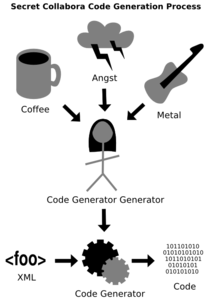
Some background: service-side code generation
The secret Collabora code-generation process

(credit: daf)

Supporting D-Bus in the GObject world has always involved quite a lot of code generation. The core API of dbus-glib is heavily reliant on varargs functions, which aren't type-safe and are easy to get wrong. dbus-glib contains a program called dbus-binding-tool, which is meant to generate reasonably sane GObject APIs for D-Bus objects. Unfortunately, it seems to be intended to generate a whole GObject at a time. Early versions of telepathy-gabble used dbus-binding-tool plus a script called gengobject.py to generate API stubs for the exported objects; developers then filled in the blanks, and hey presto, we had a GObject on D-Bus. This was fine up to a point, but had a couple of major drawbacks. Whenever we changed the D-Bus API (quite common during the early development of Telepathy), there was a very laborious and error-prone merging process. We ended up with the following process:
  • copy the D-Bus introspection XML from the telepathy-spec repository into a directory xml/pristine (actually, the canonical form for the spec was Python for a while, and we had a script that exported a contrived object onto D-Bus and introspected itself to get the XML - but that's another story!)
  • preprocess the introspection XML to add the dbus-glib CFunctionName annotation, resulting in a directory xml/modified
  • run dbus-binding-tool and a Python script gengobject.py to generate C source in xml/src
  • three-way-diff the old version of xml/src, the new version of xml/src, and the real C code in src to create a new version of src
  • pray that the diff process hadn't randomly exchanged functions' implementations
  • update the resulting code in src so it worked
  • check the whole mess back into darcs
  • hope that nobody else had made changes that would result in darcs conflicts
If you haven't yet gathered, this was a bit of a nightmare. Also, it was very easy to return the wrong thing from a method without noticing - because all the APIs were varargs, the compiler didn't notice, and the first we'd know about it was a mysterious segfault under certain circumstances.
How telepathy-glib fixes code generation telepathy-glib improves on this by taking advantage of this innocuous-looking feature in dbus-glib:
commit 355ef78d98d6fc65715845d56232199162cab12a
Author: Steve Fr cinaux <steve istique net>
Date:   Thu Aug 17 11:48:20 2006 +0200
    Interface support for bindings.
Instead of running dbus-binding-tool or creating GObjects with D-Bus interfaces, we put the entire Telepathy spec through glib-ginterface-gen.py, a distant descendant of Gabble's gengobject.py. For each interface in the spec, we generate a GInterface that mirrors the D-Bus interface. Any GObject that implements the GInterface automatically gets the D-Bus interface if it's exported onto D-Bus. There are a few non-obvious refinements, though:
  • The signature of the method implementation is always in the mode that dbus-glib calls "asynchronous", where the method implementation can either send a reply message before or after it returns. For "slow" methods, this is the only thing you can do. For instance, many Telepathy D-Bus methods can't return anything until some TCP round-trips to the server have happened. This is also the only thing you can do if you want to extract extra information, like the sender's unique name, from the method-call message (dbus-glib's "synchronous" API doesn't allow this to be done). For "fast" methods, sending a reply message before returning is just as easy as using the "synchronous" API (it's just a difference of syntax), and has an API consistent with that of the "slow" methods, making it easier for service authors.

  • The layout of the GInterface vtable is private, and (auto-generated) accessor functions are used to fill in implementations. This means our ABI doesn't change just because we re-ordered functions in the spec.

  • If no implementation is provided for a method, we just raise an appropriate error (org.freedesktop.Telepathy.Errors.NotImplemented), rather than suffering an assertion failure. This means we can safely add methods to an interface.

  • While we're generating code anyway, we generate some static inline wrapper functions which wrap dbus_g_method_return(), to have type-safe method returns. You can easily check that a method replies with correct types, by checking that the implementation of Foo() replies by calling tp_svc_some_interface_return_from_foo().

  • Similarly, we generate wrapper functions to emit signals, to get type-safe signal emission.

Not all interfaces are stable enough to be included in telepathy-glib's stable API and ABI, so some of our other projects include a copy of the telepathy-glib code-generation tools, and generate their own "mini-telepathy-glib" (traditionally in a /extensions/ directory) for their implementation-specific (drafts of) interfaces. This isn't yet as polished as it ought to be (mainly because we don't want to freeze the augmented-introspection-XML format that we write the Telepathy spec in, because it's rather ad-hoc and hackish in places) but it works quite well in practice. To see what this looks like in practice, have a look at the examples in telepathy-glib, or at a Telepathy connection manager like telepathy-gabble.
Mixins and base classes Another feature of telepathy-glib which makes life easier for connection manager authors is that it provides "mixins" and base classes which implement some of the GInterfaces. There's absolutely nothing magic about the base classes - they don't have any access to private implementation details of the GInterfaces, they just implement them like everyone else does. The "mixins" are only slightly more magical - they store some extra state inside the structures representing GObjects and their classes, and use it to provide default implementations of some or all of the methods on a particular interface (or two interfaces, in the case of the new TpMessageMixin). I'll leave it up to Rob to explain those in greater detail, since I seem to remember that he invented them :-P The examples and regression tests in telepathy-glib are quite good examples of how these work in practice.

Simon McVittie: A magical xrandr incantation

Here's a handy incantation I use with the Intel X.org graphics driver on my laptop.

Put this script somewhere convenient:

#!/bin/sh
if xrandr   grep '^VGA connected' >/dev/null
then
    #echo "VGA connected"
    xrandr --output VGA --above LVDS --auto
    xrandr --output LVDS --auto
else
    #echo "VGA not connected"
    xrandr --auto
fi 2>&1   logger -t xrandr-hotkey

and bind it to your "switch video mode" key, e.g. Fn+F7 on my Thinkpad X60s. For instance, I run xbindkeys, so I saved it as autoxrandr and put this in ~/xbindkeysrc:

"exec /home/smcv/bin/autoxrandr"
    XF86Display

Now if you press the "switch video mode" key with a monitor plugged in, you'll get the external monitor appearing above the laptop panel (my preferred configuration - I've balanced my monitor on an N800 box to get the bottom of the screen level with the top of my laptop's screen). If you press that key again after unplugging the VGA cable, the laptop will turn off the VGA output and pull all the windows onto the built-in screen.

8 November 2008

Joerg Jaspert: Debian mirror scripts

With a small mail to our mirrors-announce list, I just opened the work of more than one month to the public. Even better, I strongly encourage every mirror admin to use my scripts, or at least scripts that follow a minimal set of rules I wrote down… Some long time (somewhere in April or May this year) I got added to the Debian mirroradm group. First it was only to get some problems with packages.debian.org solved, but later on I started doing more. This group is basically the one that handles the archvsync user on .debian.org machines and also manages the official Debian mirrors listing. As the archvsync user exists on multiple .debian.org machines, and many of them do mirror a copy of our archive for various reasons, all of them had some version of a mirroring script, and sometimes also a version of a pushmirror script. Unfortunately, as they all had been maintained mostly on their own per machine - they sometimes had evolved a bit different. Additionally all of them had a few problems which could leave us with a broken mirror behind, despite it looking all well. So on Sept. 26 I decided to trash it all and rewrite the script and put it all in a VCS (and selected git). For that I set myself a few goals, like (in no particular order) Now, 109 commits and more than a month later, I was finally able to open the scripts to the wide public. (Had multiple people test them before this, but thats always different than a real “release”). The scripts are in use on all .debian.org machines and some other mirrors already, so I’m fairly sure they work.
As I already wrote, Debian mirror admins are strongly encouraged to use this scriptset and not to invent their own. In case you miss a feature either send me a mail describing it, or better, a patch implementing it. I’m happy to implement as much as possible (and sensible :) ) And while it is discouraged to use own scripts, sometimes people have reasons to have their own, so there is now a minimal set of functionality that such a script MUST support. All of those requirements are easy to fulfill. Well, at least the MUST ones. The first one is basically a given, all scripts I know are doing this already. The second one sounds more complicated, but actually might just be about 4 lines of actual code changes. Just touch an extra file before you gain a lockfile (to avoid two scripts running at the same time) and then rerun rsync as long as that extra file is around. (It helps to rm this trigger file right before you call rsync :) ). The should directive is actually a little more work to implement correctly. I won’t show source here, read the ftpsync script if you want to see it, but I try some small explanation. Background: Debian mirror synchronisation is usually done by scripts that get started via ssh. As mirror operators (understandably) do not like their upstream mirror to be able to login, this is done using “ssh triggers”, a feature I wrote about earlier. Those are sshkeys using a forced command, so nothing else than this command will be run, ever. SSH, if used with such forced commands, has the helpful feature that it sets the environment variable SSH_ORIGINAL_COMMAND containing the original arguments. Which means that, if the mirror pushes you with “ssh yourhost -l mirror sleep 1” you will see *sleep 1 in that variable. It is what many mirror operators currently use when pushing their downstreams. Now, we can use that to tell the receiving end all things we want it to know. If you look in my script you will see that I defined a little more than the minimal arguments. But none of the additional ones are a requirement, they only make life much easier. My script currently understands, additional to the 3 minimal ones:
As if that wasn’t enough, I also had to rewrite the runmirrors script. The old 10-line one just didn’t cope with the more general approach. This script is used to “push” your downstream mirrors, telling them that they need to update. (Which is the only sane way to run a mirror. cron is just not made for mirrors that can update at random times!). One nice new feature of it is the ability to update multiple mirrors nearly at the same time. This is extremely helpful in case of DNS Round Robin entries like security.debian.org (multiple hosts offering the same archive under one hostname). You do not want to have such hosts out of sync. Not even for a minute, if you can avoid that. So we now push the mirrors with sync:stage1 as argument. Then we wait until all of them have finished the stage1 sync before we push them all again, this time with sync:stage2 as argument. This will erase any update delays thanks to network latency / low bandwidth one of the security mirrors might have, as the large transfers (all the binary and source packages) are done in stage1. They can take time, a normal user won’t notice it - the Package and Source indices are not transferred yet. They arevery small and as such transfered pretty fast whenever stage1 is done everywhere and we tell mirrors to do stage2.
All in all it was a pretty nice exercise writing those scripts. Comments: 0

4 November 2008

Ross Burton: OfflineIMAP, ConsoleKit, GNOME Keyring

Over the weekend I finally got fed up with Evolution struggling to connect to work's "IMAP" server (Exchange 2007), and switched to using OfflineIMAP to sync the mail to a local Maildir. This as expected worked pretty well, and I'm now hidden from the nasty lag on the server. However, I've had to write my top secret Intel password into .offlineimaprc, which sucks. Then I had a cunning plan... GNOME Keyring will store passwords in a pretty secure manner, so somehow I need to fetch the password from there. A quick look at the OfflineIMAP manual revealed that I can write Python functions which return the password, so I should be abe to hook into the keyring from OfflineIMAP. This should be fairly simple:

import gobject, gnomekeyring
# The keyring needs to know the application name
if gobject.get_application_name() is None:
  gobject.set_application_name("offlineimap")
def keyring(user, host):
  keys = gnomekeyring.find_network_password_sync(user=user, server=host, protocol="imap")
  # First one will do nicely thanks
  return keys[0]["password"]
...
remotepasseval = keyring("rburton", "imapmail.intel.com")
After writing a small tool to add the key to the keyring, to my surprise this worked first time. I bounced with glee, but ten minutes later I had error messages from OfflineIMAP running from cron in my inbox... GNOME Keyring uses an environment variable to find the daemon, which isn't set in a cron environment. GNOME Keyring will fall back to using DBus to find the daemon, but the DBus session bus environment variable isn't set. DBus will fall back to reading the session bus address from the X root window, but DISPLAY isn't set so that doesn't work either... EPIC FAIL. But, I thought, I upgraded to Network Manager 0.7 last week which bought in ConsoleKit. If I ask ConsoleKit for my sessions I should be able to find a session with has an X connection, then I can set DISPLAY appropriately and then the chain described above will work, and I'll have my password. Shockingly, this worked first time too:
import dbus, os
if not os.getenv("DISPLAY"):
  # Get the ConsoleKit manager
  bus = dbus.SystemBus()
  manager_obj = bus.get_object('org.freedesktop.ConsoleKit', '/org/freedesktop/ConsoleKit/Manager')
  manager = dbus.Interface(manager_obj, 'org.freedesktop.ConsoleKit.Manager')
  
  # For each of my sessions..
  for ssid in manager.GetSessionsForUnixUser(os.getuid()):
    obj = bus.get_object('org.freedesktop.ConsoleKit', ssid)
    session = dbus.Interface(obj, 'org.freedesktop.ConsoleKit.Session')
    # Get the X11 display name
    dpy = session.GetX11Display()
    if dpy:
      # If we have a display, set the environment variable
      os.putenv("DISPLAY", dpy);
      break
(man, I really with python-dbus had a better syntax for getting objects with a specific interface) So there you go, integrating OfflineIMAP with the GNOME Keyring via ConsoleKit and DBus. Surprisingly this was pretty easy to do, thanks to DBus and the magic provided by ConsoleKit it is 100% hack free.

Russell Coker: Basics of EC2

I have previously written about my work packaging the tools to manage Amazon EC2 [1]. First you need to login and create a certificate (you can upload your own certificate - but this is probably only beneficial if you have two EC2 accounts and want to use the same certificate for both). Download the X509 private key file (named pk-X.pem) and the public key (named cert-X.pem). My Debian package of the EC2 API tools will look for the key files in the ~/.ec2 and /etc/ec2 directories and will take the first one it finds by default. To override the certificate (when using my Debian package) or to just have it work when using the code without my package you set the variables EC2_PRIVATE_KEY and EC2_CERT. This Amazon page describes some of the basics of setting up the client software and RSA keys [2]. I will describe some of the most important things now: The command “ec2-add-keypair gsg-keypair > id_rsa-gsg-keypair” creates a new keypair for logging in to an EC2 instance. The public key goes to amazon and the private key can be used by any ssh client to login as root when you creat an instance. To create an instance with that key you use the “-k gsg-keypair” option, so it seems a requirement to use the same working directory for creating all instances. Note that gsg-keypair could be replaced by any other string, if you are doing something really serious with EC2 you might use one account to create instances that are run by different people with different keys. But for most people I think that a single key is all that is required. Strangely they don’t provide a way of getting access to the public key, you have to create an instance and then copy the /root/.ssh/authorized_keys file for that. This Amazon page describes how to set up sample images [3]. The first thing it describes is the command ec2-describe-images -o self -o amazon which gives a list of all images owned by yourself and all public images owned by Amazon. It’s fairly clear that Amazon doesn’t expect you to use their images. The i386 OS images that they have available are Fedora Core 4 (four configurations with two versions of each) and Fedora 8 (a single configuration with two versions) as well as three other demo images that don’t indicate the version. The AMD64 OS images that they have available are Fedora Core 6 and Fedora Core 8. Obviously if they wanted customers to use their own images (which seems like a really good idea to me) they would provide images of CentOS (or one of the other recompiles of RHEL) and Debian. I have written about why I think that this is a bad idea for security [4], please make sure that you don’t use the ancient Amazon images for anything other than testing! To test choose an i386 image from Amazon’s list, i386 is best for testing because it allows the cheapest instances (currently $0.10 per hour). Before launching an instance allow ssh access to it with the command “ec2-authorize default -p 22“. Note that this command permits access for the entire world. There are options to limit access to certain IP address ranges, but at this stage it’s best to focus on getting something working. Of course you don’t want to actually use your first attempt at creating an instance, I think that setting up an instance to run in a secure and reliable manner would require many attempts and tests. As all the storage of the instance is wiped when it terminates (as we aren’t using S3 yet) and you won’t have any secret data online security doesn’t need to be the highest priority. A sample command to run an instance is “ec2-run-instances ami-2b5fba42 -k gsg-keypair” where ami-2b5fba42 is a public Fedora 8 image available at this moment. This will give output similar to the following: RESERVATION r-281fc441 999999999999 default
INSTANCE i-0c999999 ami-2b5fba42 pending gsg-keypair 0 m1.small 2008-11-04T06:03:09+0000 us-east-1c aki-a71cf9ce ari-a51cf9cc The parameter after the word INSTANCE is the serial number of the instance. The command “ec2-describe-instances i-0c999999” will provide information on the instance, once it is running (which may be a few minutes after you request it) you will see output such as the following: RESERVATION r-281fc441 999999999999 default
INSTANCE i-0c999999 ami-2b5fba42 ec2-10-11-12-13.compute-1.amazonaws.com domU-12-34-56-78-9a-bc.compute-1.internal running gsg-keypair 0 m1.small 2008-11-04T06:03:09+0000 us-east-1c aki-a71cf9ce ari-a51cf9cc The command “ssh -i id_rsa-gsg-keypair root@ec2-10-11-12-13.compute-1.amazonaws.com” will then grant you root access. The part of the name such as 10-11-12-13 is the public IP address. Naturally you won’t see 10.11.12.13, it will instead be public addresses in the Amazon range - I replaced the addresses to avoid driving bots to their site. The name domU-12-34-56-78-9a-bc.compute-1.internal is listed in Amazon’s internal DNS and returns the private IP address (in the 10.0.0.0/8 range) which is used for the instance. The instance has no public IP address, all connections (both inbound and outbound) run through some sort of NAT. This shouldn’t be a problem for HTTP, SMTP, and most protocols that are suitable for running on such a service. But for FTP or UDP based services it might be a problem. The part of the name such as12-34-56-78-9a-bc is the MAC address of the eth0 device. To halt a service you can run shutdown or halt as root in the instance, or run the ec2-terminate-instances command and give it the instance ID that you want to terminate. It seems to me that the best way of terminating an instance would be to run a script that produces a summary of whatver the instance did (you might not want to preserve all the log data, but some summary information would be useful), and give all operations that are in progress time to stop before running halt. A script could run on the management system to launch such an orderly shutdown script on the instance and then uses ec2-terminate-instances if the instance does not terminate quickly enough. In the near future I will document many aspects of using EC2. This will include dynamic configuration of the host, dynamic DNS, and S3 storage among other things.

3 November 2008

Enrico Zini: rc-buggy packages sorted by popularity

rc-buggy packages sorted by popularity After doing a round of tag reviews so that we release lenny with the latest tag contributions, I still had a bit of spare time. Since people are urging to fix the last bugs I thought I could contribute a list of RC-buggy packages sorted by popularity:
#!/usr/bin/python
import urllib2
import sys, re #, gzip
PKGRE = re.compile(r'<strong>Package: </strong><a href="[^"]+" name="([^"]+)">')
POPCONRE = re.compile(r'^(\d+)\s+(\S+)')
PKGMAPRE = re.compile(r'^([^(]+)\(([^)]+)')
COMMASPLIT = re.compile(r'\s*,\s*')
# Allow to download other package views
if len(sys.argv) > 1:
    url = sys.argv[1]
else:
    url = "http://bts.turmzimmer.net/details.php"
def read_packages(url):
    "Download the list of rc-buggy packages"
    fd = urllib2.urlopen(url)
    for line in fd:
        mo = PKGRE.search(line)
        if mo:
            yield mo.group(1)
# FIXME: this is a deprecated data source, but at the moment it is just what
#        is needed
def read_bintosrc(url = "http://qa.debian.org/data/ddpo/results/ddpo_packages"):
    "Download the binary to source package map"
    fd = urllib2.urlopen(url)
    for line in fd:
        mo = PKGMAPRE.search(line)
        if mo:
            src = mo.group(1)
            bin = COMMASPLIT.split(mo.group(2))
            for p in bin:   
                yield p, src
def read_popcon(url = "http://popcon.debian.org/by_inst"):
    "Download popcon information"
    fd = urllib2.urlopen(url)
    # It doesn't work on urllib2 objects because it wants tell()
    #fd = gzip.GzipFile(fileobj=fd, filename=url, mode="rb")
    for line in fd:
        mo = POPCONRE.match(line)
        if mo:
            yield mo.group(2), int(mo.group(1))
print "Reading mapping of binary packages to source packages..."
bin2src = dict(read_bintosrc())
print "Reading popcon scores..."
# We actually want the score of source packages, and for it we use the score of
# its binary package with the highest score
scores = dict()
for pkg, score in read_popcon():
    pkg = bin2src.get(pkg, pkg)
    if pkg not in scores:
        scores[pkg] = score
#scores = dict(read_popcon("http://popcon.debian.org/by_inst.gz"))
print "Reading list of rc-buggy packages..."
# The bug page has a mix of source and binary packages: convert all to source
# packages
packages = sorted(read_packages(url), key=lambda x:scores.get(bin2src.get(x,x), 0))
for p in packages:
    print scores.get(bin2src.get(p,p), 0), p
This can be run on people.debian.org as ~enrico/popzimmer (0 is the rank of packages that for some reason cannot be mapped to any rank):
$ ~enrico/popzimmer 
Reading mapping of binary packages to source packages...
Reading popcon scores...
Reading list of rc-buggy packages...
0 roxen-fonts-iso8859-2
2 dpkg
11 pam
61 glibc
61 libc6
123 initramfs-tools
149 bind9
150 grub
180 portmap
213 nfs-common
279 libgl1-mesa-dri
298 libsnmp-base
298 snmpd
309 avahi
397 mysql-dfsg-5.0
408 xserver-xorg-input-wacom
409 xserver-xorg-video-vesa
428 docbook-xml
499 openoffice.org-core
567 xine-lib
600 evolution-data-server
669 eog
671 xserver-xorg-video-intel
691 epiphany-browser
691 epiphany-gecko
695 kdelibs4c2a
698 uswsusp
754 guile-1.6
959 gpm
964 cups
990 kdebase
1002 ghostscript
1069 giflib
1076 xulrunner-1.9
1177 libapache2-mod-perl2
1217 vlc-nox
1229 kernel-package
1311 kdeutils-dev
1520 libparted1.8-10
1767 wireshark
1785 selinux-policy-default
1908 dia
1943 htop
1983 boost
2140 cantlr
2145 transmission
2159 emacs22
2312 swfdec-mozilla
2449 eclipse
2449 libswt3.2-gtk-java
2728 lilo
2898 libnss-ldap
3013 java-access-bridge
3051 blender
3099 libtemplate-perl
3499 fglrx-atieventsd
3602 virtualbox-ose
3619 jfsutils
3806 anjuta
3962 kbuild
4076 libgnustep-gui0.14
4222 libwebkit-1.0-1
4332 rosegarden
4412 matplotlib
4412 python-matplotlib
4950 mail-notification-evolution
5195 nut-cgi
5273 sbcl
5538 ruby1.9
5679 kmymoney2
6076 websvn
6147 miro
6264 gnat-4.1
6431 gallery2
6478 gnome-chess
6512 joystick
6862 istanbul
6937 wordpress
7476 luatex
7635 csound
7635 python-csoundac
8257 libpam-mount
8471 wmcpuload
8631 nbsmtp
8642 oxine
8774 axiom
8949 libengine-pkcs11-openssl
9052 clamav-getfiles
9221 open-iscsi
9262 ptex-bin
9701 egroupware-core
10012 debian-cd
10127 libjogl-java
10453 libjson-xs-perl
10698 gcjwebplugin
10736 request-tracker3.6
11294 python-extclass
11518 rkward
11600 alevt
12929 otrs2
13205 bindgraph
13956 icecc-monitor
14223 netmaze
14505 cdebconf
14526 mumble
14687 fnonlinear
14724 recite
14789 jbidwatcher
15766 libnss-ldapd
15812 glpi
15905 lustre-source
15982 win32-loader
16232 ampache
17168 libghc6-missingh-dev
17311 acl2
17830 apertium
18462 emacspeak
18469 glassfish
19257 isight-firmware-tools
19719 libnagios-object-perl
20144 libwx-perl
20465 dns2tcp
21614 python-kinterbasdb-dbg
21690 hf
21902 libcobra-java
22365 tomcat6
22573 libphp-snoopy
23501 coco-java
23926 boxbackup-server
24009 libghc6-wash-dev
26323 libdesktop-notify-perl
26439 opendb
28426 adolc
28795 xorp
29986 libgdata-java
31262 libjboss-serialization-java
31472 pixelpost
31658 cournol
32939 mediamate
34365 gforge-plugin-scmcvs
34659 libgearman-client-async-perl
42233 libhamcrest-java
48076 mahara
55303 mxallowd
85881 roxen-fonts-iso8859-1

So, if you don't know from what package to start fixing bugs, "Begin at the beginning,", the King said, very gravely, "and go on till you come to the end: then stop."

Russell Coker: Types of Cloud Computing

The term Cloud Computing seems to be poorly defined at the moment, as an example the Wikipedia page about it is rather incoherent [1]. The one area in which all definitions of the term agree is that a service is provided by a varying number of servers of which the details are unknown to the people who use the services - including the people who program them. There seem to be four main definitions of cloud computing. The first one is Distributed Computing [2] (multiple machines in different administrative domains being used to perform a single task or several tasks), this definition does not seem to be well accepted and will probably disappear. The next one is Software As A Service [3] which is usually based on the concept of outsourcing the ownership and management of some software and accessing it over the Internet. An example is the companies that offer outsourced management of mail servers that are compatible with MS Exchange (a notoriously difficult system to manage). For an annual fee per email address you can have someone else run an Exchange compatible mail server which can talk to Blackberries etc. The main benefit of SAAS is that it saves the risk and expense of managing the software, having the software deployed at a central location is merely a way of providing further cost reductions (some companies that offer SAAS services will also install the software on your servers at greater expense). The last two definitions are the ones that I consider the most interesting, that is virtual machines (also known as Cloud Infrastructure [4]) and virtual hosting of applications (also known as Cloud Platforms [5]). The Amazon EC2 (Elastic Cloud Computing) service [6] seems to be the leading virtual machine cloud service at the moment. Google App Engine [7] seems to be the leading cloud application hosting service at the moment. It is also claimed that “Cloud Storage” is part of cloud computing. It seems to me that storing data on servers all over the world is something that was done long before the term “Cloud Computing” was invented, so I don’t think it’s deserving of the term.

2 November 2008

John Goerzen: Politics and the Church

My church is one in which politics are checked at the door. Some church members wear their politics on their yard, or on their blog -- and just about every opinion is represented in the church. But you rarely hear politics mentioned in church. When it is mentioned, it's issue-oriented rather than candidate-oriented or policy-oriented -- we'll hear updates on efforts to create a peace tax fund, for instance.

But today, hearing about politics is just about unavoidable.

The relationship between Christianity and government has been uneasy and troubled all the way back to the religion's founding. Many Christians, and I count myself in this, believe that our first loyalty is to Jesus, and on those grounds, refuse to say the pledge of allegiance. What, we wonder, would our word be worth if we were forced to disobey our government because of a law that was unjust or immoral? How could we even say the words "one nation, under God, with liberty and justice for all" when those words were written at a time when the KKK was active, lynchings were common, and are said today at a time when people treat Muslims and immigrants with modern disdain?

In short, we believe we are called to be citizens of a different kingdom first.

So, today, our pastor deliberately picked a difficult scripture passage for us: Romans 13:1-7, which reads, in part:

Everyone must submit himself to the governing authorities. . . The authorities that exist have been established by God. . . Consequently, he who rebels against the authority is rebelling against what God has instituted, and those who do so will bring judgment on themselves. For rulers hold no terror for those who do right, but for those who do wrong. . . Therefore, it is necessary to submit to the authorities, not only because of possible punishment but also because of conscience.


What an extraordinary set of statements. This was written during the time of the Roman Empire, which could hardly be said to have been a just and benign government. It's hard for me to imagine the Roman Legion being established by God.

In more modern times, it would seem to denounce the American revolution as a rebellion against authority and therefore a rebellion against God. It would also seem to denounce the protests that we see all over the world -- striking workers in France, human rights seekers in Burma, war protesters in the United States. Would it even have condemned the protests in the 1960s over civil rights in this country, or the protests against war today?

One commentator notes that "Paul is not stating that this will always be true but is describing the proper, ideal function of rulers. When civil rulers overstep their proper function, the Christian is to obey God rather than human authorities" -- a theme Paul mentioned more than once in Acts.

What relevance does this have for us today? It seems that we are to help our rulers act in a just way, even if we disagree with them -- no matter who wins the election. It is also a reminder that a superficial reading of the Bible, taken out of context and without a deep understanding to understand the author's point, can potentially lead to very strange conclusions.

The American National Council of Churches has issued a non-partisan voting guide, which we found in our bulletin today. It is an interesting read, and probably not what you think; it begins with, "War is contrary to the will of God." Thought-provoking stuff.

I find it interesting that there are a lot of people out there that say that religion is responsible for a lot of ill in this country, then proceed to hold pretty much the same opinions I do for pretty much the same reasons. I just point out that the Bible is deeper than intolerance and submission.

Matthew Garrett: Ultamatix

First, let me make one thing clear. This isn't constructive criticism. This is just criticism. It's directed at software that's so wrong-headed that there's no way to make it significantly better, and everyone involved would be much better spending their time doing something else instead of trying to fix any of what I'm about to describe. It's not worth it. Sit in a park or something instead. Meet new and interesting people. Take up a hobby that doesn't involve writing shell scripts for Linux. You'll be happier. I'll be happier. Everyone wins.

Anyway. I wrote about Automatix some time ago. It died and the world became a better place. More recently it's been resurrected as something called Ultamatix. In summary, don't bother. It's crap. And dangerous. But mostly crap. Again, I'm going to utterly ignore the UI code and just concentrate on what it runs.
There's almost certainly more. I got bored. The worrying thing about this is that the Ultamatix author read my criticisms of Automatix and appears to have attempted to fix all of them. The problem with this is that there's clearly a complete lack of understanding of the fundamental problem in several cases. For example, one of my criticisms of Automatix:

sudo sed -i "s/^vboxusers\(.*\):$/vboxusers\1:$AXUSER/" /etc/group

- assumes that the system isn't using some sort of user directory service.


and the Ultamatix response:

Fixed...Got rid of Virtualbox

Except exactly the same problem is present at other points in Ultamatix, as noted above. Taking a bug list and slavishly fixing or deleting all the bugs isn't helpful if you then proceed to add the same bug back in 24 other places. In that respect, it's even worse than Automatix - the author's managed to produce a huge steaming pile of shite despite having been told how to avoid doing so beforehand. He may be no newbie to programming, but if not it's a perfect example of how experience doesn't imply competence.

Don't install this package. Don't let anyone else install this package. If you see anyone advocating the installation of this package, call them a fool. There's absolutely no excuse whatsoever for the existence of this kind of crap.

Minor update:
The above was looking at 1.8.0-4. It turns out that there's a 1.8.0-5 that's not linked off the website. There's no substantive difference, but some of the numbers may be slightly different.

Russell Coker: Integrity and Mailing Lists

One significant dividing factor between mailing lists is the difference between summary lists (where the person who asks a question receives replies off-list and then sends a summary to the list) and the majority of mailing lists which are discussion lists (where every reply goes to the list by default). I have seen an argument put forward that trusting the answers on a mailing list that operates under the summary list model is inherently risky and that peer review is required. It could be argued that the process of sending a summary to the list is the peer review. I’m sure that if someone posts a summary which includes some outrageously bad idea then there will be some commentary in response. Of course the down-side to this is that it takes a few days for responses to the question to arrive and as it’s common that computer problems need to be solved in hours not days the problem will be solved (one way or another) before the summary message is written. But the idea of peer review in mailing lists seems to fall down in many other ways. The first problem with the idea of peer review is that the usual aim of mailing lists is that most people will first ask google and only ask the list if a reasonable google search fails (probably most mailing lists would fall apart under the load of repeated questions otherwise). Therefore I expect that the majority of such problems to be solved by reading a web page (with no peer review that is easily accessible). Some of those web pages contain bad advice and part of the skill involved in solving any problem relates to recognising which advice to follow. Also it’s not uncommon for a question on a discussion list to result in a discussion with two or more radically different points of view being strongly supported. I think that as a general rule there is little benefit in asking for advice if you lack any ability to determine whether the advice is any good, and which of the possible pieces of good advice actually apply to your situation. Sometimes you can recognise good advice by the people who offer it, in a small community such as a mailing list it’s easy to recognise the people who have a history of offering reasonable advice. It seems that the main disadvantage of asking google when compared to asking a mailing list is that the google results will in most cases contain links to web sites written by people who you don’t know. Sometimes the advice is easy to assess, for example if someone recommends a little-known and badly documented command-line option for a utility it’s easy to read the man page and not overly difficult to read the source to discover whether it is a useful solution. Even testing a suggested solution is usually a viable option. Also it’s often the case that doing a google search on a recommended solution will be very informative (sometimes you see web pages saying “here’s something I tried which failed”). Recommendations based on personal experience are less reliable due to statistical issues (consider the the regular disagreements about the reliability of hard disks where some people claim that RAID is not necessary due to not having seen failures while others claim that RAID-5 is inadequate because it has failed them). There are also issues of different requirements, trivial issues such as the amount of money that can be spent will often determine which (if any) of the pieces of good advice can be adopted. The fact that a large number of people (possibly the majority of Internet users) regularly forward as fact rumors that are debunked by Snopes.com (the main site for debunking urban legends) seems to indicate that it is always going to be impossible to increase the quality of advice beyond a certain level. A significant portion of the people on the net are either unwilling to spend a small amount of effort in determining the accuracy of information that they send around or are so gullible that they believe such things beyond the possibility of doubt. Consider that the next time you ask for advice on a technical issue, you may receive a response from someone who forwarded a rumor that was debunked by Snopes. Sometimes technical advice is just inherently dangerous because it is impossible to verify the integrity of some code that is being shared, or because it may be based on different versions of software. In a previous blog post I analyse some issues related to security of the Amazon EC2 service [1]. While the EC2 service is great in many ways (and implements a good well-documented set of security features on the servers) the unsigned code for managing it and the old versions of the images that they offer to customers raise some serious issues that provide avenues for attack. Getting the EC2 management tools to work correctly on Debian is not trivial, I have released patches but will not release packages for legal reasons. It seems most likely to me that someone will release packages based on my patches (either because they don’t care about the legal issues or they have legal advice suggesting that such things are OK - maybe due to residing in a different jurisdiction). Then people who download such packages will have to determine whether they trust the person who built them. They may also have the issue of Amazon offering a newer version of the software than that which is packaged for Debian (for all I know Amazon released a new version yesterday). The term integrity when applied to computers refers to either accidental or malicious damage to data [2]. In the context of mailing list discussions this means both poorly considered advice and acts of malice (which when you consider spam and undisclosed conflicts of interest are actually quite common). If you ask for advice in any forum (and I use the term in it’s broadest sense to cover web “forums”, IRC, twitter, etc) then getting a useful result will depend on having the majority of members of the forum possessing sufficient integrity and skill, being able to recognise the people whose advice should be followed, or being able to recognise good advice on it’s own. I can think of few examples of forums of which I have been involved where the level of skill was sufficient to provide quality answers (and refutations for bad answers) for all areas of discussion that were on topic. People whose advice should generally be followed will often offer advice on areas where their skills are less well developed, someone whose advice can be blindly followed in regard to topic A may not be a reliable source for advice on topic B - which can cause confusion if the topics in question are closely related. Finally a fundamental difference between “peer review” (as applied to conferences and academic journals) is that review for conferences and journals is conducted before the presentation. Not only does the work have to be good enough to pass the review, but the people doing it will never be sure what the threshold is (and will generally want to do more than a minimal effort) so the quality will be quite high. While peer review in mailing lists is mostly based around the presence or absence of flames. A message which doesn’t attract flames will either have some minimal quality or be related to a topic that is not well known (so no-one regards it as being obviously wrong). Update: The “peer review” process of publishing a post on my blog revealed that I had incorrectly used who’s instead of whose.

Next.

Previous.