Search Results: "tats"

27 January 2012

Alexander Reichle-Schmehl: Release Critical Bug report for Week 04

The bug webinterface of the Ultimate Debian Database currently knows about the following release critical bugs:
In Total:1491
Affecting Wheezy:893
Wheezy only:179
Remaining to be fixed in Wheezy:714
Of these 714 bugs, the following tags are set:
Pending in Wheezy:48
Patched in Wheezy:102
Duplicates in Wheezy:45
Can be fixed in a security Update:19
Contrib or non-free in Wheezy:14
Claimed in Wheezy:0
Delayed in Wheezy:5
Otherwise fixed in Wheezy:48
Ignoring all the above (multiple tags possible) 491 bugs need to be fixed by Debian Contributors to get Debian 7.0 Wheezy released. However, with the view of the Release Managers, 788 need to be dealt with for the release to happen. Please see Interpreting the release critical bug statistics for an explanation of the different numbers.

Lior Kaplan: PHP 5.4 @ Zend

As a Linux integration guy at Zend, most of my time is spent in compiling PHP related code or dealing with the variety of Linux distributions we support. With the coming release for PHP 5.4, we (at Zend) had some interesting stuff going on. As part of the RC phase, I got to check the status of the 50-60 PHP extensions we provide, especially the PECL extensions which have different release cycles than the main PHP. With minor versions, this usually doesn t really matter, but for major versions this means that some extensions need a little bit of love and fixes to work well with the new PHP version. This of course with the help of our developers. The changes are usually one-liners due to a variable type change, or finding commits in the extension s SCM and applying/back-porting it to the current versions (e.g. pecl memcache). Our policy regarding the patches we have, is that they should at least be sent to upstream (a core member or a bug report, e.g. #55703). I think I m in the best position to enforce that patch policy, so in a few recent cases, I found myself asking one of our developers if the patch he sent me was already accepted upstream before willing to take it into the build process (in this case they are used temporarily, till we ll work with the next RC or final release).
While most people build PHP as a final and standalone product, we also test it against ZendServer (or the other way around, depends on your POV). This helps to discover problems related to and implications of the changes done in the major version. During the PHP 5.4 RC cycle (which is still not finished), we had, more than a few times, that an internal problem discovered led to debugging, code reviewing and sending feedback (and patches when relevant) to the PHP project. Providing fixes for the issues found, helps having PHP in a better shape for release. At least for me, that s one of the fun parts of work getting the chance to contribute back to the community (or at least making sure others do, as I don t write the patches myself).

Filed under: PHP

26 January 2012

Bastian Venthur: Helping awstats to correctly interpret lighttpd s log format

Note to self: when configuring awstats using lighttpd logfiles, you have to use the following log format: LogFormat="%host %virtualname %logname %time1 %methodurl %code %bytesd %refererquot %uaquot" neighter 1 nor 4 will work correctly.

24 January 2012

Julian Andres Klode: Managing system package selections using custom meta packages

Over the last years, I have developed a variety of metapackages for managing the package selections of the systems I administrate. The meta packages are organized like this:
jak-standard
Standard packages for all systems
jak-desktop
Standard packages for all desktop systems (GNOME 3 if possible, otherwise GNOME 2)
jak-printing
Print support
jak-devel
Development packages
jak-machine-<X>
The meta package defining the computer X
Each computer has a jak-machine-X package installed. This package is marked as manually installed, all other packages are marked as automatically installed. The machine packages have the attribute XB-Important: yes set in debian/control. This creates an Important: yes field. This field is not official, but APT recognizes it and does not remove those packages (the same field is set for the APT package by APT when building the cache, as APT should not be removed either by APT). It seems to work a bit like Essential, with the exception that non-installed packages are not installed automatically on dist-upgrade. The meta packages are created using seed files similar to Ubuntu. In contrast to Ubuntu, I m not using germinate to create the packages from the seeds, but a custom dh_germinate_lite that simply takes a seed file and creates the correct substvars. It s faster than germinate and really simplistic. It also does not handle Recommends currently. The whole result can be seen on http://anonscm.debian.org/gitweb/?p=users/jak/jak-meta.git. Maybe that s useful for some people. And if you happen to find some packages in the seeds that are deprecated, please let me know. Oh, and yes, some packages (such as the letterman one) are internal software not publically available yet [letterman is a simple GUI for creating letters using LaTeX]. While I m at it, I also built Ubuntu s version of wine1.2 for i386 squeeze. It can be found in
deb http://people.debian.org/~jak/debian/ squeeze main (it still needs a few changes to be correct though, I ll upload a jak2 build soon). I also built updated sun-java6 packages for my parents (mostly needed due to the plugin, some websites do not work with the IcedTea one), but can t share the binaries due to licensing requirements. I may push out a source repository, though, so others can build those packages themselves. I ll let you know once that s done.
Filed under: Debian, General

Lior Kaplan: RTL status for Libre Office 3.5.0

As LibreOffice is approaching its final 3.5.0 release, I d like to sum up the RTL status for RC1. So far, 6 RTL related bugs were resolved in the 3.5 cycle (#32530, #34222, #40950, #43790, #43793, #44078), and a few minor issues reported directly to the developer s mailing list got quick responses. Most importantly, the new features of page break and header/footer not only support RTL but actually looks good. During the LibreOffice conference I was suggested to help with these features, providing feedback, and I m glade the needed attention was given to it. Besides that, a few l10n and translation issues were solved in the process of doing the Hebrew translation (which also reflects on other RTL languages). At a few cases, these issue because a general l10n issues which affects all the languages. In general, I found the core developers responsive to mails about RTL support. I m sure the talk about RTL problems during the conference helped, as well as being more active in the project and having more personal acquaintance with the developers. That s being said, RTL support for LibreOffice still has problems, which I hope will be pushed during the 3.5.x cycles (full list at Bug 43808, the rtl meta bug). As to get some focus regarding was is to be done, I m listing the top problems:
  1. #44657 RTL UI: Horizontal scrollbar in calc main window is broken
  2. #33302 brackets inverted in rtl text (mac only)
  3. #37692 RTL list numbering reverses its direction
  4. #42070 - RTL support in broken in presenter Console extension
  5. #32531 - Incorrect cursor key movement between table cells of different directionality
  6. #104515 - RTL UI: moving active embedded object to the left moves it to the right (reported for OO.org, but verified in LibO)
  7. #37128 - Writer saves text alignment of RTL paragraph not according to the ODF specification
I hoped to have the first two done for 3.5.0, but didn t succeed in getting them fixed. Will keep trying
Filed under: i18n & l10n, Israeli Community, LibreOffice

21 January 2012

Lior Kaplan: PHP 5.4 @ Debian

PHP 5.4.0 is around the corner, with RC6 released this weekend. With the courtesy of Ond ej Sur it s already available in experimental. Earlier this week, Raphael Geissert, tested some PHP extensions with the new version and reported 16 bugs (severity: important) against those who failed to build with PHP 5.4. As they will become RC bugs when 5.4.0 will enter unstable (probably around mid February), I preferred to handle them sooner than later. The result is 3 patches sent (one already uploaded) and 5 NMUs done. During the process I poked through a lot of upstream SCMs. In the way I found out a trivial change was done in PECL s SVN two years ago for all the extensions located there, which got me suspicious regarding some extensions we have. For non PECL hosted extensions, I had to track if and when a fix was done and use it for building or do a trivial fix myself. Packages using the 3.0 (quilt) source format were extremely easy to fix, and I was quite happy it generally went fast. In general I m a passive subscriber to the Debian PHP Maintainers mailing list, and finally could help actually and not just reply emails. For me it s also doing some Debian work after a few months of focusing on the coming LibreOffice 3.5 release. update [26/1/2012]: From the 16 issues, only 2 aren t fixed already or will be on the next upstream release. As their upstreams are dead, this is in the hands or the debian people, at least till they ll FTBFS on unstable (instead of experimental).
Filed under: Debian GNU/Linux, PHP

20 January 2012

Alexander Reichle-Schmehl: Release Critical Bug report for Week 03

The bug webinterface of the Ultimate Debian Database currently knows about the following release critical bugs:
In Total:1563
Affecting Wheezy:928
Wheezy only:192
Remaining to be fixed in Wheezy:736
Of these 736 bugs, the following tags are set:
Pending in Wheezy:51
Patched in Wheezy:116
Duplicates in Wheezy:46
Can be fixed in a security Update:22
Contrib or non-free in Wheezy:12
Claimed in Wheezy:0
Delayed in Wheezy:3
Otherwise fixed in Wheezy:41
Ignoring all the above (multiple tags possible) 495 bugs need to be fixed by Debian Contributors to get Debian 7.0 Wheezy released. However, with the view of the Release Managers, 827 need to be dealt with for the release to happen. Please see Interpreting the release critical bug statistics for an explanation of the different numbers.

19 January 2012

Matt Zimmerman: Singly is hiring engineers

I ve written before about joining Singly and a little bit about the open source software we re building. There s now a bit more content on our website too, or you could watch my colleague, Jabber founder Jeremie Miller, talk about it on stage. The Singly team gathered for a discussion
Suffice to say, it s pretty interesting stuff, and we need more interesting people to join the team in order to achieve our goals in the next year. In particular, we re looking for engineers to build highly flexible, resilient and performant back-end infrastructure using Ubuntu, and innovative, usable and beautiful front-end interfaces using HTML5. For full details and how to apply, check out the Singly blog or contact me directly. At this time, we have a preference for candidates in the San Francisco bay area, but are open to exceptional candidates from elsewhere.

18 January 2012

Lior Kaplan: US Supreme Court: Copyright can be extended to foreign works once in public domain

Oh, shit yet another step to shrink the public domain.
Filed under: Free software licenses

15 January 2012

Scott Kitterman: LEGO MINDSTORMS NXT 2.0 Support in Debian/Ubuntu

A LEGO MINDSTORMS NXT 2.0 recently arrived at our house. Of course it only comes with proprietary support for Windows/Mac, so I set out to see what FOSS support for the hardware I could find. I found nxt-python. It wasn t packaged, so I packaged it up and uploaded to Debian (from whence it came to Ubuntu). It s now in for the next release of both distributions (Wheezy/Precise). This is a bit different than the provided software (which compiles code, downloads it to the NXT, and then runs it untethered). For nxt-python the nxt needs to be connected to your computer via USB or bluetooth. It s a lot of fun and it s given me a chance to introduced our youngest child to the idea that there s more to computers than point and click. Currently user level access to the device doesn t work, it has to be accessed by root. Fixing that is on my TODO. I hope someone else out there has an NXT and enjoys this too. UPDATE: Added a udev rule and uploaded again, so anyone in plugdev can access the NXT brick.

14 January 2012

Lior Kaplan: Israel to recognize software patents

The Israeli patent registrar have reverted previous ruling regarding patents on software and published a draft for the procedures to accept such patents. The procedures are open to public comments for the next 30 days. Two years ago the patent registrar have started to consider revising the the issue and got many position papers (e.g. Hamakor s papter). At the end he decided not to accept patents on software. De facto, at least one such patent (US patent 7,596,609) was accepted to be valid in Israel after that ruling. Now that the rulings is reverted, I guess will see many more software patents granted here. I wonder about the implications on the local software market hopefully it won t stagnate due to patent wars such as the ones we see every now and then in the US.
Filed under: Software Patents

13 January 2012

Alexander Reichle-Schmehl: Release Critical Bug report for Week 02

The bug webinterface of the Ultimate Debian Database currently knows about the following release critical bugs:
In Total:1537
Affecting Wheezy:900
Wheezy only:188
Remaining to be fixed in Wheezy:712
Of these 712 bugs, the following tags are set:
Pending in Wheezy:48
Patched in Wheezy:111
Duplicates in Wheezy:45
Can be fixed in a security Update:24
Contrib or non-free in Wheezy:11
Claimed in Wheezy:0
Delayed in Wheezy:2
Otherwise fixed in Wheezy:46
Ignoring all the above (multiple tags possible) 477 bugs need to be fixed by Debian Contributors to get Debian 7.0 Wheezy released. However, with the view of the Release Managers, 799 need to be dealt with for the release to happen. Please see Interpreting the release critical bug statistics for an explanation of the different numbers.

12 January 2012

Michal &#268;iha&#345;: Call for translations of phpMyAdmin 3.5

First phpMyAdmin's alpha release for 3.5 is out for some time and it's best time to start translating if you want to be on time for final release. For information about translating, check our website, in short you can translate either offline (get file from Git, translate and post it to translations tracker) or use online translation system available here: https://l10n.cihar.com/projects/phpmyadmin/ As you can see in the summary, there is lot of new or changed strings, many of the new ones coming from advisor. I suggest you to keep these as last to translate as there is quite lot of them and it is more important to have translated rest of application. The advisor messages are placed at the end of po file. I believe we can reach good amount of complete translations by final release with your contributions! PS: You can expect me again to publish translations stats on this blog as we're heading to release.

Filed under: English Phpmyadmin 0 comments Flattr this!

9 January 2012

Steve McIntyre: Armhf buildds and status in Debian

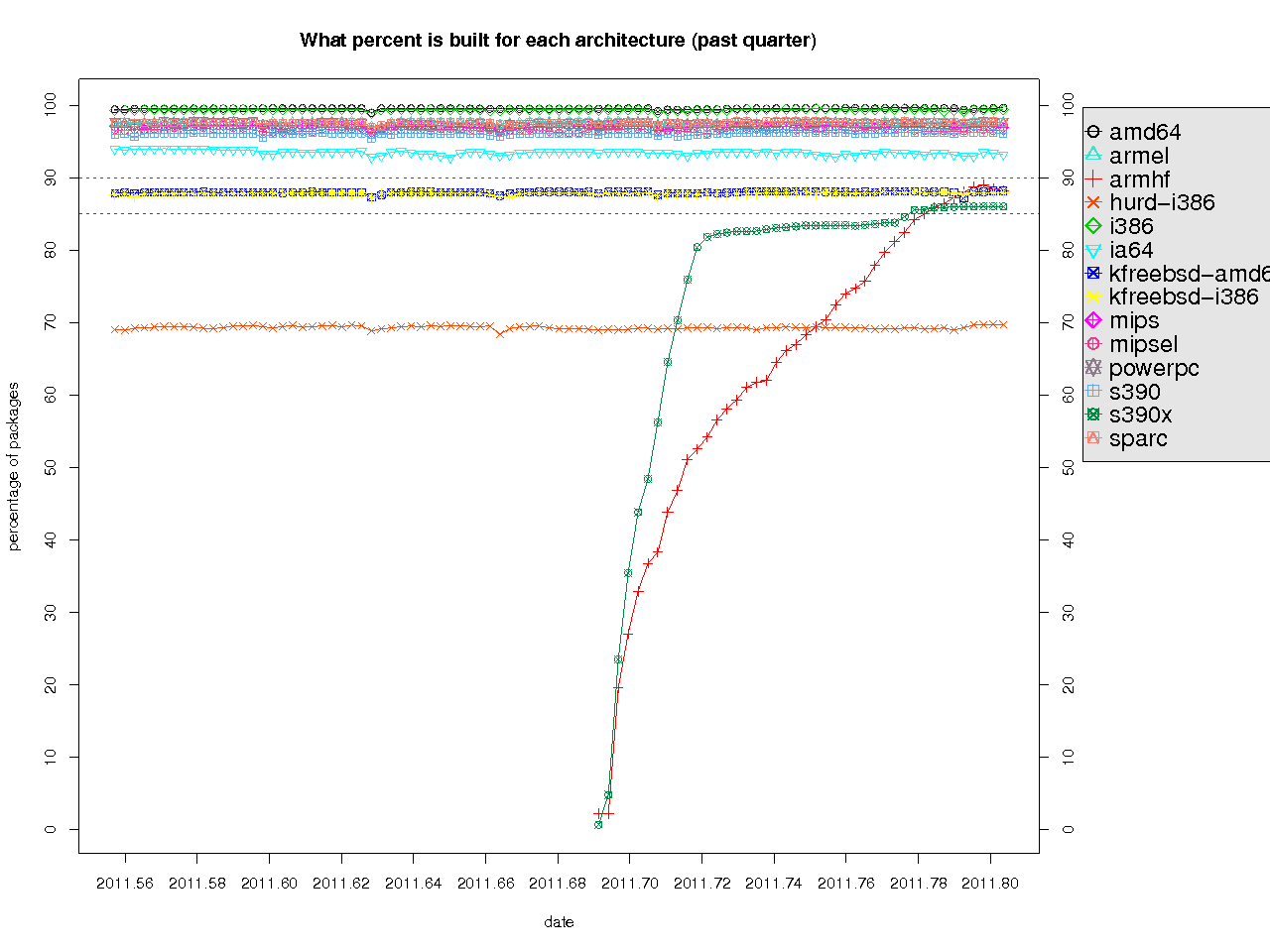
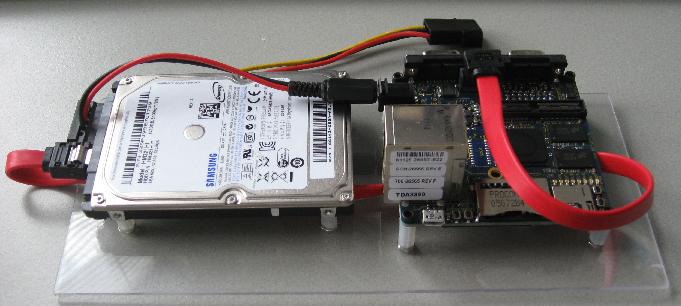
Current status Back in September, I wrote about the machines that I set up to help bootstrap the new armhf port in Debian. Basing on Konstantinos' huge efforts in bringing up the new "architecture" in debian-ports, we started importing armhf into the main Debian archive on the 24th of November. Since then, those builders have been churning away night and day to build the huge collection of software that makes up the Debian archive. The current state can be seen on the armhf buildd status page, and there's a nice graph showing how quickly we've managed to run from 0 to over 90% of the archive here. (Click on the image for a larger version, or visit https://buildd.debian.org/stats/ for other versions. We overtook hurd-i386 quickly and are now ahead of the kfreebsd-* architectures. armhf bootstrap graph We've recently brought 3 more similar build machines online (hildegard, howells and hummel), again sponsored by the nice folks at Linaro but now hosted at the York NeuroImaging Centre at the University of York. This gives us both more build horsepower to keep up with building more different bits of Debian (experimental, updates etc.) and more redundancy in case of problems. We now have the vast majority of the archive built, and now a number of us are concentrating on fixing the remaining issues: language bootstraps and bugs. Also, on the 7th of January we were just added into testing, the next step on our path for inclusion as a Debian release architecture. Setting up the machines A lot of people have been asking me about the physical setup I showed in my last blog about these machines, so here's more details for those who are interested. Mount the 6 boards into the mini-rack, connect up the Molex power connectors to each board, attach ethernet cables and turn it all on! Each board comes with a micro-SD card containing uboot and an Ubuntu installation. I've configured uboot to boot off the hard drive directly, but leaving configuration available to use the Ubuntu on the micro-SD as a simple rescue system should the need arise. The Quickstart boards are not ideal physically for two reasons: the lack of SATA power, plus you need to push a power button on each board to boot it - they don't boot automatically the moment power is applied. However, they're quite inexpensive little machines and have done a great job of building the Debian archive so far! The ideal machines for us would also include more RAM at this point. CPU on these is adequate, but the larger C++ packages (yay webkit!) use a huge amount of memory at link time. Linking in swap is not the best thing, performance-wise... :-( UPDATE 2012-01-12: Ian tells me that the newer Quickstart-R boards apparently have a different power controller; these now boot up straight away without needing you to push a button. That sounds useful.

8 January 2012

Niels Thykier: Testing migration and package relations

While looking at the dpkg Breaks-field[0]
$ aptitude show dpkg
Package: dpkg
[...]
Version: 1.16.1.2
[...]
Breaks: apt (< 0.7.7), aptitude (< 0.4.7-1), dpkg-dev (< 1.15.8), libdpkg-perl (< 1.15.8), pinfo (< 0.6.9-3.1), tkinfo (< 2.8-3.1)
it occurred to me that most (all?) of these relations were irrelevant to Britney when she migrated dpkg 1.16.1.2 to testing. Right now, at least the APT relations are only relevant if you are doing something like a distribution upgrade from Lenny/Squeeze to Wheezy. Similarly, the version constraints in a lot of dependency relations (e.g. libc6 (>= 2.11) ) are satisfied in testing and unstable at the same time. Removing the version constrains on dependencies is a rather minor thing as it is basically just a minor constant time optimization on each dependency check. However, removing an entire clause slightly reduces the problem size a bit. Particularly, the Conflicts/Breaks relations tends to be expensive for us. The first task was to identify the relations that can (or cannot) be simplified. In a Britney run we at most 4 versions of the same package per architecture, though usually only 1 or 2[1]. I devised a small set of rules to simplify the relations. These rules are applied to each package in the relation (atomic proposition, if you will).
  1. If the relation is versioned and it involves a virtual package in any suite, then do not change the relation in any way. Rationale: A virtual package cannot satisfy any versioned relation (Policy Manual 7.5)
  2. If the relation is a dependency (i.e. Pre-Depends or Depends) and the package is not available in any suite, then do not change the relation in any way.
  3. If the relation is versioned and the relation is satisfied in all suites (where the relationed-on package is available), then remove the version constrain. Rationale: If all (present) versions satisfy the relation, then version constrain does not change the semantics.
  4. If the relation is a conflict (i.e. Conflicts or Breaks) and relation is unsatisfiable in all suites, then remove the relation. Rationale: If none of the (present) versions satisfy the conflict-relation, then there is no conflict[2].
The rules are rather conservative in some cases and there is room for improvements. However, one has to remember that removing too few relations costs a bit in runtime, removing too many breaks testing and possibly a lot. Obviously, I prefer the former to the latter (especially because I will be a part of the clean up -crew). I tested my implementation of those four rules above against the current master branch. In short, it produces the same result as the master branch in all the tests so far. In the hand-made test-suite, the tests generally do not have any superfluous relations. Thus, it is slightly slower, though usually within 0.1 seconds of the master branch. On the other hand, in the live-data samples I have collected so far it does vastly better. For the longest run (sample from 2011-12-13), it reduces the runtime with ~70 seconds (from ~215 to ~145 seconds). In the other runs, it reduces total runtime with ~35 and ~2 seconds, respectively. In these samples, only the amd64 and i386 packages are considered (and human hints are ignored). For those interested, the code is available in my branch. :) [0] There is perfectly valid reason for doing that. I might get back to that in a later post. [1] One in unstable, testing, testing-proposed-updates and proposed-updates. The latter may seem a bit weird, but [0] [2] This is the rule that prune relations like the one in the dpkg Breaks-field. Edit: 2011-01/09, clarified that we have at most 4 versions per architecture.

6 January 2012

Alexander Reichle-Schmehl: Release Critical Bug report for Week 01

The bug webinterface of the Ultimate Debian Database currently knows about the following release critical bugs:
In Total:1614
Affecting Wheezy:945
Wheezy only:148
Remaining to be fixed in Wheezy:797
Of these 797 bugs, the following tags are set:
Pending in Wheezy:47
Patched in Wheezy:135
Duplicates in Wheezy:45
Can be fixed in a security Update:28
Contrib or non-free in Wheezy:10
Claimed in Wheezy:0
Delayed in Wheezy:6
Otherwise fixed in Wheezy:50
Ignoring all the above (multiple tags possible) 532 bugs need to be fixed by Debian Contributors to get Debian 7.0 Wheezy released. However, with the view of the Release Managers, 845 need to be dealt with for the release to happen. Please see Interpreting the release critical bug statistics for an explanation of the different numbers.

Robert Collins: Public service announcement: signals implies reentrant code even in Python

This is a tiny PSA prompted by my digging into a deadlock condition in the Launchpad application servers. We were observing a small number of servers stopping cold when we did log rotation, with no particularly rhyme or reason. tl;dr: do not call any non-reentrant code from a Python signal handler. This includes the signal handler itself, queueing tools, multiprocessing, anything with locks (including RLock). Tracking this down I found we were using an RLock from within the signal handler (via a library ) so I filed a bug upstream: http://bugs.python.org/issue13697 Some quick background: when a signal is received by Python, the VM sets a status flag saying that signal X has been received and returns. The next chance that thread 0 gets to run bytecode, (and its always thread 0) the signal handler in Python itself runs. For builtin handlers this is pretty safe e.g. for SIGINT a KeyboardInterrupt is raised. For custom signal handlers, the current frame is pushed and a new stack frame created, which is used to execute the signal handler. Now this means that the previous frame has been interrupted without regard for your code: it might be part way through evaluating a multi-condition if statement, or between receiving the result of a function and storing it in a variable. Its just suspended. If the code you call somehow ends up calling that suspended function (or other methods on the same object, or variations on this theme), there is no guarantee about the state of the object; it becomes very hard to reason about. Consider, for instance, a writelines() call, which you might think is safe. If the internal implementation is for line in lines: foo.write(line) , then a signal handler which also calls writelines, could have what it outputs appear between any two of the lines in writelines. True reentrancy is a step up from multithreading in terms of nastiness, primarily because guarding against it is very hard: a non-reentrant lock around the area needing guarding will force either a deadlock, or an exception from your reentered code; a reentrant lock around it will provide no protection. Both of these things apply because the reentering occurs within the same thread kindof like a generator but without any control or influence on what happens. Safe things to do are: In Launchpad s case, we will be setting a flag variable unconditionally from the signal handler, and the next log write that occurs will lock out other writers, consult the flag, and if needed do a rotation, resetting the flag. Writes after the rotation signal, which don t see the new flag, would be ok. This is the only possible race, if a write to the variable isn t seen by an in-progress or other-thread log write. That is all.

Niels Thykier: Britney in 5 minutes

About 26-28 hours ago in #debian-release on IRC:
<nthykier> damn, a britney run in 5 minutes
<adsb> they happen
<adsb> you've been spoilt by never seeing b1 at her "finest" *cough*
<aba> you mean, running for more than a day?
<Ganneff> adsb wants night-long runs?
<aba> I can remember runs where we had to block certain packages to
      make sure the run could actually end *sometimes*
<adsb> I'm quite happy with just the memory of that sort of run,
       thanks :P
<nthykier> I don't mind being spoiled if it stays at 5 minutes :P
I took the liberty of collecting the resulting data for the Britney test suite. In its reduced state[1] in runs in 30 seconds on my machine. It is already my favourite live data sample in the test suite. :D [1] Only i386 and amd64 are considered, manual hints are ignored etc.

5 January 2012

Christian Perrier: 2012 update 3 for Debian Installer localization

Please note that the stats page had some breakage for level 3 these days. This is under repairbut newt translations are still missing as of now. Status for D-I level 1 (core D-I files): Status for D-I level 2 (packages that have localized material that may appear during default installs, such as iso-codes, tasksel, etc.): Status for D-I level 3 (packages that have localized material that may appear during non-default installs, such as win32-loader) Full 100% completeness (hall of fame) for: Czech, German, Spanish, French, Italian, Kazakh, Dutch, Portuguese, Russian, Slovak

4 January 2012

Lior Kaplan: FOSDEM 2012

I'm going to FOSDEM, the Free and Open Source Software Developers' European Meeting See you there
Filed under: Debian GNU/Linux, FOSDEM, LibreOffice

Next.

Previous.