Search Results: "sf"

5 April 2024

Bits from Debian: apt install dpl-candidate: Sruthi Chandran

The Debian Project Developers will shortly vote for a new Debian Project Leader known as the DPL. The DPL is the official representative of representative of The Debian Project tasked with managing the overall project, its vision, direction, and finances. The DPL is also responsible for the selection of Delegates, defining areas of responsibility within the project, the coordination of Developers, and making decisions required for the project. Our outgoing and present DPL Jonathan Carter served 4 terms, from 2020 through 2024. Jonathan shared his last Bits from the DPL post to Debian recently and his hopes for the future of Debian. Recently, we sat with the two present candidates for the DPL position asking questions to find out who they really are in a series of interviews about their platforms, visions for Debian, lives, and even their favorite text editors. The interviews were conducted by disaster2life (Yashraj Moghe) and made available from video and audio transcriptions: Voting for the position starts on April 6, 2024. Editors' note: This is our official return to Debian interviews, readers should stay tuned for more upcoming interviews with Developers and other important figures in Debian as part of our "Meet your Debian Developer" series. We used the following tools and services: Turboscribe.ai for the transcription from the audio and video files, IRC: Oftc.net for communication, Jitsi meet for interviews, and Open Broadcaster Software (OBS) for editing and video. While we encountered many technical difficulties in the return to this process, we are still able and proud to present the transcripts of the interviews edited only in a few areas for readability. 2024 Debian Project Leader Candidate: Sruthi Chandran Sruthi's interview Hi Sruthi, so for the first question, who are you and could you tell us a little bit about yourself? [Sruthi]:
I usually talk about me whenever I am talking about answering the question who am I, I usually say like I am a librarian turned free software enthusiast and a Debian Developer. So I had no technical background and I learned, I was introduced to free software through my husband and then I learned Debian packaging, and eventually I became a Debian Developer. So I always give my example to people who say I am not technically inclined, I don't have technical background so I can't contribute to free software. So yeah, that's what I refer to myself.
For the next question, could you tell me what do you do in Debian, and could you mention your story up until here today? [Sruthi]:
Okay, so let me start from my initial days in Debian. I started contributing to Debian, my first contribution was a Tibetan font. We went to a Tibetan place and they were saying they didn't have a font in Linux. So that's how I started contributing. Then I moved on to Ruby packages, then I have some JavaScript and Go packages, all dependencies of GitLab. So I was involved with maintaining GitLab for some time, now I'm not very active there. But yeah, so GitLab was the main package I was contributing to since I contributed since 2016 to maybe like 2020 or something. Later I have come [over to] packaging. Now I am part of some of the teams, delegated teams, like community team and outreach team, as well as the Debconf committee. And the biggest, I think, my activity in Debian, I would say is organizing Debconf 2023. So it was a great experience and yeah, so that's my story in Debian.
So what are three key terms about you and your candidacy? [Sruthi]:
Okay, let me first think about it. For candidacy, I can start with diversity is one point I started expressing from the first time I contested for DPL. But to be honest, that's the main point I want to bring.
[Yashraj]:
So for diversity, if you could break down your thoughts on diversity and make them, [about] your three points including diversity.
[Sruthi]:
So in addition to, eventually when starting it was just diversity. Now I have like a bit more ideas, like community, like I want to be a leader for the Debian community. More than, I don't know, maybe people may not agree, but I would say I want to be a leader of Debian community rather than a Debian operating system. I connect to community more and third point I would say.
The term of a DPL lasts for an year. So what do you think during, what would you try to do during that, that you can't do from your position now? [Sruthi]:
Okay. So I, like, I am very happy with the structure of Debian and how things work in Debian. Like you can do almost a lot of things, like almost all things without being a DPL. Whatever change you want to bring about or whatever you want to do, you can do without being a DPL. Anyone, like every DD has the same rights. Only things I feel [the] DPL has hold on are mainly the budget or the funding part, which like, that's where they do the decision making part. And then comes like, and one advantage of DPL driving some idea is that somehow people tend to listen to that with more, like, tend to give more attention to what DPL is saying rather than a normal DD. So I wanted to, like, I have answered some of the questions on how to, how I plan to do the financial budgeting part, how I want to handle, like, and the other thing is using the extra attention that I get as a DPL, I would like to obviously start with the diversity aspect in Debian. And yeah, like, I, what I want to do is not, like, be a leader and say, like, take Debian to one direction where I want to go, but I would rather take suggestions and inputs from the whole community and go about with that. So yes, that's what I would say.
And taking a less serious question now, what is your preferred text editor? [Sruthi]:
Vim.
[Yashraj]:
Vim, wholeheartedly team Vim?
[Sruthi]:
Yes.
[Yashraj]:
Great. Well, this was made in Vim, all the text for this.
[Sruthi]:
So, like, since you mentioned extra data, I'll give my example, like, it's just a fun note, when I started contributing to Debian, as I mentioned, I didn't have any knowledge about free software, like Debian, and I was not used to even using Linux. So, and I didn't have experience with these text editors. So, when I started contributing, I used to do the editing part using gedit. So, that's how I started. Eventually, I moved to Nano, and once I reached Vim, I didn't move on.
Team Vim. Next question. What, what do you think is the importance of the Debian project in the world today? And where would you like to see it in 10 years, like 10 years into the future? [Sruthi]:
Okay. So, Debian, as we all know, is referred to as the universal operating system without, like, it is said for a reason. We have hundreds and hundreds of operating systems, like Linux, distributions based on Debian. So, I believe Debian, like even now, Debian has good influence on the, at least on the Linux or Linux ecosystem. So, what we implement in Debian has, like, is going to affect quite a lot of, like, a very good percentage of people using Linux. So, yes. So, I think Debian is one of the leading Linux distributions. And I think in 10 years, we should be able to reach a position, like, where we are not, like, even now, like, even these many years after having Linux, we face a lot of problems in newer and newer hardware coming up and installing on them is a big problem. Like, firmwares and all those things are getting more and more complicated. Like, it should be getting simpler, but it's getting more and more complicated. So, I, one thing I would imagine, like, I don't know if we will ever reach there, but I would imagine that eventually with the Debian, we should be able to have some, at least a few of the hardware developers or hardware producers have Debian pre-installed and those kind of things. Like, not, like, become, I'm not saying it's all, it's also available right now. What I'm saying is that it becomes prominent enough to be opted as, like, default distro.
What part of Debian has made you And what part of the project has kept you going all through these years? [Sruthi]:
Okay. So, I started to contribute in 2016, and I was part of the team doing GitLab packaging, and we did have a lot of training workshops and those kind of things within India. And I was, like, I had interacted with some of the Indian DDs, but I never got, like, even through chat or mail. I didn't have a lot of interaction with the rest of the world, DDs. And the 2019 Debconf changed my whole perspective about Debian. Before that, I wasn't, like, even, I was interested in free software. I was doing the technical stuff and all. But after DebConf, my whole idea has been, like, my focus changed to the community. Debian community is a very welcoming, very interesting community to be with. And so, I believe that, like, 2019 DebConf was a for me. And that kept, from 2019, my focus has been to how to support, like, how, I moved to the community part of Debian from there. Then in 2020 I became part of the community team, and, like, I started being part of other teams. So, these, I would say, the Debian community is the one, like, aspect of Debian that keeps me whole, keeps me held on to the Debian ecosystem as a whole.
Continuing to speak about Debian, what do you think, what is the first thing that comes to your mind when you think of Debian, like, the word, the community, what's the first thing? [Sruthi]:
I think I may sound like a broken record or something.
[Yashraj]:
No, no.
[Sruthi]:
Again, I would say the Debian community, like, it's the people who makes Debian, that makes Debian special. Like, apart from that, if I say, I would say I'm very, like, one part of Debian that makes me very happy is the, how the governing system of Debian works, the Debian constitution and all those things, like, it's a very unique thing for Debian. And, and it's like, when people say you can't work without a proper, like, establishment or even somebody deciding everything for you, it's difficult. When people say, like, we have been, Debian has been proving it for quite a long time now, that it's possible. So, so that's one thing I believe, like, that's one unique point. And I am very proud about that.
What areas do you think Debian is failing in, how can it (that standing) be improved? [Sruthi]:
So, I think where Debian is failing now is getting new people into Debian. Like, I don't remember, like, exactly the answer. But I remember hearing someone mention, like, the average age of a Debian Developer is, like, above 40 or 45 or something, like, exact age, I don't remember. But it's like, Debian is getting old. Like, the people in Debian are getting old and we are not getting enough of new people into Debian. And that's very important to have people, like, new people coming up. Otherwise, eventually, like, after a few years, nobody, like, we won't have enough people to take the project forward. So, yeah, I believe that is where we need to work on. We are doing some efforts, like, being part of GSOC or outreachy and having maybe other events, like, local events. Like, we used to have a lot of Debian packaging workshops in India. And those kind of, I think, in Brazil and all, they all have, like, local communities are doing. But we are not very successful in retaining the people who maybe come and try out things. But we are not very good at retaining the people, like, retaining people who come. So, we need to work on those things. Right now, I don't have a solid answer for that. But one thing, like, I was thinking about is, like, having a Debian specific outreach project, wherein the focus will be about the Debian, like, starting will be more on, like, usually what happens in GSOC and outreach is that people come, have the, do the contributions, and they go back. Like, they don't have that connection with the Debian, like, Debian community or Debian project. So, what I envision with these, the Debian outreach, the Debian specific outreach is that we have some part of the internship, like, even before starting the internship, we have some sessions and, like, with the people in Debian having, like, getting them introduced to the Debian philosophy and Debian community and Debian, how Debian works. And those things, we focus on that. And then we move on to the technical internship parts. So, I believe this could do some good in having, like, when you have people you can connect to, you tend to stay back in a project mode. When you feel something more than, like, right now, we have so many technical stuff to do, like, the choice for a college student is endless. So, if they want, if they stay back for something, like, maybe for Debian, I would say, we need to have them connected to the Debian project before we go into technical parts. Like, technical parts, like, there are other things as well, where they can go and do the technical part, but, like, they can come here, like, yeah. So, that's what I was saying. Focused outreach projects is one thing. That's just one. That's not enough. We need more of, like, more ideas to have more new people come up. And I'm very happy with, like, the DebConf thing. We tend to get more and more people from the places where we have a DebConf. Brazil is an example. After the Debconf, they have quite a good improvement on Debian contributors. And I think in India also, it did give a good result. Like, we have more people contributing and staying back and those things. So, yeah. So, these were the things I would say, like, we can do to improve.
For the final question, what field in free software do you, what field in free software generally do you think requires the most work to be put into it? What do you think is Debian's part in that field? [Sruthi]:
Okay. Like, right now, what comes to my mind is the free software licenses parts. Like, we have a lot of free software licenses, and there are non-free software licenses. But currently, I feel free software is having a big problem in enforcing these licenses. Like, there are, there may be big corporations or like some people who take up the whole, the code and may not follow the whole, for example, the GPL licenses. Like, we don't know how much of those, how much of the free softwares are used in the bigger things. Yeah, I agree. There are a lot of corporations who are afraid to touch free software. But there would be good amount of free software, free work that converts into property, things violating the free software licenses and those things. And we do not have the kind of like, we have SFLC, SFC, etc. But still, we do not have the ability to go behind and trace and implement the licenses. So, enforce those licenses and bring people who are violating the licenses forward and those kind of things is challenging because one thing is it takes time, like, and most importantly, money is required for the legal stuff. And not always people who like people who make small software, or maybe big, but they may not have the kind of time and money to have these things enforced. So, that's a big challenge free software is facing, especially in our current scenario. I feel we are having those, like, we need to find ways how we can get it sorted. I don't have an answer right now what to do. But this is a challenge I felt like and Debian's part in that. Yeah, as I said, I don't have a solution for that. But the Debian, so DFSG and Debian sticking on to the free software licenses is a good support, I think.
So, that was the final question, Do you have anything else you want to mention for anyone watching this? [Sruthi]:
Not really, like, I am happy, like, I think I was able to answer the questions. And yeah, I would say who is watching. I won't say like, I'm the best DPL candidate, you can't have a better one or something. I stand for a reason. And if you believe in that, or the Debian community and Debian diversity, and those kinds of things, if you believe it, I hope you would be interested, like, you would want to vote for me. That's it. Like, I'm not, I'll make it very clear. I'm not doing a technical leadership part here. So, those, I can't convince people who want technical leadership to vote for me. But I would say people who connect with me, I hope they vote for me.

4 April 2024

John Goerzen: The xz Issue Isn t About Open Source

You ve probably heard of the recent backdoor in xz. There have been a lot of takes on this, most of them boiling down to some version of:
The problem here is with Open Source Software.
I want to say not only is that view so myopic that it pushes towards the incorrect, but also it blinds us to more serious problems. Now, I don t pretend that there are no problems in the FLOSS community. There have been various pieces written about what this issue says about the FLOSS community (usually without actionable solutions). I m not here to say those pieces are wrong. Just that there s a bigger picture. So with this xz issue, it may well be a state actor (aka spy ) that added this malicious code to xz. We also know that proprietary software and systems can be vulnerable. For instance, a Twitter whistleblower revealed that Twitter employed Indian and Chinese spies, some knowingly. A recent report pointed to security lapses at Microsoft, including preventable lapses in security. According to the Wikipedia article on the SolarWinds attack, it was facilitated by various kinds of carelessness, including passwords being posted to Github and weak default passwords. They directly distributed malware-infested updates, encouraged customers to disable anti-malware tools when installing SolarWinds products, and so forth. It would be naive indeed to assume that there aren t black hat actors among the legions of programmers employed by companies that outsource work to low-cost countries some of which have challenges with bribery. So, given all this, we can t really say the problem is Open Source. Maybe it s more broad:
The problem here is with software.
Maybe that inches us closer, but is it really accurate? We have all heard of Boeing s recent issues, which seem to have some element of root causes in corporate carelessness, cost-cutting, and outsourcing. That sounds rather similar to the SolarWinds issue, doesn t it?
Well then, the problem is capitalism.
Maybe it has a role to play, but isn t it a little too easy to just say capitalism and throw up our hands helplessly, just as some do with FLOSS as at the start of this article? After all, capitalism also brought us plenty of products of very high quality over the years. When we can point to successful, non-careless products and I own some of them (for instance, my Framework laptop). We clearly haven t reached the root cause yet. And besides, what would you replace it with? All the major alternatives that have been tried have even stronger downsides. Maybe you replace it with better regulated capitalism , but that s still capitalism.
Then the problem must be with consumers.
As this argument would go, it s consumers buying patterns that drive problems. Buyers individual and corporate seek flashy features and low cost, prizing those over quality and security. No doubt this is true in a lot of cases. Maybe greed or status-conscious societies foster it: Temu promises people to shop like a billionaire , and unloads on them cheap junk, which all but guarantees that shipments from Temu containing products made with forced labor are entering the United States on a regular basis . But consumers are also people, and some fraction of them are quite capable of writing fantastic software, and in fact, do so. So what we need is some way to seize control. Some way to do what is right, despite the pressures of consumers or corporations. Ah yes, dear reader, you have been slogging through all these paragraphs and now realize I have been leading you to this:
Then the solution is Open Source.
Indeed. Faults and all, FLOSS is the most successful movement I know where people are bringing us back to the commons: working and volunteering for the common good, unleashing a thousand creative variants on a theme, iterating in every direction imaginable. We have FLOSS being vital parts of everything from $30 Raspberry Pis to space missions. It is bringing education and communication to impoverished parts of the world. It lets everyone write and release software. And, unlike the SolarWinds and Twitter issues, it exposes both clever solutions and security flaws to the world. If an authentication process in Windows got slower, we would all shrug and mutter Microsoft under our breath. Because, really, what else can we do? We have no agency with Windows. If an authentication process in Linux gets slower, anybody that s interested anybody at all can dive in and ask why and trace it down to root causes. Some look at this and say FLOSS is responsible for this mess. I look at it and say, this would be so much worse if it wasn t FLOSS and experience backs me up on this. FLOSS doesn t prevent security issues itself. What it does do is give capabilities to us all. The ability to investigate. Ability to fix. Yes, even the ability to break and its cousin, the power to learn. And, most rewarding, the ability to contribute.

2 April 2024

Dirk Eddelbuettel: ulid 0.3.1 on CRAN: New Maintainer, Some Polish

Happy to share that ulid is now (back) on CRAN. It provides universally unique identifiers that are lexicographically sortable, which improves over the more well-known uuid generators. ulid is a neat little package put together by Bob Rudis a few years ago. It had recently drifted off CRAN so I offered to brush it up and re-submit it. And as tooted earlier today, it took just over an hour to finish that (after the lead up work I had done, including prior email with CRAN in the loop, the repo transfer from Bob s to my ulid repo plus of course a wee bit of actual maintenance; see below for more). The NEWS entry follows.

Changes in version 0.3.1 (2024-04-02)
  • New Maintainer
  • Deleted several repository files no longer used or needed
  • Added .editorconfig, ChangeLog and cleanup
  • Converted NEWS.md to NEWS.Rd
  • Simplified R/ directory to one source file
  • Simplified src/ removing redundant Makevars
  • Added ulid() alias
  • Updated / edited roxygen and README.md documention
  • Removed vignette which was identical to README.md
  • Switched continuous integration to GitHub Actions
  • Placed upstream (header-only) library into src/ulid/
  • Renamed single interface file to src/wrapper

If you like this or other open-source work I do, you can sponsor me at GitHub.

This post by Dirk Eddelbuettel originated on his Thinking inside the box blog. Please report excessive re-aggregation in third-party for-profit settings.

Bits from Debian: Bits from the DPL

Dear Debianites This morning I decided to just start writing Bits from DPL and send whatever I have by 18:00 local time. Here it is, barely proof read, along with all it's warts and grammar mistakes! It's slightly long and doesn't contain any critical information, so if you're not in the mood, don't feel compelled to read it! Get ready for a new DPL! Soon, the voting period will start to elect our next DPL, and my time as DPL will come to an end. Reading the questions posted to the new candidates on debian-vote, it takes quite a bit of restraint to not answer all of them myself, I think I can see how that aspect contributed to me being reeled in to running for DPL! In total I've done so 5 times (the first time I ran, Sam was elected!). Good luck to both Andreas and Sruthi, our current DPL candidates! I've already started working on preparing handover, and there's multiple request from teams that have came in recently that will have to wait for the new term, so I hope they're both ready to hit the ground running! Things that I wish could have gone better Communication Recently, I saw a t-shirt that read:
Adulthood is saying, 'But after this week things will slow down a bit' over and over until you die.
I can relate! With every task, crisis or deadline that appears, I think that once this is over, I'll have some more breathing space to get back to non-urgent, but important tasks. "Bits from the DPL" was something I really wanted to get right this last term, and clearly failed spectacularly. I have two long Bits from the DPL drafts that I never finished, I tend to have prioritised problems of the day over communication. With all the hindsight I have, I'm not sure which is better to prioritise, I do rate communication and transparency very highly and this is really the top thing that I wish I could've done better over the last four years. On that note, thanks to people who provided me with some kind words when I've mentioned this to them before. They pointed out that there are many other ways to communicate and be in touch with the community, and they mentioned that they thought that I did a good job with that. Since I'm still on communication, I think we can all learn to be more effective at it, since it's really so important for the project. Every time I publicly spoke about us spending more money, we got more donations. People out there really like to see how we invest funds in to Debian, instead of just making it heap up. DSA just spent a nice chunk on money on hardware, but we don't have very good visibility on it. It's one thing having it on a public line item in SPI's reporting, but it would be much more exciting if DSA could provide a write-up on all the cool hardware they're buying and what impact it would have on developers, and post it somewhere prominent like debian-devel-announce, Planet Debian or Bits from Debian (from the publicity team). I don't want to single out DSA there, it's difficult and affects many other teams. The Salsa CI team also spent a lot of resources (time and money wise) to extend testing on AMD GPUs and other AMD hardware. It's fantastic and interesting work, and really more people within the project and in the outside world should know about it! I'm not going to push my agendas to the next DPL, but I hope that they continue to encourage people to write about their work, and hopefully at some point we'll build enough excitement in doing so that it becomes a more normal part of our daily work. Founding Debian as a standalone entity This was my number one goal for the project this last term, which was a carried over item from my previous terms. I'm tempted to write everything out here, including the problem statement and our current predicaments, what kind of ground work needs to happen, likely constitutional changes that need to happen, and the nature of the GR that would be needed to make such a thing happen, but if I start with that, I might not finish this mail. In short, I 100% believe that this is still a very high ranking issue for Debian, and perhaps after my term I'd be in a better position to spend more time on this (hmm, is this an instance of "The grass is always better on the other side", or "Next week will go better until I die?"). Anyway, I'm willing to work with any future DPL on this, and perhaps it can in itself be a delegation tasked to properly explore all the options, and write up a report for the project that can lead to a GR. Overall, I'd rather have us take another few years and do this properly, rather than rush into something that is again difficult to change afterwards. So while I very much wish this could've been achieved in the last term, I can't say that I have any regrets here either. My terms in a nutshell COVID-19 and Debian 11 era My first term in 2020 started just as the COVID-19 pandemic became known to spread globally. It was a tough year for everyone, and Debian wasn't immune against its effects either. Many of our contributors got sick, some have lost loved ones (my father passed away in March 2020 just after I became DPL), some have lost their jobs (or other earners in their household have) and the effects of social distancing took a mental and even physical health toll on many. In Debian, we tend to do really well when we get together in person to solve problems, and when DebConf20 got cancelled in person, we understood that that was necessary, but it was still more bad news in a year we had too much of it already. I can't remember if there was ever any kind of formal choice or discussion about this at any time, but the DebConf video team just kind of organically and spontaneously became the orga team for an online DebConf, and that lead to our first ever completely online DebConf. This was great on so many levels. We got to see each other's faces again, even though it was on screen. We had some teams talk to each other face to face for the first time in years, even though it was just on a Jitsi call. It had a lasting cultural change in Debian, some teams still have video meetings now, where they didn't do that before, and I think it's a good supplement to our other methods of communication. We also had a few online Mini-DebConfs that was fun, but DebConf21 was also online, and by then we all developed an online conference fatigue, and while it was another good online event overall, it did start to feel a bit like a zombieconf and after that, we had some really nice events from the Brazillians, but no big global online community events again. In my opinion online MiniDebConfs can be a great way to develop our community and we should spend some further energy into this, but hey! This isn't a platform so let me back out of talking about the future as I see it... Despite all the adversity that we faced together, the Debian 11 release ended up being quite good. It happened about a month or so later than what we ideally would've liked, but it was a solid release nonetheless. It turns out that for quite a few people, staying inside for a few months to focus on Debian bugs was quite productive, and Debian 11 ended up being a very polished release. During this time period we also had to deal with a previous Debian Developer that was expelled for his poor behaviour in Debian, who continued to harass members of the Debian project and in other free software communities after his expulsion. This ended up being quite a lot of work since we had to take legal action to protect our community, and eventually also get the police involved. I'm not going to give him the satisfaction by spending too much time talking about him, but you can read our official statement regarding Daniel Pocock here: https://www.debian.org/News/2021/20211117 In late 2021 and early 2022 we also discussed our general resolution process, and had two consequent votes to address some issues that have affected past votes: In my first term I addressed our delegations that were a bit behind, by the end of my last term all delegation requests are up to date. There's still some work to do, but I'm feeling good that I get to hand this over to the next DPL in a very decent state. Delegation updates can be very deceiving, sometimes a delegation is completely re-written and it was just 1 or 2 hours of work. Other times, a delegation updated can contain one line that has changed or a change in one team member that was the result of days worth of discussion and hashing out differences. I also received quite a few requests either to host a service, or to pay a third-party directly for hosting. This was quite an admin nightmare, it either meant we had to manually do monthly reimbursements to someone, or have our TOs create accounts/agreements at the multiple providers that people use. So, after talking to a few people about this, we founded the DebianNet team (we could've admittedly chosen a better name, but that can happen later on) for providing hosting at two different hosting providers that we have agreement with so that people who host things under debian.net have an easy way to host it, and then at the same time Debian also has more control if a site maintainer goes MIA. More info: https://wiki.debian.org/Teams/DebianNet You might notice some Openstack mentioned there, we had some intention to set up a Debian cloud for hosting these things, that could also be used for other additional Debiany things like archive rebuilds, but these have so far fallen through. We still consider it a good idea and hopefully it will work out some other time (if you're a large company who can sponsor few racks and servers, please get in touch!) DebConf22 and Debian 12 era DebConf22 was the first time we returned to an in-person DebConf. It was a bit smaller than our usual DebConf - understandably so, considering that there were still COVID risks and people who were at high risk or who had family with high risk factors did the sensible thing and stayed home. After watching many MiniDebConfs online, I also attended my first ever MiniDebConf in Hamburg. It still feels odd typing that, it feels like I should've been at one before, but my location makes attending them difficult (on a side-note, a few of us are working on bootstrapping a South African Debian community and hopefully we can pull off MiniDebConf in South Africa later this year). While I was at the MiniDebConf, I gave a talk where I covered the evolution of firmware, from the simple e-proms that you'd find in old printers to the complicated firmware in modern GPUs that basically contain complete operating systems- complete with drivers for the device their running on. I also showed my shiny new laptop, and explained that it's impossible to install that laptop without non-free firmware (you'd get a black display on d-i or Debian live). Also that you couldn't even use an accessibility mode with audio since even that depends on non-free firmware these days. Steve, from the image building team, has said for a while that we need to do a GR to vote for this, and after more discussion at DebConf, I kept nudging him to propose the GR, and we ended up voting in favour of it. I do believe that someone out there should be campaigning for more free firmware (unfortunately in Debian we just don't have the resources for this), but, I'm glad that we have the firmware included. In the end, the choice comes down to whether we still want Debian to be installable on mainstream bare-metal hardware. At this point, I'd like to give a special thanks to the ftpmasters, image building team and the installer team who worked really hard to get the changes done that were needed in order to make this happen for Debian 12, and for being really proactive for remaining niggles that was solved by the time Debian 12.1 was released. The included firmware contributed to Debian 12 being a huge success, but it wasn't the only factor. I had a list of personal peeves, and as the hard freeze hit, I lost hope that these would be fixed and made peace with the fact that Debian 12 would release with those bugs. I'm glad that lots of people proved me wrong and also proved that it's never to late to fix bugs, everything on my list got eliminated by the time final freeze hit, which was great! We usually aim to have a release ready about 2 years after the previous release, sometimes there are complications during a freeze and it can take a bit longer. But due to the excellent co-ordination of the release team and heavy lifting from many DDs, the Debian 12 release happened 21 months and 3 weeks after the Debian 11 release. I hope the work from the release team continues to pay off so that we can achieve their goals of having shorter and less painful freezes in the future! Even though many things were going well, the ongoing usr-merge effort highlighted some social problems within our processes. I started typing out the whole history of usrmerge here, but it's going to be too long for the purpose of this mail. Important questions that did come out of this is, should core Debian packages be team maintained? And also about how far the CTTE should really be able to override a maintainer. We had lots of discussion about this at DebConf22, but didn't make much concrete progress. I think that at some point we'll probably have a GR about package maintenance. Also, thank you to Guillem who very patiently explained a few things to me (after probably having have to done so many times to others before already) and to Helmut who have done the same during the MiniDebConf in Hamburg. I think all the technical and social issues here are fixable, it will just take some time and patience and I have lots of confidence in everyone involved. UsrMerge wiki page: https://wiki.debian.org/UsrMerge DebConf 23 and Debian 13 era DebConf23 took place in Kochi, India. At the end of my Bits from the DPL talk there, someone asked me what the most difficult thing I had to do was during my terms as DPL. I answered that nothing particular stood out, and even the most difficult tasks ended up being rewarding to work on. Little did I know that my most difficult period of being DPL was just about to follow. During the day trip, one of our contributors, Abraham Raji, passed away in a tragic accident. There's really not anything anyone could've done to predict or stop it, but it was devastating to many of us, especially the people closest to him. Quite a number of DebConf attendees went to his funeral, wearing the DebConf t-shirts he designed as a tribute. It still haunts me when I saw his mother scream "He was my everything! He was my everything!", this was by a large margin the hardest day I've ever had in Debian, and I really wasn't ok for even a few weeks after that and I think the hurt will be with many of us for some time to come. So, a plea again to everyone, please take care of yourself! There's probably more people that love you than you realise. A special thanks to the DebConf23 team, who did a really good job despite all the uphills they faced (and there were many!). As DPL, I think that planning for a DebConf is near to impossible, all you can do is show up and just jump into things. I planned to work with Enrico to finish up something that will hopefully save future DPLs some time, and that is a web-based DD certificate creator instead of having the DPL do so manually using LaTeX. It already mostly works, you can see the work so far by visiting https://nm.debian.org/person/ACCOUNTNAME/certificate/ and replacing ACCOUNTNAME with your Debian account name, and if you're a DD, you should see your certificate. It still needs a few minor changes and a DPL signature, but at this point I think that will be finished up when the new DPL start. Thanks to Enrico for working on this! Since my first term, I've been trying to find ways to improve all our accounting/finance issues. Tracking what we spend on things, and getting an annual overview is hard, especially over 3 trusted organisations. The reimbursement process can also be really tedious, especially when you have to provide files in a certain order and combine them into a PDF. So, at DebConf22 we had a meeting along with the treasurer team and Stefano Rivera who said that it might be possible for him to work on a new system as part of his Freexian work. It worked out, and Freexian funded the development of the system since then, and after DebConf23 we handled the reimbursements for the conference via the new reimbursements site: https://reimbursements.debian.net/ It's still early days, but over time it should be linked to all our TOs and we'll use the same category codes across the board. So, overall, our reimbursement process becomes a lot simpler, and also we'll be able to get information like how much money we've spent on any category in any period. It will also help us to track how much money we have available or how much we spend on recurring costs. Right now that needs manual polling from our TOs. So I'm really glad that this is a big long-standing problem in the project that is being fixed. For Debian 13, we're waving goodbye to the KFreeBSD and mipsel ports. But we're also gaining riscv64 and loongarch64 as release architectures! I have 3 different RISC-V based machines on my desk here that I haven't had much time to work with yet, you can expect some blog posts about them soon after my DPL term ends! As Debian is a unix-like system, we're affected by the Year 2038 problem, where systems that uses 32 bit time in seconds since 1970 run out of available time and will wrap back to 1970 or have other undefined behaviour. A detailed wiki page explains how this works in Debian, and currently we're going through a rather large transition to make this possible. I believe this is the right time for Debian to be addressing this, we're still a bit more than a year away for the Debian 13 release, and this provides enough time to test the implementation before 2038 rolls along. Of course, big complicated transitions with dependency loops that causes chaos for everyone would still be too easy, so this past weekend (which is a holiday period in most of the west due to Easter weekend) has been filled with dealing with an upstream bug in xz-utils, where a backdoor was placed in this key piece of software. An Ars Technica covers it quite well, so I won't go into all the details here. I mention it because I want to give yet another special thanks to everyone involved in dealing with this on the Debian side. Everyone involved, from the ftpmasters to security team and others involved were super calm and professional and made quick, high quality decisions. This also lead to the archive being frozen on Saturday, this is the first time I've seen this happen since I've been a DD, but I'm sure next week will go better! Looking forward It's really been an honour for me to serve as DPL. It might well be my biggest achievement in my life. Previous DPLs range from prominent software engineers to game developers, or people who have done things like complete Iron Man, run other huge open source projects and are part of big consortiums. Ian Jackson even authored dpkg and is now working on the very interesting tag2upload service! I'm a relative nobody, just someone who grew up as a poor kid in South Africa, who just really cares about Debian a lot. And, above all, I'm really thankful that I didn't do anything major to screw up Debian for good. Not unlike learning how to use Debian, and also becoming a Debian Developer, I've learned a lot from this and it's been a really valuable growth experience for me. I know I can't possible give all the thanks to everyone who deserves it, so here's a big big thanks to everyone who have worked so hard and who have put in many, many hours to making Debian better, I consider you all heroes! -Jonathan

29 March 2024

Patryk Cisek: Sanoid on TrueNAS

syncoid to TrueNAS In my homelab, I have 2 NAS systems: Linux (Debian) TrueNAS Core (based on FreeBSD) On my Linux box, I use Jim Salter s sanoid to periodically take snapshots of my ZFS pool. I also want to have a proper backup of the whole pool, so I use syncoid to transfer those snapshots to another machine. Sanoid itself is responsible only for taking new snapshots and pruning old ones you no longer care about.
28 March 2024

Scarlett Gately Moore: Kubuntu, KDE Report. In Loving Memory of my Son.

Personal: As many of you know, I lost my beloved son March 9th. This has hit me really hard, but I am staying strong and holding on to all the wonderful memories I have. He grew up to be an amazing man, devoted christian and wonderful father. He was loved by everyone who knew him and will be truly missed by us all. I have had folks ask me how they can help. He left behind his 7 year old son Mason. Mason was Billy s world and I would like to make sure Mason is taken care of. I have set up a gofundme for Mason and all proceeds will go to the future care of him. https://gofund.me/25dbff0c

Work report Kubuntu: Bug bashing! I am triaging allthebugs for Plasma which can be seen here: https://bugs.launchpad.net/plasma-5.27/+bug/2053125 I am happy to report many of the remaining bugs have been fixed in the latest bug fix release 5.27.11. I prepared https://kde.org/announcements/plasma/5/5.27.11/ and Rik uploaded to archive, thank you. Unfortunately, this and several other key fixes are stuck in transition do to the time_t64 transition, which you can read about here: https://wiki.debian.org/ReleaseGoals/64bit-time . It is the biggest transition in Debian/Ubuntu history and it couldn t come at a worst time. We are aware our ISO installer is currently broken, calamares is one of those things stuck in this transition. There is a workaround in the comments of the bug report: https://bugs.launchpad.net/ubuntu/+source/calamares/+bug/2054795 Fixed an issue with plasma-welcome. Found the fix for emojis and Aaron has kindly moved this forward with the fontconfig maintainer. Thanks! I have received an https://kfocus.org/spec/spec-ir14.html laptop and it is truly a great machine and is now my daily driver. A big thank you to the Kfocus team! I can t wait to show it off at https://linuxfestnorthwest.org/. KDE Snaps: You will see the activity in this ramp back up as the KDEneon Core project is finally a go! I will participate in the project with part time status and get everyone in the Enokia team up to speed with my snap knowledge, help prepare the qt6/kf6 transition, package plasma, and most importantly I will focus on documentation for future contributors. I have created the ( now split ) qt6 with KDE patchset support and KDE frameworks 6 SDK and runtime snaps. I have made the kde-neon-6 extension and the PR is in: https://github.com/canonical/snapcraft/pull/4698 . Future work on the extension will include multiple versions track support and core24 support.

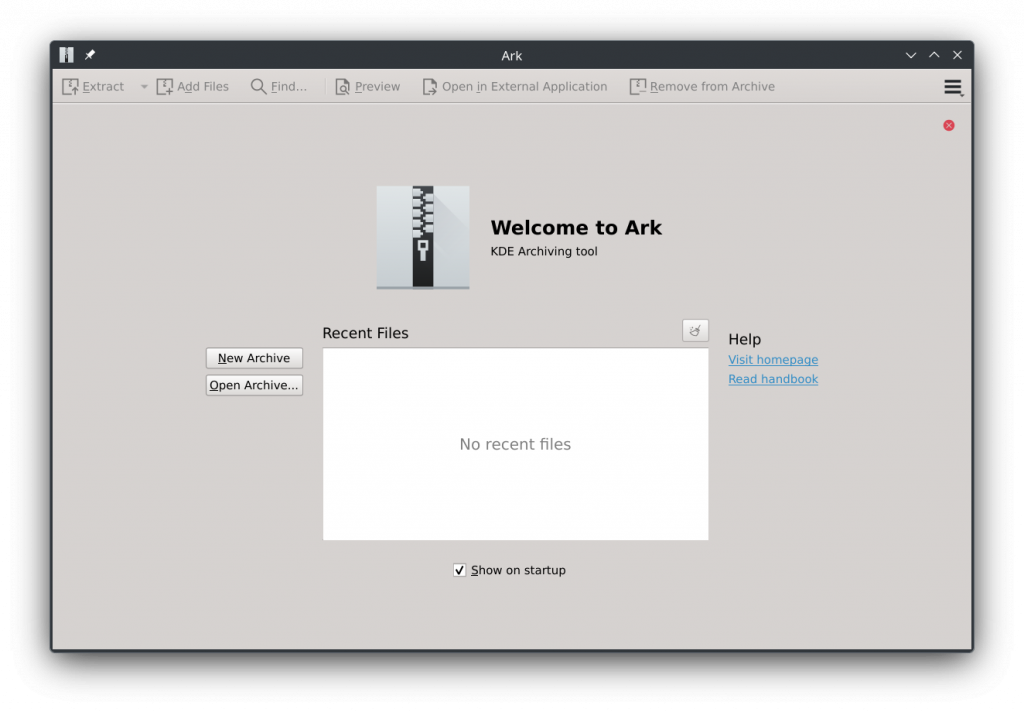
I have successfully created our first qt6/kf6 snap ark. They will show showing up in the store once all the required bits have been merged and published. Thank you for stopping by. ~Scarlett

25 March 2024

Jonathan Dowland: a bug a day

I recently became a maintainer of/committer to IkiWiki, the software that powers my site. I also took over maintenance of the Debian package. Last week I cut a new upstream point release, 3.20200202.4, and a corresponding Debian package upload, consisting only of a handful of low-hanging-fruit patches from other people, largely to exercise both processes. I've been discussing IkiWiki's maintenance situation with some other users for a couple of years now. I've also weighed up the pros and cons of moving to a different static-site-generator (a term that describes what IkiWiki is, but was actually coined more recently). It turns out IkiWiki is exceptionally flexible and powerful: I estimate the cost of moving to something modern(er) and fashionable such as Jekyll, Hugo or Hakyll as unreasonably high, in part because they are surprisingly rigid and inflexible in some key places. Like most mature software, IkiWiki has a bug backlog. Over the past couple of weeks, as a sort-of "palate cleanser" around work pieces, I've tried to triage one IkiWiki bug per day: either upstream or in the Debian Bug Tracker. This is a really lightweight task: it can be as simple as "find a bug reported in Debian, copy it upstream, tag it upstream, mark it forwarded; perhaps taking 5-10 minutes. Often I'll stumble across something that has already been fixed but not recorded as such as I go. Despite this minimal level of work, I'm quite satisfied with the cumulative progress. It's notable to me how much my perspective has shifted by becoming a maintainer: I'm considering everything through a different lens to that of being just one user. Eventually I will put some time aside to scratch some of my own itches (html5 by default; support dark mode; duckduckgo plugin; use the details tag...) but for now this minimal exercise is of broader use.

24 March 2024

Anuradha Weeraman: This is a test

This is a testTesting 1 2 3

Niels Thykier: debputy v0.1.21

Earlier today, I have just released debputy version 0.1.21 to Debian unstable. In the blog post, I will highlight some of the new features.
Package boilerplate reduction with automatic relationship substvar Last month, I started a discussion on rethinking how we do relationship substvars such as the $ misc:Depends . These generally ends up being boilerplate runes in the form of Depends: $ misc:Depends , $ shlibs:Depends where you as the packager has to remember exactly which runes apply to your package. My proposed solution was to automatically apply these substvars and this feature has now been implemented in debputy. It is also combined with the feature where essential packages should use Pre-Depends by default for dpkg-shlibdeps related dependencies. I am quite excited about this feature, because I noticed with libcleri that we are now down to 3-5 fields for defining a simple library package. Especially since most C library packages are trivial enough that debputy can auto-derive them to be Multi-Arch: same. As an example, the libcleric1 package is down to 3 fields (Package, Architecture, Description) with Section and Priority being inherited from the Source stanza. I have submitted a MR to show case the boilerplate reduction at https://salsa.debian.org/siridb-team/libcleri/-/merge_requests/3. The removal of libcleric1 (= $ binary:Version ) in that MR relies on another existing feature where debputy can auto-derive a dependency between an arch:any -dev package and the library package based on the .so symlink for the shared library. The arch:any restriction comes from the fact that arch:all and arch:any packages are not built together, so debputy cannot reliably see across the package boundaries during the build (and therefore refuses to do so at all). Packages that have already migrated to debputy can use debputy migrate-from-dh to detect any unnecessary relationship substitution variables in case you want to clean up. The removal of Multi-Arch: same and intra-source dependencies must be done manually and so only be done so when you have validated that it is safe and sane to do. I was willing to do it for the show-case MR, but I am less confident that would bother with these for existing packages in general. Note: I summarized the discussion of the automatic relationship substvar feature earlier this month in https://lists.debian.org/debian-devel/2024/03/msg00030.html for those who want more details. PS: The automatic relationship substvars feature will also appear in debhelper as a part of compat 14.
Language Server (LSP) and Linting I have long been frustrated by our poor editor support for Debian packaging files. To this end, I started working on a Language Server (LSP) feature in debputy that would cover some of our standard Debian packaging files. This release includes the first version of said language server, which covers the following files:
  • debian/control
  • debian/copyright (the machine readable variant)
  • debian/changelog (mostly just spelling)
  • debian/rules
  • debian/debputy.manifest (syntax checks only; use debputy check-manifest for the full validation for now)
Most of the effort has been spent on the Deb822 based files such as debian/control, which comes with diagnostics, quickfixes, spellchecking (but only for relevant fields!), and completion suggestions. Since not everyone has a LSP capable editor and because sometimes you just want diagnostics without having to open each file in an editor, there is also a batch version for the diagnostics via debputy lint. Please see debputy(1) for how debputy lint compares with lintian if you are curious about which tool to use at what time. To help you getting started, there is a now debputy lsp editor-config command that can provide you with the relevant editor config glue. At the moment, emacs (via eglot) and vim with vim-youcompleteme are supported. For those that followed the previous blog posts on writing the language server, I would like to point out that the command line for running the language server has changed to debputy lsp server and you no longer have to tell which format it is. I have decided to make the language server a "polyglot" server for now, which I will hopefully not regret... Time will tell. :) Anyhow, to get started, you will want:
$ apt satisfy 'dh-debputy (>= 0.1.21~), python3-pygls'
# Optionally, for spellchecking
$ apt install python3-hunspell hunspell-en-us
# For emacs integration
$ apt install elpa-dpkg-dev-el markdown-mode-el
# For vim integration via vim-youcompleteme
$ apt install vim-youcompleteme
Specifically for emacs, I also learned two things after the upload. First, you can auto-activate eglot via eglot-ensure. This badly feature interacts with imenu on debian/changelog for reasons I do not understand (causing a several second start up delay until something times out), but it works fine for the other formats. Oddly enough, opening a changelog file and then activating eglot does not trigger this issue at all. In the next version, editor config for emacs will auto-activate eglot on all files except debian/changelog. The second thing is that if you install elpa-markdown-mode, emacs will accept and process markdown in the hover documentation provided by the language server. Accordingly, the editor config for emacs will also mention this package from the next version on. Finally, on a related note, Jelmer and I have been looking at moving some of this logic into a new package called debpkg-metadata. The point being to support easier reuse of linting and LSP related metadata - like pulling a list of known fields for debian/control or sharing logic between lintian-brush and debputy.
Minimal integration mode for Rules-Requires-Root One of the original motivators for starting debputy was to be able to get rid of fakeroot in our build process. While this is possible, debputy currently does not support most of the complex packaging features such as maintscripts and debconf. Unfortunately, the kind of packages that need fakeroot for static ownership tend to also require very complex packaging features. To bridge this gap, the new version of debputy supports a very minimal integration with dh via the dh-sequence-zz-debputy-rrr. This integration mode keeps the vast majority of debhelper sequence in place meaning most dh add-ons will continue to work with dh-sequence-zz-debputy-rrr. The sequence only replaces the following commands:
  • dh_fixperms
  • dh_gencontrol
  • dh_md5sums
  • dh_builddeb
The installations feature of the manifest will be disabled in this integration mode to avoid feature interactions with debhelper tools that expect debian/<pkg> to contain the materialized package. On a related note, the debputy migrate-from-dh command now supports a --migration-target option, so you can choose the desired level of integration without doing code changes. The command will attempt to auto-detect the desired integration from existing package features such as a build-dependency on a relevant dh sequence, so you do not have to remember this new option every time once the migration has started. :)

21 March 2024

Ian Jackson: How to use Rust on Debian (and Ubuntu, etc.)

tl;dr: Don t just apt install rustc cargo. Either do that and make sure to use only Rust libraries from your distro (with the tiresome config runes below); or, just use rustup. Don t do the obvious thing; it s never what you want Debian ships a Rust compiler, and a large number of Rust libraries. But if you just do things the obvious default way, with apt install rustc cargo, you will end up using Debian s compiler but upstream libraries, directly and uncurated from crates.io. This is not what you want. There are about two reasonable things to do, depending on your preferences. Q. Download and run whatever code from the internet? The key question is this: Are you comfortable downloading code, directly from hundreds of upstream Rust package maintainers, and running it ? That s what cargo does. It s one of the main things it s for. Debian s cargo behaves, in this respect, just like upstream s. Let me say that again: Debian s cargo promiscuously downloads code from crates.io just like upstream cargo. So if you use Debian s cargo in the most obvious way, you are still downloading and running all those random libraries. The only thing you re avoiding downloading is the Rust compiler itself, which is precisely the part that is most carefully maintained, and of least concern. Debian s cargo can even download from crates.io when you re building official Debian source packages written in Rust: if you run dpkg-buildpackage, the downloading is suppressed; but a plain cargo build will try to obtain and use dependencies from the upstream ecosystem. ( Happily , if you do this, it s quite likely to bail out early due to version mismatches, before actually downloading anything.) Option 1: WTF, no I don t want curl bash OK, but then you must limit yourself to libraries available within Debian. Each Debian release provides a curated set. It may or may not be sufficient for your needs. Many capable programs can be written using the packages in Debian. But any upstream Rust project that you encounter is likely to be a pain to get working, unless their maintainers specifically intend to support this. (This is fairly rare, and the Rust tooling doesn t make it easy.) To go with this plan, apt install rustc cargo and put this in your configuration, in $HOME/.cargo/config.toml:
[source.debian-packages]
directory = "/usr/share/cargo/registry"
[source.crates-io]
replace-with = "debian-packages"
This causes cargo to look in /usr/share for dependencies, rather than downloading them from crates.io. You must then install the librust-FOO-dev packages for each of your dependencies, with apt. This will allow you to write your own program in Rust, and build it using cargo build. Option 2: Biting the curl bash bullet If you want to build software that isn t specifically targeted at Debian s Rust you will probably need to use packages from crates.io, not from Debian. If you re doing to do that, there is little point not using rustup to get the latest compiler. rustup s install rune is alarming, but cargo will be doing exactly the same kind of thing, only worse (because it trusts many more people) and more hidden. So in this case: do run the curl bash install rune. Hopefully the Rust project you are trying to build have shipped a Cargo.lock; that contains hashes of all the dependencies that they last used and tested. If you run cargo build --locked, cargo will only use those versions, which are hopefully OK. And you can run cargo audit to see if there are any reported vulnerabilities or problems. But you ll have to bootstrap this with cargo install --locked cargo-audit; cargo-audit is from the RUSTSEC folks who do care about these kind of things, so hopefully running their code (and their dependencies) is fine. Note the --locked which is needed because cargo s default behaviour is wrong. Privilege separation This approach is rather alarming. For my personal use, I wrote a privsep tool which allows me to run all this upstream Rust code as a separate user. That tool is nailing-cargo. It s not particularly well productised, or tested, but it does work for at least one person besides me. You may wish to try it out, or consider alternative arrangements. Bug reports and patches welcome. OMG what a mess Indeed. There are large number of technical and social factors at play. cargo itself is deeply troubling, both in principle, and in detail. I often find myself severely disappointed with its maintainers decisions. In mitigation, much of the wider Rust upstream community does takes this kind of thing very seriously, and often makes good choices. RUSTSEC is one of the results. Debian s technical arrangements for Rust packaging are quite dysfunctional, too: IMO the scheme is based on fundamentally wrong design principles. But, the Debian Rust packaging team is dynamic, constantly working the update treadmills; and the team is generally welcoming and helpful. Sadly last time I explored the possibility, the Debian Rust Team didn t have the appetite for more fundamental changes to the workflow (including, for example, changes to dependency version handling). Significant improvements to upstream cargo s approach seem unlikely, too; we can only hope that eventually someone might manage to supplant it.
edited 2024-03-21 21:49 to add a cut tag


comment count unavailable comments

Ravi Dwivedi: Thailand Trip

This post is the second and final part of my Malaysia-Thailand trip. Feel free to check out the Malaysia part here if you haven t already. Kuala Lumpur to Bangkok is around 1500 km by road, and so I took a Malaysian Airlines flight to travel to Bangkok. The flight staff at the Kuala Lumpur only asked me for a return/onward flight and Thailand immigration asked a few questions but did not check any documents (obviously they checked and stamped my passport ;)). The currency of Thailand is the Thai baht, and 1 Thai baht = 2.5 Indian Rupees. The Thailand time is 1.5 hours ahead of Indian time (For example, if it is 12 noon in India, it will be 13:30 in Thailand). I landed in Bangkok at around 3 PM local time. Fletcher was in Bangkok that time, leaving for Pattaya and we had booked the same hostel. So I took a bus to Pattaya from the airport. The next bus for which the tickets were available was at 7 PM, so I took tickets for that one. The bus ticket cost was 143 Thai Baht. I didn t buy SIM at the airport, thinking there must be better deals in the city. As a consequence, there was no way to contact Fletcher through internet. Although I had a few minutes call remaining out of my international roaming pack.
A welcome sign at Bangkok's Suvarnabhumi airport.
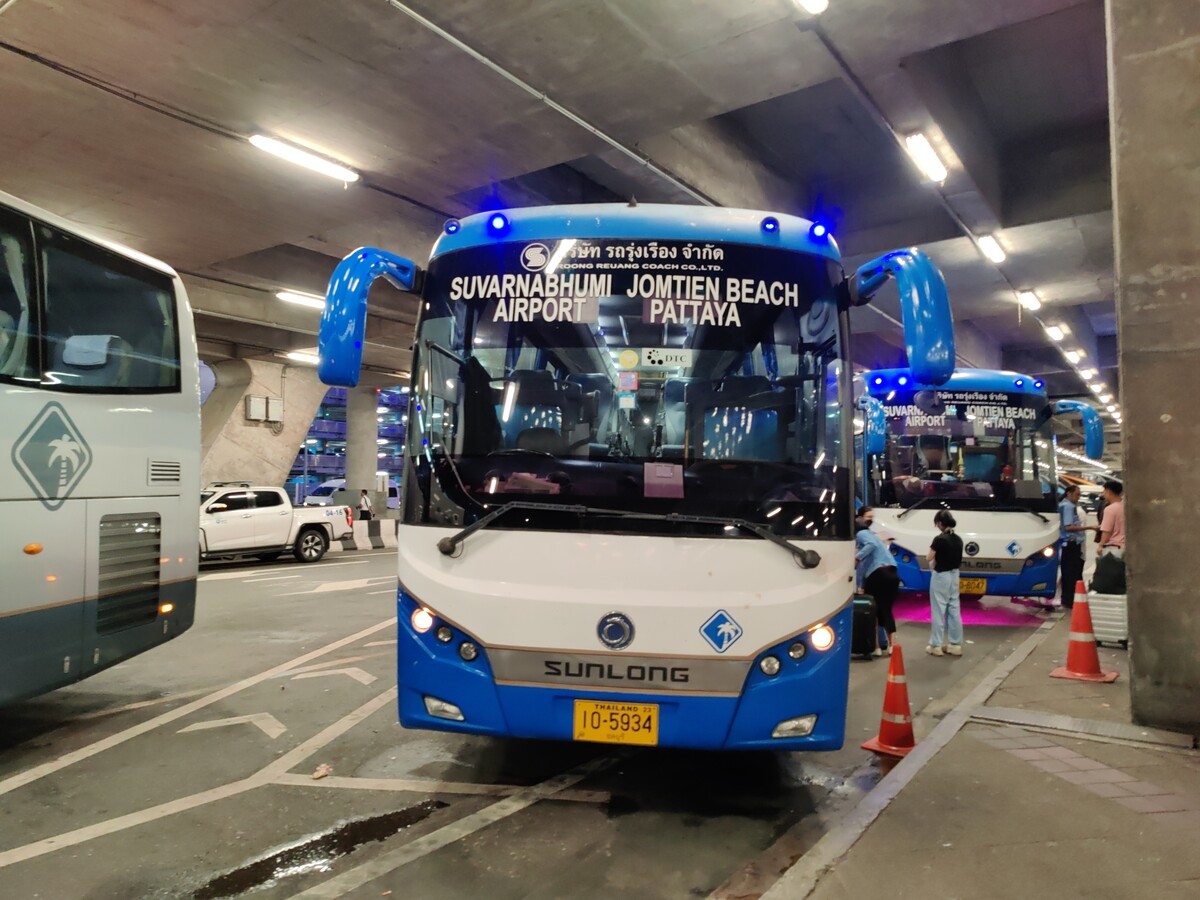
Bus from Suvarnabhumi Airport to Jomtien Beach in Pattaya.
Our accommodation was near Jomtien beach, so I got off at the last stop, as the bus terminates at the Jomtien beach. Then I decided to walk towards my accommodation. I was using OsmAnd for navigation. However, the place was not marked on OpenStreetMap, and it turned out I missed the street my hostel was on and walked around 1 km further as I was chasing a similarly named incorrect hostel on OpenStreetMap. Then I asked for help from two men sitting at a caf . One of them said he will help me find the street my hostel is on. So, I walked with him, and he told me he lives in Thailand for many years, but he is from Kuwait. He also gave me valuable information. Like, he told me about shared hail-and-ride songthaews which run along the Jomtien Second Road and charge 10 Baht for any distance on their route. This tip significantly reduced our expenses. Further, he suggested me 7-Eleven shops for buying a local SIM. Like Malaysia, Thailand has 24/7 7-Eleven convenience stores, a lot of them not even 100 m apart. The Kuwaiti person dropped me at the address where my hostel was. I tried searching for a person in-charge of that hostel, and soon I realized there was no reception. After asking for help from locals for some time, I bumped into Fletcher, who also came to this address and was searching for the same. After finding a friend, I felt a sigh of relief. Adjacent to the property, there was a hairdresser shop. We went there and asked about this property. The woman called the owner, and she also told us the required passcodes to go inside. Our accommodation was in a room on the second floor, which required us to put a passcode for opening. We entered the passcode and entered the room. So, we stayed at this hostel which had no reception. Due to this, it took 2 hours to find our room and enter. It reminded me of a difficult experience I had in Albania, where me and Akshat were not able to find our apartment in one of the hottest days and the owner didn t know our language. Traveling from the place where the bus dropped me to the hostel, I saw streets were filled with bars and massage parlors, which was expected. Prostitutes were everywhere. We went out at night towards the beach and also roamed around in 7-Elevens to buy a SIM card for myself. I got a SIM for 7 day unlimited internet for 399 baht. Turns out that the rates of SIM cards at the airport were not so different from inside the city.
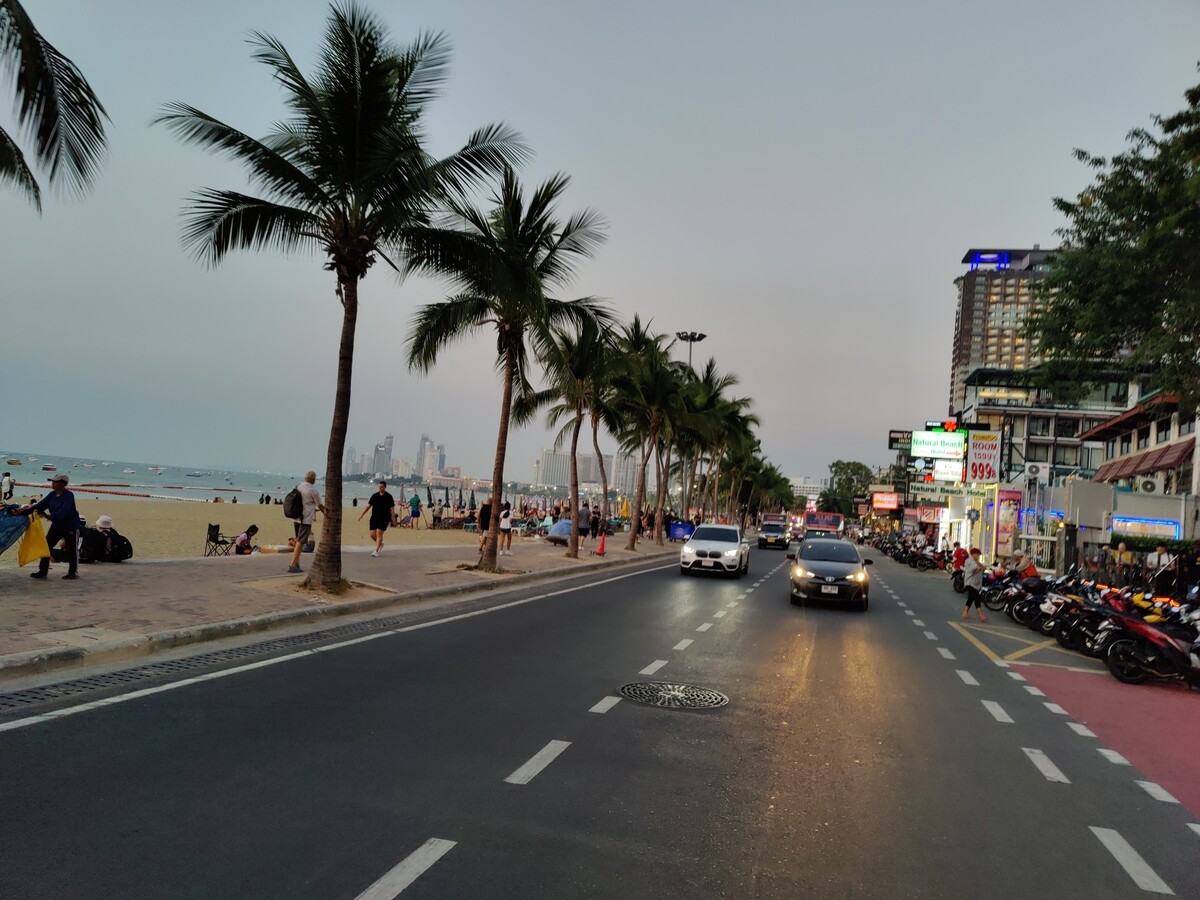
Road near Jomtien beach in Pattaya
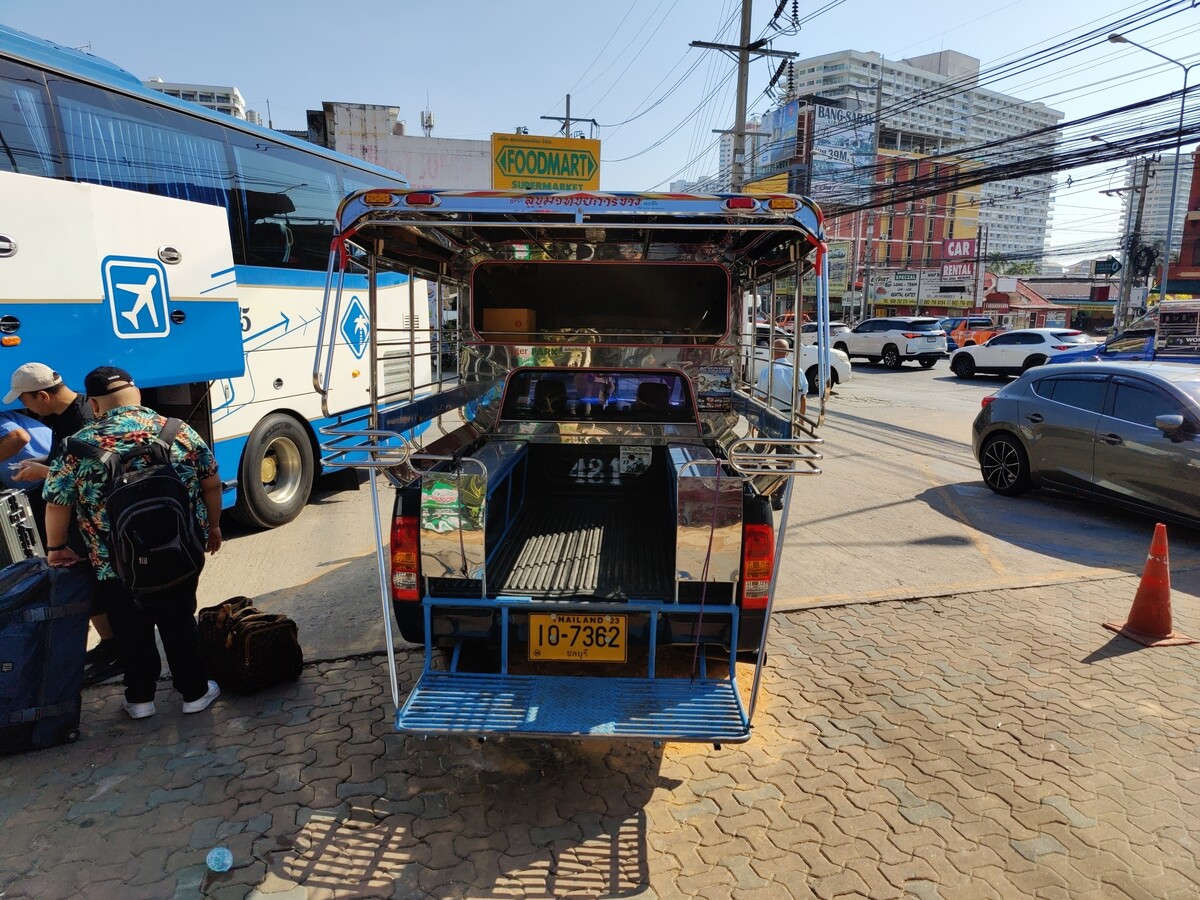
Photo of a songthaew in Pattaya. There are shared songthaews which run along Jomtien Second road and takes 10 bath to anywhere on the route.

Jomtien Beach in Pattaya.
In terms of speaking English, locals didn t know English at all in both Pattaya and Bangkok. I normally don t expect locals to know English in a non-English speaking country, but the fact that Bangkok is one of the most visited places by tourists made me expect locals to know some English. Talking to locals is an integral part of travel for me, which I couldn t do a lot in Thailand. This aspect is much more important for me than going to touristy places. So, we were in Pattaya. Next morning, Fletcher and I went to Tiger park using shared songthaew. After that, we planned to visit Pattaya Floating market which is near the Tiger Park, but we felt the ticket prices were higher than it was worth. Fletcher had to leave for Bangkok on that day. I suggested him to go to Suvarnabhumi Airport from the Jomtien beach bus terminal (this was the route I took the last day in opposite direction) to avoid traffic congestion inside Bangkok, as he can follow up with metro once he reaches the airport. From the floating market, we were walking in sweltering heat to reach the Jomtien beach. I tried asking for a lift and eventually got successful as a scooty stopped, and surprisingly the person gave a ride to both of us. He was from Delhi, so maybe that s the reason he stopped for us. Then we took a songthaew to the bus terminal and after having lunch, Fletcher left for Bangkok.
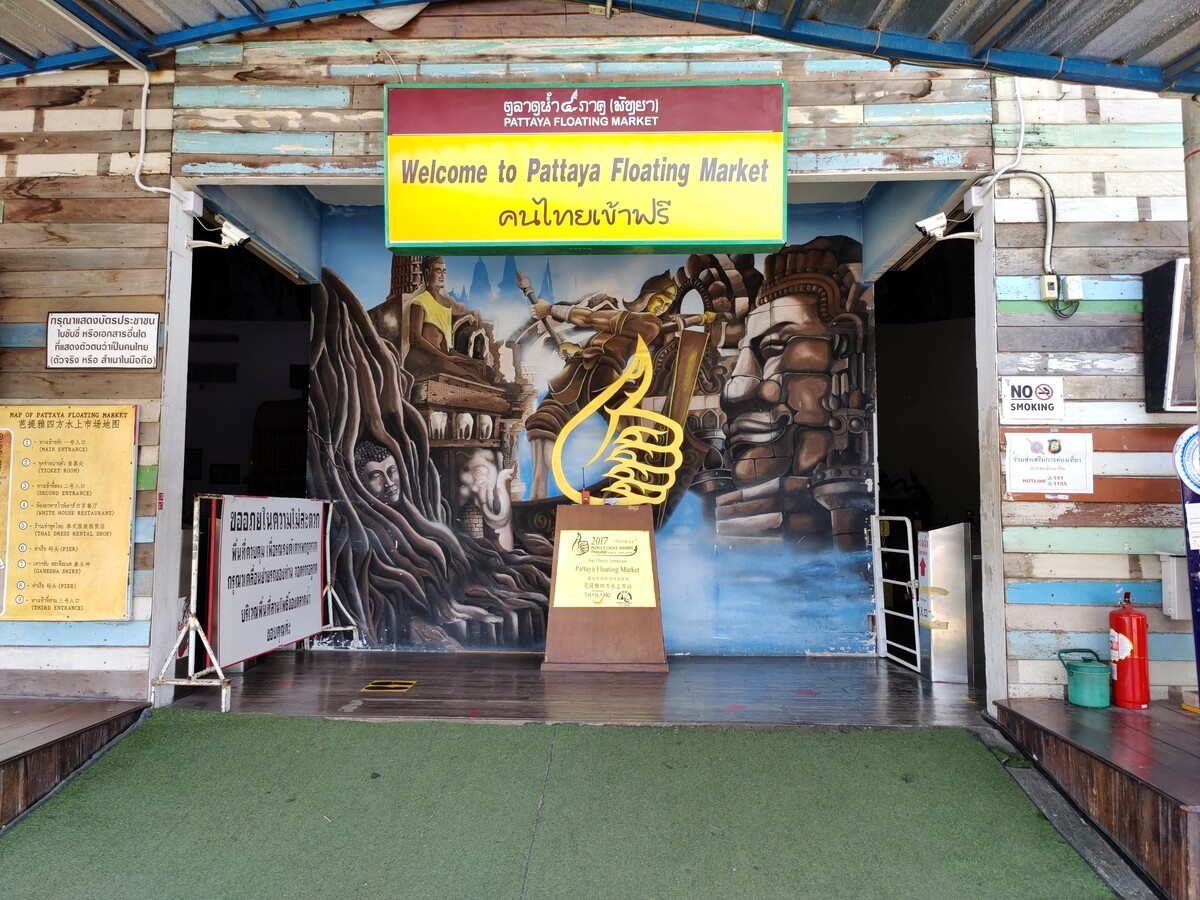
A welcome sign at Pattaya Floating market.

This Korean Vegetasty noodles pack was yummy and was available at many 7-Eleven stores.
Next day I went to Bangkok, but Fletcher already left for Kuala Lumpur. Here I had booked a private room in a hotel (instead of a hostel) for four nights, mainly because of my luggage. This costed 5600 INR for four nights. It was 2 km from the metro station, which I used to walk both sides. In Bangkok, I visited Sukhumvit and Siam by metro. Going to some areas require crossing the Chao Phraya river. For this, I took Chao Phraya Express Boat for going to places like Khao San road and Wat Arun. I would recommend taking the boat ride as it had very good views. In Bangkok, I met a person from Pakistan staying in my hotel and so here also I got some company. But by the time I met him, my days were almost over. So, we went to a random restaurant selling Indian food where we ate some paneer dish with naan and that restaurant person was from Myanmar.
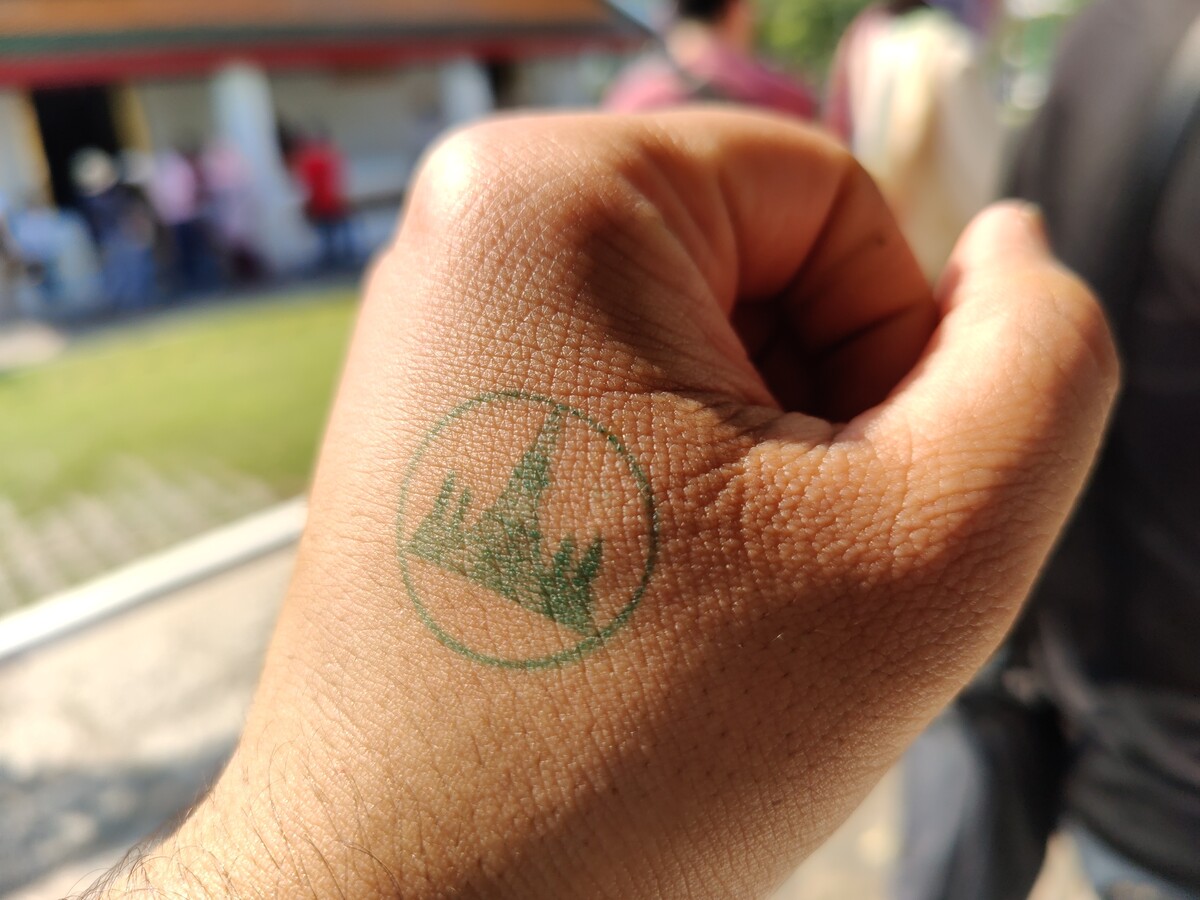
Wat Arun temple stamps your hand upon entry

Wat Arun temple
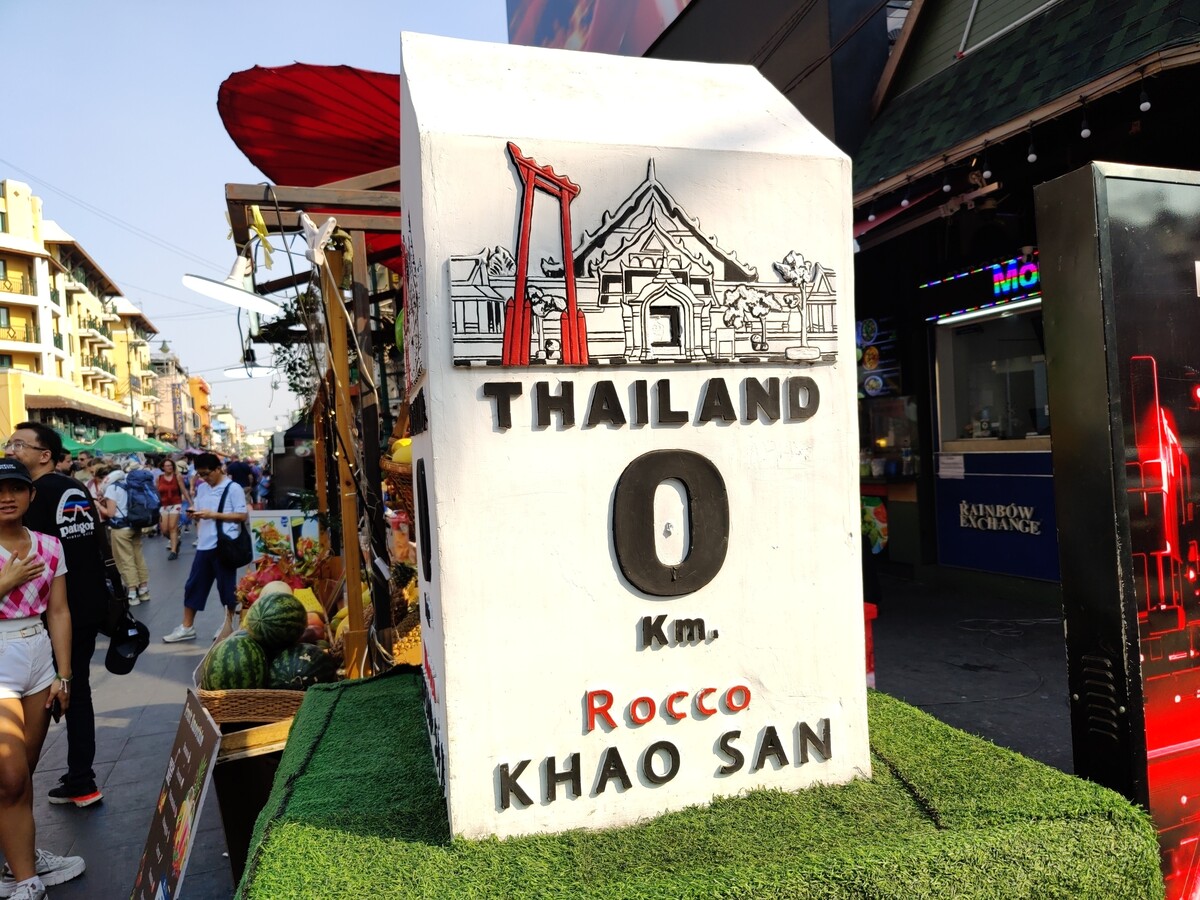
Khao San Road
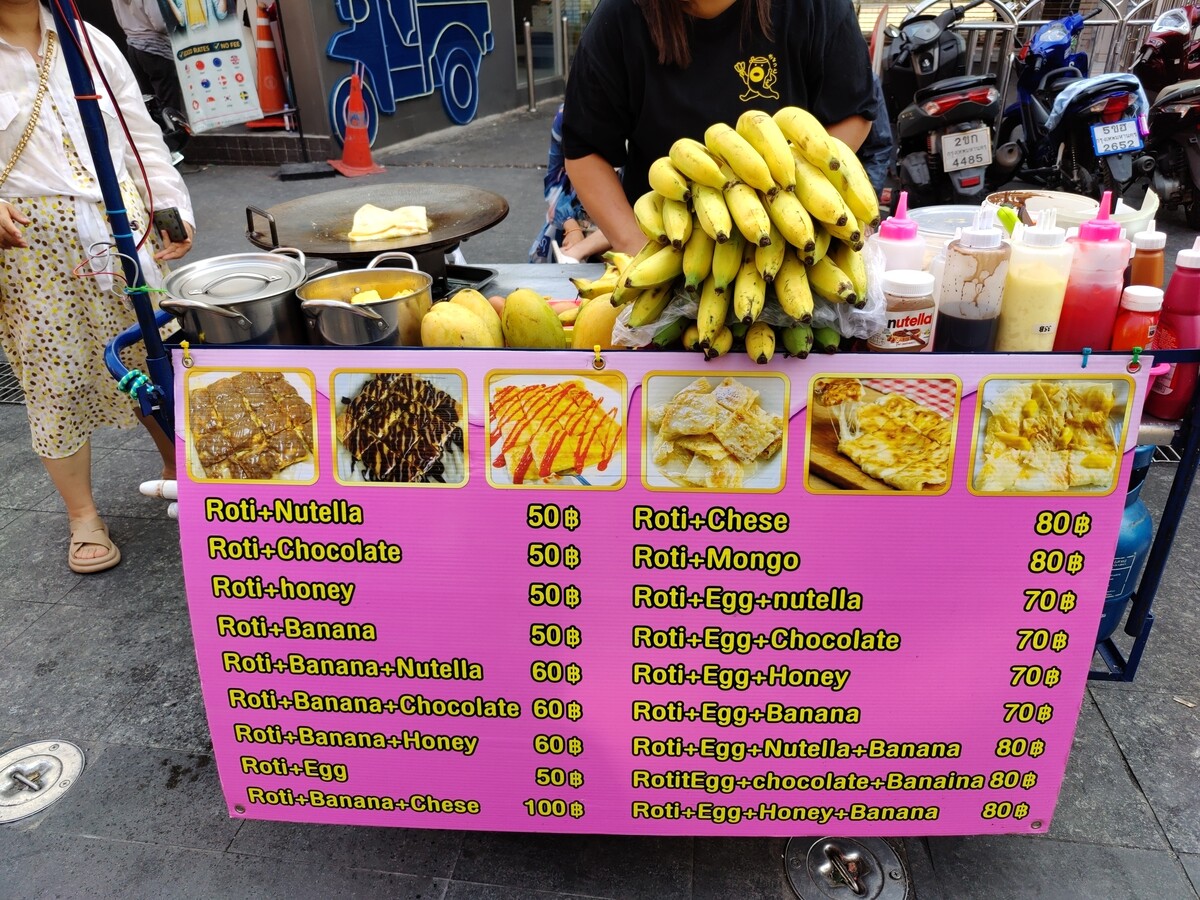
A food stall at Khao San Road
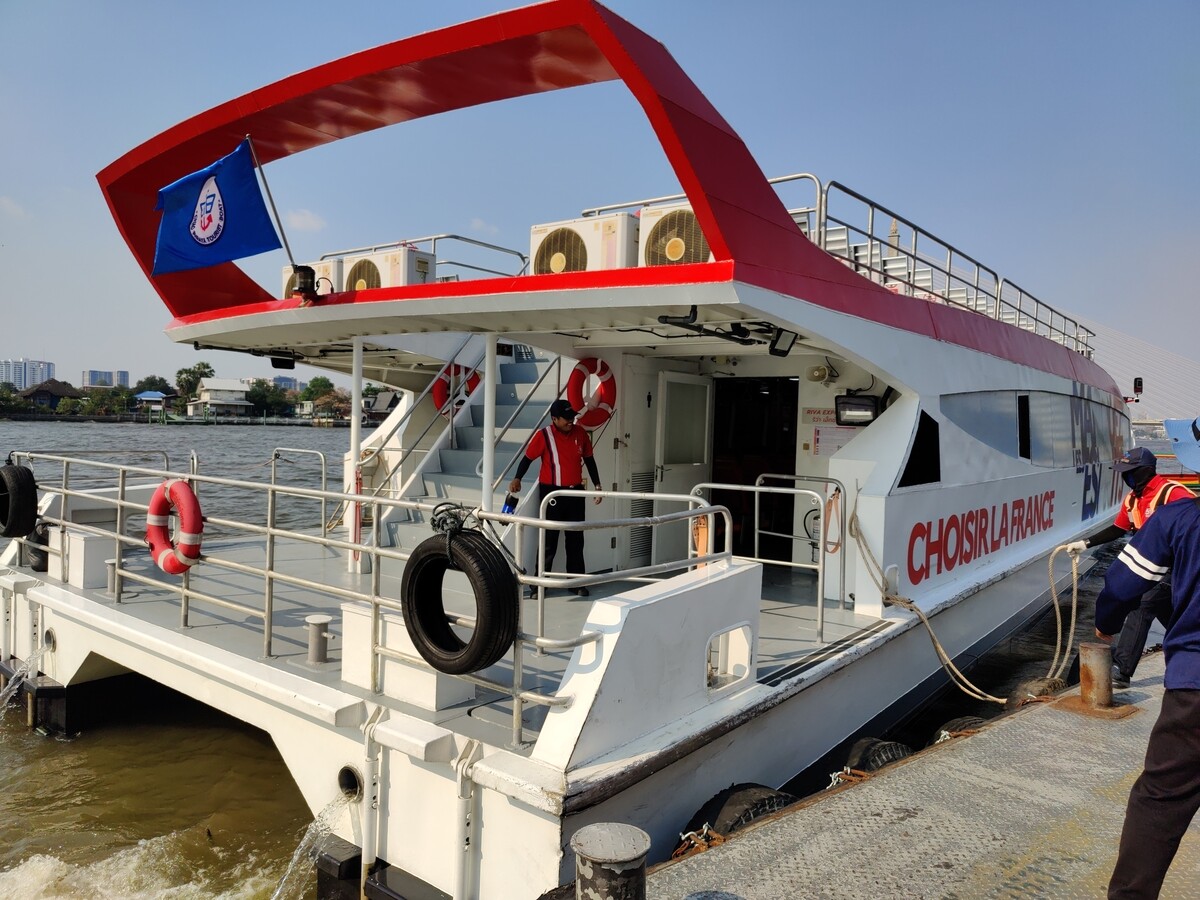
Chao Phraya Express Boat
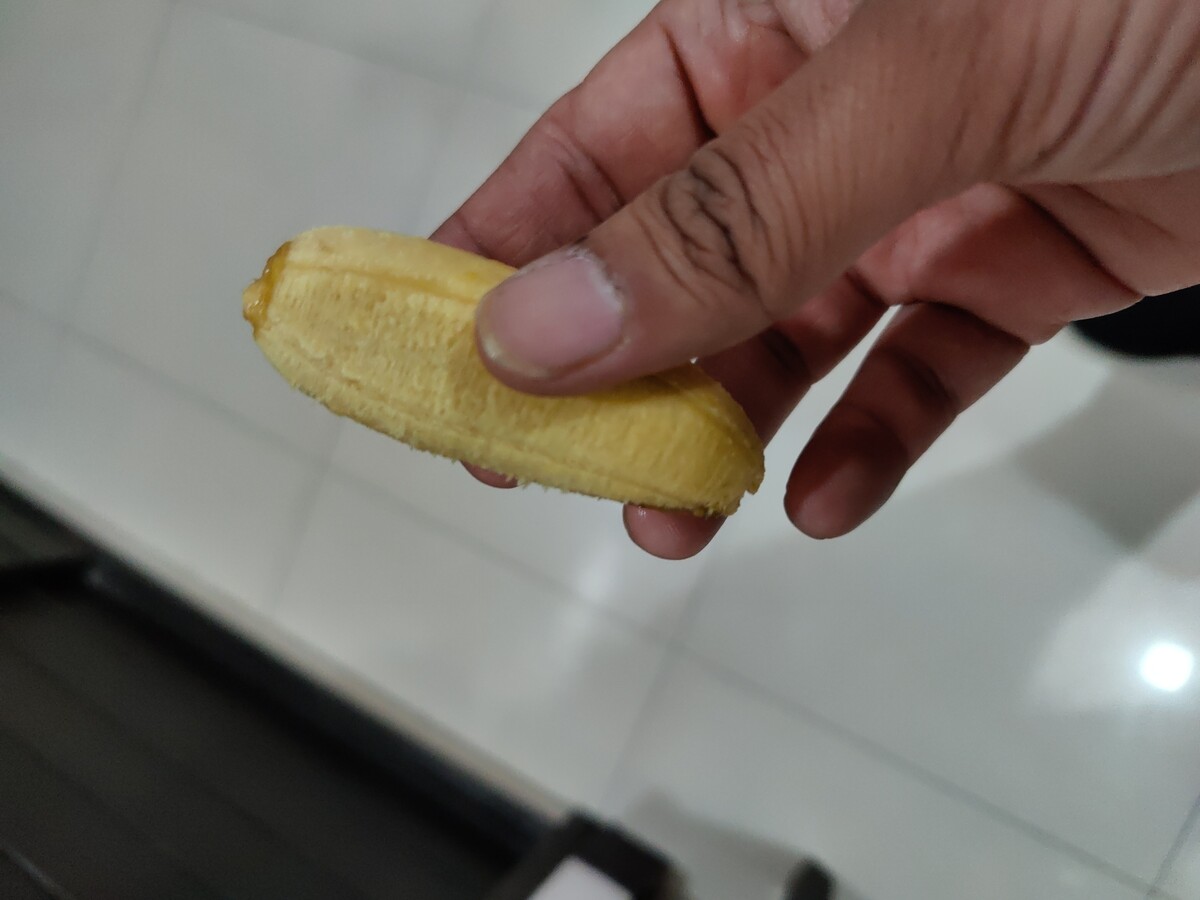
For eating, I mainly relied on fruits and convenience stores. Bananas were very tasty. This was the first time I saw banana flesh being yellow. Mangoes were delicious and pineapples were smaller and flavorful. I also ate Rose Apple, which I never had before. I had Chhole Kulche once in Sukhumvit. That was a little expensive as it costed 164 baht. I also used to buy premix coffee packets from 7-Eleven convenience stores and prepare them inside the stores.
Banana with yellow flesh
Fruits at a stall in Bangkok
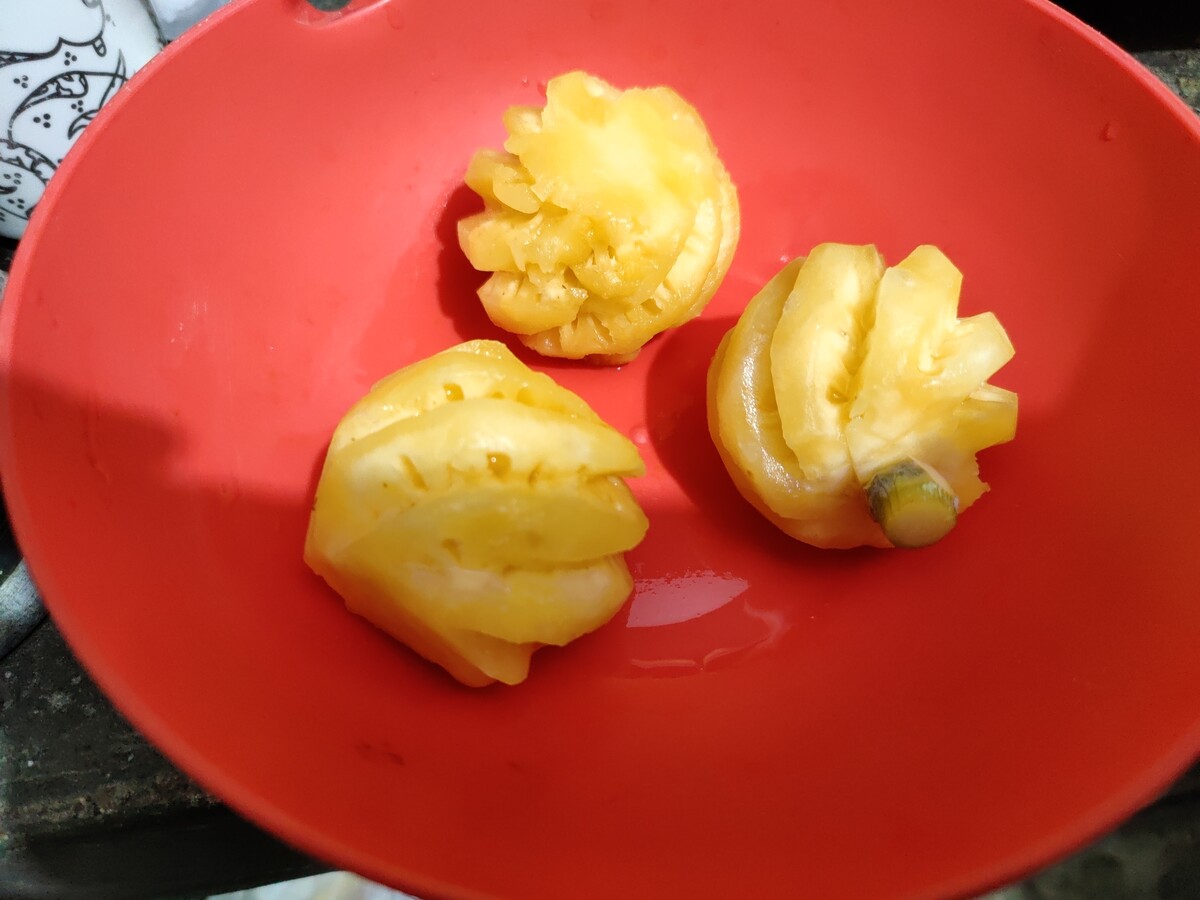
Trimmed pineapples from Thailand.

Corn in Bangkok.
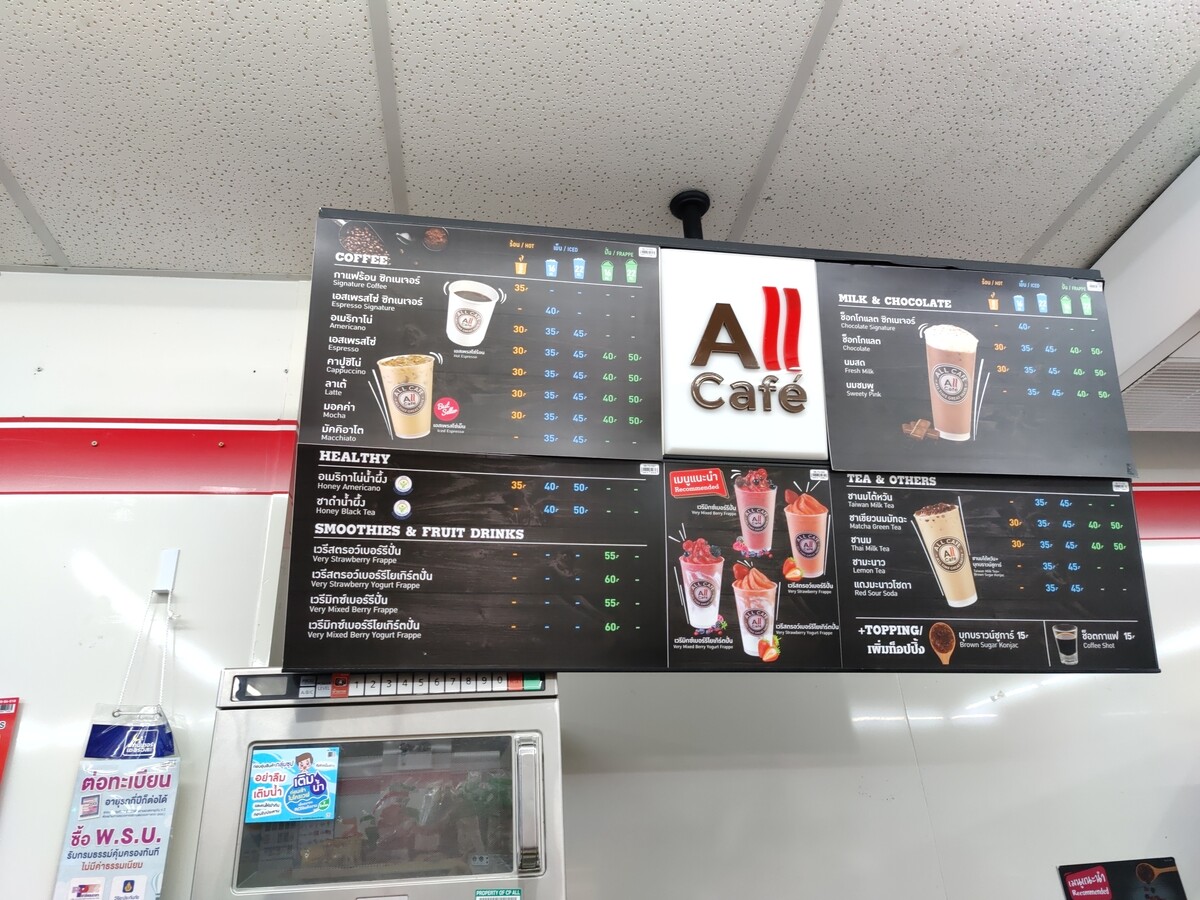
A board showing coffee menu at a 7-Eleven store along with rates in Pattaya.
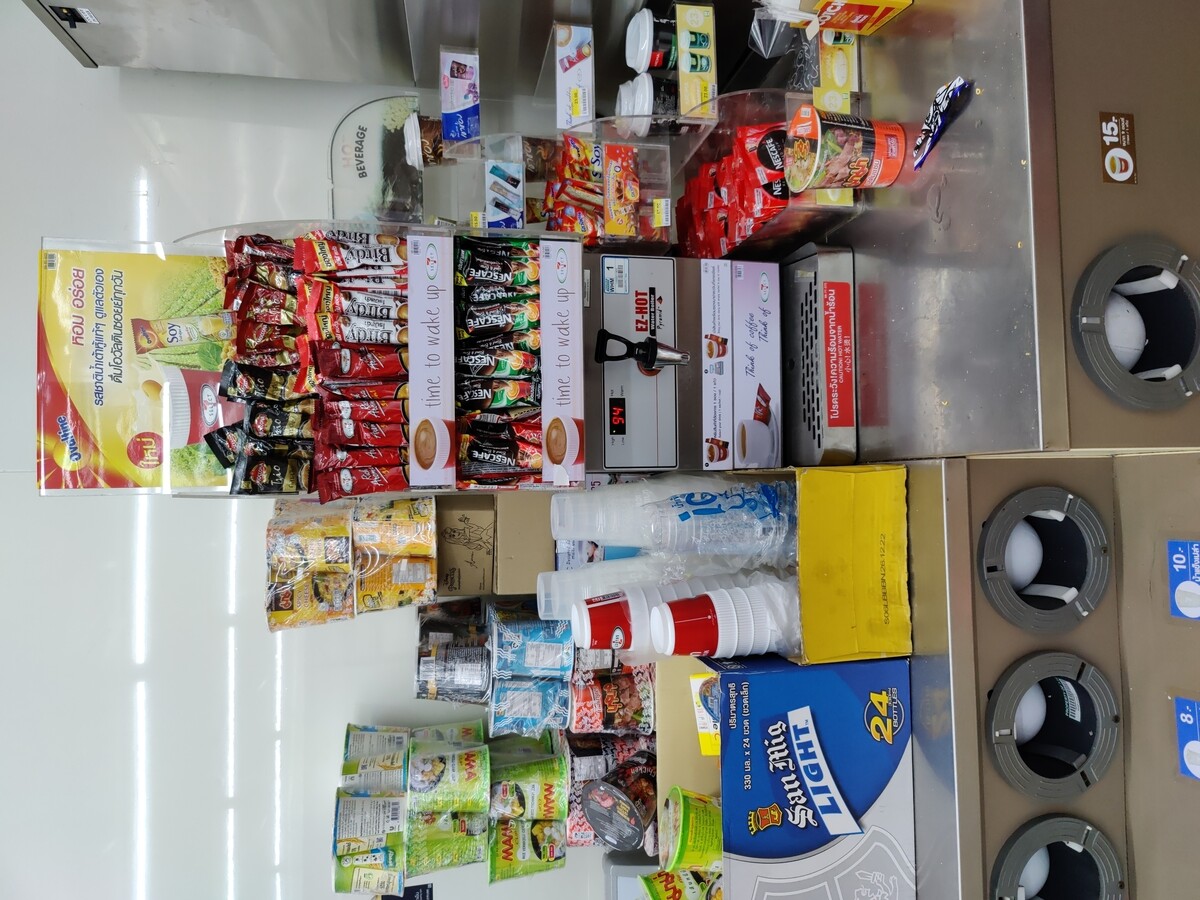
In this section of 7-Eleven, you can buy a premix coffee and mix it with hot water provided at the store to prepare.
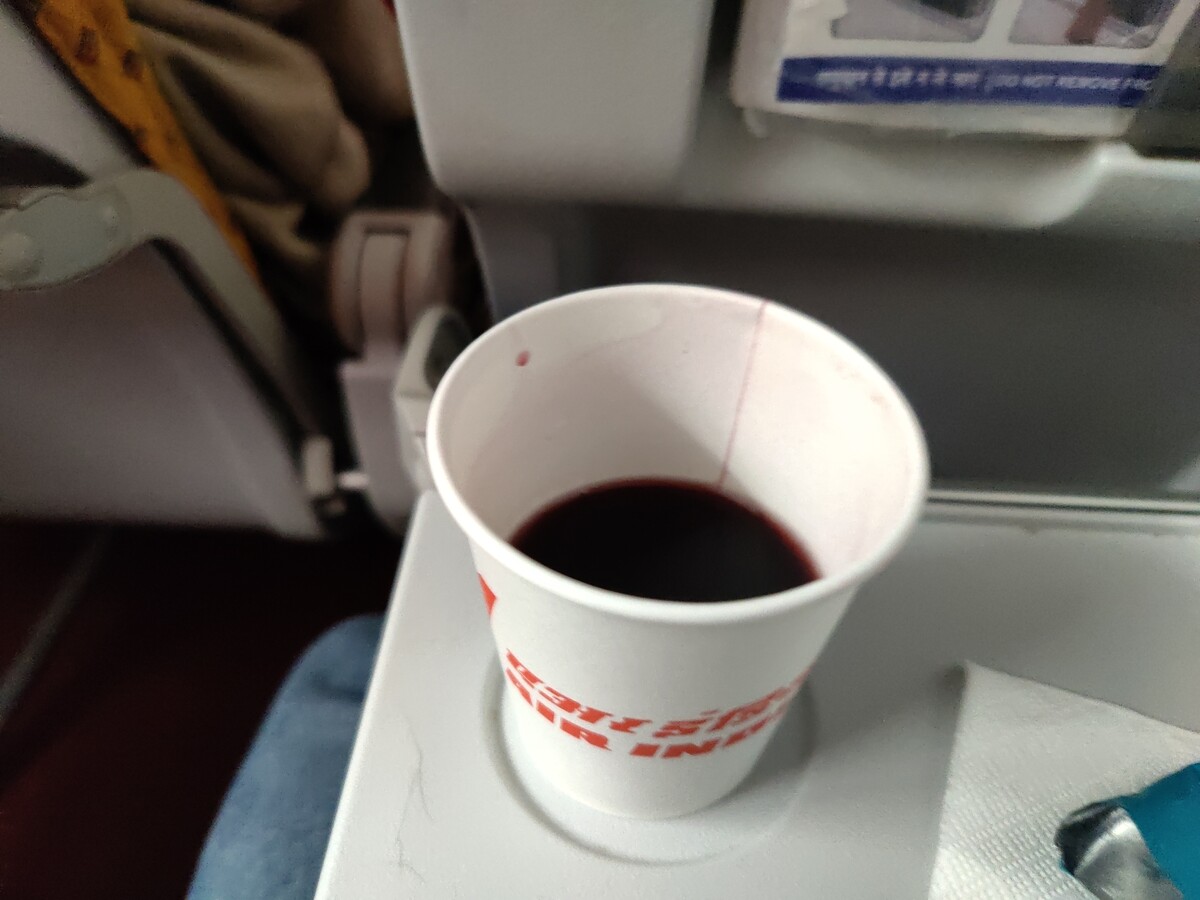
My booking from Bangkok to Delhi was in Air India flight, and they were serving alcohol in the flight. I chose red wine, and this was my first time having alcohol in a flight.
Red wine being served in Air India

Notes
  • In this whole trip spanning two weeks, I did not pay for drinking water (except for once in Pattaya which was 9 baht) and toilets. Bangkok and Kuala Lumpur have plenty of malls where you should find a free-of-cost toilet nearby. For drinking water, I relied mainly on my accommodation providing refillable water for my bottle.
  • Thailand seemed more expensive than Malaysia on average. Malaysia had discounted price due to the Chinese New year.
  • I liked Pattaya more than Bangkok. Maybe because Pattaya has beach and Bangkok doesn t. Pattaya seemed more lively, and I could meet and talk to a few people as opposed to Bangkok.
  • Chao Phraya River express boat costs 150 baht for one day where you can hop on and off to any boat.

13 March 2024

Freexian Collaborators: Debian Contributions: Upcoming Improvements to Salsa CI, /usr-move, packaging simplemonitor, and more! (by Utkarsh Gupta)

Contributing to Debian is part of Freexian s mission. This article covers the latest achievements of Freexian and their collaborators. All of this is made possible by organizations subscribing to our Long Term Support contracts and consulting services.

/usr-move, by Helmut Grohne Much of the work was spent on handling interaction with time time64 transition and sending patches for mitigating fallout. The set of packages relevant to debootstrap is mostly converted and the patches for glibc and base-files have been refined due to feedback from the upload to Ubuntu noble. Beyond this, he sent patches for all remaining packages that cannot move their files with dh-sequence-movetousr and packages using dpkg-divert in ways that dumat would not recognize.

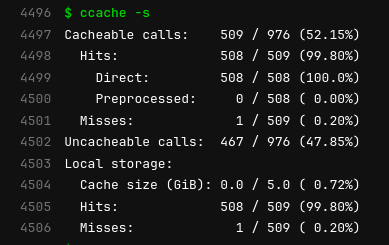
Upcoming improvements to Salsa CI, by Santiago Ruano Rinc n Last month, Santiago Ruano Rinc n started the work on integrating sbuild into the Salsa CI pipeline. Initially, Santiago used sbuild with the unshare chroot mode. However, after discussion with josch, jochensp and helmut (thanks to them!), it turns out that the unshare mode is not the most suitable for the pipeline, since the level of isolation it provides is not needed, and some test suites would fail (eg: krb5). Additionally, one of the requirements of the build job is the use of ccache, since it is needed by some C/C++ large projects to reduce the compilation time. In the preliminary work with unshare last month, it was not possible to make ccache to work. Finally, Santiago changed the chroot mode, and now has a couple of POC (cf: 1 and 2) that rely on the schroot and sudo, respectively. And the good news is that ccache is successfully used by sbuild with schroot! The image here comes from an example of building grep. At the end of the build, ccache -s shows the statistics of the cache that it used, and so a little more than half of the calls of that job were cacheable. The most important pieces are in place to finish the integration of sbuild into the pipeline. Other than that, Santiago also reviewed the very useful merge request !346, made by IOhannes zm lnig to autodetect the release from debian/changelog. As agreed with IOhannes, Santiago is preparing a merge request to include the release autodetection use case in the very own Salsa CI s CI.

Packaging simplemonitor, by Carles Pina i Estany Carles started using simplemonitor in 2017, opened a WNPP bug in 2022 and started packaging simplemonitor dependencies in October 2023. After packaging five direct and indirect dependencies, Carles finally uploaded simplemonitor to unstable in February. During the packaging of simplemonitor, Carles reported a few issues to upstream. Some of these were to make the simplemonitor package build and run tests reproducibly. A reproducibility issue was reprotest overriding the timezone, which broke simplemonitor s tests. There have been discussions on resolving this upstream in simplemonitor and in reprotest, too. Carles also started upgrading or improving some of simplemonitor s dependencies.

Miscellaneous contributions
  • Stefano Rivera spent some time doing admin on debian.social infrastructure. Including dealing with a spike of abuse on the Jitsi server.
  • Stefano started to prepare a new release of dh-python, including cleaning out a lot of old Python 2.x related code. Thanks to Niels Thykier (outside Freexian) for spear-heading this work.
  • DebConf 24 planning is beginning. Stefano discussed venues and finances with the local team and remotely supported a site-visit by Nattie (outside Freexian).
  • Also in the DebConf 24 context, Santiago took part in discussions and preparations related to the Content Team.
  • A JIT bug was reported against pypy3 in Debian Bookworm. Stefano bisected the upstream history to find the patch (it was already resolved upstream) and released an update to pypy3 in bookworm.
  • Enrico participated in /usr-merge discussions with Helmut.
  • Colin Watson backported a python-channels-redis fix to bookworm, rediscovered while working on debusine.
  • Colin dug into a cluster of celery build failures and tracked the hardest bit down to a Python 3.12 regression, now fixed in unstable. celery should be back in testing once the 64-bit time_t migration is out of the way.
  • Thorsten Alteholz uploaded a new upstream version of cpdb-libs. Unfortunately upstream changed the naming of their release tags, so updating the watch file was a bit demanding. Anyway this version 2.0 is a huge step towards introduction of the new Common Print Dialog Backends.
  • Helmut send patches for 48 cross build failures.
  • Helmut changed debvm to use mkfs.ext4 instead of genext2fs.
  • Helmut sent a debci MR for improving collector robustness.
  • In preparation for DebConf 25, Santiago worked on the Brest Bid.

11 March 2024

Joachim Breitner: Convenient sandboxed development environment

I like using one machine and setup for everything, from serious development work to hobby projects to managing my finances. This is very convenient, as often the lines between these are blurred. But it is also scary if I think of the large number of people who I have to trust to not want to extract all my personal data. Whenever I run a cabal install, or a fun VSCode extension gets updated, or anything like that, I am running code that could be malicious or buggy. In a way it is surprising and reassuring that, as far as I can tell, this commonly does not happen. Most open source developers out there seem to be nice and well-meaning, after all.

Convenient or it won t happen Nevertheless I thought I should do something about this. The safest option would probably to use dedicated virtual machines for the development work, with very little interaction with my main system. But knowing me, that did not seem likely to happen, as it sounded like a fair amount of hassle. So I aimed for a viable compromise between security and convenient, and one that does not get too much in the way of my current habits. For instance, it seems desirable to have the project files accessible from my unconstrained environment. This way, I could perform certain actions that need access to secret keys or tokens, but are (unlikely) to run code (e.g. git push, git pull from private repositories, gh pr create) from the outside , and the actual build environment can do without access to these secrets. The user experience I thus want is a quick way to enter a development environment where I can do most of the things I need to do while programming (network access, running command line and GUI programs), with access to the current project, but without access to my actual /home directory. I initially followed the blog post Application Isolation using NixOS Containers by Marcin Sucharski and got something working that mostly did what I wanted, but then a colleague pointed out that tools like firejail can achieve roughly the same with a less global setup. I tried to use firejail, but found it to be a bit too inflexible for my particular whims, so I ended up writing a small wrapper around the lower level sandboxing tool https://github.com/containers/bubblewrap.

Selective bubblewrapping This script, called dev and included below, builds a new filesystem namespace with minimal /proc and /dev directories, it s own /tmp directories. It then binds-mound some directories to make the host s NixOS system available inside the container (/bin, /usr, the nix store including domain socket, stuff for OpenGL applications). My user s home directory is taken from ~/.dev-home and some configuration files are bind-mounted for convenient sharing. I intentionally don t share most of the configuration for example, a direnv enable in the dev environment should not affect the main environment. The X11 socket for graphical applications and the corresponding .Xauthority file is made available. And finally, if I run dev in a project directory, this project directory is bind mounted writable, and the current working directory is preserved. The effect is that I can type dev on the command line to enter dev mode rather conveniently. I can run development tools, including graphical ones like VSCode, and especially the latter with its extensions is part of the sandbox. To do a git push I either exit the development environment (Ctrl-D) or open a separate terminal. Overall, the inconvenience of switching back and forth seems worth the extra protection. Clearly, isn t going to hold against a determined and maybe targeted attacker (e.g. access to the X11 and the nix daemon socket can probably be used to escape easily). But I hope it will help against a compromised dev dependency that just deletes or exfiltrates data, like keys or passwords, from the usual places in $HOME.

Rough corners There is more polishing that could be done.
  • In particular, clicking on a link inside VSCode in the container will currently open Firefox inside the container, without access to my settings and cookies etc. Ideally, links would be opened in the Firefox running outside. This is a problem that has a solution in the world of applications that are sandboxed with Flatpak, and involves a bunch of moving parts (a xdg-desktop-portal user service, a filtering dbus proxy, exposing access to that proxy in the container). I experimented with that for a bit longer than I should have, but could not get it to work to satisfaction (even without a container involved, I could not get xdg-desktop-portal to heed my default browser settings ). For now I will live with manually copying and pasting URLs, we ll see how long this lasts.
  • With this setup (and unlike the NixOS container setup I tried first), the same applications are installed inside and outside. It might be useful to separate the set of installed programs: There is simply no point in running evolution or firefox inside the container, and if I do not even have VSCode or cabal available outside, so that it s less likely that I forget to enter dev before using these tools. It shouldn t be too hard to cargo-cult some of the NixOS Containers infrastructure to be able to have a separate system configuration that I can manage as part of my normal system configuration and make available to bubblewrap here.
So likely I will refine this some more over time. Or get tired of typing dev and going back to what I did before

The script
The dev script (at the time of writing)

10 March 2024

Vasudev Kamath: Cloning a laptop over NVME TCP

Recently, I got a new laptop and had to set it up so I could start using it. But I wasn't really in the mood to go through the same old steps which I had explained in this post earlier. I was complaining about this to my colleague, and there came the suggestion of why not copy the entire disk to the new laptop. Though it sounded like an interesting idea to me, I had my doubts, so here is what I told him in return.
  1. I don't have the tools to open my old laptop and connect the new disk over USB to my new laptop.
  2. I use full disk encryption, and my old laptop has a 512GB disk, whereas the new laptop has a 1TB NVME, and I'm not so familiar with resizing LUKS.
He promptly suggested both could be done. For step 1, just expose the disk using NVME over TCP and connect it over the network and do a full disk copy, and the rest is pretty simple to achieve. In short, he suggested the following:
  1. Export the disk using nvmet-tcp from the old laptop.
  2. Do a disk copy to the new laptop.
  3. Resize the partition to use the full 1TB.
  4. Resize LUKS.
  5. Finally, resize the BTRFS root disk.
Exporting Disk over NVME TCP The easiest way suggested by my colleague to do this is using systemd-storagetm.service. This service can be invoked by simply booting into storage-target-mode.target by specifying rd.systemd.unit=storage-target-mode.target. But he suggested not to use this as I need to tweak the dracut initrd image to involve network services as well as configuring WiFi from this mode is a painful thing to do. So alternatively, I simply booted both my laptops with GRML rescue CD. And the following step was done to export the NVME disk on my current laptop using the nvmet-tcp module of Linux:
modprobe nvmet-tcp
cd /sys/kernel/config/nvmet
mkdir ports/0
cd ports/0
echo "ipv4" > addr_adrfam
echo 0.0.0.0 > addr_traaddr
echo 4420 > addr_trsvcid
echo tcp > addr_trtype
cd /sys/kernel/config/nvmet/subsystems
mkdir testnqn
echo 1 >testnqn/allow_any_host
mkdir testnqn/namespaces/1
cd testnqn
# replace the device name with the disk you want to export
echo "/dev/nvme0n1" > namespaces/1/device_path
echo 1 > namespaces/1/enable
ln -s "../../subsystems/testnqn" /sys/kernel/config/nvmet/ports/0/subsystems/testnqn
These steps ensure that the device is now exported using NVME over TCP. The next step is to detect this on the new laptop and connect the device:
nvme discover -t tcp -a <ip> -s 4420
nvme connectl-all -t tcp -a <> -s 4420
Finally, nvme list shows the device which is connected to the new laptop, and we can proceed with the next step, which is to do the disk copy.
Copying the Disk I simply used the dd command to copy the root disk to my new laptop. Since the new laptop didn't have an Ethernet port, I had to rely only on WiFi, and it took about 7 and a half hours to copy the entire 512GB to the new laptop. The speed at which I was copying was about 18-20MB/s. The other option would have been to create an initial partition and file system and do an rsync of the root disk or use BTRFS itself for file system transfer.
dd if=/dev/nvme2n1 of=/dev/nvme0n1 status=progress bs=40M
Resizing Partition and LUKS Container The final part was very easy. When I launched parted, it detected that the partition table does not match the disk size and asked if it can fix it, and I said yes. Next, I had to install cloud-guest-utils to get growpart to fix the second partition, and the following command extended the partition to the full 1TB:
growpart /dev/nvem0n1 p2
Next, I used cryptsetup-resize to increase the LUKS container size.
cryptsetup luksOpen /dev/nvme0n1p2 ENC
cryptsetup resize ENC
Finally, I rebooted into the disk, and everything worked fine. After logging into the system, I resized the BTRFS file system. BTRFS requires the system to be mounted for resize, so I could not attempt it in live boot.
btfs fielsystem resize max /
Conclussion The only benefit of this entire process is that I have a new laptop, but I still feel like I'm using my existing laptop. Typically, setting up a new laptop takes about a week or two to completely get adjusted, but in this case, that entire time is saved. An added benefit is that I learned how to export disks using NVME over TCP, thanks to my colleague. This new knowledge adds to the value of the experience.

4 March 2024

Paulo Henrique de Lima Santana: Bits from FOSDEM 2023 and 2024

Link para vers o em portugu s

Intro Since 2019, I have traveled to Brussels at the beginning of the year to join FOSDEM, considered the largest and most important Free Software event in Europe. The 2024 edition was the fourth in-person edition in a row that I joined (2021 and 2022 did not happen due to COVID-19) and always with the financial help of Debian, which kindly paid my flight tickets after receiving my request asking for help to travel and approved by the Debian leader. In 2020 I wrote several posts with a very complete report of the days I spent in Brussels. But in 2023 I didn t write anything, and becayse last year and this year I coordinated a room dedicated to translations of Free Software and Open Source projects, I m going to take the opportunity to write about these two years and how it was my experience. After my first trip to FOSDEM, I started to think that I could join in a more active way than just a regular attendee, so I had the desire to propose a talk to one of the rooms. But then I thought that instead of proposing a tal, I could organize a room for talks :-) and with the topic translations which is something that I m very interested in, because it s been a few years since I ve been helping to translate the Debian for Portuguese.

Joining FOSDEM 2023 In the second half of 2022 I did some research and saw that there had never been a room dedicated to translations, so when the FOSDEM organization opened the call to receive room proposals (called DevRoom) for the 2023 edition, I sent a proposal to a translation room and it was accepted! After the room was confirmed, the next step was for me, as room coordinator, to publicize the call for talk proposals. I spent a few weeks hoping to find out if I would receive a good number of proposals or if it would be a failure. But to my happiness, I received eight proposals and I had to select six to schedule the room programming schedule due to time constraints . FOSDEM 2023 took place from February 4th to 5th and the translation devroom was scheduled on the second day in the afternoon. Fosdem 2023 The talks held in the room were these below, and in each of them you can watch the recording video. And on the first day of FOSDEM I was at the Debian stand selling the t-shirts that I had taken from Brazil. People from France were also there selling other products and it was cool to interact with people who visited the booth to buy and/or talk about Debian.
Fosdem 2023

Fosdem 2023
Photos

Joining FOSDEM 2024 The 2023 result motivated me to propose the translation devroom again when the FOSDEM 2024 organization opened the call for rooms . I was waiting to find out if the FOSDEM organization would accept a room on this topic for the second year in a row and to my delight, my proposal was accepted again :-) This time I received 11 proposals! And again due to time constraints, I had to select six to schedule the room schedule grid. FOSDEM 2024 took place from February 3rd to 4th and the translation devroom was scheduled for the second day again, but this time in the morning. The talks held in the room were these below, and in each of them you can watch the recording video. This time I didn t help at the Debian stand because I couldn t bring t-shirts to sell from Brazil. So I just stopped by and talked to some people who were there like some DDs. But I volunteered for a few hours to operate the streaming camera in one of the main rooms.
Fosdem 2024

Fosdem 2024
Photos

Conclusion The topics of the talks in these two years were quite diverse, and all the lectures were really very good. In the 12 talks we can see how translations happen in some projects such as KDE, PostgreSQL, Debian and Mattermost. We had the presentation of tools such as LibreTranslate, Weblate, scripts, AI, data model. And also reports on the work carried out by communities in Africa, China and Indonesia. The rooms were full for some talks, a little more empty for others, but I was very satisfied with the final result of these two years. I leave my special thanks to Jonathan Carter, Debian Leader who approved my flight tickets requests so that I could join FOSDEM 2023 and 2024. This help was essential to make my trip to Brussels because flight tickets are not cheap at all. I would also like to thank my wife Jandira, who has been my travel partner :-) Bruxelas As there has been an increase in the number of proposals received, I believe that interest in the translations devroom is growing. So I intend to send the devroom proposal to FOSDEM 2025, and if it is accepted, wait for the future Debian Leader to approve helping me with the flight tickets again. We ll see.

28 February 2024

Daniel Lange: Opencollective shutting down

Update 28.02.2024 19:45 CET: There is now a blog entry at https://blog.opencollective.com/open-collective-official-statement-ocf-dissolution/ trying to discern the legal entities in the Open Collective ecosystem and recommending potential ways forward.

Gee, there is nothing on their blog yet, but I just [28.02.2023 00:07 CET] received this email from Mike Strode, Program Officer at the Open Collective Foundation: Dear Daniel Lange, It is with a heavy heart that I'm writing today to inform you that the Board of Directors of the Open Collective Foundation (OCF) has made the difficult decision to dissolve OCF, effective December 31, 2024. We are proud of the work we have been able to do together. We have been honored to build community with you and the hundreds of other collectives hosted at the Open Collective Foundation. What you need to know: We are beginning a staged dissolution process that will allow our over 600 collectives the time to close or transition their work. Dissolving OCF will take many months, and involves settling all liabilities while spending down all funds in a legally compliant manner. Our priority is to support our collectives in navigating this change. We want to provide collectives the longest possible runway to wind down or transition their operations while we focus on the many legal and financial tasks associated with dissolving a nonprofit. March 15 is the last day to accept donations. You will have until September 30 to work with us to develop and implement a plan to spend down the money in your fund. Key dates are included at the bottom of this email. We know this is going to be difficult, and we will do everything we can to ease the transition for you. How we will support collectives: It remains our fiduciary responsibility to safeguard each collective's charitable assets and ensure funds are used solely for specified charitable purposes. We will be providing assistance and support to you, whether you choose to spend out and close down your collective or continue your work through another 501(c)(3) organization or fiscal sponsor. Unfortunately, we had to say goodbye to several of our colleagues today as we pare down our core staff to reduce costs. I will be staying on staff to support collectives through this transition, along with Wayne Kleppe, our Finance Administrator. What led to this decision: From day one, OCF was committed to experimentation and innovation. We were dedicated to finding new ways to open up the nonprofit space, making it easier for people to raise and access funding so they can do good in their communities. OCF was created by Open Collective Inc. (OCI), a company formed in 2015 with the goal of "enabling groups to quickly set up a collective, raise funds and manage them transparently." Soon after being founded by OCI, OCF went through a period of rapid growth. We responded to increased demand arising from the COVID-19 pandemic without taking the time to establish the appropriate systems and infrastructure to sustain that growth. Unfortunately, over the past year, we have learned that Open Collective Foundation's business model is not sustainable with the number of complex services we have offered and the fees we pay to the Open Collective Inc. tech platform. In late 2023, we made the decision to pause accepting new collectives in order to create space for us to address the issues. Unfortunately, it became clear that it would not be financially feasible to make the necessary corrections, and we determined that OCF is not viable. What's next: We know this news will raise questions for many of our collectives. We will be making space for questions and reactions in the coming weeks. In the meantime, we have developed this FAQ which we will keep updated as more questions come in. What you need to do next: Dates to know: In Care & Accompaniment,
Mike Strode
Program Officer
Open Collective Foundation Our mailing address has changed! We are now located at 440 N. Barranca Avenue #3717, Covina, CA 91723, USA

25 February 2024

Ben Hutchings: Converted from Pyblosxom to Jekyll

I ve been using Pyblosxom here for nearly 17 years, but have become increasingly dissatisfied with having to write HTML instead of Markdown. Today I looked at upgrading my web server and discovered that Pyblosxom was removed from Debian after Debian 10, presumably because it wasn t updated for Python 3. I keep hearing about Jekyll as a static site generator for blogs, so I finally investigated how to use that and how to convert my existing entries. Fortunately it supports both HTML and Markdown (and probably other) input formats, so this was mostly a matter of converting metadata. I have my own crappy script for drafting, publishing, and listing blog entries, which also needed a bit of work to update, but that is now done. If all has gone to plan, you should be seeing just one new entry in the feed but all permalinks to older entries still working.

Russ Allbery: Review: The Fund

Review: The Fund, by Rob Copeland
Publisher: St. Martin's Press
Copyright: 2023
ISBN: 1-250-27694-2
Format: Kindle
Pages: 310
I first became aware of Ray Dalio when either he or his publisher plastered advertisements for The Principles all over the San Francisco 4th and King Caltrain station. If I recall correctly, there were also constant radio commercials; it was a whole thing in 2017. My brain is very good at tuning out advertisements, so my only thought at the time was "some business guy wrote a self-help book." I think I vaguely assumed he was a CEO of some traditional business, since that's usually who writes heavily marketed books like this. I did not connect him with hedge funds or Bridgewater, which I have a bad habit of confusing with Blackwater. The Principles turns out to be more of a laundered cult manual than a self-help book. And therein lies a story. Rob Copeland is currently with The New York Times, but for many years he was the hedge fund reporter for The Wall Street Journal. He covered, among other things, Bridgewater Associates, the enormous hedge fund founded by Ray Dalio. The Fund is a biography of Ray Dalio and a history of Bridgewater from its founding as a vehicle for Dalio's advising business until 2022 when Dalio, after multiple false starts and title shuffles, finally retired from running the company. (Maybe. Based on the history recounted here, it wouldn't surprise me if he was back at the helm by the time you read this.) It is one of the wildest, creepiest, and most abusive business histories that I have ever read. It's probably worth mentioning, as Copeland does explicitly, that Ray Dalio and Bridgewater hate this book and claim it's a pack of lies. Copeland includes some of their denials (and many non-denials that sound as good as confirmations to me) in footnotes that I found increasingly amusing.
A lawyer for Dalio said he "treated all employees equally, giving people at all levels the same respect and extending them the same perks."
Uh-huh. Anyway, I personally know nothing about Bridgewater other than what I learned here and the occasional mention in Matt Levine's newsletter (which is where I got the recommendation for this book). I have no independent information whether anything Copeland describes here is true, but Copeland provides the typical extensive list of notes and sourcing one expects in a book like this, and Levine's comments indicated it's generally consistent with Bridgewater's industry reputation. I think this book is true, but since the clear implication is that the world's largest hedge fund was primarily a deranged cult whose employees mostly spied on and rated each other rather than doing any real investment work, I also have questions, not all of which Copeland answers to my satisfaction. But more on that later. The center of this book are the Principles. These were an ever-changing list of rules and maxims for how people should conduct themselves within Bridgewater. Per Copeland, although Dalio later published a book by that name, the version of the Principles that made it into the book was sanitized and significantly edited down from the version used inside the company. Dalio was constantly adding new ones and sometimes changing them, but the common theme was radical, confrontational "honesty": never being silent about problems, confronting people directly about anything that they did wrong, and telling people all of their faults so that they could "know themselves better." If this sounds like textbook abusive behavior, you have the right idea. This part Dalio admits to openly, describing Bridgewater as a firm that isn't for everyone but that achieves great results because of this culture. But the uncomfortably confrontational vibes are only the tip of the iceberg of dysfunction. Here are just a few of the ways this played out according to Copeland: In one of the common and all-too-disturbing connections between Wall Street finance and the United States' dysfunctional government, James Comey (yes, that James Comey) ran internal security for Bridgewater for three years, meaning that he was the one who pulled evidence from surveillance cameras for Dalio to use to confront employees during his trials. In case the cult vibes weren't strong enough already, Bridgewater developed its own idiosyncratic language worthy of Scientology. The trials were called "probings," firing someone was called "sorting" them, and rating them was called "dotting," among many other Bridgewater-specific terms. Needless to say, no one ever probed Dalio himself. You will also be completely unsurprised to learn that Copeland documents instances of sexual harassment and discrimination at Bridgewater, including some by Dalio himself, although that seems to be a relatively small part of the overall dysfunction. Dalio was happy to publicly humiliate anyone regardless of gender. If you're like me, at this point you're probably wondering how Bridgewater continued operating for so long in this environment. (Per Copeland, since Dalio's retirement in 2022, Bridgewater has drastically reduced the cult-like behaviors, deleted its archive of probings, and de-emphasized the Principles.) It was not actually a religious cult; it was a hedge fund that has to provide investment services to huge, sophisticated clients, and by all accounts it's a very successful one. Why did this bizarre nightmare of a workplace not interfere with Bridgewater's business? This, I think, is the weakest part of this book. Copeland makes a few gestures at answering this question, but none of them are very satisfying. First, it's clear from Copeland's account that almost none of the employees of Bridgewater had any control over Bridgewater's investments. Nearly everyone was working on other parts of the business (sales, investor relations) or on cult-related obsessions. Investment decisions (largely incorporated into algorithms) were made by a tiny core of people and often by Dalio himself. Bridgewater also appears to not trade frequently, unlike some other hedge funds, meaning that they probably stay clear of the more labor-intensive high-frequency parts of the business. Second, Bridgewater took off as a hedge fund just before the hedge fund boom in the 1990s. It transformed from Dalio's personal consulting business and investment newsletter to a hedge fund in 1990 (with an earlier investment from the World Bank in 1987), and the 1990s were a very good decade for hedge funds. Bridgewater, in part due to Dalio's connections and effective marketing via his newsletter, became one of the largest hedge funds in the world, which gave it a sort of institutional momentum. No one was questioned for putting money into Bridgewater even in years when it did poorly compared to its rivals. Third, Dalio used the tried and true method of getting free publicity from the financial press: constantly predict an upcoming downturn, and aggressively take credit whenever you were right. From nearly the start of his career, Dalio predicted economic downturns year after year. Bridgewater did very well in the 2000 to 2003 downturn, and again during the 2008 financial crisis. Dalio aggressively takes credit for predicting both of those downturns and positioning Bridgewater correctly going into them. This is correct; what he avoids mentioning is that he also predicted downturns in every other year, the majority of which never happened. These points together create a bit of an answer, but they don't feel like the whole picture and Copeland doesn't connect the pieces. It seems possible that Dalio may simply be good at investing; he reads obsessively and clearly enjoys thinking about markets, and being an abusive cult leader doesn't take up all of his time. It's also true that to some extent hedge funds are semi-free money machines, in that once you have a sufficient quantity of money and political connections you gain access to investment opportunities and mechanisms that are very likely to make money and that the typical investor simply cannot access. Dalio is clearly good at making personal connections, and invested a lot of effort into forming close ties with tricky clients such as pools of Chinese money. Perhaps the most compelling explanation isn't mentioned directly in this book but instead comes from Matt Levine. Bridgewater touts its algorithmic trading over humans making individual trades, and there is some reason to believe that consistently applying an algorithm without regard to human emotion is a solid trading strategy in at least some investment areas. Levine has asked in his newsletter, tongue firmly in cheek, whether the bizarre cult-like behavior and constant infighting is a strategy to distract all the humans and keep them from messing with the algorithm and thus making bad decisions. Copeland leaves this question unsettled. Instead, one comes away from this book with a clear vision of the most dysfunctional workplace I have ever heard of, and an endless litany of bizarre events each more astonishing than the last. If you like watching train wrecks, this is the book for you. The only drawback is that, unlike other entries in this genre such as Bad Blood or Billion Dollar Loser, Bridgewater is a wildly successful company, so you don't get the schadenfreude of seeing a house of cards collapse. You do, however, get a helpful mental model to apply to the next person who tries to talk to you about "radical honesty" and "idea meritocracy." The flaw in this book is that the existence of an organization like Bridgewater is pointing to systematic flaws in how our society works, which Copeland is largely uninterested in interrogating. "How could this have happened?" is a rather large question to leave unanswered. The sheer outrageousness of Dalio's behavior also gets a bit tiring by the end of the book, when you've seen the patterns and are hearing about the fourth variation. But this is still an astonishing book, and a worthy entry in the genre of capitalism disasters. Rating: 7 out of 10

2 February 2024

Scarlett Gately Moore: Some exciting news! Kubuntu: I m back!!!

It s official, the Kubuntu Council has hired me part time to work on the 24.04 LTS release, preparation for Plasma 6, and to bring life back into the Distribution. First I want thank the Kubuntu Council for this opportunity and I plan a long and successful journey together!!!! My first week ( I started midweek ): It has been a busy one! Many meet and greets with the team and other interested parties. I had the chance to chat with Mike from Kubuntu Focus and I have to say I am absolutely amazed with the work they have done, and if you are in the market for a new laptop, you must check these out!!! https://kfocus.org Or if you want to try before you buy you can download the OS! All they ask is for an e-mail, which is completely reasonable. Hosting isn t free! Besides, you can opt out anytime and they don t share it with anyone. I look forward to working closely with this project. We now have a Kubuntu Team in KDE invent https://invent.kde.org/teams/distribution-kubuntu if you would like to join us, please don t hesitate to ask! I have started a new Wiki and our first page is the ever important Bug triaging! It is still a WIP but you can check it out here: https://invent.kde.org/teams/distribution-kubuntu/docs/-/wikis/Bug-Triage-Story-WIP , with that said I have started the launchpad work to make tracking our bugs easier buy subscribing kubuntu-bugs to all our packages and creating proper projects for our packages missing them. We have compiled a list of our various documentation links that need updated and Rick Timmis is updating kubuntu.org! Aaron Honeycutt has been busy with the Kubuntu Manual https://github.com/kubuntu-team/kubuntu-manual which is in good shape. We just need to improve our developer story  I have been working on the rather massive Apparmor bug https://bugs.launchpad.net/ubuntu/+source/apparmor/+bug/2046844 with testing the fixes from the ppa and writing profiles for the various KDE packages affected ( pretty much anything that uses webengine ) and making progress there. My next order of business staging Frameworks 5.114 with guidance from our super awesome Rik Mills that has been doing most of the heavy lifting in Kubuntu for many years now. So thank you for that Rik  I will also start on our big transition to the Calamaras Installer! I do have experience here, so I expect it will be a smooth one. I am so excited for the future of Kubuntu and the exciting things to come! With that said, the Kubuntu funding is community donation driven. There is enough to pay me part time for a couple contracts, but it will run out and a full-time contract would be super awesome. I am reaching out to anyone enjoying Kubuntu and want to help with the future of Kubuntu to please consider a donation! We are working on more donation options, but for now you can donate through paypal at https://kubuntu.org/donate/ Thank you!!!!!
31 January 2024

Valhalla's Things: Macrame Bookbag

Posted on January 31, 2024
Tags: madeof:atoms, craft:macrame
a macrame bag in ~3 mm ecru yarn, with very irregular knots of different types, holding a book with a blue cover. The bottom part has a rigid single layer triangle and a fringe. In late 2022 I prepared a batch of drawstring backpacks in cotton as reusable wrappers for Christmas gifts; however I didn t know what cord to use, didn t want to use paracord, and couldn t find anything that looked right in the local shops. With Christmas getting dangerously closer, I visited a craft materials website for unrelated reasons, found out that they sold macrame cords, and panic-bought a few types in the hope that at least one would work for the backpacks. I got lucky, and my first choice fitted just fine, and I was able to finish the backpacks in time for the holidays. And then I had a box full of macrame cords in various sizes and types that weren t the best match for the drawstring in a backpack, and no real use for them. I don t think I had ever done macrame, but I have made friendship bracelets in primary school, and a few Friendship Bracelets, But For Real Men So We Call Them Survival Bracelets(TM) more recently, so I didn t bother reading instructions or tutorials online, I just grabbed the Ashley Book of Knots to refresh myself on the knots used, and decided to make myself a small bag for an A6 book. I choose one of the thin, ~3 mm cords, Tre Sfere Macram Barbante, of which there was plenty, so that I could stumble around with no real plan. A loop of four cords, with a handle made of square knots that keeps it together. I started by looping 5 m of cord, making iirc 2 rounds of a loop about the right size to go around the book with a bit of ease, then used the ends as filler cords for a handle, wrapped them around the loop and worked square knots all over them to make a handle. Then I cut the rest of the cord into 40 pieces, each 4 m long, because I had no idea how much I was going to need (spoiler: I successfully got it wrong :D ) I joined the cords to the handle with lark head knots, 20 per side, and then I started knotting without a plan or anything, alternating between hitches and square knots, sometimes close together and sometimes leaving some free cord between them. And apparently I also completely forgot to take in-progress pictures. I kept working on this for a few months, knotting a row or two now and then, until the bag was long enough for the book, then I closed the bottom by taking one cord from the front and the corresponding on the back, knotting them together (I don t remember how) and finally I made a rigid triangle of tight square knots with all of the cords, progressively leaving out a cord from each side, and cutting it in a fringe. I then measured the remaining cords, and saw that the shortest ones were about a meter long, but the longest ones were up to 3 meters, I could have cut them much shorter at the beginning (and maybe added a couple more cords). The leftovers will be used, in some way. And then I postponed taking pictures of the finished object for a few months. The same bag, empty and showing how the sides aren't straight. Now the result is functional, but I have to admit it is somewhat ugly: not as much for the lack of a pattern (that I think came out quite fine) but because of how irregular the knots are; I m not confident that the next time I will be happy with their regularity, either, but I hope I will improve, and that s one important thing. And the other important thing is: I enjoyed making this, even if I kept interrupting the work, and I think that there may be some other macrame in my future.
Next.

Previous.