Search Results: "robert"

8 March 2008

Robert Collins: 8 Mar 2008

Best Breakfast place if you are in london: Roast Yum. (Also most expensive I suspect).

1 March 2008

Runa Sandvik: Why arent we using doc-base?

In November 2007 Roberto C. Sanchez filed bug #451690 in irssi: Please include a doc-base registration file. Including this file isn’t that hard, and while reading the Debian doc-base Manual I found out that “Every Debian package that provides online documentation (other than manual pages) will register these documents to doc-base.” So, if a missing doc-base registration file is important enough for someone to file a bug on, why does my /usr/share/doc-base/ only contain 69 files compared to the 1444 files in /usr/share/doc/ ?

26 February 2008

Robert Collins: 26 Feb 2008

I'm very happy to announce that Canonical are hosting a Squid meetup in London this coming Saturday and Sunday the 1st and 2nd of March. Any developers (in the broad sense - folk doing coding/testing/documenting/community support/) are very welcome to attend. As it is a weekend and a security office building, you need to contact me to arrange to come - just rocking up won't work :). We'll be there all Saturday and Sunday through to mid-afternoon. The Canonical London office is in Millbank Tower http://en.wikipedia.org/wiki/Millbank_Tower. So if you want to come by please drop me a mail. We'll be getting very technical very quickly I expect - for folk wanting a purely social meetup, I'm going to pick a reasonable place to meet for food and (optionally) alcohol on Saturday evening - I'll post details here mid-friday.

19 February 2008

Filip Van Raemdonck: Two no more

Mid august, “responsability” will get a new meaning: my wife is into the 15th week of our third pregnancy.
We actually already should've become parents last november, but almost halfway through the first pregnancy the child had stopped growing and was diagnosed with trisomy 13, because of a hereditary Robertsonian translocation that Veerle turned out to be having. Short of waiting for the pregnancy to spontaneously abort, the only way to deliver the child was induced labour. We already knew from the karyogram that had uncovered the trisomy syndrome that it was a boy, though it was impossible to see that. The little fellow was about two thirds the length he should've been, and weighed about one third the normal weight.

We visited a fertility clinic a few weeks afterwards, but were told that the actual chance of us getting a healthy baby was a lot higher when we would naturally conceive than through in vitro fertilization. The only advantage of the latter method would be near elimination of the 50% chance to a failed pregnancy of natural conception. (For clarification: due to the translocation, there's a two-in-four chance that a conceived child carries an incorrect number of chromosomes; such embryos have a near-zero chance of making it through the pregnancy)

By the end of summer, Veerle was pregnant again. This time however it lasted for only seven weeks, after which the foetus died. Examination of a tissue sample again uncovered trisomy 13 syndrome. And it was again a boy.

Now it's the third pregnancy, and almost three weeks ago a chorionic villus sampling was performed to determine if this time the child would be healthy. Although a FISH (“fluorescent in situ hybridization”) test performed in the first two days showed no sign of problems, it was only after the liberating phonecall that came in yesterday that we could take a deep breath and smile. The baby has inherited the Robertsonian translocation though, but that doesn't lessen our joy.

As a side effect of the karyogram, we also know the gender weeks before ultrasound might reveal it. However, I haven't secured the necessary permit to disclose this information. I'll tell everyone in half a year from now...

16 February 2008

Robert Collins: 17 Feb 2008

Just an observation on the user interface of mobile phone chargers. My phone runs flat all the time. And it's all UI. The phone manual sayeth: "Do not leave the phone on the charger once it is charged; doing so will reduce battery life." The phone gives no signal when its charged. So I have to stand over the phone when its charging, to ensure I unplug it appropriately. As a result: I don't charge it when I'm in a rush; and it never gets charged when I'm about to do something else - I will forget it. Blech. How much can a 'disconnect when charged' circuit really cost?

10 February 2008

Robert Collins: 11 Feb 2008

For simpler tracing of python code than my snippet...: python -mtrace -t program.py

9 February 2008

Jordi Mallach: Time for GRUB2?

My Apple Powerbook 5,4 just booted for the first time using GRUB, with no manual intervention, from Apple chime to GDM prompt. This is a great milestone for GRUB2 on powerpc-ieee1275 and OpenFirmware, as until now, multiple problems in the loader would drop you to OF console straight away, although other PowerPC hardware with other firmware implementations did manage to work. Recent fixes by Pavel in the core and some other minor fixes for the userland utils have taken grub2 to the point where it is usable on most PowerPC hardware. On Apple, the only minor issue remaining is grub-probe insisting on (hd) not being a valid device name, so for now I have to trick it into believing it's really (hd1). In parallel, many other GRUB2 improvements haven't stopped hitting CVS in the last months, which have seen how new contributors joined grub-devel and helped GRUB2 get the great momentum it's enjoying right now. Vesa, Robert and Bean have been really active lately, and have fixed long standing issues or written a lot of new code. One of the features GRUB2 acquired recently was image loading for background images. Much more powerful than the implementation in GRUB Legacy, GRUB2 can now read images in multiple formats, can handle up to 24bit colour and render a menu in arbitrary resolutions. The menu can now show UTF-8, and the Debian package will configure a pretty theme that matches the rest of the system if desktop-base is installed:


GRUB2 speaking UTF-8 Catalan Although I'm not sure if GRUB2 is completely up-to-par with GRUB Legacy on i386/amd64, it seems the tricky bits, like video, LVM, RAID and the standard filesystems are supported and working. What GRUB2 needs now, in order to finally replace the aging and upstream-lacking GRUB Legacy you probably have installed, is massive testing. Debian has traditionally been a testbed for GRUB Legacy patches, and is also the platform where GRUB2 is being more widely tested. Having GRUB2 included in lenny's debian-installer would be a great step forward, and by the looks, I think we're well on time to manage this. Replacing GRUB Legacy with GRUB2 is trivial. On PCs, just install the grub-pc package. You'll be offered to keep GRUB Legacy, but with an added menu entry to chainload GRUB2. If you're worried that GRUB2 might fail on your hardware, accept this, and try to load GRUB2 from GRUB. If it works, you then know you can get rid of GRUB Legacy completely and keep GRUB2 in the MBR. On PowerPC-based Macs, you'll have to work around the small issue I mentioned above. Install the grub-ieee1275 package. You also need a very recent powerpc-ibm-utils package, which was just uploaded to unstable. Mount your bootstrap partition, probably /dev/hda2 in /boot/grub, and generate a device.map file with grub-mkdevicemap. Check the contents. If your first device name lacks a drive number such as (hd), it's probably correct, although this will make things fail later. Change it to (hd0) for now. As grub-install relies on grub-probe, you'll have to generate your grub image by hand. Copy all .mod files in /usr/lib/grub/powerpc-ieee1275 to your bootstrap partition, and generate a core.img:

root@powerpc:/boot/grub# grub-mkimage -d . -o /boot/grub/core.img *.mod
root@powerpc:/boot/grub# update-grub
root@powerpc:/boot/grub# nvsetenv boot-device hd:2,core.img
The generated grub.cfg will have references to (hd0,X), which you'll have to correct back to (hd,X) if necessary for your OpenFirmware. After this, you are probably ready to reboot, cross two fingers and get a warm "Welcome to GNU GRUB!" message at boot, which will then be followed by a standard GRUB menu, but on your nice PowerPC box. Unfortunately, the eye candy in the screenshot above isn't available yet in this platform, as it lacks VESA. Does someone in the audience want to contribute a video driver for powerpc? :)

4 February 2008

Daniel Baumann: My misc developement news (Januar 2008)

In the past I was not blogging small things if they were not worth a full blog entry on their own (or if I did not have the time to make up a full entry of it :). Inspired by the example of Raphaël Hertzog <hertzog@debian.org> with "News for Debian developers" for <debian-devel-announce@lists.debian.org>, I am intending to do the same on a monthly basis about my own Debian related work. This first entry about January 2008 also covers a few things from the last month of 2007. General News Package News Team News

25 January 2008

Antti-Juhani Kaijanaho: Starship Troopers

Robert A. Heinlein: Starship Troopers (Putnam, 1959)
Paul Verhoeven (director): Starship Troopers (TriStar, 1997) The trouble with movies is that they fit only a short story. You can make a terrific movie out of a short story, but I have never seen a movie made of a novel that was at the same time good and faithful – most movies made of books fail in both. The novel Starship Troopers chronicles the evolution of a high-school kid into a mobile infantry officer in a world which had seen modern democracies fail and be replaced by a veterans’ rule (veterans of also noncombat and civilian service, not just military) – Juan Rico gets in just to impress a girl, and maybe to get to vote some day, goes through boot camp, makes combat drops from orbit as a private and then as a NCO, gets opted for officer training and by the end of the book is a competent officer, helping his old drill sergeant who had found the prize. Along the way we get political sermons (now I know where John Ringo got his tendency to have characters lecture on politics!), some interesting characters and just a hint of romance. The movie paints in broad strokes and primary colors. The first half of it is in fact a fairly decent redesign of the book as a movie, though I did not like at all how much in the face the romance (and two interconnected love triangles!) was played. Johnnie Rico gets in to impress a girl, goes through boot camp, makes some combat drops – And then it transforms into a horror movie (and loses any resemblance with the book). They make a combat drop, Lieutenant Rico drops his mission and goes rescue his girlfriend (the two triangles having been – eliminated by now) and totally misses his old drill sergeant finding the prize. Allegedly, the director never finished reading the book. Well, it shows. In the book, Rico would have been hanged by the neck until dead, dead, dead well before the end of the movie just for striking a superior officer; in the movie, everybody just shrugs it off. The book is an enjoyable military story, the founding father of a subgenre consisting of lots of newer books; the movie is just silly. If you have seen the movie, read the book. Don’t bother the other way around.

23 January 2008

Robert Collins: 23 Jan 2008

Tracing python programs. Today, Evan Dandrea asked a general question "Where is set -x for python". A quick google for sys.settrace found: Some code snippets. I thought this was nice, but surely you want to be able to just trace an arbitrary program. So I present a 'quick hack' (5 minutes precisely :)) to do that based on the previous links final version:
#!/usr/bin/env python
 import linecache
import os
import os.path
import sys
 def traceit(frame, event, arg):
    if event == "line":
        lineno = frame.f_lineno
        filename = frame.f_globals["__file__"]
        if (filename.endswith(".pyc") or
            filename.endswith(".pyo")):
            filename = filename[:-1]
        name = frame.f_globals["__name__"]
        line = linecache.getline(filename, lineno)
        print "%s:%s: %s" % (name, lineno, line.rstrip())
    return traceit
 def main():
    search_path = os.environ.get('PATH',
        '').split(os.path.pathsep)
    argv = sys.argv[1:]
    if not argv:
        raise Exception("No command to trace supplied")
    args = argv[1:]
    command = argv[0]
    if os.path.sep not in command:
        for path in search_path:
            if os.path.exists(os.path.join(path, command)):
                command = os.path.join(path, command)
                break
    del sys.argv[0]
    source = open(command, 'rt')
    exec_symbols = dict(globals())
    exec_symbols['__name__'] = '__main__'
    sys.settrace(traceit)
    exec source in exec_symbols, exec_symbols
 main()
 

22 January 2008

Robert Collins: 22 Jan 2008

I send mail from my laptop by a local smarthost-with-auth install of exim4. Recently I got motivated to setup smtp submission port for this, as I got tired of borked hotel wifi intercepting smtp, and was behind a firewall that allowed no smtp out... It was pretty simple - on my mail server, enable listening on port 587 by putting: 'daemon_smtp_ports = smtp : 587' in before the local_interfaces line. And on my laptop, edit the 'remote_smtp_smarthost' stanza to add 'port = 587'. Yay to less mail headaches.

10 January 2008

Robert Collins: 11 Jan 2008

thank you lazyweb; A number of folk have written to me pointing out Netem. One in particular, Yusuf Goolamabbas even provided a set of wrapper scripts for Netem that I'm going to be digging into next week. Netem is built around various lower level tools like tc, which is good (tc is what I was using year ago). I'm hopeful it will be really easy to use, and will blog something when I've used it in anger :)

9 January 2008

Robert Collins: 10 Jan 2008

Dear lazyweb, In bzr development we are now working primarily on network performance. One of the key things about being sure we have improved things is automated, repeatable benchmarks. And for that to be useful in networking environments we need to control latency and bandwidth and packet loss. I know this isn't a new problem, but it was about 5 years ago that I last did this sort of thing. What are the best tools today (for linux :)). Ideally I'd be able to bring up a bunch of local addresses like 127.0.1.1 or 127.0.0.2, with different properties - such that traffic from 127.0.0.1 to 127.0.0.2 will simulate being uploaded over adsl, and 127.0.0.2 to 127.0.0.1 will simulate being downloaded over adsl.

15 December 2007

Zak B. Elep: To Australia and Back: OSDC Brisbane 2007

Its been a couple of weeks since the Open Source Developers’ Conference in Brisbane, but it was only now that I’ve got the time to blog about it. :) This is due to some work that got piled in my backlog (I haven’t been lazy enough to have this work all automated yet :(). First off, my trip to Brisbane was a long one, due to the UNDP travel agency giving me a route taking me to Bangkok first, because of my exchange grant’s papers made in short notice. No matter: this being my first ever international trip, this meant that I would be visiting two different countries in just one shot. Bangkok was just an overnight stay though, so I didn’t see much, but their new airport was nevertheless impressive. Arriving there at almost midnight, the only bright places I saw were the big Suvarnabhumi airport and the Novotel where I had my layover. After some sleep, I had a pleasant morning, but only a short one at Bangkok, as my flight to Brisbane followed after: DSC06879.JPG The Brisbane flight was long, and I arrived just an hour before midnight. Now, my next problem was getting a place to stay. I took an airport shuttle to the Royal on the Park, where the conference will be held, first to see if there are any free rooms, or barring that, some recommendation on nearby places to stay, even if only for the night. I was quite anxious because I wasn’t able to arrange for accommodation prior to this trip (short notice, remember?), so I decided to go directly to the venue to be the best way of trying my luck. And try my luck it was! First, I was greeted by a front desk manager who turned out to be a fellow Filipino, and he helped me get a room in the hotel. At the time though, he could not guarantee that I can stay there for the duration of the trip (only for the night) but he would help me to find alternate accommodation instead on the next day. I thought that was good enough, since it was already midnight by the time I reached the hotel, and just a bed to sleep on for the night would do great for me to worry about moving elsewhere later. And the next day: Day 1 of OSDC: DSC06880.JPG I was up rather too early that day; the worrying about moving elsewhere settled in too early as well, and had made me check out very early so I can hopefully look for that alternate accommodation by lunchtime. One by one, the attendees came, and soon enough more than a couple of hundred people were filling the main conference room, waiting for OSDC to begin. And we began with a keynote from Rusty Russell on C, the humbling language and Ian Clatworthy’s talk on distributed version control systems. After the keynote, I was notified by the hotel management that instead of moving elsewhere, I can just remain there for the duration of the conference. I was quite relieved! For the remainder of the day, I listened in on the Perl stream of talks from Kirrily Robert, Josh Heumann, and Jacinta Richardson, on packaging Perl modules, Perl 6, and Perl code optimizations, respectively. Kirrily’s talk was timely since I am writing a couple of Perl modules to be released on the CPAN (one, Tie::Amazon::S3, is now up ;) On the morning Day 2, I listened in on Mark Rees’ talk on testing web applications using twill and a scripting language, like Python. I then followed Adam Kennedy’s talk on the CPAN 1.5, learning about CPAN::Mini, the CPANPLUS (which IIRC will be standard in Perl 5.10) and the Tiny modules in the process. More on the Perl stream continued with another talk from Josh Heumann on intermediate Perl testing, providing a humorous yet informative strategies not really just for testing Perl scripts or modules but for software testing in general: DSC06888.JPG Later in the afternoon was Paul King’s talk on agile developer practices for dynamic languages, covering Groovy and Ruby. That was later followed by Leslie Hawthorn’s talk about the Google Summer of Code and the announcement of the Highly Open Participation contest for the young geeks who are not yet in college or university but would like to work on open source projects just like the SoC-ers. After the day’s schedule of talks, there was a break before the conference dinner, allowing also for a short keysigning session and CACert identity check. Then, we had the conference dinner, sponsored by Google. There was also a game held: every table makes up a team who, given some Play-dohs and imagination, are to make up a bug’; the best bug’ wins a free book. Unfortunately, my table/team didn’t win any books, but that was beside the point anyway, as the bugs that were made up were quite something: DSC06898.JPG DSC06895.JPG On the last day, the morning talks I attended were all about Ruby and Rails. Nic Williams gave an introductory talk on Rails, then Paul King gave another talk, this time on Grails (the Java version of Rails,) and closing the morning session was Keith Pitty’s talk on Ruby for Java shops. For the afternoon, I followed Adam Kennedy’s talk on optimizing projects for wetware. DSC06936.JPG For the closing keynote, Nat Torkington talked about the future of software: DSC06945.JPG And with a day left before returning home, I went to sightseeing mode, bought a couple of books, and the mandatory pasalubong for the relatives. At midnight, my flight took me back to Bangkok, another long trip that touched down at the crack of dawn: DSC07034.JPG After a few hours’ wait, I took the plane back to Manila, returning home just after lunchtime. This being my first international trip, making it alone seemed to be quite an adventure. But I wasn’t really alone in this endeavor: kudos goes to the UNDP International Open Source Network for their exchange grant program, to my relatives for their support, to Free and Open Source Software for really making things rock (and free ;), and to $DEITY for being there. Until the next trip!

27 November 2007

Russell Coker: Links

The web site www.CheatNeutral.com offers cheaters the possibility of paying single or monogamous people to offset their cheating. It’s an interesting spin on the carbon trading schemes that are on offer. www.greenmaven.com - a Google search site for Green related information. www.greenerbuildings.com - information on designing buildings to be “Green”. Binary adding machine using marbles and wood-work [1]. I’ve just been reading Accelerando by Charles Stross [2], in that book he describes the Pentagon using Babbage machines to avoid the potential of electronic surveillance. Alan Robertson has just started a blog [3]. He is a lead developer in the Linux-HA (Heartbeat) [4] project (which incidentally lists SGI as a friend due to the work that Anibal and I did [5]). Here is an interesting article about light pollution [6]. It covers the issues of observing the stars, saving energy, and reducing crime through effective lighting.

26 November 2007

Matt Brubeck: 26 Nov 2007

PDF on Kindle I've seen plenty of good commentary on the Amazon Kindle. Robert Love's hands-on review and follow-up cover both Linux-hacker and regular customer views. But there's one question that I haven't seen answered elsewhere: Why doesn't the Kindle support PDF natively? I think the answer is simple: The Kindle's 800×600 e-ink screen has too few pixels to render a typical PDF file readably, and its refresh rate is too slow for comfortable scrolling. The only practical solution for most PDFs is to extract the text and convert it to a reflowable format like HTML (which Kindle users can do with Amazon's $0.10 wireless service or free PC-based service). The US$700 iLiad (with 64% more pixels) is much better for PDF reading, but will still run into trouble with some files. It seems that the current generation of ebook readers comes with a decision—cheap, e-ink, or PDF: choose any two. The refresh problem is one reason I'm not sold on e-ink. I'm curious to compare the Kindle screen to my XO laptop, which seems like an interesting compromise between normal LCD and e-ink displays. Disclaimer: I work for Amazon, but I don't know anything about the Kindle except what I learned from the user's guide and from playing with one at the office.

21 November 2007

Dirk Eddelbuettel: Several new Rmetrics packages

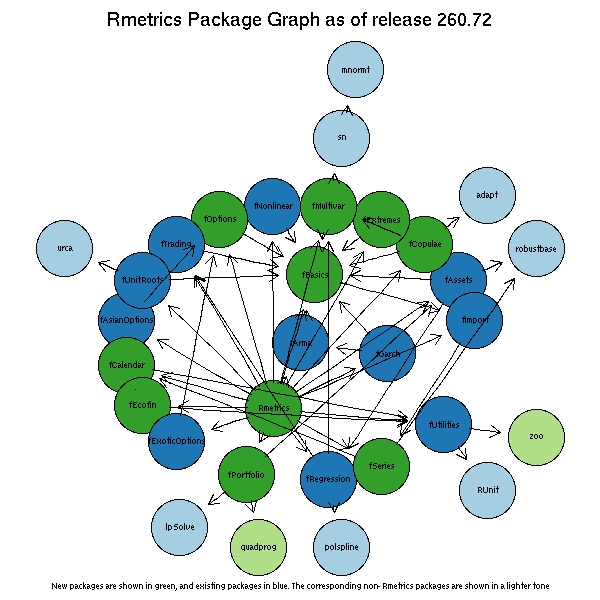
Debian has provided Rmetrics packages for financial engineering and computational finance since the Rmetrics release for R 1.9.0 in the summer of 2004. Over the years, Rmetrics has gotten more granular and changed from a handful of packages to two handfuls --- and the most recent release extended this trend even further to almost two dozen packages as shown in this chart. Dependency chart for Rmetrics packages Rmetrics now comprosises over twenty individual packages. Eleven new packages were added in the 260.72 release for R 2.6.0, and they required eight other new packages from CRAN. While I would have preferred a more spread-out approach than the shotgun approach of having to introduce all these new packages at once (which took the last four weeks), I am in support of the reorganisation which should make maintenance more easy going forward. So to get all of these packages onto a Debian box, a quick sudo apt-get install r-cran-rmetrics is all it takes. Currently supported only in the always-fresh unstable flavour, but hopefully soon in testing too. A big Thank You goes to the Debian FTPmasters. Of the 20-some packages that I added to Debian during this Rmetrics expansion, many were added within a day or two. Lastly, thanks also to Florian Hahne, Robert Gentleman and Elijah Wright for much appreciated help with R's Rgraphviz and graph packages to create the chart above. It only takes a handful of lines to create the basic graph, and another few lines for the colours and titles. The code is available on request, of course, but you need the current development versions of the BioConductor packages Rgraphviz and graph (which are not in Debian yet).
16 November 2007

Ond&#345;ej &#268;ert&iacute;k: SAGE Days 6

From November 9 till November 15 I attended SAGE Days 6 in Bristol, UK. It was a conference and a coding sprint for the SAGE project, which wants to build something comparable to Mathematica, Maple, Matlab and Magma built only from open source components without reinventing the wheel. Sage also provides excellent novel implementations for many mathematical algorithms (not found in Mathematica/Maple etc.).

I was invited to give a talk about SymPy, which is a Python library for symbolic mathematics, that we are doing.

Here are my notes from each day:

Saturday: one, two
Sunday: one, two
Monday, Tuesday, Wednesday: one

Impressions

Very positive. I started SymPy two years ago, because I wanted to play with symbolic mathematics in Python, see for example my presentation I gave at this conference for details. SAGE at that time was just able to do some mathematics things, but it was very weak in calculus, which is the SymPy's main domain. This has changed last half a year, when SAGE people managed to wrap Maxima in Python (which I thought to be completely impossible), so I started to follow SAGE development more closely. After the SD6, I must say I became very excited about the project.

One problem with mailinglists, IRC and other online interaction is that it's very difficult for me to get an impression about the people and the project. Being able to meet the developers and discuss with them face to face gives me the impression very quickly and very accurately.

By far the biggest guarantee, why it is worthy for me to contribute to SAGE, is the project leader, William Stein. He is very rational and pragmatic (I like these two properties) and after many discussions with him, I came to realize that he has basically identical views on the important things as I do and were I on his place, I would do the same decisions as he did and does. That's very nice, because I can concentrate my energy on things that I like to improve and don't have to worry about other things, because I know he will do it right.

The other SAGE developers are experts and with similar attitude as William has. It's enthusiastic to be among people who make things happen. For example one of the authors of Cython, Robert, implemented during SD6 a very nice HTML output, that shows Cython code, with colors according to how many Python API calls are called on that particular line, and by clicking that line it shows the corresponding C code.

SAGE project has a high aim and it stricly goes for it, without looking too much to the right or left, and that's how it should be. And it does produce a lot of very useful and high quality stuff along the way, for example Cython (probably the best wrapper for C/C++ things now, only pypy could possibly beat it, but that's still more a research project) or the SAGE notebook, which looks like a Mathematica notebook, but better and in a browser (together with a revision history, sharing, SSL encryption, etc.).

The only little problem is that currently SAGE developers are all mathematicians and as is well-known, mathematicians looks at mathematic from a very different prospective than physicists. :) And so I need calculus, advanced calculus and only when this is working, and working well, I can build on it some more advanced features. SAGE currently goes a little the other way - it has a lot of advanced features, from number theory, modular forms, elliptic curves, etc., but the basic calculus still needs a lot of improvements. SAGE wraps Maxima, because Maxima is quite fast, very well tested, so it works well. It's difficult to extend and written in LISP and that's very bad. That's where SymPy could help - it's in Python, very easy to extend, but currently slower than Maxima (rewriting parts of SymPy using Cython, or even C directly, will make it faster, hopefully as fast as Maxima or faster).

It's not yet in Debian, but SAGE people are working on it. It's not an easy task unfortunately.

Conclusion

SAGE is a very promising young project and I think it will succeed to provide an open source alternative to Maple, Matlab, Mathematica and Magma.

4 November 2007

Daniel Burrows: Lessig at the University of Washington

On Friday 2007-11-02, I watched Larry Lessig give a presentation at the University of Washington entitled Is Google (2008) Microsoft (1998)? Since it was Lessig, the talk was articulate and thought-provoking, and he used his slides very well (unlike many presenters who just read bullet points).

The argument he made is that Google is like Microsoft in some ways (and so are other companies like Facebook). In his analysis, the problem with Microsoft was that so many companies made themselves Microsoft-dependent, which both forced other companies to follow suit (due to network effects) and gave Microsoft leverage they could use against everyone in their ecosystem (e.g., Netscape). According to Lessig, Microsoft was not evil to use this leverage, but you have to recognize that Microsoft will do what is best for Microsoft, and this may not be what is best for you. He then suggested that we should be aware of the potential for the same thing to happen; in support of this point, he quoted excerpts from the terms of service from the APIs of Google and Facebook, which contain typical statements like we reserve the right to terminate your use of this service for any reason or for no reason, and asked: What if Microsoft had written this license agreement?

But it seemed to me that this wasn't his main point. He was using this observation as a springboard to talk about issues revolving around competition and public policy. Specifically, he feels that we should work towards a more just model of interaction between companies and users whose work makes the company more valuable (by contributing to a software ecosystem, by posting content on the Web site, etc). But the correct way to do this (he says) is not via competition, after-the-fact litigation, or voluntary codes of conduct: competition may not be around to enforce good behavior (as we've seen with Microsoft), litigation may be too late and ineffective (again, see Microsoft), and voluntary codes of conduct will disappear as soon as they get in the way of the bottom line. The correct approach, he argued, is across-the-board regulation so that all the companies have to play by the same rules.

From there he went on to talk about governmental corruption. He said (quoting Robert Reich's book Supercapitalism) that the reason we consistently look for solutions in the market and in voluntary compliance is that our governmental system is broken and does not effectively regulate corporations in the public interest. But Lessig is optimistic that we can change things (he joked that his publisher was unhappy with this point of view, because his brand has been built on pessimism). In his view, the politicians in Washington, by and large, want to be honest and do good, but they aren't able to within the current political system. For instance, on the few occassions that he managed to get access to lawmakers to discuss copyright issues, it was often the first time they had heard that there was more than one side to the argument. He thinks we need a national political movement that will shame politicians into being less corrupt.

This is all a simplification of what he said, of course; unfortunately, I wasn't able to find a recording of this talk on Lessig's Web site, or I'd point you at primary source material. I don't know if this is because he chose not to post it, or because it just hasn't been made available yet.

My view

In general, I thought that the speech was very interesting and well thought out. But as much as I'd like to buy into his optimism that we can fix our system, I don't think it's well-founded, for two reasons.

First, he argued that competition will resolve some of these problems (that was before and after he said we can't rely on competition, which I found confusing and may indicate that I misunderstood something). His evidence for this seemed to be that when Microsoft was dominating the world, users responded by reducing their dependence on Microsoft products and by switching to alternatives such as Linux. But, in fact, although more people may be using Linux than in the past, virtually everyone is still only using Windows, it's still almost impossible to find a programming job that isn't Windows-only, and Microsoft is still raking in money hand over fist; indeed, they're doing so well that they're planning to expand their workforce by a third. To take just one data point of many: I ride the bus to Seattle and back, and I regularly see other people using laptops as they commute. Virtually all the laptops run Windows. Occasionally I'll see a Mac, and every few months I'll see a guy running Linux on his laptop; I say "a guy" because it's the same guy every single time. So by my estimation, use of Linux on laptops in buses on the 545 route from Redmond to Seattle is way below 1%, with Macintoshes somewhere around 5%.

To broaden my point, I think Lessig has fallen into a trap that highly intelligent people, particularly those in academia, tend to fall into. In academia, you are surrounded by people who value learning and thinking deeply about the world. These are people who will give serious and unbiased consideration to questions like what is the social effect of my acceptance of the Facebook Terms of Service? and If I become dependent on this service, will that possibly affect me in five years if the company decides to act against my interests? The problem with this is that these people are not representative of the population at large. The population at large thinks why is this check-box getting in the way of me sending pictures to my friends? And I have no doubt that any kid who, e.g., refuses to sign up for Facebook as a protest against their TOS will be roundly mocked in their social circles for being a weird antisocial nonconformist. (of course, this may not apply to the small minority of people like myself whose social circles consist of weird antisocial nonconformists)

Second, Lessig's optimism about the political system seemed to be based on his observation that the people in government are, by and large, not venally corrupt: they want to do good, but the system is constructed in a way that makes this impossible. To me, that's a tremendously disheartening statement. If our problem were simply a few, or even many, corrupt politicians, this would be a solvable problem: even nowadays, Americans have some ability to choose who gets elected, and I believe that a sufficiently well-coordinated campaign could replace bad politicians with good ones.

But if the problem is that the system is corrupt even when the individuals are honest, it's a much deeper problem and frankly one that I don't know how to solve. While individuals have some direct control over who gets elected, we have no way to directly change the system that produces the corruption; the levers to do this are in the hands of the politicians elected through that broken system. It's unlikely that the politicians themselves will fix the problem, because they've benefited deeply from it: if the system is left as it is, well over 90% of Congress members will keep
their jobs
in the next election cycle, and any effective change seems likely (by definition) to disrupt this cushy arrangement.

On the other hand, running new candidates for office will not fix the problem. After all, if the problem is that the system is corrupt even when the participants are honest, then putting more honest people into government will have no effect. In order to get elected, these new politicians will have to become just as corrupt as the old ones, because that's how the system is set up. So we might change the faces, but we'll have the same old problems.

I recall two specific concrete proposals that Lessig made to make the system more responsive. First, he suggested shaming politicians who engage in corrupt behavior -- presumably taking large donations from interested parties. I don't see how this will help. Americans generally have a very low regard for the political class as it is; will pointing out particular examples of politicians taking money really make a difference when it comes to votes? And if it doesn't, will it really produce any change in their behavior? Politicians are motivated by votes the same way corporations are motivated by money; unless they stand a chance of losing their job (which is virtually impossible in any event), there's no reason for them to change how they behave.

His second proposal was for a system of contributions where it's impossible for any individual to prove they had donated a particular amount of money to a particular candidate. Even assuming it could be implemented perfectly, I don't think this will really solve the problem, for two reasons. First, it's not generally a secret what moneyed interests want. Politicians who want to attract large donations can just take positions that they know will appeal to donors of that sort. The donors themselves can make this easier on the candidates by, e.g., posting public position statements on issues of the day. Secondly, and this is far more insidious, even if politicians honestly represent their positions, then because success in running for office is so tied to the amount of money the candidate can raise, only candidates who hold opinions favorable to large corporations and wealthy individuals will be able to get elected. In fact, for all I know this is what happens already!

But with all that said, it was a really interesting talk and Lessig tied together some things you might not think would go together. If a video or Flash presentation becomes available, I would recommend watching through it. And hopefully my pessimistic predictions will be wrong; it's certainly happened before.

26 October 2007

Robert Collins: 26 Oct 2007

Flying to the US for UDS in Boston... and this time no dreaded AAAA's. Seems the US doesn't hate me quite so much, much more pleasant this time. Still, being fingerprinted for entering a country is rather irritating, back home we only do that to criminals.

Next.

Previous.