Search Results: "pini"

20 May 2014

Laura Arjona: Some experiences, and TODO, about fonts

TL;DR I don t know much about fonts, I just use the stock ones that come with my system. From time to time I have issues with docs that others create, and use other fonts. This post is about my plans on learning a bit more and, at least, know how to solve those issues, if it s possible, while staying in the bright side (the free-software / free font side). Long version The context I use Debian, LibreOffice, sometimes Inkscape, and LaTeX. One of my favorite hashtags is #iloveplaintext, I don t know much about design in general, and fonts and typography in particular. I didn t change the fonts in my desktops (only reduced the size in the laptop, to be able to read a bit more in my low resolution screen), I rarely change the font in Writer (maybe from Liberation Serif to Liberation Sans), I never changed the font in a LaTeX document or LaTeX beamer presentation (I write boring documents, I know) and when I paste from the web, it s usually because I want to read a long article so I paste as plain text in gedit and print it or save it. So I ve never felt to learn more about fonts, it just works, and covers my needs, (or not, but I mostly could live with the issues). Then a friend in the Pump.io network, Adri n Perales, published a blog post about Typography (in Spanish) that I liked very much, and I began to think (and remember) some of the issues that I have from time to time with fonts. Issue #1: League Gothic: a free font that was not installed in my system Today, again in the Pump.io network, I discover that the FSF published a poster Privacy is impossible without free software , in SVG format, but it didn t look well when I opened it with GIMP, clearly due to some missing font. Nice that SVG format is a plain text format (XML)! So I opened the file with gedit and searched for the text string whose font was missing. It was League Gothic font, of course a free software font, but not packaged in Debian, it seems. No problem. I downloaded the font, copied the files in /usr/share/fonts and problem solved. Issue #2: Book Antiqua: a non-free font (must find equivalent) A document made with Microsoft Word that one friend sends to me so I review and resend (in PDF format) to other people. It s a leaflet, and it has text in Arial, in Tahoma, and in Book Antiqua. When I open it with LibreOffice the aspect is wrong (the substitutes are not the same size so some breaking lines and so). Book Antiqua is not free. I learned that it s an imitation of the Palatino font, and that a similar font in the free software systems is URW Palladio . In Writer (LibreOffice), I went to Tools > Options > Fonts and declared the equivalence of the two fonts, so the program would use URW Palladio as a substitute of Book Antiqua. I opened again the document and it was quite better, very similar to the original aspect. I didn t bother in changing the text in Arial or Tahoma, since the substitutes that LibreOffice used were quite good. But I bookmarked this page: A Web Designer Guide to Linux Fonts for remembering the different fonts that I can try to emulate the Windows ones. I also know that I can install the Microsoft Core Fonts for the web since they are packaged for Debian in the contrib archive. But I ll try to survive without them for now (until now, I didn t bother, why should I now that I have the substituting guide?). In other news, I got impressed that MS Core Fonts is #4 in Most downloads all over the time in SourceForge, with more than 450 million downloads \o/ Issue #3: Installing a new free font in Debian So I decided to install one of the fonts that Adri n Perales recommended in his blog post, Linux Libertine . Since it is packaged for Debian, it s super easy:
# apt-get install ttf-linux-libertine
(my LibreOffice was opened, so I closed it and opened again, and the font was there ready for use). Issue #4: Use a different font in LaTeX Well, as always, there is not one but many ways to do that in LaTeX. My intuition tells me that if there is a LaTeX package for the font that I want to use, it s probably a nice idea to just use it. So I searched about Linux Libertine in LaTeX and yes, there is a package (and you can find a very interesting font guide in The LaTeX font catalogue ). I installed the package texlive-fonts-extra, and then, I added two lines in my LaTeX document:
\usepackage libertine 
\usepackage[T1] fontenc 
Compiled, and the resultant PDF was using Libertine font instead of Computer Modern. TODO (and/or wishlist) When opening a document that uses a font not present in my system, I maybe wouldn t notice that a font is missing and I see a substitute (and maybe not the best one)!. It would be nice that the program tells the user This file uses the font X, and it seems it s not in your system. I ll use font Y as a substitute . I m not sure if there is a standard way to know which package contains a certain font. I use a web search engine to try to find out, and the websites that I linked in the article. I have to investigate and learn a bit more about free fonts equivalents to the ones that other people use, and fonts in general, so my documents are more beautiful and people gets interested to know about the tools that I use to produce them. Well, I ve written a long blog post (thanks if you read until here!), solved some issues, and try some things, but not even capturing a snapshot to show here! It seems that I m still lazy, forgive me I hope at least this #plaintext is useful for you :)
Filed under: My experiences and opinion, Uncategorized Tagged: Debian, English, Fonts, Free Software, LaTeX, libre software, LibreOffice, Moving into free software, pump.io

18 May 2014

Benjamin Mako Hill: Installing GNU/Linux on a 2014 Lenovo Thinkpad X1 Carbon

I recently bought a new Lenovo X1 Carbon. It is the new second-generation, type 20A7 laptop, based on Intel s Haswell microarchiteture with the adaptive keyboard. It is the version released in 2014. I also ordered the Thinkpad OneLink Dock which I have returned for the OneLink Pro Dock which I have not yet received. The system is still very new, challenging, and different, but seems to support GNU/Linux reasonably well if you are willing to run a bleeding edge version and/or patch your kernel and if you are not afraid to spend an afternoon or two tweaking things. What follows are my installation notes for Debian testing (jessie) when I installed it in early May 2014. My general impressions about the laptop as a GNU/Linux system and overall are at the end of this write-up.
System Description The X1 Carbon I ordered included the 512GB SSD, the 14.0 inch WQHD (2560 1440) 260 nit touchscreen, and the maximum 8GB of memory. I believe the rest is not particularly negotiable but includes a 720p HD Camera, a 45.2Wh battery, and an Intel Dual Band Wireless 7260AC with Bluetooth 4.0. For those that are curious Here is the output of lspci on the system:
00:00.0 Host bridge: Intel Corporation Haswell-ULT DRAM Controller (rev 0b)
00:02.0 VGA compatible controller: Intel Corporation Haswell-ULT Integrated Graphics Controller (rev 0b)
00:03.0 Audio device: Intel Corporation Haswell-ULT HD Audio Controller (rev 0b)
00:14.0 USB controller: Intel Corporation Lynx Point-LP USB xHCI HC (rev 04)
00:16.0 Communication controller: Intel Corporation Lynx Point-LP HECI #0 (rev 04)
00:16.3 Serial controller: Intel Corporation Lynx Point-LP HECI KT (rev 04)
00:19.0 Ethernet controller: Intel Corporation Ethernet Connection I218-LM (rev 04)
00:1b.0 Audio device: Intel Corporation Lynx Point-LP HD Audio Controller (rev 04)
00:1c.0 PCI bridge: Intel Corporation Lynx Point-LP PCI Express Root Port 6 (rev e4)
00:1c.1 PCI bridge: Intel Corporation Lynx Point-LP PCI Express Root Port 3 (rev e4)
00:1d.0 USB controller: Intel Corporation Lynx Point-LP USB EHCI #1 (rev 04)
00:1f.0 ISA bridge: Intel Corporation Lynx Point-LP LPC Controller (rev 04)
00:1f.2 SATA controller: Intel Corporation Lynx Point-LP SATA Controller 1 [AHCI mode] (rev 04)
00:1f.3 SMBus: Intel Corporation Lynx Point-LP SMBus Controller (rev 04)
BIOS/Firmware The BIOS firmware is non-free and proprietary as it the case with all ThinkPads and nearly all laptops. According to this thread there is a bug in the default BIOS that means that suspend to RAM is broken in GNU/Linux. You can get updated BIOS at the Lenovo s ThinkPad X1 Carbon (Type 20A7, 20A8) Drivers and software page by looking in the the BIOS section. Honestly, the easiest approach is probably to download the Windows BIOS Update utility (documentation is here) which you can use to run the BIOS update from within Windows before you install GNU/Linux. If that s not an option (e.g., if you ve already installed GNU/Linux) the best method is to download the bootable CD ISO from the same page. Of course, since the X1 Carbon has no optical media, you have to find another way to boot the CD image. I struggled to get the ISO to boot from USB using the usually reliable dd method. This message suggest that the issue had to do with the El Torito wrapper:
I had to dump the eltorito image from the ISO they provide, after that I was able to dd the resulting image to a flash drive and the bios update went well, no cdrom needed.
I updated to version 1.13 of the BIOS which fixes the suspend/resume bug. By the time you read this, there may be newer versions that fix other things so check the Lenovo website.
Installing Debian I installed Debian testing using the March 19, 2014 Alpha 1 release of the Debian Installer for Jessie (currently testing). I installed in graphical mode. With the WQHD screen, everything was extremely tiny but it worked flawlessly. I downloaded the amd64 net install image from the normal place and installed the rest of the system using the built-in Ethernet port which required no firmware or extra drivers. I did the normal dd if=FILENAME.iso of=/dev/sdX method of getting the installer onto the a USB stick to boot. I turned off restricted boot in BIOS first. In general, the latest version of the Debian installation guide is always a good source of guidance on installing Debian. I used the Debian installer wizard to partition and selected Use entire disk and partition it for LVM and encrypted data which kept the UEFI partitions around. The system installed with no errors or issues and booted up normally afterward. The grub menu is hilariously narrow on the WQHD screen. If you want to use the built-in wireless and/or Bluetooth, you will need to install the non-free iwlwifi firmware package. It is very lame that we still have to do this to use hardware we have purchased.
What Works and Doesn t The following stuff works the first time I booted into the GNOME 3 desktop and logged in:
  • The WQHD 2560 1440 screen
  • The touchscreen
  • Both the TrackPoint and the touchpad
  • Built-in e1000e Ethernet using the dongle
  • The keyboard plus the adaptive row of F1-F12 keys.
  • External monitor using the full HDMI or mini-DisplayPort connectors
  • Audio (both speakers and microphone)
  • The camera/webcam
The following stuff works if you install non-free firmware:
  • Internal Wireless
  • Bluetooth 4.0
The following stuff works with qualifications:
  • Suspend to RAM Works once you have updated the firmware.
  • The adaptive keyboard The F1-F12 keys work but the button that theoretically lets you switch to different sets of function buttons (e.g., volume, brightness) does nothing.
  • Disabling the touchpad There is a BIOS option to disable the touchpad. It works in Windows and does nothing at all in GNU/Linux.
I have not tried:
  • The fingerprint reader
Disabling the touchpad As a long-term ThinkPad user, I love the TrackPoint pointing stick. If you plan on using this, the built-in touchpad is incredibly aggravating because it is very easy to brush against it while using the TrackPoint. In BIOS, there is an option to disable the touchpad. Although this works in Windows, it does absolutely nothing in GNU/Linux. Part of the issue is that, unlike the older X1 Carbon and other ThinkPads, there are no TrackPoint buttons. Instead of buttons, there are regions at the top of the touchpad which are configured, in software, to act like buttons. If you want to be able to click, the touchpad can never be truly turned off. This is not problem unique to the Haswell X1 Carbon and a number of people have been struggling with this issue on other Lenovo laptops. Essentially, what you need to do is configure your touchpad so that the buttons are where you want them and so that it ignores any input for the purposes of cursor movement. There are a few ways of doing this but this answer from an askubuntu.com question has the solution I ended up using:

Open file /usr/share/X11/xorg.conf.d/50-synaptics.conf for edit.

Find Section InputClass which the following line is Identifier Default clickpad buttons .

Edit option for SoftButtonAreas to values 64% 0 1 42% 36% 64% 1 42%, this is size of the right and middle button.

Enable option AreaBottomEdge and change value to 1, this will disable touchpad movement.

If everything done right, your class should looks like:

Section "InputClass"
     Identifier "Default clickpad buttons"
     MatchDriver "synaptics"
     Option "SoftButtonAreas" "64% 0 1 42% 36% 64% 1 42%"
     Option "AreaBottomEdge" "1"
EndSection
Essentially, the first Option line will create a middle button that is 32% of the width and 42% of the height, and a right button that is 32% of the width and 42% of the height. The synaptics manpage (man synpatics) will give you more detail on the general way this works. Of course, something does feel very wrong about editing a file in /usr/share.
Fixing the Adaptive Keyboard The most wild feature of the laptop is the adaptive keyboard strip. The strip is a back-lit LCD that looks almost like E Ink screen and acts as a touchscreen keyboard. The default mode gives you the F1-F12 keys. If you press the keys (since they aren t buttons, you just put your finger on top of them) they act like normal F-keys. You can Ctrl-Alt-F1, etc., to switch to virtual terminals out of the box. There are four modes: Function (i.e., normal F-keys), Home, Web, and Chat. The last three overlap quite a bit (e.g., they all have brightness and volume). You can play with an example on the Lenovo homepage. In Windows, switching programs will apparently change these keys so that an appropriate set of buttons is shown for the application you are using. You can also change these keys manually with a big Fn button at the far left of the adaptive keyboard strip. As I write this this, released kernels do not support the adaptive keyboard Fn button which means you cannot use anything other than the F-keys out of the box. I believe it also means that resuming from suspend to RAM breaks these keys. That said, Shuduo Sang from Canonical has released several versions of a patch to to the thinkpad_acpi kernel module which adds support for the Home mode. The other modes (web and chat) do not seem to be supported. The latest version of the patch is on on the Linux Kernel Mailing List and the relevant commits are:
330947b save and restore adaptive keyboard mode for suspend and,resume
3a9d20b support Thinkpad X1 Carbon 2nd generation's adaptive keyboard
Although this is not supported in Debian testing at the time of writing, a bug was filed in Debian and quickly fixed by Ben Hutchings in Debian kernel version 3.14.2-1 which is currently in sid/unstable. As a result, if you install the latest version kernel from Debian unstable (3.14.2-1 or later), the adaptive keyboard just works. If you aren t using Debian and if kernel you are using does not have support, you might be patching your kernel.
General Impressions As I have described in my interview with The Setup, I have been a user of ThinkPad X-series laptops for many years. This is my sixth X-series ThinkPad. Overall, I quite like the hardware! Once things mature a little bit, I think that this will be a great laptop for running GNU/Linux. That said, I ordered the laptop without realizing that the X1 Carbon had gone through a major revision! The keyboard was quite a suprise. I think that changing a system so radically without changing the model name/number is a very bad move on Lenovo s part. There are two remaining issues with the system I m still struggling with: (1) the keyboard layout is freaky and weird, and (2) the super high resolution screen breaks many things. The quality of the keyboard itself is great and worthy of the ThinkPad name. That said, there are two ways in which it is strange. The first is the adaptive keyboard strip. Overall, it works surprisingly well and I think it is a clever idea. My sense is that the strip is more annoying in Windows because it changes out from under you all the time. In GNU/Linux, only manual changing of modes is supported. This, in my opinion, is a feature. I do miss the real feedback you get from pressing keys but for F-keys and volume-keys that I don t use often this isn t too important. On the downside, I have realized several times that I had been holding down a button for several seconds and not noticed. The more annoying issue with the keyboard is the way that the other keys have moved around. Getting rid of the CapsLock is wonderful! How has this taken so long? Replacing it with a split Home and End keys is nuts. I ve remapped the Home and End to put Control back where it should be. My right Control to now Home but I still don t have an End key. The split Backspace and Delete is not a problem for me. The tilde/apostrophe is in a very bad place. There is no Insert, Print Screen/SysRq, Scroll Lock, Pause/Break or NumLock. They are all just gone. Surprisingly, I haven t missed any of them. The second issue is the 2560 1440 resolution on the 14 inch screen. I use a 27 inch external monitor with the same native resolution laptop but, by my arithmetic, the pixel density on the laptop is 210 DPI instead 109 DPI on the external monitor. The result is the scaling problem and it s a huge pain that seems mostly unsolved on any operating system. Fonts and widgets that look good on the laptop look huge on my external monitor. Stuff that looks good on my external monitor looks minuscule on the laptop. I routinely move windows between my laptop screen and my large monitor. Until I find a display system that can handle this kind of scaling effectively, this requires changing font size and zooming all the time. At the moment, I m shrinking and expanding my font size using the built in hot keys in Emacs, Gnome Terminal, and Firefox/Iceweasel. I love the high resolution screen but the current situation is crazy-making. Finally, this setup will not get you into the Church of Emacs and it s not about to find its way onto the FSF s list of endorsed hardware. For one, I paid the Windows tax. Beyond that, there is the non-free BIOS and the need for non-free firmware to use the wireless and Bluetooth. This is standard for ThinkPads but it isn t getting any easier to swallow. There are alternatives in the form of Gluglug s X60 laptops running CoreBoot, Lemote Yeelong laptops, Bunnie Huang s Novena and others that are better in these regards. I am very excited for these projects but, for a number of reasons, these just weren t an option for the laptop I use for my research computing.


11 May 2014

Matthew Garrett: Oracle continue to circumvent EXPORT_SYMBOL_GPL()

Oracle won their appeal regarding whether APIs are copyrightable. There'll be ongoing argument about whether Google's use of those APIs is fair use or not, and perhaps an appeal to the Supreme Court, but that's the new status quo. This will doubtless result in arguments over whether Oracle's implementation of Linux APIs in Solaris 10 was a violation of copyright or not (and presumably Google are currently checking whether they own any code that Oracle reimplemented), but that's not what I'm going to talk about today.

Oracle own some code called DTrace (Wikipedia has a good overview here - what it actually does isn't especially relevant) that was originally written as part of Solaris. When Solaris was released under the CDDL, so was DTrace. The CDDL is a file-level copyleft license with some restrictions not present in the GPL - as a result, combining GPLed code with CDDLed code will (in the absence of additional permission grants) result in a work that is under an inconsistent license and cannot legally be distributed.

Oracle wanted to make DTrace available for Linux as part of their Unbreakable Linux product. Integrating it directly into the kernel would obviously cause legal issues, so instead they implemented it as a kernel module. The copyright status of kernel modules is somewhat unclear. The GPL covers derivative works, but the definition of derivative works is a function of copyright law and judges. Making use of explicitly exported API may not be sufficient to constitute a derivative work - on the other hand, it might. This is largely untested in court. Oracle appear to believe that they're legitimate, and so have added just enough in-kernel code (and GPLed) to support DTrace, while keeping the CDDLed core of DTrace separate.

The kernel actually has two levels of exposed (non-userspace) API - those exported via EXPORT_SYMBOL() and those exported via EXPORT_SYMBOL_GPL(). Symbols exported via EXPORT_SYMBOL_GPL() may only be used by modules that claim to be GPLed, with the kernel refusing to load them otherwise. There is no technical limitation on the use of symbols exported via EXPORT_SYMBOL().

(Aside: this should not be interpreted as meaning that modules that only use symbols exported via EXPORT_SYMBOL() will not be considered derivative works. Anything exported via EXPORT_SYMBOL_GPL() is considered by the author to be so fundamental to the kernel that using it would be impossible without creating a derivative work. Using something exported via EXPORT_SYMBOL() may result in the creation of a derivative work. Consult lawyers before attempting to release a non-GPLed Linux kernel module)

DTrace integrates very tightly with the host kernel, and one of the things it needs access to is a high-resolution timer that is guaranteed to monotonically increase. Linux provides one in the form of ktime_get(). Unfortunately for Oracle, ktime_get() is only exported via EXPORT_SYMBOL_GPL(). Attempting to call it directly from the DTrace module would fail.

Oracle work around this in their (GPLed) kernel abstraction code. A function called dtrace_gethrtimer() simply returns the value of ktime_get(). dtrace_gethrtimer() is exported via EXPORT_SYMBOL() and therefore can be called from the DTrace module.

So, in the face of a technical mechanism designed to enforce the author's beliefs about the copyright status of callers of this function, Oracle deliberately circumvent that technical mechanism by simply re-exporting the same function under a new name. It should be emphasised that calling an EXPORT_SYMBOL_GPL() function does not inherently cause the caller to become a derivative work of the kernel - it only represents the original author's opinion of whether it would. You'd still need a court case to find out for sure. But if it turns out that the use of ktime_get() does cause a work to become derivative, Oracle would find it fairly difficult to argue that their infringement was accidental.

Of course, as copyright holders of DTrace, Oracle could solve the problem by dual-licensing DTrace under the GPL as well as the CDDL. The fact that they haven't implies that they think there's enough value in keeping it under an incompatible license to risk losing a copyright infringement suit. This might be just the kind of recklessness that Oracle accused Google of back in their last case.

comment count unavailable comments

7 May 2014

Laura Arjona: I need a new GPG Key

TL;DR This key is no longer usable:
pub  2048R/9C6C32C7 2014-02-16 Laura ARJONA REINA <larjona99@gmail.com>
                               Laura ARJONA REINA <larjona@fsfe.org>
                               Laura ARJONA REINA <laura.arjona@upm.es>
                               Old key 0xE20474C3 no longer valid: lost secret key. (Clave antigua 0xE20474C4 ya no es v lida: clave secreta perdida.)
Fingerprint=F29B A6D8 D1DC A30F 3E34  53DF 5CD1 FDE5 9C6C 32C7
Please act as if it does not exist. The reason is that I cannot remember the passphrase of my master GPG key. This is why I didn t signed any of the keys of people that I met in Barcelona MiniDebconf. My geek self steem is a bit undermined, but feeling sorry for myself accomplishes nothing, so I think I will not hide problems and move on. I ll post about my new key soon. Long version The bad news The bad news are many. I generated my key in February 2014 (I generated my very first GPG Key in 2010, as an exercise, but never used it again, and in 2014 I couldn t remember the passphrase, and the paper where it was written, had got lost before). Anyway, February 2014, new GPG key. I followed the Howto in FSFE wiki in order to use my brand new FSFE SmartCard. I have to admit that I didn t understand very well how all this works, and it seems that my main mistake was to miss-understand that since I was using a smartcard, with a PIN and an Admin PIN, remembering passphrases was no longer required (only remembering the PINs). I was WRONG! PINs are for daily use with the subkeys of your card (for encryption, decryption, and signing stuff different than GPG keys), you still have the master key that is not in the card (but in a separate medium in a safe place), and for the master key we still use passphrase, and the master key is the one that allows signing keys from other people, and changing, revoking, adding subkeys, etc. So, it seems I used a random passphrase that I didn t write down and I could not remember, due to this terrible missunderstanding. Another bad news is that I didn t generate a revocation certificate (well in fact, I was going to generate just before signing the first key of another person, and then I realize that it was asking the passphrase, hence the problem). First I thought that it should ask the PIN and my smartcard setup was wrong or anything, but after reading and interchanging emails with other people more experienced than me, I realized that I should remember that passphrase. And I couldn t. So there are no revocation certificates :( Another bad news is that some (awesome) people already signed my key, and it will be difficult to meet again so they sign my new key. I was thinking about applying to the Debian new member process this summer, and I have not many opportunities to meet Debian people in person, so I gathered quite a lot signs last March in MiniDebConf Barcelona. Now I m again at the starting point (well, this is perfect excuse to try to join a Debian event soon :) I don t know how I would manage to do it, but I ll try!). The good news (Always look at the bright side of life ) The main good news is that I didn t used the GPG key for signing/encrypting important stuff: I just interchanged some encrypted mail as test with friends, and signed some mails sent to public mailing lists (for signing mails I was using the smartcard PIN so I didn t notiece the problem). The other main good news is that my key is not compromised (well, you can never be sure, but I think so). I cannot revoke it but I m quite sure nothing important depends on that key. Other good news is that I have read a lot about how GPG works and how the smartcard works, keys and subkeys and all this stuff, and I think now I understand everything quite better. I have learned (and also tried) tools as nasty, John The Ripper and rephrase to try to recover the passphrase. I didn t recover it, but at least I know that all those (free software) tools exist and how to use them :) And I have learned the lesson: to be extremely careful, test that everything works (not just try one or two things, test everything) and to not leave work for later (and for example, generate the revocation certificates just right after the keys). Next steps I ll send a message to all the friends that signed or downloaded my old GPG key apologysing and pointing to this blog post so they learn the details about why I create a new key. I ll take this opportunity to download and use the Tails (The Agnostic Incognito System, a Debian derivative which is a live system and is focused in protecting privacy and anonymity of the user). Tails will be my safe, network disconnected environment to generate the new keys and do the sensible tasks with them. I think this time I will create my main key 4096-bit long (since now I understand that the main key is not stored in the card) and the subkeys can be 2048-bit or 3072 to fit in the smarcard. Well, hands on! I ll write another blog post when my new GPG keys are ready. I hope third time s the charm! Note: Thank you to all the people that gave me advice and support (knowledge, links, moral support) about this issue. You know who you are!
Filed under: My experiences and opinion, Tools Tagged: Debian, encryption, English, Free Software, gpg, libre software, Moving into free software, mswl-cases

1 May 2014

Siri Reiter: Communication building blocks for MiniDebConf Barcelona 2014 (drafts)

Sustainable visual identity design is a design that recycles as many elements as possible with every new piece of communication. Not only is a brand strengthened every time the logo and any other identity forming visual element is used, a lot of work is also saved as well. Every logo variant is a weakening of the brand, not a strengthening. Of course design improvements can be made - always, all year 'round - preferably not right up to the next conference. I consider it a waste of time to create a sublogo for a minidebconf. The Debian logo is perfectly suitable as logo for a Debian conference. In the particular case of the Barcelona MiniDebConf 2014, I think the Debian Women logo is the proper logo to use, though, since it is a Debian Women project, contradictionary as it may sound. The same principle of recycling typography and grids. I'd like as much identity matter - and work - to be reused, as possible. There is no need to reinvent the wheel every time. A visual theme created with illustration and colour schemes is enough as identity indicator for smaller events like MiniDebConfs. In my opinion.

Logo and logotype The Debian Women logo. Event name set in the font Procipio, familiar to the Debian logo. The name is long and cannot be scaled down much. A version with the name set in two lines can be used in narrow space, like on a folder.

Theme The speech bubble is a part of the visual theme. Orange is a color I connect with Spain, sun and oranges. I suggest it used with red like the Debian logo red.

Poster The speech bubbles could be used in a varied form. I've stated a few important statements here. I'd like a shared list of statements. There must be other info on the poster as well. The white space at the bottom is for sponsor logos. The font I use in the speech bubbles in this draft is an Apple font called Flood. I'd like to find a free font with similar qualities.

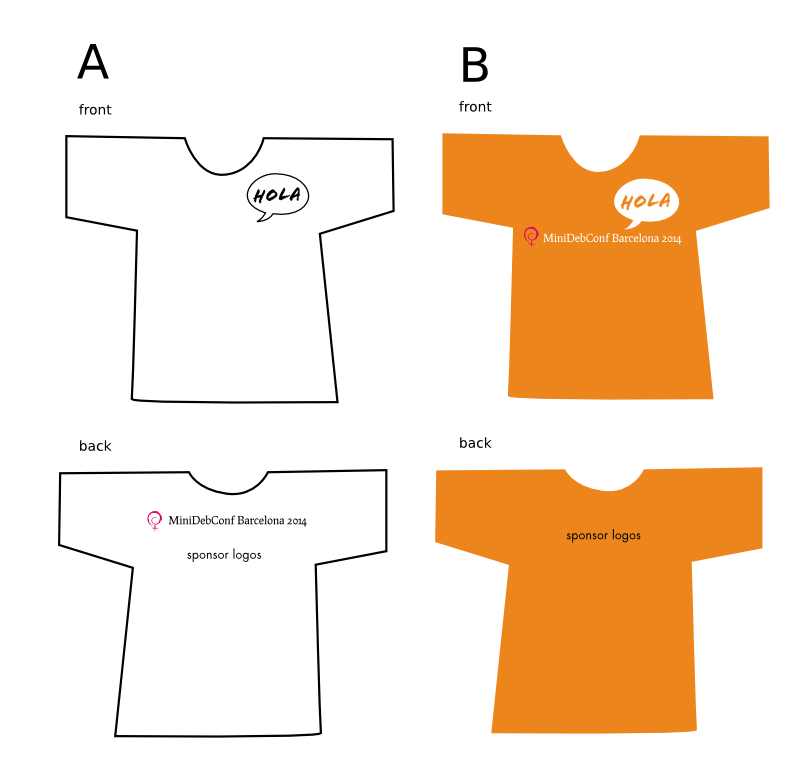
T-shirt There are many possibilities. I like the idea of printing just a speech bubble in the front and give people the opportunity to write their personal statements with textile pens. Nametags could be badges to be filled out on the spot with a pen.

Siri Reiter: That goddamned perfection again

Since the MiniDebConf Jonas and I have been travelling in Spain, France and finally staying in Belgium for a week, getting some work done. It's been harder than imagined to work during travel. I haven't exercised either, and regained at least three of four kilos I spent much time and effort getting rid in the year preceding. I thrive in my home and find it hard to keep my own time and focus when I am deprived of my own space. It was challenging to give a talk, "Why aren't more designers using Debian or working for Debian", my first public talk. I've been working to recapture my points in writing, to make a stronger statement, but I seem to blur my own views with conflicting ones, and I'm loosing momentum every day. One of my reasons for speaking up was to do it even though I'm not at trained speaker and have "nothing" to contribute but my opinions from the angle of a user that happens to be a designer. Not claiming to be a superior designer, but one that would like to contribute if it was easier to figure out how. And since the community wants to encourage designers to contribute to the Debian project, I figured it to be a good idea to talk about how this has been challenging to me as a dedicated user and completely out of the question for any other designer I know - or knew before the minidebconf. No reseach, no scientific proofs, just my wiew from my "dumb user" and designer's perspective. I saw one single attendant rolling his eyes during my talk. I didn't care at that time, but I've given that look more consideration than the people approaching me after the talk, saying thank you for voicing their opinions and thoughts. I think that's absolutely astonishing and at the same time it's just typically me. It makes me angry, first with myself for not speaking to this man's perception of things, then with myself for not just letting go of that image. I'm really glad that so many seemed to listen with curiosity and interest. What if one more - or half of the auditorium - had rolled their eyes? I don't like to feel that vulnerable. The truth is, though, that I'm really not. I gave the talk against my fear of failure and public humiliation and I'm convinced that my thoughts and actions matter, just as anybody's does, if we dare to say what's on our minds and to take action. I believe it's in anybody's power to "make a difference" and even "change the world" - at least in a small way. I guess that's one of the underlying reasons to be a designer in the first place. That is quite a strong position to take. I've created the wikipage http://wiki.debian.org/Design - well knowing that design is a word with many meanings. Everything is design. Since the talk I've been in doubt about that page. About the project, my aim with it, what to do about it, how to move on with just a tiny babystep, and I realise that I'm simply afraid to be disturbing someone's peace, making people angry or roll their eyes at my fumbling attempts to figure out in public what can be done to make a thriving community of designers collaborating with coders to make better, more usable and attractive software in the free, wide world. I'm starting a design process, not presenting a perfect, finished solution. Now, having put these thoughts into words, perhaps, my mind will be somewhat appeaced and let me move on with my intended tasks of cultivating that acclaimed space in the Debian information jungle into a friendly and welcoming place with info that makes it easier to be a contributing designer in Debian.

30 April 2014

Wouter Verhelst: Code of Conduct accepted

It's taken a while to get here, but the code of conduct that I set out to produce about a year ago now has been voted on. The result which has been released earlier this week is that the code of conduct has been accepted, but that future updates would require another GR. Although not my personal preference, it's pretty much what I expected. I still think allowing the DPL to update the code of conduct in the future would be preferable over having to go through another GR (after all, if the DPL does something silly, we have ways of reverting that decision); but regardless, the fact that the code of conduct is accepted is, in my opinion, a major step forward for Debian. Thanks to everyone who voted!

26 April 2014

Russell Coker: BTRFS Status April 2014

Since my blog post about BTRFS in March [1] not much has changed for me. Until yesterday I was using 2.13 kernels on all my systems and dealing with the occasional kmail index file corruption problem. Yesterday my main workstation ran out of disk space and went read-only. I started a BTRFS balance which didn t seem to be doing any good because most of the space was actually in use so I deleted a bunch of snapshots. Then my X session aborted (some problem with KDE or the X server I ll never know as logs couldn t be written to disk). I rebooted the system and had kernel threads go into infinite loops with repeated messages about a lack of response for 22 seconds (I should have photographed the screen). When it got into that state the ALT-Fn keys to change a virtual console sometimes worked but nothing else worked the terminal usually didn t respond to input. To try and stop the kernel from entering an infinite loop on every boot that I used rootflags=skip_balance on the kernel command line to stop it from continuing the balance which made the system usable for a little longer, unfortunately the skip_balance mount option doesn t permanently apply, the kernel will keep trying to balance the filesystem on every mount until a btrfs balance cancel operation succeeds. But my attempts to cancel the balance always failed. When I booted my system with skip_balance it would sometimes free some space from the deleted snapshots, after two good runs I got to 17G free. But after that every time I rebooted it would report another Gig or two free (according to btrfs filesystem df ) and then hang without committing the changes to disk. I solved this problem by upgrading my USB rescue image to kernel 3.14 from Debian/Experimental and mounting the filesystem from the rescue image. After letting kernel 3.14 work on the filesystem for a while it was in a stage where I could use it with kernel 3.13 and then boot the system normally to upgrade it to kernel 3.14. I had a minor extra complication due to the fact that I was running apt-get dist-upgrade at the time the filesystem went read-only do the dpkg records of which packages were installed were a bit messed up. But that was easy to fix by running a diff against /var/lib/dpkg/info on a recent snapshot. In retrospect I should have copied from an old snapshot of the root filesystem, but I fixed the problems faster than I could think of better ways to fix them. When running a balance the system had a peak IO rate of about 30MB/s reads and 30MB/s writes. That compares to the maximum contiguous file IO speed of 260MB/s for reads and 320MB/s for writes. During that time it had about 50% CPU time used for my Q8400 quad-core CPU. So far the only tasks that I do regularly which have CPU speed as a significant bottleneck are BTRFS filesystem balancing and recoding MP4 files. Compiling hasn t been an issue because recently I haven t been compiling many programs that are particularly big. Lessons Learned I should photograph the screen regularly when doing things that won t be logged, those kernel error messages might have been useful to me or someone else. The fact that the only kernel that runs BTRFS the way I need comes from the Experimental repository in Debian stands in contrast to the recent kernel patch that stops describing BTRFS as experimental. While I have a high opinion of the people who provide support for the kernel in commercial distributions and their ability to back-port fixes from newer kernels I m concerned about their decision to support BTRFS. I m also dubious about whether we can offer BTRFS support in Debian/Jessie (the next version of Debian) without a significant warning. OTOH if you find yourself with a BTRFS system that isn t working well you could always hire me to fix it. I accept payment via Paypal, bank transfer, or Bitcoin. If you want to pay me in Grange then I assure you I will never forget about it. ;) I thought that I wouldn t have CPU speed issues when I started using the AMD64 architecture, for most tasks that s been the case. But for systems for which storage is important I ll look at getting faster CPUs because of BTRFS. Using faster CPUs for storage isn t that uncommon (I used to work for SGI and dealt with some significant CPU power used for file serving), but needing a fast quad-core CPU to drive a single SSD is a little disappointing. While recovery from file system corner cases isn t going to be particularly common it s something that you want completed quickly, for personal systems you want to be doing something else and for work systems you don t want down-time. The BTRFS problems with running out of disk space are really serious. It seems that even workstations used at home can t survive without monitoring. For any other filesystem used at home you can just let it get full and then delete stuff. Include rootflags=skip_balance in the boot loader configuration for every system with a BTRFS root filesystem and in the /etc/fstab for every non-root BTRFS filesystem. I haven t yet encountered a single situation where continuing the balance did any good or when it didn t do any harm.

4 April 2014

Gunnar Wolf: Mozilla: So our communitary echobox *does* resound with social issues

I woke up to the news that, after a very short tenure, Brendan Eich steps down as the Mozilla CEO. Why? Because of the community outcry. Because some years ago, Eich pubilcly supported (and donated funds) the ban of any kind of marriages in California that were not between a man and a woman. The world has advanced enormously in this regard in the last years/decades, and so many individuals and organizations opposed and announced they would boycott Mozilla that either him or Mozilla could not stand the pressure anymore. So, of course, it's sad the person had to resign. Many people talked about freedom of speech, freedom of harbouring his own personal opinion But when it comes to the rights of minorities, particularly of minorities that have suffered such hard prejudice and abuse as the gay, lesbian and all the other non-orthodox sexual- and gender- orientations, righting a wrong is much more important than preserving an individual's freedom of opinion. Besides, it's not just thinking or talking about something The concrete proposition Eich supported (and eventually made him resign) is about bringing the life of thousands of people to a hellish state of uncertainty, and going back to not having a way for the society to legally recognize their way of being, their love, their lifes. But anyway What prompts me into writing this is that, once again, the Free Software (and related denominations) community has shown that a set of core values, seemingly shared by a very large amount of our own people with no coordination or correlation with what conforms us as a community (and thus, being emergent traits), are strong enough to create a critical mass, to achieve cohesion. And that ours is not just a technical community of people writing software at all layers of the stack, but first and foremost is a group of social activists, committed to making the world better. I will quote from Matthew Garrett's post on this topic, clearly more contundent and thorough that what I'm trying to come up with:
The Mozilla Manifesto discusses individual liberty in the context of use of the internet, not in a wider social context. Brendan's appointment was very much in line with the explicit aims of both the Foundation and the Corporation - whatever his views on marriage equality, nobody has seriously argued about his commitment to improving internet freedom. So, from that perspective, he should have been a fine choice. But that ignores the effect on the wider community. People don't attach themselves to communities merely because of explicitly stated goals - they do so because they feel that the community is aligned with their overall aims. The Mozilla community is one of the most diverse in free software, at least in part because Mozilla's stated goals and behaviour are fairly inspirational. People who identify themselves with other movements backing individual liberties are likely to identify with Mozilla. So, unsurprisingly, there's a large number of socially progressive individuals (LGBT or otherwise) in the Mozilla community, both inside and outside the Corporation. A CEO who's donated money to strip rights from a set of humans will not be trusted by many who believe that all humans should have those rights. It's not just limited to individuals directly affected by his actions - if someone's shown that they're willing to strip rights from another minority for political or religious reasons, what's to stop them attempting to do the same to you? Even if you personally feel safe, do you trust someone who's willing to do that to your friends? In a community that's made up of many who are either LGBT or identify themselves as allies, that loss of trust is inevitably going to cause community discomfort.

31 March 2014

Laura Arjona: MiniDebConf Barcelona 2014

Wow, I cannot believe it has already been 2 weeks from MiniDebConf Barcelona.
It has been the first Debian event (and free software conference) that I have attended in person, and I took the opportunity to get more involved, giving a talk about translations together with Francesca Ciceri, and two lightning talks about two free software projects that I use and love and I d like to see them packaged for Debian: Pump.io and GNU MediaGoblin (videos coming soon). I also somehow-promoted Keysigning during the conference (well, in fact, I just sent some two emails to the mailing list before, and printed stickers with May I sign your key? slogan so we could keysign easily in the freetime between talks). The people I ve met some people in person, who I was following in the Debian mailing lists and identi.ca for long time (years, in some cases \o/). It has been amazing to meet Francesca Ciceri and Enrico Zini, since their blogposts and vision about Debian diversity skills have influenced very much in my involvement in Debian. It has been very important to me to be able to say THANK YOU to Tiago from the Debian video team (sorry Holger, I couldn t manage to meet you face to face), because I have learned so many things watching videos from Debconfs! Videos helped me to feel that I m part of the community, even when I cannot attend to the events, by following the streaming and being able to recognize the faces of the people and the work they do in Debian. I ve met many Debian Women, of course. I m so fan of all of them! I m enjoying a welcoming and diverse community thanks to many of them that worked since many years ago to make Debian what it is now, and faced bitter moments too. I cannot say that I engaged in many deep conversations (well, maybe some 2 or 3, and me mostly listening), but the most important thing that I keep from them was simply being there , watching and listening, enjoying the voices of the experience like Ana and Miriam, and the freshness and joy of Tassia, Solveig and Elena, for example. I ve tried to be welcoming too, I m not a newbie anymore as new people come to the group :) New projects (and renewing forces for other) Debian contributors I wanted to get more involved in the Debian contributors project and it has been a perfect opportunity to understand better all what I had read and watched about it before going to Barcelona. My plan is, apart of doing promotion as with all the projects that I use and love, to try to get translator work credited via Debian Contributors. That means to hack the l10n bot that now gathers info from the mailing lists to build the coordination pages for translators. It shouldn t be difficult to make it send that info to contributors.debian.org site, but I ll try to understand how it works and propose an elegant patch. No idea about Perl, btw, but anyway, it s a good excuse to start learning. Mediagoblin and pump.io packaging I m not sure I can help on this, but I ll keep an eye in the evolution of the Debian packaging of GNU MediaGoblin and the Pumpiverse software. I ll give moral support, at least, to the people actually working on that :) Website and Publicity team After Solveig s talk about bug triaging I ve been thinking about some bugs that I reviewed in the Website and Publicity team, and I think I should make a new round on the pending bugs to close them if they don t apply anymore, or to try to push a bit more towards a solution, if I can. Tails website translation Tails is a Debian derivative preconfigured to work out-of-the-box with privacy and anonymity features, since uses the Tor network for all the outgoing and ingoing connections.
Solveig proposed me to join the Spanish translators team at Tails. I just joined the translators mailing list, in order to help translating the Tails website into Spanish (the software is already translated, under the Tor Project). This is a new challenge from the translation point of view, since they work with PO files. And now, what? Well, first, I ll try to clean a bit my TODO list, mainly about translations, and other things not related to Debian. From now on until summer, I ll keep an eye and a hand on all the projects in which I am involved, and also I ll try to keep on engaging with the community via pump.io, the mailing lists, and IRC channels. Next summer, if I can put in order my GPG keys (long story), I ll try to join the Debian New Member process. If not, I ll try to get new keys and some signs, and then I ll apply. OTOH, thanks to the end of Windows XP support, it seems that some people are willing to migrate to any GNU/Linux distribution, and of course I m recommending Debian. Expect some blog posts about these migrations (wow, I should migrate some servers that still run Squeeze too ) and my new role of Debian help desk at job, if finally some people decide to migrate. I have gathered Debian stickers to proudly give to anyone that installs Debian in their computer!
Filed under: Events, My experiences and opinion, Videos Tagged: Communities, Contributing to libre software, Debian, English, Free Software, libre software, MediaGoblin, Moving into free software, pump.io, translations

23 March 2014

Russell Coker: Aldi Deserves an Award for Misleading Email

Aldi Mobile has made a significant change to their offerings. They previously had an offer of $35 for unlimited calls and 2.5G of data in a month for which they had to publicly apologise for misleading customers as 2500 minutes of calls a month (83 minutes per day) is no-where near unlimited [1]. They also had an offer of $15 for 2G of data. In an email about this Aldi said Many of our customers are using a lot less than what is included in our current $35 plan. So we will soon be introducing new Value Packs with more flexible options; meaning you only pay for what you really need and they start from just $10. . That is grossly misleading, if they offered new plans in addition to the old ones and allowed customers to choose the plan that is the best match then it would be useful to some customers. But removing the supposedly unlimited plan and the $15 for 2G of data option is removing affordable options for people who want to use their phones for lots of calls or very few calls but moderate amounts of data use. New Plans The base rate for calls on Aldi pre-paid is $0.12 per minute and $0.12 per SMS, consider every mention of minute in this section to be minute or SMS . The Aldi Newplans page [2] starts with a $10 per month plan which offers 100 minutes of calls which would be $12 at the previous rate of $0.12 per minute. That is OK value when compared to just using the pre-paid calls if you consistently use more than 83 minutes of calls per month. However if you don t use 84 minutes of calls (EG you don t speak much on the phone and use Google Hangouts instead of SMS) then it s not good value. Also the advertised data use is $5 per 100MB, which is way below what is needed for a typical user with an Android phone. My mother in law was barely able to stick within a limit of 300MB/month when that was her limit, but while using the Aldo 2G/month bolt-on she s increased her data usage. The smallest of the new plans costs $20 per month, it provides 300 minutes of calls and includes 300MB of data. For an extra $7 you can get another 300MB of data. For my mother in law it seems that the cheapest option on the new plans would be $27 per month, that would cover the 60 minutes of calls she might make and the 450MB of data she s probably using. That s significantly more expensive than her previous cost of $15 for 2G of data and $7.20 for calls and has the additional difficulty that I would have to be more involved in helping her avoid excessive data use. The 2G data bolt-on was really good for some of my relatives, when they use that and configure their phones not to update software over 3G they never had to ask me about any problems related to excess data use. So my mother in law is facing an extra $5 per month (or maybe more depending on data use) and more time spent calling me for tech support. The data bolt on that Aldi is going to offer in future is $30 for 3G of data to replace the previous offer of $15 for 2G of data. The cost will be unchanged for anyone who uses between 2G and 3G a month, for everyone who uses less than 2G or more than 3G the data bolt-on will cost more. There is simply no possibility for any Aldi data-only customer to save on data use. The only way someone who uses a moderate amount of data could save money is if they use more than 160 minutes of calls and less than 1G of data. Disclaimer My analysis above is based on interpreting the Aldi web site. As with most telcos they aren t trying to make things easy in this regard, it seems that the consensus of opinion among telcos is to use complex pricing to make it difficult to compare and reduce competitive pressure. I blame any inaccuracies in my analysis on the Aldi web site. Why Aldi Shouldn t Mislead Customers Aldi isn t primarily a mobile phone company, their main business is running a supermarket. The trust of customers is important to them, raising prices when competition goes away is one thing, but misleading customers about it is another. If Aldi were to honestly say now that Kogan Mobile no longer exists there is nothing forcing us to have low prices then I d have a lot more respect for their company and be more inclined to shop at their supermarket. It s a sad indictment of our society that I need to include a why lying is wrong section in such a blog post.

20 March 2014

Bits from Debian: Debian Project Leader elections 2014

It's again that time of the year for the Debian Project: the elections of its Project Leader! Starting on March 31st, and during the following two weeks, the Debian Developers will vote to choose the person who will guide the project for one year. Among this year's candidates there is the current DPL, Lucas Nussbaum, who admits that "the workload involved in being the DPL is just huge," and motivates his nomination with the need for stability in the project in this release cycle, especially after the difficult decision about the default init system. In his platform, Lucas speaks of technical and social steps to improve the project: from reproducible builds for a more secure archive to a renewed effort to run Debian on new platforms (especially smartphone and tablets); from a more welcoming approach to prospective contributors to an easier collaboration with organizations. The only other candidate left after Gergely Nagy withdrew his nomination, is former Release Manager Neil McGovern. Neil's platform focuses mainly on the need to "ensure that we cater to our users, and there's millions of them. From those running the latest software in unstable, to people who simply want a rock solid core release." In his opinion "the size of Debian is increasing, and will reach a point where we're unable to guarantee basic compatibility with other packages, or the length of time it takes to do so becomes exponentially longer, unless something changes." To fix this problem, Neil proposes the implementation of PPAs (Personal Package Archives), the modernisation of the current build and infrastructure system as well as generally supporting the various teams. The campaigning period will last until March 30th: the candidates are already engaged in debates and discussions on the debian-vote mailing list where they'll reply to questions from users and contributors.

Laura Arjona: Hello, world! I m a Debian contributor

My blog is included now in Planet Debian, so this post is to say hello :) And what can be better to explain who I am, that saying that I am a Debian Contributor? What does Debian Contributor mean? There are lots of tasks that people accomplish to make Debian better, and Debian Contributor is a new hat to credit any participation in the Debian Project, of any kind (even if the contributor is not a full-member of Debian). The idea was started and promoted by Enrico Zini. In less than one year, a website with a list of Debian Contributors, data source schemes and much more pieces have been designed. The site is working, and evolving, according to a roadmap. There are some working data sources already, some other proof of concept , pending to adopt or refine. There are much more kind of contributions that still have no data source created. Everybody can help on that! An example: my contributions I m listed now as wiki editor (at least, I edit once a month when doing my spam fighting tasks), website committer (I upload translations to the Spanish part of the website), and publicity (I ve sent some news to Debian Project News from time to time). Having your name in a list may seem a small thing, but happiness is made of small things!! The website committers data source is one of the proof of concepts and it s not being updated recently. I hope that somebody in the www team takes care of that oh wait, I m part of the www team I m part of the Spam Fighting Force too, but the data source tracks the spam reports reviewers, and I don t do that, I only report spam. That s why I m not there (yet). I m also a translator, member of the Spanish team. Translators are already credited in the translation coordination pages (for example this one), but we want to include them in the main list of Debian Contributors too. That means modifying the bot that tracks the mailing lists. I have joined the i18n team and I hope I can understand how it works and try to propose the required changes. If in the meanwhile, other person comes with the solution, the better! I have given a talk (and two lightning talks) in the last MiniDebConf Barcelona 2014. Most of the speakers in Debian events are available via the Debconf website, for example: http://penta.debconf.org/dc13_schedule/speakers.en.html I m sure a data source can be created somehow! More examples of data sources As I said, these are only examples (it s not about crediting my contributions, but everybody s). So if you explore the already managed data sources, you can find the Debian Sysadmin and Security teams, package maintainers, package uploaders to FTP sites, committers to several source code repositories of Debian-related software, people helping mentoring other people in Debian, people helping in the New Member process, people subtitling talks But we need more!! Please have a look at DcSiteDevel where you can learn how to create a data source and the tools for extracting information in an easy way. If each Debian Team cares of their own data source (which allows to credit their members) it is a sustainable way and also improves those Team s visibility (and new contributions, probably!). Identity management The last updates to Debian Contributors project are about identity management. Right now the site only shows data of contributors having a @debian.org account or an account in Alioth (the Debian software forge, used for many subprojects). It also uses the email field to merge contributions made in areas where you login with other kind of user (e.g. the wiki). This is a great step towards crediting people that are not full Debian members (yet), if they want their names to appear in the Debian Contributors list (they can opt-out too, or show/hide each contribution separately). So, what next? There is a Roadmap and a TODO list. But nobody as individual can know all the roles and actual work in the Debian project. It s better that each team cares about how to send their contribution info to the site. There are some mining tools available to extract for example names of committers in source code repositories, or senders in mailing lists. Not much code is required. Please think about it and join the wave of making Debian diversity skills more visible!
Filed under: Interesting sites, My experiences and opinion, Uncategorized Tagged: Communities, Contributing to libre software, data mining, Debian, Developer motivations, English, libre software, Project Management, statistics, translations

26 February 2014

Andrew Pollock: [life] Day 29, Coochiemudlo Island and The Cow House

I thought it might be a good idea for Zoe to do something out of the ordinary while Sarah was away, to help pass the time, so I booked The Cow House, one of the Quirky Cottages on Coochiemudlo Island for a couple of nights. I'm thinking it'll be a fun goal to work our way around all of the islands in Moreton Bay eventually, and Coochie is an easy 20 minute barge journey from Victoria Point, so it seemed like as good a starting point as any. So I packed the car up this morning, and after my 8am chiropractic adjustment, we set out. I'd initially thought the barge left at 9:40am, but I was relieved discover it was 10:40am. That extra hour up my sleeve made things much less hectic. It was a 40 minute drive from home to Victoria Point, and we arrived with enough time for Zoe to have a quick play in a nearby playground before we had to drive onto the barge. The house is nothing to phone home about. In fact the mobile coverage is so patchy, phoning home would be rather difficult. It's an old two bedroom fibro shack, with a painted concrete floor. It's been nicely painted in cow print and themed extremely bovinely. Zoe loved it. There were stuffed cows everywhere. She even found some cow slippers. There's chickens running around loose outside. My biggest beef with the place is the fly screens aren't intact, and there are plenty of mosquitoes about. I'm going to have keep Zoe lathered in mosquito repellent or we're going to have a bad time. There is a good supply of kids' dress up costumes, and Zoe's been prancing around the house in a pink princess dress any time she gets the opportunity. I brought the bike and bike trailer with me (which ended up making packing the car more of a challenge). After Zoe's nap, we went for an explore around the island by bike. There was no road around the outside of the island, so we followed the main road along the width of the island, and reached the other side in about 5 minutes. The tide was out, so we decided to return back to the house to get our swim gear and come back and have a bit of a splash around in the water. We biked back in our swim gear. I'd bought Zoe a pair of water shoes so we didn't have to worry about what we were walking on, and I wore my snorkeling boots. The tide was out, but it looked like it was coming back in. We walked out to a big pole that was in the water marking some rocks and then started walking back again. Zoe was a bit standoffish about rocks in the water, and generally a bit apprehensive of anything strange along the way. I spotted a mud crab in really shallow water by the shore, and brought Zoe over to see it. It had half buried itself in the sand, so I nudged it with my boot and it came out with its claws out, and Zoe completely freaked out when it started walking in her direction and she gave the most bloodcurdling scream I've ever heard her make (way worse than when she had her last vaccinations) and she climbed up my leg like a rat up a rope. That was the end of that. She wasn't very interested in walking along the beach lest we run into any more crabs, so we biked back to our side of the island, had an ice cream and returned to the house so Zoe could have a shower and I could start dinner. Zoe's sleeping in a king sized bed tonight, so we'll see how that works out. Bedtime has been a little bit interesting because of the change of surroundings, and there's been a lot of pining for Mummy. Hard to say if it's because of the nap today or the different sleeping arrangements.

18 February 2014

Thomas Koch: Waiting for a STATE folder in the XDG basedir spec

The XDG Basedirectory specification proposes default homedir folders for the categories DATA (~/.local/share), CONFIG (~/.config) and CACHE (~/.cache). One category however is missing: STATE. This category has been requested several times but nothing happened.
Examples for state data are:
The missing STATE category is especially annoying if you're managing your dotfiles with a VCS (e.g. via VCSH) and you care to keep your homedir tidy.
If you're as annoyed as me about the missing STATE category, please voice your opinion on the XDG mailing list.
Of course it's a very long way until applications really use such a STATE directory. But without a common standard it will never happen.

11 February 2014

Enrico Zini: an-absolute-truth

An absolute truth Every time people phrase their own opinions as absolute truths, they look grotesque and they incite violence. If you now feel like stabbing me, then you may be seeing my point.

8 February 2014

Sam Hartman: Debian: Init Interfaces Our Users *and* Free Software

Recently, I ve been watching the Debian Schadenfreude related to init systems. For those who do not know, Debian is trying to decide whether Systemd or Upstart will be used to start software on Debian. There are two other options, although I think Systemd and Upstart are the main contenders. Currently the Technical Committee is considering the issue, although there s some very real chance that the entire project will get dragged through this swamp with the general resolution process. This is one of those discussions that proves that Debian truly is a community: if we didn t have something really strong holding us together we d never put up with something this painful. Between the accusations that our users now know the persecution European pagans faced at the hands of Christians as the Systemd priests drive all before them, a heated discussion of how the Debian voting system interacts with this issue, two failed calls for votes, a discussion of conflicts of interests, and a last-minute discussion of whether the matter had been appropriately brought before the Technical committee (and if so, under what authority), there s certainly schadenfreude to go around if you re into that sort of thing. However, through all this, the Technical Committee has been doing great work understanding the issues; it has been a pleasure to watch their hard work from the side lines. I d like to focus on one key question they ve found: how tightly can other software depend on the init system. Each init system offers some nice features. Upstart has an event triggering model. Systemd manages login sessions and at least in my opinion has a really nice service file format. Can I take advantage of these in my software. If I do, then users of my software might need to use a particular init system. Ian Jackson argues that we should give our users the choice of what init system to run. He reminds us that Debian is a community that supports diversity and diverse goals. We support multiple desktop systems, web browsers, etc. Wherever we can, we support people working on their goals and give developers the opportunity to make it work. When developers succeed, we give our users the opportunity to choose from among the options that have been developed. I think of Ian s argument as an appeal to part of our Social Contract. Clause 4 of the social contract begins:
Our priorities are our users and free software.
We will be guided by the needs of our users and the free software community. We will place their interests first in our priorities. We will support the needs of our users for operation in many different kinds of computing environments.
Ian is right that our users will be served by choice in init systems. However, this trade off needs to be balanced against the needs of the free software community. Diversity is an important goal but it should not come at the price of stagnation and innovation. If I want to avoid using init scripts because they don t provide restart on failure, because they are hard to write correctly, and because they don t provide access to modern security isolation techniques, I should be able to do that. If Systemd service files provide a superior solution, I should be able to work toward using them. If the desire for init system diversity shuts down my ability to find like-minded people who want to take advantage of improvements in init systems and work towards that goal, then we ve significantly damaged Debian as a forum for technical cooperation. Early in my work as a Debian Developer, Anthony Towns taught me an interesting principle. Those who do the work get significant influence over how and what gets done. Ian s right that we need to enable people to work towards choice in init systems. Those like-minded people need to be given a chance to find each other and pursue their goal. However the cost of success should be on the shoulders of those who value choice in init systems. It should not come at the cost of preventing people from depending on improvements in init systems. The best proposal I ve seen for balancing this is to enumerate stable interfaces that people want to use. Things like the logind interface or my favorite the service file interface. It needs to be possible to make another implementation of the interface. The interface needs to be stable enough that a dedicated team could have a chance of catching up with an implementation. At some point during the release cycle such interfaces would need to be frozen. However, I don t think it is reasonable to mandate that there are multiple implementations of the interface, only that there could be. The point is to give people a chance to work towards diversity in init systems, not to force it down peoples throats kicking and screaming until they leave the project or ignore our processes. Steve Langasek and Colin Watson seem to be working towards this. It s possible there s another approach besides interfaces. My main concern is the same as Ian s: maintain Debian as a forum for people to pursue their goals and work together. I suspect we see the conflict in these goals differently. I hope that we as a project can explore this conflict and figure out where we have common ground. I commit to exploring how we can work towards init choice in my frameworks; I ask those who prioritize init choice to commit to explore how we can take advantage of new features in their framework.

31 January 2014

Daniel Pocock: If you thought systemd proponents were bad....

Just imagine for a moment if something like the iPhone App Store approval process was applied to every application for a domain name. Delays and unexplained rejections killing many great ideas before they even get off the ground. In the worse cases, like that of Greg Hughes, the great firewall of the app store has been used to quash ideas that it appears Apple may have been planning to compete with or copy. If domain applicants had to go through such a process or if other core technologies fell into a rut like that then it would throw Charles Darwin's long established theory of evolution out the window and society would end up eating each other. Once companies had established their position and were happily making money they would do everything possible to stomp out any innovation that may undermine them. This is exactly the kind of non-evolution that has plagued the telecoms sector for many years now. You don't have to look past the price of a simple SMS to see the truth of this situation. Your 160 bytes can cost anywhere between $US0.10 - $US0.50 throughout the western world, even on a network that is otherwise charging maybe $10 per 1MiB (the equivalent of 6,000 text messages) when roaming. One of the compelling features of free software is that it empowers innovation and efficiency. Telecoms executives may argue that by charging you these extortionate fees, they are keeping spam out of your phone. Think again: technologies like XMPP and SIP are doing that even more effectively and without any price to pay. Software for managing buddy lists and algorithms for spam detection put those telecoms executives out of a job. If SIP, XMPP or both become dominant, evolution may succeed yet. Despite having these great technologies available for messaging and multimedia communications and despite having a range of free software success stories in products such as Firefox or whole distributions like Fedora, Debian and its derivatives like Ubuntu, non-free communications solutions like Skype and Viber continue to run rampant in the voice and video domain. As it turns out, this is a very dangerous area for the free software community to neglect. How many people know somebody who tried running Linux but went back to a proprietary solution so they could use a non-free softphone? In these cases, it is not the phone software itself that appeals to the user: it is the people that software lets them communicate with, their friends, family, professional community and beyond. For people who don't truly perceive the benefits of free software or those who don't have the confidence or experience to defend those benefits, the power of Metcalfe's law hits them like a tsunami and violently sweeps away all the rest of the free software they had started to use. While Skype is currently available for some distributions of Linux, it is not free software: amongst other things, there is no published source code and no independent review of the code has been possible. Leveraging the power of Metcalfe's law, the publisher of that software gains significant power over those who choose to install it. Any day now, they could even use it to offer users a one-click "free trial" upgrade to some "Windows Lite" or install other components that obstruct effective upgrades to newer versions of the free operating system. To make an analogy, the potential for dirty tricks in this area is far more scary than the things systemd proponents have been accused of. For those with an interest in solving these problems or at least giving free real-time communications software a try, On the init system issue itself Note: the reference to systemd is not itself an opinion for or against any particular init system in Debian nor is it a suggestion that any one side is badder than any other.

25 January 2014

Russell Coker: Links January 2014

Fast Coexist has an interesting article about the art that Simon Beck creates by walking in snow [1]. If you are an artist you can create art in any way, even by walking in patterns in the snow. Russ Altman gave an interesting TED talk about using DNA testing before prescribing drugs [2]. I was surprised by the amount of variation in effects of codeine based on genetics, presumably many other drugs have a similar range. Helen Epstein wrote an interesting article about Dr. Sara Josephine Baker who revolutionised child care and saved the lives of a huge number of children [3]. Her tenacity is inspiring. Also it s interesting to note that the US Republican party was awful even before the Southern Strategy . The part about some doctors opposing child care because it s the will of God for children to die and keep them in employment is chilling. Jonathan Weiler wrote an insightful article about the problems with American journalism in defending the government [4]. He criticises the media for paying more attention to policing decorum than to content. Tobias Buckell wrote an interesting post about the so-called socialised health-care in the US [5]. He suggests that Ronald Reagan socialised health-care by preventing hospitals from dumping dying people on the street. I guess if doing nothing for people until they have a medical emergency counts as socialised health-care then the US has it. Kelvin Thomson MP made some insightful comments about climate change, the recent heat-wave in Australia, and renewable energy [6]. Iwan Baan gave an interesting TED talk about ways that people have built cheap homes in unexpected places [7], lots of good pictures. Racialicious has an interesting article by Arturo R. Garc a about research into the effects of concussion and the way the NFL in the US tried to prevent Dr. Bennet Omalu publicising the results of his research [8]. Stani (Jan Schmidt) wrote an interesting post about how they won a competition to design a commemerative Dutch 5 Euro coin [9]. The coin design is really good (a candidate for the geekiest coin ever), I want one! Seriously if anyone knows how to get one at a reasonable price (IE close to face value for circulated or not unreasonably expensive for uncirculated) then please let me know. When writing about Edward Snowden, Nathan says Imagine how great a country would be if if it were governed entirely by people who Dick Cheney would call Traitor [10]. That s so right, that might make the US a country I d be prepared to live in. Andrew Solomon gave an interesting TED talk Love No Matter What about raising different children [11]. Aditi Shankardass gave an interesting TED talk about using an ECG to analyse people diagnosed wit severe Autism and other developmental disorders [12]. Apparently some severe cases of Autism have a root cause that can be treated with anti-seizure medication. George Monbiot wrote an insightful article about the way that Bono and Bob Geldoff promote G8 government intervention in Africa and steal air-time that might be given to allow Africans to represent themselves in public debates [13]. Daniel Pocock wrote an informative article about racism in Australian politics and how it is bad for job-seekers and the economy (in addition to being horribly wrong) [14]. Aeon Magazine has an interesting article by Anne Buchanan about the difference between scientists and farmers [15]. She has some interesting points about the way that the lack of general knowledge impacts research, but misses the point that in most fields of study there is a huge problem of people not knowing about recent developments in their own field. I don t think it s a pipe dream to be well educated in humanities and science, but I guess that depends on the definition of well educated . Brian Cox gave an interesting TED talk titled Why We Need the Explorers about the benefits of scientific research [16]. Yupu Zhang, Abhishek Rajimwale, Andrea C. Arpaci-Dusseau, and Remzi H. Arpaci-Dusseau from the University of Wisconsin-Madison wrote an interesting paper about ZFS corruption in the face of disk and memory errors [17]. One thing to note is that turning off atime can reduce the probability of a memory error leading to corrupt data being written to disk, run zfs set atime=off tank to fix this. The comedian Solomon Georgio celebrated Martin Luther King day by tweeting I love you to racists [18]. It s an interesting approach and appears to have worked well.

20 January 2014

Wouter Verhelst: On the init system debate

The decision on which init system to use has plagued Debian for a fairly long time now. We've had people talking about it as early as debconf11 in Banja Luka, and we still haven't got a decision. Instead, the decision has been going round in circles, in a typical bikeshed fashion. Originally, my opinion on the subject was "sysv-rc is good enough for everyone, and it's portable, which other alternatives aren't". By now, however, I've become convinced that the first part of that statement isn't true, and that as a result a switch of a default init system is indeed appropriate; that we should indeed switch to "something else", at least for our Linux ports. Once I came to that conclusion, my opinion on what, exactly, we should use turned out to be nonexistent. That is, I don't care. Anything will be fine. What is bothering me, though, is that things keep dragging on and on and on and on and on and on and on, ad infinitum. We should just pick one and be done with it, dammit. The fact that sysv-rc is replaced by "something else" does not mean people must stop using sysv init scripts. Even if the maintainer of some random package "foo" refuses to accept patches to support sysv-rc for his package, there's nothing stopping anyone from providing a package "sysv-support" containing init scripts (and nothing else) for sysv-rc. The same goes for a hypothetical upstart-support or systemd-support package, of course: if you want to continue living in the stone age and keep using sysv-rc forever, then there is nothing stopping you. Even if we decide to use something else for our Linux ports. Ideally the non-Linux ports would move to something more modern too; but there really really really isn't any reason why it would be a problem if they didn't. Can we stop painting the bikeshed now? If we don't, soon we'll have to call it "hunk of paint with some bikes inside" rather than "bikeshed". Thanks.

Next.

Previous.