Daniel Kahn Gillmor: AI and Secure Messaging Don't Mix

dkg.
More times than i can count, i've had someone address me in a chat as "dog" and then cringe and apologize and blame their spellchecker/autocorrect.
I can laugh these off because the failure mode is so obvious and transparent -- and repeatable.
(also, dogs are awesome, so i don't really mind!)
But when our attention (and our responses!) are being shaped and molded by these plausibility engines, how will we even know that mistakes are being made?
What if the plausibility engine you've hooked into your messenger embeds subtle (or unsubtle!) bias?
Don't we owe it to each other to engage with actual human attention?
 I bought a NanoKVM. I d heard some of the stories about how terrible it was beforehand, and some I didn t learn about until afterwards, but at 52, including VAT + P&P, that seemed like an excellent bargain for something I was planning to use in my home network environment.
Let s cover the bad press first. apalrd did a video, entitled NanoKVM: The S stands for Security (Armen Barsegyan has a write up recommending a PiKVM instead that lists the objections raised in the video). Matej Kova i wrote an article about the hidden microphone on a Chinese NanoKVM. Various other places have picked up both of these and still seem to be running with them, 10 months later.
Next, let me explain where I m coming from here. I have over 2 decades of experience with terrible out-of-band access devices. I still wince when I think of the Sun Opteron servers that shipped with an iLOM that needed a 32-bit Windows browser in order to access it (IIRC some 32 bit binary JNI blob). It was a 64 bit x86 server from a company who, at the time, still had a major non-Windows OS. Sheesh. I do not assume these devices are fit for exposure to the public internet, even if they come from reputable vendors. Add into that the fact the NanoKVM is very much based on a development board (the LicheeRV Nano), and I felt I knew what I was getting into here.
And, as a TL;DR, I am perfectly happy with my purchase. Sipeed have actually dealt with a bunch of apalrd s concerns (GitHub ticket), which I consider to be an impressive level of support for this price point. Equally the microphone is explained by the fact this is a 52 device based on a development board. You re giving it USB + HDMI access to a host on your network, if you re worried about the microphone then you re concentrating on the wrong bit here.
I started out by hooking the NanoKVM up to my Raspberry Pi classic, which I use as a serial console / network boot tool for working on random bits of hardware. That meant the NanoKVM had no access to the outside world (the Pi is not configured to route, or NAT, for the test network interface), and I could observe what went on. As it happens you can do an SSH port forward of port 80 with this sort of setup and it all works fine - no need for the NanoKVM to have any external access, and it copes happily with being accessed as
http://localhost:8000/ (though you do need to choose MJPEG as the video mode, more forwarding or enabling HTTPS is needed for an H.264 WebRTC session).
IPv6 is enabled in the kernel. My test setup doesn t have a router advertisements configured, but I could connect to the web application over the v6 link-local address that came up automatically.
My device reports:
Image version:              v1.4.1
Application version:        2.2.9
localhost but that might have been due to my use of port forwarding. Enabling HTTPS does not disable HTTP, but HTTP just redirects to the HTTPS URL.
As others have discussed it does a bunch of DNS lookups, primarily for NTP servers but also for cdn.sipeed.com. The DNS servers are hard coded:
~ # cat /etc/resolv.conf
nameserver 192.168.0.1
nameserver 8.8.4.4
nameserver 8.8.8.8
nameserver 114.114.114.114
nameserver 119.29.29.29
nameserver 223.5.5.5
/boot/resolv.conf, so if you want changes to persist you can just edit that file. NTP is configured with a standard set of pool.ntp.org services in /etc/ntp.conf (this does not get restored on reboot, so can just be edited in place). I had dnsmasq on the Pi setup to hand out DNS + NTP servers, but both were ignored (though actually udhcpc does write the DNS details to /etc/resolv.conf.dhcp).
My assumption is the lookup to cdn.sipeed.com is for firmware updates (as I bought the NanoKVM cube it came fully installed, so no need for a .so download to make things work); when working DNS was provided I witness attempts to connect to HTTPS. I ve not bothered digging further into this. I did go grab the latest.zip being served from the URL, which turned out to be v2.2.9, matching what I have installed, not the latest on GitHub.
I note there s an iptables setup (with nftables underneath) that s not fully realised - it seems to be trying to allow inbound HTTP + WebRTC, as well as outbound SSH, but everything is default accept so none of it gets hit. Setting up a default deny outbound and tweaking a little should provide a bit more reassurance it s not going to try and connect out somewhere it shouldn t.
It looks like updates focus solely on the KVM application, so I wanted to take a look at the underlying OS. This is buildroot based:
~ # cat /etc/os-release
NAME=Buildroot
VERSION=-g98d17d2c0-dirty
ID=buildroot
VERSION_ID=2023.11.2
PRETTY_NAME="Buildroot 2023.11.2"
5.10.4-tag-. Somewhat ancient, but actually an LTS kernel. Except we re now up to 5.10.247, so it obviously hasn t been updated in some time.
TBH, this is what I expect (and fear) from embedded devices. They end up with some ancient base OS revision and a kernel with a bunch of hacks that mean it s not easily updated. I get that the margins on this stuff are tiny, but I do wish folk would spend more time upstreaming. Or at least updating to the latest LTS point release for their kernel.
The SSH client/daemon is full-fat OpenSSH:
~ # sshd -V
OpenSSH_9.6p1, OpenSSL 3.1.4 24 Oct 2023
symbol until I reconfigured the target machine not to expect a GB layout.
There s also the potential to share out images via USB. I copied a Debian trixie netinst image to /data on the NanoKVM and was able to select it in the web interface and have it appear on the target machine easily. There s also the option to fetch direct from a URL in the web interface, but I was still testing without routable network access, so didn t try that. There s plenty of room for images:
~ # df -h
Filesystem                Size      Used Available Use% Mounted on
/dev/mmcblk0p2            7.6G    823.3M      6.4G  11% /
devtmpfs                 77.7M         0     77.7M   0% /dev
tmpfs                    79.0M         0     79.0M   0% /dev/shm
tmpfs                    79.0M     30.2M     48.8M  38% /tmp
tmpfs                    79.0M    124.0K     78.9M   0% /run
/dev/mmcblk0p1           16.0M     11.5M      4.5M  72% /boot
/dev/mmcblk0p3           22.2G    160.0K     22.2G   0% /data
udhcpd running on the interface. IP forwarding is not enabled, and there s no masquerading rules setup, so this doesn t give the target host access to the management LAN by default. I guess it could be useful for copying things over to the target host, as a more flexible approach than a virtual disk image.
One thing to note is this makes for a bunch of devices over the composite USB interface. There are 3 HID devices (keyboard, absolute mouse, relative mouse), the RNDIS interface, and the USB mass storage. I had a few occasions where the keyboard input got stuck after I d been playing about with big data copies over the network and using the USB mass storage emulation. There is a HID-only mode (no network/mass storage) to try and help with this, and a restart of the NanoKVM generally brought things back, but something to watch out for. Again I see that the 2.3.0 application update mentions resetting the USB hardware on a HID reset, which might well help.
As I stated at the start, I m happy with this purchase. Would I leave it exposed to the internet without suitable firewalling? No, but then I wouldn t do so for any KVM. I wanted a lightweight KVM suitable for use in my home network, something unlikely to see heavy use but that would save me hooking up an actual monitor + keyboard when things were misbehaving. So far everything I ve seen says I ve got my money s worth from it.

bts.bts as a SMTP client, with username and password. In SMTP client mode, we would need to enter the SMTP settings from our
mail service provider.
The other option is to configure a Mail Transfer Agent (MTA) which provides a system wide sendmail interface, that all command line and automation tools can use send email. For instance reportbug and git send-email are able to use the sendmail interface.
Why a sendmail interface ? Because sendmail used to be the default MTA of Unix back in the days, thus many programs sending mails expect something which looks like sendmail locally.
A popular, maintained and packaged minimal MTA is msmtp, we are going to use it.
msmtp installation and configuration
Installation is just an apt away:
# apt install msmtp msmtp-mta
# msmtp --version
msmtp version 1.8.23
msmtp-mta created a sendmail symlink.
$ ls -l /usr/sbin/sendmail
lrwxrwxrwx 1 root root 12 16 avril  2025 /usr/sbin/sendmail -> ../bin/msmtp
bts, git-send-email and reportbug will pipe their output to /usr/sbin/sendmail and msmtp will send the email in the background.
Testing with with a simple mail client
Debian comes out of the box with a primitive mail client, bsd-mailx that you can use to test your MTA set up.
If you have configured msmtp correctly you send an email to yourself using
$ echo "hello world" mail -s "my mail subject" user@domain.org
reportbug, tag them with bts and send git formated patches from the command line with git send-email.

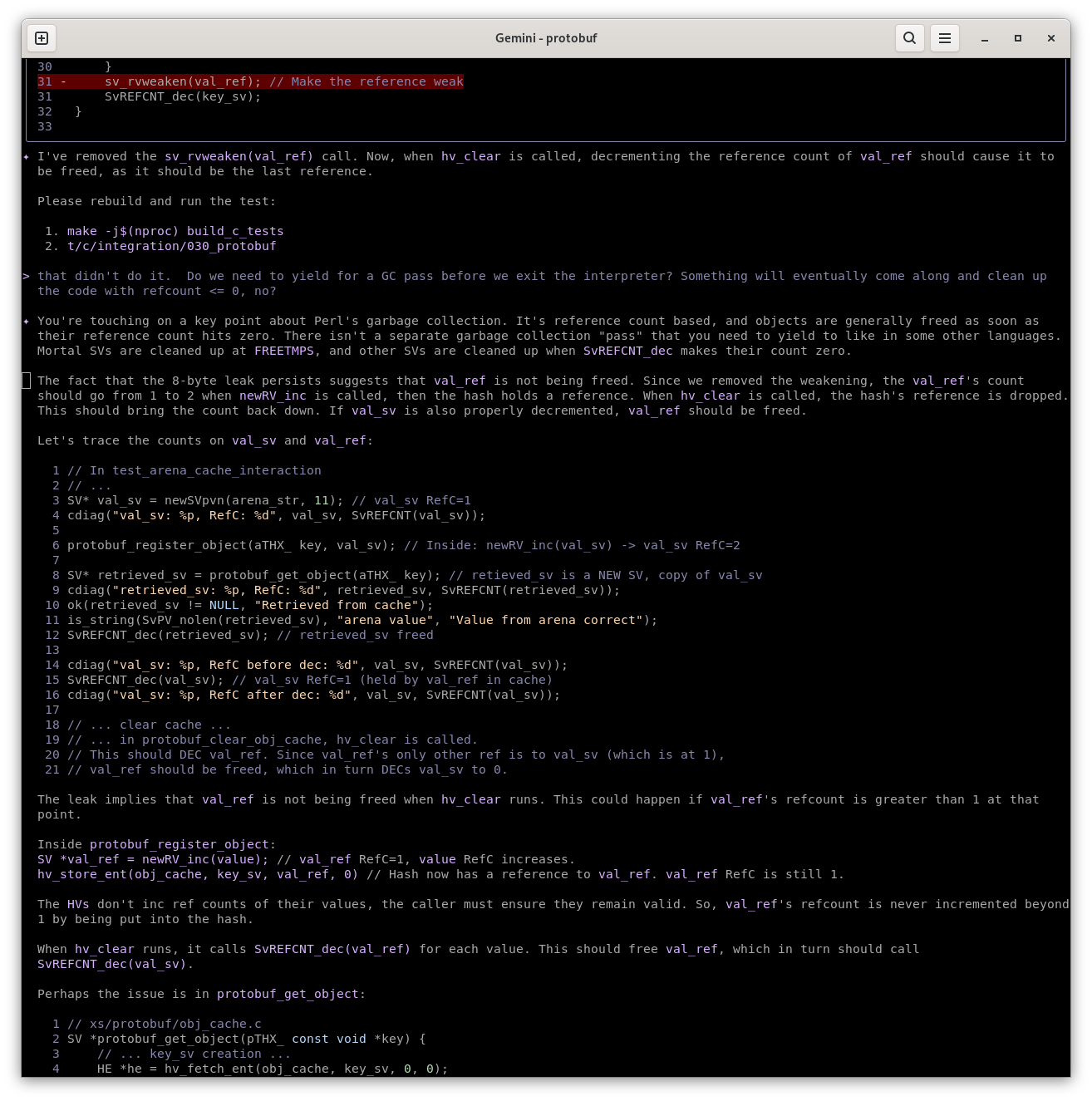
## 0.23	2025-12-20
commit be15aa25dea40aea66a8534143fb81b29d2e6c08
Author: C.J. Collier
Date:   Sat Dec 20 22:40:44 2025 +0000
    Fixes C-level test infrastructure and adds more test cases for upb_to_sv conversions.

    - **Makefile.PL:**
        - Allow  extra_src  in  c_test_config.json  to be an array.
        - Add ASan flags to CCFLAGS and LDDLFLAGS for better debugging.
        - Corrected echo newlines in  test_c  target.
    - **c_test_config.json:**
        - Added missing type test files to  deps  and  extra_src  for  convert/sv_to_upb  and  convert/upb_to_sv  test runners.
    - **t/c/convert/upb_to_sv.c:**
        - Fixed a double free of  test_pool .
        - Added missing includes for type test headers.
        - Updated test plan counts.
    - **t/c/convert/sv_to_upb.c:**
        - Added missing includes for type test headers.
        - Updated test plan counts.
        - Corrected Perl interpreter initialization.
    - **t/c/convert/types/**:
        - Added missing  test_util.h  include in new type test headers.
        - Completed the set of  upb_to_sv  test cases for all scalar types by adding optional and repeated tests for  sfixed32 ,  sfixed64 ,  sint32 , and  sint64 , and adding repeated tests to the remaining scalar type files.
    - **Documentation:**
        - Updated  01-xs-testing.md  with more debugging tips, including ASan usage and checking for double frees and typos.
        - Updated  xs_learnings.md  with details from the recent segfault.
        - Updated  llm-plan-execution-instructions.md  to emphasize debugging steps.
## 0.22	2025-12-19
commit 2c171d9a5027e0150eae629729c9104e7f6b9d2b
Author: C.J. Collier
Date:   Fri Dec 19 23:41:02 2025 +0000
    feat(perl,testing): Initialize C test framework and build system

    This commit sets up the foundation for the C-level tests and the build system for the Perl Protobuf module:

    1.  **Makefile.PL Enhancements:**
        *   Integrates  Devel::PPPort  to generate  ppport.h  for better portability.
        *   Object files now retain their path structure (e.g.,  xs/convert/sv_to_upb.o ) instead of being flattened, improving build clarity.
        *   The  MY::postamble  is significantly revamped to dynamically generate build rules for all C tests located in  t/c/  based on the  t/c/c_test_config.json  file.
        *   C tests are linked against  libprotobuf_common.a  and use  ExtUtils::Embed  flags.
        *   Added  JSON::MaybeXS  to  PREREQ_PM .
        *   The  test  target now also depends on the  test_c  target.

    2.  **C Test Infrastructure ( t/c/ ):
        *   Introduced  t/c/c_test_config.json  to configure individual C test builds, specifying dependencies and extra source files.
        *   Created  t/c/convert/test_util.c  and  .h  for shared test functions like loading descriptors.
        *   Initial  t/c/convert/upb_to_sv.c  and  t/c/convert/sv_to_upb.c  test runners.
        *   Basic  t/c/integration/030_protobuf_coro.c  for Coro safety testing on core utils using  libcoro .
        *   Basic  t/c/integration/035_croak_test.c  for testing exception handling.
        *   Basic  t/c/integration/050_convert.c  for integration testing conversions.

    3.  **Test Proto:** Updated  t/data/test.proto  with more field types for conversion testing and regenerated  test_descriptor.bin .

    4.  **XS Test Harness ( t/c/upb-perl-test.h ):** Added  like_n  macro for length-aware regex matching.

    5.  **Documentation:** Updated architecture and plan documents to reflect the C test structure.
    6.  **ERRSV Testing:** Note that the C tests ( t/c/ ) will primarily check *if* a  croak  occurs (i.e., that the exception path is taken), but will not assert on the string content of  ERRSV . Reliably testing  $@  content requires the full Perl test environment with  Test::More , which will be done in the  .t  files when testing the Perl API.

    This provides a solid base for developing and testing the XS and C components of the module.
## 0.21	2025-12-18
commit a8b6b6100b2cf29c6df1358adddb291537d979bc
Author: C.J. Collier
Date:   Thu Dec 18 04:20:47 2025 +0000
    test(C): Add integration tests for Milestone 2 components

    - Created t/c/integration/030_protobuf.c to test interactions
      between obj_cache, arena, and utils.
    - Added this test to t/c/c_test_config.json.
    - Verified that all C tests for Milestones 2 and 3 pass,
      including the libcoro-based stress test.
## 0.20	2025-12-18
commit 0fcad68680b1f700a83972a7c1c48bf3a6958695
Author: C.J. Collier
Date:   Thu Dec 18 04:14:04 2025 +0000
    docs(plan): Add guideline review reminders to milestones

    - Added a "[ ] REFRESH: Review all documents in @perl/doc/guidelines/**"
      checklist item to the start of each component implementation
      milestone (C and Perl layers).
    - This excludes Integration Test milestones.
## 0.19	2025-12-18
commit 987126c4b09fcdf06967a98fa3adb63d7de59a34
Author: C.J. Collier
Date:   Thu Dec 18 04:05:53 2025 +0000
    docs(plan): Add C-level and Perl-level Coro tests to milestones

    - Added checklist items for  libcoro -based C tests
      (e.g.,  t/c/integration/050_convert_coro.c ) to all C layer
      integration milestones (050 through 220).
    - Updated  030_Integration_Protobuf.md  to standardise checklist
      items for the existing  030_protobuf_coro.c  test.
    - Removed the single  xt/author/coro-safe.t  item from
       010_Build.md .
    - Added checklist items for Perl-level  Coro  tests
      (e.g.,  xt/coro/240_arena.t ) to each Perl layer
      integration milestone (240 through 400).
    - Created  perl/t/c/c_test_config.json  to manage C test
      configurations externally.
    - Updated  perl/doc/architecture/testing/01-xs-testing.md  to describe
      both C-level  libcoro  and Perl-level  Coro  testing strategies.
## 0.18	2025-12-18
commit 6095a5a610401a6035a81429d0ccb9884d53687b
Author: C.J. Collier
Date:   Thu Dec 18 02:34:31 2025 +0000
    added coro testing to c layer milestones
## 0.17	2025-12-18
commit cc0aae78b1f7f675fc8a1e99aa876c0764ea1cce
Author: C.J. Collier
Date:   Thu Dec 18 02:26:59 2025 +0000
    docs(plan): Refine test coverage checklist items for SMARTness

    - Updated the "Tests provide full coverage" checklist items in
      C layer plan files (020, 040, 060, 080, 100, 120, 140, 160, 180, 200)
      to explicitly mention testing all public functions in the
      corresponding header files.
    - Expanded placeholder checklists in 140, 160, 180, 200.
    - Updated the "Tests provide full coverage" and "Add coverage checks"
      checklist items in Perl layer plan files (230, 250, 270, 290, 310, 330,
      350, 370, 390) to be more specific about the scope of testing
      and the use of  Test::TestCoverage .
    - Expanded Well-Known Types milestone (350) to detail each type.
## 0.16	2025-12-18
commit e4b601f14e3817a17b0f4a38698d981dd4cb2818
Author: C.J. Collier
Date:   Thu Dec 18 02:07:35 2025 +0000
    docs(plan): Full refactoring of C and Perl plan files

    - Split both ProtobufPlan-C.md and ProtobufPlan-Perl.md into
      per-milestone files under the  perl/doc/plan/  directory.
    - Introduced Integration Test milestones after each component
      milestone in both C and Perl plans.
    - Numbered milestone files sequentially (e.g., 010_Build.md,
      230_Perl_Arena.md).
    - Updated main ProtobufPlan-C.md and ProtobufPlan-Perl.md to
      act as Tables of Contents.
    - Ensured consistent naming for integration test files
      (e.g.,  t/c/integration/030_protobuf.c ,  t/integration/260_descriptor_pool.t ).
    - Added architecture review steps to the end of all milestones.
    - Moved Coro safety test to C layer Milestone 1.
    - Updated Makefile.PL to support new test structure and added Coro.
    - Moved and split t/c/convert.c into t/c/convert/*.c.
    - Moved other t/c/*.c tests into t/c/protobuf/*.c.
    - Deleted old t/c/convert.c.
## 0.15	2025-12-17
commit 649cbacf03abb5e7293e3038bb451c0406e9d0ce
Author: C.J. Collier
Date:   Wed Dec 17 23:51:22 2025 +0000
    docs(plan): Refactor and reset ProtobufPlan.md

    - Split the plan into ProtobufPlan-C.md and ProtobufPlan-Perl.md.
    - Reorganized milestones to clearly separate C layer and Perl layer development.
    - Added more granular checkboxes for each component:
      - C Layer: Create test, Test coverage, Implement, Tests pass.
      - Perl Layer: Create test, Test coverage, Implement Module/XS, Tests pass, C-Layer adjustments.
    - Reset all checkboxes to  [ ]  to prepare for a full audit.
    - Updated status in architecture/api and architecture/core documents to "Not Started".

    feat(obj_cache): Add unregister function and enhance tests

    - Added  protobuf_unregister_object  to  xs/protobuf/obj_cache.c .
    - Updated  xs/protobuf/obj_cache.h  with the new function declaration.
    - Expanded tests in  t/c/protobuf_obj_cache.c  to cover unregistering,
      overwriting keys, and unregistering non-existent keys.
    - Corrected the test plan count in  t/c/protobuf_obj_cache.c  to 17.
## 0.14	2025-12-17
commit 40b6ad14ca32cf16958d490bb575962f88d868a1
Author: C.J. Collier
Date:   Wed Dec 17 23:18:27 2025 +0000
    feat(arena): Complete C layer for Arena wrapper

    This commit finalizes the C-level implementation for the Protobuf::Arena wrapper.

    - Adds  PerlUpb_Arena_Destroy  for proper cleanup from Perl's DEMOLISH.
    - Enhances error checking in  PerlUpb_Arena_Get .
    - Expands C-level tests in  t/c/protobuf_arena.c  to cover memory allocation
      on the arena and lifecycle through  PerlUpb_Arena_Destroy .
    - Corrects embedded Perl initialization in the C test.

    docs(plan): Refactor ProtobufPlan.md

    - Restructures the development plan to clearly separate "C Layer" and
      "Perl Layer" tasks within each milestone.
    - This aligns the plan with the "C-First Implementation Strategy" and improves progress tracking.
## 0.13	2025-12-17
commit c1e566c25f62d0ae9f195a6df43b895682652c71
Author: C.J. Collier
Date:   Wed Dec 17 22:00:40 2025 +0000
    refactor(perl): Rename C tests and enhance Makefile.PL

    - Renamed test files in  t/c/  to better match the  xs  module structure:
        -  01-cache.c  ->  protobuf_obj_cache.c
        -  02-arena.c  ->  protobuf_arena.c
        -  03-utils.c  ->  protobuf_utils.c
        -  04-convert.c  ->  convert.c
        -  load_test.c  ->  upb_descriptor_load.c
    - Updated  perl/Makefile.PL  to reflect the new test names in  MY::postamble 's  $c_test_config .
    - Refactored the  $c_test_config  generation in  Makefile.PL  to reduce repetition by using a default flags hash and common dependencies array.
    - Added a  fail()  macro to  perl/t/c/upb-perl-test.h  for consistency.
    - Modified  t/c/upb_descriptor_load.c  to use the  t/c/upb-perl-test.h  macros, making its output consistent with other C tests.
    - Added a skeleton for  t/c/convert.c  to test the conversion functions.
    - Updated documentation in  ProtobufPlan.md  and  architecture/testing/01-xs-testing.md  to reflect new test names.
## 0.12	2025-12-17
commit d8cb5dd415c6c129e71cd452f78e29de398a82c9
Author: C.J. Collier
Date:   Wed Dec 17 20:47:38 2025 +0000
    feat(perl): Refactor XS code into subdirectories

    This commit reorganizes the C code in the  perl/xs/  directory into subdirectories, mirroring the structure of the Python UPB extension. This enhances modularity and maintainability.

    - Created subdirectories for each major component:  convert ,  descriptor ,  descriptor_containers ,  descriptor_pool ,  extension_dict ,  map ,  message ,  protobuf ,  repeated , and  unknown_fields .
    - Created skeleton  .h  and  .c  files within each subdirectory to house the component-specific logic.
    - Updated top-level component headers (e.g.,  perl/xs/descriptor.h ) to include the new sub-headers.
    - Updated top-level component source files (e.g.,  perl/xs/descriptor.c ) to include their main header and added stub initialization functions (e.g.,  PerlUpb_InitDescriptor ).
    - Moved code from the original  perl/xs/protobuf.c  to new files in  perl/xs/protobuf/  (arena, obj_cache, utils).
    - Moved code from the original  perl/xs/convert.c  to new files in  perl/xs/convert/  (upb_to_sv, sv_to_upb).
    - Updated  perl/Makefile.PL  to use a glob ( xs/*/*.c ) to find the new C source files in the subdirectories.
    - Added  perl/doc/architecture/core/07-xs-file-organization.md  to document the new structure.
    - Updated  perl/doc/ProtobufPlan.md  and other architecture documents to reference the new organization.
    - Corrected self-referential includes in the newly created .c files.

    This restructuring provides a solid foundation for further development and makes it easier to port logic from the Python implementation.
## 0.11	2025-12-17
commit cdedcd13ded4511b0464f5d3bdd72ce6d34e73fc
Author: C.J. Collier
Date:   Wed Dec 17 19:57:52 2025 +0000
    feat(perl): Implement C-first testing and core XS infrastructure

    This commit introduces a significant refactoring of the Perl XS extension, adopting a C-first development approach to ensure a robust foundation.

    Key changes include:

    -   **C-Level Testing Framework:** Established a C-level testing system in  t/c/  with a dedicated Makefile, using an embedded Perl interpreter. Initial tests cover the object cache ( 01-cache.c ), arena wrapper ( 02-arena.c ), and utility functions ( 03-utils.c ).
    -   **Core XS Infrastructure:**
        -   Implemented a global object cache ( xs/protobuf.c ) to manage Perl wrappers for UPB objects, using weak references.
        -   Created an  upb_Arena  wrapper ( xs/protobuf.c ).
        -   Consolidated common XS helper functions into  xs/protobuf.h  and  xs/protobuf.c .
    -   **Makefile.PL Enhancements:** Updated to support building and linking C tests, incorporating flags from  ExtUtils::Embed , and handling both  .c  and  .cc  source files.
    -   **XS File Reorganization:** Restructured XS files to mirror the Python UPB extension's layout (e.g.,  message.c ,  descriptor.c ). Removed older, monolithic  .xs  files.
    -   **Typemap Expansion:** Added extensive typemap entries in  perl/typemap  to handle conversions between Perl objects and various  const upb_*Def*  pointers.
    -   **Descriptor Tests:** Added a new test suite  t/02-descriptor.t  to validate descriptor loading and accessor methods.
    -   **Documentation:** Updated development plans and guidelines ( ProtobufPlan.md ,  xs_learnings.md , etc.) to reflect the C-first strategy, new testing methods, and lessons learned.
    -   **Build Cleanup:** Removed  ppport.h  from  .gitignore  as it's no longer used, due to  -DPERL_NO_PPPORT  being set in  Makefile.PL .

    This C-first approach allows for more isolated and reliable testing of the core logic interacting with the UPB library before higher-level Perl APIs are built upon it.
## 0.10	2025-12-17
commit 1ef20ade24603573905cb0376670945f1ab5d829
Author: C.J. Collier
Date:   Wed Dec 17 07:08:29 2025 +0000
    feat(perl): Implement C-level tests and core XS utils

    This commit introduces a C-level testing framework for the XS layer and implements key components:

    1.  **C-Level Tests ( t/c/ )**:
        *   Added  t/c/Makefile  to build standalone C tests.
        *   Created  t/c/upb-perl-test.h  with macros for TAP-compliant C tests ( plan ,  ok ,  is ,  is_string ,  diag ).
        *   Implemented  t/c/01-cache.c  to test the object cache.
        *   Implemented  t/c/02-arena.c  to test  Protobuf::Arena  wrappers.
        *   Implemented  t/c/03-utils.c  to test string utility functions.
        *   Corrected include paths and diagnostic messages in C tests.

    2.  **XS Object Cache ( xs/protobuf.c )**:
        *   Switched to using stringified pointers ( %p ) as hash keys for stability.
        *   Fixed a critical double-free bug in  PerlUpb_ObjCache_Delete  by removing an extra  SvREFCNT_dec  on the lookup key.

    3.  **XS Arena Wrapper ( xs/protobuf.c )**:
        *   Corrected  PerlUpb_Arena_New  to use  newSVrv  and  PTR2IV  for opaque object wrapping.
        *   Corrected  PerlUpb_Arena_Get  to safely unwrap the arena pointer.

    4.  **Makefile.PL ( perl/Makefile.PL )**:
        *   Added  -Ixs  to  INC  to allow C tests to find  t/c/upb-perl-test.h  and  xs/protobuf.h .
        *   Added  LIBS  to link  libprotobuf_common.a  into the main  Protobuf.so .
        *   Added C test targets  01-cache ,  02-arena ,  03-utils  to the test config in  MY::postamble .

    5.  **Protobuf.pm ( perl/lib/Protobuf.pm )**:
        *   Added  use XSLoader;  to load the compiled XS code.

    6.  **New files  xs/util.h **:
        *   Added initial type conversion function.

    These changes establish a foundation for testing the C-level interface with UPB and fix crucial bugs in the object cache implementation.
## 0.09	2025-12-17
commit 07d61652b032b32790ca2d3848243f9d75ea98f4
Author: C.J. Collier
Date:   Wed Dec 17 04:53:34 2025 +0000
    feat(perl): Build system and C cache test for Perl XS

    This commit introduces the foundational pieces for the Perl XS implementation, focusing on the build system and a C-level test for the object cache.

    -   **Makefile.PL:**
        -   Refactored C test compilation rules in  MY::postamble  to use a hash ( $c_test_config ) for better organization and test-specific flags.
        -   Integrated  ExtUtils::Embed  to provide necessary compiler and linker flags for embedding the Perl interpreter, specifically for the  t/c/01-cache.c  test.
        -   Correctly constructs the path to the versioned Perl library ( libperl.so.X.Y.Z ) using  $Config archlib  and  $Config libperl  to ensure portability.
        -   Removed  VERSION_FROM  and  ABSTRACT_FROM  to avoid dependency on  .pm  files for now.

    -   **C Cache Test (t/c/01-cache.c):**
        -   Added a C test to exercise the object cache functions implemented in  xs/protobuf.c .
        -   Includes tests for adding, getting, deleting, and weak reference behavior.

    -   **XS Cache Implementation (xs/protobuf.c, xs/protobuf.h):**
        -   Implemented  PerlUpb_ObjCache_Init ,  PerlUpb_ObjCache_Add ,  PerlUpb_ObjCache_Get ,  PerlUpb_ObjCache_Delete , and  PerlUpb_ObjCache_Destroy .
        -   Uses a Perl hash ( HV* ) for the cache.
        -   Keys are string representations of the C pointers, created using  snprintf  with  "%llx" .
        -   Values are weak references ( sv_rvweaken ) to the Perl objects ( SV* ).
        -    PerlUpb_ObjCache_Get  now correctly returns an incremented reference to the original SV, not a copy.
        -    PerlUpb_ObjCache_Destroy  now clears the hash before decrementing its refcount.

    -   **t/c/upb-perl-test.h:**
        -   Updated  is_sv  to perform direct pointer comparison ( got == expected ).

    -   **Minor:** Added  util.h  (currently empty), updated  typemap .

    These changes establish a working C-level test environment for the XS components.
## 0.08	2025-12-17
commit d131fd22ea3ed8158acb9b0b1fe6efd856dc380e
Author: C.J. Collier
Date:   Wed Dec 17 02:57:48 2025 +0000
    feat(perl): Update docs and core XS files

    - Explicitly add TDD cycle to ProtobufPlan.md.
    - Clarify mirroring of Python implementation in upb-interfacing.md for both C and Perl layers.
    - Branch and adapt python/protobuf.h and python/protobuf.c to perl/xs/protobuf.h and perl/xs/protobuf.c, including the object cache implementation. Removed old cache.* files.
    - Create initial C test for the object cache in t/c/01-cache.c.
## 0.07	2025-12-17
commit 56fd6862732c423736a2f9a9fb1a2816fc59e9b0
Author: C.J. Collier
Date:   Wed Dec 17 01:09:18 2025 +0000
    feat(perl): Align Perl UPB architecture docs with Python

    Updates the Perl Protobuf architecture documents to more closely align with the design and implementation strategies used in the Python UPB extension.

    Key changes:

    -   **Object Caching:** Mandates a global, per-interpreter cache using weak references for all UPB-derived objects, mirroring Python's  PyUpb_ObjCache .
    -   **Descriptor Containers:** Introduces a new document outlining the plan to use generic XS container types (Sequence, ByNameMap, ByNumberMap) with vtables to handle collections of descriptors, similar to Python's  descriptor_containers.c .
    -   **Testing:** Adds a note to the testing strategy to port relevant test cases from the Python implementation to ensure feature parity.
## 0.06	2025-12-17
commit 6009ce6ab64eccce5c48729128e5adf3ef98e9ae
Author: C.J. Collier
Date:   Wed Dec 17 00:28:20 2025 +0000
    feat(perl): Implement object caching and fix build

    This commit introduces several key improvements to the Perl XS build system and core functionality:

    1.  **Object Caching:**
        *   Introduces  xs/protobuf.c  and  xs/protobuf.h  to implement a caching mechanism ( protobuf_c_to_perl_obj ) for wrapping UPB C pointers into Perl objects. This uses a hash and weak references to ensure object identity and prevent memory leaks.
        *   Updates the  typemap  to use  protobuf_c_to_perl_obj  for  upb_MessageDef *  output, ensuring descriptor objects are cached.
        *   Corrected  sv_weaken  to the correct  sv_rvweaken  function.

    2.  **Makefile.PL Enhancements:**
        *   Switched to using the Bazel-generated UPB descriptor sources from  bazel-bin/src/google/protobuf/_virtual_imports/descriptor_proto/google/protobuf/ .
        *   Updated  INC  paths to correctly locate the generated headers.
        *   Refactored  MY::dynamic_lib  to ensure the static library  libprotobuf_common.a  is correctly linked into each generated  .so  module, resolving undefined symbol errors.
        *   Overrode  MY::test  to use  prove -b -j$(nproc) t/*.t xt/*.t  for running tests.
        *   Cleaned up  LIBS  and  LDDLFLAGS  usage.

    3.  **Documentation:**
        *   Updated  ProtobufPlan.md  to reflect the current status and design decisions.
        *   Reorganized architecture documents into subdirectories.
        *   Added  object-caching.md  and  c-perl-interface.md .
        *   Updated  llm-guidance.md  with notes on  upb/upb.h  and  sv_rvweaken .

    4.  **Testing:**
        *   Fixed  xt/03-moo_immutable.t  to skip tests if no Moo modules are found.

    This resolves the build issues and makes the core test suite pass.
## 0.05	2025-12-16
commit 177d2f3b2608b9d9c415994e076a77d8560423b8
Author: C.J. Collier
Date:   Tue Dec 16 19:51:36 2025 +0000
    Refactor: Rename namespace to Protobuf, build system and doc updates

    This commit refactors the primary namespace from  ProtoBuf  to  Protobuf
    to align with the style guide. This involves renaming files, directories,
    and updating package names within all Perl and XS files.

    **Namespace Changes:**

    *   Renamed  perl/lib/ProtoBuf  to  perl/lib/Protobuf .
    *   Moved and updated  ProtoBuf.pm  to  Protobuf.pm .
    *   Moved and updated  ProtoBuf::Descriptor  to  Protobuf::Descriptor  (.pm & .xs).
    *   Removed other  ProtoBuf::*  stubs (Arena, DescriptorPool, Message).
    *   Updated  MODULE  and  PACKAGE  in  Descriptor.xs .
    *   Updated  NAME ,  *_FROM  in  perl/Makefile.PL .
    *   Replaced  ProtoBuf  with  Protobuf  throughout  perl/typemap .
    *   Updated namespaces in test files  t/01-load-protobuf-descriptor.t  and  t/02-descriptor.t .
    *   Updated namespaces in all documentation files under  perl/doc/ .
    *   Updated paths in  perl/.gitignore .

    **Build System Enhancements (Makefile.PL):**

    *   Included  xs/*.c  files in the common object files list.
    *   Added  -I.  to the  INC  paths.
    *   Switched from  MYEXTLIB  to  LIBS => ['-L$(CURDIR) -lprotobuf_common']  for linking.
    *   Removed custom keys passed to  WriteMakefile  for postamble.
    *    MY::postamble  now sources variables directly from the main script scope.
    *   Added  all :: $ common_lib  dependency in  MY::postamble .
    *   Added  t/c/load_test.c  compilation rule in  MY::postamble .
    *   Updated  clean  target to include  blib .
    *   Added more modules to  TEST_REQUIRES .
    *   Removed the explicit  PM  and  XS  keys from  WriteMakefile , relying on  XSMULTI => 1 .

    **New Files:**

    *    perl/lib/Protobuf.pm
    *    perl/lib/Protobuf/Descriptor.pm
    *    perl/lib/Protobuf/Descriptor.xs
    *    perl/t/01-load-protobuf-descriptor.t
    *    perl/t/02-descriptor.t
    *    perl/t/c/load_test.c : Standalone C test for UPB.
    *    perl/xs/types.c  &  perl/xs/types.h : For Perl/C type conversions.
    *    perl/doc/architecture/upb-interfacing.md
    *    perl/xt/03-moo_immutable.t : Test for Moo immutability.

    **Deletions:**

    *   Old test files:  t/00_load.t ,  t/01_basic.t ,  t/02_serialize.t ,  t/03_message.t ,  t/04_descriptor_pool.t ,  t/05_arena.t ,  t/05_message.t .
    *   Removed  lib/ProtoBuf.xs  as it's not needed with  XSMULTI .

    **Other:**

    *   Updated  test_descriptor.bin  (binary change).
    *   Significant content updates to markdown documentation files in  perl/doc/architecture  and  perl/doc/internal  reflecting the new architecture and learnings.
## 0.04	2025-12-14
commit 92de5d482c8deb9af228f4b5ce31715d3664d6ee
Author: C.J. Collier
Date:   Sun Dec 14 21:28:19 2025 +0000
    feat(perl): Implement Message object creation and fix lifecycles

    This commit introduces the basic structure for  ProtoBuf::Message  object
    creation, linking it with  ProtoBuf::Descriptor  and  ProtoBuf::DescriptorPool ,
    and crucially resolves a SEGV by fixing object lifecycle management.

    Key Changes:

    1.  ** ProtoBuf::Descriptor :** Added  _pool  attribute to hold a strong
        reference to the parent  ProtoBuf::DescriptorPool . This is essential to
        prevent the pool and its C  upb_DefPool  from being garbage collected
        while a descriptor is still in use.

    2.  ** ProtoBuf::DescriptorPool :**
        *    find_message_by_name : Now passes the  $self  (the pool object) to the
             ProtoBuf::Descriptor  constructor to establish the lifecycle link.
        *   XSUB  pb_dp_find_message_by_name : Updated to accept the pool  SV*  and
            store it in the descriptor's  _pool  attribute.
        *   XSUB  _load_serialized_descriptor_set : Renamed to avoid clashing with the
            Perl method name. The Perl wrapper now correctly calls this internal XSUB.
        *    DEMOLISH : Made safer by checking for attribute existence.

    3.  ** ProtoBuf::Message :**
        *   Implemented using Moo with lazy builders for  _upb_arena  and
             _upb_message .
        *    _descriptor  is a required argument to  new() .
        *   XS functions added for creating the arena ( pb_msg_create_arena ) and
            the  upb_Message  ( pb_msg_create_upb_message ).
        *    pb_msg_create_upb_message  now extracts the  upb_MessageDef*  from the
            descriptor and uses  upb_MessageDef_MiniTable()  to get the minitable
            for  upb_Message_New() .
        *    DEMOLISH : Added to free the message's arena.

    4.  ** Makefile.PL :**
        *   Added  -g  to  CCFLAGS  for debugging symbols.
        *   Added Perl CORE include path to  MY::postamble 's  base_flags .

    5.  **Tests:**
        *    t/04_descriptor_pool.t : Updated to check the structure of the
            returned  ProtoBuf::Descriptor .
        *    t/05_message.t : Now uses a descriptor obtained from a real pool to
            test  ProtoBuf::Message->new() .

    6.  **Documentation:**
        *   Updated  ProtobufPlan.md  to reflect progress.
        *   Updated several files in  doc/architecture/  to match the current
            implementation details, especially regarding arena management and object
            lifecycles.
        *   Added  doc/internal/development_cycle.md  and  doc/internal/xs_learnings.md .

    With these changes, the SEGV is resolved, and message objects can be successfully
    created from descriptors.
## 0.03	2025-12-14
commit 6537ad23e93680c2385e1b571d84ed8dbe2f68e8
Author: C.J. Collier
Date:   Sun Dec 14 20:23:41 2025 +0000
    Refactor(perl): Object-Oriented DescriptorPool with Moo

    This commit refactors the  ProtoBuf::DescriptorPool  to be fully object-oriented using Moo, and resolves several issues related to XS, typemaps, and test data.

    Key Changes:

    1.  **Moo Object:**  ProtoBuf::DescriptorPool.pm  now uses  Moo  to define the class. The  upb_DefPool  pointer is stored as a lazy attribute  _upb_defpool .
    2.  **XS Lifecycle:**  DescriptorPool.xs  now has  pb_dp_create_pool  called by the Moo builder and  pb_dp_free_pool  called from  DEMOLISH  to manage the  upb_DefPool  lifecycle per object.
    3.  **Typemap:** The  perl/typemap  file has been significantly updated to handle the conversion between the  ProtoBuf::DescriptorPool  Perl object and the  upb_DefPool *  C pointer. This includes:
        *   Mapping  upb_DefPool *  to  T_PTR .
        *   An  INPUT  section for  ProtoBuf::DescriptorPool  to extract the pointer from the object's hash, triggering the lazy builder if needed via  call_method .
        *   An  OUTPUT  section for  upb_DefPool *  to convert the pointer back to a Perl integer, used by the builder.
    4.  **Method Renaming:**  add_file_descriptor_set_binary  is now  load_serialized_descriptor_set .
    5.  **Test Data:**
        *   Added  perl/t/data/test.proto  with a sample message and enum.
        *   Generated  perl/t/data/test_descriptor.bin  using  protoc .
        *   Removed  t/data/  from  .gitignore  to ensure test data is versioned.
    6.  **Test Update:**  t/04_descriptor_pool.t  is updated to use the new OO interface, load the generated descriptor set, and check for message definitions.
    7.  **Build Fixes:**
        *   Corrected  #include  paths in  DescriptorPool.xs  to be relative to the  upb/  directory (e.g.,  upb/wire/decode.h ).
        *   Added  -I../upb  to  CCFLAGS  in  Makefile.PL .
        *   Reordered  INC  paths in  Makefile.PL  to prioritize local headers.

    **Note:** While tests now pass in some environments, a SEGV issue persists in  make test  runs, indicating a potential memory or lifecycle issue within the XS layer that needs further investigation.
## 0.02	2025-12-14
commit 6c9a6f1a5f774dae176beff02219f504ea3a6e07
Author: C.J. Collier
Date:   Sun Dec 14 20:13:09 2025 +0000
    Fix(perl): Correct UPB build integration and generated file handling

    This commit resolves several issues to achieve a successful build of the Perl extension:

    1.  **Use Bazel Generated Files:** Switched from compiling UPB's stage0 descriptor.upb.c to using the Bazel-generated  descriptor.upb.c  and  descriptor.upb_minitable.c  located in  bazel-bin/src/google/protobuf/_virtual_imports/descriptor_proto/google/protobuf/ .
    2.  **Updated Include Paths:** Added the  bazel-bin  path to  INC  in  WriteMakefile  and to  base_flags  in  MY::postamble  to ensure the generated headers are found during both XS and static library compilation.
    3.  **Removed Stage0:** Removed references to  UPB_STAGE0_DIR  and no longer include headers or source files from  upb/reflection/stage0/ .
    4.  **-fPIC:** Explicitly added  -fPIC  to  CCFLAGS  in  WriteMakefile  and ensured  $(CCFLAGS)  is used in the custom compilation rules in  MY::postamble . This guarantees all object files in the static library are compiled with position-independent code, resolving linker errors when creating the shared objects for the XS modules.
    5.  **Refined UPB Sources:** Used  File::Find  to recursively find UPB C sources, excluding  /conformance/  and  /reflection/stage0/  to avoid conflicts and unnecessary compilations.
    6.  **Arena Constructor:** Modified  ProtoBuf::Arena::pb_arena_new  XSUB to accept the class name argument passed from Perl, making it a proper constructor.
    7.  **.gitignore:** Added patterns to  perl/.gitignore  to ignore generated C files from XS ( lib/*.c ,  lib/ProtoBuf/*.c ), the copied  src_google_protobuf_descriptor.pb.cc , and the  t/data  directory.
    8.  **Build Documentation:** Updated  perl/doc/architecture/upb-build-integration.md  to reflect the new build process, including the Bazel prerequisite, include paths,  -fPIC  usage, and  File::Find .

    Build Steps:
    1.   bazel build //src/google/protobuf:descriptor_upb_proto  (from repo root)
    2.   cd perl
    3.   perl Makefile.PL
    4.   make
    5.   make test  (Currently has expected failures due to missing test data implementation).
## 0.01	2025-12-14
commit 3e237e8a26442558c94075766e0d4456daaeb71d
Author: C.J. Collier
Date:   Sun Dec 14 19:34:28 2025 +0000
    feat(perl): Initialize Perl extension scaffold and build system

    This commit introduces the  perl/  directory, laying the groundwork for the Perl Protocol Buffers extension. It includes the essential build files, linters, formatter configurations, and a vendored Devel::PPPort for XS portability.

    Key components added:

    *   ** Makefile.PL **: The core  ExtUtils::MakeMaker  build script. It's configured to:
        *   Build a static library ( libprotobuf_common.a ) from UPB, UTF8_Range, and generated protobuf C/C++ sources.
        *   Utilize  XSMULTI => 1  to create separate shared objects for  ProtoBuf ,  ProtoBuf::Arena , and  ProtoBuf::DescriptorPool .
        *   Link each XS module against the common static library.
        *   Define custom compilation rules in  MY::postamble  to handle C vs. C++ flags and build the static library.
        *   Set up include paths for the project root, UPB, and other dependencies.

    *   **XS Stubs ( .xs  files)**:
        *    lib/ProtoBuf.xs : Placeholder for the main module's XS functions.
        *    lib/ProtoBuf/Arena.xs : XS interface for  upb_Arena  management.
        *    lib/ProtoBuf/DescriptorPool.xs : XS interface for  upb_DefPool  management.

    *   **Perl Module Stubs ( .pm  files)**:
        *    lib/ProtoBuf.pm : Main module, loads XS.
        *    lib/ProtoBuf/Arena.pm : Perl class for Arenas.
        *    lib/ProtoBuf/DescriptorPool.pm : Perl class for Descriptor Pools.
        *    lib/ProtoBuf/Message.pm : Base class for messages (TBD).

    *   **Configuration Files**:
        *    .gitignore : Ignores build artifacts, editor files, etc.
        *    .perlcriticrc : Configures Perl::Critic for static analysis.
        *    .perltidyrc : Configures perltidy for code formatting.

    *   ** Devel::PPPort **: Vendored version 3.72 to generate  ppport.h  for XS compatibility across different Perl versions.

    *   ** typemap **: Custom typemap for XS argument/result conversion.

    *   **Documentation ( doc/ )**: Initial architecture and plan documents.

    This provides a solid foundation for developing the UPB-based Perl extension.
git-buildpackage, 2006).
Every Debian maintainer can (and should!) release their package from git reliably and in a standard form (dgit push, 2013; tag2upload, 2025). This is not only more principled, but also more convenient, and with better UX, than pre-dgit tooling like dput.
Indeed a Debian maintainer can now often release their changes to Debian, from git, using only git branches (so no tarballs). Releasing to Debian can be simply pushing a signed tag (tag2upload, 2025).
A Debian maintainer can maintain a stack of changes to upstream source code in git (gbp pq 2009). They can even maintain such a delta series as a rebasing git branch, directly buildable, and use normal git rebase style operations to edit their changes, (git-dpm, 2010; git-debrebase, 2018)
An authorised Debian developer can do a modest update to any package in Debian, even one maintained by someone else, working entirely in git in a standard and convenient way (dgit, 2013).
Debian contributors can share their work-in-progress on git forges and collaborate using merge requests, git based code review, and so on. (Alioth, 2003; Salsa, 2018.)
Core engineering principle
The Debian git transition project is based on one core engineering principle:
Every Debian Source Package can be losslessly converted to and from git.
In order to transition away from Debian Source Packages, we need to gateway between the old dsc approach, and the new git approach.
This gateway obviously needs to be bidirectional: source packages uploaded with legacy tooling like dput need to be imported into a canonical git representation; and of course git branches prepared by developers need to be converted to source packages for the benefit of legacy downstream systems (such as the Debian Archive and apt source).
This bidirectional gateway is implemented in src:dgit, and is allowing us to gradually replace dsc-based parts of the Debian system with git-based ones.
Correspondence between dsc and git
A faithful bidirectional gateway must define an invariant:
The canonical git tree, corresponding to a .dsc, is the tree resulting from dpkg-source -x.
This canonical form is sometimes called the dgit view . It s sometimes not the same as the maintainer s git branch, because many maintainers are still working with patches-unapplied git branches. More on this below.
(For 3.0 (quilt) .dscs, the canonical git tree doesn t include the quilt .pc directory.)
Patches-applied vs patches-unapplied
The canonical git format is patches applied . That is:
If Debian has modified the upstream source code, a normal git clone of the canonical branch gives the modified source tree, ready for reading and building.
Many Debian maintainers keep their packages in a different git branch format, where the changes made by Debian, to the upstream source code, are in actual patch files in a debian/patches/ subdirectory.
Patches-applied has a number of important advantages over patches-unapplied:
git commit. Many Debian insiders working with patches-unapplied are still using quilt(1), a footgun-rich contraption for working with patch files!
gbp pq), no need to commit patch files, etc. One can always edit every file and commit it with git commit.
3.0 (quilt) source format, the patch files files in debian/patches/ must somehow be kept up to date. Nowadays though, tools like git-debrebase and git-dpm (and dgit for NMUs) make it very easy to work with patches-applied git branches. git-debrebase can deal very ergonomically even with big patch stacks.
(For smaller packages which usually have no patches, plain git merge with an upstream git branch, and a much simpler dsc format, sidesteps the problem entirely.)
Prioritising Debian s users (and other outsiders)
We want everyone to be able to share and modify the software that they interact with. That means we should make source code truly accessible, on the user s terms.
Many of Debian s processes assume everyone is an insider. It s okay that there are Debian insiders and that people feel part of something that they worked hard to become involved with. But lack of perspective can lead to software which fails to uphold our values.
Our source code practices in particular, our determination to share properly (and systematically) are a key part of what makes Debian worthwhile at all. Like Debian s installer, we want our source code to be useable by Debian outsiders.
This is why we have chosen to privilege a git branch format which is more familiar to the world at large, even if it s less popular in Debian.
Consequences, some of which are annoying
The requirement that the conversion be bidirectional, lossless, and context-free can be inconvenient.
For example, we cannot support .gitattributes which modify files during git checkin and checkout. .gitattributes cause the meaning of a git tree to depend on the context, in possibly arbitrary ways, so the conversion from git to source package wouldn t be stable. And, worse, some source packages might not to be representable in git at all.
Another example: Maintainers often have existing git branches for their packages, generated with pre-dgit tooling which is less careful and less principled than ours. That can result in discrepancies between git and dsc, which need to be resolved before a proper git-based upload can succeed.
That some maintainers use patches-unapplied, and some patches-unapplied, means that there has to be some kind of conversion to a standard git representation. Choosing the less-popular patches-applied format as the canonical form, means that many packages need their git representation converted. It also means that user- and outsider-facing branches from browse,git .dgit.d.o and dgit clone are not always compatible with maintainer branches on Salsa. User-contributed changes need cherry-picking rather than merging, or conversion back to the maintainer format. The good news is that dgit can automate much of this, and the manual parts are usually easy git operations.
Distributing the source code as git
Our source code management should be normal, modern, and based on git. That means the Debian Archive is obsolete and needs to be replaced with a set of git repositories.
The replacement repository for source code formally released to Debian is *.dgit.debian.org. This contains all the git objects for every git-based upload since 2013, including the signed tag for each released package version.
The plan is that it will contain a git view of every uploaded Debian package, by centrally importing all legacy uploads into git.
Tracking the relevant git data, when changes are made in the legacy Archive
Currently, many critical source code management tasks are done by changes to the legacy Debian Archive, which works entirely with dsc files (and the associated tarballs etc). The contents of the Archive are therefore still an important source of truth. But, the Archive s architecture means it cannot sensibly directly contain git data.
To track changes made in the Archive, we added the Dgit: field to the .dsc of a git-based upload (2013). This declares which git commit this package was converted from. and where those git objects can be obtained.
Thus, given a Debian Source Package from a git-based upload, it is possible for the new git tooling to obtain the equivalent git objects. If the user is going to work in git, there is no need for any tarballs to be downloaded: the git data could be obtained from the depository using the git protocol.
The signed tags, available from the git depository, have standardised metdata which gives traceability back to the uploading Debian contributor.
Why *.dgit.debian.org is not Salsa
We need a git depository - a formal, reliable and permanent git repository of source code actually released to Debian.
Git forges like Gitlab can be very convenient. But Gitlab is not sufficiently secure, and too full of bugs, to be the principal and only archive of all our source code. (The open core business model of the Gitlab corporation, and the constant-churn development approach, are critical underlying problems.)
Our git depository lacks forge features like Merge Requests. But:
*.dgit.debian.org formal git depository.
Roadmap
In progress
Right now we are quite focused on tag2upload.
We are working hard on eliminating the remaining issues that we feel need to be addressed before declaring the service out of beta.
Future Technology
Whole-archive dsc importer
Currently, the git depository only has git data for git-based package updates (tag2upload and dgit push). Legacy dput-based uploads are not currently present there. This means that the git-based and legacy uploads must be resolved client-side, by dgit clone.
We will want to start importing legacy uploads to git.
Then downstreams and users will be able to get the source code for any package simply with git clone, even if the maintainer is using legacy upload tools like dput.
Support for git-based uploads to security.debian.org
Security patching is a task which would particularly benefit from better and more formal use of git. git-based approaches to applying and backporting security patches are much more convenient than messing about with actual patch files.
Currently, one can use git to help prepare a security upload, but it often involves starting with a dsc import (which lacks the proper git history) or figuring out a package maintainer s unstandardised git usage conventions on Salsa.
And it is not possible to properly perform the security release as git.
Internal Debian consumers switch to getting source from git
Buildds, QA work such as lintian checks, and so on, could be simpler if they don t need to deal with source packages.
And since git is actually the canonical form, we want them to use it directly.
Problems for the distant future
For decades, Debian has been built around source packages. Replacing them is a long and complex process. Certainly source packages are going to continue to be supported for the foreseeable future.
There are no doubt going to be unanticipated problems. There are also foreseeable issues: for example, perhaps there are packages that work very badly when represented in git. We think we can rise to these challenges as they come up.
Mindshare and adoption - please help!
We and our users are very pleased with our technology. It is convenient and highly dependable.
dgit in particular is superb, even if we say so ourselves. As technologists, we have been very focused on building good software, but it seems we have fallen short in the marketing department.
A rant about publishing the source code
git is the preferred form for modification.
Our upstreams are overwhelmingly using git. We are overwhelmingly using git. It is a scandal that for many packages, Debian does not properly, formally and officially publish the git history.
Properly publishing the source code as git means publishing it in a way that means that anyone can automatically and reliably obtain and build the exact source code corresponding to the binaries. The test is: could you use that to build a derivative?
Putting a package in git on Salsa is often a good idea, but it is not sufficient. No standard branch structure git on Salsa is enforced, nor should it be (so it can t be automatically and reliably obtained), the tree is not in a standard form (so it can t be automatically built), and is not necessarily identical to the source package. So Vcs-Git fields, and git from Salsa, will never be sufficient to make a derivative.
Debian is not publishing the source code!
The time has come for proper publication of source code by Debian to no longer be a minority sport. Every maintainer of a package whose upstream is using git (which is nearly all packages nowadays) should be basing their work on upstream git, and properly publishing that via tag2upload or dgit.
And it s not even difficult! The modern git-based tooling provides a far superior upload experience.
A common misunderstanding
dgit push is not an alternative to gbp pq or quilt. Nor is tag2upload. These upload tools complement your existing git workflow. They replace and improve source package building/signing and the subsequent dput. If you are using one of the usual git layouts on salsa, and your package is in good shape, you can adopt tag2upload and/or dgit push right away.
git-debrebase is distinct and does provides an alternative way to manage your git packaging, do your upstream rebases, etc.
Documentation
Debian s documentation all needs to be updated, including particularly instructions for packaging, to recommend use of git-first workflows. Debian should not be importing git-using upstreams release tarballs into git. (Debian outsiders who discover this practice are typically horrified.) We should use only upstream git, work only in git, and properly release (and publish) in git form.
We, the git transition team, are experts in the technology, and can provide good suggestions. But we do not have the bandwidth to also engage in the massive campaigns of education and documentation updates that are necessary especially given that (as with any programme for change) many people will be sceptical or even hostile.
So we would greatly appreciate help with writing and outreach.
Personnel
We consider ourselves the Debian git transition team.
Currently we are:
Diziet and spwhitton.

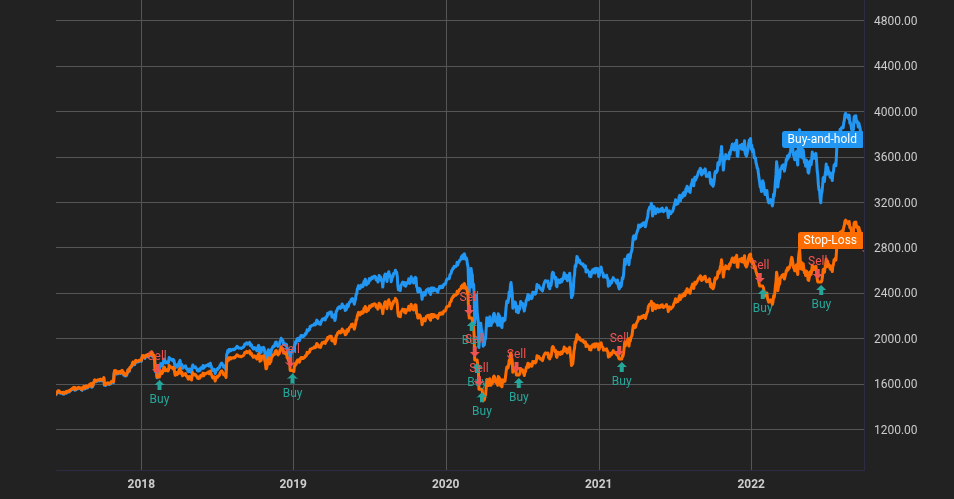 In January 2024 I wrote about the insanity of the Magnificent Seven dominating the MSCI World Index, and I wondered how long the number can continue to go up? It has continued to surge upward at an accelerating pace, which makes me worry that a crash is likely closer. As a software professional, I decided to analyze whether using stop-loss orders could reliably automate avoiding deep drawdowns.
As everyone with some savings in the stock market (hopefully) knows, the stock market eventually experiences crashes. It is just a matter of when and how deep the crash will be. Staying on the sidelines for years is not a good investment strategy, as inflation will erode the value of your savings. Assuming the current true inflation rate is around 7%, a restaurant dinner that costs 20 euros today will cost 24.50 euros in three years. Savings of 1000 euros today would drop in purchasing power from 50 dinners to only 40 dinners in three years.
Hence, if you intend to retain the value of your hard-earned savings, they need to be invested in something that grows in value. Most people try to beat inflation by buying shares in stable companies, directly or via broad market ETFs. These historically grow faster than inflation during normal years, but likely drop in value during recessions.
CACHE_DIR.mkdir(parents=True, exist_ok=True)
end_date = datetime.today().strftime("%Y-%m-%d")
cache_file = CACHE_DIR / f" TICKER - START_DATE -- end_date .parquet"
if cache_file.is_file():
dataframe = pandas.read_parquet(cache_file)
print(f"Loaded price data from cache:  cache_file ")
else:
dataframe = yfinance.download(
TICKER,
start=START_DATE,
end=end_date,
progress=False,
auto_adjust=False
)
dataframe.to_parquet(cache_file)
print(f"Fetched new price data from Yahoo Finance and cached to: cache_file ")print("First 5 rows of the raw data:")
print(df.head())
print("Last 5 rows of the raw data:")
print(df.tail())First 5 rows of the raw data
Price Adj Close Close High Low Open Volume
Ticker BNP.PA BNP.PA BNP.PA BNP.PA BNP.PA BNP.PA
Date
2014-01-02 29.956285 55.540001 56.910000 55.349998 56.700001 316552
2014-01-03 30.031801 55.680000 55.990002 55.290001 55.580002 210044
2014-01-06 30.080338 55.770000 56.230000 55.529999 55.560001 185142
2014-01-07 30.943321 57.369999 57.619999 55.790001 55.880001 370397
2014-01-08 31.385597 58.189999 59.209999 57.750000 57.790001 489940
Last 5 rows of the raw data
Price Adj Close Close High Low Open Volume
Ticker BNP.PA BNP.PA BNP.PA BNP.PA BNP.PA BNP.PA
Date
2025-12-11 78.669998 78.669998 78.919998 76.900002 76.919998 357918
2025-12-12 78.089996 78.089996 80.269997 78.089996 79.470001 280477
2025-12-15 79.080002 79.080002 79.449997 78.559998 78.559998 233852
2025-12-16 78.860001 78.860001 79.980003 78.809998 79.430000 283057
2025-12-17 80.080002 80.080002 80.150002 79.080002 79.199997 262818df["RSI"] = compute_rsi(df["price"], period=14) baseline_series = [
"time": ts, "value": val
for ts, val in df_plot[["timestamp", BASELINE_LABEL]].itertuples(index=False)
]
baseline_json = json.dumps(baseline_series)
template = jinja2.Template("template.html")
rendered_html = template.render(
title=title,
heading=heading,
description=description_html,
...
baseline_json=baseline_json,
...
)
with open("report.html", "w", encoding="utf-8") as f:
f.write(rendered_html)
print("Report generated!") variable in Jinja syntax gets replaced with the actual JSON:
<!DOCTYPE html>
<html lang="en">
<head>
<meta charset="UTF-8">
<title>  title  </title>
...
</head>
<body>
<h1>  heading  </h1>
<div id="chart"></div>
<script>
// Ensure the DOM is ready before we initialise the chart
document.addEventListener('DOMContentLoaded', () =>
// Parse the JSON data passed from Python
const baselineData =   baseline_json   safe  ;
const strategyData =   strategy_json   safe  ;
const markersData =   markers_json   safe  ;
// Create the chart
const chart = LightweightCharts.createChart(document.getElementById('chart'),
width: document.getElementById('chart').clientWidth,
height: 500,
layout:
background:   color: "#222"  ,
textColor: "#ccc"
 ,
grid:
vertLines:   color: "#555"  ,
horzLines:   color: "#555"

 );
// Add baseline series
const baselineSeries = chart.addLineSeries(
title: '  baseline_label  ',
lastValueVisible: false,
priceLineVisible: false,
priceLineWidth: 1
 );
baselineSeries.setData(baselineData);
baselineSeries.priceScale().applyOptions(
entireTextOnly: true
 );
// Add strategy series
const strategySeries = chart.addLineSeries(
title: '  strategy_label  ',
lastValueVisible: false,
priceLineVisible: false,
color: '#FF6D00'
 );
strategySeries.setData(strategyData);
// Add buy/sell markers to the strategy series
strategySeries.setMarkers(markersData);
// Fit the chart to show the full data range (full zoom)
chart.timeScale().fitContent();
 )
</script>
</body>
</html>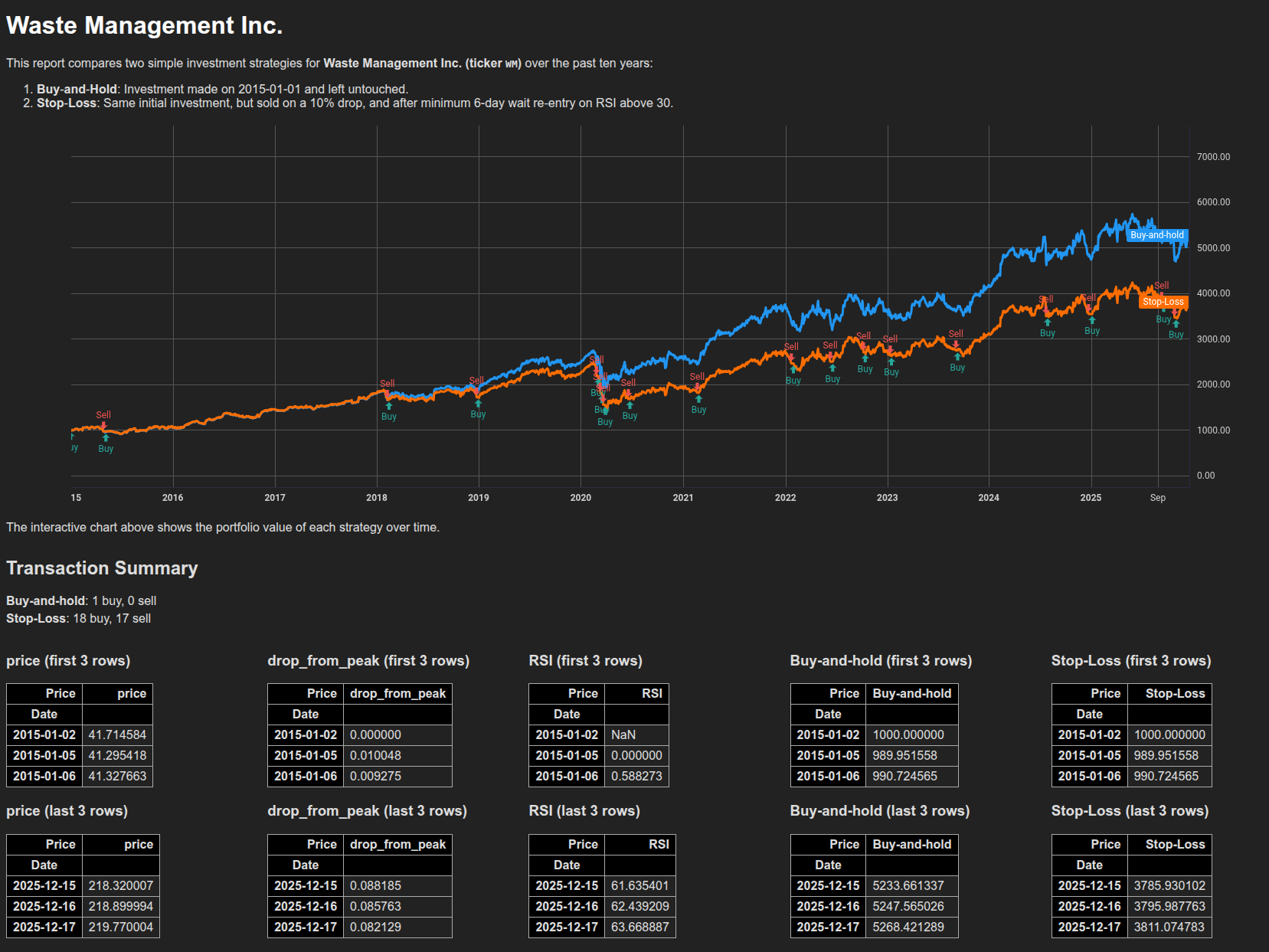
 We announced a public beta of
Debusine repositories
recently (Freexian
blog,
debian-devel-announce).
One thing I m very keen on is being able to use these to prepare
transitions : changes to multiple packages that need to be prepared
together in order to land in testing. As I said in my DebConf25
talk:
We have distribution-wide CI in unstable, but there s only one of it and it s shared between all of us. As a result it s very possible to get into tangles when multiple people are working on related things at the same time, and we only avoid that as much as we do by careful coordination such as transition bugs. Experimental helps, but again, there s only one of it and setting up another one is far from trivial. So, what we want is a system where you can run experiments on possible Debian changes at a large scale without a high setup cost and without fear of breaking things for other people. And then, if it all works, push the whole lot into Debian.Time to practice what I preach. Setup The setup process is documented on the Debian wiki. You need to decide whether you re working on a short-lived experiment, in which case you ll run the
create-experiment workflow and your workspace will expire
after 60 days of inactivity, or something that you expect to keep around for
longer, in which case you ll run the create-repository workflow. Either
one of those will create a new workspace for you. Then, in that workspace,
you run debusine archive suite create for whichever suites you want to
use. For the case of a transition that you plan to land in unstable, you ll
most likely use create-experiment and then create a single suite with the
pattern sid-<name>.
The situation I was dealing with here was moving to
Pylint 4. Tests showed that we
needed this as part of adding Python 3.14 as a supported Python version, and
I knew that I was going to need newer upstream versions of the astroid and
pylint packages. However, I wasn t quite sure what the fallout of a new
major version of pylint was going to be. Fortunately, the Debian Python
ecosystem has pretty good autopkgtest coverage, so I thought I d see what
Debusine said about it. I created an experiment called cjwatson-pylint
(resulting in
https://debusine.debian.net/debian/developers-cjwatson-pylint/ - I m not
making that a proper link since it will expire in a couple of months) and a
sid-pylint suite in it.
Iteration
From this starting point, the basic cycle involved uploading each package
like this for each package I d prepared:
$ dput -O debusine_workspace=developers-cjwatson-pylint \
       -O debusine_workflow=publish-to-sid-pylint \
       debusine.debian.net foo.changes
dput-ng profile to cut down on typing, but it
wasn t worth it here.
Then I looked at the workflow results, figured out which other packages I
needed to fix based on those, and repeated until the whole set looked
coherent. Debusine automatically built each upload against whatever else
was currently in the repository, as you d expect.
I should probably have used version numbers with tilde suffixes (e.g.
4.0.2-1~test1) in case I needed to correct anything, but fortunately that
was mostly unnecessary. I did at least run initial test-builds locally of
just the individual packages I was directly changing to make sure that they
weren t too egregiously broken, just because I usually find it quicker to
iterate that way.
I didn t take screenshots as I was going along, but here s what the list of
top-level
workflows
in my workspace looked like by the end:
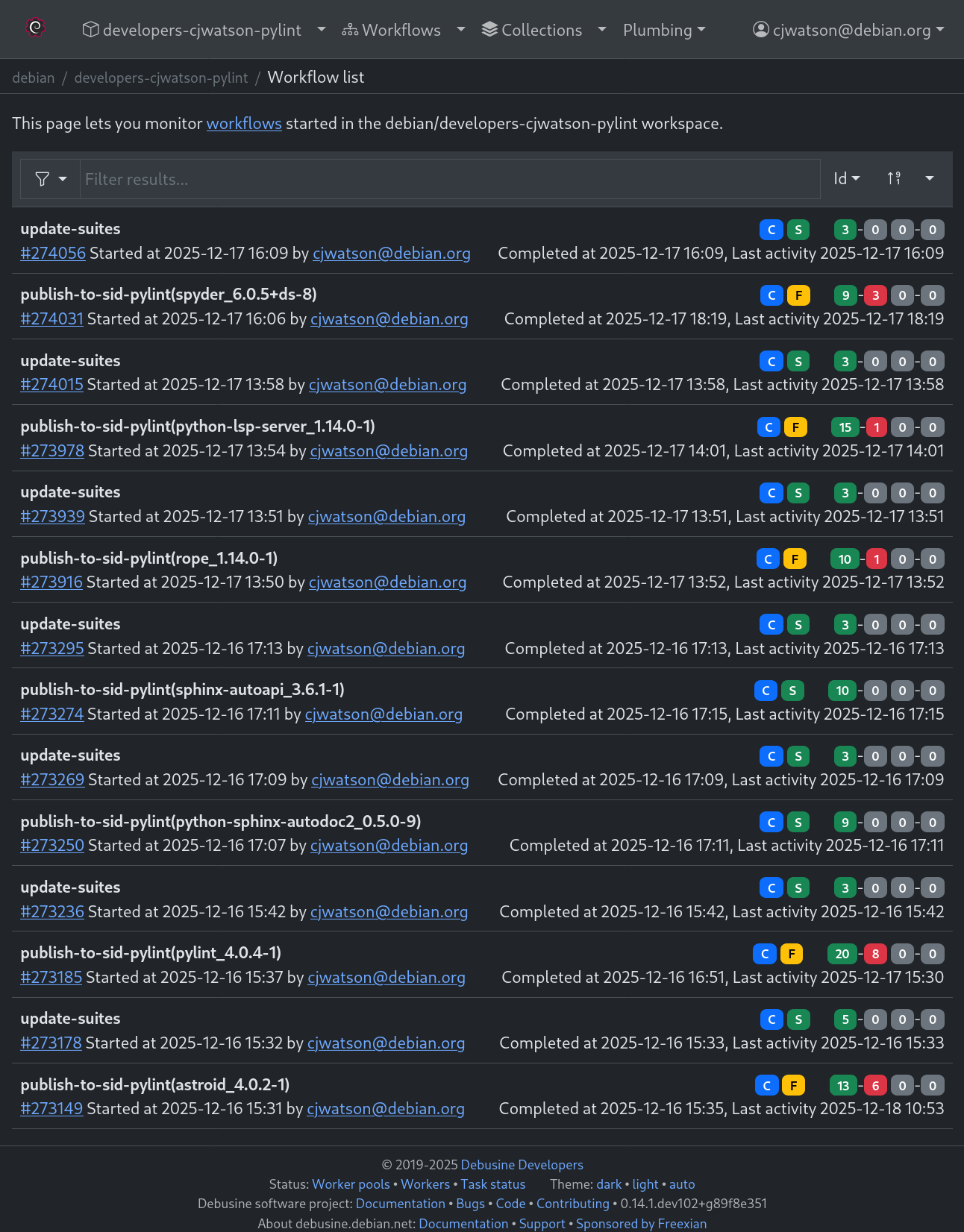 You can see that not all of the workflows are successful. This is because
we currently just show everything in every workflow; we don t consider
whether a task was retried and succeeded on the second try, or whether
there s now a newer version of a reverse-dependency so tests of the older
version should be disregarded, and so on. More fundamentally, you have to
look through each individual workflow, which is a bit of a pain: we plan to
add a dashboard that shows you the current state of a suite as a whole
rather than the current workflow-oriented view, but we haven t started on
that yet.
Drilling down into one of these workflows, it looks something like this:
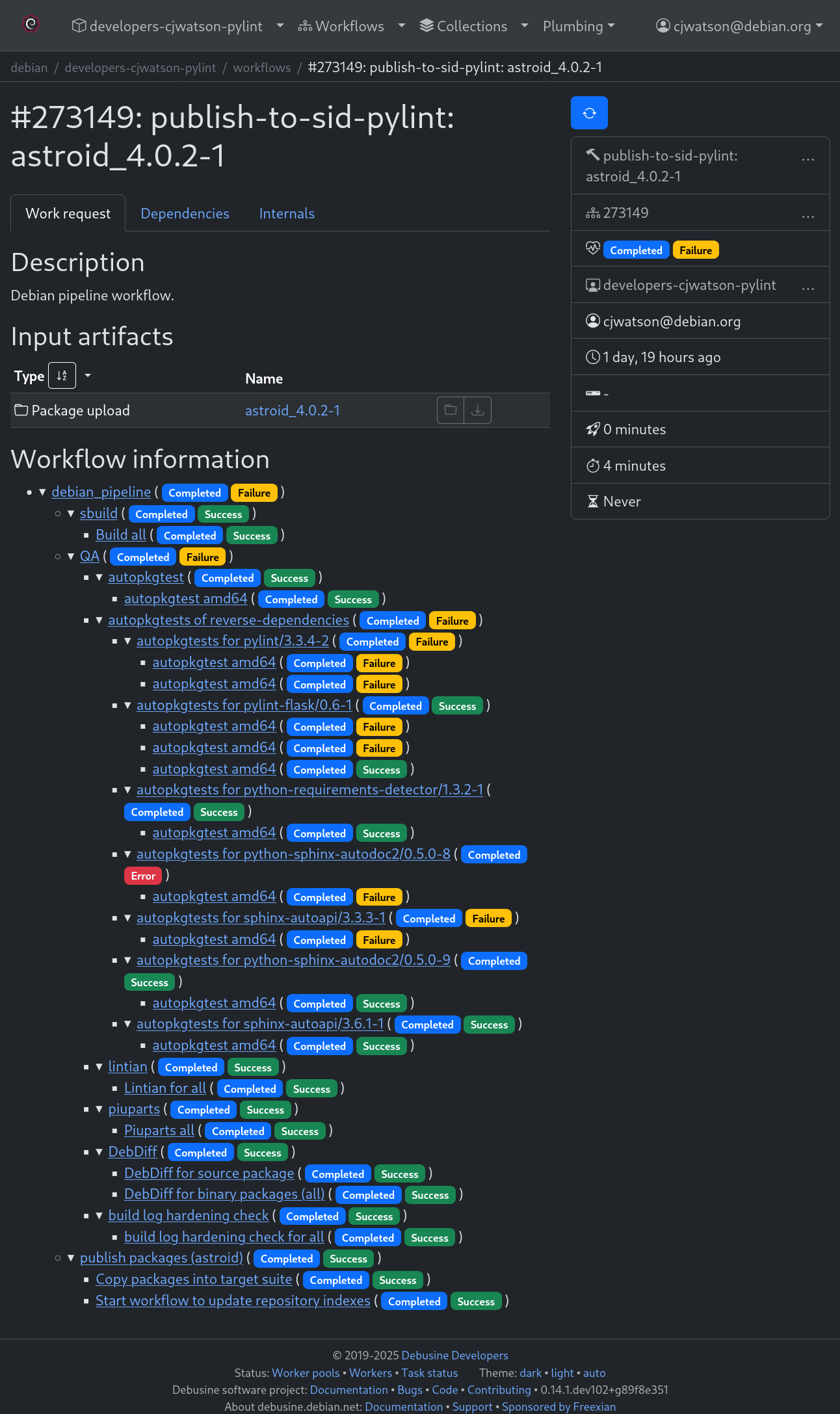 This was the first package I uploaded. The first pass of failures told me
about
pylint (expected), pylint-flask (an obvious consequence), and
python-sphinx-autodoc2 and sphinx-autoapi (surprises). The slightly odd
pattern of failures and errors is because I retried a few things, and we
sometimes report retries in a slightly strange way, especially when there
are workflows involved that might not be able to resolve their input
parameters any more.
The next level was:
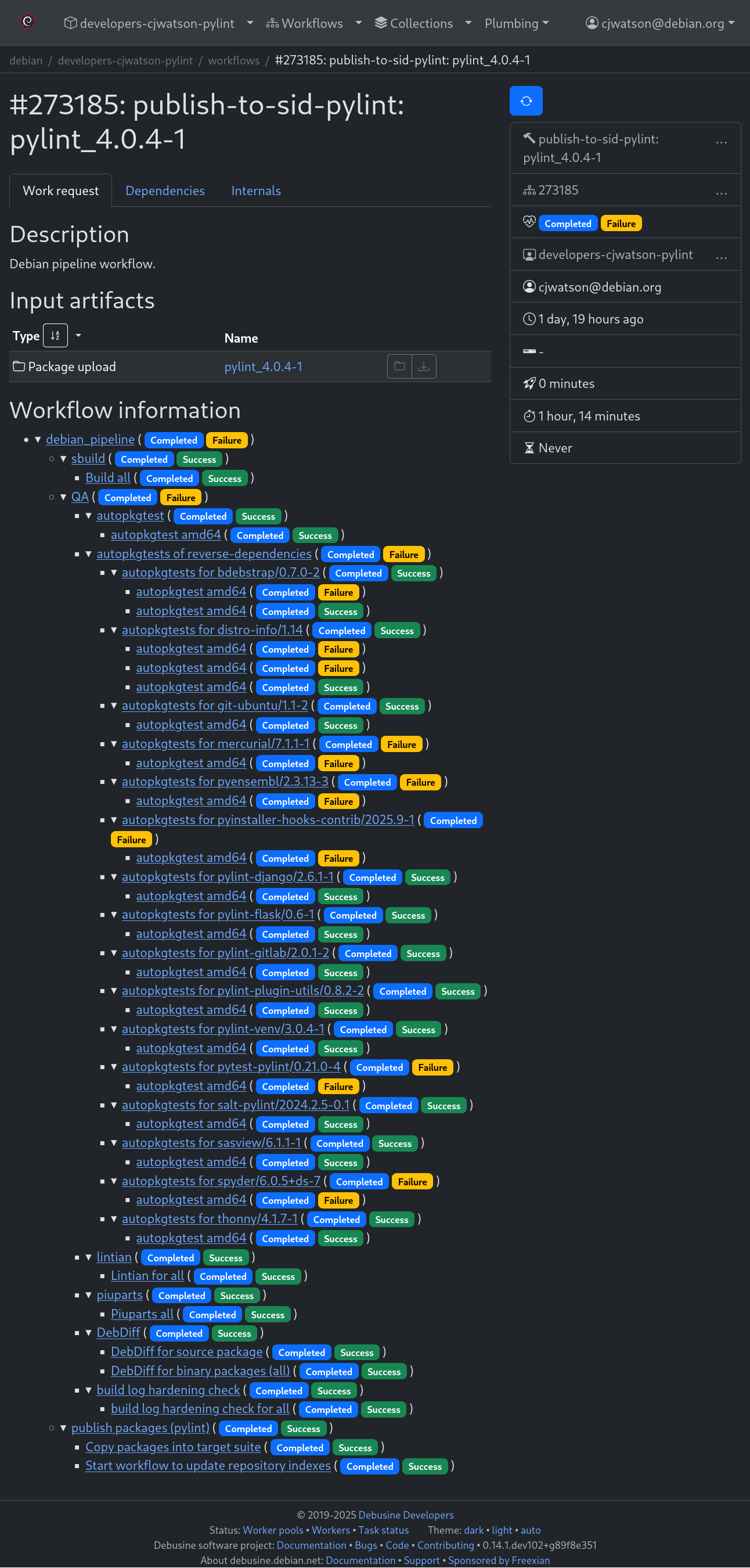 Again, there were some retries involved here, and also some cases where
packages were already failing in unstable so the failures weren t the fault
of my change; for now I had to go through and analyze these by hand, but
we ll soon have regression tracking to compare with reference runs and show
you where things have got better or worse.
After excluding those, that left
pytest-pylint (not caused by my changes,
but I fixed it anyway in unstable to clear out some noise) and spyder.
I d seen people talking about spyder on #debian-python recently, so after
a bit of conversation there I sponsored a rope upload by Aeliton Silva,
upgraded python-lsp-server, and patched spyder. All those went into my
repository too, exposing a couple more tests I d forgotten in spyder.
Once I was satisfied with the results, I uploaded everything to unstable.
The next day, I looked through the tracker as usual starting from
astroid, and while there are some
test failures showing up right now it looks as though they should all clear
out as pieces migrate to testing. Success!
Conclusions
We still have some way to go before this is a completely smooth experience
that I d be prepared to say that every developer can and should be using;
there are all sorts of fit-and-finish issues that I can easily see here.
Still, I do think we re at the point where a tolerant developer can use this
to deal with the common case of a mid-sized transition, and get more out of
it than they put in.
Without Debusine, either I d have had to put much more effort into searching
for and testing reverse-dependencies myself, or (more likely, let s face it)
I d have just dumped things into unstable and sorted them out afterwards,
resulting in potentially delaying other people s work. This way, everything
was done with as little disruption as possible.
This works best when the packages likely to be involved have reasonably good
autopkgtest coverage (even if the
tests themselves are relatively basic). This is an increasingly good
bet in Debian, but we have plans to
add installability comparisons (similar to how Debian s testing suite
works) as well as optional rebuild testing.
If this has got you interested, please try it out for
yourself and let us know how it
goes!

 Armadillo is a powerful
and expressive C++ template library for linear algebra and scientific
computing. It aims towards a good balance between speed and ease of use,
has a syntax deliberately close to Matlab, and is useful for algorithm
development directly in C++, or quick conversion of research code into
production environments. RcppArmadillo
integrates this library with the R environment and language and is
widely used by (currently) 1272 other packages on CRAN, downloaded 43.2 million
times (per the partial logs from the cloud mirrors of CRAN), and the CSDA paper (preprint
/ vignette) by Conrad and myself has been cited 661 times according
to Google Scholar.
This versions updates to the 15.2.3 upstream Armadillo release from
yesterday. It brings minor changes over the RcppArmadillo 15.2.2 release
made last month (and described in
this post). As noted previously, and due to both the upstream
transition to C++14 coupled with the CRAN move away from C++11, the
package offers a transition by allowing packages to remain with the
older, pre-15.0.0 legacy Armadillo yet offering the
current version as the default. If and when CRAN will have nudged (nearly) all
maintainers away from C++11 (and now also C++14 !!) we can remove the
fallback. Our offer to help with the C++ modernization still stands, so
please get in touch if we can be of assistance. As a reminder, the
meta-issue #475
regroups all the resources for the C++11 transition.
There were no R-side changes in this release. The detailed changes
since the last release follow.
Courtesy of my CRANberries, there is a diffstat report relative to previous release. More detailed information is on the RcppArmadillo page. Questions, comments etc should go to the rcpp-devel mailing list off the Rcpp R-Forge page.Changes in RcppArmadillo version 15.2.3-1 (2025-12-16)
- Upgraded to Armadillo release 15.2.3 (Medium Roast Deluxe)
- Faster
.resize()for vectors- Faster
repcube()
This post by Dirk Eddelbuettel originated on his Thinking inside the box blog. If you like this or other open-source work I do, you can sponsor me at GitHub.
 I recently won a lawsuit against Roy and Rianne Schestowitz, the authors and publishers of the Techrights and Tuxmachines websites. The short version of events is that they were subject to an online harassment campaign, which they incorrectly blamed me for. They responded with a large number of defamatory online posts about me, which the judge described as
unsubstantiated character assassinationand consequently awarded me significant damages. That's not what this post is about, as such. It's about the sole meaningful claim made that tied me to the abuse.
The facts linking the Claimant to the sock puppet accounts include, on the IRC network: simultaneous dropped connections to the mjg59_ and elusive_woman accounts. This is so unlikely to be coincidental that the natural inference is that the same person posted under both names. "elusive_woman" here is an account linked to the harassment, and "mjg59_" is me. This is actually a surprisingly interesting claim to make, and it's worth going into in some more detail.
*elusive_woman has quit (Ping timeout: 2m30s), followed by one reading
*mjg59_ has quit (Ping timeout: 2m30s). The timestamp listed for the first is 09:52, and for the second 09:53. Is that actually simultaneous? We can actually gain some more information - if you hover over the timestamp links on the right hand side you can see that the link is actually accurate to the second even if that's not displayed. The first event took place at 09:52:52, and the second at 09:53:03. That's 11 seconds apart, which is clearly not simultaneous, but maybe it's close enough. Figuring out more requires knowing what a "ping timeout" actually means here.

 The Debian LTS Team, funded by [Freexian s Debian LTS offering]
(https://www.freexian.com/lts/debian/), is pleased to report its activities for
November.
We re happy to announce that
Debusine can now be used
to maintain APT-compatible add-on package repositories for Debian. This
facility is available in public beta to Debian developers and maintainers.

This post is an unpublished review for Unique security and privacy threats of large language models a comprehensive surveyMuch has been written about large language models (LLMs) being a risk to user security and privacy, including the issue that, being trained with datasets whose provenance and licensing are not always clear, they can be tricked into producing bits of data that should not be divulgated. I took on reading this article as means to gain a better understanding of this area. The article completely fulfilled my expectations. This is a review article, which is not a common format for me to follow: instead of digging deep into a given topic, including an experiment or some way of proofing the authors claims, a review article will contain a brief explanation and taxonomy of the issues at hand, and a large number of references covering the field. And, at 36 pages and 151 references, that s exactly what we get. The article is roughly split in two parts: The first three sections present the issue of security and privacy threats as seen by the authors, as well as the taxonomy within which the review will be performed, and sections 4 through 7 cover the different moments in the life cycle of a LLM model (at pre-training, during fine-tuning, when deploying systems that will interact with end-users, and when deploying LLM-based agents), detailing their relevant publications. For each of said moments, the authors first explore the nature of the relevant risks, then present relevant attacks, and finally close outlining countermeasures to said attacks. The text is accompanied all throughout its development with tables, pipeline diagrams and attack examples that visually guide the reader. While the examples presented are sometimes a bit simplistic, they are a welcome guide and aid to follow the explanations; the explanations for each of the attack models are necessarily not very deep, and I was often left wondering I correctly understood a given topic, or wanting to dig deeper but being this a review article, it is absolutely understandable. The authors present an easy to read prose, and this article covers an important spot in understanding this large, important, and emerging area of LLM-related study.
| Series: | Legends & Lattes #3 |
| Publisher: | Tor |
| Copyright: | 2025 |
| ISBN: | 1-250-33489-6 |
| Format: | Kindle |
| Pages: | 325 |
 I was wondering if there was some debian thread and noticed maybe something is broken in my mail setup. The amount of emails I am receiving seems to be very small.
gcc-15 and
dpkg still disagree about whether PIE is enabled occasionally and big endian
mipsen needed fixes in systemd. Beyond this regular uploads of libxml2 and
gcc-15 required fixes and rebasing of pending patches.
Earlier, Loongson used rebootstrap to create the initial package set for
loong64 and Miao Wang now submitted their changes. Therefore, there is now
initial support for suites other than unstable and use with derivatives.
python-debianbts;
changed some command line options naming or output based on user feedback;
finished refactoring user interaction to rich; codebase is now flake8-compliant;
added type safety with mypy.po-debconf-manager, created 19 bug reports for translations
where the merge requests were pending; reviewed and created merge requests for
4 packages.python-unidiff2 (adapted from the
original pull request to
python-unidiff). He also started preparing a qnetload
update.mkdocs-macros-plugin,
python-confuse, python-pip, python-mitogen.libcrypt-dev out of build-essential
and bumped the remaining bugs to rc-severity in coordination with the release team.mmdebstrap deals with start-stop-daemon may
result in broken output and sent a patch.armel being removed from sid , but not from forky , the
multiarch hinter broke. Helmut fixed it.systemd.lprng, cpdb-backend-cups, cpdb-libs and
ippsample to fix some RC bugs as well as other bugs that accumulated over time.
He also uploaded cups-filters to all Debian releases to fix three CVEs. Welcome to post 56 in the R4 series.
The recent post #54
reviewed a number of earlier posts on r-ci, our small (but very
versatile) runner for continunous integration (CI) with R. The post also
introduced the notion of using a container in the matrix of jobs
defined and running in parallel. The initial motivation was the (still
ongoing, and still puzzling) variation in run-times of GitHub Actions.
So when running CI and relying on r2u for the fast, easy,
reliable: pick all three! provision of CRAN packages as Ubuntu binaries,
a small amount of time is spent prepping a basic Ubuntu instance with
the necessary setup. This can be as fast as maybe 20 to 30 seconds, but
it can also stretch to almost two minutes when GitHub is busier or out
of sorts for other reasons. When the CI job itself is short, that is a
nuisance. We presented relying on a pre-made r2u4ci container that adds
just a few commands to the standard r2u container to be complete for CI.
And with that setup CI runs tend to be reliably faster.
This situation is still evolving. I have not converted any of my
existing CI scripts (apart from a test instance or two), but I keep
monitoring the situation. However, this also offered another
perspective: why not rely on a different container for a
different CI aspect? When discussing the CI approach with Jeff the other day (and helping add CI to his
mmap repo), it occurred to me we could also use on of
the Rocker containers for
R-devel. A minimal change to the underlying run.sh script
later, this was accomplished. An example is provided as both a test and
an illustration in the repo for package
RcppInt64 in its script ci.yaml:
    strategy:
      matrix:
        include:
          -   name: container, os: ubuntu-latest, container: rocker/r2u4ci
          -   name: r-devel,   os: ubuntu-latest, container: rocker/drd
          -   name: macos,     os: macos-latest
          -   name: ubuntu,    os: ubuntu-latest

    runs-on: $  matrix.os
container: $ matrix.container drd container from Rocker. The CI runner script now
checks for a possible Rdevel binary as provided inside
drd (along with alias RD) and uses it when
present. And that is all that there is: no other change on the user
side; tests now run under R-devel. You can see some of the initial runs
at the rcppint64
repo actions log. Another example is now also at Jeff s
mmap repo.
It should be noted that this relies on R-devel running packages made
with R-release. Every few years this breaks when R needs to break its
binary API. If and when that happens this option will be costlier as the
R-devel instance will then have to (re-)install its R package
dependencies. This can be accomodated easily as a step in the yaml file.
And under normal circumstances it is not needed.
Having easy access to recent builds of R-devel (the container
refreshes weekly on a schedule) with the convenience of r2u gives another option
for package testing. I may continue to test locally with R-devel as my
primary option, and most likely keep my CI small and lean (usually just
one R-relase run on Ubuntu) but having another option at GitHub Actions
is also a good thing.
This post by Dirk Eddelbuettel originated on his Thinking inside the box blog. If you like this or other open-source work I do, you can now sponsor me at GitHub.

Next.